
Every year 105,000 Christians are killed because of their faith. This shocking figure was disclosed by Italian sociologist Massimo Introvigne, representative of the OSCE (Organization for Security and Cooperation in Europe) on Combating Intolerance and Discrimination against Christians, at the “International Conference on Inter-religious dialogue between Christians, Jews and Muslims,” (Conference as reported on this site in 2011, Catholic Culture.org)
[i]When we think of martyrs[ii] for their Christian faith, what often first comes to mind are ancient artifacts and stories, some legend, most rooted in fact. The Roman catacombs. Exposed to live beasts in the Colosseum for the entertainment of the gladiator bread and circus spectators, like all addicts needing more and more of their malformed pleasures of gore and the suffering of others to achieve new highs. We think of the original apostles; all but Judas Iscariot who committed suicide and John who died of extreme old age in exile on Patmos. The rest were murdered for their faith, refusing to deny Jesus, a refusal unto their own death.
Beheaded, crucified, burned alive, skinned alive, ran through with a sword, sawn in half. Being an original apostle of Jesus was no sinecure. They died because they had seen something that utterly transformed them and gave them absolute confidence that something was greater than death. Not for riches, not for power or conquest, certainly not for pleasure or praise, but to spread the Good News that echoes down the centuries: Jesus Christ of Nazareth died and then arose from the dead; they gave up everything we tell ourselves is necessary for happiness and died in beatitudo[iii].
What we don’t often think about is that more Christian martyrs were murdered in the last century than in all the previous centuries since Jesus walked in Jerusalem, about forty-five million of them. This does not include those murdered by tyranny who happened to be Christian, only those who specifically died for their faith. From Auschwitz to the Gulag, the Cultural Revolution of Mao and the Marxist revolution in Mexico to the ongoing butchery of radical Islam such as Boko Haram[iv] in Nigeria. From Father Maximillian Kolbe and Edith Stein (Sister Teresa Benedicta of the Cross)[v] to Blessed Miguel Agustín Pro in the Catholic persecution of La Cristiada during the Marxist Mexican revolution and the courageous Cristero resistance to the atheist repressors, what Graham Greene called the “the fiercest persecution of religion anywhere since the reign of Elizabeth.”[vi]
“¡Viva, Cristo Rey!”
“But they cried out with a loud voice and stopped their ears and rushed together upon him. Then they cast him out of the city and stoned him; and the witnesses laid down their garments at the feet of a young man named Saul. And as they were stoning Stephen, he prayed, “Lord Jesus, receive my spirit.” And he knelt down and cried with a loud voice, “Lord, do not hold this sin against them.” And when he had said this, he fell asleep.” Acts 7:57-60, RSV (In a previous verse describing Stephen, his face was described as that of an angel.)
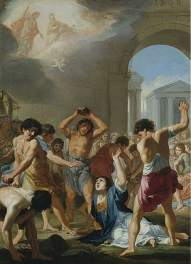
Stella, Jacques; The Martyrdom of St Stephen
In our secular culture of a sort of loosely defined neo Pelagianism, all dogs go to heaven. If most think about God at all, our god is a remote clockmaker who maybe set things in motion millions of years ago but has little or nothing to do with our day-to-day life or how we live it. The qualifier is just being a generally nice person, which is an embarrassingly low bar. Maybe you need to love pets and be pleasant at the coffee shop. The prevalent worldview about these things in young people has been called “Moral Therapeutic Deism,” the central point of which is that the goal of human existence is to feel good about oneself and be happy. Surely a flimsy and ill-defined structure and not one for which self-sacrifice, especially sacrifice of one’s life for a relationship with God makes any sense at all.
Faith like that is not a set of moral principles. Nor a philosophy. Nor just ritual, habit, and lifestyle. No, faith like that is a deep relationship of trust with a Person. An irreplaceable friendship worth dying for. As St. Thomas Aquinas famously stated, “To one who has faith, no explanation is necessary. To one without faith, no explanation is possible.”
Not ancient history, but contemporary and ongoing, the witnesses of great devotion and love are an ongoing miracle. What prompted this post were two stories a visiting Columban missionary priest told us at daily Mass the week before last on the memorial of St. Stephen, who was murdered with large stones. All Stephen had to do was deny the truth of what he knew about Jesus, and all would be forgiven. He chose to suffer an excruciating death before making such a denial. Why would he ever do that?
Our celebrant telling the stories served many years in missions including seven in Juarez, Mexico on the border with El Paso, Texas. While there, he taught and pastored three young men in his confirmation class. One was discerning a vocation to the priesthood. Our meanest poverty here does not approach what afflicts the poor in Juarez. These young men scratched out an income as best they could. One source of cash was helping those trying to make it across to El Paso. Before we start in on “illegal immigrants” and all the rest, these are desperate people trying to escape cruel government, no opportunities, and worried each night how they will feed their kids tomorrow. As we sip our morning coffee and make whatever breakfast pleases us, we may want to ponder for just a moment what it would be like to live in such circumstances and what we would or would not do to provide some measure of security for our loved ones.
Many of these unfortunates are then further exploited by the ‘coyotes’ who traffic human beings. If they are young and female (or sometimes male), after they pay their rapacious fees, they can be trapped into the sex trade, addicted, and ruined. The three young men charged much less and got them safely over the border. However, the coyotes worked for the cartels (one of two in Juarez at the time). With cash flow that rivaled large corporations, the people trade netted as much as the drugs that were their original main product. Brutal and better armed than the police, even the gendarmes are afraid of them. These three young men had no chance at all. One evening, they were kidnapped, dragged into the desert, and stoned to death, their heads were smashed with large rocks. Again, and again, and again. Beyond recognition even with dental records. The cartel thugs then threw dead dogs on top of their corpses as their warning to any who dared to defy them, no matter how insignificant their small piece of the action was.
Called out by the bereaved families the next morning, our visiting priest went out and helped recover the corpses. He remembers carefully scraping the rocks for brain, flesh, and blood, retaining as much of the DNA as possible because it belonged to human beings created in Imago Dei and must be given reverence and be buried with them. Each year on the memorial of the stoned to death St. Stephan, he remembers his three young men. Perhaps they don’t belong in the long list of classic Christian martyrs who died for their faith, but neither were they coyote predators; they had empathy and care for their clients, caring human beings of faith and hope.
The second story the missionary priest told us that morning fits the Christian martyr description more closely. A hundred miles south of Juarez in a diocese served mostly by Jesuit missionaries, Pedro Palma, a sixty-year-old tour guide, similarly crossed paths with the Sinaloa cartel for reasons that may never be known. He was shot several times on the street in front of the church in the village of Cerocahui. He managed to stagger inside crying out for sanctuary, a centuries old tradition of protection. Sanctuary and haven ignored by the gunmen; they rushed in after him and finding him halfway up the center aisle, shot him several more times. With the last of his strength, he dragged himself to the altar and died.
Two elderly Jesuit priests who had retired to live at the church rushed to his aide. Father Joaquin Mora, 78, and Father Javier Campos, 80, were murdered alongside him. Helpers? Yes. Doing what priests do? Yes. But ultimately, they were what the gunman perceived them to be, and rightly so. Witnesses.
***************************************************************************************
Would I have such faith and confidence in my faith in Christ? I pray that I would if called to. Jesus, I trust in You.
One last witness in this post: Charles de Foucauld. As a young man he gained some fame as an explorer and author. Later he experienced as many still do, a new understanding, a conversion, a metanoia change of mind. “He lost his faith as an adolescent. His taste for easy living was well known to all and yet he showed that he could be strong willed and constant in difficult situations. He undertook a risky exploration of Morocco (1883-1884). Seeing the way Muslims expressed their faith questioned him and he began repeating, “My God, if you exist, let me come to know you.” [vii] And so God answered that prayer, and Charles discovered a new life worth living.
Later, Foucauld became a Trappist, then a priest, and worked the rest of his life among the Muslims telling them about the Gospel, the Good News. Charles was murdered by an Islamist gang of assassins in 1916 who clearly didn’t want what he was offering. He wrote many things, including this prayer that explains what becomes the deepest core conviction of all witnesses. One worth dying for.
“Father,
I abandon myself into your hands; do with me what you will. Whatever you may do, I thank you.
I am ready for all, I accept all. Let only your will be done in me, and in all your creatures.
I wish no more than this, O Lord.
Into your hands I commend my soul; I offer it to you with all the love of my heart,
for I love you, Lord, and so need to give myself, to surrender myself into your hands, without reserve, and with
boundless confidence, for you are my Father.” Charles de Foucauld
[i] Main image from UK Art and the Fitzwilliam Museum. The Martyrdom of St. Stephen, Jacques Stella. https://artuk.org/discover/artworks/the-martyrdom-of-st-stephen-5568
[ii] “Martyr” is from the ancient Greek matur, and then liturgical Latin, meaning “witness.” The final and ultimate statement of faith as a witness.
[iii] Great peace and joy.
[iv] “Boko Haram, which aims to expel Western influence and create a Salafi-Islamist state in its area of operations, has killed an estimated 50,000 people and displaced more than 2.5 million people since it was established in 2002.”
[v] St. Teresa Benedicta of the Cross, ne Edith Stein, a Catholic convert and renowned philosopher prior to the war was murdered at Auschwitz for her faith. As was St. Maximillian Kolbe, a Franciscan friar and Polish priest imprisoned for speaking out against the Nazis and while there volunteered to die in place of a married man with children who had been selected to be killed. The man he replaced eventually survived the camps.
[vi] https://www.usccb.org/committees/religious-liberty/viva-cristo-rey
[vii] https://www.vatican.va/news_services/liturgy/saints/ns_lit_doc_20051113_de-foucauld_en.html
 Quo Vadis Blog
Truly touching and convicting. The time is coming again Jack when Christians will be martyred even more than they
are now…we must be ready. It may not be in our lifetimes, but then again, it might.
Thank you for your post.
LikeLike