
“In Maine we have a saying that there is no point in speaking unless you can improve the silence.” Ed Muskie
Not sure this improves the silence, but…

When we drive up the dirt road from the camp on Webb Lake to turn east on Wilton Road to Farmington for church or groceries, there are Maine houses along the way that we remember with affection and respect. Old houses, generations old. Practical houses for pragmatic people who avoid many things that don’t make sense and do many things that do. Center chimney capes are common, and there are larger colonials with integrated additions for various purposes and perhaps extra kids.
Maine fosters eccentricity and a vast collection of creative architectural solutions; many varied attempts with mixed success to survive long snowy winters are everywhere in evidence. Homes along the rural roads are scattered with large dooryards, and the inexorable forest threatens to encroach on the fields that are left. Old, barely habitable double-wide faded mobile homes sit on overgrown once cleared lots with a motley collection of partially cannibalized pickups and campers up on blocks – ten foot tall poplars and alders growing through perforated flatbeds. A deserted small John Deere tractor with a flat tire disconsolately rusts out. Rural poverty with stove pipes sticking out through the walls of shacks sided with boards and wind torn Tyvek house wrap. A few are abandoned with collapsed roofs; others look like they should be but aren’t.
A quarter of the mile down the road an impeccable modular cape or ranch sits proudly on a small hill, carefully, lovingly landscaped with a paved, sealed driveway, a small flagpole and new flag in front, and a lawn that looks like it was trimmed with barber scissors. A modest vegetable garden grows fifty feet from the house, often surrounded by a wood pole and galvanized wire perimeter to discourage the deer and rabbits. Hopeful tomato plants, green beans, corn, potatoes, peppers, and some greens – spinach, beets, or Swiss chard, zucchini and summer squash, maybe a pumpkin or watermelon vine spreading along the rich soil, growing so fast the bottom of the fruit is drag worn and discolored.
Certain features identify my favorite species of farmhouse, and there are sadly fewer of them than fifty years ago when we lived here. Some of them are deteriorating and returning slowly to the earth. Some are re-tasked into apartments. Some are meticulously maintained, but there are a couple of overhead garage doors installed where large paned wood windows or homemade matched pine board doors once adorned the facade.
Frequently they have metal roofs that are loud in a downpour. Like sleeping in a tin tent, but comforting, steady protection from nature in a four season environment. Metal roofs with a steep pitch to shed snow easily. We had such a house with a metal roof when we lived in Farmington forty years ago. No gutters to be torn off with ice dams and snow slides, just a two foot cantilever to push the gushing rainwater and melted snow away from the house. Diverters or a small additional extension over the front door with the granite threshold protect visitors and residents opening the door. Sensible roofs that can last for at least a generation for a harsh climate with deep snow in the winter.
A barn that was once for farm animals, and still is for a few, remains attached to some of these homes. Hay in the loft. Stalls and laying nests for the hens, vegetable and egg stands out by the road. Grain in the large wood feed box. Chickens, goats, a milk cow, perhaps some calves for future milk or steaks, and a deadly, half feral, symbiotic barn cat or two to control the mice and rats. Barns are sometimes connected to the family home through that most sensible extra room – a summer kitchen. Much more than a breezeway connecting to a two car garage, a summer kitchen is like many things in Maine – it has more than one useful purpose.
Harsh winters are interrupted by glorious springs that also harken the arrival of mud and black fly season. Time to plant and begin the arduous process of splitting next winter’s firewood. In winter and spring, it’s prudent to have a connection to the barn that doesn’t include wading through drifts or shoveling a path.
When the heat of a six week summer hits, there are abundant lakes, rivers, streams, and for those fortunate coastal dwellers, saltwater beaches. But it’s a time for summer kitchens too.
A summer kitchen serves several critical purposes besides connecting to the barn for winter access to animals needing attention. A summer kitchen lessens July and August heat building up in the house for cooking in the main kitchen, heat rising to the bedrooms to make sleeping a sweaty project even when the screens aren’t torn. A sound wood stove in the summer kitchen is good for the long boils for lobster or sugar corn on the cob and baking bread or canning later in the summer and fall. Summer kitchens by design are practical, built for storage and work with only stone counter workspace and maybe a stool or two without adornment or pictures on the wall. Oftentimes they lack plastered and insulated walls like the barn they connect. Simple and perfect for their purpose.
The kitchen hospitality so common and welcome for Maine visitors planned or unplanned is reserved for the in-house winter kitchen where the family table and chairs are set up. With sugar bowl, creamer, mugs and whatever muffins or scones or cookies are in the pantry at the ready.
Summer kitchens are beneficial, intelligent, thoughtful, sensible things, a symbol for me of a beneficent, thoughtful, and intelligent people with generations of experience and hospitality in a challenging climate.
“Maine is a joy in the summer. But the soul of Maine is more apparent in the winter.” Paul Theroux
Here we are once again after forty or fifty years of enjoying Lake Webb in an old camp – a rare place in west central Maine lakes country. Surrounded by hills and mountains: Mount Blue, Tumbledown, Bald Mountain, Big Jackson, Little Jackson, Blueberry Mountain. Sunsets beyond my ability to describe them. Clean, clear water constantly refreshed with nine streams feeding Webb and one large outlet into the Weld River that flows unimpeded alongside State Highway 142 to the Androscoggin River and on to the Atlantic. Once it was a major logging route with the native tall white pines, spruce, and hemlocks abundant in the eighteenth and nineteenth centuries. Wood to build the houses. Wood to build the ships at Bath. Planks, boards, masts.
More power boats now than our first years here, but mostly on the weekend. Since the beginning occasional water skiers and tubers have circled the five mile long, twenty seven hundred acres lake. But jet skis are a relatively recent, unwelcome, and loud intrusion that terrifies the loons and herds them into the outflow end of the lake. I wonder sadly when the last loon will seek a refuge in another lake farther from the yahoos. That will be a heartbreaking loss. One would think thrill chasers could find a quieter, less obnoxious way of feeling power between their legs. There are plenty of other places to play man-boy. Not this little bit of remaining retreat and haven. That’s why God made Harley’s for crying out loud.
During the week though, there are still mostly single sail wind powered silent boats, canoes, kayaks, and an occasional small flat bottomed fishing boat trawling at a very low speed. The sound of children playing and laughing on a still morning can carry more than the half a mile that separates us from the state beach on the opposite side the lake. Those are welcome sounds. We can see the splashes when they jump off the “Big Rock” about three quarters of the way across. We make at least one pilgrimage ourselves in the canoe. The outcropping juts about four feet above the surface with a straight drop into deep water. The Mount Blue State Park side of the rock is fifteen feet of gradual gentle slope of granite at about a four pitch, perfect for dragging a canoe to rest while we dive, jump, and swim.
“Did you ever see a place that looks like it was built just to enjoy? Well, this whole state of Maine looks that way to me.” Will Rogers
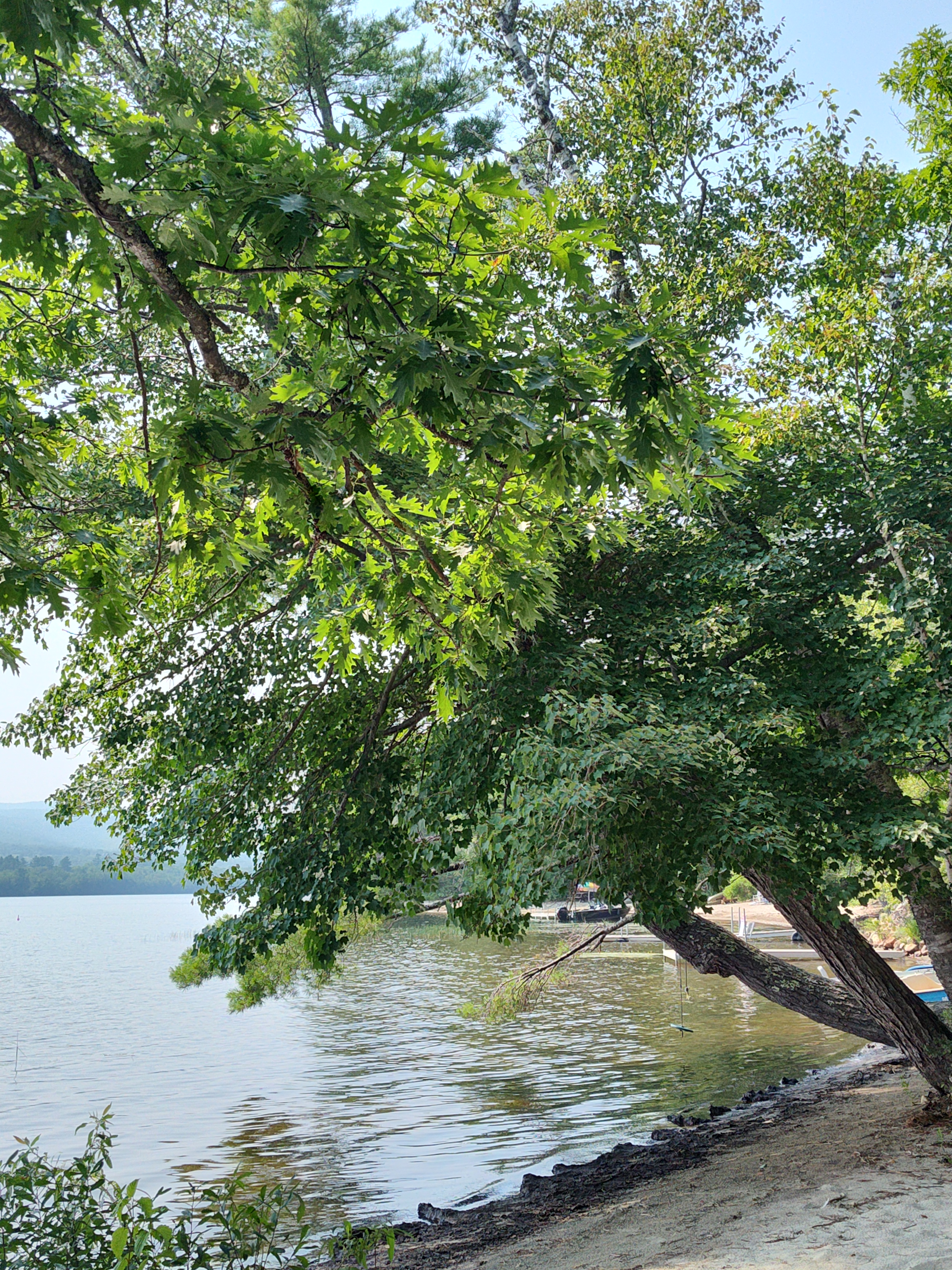
Sunday Mass for us is at St. Joseph Church in Farmington about forty minutes east first up, then down an elevation past Bald Mountain, a winding road with switchbacks and vistas that pops my ears. St. Joe’s is the parish that welcomed us back to the Church half a century ago: the happy event that saved our marriage. There we formed lifelong friendships. The current pastor, Father Paul, recognizes us now with a smile and greeting. As he does greet our daughter and her family with five children who stay at the camp where we stayed with her as an infant so many years ago. The screened in porch sits fifteen feet from the water’s edge. (see picture above for a view from the porch)
The former pastor at St. Joe’s from fifty years ago, Father Joe McKenna, is retired and ninety three, living in Portland. A most welcome visit and meal with him on the way north is something we always look forward to and are grateful for. He still retains his lively, unconventional intelligence, acute insights, fighting spirit, and wry sense of Irish humor. A natural storyteller, he is always delightful company.
The couple that owns the only remaining store in Weld converted it from the last elementary school here; they always greet us as well as old friends. We can get most everything really needed by way of groceries there. Downeast coffee, lunch and breakfast too at the counter in the adjacent old classroom. Good breakfasts with fresh eggs, bacon, toast and home fries. Burgers, fries, hot dogs, sandwiches, pizza, it’s open most summer days from six in the morning until early evening. A small playground next to the parking lot still entertains the kids, albeit with gravel on the ground, not ground up rubber stuff. A single clay tennis court remains well maintained at the bottom of the hill next to the Weld Community Center. Sweep the court, brush clean the lines when done, and wear shoes that won’t tear up the court are the only rules.
The entertainments of screens or city are scraggly substitutes for these simple pleasures. They may bring titillation, but the consolations of woods, fields, mountains, lakes, and time to read are healing. Screens and entertainments bring commotion and distraction from our troubles, but not restoration. Only places like this restore.
“Maine is a beautiful place that I paradoxically want to hoard to myself and share with everyone I meet.” John Hodgman
We know that there will be a last visit someday to our treasured Maine woods. The camp will change hands from the family we have known and liked here for four decades, or we will become too infirm to make the trip. We may not know it when our final visit ends, but I have no regrets, only gratitude for our many irreplaceable memories that will console us for the rest of our lives.
“I would really rather feel bad in Maine than feel good anywhere else.” E.B. White
- Images: Top: Common Maine road hazard
- Middle: View at the camp porch of Webb Lake
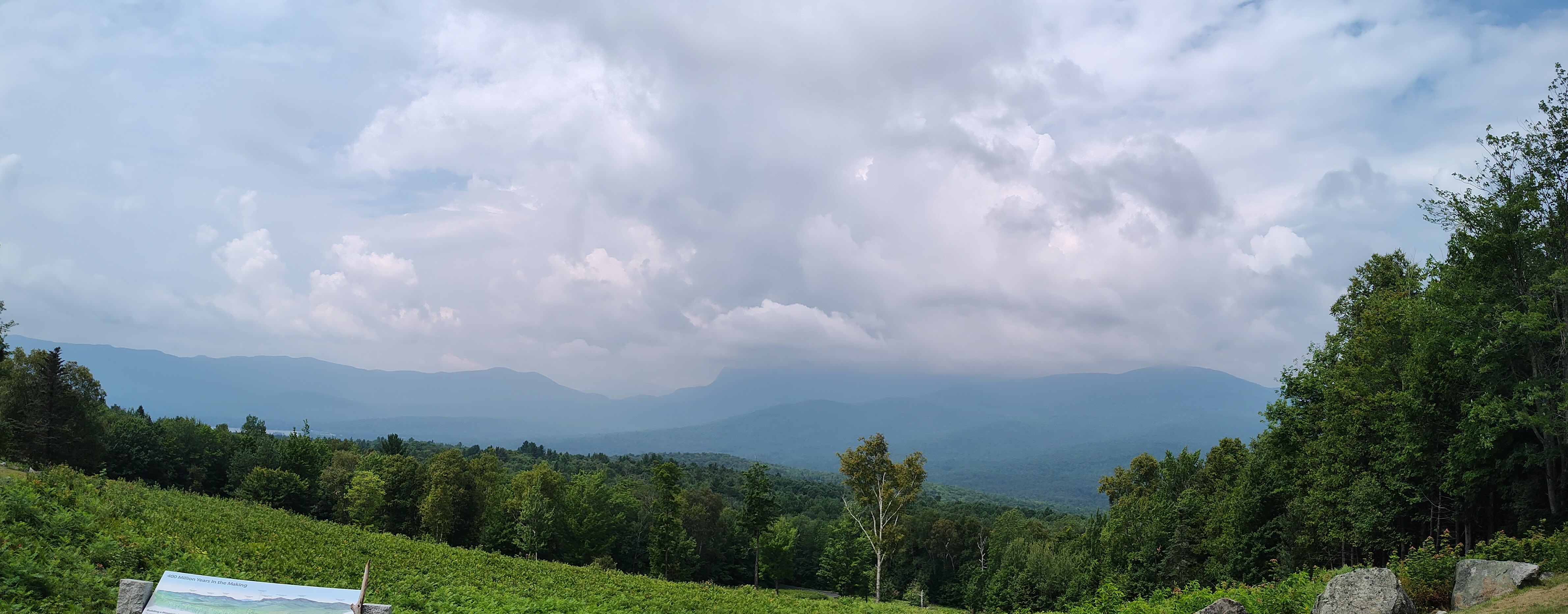
- Bottom: View from nearby Center Hill near the spring where we get our water
 Quo Vadis Blog
Jack, nice reminding of what life was and how life changes with age. Does life grow old? We do and very often we wish for the past and its happiest memories. We tend to forget the unhappy events of the past. So what do we do in the present? We can’t go back. We continue on and hope and pray that we’ve taken the correct forks in the road. Faith guides us and someday we will experience eternal joy. In the words of an Emmy Lou Harris song, ” Goodnight old world we’ll see you tomorrow. We rise with the sun and fall with the sparrow. But here is this child to soften the sorrow.” And life goes on.
Denis
LikeLike
What a lovely picture of Maine and its camps. Your descriptions take me there and remind me of the beautiful Oregon woods. Not quite Maine…but beautiful none the less.
LikeLike
Pingback: Fragments | Quo Vadis Blog