“First of all, we are at the end of Christendom. Now not Christianity, not the Church. Remember what I am saying. Christendom is economic, political, social life as inspired by Christian principles. That is ending — we’ve seen it die…We live in it from day to day and we do not see the decline.”Bishop Fulton J Sheen in a TV address in 1974
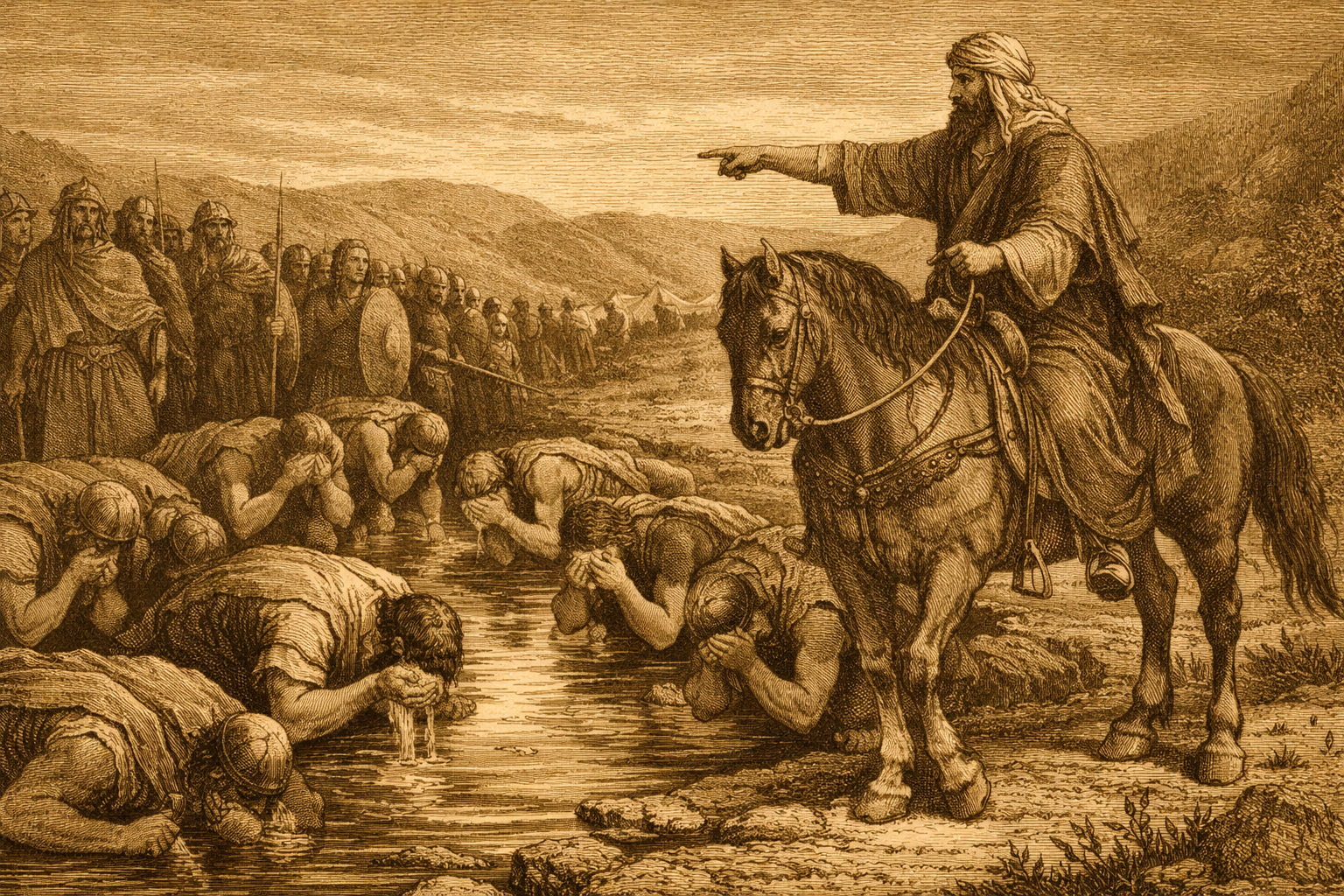
The Call of Gideon’s Army
Sometime in the mid-eighties, I cannot remember the details of the occasion, we were in the sacristy prior to a Mass at the St. Peter and Paul Cathedral in Providence quietly talking with a monsignor who is now a bishop in another diocese, a perceptive and thoroughly educated man of deep thought and understanding.
He spoke about Gideon’s army and how God used a tiny group of three hundred men to save the kingdom of Israel, a small cohort selected and ready to face long odds of survival against thousands.[i] God does not need a task force. The monsignor was sure that is what the Church and Christianity were facing at this point of postmodern, post-Christian history and equally sure that the tiny, storm tossed dory of our faith would weather the times. The intervening years have done nothing to dissuade me of his observation, verified daily in the news. The deconstruction of the foundations of an ancient culture seems mutually assured, undermined within and without the church and most disastrously within individuals – confused and alienated, lonely and depressed in record numbers.
Jorge Bergoglio, when he was still an archbishop in Argentina, famously noted that we are not in an era of change, but rather a change of eras, a change that began centuries ago as early as pre Enlightenment late Medieval times with William of Ockham [ii] and with each new revolution has accelerated and deepened. After the Eastern schism severed the unity of the Church, the Protestant Revolution heralded the scattering of Christendom into more than 2,000 denominations. It seems every few months I see a new rented storefront church with four dozen folding chairs and a new pastor, a slightly different focal point, three guitars, a set of drums, and great enthusiasm.
Another signpost on the road to the dissolution of Christendom as the social imaginative that informed a culture was the French Revolution ushering in a virulent anti-Christian conflict. A vicious confrontation enforced a fierce secularism reducing all we know to the material, humans to a collection of randomly organized atoms, and God to a superstition for the unenlightened. The revolution committed to redefine Freedom as the new benchmark of justice. Freedom for what remains unclear, followed immediately by tyranny and unspeakable entirely predictable violence.
A scant few decades later, the Industrial Revolution redefined and deified worldly success and the accumulation of wealth as the benchmark of human flourishing. Science emerged as the franca lingua of our time and for many today it is the primary, if not sole, arbiter and proof of all things true – a reductive myopia and worldview that some more thoughtful folks named with considerable alarm “scientism.” The dizzying pace of this revolution continues unabated with Artificial Intelligence now exploding in our pockets after we have become thoroughly acclimated and addicted to its precursor internet with tracking algorithms, instant connectivity, and a flooded river of information. Where this will lead is a perplexing uncertainty that is impossible to predict.
The Sexual Revolution of the Woodstock Generation and the Sixties welcomed into the mainstream culturally catastrophic ideas that have destroyed families, commitment, trust, and the understanding of who the human person is, seeming at least temporarily to have deconstructed the ancient patterns which formed human families, and their communities, and perpetuated our weary species.
What began in revolutions of radical rearranging of ideas and philosophies has distilled into desperate sadness, confusion, incoherence, and void in individual hearts and minds.
“In our own time, it has been particularly challenged by an abandonment of the Faith — a phenomenon progressively more manifest in societies and cultures which for centuries seemed to be permeated by the Gospel. The social changes we have witnessed in recent decades have a long and complex history, and they have profoundly altered our way of looking at the world.” Pope Benedict XVI, Ubicumque et semper[iii]
Human beings are hard-wired for worship, the transcendent and for God. We are born with a hole at our center more extensive than our insecure egos can satisfy on their own. Our souls and nature both abhor a vacuum, so “our heart is restless and will not rest” until the hole is healed. If not with real healing, then we will make all efforts to fill it with something. Not worshipping something is not an option, or as Bob Dylan sang, “Ya gotta serve somebody.” In post Christendom times, often that will be a derivative of a progressive religion that is in suspension like a sugary powder in the water in the cultural tank in which we live.[iv] We absorb this sugary powder convinced it is our own enlightened idea and comfort ourselves with that illusion.
This religion comes in a hundred hues, but there are shared characteristics common among them. With five minutes of introspection, we recognize where they surface in the social imagination that informs us – influencing how and what we think. The articles of this creed are pervasive, either subtly or not so subtly, in what we read and watch. In our news, our popular books, our entertainment, and are most prevalent in our educational mainstream carefully managed by an elite two or three generations deep now in this false faith.
Too much for a blog post, so I urge you to read the books linked in the notes below for more depth. However, there are signposts of which we should be aware that have become part of the language and assumptions absorbed into our understanding of how life is, our religion and our ruling philosophy, even with regular churchgoers. This faith is a type of neo-Gnosticism, that ancient multifaceted heresy that periodically grows a new head. One of its properties is a belief that it possesses superior guiding wisdom as insider knowledge or enlightenment known only to those who know. You know who you are.
The foundational precept is that if we tweak our exterior circumstances according to this wisdom, reform our society ‘out there’ with the right adjustments according to that wisdom, we move forward to our perfect world. In this lens, history is linear, and progress is always positive. From transhumanism to the right to alter our own bodies to political tribes which all have their own ideas of human perfection, we have come to believe we can create our own reality, and it will be better than what we have been given. We can decide what it means to be human. We can avoid asking the awkward question, “Just because we can do something, should we do it?”[v] We can make our own heaven. We can choose our own truth and remake ourselves in our own image. We can define our own good and evil like we were picking it from a tree, a dangerous vanity which we have done before a long time ago, and it did not go well.
Fundamentally utopian in assumption and structure, this belief system ignores what St. Thomas More knew when he coined the term “Utopia” for his book centuries ago. “Utopia” combines two Greek words and means “no place.” Given the disastrous results of every contrived utopian scheme from the French Revolution to the Third Reich, the Soviet Union, North Korea, and Venezuela, it is a treacherous faith.
Utopian collective solutions rid us of two uncomfortable features of Christian faith: individual responsibility because the problem is “out there” in everyone else, and the doctrine of the Fall asking us for repentance and deep personal change. Our times are the most prosperous in our history, for the wealthy, of course, but for the rest of us too, with conveniences in the most modest of American homes undreamed of by the richest kings in past times. Yet, we remain riven with record high loneliness, depression, and anxiety. Social media is a convenient foil, but it is an accelerant, not a root cause. The deeper mystery lies where it always has, in what Augustine called “incurvatus in se,” or turned inward into ourselves, his description of sin. Not a series of unfortunate acts, but a condition which needs a cure. Utopian fantasies cannot fix that and putting our trust in them exacerbates our avoidance of personal responsibility and our alienation.
According to this post-Christian faith, our salvation is based on ridding ourselves of our illusions, learning the rules, and gaining enlightenment, and is not a question of sin and repentance. This utopian ‘faith’ leaches into our politics and crosses ideological lines. Two examples for clarity. For the ‘woke,’ the requisite enlightenment is different than from the MAGA version, but both presuppose a certain knowledge and trust that will lead us to the promised land. Both assume the unenlightened are at best ignorant and at worst evil. True to Giradian theory, each set of true believers also has their own set of scapegoats that society must suppress or rid itself of. You know who they are. Watch Newsmax or MSNBC commentators; they will happily point them out to you from two poles. Misery, distrust, and animosity proceed from this as surely as rot festers in malignancy.
“Freedom is an incantatory word in all Progressive forms of faith, not as something to be achieved through a road of discipline and the development of virtue according to a divine pattern but by breaking the perceived bonds of oppression that limit the self-creative process.” Monsignor James Shea, “The Religion of the Day”
A committed remnant core should not discourage us; this has been the pattern since the beginning. Numerous times, throughout Church history, a remnant revived our faith with periodic renewal and necessary pruning. In previous times of heresy, corruption, confusion, and neglect, there has always been a remnant to grow new and fruitful life. Holy men and women who will not compromise have always led renewal in these times. We call them saints.
The “Judaizing” tendency afflicting the early Church produced the remedy of Paul’s teaching on grace and the decisions made at the Council of Jerusalem. Brilliant theologians like Irenaeus fought the early Gnostics that denied the goodness of creation. The Arian error denying the divinity of Jesus and the mystery of the Trinity spread through the entire Church, including the majority of bishops; it was only defeated by the heroism of saints like Athanasius, Augustine, and even Nicholas (yes that St Nick) who punched Arius in the face at the Council of Nicaea in 325, where a creed was written that we still pray at Mass today.
The corruption and affluence of medieval cities destroying the Church from within brought forth Francis, Dominic, and the mendicant orders. The unbelieving rationalism and violent revolution in the eighteenth century sparked the liturgical renewal of priestly reform in figures like John Vianney and John Bosco. Always from the beginning the likes of Aquinas, Bonaventure, Teresa of Avila, Catherine of Sienna, Ignatius, Therese of the Little Flower have risen up in small remnants of love and faith to counter crises and address new cultural changes in ways as various as needed for their times. The list is almost endless into our own times.
Now is our time, the times we have inherited. We have lived among saints now. Mother Teresa, Karol Wojtyla, Maximillian Kolbe, Fulton Sheen, Padre Pio, and those who walk with us still in our diocese, in our parish, in our neighborhoods, in our homes, who are yet to be widely known. There are signs or stirrings that something is already going on. It may just be the beginnings of the Spirit once again visiting His people. Young people, especially Gen Z and Millenials, are yearning for something beyond radical subjectivism and self creation. Having never been exposed to Christianity even in their homes growing up, they know that something is missing, a terrible void in the their young lives. For the last few years more and more are first exploring and then coming to parishes and campus ministries like Newman Centers. Look here. Listen here. I do not know if the tide has indeed turned, but the generation with the lowest church participation ever recorded has begun to realize the culture we left them left a hole in their heart. They are right. Do not be afraid or discouraged or abandon the struggle.
True freedom is not invented, but it is, as it has always been, discovered in the faith brought to its culmination in Jesus Christ 2,000 years ago when the Creator of the universe, a universe that was unnecessary and pure gift, broke definitively once into human history to redeem our confusion, loneliness, alienation, and blinded self-destructive self-creation.
Upon reflection, may we realize that He redeemed our human existence in the only way possible – by entering our self-created hell and becoming one of us. He experienced in the same living flesh as we have everything we experience: our joy, human love, and wonder of discovery, but also our crushing disappointments, He suffered every indignity and pain that we most fear. Yet, He said, “Do not be afraid.” Scourged, beaten, ridiculed, abandoned, stripped naked, and executed most cruelly. Dead, buried in a tomb in the darkness, ended.
Resurrection. Not a symbol, but an actual historical happening that differentiates Jesus from any other religious figure, and Who is the center of our faith. Everything changed, and for the Christian, it is the central event of human history. He destroyed death and all suffering in an unlikely way that only God could have imagined and devised. He rose again, and invited us to join Him, not fallible, atomized, and tangled as we are, but recreated new and divinized. He became one of us.
Not stuck in our own inner torment, in the soul destroying ersatz autonomy of an impossible self-creation – but breaking out into the light to discover the release of new creation with the eyes of faith, a new creation which cannot be seen by the eyes of our body alone. A gift of faith, a gift freely given to all who ask. To see beyond the now and material and come to the realization of our true nature made in the image of God. Not a grim slog into the murk, but a long, sometimes wandering, journey into the light.
We are, each one of us, a strange and unlikely alloy of body and soul; heart and mind; spirit and earth. The surprising truth is that God created and placed us here in these times to be a sign of and to fulfill that call to be what reaches beyond ourselves. Each of us is a miracle alchemy of whimsy, wonder, and work of every variety. Beyond all reasonable expectations we are to rise into gratitude, peace, joy, and true freedom. Not the license to scratch every itch, but the freedom to be what God called us to be, to choose freely the good, the true, and the beautiful into eternity.
“On the first day of the week, Mary of Magdala came to the tomb early in the morning, while it was still dark, and saw the stone removed from the tomb. So she ran and went to Simon Peter and to the other disciple whom Jesus loved, and told them, “They have taken the Lord from the tomb, and we don’t know where they put him. So, Peter and the other disciple went out and came to the tomb. They both ran, but the other disciple ran faster than Peter and arrived at the tomb first; he bent down and saw the burial cloths there, but did not go in. When Simon Peter arrived after him, he went into the tomb and saw the burial cloths there, and the cloth that had covered his head, not with the burial cloths but rolled up in a separate place. Then the other disciple also went in, the one who had arrived at the tomb first, and he saw and believed.” John 20:1-8, New American Bible Revised Edition translation
[i] In the Book of Judges, God directs Gideon to reduce his army of 22,000 to defend His people from the hordes of Midian, Amalek, and the Kedemites. The first cut to 10,000 sent home all who were inexperienced proven warriors, and any who were afraid. The Lord told Gideon that he needed even fewer for His purpose. The final winnowing seems at first to be mysterious: He instructed Gideon to observe his troops after a long brutal day in the sun, when they came to a source of water. Those that knelt to drink with their face in the water he sent home; only the three hundred who scooped the water to their mouths and lapped it from their hand remained for the battle.
[ii] Research William of Ockham and the evolution of the philosophies of voluntarism and nominalism to understand how this began way before modernity.
[iii] As quoted in “From Christendom to Apostolic Mission,” Monsignor James Shea, University of Mary Press, 2020
[iv] The ideas that form our progressive religion Monsignor Shea describes in depth in his follow up book, “The Religion of the Day,” University of Mary Press, 2023. Strongly suggest you buy a copy of each. They are more long essays and can be read easily in a couple of sessions each. You will gain great insight into the confusion that surrounds us.
[v] Spend a fruitful half hour and listen to a good summary of what this new faith is and how we should respond to it, from the author of the books noted above, Monsignor James Shea, and you will hear it far better than I can write it. “What Does it Mean to be Human?”
 Quo Vadis Blog