
Except for the point, the still point, there would be no dance, and there is only the dance. T.S. Eliot – Four Quartets
 Being the oldest of five (eventually to be six) children in 1956, the age of ten brought with it occasional responsibilities that would be surprising to most ten year olds in 2013. We shared one bathroom, and the four boys shared one bedroom in a three bedroom cape with two small one window dormers in the front. When I was thirteen or so, my youngest brother, Marty, filled out the nest, and my dad added on a family room. We never questioned and rarely felt put upon by the living arrangements; our family was secure and happy in our daily routines. My parents had one car; my father worked two jobs and my mother worked full time as a mom, which was quite enough for anyone.
Intermittently my mom asked her oldest to help out paying bills downtown, which was a mile or so from our house. Accomplishing this on my bike was an easy adventure and invited me in to the mysterious grown up world. My mother didn’t have a car when my father was at work, and in 1956 in addition to me, she had two kids in diapers plus a set of five year old fraternal twins, one of whom had a severe hearing disability. She handled this all with aplomb and good humor most of the time, but when the bills were due, she needed some assistance.
The budget was managed by accruing cash weekly in separate envelopes for various expense categories. I would be given the utilities envelopes and the mortgage envelope, and then mount up on my bike. There were no bike racks or bike locks, none was needed, just a kickstand or a convenient wall to leave the bike against. First, I would go to the bank, then the electric company and the telephone office. No gas company bill in 1956 and I think she paid cash to the oil man, when he delivered. Grocery shopping was a full family affair when we were little. The checkout clerk would help load the groceries into our car. I lost five dollars in change once, which was a minor disaster in a time when it represented nearly fifty percent of the weekly grocery budget. She was disappointed, but kept her concern brief and tight lipped – almost. I was admonished after that to return straight home with no stops at friends’ houses or especially the library, which could delay my return for hours.
 A bike ride to the library was also about a mile, and with the possible exception of a sandlot baseball game behind the elementary school, my favorite activity. I was a constant reader and shy at ten. There are pictures of me my mother still has, sitting on the floor reading a book absolutely absorbed and still, amid the chaos of my five siblings. I haven’t changed all that much – except for the shy part, although I remain private. My reading consumption was and remains omnivorous, but at ten inclined towards biographies of Indian fighters and tales of King Arthur and the Knights of the Round Table. As I got a little older, I was spellbound by biographies of Thomas Edison and Babe Ruth with The Count of Monte Christo not far behind.
The Walpole Library was small, but well stocked. Upstairs was for the adults, but the basement was reserved for children and adolescent fare. The librarian was a genial and skilled substitute far superior to Google for a ten year old; the card catalog held the keys to the kingdom. If the librarian was preoccupied, we could sneak out to the front steps and edge our way around the whole structure on an eight inch granite ledge that circumscribed the building as a design feature just below the windows. The children’s section had round low reading tables with small chairs.
In one corner, two stereoscopes resided along with boxes of the two photo four by ten inch cards that fitted into them. Most of the pictures were black and white, although some, including Civil War historical shots were sepia. As a ten year old, I especially liked the battle aftermath photos. When viewed through the lenses, they appeared in 3D. Developed in the mid nineteenth century and vastly improved by Oliver Wendell Holmes in 1861, the stereoscope opened previously undreamt wonders to a ten year old. From Egyptian pyramids to the streets of Paris to the Grand Tetons, our new world was limited only by our imaginations.
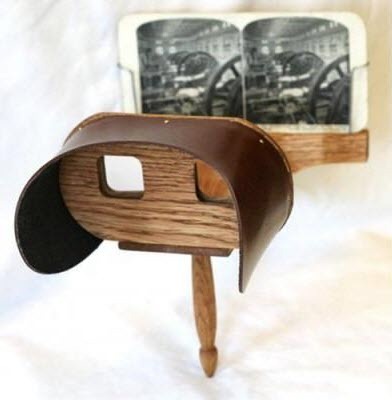 Stereoscopes are now valuable antiques and anachronistic reminders of simpler times (that is simpler unless one lifts the edges of the curtains). They were supplanted sadly by more enticing moving pictures and eventually television. Our television was a big box in the living room with a small black and white screen and three somewhat fuzzy channels. Ozzie and Harriet, I Love Lucy, The Ed Sullivan Show, The Jack Benny Show, The Honeymooners and many, many Westerns like Gunsmoke and Have Gun, Will Travel drained away our family hours as we got older. I could still slip away to my sanctuary in the eaves of the attic, which had a single pull chain light bulb and a hook and eye latch, to seek the quiet harbor of my books.
I’ve heard it said that we all have our nineteen year old selves permanently emblazoned on our personalities. Can it be any less so for ten? My tenth birthday was in February of 1956, eleven years to the day after the Marines raised the American flag on Iwo Jima, securing a key stronghold on the long drive to Tokyo. To idealize any period of time is to trivialize it, however to hold it at the center of our innocence is quite another.
The fifties were in some ways innocent and optimistic, yet they also harbored Jim Crow laws and the hypocrisy of country club adultery and too much liquor. But most families were hard working and held traditional morality dear; the parents were the “Greatest Generation” determined to leave behind the Depression years of the thirties of their youth and the killing years of the forties of the war, and to pass on to their children a safer, more stable and more comfortable future. For this they worked steadily and generally cheerfully for the rest of their lives. Comfortable was achieved; stable and safe eventually were beyond theirs to bequeath, but in the fifties, at least the illusion of simpler times was lovingly preserved.
“We don’t know what we are doing, because we don’t know what we are undoing.” G.K. Chesterton
 Quo Vadis Blog