Category Archives: Culture views

The Nature of a Beech Tree

 Beech trees are comfortable.  Smooth gray bark with sweeping sloped crotches, beech gifts the climber with branches near enough for easy assent and spaced far enough to allow access to all areas of the tree without too much rope tangling.  The canopy is graceful, spreading as much as fifty feet.  Taxonomically related to oaks, the wood is strong and reliable with plenty of convenient nooks for a contented coffee break. I love beech trees.

In the eighties Jimmy and I formed a symbiotic partnership that lasted almost a decade. We were the proverbial weekend two guys in a pickup truck (actually two pickup trucks).  He was a high school biology teacher who saved his money, bought a small clapped out, now thriving, nursery and landscaping operation and today owns a successful business, even hosting for years his own landscaping advice Saturday radio show that is widely respected in Boston.  Both of us were trying to support our dreams (and in my case parochial school tuitions).  I was the tree climber; he ran the ropes and chainsaw on the ground.  Both of us cleaned up the mess.  Occasionally, we would take on projects far beyond the scope for which we were equipped.  Jimmy and I were nothing if not confident in our ability to overcome.

One such job was taking down an old, weakened and dangerous beech tree on the estate Jimmy lived on as part time groundskeeper.  Forty five or more inches diameter at the ground, it extended upwards at least eighty feet.  We had room to drop it, but to control the fall I climbed it to put in a pull line at sixty feet or so.  About twenty feet up, the trunk branched into two main leaders.  As I climbed past that divergence, I heard a low familiar hum and looked down into a mass of honey bees nestled in the crotch.   The bees and I attentively ignored one another.

When I descended after setting the pull line, we huddled and came up with a contingency plan.  Clearly, when the tree hit the ground, a nest of undetermined size would be broken open and discharge an army of protective, seriously overwrought, stinging insects.  We warned off weekend picnickers and Frisbee throwers; the estate was open to the townspeople and lovely.   Jimmy hooked up the pull line to the pickup truck, putting tension on it well clear of the fall zone, and I began to cut the notch about two feet off the ground.  The cutting stopped abruptly when sparks erupted and we discovered the center of the tree had been filled with cement many years earlier to try and treat a cavity.  The hits just kept on coming.  We regrouped at Jimmy’s tool box and pulled out a three pound hammer and cold chisel.

Making the cut took well over an hour, normally a ten minute job.  A little careful chain sawing, resharpen the teeth, some hammer and chisel work – eventually the tree was sufficiently notched to start the back cut, which involved the same arrangement of chain saw, chisel and chain file.  As the tree started its rapidly accelerating fall, I ran like my life depended on it to the truck and jumped in the cab.  The beech hit the ground with a crash, splitting open longitudinally and tearing apart an awe inspiring bee’s nest over fifteen feet long.  Almost immediately the windshield and side windows of the truck were covered in bees so thick we couldn’t see out.  We waited, tethered to the top of the tree with no place to go and told stories.  Eventually, we had to kill the bees that night when they settled down, after we consulted with a local bee keeper, who assured us we would never be able to find the queen and relocate the nest.  We didn’t want to spoil all that honey with pesticide, but the exposed nest could not be left with all the children who played in the fields nearby.  We cut the tree into firewood by our headlights late into the night and hauled the brush to the estate’s mulch pile.

Current arboricultural practice avoids the cement filled cavity because it seals in the rot and creates a fulcrum further weakening the tree against future storms.  Other common practices of my youth are no longer espoused by those who understand the nature of trees.  At one time, we carried screw top paint pots, ruining our clothes as we painted all cuts over three inches to protect the tree.  What the paint really did was kill back the cambium, that single layer of growth cells that produce bark on the outside and vessels to transport nutrients on the inside.  Cambium is how the tree grows in girth and how it heals from injury.  The paint slowed healing, and the protection it afforded against rotting fungus spores broke down long before the wound healed over.

A third abandoned common wisdom relates to how young trees were planted.  Routinely we would stake them with wire and hose to keep them from blowing over and fill the hole in which we planted them with rich nutrients and peat moss.  Stakes are now left in place only a very short period, if at all, and the heavy nutrients are now generally left out.  As knowledge of tree development and physiology has evolved, we’ve learned staking prevents much of the normal swaying in the wind that stimulates long term root growth, which more permanently anchors the tree against uprooting in a storm.  Over fertilizing saplings promotes excessive root development circumscribed primarily within the original planting pit and depresses root growth out into the indigenous soil that is necessary to nurture the tree for decades.

There is an analog, I believe, with people.  Over protection and excessive coddling inhibits the testing and development necessary for healthy, long term growth.  As our child centered culture awards trophies for participation and social promotion for substandard academic  performance, we wrongly cultivate “self esteem” at the expense of self reliance and real confidence fired in the kilns of overcoming difficult circumstances.  The truth is rooted in the difficult reality that we are not all equally talented, bright or capable in every aspect of life, but we all have a niche wherein we can contribute and flourish.

Culturally, the progressive holds out for equal outcome, not opportunity, to the detriment of long term societal health.  Robust individualism slowly putrefies in a culture steeped in collectivism and entitlement, ultimately weakening the whole organism of this great blue ball we inhabit.  Individualism is decried as selfish and egocentric, while, I believe it to be our only true course to growth and healing.

“The individualism of which we speak (is) in contrast to socialism and all other forms of collectivism…  The essential features of that individualism which, from elements provided by Christianity and the philosophy of classical antiquity, was first fully developed during the Renaissance and has since grown and spread into what we know as Western civilization—are the respect for the individual man qua man, that is the recognition of his own views and tastes as supreme in his own sphere…and the belief that it is desirable that men should develop their own individual gifts and bents.”  The Road To Serfdom, F. A Hayek

2 Comments

Filed under Culture views, Tree Stories

Rock the Baby

She was naked, terrified, utterly alone, confused, sinking ever deeper into hypothermia.  Initial shivering and body movement slowly diminished.  She hadn’t eaten or had anything to drink all day; in point of fact she had never eaten since she was born – early that morning.  Her cries weakened; the slight rising and falling of her little chest was barely evident.  The baby lay on a ledge outcropping at the edge of the forest; her recently severed umbilical cord was clearly visible.  The cautious female hyena approached tentatively, her head in constant motion looking for the baby’s protector, but there was no one.  Creeping ever closer, the scent aroused the hyena’s hunger.  Jaws opened and snapped closed; the weak cries stopped altogether.  The hyena mother picked up the tiny body and knew what to do, what all mothers should do: back in the cave her babies had to eat.

In ancient Rome and Greece, infanticide was routinely practiced.  Often the murder was by neglect: exposure to the elements or putting babies outside by the doorstep in earthen jars.  Starvation, thirst, asphyxiation, cold, heat or predators would kill them, and the parents could absolve themselves from direct responsibility because a god or another person could have come along and saved them.  Some were more direct.  Burying alive, strangulation, bashing them against a rock or throwing infants into the Tiber, each method had its advocates.

We would prefer to suppose such barbaric practices were abandoned as more enlightened civilizations evolved.  Since the most recent past century was the bloodiest in human history, we should be disabused of our smug pretensions by now. Even a cursory examination will show that infanticide is still common, especially in China and India, but it is a curse in every nation, including our own.  The most frequent victims due to various sociological pathologies and selection have always been baby girls. Link to a brief history of infanticide.  

Outrage and violence, this is all I see,

all is contention, and discord flourishes.

And so the law loses its hold,

and justice never shows itself.

Yes, the wicked man gets the better of the upright,

and so justice is seen to be distorted.

Habakkuk 1: 4 -6

Dr. Peter Singer holds the Ira W. Decamp Chair of Bioethics at Princeton University and is considered by many as one of the premier bioethicists in America.  The guiding light of the animal rights movement, he decries “speciesism” as being as woeful a human failing as racism or sexism.  His premise is that a mature animal capable of suffering is more deserving of our protection than, say, a human pre born or neonate.

Prominent in his post modern ethic is euthanasia for the suffering or disabled, especially if they are infants.  His is a “quality of life” utilitarian ethic, not a “sanctity of life” natural law ethic.  Let him speak for himself.  “We may not want a child to start on life’s uncertain voyage if the prospects are clouded. When this can be known at a very early stage in the voyage, we may still have a chance to make a fresh start. This means detaching ourselves from the infant who has been born, cutting ourselves free before the ties that have already begun to bind us to our child have become irresistible. Instead of going forward and putting all our effort into making the best of the situation, we can still say no, and start again from the beginning.”

Nor is Dr. Singer alone in his cause.  Nobel Prize-winning molecular biologist, Sir John Sulston, who also worked on the Human Genome project, implicitly advocated the extermination of the disabled when he said, “I don’t think one ought to bring a clearly disabled child into the world”.  Professor Robert Edwards, the IVF pioneer who helped bring to birth the world’s first test-tube baby, said, “Soon it will be a sin for parents to have a child which carries the heavy burden of genetic disease.”  Playing God is an adult game as old as humankind and is still in vogue.

Now, we cannot ascribe this position solely to the radical fuming of ivory towered academia; Dr. Singer was the bioethics advisor in the Clinton administration and remains one of the lights (such as it is) to that which informs much of the “progressive” agenda.  Here’s another of his pomposities, “Human babies are not born self-aware or capable of grasping their lives over time. They are not persons. Hence their lives would seem to be no more worthy of protection than the life of a fetus.”   Couldn’t be much more clear, and in this regard, I am in complete agreement with the last phrase.  There is no moral difference between abortion and early infanticide.  It is not the journey down the birth canal and into the light that makes a human being a person.

“After ruling our thoughts and our decisions about life and death for nearly two thousand years, the traditional Western ethic has collapsed.”  Dr. Peter Singer

More disturbing still is the mainstreaming of the utilitarian ethic concerning human life and the insistence of the progressive that irrespective of our profound moral objections, we all should pay for it.  Buried among the 5 gazillion platitudes, the 2012 platform of the Democratic Party Convention included this: The Democratic Party strongly and unequivocally supports Roe v. Wade and a woman’s right to make decisions regarding her pregnancy, including a safe and legal abortion, regardless of ability to pay. That’s “newspeak” for “we want complete access to abortion for any reason at any stage of the pregnancy paid for by the state.” The platform committee included in its members some of the most radical progressives like Barney Frank. **

As a State Senator, Barack Obama opposed a bill protecting infants born alive during a botched abortion.  Ramesh Ponnuro’s recent article in National Review Online wrote of it and quoted Obama, “Granting them protection by requiring that a second doctor be present to treat any born-alive infant would ‘burden the original decision of the woman and the physician to induce labor and perform an abortion.’ Legal protection for these infants, in addition to being wrong on principle, would inhibit abortion.”   (Emphasis mine.) Apparently, drowning them in a bucket like a kitten (as is common practice among abortionists when something goes wrong and the baby is born alive) was perfectly OK with the good senator.  He is the most radically pro abortion president in our history.

No clichés about the slippery slope.  We’re well past the crest and rushing down the icy hill.  The question is: what are we going to do to mitigate the crash at the bottom?

You’re gonna have to serve somebody, yes indeed
You’re gonna have to serve somebody

Well, it may be the devil or it may be the Lord
But you’re gonna have to serve somebody

Gotta Serve Somebody (From the album “Slow Train Coming”)   Bob Dylan

** The DNC Platform Committee also caused public furor when, unprecedented, they removed any reference to “God”and Jerusalem as the capital of Israel, which after a political decision to limit the damage, treated us to the spectacle of God, Israel and Jerusalem being booed from the floor of the DNC.  The Mayor of Los Angeles,  Antonio Villaraigosa, was forced to gavel over the objections of many convention delegates to add those references back in on a voice vote that clearly fell short of the 2/3’s needed. Pretty entertaining though.  (Link to video).

8 Comments

Filed under Culture views

Gimme Shelter

 An early fall chill lends urgency to the just after sunrise start.  A five person house framing crew stretches and climbs out of the crew cab pickup truck, which tows the tools and nails trailer.  The first floor deck sheathing had been laid down the day before, and first walls would be nailed in place before day’s end – on track to frame the 2,300 square foot colonial in three weeks with garage and farmer’s porch.

First out of the trailer is the generator and compressor; no temp power is yet available at the jobsite.  Next out, the carpenters deploy cords for the saws and hoses for the nail guns.  The truck from the lumberyard pulls in.  The driver releases the Moffet forklift from the back and begins to unload pre cut studs, plate stock, OSB sheathing and a few 2 x 10’s for headers according to the estimator’s take off and framing foreman’s review with the lumber salesperson.   The practiced driver spreads the materials about the foundation to limit the amount of grunt work by the carpenters to get the right product to its designated place in the structure.

Carpenters jump on the lumber driver with good natured  repartee; profanity goes back and forth along with bawdy inquiries about girlfriends, wives and the attractive woman two doors down in the house they finished a couple of months ago.  Almost no sentence and few phrases avoid the habitual “F” bomb as a verb, noun, exclamation, adjective, adverb or occasionally an emphatic two syllables in the middle of a word.   “Where are my f’ing pencils and hoodies?”  As the driver pulls away, the lead carpenter or foreman is already snapping chalk lines on the deck.  After cutting them to the right length, he tacks together top and bottom plates to mark them out for studs as a start to assemble one of the twenty or thirty walls that make up the first floor.  Worn plans are rolled out on a makeshift plywood table.

The rest of the crew carries studs to nail between the plates and begins to cut headers, jacks, cripples, window frame sills and all the rest.  There isn’t a lot of talk by this time; everyone knows what to do.  By 8:30 or 9, they are standing up the first walls, bracing them plumb and level.  As the sun gets higher, shirts come off.  Arms, chests and backs are well developed, not with gym muscles, but resilient strength that will go all day.   Everyone is tanned dark with calloused hands.   At around 10 or so, the “roach coach” bounces in with horn blaring and the crew drifts over for coffee and snacks.  Some of the guys buy their lunch for later, usually a plastic wrapped day old sandwich or steamed hot dog.  The joking banter starts up anew.  By the end of the day, the first floor walls will be ready for the second floor joists tomorrow.

So the process goes.  The foundation form workers, concrete trucks, tree cutters and site work equipment have already come and gone – the dirt movers will return later to finish the final grading, driveway and landscaping.  After the roof is on and the windows are in, the other subs show up sequentially scheduled by the contractor:  roofer, siding and exterior trim crew,  MEPs – mechanicals (heating, ventilation, etc), electricians, plumbers, then masons, insulation installers, sheet rockers, plasterers, finish carpenters, painters, flooring installers, cabinetry and countertop makers.  Some MEPs come to rough in, and others come to install the finishing plumbing, lighting, fixtures and cover plates after all the other crews have finished their work.   Carefully planned throughout the progression are the various permits, inspections and checklists along the way to comply with thick code books and engineering requirements.  Sometimes in a small company, the builder and his wife finish up to final clean and take the manufacturer’s stickers off the windows.

Many of the subs know each other from other jobs.  Most get along; some don’t, especially if their work is increased or complicated by other subs.  If the plumber gets out a Sawzall and attacks floor joists to put in their drains or the sheet rocker buries the electrical boxes, sometimes sparks fly literally or figuratively.  The contractor frequently plays the role of arbitrator in these disputes.

Dependent upon these job site jobs are thousands of hardworking lumberyard, window, door and appliance manufacturers, pipe makers, wire makers, cabinet makers, log sawyers, timber cutters, gypsum and copper miners, cabinet makers, lighting assemblers, supply houses, realtors and myriad others who benefit from this bedrock industry.  Without them, our economy will and has suffered grievous harm.

An efficient builder will turn over a typical new house of this size in 90 days from digging the foundation to bikes in the driveway.  Some of the big national builders can get occupancy permits in 70 days.  When a company puts up 30,000 houses a year, efficiency is at a premium.  A large, fully custom home can take a year or more.  Approvals for lots and subdivisions usually take several years with frequently contentious planning board and zoning variance hearings.  Deals are cut for “contributions” to the town such as sewage pumping stations or Little League fields.  Relationships for good or ill are forged with building inspectors.  Bonds are filed; roads are cut; land is donated to the towns for public use.  Acquisition, development and construction loans are a never ending ongoing struggle.  Creativity abounds.

As large as the big builders are like Pulte, Lennar and D.R. Horton, most new homes are still built by small entrepreneurial builders, who by their risk taking, will, intelligence, experience, persistence and courage turn raw land into someone’s dream and shelter from the storm.

On this Labor Day weekend, I salute the thousands of entrepreneurs, who work as architects, engineers, contractors and subcontractors; almost all are small businesses.  They claw a living out of the earth, providing jobs for many others and homes for families all across this country in every state and county. I have been in and around this business for almost forty years, and my admiration for these independent, skilled businessmen is undiminished.  I am proud to play a small role in this demanding enterprise.

The fruit of their work is a fundamental of human survival – shelter. An honorable, necessary and admirable group of skilled builders, artisans and sub contractors get up each workday morning in wind, numbing cold, snow or parching heat or steady drizzle to provide with great difficulty what is critical to our way of life.

And, yes, Mr. President, they did build it.

Oh, a storm is threat’ning
My very life today
If I don’t get some shelter

Oh yeah, I’m gonna fade away  

Mick Jagger and Keith Richards

Leave a comment

Filed under Culture views

Truth Fairy Revisited

My colleague from three companies ago, Anthony, lives near Atlanta making his living as a “storyteller, speaker, humorist and writer.”  When I first encountered him as a professional trainer, he was (and presumably still is) engaging, funny, warm, articulate and full of insights he was most eager to pass along to us; he was good at what he did.  We engaged in a brief exchange of ideas as comments in last week’s blog, in which we went back and forth with a fundamental divergence of opinion – would that all opposing views could be discussed so genially.  Later in the week Anthony published the current edition of his “Waypoints – Guideposts for Fellow Travelers” entitled “The Truth Fairy.” It is herein attached; please give it a read.  Link to Waypoints.  Back arrow to return to this post.  Sign up, and he will add you to his email distribution list.

His ideas, so amicably held and voiced, when juxtaposed to mine, lead us to what I believe is the crucial divide of our times – a rift that cannot be reconciled, but can have mutual understanding and respect among people of good will.  Religious and agnostic; progressive and conservative all distill down to this:  utilitarian positivism and moral relativism in stark contrast to the concepts of revelation and natural law.

Postmodern ideals and ethics evolved through the Enlightenment and later the Nihilism and “God is Dead” philosophy of Friedrich Nietzsche, the Existential writings of Jean Paul Sartre and many others.  Perhaps the positivist roots go even deeper into thirteenth and fourteenth century scholastic writings and Father Wilhelm of Ockham of “Ockham’s Razor” renown.  These seminal ideas developed parallel with the ascendency of the scientific method as the sole arbiter of truth like a robotic meshworm boring through the ear and into the brain of Western Civilization until it insinuated itself into the synapses and impulses, unhinging us utterly from any absolutes, and as Waypoints would have us say, “Are there any truths or are there merely facts?  To say that a thing is true is to definitively and confidently declare it both undeniable and incontrovertible.”   Just so.

The argument of the positivist is that without empirical evidence nothing can be known as true.  In the beginning, those like Father Wilhelm would exempt the unknowable complexities of God and miracles from the strictures of positivist dogma because revelation and faith are by definition of a different nature of truth.  As all ideas have consequences, fledgling positivist thought eventually overran all that Creator folderol and pontificated loudly “Gott ist tot! – if indeed He ever existed – and He is therefore irrelevant to the discussion.”

“Ultimately, the problem with militant neo-atheism is that it represents a profound category error.  Explaining religion – or indeed the human experience – in scientific terms is futile.  It would be as bizarre to launch a scientific investigation into the truth of Anna Karenina or love.”  Bryan Appleyard writing in the New Statesman

My contention is not that Waypoints expresses the thoughts of a dyed in the wool positivist, clearly Anthony chooses an alternative faith, that of Emerson and Thoreau and “The Little Prince”, but only that positivist thought inculcates our culture and fashions our perspectives.  If we wandered through most of what passes for education since the mid twentieth century, it is the sea in which we swim and the lens through which we see.

My objection lies in the dismissal of those who are of a different faith as “blindly giving all that I have to you” and foolishly relying on “an anthology of ancient stories, screeds and scriptures, all of which are subject to great debate and drastically differing translations,” and thus to Anthony ”both silly and pointless.”  This seems to me superficial and smug, unworthy of such an intelligent mind.

“Don’t lay no boogie woogie on the King of Rock and Roll!”   Long John Baldry

As an aside, the utopian visions of Emerson, which have their foundation in transcendental principles not provable or disprovable in physical experience, were tried and found wanting in the communes of the nineteenth and twentieth century, and the gulags of the Soviet Union.  Emerson and Thoreau were among the guiding lights of Brook Farm, but only visited; they didn’t live there, being far too bright for that.  No utopian society existed that did not deconstruct into discord, chaos, tyranny or dystopia.  As for the “Little Prince”, unless one reads Antoine Saint-Exupery in the original French, we are relying on one of dozens of translations.

The library we call the Bible, the meticulous translations from the original languages and the tens of thousands of books written about it and the faith it represents are among the most comprehensively analyzed, discussed and thought about subjects in human history.  Thomas Huxley, the famed agnostic biologist of Victorian times, put it this way, “Take the Bible as a whole; make the severest deductions which fair criticism can dictate for shortcomings…, and there still remains in the old literature a vast residuum of moral beauty and grandeur.”

Is truth exclusive?  In other words, if two things are posited and are exactly opposite, is it only my truth and your truth with no objective judgment possible wherein one position is right and the other wrong?  Or is objective truth itself a self evident impossibility outside the laboratory?

For the ancients of Western Civilization, the existence of a Natural Law of incontrovertible truths set deep in the DNA of human kind by its Creator was a given, far before the amazing body of Christian literature on the concepts by the likes of the brilliant Aquinas and Augustine.   No lesser light than Aristotle put it this way, “There is in nature a common principle of the just and unjust that all people in some way divine, even if they have no association or commerce with each other.”  As C.S. Lewis wrote, there are sometimes differing interpretations of what “fairness” means across cultures and times, but there is universal agreement that the concept of “fairness” is of high value to a healthy society.  No one contends that a culture rooted in injustice or unfairness would be a good one.  Or for that matter one rooted in cowardice, lies and the murder of the innocent.

So, dear friend, we can disagree about the mores and morals of our current culture, but please don’t admonish us to “think about it”.    We do.

Law is “the highest reason, implanted in Nature, which commands what ought to be done and forbids the opposite.”  “Right is based, not upon men’s opinions, but upon Nature.”  Marcus Tullius Cicero (106-43 BC)

2 Comments

Filed under Culture views

Scientists and Their Dogma

A series of papers on “HIV in Men Who Have Sex with Men” from the prestigious British medical journal, Lancet, were presented as a symposium at the recent international AIDS 2012 conference in Washington, DC.  Not necessarily surprisingly, given current scientific dogma, one of the major causes of the continuing epidemic among active homosexual men was cited as homophobia and discrimination against gay men.

Oh yes, there are some behavioral risk factors, of course, but if only gay men felt secure enough to take advantage of best medical practices, HIV incidence would plummet.  Toxic intolerance, especially religious bigotry, compels homosexual men, particularly black homosexual men, to forgo proper care and increases risk. Huh?

One might reasonably ask what behavioral risks?   Within the papers, we find that active homosexual men are eighteen times more likely to contract the HIV virus and AIDS than the general population.  A single homosexual act with a new partner puts the impassioned at a 1.4% risk of HIV infection.  Why is that?

Several factors are named.  In the interest of keeping this a family friendly, PG rated blog, some discretion will be necessary.  Anal sex is more risky (if not more frisky) since HIV is a gut-tropic virus.  (i.e. the little guys tend to prosper in the alimentary canal.)   Secondly, since the male can be (not to put too fine a point on it) either the inserter or recipient in the transaction, the odds of something going awry increase and things can get dicey.  An additional risk factor, despite protestations of forever love and marriage, irrefutable statistics show the gay lifestyle to be predominantly promiscuous.  Multiple partners mean multiplication, if not exponential risk; it’s just math.  As a further result of these behaviors, gay men also have far higher rates of infection by other STDs, depression and substance abuse.   But, it’s homophobia that’s really at the root of the problem.

Whether the discussion is global warming/climate change, the creation of our universe, embryonic stem cell research (now largely moot due to scientific advancements using adult stem cells) and even “definitive” studies “proving” conservatives suffer from a kind of mental illness,   increasing impenetrability is encountered when trying to ascertain the real facts.  It seems almost impossible to determine what’s really behind the conclusions.  Larry Summers, former head of the Economic Council for President Obama and Treasury Secretary for President Clinton, lost his job as President of Harvard University when he said women were underrepresented at the highest levels of science, and that may be caused because women, while possessing higher average intelligence than men, are underrepresented at the periphery of the intelligence bell curve – both ends:  more male geniuses and more males with below normal IQs.  Just citing a scientific study sealed his fate among the faculty, which condemned him with a vote of no confidence.

 If someone presumes to question the causes or the proposed solutions for global warming, they are relegated to the ranks of anti science Neanderthals, but the scandalous emails exposing the ideological agenda of the purveyors of global warming are passed off as an anomaly.  If a layperson suggests that cloning human beings to kill them and harvest their stem cells may pose moral difficulty, well that reactionary is clearly a desperately ignorant, knuckle dragging dupe.  Physics by definition has no idea what occurred before the Big Bang, when time and space and light and matter came into being, yet if someone suggests that there may be a theological explanation, the derision dripping from some scientists is transcendent.

Dogma of any kind is similarly derided by the ideology of the left.  Yet someone’s dogma prevails always; whether the dogma of science or ideology or religion, there is a body of thought and belief that forms conclusions and solutions.  To believe that there is no dogma promulgated by worship at the altar of the god of “purely objective” science, is naïve and dangerous.

“Science is silent on what should be done with the fruits of science.  Science can cure illnesses and cause them, destroy cities and build them, save lives and take them.  It is the realm outside of science, the realm of morality and religion.  i.e., the realm of dogma that tells us what is permissible and what is taboo.  The scientist free of moral dogma is a cartoon villain who creates death rays for sport or ransom. 

Dogma constrains how science should be doneThe Hippocratic Oath… represents not a triumph of science but a triumph of moral absolutism.” 

“The Tyranny of Clichés”, Jonah Goldberg.

5 Comments

Filed under Culture views

Threads, Calculations and Tinkering

                      Leon Black was revealed this week as the buyer in May of “The Scream”, the Edvard Munch masterpiece of terror and despair, for nearly $120 million, the largest amount ever paid for a work of art.  After leaving as head of Mergers and Acquisitions for Drexel, Burnham, Lambert, Mr. Black founded Apollo Global Management, a private equity, alternative investment firm specializing in leveraged buyouts and restructuring of distressed corporations.  He is widely respected as a knowledgeable collector of art, sitting on the board of both New York’s Metropolitan Museum of Art and the Museum of Modern Art, setting up a potential rivalry for display of the pastel on board version of the image.

Munch painted four iterations of “The Scream” as well as creating a lithograph stone; the other two painted renditions and one pastel already reside in Norway museums.  He wrote a poem describing his vision as “an infinite scream passing through nature” amid blood-red clouds. The scene was painted in Oslofjord, a “popular” site for Norwegian jumper suicides and in 1895 was near both a slaughterhouse and a lunatic asylum.  The overused and clichéd adjective “iconic”, which I have come to despise, may, in this case, truly apply.

Mr. Black’s mother was an artist; his father, Eli, controlled United Brands Company, which owned Chiquita Bananas of gunboat diplomacy infamy.  Eli jumped from the 44th floor of the Pan Am Building while under investigation by Federal regulators for bribing a Honduras official. The Pan Am Building, now the Met Life Building, is over 800’ tall, and from the 44th floor, in 1975, Mr. Black senior leapt from about 600 feet after breaking a window with his briefcase.  At the universal acceleration constant, it would have taken him around six seconds to hit Park Avenue like a water balloon at over 130 MPH.  One, one thousand….  Two, one thousand…. Seems like a long time to scream.

“Some say the world will end in fire, some say in ice.”  Fire and Ice, Robert Frost

**************************************

To put things into a bit of perspective, $120,000,000 would buy Mr. Black about 3 ¾ seasons of Alex Rodrigues’ services at third base for the NY Yankees, OR salvage about 1/5 of what the Obama administration drained into the Solyndra bankruptcy and 1,100 laid off green jobs, OR cover just 17 minutes of 24-7-365 Federal spending. Then again, if we add up the nearly $16 trillion in Federal debt and the nearly $120 trillion in unfunded Federal entitlement programs, Mr. Black’s $120 million covers the Federal liability of only 69 of us 313 million of U.S. citizens.  Every American man, woman and child owes just over $1.7 million of liabilities as our share of the debt and unfunded entitlements.  See National Debt Clock.  Plug that into your personal balance sheet, per person in your family, and see how it looks.  Thank goodness my four children are grown and gone, so they are on their own – only $3.4 million in additional debt for Rita and me now.  Just kidding, kids.   For Mr. Black, reputedly worth over $3.5 billion after Apollo Global went public last year, the $3.4 million for him and his wife of layered on Federal debt represents less than 1/10 of a percent of his net worth, but for most of us, it’s far more than we will ever accumulate or earn in this lifetime.  Perhaps a primal scream or two wouldn’t hurt.

*********************************

Since money seems to be weaving threads together in a barter equivalency, recently Melinda Gates and the Gates Foundation pledged $560 million, somewhat less than five “Screams”, to promote, disseminate and spread the “gospel” about contraceptives to the third world.  “That’s universal – we want to bring every good thing to our children,” she says. “But what’s not universal is our ability to provide every good thing.”  Material success and the aggregation of possessions are therefore the raison d’être of our 70 or 80 spins around the sun and how we are to keep score –   presumably not a problem for Bill and Melinda’s kids.  The Gates solution for the rest of the world is to not have children, or at least to have a lot fewer of them.

The blood-dimmed tide is loosed, and everywhere
The ceremony of innocence is drowned

The Second Coming, W.B. Yeats

This is a solution that is working out well in all of Western Europe, Japan and more recently the United States, where the population growth has fallen below a replacement rate, resulting in an increasingly aging population wherein it will become ever more unsustainable for the young to support the needs of the old.

Certainly, contraception is not a cause, but merely a symptom and enabler of the trend in Western culture as we persist in deracinating marriage by the cultivation of the utilitarian ethic of the “progressive” and devolve in viewing sex as less a function of commitment, family, children and intimate bonding between human beings and more as solely a function of hedonism and unhindered pleasure.  Since widespread use of contraception and sterilization has taken root in our culture, our divorce rate has exploded to 50%, we’ve progressed from three or four sexually transmitted diseases to over a hundred, pornography grows more graphic and dehumanizing as it saturates our cyberspace and all manner of spousal abuse abounds: the objectification of women on steroids, as it were.

Medical side effects of the Pill include decreased libido (some minor irony there), high blood pressure, weight gain, blood clots, more strokes and heart attacks, increased risk of depression and breast cancer (up to 70% higher), especially if taken before a woman’s first child, and twice the aging rate of the uterine lining, which can contribute or cause future infertility.  This magic potion (“Just take this, honey, and we won’t have any worries!”) causes on average at least one early term abortion a year per woman, since the Pill, not just the “morning after” version, indisputably is an abortifacient because it inhibits the ability of the uterine lining to implant and sustain the life of the conceived tiny baby.

But it gets even better.   A Time Magazine article on The Pill cites recent studies proving that progestin from The Pill, (artificial chemicals that mimic the action of the progesterone hormone) are excreted in the urine of millions of women taking the stuff, and it inevitably flows into our water supply.

Early studies show (perhaps like the canary in the coalmine) that aquatic life (fish and frogs) and a few mammalian studies (rats and mice) show degradation of ovaries resulting in infertility from the ingestion of this water.  Women, who take the pill after childbirth, have lower milk producing capability.  A French funded study showed that progestin and other artificial steroids that make their way into our water supply are cumulative and are much more difficult to purify out than other contaminants.  As we travel down this road, even those not taking these potent chemicals will suffer some of the consequences.

Progress, indeed, providing a windfall from which the rest of the world surely will benefit.  Perhaps Bill and Me Lady should stick with malaria.  Perhaps Edvard Munch had something there after all.

“This is the dead land

This is the cactus land….

Between the conception

And the creation

Between the emotion

And the response

Falls the Shadow….

This is the way the world ends

This is the way the world ends

This is the way the world ends

Not with a bang, but a whimper..”

The Hollow Men, T.S.  Eliot

1 Comment

Filed under Culture views

Compromise and Ideology

Blind Lady Justice

Are there two less understood concepts in the lexicon?  “Ideology” derives from the “science of ideas” and “philosophy of the mind”.  “Compromise” derives from “a mutual promise”.  In our post modern usage, ideology is usually depicted as bad and compromise as good.  The current media blockbuster of the Supreme Court’s narrow 5 to 4 decision to uphold Obamacare is a case in point.  Led by Chief Justice John Roberts, a hybrid compromise of sorts allowed the ill advised, cumbersome law to stand.  At least temporarily.

Some conservatives took some consolation in the Court ruling definitively that the Commerce Clause of the Constitution could not justify Congress passing legislation that coerced  a private commerce transaction (i.e. purchasing health insurance).  This is a tinny and Pyrrhic small victory.  However, the Court decreed, Congress, under its constitutional powers, could tax those not buying insurance.  As Justice Antonin Scalia scathingly noted during the hearings on the bill, if a law citing the Commerce Clause could order a citizen to buy health insurance, what would prevent a law being passed under similar rationale to order us to buy broccoli?  Or, I suppose, to not buy sugary drinks, eight cylinder cars or microwave ovens.

Under this ruling, the Commerce Clause cannot be used to order us to not buy microwaves, but it could tax us into impecuniousness for doing it.  The Supreme Court put its imprimatur on all such future laws and widely exposed us to incursions through the tax code on any liberty inconvenient to a social agenda.  The Supreme Court rewrote what the legislature did by declaring the mandate a tax, which the legislators and the President explicitly denied that it was  on many occasions during its debate.  We haven’t seen such blatant judicial legislating and constitutional rework since Roe v Wade.  Charles Krauthammer called the Court’s tortured reasoning a “great finesse”.

This convoluted compromise performed a Heimlich maneuver on bloated legislation, but it left proponents with all the unresolved problems of the bill.  Obamacare now has been deemed by the highest court in the land as the biggest tax increase in our lifetimes, again something the President promised over and over he would not do to anyone making under $250,000.  Obamacare, even with the huge tax increase, will still add to our deficit a staggering one trillion dollars over its first ten years.  Obamacare will add millions to the lists of the insured through its provisions, and according to an exhaustive Price Waterhouse study, raise insurance premiums for the average family by 40%.  Since it will be far cheaper for the young and healthy to pay the tax than to buy insurance, and because they now can sign up for insurance at any time irrespective of their health and previous conditions, what will prevent them from waiting to buy it until insurance is a desperate and expensive necessity?  Nothing.

The economic underpinning of the bill relies on the assumption that younger, healthy people will buy policies and support the expenses of the old and sick.  Of course, the solution would be to raise the penalty tax even higher, and the authors of the new bastardized system clearly love taxes.

Occasionally compromise is not possible without splitting the baby in two in some Solomonic solution.  How, for instance, is it possible to reconcile a fundamental divide on an idea such as “fairness”?  For many, fairness involves a person getting to keep, spend and reinvest the gains earned by their hard work, risk, intellect and talent.  When President Obama was asked by Charlie Gibson of ABC News in 2008, “If you knew – not believed, but knew — that lowering the capital gains tax rate would raise more (tax) revenue (through increased economic activity), would you still favor raising them?”  Obama answered that he would because of “fairness”.  OK, then.  Explain, please, how a “moderate independent” would find a principled compromise for this gap in the very understanding of the concept of fairness.  Or abortion (a baby is a baby only some of the time)?  Or racist policies such as ‘affirmative action’ (it’s ok to discriminate in favor of some minorities, but not in favor of others)?

A compromise trying to gap that deep a divide of standards is like both camps starting from either side of a ten mile ravine to build a bridge.  Each builds five miles and stops, waiting for the other.  The complication is that they started fifty miles apart on their side of the abyss.  Both get to the end of their side of the bridge with nowhere to go and no plan to complete the span. (Thanks to Jonah Goldberg’s new book, “The Tyranny of Cliché’s” for the metaphor.)

If compromise is not always good, how about ideology?  Ideology is often depicted as akin to some unidentified sticky substance under our shoes in a discount movie theater.  Originally the word connoted a worldview: a set of learned suppositions and principles based on experience and observation that informs our decisions and understanding.  Edmund Burke, the Irish born long serving British House of Commons member, is remembered as a strong supporter of the American Revolution and passionate opponent of the French version.  He decried the blood-spattered extremes of Jacobin ideology and was the intellectual father of modern conservatism.  Burke perceived all “ideology” as the province of Utopian madness determined to create a man made Heaven on earth, sort of a political religion based on the fallacy of the perfectibility of man.  Not really dissimilar to how many conservatives view leftish ideology even today.
A radical ideology renders a left leaning partisan obviously incapable of holding a reasonable idea not based on totalitarian impulse.

More recently, it is the left that decries the ideology of conservatives as bigoted, if not actually racist, small minded and reactionary – certainly not “progressive” or “pragmatic”, which is a code word for utilitarian ethics.   A benighted ideology renders a conservative obviously incapable of holding a reasonable idea not based on “clutching their guns and Bibles”.

Just as some ideas are bad and some are good, so similarly are ideologies.  Is it reasonable to conjure up ghosts of Himmler and Hitler when debating those who expound a worldview that favors smaller government, personal responsibility and fewer subsidies based on race?  (The dogmatic error that Nazism was other than a movement of the Left notwithstanding.)   Is it reasonable to allude to Lenin or Mao when debating those who insist that government should solve complex problems with higher taxes, deficit budgets and bureaucratic mandates?    Would it not be a step up for all to take a step back, articulate our ideas without invective and do the best we can in good faith to understand other American’s ideas with the assumption that the loyal opposition is just that?  Perhaps we can find no compromises without abrogating our principles, but we can treat each other with civility and respect.

“Every social order rests on an ideology.”  Friedrich Hayek

2 Comments

Filed under Culture views, Politics and government

Divided Nation

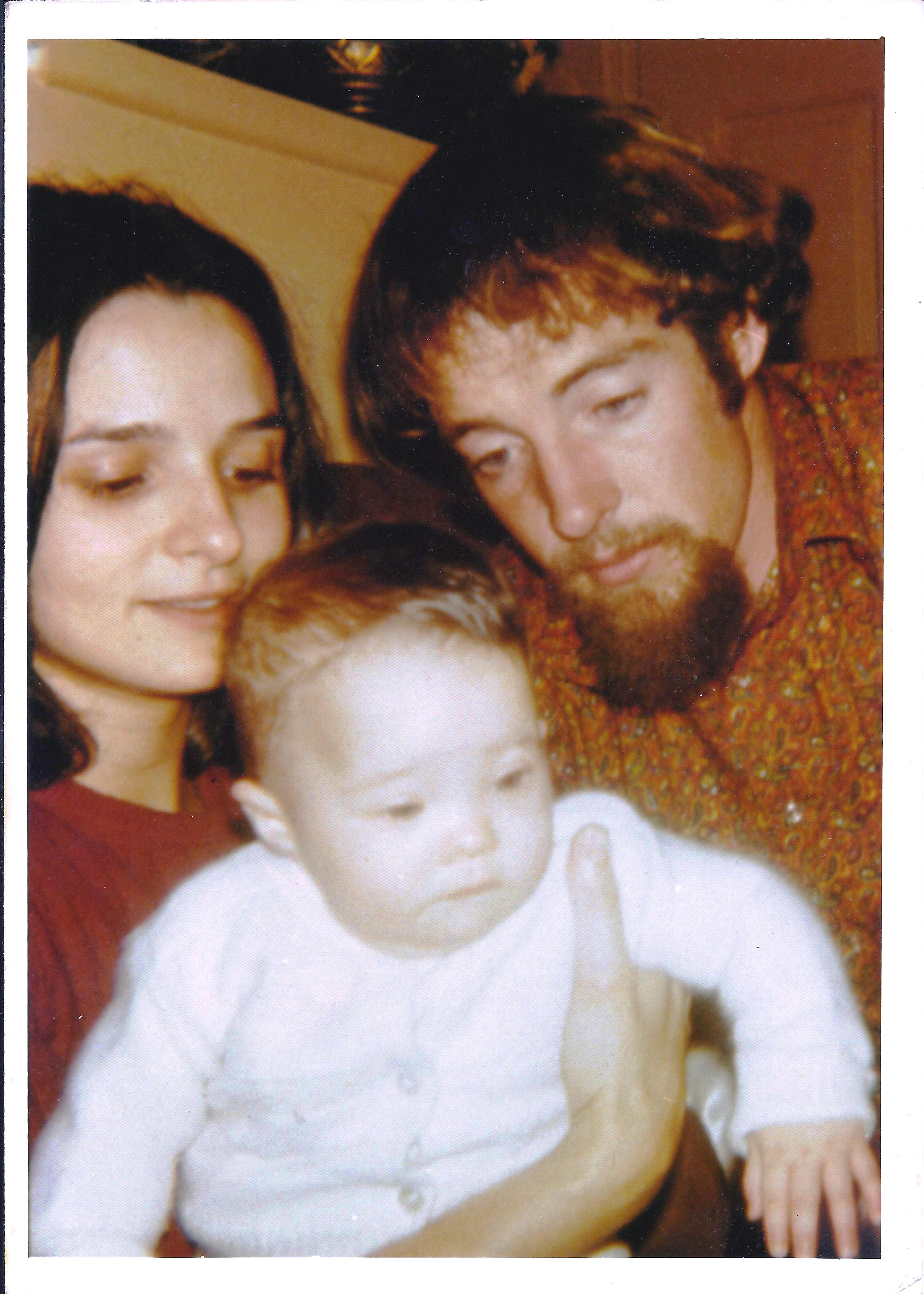
1970 with Amy

Winston Churchill most famously decreed, “If you’re not a liberal at twenty, you have no heart; if you’re not a conservative at forty, you have no brain.”  The journey we’ve made in the last forty years follows that well worn path.  Much is written about current gridlock and which political leader is most divisive, but even a cursory look at the United States demonstrates deep divisions for our whole history.  The early Republican party led by Abraham Lincoln carefully negotiated extremely tricky political waters to the Emancipation Proclamation, followed later, after his death, to amendments to our Constitution to first free, then enfranchise (at least the men) 3 ½ million Americans of African descent.

During the time both before and during a Civil War, emotions ran rampant; a pro slavery South Carolina Democrat Congressman, Preston Brooks, severely beat and nearly killed Massachusetts Republican Senator Charles Sumner with a metal headed cane on the floor of the Senate after Sumner delivered an impassioned Abolitionist speech likening slave owners to pimps.  Sumner took three years to recover sufficiently to return to the Senate.  Brooks was fined $300 and was overwhelmingly reelected to Congress by his constituents. We haven’t yet seen physical violence in Congress yet, although a few like former Senator John Edwards almost certainly would benefit from a sound thrashing.

The leaders on the liberal side of the current schism were produced through the Vietnam War and post Vietnam War periods, during which few compromises were countenanced.  In 1969, Bobby Kennedy and Martin Luther King were murdered martyrs to the anti war and civil rights movements. The eventually disgraced Richard Nixon was the President of the United States, and from the perspective of early twenties dilettante radicals like Rita and me, prospects seemed bleak.  We read rags like “Ramparts” Magazine, books by Eldridge Cleaver and tracts about the Chicago Seven. There was Cambridge, Berkeley and Haight-Ashbury, Ann Arbor and Boulder.  Because we wanted to see the Rockies, we put our few pieces of furniture in storage over Rita’s father’s garage and headed to Boulder, Colorado. “Power to the people.”

In retrospect, we were remarkably uninformed, entitled by the sacrifice of our parents, naïvely idealistic and determined to make a difference – whatever that meant.  A couple of years before, after graduating from college, my military career turned out to be a one day adventure for a physical that I failed when the Army doctors discovered I take an anti-convulsion medication due to a severe head injury from a high school car accident.  I have never had a day time incident, so it didn’t seem crucial, but it was one and out for me.  Things went Left after that.  An arm chair psychoanalyst may discern that my early job choices for dangerous work were possibly compensatory for a young man.  I was a skilled tree worker; Rita was a Boston hospitals trained RN.  Neither one of us had a moment’s doubt that we would find work out West, which turned out to be a problem solved the third day after we arrived.

Our revolutionary efforts were pedestrian and embarrassingly feckless.  One demonstration at the University of Denver; a Joan Baez concert at Red Rocks the same month she performed at a farm in Woodstock, NY (she spoke amusingly of the then Governor of California, Ronald Ray-Gun); a few joints around campfires under the black night of a billion stars on back packing trips into the mountains; a visit or two to the American Friends Service Committee (an offshoot of the non violent Quaker center for conscientious objection), and small gatherings in friend’s apartments to cavil about “the cause” and tell stories about Cam Bishop, whom I once met, a living off the land FBI’s Ten Most Wanted fugitive, who blew up the power station that fed Fort Carson.

With David and Kris Levin, our upstairs neighbors, we decided to take a week’s vacation and drive to San Francisco over Loveland Pass.  David was my chess partner at the University of Colorado Chess Club, until they threw us out when they asked us both to join their chess team, and we confessed to not being students.  He worked for the American Friend’s along with a Catholic priest, whose name escapes me.  David had been a wilderness guide in Talkeetna, Alaska, and they had lived for a while in Mexico City.  Their wanderings were not uncommon.

Driving through eastern Utah, we stopped in Vernal around midnight for fuel at an all night, coin operated gas station – two long haired couples in a worn out station wagon with a mattress in the back, so we could drive straight through to Frisco.  While there, a Camaro SS with a hood scoop pulled in with five twenty something well trimmed guys looking for something to do on a Saturday night.  We qualified as the entertainment, especially after a few beers.  As we pulled out of the station, they followed us.

What followed included huddling in the back seat with a tire iron in my hand while we held the mattress up to the window to protect ourselves from flying glass as they threw full beer bottles at the car and almost running them over when they raced ahead to block the road.  On either side of the road, there was a hundred miles of desolate nothing.

Finally they joined up with another car of their friends, and we knew it was a matter of time before they trapped our old beater.  It took three hours to drive the thirty miles to the next town; David pulled into the yard of a house with the lights still on.  David and I stayed at the car as our tormentors pulled up near us.  Kris and Rita pounded on the door of the home; the owner answered the door for our terrified wives with a lever action 30-30 Winchester at port arms.

The young couple in the house was up with an ill child, so Rita’s pediatric nurse experience was welcomed.  Once he sorted us out, the father recognized the cars parked out front with one belonging to the county sheriff’s son, who had been implicated the summer before in the disappearance of a hitchhiking couple.  We called the state police, who were at first reluctant to come, but after my non violent friend, David, threatened to shoot a few of them, they sent the cavalry.  When the police car approached with lights blaring from a long distance, both cars left back towards Vernal.  After we assured the trooper that it wasn’t just (in his words) “drunk Indians”, he agreed to look for them.  We rode in his car back to Vernal and identified the Camaro in the parking lot of an all night diner.  The trooper dropped us at the courthouse, then went and arrested five of them.

Couples and five harassers then sat in a waiting room at the courthouse for another hour and a half waiting for a judge to show up.  The ensuing conversation confirmed the implacable nature of our differences.   The smooth one was conciliatory after Rita’s pregnancy became obvious.  Another was headed to Vietnam in the Army the following Monday, which had prompted their partying.  They despised us; the hatred was palpable at first, but by the end of the hour and a half, most began to see one another as human beings.  Discussion softened, except for the departing soldier, who kept trying to start a fight, but who could blame him?

We found out a bit about life for young men in rural Utah with fast cars being the extent of available distraction; we all learned to reify the other side’s point of view through discussion held in neutral territory.   No permanent bridges, and conciliation was nearly impossible given the polarity, however all of us became more than caricatures to the other.

When the judge finally came, we filled out complaint forms.  The judge assured us we would be called back to testify when the trial came up in a month or so.  Even though it meant several hundred miles of driving through the mountains, we agreed to come back.  Exhausted, we never made it past Salt Lake City, where we rested and turned around, carefully avoiding Vernal on the way back.

Of course, from the courts of Vernal, we never heard a word.

Still dancing after all these years

For myself, I am an optimist – it doesn’t seem of much use to be anything else.  Winston Churchill.

5 Comments

Filed under Culture views

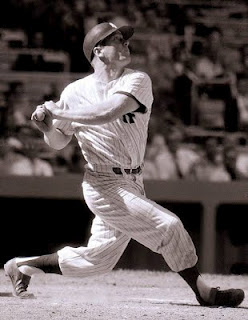
The Mick

Effortless grace

“I could never be a manager.  All I have is natural ability.”  Mickey Mantle in Great Sports Reporting.

In 1968 Tim was ten when his Dad, Bob, was given tickets to a Red Sox/Yankees game at Fenway.  Like many in Rhode Island Tim grew up a Yankees fan and Mickey Mantle was his hero.  “The Mick” was taking a farewell tour in his retirement year, and it was to be his last series in Fenway Park.  Bob managed a district for Suburban Propane, but with a wife and four boys, they had little money to spare for entertainment.  A family Sunday afternoon at Scarborough Beach was as close as Tim had been to a vacation.  Yankees games were a world of imaginings he heard on the radio; Tim had never been to a major league baseball game.

An equipment supplier offered to take Bob and their top salesperson to the game along with a night of extravagant dining in Boston.  Bob asked first the salesperson and then the benefactor if he could take his sons to the game instead.  Everyone agreed.  When Bob came home, he told Tim and his brother Chuck the news, and it was all Tim thought about until game night.

Every kid remembers his first trip to the ballpark, whether it’s Fenway or Yankee Stadium or Wrigley Field, but Fenway, the grand old “bandbox” is surely special.

Fenway at twilight

“Fenway Park, in Boston, is a lyric little bandbox of a ballpark.  Everything is painted green and seems in curiously sharp focus, like the inside of an old-fashioned peeping-type Easter egg.”  John Updike in the New Yorker on the occasion of Ted William’s retirement.  1960

Coming past the fortress front of Fenway, the boys and their father entered into the catacombs underneath the stands.  Dirty, noisy, crowded, a bewildering array of young and old, more male than female, pushing, bumping, looking at tickets and anxiously following signs to the right section.  Finally they found their ramp, ascended with the crowd, at first seeing only the twilight, the blinding high arrays of lights just coming to life, and then emerging into the aisle to encounter a breath stopping, beatific vision of green, The Wall, natural grass, base paths with freshly limed lines, dugouts full of champions and players stretching and throwing the ball around.  The boys, as all boys, were wide eyed, open mouthed, trying in vain to see it all at once.  Fenway is intimate; they felt on the field, yet it seemed immense; they were flabbergasted just how far their heroes had to bat and throw.  How high the ball went and how amazingly quickly the ball traveled from one end of the field to the other.  Untainted wonder.

Their dad led them down, down until they were four or five rows behind the visitor’s dugout. One further thrill when Dad bought hot dogs wrapped in napkins passed hand to hand down the row while the money went the other way; maybe a bag of peanuts later, thrown twenty feet by another vendor?  “Don’t drop them, Dad, they’ll boo ya!” They were close enough to hear the players shout back and forth and laugh.  Oh my, there was Mickey.

When Mantle first came up in 1951, he made $7,500 and played in the outfield with a guy named DiMaggio.  The Yankees took the World Series in four over the Giants in a subway series. Phil Rizzuto was the shortstop; Bobby Cox played third.  Mickey was an almost mythical farm boy from Oklahoma; he moved with astonishing grace and speed, a god even among all the other amazing athletes.  There was nothing he couldn’t do with bat, ball, glove or legs.  Mickey Mantle was arguably the greatest switch hitter in baseball history and a lock for a first ballot trip to the Hall of Fame with 536 home runs by the time his career wound down. In 1968 he made the kingly salary of $100,000 in the last year of his contract, and played part time first base on worn out wheels.

“I can’t play anymore.  I can’t hit the ball when I need to.  I can’t steal second when I need to.  I can’t go from first to third when I need to.  I have to quit.”  Mickey Mantle in 1968

Neither the Yanks nor the Sox were going anywhere that summer; they finished 4th and 5th in the American League the season Denny McLain pitched 31 wins  with a 1.99 ERA, and the Tigers won the World Series.  It was a tired game in a tired year, but Mickey was there, and both the Sox and Yankee fans loved him.  It was enough. Mick sat on the bench early in the game, but came in later under fan pressure.  He got a standing ovation the first time he got up.  He struck out awkwardly – a gimpy, sore guy, just a vestige of when he owned the game.  Mickey came to the plate one more time late in the game.  The crowd stood again and lifted the roof.  Tim doesn’t remember the score or the outcome, but he remembers this.

“…if I had played my career hitting singles like Pete, I’d wear a dress.”  Mickey on Pete Rose, in The Mick

The Mick fouled the first pitch back.  The second bounced in for a ball.  At the third pitch, he swung with a brief, magnificent flash of his youthful strength, balance and speed; the ball exploded towards left field.  It hit the tin of The Wall with a bang heard throughout the park, an unforgettable sound unique to Fenway Park.  Mick grimaced as he headed towards first, barely able to imitate anything near running.  A young, future Hall of Famer, Carl Yastrzemski, roamed left field like a lion and already had learned like an art form how to play balls hit off The Wall.  He positioned himself perfectly and plucked the ball in the air off the wall.  He spun to throw it in and Mickey was barely halfway to second.  Yaz pumped with the ball towards the infield.  He pumped again, and yet a third time as Mickey pulled into second base; only then did Yaz throw a rope to a grinning Rico Petrocelli covering the bag.  The fans rose as one to applaud this tribute to greatness back before baseball became “Moneyball” spreadsheets of stats and millionaire salaries.  When baseball was still America’s game.

“I would change policy, bring back natural grass and nickel beer.  Baseball is the belly-button of our society.  Straighten out baseball, and you straighten out the rest of the world.”  Bill Lee in an interview with a sports writer about the state of the game he loved.

4 Comments

Filed under Culture views

Tale of Two Doctors

When we were in our early thirties and living in Maine, Rita gave birth to Angela in Portland.  She was 2 pounds, 6 ounces at birth and 28 weeks in the womb.  She spent the next seven weeks in the neonatal intensive care units of Maine Medical Centers in Portland and Lewiston.  Angela now has two beautiful daughters of her own (Gianna and Elena), a great husband as well as a master’s degree in education.   Since Rita’s own OB_GYN doctor lived ninety miles north and near where we lived, the second year resident who delivered her was Dr. Bruce Churchill.  He carefully explained to us what to expect and that because of her early arrival, she most likely wouldn’t cry; that was the only thing he was wrong about.  Angela was a fighter from the jump.

Dr. Bruce Churchill

Dr. Churchill’s grace under pressure, skill and personal warmth will never be forgotten by us.  He was named “Physician of the Year” by the Portland newspaper in 2000.  At one point during those trying first few weeks, he offered us the second bedroom in his apartment because of the travel required by Rita’s successful effort to establish her nursing.  She initially used a breast pump and delivered frozen milk in half ounce containers, which the nurses would feed to Angela a little at a time.  When researching this post, we learned that Dr. Churchill was diagnosed with ALS (Lou Gehrig disease) in 2006, but continues to practice at the Coastal Woman’s Healthcare Center in Scarborough. He and his wife, Cindy, lead the annual ALS march in Portland to raise research funds to fight his terminal disease.  He was the varsity girl’s volleyball assistant coach at Greeley High School.  The annual girls volleyball state championship tournament has been renamed “The Bruce Churchill Classic”.  He specializes in adolescent care and menopause.  His increasing disability forced him to stop delivering babies in 2008.  Not many deserve the honorific, “Doctor” more than Bruce.

The other end of the spectrum fell in Kansas.

Kelly was fourteen and pregnant since she was thirteen.  When her baby was twenty weeks developed, and after four days in a Wichita, Kansas motel during which time her cervix was incrementally dilated, her womb and amniotic fluid were injected with a saline or urea solution.  The baby swallows the stuff; she suffers burned skin and is poisoned.  A saline poisoned baby can take up to an hour to die.  A baby at twenty weeks recognizes her mother’s voice, moves her mouth, grasps, blinks, has hair and fingernails; her gender is distinguishable with ultrasound, and she feels pain.  Kelly was taken into a room with four or five other mothers and awaited the doctor’s order to bring her to a smaller room that served as the final solution.  The nurses instructed her to sit on what resembled a toilet and push.  Her dead baby fell into the toilet.  The remains of the babies were burned in an incinerator, which emitted smoke not unlike the smoke produced at veterinarian clinics or Auschwitz. Link to interview with Kelly.

Dr. George Tiller

Dr. George Tiller owned one of the three abortion facilities nationwide that performed late term abortions into the final month of pregnancy, killing many babies as developed or more developed than our Angela. Until the procedure named as “partial birth abortion” was banned in 2003, Tiller did them. This “intact dilation and extraction” method involved turning the baby and delivering all but the baby’s head, then jamming a pair of surgical scissors into the baby’s head and opening them, finally inserting a vacuum catheter in the wound. The baby’s brain is sucked out, collapsing the skull.  After this barbarity was proscribed, Tiller was left with two still legal procedures for late term abortions: the saline burn and poison method and the other D&E (Dilation and Extraction).  The cervix is dilated and forceps are used to literally tear the baby limb from limb, twisting legs off like one would test a cooked chicken, crushing the skull, snapping the spine and pulling the baby out piece by piece.  In most states, if someone is convicted of doing this to a live guinea pig, they will go to jail for up to five years.

Tiller’s clinic performed between 50,000 and 60,000 abortions during his career, which exceeds the total number of Americans killed in Vietnam, Iraq and Afghanistan.  His father was also a physician and did illegal abortions before Roe v Wade, a mentor while young George was growing up starting a multigenerational thriving business.   Tiller made millions and donated to many politicians through his ProKanDo PAC.  ProKanDo was the largest PAC

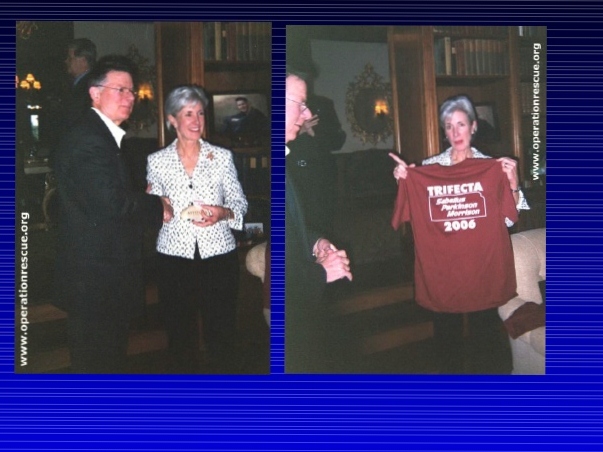
Tiller and Sebelius

in Kansas.  One of the major beneficiaries was former Kansas Governor Kathleen Sebelius, now the Obama Secretary of Health and Human Services.  She collected tens of thousands from Tiller over the years and profitably helped keep the law off his back.

Kathleen Sebelius and ??

Tiller managed to circumvent Kansas law for thirty years.  He aborted the babies of many minors and did not report the sexual abuse or statutory rape as the law requires.  Kansas law also states that two physicians must authorize late term abortions and both certify that the abortion would prevent a “permanent and irreversible injury to a major bodily function” to the mother, an occurrence that was used by Tiller in 414 cases in 2005 alone.  When these were investigated by Dr. Paul McHugh, a psychiatrist contracted by the Kansas Attorney General, he found only one or two that may have actually qualified.  Among the justifications were such things as delaying the mother’s education and missing a rock concert.  Link to Obama record on life issues

Ann Kristen Neuhaus

The abortionist who helped to certify the abortions, Dr. Ann Kristen Neuhaus, had her license to practice medicine revoked in 2012 after a six year effort, when she was found to have participated in numerous illegal late term abortions while working with Tiller.  She routinely used a computer multiple choice quiz for her psychological “evaluations”, and in some cases never met the patient. Tiller had announced his intention to voluntarily surrender his license and retire in 2009, when he was shot dead through the eye while in church.  Which church is hard to imagine.  His killer was sentenced to life imprisonment.

Tiller and Churchill.  A tale of two doctors.  Your call.

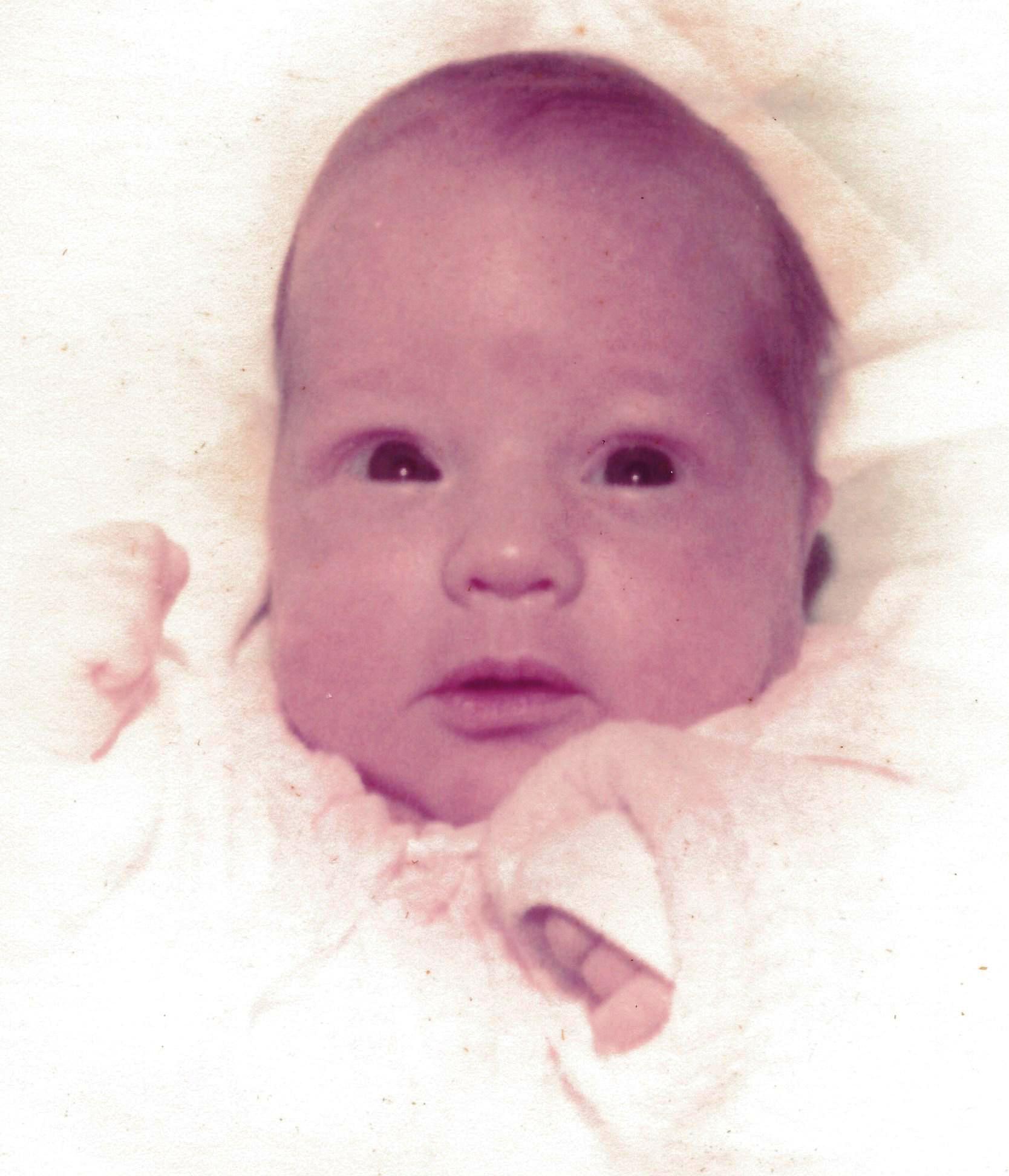
Angela and the girls

3 Comments

Filed under Culture views