Category Archives: Politics and government

Free Speech is Not Always Free

Last Thursday at the Rhode Island Statehouse, the Occupy Providence folks joined by the “professionals” from Occupy Wall Street finally clarified their muddled message a bit while shutting down the Rhode Island Right to Life Committee’s annual rally in the rotunda.  Apparently greed is bad; abortion is good.  Abortion is so good, even though it already ends 23% of pregnancies in Rhode Island, there needs to be more of them, and indeed killing our unborn children should be an entitlement paid for with public tax dollars, breaching both tradition and the law in Rhode Island.

The governor, Lincoln Chaffee, recently issued an executive order to create the health benefit exchanges mandated by Obamacare.  When the state senate refused to pass the exchanges allowing abortion funding, the good governor took it upon himself to design them with the mandated payments for abortion.  This executive order is being challenged in the courts.  The Occupiers, like the governor, prefer administrative fiat and publically funded abortions, seizing by edict that which must be the legislature’s prerogative.  This strategy of executive strong-arming is exactly what President Obama explicitly has promised us should he be reelected.  The legislature be damned.

To reinforce their message, the Occupiers engaged in brown shirt thuggery and exercised their First Amendment rights by booing down the free speech of those who would exercise theirs.  Palpable anger, whistles, bumping, bullying grandmothers and children, fist pumping and pelting the high school girls of LaSalle Academy with condoms were taken, it seems, from the playbook of dilettante revolutionaries.  The well planned, orchestrated and slowly intensifying commotion started with signs and escalated with incremental crowding of the podium and intimidation of especially young pro life speakers to the point of making further speeches or prayers impossible.

They hooted down Barth Bracy, Executive Director of RIRTL, when he was telling them they weren’t part of the 99%, but a remnant of the survivors in the 77% of their demographic who dodged the abortionist.  Father Bernard Healey, who represented the Diocese of Providence, was prevented from leading the closing prayer.  The diocese actually implemented the homeless shelter that the Occupiers have been demanding ineffectually for months from the City of Providence.  Father Healey, an affable, intelligent man with a ready sense of humor, would have liked to pray for the mothers, the babies and the Occupy Providence mob, but was prevented from doing so.

These “revolutionaries” will eventually take showers (one would hope – those nearest them at the rally told us that personal hygiene was not their strong suit) and go back to their classrooms at Brown to check on their trust funds, but in the meanwhile they played winter camping out in tents in Burnside Park and disrupted the orderly gatherings of those with whom they disagree. Perhaps the Brown University Swearer Center for Public Service would consider setting up a homeless center themselves with the dorm capacity vacated by the Occupiers.  However, I suspect the Brown public service community is more comfortable with the theoretical when it comes to helping the homeless; the messy details are best left to other than the chardonnay crowd.

Providence Mayor Angel Taveras should follow the lead of the more courageous leadership in New York and Boston.  The time is past due for the Providence police to don their Tyvek hazardous material suits and filtered masks, clean out the tents and disinfect the area for use by the 99% of Providence residents and taxpayers who used to enjoy the park.

Freedom of speech is not a sometimes thing, available only to the loud and noxious.  The vast majority of Americans greatly value the right of peaceable assembly to express to their lawmakers their most heartfelt views on critical issues.  Pity the few who don’t so value the First Amendment and overrun that right for the rest of us with adolescent tantrums.

To suppress free speech is a double wrong. It violates the rights of the hearer as well as those of the speaker.  Frederick Douglass
7 Comments

Filed under Politics and government

The Fourth Greatest President in American History (Part 1)

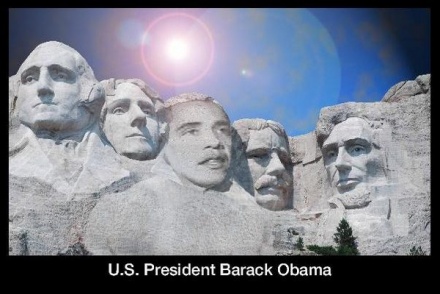
Future Mount Rushmore?

President Obama consistently differentiates Himself from mere mortal politicians. No great surprise that in his impregnable narcissism during an interview on “Sixty Minutes” he portrayed the ‘accomplishments’ of his first term as superior to any prior president with the possible exceptions of Johnson (presumably Lyndon), FDR and Lincoln.  (Click here to watch video – back arrow to return to blog.)  I am hard pressed to catch my breath with that claim.  Even CBS had to do a double take (or in this case an outtake).

Compare the Roosevelt response to the Great Depression and the Obama response to the financial crisis of 2008.  A debate about Keynesian economics is way beyond the scope of this humble blog, but FDR faced a far worse unemployment and financial crisis than we experienced in 2008.  Unemployment topped 25% with a 37% rate of non-farm unemployment in 1933.  He built permanent public works projects such as the Hoover Dam and developed a public employment program, the Civilian Conservation Corps, which hired young, single men between 18 and 25.  These men were exercised into good physical shape, trained to be more employable and accomplished multiple conservation goals in erosion and flood control, forest culture and protection, disaster relief, structural improvements and wildlife conservation – not quite the same as the nonexistent ‘shovel ready’ jobs of the Obama era. Over its 9 year history until the beginning of WWII, over 2.5 million young men had jobs, money for their families and restored dignity.  Stan Musial, Aldo Leopold, Chuck Yeager, Robert Mitchum, Archie Moore, my father and father-in-law were all enrollees.

In contrast, President Obama crafted the most egregious example of pork barrel earmarks-for- friends Federal spending in American history, over $800 billion.  His history of crony capitalism extends from the earliest years of his career.  As an Illinois state senator in his book, “Audacity of Hope”, Obama told of having his credit card declined when his law business was out of money.  His political ally and wealthy campaign donor, Robert Blackwell, paid him an $112,000 legal retainer to save him from bankruptcy.  What his book failed to note was that State Senator Obama shepherded through a $320,000 Illinois tourism grant to subsidize a state Ping-Pong tournament that benefitted Blackwell’s table tennis company.

President Obama’s long political and financial connections with the now imprisoned ex governor, Rod Blagojevich and real estate developer Antoin (Tony) Rezko as well as with millionaire slumlord and Democrat king maker Valerie Jarrett (still with him as his Senior Advisor on Public Engagement and Intergovernmental Affairs) and Mayor Richard J. Daley are well documented in NY Times bestselling author, Michelle Malkin’s 2009 book on the Obama administration history, “Culture of Corruption”.  President Obama’s roots are deeply embedded in Chicago Democrat machine politics.  The corrupt profligacy of the American Recovery and Investment Act of 2009 is no surprise, but a predictable continuation of his record.

In the interest of brevity, let’s look at just one facet of the Recovery Act, the Department of Energy’s 1705 Loan Guarantee Program and 1603 Grant Program for alternative fuel and green power projects.  As documented in Peter Schweizer’s recent book, “Throw Them All Out”, oversight of the loans distribution was not entrusted to a scientist or even an experienced Department of Energy bureaucrat, but to Steve Spinner, an Obama appointee.  Mr. Spinner was previously on the campaign’s National Finance Committee, was a significant campaign contributor and bundler himself; he sat on the White House Business Council.  The grant allocations were stage managed by Sanjay Wagle, who was the co chairperson of Cleantech and Green Business Leaders for Obama, which supplied millions for his campaign.

Of the $20.5 billion in ‘green’ loan guarantees, $16.4 billion went to companies “either run by or primarily owned by Obama financial backers – individuals who were bundlers, members of his campaign’s National Finance Committee or large donors to the Democratic Party.”  Most were early backers of his presidential run for office.  The Solyndra scandal was the most public failure ($573 million in loan guarantees), but there were others.  As you may remember 35% of Solyndra was owned by George Kaiser, major Obama donor and bundler.  The President personally went to the California factory twice to brag of all the green jobs created there.  Solyndra never was able to manufacture a solar panel for less than they sold it for.  After the bankruptcy, all jobs were lost almost overnight.

Loans often went to previously small or almost nonexistent companies.  The owners often took advantage of the credibility lent to them by the guarantees, took their companies public and cashed out.  Steve Farber, a major donor to the DNC and the 2008 convention host, along with Steve Westy, who bundled more than $500,000 for the campaign, openly advertised in the Wall Street Journal that their connections would ‘hook up’ a company for loans and grants.

Some, such as Granite Reliable Wind ($135 million), were companies directly connected to White House staff.  The company was owned by CCMP Capital, of which Nancy-Ann DeParle, White House Deputy Chief of Staff, had been the managing director.  A wind farm subsidized by the Federal government cost less than 55% of what non subsidized companies had to pay.  Grants were given to companies with less than 10% private equity skin in the game.  Normal grant approvals required at least 30% private equity investment.  The Congressional General Accounting Office found numerous incidents of a lack of transparency in the applications and favoritism to ‘friends and families’ among the winners. The GAO was ignored.

A final typical example was Leucadia Energy, which was awarded grants and loan guarantees totaling $3.5 billion for three separate projects.  The company is a subsidiary of Leucadia National.  At the time of the administration’s decision, Leucadia Energy had annual revenues of $120,000 and one employee, when it was given billions.  Perhaps not surprisingly, Chairman and CEO Ian Cumming was a member of the 2008 Obama National Finance Committee and DNC Convention Committee.  Cumming wrote large personal checks contributing to Obama campaign funds in the weeks just before the approvals.  Eighteen months later in December of 2010, exactly three jobs had been created.

Next week another aspect of this fourth greatest presidency.

“Associate with men of good quality if you esteem your own reputation; for it is better to be alone than in bad company.”  George Washington

1 Comment

Filed under Politics and government

The China Model – Handle with Care

Ambulances and vans pull to the side of a remote road and idle; surgeons and assistants wait patiently just after sunset.  Gun shots signal the onset of frantic activity.  The final few hundred yards are driven into an open area; still warm bodies of executed criminals, political prisoners and religious dissenters are carried into makeshift mobile operating facilities.  Body parts are hastily harvested with the occasional chest contraction or gasp from not quite yet dead donors.  The commodity market for livers, kidneys, corneas and the occasional heart not ruined by a bullet is lucrative (about $4,700 for a good kidney). Victims were given anti coagulants to help ensure good results and told the injections were anesthesia to mitigate pain during their executions.  The only provided anesthesia penetrated the right side of their chests at 300 meters per second from a Norinco knockoff of the 9 mm Tokarev Model 213, the reliable sidearm of Chinese officialdom.

Not some ghastly science fiction by Michael Crichton or Robin Cook, but true horror in an immense region in northwestern China called East Turkestan.   No , this story is true and was related to Ethan Guttmann from the Foundation for the Defense of Democracies by two former doctors forced into service by the Chinese Army:  Nijat Abdureyim and Enver Tohti, and was published in last week’s Weekly Standard.  They were ordered to cut deep and fast.  An estimated 65,000 Turkestan, mostly Muslim, were ‘harvested’ in the late 1990’s.  Ethnically, the original inhabitants are Turkic and now a minority to the imported Han Chinese.  More recently, this profitable sideline of culling those that challenge the state was visited upon the unlucky chosen of Falun Gong, three million of whom were funneled through Chinese corrections facilities.  Prisoners were blood tested and tissue matched before those selected for execution were lead away.  Occasionally, Chinese officials in need of a kidney or liver waited in a hospital and were matched with a not yet dispatched donor.  At the end of a restaurant interview, Dr. Tohti turned to Dr. Abdureyim, saying, “Nijat, we really are going to hell.”  His companion was silent and knocked back his beer.

When girls were born to Turkestan women, mid wives were known to inject them with “antibiotics”, which were not administered to Chinese infants.  Within two weeks, the babies turned blue and died.  If confronted, mid wives told the mothers their babies were simply not up to handling the “medicine”.  Well documented ‘one child’ policies and forced abortions by the Chinese government expose pervasive human rights abuse.  Tallying the atrocities of the Cultural Revolution, the government of China has murdered millions in the interest of the supremacy of the far left State and the People.

A second article about China this week by Andy Stern appeared in the Wall Street Journal editorial pages.  Mr. Stern is a fellow at Columbia University’s Richman Center and is the former president of the Service Employees International Union (SEIU).  According to the filing with the Federal Election Commission, the SEIU PAC was the largest single contributor to President Obama’s election campaign with over $27 million taken from the dues of healthcare, property services and public employees. Stern was appointed by President Obama to the National Commission on Fiscal Responsibility and Reform (?!?).  During his tenure, the SEIU also donated $6 million to ACORN, the community action group discredited for voter fraud.  The SEIU was deemed the “most engaged and influential” lobby for the ObamaCare bill.  Stern was the most frequent visitor to the White House during the first year of the administration – 22 times according to White House logs.   Perhaps some microbrews in the Rose Garden discussing preferred mentors of President Obama like Saul Alinsky (author of “Rules for Radicals”)?

In his editorial, Stern praises the superiority of the China model of the “planned economy” as clearly the future. The editorial is smooth and persuasively written.  “The free market fundamentalist economic model is being thrown onto the trash heap of history”.  He cites China’s ascent to become the world’s second largest economy, their 10% wage growth (although many citizens in China still live in third world conditions), their commitment to next generation Information Technology (how much is pirated is not mentioned), and he waxes most rhapsodic about their penchant for five year plans, while the “Americans are planning only for the next election”.  Five year plans worked out especially well for the late, unlamented Soviet Union.

A third “China” allusion this week is cited in a Yuval Levin National Review article. Peter Orszag, former budget director for the Obama administration, is quoted from his editorial in “The New Republic”.  He tells us we need to take power from Congress and give it to “automatic policies and depoliticized commissions.  Radical as it sounds, we need to counter the gridlock of our political institutions by making them a bit less democratic.”  President Obama has frequently said similar things, presumably as long as he controls the commissions.  He has told aides that making the changes he wants would be a lot easier if he was the president of China.  Whether ironic whimsy or a revelatory foretaste is up to you.

A favored quote of Saul Alinsky is, “History is a relay of revolutions” and another is “Power is not only what you have, but what the enemy thinks you have.”  His plan for the radicals of the sixties was to clean up, get haircuts and infiltrate through political action to the highest positions of power they could attain.  To underestimate their intelligence and determination is a grievous error.

The left is alive and well in Beijing, on American campuses like Columbia, in unions like the SEIU and on 1600 Pennsylvania Avenue NW, in Washington, DC.

“All truths are easy to understand once they are discovered; the point is to discover them.”  — Galileo

4 Comments

Filed under Politics and government

Let’s Party!

Much has been written comparing and contrasting the Occupy Wall Street (OWS) protestors and the “Tea Party”.  Both groups evidence great dissatisfaction with our current state of affairs, and each has chosen a different path to express that dissatisfaction.  The “Tea Party” leaders pay for the necessary permits to assemble, have organized effectively to influence elections, pay the costs of their own clean up and for the most part have become a formidable political force focused on shrinking a bloated and inefficient government.  The OWS leaders, where they can be identified, engage in civil disobedience, illegally squat on public land (yes, you can picture the whole graphic) and don’t shoulder the costs of their demonstrations; they are an eclectic fusion of discontent and fringe causes focused on an incoherent ideology.  At best, they are what Jonah Goldberg calls “dreamy anarchists”.

OWS embraces the full circus of the politics of alienation from militant vegans to Black (and Gray) Panthers to the deranged homeless.   Their sites in NYC and Oakland have many criminal complaints ranging from assault and theft to sexual misconduct and rape. The leaders discourage reporting to police any crime in their makeshift tent community because they spurn the legitimacy of all authority.

However, the OWS protestors are not without some rationale for their discontent.  Like their forbears of the sixties, who had some valid grievances of racism, sexism, government corruption and bellicosity, the current banner wavers find justification for their disassociation in some genuine evils.   If there is a constant in their chanting, the bogeyman is “corporate greed”.  Every day seems to expose another scandal on Wall Street or in the business community.

  • Citibank agreed to a $285 million settlement with the Security and Exchange Commission for selling risky mortgage derivatives with hefty fees to investors, then going short on the same CDOs they sold.  i.e.: They bet successfully against their own investors on financial instruments from which they benefitted greatly selling.  Goldman Sachs and JP Morgan Chase settled similar suits last year.
  • Until two weeks ago, Rajat Gupta was one of America’s most respected Wall Street directors for Goldman Sachs and Proctor & Gamble after working his way up to become the managing director of the well-regarded McKinsey & Co. consulting firm.  He was arrested and accused of passing inside information to his friend, former hedge fund king, Raj Rajaratam – information from which Rajaratam made or saved millions.   Mr. Rajaratam is currently serving an 11 year prison sentence for other offenses.
  • Solyndra took hundreds of millions in government guaranteed loans through the Department of Energy, dissipated it all and filed for bankruptcy.  One of the founding investors of the company was former Dept. of Energy official,  Stephan Spinner, who is a significant bundler for Obama campaign fund raising. Congress is attempting to subpoena Valerie Jarrett and Larry Summers, current and former administration officials, who had a hand in pushing for the loans.
  • Another major bundler of funds for the campaign is Jon Corzine, the ex Democrat Governor of New Jersey. A former Goldman Sachs director, as Chairman and CEO, he took MF Global recently into the sixth largest bankruptcy in American history.  He resigned last week amidst charges of a misplaced $600 million, falsifying financial statements by hiding debt and misappropriating client’s money.  They destroyed the investments of many by making bad, risky bets on European bonds.

OWS has plenty of grist for their mill; the problem is that they seem more intent on getting someone else to pay their student loans, beating drums, breaking windows and defecating on police cars than driving substantive reform.  This is all quite entertaining; however the causes of our discontent cannot be remedied by protests or for that matter political action in the short term.  The bleak facts are these:

  • The Federal Reserve projects that unemployment won’t drop below 8 until 2014 and real GDP growth won’t exceed 3% until at least 2013.  We ain’t out of the woods.
  • The bottom 40% of American households earns less in inflation adjusted dollars than they did in 1989.  The next 20% are about even.  The top two tiers have improved 6.4% and 17% in twenty years.  Yes, the rich are getting richer, but at less than 1% a year.
  • The concern is systemic:  a prospering middle class, which was the buoyancy of the mid twentieth century economy, was secured in well paying, blue collar jobs that for the most part no longer exist.
  • Globalization means that workers in Michigan aren’t competing for good jobs with workers in Pennsylvania or Ohio any longer; their competition is in Malaysia, Mumbai and Shenzhen.  And nothing is going to change that.  Tariffs, trade wars, higher taxes and xenophobic rants will not modify the certainty that our economy has changed, and it will never be 1950 again.

Wall Street greed should be prosecuted when it crosses the line, but if we taxed them all to penury and spent it all on government make work, what ails us will not be fixed, only made worse.  So, OWS, please call us to dream of a better world, but don’t rail against the tide and wind until the winds no longer blow and the tide doesn’t come in.  What is needed is hard work, sober judgment and the creative spirit that made America great.  We need dreamers, and even more we need doers.

Quote from a letter to George Will from William F. Buckley on conservatism:

“We must do what we can to bring hammer blows against the bell jar that protects the dreamers from reality.  The ideal scenario is that pounding from without we can effect resonances, which will one day crack through to the latent impulses of those who dream within bringing to life a circuit that will spare the republic.”

1 Comment

Filed under Culture views, Politics and government

Loose Threads

A week ago we took on the responsibility of a puppy, Teddy (after Ted Williams), a small one, but nonetheless a barking, chewing, licking, eating, jumping and enthusiastic one with all the requisite normal bodily functions.  At the moment he is (as one wag jibed) like large government: insatiable appetite on one end and unrestrained profligacy on the other.  Teddy has a chew toy, an increasingly grimy weasel with a noise maker at each end; we affectionately named the chew toy Barack.  Barack is a safe substitute for our shoes, rugs and furniture, but thread by thread he is coming apart, much like the rapidly unraveling ObamaCare bill that consumed the attention of an administration for two and a half years while the economy swirled around the basin.

Almost 2,700 pages of the Patient Protection and Affordable Care Act as amended by the Health Care and Education Reconciliation Act (ACA), which almost no one read before they voted on, consists of over 450 provisions that even the former Speaker of the House, Nancy Pelosi, famously said we would have to pass to know what was in it. And they did pass it.  Thread by thread it is falling apart.  With a return to fiscal sanity and one more election, with a bit of luck it will justifiably disappear into the trashcan of history along with other abysmal legislation like Smoot-Hawley tariffs and Fugitive Slave laws.

The first loose threads were in multiple litigations filed by many states and some private parties challenging the constitutionality of the individual mandate.  To overly simplify, the suits state that Congress overstepped its authority under the Tenth Amendment and the Commerce clause by compelling individuals and families to purchase health insurance.  These challenges are not frivolous and are being pursued with great vigor by some very talented Attorneys General.   Five district courts filed decisions to date, and all are under appeal to various Federal Circuit Courts.  Three by Democrat appointed judges found the ACA constitutional; two Republican appointed judges found it unconstitutional.  One of these found it severable (just the individual mandate would be struck down), and one found it unconstitutional and not severable (the whole bill would fall if upheld).  Because of the profound implications to our economy and future, these appeals will be fast tracked and wind their way to the Supreme Court before the next election.  This seemingly dry and arcane subject matter is of urgent importance to every family in America.

A second weakened thread you’ve probably seen on television – the American Medical Association ads with the older person desperately clinging to a large bunch of balloons high in the air as they burst one by one.  If the cuts proposed in the ACA bill are put into effect, physicians and health facilities will not be able to afford to treat Medicare patients at below their costs and won’t accept new ones.  This is the focus of the AMA advertising.  The issue is just one of the transparent deceptions of the ACA.  When legislation has a budget impact, it is ‘scored’ by the Congressional Budget Office.  The CBO is constrained by their charter to calculate the cost of a bill exactly by the provisions of the bill as presented, irrespective of realistic expectation or outright false assumptions.  In this case, the bill pretends to cut $500 billion in future Medicare costs for the elderly by savaging physician and hospital fees with a government panel.  Of course, the cynical expectation was that these cuts were never going to be implemented.  The cuts were needed to keep the CBO scoring of the bill’s cost down.  Because they will not be put into effect, this will add half a trillion to the deficit built into the bill.  Unsustainable is the cliché and the reality.

A third thread was completely pulled loose on last Friday.  Kathleen Sebelius, the Secretary of Health and Human Services, conceded that the CLASS program of the ACA bill for long-term health care is impossibly costly.  The Democrat’s hopes were that they could get it off the ground and turn it into another deficit entitlement program by sliding it into the bill.  They claimed to cut costs by $70 billion, another fabrication for the CBO and utterly, mockingly false.  Turns out only sick people want to sign up, and to fund the bill’s expectations would have cost each person who wanted to sign up about $3,000 a month.  Oops. To make this even marginally viable, they would need to sign up 230,000,000 of us at a cost of $200 to $300 a month.  To be even marginally viable, CLASS would have had to have been mandatory for all, and the required number exceeds the entire working population.  Oops.  Fortunately, retired NH Senator Judd Gregg (R) managed to insert a provision into the CLASS provisions of the bill that required actuarial proof that the long-term care section would be self funding for 75 years before enactment.  Since it would bankrupt in about 15 minutes, it didn’t clear the hurdle.

3 provisions down, 447 to go.

Chances seem to be improving weekly that this dog’s breakfast will evaporate, and the only accomplishment of the first 2 ½ years of the Obama administration will be exposed as the incompetent circus most knew it was.

There is some good news in all of this for the mainstream media Obama cheering section:  with the coming of Teddy and puppy paper training, we at last have a good reason to occasionally buy an issue of the New York Times or the Boston Globe.

Leave a comment

Filed under Politics and government

Broken Cisterns

Recent survey results describe trust in the Federal government at a historic all time low; only 17% of Americans are “positive” about their government in the latest Gallup poll, and 63% were negative.  An August Pew Research poll reported that only 22% were even “basically content” with how our leaders are running the country.  The Old Testament prophet Jeremiah admonished God’s people for their misplaced trust, “They have dug themselves cisterns, broken cisterns that hold no water.”  Broken cisterns are useless for hydration and a trap for those who are pushed into one.

Trust begins and ends at the top.  The Obama administration to date has been a crushing failure at almost every turn, most especially in managing the economy.  Beginning with the ill advised Keynesian borrowed trillion dollar stimulus that by almost any measure was a catastrophe – a boondoggle of pork, waste and no lasting jobs; he rounded the corner with the trillion dollar Obamacare 2,500 page mystery bill and is still going strong with literally ten thousand pages of new, business choking regulations from the Environmental Protection Agency, the Labor Relations Board and an inflated health care bureaucracy.   President Obama is doing his utmost to keep his promise to “fundamentally change America.”  His “hope”, however, is not keeping well and has turned sour.

If you recall, he recognized at the beginning of his administration that the massive deficit caused by Federal overspending was not viable; he pledged to cut the deficit in half by the end of his first term (see video link).  President Obama needs some remedial work on the placement of his decimal points.  He doubled the deficit and is still working hard to grow it some more.   When the opportunity arose during the debt ceiling debate to step back from the brink to make significant cuts, he instead dragged out overwrought class warfare rhetoric and, as Washington loves to do, deferred the hard decisions to yet another feckless committee.  He already had a report from a bipartisan deficit reduction commission (Simpson/ Bowles) and didn’t like what he heard, so ignored its conclusions and recommendations.  He’s still waiting to hear what he wants to hear, but his ideology keeps tripping on those ruinous and pesky facts.

After almost three years, this is now the Obama economy without a doubt. Following the much heralded (by the administration) “Recovery Summer” of 2010, we’ve suffered through five straight quarters of declining GDP growth.  Manufacturing is moribund, and housing remains a smoking, overturned hulk on the side of the tracks.  Our cisterns are leaking.  Could it be that it was simply a terrible idea to put our trust in a first term U.S. Senator with radical ideology, a record of voting “present” as a state legislator and some community organizing experience for the toughest executive position in the world?

There was another Illinois politician who did know what virtuous leadership requires.  In 1855 Abraham Lincoln was an ambitious leader in the Illinois State House of Representatives.  The opportunity arose to run for the U.S. Senate, a position he understood then as possibly his last and best opportunity for higher office.  The Illinois House would decide the outcome.  After several ballots his tally stood at 47 votes, four shy of the 51 he needed for victory.  The Douglas Democrat, James Shields, had 41; another Democrat, Congressman Lyman Trumbell, had 5.  Trumbell, like Lincoln, was part of a fragile coalition of Whigs, No Nothing Party members and anti-slavery Democrats who opposed the Nebraska Act and slavery.  The Trumbell supporters would not budge because as anti- slavery Democrats, they believed they could not be reelected if they voted for a Whig for the Senate.  After it became clear to Lincoln that even as the clear front runner he could not win, he asked his supporters to switch their allegiance to Lyman Trumbell in order to secure an anti slavery Senate seat for Illinois, which they did, some literally in tears. This coalition of Whigs, disaffected anti slavery Democrats and the remnants of the No Nothing party ultimately formed the basis of the new Republican Party.  Lincoln sacrificed his political aspirations for a moral truth – the essence of virtuous leadership.

Lincoln never addressed a joint session of Congress.  Although Washington and John Adams had done so, Thomas Jefferson submitted written remarks to be read by a clerk to the legislature. Jefferson regarded the President speaking to a joint session as too monarchial, modeled after the Speech from the Throne to Parliament in Great Britain.  The tradition of refraining from the regal persisted for over a hundred years until Woodrow Wilson revived the State of the Union address in 1913.  Perhaps another joint session is only to be expected from a President who would be king.

 This week we await yet another “jobs plan” from President Obama, another speech, his default response.  From an effective leader we might expect a specific financial plan to curtail the growth of government and entitlements with relief for small businesses and tax payers.  I sincerely hope so.  From President Obama, more than likely, it means just one more political speech with the extra pomp of a joint session just as he harangued Congress for Obamacare.  I anticipate a superfluous non event into which even the most avid Democrat will struggle to stay tuned.  Who are the Sox playing that night?

Thomas Paine, “The Crisis”, 1776.  “If there must be trouble, let it be in my day, that my child may have peace.”

1 Comment

Filed under Politics and government

Spongy Conduits

In 1995 Marvin Phaup, a Deputy Assistant Director in the Congressional Budget Office, wrote a damning report about the potential lethal risks to the U.S. economy in Government Sponsored Enterprises, specifically Fannie Mae and Freddie Mac, due to the combination of their being backed with the full faith and credit of the United States and legislation passed in 1992 during the Clinton administration that lowered their capital reserve requirements.  By lowering reserves well below any prudent guidelines required of other lenders, the onus fell on the taxpayer to pick up losses. 

The perceived security of U.S. government guarantees allowed Fannie Mae to make far riskier loans and attract investors to supply the money than otherwise would have been  possible.  The advantage generated savings and benefits to Fannie Mae of around $7 billion per year.  Mr. Phaup’s analysis of how these savings were (and weren’t) passed on to the lower and middle income borrowers inspired him to name these GSEs “spongy conduits” because of the billions that wound up in the pockets of investors and senior executives of the organizations, particularly James Johnson, the brilliant CEO of Fannie.  Over $2 billion of the annual benefit was absorbed into the organization, not passed along as lower costs to borrowers.

James Johnson, once a roommate of Bill Clinton’s at a Martha’s Vineyard strategy session in 1969 for the Eugene McCarthy campaign, was a skilled manipulator of regulators and legislators, a lightning fast and brutal negotiator.  He forged symbiotic relationships with key Democrats  like Barney Frank to keep the lens from focusing on what was going on behind the black curtain; Mr. Johnson personally made millions, placing him in the upper echelons of executive compensation.  His well funded marketing and lobbying organization sold the myth of Fannie Mae’s noble mission to put more Americans into homes.    Johnson spread a lot of money around to secure the support of politicians and advocacy organizations like ACORN.  He and Bill Clinton fashioned the National Partners in Homeownership in 1994, and we were set on the path that greatly damaged our economy 14 years later.

Fannie Mae cranked up its formidable lobbying and public relations machine at the first hint of a threat to the channel of taxpayer guaranteed money.  Mr. Phaup was maligned, even spreading rumors of mental illness, when he (and then CBO head, June O’Neill) couldn’t be intimidated into mitigating their report as many other skeptics had backed away during Johnson’s lucrative reign.  When unable to alter the report, Fannie leveraged its cronies in congress and the main stream media to suppress the report’s significance.

In 1999, it got worse. A “beaming” President Clinton signed into law the Gramm-Leach-Bliley legislation that finished off the 1933 Glass-Steagall Act, which had protected consumers and investors from fraudulent bankers for over six decades: the much criticized deregulation of banks and investment houses that blurred the lines and gutted the rules.  The bill was backed by financial luminaries like Alan Greenspan, longtime head of the Federal Reserve, and Lawrence Summers, then Treasury Secretary and later senior financial advisor to Barack Obama.  The Bush administration bought into the fairy tale of home ownership for those who couldn’t afford them and the train rolled on undeterred.

A blog post is too limited to explore the multiplicity of greed from homeowners to mortgage brokers to bankers to investors to politicians with the labyrinths of Credit Default Swaps and Collateralized Debt Obligations.   I suggest reading Gretchen Morgenson’s and Joshua Rosner’s “Reckless Endangerment” and Michael Lewis’ “The Big Short” for a much more comprehensive viewing.

The point of a synopsis of the roots of our ongoing problems is Mr. Phaup’s superb “spongy conduits” metaphor.  Big government and its unwieldy, huge bureaucracy full of self serving czars and drones are spongy conduits by their very nature.  The current occupant of the White House is a particularly wearying exemplar (see Norman Podhordetz’s WSJ  current editorial), but the truth remains: only limiting the money and power that government accrues and misuses can control the creature.

Canada saved its economy with severe austerity measures in the last decade by doing deep government cuts and layoffs.  Government jobs shrunk, entitlements dwindled and the unemployment rate, even with shedding many public jobs, dropped.  Now Canadian currency has rebounded from an almost 30% discount to the American dollar to parity and even a premium.  Texas is a domestic example of what a partnership between limited government and private business can achieve for economic growth and job creation.

It’s not that government makes plenty of mistakes (which it does) or even that it’s full of corruption and greed (which it is), the benchmark is the entity itself: its size and power.

George Washington wrote in a letter to General Phillip Schulyer during the earliest part of the war for American independence.
“We must do our best with Mankind as it is, not as we wish it to be.”

3 Comments

Filed under Politics and government

Structural Borders

As much as I despise retail shopping, I have two guilty pleasures in this regard: hardware stores and book stores, both of which can hook me for as long as my wife will tolerate.  She is far more patient in book stores because we share the attachment.  In the romantic comedy, “You’ve Got Mail”, Tom Hank’s mega corporate bookstore puts Meg Ryan’s “The Shop Around The Corner” out of business.  Like its 1940 forbear, Tom and Meg fall in love as e-pen pals, just as Jimmy Stuart and Margaret Sullavan fell in love in the original movie as snail mail correspondents.  In the real world, however, so many shops around so many corners felt the axe when Borders or Barnes & Noble set up down the street with few regrets from the big company.   I have fond memories among the shelves of those specialty stores.

Friday, Borders itself failed to emerge from last winter’s Chapter 11, and all their stores began final liquidation sales.  E-readers, Amazon, the expense of running brick and mortar stores and the intense schedules of harried shoppers spending more of our discretionary income on the internet were too much to overcome.  Their late entry into e-commerce, unlike Amazon and B&N, left Borders laboring to catch up, and they never did.

Will the eccentric bibliophiles who tend to staff even the corporate stores slide off into impracticality and the ranks of structural  unemployment?  I most ardently hope not.  We will be culturally poorer for the loss.  Along with librarians, these engaging, lovely folks are resources that enrich our lives.  In our home, we buy, borrow and read fifty or more books a year, and add another dozen or more as gifts.  How gloomy it will be to bid farewell to pleasant browsing of friendly books among kindred spirits.  As regular buyers of books on line (some from Borders) and an ardent e-reader user, I feel a bit complicit in their obsolescence.

If these gentle souls join typewriter repairers, wagon wheelwrights and many who once worked in our factories in that most intractable category of structural unemployment, they will add to an increasingly troublesome segment.  Estimates are that upwards of 8 points of the 9.2 points of unemployment rate consist of those who need work but have skills which are necessary less and less frequently.  Following the recent financial crisis, the United States added double the percentage of its citizens to the unemployed than any other Western country.  Some of these were cyclical, albeit long term, in construction and housing related  categories, but an alarmingly large group cannot find work doing jobs in which they were once so capable because those jobs have been displaced by technological advance or off shore competition.  They are structurally unemployed.

One of the most distressing aspects of the persistent high jobless rate is the long duration laid off workers spend looking and hoping and looking some more.  Some simply give up; others acclimate to unemployment and extended benefits.  They are discouraged and fenced in by limited or specialized (and increasingly less needed) skills in the accelerating pace of change in business.  That curve is likely to continue to steepen.  The percentage increase of structural unemployment among those looking for work for more than twenty six weeks is far greater than the increase in structural unemployment for those who have found jobs in less time.

The current administration has done precious little to address this crisis.  New manufacturing and new products require substantial capital investment, which is indispensable to generate competitive productivity.  This expense will create well paying jobs, or at least jobs which deliver sustainable income.  The ruinously expensive and feckless efforts of the Obama  administration focus on quick fix, unshovel ready jobs and fattening the minions of government to enforce and ladle on job killing regulations.

Misnamed health care reform and thousands of pages of new regulations to implement an ideological agenda bring about burdens crushing growth in private business.  The long term, serious work of encouraging cash investment waits largely ignored.  Political posturing, spin, hissy fit press conferences and blame placing frustrate those who would innovate and those who sit and wait.

We will persist, however, in hope and to read and to learn.  My wife, Rita, remains resolutely faithful to paper and bound books; many, however, are dropped on the back porch by FedEx.  She gets regular thank you cards from Amazon.  As is my habit, I stockpile a small treasury of books to enjoy on my vacation in late August.  Already three are set aside with great anticipation:
ready to read on my Nook.

7 Comments

Filed under Politics and government

Separation

We face an organized, well funded and pervasive effort to separate God from government.  The separation of Church and State is a baseline tenet of our Constitution.  However, an objective student of American history knows the intent of the Bill of Rights was not to sever God from American life, but to proscribe a state sponsored church as was the case in England at the time of the Constitution. This unhappy marriage leads to censorship, persecution and prejudice, if not violence. Many came to the Americas to seek the freedom to worship as they pleased.

Constitutional separation of Church and State notwithstanding, it was implicit in the worldview of the founding fathers and  authors of the Constitution that faith and human consciences formed in moral principles were inherent to the functioning of a democracy. Whether Deist like Thomas Jefferson or committed traditional Christian like John Adams, all agreed that a healthy and vibrant republic would persist provided the citizenry who governed (and their representatives) were educated on the issues and shared unyielding common moral values fostering honesty, hard work, keeping promises and active, informed participation in self rule.

Only a population which agrees on universal virtues, embraces necessary self sacrifice and eschews unbridled self-interest is worthy and able to govern itself over time.   Absent these virtues, as de Tocqueville aptly observed, democracy risks collapsing into anarchy, tyranny or some uncontrolled variation of mob rule (e.g. The French Revolution or the carnage of the 1918 Russian White and Red Armies).   The essential soundness of mind, spirit and faith of the American people enabled and ennobled the great American experiment.

To attempt to disconnect our discourse in the public square from faith is dangerous in the short term, and fatal in the long term.   Amusing atheism full of the glib, caustic wit of ‘plausible liars’ is well entrenched in academia and popular media.  This deluge has “educated” our young people for two or more generations. Vigilance, discernment and knowledge are central to our cultural survival.  As the old sergeant on “Hill Street Blues” used to say, “Be careful out there!”

A muddle of “I’m OK, You’re OK – every stray opinion is of equal value” lives out there in books, movies, TV, magazines and the internet.   Fertile ground is created for the kind of confusion that prevails in clever wordplay on the topic.  In other quarters religion has been downgraded to feel good soporifics. Little wonder why the young are uncertain and adopt what is easy – doing nothing.  Why commit to or be challenged by or form their consciences on cotton candy: sweet, pretty and utterly devoid of substance?

Our culture seems to have fallen into a disturbing contradiction:  we love things, and use people.  In that darkness, we will benefit by perceiving the light of the Ten Commandments not as strictures or fun spoilers or prissy; they are guidelines to growing in virtue.  As woeful as we can be at living virtuous lives, we incrementally progress in this lifelong pursuit only through relationships – with God and with each other.  In the process of grinding and polishing our way to virtue through relationships, we make it possible to live together with mutual support in a political structure called democracy.  Virtue gives our lives worth and the structure to embrace freedom.  Without virtue, democracy seeks order in dangerous places and will be lost in one tyranny or another.

7 Comments

Filed under Politics and government

Gideon’s Army

That helpless sensation when we read the political news originates in the misunderstanding that one person’s voice is lost in the cacophony that threatens to overwhelm all public discourse. The sensation is real; the underlying perception is not. On a local level, while legislators are beleaguered with fund raising and reelection, most of them remain sensitive to their constituency. If you truly want an education, spend a few dollars and attend a fund raiser: what is humorously labeled ‘a time’ in little Rhody. Access is cheap.

If specific legislation elicits more than a couple of phone calls or emails to a local legislator, their interest is piqued. When an issue prompts a dozen or twenty constituents to weigh in, the hallway whispers and nervous cell phone calls can pass a tipping point. The scramble to a safe harbor will alter a vote or relegate newly proposed, damaging law to a quiet death in committee. Threatened with a looming vote for which they will be accountable to the electorate, many politicians will opt to cut a coffee shop deal, avoiding a potentially exposed position.

Anyone who has testified at a public hearing of a state level House or Senate subcommittee probably has witnessed the arrogance of power or experienced the derision visited upon the citizen who dares to challenge those who hold it. Irrespective of the gauntlet, fear of public embarrassment, even humiliation, is not justification for lacking the courage to speak up. The correct response to the self satisfied incumbent is to give them pause with the united voices of a committed few.

In the Book of Judges, God directs Gideon to reduce his army of 22,000 to defend His people from the hoards of Midian, Amalek and the Kedemites. The first cut to 10,000 sent home all who were not experienced, courageous warriors, any who were afraid. The Lord told Gideon that even fewer were needed for His purpose. The final winnowing seems at first to be mysterious: He instructed Gideon to observe his troops after a long hot day, when they came to a source of water. Those that knelt to drink with their face in the water were sent home; those who scooped the water to their mouths and lapped it from their hand were retained for the battle. What is the significance of this screening?

With no informed theological basis I believe the criteria were these: those that lapped the water from their hand remained watchful and wary; they controlled their thirst to maintain vigilance against threats. Self control, intelligent observation, relentless watchfulness. All were warriors; only three hundred did what was necessary. The few remaining were sufficient. They still are.

3 Comments

Filed under Politics and government