Tag Archives: Maine story

Maine Anecdotes

“The only thing I knew how to do

Was to keep on keepin’ on like a bird that flew.” Bob Dylan “Tangled Up In Blue”

Center Hill panoramaOur two weeks in Maine were nostalgic and new. Old friends, encounters with abundant wildlife, vistas that cause me to catch my breath at any moment around any corner.

Early one morning we were sitting with three of our granddaughters on the little beach on Webb Lake in front of their camp, when all three yelled out something like “Whoa.” A bald eagle was pumping hard and powerfully to regain altitude with water dripping from its wingtips, rising from the lake with a fish in its talons. One of the many of various species of ducks we like watching there was beating wings furiously in the other direction from the same point of origin, clearly panicked. I wasn’t sure of the species since it was moving away with undue haste. The duck flew startlingly fast and low, barely clearing the water’s surface.

The girls told us the eagle had stolen the fish from the duck. Probably it was a merganser if that was what happened, since they will eat larger than the other common ducks on the lake like mallards and wood ducks.  The eagle may have plunged while hunting right next to the shocked duck. Mary told us from “Wild Kratts”[i] that bald eagles prefer fish above all other prey. The duck was fortunate that the eagle’s culinary preferences did not include waterfowl that morning, and a full grown duck would be a talon full for an eagle. Eagles don’t often miss what they spot to eat. Their diving into the water is fast and deadly. It was an indelible moment, unrecorded as my phone was back in the camp. That’s all right, maybe as it should be. The image remains.

A couple of evenings later we were driving back from our almost nightly visit to Center Hill lookout over the lake (panorama above); as we were passing through the center of town (one store), a pair of white tail deer jumped in front of us. We always travel slowly while going through town and were easily able to avoid a collision. The buck with the rack was chasing the doe; neither were as large as they can be. But perfect, tawny, sinewy, beautiful. We looked over to the small field adjacent to the house on our right. The flirting couple were dancing, bumping, playing, cavorting, four legged straight up hops in sheer fun, oblivious to our observing them.  It was a joyful moment but remains unrecorded as my phone was in my pocket. That’s all right, maybe as it should be. The image remains.

“I ain’t got no window, ain’t got no door

But I can feel sun shinin’ where it’s never shined before, never shined before

Feel sun shinin’ where it’s never, never shined before

But I’m still climbing up the mountain side

You can’t count me out

Long as I got my heart and soul

I got everything, I got everything I need

Everything I need.”  Keb’ Mo’, “Everything I Need”

The temptation is to idealize Maine and idealizing is not without some justification, but that would be trivializing and unfair. Unfair to the wonder of the place and the variety of its people, unfair to anyone reading this. Like most stories, it’s more complicated than that.

Cannabis stores seem to be everywhere now. I counted at least two dozen of them. In the city. In small towns. Along country roads. Most of them look shiny, have professional logos and signage, and have more than a few cars in the parking lot. When we lived here so many years ago, weed was illegal, and weed was everywhere too, but it was in service of a rebellious panache, a naïve ‘rebellion.’ Many I knew grew their own in their garden or up in a hidden clearing behind the house. Almost everyone I knew rolled a joint or picked one out of a bowl at a party from time to time: back to the land hippies, local town young people, artisans, poets, and professionals. So did I, for a while, but I gave it up in my late twenties; an occasional recreational hobby began in Boulder a couple of thousand miles west of Maine and ended in Mount Vernon. No single, articulated reason to stop; it just didn’t seem worth the lethargy in the morning. A casual quit.

 Now that cannabis is commercialized on nearly every corner, smoking weed has lost its outlaw attraction and sunk into just another way to get high on Saturday night. Or Tuesday. Along streets in clapped out mill towns that no longer have a mill, next to the prosperous cannabis storefronts, idle men and women slump on the wooden stairways of three story faded tenements with despairing faces staring vacantly back – prematurely aged with few signs of hope.

“I guess there’s nothing left for me to do but go get stoned

Let the past paint pictures through my head

Might drink a fifth of Thunderbird and try to write a sad song

Tell me baby why you been gone so long.”

“Why You Been Gone So Long,” Mickey Newbury, Eleven Hundred Springs

On a whim coming back to the lake from church, we decided to explore some roads we hadn’t driven in decades, taking a longer way home through the hills. We took the Temple Road, and dead reckoning navigation told me that we could find a shorter way home from Temple once we got there.

But I’ve grown citified and dead reckoning made me nervous where once it would not have been so. Google Maps solved that, and sure enough it highlighted the most direct route back to Webb Lake. We struck out resolutely on the Intervale Road, turned north on Day Mountain Road, which ran into Jackson Mountain Road. Somewhere along the Day Mountain Road, we ran out of pavement, but that didn’t discourage us. Roads in Maine in rural areas frequently turn to well-maintained gravel roads where cars routinely travel at forty five miles per hour.

Unfortunately, that wasn’t Jackson Mountain Road. Hard packed smooth gravel road became loose gravel road, washed out in ten foot fissures, but able to be negotiated on one side or the other at ten miles per hour – too narrow for two cars to safely pass. Then more washed out, but barely navigable with great care. Five miles per hour.  The slope got close to forty five degrees-not straight up, but it felt like it. The camps were fewer and sketchier or abandoned. Finally, the camps ran out and a handwritten “dead end” sign was tacked to a tree.

My trust in Google Maps was shaken, but not stirred. It was always reliable, right? I was still on the blue lighted way. Local signage must be wrong or outdated. What do people who live here know that surpasses the AI wizard behind the black curtain? I kept going. Rita was increasingly skeptical. Finally at the top of a very steep almost impassible run of a quarter mile, a culvert was completely gone, replaced by a four foot drop across the road. Fortunately backing down the hill fifty feet or so, there was a turnaround. Slowly back to Intervale Road and turned left towards the town of Strong. A bit to eat at the good general store there across from the large factory making fuel for pellet stoves. Finally, paved state highway two lane roads all the way to the north end of Webb Lake.

Rita, as I have often given her cause to be, was patient, albeit with a sly smile or two on the way back.

“Then we’re rollin’ on

Rollin’ on

Feeling, better

Than we did last night

Rollin’ on rollin’ on

It’s hard sometimes, but

Pretty much it’s alright.”  “Rollin’ On,” Emmylou Harris and Mark Knopfler


The day before we packed up for home, we drove over more excellent back roads to our old hometown in Mount Vernon, about a fifty minute pretty ride through hills, farms, and lake country.  I was reminded of why I love this place so much.  On the shore of Lake Minnehonk downtown in the building where we once went to pick up our mail, there now is the Post Office Café and Bakery. We met friends from nearly fifty years ago, Alan and Donna, for breakfast. An outstanding place, we sat at a clear finished maple table by the back windows and looked where I walked out one frozen night to do battle in what became known as the Swordfight on the Lake.[ii]

We are decades older now than when Donna used to come over to our place to watch our kids for a few hours two afternoons a week. Rita was working as a labor and delivery nurse forty minutes away in Augusta part time from three to eleven. I was on the road for a commercial lumber company and got home about six most nights. Donna’s kids, Autumn and Oak, would play with our first two, Amy and Gabriel, while Donna lovingly minded everyone at our house until I pulled in. Autumn was the plague of Gabe’s elaborate Lego creations. She delighted in destroying them. Good memories now.

At the Post Office Café, two hours passed in a moment, the conversation picked up as if it was forty years ago. Alan is a successful serial entrepreneur who grew up in Mount Vernon. Back in the seventies, he had a chainsaw and a log cutting business with skidders and trucks. Buying the rights to clear somebody’s woodlot and selling the product to local sawmills and paper mills. Poplar to the paper mills, hemlock, spruce, and pine to be sawn into boards. Hard work. Brutal work only for the strong. Later he slightly altered course and became a skilled contractor. Alan still builds custom homes for folks in the area. He starts with a wooded, difficult lot, and ends with a beautiful structure to provide shelter for his clients.

We laughed, got quiet, remembered, talked again. Caught up. Told stories. One favorite was about the time Alan came into Rita’s flu clinic when she was serving as the town health officer. A rough flu year, and the vaccine was causing some severe and notorious reactions that year. All the old folks in the folding chairs were nervous. Alan, who looked like he could bench press a Buick, lined up, got jabbed, took two steps, spun around, and dramatically crashed through some chairs to the floor in front of the horrified onlookers. Rita ran over to him. Only she recognized that prostrate Alan was quivering, and his shoulders were shaking. As he laughed. She compounded the confusion in the room by kicking him and calling him a decidedly uncivil name.

We talked of kids and grandkids, joys and disappointments. About local people we once knew well, many no longer above the ground. Nostalgic and new. Enjoyed the food and the company immensely. Reconnected seamlessly.

“It is one of the blessings of old friends that you can afford to be stupid with them.” Ralph Waldo Emerson

[1] “Anecdote” is derived from the Greek “anekdota” meaning “things unpublished.

[i] For those without kids around, “Wild Kratts” is a popular partially animated children’s program that teaches them love for and knowledge of many wildlife species.

[ii] https://quovadisblog.net/2022/09/18/swordfight-on-the-lake-redux/
2 Comments

Filed under Maine Tales

Body Surfing

“Always marry a girl from Texas; no matter what happens, she’s seen worse.” I first heard this from Pete Seeger during his concert at Symphony Hall in Boston in the late sixties.

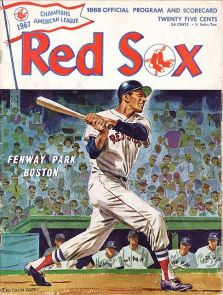
~1967 Red Sox program

The latest generation of fear filled waders with their water shoes and 50 SPF might well miss their big chance. Sometimes you just jump into the wave and ride it out. We married way too young at twenty and fifty-seven years later we’re still trying to work things out. According to current standards we did everything wrong. No pre-nup, no separate accounts – bills paid in cash out of envelopes without one for savings, no student debt because we were paying as we went with tuition paid from my summer tree climbing job. Rita was working as a registered nurse while I finished school. All in. One old beat-up car we shared with no payments, third story walk up railroad apartment, no savings account, nothing held back, in love and glad of it. She wasn’t from Texas, although I’ve known some strong women from Texas, so I’m pretty sure the quote above is true. No, Rita was a nurse, and the saying applies: Always marry a nurse because no matter what happens, she’s seen worse.

We had no carefully planned house carefully furnished, or even a budget outside of hastily scribbled categories and weekly amounts on the envelopes, and no plan for every contingency we could worry about. Twenty-five bucks a week into the “Rent” envelope. Ten into “Food.” Five into “Electric” Five into “Phone.” Five into “Entertainment,” which was spent for an occasional movie downtown or an impulse trip to the State Street Fruit Store for a fifty-cent hot fudge sundae. Sometimes when the urge struck after we went to bed, I was sent out to bring a couple of them home – whip cream, nuts, and a cherry included. Everything cost much less, and wages as always barely kept ahead of them.

Our one extravagance was the KLH stereo and turntable we bought with our wedding money. Vinyl. Eclectic. From Van Cliburn’s Tchaikovsky’s First Piano Concerto to Bob Dylan and Joan Baez to Dave Brubeck, Doc Watson, and Mozart. Stupid happy. Lots of hugs. Lots of cuddles. Still a lot of hugs and cuddles, sleeping like spoons. Some hard times later. Mistakes and some heartaches. And good times. Many more good times. Some challenging waves; some thrilling ones too. Very few regrets. Wouldn’t change a thing.

The first summer after we were married at Blessed Sacrament Church, which is where we both had our First Communions, the Red Sox won their first pennant in twenty-one years. The time before that was in 1946 when Ted Williams returned to Fenway from WWII. Before that it was two years after my father was born in 1918 when they traded away the Babe. No series win for another 34 years after that pennant. My father, a lifelong fan, never saw a series win. But he and my mother were visiting us in Northampton when they clinched the pennant in 1967. Yaz. Rico Petrocelli. Reggie Smith. Jim Lonborg. Tony C. George Scott.

Everyone came out of their houses. All the church bells in town were ringing in jubilation. Rita climbed up on my shoulders, and I started to sprint down the sidewalk dodging the crowd like a running back. She pulled my hair to stop and started to laugh. Laughing so hard she wet her pants and warmed my neck. Got angry at me for the wet pants. I loved her so.

Ah yes, All in. Jump in the wave with some good timing and the ride is exhilarating. From a distance, the observer doesn’t perceive very rapid motion, but inside the break is very different. The sound of the surf and the rush of the water in your ears, the power of the thing. You’re flying, carried along by a surge of energy that built up for a hundred miles, then breaks when gravity overcomes speed, and the shore slopes shallow. Some rough rides, some smooth, occasional misses and the wave passes over you. But, God, jump in. Hesitate when the right wave comes, and you will never see another one like it. There is no substitute.

“Sing me a melody,

Sing me a blues

Walk through the bottomland without no shoes

The Brazos she’s running scared

She heard the news

Walk through the bottomland without no shoes

Won’t you walk through the bottomland without no shoes?” Lyle Lovett[i]

We rode many waves over the years. Some tested us sorely. One memorable ride was in 1983, the year after our third child was born in April and my father died on his birthday in December. We learned once again what it was like to ride a wave that was an invitation from God.

We visited a Catholic community while at a conference during the winter in Providence, Rhode Island and met some folks who later would become close friends. We sensed a strong sense of belonging, but we already had that in Maine and could have stayed for the rest of our lives.

In the spring of 1983, all our little family – Rita and I with the three kids (only Meg who wasn’t born yet was missing) went on a four-day Easter retreat in Augusta when we were living in Maine. We had felt a prompting of the Holy Spirit to move back closer to our parents who were aging: my recently widowed mother and both of Rita’s folks. And perhaps a call to dive into a wave carrying us into deeper waters in our faith. We loved small town Maine, our parish, my job; I resisted. But in the prayer journal I kept each morning, the readings kept coming. About caring for parents. About God gathering His people. About journeys of faith. Give me a break, Lord. I like it here!

Finally, after much hesitation, on Holy Saturday, I managed to meet with the retreat director, Father Bourque (no relation to the Boston Bruin All Star defenseman.) We talked for a half hour around eleven o’clock after everyone was in bed. He had a pronounced French-Canadian accent. I showed him my journal, hoping that he would tell me to get real and stop making myself crazy. The job market was terrible, we were just coming out of a recession, and the real estate market was worse. Houses in our county were lingering for up to a year until the sellers got tired and cut their prices severely. He looked at me with startlingly deep blue eyes and said, “I think God wants you to move.” My heart started pounding. Not my plan.

He suggested that since moving a few hundred miles with my family to uncertain places in uncertain times was serious business, I should do some testing to make sure of our discernment. Ah, I thought. A good out. But his test turned out to be not trivial. Father Bourque looked at me again, “Since times are hard, test the waters for a job down there, and if that looks promising, put your house on the market.” How about something a little safer like a wet fleece[ii], Father? This test is a commitment to the wave before it breaks. “Look for the job, sell the house,” he said.

We do understand that we don’t always understand; responding and traveling in the Will of God is always in the end faith in the unknown trail, and there are brambles, stumbling stones, and blind corners. On our return Monday, I called my boss in Boston. I was on the road selling commercial projects for a large regional lumber company, making Boston wages, but in a much less expensive cost of living situation in rural Maine. Life was settled and going well. But the invitation and wave were calling. Since I was in good standing in the company, the most comfortable testing of the job waters was calling the office. “Warren,” I said, “Just thinking of maybe exploring a larger market. What have you got in say, Southeastern Mass, or Rhode Island or even Cape Cod?” “I like what you are doing in Maine,” he said, “but if you need to make a change, I’d love to have you in Rhode Island. I just fired the guy there on Friday.” I remembered what a skilled veteran told me once: don’t bother to learn their names until they’ve been here at least a year. It’s a tough business.

Be still my heart. That’s one of Father’s discernment keys, but houses stay on the market here for a long, long time. We’re still safe. I called a friend who was a real estate agent in town. Ed was my tennis buddy and not encouraging about us moving, but he said he would put a satisfactory price on it from a seller’s perspective and list it if I insisted and had lots of patience. I did insist and would be happy if my patience was infinite. We had a full price offer in five days. The wave was breaking and moving much too fast for comfort.

When we made a second visit to confirm the community, we were invited to stay with a family who would soon become dear friends we love to this day. On a walk in the neighborhood with the baby, five houses down the street, we came upon a realtor nailing up a “For Sale” sign on a less than thriving street Norway maple tree. The owner had died two weeks before, and his sister who now owned the house was selling it quite a bit below market because, while solid and well built, it was sixty years old and needed major updating – needed a new kitchen, a new bathroom, refinishing the oak floors, painting all the walls, rewiring and replumbing. But the roof was good, the furnace sound, the full Douglas fir two by four framing superlative. Made an offer. Accepted in a day. Done deal.

Easter retreat. By Pentecost we were living in Providence with a lot of work to do. That’s what body surfing can be like. The rush of power is beyond your ability to control. Moving faster than you thought you could. Twenty yards closer to the beach in five seconds.

That’s what body surfing with God can be like.

Sachuest Beach Surfers end

One more recent short body surfing story that ties back to the opening quote from Pete Seeger about girls from Texas (and nurses). Earlier this year, I was body surfing at Surfer’s End on Sachuest Beach (See picture from my cell phone). At 77, Rita was reading a book and sort of keeping an eye on me. She was skeptical that body surfing was the best use of my time at our age.

The key to body surfing is timing. It’s all timing. Hit the wave just as it breaks, and you can go a long way. Jump into it too early, and it passes you by. Too late, and it breaks ahead, rapidly fizzling out in front of you while you turn to wait for the next one. Thrashing and frantic swimming to catch up is useless. There are other possible outcomes. Lose sufficient attention and the wave smashes your face into the sand. Forehead scrapes that look like someone touched up your forehead with a belt sander loaded with a 24-grit belt. They can bleed profusely but without any real lasting injury other than cosmetics. I bled. Came up out of the water. Good thing there were no sharks about. Waded toward shore splashing the cleansing and cooling salt water on my head. Blood running down my face.

Rita glances up and looking concerned walks down to the water. “Always marry a nurse because no matter what happens, she’s seen worse.” It’ll all be OK now. My nurse will assess the damage. Her face goes from concern to something else. I am starting to worry about spending the evening in the emergency room. She struggles to control her emotions. She tried to resist; she really did. Then she bursts into laughter. “I told you, dummy.”

“To me, when you go body surfing, it’s a way of simplifying everything. It’s just you and the wave and the experience. Life is a balancing act.” Mike Steward, champion body surfer. From a Surfer Today article.

[i] Superb video with the incomparable Emmy Lou Harris providing in the harmony. Walk Through the Bottomland

[ii] See Judges 6:33-40 in which Gideon tests God’s promise of victory over overwhelming enemy forces by laying out a fleece for dew.

2 Comments

Filed under Faith and Reason, Personal and family life