
“In a liberal society that values the moral and legal equality of all persons, the undocumented are impossible subjects, persons whose presence is a social reality yet a legal impossibility.” Mae N Ngai, “Impossible Subjects: Illegal Aliens and the Making of Modern America” 2003

The Wave at Coyote Butte
On our recent annual Maine pilgrimage our great good fortune was to visit with our former pastor, Father Joe McKenna, now retired in Portland. Our conversations are always wide and deep about various topics ranging secular and religious. Never a disappointment to be with him.
A good storyteller, he told the tale of his Irish forebears who immigrated first from County Monaghan in Ireland to Prince Edward Island, then answered the call for jobs in the mills of Rumford, Maine. Thousands of immigrants, mostly French Canadian and Irish came in a similar way to build railroads, build textile and paper mills then run the machines in them all over New England.
From Prince Edward Island, they often traveled via the PEI Railway to the Borden–Cape Tormentine ferry, then Canadian lines to Quebec/Maine connections. The Grand Trunk Railway/CN line into Lewiston was a gateway for the workers—locals even called the Lincoln St. depot a mini “Ellis Island.” Trains from Quebec (and Maritimes connections) dropped people steps from “Little Canada” in Lewiston. An hour or so north, they would arrive in Rumford, and the McKenna family’s new home. Father Joe worked as a pipe fitter in the paper mill for a while before college and the seminary.
Before 1924 nothing was required to go to work in Maine mills from Canadian citizens except willingness, diligence, hard work, and a train ticket. Pack a bag or two, buy a train ticket, go to work. They came for an opportunity to work hard and flourish, for themselves and most especially for their families. No different than most that have come here for the last four centuries. Moving into company housing at first, then many would build homes, and a new life. Establish parishes, build churches with their own hands, create social clubs, dance on Saturday nights, volunteer in their communities, help their kids with their homework, have block parties. Their kids and grandkids were birthright citizens, many of them fought and died for America in combat, worked in the mills, and many would pursue other vocations becoming the first in their families to graduate from college. Irish lawyers, doctors, college professors, legislators, and an occasional president.
The mills and the mill owners needed workers to produce the lumber, textiles, paper, and other products that American consumers wanted. The workers needed opportunity and a solid foundation on which to build a life for their families. Such a simple transactional confluence of interests built the most prosperous country in the world, perhaps in the history of the world.
“Give me your tired, your poor, Your huddled masses yearning to breathe free.” Inscribed on the bottom of the Statue of Liberty, from the poem “The New Colossus” by Emma Lazarus
Before 1924, U.S.–Canada land borders were comparatively loose; seasonal and circular migration for mill work was common. Most came with no identity requirements or identity checks. Many would go back and forth as the work allowed with no visa requirements. The U.S. Border Patrol was only created in 1924, and many Canadians living in the U.S. before then later “re-immigrated” formally in the 1940s to regularize status. The process for that normal and relatively painless process was established in the Registry Act of 1929. People who entered before June 3, 1921, had a clean record, were “of good moral character,” and were not deportable, could create an official arrival record using a simple form (659 “Record of Registry”) without leaving the U.S. Many Canadians in mill towns did this in the early 1930’s. Many wanted to be full citizens who could vote and participate in local government. Straightforward, relatively simple, and considerate of their humanity, the registration process was common sense. America was happy to welcome the productive workers she needed to grow.
A blog post is a poor instrument to track the whole history of border law and enforcement since then.[i] Complex, inconsistent, confusing, chaotic, political, rife with conflicting ideology and rancor on all sides. This is not a suggestion that the recent history of unenforced law and virtual open borders was effective or salutary. A nation to be a nation must have borders and rules for crossing them – who qualifies and who doesn’t. Recent efforts by the current administration to secure what was insecure were necessary and long overdue, and the resulting human drama from the long absence of such a border is heartbreaking.
But there is even more heartbreak with what has ensued since the border was shut down hard.
“(A)n irrational fear, hatred, and hostility toward immigrants has been a defining feature of our nation from the colonial era to the Trump era.” Erika Lee, America for Americans: A History of Xenophobia in the United States (New York: Basic Books, 2019)
Most of us have an aversion to statistical arguments, but in this debate, they are inescapable. Compounding the difficulty is finding solid sources for the numbers; after all, “undocumented” means undocumented. What is presented here are reasonable approximations from the best sources I could find. Here’s a few that are verifiable from usually reliable authority but with the caveat stated above. Vulnerable populations are not lining up for the census takers. or surveyors. But in the critical agricultural labor sector with a perennial shortage, about 40% of workers are undocumented and 79% of them have been here longer than ten years, 2/3 of them longer than 15 years. Across all labor sectors, most of which have an increasing shortage of experienced labor, such as construction, landscaping, and hotel service, there are significant numbers of undocumented workers. Over 66% of all undocumented workers have been here over ten years.
I worked in and around the construction industry for over forty five years and can tell many tales of these workers. Some are funny, some poignant, some personal. Some of the finest people I have ever worked with or met probably come up short with documents[ii]. What I can say from deep experience is absent the contributions of these workers, much less would be getting built in America and at a much slower pace. Much more could be written, but I only want to present a general outline for a broader view.
One more set of stats is needed for additional perspective. The major justification for the mass incarcerations and deportations has been the much publicized stories of horrific crimes committed by what the administration refers to as “illegal immigrants.” The common inference is that the preponderance of the undocumented are a danger to the rest of us. Gang members, terrorists, murderers, rapists, child traffickers, carjackers, awful people. No one would ever object to rounding those miscreants up and dropping them down a deep hole. But is that the norm for these people without papers? Actual numbers from the most comprehensive studies to date that have been done in Texas show that just under 80% have no criminal records and many of those crimes are traffic offenses, DUI’s, and misdemeanors. The real numbers of felony conviction rates from the Texas study funded by the Federal Department of Justice show that native born citizens have a felony conviction rate of 1,422 per 100,000. The comparable tally for undocumented immigrants was 782 per 100,000, which is about 55% of the native born rate.[iii]

ICE agent Photograph by Olga Fedorova_AP
Masked ICE (Immigration Control Enforcement) agents are busily scooping them up. Some are much publicized criminals and gang members. However, the big numbers come from raiding meat processing plants, farms, landscape and groundskeeping crews, then going after construction jobsites and day laborers at big warehouses and Home Depots. New ICE agents are being recruited as young as 18 years old with a $50,000 signing bonus to quickly ramp up the number of agents. There are leaked internal memos citing a 3,000 per week target or quota; a number that has since been denied by those that wrote the memos. In the early days of the roundup the documentation for those who had been arrested showed that 50% had criminal records; by June, that had dropped to 30%. As conservative influencer and podcaster Joe Rogan protested, we expected them to take murderers off the street, but we are now arresting landscapers, construction and Home Depot workers. Reports are that 60,000, many formerly employed and paying taxes, now languish in makeshift barbed wire camps in substandard conditions called celebratory names like “Alligator Alcatraz.”[iv] What could go wrong?
“The search for a scapegoat is the easiest of all hunting expeditions.” Rene Girard “It is not an accident that the victims are always chosen from among those who are in some way different, vulnerable, or powerless, and therefore not easily able to defend themselves.” – from interviews with Gerard by Alain de Botton[v]
There is still a darker side to this: a long sad history of scapegoating in our immigration policy and politics. What is happening today is just one more dismal chapter of how to get elected by placing blame for our unhappiness and dysfunction on a convenient tackling dummy. When any human beings are downgraded to being moving pieces on a political battlefield, bad things happen. When a large group of human beings are feared, blamed, vilified, dehumanized, and degraded based solely on their immigration status, not on the individual’s record or “moral character,” we have lost our way.
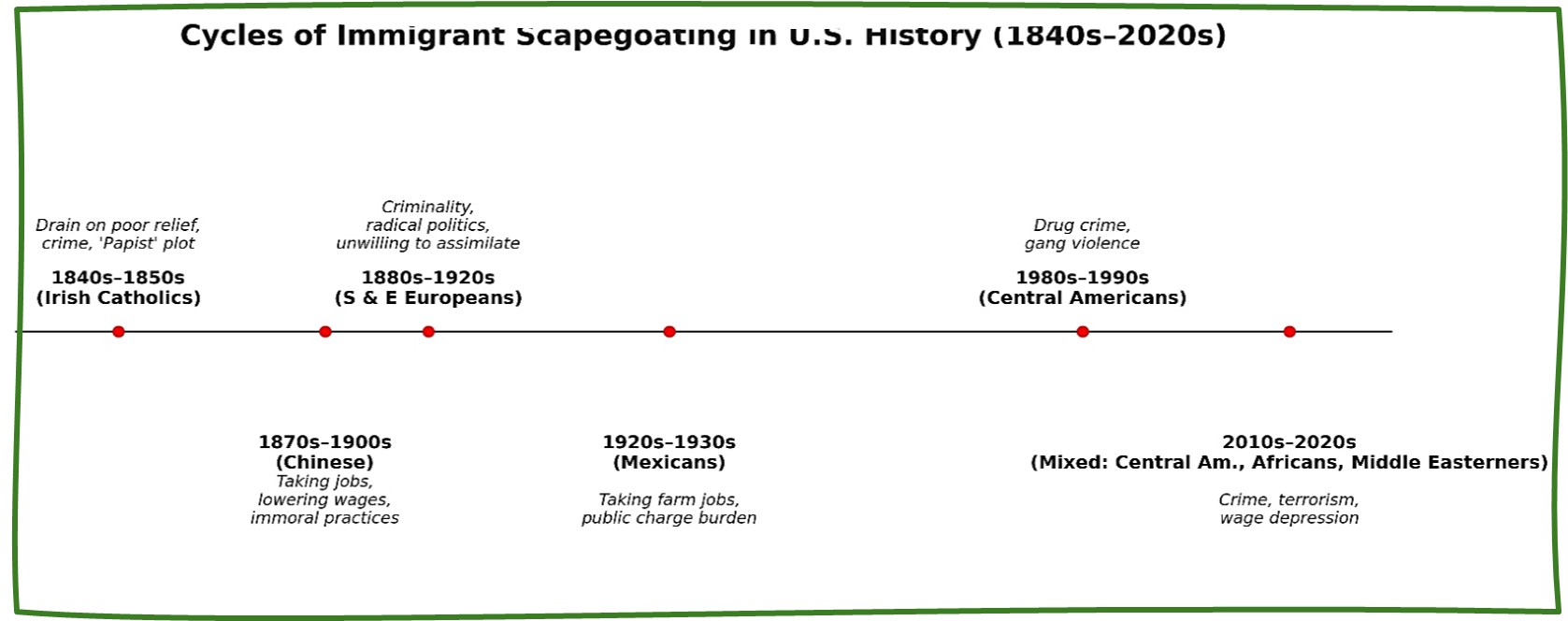 Whether it was the common signs, “No Irish Need Apply,” of the mid nineteenth century or the derogative “WOPS”[vi] reference for Italian immigrants in the late nineteenth and early twentieth century, when new large groups of a particular ethnicity immigrate to America, the fear and loathing of the unknown soon emerges among us and is leveraged by politicians with their wet finger in the air looking for votes.
I do not advocate open borders, secure borders should be a given, but a cautionary note about how we handle millions of the people who live here now and have for a decade or longer. Do we need to round out secure borders with a system analogous to the 1940’s registry as more humane, more just, more common sense than the big roundup? Not to be described both inaccurately and mockingly as “amnesty,’ but a better way to treat those that share our neighborhoods, join us in worship, pay taxes, create families and do what immigrants have always done here: make America great[vii].
“You can go to live in France, but you cannot become a Frenchman. You can go to live in Germany or Turkey or Japan, but you cannot become a German, a Turk, or a Japanese. But anyone, from any corner of the Earth, can come to live in America and become an American.” Ronald Reagan’s last speech as President. (Transcript. Video excerpt.)
[i] Don’t’ take my word for it. Do your own short research on comparing the various 1929-1940 registration acts and the 1986 Immigration Reform and Control Act (IRCA) for a sense of how complex and misunderstood now out of date these laws are, and none of which remotely solves the current morass. Google or ChatGPT or your favorite bot will do. It’s not hard to find.
[ii] Here’s one such personal encounter from a blog post at least a dozen years old. Selvin.
[iii] U.S. Department of Justice–supported report, “Unauthorized Immigration, Crime, and Recidivism: Evidence From Texas (2012–2018)”, provides arrest rate data across several felony categories:
Violent crime arrests (2012–2018):
U.S.-born citizens: 213 per 100,000
Undocumented immigrants: 96.2 per 100,000
Drug crime arrests:
U.S.-born: 337.2 per 100,000
Undocumented: 135 per 100,000
Property crime arrests:
U.S.-born: 165.2 per 100,000
Undocumented: 38.5 per 100,000
Homicide arrests:
U.S.-born: 4.8 per 100,000
Undocumented: 1.9 per 100,000
[iv] Judge orders much of “Alligator Alcatraz” dismantled.
[v] https://scapegoatshadows.com/alain-de-botton-rene-girard/
[vi] The common understanding is the derivation of the insulting WOPS characterization as With Out Papers is false. It came from an overheard and misunderstood enthusiastic greeting of Italians to one another.
John Ciardi, Browser’s Dictionary:
”WOPS is a “Pejorative name for an Italian. . . . From the Italian, south-of-Rome dialect, guappo, dude. Introduced into America c. 1900, [H. L.] Mencken cited guappo as a common form of greeting among Italian immigrants. It was never that but a rather jovial exclamation when a man showed up in his flashiest Sunday best: che guappo! What a dude! . . . (The commonly offered derivation W(ith) O(ut) P(apers), with reference to immigrants at Ellis Island is nonsense.)”

 Quo Vadis Blog