Tag Archives: politics

perspectives from a few steps back

“It is better to take refuge in the LORD

than to trust in man.

It is better to take refuge in the LORD

than to trust in princes.”   Psalm 118: 8-9

 Papa standing at the rimIf we had lived in the Roman Empire, which lasted about 500 years as the Western Roman Empire and another thousand or so as the Byzantine Empire based in Constantinople, we would have expected that daily life probably would never change[i].

If I was a carpenter in a village outside of Rome in the year 200 AD, I’d get up before dawn for a simple breakfast of bread, cheese, and water, and gather my wood and iron tools, some I had made, some I inherited from my father and grandfather.  Off to work making doors or furniture or a larger project in a team like an aqueduct. Return home at the end of a taxing day, maintain and clean my tools, readying them for the morning, a supper of fish or grains or occasional meat. Time with my family, a quiet conversation about the kids with my wife, or perhaps head out to the tavern to debate the games or the latest battles up north or the comely suppleness of the new barmaid. A few times a year, if I was so inclined, I might head off to the games. Gladiators, animal hunts, spectacular and gruesome executions, maybe a few of those annoying Christians thrown in among the hungry lions, bears, and tigers.

I would expect my sons to follow in my trade, join the guild, learn the skills. As I had. As my father and grandfather had. There would be a sense of inevitability and the survival of my culture, a natural permanent order of things that always were and always will be. I might complain about the excesses, stupidity, and corruption of the current emperor, grumble quietly to friends or family that I trusted. My best hope might be that an illness or assassination would bring about a change in the emperor. That there would be no emperor would probably never occur to me. I’d have little understanding of the eventual effervescence of every system or culture.

We bicker, fuss, complain about, and regret (or perhaps celebrate) the recent election or the woeful character of the choices presented to us, but do we spend any effort on the why or whether or the finitude of the fragile and vulnerable structure of the society that spawned such an election? Are we bedeviled by the trees and unaware of the danger to the forest? Are the smoldering coals in old fires even now biding time until a little breeze fires them into a conflagration?

But we ought to consider that we may be in a period of profound change that historians will regard as the collapse of a civilization. Not to panic, the transition may be several centuries in the making and another in the denouement, but for we who are living in it, a lasting confusion may accompany us throughout our lifetime.

“Schism in the soul, schism in the body social, will not be resolved by any scheme to return to the good old days (archaism), or by programs guaranteed to render an ideal projected future (futurism), or even by the most realistic, hardheaded work to weld together again the deteriorating elements [of civilization]. Only birth can conquer death―the birth, not of the old thing again, but of something new.”  Joseph Campbell, “The Hero with a Thousand Faces” commenting on Arnold Toynbee’s “A Study of History.

Why does the disruptive populism of a Donald Trump resonate with seventy million voters? One contributing factor is the sense of powerlessness and disconnection of so many. Why are depression, drug use, and loneliness at historically high levels, especially among the young?

We wander around in a time afflicted with “presentism.” From a Rusty Reno article, “Resisting Presentism”, on the fallacy of naively looking towards a perfect future while ignoring the hard earned lessons of the past: “We live in a time of hot takes. Websites rush to post commentary of the latest Trump nomination. Denizens of X and other social-media sites swirl in cyclones of denunciation and attack. Everything is keyed to what’s happening right now. The latest triumph. The latest outrage. The latest meme.” And this societal addiction by its nature leaves us terribly anxious in a constant knawing state of feeling unmoored.

A culture of self-invention, radical subjectivism, and materialist utilitarianism is what we have. A seething cauldron of conflicting values with no umpire who everyone accepts to call balls and strikes or who is safe or out because there are no agreed upon rules. Or commonly understood definitions for that matter.  We are a society of dueling egos and wills in a Nietzschean or Hobbesian nightmare. Some of our disagreements leave little room for compromise because they are so fundamental. A warm baby or a fetus torn asunder before she can draw a breath.  A man somehow changed into a woman or a surgically mutilated, permanently sterile male human body with missing parts and now committed to a lifetime of taking debilitating artificial hormones while still suffering from a tormenting mental illness.

Blame social media, the computer in everyone’s pocket, coercive and intrusive government and institutional reeducation, ideological programs that undermine trust and family structure, the deep and growing hostility and anger in the culture split along ideological lines, the twenty four hour alarmist news cycle, the predominance of nihilism, violence, and exploitive sexuality in popular entertainment, ubiquitous, addictive, and ever more degrading porn, fatherless households, racism, sexism, transphobic animus, Big Corporations, Big Pharma, billionaire tyrants, elite technocrats running our lives, lack of gun laws, too many gun laws, far right extremism, far left extremism, Nazis in the woodshed, communists in the Senate, forever chemicals in the water, overpopulation, death spiral birth rates, or pick your lead story of the day. Reasons for societal unhappiness are not in short supply and reducing our woes to one or the other also breaks along ideological fault lines.

We are the confused mess that is living through the death of one civilization and the unknown beginnings of the next.

“It’s a restless hungry feeling

That don’t mean no one no good

When ev’rything I’m a-sayin’

You can say it just as good

You’re right from your side

I’m right from mine

We’re both just one too many mornings

And a thousand miles behind” Bob Dylan, “One Too Many Mornings.”  1964

 In July, a post here discussed in detail the weakening infrastructure of Sagging Bridges in our home state of Rhode Island. The physical deterioration of what we rely on every day was a metaphor for the deep-rooted breakdown of what we rely on every day for our societal coherence.  Like the road bridges, the bridges of our civilization – their pilings, supports, beams, and the strength of what keeps us from plunging into the river are corroding and creaking a bit each time they are driven over.[ii]

I’ve been fascinated by the various and unlikely voices over the last couple of years who are lamenting the loss of a “Christian civilization,” a culture with objective truths and values, a culture with defined borders, and agreed upon norms of behavior.  Defining for its members what’s good and what’s evil. Defining a solid foundation of an agreed upon understanding of the nature of human fulfillment and happiness. Among these are Richard Dawkins, one the four horsemen of the new atheism, Jordan Peterson, social influencer extraordinaire and still on a spiritual journey, and Bill Maher, celebrated TV host, comedian, atheist, and mocker of all things religious. Others too. They understand the loss and turmoil of living in a post Christian culture but fall short of understanding what is required. They think that we can build a vehicle to the future by our own efforts. Perhaps a few tweaks and little Kantian categorical imperative. Similar to me trying to fix my car with a YouTube video, a screwdriver, and vice grips.

“Said the Lord God, “Build a house,

Smoke and iron, spark and steam,

Speak and vote and buy and sell;

Let a new world throb and stream,

Seers and makers, build it well.”   G.K. Chesterton, The Kingdom of Heaven

 They understand the loss and turmoil of living in a post Christian culture but cannot bring themselves to acknowledge that the center of a Christian culture is not a set of rules, boundaries, and definitions, but a relationship with a Person.[iii] A Christian culture without Christ is incoherent.  We will try in vain to build a tower to heaven as did the people of Babel.  Don’t we ever learn?  A tower buiilt with our own tools  isn’t what is needed, but a road, a path, a Way.

The road to heaven is already leveled and built. We must learn to walk on it.

 “And everyone who listens to these words of mine but does not act on them will be like a fool who built his house on sand. The rain fell, the floods came, and the winds blew and buffeted the house. And it collapsed and was completely ruined.”  Matthew 7: 26-27

[i][i] Other cultures have lasted even longer than the Roman civilization. The folks who lived in them probably never foresaw any different state. Here are a few.

[ii] In that post was some discussion of Patrick Deneen’s insightful 2018 book “Why Liberalism Failed. A worthy read which asks the question has liberalism failed because it succeeded? Its failure was preordained in its premises.  The book was praised by such diverse reviewers as Barack Obama and Rod Dreher.  Rather than reiterate what’s already been written, read last year’s post in the link above or better, read the book. Another powerful book on a related theme was Charles Chaput’s 2016 “Strangers in a Strange Land.”  How does one begin to live an authentic Christian life in a post Christian culture? Way too much for a blog post, I suggest strongly for your reflection and to gain deep insight into our times, read the book. Accessible, wonderfully written and powerfully insightful about what we are living through, yet the book is hopeful about where peace both inner and corporately can be found.

[iii] A brilliant debunking of “Christian civilization” without Christ is in the current First Things issue. “Against Christian Civilization” by Paul Kingsnorth. Taken from his Erasmus Lecture a few months ago. Well worth your time.

1 Comment

Filed under Culture views, Faith and Reason

perspective

Someone left the cake out in the rain

I don’t think that I can take it

‘Cause it took so long to bake it

And I’ll never have that recipe again

Oh, no…. Jimmy Webb, “MacArthur Park”

[i]We have survived the election of 2024 (so far). Some are fleeing the country and heading to more stable Perspectivesociety – like France or Somalia. Some are pledging to shun and have no contact with family, friends and neighbors who voted for the winner (which does not bode well for some marriages, block parties, and Thanksgiving dinners). Some are joining the “4B” movement[ii] of women who are shaving their heads and pledging no men, no dating, no sex, no marriage, and no children.

This seems counterproductive to long-term societal health in a nation nearly 25% below the replacement rate necessary to sustain the population and programs like Social Security and Medicare. Not to mention sustaining a trend to run out of consumers in a country that is centered on consumerism. Creating together in solidarity a joyful future full of hope. Makes sense to me.

And so it goes.

“In framing a government which is to be administered by men over men, the great difficulty lies in this: you must first enable the government to control the governed and the next place, oblige it to control itself.” James Madison, Federalist Papers

The campaigns of both parties, never a bloodless affair, were dispiritedly acrimonious. Opponents were not merely variously fascist, racist, murderous, communist, or tyrannical; they were evil instruments of the devil, irredeemable and odious. We all lived through the recent campaigns in which the Harris campaign raised and spent over a billion dollars in direct funds and around six hundred and fifty in outside PAC spending. The Trump campaign raised about three hundred and eighty million in direct campaign funds and another seven hundred and eleven million in outside PAC spending.[iii] That’s an astonishing jackpot and a lot of ads we sat through. And been polled about. And identifying which voters were likely to support the candidates, then trying to turn them out. Vitriol ruled. Accusations flew. Lies abounded. I was very happy to see the backside of that.

We hate politicians. We want principled leaders who are courageous, articulate, calm, and not noisy faultfinders. We want statesmen, but they are scarce. What we have are opportunistic candidates who tell us what we think we want to hear depending upon the audience that day. Not a recent phenomenon, but seemingly endemic in our system of governance; this sorry state is – in the end – the nature of representative democracy.

“With exceptions so rare that they are regarded as miracles and freaks of nature, successful democratic politicians are insecure and intimidated men. They advance politically only as they placate, appease, bribe, seduce, bamboozle, or otherwise manage to manipulate the demanding and threatening elements in their constituencies. The decisive consideration is not whether the proposition is good but whether it is popular—not whether it will work well and prove itself but whether the active talking constituents like it immediately.” Walter Lippmann, “The Decline of Western Democracy”, Atlantic Magazine, February 1955.

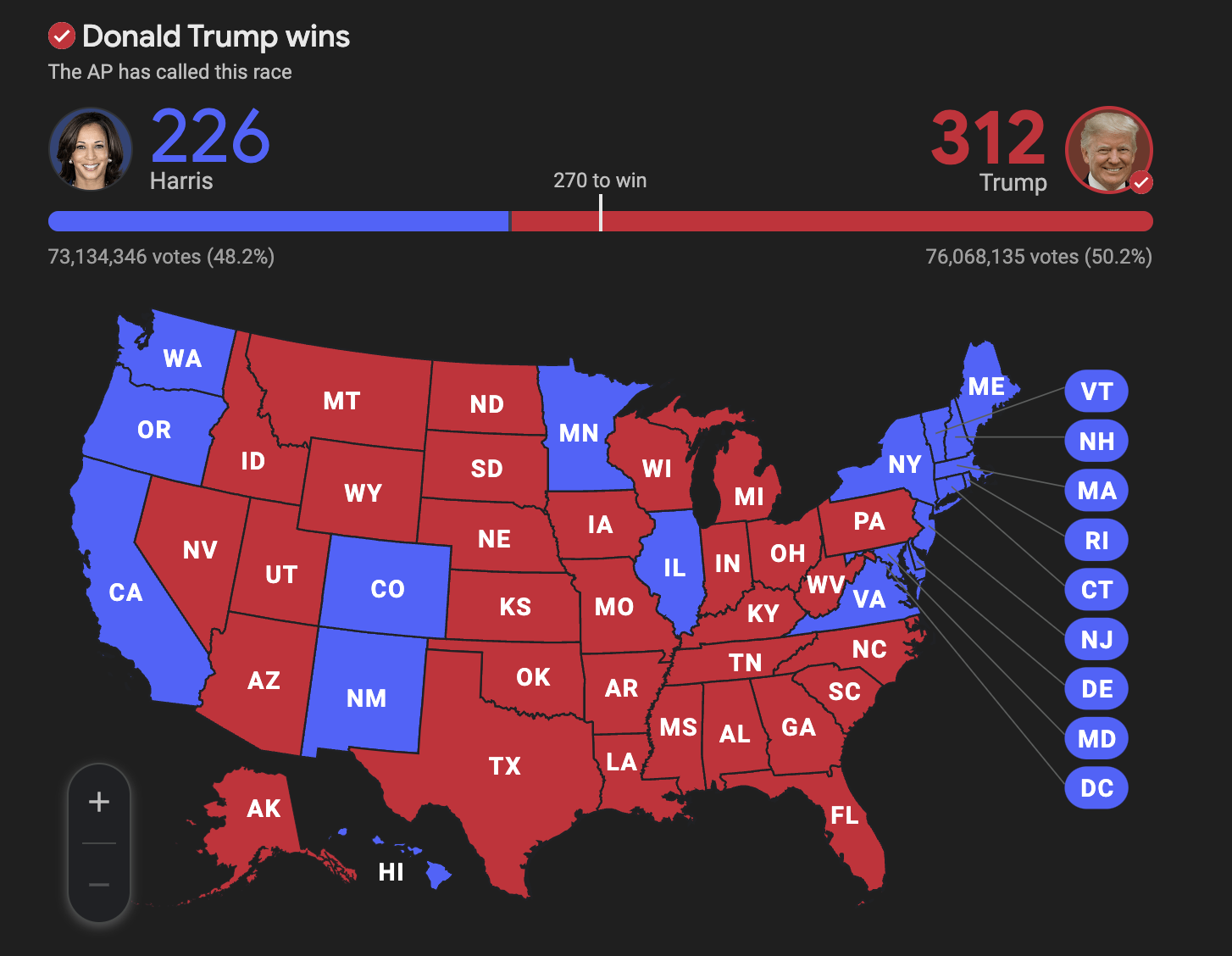
election map

An alternative to despair (or elation) after the election might be to take a deep breath, look at the results and learn, maybe change course. With a cursory look, the Red Wave seems to have been decisive, a trifecta, Executive Office, Senate, and House. There is some evidence to support triumphalist gloating. In the electoral college, President Trump captured 312 out of a possible 538 and Kamala Harris a distant 226, a remarkable gain of 80 delegates since his loss in 2020 and a percentage gain of nearly fifteen percent. Tsunami scale.

However, once we look at the detail, it gets a little murky. The margin of total voters was slim, under two percent, and after the multiple third party candidates are factored in, he didn’t have a true majority over fifty percent. The Red Wave means something, but it is more a pronounced ripple. Except for four states, the left – right split is not hard to decipher. Two percent of voters make the difference; of course, there was a whole lot more than that in geography.[iv] Mostly the coastal elites v the ‘basket of deplorables’ in flyover country.

There is something else going on, and an election of a disruptive and off-putting real estate developer and game show host is not going to solve all our problems and cure all our ills.

Two thirds of the voters in the country think we are headed in the wrong direction. Our leaders seem not to recognize the struggles of those who don’t go to wine tastings in enclaves like Georgetown. Despite all reassurances of a recovered economy, most of us are aware that accumulated twenty one percent inflation since 2020 is painful. We get nervous every time we go to the grocery store. Paying the credit card bills and keeping nutritious food on the table for our kids and taking them to the doctor when they need it seems to be ever more at risk.

I won’t reiterate what people better informed and smarter than I have covered with well-reasoned insight.[v] See the footnotes below for links to some good sources with which you may not be familiar.

“What people want to be governed by a ruling class that holds it in contempt? What historical precedent is there for a lasting culture whose story-makers are embarrassed by their own ancestors? How can any culture continue into the future if it is teaching its children a deeply disturbing form of racialised self-loathing?” Paul Kingsnorth, “The Abbey of Misrule” Substack, “The Faustian Fire,” April 28, 2021

The seemingly irreconcilable divisions of polity and principles have not abated. If anything, the passions of the election have widened the chasm. For politicians, the political process, the legacy media that once served as a de facto fourth branch of government to keep legislators honest and voters informed, and in the immense Federal bureaucracy scornfully referred to as the ‘deep state,’ trust is at an all time low point. Approval ratings of the current administration were in the thirties. So, an unlikable and unlikely challenger who himself has approval ratings just better than small plastic bags full of dog excrement left on the side of a hiking trail made an historic comeback. His disapproval ratings approach ‘fear and loathing’ among his many detractors. The election has been resolved; the divide that separates us has deepened.

Seventy five plus million voters chose a problematic candidate, a blustering disruptor with baggage. Why would they do so? The obvious answer is in the previous citation that just under seventy percent of us think the country is headed in the wrong direction. We want a disruptor who promises to shake the foundations and to fix us. We’re unhappy with a paycheck to paycheck wallet and not sure we can pay for groceries if we make our car payments. We’re unhappy with a national debt that exceeds our mortgage per household[vi]. We’re unhappy with our credit card balances growing so rapidly to keep ourselves temporality afloat – currently all together at $1.17 trillion, a daunting high water mark. We’re unhappy with Federal agencies holding enormous power seemingly targeting political enemies. We’re unhappy with incessant, ideological ‘wokeism’ incoherence, which is increasingly detached from what most see as reality. We’re unhappy reading about and experiencing that agenda being forced upon the institutions of our society: our schools, our government, and even private businesses. Out of our control to deter – so much seems out of our control and beyond our power to affect. Desperate measures – we elect as savior a serial liar and (possibly) reformed exploitive womanizer who calls people ugly names. What the hell is wrong with us?

We’re unhappy with the government we’re living under, and the politicians hold their own subjects outside the Beltway in transparent contempt. That we would willingly choose such a flawed and self-absorbed candidate, one so laden with hubris and flamboyant braggadocio, insulated by surrounding himself with sycophants,  cries out that we are in trouble and see no easy path out.

But choose these people we do. We don’t trust them, and they don’t trust us.

We ask our representatives to accomplish the impossible with effortless grace while looking telegenic, then we disdain them and call them evil. Who would apply for such a job?

“The third and most significant source of pressures which discourage political courage in the conscientious Senator or Congressman… is the pressure of his constituency, the interest groups, the organized letter writers, the economic blocs and even the average voter. To cope with such pressures, to defy them or even to satisfy them is a formidable task. All of us occasionally have the urge to follow the example of Congressman John Steven McGroarty of California, who wrote a constituent in 1934: One of the countless drawbacks of being in Congress is that I am compelled to receive impertinent letters from a jackass like you in which you say I promised to have the Sierra Madre mountains reforested and I have been in Congress two months and haven’t done it. Will you please take two running jumps and go to hell.” From “Profiles in Courage” by John F Kennedy, 1955, Harper

No, something else far deeper is going on, trust is broken, the culture is broken, and one election is not going to fix it. Maybe no election can fix it. More to follow next time. The often quoted lines from Yeats’ “The Second Coming”[vii] seem more instantiated every passing year:

“Things fall apart; the centre cannot hold;

Mere anarchy is loosed upon the world,

The blood-dimmed tide is loosed, and everywhere

The ceremony of innocence is drowned;

The best lack all conviction, while the worst

Are full of passionate intensity.”

[i] Open source image. The big rock and the photo are not retouched or Photoshopped. Turn upside down if you want a different perspective.

[ii] 4B Movement of fear, misandry, and suicidal bitterness.

[iii] Tracking political spending and sources of funds: https://www.opensecrets.org/2024-presidential-race

[iv] Election map – Associated Press

[v] From the Tangle news website: https://www.readtangle.com/final-2024-election-post-mortem/ or here from James Heaney at De Civitate: https://decivitate.substack.com/p/some-impromptu-post-election-thoughts

[vi] The average mortgage balance per household is around $146,000. The Federal debt exceeds $35 trillion and growing rapidly. Expressed as a per household debt, each household is on the hook for over $266,000. No business or home could support such a load.

[vii] Poetry Foundation. W.B. Yeats. https://www.poetryfoundation.org/poems/43290/the-second-coming

7 Comments

Filed under Politics and government

Sagging Bridges

“We all want progress. But progress means getting nearer to the place where you want to be. And if you have taken a wrong turning then to go forward does not get you any nearer. If you are on the wrong road progress means doing an about-turn and walking back to the right road and in that case the man who turns back soonest is the most progressive man.” C.S. Lewis, “The Case for Christianity”


When we first moved to Aquidneck Island[i] in Narragansett Bay, a local carpenter working with me on home renovations told me he had not been off the island for ten years-he had everything he needed here, why waste his time going over bridges? Having lived in four states and traveled in at least forty others, I thought that was ridiculous. After seven years in this beautiful place, I gradually have become more empathic with his perspective. Indeed, why waste my finite time? However, we occasionally really do need to get to other places.

Absent a seaworthy boat or some flying lessons that leaves three avenues: the Mount Hope Bridge into Bristol, the Sakonnet River Bridge into Tiverton, and the Newport Pell Bridge into Jamestown. Our tiny state of Rhode Island is only thirty-seven miles wide and forty-eight miles long, but it has four hundred miles of seashore with its many inlets, islands, and bays small and large.  Surrounded by the Tohu wa-bohu,[ii] bridges are not a trivial concern.

Late last year, Providence and all of Rhode Island suffered some of the worst traffic snarls in my memory when the cantilevered Washington Bridge on I 195 was first shut down and then severely restricted after a young engineer making a routine inspection discovered that one of its supports was rusting out, separating, and shifting each time a load hit it. Our forty-five-minute trip to Heritage Ballet with granddaughters became a dispiriting hour to an hour and a half without notice, and life changed around here. Only the diligence, then alarm, of a single engineer averted structural failure with dozens of cars dumped into the Providence River on the main access to the city from the southeast, and a terrible body count. Years of desultory inspections and shoddy practices led to the failure of a few large bolts and imminent collapse. Or was the original design with its vulnerability to a few bolts rusting out the underlying cause of the misery and potential tragedy?

Panorama of Francis Scott Key Bridge Collapse

Francis Scott Key Bridge Collapse  James Rajda  IStock

[iii]A few months later in March, a giant cargo ship lost power and the ability to turn in Baltimore Harbor and drifted at around 8 mph into one of the supports of the Francis Scott Key Bridge. Underlying that immediate cause was a faulty design concept that neglected to protect against an inadvertent collision.

I asked my friend ChatGPT about the power of a ninety-five-ton vessel loaded with an additional 4,700 twenty-foot ten-ton containers. It quickly came back with the calculations confirming the Dali struck one of the bridge’s supports with a kinetic energy impact of about 16.3 billion foot pounds. How would that compare to a fully loaded 18-wheeler at 80,000 pounds, I asked. Comparable, indeed, Chat told me, if the truck was travelling at 436 miles per hour.  That would do it, I said. Chat agreed with its customary understated lack of humor. A major link to the city was destroyed, and the whole necessary commerce of the harbor was lost for months. Six men were killed who were maintaining the bridge. Some of the bodies were ever recovered. Only good fortune timed the collision to occur during the predawn and not when hundreds of commuters were crossing it.

Was the electrical fault cursing the Dali with a total loss of control the sole proximate cause of the crisis, or was the design and structure of the bridge built in 1977 the true source of the collapse? Federal standards were put in place in 1991 requiring fenders or “dolphins” be built to divert and protect bridge supports from errant giant cargo ships. Existing bridges were ‘grandfathered’ in. Only 34% of bridges in use over American navigable rivers and harbors under which commercial seagoing vessels travel every day protect the structural supports that hold them up.

The Newport Pell Bridge, which is the heavily travelled only bridge on the south end of our island with access to Route 95 south to New York and beyond, is one of them, and of a similar design to the now destroyed Francis Scott Key Bridge. Every day we see the large container ships, tankers, and cruise ships in Newport navigating under the bridge.

There are far more critical bridges than those spanning rivers. Some connect us along more profound ways. Or don’t. We can look at how they are supported and how the supports are holding up.

“If you see somebody, would you send ’em over my way?

I could use some help here with a can of pork and beans.”  John Prine, “Knockin’ on Your Screen Door.


Slowly, inexorably, the unkempt premises of our youth develop into how we think, and the murky waters of the fishbowl in which we swim limits what we see. What we know. What we think we know. Our assumptions about what is real. C.S. Lewis once wrote, “The future is something which everyone reaches at the rate of sixty minutes an hour, whatever he does, whoever he is.”  Thus, it is for us all, and it is beneficial for all to squint through the walls of the bowl from time to time.

 Recent polls confirm that 25% of voters hate and distrust both major candidates in this year’s elections, the highest “double hater” rate in forty years. How ever did we come to this? What divides us is embedded more deeply than two unlikeable politicians. And far less amenable to a quick fix or the next election or better candidates.

 MAGA vs wokeism in our hardened silos. Both sides regularly post memes of their opposition depicted as ignorant, compliant sheep. Can we all be ruminating, cud chewing, herbivores in adjoining pastures suffering through a drought?  Maybe.

Both the MAGA true believers and the woke minions arose from the assumptions and ideas of Enlightenment philosophers and classical liberalism. The same soil raised both grain and weeds, with the weeds stipulated by the other side. When the liberal ideology of democracy, individualism, and liberty seemingly triumphed over the other more baleful ‘isms’ of the twentieth century, our assumptions and premises hardened. We determined that liberalism[iv] and liberal democracy were not only the most just expression of government and philosophy yet devised by human beings, but the only just one, the ultimate end of progress, what we all should and must aspire to. Coloring outside those lines is unrealistic and traitorous. The water in our fishbowl. To think otherwise is to question our most fundamental assumptions.

Consider that both MAGA advocates and the wokeism cancel culture may seem like the basic divide in our culture but have both arisen from the same premises. The definition of the terms of those premises have rusted out from when they were conceived. Liberty and individualism as the basis of human happiness have evolved, moved on, remade themselves predetermined by their headwaters.

Happiness is no longer understood in the context of the preliberal Aristotelian concept of discovering and learning an objective and common goodness and virtue, then living our lives congruent with that. The closer we get to the ideal, the happier we are due to our unchangeable nature. No, happiness has become the unfettered freedom to do what we want to do, our emotional and ephemeral and shifting desires.

Liberty has ceased to be the freedom to do what we ought. “Ought” is no longer a broadly accepted concept – what C.S. Lewis named the “Tao,” the vestigial collective conscience of commonly held beliefs about the good, the true, and the beautiful: what it means to be good wired into our nature. No, liberty has devolved into the absolute freedom to do what we want, when we want  – with the one provision that we don’t harm anyone else. What quickly is exposed as a fantasy of impossible harmlessness is fated to be a perpetual struggle of conflicting wills, leaving us atomized and alone, bewildered and hostile. Without a common ground of what we should be, how do we negotiate a just solution? Or any solutions?

The leftward interpretation of that new definition of freedom tends to be limited to all things pleasurable, especially relating to sexual expression and to avoidance of pain. For those on the right, while paying minimal homage to something called “family values,” the new understanding of freedom tends toward all things economic and unrestricted capitalism resulting in ever more disparity between those that got it, and those that don’t. Freedom means financial freedom. But left and right are merely different interpretations of where classical liberalism led us.

The philosophical supports of liberal democracy and classical liberalism have rusted out from the vulner-abilities of their model. The fenders and dolphins that would protect them have been neglected. Or forgotten entirely.

“When he woke she was leaning against his shoulder. He thought she was asleep but she was looking out the plane window. We can do whatever we want, she said.    

 No, he said. We can’t.”           Cormac McCarthy, “The Passenger”

The authors of our Declaration of Independence and Constitution understood that the sustainability of our whole project of a democratic republic would succeed or fail on the common beliefs and shared values of its citizens, and if those shared values evanesced, it would collapse.[v] Yet, those common beliefs and shared values are not passed along by government; they are learned in organized or informal associations, churches, and most importantly in families. Passed down in a thousand conversations and experiences one person at a time. All of these fenders and protections of associations, faith, and family have degraded in an accelerated fashion over our lifetimes due to the same foundational principles of individualism, materialism, and the primacy of will.

The evidence of that change is all around us and was exposed clearly in a 2023 Wall Street Journal poll that compared the highest values of our citizenry in 1998 and where they shifted in twenty five years. To recap the key findings:

Patriotism: The importance of patriotism has decreased significantly, with only 38% of respondents in 2023 considering it very important, down from 70% in 1998.

Religion: The value placed on religion has also diminished, with 39% of respondents in 2023 viewing it as very important, compared to 62% in 1998.

Community Involvement: The significance of community involvement fell dramatically, with only 27% considering it very important in 2023, compared to 47% in 1998.

Having Children: The importance of having children dropped from 59% in 1998 to 30% in 2023. That is reflected in a birth rate well below replacement, a potential demographic winter, a still prevalent popular misbelief of overpopulation, and the difficulty of funding the social safety net of things like social security and Medicare because of an aging population and not enough workers contributing to keep them solvent.

The family is in such a crisis that over 50% of kids are raised by single parents or unmarried parents with the least affluent and educated among us suffering the most loss. Having children should be seen as an indicator of hope and confidence in the future. No kids indicates a debilitating skepticism about where we are headed.

Money: Conversely, the importance of money increased from 31% in 1998 to 43% in 2023. When hope is lost, financial security is perceived as more important.

The sacrifice and common vision of the founders of our country have given away to subjective and fungible aspirations that find little reason to cohere, and many reasons to pursue their own indulgence.

“Read not to contradict and confute, nor to believe and take for granted….but to weigh and consider.”

 Francis Bacon[vi]

Six years ago, Dr. Patrick Deneen, political philosopher and political science professor at Notre Dame, published a book of powerful and disturbing insight, “Why Liberalism Failed.”  It has been positively and thoughtfully reviewed by such diverse thinkers as Barack Obama and  Rod Dreher as ideas well worth considering. He pleased and distressed readers from both sides of the aisle, sometimes both in the same reader. A great debate ensued across many platforms.  Summarizing it in a blog post is nigh on impossible, but for this some relevant points give us plenty to think about.

To summarize the many ideas worth your attention, a reductionist, and inadequate summary of complex ideas follows below. Much better if it tempts you into buying the book or taking a trip to the library. The footnotes in this post that contain quotes that are worth your scrutiny. Better yet, read the book and some of the abundant commentary with a quick search.

Patrick Deneen critically examined the liberal political philosophy that has dominated Western societies for centuries. Deneen argues that liberalism, both in its classical and progressive forms, is inherently flawed and has led to many of the social, political, and economic crises we face today.

Liberalism contains internal contradictions that make it unsustainable in the long run. While it promotes individual freedom, that same perceived freedom simultaneously undermines the communal bonds and social structures necessary for maintaining that freedom.  The emphasis on individual autonomy and rights has eroded traditional communities and institutions. This has led to social fragmentation, weakening the societal fabric that supports a functioning democracy.

Liberalism’s promotion of market-based economies has resulted in significant economic disparities. The focus on individual success has led to a concentration of wealth and power, exacerbating social inequalities. The liberal pursuit of endless economic growth and consumption also has contributed to environmental degradation. The prioritization of human dominion over nature has led to ecological crises that threaten the planet.

Liberalism’s emphasis on personal choice and freedom has led to political polarization and a breakdown in civil discourse. The lack of a shared moral framework has complicated attempts to address collective challenges effectively, leading to many impasses, obstructing civil discourse, and mutual understanding across ideological lines.  We have busily been building our own tower of Babel for decades.

Does anyone doubt that is the situation we find ourselves in?

The liberal embrace of technological advancement, without sufficient ethical thinking, has resulted in technology dominating human life. We face concerns about privacy, autonomy, and the role of technology in shaping human values.

And most troubling of all, the focus on individualism has led to a loss of shared purpose and meaning. As traditional sources of identity and community have weakened, people have struggled to find a sense of belonging. Deneen calls for a rethinking of political philosophy that goes beyond liberalism. He advocates for a return to more localized, community-oriented ways of life that prioritize human relationships, ethical considerations, and environmental stewardship.

Deneen’s book argues that the very principles that undergird liberalism have sown the seeds of its failure, leading to widespread social, economic, and environmental issues. He urges a reconsideration of our political and social structures to foster a more sustainable and cohesive society. A longer quote from the book is included in the footnotes and expands the basic concepts of the book.[vii] I recommend them to you.

“Perhaps above all, liberalism has drawn down on a preliberal inheritance and resources that at once sustained liberalism but which it cannot replenish. The loosening of social bonds in nearly every aspect of life—familial, neighborly, communal, religious, even national—reflects the advancing logic of liberalism and is the source of its deepest instability. …. Liberalism has failed—not because it fell short, but because it was true to itself.” Patrick Deneen, “Why Liberalism Failed”

We drive over our sagging bridges without hesitation or any concern that they may collapse into the water. Roman culture lasted for well over a thousand years, and her citizenry had little cause to think it wouldn’t last for another thousand. Her citizens had no fears that it would crumble under its own internal contradictions, flaws, hedonism, complacency, and hubris. But collapse it did. There are lessons there.

The ideas to think about here are that perhaps the central supports of liberalism have rusted out since the founding of the American republic. Reflecting on that potential for collapse under its own weight, what adjustments or profound changes need to be thought about as we move into the twenty first century after its first twenty five years. Changes in society; changes in our local support social groups; changes in ourselves.

Changes that may fall upon us whether we are prepared to understand or deal with them. Like the gravity against which bridges struggle to withstand, they have their own inevitability.[viii]

“The truth is like a lion; you don’t have to defend it. Let it loose; it will defend itself.”  St. Augustine

[i] Aquidneck Island consists of the original settlements of Portsmouth, where we live. It was founded in 1638, and Newport was founded in 1639 to our south. After many territorial disputes between the busy port city of Newport and more rural Portsmouth, a permanent resolution was agreed upon by founding the appropriately named Middletown in 1743. The island is only five miles wide and fifteen long, but sometimes it’s just hard to get along. Separate governments still exist for all three – two towns and a small city of long distinction.

[ii] The Tohu wa-bohu is the ancient Hebrew term for the sea and symbol of the formless and terrifying emptiness and confusion, the chaos without God before He formed the earth. When Jesus calmed the sea for the terrified disciples in the New Testament, it told of both a literal event and a symbol for God’s power and providence.

[iii] Image copyright from IStock and photographer James Rajda with permission

[iv] In this context, liberalism refers to classical liberalism as expressed by John Locke, not liberalism as restricted to the progressivism it connotes for the most part in contemporary understanding.

[v] Founding Fathers and the Concept of Virtue:

John Adams famously wrote, “Our Constitution was made only for a moral and religious People. It is wholly inadequate to the government of any other”. He believed that the success of the American republic depended on the virtue of its citizens.

Thomas Jefferson also emphasized the importance of education and the cultivation of virtue. He believed that an informed and virtuous citizenry was essential for the functioning of a democratic society. He was a Deist, not a Christian like Adams, but he believed that natural rights were given by God, however he defined that, and not subject to denial by men or law: We hold these truths to be self-evident, that all men are created equal, that they are endowed by their Creator with certain unalienable Rights, that among these are Life, Liberty and the pursuit of Happiness.

James Madison acknowledged the need for checks and balances within government to mitigate the effects of human frailty but also stressed the importance of civic virtue.

Thus, citizens being formed in the virtues like prudence, self-sacrifice even to giving their lives and fortunes, temperance, right judgment, and a commonly held understanding of objective good were essential to the sustainability of a democratic society.

[vi] Saw this quote posted by a dear friend, Father Joe McKenna. Francis Bacon is considered the inventor of the scientific method.

[vii]  Some quotes from the book, “Why Liberalism Failed:”

“A main result of the widespread view that liberalism’s triumph is complete and uncontested—indeed, that rival claims are no longer regarded as worthy of consideration—is a conclusion within the liberal order that various ills that infect the body politic as well as the civil and private spheres are either remnants of insufficiently realized liberalism or happenstance problems that are subject to policy or technological fix within the liberal horizon. Liberalism’s own success makes it difficult to sustain reflection on the likelihood that the greatest current threat to liberalism lies not outside and beyond liberalism but within it. The potency of this threat arises from the fundamental nature of liberalism, from what are thought to be its very strengths—especially its faith in its ability of self-correction and its belief in progress and continual improvement—which make it largely impervious to discerning its deepest weaknesses and even self-inflicted decline. No matter our contemporary malady, there is no challenge that can’t be fixed by a more perfect application of liberal solutions.

      These maladies include the corrosive social and civic effects of self-interest—a disease that arises from the cure of overcoming the ancient reliance upon virtue. Not only is this malady increasingly manifest in all social interactions and institutions, but it infiltrates liberal politics. Undermining any appeal to common good, it induces a zero-sum mentality that becomes nationalized polarization for a citizenry that is increasingly driven by private and largely material concerns. Similarly, the “cure” by which individuals could be liberated from authoritative cultures generates social anomie that requires expansion of legal redress, police proscriptions, and expanded surveillance. For instance, because social norms and decencies have deteriorated and an emphasis on character was rejected as paternalistic and oppressive, a growing number of the nation’s school districts now deploy surveillance cameras in schools, anonymous oversight triggering post-facto punishment. The cure of human mastery of nature is producing consequences that suggest such mastery is at best temporary and finally illusory: ecological costs of burning of fossil fuels, limits of unlimited application of antibiotics, political fallout from displacement of workforce by technology, and so forth. Among the greatest challenges facing humanity is the ability to survive progress.

      Perhaps above all, liberalism has drawn down on a preliberal inheritance and resources that at once sustained liberalism but which it cannot replenish. The loosening of social bonds in nearly every aspect of life—familial, neighborly, communal, religious, even national—reflects the advancing logic of liberalism and is the source of its deepest instability. The increased focus upon, and intensifying political battles over the role of centralized national and even international governments is at once the consequence of liberalism’s move toward homogenization and one of the indications of its fragility.”

[viii] I enthusiastically recommend a more recent Substack post by N.C. Lyons on a different aspect of the same issues.

“Autonomy and the Automaton”   Here’s a quote to get your attention:

“The paradox is this: we subsist under an increasingly totalizing and oppressive managerial regime, in which a vast impersonal hive-mind of officious bureaucrats and ideological programmers aims to surveil, constrain, and manage every aspect of our lives, from our behavior to our associations and even our language and beliefs. This rule-by-scowling-HR manager could hardly feel more collectivist – we’re trapped in a “longhouse” ruled over by controlling, emasculating, spirit-sapping, safety-obsessed nannies. Naturally, our instinct is to sound a barbaric yawp of revolt in favor of unrestrained individual freedom. And yet, as I’ve endeavored to explain several times before, it is also a kind of blind lust for unrestrained individualism that got us stuck here in the first place.

The paradox is that the more individuals are liberated from the restraints imposed on them by others (e.g. relational bonds, communal duties, morals and norms) and by themselves (moral conscience and self-discipline), the more directionless and atomized they become; and the more atomized they become, the more vulnerable and reliant they are on the safety offered by some greater collective. Alone in his “independence,” the individual finds himself dependent on a larger power to protect his safety and the equality of his proliferating “rights” (desires) from the impositions of others, and today it is the state that answers this demand. Yet the more the state protects his right to consume and “be himself” without restraint, the less independently capable and differentiated he becomes, even as his private affairs increasingly become the business of the expanding state.”


3 Comments

Filed under Culture views

Viability

“Whatever else anything is, it ought to begin by being personal.”  Kathleen to Joe (Meg Ryan to Tom Hanks) in “You’ve Got Mail.

chicken or eggA friend told us recently about this meme on Facebook with a simple picture of an egg and the caption, “In Alabama, this is a chicken.”[i] A spirited discussion ensued with some friends about the controversial Alabama Supreme Court decision concerning the nature of embryos and the ethics of ‘in vitro’ fertilization (IVF)[ii].
This led to another friend reminding us of a story from 1979 in nearby Newport that was covered extensively in local news. We were living in Maine at the time and were unaware of the tragedy. A woman she knows well was rear ended in her car. She survived, but her baby was killed. The baby was still in utero, and the mom was within a few days of her due date nine months into her pregnancy. The controversy ensued when the devastated woman pursued the case as a wrongful death caused by vehicular homicide. After a wrenching public trial, the driver of the other car that caused the death was found innocent of that charge, not because he didn’t cause the accident, but because the baby in the mom’s womb according to the court did not meet the requirements to be protected as a human being.

At issue in both controversies is “when does a human being qualify as a human being deserving of the protection of law all of us enjoy and count upon?” Science is clear and uncontroversial in every embryology textbook in every medical school: at conception, a new human is created, with a complete genome unique in all of history. When the sperm’s DNA merges with the DNA of the egg, the resulting zygote contains within itself all that is necessary to produce first the zygote, then the blastocyst, then the embryo, then the baby (or fetus, which just means ‘little one’.)[iii] Thus is initiated the biological wonder of an unbroken continuum that does not cease maturing for the rest of her life.[iv]

Viability means “ability to live,” the root of which, derives from the Latin “vita,” which means life. “Vita” is the same root of many other English words like “vital,” vivacious,” “vitamin,” “revive,” and “survive.” The connotation ascribed to viability in a fetus is one that can survive outside the womb. This connotation is arbitrary as a legal status. No newborn infant can long survive without continued nurture and protection, a fact well known in ancient Rome where unwelcome or imperfect infants were exposed on a rock to die. An infant is viable, so is the preborn baby.  So is the zygote, the blastocyst, and the embryo – viable within the protection and nurture of a woman’s womb – but viable, nonetheless. The continuum of every life, if uninterrupted by disease or mishap or violence is built into the first instant of the creation of the new genome and cell.

Viability outside the womb is the line many have decided to draw concerning when a fetus is a human, a line coming increasingly earlier in a pregnancy.  A baby born at 22 weeks gestation or 18 weeks early at 14 ounces has survived birth and prospered[v] into toddlerhood. Why not make heartbeat or the pulsing of heart tissue the standard? Or implantation of the placenta in the wall of the uterus? Or “quickening?”  Or birth? Or, as some have proposed, such as Dr. Peter Singer, three months after birth? All have their merits and devotees. For that matter, why is vivaciousness off the table? We all like cute babies. Maybe only cute babies are human?  

The whole debate is arbitrary, a philosophical and ethical debate, not a scientific question, which is askedMildred Jefferson quote 1 and answered by the science of embryology. Advancing technology has provided another compelling proof, the visual, emotional confirmation of ultrasound images, which have in many ways changed the discussion. No one ever looked at the live images of a developing human being in their womb and thought, “This is a fetus made up of ‘meat Legos’** or an undifferentiated clump of tissue with which (because I have the power), I can do anything I want.” No, no – they put the images up on their refrigerator with magnets in wonder and joy. This is my baby.

The debate grows ever more bitter and emotional, and no court decision or legislation is going to settle the matter definitively. The public debate is mirrored internally in every human heart and mind, and it is there it will be settled for society. But there is an objective truth with which every conscience must contend. And everyone knows it.

“I shall be telling this with a sigh

Somewhere ages and ages hence:

Two roads diverged in a wood, and I—

I took the one less traveled by,

And that has made all the difference.” Robert Frost, “The Road Not Taken”

Human beings don’t have reproductive systems: we each have half a reproductive system. One half of cell-flashhumans are female. One half are male. Science informs us in the instant a human sperm enters a human egg, there is a flash of light, and in 2016, a lab in Northwestern University filmed it, something to do with the zinc released from the egg.[vi] That flash occurs once in every human life and signals the very beginning of a life that a few hours later when the DNA merges contains all the genetic information necessary to create and develop our mature form. Every tiny increment along our way is human life.

An old series of memes tells us that no one has ever been heard to say on their deathbed that they wished they had spent more time at work (or watching television or death scrolling TikTok). I suggest as an analogue a series of questions each one of us will ask. Or should.

  • Do we want to treat life as a commodity to be frozen, collected, and selected for gender or eye color or possible defect? Or is it our obligation to respect the embryo as a unique and natural to be expected consequence of the total self-giving and loving act between a man and a woman committed for life to one another?[vii] Between a lab or a wedding bed?
  • In the case of abortion, do we choose a nursery or a medical waste bucket? A swaddling cloth or stainless steel? Nurture or disposal?
  • Do we want to objectify human life or treasure it as precious?
  • Do we want to base our decisions on fear, pure self intersest, and despair or hope, self sacrifice, and love?
  • Do we want to be givers of life or bringers of death?

In this context, where do we, (you and I), draw the line between when life is cherished, protected, and nurtured and when it can be discarded as imperfect, too expensive, too frightening, too disruptive, too damn inconvenient?  

Where do you draw the line?  Where do you come down – at how many weeks gestation or stage of development along the continuum? Then each of us needs to justify that position and understand why we hold it.

For me, the known science is sufficient. Not what the social and entertainment media and our culture inculcate in us, but what reason and conscience tells us is true.

It seems to me these are important questions. Not to be given a cursory dismissal with a cutesy, superficially clever meme, trivializing what is solemnly important and redefining anthropology – what it means to be a human being. We owe to ourselves an honest appraisal of what we believe, and why.

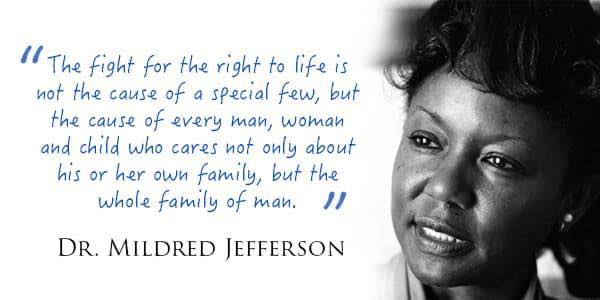
“I became a physician in order to help save lives. I am at once a physician, a citizen, and a woman, and I am not willing to stand aside and allow the concept of expendable human lives to turn this great land of ours into just another exclusive reservation where only the perfect, the privileged, and the planned have the right to live.”  Dr. Mildred Jefferson, mentor and much missed friend.


** “Meat legos” is a creative term from Mary Harrington’s blog and her post here in the Reactionary Feminist. She coined the descriptive “meat Legos matrix” as a name for that aspect of our destructive  postmodern culture of radical self invention wherein we harbor an unjustified or delusional optimism that through technology we can enjoy complete freedom to be almost anything, including treating our bodies as disembodied objects of our imagination. The term has gained great currency in the two years since she invented it. “Meat Legos” graphically recognizes an unprecendented shift in human anthropology uhheard of for all of history and calls into question all our basic assumptions about what a human being is, what our purpose is, and the nature of the mind/body synthesis. 


[i] The meme is wrong on many levels. One of them is that an egg or a chicken is not a human being, which is profoundly different. A non-fertilized egg is breakfast. A fertilized egg is a future Sunday dinner.

[ii] The case was a wrongful death civil suit filed by a couple who had preserved frozen “spare” embryos at the IVF clinic they had used. The embryos were destroyed by another disturbed patient who broke into the clinic’s freezer and pulled out a handful produced by the couple who sued him. Burning his hand on the cryogenically frozen embryos, he dropped them, and they were killed. The court found that frozen embryos were human and qualified the case as a wrongful death suit and negligent homicide. The case was not about whether IVF was licit, but about the nature of a human embryo.

[iii] “The best single sperm moves inside the egg and a zygote is formed,” says Dr. Richlin. The zygote phase lasts for around four days; it eventually turns into a blastocyst, and then an embryo.” (From: https://www.parents.com/what-is-a-zygote-7112279#)

[iv] Excellent animated video on fetal development from fertilization to birth: https://babyolivia.liveaction.org/ or some more detailed information here:  https://www.britannica.com/video/192622/Human-embryonic-development-birth-fertilization

[v] One of several articles about this baby: https://www.businessinsider.com/baby-born-at-22-weeks-weighed-14-ounces-2022-8#

[vi] https://www.sciencealert.com/scientists-just-captured-the-actual-flash-of-light-that-sparks-when-sperm-meets-an-egg

[vii] What is the nature of the act? What is its telos or purpose? Unitive and procreative or purely recreational?  Should a pro choice understanding come earlier in the proceedings? Is there a responsibility in choosing to participate in the baby making act?

5 Comments

Filed under Culture views

Big Waves Break Twice

“And when the last law was down, and the Devil turned ’round on you, where would you hide, Roper, the laws all being flat?” as spoken by St. Thomas More, “Man for All Seasons,” Robert Bolt

Sachuest Beach Surfers endRita and I will often walk Sachuest Beach. Sometimes we sit at Surfer End and pray or watch the surfers or the waves on a smaller wave day. We have been transfixed watching them build with the wind far out into the bay. As they approach the shore, the larger ones will break twice: once about fifty feet out and a second time when gravity again overcomes momentum and the top curls over very near shore.

Thousands of gallons cascade over suddenly with a noticeable thump that can be heard and felt up on the seawall. Why anyone would ever bring a sound maker to a beach has always been a mystery to me. Just the waves please. Breaking. Breaking. For a million years.

Recently the big ones breaking twice set me thinking about Brown v Board of Education and the more recent Dobbs v Jackson Women’s Health Organization Supreme Court decision. Both were big waves that broke twice.

“To separate children from others of similar age and qualifications solely because of their race generates a feeling of inferiority as to their status in the community that may affect their hearts and minds in a way unlikely ever to be undone.” Chief Justice Earl Warren about Brown v Board of Education

In 1954 Brown v Board of Education overturned Plessy v Ferguson in 1896 that enforced separate but equal segregation, zealously guarded practices mostly in the South. For fifty-eight years, segregation held sway. Separate facilities for black folks: lunch counters, bus seats, restrooms, hotel accommodations, sports teams, and most damningly, schools.

In Plessy, the Court held that “separate but equal” satisfied the Constitution and the Fourteenth Amendment. But “separate but equal” was separate only.  Equal was a far piece off. In Brown, justice finally prevailed.

A quick and just overturning of a gravely mistaken Supreme Court decision half a century ago, and all was set right overnight. Not exactly. The wave breaks twice. Those of us of an age will never forget the interim.

For the next decade or more, the battle raged with the Federal government stepping in many times to enforce integrated facilities when the various states refused to comply. Democrats pushed hard back for many years to sustain the old “Jim Crow” laws that stifled opportunities for minorities. Opportunities to ride at the front of the bus, opportunities to drink from the same water fountain, opportunities to eat at the same counter in the cafeteria or restaurant, opportunities to an equal education in the same school or college as white kids. Blood was shed. Dr. Martin Luther King and others were shot, hung, burned, and martyred to the cause of equality of rights and opportunity. “We Shall Overcome” was sung by Joan Baez on the steps of the Lincoln Memorial and on the march to Selma, Alabama with Dr. King and became an anthem most of us knew well. The “I Have a Dream” speech on the Lincoln Memorial steps in 1963 can still bring chills almost another sixty years later.

The wave breaks twice, and it’s a brutal turmoil under the swelling surface.

“Like the infamous decision in Plessy v. Ferguson, Roe was also egregiously wrong and on a collision course with the Constitution from the day it was decided. We hold that Roe and Casey must be overruled. The Constitution makes no reference to abortion, and no such right is implicitly protected by any constitutional provision…” Majority opinion in Dobbs v Jackson

As it was with Plessy, so it is with Roe. A gravely flawed decision from nearly fifty years before was justly undone. The second break is building. The segregationists brought out the dogs. The abortion lobby and their political allies are hard at it now with different dogs. This time many states are passing laws and trying to protect those who have no voice, while the Feds are working for the abortion lobby. The Feds have largely ignored almost two hundred attacks on churches and crisis pregnancy centers from vandalism to fire-bombing since the preliminary Dobbs decision was illegally leaked to a complicit press.[i] Those praying and holding signs at abortion clinics have not been so lucky. For them, it’s been predawn arrests in front of their families by heavily armed Department of Justice and FBI storm troopers.[ii] The confusion, draconian policies, and rhetoric we read and see every day is the interim as it was in those fifteen years following Brown v Board of Education. For us, it’s just the beginning.

Perhaps at some future point, a case will be adjudicated about the personhood of the pre-born human being. The science of embryology is settled without exception about the human nature of the fetus with her unique and complete genome. The sticking point is ideological and philosophical, not scientific. When does a developing human being gain the protection as persons under the law? When in the continuum of human development should the dividing line between life and extinction be drawn? Or do we simply ‘follow the science’ and protect innocent human life during its most vulnerable period from the start?

“The person—especially a woman—may be disillusioned by the fact that over time a man’s affection turns out to be only, so to speak, a cover for desire or even for an explicit will to use. Both a woman and a man may be disillusioned by the fact that the values attributed to the beloved person turn out to be fiction. Because of the dissonance between the ideal and the reality, affective love is sometimes not only extinguished but even transformed into affective hatred.” – Karol Wojtyla, Love and Responsibility

The false binding of abortion to the freedom of women has made this discussion most knotty. Once the argument is framed as chattel or forced pregnancy, the humanity of the fetus is quickly pushed to the back of the bus.

What if we considered the discussion from the other side of the mirror, a changed vantage point? What if the sexual revolution has brought about a new type of enslavement for women? Perhaps if men were held accountable more explicitly for their participation in the baby making act, this deeper joint responsibility would allow the developing human to become once again hallowed and an invitation to nurturing, not destruction. Three generations of aggressive and irresponsible sperm donors have risen like specters from the sexual revolution. Women, rather than gaining freedom, are held primarily responsible for an unplanned pregnancy[iii]. The hook up culture assumes hooking up as an expectation, but if the baby making act makes a baby, well, the mom better take care of things because she blew the protection, right? And the kid is thrown into the soul blasted bargain.

Section 17 of Pope St Paul VI’s famous (or infamous according to your light) “Humanae Vitae” accurately foretold the predictable outcome of ubiquitous contraception as a proposed solution to this changed expectation, unprecedented in the history of our culture as a norm. “Not much experience is needed to be fully aware of human weakness and to understand that human beings—and especially the young, who are so exposed to temptation—need incentives to keep the moral law, and it is an evil thing to make it easy for them to break that law. Another effect that gives cause for alarm is that a man who grows accustomed to the use of contraceptive methods may forget the reverence due to a woman, and, disregarding her physical and emotional equilibrium, reduce her to being a mere instrument for the satisfaction of his own desires, no longer considering her as his partner whom he should surround with care and affection.”

One-night stands or a few weeks hook up became far too common, and the surrounding “with care and affection” often was a forgotten victim, along with the baby. Has this been a ‘freedom’ or an impoverishment for women? Does any woman, no matter how frightened and abandoned and alone, in her heart of hearts want to destroy the baby in her womb?

The momentum shift jerked the culture off its center of gravity, and the tilted axis left men, women, and developing babies profoundly undone.

“Love consists of a commitment which limits one’s freedom – it is a giving of the self, and to give oneself means just that: to limit one’s freedom on behalf of another. Limitation of one’s freedom might seem to be something negative and unpleasant, but love makes it a positive, joyful and creative thing. Freedom exists for the sake of love.” Karol Wojtyła, Love and Responsibility

[i] https://www.catholicnewsagency.com/news/256390/2023-witnessed-continued-attacks-on-pro-life-pregnancy-centers-churches

[ii] https://www.heritage.org/crime-and-justice/commentary/fbi-justice-department-twist-federal-law-arrest-charge-pro-life

[iii] After forty years of Rita and I involved in helping women in this predicament, the guy walking or threatening to walk if the woman becomes pregnant is commonplace. The expectation of the man to “do the right thing” is a quaint and naive anachronism.

1 Comment

Filed under Culture views, Faith and Reason