
[/audiLink to the series of querieso]
“Over time I think we will probably see a closer merger of biological intelligence and digital intelligence,” Musk told an audience at the World Government Summit in Dubai, where he also launched Tesla in the United Arab Emirates (UAE). “It’s mostly about the bandwidth, the speed of the connection between your brain and the digital version of yourself, particularly output.” CNBC – February 13, 2017, “Elon Musk: Humans must merge with machines or become irrelevant in AI age.” [i]
Yes, the walls have broken down, but the techno elites have an alternate vision for the future prepared for us. Elon Musk is one of the foremost, and as the richest guy in the world, next he will work to enlist the help of the government. He will lead us into the promised land of our future as cyborgs and aliens occupying other planets throughout the galaxy.
We should not make the mistake of ignoring this; it is a powerful utopian vision. Such fantasies have fascinated and attracted human beings as long as there have been human beings. Elon’s iteration promises to create for us a fresh new version of heaven, omniscience, and immortality. This utopia (some would say dystopia) is nothing less than a religion with a creed, dogma, and eternal rewards. All we must do is cease to be human, and we will be perfect: the current version of “immanentizing the eschaton.” I queried the thing, the LLM AI ChatGpt 4.0, about this, a series of questions and responses which is attached for you, so that if you have interest, you can read on. I found it fascinating, including its conclusion that a hybrid AI human is probably not a great idea. [ii]
But that is not the point of this post. The main idea of this exploration of broken walls is what we can do to repair them.
“Float like a butterfly, sting like a bee – his hands can’t hit what his eyes can’t see.” “I’m so fast that last night I turned off the light switch in my hotel room and got into bed before the room was dark.” Muhammed Ali about the epic Kinshasa 1974 world heavyweight championship match, “The Rumble in the Jungle.” And from his opponent, George Foreman, “Muhammad amazed me, I’ll admit it. He out-thought me, he out-fought me. That night, he was just the better man in the ring”
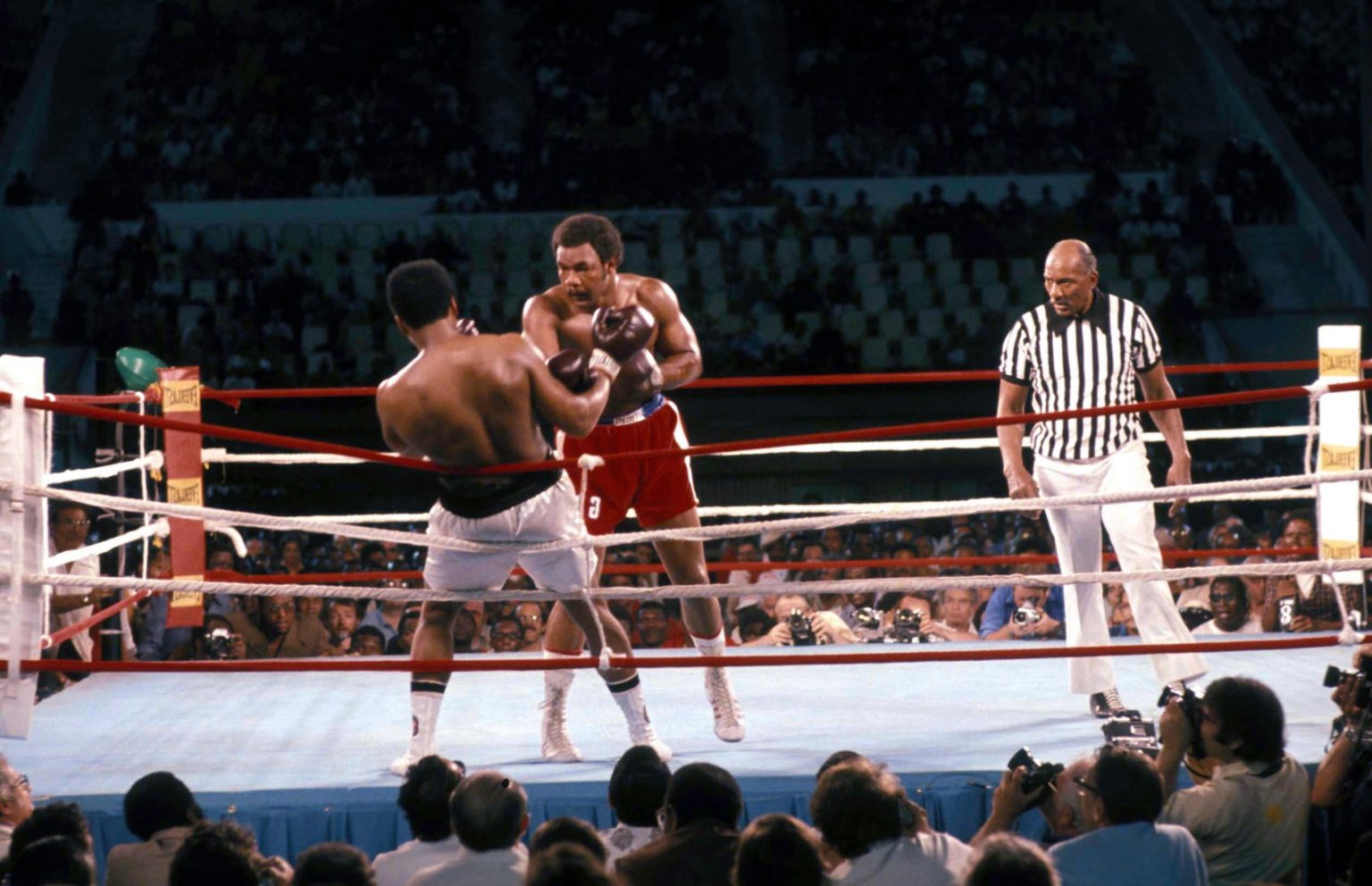
George Foreman died earlier this month by all accounts an exemplary man. After retiring from boxing and winning back his title at the age of 45, he went on to become a multimillionaire businessman and minister.
When he was fighting, he was dangerously powerful. Reputedly one of the hardest hitting boxers ever. Hit harder than Joe Frazier. Hit harder than Mike Tyson. And either of those fighters could put out your lights long before you hit the floor.
Ali could hit too, but not like George. A deficiency that could be overcome, but in fighting George Foreman you were half a second lapse away from unconsciousness at any moment.
In Zaire that night Ali used his amazing speed and reaction time. And he used his boxing knowledge and experience. He did something never done before and to the dismay of the fans who wanted to see toe to toe, brain rattling, battle. He invented what he called in his usual creative and funny manner, “Rope a Dope.” He leaned back against the ropes at the periphery of the ring and slipped, dodged, ducked, took a few passing blows, and mocked George Foreman. For round after round, George punched himself out. He was exhausted. “Is that all you got, George?” Ali whispered to him in a clinch. Foreman’s tired hands slowed just a tiny increment. That’s all Ali needed and what he was waiting for.
In the final seconds of the eighth round, Ali did what Ali was uniquely capable of doing. He exploded with a close to instananeous combination rocking and stunning his opponent -jabs, left hook, straight right to the face -so fast it was hard to follow[iii], dropping his opponent now momentarily unconscious. Slow motion video confirmed what happened to George Foreman. He went down like he was tasered, and it was over. Spectators who had grown restive with Ali’s refusal to go toe to toe were as stunned as George was. Muhammed Ali was once more was world heavyweight champion.
“If we are to preserve culture we must continue to create it.” Johan Huizinga, Dutch historian, 1872-1945[iv]
We are assailed every day with competing concepts of the culture; the punches come hard, fast,and from every unexpected direction. There is no escape from the assault. Lessons from the ‘rope a dope’ strategy of the great Ali in the “Rumble in the Jungle” serve us well. Standing toe to toe punching it out with

postmodern, post-Christian culture in its full strength is impossible; we will exhaust ourselves until one powerful combination finishes us.
We get one life, one defining decision about how we are to live it. How we are to slip the knockout punch and remain ready to respond when necessary? And how does that strategy inform our daily interactions?
One valuable resource I recommend for our rope-a- dope plan is a book I’ve mentioned before, Archbishop Emeritus Charles Chaput’s “Strangers in a Strange Land,”[v]. Unlike Rod Dreher’s excellent and popular “Benedict Option,”” Strangers in a Strange Land” theorizes that rather than retreating into small enclaves, we must engage the culture while slipping its worst knocks, and when necessary, we take a few hits for the team.
He writes first about the state of the society and culture in which we find ourselves, then he suggests our response. Here is a short summary of the ideas in the book about how we are to respond.
Acknowledging the growing temptation for faithful Christians to withdraw from public life in a society increasingly hostile or indifferent to Christian beliefs—especially around marriage, sexuality, the dignity of life, and objective truth—it can feel like retreat is the only option. He’s sympathetic to that instinct but rejects it. Archbishop Chaput recognizes the appeal of building intentional, isolated Christian communities. While he affirms the importance of forming strong, faithful communities, he insists that withdrawal is not the answer—not in the Gospel, and not in history.
“Jesus didn’t tell us to bunker down. He told us to make disciples.”
Christians are called to engage the world, not flee from it. To be salt and light (Matthew 5:13–16)—which only makes sense if we’re out in the world, not hidden away. And we cannot shy away from the cost of real witness. He reminds us that throughout history, Christian witness has often meant sacrifice—and at times, martyrdom – the word “martyr” comes from the Greek “martus“(μάρτυς), which means witness. While modern Americans may not face bloody persecution as martyrs are suffering in other countries, we do risk social marginalization, professional consequences, or ridicule. But bearing those costs with integrity and joy is part of being a Christian in a post-Christian age.
He emphasizes the tone of our witness: not angry or defensive, but joyful, confident, and loving. The early Christians didn’t win converts by wagging fingers—they lived lives that made pagan neighbors wonder, “What do they have that we don’t?” He calls for a similar approach today: to live lives of beauty, integrity, generosity, and peace that cause others to ask questions.
Rather than abandoning the public square, Archbishop Chaput urges Catholics to be present in law, media, education, the arts, politics, and business—bringing a Christian imagination and moral compass to those spaces. He challenges the faithful not to give up on shaping the broader culture.
“We don’t escape from the world; we bring Christ into it.”[vi]
The Church is a field hospital, not a fortress. While forming strong, intentional communities is important, they must be outward facing. We need to support each other, yes—but ultimately, we’re here to serve the world, not escape from it.
I just pray that I get better at it because I have a very long way to go.
“No one in the world can change Truth. What we can do and should do is seek truth and to serve it when we have found it. The real conflict is in the inner conflict. Beyond armies of occupation and the hecatombs of extermination camps, there are two irreconcilable enemies in the depth of every human soul: good and evil, sin and love. And what use are the victories on the battlefield if we ourselves are defeated in our innermost personal selves?” St. Maximillian Kolbe, Polish priest, publisher, evangelist and martyr who volunteered to die in place of a stranger in Auschwitz.[vii]
Final thoughts for today. Jesus related a wonderful parable about a barren fig tree. You may remember it. The vineyard owner told the gardener to cut it down because it didn’t produce any fruit. The gardener, who it has been suggested is a metaphor for Jesus himself, told the boss to give it a chance. He’ll cultivate it (cultivate comes from the same root word as culture), fertilize it, care for it personally and carefully, and if it still doesn’t bear fruit, eventually it will go.
St. Paul who contributed more books to the New Testament than anyone else, started out as Saul of Tarsus, a zealous persecutor of Christians, complicit even in their murder. But along the way, Saul met Jesus personally and became Paul, the greatest of evangelists. That’s a long story for another time, but among his letters lovingly preserved for a couple of millennia is one to the small developing church in Galatia. In that letter Paul called out the fruits of the spirit, the fruits the fig tree was lacking.
The fruits of the spirit are not hoarded, nor is the vineyard owner miserly in providing them. Freely given, all we have to do is ask and be willing to change our lives radically. Our necessary response is not a grit our teeth determination but openness of heart and acceptance. A simple fiat starts them growing. Impediments to fertile lives are self inflicted.
Every human jproject of value is one heart, one mind, one soul at a time. Lent is a perfect time for our own examen. How are we doing in building a culture of life, love, and hope? What fruit are we bearing that helps shape first ourselves, then our small circle of influence, our culture? I have a very long way to go.
“But the fruit of the Spirit is love, joy, peace, patience, kindness, goodness, faithfulness, gentleness, and self-control. Against such as these things there is no law.” Galatians: 5 22-23
[i] https://www.cnbc.com/2017/02/13/elon-musk-humans-merge-machines-cyborg-artificial-intelligence-robots.html
[ii] email me for the ChatGPT bot on “immanentizing the eschaton” and Elon Musk.
[iii] Lights out on the way to the mat.
[iv] Huizinga argued that the spirit of technical and mechanical organization had replaced spontaneous and organic order in cultural as well as political life. Wikipedia
[v] Strangers in a Strange Land: Living the Catholic Faith in a Post-Christian World, Charles J. Chaput, Henry Holt & Company, 2017
[vi] A YouTube interview with Archbishop Charles Chaput discussing his book:
[vii] Quoted from the “Little Black Book, Lent 2025 published by Little Books, Diocese of Saginaw, Michigan
Photo credit: George Foreman vs Muhammad Ali October. 30, 1974 Rumble In The Jungle in Kinshasa, Zaire. Credit: 369108Globe Photos/MediaPunch
 Quo Vadis Blog