Tag Archives: Webb Lake

Maine Anecdotes

“The only thing I knew how to do

Was to keep on keepin’ on like a bird that flew.” Bob Dylan “Tangled Up In Blue”

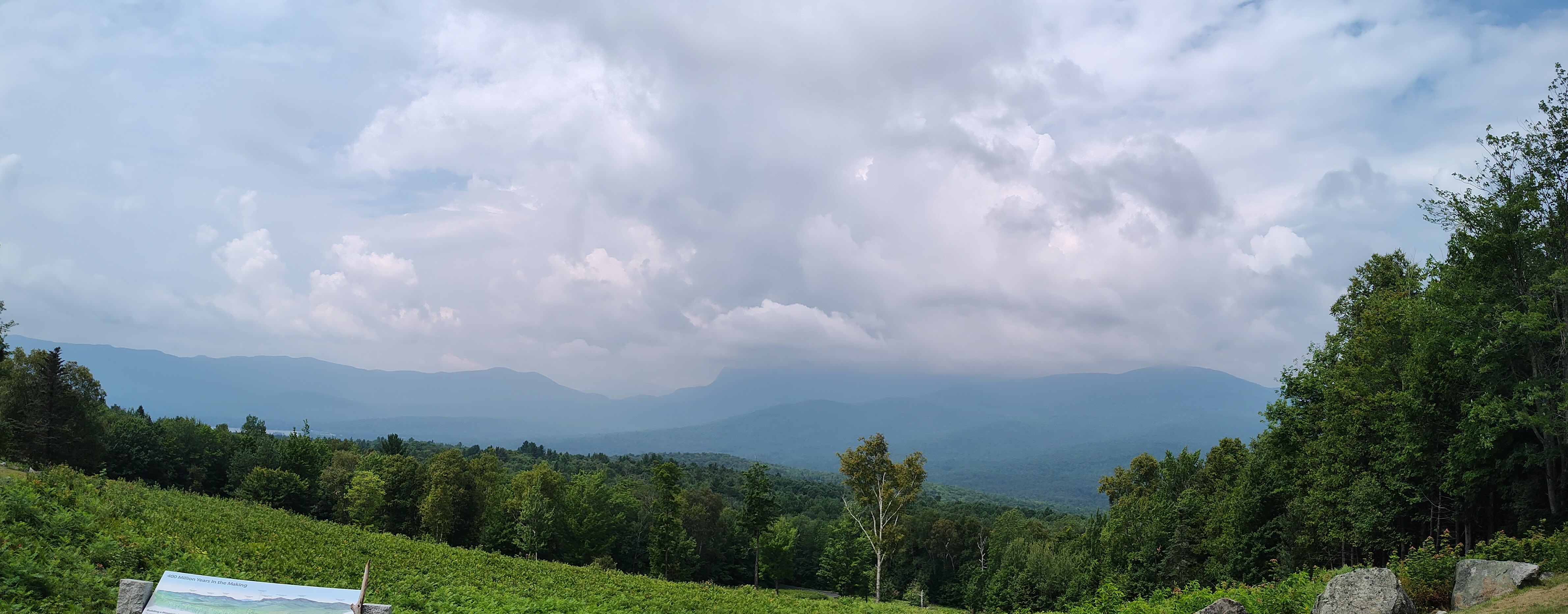
Center Hill panoramaOur two weeks in Maine were nostalgic and new. Old friends, encounters with abundant wildlife, vistas that cause me to catch my breath at any moment around any corner.

Early one morning we were sitting with three of our granddaughters on the little beach on Webb Lake in front of their camp, when all three yelled out something like “Whoa.” A bald eagle was pumping hard and powerfully to regain altitude with water dripping from its wingtips, rising from the lake with a fish in its talons. One of the many of various species of ducks we like watching there was beating wings furiously in the other direction from the same point of origin, clearly panicked. I wasn’t sure of the species since it was moving away with undue haste. The duck flew startlingly fast and low, barely clearing the water’s surface.

The girls told us the eagle had stolen the fish from the duck. Probably it was a merganser if that was what happened, since they will eat larger than the other common ducks on the lake like mallards and wood ducks.  The eagle may have plunged while hunting right next to the shocked duck. Mary told us from “Wild Kratts”[i] that bald eagles prefer fish above all other prey. The duck was fortunate that the eagle’s culinary preferences did not include waterfowl that morning, and a full grown duck would be a talon full for an eagle. Eagles don’t often miss what they spot to eat. Their diving into the water is fast and deadly. It was an indelible moment, unrecorded as my phone was back in the camp. That’s all right, maybe as it should be. The image remains.

A couple of evenings later we were driving back from our almost nightly visit to Center Hill lookout over the lake (panorama above); as we were passing through the center of town (one store), a pair of white tail deer jumped in front of us. We always travel slowly while going through town and were easily able to avoid a collision. The buck with the rack was chasing the doe; neither were as large as they can be. But perfect, tawny, sinewy, beautiful. We looked over to the small field adjacent to the house on our right. The flirting couple were dancing, bumping, playing, cavorting, four legged straight up hops in sheer fun, oblivious to our observing them.  It was a joyful moment but remains unrecorded as my phone was in my pocket. That’s all right, maybe as it should be. The image remains.

“I ain’t got no window, ain’t got no door

But I can feel sun shinin’ where it’s never shined before, never shined before

Feel sun shinin’ where it’s never, never shined before

But I’m still climbing up the mountain side

You can’t count me out

Long as I got my heart and soul

I got everything, I got everything I need

Everything I need.”  Keb’ Mo’, “Everything I Need”

The temptation is to idealize Maine and idealizing is not without some justification, but that would be trivializing and unfair. Unfair to the wonder of the place and the variety of its people, unfair to anyone reading this. Like most stories, it’s more complicated than that.

Cannabis stores seem to be everywhere now. I counted at least two dozen of them. In the city. In small towns. Along country roads. Most of them look shiny, have professional logos and signage, and have more than a few cars in the parking lot. When we lived here so many years ago, weed was illegal, and weed was everywhere too, but it was in service of a rebellious panache, a naïve ‘rebellion.’ Many I knew grew their own in their garden or up in a hidden clearing behind the house. Almost everyone I knew rolled a joint or picked one out of a bowl at a party from time to time: back to the land hippies, local town young people, artisans, poets, and professionals. So did I, for a while, but I gave it up in my late twenties; an occasional recreational hobby began in Boulder a couple of thousand miles west of Maine and ended in Mount Vernon. No single, articulated reason to stop; it just didn’t seem worth the lethargy in the morning. A casual quit.

 Now that cannabis is commercialized on nearly every corner, smoking weed has lost its outlaw attraction and sunk into just another way to get high on Saturday night. Or Tuesday. Along streets in clapped out mill towns that no longer have a mill, next to the prosperous cannabis storefronts, idle men and women slump on the wooden stairways of three story faded tenements with despairing faces staring vacantly back – prematurely aged with few signs of hope.

“I guess there’s nothing left for me to do but go get stoned

Let the past paint pictures through my head

Might drink a fifth of Thunderbird and try to write a sad song

Tell me baby why you been gone so long.”

“Why You Been Gone So Long,” Mickey Newbury, Eleven Hundred Springs

On a whim coming back to the lake from church, we decided to explore some roads we hadn’t driven in decades, taking a longer way home through the hills. We took the Temple Road, and dead reckoning navigation told me that we could find a shorter way home from Temple once we got there.

But I’ve grown citified and dead reckoning made me nervous where once it would not have been so. Google Maps solved that, and sure enough it highlighted the most direct route back to Webb Lake. We struck out resolutely on the Intervale Road, turned north on Day Mountain Road, which ran into Jackson Mountain Road. Somewhere along the Day Mountain Road, we ran out of pavement, but that didn’t discourage us. Roads in Maine in rural areas frequently turn to well-maintained gravel roads where cars routinely travel at forty five miles per hour.

Unfortunately, that wasn’t Jackson Mountain Road. Hard packed smooth gravel road became loose gravel road, washed out in ten foot fissures, but able to be negotiated on one side or the other at ten miles per hour – too narrow for two cars to safely pass. Then more washed out, but barely navigable with great care. Five miles per hour.  The slope got close to forty five degrees-not straight up, but it felt like it. The camps were fewer and sketchier or abandoned. Finally, the camps ran out and a handwritten “dead end” sign was tacked to a tree.

My trust in Google Maps was shaken, but not stirred. It was always reliable, right? I was still on the blue lighted way. Local signage must be wrong or outdated. What do people who live here know that surpasses the AI wizard behind the black curtain? I kept going. Rita was increasingly skeptical. Finally at the top of a very steep almost impassible run of a quarter mile, a culvert was completely gone, replaced by a four foot drop across the road. Fortunately backing down the hill fifty feet or so, there was a turnaround. Slowly back to Intervale Road and turned left towards the town of Strong. A bit to eat at the good general store there across from the large factory making fuel for pellet stoves. Finally, paved state highway two lane roads all the way to the north end of Webb Lake.

Rita, as I have often given her cause to be, was patient, albeit with a sly smile or two on the way back.

“Then we’re rollin’ on

Rollin’ on

Feeling, better

Than we did last night

Rollin’ on rollin’ on

It’s hard sometimes, but

Pretty much it’s alright.”  “Rollin’ On,” Emmylou Harris and Mark Knopfler


The day before we packed up for home, we drove over more excellent back roads to our old hometown in Mount Vernon, about a fifty minute pretty ride through hills, farms, and lake country.  I was reminded of why I love this place so much.  On the shore of Lake Minnehonk downtown in the building where we once went to pick up our mail, there now is the Post Office Café and Bakery. We met friends from nearly fifty years ago, Alan and Donna, for breakfast. An outstanding place, we sat at a clear finished maple table by the back windows and looked where I walked out one frozen night to do battle in what became known as the Swordfight on the Lake.[ii]

We are decades older now than when Donna used to come over to our place to watch our kids for a few hours two afternoons a week. Rita was working as a labor and delivery nurse forty minutes away in Augusta part time from three to eleven. I was on the road for a commercial lumber company and got home about six most nights. Donna’s kids, Autumn and Oak, would play with our first two, Amy and Gabriel, while Donna lovingly minded everyone at our house until I pulled in. Autumn was the plague of Gabe’s elaborate Lego creations. She delighted in destroying them. Good memories now.

At the Post Office Café, two hours passed in a moment, the conversation picked up as if it was forty years ago. Alan is a successful serial entrepreneur who grew up in Mount Vernon. Back in the seventies, he had a chainsaw and a log cutting business with skidders and trucks. Buying the rights to clear somebody’s woodlot and selling the product to local sawmills and paper mills. Poplar to the paper mills, hemlock, spruce, and pine to be sawn into boards. Hard work. Brutal work only for the strong. Later he slightly altered course and became a skilled contractor. Alan still builds custom homes for folks in the area. He starts with a wooded, difficult lot, and ends with a beautiful structure to provide shelter for his clients.

We laughed, got quiet, remembered, talked again. Caught up. Told stories. One favorite was about the time Alan came into Rita’s flu clinic when she was serving as the town health officer. A rough flu year, and the vaccine was causing some severe and notorious reactions that year. All the old folks in the folding chairs were nervous. Alan, who looked like he could bench press a Buick, lined up, got jabbed, took two steps, spun around, and dramatically crashed through some chairs to the floor in front of the horrified onlookers. Rita ran over to him. Only she recognized that prostrate Alan was quivering, and his shoulders were shaking. As he laughed. She compounded the confusion in the room by kicking him and calling him a decidedly uncivil name.

We talked of kids and grandkids, joys and disappointments. About local people we once knew well, many no longer above the ground. Nostalgic and new. Enjoyed the food and the company immensely. Reconnected seamlessly.

“It is one of the blessings of old friends that you can afford to be stupid with them.” Ralph Waldo Emerson

[1] “Anecdote” is derived from the Greek “anekdota” meaning “things unpublished.

[i] For those without kids around, “Wild Kratts” is a popular partially animated children’s program that teaches them love for and knowledge of many wildlife species.

[ii] https://quovadisblog.net/2022/09/18/swordfight-on-the-lake-redux/

2 Comments

Filed under Maine Tales

Summer Kitchens

“In Maine we have a saying that there is no point in speaking unless you can improve the silence.” Ed Muskie

Not sure this improves the silence, but…

Maine road hazard

When we drive up the dirt road from the camp on Webb Lake to turn east on Wilton Road to Farmington for church or groceries, there are Maine houses along the way that we remember with affection and respect. Old houses, generations old. Practical houses for pragmatic people who avoid many things that don’t make sense and do many things that do. Center chimney capes are common, and there are larger colonials with integrated additions for various purposes and perhaps extra kids.

Maine fosters eccentricity and a vast collection of creative architectural solutions; many varied attempts with mixed success to survive long snowy winters are everywhere in evidence. Homes along the rural roads are scattered with large dooryards, and the inexorable forest threatens to encroach on the fields that are left. Old, barely habitable double-wide faded mobile homes sit on overgrown once cleared lots with a motley collection of partially cannibalized pickups and campers up on blocks – ten foot tall poplars and alders growing through perforated flatbeds. A deserted small John Deere tractor with a flat tire disconsolately rusts out. Rural poverty with stove pipes sticking out through the walls of shacks sided with boards and wind torn Tyvek house wrap. A few are abandoned with collapsed roofs; others look like they should be but aren’t.

A quarter of the mile down the road an impeccable modular cape or ranch sits proudly on a small hill, carefully, lovingly landscaped with a paved, sealed driveway, a small flagpole and new flag in front, and a lawn that looks like it was trimmed with barber scissors. A modest vegetable garden grows fifty feet from the house, often surrounded by a wood pole and galvanized wire perimeter to discourage the deer and rabbits. Hopeful tomato plants, green beans, corn, potatoes, peppers, and some greens – spinach, beets, or Swiss chard, zucchini and summer squash, maybe a pumpkin or watermelon vine spreading along the rich soil, growing so fast the bottom of the fruit is drag worn and discolored.

Certain features identify my favorite species of farmhouse, and there are sadly fewer of them than fifty years ago when we lived here. Some of them are deteriorating and returning slowly to the earth. Some are re-tasked into apartments. Some are meticulously maintained, but there are a couple of overhead garage doors installed where large paned wood windows or homemade matched pine board doors once adorned the facade.

Frequently they have metal roofs that are loud in a downpour. Like sleeping in a tin tent, but comforting, steady protection from nature in a four season environment. Metal roofs with a steep pitch to shed snow easily. We had such a house with a metal roof when we lived in Farmington forty years ago. No gutters to be torn off with ice dams and snow slides, just a two foot cantilever to push the gushing rainwater and melted snow away from the house. Diverters or a small additional extension over the front door with the granite threshold protect visitors and residents opening the door. Sensible roofs that can last for at least a generation for a harsh climate with deep snow in the winter.

A barn that was once for farm animals, and still is for a few, remains attached to some of these homes. Hay in the loft. Stalls and laying nests for the hens, vegetable and egg stands out by the road. Grain in the large wood feed box. Chickens, goats, a milk cow, perhaps some calves for future milk or steaks, and a deadly, half feral, symbiotic barn cat or two to control the mice and rats. Barns are sometimes connected to the family home through that most sensible extra room – a summer kitchen. Much more than a breezeway connecting to a two car garage, a summer kitchen is like many things in Maine – it has more than one useful purpose.

Harsh winters are interrupted by glorious springs that also harken the arrival of mud and black fly season. Time to plant and begin the arduous process of splitting next winter’s firewood. In winter and spring, it’s prudent to have a connection to the barn that doesn’t include wading through drifts or shoveling a path.

When the heat of a six week summer hits, there are abundant lakes, rivers, streams, and for those fortunate coastal dwellers, saltwater beaches. But it’s a time for summer kitchens too.

A summer kitchen serves several critical purposes besides connecting to the barn for winter access to animals needing attention. A summer kitchen lessens July and August heat building up in the house for cooking in the main kitchen, heat rising to the bedrooms to make sleeping a sweaty project even when the screens aren’t torn. A sound wood stove in the summer kitchen is good for the long boils for lobster or sugar corn on the cob and baking bread or canning later in the summer and fall. Summer kitchens by design are practical, built for storage and work with only stone counter workspace and maybe a stool or two without adornment or pictures on the wall. Oftentimes they lack plastered and insulated walls like the barn they connect. Simple and perfect for their purpose.

The kitchen hospitality so common and welcome for Maine visitors planned or unplanned is reserved for the in-house winter kitchen where the family table and chairs are set up. With sugar bowl, creamer, mugs and whatever muffins or scones or cookies are in the pantry at the ready.

Summer kitchens are beneficial, intelligent, thoughtful, sensible things, a symbol for me of a beneficent, thoughtful, and intelligent people with generations of experience and hospitality in a challenging climate.

“Maine is a joy in the summer. But the soul of Maine is more apparent in the winter.” Paul Theroux

Here we are once again after forty or fifty years of enjoying Lake Webb in an old camp – a rare place in west central Maine lakes country. Surrounded by hills and mountains: Mount Blue, Tumbledown, Bald Mountain, Big Jackson, Little Jackson, Blueberry Mountain. Sunsets beyond my ability to describe them. Clean, clear water constantly refreshed with nine streams feeding Webb and one large outlet into the Weld River that flows unimpeded alongside State Highway 142 to the Androscoggin River and on to the Atlantic. Once it was a major logging route with the native tall white pines, spruce, and hemlocks abundant in the eighteenth and nineteenth centuries. Wood to build the houses. Wood to build the ships at Bath. Planks, boards, masts.

Webb trees

More power boats now than our first years here, but mostly on the weekend. Since the beginning occasional water skiers and tubers have circled the five mile long, twenty seven hundred acres lake. But jet skis are a relatively recent, unwelcome, and loud intrusion that terrifies the loons and herds them into the outflow end of the lake. I wonder sadly when the last loon will seek a refuge in another lake farther from the yahoos. That will be a heartbreaking loss. One would think thrill chasers could find a quieter, less obnoxious way of feeling power between their legs. There are plenty of other places to play man-boy. Not this little bit of remaining retreat and haven. That’s why God made Harley’s for crying out loud.

During the week though, there are still mostly single sail wind powered silent boats, canoes, kayaks, and an occasional small flat bottomed fishing boat trawling at a very low speed. The sound of children playing and laughing on a still morning can carry more than the half a mile that separates us from the state beach on the opposite side the lake. Those are welcome sounds. We can see the splashes when they jump off the “Big Rock” about three quarters of the way across. We make at least one pilgrimage ourselves in the canoe. The outcropping juts about four feet above the surface with a straight drop into deep water. The Mount Blue State Park side of the rock is fifteen feet of gradual gentle slope of granite at about a four pitch, perfect for dragging a canoe to rest while we dive, jump, and swim.

“Did you ever see a place that looks like it was built just to enjoy? Well, this whole state of Maine looks that way to me.” Will Rogers

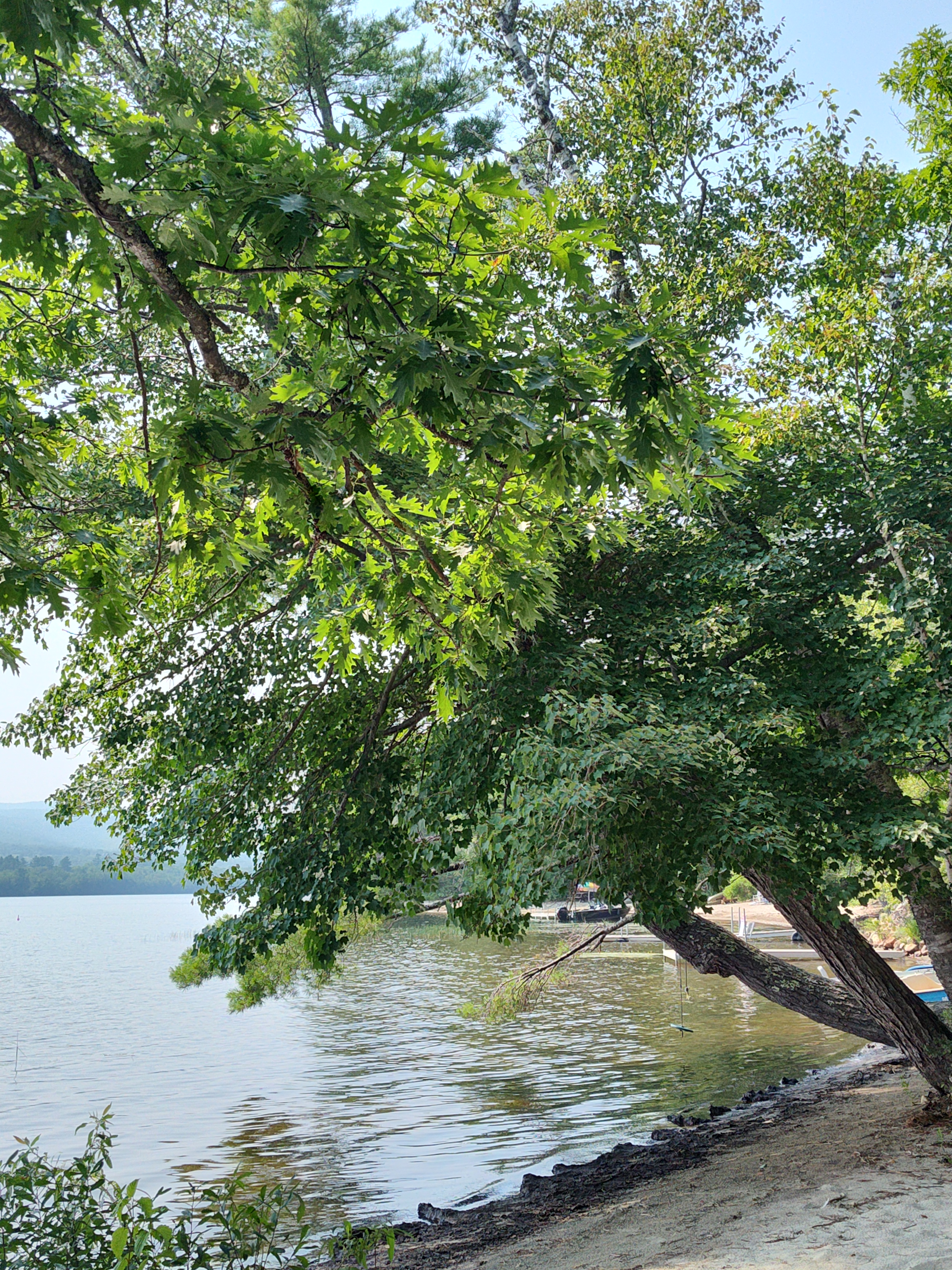
Sunday Mass for us is at St. Joseph Church in Farmington about forty minutes east first up, then down an elevation past Bald Mountain, a winding road with switchbacks and vistas that pops my ears. St. Joe’s is the parish that welcomed us back to the Church half a century ago: the happy event that saved our marriage. There we formed lifelong friendships. The current pastor, Father Paul, recognizes us now with a smile and greeting. As he does greet our daughter and her family with five children who stay at the camp where we stayed with her as an infant so many years ago. The screened in porch sits fifteen feet from the water’s edge. (see picture above for a view from the porch)

The former pastor at St. Joe’s from fifty years ago, Father Joe McKenna, is retired and ninety three, living in Portland. A most welcome visit and meal with him on the way north is something we always look forward to and are grateful for. He still retains his lively, unconventional intelligence, acute insights, fighting spirit, and wry sense of Irish humor. A natural storyteller, he is always delightful company.

The couple that owns the only remaining store in Weld converted it from the last elementary school here; they always greet us as well as old friends. We can get most everything really needed by way of groceries there. Downeast coffee, lunch and breakfast too at the counter in the adjacent old classroom. Good breakfasts with fresh eggs, bacon, toast and home fries. Burgers, fries, hot dogs, sandwiches, pizza, it’s open most summer days from six in the morning until early evening. A small playground next to the parking lot still entertains the kids, albeit with gravel on the ground, not ground up rubber stuff. A single clay tennis court remains well maintained at the bottom of the hill next to the Weld Community Center. Sweep the court, brush clean the lines when done, and wear shoes that won’t tear up the court are the only rules.

The entertainments of screens or city are scraggly substitutes for these simple pleasures. They may bring titillation, but the consolations of woods, fields, mountains, lakes, and time to read are healing. Screens and entertainments bring commotion and distraction from our troubles, but not restoration. Only places like this restore.

“Maine is a beautiful place that I paradoxically want to hoard to myself and share with everyone I meet.” John Hodgman

We know that there will be a last visit someday to our treasured Maine woods. The camp will change hands from the family we have known and liked here for four decades, or we will become too infirm to make the trip. We may not know it when our final visit ends, but I have no regrets, only gratitude for our many irreplaceable memories that will console us for the rest of our lives.

“I would really rather feel bad in Maine than feel good anywhere else.” E.B. White

  • Images: Top: Common Maine road hazard
    • Middle: View at the camp porch of Webb Lake
    • Bottom: View from nearby Center Hill near the spring where we get our water

View from Center Hill

2 Comments

Filed under Maine Tales, Personal and family life

Beer Cans, Sandwich Wrappers and Other Flotsam

“Beauty is the battlefield where God and Satan contend for the hearts of men.”  The Brothers Karamazov,  Fyodor Dostoevsky

Sunset from Dummer’s Beach campground, Webb Lake

When our son Gabe was seven or eight, we were driving back from Portland to our home in Farmington, Maine. At some point on Route 202 near Winthrop, he rid himself of a pesky bit of trash out the open back window of our Ford. In Maine, then as now, littering is a hanging offense, and a state trooper spotted the infraction and did a quick U turn behind us. A mile or so down the road, he pulled us over.  He politely asked if I knew what we had perpetrated, and I pleaded ignorance. He instructed me on the serious nature of our offense. Gabe in our backseat looked like a puppy who just ate the stew meat off the kitchen table.

I asked the trooper, who understood exactly what had happened, if Gabe would have to go to prison or just work off his fine in home confinement until he was twenty-one. We negotiated a just settlement, and the trooper took me at my word we would reverse course, find the offending litter and retrieve it, which we promptly did with no Maine State Police vehicle following us. Gabriel learned from his experience, and it was many years before he had to spend a night in jail.

We’ve noticed on our bike rides here in Maine that roadside litter is much rarer than in Rhode Island, where it is a plague – an occasional yahoo beer can on these rural roads in Maine, but if we see three in a mile, it is unusual. In Rhode Island, just past the welcome to beautiful Rhode Island signs, the mess begins along the road, even on the beaches after hours. I’ve often wondered what combination of neglectful parenting, ignorance and arrogance prompts passersby to believe it is someone else’s job to clean up after them.

I think the lack of jeopardy may account for some of it in Rhode Island-I’ve never seen littering laws enforced; and in Maine residents and visitors alike harbor a respect, almost a reverence, for the beauty around nearly every turn.

“Late have I loved thee, Beauty ever old, ever new; late have I loved thee. Lo, you were within, but I was outside, seeking there for you, and upon the shapely things you have made I rushed headlong.”  Confessions of St. Augustine [i]

 As we stood silently for long minutes watching the sunset just to the south of Tumbledown across Webb Lake, I was struck anew with the gratuitous beauty of sun, clouds, mountains and water. Why was nature made beautiful instead of pallid and enervating? Why are human beings such that their senses and spirits perceive the beauty? What grace and gift is at work here? The same grace and gift moves artists of music, form and hue to create as best we can a reflected beauty. And, most importantly, what Truth is to be found congruent with the Beauty?

When we fail to ask such questions, when we persist without respite in the endless business of commerce and noise, amusements and entertainments precisely to avoid asking such questions, we dodge not just blundering through some sophomoric speculations, but hazard missing why we are on this big blue beautiful ball hurtling at unimaginable speed around the galaxy and through the void: we risk missing the entire point. We fail to pay attention to the jeopardy of forgetting our teleology, the end for which we exist as separate from the other creatures on this fragile planet, and perhaps from the other creatures (if there are any) in this universe.

In an Associated Press syndicated technology article this week in the Lewiston Sun Journal, the latest “big leap” in Apple technology was lauded. “Augmented reality” (AR) will be rolled out in the next iteration of software for iPads and iPhones with built in capability for entrepreneurial “killer apps” to layer on enhancement to our staid, just plain old reality. Related to virtual reality, it will feature the ability, like the washed-up “Pokemon Go” phenomenon, to allow us to visualize in our surroundings magical apparitions that aren’t there. Millions will be able to spend billions of their finite, irreplaceable hours distracting themselves with these wonderful apparitions because, apparently, we don’t have enough distraction already. Facebook, Google and Microsoft are frantically working to roll out their own AR versions. Tim Cook, Apple CEO, hailed AR as “profound technology.” Indeed. “I am so excited about it, I just want to yell and scream!” exclaimed Mr. Cook.  Exactly so, I say; I have a similar urge. [ii]

I would make a modest proposal to Mr. Cook and to you, dear reader. Perhaps we could better spend a little time undistracted, unentertained, without a screen, with some unaugmented reality. And in that quiet without noise and interruption, without beer cans and roadside trash, ask ourselves some questions. I would suggest that a sunset over Webb Lake, looking towards Mount Blue and Tumbledown might be a good place to start.

“We’re all haunted by (death) in one way or another. And it’s the easiest thing in the world to push away, you just get a cappuccino. But, yes, you’re haunted by it in a different way (as you get older).  I feel its presence. I feel it in my sleep, in dreams, in waking.” Sam Shepard, who died this week at 73.


[i] Quotes from Dostoevsky and Augustine were cited in “Strangers in a Strange Land” by Charles Chaput, Archbishop of Philadelphia. In writing about these things, Archbishop Chaput quotes some lines from “Evening,” a poem by Rainier Maria Rilke and continues with his own comments:

Slowly now the evening changes his garments

held for him by a rim of ancient trees;

you gaze: and the landscape divides and leaves you

one sinking and one rising toward the stars.


And you are left, to none belonging wholly,

not so dark as a silent house, nor quite

so surely pledged unto eternity

as that which grows to star and climbs the

night.


To you is left (unspeakably confused)

your life, gigantic, ripening, full of fears,

so that it, now hemmed in, now grasping

all,

is changed in you by turns to stone and

stars.

 Philosophers and psychologists have offered many different theories about the nature of the human person. But few have captured the human condition better than Rilke does in those twelve lines. We are creatures made for heaven, but we are born of this earth. We love the beauty of this world, but we sense that there’s something more behind that beauty. Our longing for that “something” pulls us outside of ourselves.

 [ii] Why Our Screens Make Us Less Happy, TEXx talk, Adam Alter

3 Comments

Filed under Culture views, Maine Tales, Personal and family life

Noise

 “There is a silent self within us whose presence is disturbing precisely because it is so silent: it can’t be spoken. To articulate it, to verbalize it, is to tamper with it, and in some ways to destroy it. Our culture is geared in many ways to help us evade any need to face this inner, silent self.” Thomas Merton, Love and Living.

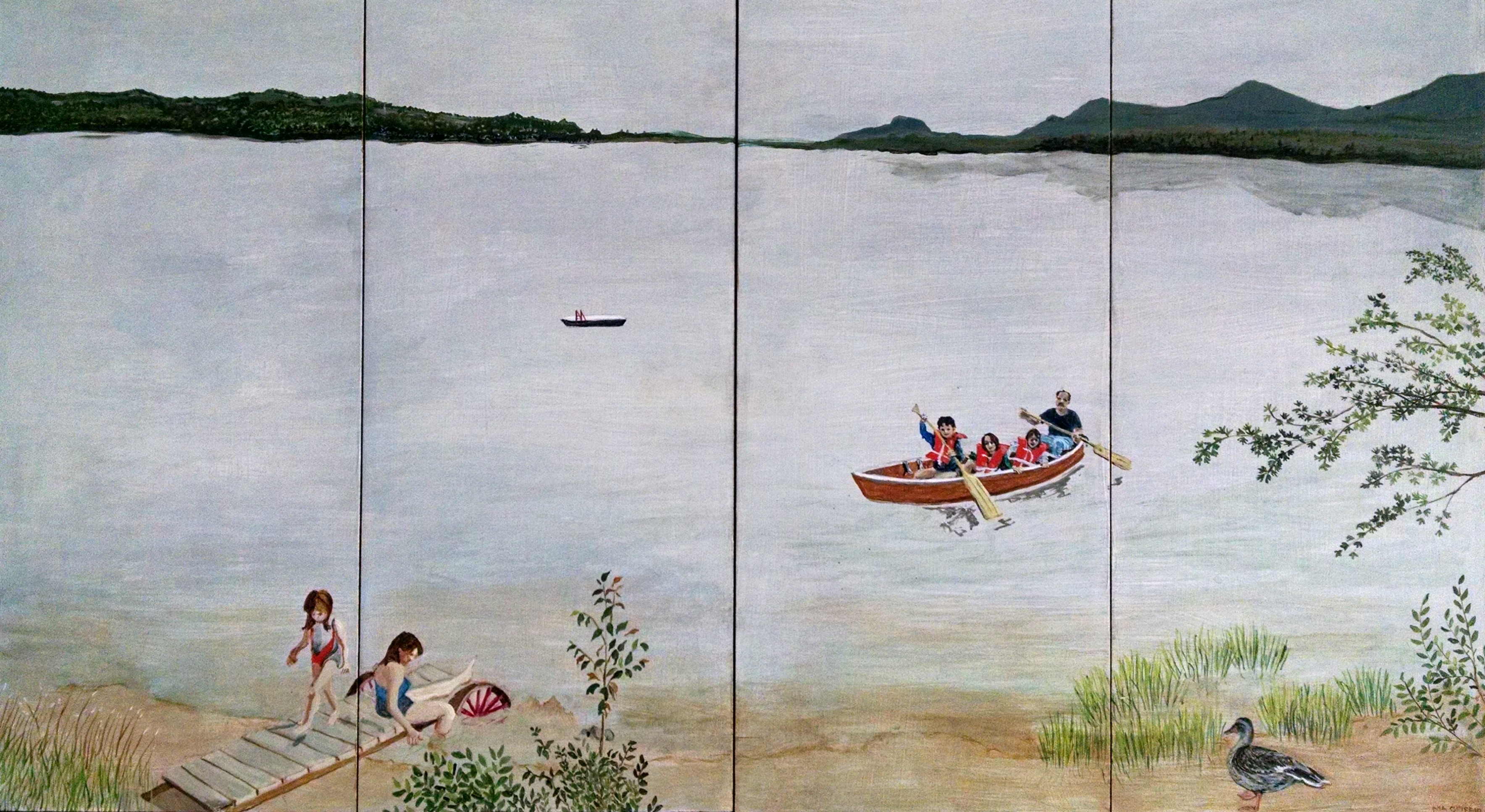
Webb Lake wall panelsSteve Griffin, owner of Island Carpentry, has done much precise, beautiful work in our house in Middletown. We have come to know and value Steve’s friendship. Last year when he directed the installation and did the carpentry to install our gas fireplaces, he built a box over the mantle of one of them to mount our television. Bartering for our replaced electric kitchen stove, Steve’s wife, Mary Ann, created with Steve a four panel door to hide the box. Using old photographs Rita gave her, she painted a composite scene of our many summers spent in a rented old camp on Webb Lake in Weld, ME. This week she finished.

One of the many gifts Webb Lake gave us was solace and silence, especially early in the morning when the lake was mirror calm. I’m an early morning riser and have been for at least fifty years. Silence for private time, prayer and reading that leads to reflection and meditation is a before dawn activity for me, as it was on Webb Lake in the canoe. Here it is birdsong and sometimes the distant, muted foghorn in Newport Harbor which carries in the pre-dawn stillness. Is there anything more grand than that first cup of coffee in the sunroom looking out over the garden, the eighteenth century stone wall and Rhode Island Nursery across the lane? As Thomas Merton wrote, “our culture is geared…to help us evade any need to face (our) inner, silent self.” Yet this “inner, silent self” is where we most need to wander at leisure if we ever expect to find our peace, our self-knowledge, our connection.

“We live in a state of constant semi-attention to the sound of voices, music, traffic, or the generalized noise of what goes on around us all the time. We are more or less there.” Thomas Merton, Love and Living.

To Merton’s constant semi-attention in the last few decades, we’ve layered on omnipresent emails, texts, Facebook, Snapchat, Tweets, YouTube, television with a thousand channels, Pandora, videos and video games on demand, the insistent phones on our belt and on and on.  And on.  We don’t have to do much to completely avoid our silent, inner selves and the meaning of our increasingly preoccupied lives. In truth, we seek commotion: for after all, within those distractions persists our ability to avoid what we truly need to engage. For the ‘unexamined’ life is frenetically busy, exhausting even, but on the surface painless, while vaguely troubling underneath is a deep discontent like a tumor without symptoms yet. Without recognizing our core, what is left wanting, and what change is prerequisite to peace, we are left without a center at rest. Human beings are born with restless hearts, with a hole in the center. Do we seek what will truly heal it or do we squander our time by obfuscating with the deluge of stimuli?

” A great strong wind was rending the mountains and breaking in pieces the rocks before the Lord; but the Lord was not in the wind. And after the wind, an earthquake, but the Lord was not in the earthquake. And after the earthquake, a fire, but the Lord was not in the fire; and after the fire the sound of a gentle blowing. When Elijah heard this, he wrapped his face in his mantle and went out and stood in the entrance of the cave. And behold a voice came to him and said to him, “What are you doing here, Elijah?”  1 Kings 19: 11-13

“What are you doing here?” is the only relevant question we all must answer.

Garden 2016As I was going through the painstaking process of pulling the disassembled tomato support cages from the ceiling joists of the shed, straightening out the bent members, cobbling them back together for one more year and erecting them around this season’s hope for red tomatoes, Rita remarked to me that I was a patient gardener. I have never thought of myself as particularly patient; Type A, driving for perfection, impatient with myself especially. But times and souls change, especially when we spend the time to fill the hole in the middle.

I realized planting the last of the pole beans, the yellow bush beans and peas today with Gianna and Ellie, our two oldest granddaughters, that the hours pass quickly. We laugh, teach, learn and plant. They tell us where to put the pumpkins and sunflowers, their favorites. We can also be quiet together. Gianna is eight and now is the official reader of seed packets, discerning depth and spacing. Why are cucumber and the various kinds of squash planted in rings called hills? Why are some seeds planted an inch deep, and some only a quarter inch? Why is the squirrel eating the new corn and cucumber sprouts? If we see the baby rabbits out there in the garden, will I turn into Mr. McGregor?

I further realize that the overriding sensation of the garden in the sun with sore muscles, dirty feet, red knees and calloused hands is contentment, deep, abiding contentment. And that is enough.

“We are not fully present and not fully absent; not fully withdrawn, yet not completely available. We just float along in the general noise which drowns out the deep, secret and insistent demands of the inner self.” Thomas Merton, Love and Living.

8 Comments

Filed under Culture views, Personal and family life