
“The face is a picture of the mind as the eyes are its interpreter.” Cicero, De Oratore
In 1968, the year after we were married, I vaguely remember going to see the brilliant movie “Faces” written and directed by John Cassavetes in the downtown theater in Northampton where we lived. Going to a movie was our mutually enjoyed extravagance back before movies too often became caricatures, CGI, and comic book superheroes. Our date was often followed by a fifty cent hot fudge sundae at the State Street Fruit Store soda jerk counter if it wasn’t too late. “Faces” delved the emotions, vulnerabilities, and masks of the characters in the tragic dissolution of a marriage, intensely personal and focused on close ups of the actors with a handheld camera. I don’t remember much of the plot, but I do remember the faces.
 Faces do that to us. Anatomy books tell of forty three muscles and over ten thousand documented expressions, some powerful and some subtle. The human face is unique to each person; facial recognition software is based on that certain knowledge. With any degree of awareness, we are sensitive in the extreme to the subtle shifts in the facial expressions of those with whom we are most familiar, especially in our spouse that we love and especially in a spouse of nearly sixty years. Our faces have evolved over these many years, but while our shared life together has drawn us ever closer, her character, her essence, her irreplaceable “Ritaness” has not changed, and her face mirrors the same person I fell in love with all those decades ago.
We often read the same books. We’ve been reading Carl Trueman’s book published last month, “The Desecration of Man,” [i] which like most of what Dr. Trueman writes, provides an insightful look into what we have wrought in our postmodern culture. There is a memorable passage in the book where he discusses faces in a way that traces a particular woe the sexual revolution has exacerbated.
Trueman explains the impact and roots of how ubiquitous pornography has metastasized into a billion dollar industry in every corner of the internet and on every kid’s smartphone and has been enabled through the insistent undermining of the exceptionalism of the human person. What he calls the “desecration of man” developed for centuries as we incrementally substituted understanding our existence as a unique created being made in the image of our Creator (Imago Dei) with evolving as a lucky collection of atoms. From a miracle hybrid of soul and body to a rearrangeable assembly of “meat Legos”[ii]. But I digress.
In one chapter, he quotes a passage from Roger Scruton’s book, “The Face of God.” Scruton describes pornography as “a marginalization, indeed a kind of desecration, of the human face.” Porn, which is a demeaning drama of prostitution in front of a camera, replaces a unique face with a body, and any body will do, interchangeable and consumable. When we look upon another’s face, we see an “I”, a subject; when we look only upon a body, we see an object to be used. Trueman invites us to share a thought experiment.
A groom anxiously awaits the appearance of his bride while he stands next to his best man at the front of the church. Suddenly, the back door opens, the bridesmaids and entourage process into the church with the organ playing Mendelssohn’s “Wedding March.” But instead of the woman he loves and to whom he pledged his troth, another woman walks in with a face not the one he cherishes. Perhaps she’s even beautiful, but would he be satisfied with this stranger? Would he still be willing to commit his whole life to her for richer or poorer, in sickness and in health until death do them part?
The sexual act out of the context of this pledge is hormonal lust, not love, a selfish act of using another person for pleasure. In this transaction, we objectify another human being, and they objectify us. At least ideally, the marital embrace once was considered as holy, a unique intimacy between a man and a woman based on surrender and trust, and a loving lifelong commitment. Together out of that commitment, they share responsibility and sacrifice in mutual love for childbearing and rearing commensurate with the sacred telos of reproduction and continuation of our species. All these aspects were recognized to be intrinsic in our nature as man and woman and our relationship. The status of sexual relationships now, while casual and ubiquitous in entertainments, is merely a desirable component of personal self-fulfillment and pleasure, thus, “If it feels good, do it.” The hook up culture that resulted has diminished us.
So, has the millennia old definition of what it is to be human been jettisoned as well, tragically and in grave error? Has our understanding of what it means to be human become incoherent and abandoned the Creator’s vision for us as made in Imago Dei? Is the postmodern, progressive understanding of us as a random collection of molecules evolved accidentally in a harsh and unforgiving universe an improvement or an impoverishment? Have we stopped seeing each other’s faces?
“In her face I saw such things as make me say:
‘Now God, who made such a one, be praised.’” Dante Alighieri, La Vita Nuova
 When I look at Rita, I see her face. Always have.
From the dedication to my book:
In a sudden revelation, Rita or I will look at each other and declare, “You’re a different person than me.” After almost six decades of married life, that is not a simple proposition.
I will look over at her reading or praying near the woodstove early on a winter morning with her finger absentmindedly twirling in her hair just above her ear and become filled with love. We have come so far together. I joke that we grew up together, but it was after we were married.
Astonishingly at just over nineteen, she committed to living our lives together for better or worse, and before we were twenty one, we took the vows. She was a respected assistant head nurse on a large floor in a city hospital at twenty two while she provided the bulk of our thrifty livelihood while I was still in college.
When our children started coming after I graduated, she put aside her dreams, career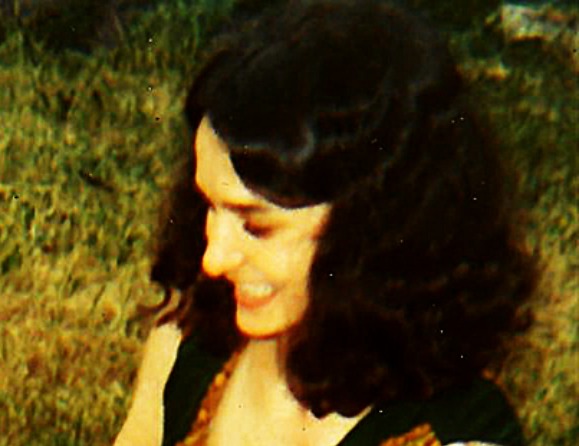 aspirations, and who knows what else to throw her lot in with a guy who wanted to climb trees for a living. She created our home out of new whole cloth and held up more than her end for many years until she returned to the workforce a quarter of a century later to lead and hold together a couple of different prolife nonprofit organizations.
Imagine! Committing to share a life with someone and all that entails. Ups, downs, our own frailties, fears, uncertainties, gifts, and liabilities. All in. Nothing reserved. Yet, she did it. With me. Takes my breath away sometimes.
” When you are old and grey and full of sleep,
And nodding by the fire, take down this book,
And slowly read, and dream of the soft look
Your eyes had once, and of their shadows deep;
How many loved your moments of glad grace,
And loved your beauty with love false or true,
But one man loved the pilgrim soul in you,
And loved the sorrows of your changing face” William Butler Yeats, When You Are Old
[i] Desecration of Man: How the Rejection of God Degrades our Humanity, Carl R Trueman, Penguin Random House 2026
[ii] Mary Harrington’s perfect description of the malleable body under the influence of postmodern radical subjectivism.

