Author Archives: jparquette

jparquette's avatar

About jparquette

Fortunate and blessed in companionship with my wife of fifty seven years, in health and in modest, but more than adequate circumstances. Life is good.

Good Friends Never Let You Down

Not to imply that we occasionally can’t be disappointed in our friendships (or be disappointing to our friends), but that in the best of friendships, we always find a way to work things out.  Through those friendships we are led to new insights and a deeper understanding of our lives and of ourselves.   In one of the Maine Tales posts, I wrote of our return to our faith and the Church thirty eight years ago.  Here is that post: Maine Tales IV – The Road Not Taken and an excerpt from it, when we met our good friend, Father Joe McKenna:

We looked up Catholic Churches in the Yellow Pages (an anachronism now).  Mount Vernon was at the center of a fifty mile circle roughly encompassing Augusta, Waterville and Farmington.  Rita worked part time as an RN in Augusta, but Farmington for some reason attracted us.  I called St. Joseph’s Church in Farmington; a friendly voice picked up with a lively, “St. Joe’s!”  Father Joe McKenna answered his own phone calls and was nearly perfect for hurting children of the sixties — an admixture of intellectual, poet, faith filled priest and wonderfully warm and funny human being with holes in the elbows of his sweaters. We entered the little, wood framed church on a side street, far smaller than the Baptist, Episcopalian and Congregationalist stone and brick edifices on Main Street.  It was Pentecost Sunday, no happenstance, and Father Joe was alive with the Spirit.

Father Joe has been what he calls semi-retired now for quite a few years and lives in Portland.  He remains active with nursing home work and a prison ministry, but we keep a valued, long distance friendship with emails and too infrequent visits.  As I have occasionally done with others, I’ll take advantage of Father Joe’s writing to share with permission a recent correspondence.  If there are seeming non sequiturs, the errors are mine.

Father Joe, now eighty three, clearly has lost nothing off the fastball and enjoys very much new knowledge.  The email exchange was initiated when Father Joe responded to the post a couple of weeks ago.  Even with editing for brevity, it is still quite lengthy, and I hope you find worth your time and attention.

Father Joe: Hi Jack and Rita.  Very, very interesting.  At last I know the reason why mitochondria passes only though the mother.  Simple enough when you know why.  Merry Christmas to you and yours and many OF them!

Jack: Really enjoyed “Time To Start Thinking” and thank you again. His observations and analysis do get me thinking as we all need to be.  His solutions, when he proposes them are a little too Keynesian and pessimistic for me, but well worth consideration.  A book I would recommend to anyone.  Glad we could clear up mitochondria once and for all.
Love from RI, j&r   

 (Note:  Father Joe had sent me a book he had read, Time to Start Thinking: America in the Age of Descent, by Edward Luce, long time economics writer for the Financial Times of London.  I would recommend it to all who have interest.)

Father Joe: What I found about the book is that it is a series of interviews about what each person thinks is going on.  Then you can draw your own conclusions.  It must be fantastic to have descendants!

Jack:  Terrifying actually.  What have we wrought, and what are we handing on to those descendants?

Father Joe: Oh come on.  It’s Christmas… when we concentrate on the virtue of hope! A lovely virtue.  I discovered it in the seminary sitting next to Mike McManus..… Anyway because he was McManus and I was McKenna sometimes we sat together.  He was filled with hope and happiness and gradually he worked on me to get rid of some of my negativity.  He recommended a book “God Speaks” by Charles Peguy.  I will send you a copy from Amazon.  It changed my life.  Have a merry one!

Jack:  You are right, of course.  And not just for the Christmas season… When I get all cataclysmically dreary and cosmically anxious, I must refocus on gratitude for the many, many blessings in my life and stop whining.  And you, dear friend, are one of the blessings.  I’ve read some of Charles Peguy’s poetry, but can’t remember if I’ve seen that one.

Several exchanges ensued about Peguy’s and Luce’s books, then this.

Father Joe:  Do any of your kids have troubles with science and God?

Jack:  (Note:  Name and identifying pronouns left as ***) I think ***** has the most trouble with faith and science…  If something cannot be demonstrated, touched with any of the five senses or proven with the scientific method, it is discounted.  Completely eludes *****.  Certainly intelligent and realizes that acknowledging God and especially Jesus requires a response…, so *** holds *** ground…  That atheism is every bit as much a leap of faith (and with vast gaps that require invincible credulity) as belief and trust in God, *****does not yet see.  But we are working on it.

Anyway, the prayers of our first pastor would be greatly appreciated for*** faith and the faith of all my children.

Father Joe:  It always comes down to three:  Belief in the Eucharist, belief that Jesus is God, belief in a creator.
(1)  The Eucharist is the Body and Blood of Christ.  Rome accepts the Orthodox Eucharist.  This is not one of the problems that keep us apart.  A Catholic may receive Communion in an Orthodox Church if no Catholic church is available… and, as you know well, we were together for 1000 years.  The Orthodox belief in the Eucharist is interesting:  “The Eucharist is the center of worship in the Orthodox Church. We do not explain scientifically how the bread and wine become the Body and Blood of Christ.  Orthodox Christians believe that during the Eucharist believers partake mystically of Christ’s body and blood and through it receive his life and strength.”  This is acceptable if one has a problem using Aristotle to explain the Eucharist.
(2)  Jesus is God.  Perhaps a new book might be helpful here: Jay Perini: “Jesus, the Human Face of God.”
(3) There is a Creator.  If I can find an essay I wrote for the Portland Press Herald, I’ll send it on.
Happy New Year!

Jack: I’d love to read your article, and it’s easy to get too far in the weeds with the Aristotelian substance and incidentals explanation, so that’s helpful…  I’ve tried to explain to ***** that it’s Fides first, then Ratio. I’m with Pascal on this; faith is first of the heart, imagination and will.  Not irrational by any means, but the mind and the intellect support faith, and understanding follows the decision.

We come first to faith through love, like the love of a small parish priest for his flock leads them to Love.  I guess that is what is most disappointing – that the love from the parents was insufficient to overcome skepticism and incredulity (regarding faith).

I’ll let Father Joe McKenna’s piece end the post. He needs no help from me.

Okay so how DID we get here?

I watch a lot of science programs… on PBS and the History Channel. I have a pretty good science grounding… for an amateur. I’ve been keeping up with the latest in Quantum Physics and Astronomy and the Origins of the Universe. I heard Stephen Hawking say on TV lately that you don’t need a creator to explain where the universe came from… particles just appear and disappear at random. I watched Brian Greene’s “The Fabric of the Universe.” He is a spokesperson for that scientific community who are investigating this very interesting topic.

Let me set up the problem that Greene’s community is involved with.

Here I am sitting at my computer typing this essay. Back 12 billion years ago there was nothing but quarks. So how did I get here from those quarks and why am I smart enough to write this essay?

If I do not accept a creator then the only solution is that I got here by chance; yes, the same chance/luck that is involved when you are sitting at a slot machine. (Well, not exactly because they are fixed to favor the house.) But explaining how I got here by chance requires a lot of lucky outcomes. Here are just a few: By lucky chance stars were formed; by lucky chance our sun was formed to be just the right size; cosmic dust was attracted by our sun and formed planets and by lucky chance one of them…the planet earth… was just the right distance from the sun to have the right temperature and just the right weight to keep its atmosphere from spinning off, etc., etc., etc. All these strokes of luck are now called the “Goldilocks effect”: everything had to be “just right” for life to even start.

What are the chances that each of these fortuitous circumstances would happen (and there are many thousands)? And they must occur at a given moment in the progress of the universe, because if they don’t happen at the proper instant as the universe progresses they do not have a second chance. You can’t go back and try again.

Just like you have to pull the lever on the slot machine quite a number of times…and fail… to finally get the lucky prize, so there has to be multiple universes in which the chances for all these events can play out… and fail… to finally get a universe (ours) and a planet (ours) where life can evolve and I can sit here at this computer. The task that Greene et al have set for themselves is to put into mathematical formulae all the variables that go into all these chances happening, ultimately resulting in me sitting here. It takes more than one blackboard on which to write them all out.

They use the mathematics of Statistics. (Yes, what you learned as seniors in high school.) That’s what all those equations are that fill their blackboards. This is what Steve Green means when he keeps saying “mathematics says that you have to have billions of this or billions of that”… and of course he is right… you would have to have billions of universes if everything depended on chance. And because he is a philosophical Determinist (no free will… everything is “determined”) he goes one further: he maintains that in some of these universes there could be another person just like you.

Do you have to accept this elaborate hypothesis? (Don’t forget, it’s only an hypothesis… not even a theory…unproven.) Will you be considered a science denier if you don’t? Will professors look at you with a condescending smile?

They probably will. We’re supposed to be intimidated by all those equations on those blackboards. Because we’re not cosmologists in the halls of science it can be considered “rubey” (do they still use this word?) to disagree with these very learned researchers.

But hey, you know what? They put their pants on one leg at a time just like the rest of us. Yes, they have doctorate degrees. I know lots of people who have doctorates. I knew a Doctor of Literature one time who believed that the world was made 6000 years ago! My physician has a doctorate. And you know what he tells me? That I have to manage my own health. He is there to give me yearly physicals and to refer me to specialists if the need arises but I have to manage my own health.

I keep up with science. I keep up with Biblical Studies that investigates the meanings of the opening chapters of Genesis. I listen to physical and astronomical scientists explaining their hypotheses… I look at their evidence with an open “scientific” mind. But I manage my own world view.

Some of these scientists, you know, are not even following the scientific method. Scientific method says you start “with an open mind” and proceed to gather evidence no matter where it leads you. And if you find there are two possible conclusions, you follow the principle of Ockham’s Razor and accept the one with the least complications. But if you start with the premise that there is no creator and then proceed to weave theories that back that up… complicated theories… multiple universe theories… is that science?

And as for Steve Hawking: yes particles can come in and out of existence seemingly by themselves. But to conclude from this that the universe came into existence by itself is more than a stretch… it’s not good science.

My advice to the Brian Greenes et al is to put away your blackboards for a while and come out into the real world. Take a walk in a park or by the seashore. Many a genius has come up with an important inspiration walking along the seashore. All these universes you are positing… wouldn’t it be a lot more “economical” and logical scientifically to search for a creative force… of some sort… somewhere?


2 Comments

Filed under Maine Tales, Personal and family life

The DNA of Christmas

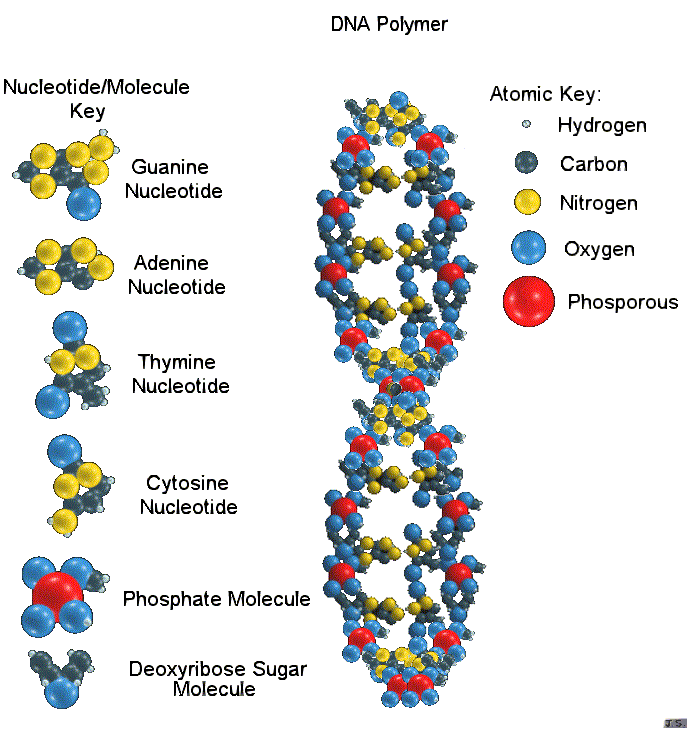
dnaThe double helix of DNA stores and passes down through generations all the genetic information necessary for carbon based life forms on this green and blue planet.  DNA diagrams look like counterclockwise corkscrewed ladders.  The models help us to understand how this wondrous alchemy works, but they are simplified.  Inside each nucleus, the DNA coils tightly in and upon itself.

These long molecules recreate through ‘messenger’ molecules the amino acids that build all the proteins of which our bodies consist.  Each connecting rung of the ladder bonds in one of two combinations of four smaller molecules called nucleic bases. When DNA molecules ‘unzip’, separating at the nucleic bases, each half regenerates into an exact replica of the original.  This self replication is what makes possible all life to continue, and such an unzipping and reforming occurs within the human body thousands of times a second.

 “The DNA in just one cell can stretch six feet long – yet it fits into a nucleus around a thousandth of an inch wide.  And since we have trillions of cells, all the DNA in one human body can stretch roughly from the sun to Pluto and back.”  The Violinist’s Thumb: Love, War and Genius as Written by our Genetic Code, Sam Kean

Mitochondria are tiny bean shaped organs that supply energy within our cells. [1]  Curiously, they have their own DNA. Science theorizes that they were bacteria or viruses ‘eaten’ by other primitive cells eons ago and evolved in a symbiotic relationship. Mitochondrial DNA is most useful, because sperm from those of us who are male are primarily DNA carriers that swim with tails; they are too tiny to contain mitochondria.  Hence, all mitochondria and its DNA are passed on solely through the mother.  Since this DNA is stable and reliable, it mutates on average only once every 3,500 years or so.  This remarkable characteristic has enabled biochemists to analyze mitochondrial DNA common to human beings alive today and trace it back to a single source — the first “Eve.”  She lived in Africa approximately 170,000 years ago.  The name “Eve” comes from the Hebrew word, HAWAH, a verb which means “to live.”

And so we come to Christmas.

”For You created my inmost being; You knit me together in my mother’s womb. I praise You because I am fearfully and wonderfully made.”  Psalm 139, 13-14

The early Church fathers in the first two centuries after the apostles wrote extensively of Mary, the mother of Jesus, as a New Eve. Ireneus, Justin and Tertullian, followed by Jerome and Ambrose develop the Eve-Mary parallel.  Jesus is described as the New Adam.  “It was through a man and woman that flesh was cast from paradise; it was through a virgin that flesh was linked to God.” (St. Ambrose).  “Death through Eve.  Life through Mary.” (St. Jerome)  They taught that just as the pride, lies and disobedience of Adam and Eve (and all human beings) opened the breach between God and man, the humility, truth and obedience of first Mary, and then ultimately, perfectly her Son, bridged it.

When Jesus saw his mother there, and the disciple whom he loved standing nearby, he said to her, “Woman, here is your son,” and to the disciple, “Here is your mother.” From that time on, this disciple took her into his home. John 26-27.  Mary became mother of John and of the Church, and spiritually, the mother of us all.  The “disciple took her into his home”; when Mary comes into our home, she does what she always does, she brings Jesus to us and us to Jesus.

“Answer quickly, O Virgin.  Reply in haste to the angel…Why do you delay, why are you afraid? … Let humility be bold… In this matter alone, O prudent Virgin, do not fear to be presumptuous… Arise, hasten, open… ‘Behold, the handmaid of the Lord’, she says, ‘be it done to me according to your word.’”.  Saint Bernard

So as we hasten and worry, as we fret and rush about, we, too, are given the opportunity as Mary was to “be not afraid.”  Christmas is not department stores open a hundred straight hours until late Christmas Eve.  Christmas is not maxing out the credit cards in a futile bargain to please others or to please ourselves.  Where do we find our solace?  Where is peace?  How do we reflect on the miracle and the bridge between Creator and creature, born twenty centuries ago in such humble circumstances?  “Let it be done to me according to your word.”

“There are those who pour out gold from a purse and weigh out silver on the scales; then they hire a goldsmith to make it into a god before which they fall down in worship.  They lift it to their shoulders to carry; when they set it in place again, it stays, and does not move from the spot.  Although they cry out to it, it cannot answer; it delivers no one from distress.” Isaiah 46

Our DNA determines much about us and each mix is unique in all of history, but it does not determine ‘us.’  Our DNA is ephemeral; our soul is immortal.  We are determined in our soul by our will and by our decisions.  Not just at Christmas time, but by the slow aggregation of our daily decisions throughout our life.  We can fall into an “idolatry of disbelief.”[2] We become to a great degree that which we choose to become.  And through our Creator’s great mercy, we have a new opportunity today and every day to become new, to begin again.  That is the Good News of Christmas.

“Christ dwelt for nine months in the tabernacle of Mary’s womb.  He dwells until the end of ages in the tabernacle of the Church’s faith.  He will dwell forever in the knowledge and love of each faithful soul.” Blessed Isaac of Stella, abbot.


[1] Chloroplasts are analogous tiny organs in plant cells with their own DNA. In them, the hard work of photosynthesis takes place that captures the sun’s energy and is a necessary first step for all life.

[2] Article in Crisis Magazine by Regis Martin.

Leave a comment

Filed under Background Perspective

Pink Orthodoxy and The Real War on Women

Copernicus painting of a heliocentric universe

Copernicus painting of a heliocentric universe

As with all revisionist history, the truth is more complicated than the myth.  Mikolaj Kopernik was a canon in the Polish cathedral in Frombork, Poland.  Educated in elite universities in Krakow, Bologna and Padua with support from his uncle, the bishop, he was a church administrator, a lawyer, practiced medicine and to pass the time translated ancient poetry from Greek to Latin, formulated currency reform and painted.  He died in obscurity in 1543 and was buried unmarked beneath the cathedral floor with a hundred others who spent their lives working for the Church.

MIkolaj chose to be known by the Latinized version of his name, Copernicus, and his enduring legacy and thirty year passion was astronomy.  Two months prior to his death, he published in Latin, “De Revolutionibus Orbium Coelestium”, or “On the Revolutions of the Heavenly Spheres.” In it he challenged the scientific orthodoxy that had persisted through ancient Greece and Rome of a geocentric universe which taught that the sun, the planets and the stars revolved around the earth.  His heliocentric hypothesis was indeed a revolution based on his mathematics and observations from the planetarium in a corner of the cathedral grounds.  An esoteric academic work, it was little contested by the Church or anyone else.

“There is talk of a new astrologer who wants to prove that the earth moves and goes around instead of the sky, the sun, the moon, just as if somebody were moving in a carriage or ship might hold that he was sitting still and at rest while the earth and the trees walked and moved. But that is how things are nowadays: when a man wishes to be clever he must needs invent something special, and the way he does it must needs be the best! The fool wants to turn the whole art of astronomy upside-down. However, as Holy Scripture tells us, so did Joshua bid the sun to stand still and not the earth.” Martin Luther about Copernican theory

Everything changed when in the conflagration of the Protestant Revolution, Protestant theologians proclaimed a heliocentric universe as contrary to Holy Scripture.  After Galileo took up the Copernican heliocentric model in 1616, the Church was grievously wrong and reacting to the Protestant position, added “On the Revolutions of the Heavenly Spheres” to her list of banned books. The Pope ordered Galileo held in home confinement.  The book remained on the list for over two centuries until 1835.  The Church has since acknowledged the error.  Science and faith are two complementary, not opposing, aspects of human understanding and truth.

Science can purify religion from error and superstition.  Religion can purify science from idolatry and false absolutes.” Pope John Paul II

In our secular humanist culture, orthodoxies are dearly held, and contrarian evidence is enthusiastically ignored.  One such article of faith recklessly endangers women, especially young women.  “Women’s reproductive rights” as a principle of secular orthodoxy transcends politics, transcends religion and transcends science as well.

Two news stories in the last week or so were not covered extensively in that most ardent defender of the faith, those impregnable bastions of orthodoxy, the liberal press and electronic media from the New York Times to MSNBC et al.  The first defense against heterodoxy is to disregard all evidence that contradicts the precepts; the second is to suppress the sources.

The first story informs us that new incidences of cancer worldwide are up substantively from 12.7 million in 2008 to 14.1 million in 2012.  According to the World Health Organization, deaths from cancer rose in the same period from 7.6 million to 8.2 million.  Deaths from breast cancer rose to 522,000 last year.  Diagnosis of breast cancer rose 20% in four years to 1.7 million women in 2012.  Despite enormous effort in expense and brilliance, cancer seems to keep on keeping on, especially as the developing world claims the dubious benefits of modern culture.

The second story is indeed the ‘elephant in the living room’ that is becoming more and more difficult to overlook. Dr. Joel Brind (Professor of Endocrinology at City University in NY) and Dr. Angela Lanfranchi (breast cancer oncologist, medical school professor and surgeon) founded the Breast Cancer Prevention Institute (BCPI) in the late nineties and have for many years been voices crying in the wilderness regarding the correlation between induced abortions, birth control drugs and breast cancer.  On their website (see link) dozens of studies over many years document these relationships.  A small minority of studies doesn’t show this correlation, and those are the studies most frequently cited by Planned Parenthood and other defenders of abortion, including the current administration in Washington.  The negative finding studies were sometimes funded by abortion advocates or employed flawed methodology in compiling their statistics, according to BCPI.

Last week, the voice of BCPI was joined by a most unlikely chorus – a China based meta study and a study based in India that ties without doubt induced abortion and breast cancer. The meta-analysis from China was published in the peer reviewed international journal, “Cancer Causes and Control.”  A meta-analysis studies data from many experiments and draws conclusions from all of them.  China’s recently modified one child policy has resulted so far in 336 million induced abortions, so there is no lack of subjects available.  The results showed a 44% increase in breast cancer risk for women with a single induced abortion, a 76% increased risk for women with two, and an 89% raised risk for women with more than two.  Dr. Brind commented their findings as “of the sort of magnitude that has typified the link between cigarettes and lung cancer.”

A study in the Indian Journal of Community Medicine found a six fold increased risk for breast cancer for women who have had abortions.  The governments of China and India support abortion, so there is no political motivation for these findings.

For birth control pills, the evidence is also clear.  The birth control pill is actually listed along with tobacco, formaldehyde and plutonium as a group 1 carcinogen by both the American Cancer Society and the World Health Organization.  Group 1 carcinogens are proven to cause cancer.

The reason these facts are not discussed with the women showing up for abortions or birth control pills at Planned Parenthood and other providers and/or advocates for these things is secular orthodoxy revolving around “women’s reproductive rights.”  That Planned Parenthood performed over 327 thousand abortions last year at an average billing of between $300 and $950 ($202 million per year at average) perhaps could influence their reticence[1].  That the pink epicenter of breast cancer awareness, the Susan G Komen Institute funds over $500,000 per year to Planned Parenthood for breast cancer screening[2] may have something to do with their reluctance to publicize these facts. Federal funding for Planned Parenthood under the Obama administration has risen to an all time high of tax payer money – $540 million last year or $1.5 million a week.  Great incentive exists to limit scrutiny.  History will eventually sort out this, as it sorted out a geocentric universe.  For 1.7 million women last year, the sorting will be too late.

“The Muslim world is threatened by religious fanaticism.  The Western world is threatened by secular fanaticism.”  Dennis Prager


[1] Planned Parenthood has 33 executives making more than $200,000 per year.  Their president, Cecile Richards, makes $583,323 annually.

[2] Planned Parenthood’s well publicized breast cancer screenings used to justify the Komen grants dropped 14% last year and a total of 29% from 2009 to 2011. Their screenings are all manual, similar to a self examination.  Although they have publically touted mammograms, none of their facilities actually do them or have the equipment.  They do referrals.

2 Comments

Filed under Culture views

Stone-enders

Eleazer Arnold's Splendid Mansion

Eleazer Arnold’s Splendid Mansion

Walking through Lincoln Woods, we emerged onto Great Road in Lincoln, RI.  Looking for a place to warm up, we happened upon Arnold House and took the short tour with a member of the historical society.  It was built in 1693 and originally called by the local residents “Eleazer’s Splendid Mansion” after its first owner and builder, Eleazer Arnold, who farmed the surrounding 140 acres.  His splendid mansion even after additions over the years is insignificant compared to the overwrought and pretentious McMansion of the early twenty first century. Gracefully proportioned lines fit perfectly with a New England landscape.  “Stone-enders” modeled the former homes in western England of the seventeenth century immigrants.  The west end of those houses consists of three feet of four to fourteen inch stones laid tightly and mortared together; the remainder of the structure was wood post and beam framed with wooden pegs and hand forged nails.  Leaded glass windows were small to be more easily defensible from indigenous raiders and to limit winter air leaks around the glass.  Many of the original wide pine boards, the oak carrying beams and three fire scorched stone fireplaces with their stone hearths are still in place.

The massive stone end is coated on the exterior with local white limestone mortar and tapers from bottom to top, providing vents for multiple walk in fireplaces – one on each floor.  The west end orientation in England presented a staunch bulwark to retain heat and defeat the prevailing winds.  In Lincoln, the stone faces to the west as well, paying no heed to the fiercest storms in New England blowing in from the northeast.  Even though the Arnolds had lived in early Rhode Island for over twenty years, apparently common sense and local conditions had little chance against traditional practices.  The Rhode Island stone-ender is a metaphor for the human condition of “this is the way we do it because this is the way it is done.”

“The pessimist complains about the wind; the optimist expects it to change; the realist adjusts the sails.”  William Arthur Ward

Returning back through the New England woods, I was struck by the persistence of this metaphor in many aspects of our culture and especially in government.  The “audacity of hope” is a conspicuous illustration.  In 2008 Barack Obama railed against the dysfunction in Washington that he was going to remedy. Two groups were singled out: “the typical politician playing the same old tired cynical games,” craving reelection fund money and the oft maligned lobbyists who used “money and influence (to) drown out people’s voices.”  Reiterating this catchphrase incessantly, he boasted that his campaign had not taken a dime from lobbyists or Political Action Committees. He would shun special interest donations to his campaign and find his money from “the working men and women who dug into what little savings they had to give five and ten dollars to this cause.  Supporters had an opportunity to rally around, “Not this year.  Not this time!”[1]  Together with Obama, they could build “a nation healed.  A world repaired. And an America that believes again.” Thrilling and “fundamentally changing America” with “hope and change.”

“Hope is a soufflé that doesn’t rise twice.”  Bill Galston, Deputy Assistant on Domestic Policy to President Clinton and Senior Fellow of the Brookings Institute

This glittering vision was built on carefully parsed sentences that skirted the truth.  He broke George W. Bush’s fund raising records by a large margin.  Bush’s money came from big fossil fuel energy, the defense industry and doctors.  Obama did collect from his little guys and his website; however the foundation of his finances came from Wall Street, Silicon Valley and lawyers.  His largest contributors were corporations, large universities, government agencies, their employees and the immediate family of owners or employees; among them were University of California, Goldman Sachs, JP Morgan Chase, Microsoft, Google, IBM, General Electric, Morgan Stanley and the U.S. Government (especially the Department of Justice).  Millions also were raised by “bundlers” in frequent fundraisers attended by President, and from Planned Parenthood and the unions, especially the Service Employees International Union.   Not their lobbyists, but direct from the source.  One of the most influential lobbyists on K Street in Washington is Tony Podesta.  He said, “Obama doesn’t really mean it, and we’re not taking any of it personally.  We’ll be back to business as usual after the election.”  This proved prophetic understatement.

Another prominent lobbyist put it this way: Obama talks about special interests and their hired guns, but then he only bans the hired guns.  “It was like boycotting a criminal lawyer, then going partying with the defendant.”  The access to the White House by these bundlers and companies is well documented – not quite sleeping in the Lincoln bedroom, but immediate admittance nonetheless.

The dirty little truth about most legislation on the federal and state level is that it is usually written by staffers and lobbyists in small ad hoc committees.  Much of the convoluted 2,400 page Obamacare Affordable Care bill was drafted on behalf of the administration by the staff of retiring Democrat Senator Max Baucus, who over the years received $3.8 million in health care industry campaign contributions.  In order to secure sufficient Democrat support in both houses, it was necessary to forge two major agreements with the interests that provide the money for the new reality of “perpetual campaigns.”  The first deal was cut with the health care industry shutting down any one payer government competition and conscripting for the insurance companies millions of new subscribers.  The second one guaranteed “big pharma” would not face government negotiations for lower Medicare drug costs and banned importation of competitive Canadian products.  Without these arrangements, costing taxpayers billions, the ACA Obamacare bill never would have been enacted.  A senior advisor to the president was heard to say, “Obama has just caved without firing a shot.”

Timothy Geithner, Treasure Secretary at the time, wrote the white paper upon which much of the second major piece of Obama’s first term was based, the Dodd-Frank banking regulation bill,  which enshrined in law the “too big to fail” protections for big banks and financial institutions.  During the writing of this bill, Mr. Geithner met or spoke with Lloyd Blankfein, CEO of Goldman Sachs, the second largest campaign contributor, thirty eight times, eight times as often as he met with either Harry Reid or Nancy Pelosi.  And so it goes.

 A cynic might say that the Barack Obama of Valerie Jarrett, Rahm Emmanuel, Rod Blagojevich and the old Daley Chicago machine is a clever charlatan, well trained in Illinois money and power politics.  Or is it that his aloof (some would contend disinterested) and inexperienced management style left him defenseless to the big money ways of Washington?  Like a man in a dream standing on the beach watching his youthful ideals drown, and wondering why he had forgotten how to swim.

“He is trying to recapture his innocence, yet all he succeeds in doing is to inoculate the world with his disillusionment.”  Henry Miller


[1] Many of these quotes are taken from “Time to Start Thinking – America in the Age of Descent” 2012 Grove Press by Edward Luce 2012.  Mr. Luce is a long time journalist with the Financial Times of London.

5 Comments

Filed under Politics and government

Walden Pond Walk

Walden Pond Autumn

Walden Pond Autumn

“I went to the woods because I wished to live deliberately, to front only the essential facts of life, and see if I could not learn what it had to teach, and not, when I came to die, discover that I had not lived”  Henry David Thoreau, Walden

A few weeks ago, we stopped at the site where Henry David Thoreau built his cabin and walked nearly two miles around the pond. In early November, autumn has settled deeply in, and winter approaches.  The woods in which he chose to pare down to essentials remains.  The chestnuts and the elms are gone, but red oak, white oak, white pine, Canadian hemlock and white spruce remain sprinkled with alder, paper birch and poplar – resplendent with the New England fall palette.

Oak leaves cling late into the year, some persist nearly until spring like pleasant regrets and hope for an annual reawakening.  The peace of the place and the replica cabin where he lived so simply leads to long thoughts.  My friend, Anthony Vinson from Atlanta, who has been referenced here before, sent this out in his pre holiday newsletter:  the concept of happiness through the accumulation of stuff has failed.  Of course, he is right.

“(We) ought to use the world, not become its slave.  And what does this mean?  It means having, as though not having.”  St. Augustine

On Thanksgiving Day, we gather with family and friends, mindful of the many blessings of our lives, most especially the beloved we gather with and those beloved who gather in other places.  If we preserve a Thanksgiving tradition asking around the table for that which we are most grateful in the past year, rarely will it be a new car or flat screen television.  Health renewed or new found faith, the birth of a grandchild, the steadfast love of our children and spouse, perhaps a fresh job or reuniting with a long separated loved one – those are what we cherish.

Gratitude as a way of life brings us happiness.  Joy follows peaceful reflection on captured opportunities to love in our lives.  We are not grateful because we are happy; we are happy because we are grateful.  Even in our most trying circumstances, we are most able to cope with patience and love because of gratitude for our many blessings – past, present and future.

Father James, our pastor at St. Patrick Church, reminded us this morning that thanksgiving is not just an annual dinner, but we should be thanksgiving people every day — several times a day.  Each day offers many moments and occasions to be grateful.  When we pause, reflect, are thankful and then go forward with loving thoughts, words and actions, we become most happy.  All of us have many chances to grow,  to love, to get it right, however our spins around the sun on this tired old planet are finite.  Eventually we run out of mulligans.  We ought not to waste them in trivial pursuits and barren quests to fill the hole in our hearts with non essential and ephemeral goods.

“When a potter is making a vessel and it becomes misshapen or breaks in his hands, he shapes it again; but once placed in the oven, it is beyond repair.”  Unknown second century homilist. 

4 Comments

Filed under Personal and family life

“Don’t Fence Me In”

“I can’t look at hobbles and I can’t stand fences” from “Don’t Fence Me In”, Cole Porter

-fencingConstructing wood fence in the early sixties was my first grown up job.   Having moved on from paper boy, caddy and haying on a diary farm for $1 per hour cash when I was fifteen, my father introduced me to three brothers and their father, Vito.  Each brother practiced a specialty with their own companies, but they conferred daily, so that an employee once hired shifted from installing fence to installing swimming pools and driveways or framing houses, all of which I did when I turned 16.  I settled into the fence business primarily and worked through high school and most of college.  When I turned eighteen, I was awarded my own small crew, a large stake body truck and got paid by the foot.  In a productive week, I could earn two hundred and fifty dollars, a modest fortune in 1965.

We were expected every day to put in twenty sections of six foot cedar picket fence with a gate or thirty sections of post and rail a day.  Each post for a six foot fence was buried roughly thirty inches deep.  If it was sandy and light, a hole could be dug with our hand posthole diggers in under ten minutes.  If we ran into what we called “hard pan” – packed clay that felt like rock – and ran into large stones in our hole, one post could take a half an hour of sweat.  For this tough digging, a posthole digger alone was inadequate, and we would thump away with a heavy iron bar to loosen each grueling scoop.  The bar was hexagonal in section, weighed fifteen pounds, about fifty inches and sharpened to a point on a stone wheel grinder.  No power augurs for us.

Each day we would be assigned to a customer’s home, loading up in the morning the right amount of fence panels, line posts, end posts, corner posts and gates to erect in wood the sketch and specifications agreed to in the contract the owners signed with our salesperson, Eddie.    We built calluses and muscle; and many days were an adventure.  The north shore of Boston, where land was dear and the ground hard, was most challenging.  Once a neighbor came out and spotted the thick string we stretched along the lot line and against which we planned to dig holes and install a fence.  He ran into his house, came out with a hatchet and cut our line in five or six pieces.  I told our customer we’d come back when he sorted out his border dispute.  No extra charge for the lost line.

Occasionally a big job would take more than one day, and we would return to a site. One such project was over four hundred feet of six foot fence around a oversized lot in Revere in which a new in ground swimming pool had been bedded.  Most people with a new pool surrounded it with an unassuming enclosure to meet the building code and prevent uninvited kids from drowning.  This family wrapped their entire yard.  One motive for this barricade became apparent the first afternoon, when the seventeen year old daughter came out to tan in a bikini that failed to cover much of anything.  My distracted crew soldiered on.  They hoped the next day would be sunny.

A bikini is like a barbed wire fence.  It protects the property without obscuring the view.” Joey Adams

Her parents remained on the property all day, which seemed odd to us.  In 1965 most men who had money enough for pool and fence were at work themselves.  The father was a handsome Italian in his early forties, unpretentious, reserved, but friendly, who brought us cold drinks and snacks.  The second day he charcoal grilled us hamburgers for lunch.  I respected customers who took care of the crew – not only for their kindness – but for their intelligence to extract quality workmanship from the young men who wanted to please them.  When we finished, he tipped us generously in cash.

I told Eddie about the family (including the daughter), and he responded with a cautionary tale.  The father made a lucrative business out of killing people.  This affable soft spoken father would get on a plane from time to time, fly to Las Vegas or Detroit or Kansas City, spend a day or two and come home with a lot of cash.  Some other father in Las Vegas, Detroit or Kansas City wouldn’t come home.  Although locally affiliated, he never worked close to home.  I accused Eddie of making up one of his frequent stories, and he remained silent and unsmiling.  Eddie knew things. A few months later during an outbreak of the murderous gang wars between the Italian mob and Whitey Bulger’s Winter Hill gang, I read in the Boston Globe of a body dumped in my old fence customer’s driveway – not his.

“Don’t ever take a fence down unless you know the reason it was put up.”  Robert Frost

I was reminded of the story this week when reading about the Federal circuit court decision upholding the new Texas law that required doctors doing abortions to maintain admitting privileges in a hospital within thirty miles of their clinics. (Bear with me for the connection.)  Supporters of unfettered abortion claim this law is restrictive to a woman’s “right” to take her child’s life, even though the law specifically states it is to protect women’s health when there are complications, such as excessive bleeding, sepsis or a perforated uterus.  The defender’s rationale is that abortion doctors often come from other states or at least from a far flung part of Texas, so they don’t admit enough patients to qualify for hospital privileges.

Elaborating, they contend that it is necessary for these doctors to live other than where they ply their trade because abortion protesters make it uncomfortable or even dangerous for them.  We’ve know many of these “abortion protestors” who “intimidate” these doctors.  Almost all of them are armed with rosary beads or an occasional sign.

Could it be that they live in other states or locations hundreds of miles away because they prefer to fly in from their home environs, do their work for a day or two and fly home, while at least half their patients won’t ever go home?  The neighbors and their daughters may never know how their parents pay for the pool.

“Euphemism is a human device to conceal the horrors of reality.”  Paul Johnson

1 Comment

Filed under Culture views, Personal and family life

Broken Music

Angela and Meg on Lake Webb, Weld, ME circa 1988

Angela and Meg on Lake Webb, Weld, ME circa 1988

Music is well said to be the speech of angels.  Thomas Carlyle

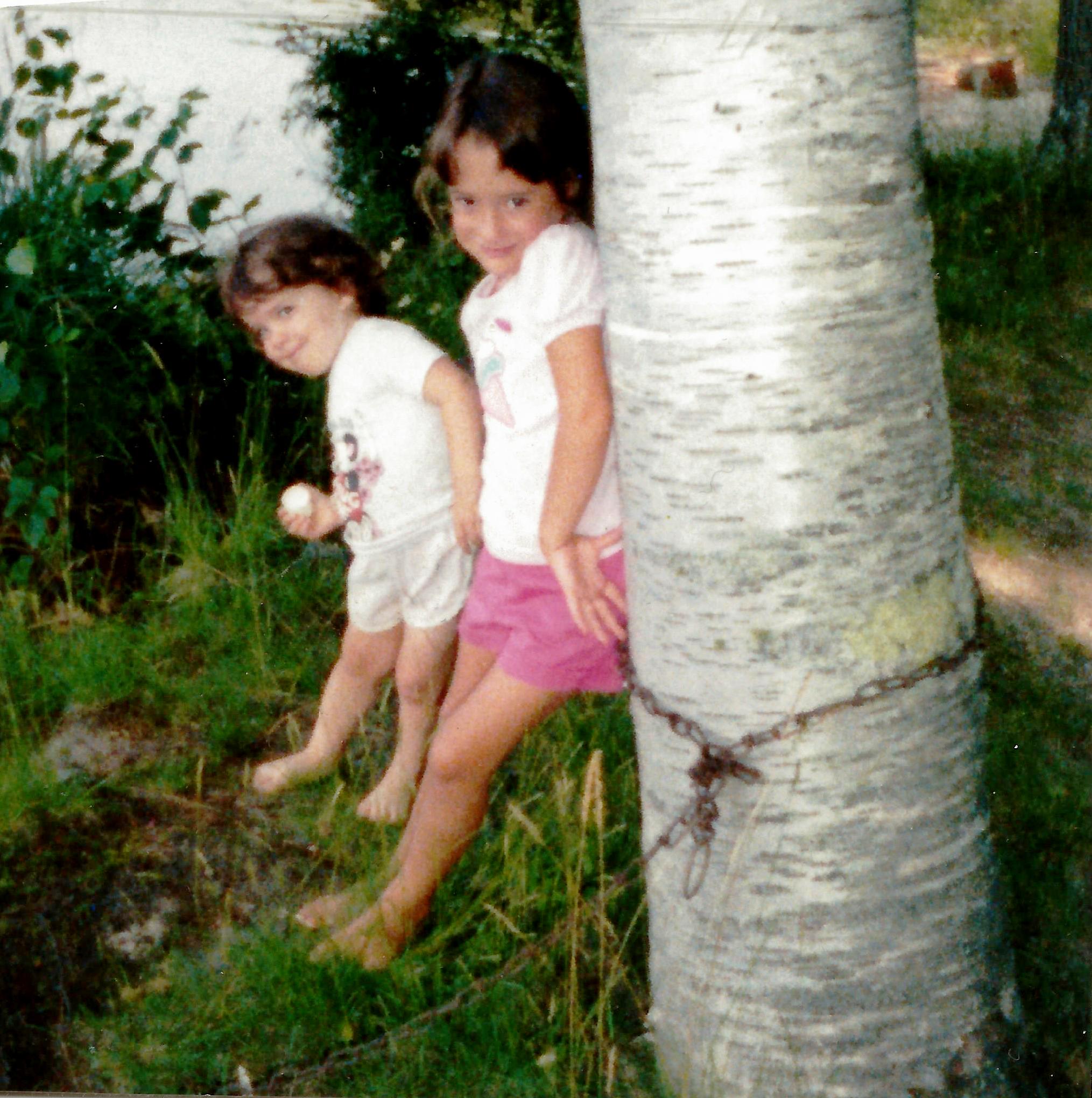
Twenty five years ago we were walking the neighborhood with our two youngest daughters, Angela and Meg, when three year old Meg took note of sewage back up.  “Dad,” she said, “someone is having a yucky cookout!”  I had been pondering the science that concluded that all smells consist of millions of tiny particles spewed from their point of origin; she was trying to make sense of a new experience as all children will do.  At first I was confused, and then all became clear.  Meg’s experience of outdoor smells was mostly of hamburgers, hot dogs and chicken on the grill.  This was an outdoor smell, but made her queasy, therefore….

“Yucky cookout” wasn’t Meg’s mistake; it was someone else’s misfortune.

Without music, life would be a mistake.  Friederich Nietzsche

Our first grandchild, Gianna, is now five, the daughter of Peter and our next to youngest daughter, Angela.  They live a couple of blocks over, and we see them often.  When a car passes with windows down presumably to assault the rest of us with make-believe gangsta toughness, she takes note of the pulsing onslaught at decibel levels which would require OSHA approved ear protection.  Occasionally, she will mimic Peter’s response, “Thank you for sharing,” but she adds her own refinement to this auditory mugging, “Thank you for sharing the broken music.”  Much young wisdom lies in this analogy.

Gianna and Ellie on Lake Webb 2013

Gianna and Ellie on Lake Webb 2013

Since well before she was born, as her mother had, Gianna listened to magnificent sounds that are sometimes elevating, sometimes spiritually stirring, sometimes peaceful. Mozart, Verdi, Tchaikovsky, Debussy, Chopin, but also an eclectic medley of Norah Jones, Doc Watson, bluegrass from Alison Krauss or old Nitty Gritty Dirt Band albums like “Will the Circle Be Unbroken”, Nat King Cole, Dave Brubeck and many others.  She is in her second year of ballet lessons – her teacher, Jamie, danced as Sugar Plum Fairy for the same “Nutcracker” Christmas productions in which Angela and Meg danced.  Our parish is lively – the whole congregation at Sunday Mass, including the children, sing uplifting songs.  Her whole young life has been immersed in beautiful music.  Gianna’s response to music often is to break into spontaneous dance; her two year old sister, Ellie, imitates her as she sweeps into the living room with kindergarten chassés, petit jetés and demi-pliés. This is so reminiscent to us of her mother and Aunt Meg at that age.

“Broken music” wasn’t Gianna’s mistake; it was someone else’s misfortune.

Music expresses that which cannot be said and on which it is impossible to be silent.    Victor Hugo

Admittedly, hip-hop and rapping are estranged from me, and I remain ignorant of their nuance (if nuance isn’t a bridge too far for them); they evolved from and were a reaction to the dismal disco of the seventies. Disco also spawned the early sampling of rave techno and house music.  These genres are contrived offshoots, but allegedly reflect an alienated culture: outraged anger or frenetic coupling — joyless, addictive, frequently drugged out, adrenaline fueled thrill and pleasure-seeking without succor or respite or ascent of the spirit.  They seem to me to stink of stale sweat, testosterone, hostility and lust void of love. For your edification, here’s a small sampling:

Smoke any as***le that’s sweating me
Or any motherf**ker that threatens me
I’m a sniper with a hell of a scope
Takin out a cop or two they can’t cope with me

F**k the Police – NWA (Dre)

And I’m gunning for your spouse
Tryin to send the b***h back to her maker
And if you’ve got a daughter over 15
I’m gonna rape her!

X is Coming for you – DMX

So I f**ked your b***h you fat motherf**ker!
Hit ‘em up – 2pac and The Outlaws

Music is intended and designed for sentient beings that have hopes and purposes and emotions.  Jacques Barzun

Angela posted a video on her Facebook page this week, which is well worth the four minutes it takes to watch, about the Landfill Harmonic Orchestra.  Brimful of gratitude for the many blessings in my life, I marvel at the elegance brought up like precious stones from the refuse.  The creators of the video tell of an enormous landfill in Cateura, Paraguay, on which thousands of people live and rely upon for sustenance, recycling trash and selling it.  Some of the youth have been organized by volunteer musicians and teachers into an orchestra; they play instruments fashioned from other people’s junk.  Bebi is a nineteen year old who plays a cello, he tells us, made from an oil drum and salvaged wood; the pegs are made out of an old tool used to tenderize beef. He plays a credible version of the J.S. Bach Prelude from Unaccompanied Cello Suite No. 1 in G Major, which you may recognize from the Galapagos Island scene in the Russell Crowe movie, “Master and Commander.” These children play Handel’s Water Music and many other pieces.  From out of the most wretched conditions, they draw beauty.

The machine nature of hip-hop and techno music draws alienation from what was once meaningful:  sampling and repeating and hammering away with no instruments made by hand out of real materials – wood, gut and steel string, reeds, brass and craftsmanship.  The derivative nature of hip hop requires not as much musical ability as some sophisticated electronic gear – a DJ and a recurrently angry and misogynist MC.  Where the Landfill Harmonic Orchestra recaptures harmony and beauty from deprivation; the rappers distort into depravity what was once harmonious.

Rita and I played guitar and banjo when our kids were small and sang a lot with them; Rita also plays an accordion, a legacy from her childhood.  Angela and Meg played piano and flute; Gianna this morning told us she wants to play piano or violin.  She has lovely hands with long, strong fingers that will help her to do that.  She has expressed no interest in learning to “scratch” a turntable or to “play” an electronic beat maker or synthesizer.

For Gianna and for me, sadly, there is “broken music” without redemption or real meaning to draw us closer to one another or to lift our souls.  Perhaps this brokenness exposes a broken culture; if so, it is a culture Gianna chooses not to embrace.

My life would be worthless without music….. People realize that we shouldn’t throw away trash carelessly; well we shouldn’t throw away people either.  From two of the players in the Landfill Harmonic Orchestra

If music be the food of love, play on.  William Shakespeare

5 Comments

Filed under Culture views, Personal and family life

Maine Tales – V, an Absence of Time

“Eternity is said not to be an extension of time, but an absence of time.”  Maurice Bendrix in The End of the Affair, Graham Greene

Events, players from the theater of our lives and time are inextricably knotted in the woof and warp of our memory and in our character.  Many of the supporting cast we met during that period we lived in Maine informs our humanity, but they seemed not so central at the time.  In our encounters with them we paused on the trail like rounding a curve and sighting an unexpected vista.  I cannot tell you exactly how we met them, but the vignettes of our connection are indelible.

“What then is time?  If no one asks me, I know what it is.  If I wish to explain it to him who asks, I do not know. St. Augustine

Alan and Donna lived in a hand framed wood house that Alan built on a wood lot they owned in nearby Vienna (Vy-anna).  They kept a large garden and goats and raised three bright children – Autumn, Oak and Brook.  Oak was the boy.  Alan sported shaggy hair and full beard; he cut timber, built houses, ran his own heavy equipment and made his own way in the town next to his birthplace in Mount Vernon.  Early on Alan seemed just a tough, very strong woodsman who handled a big chainsaw as effortlessly as other men handled a keyboard.  But it would be a mistake to miss his well honed intelligence.

 He made it his business to be as self sufficient as possible, never losing his edge to grow his own food, heat with his own wood and maintain his autonomy. His drive and ability made him a financially secure land developer and builder.  Alan’s tendency for Maine tall tales often led to wry humor and good natured exaggeration.  Donna was a refugee of flower children from New Jersey, an authentic gentle soul, who could mask her own keen understanding of human weakness with an indefatigable willingness to help anyone who needed some.  When Rita was working part time as an RN at Augusta General, Donna would bring Autumn and Oak to our house and provide an inexpensive home day care for our two little ones in the afternoon until I got home in the evening.  Our children adored her.

Rita was appointed as the Health Care Officer for Mount Vernon, a title with almost no money and few defined duties.  She conducted free blood pressure clinics and a mandated flu shot clinic in a year the state health department predicted a bad winter.  She set up in the Grange Hall where Alan and Donna had celebrated their Baptist sunrise wedding reception breakfast.  The mood was lively with the good natured gossip of mostly elderly ladies and nervous chatter speculating on the rumors that other towns had seen adverse reactions to the inoculations.  When Alan walked in for his flu shot, he jammed up his T shirt, exposing a bicep as big as some thighs.  Rita suspected his mischievous smile, but the free clinic was for all comers.  Upon sticking him, he moaned loudly, spun around, crashed through several rows of folding chairs then face first in a dead fall onto the floor, horrifying the kind old ladies.  They were more appalled when Rita headed over to kick his prone body now quivering with laughter.

“Saint Augustine was asked where time came from.  He said it came out of the future, which didn’t exist yet, into the present that had no duration, and went into the past, which had ceased to exist.  I don’t know that we can understand time any better than a child.”  Father Crompton in The End of the Affair, Graham Greene

Bert and Taffy owned a lovely piece of land at the edge of a large field.  They, too, had a big garden and a menagerie of laying hens and some turkeys. Bert convinced me that domestic turkeys were stupid enough to drown in a storm by looking up to watch the rain.  I was never quite sure if he was teasing me.   Their four children’s names all alliterated, starting in “B”. They looked just like their names would have you expecting them to look.  Taffy tended towards long dresses in winter, plaid shorts in summer, thick glasses and effervescent laughter.   Bert almost always wore bib overalls and a black full beard; he weighed close to three hundred pounds.  Again it was a grievous error to judge these books by their covers.

When we met Bert, he was a real estate broker with a booming voice that filled almost any space.  Instantly likeable, we came to know them and fed the laying hens and turkeys once when they visited Taffy’s parents out of state.  Bert grew up on a subsistence farm a couple of towns over in Stark, but came to the attention of state educators when he won the high school science fair as a freshman.  His prize winner was a study of irradiated bean seed growth. He irradiated them with a homemade linear proton accelerator he built in his dirt floor cellar with concentrically smaller circular magnets, a vacuum tube and hydrogen he bought mail order from Popular Mechanics Magazine.   He earned a full scholarship to MIT but dropped out as a sophomore, bored with the classes and the city.

Twice a week he drove down to the coast to teach Maritime History to cadets at the Maine Maritime Academy.  Occasionally he published academic articles and had worked for a time at the Brookings Institute.  He got into the real estate business because he needed the money after struggling for years to make a living off a small bookstore he owned in Boothbay Harbor.  Bert was a truly gifted story teller.

My personal favorite of Bert’s stories told an archetypical favorite theme: the city slicker made a fool by the Maine farmer.  Bert’s father plowed his planting with a pair of oxen.  Late one spring, when the frost driven mud grudgingly gave back the land, he was turning over the soil behind his team when a Chrysler convertible with New York plates pulled over at the side of the dirt road adjacent to his field.  The wife had the camera, the husband yelled over to Bert’s father to ask him if he minded them taking some pictures of the scene too quaint for the folks back home to believe.  His Dad picked his way through the plowed rows and approached the car.  He removed his floppy hat, wiped his brow and told them that he would prefer they didn’t because the oxen would get spooked and he’d lose an afternoon’s work.  The couple discussed it as though Bert’s dad was invisible, and the man offered to pay $20 to take the pictures to make up for the lost production.  Bert’s dad thought for a long while and reluctantly accepted the money.  The city folks drove off, kicking up dust, happy to have a story with which they could entertain the cocktail party.

Bert would laugh raucously as he told us his Dad quickly resumed his plowing with a weeks’ worth of grocery money in his pocket.  Bert concluded his story telling his audience that you could shoot an ox on a Tuesday, and he wouldn’t fall over until Saturday.  His Dad related his story to all listeners for years.

I could never distinguish the story from the story teller with Bert and the truth was asymptotic, but they were entertaining.

“Take time: apart from cosmology, where the big bang marked the beginning of time, there is nothing in physics to distinguish one moment of time from the next.”  Paul Davies, introduction to Six Easy Pieces.

These stories and stories about stories are thirty years old now, but seem fresh.  Some memories don’t fade; they subcutaneously assimilate until they are woven into our nature.  The lessons about our self righteousness and prideful, premature judgment of others are indelible.  Our preconceived notions about the shortcomings and foibles of others we learned were products of our own insecurities.  Our stories and memories form us.  They become us.

“For example, love is not a science. So, if something is said not to be a science, it does not mean that there is something wrong with it.”  Six Easy Pieces, Richard Feynman

4 Comments

Filed under Maine Tales

Fathom the Shallows

I’ve been wandering through this land
Just doin’ the best I can Tryin’ to find what I was meant to do
And the people that I see
Look as worried as can be
And it looks like they are wanderin’, too.

And I can’t help but wonder where I’m bound
Where I’m bound
I can’t help but wonder where I’m bound…,   Tom Paxton

Once a smart phone became firmly established in my daily routine, layered on top of an assertive laptop, the compulsion to check emails and all manner of distraction entrenches week by week into my neurons and synapses.  The message notification “dings” set me to salivating like Pavlov’s dogs; resisting the impulse to jump from what I am doing to the current diversion is increasingly difficult.  Focus blurs.

Nicolas Carr published in 2010 The Shallows, What the Internet is Doing to our Brains, which analyzes the physical, emotional and psychological effects in our brains of using the net.  I first listened to “The Shallows” as an audio book, now I’m reading it on the Nook; I can’t get the ideas to stop their reverberations. The implications for us and for the lives of our children are unsettling.

Our method of acquiring information is transmuting us into feverish wantons with the attention deficits of mosquitoes in a crowded tent on a humid summer night.  On laptop or smart phone we flit to the compelling chime of personal and work email, Facebook updates, Linked In messages, Tweets, text messages and voicemail notifications. The banner of multitasking rides at the head of a rabble with a disordered compass.

”It wasn’t just that so many of my habits and routines were changing as I became more accustomed to and dependent on the sites and services of the net.  The very way my brain worked seemed to be changing. It was then that I began worrying about my inability to pay attention to one thing for more than a couple of minutes…. My brain… wasn’t just drifting.  It was hungry.  It was demanding to be fed the way the Net fed it – and the more it was fed, the hungrier it became.” The Shallows, Nicolas Carr

Brain theory long assumed genetically predisposed neurons and synapses which congealed in late adolescence.  Neurology now concludes that plasticity for neuron and synapse formation persists for all of our lives.  We rewire incessantly. New experience and repetitive actions shape fresh biological connections; neglected habits atrophy.  The media is not only the message, but re-forms our minds, our nerve cells, how we think and what we think.

We read fewer books and grow impatient with long articles (or blog posts).  We follow YouTube videos, clever slogans and the Tweets of movie actors and baseball players where once we probed nuance in the insights of genius. 140 characters and hash tags hazard scarce space for fine distinctions. Research and analysis defaults to bouncing hyperlink to hyperlink, descending into minutiae and boggling detail. Renaissance Man is no more; as my boss is fond of saying, we major in minors. We know (or have immediate access to) more and more about less and less.

”By waiting and by calm you shall be saved, in quiet and in trust your strength lies.  But this you did not wish.”  Isaiah 30:15

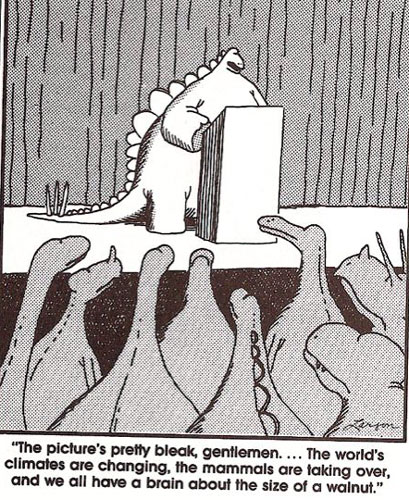
Dinosaurs Far Side Gary LarsonI wonder if other societal problems are related.  Can it be coincidence that the first generation engrossed in on line distraction and video games from their infancy is also the generation beset with epidemic Attention Deficit/ Hyperactivity Disorder?  After decades of consistent improvement, IQ scores have declined in the last fifteen years, mainly in writing and verbal skills.  Studies cited in “The Shallows” are conclusive that those reading material in a traditional book retain more and have deeper understanding of the same material read by other subjects on screen with hyperlinks, supposedly better equipping them to explore and understand associated texts.  How can these two issues not be related?  Are we sacrificing biological memory capacity and the ability for deep thinking even as we gain in artificial memory and silicone aided rapid computation and recall?  Are exponential gains in access to facts depriving us of knowledge, and worse, of sorely needed wisdom?  Where do we find peace in feverish, addictive distraction?

Then you better start swimmin’
Or you’ll sink like a stone
For the times they are a-changin’.
   Bob Dylan

The still developing technology affords us the ability to assimilate not only the printed word, but images, video and speech from sites like TED and on line learning educational channels from many universities.  Irrevocably alterations occur to how we learn and communicate, even how our brain works, hopefully into wisdom, not Babel.  Should we choose to dissipate this windfall into pornography, trivialities, Tweets, two minute YouTube videos, Facebook posts and in violent, amoral games like Grand Theft Auto, we will corkscrew into degradation.  One of the earliest developments in printed books was pervasive pornography, but the ship pitched in the storm for a while and then righted. Should we similarly roll with the wind and tide to integrate imaginatively human wisdom with this virtually unlimited source of information, our children will have a future worth leaving them.  Our creative gifts and free will to act will set us on our path.  The jury is not only still out, we are the accused, the advocates, the judge and the jury.

“Many years back I gave up all claim to a rational view of the world and even avoided people who believed that the laws of physics and causality have any application when it comes to understanding the mysteries of creation or the fact that light can enter the eye and form an image in the brain and send a poetic tendril down the arm into a clutch of fingers that could write the Shakespearean sonnets.”  Creole Belle, James Lee Burke  

8 Comments

Filed under Culture views

The Perfect Strawberry

The perfect strawberry is a complicated business, and one in which I am not particularly adept. To understand this year’s crop requires a history.

Twenty years ago in Providence, an 80’ Norway spruce in our back yard made the transition from playground and shade provider to weed.  Conifers have been around this tired planet for 200 million years, a vital component of many ecosystems.  Their names are strong, evocative – even poetic:  Sitka Spruce, Pacific Silver Fir, Lodgepole Pine, Incense Cedar, Mountain Hemlock, Baldcypress, Redwood, and Tamarack.   Evergreen is a misnomer.  Each species has its own timetable, but they shed their needles every year like deciduous trees, some with a striking fall yellow.  Their narrow pointed leaves carpet the earth, but they only drop older needles with the current crop (or several year’s worth) remaining to hold ever-green all winter.

In the early nineties, this illustrious past made no difference to me: the needles and shade killed what little lawn I had in my tiny city lot; the sticky, Norway-Spruce-conesgolden drippings from the bark bonded to the finish of our cars; cones devastated our bare feet, and the 18” limbs hung like the Sword of Damocles over my garage, only five feet from its thirty six inch trunk.  We had no hope of a garden, and the pin oak I treasured twenty feet north of the spruce was beginning to deform to find sun of its own. The Norway spruce which had been planted by the previous owner of our home in the 1930’s was sixty years later a tall and heavy weed.

After we moved to Providence, my son designed and built a refuge with his new city friends.  Scavenging from the dumpsters in a six lot subdivision a quarter mile away, they cut and fit remnants of two by fours, two by sixes, half inch plywood and discarded loose nails into a tree house fifteen feet up in the Norway spruce.  My only contributions were a blue tarp to waterproof the roof and, after setting a rope in place, teaching Gabriel how to foot lock up the rope to his sanctuary.  I did go up to reassure his mother that although not OSHA compliant, it was habitable and secure.

The three wings, each long enough to accommodate a sleeping bag conjoined into a four foot square parlor under a three and a half foot ceiling.  Once they hoisted themselves up and pulled the rope up after them, parents slept secure that no marauders could easily access their fortress.  The boys ran an extension cord from Gabe’s window for a light, and when they each stretched out on their bags facing inward, the center afforded ample space for card playing, scarfing down Twinkies, Cokes and Doritos (fare foreign to his mother’s kitchen), tale telling and planning night excursions into the city.  We naively thought they were safe from the city; years later we learned the city wasn’t safe from them.

Unbeknownst to their parents, two in the morning expeditions wandered as far as the bus tunnel steeply descending the half mile from Brown University Hill to South Main Street near the courthouse three miles from our house.  The tunnel was a traffic free route for public transportation connecting the university communities of Rhode Island School of Design and Brown to downtown.  Pitch dark, except when a bus caromed through lights ablaze, the tunnel was an irresistible challenge for pre teen skateboarders.  Even in the nanny state days of ubiquitous helmets, boys will find ways of courting danger to grow into men.  They all survived – no fractures or paralysis.

The boys grew to manhood, and the young man helped his father dismantle the abandoned refuge and cut down its pedestal, now a weed.  With chainsaw, climbing saddle and ropes, we worked for two days first lowering the large limbs over the garage from the bottom up, and then popping the top twenty five feet into the small target circumscribed by the back fence, the pin oak, the garage and our house.  After all the limbs and top were safely cut up on the ground, three more ten foot logs were dropped one at a time from the remaining pole.  Last was the twenty five foot trunk, which we notched and felled onto the mark.

With the spruce gone, several years went by before we dug in a twelve by twenty foot raised planting bed in the sunny spot salvaged from the spruce’s shade.  Hundreds of pounds of organic compost built up top soil, and lime sweetened sixty years of acidic spruce needles.  First there were flowers, a lilac and a butterfly bush.  Later we reverted to our Maine habit of vegetable and herb garden.  In the tiny plot, we plant tomatoes, lettuce, zucchini and an occasional ill advised venture into peppers or pole beans.

strawberryTwo years ago, we put in some strawberry plants, which quickly expired for horticultural reasons unfathomable to amateurs.  Last year I tried again, and they took.  The few miserable fruit that exposed themselves were quickly consumed by birds just as they matured.  Undeterred, this winter I protected them with boards as we stored our firewood in the garden.  Unsure what I would find this spring, I was pleased to find they had prospered under the tarps and four cords of oak and maple.

Spring arrived; I weeded and raked in yet another few hundred pounds of dried manure and planted this year’s crop of vegetables.  The four strawberry plants looked so promising I planned to buy some bird netting to defend the harvest from predators, but waited until the weekend, which as it turned out, was three days too late.

Memo:  buy bird netting early next year.

Last week, while watering the garden at five AM as is my habit, I glimpsed half buried red under one of the strawberry plants.  With faint hope and mounting joy, I gently uncovered just ripened perfection.  I briefly considered saving it for Rita, but she was asleep after all.  I washed off the soil, admired God’s wondrous variety for a few moments and bit into sweet delight after a bitter winter.

“It is better to limp along the way than stride along off the way.  For a man who limps along the way, even if he only makes slow progress, comes to the end of the way, but one who is off the way, the more quickly he runs, the further away he is from his goal.”  Thomas Aquinas

5 Comments

Filed under Personal and family life