Author Archives: jparquette

jparquette's avatar

About jparquette

Fortunate and blessed in companionship with my wife of fifty seven years, in health and in modest, but more than adequate circumstances. Life is good.

Broken Music

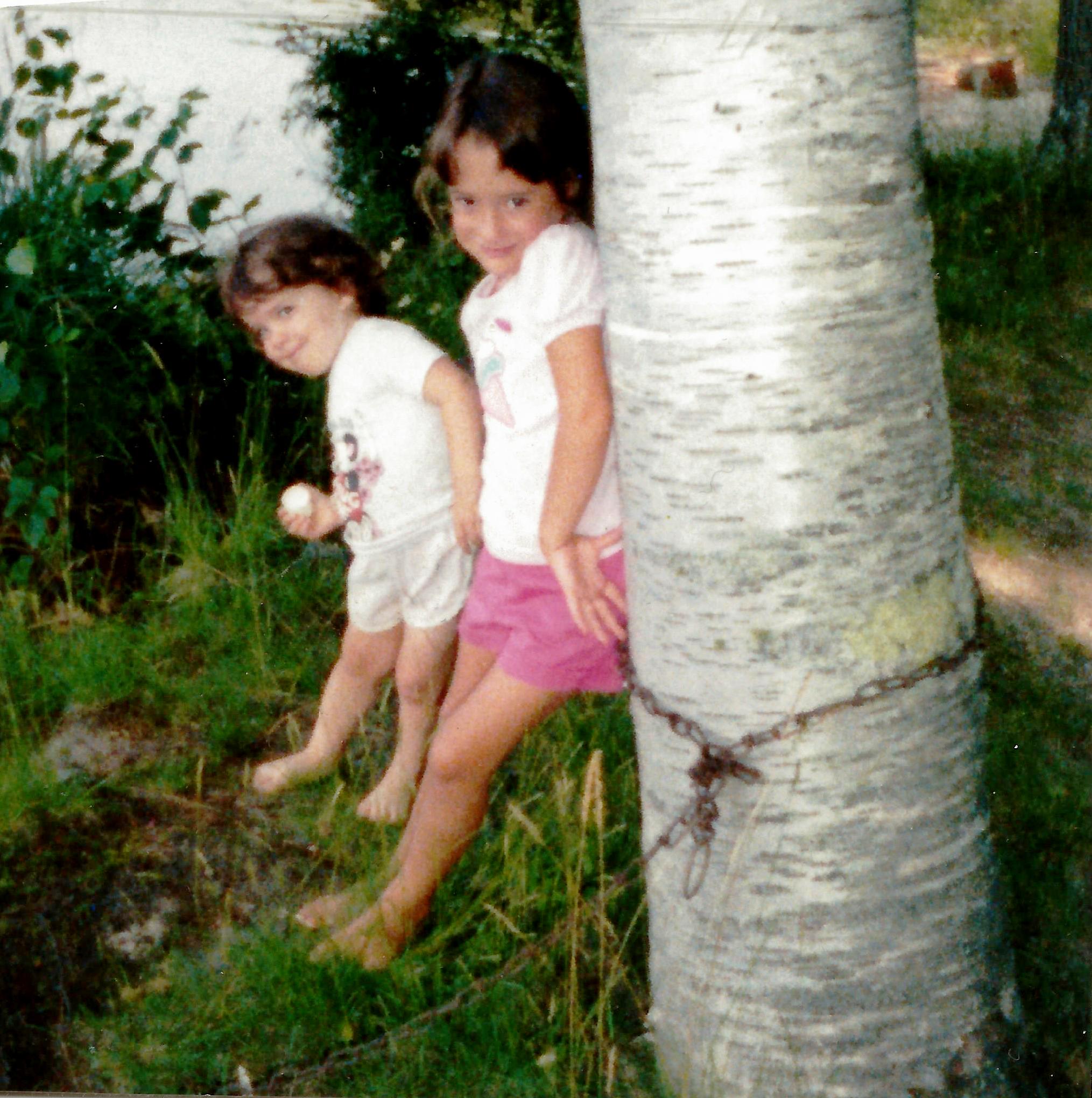
Angela and Meg on Lake Webb, Weld, ME circa 1988

Angela and Meg on Lake Webb, Weld, ME circa 1988

Music is well said to be the speech of angels.  Thomas Carlyle

Twenty five years ago we were walking the neighborhood with our two youngest daughters, Angela and Meg, when three year old Meg took note of sewage back up.  “Dad,” she said, “someone is having a yucky cookout!”  I had been pondering the science that concluded that all smells consist of millions of tiny particles spewed from their point of origin; she was trying to make sense of a new experience as all children will do.  At first I was confused, and then all became clear.  Meg’s experience of outdoor smells was mostly of hamburgers, hot dogs and chicken on the grill.  This was an outdoor smell, but made her queasy, therefore….

“Yucky cookout” wasn’t Meg’s mistake; it was someone else’s misfortune.

Without music, life would be a mistake.  Friederich Nietzsche

Our first grandchild, Gianna, is now five, the daughter of Peter and our next to youngest daughter, Angela.  They live a couple of blocks over, and we see them often.  When a car passes with windows down presumably to assault the rest of us with make-believe gangsta toughness, she takes note of the pulsing onslaught at decibel levels which would require OSHA approved ear protection.  Occasionally, she will mimic Peter’s response, “Thank you for sharing,” but she adds her own refinement to this auditory mugging, “Thank you for sharing the broken music.”  Much young wisdom lies in this analogy.

Gianna and Ellie on Lake Webb 2013

Gianna and Ellie on Lake Webb 2013

Since well before she was born, as her mother had, Gianna listened to magnificent sounds that are sometimes elevating, sometimes spiritually stirring, sometimes peaceful. Mozart, Verdi, Tchaikovsky, Debussy, Chopin, but also an eclectic medley of Norah Jones, Doc Watson, bluegrass from Alison Krauss or old Nitty Gritty Dirt Band albums like “Will the Circle Be Unbroken”, Nat King Cole, Dave Brubeck and many others.  She is in her second year of ballet lessons – her teacher, Jamie, danced as Sugar Plum Fairy for the same “Nutcracker” Christmas productions in which Angela and Meg danced.  Our parish is lively – the whole congregation at Sunday Mass, including the children, sing uplifting songs.  Her whole young life has been immersed in beautiful music.  Gianna’s response to music often is to break into spontaneous dance; her two year old sister, Ellie, imitates her as she sweeps into the living room with kindergarten chassés, petit jetés and demi-pliés. This is so reminiscent to us of her mother and Aunt Meg at that age.

“Broken music” wasn’t Gianna’s mistake; it was someone else’s misfortune.

Music expresses that which cannot be said and on which it is impossible to be silent.    Victor Hugo

Admittedly, hip-hop and rapping are estranged from me, and I remain ignorant of their nuance (if nuance isn’t a bridge too far for them); they evolved from and were a reaction to the dismal disco of the seventies. Disco also spawned the early sampling of rave techno and house music.  These genres are contrived offshoots, but allegedly reflect an alienated culture: outraged anger or frenetic coupling — joyless, addictive, frequently drugged out, adrenaline fueled thrill and pleasure-seeking without succor or respite or ascent of the spirit.  They seem to me to stink of stale sweat, testosterone, hostility and lust void of love. For your edification, here’s a small sampling:

Smoke any as***le that’s sweating me
Or any motherf**ker that threatens me
I’m a sniper with a hell of a scope
Takin out a cop or two they can’t cope with me

F**k the Police – NWA (Dre)

And I’m gunning for your spouse
Tryin to send the b***h back to her maker
And if you’ve got a daughter over 15
I’m gonna rape her!

X is Coming for you – DMX

So I f**ked your b***h you fat motherf**ker!
Hit ‘em up – 2pac and The Outlaws

Music is intended and designed for sentient beings that have hopes and purposes and emotions.  Jacques Barzun

Angela posted a video on her Facebook page this week, which is well worth the four minutes it takes to watch, about the Landfill Harmonic Orchestra.  Brimful of gratitude for the many blessings in my life, I marvel at the elegance brought up like precious stones from the refuse.  The creators of the video tell of an enormous landfill in Cateura, Paraguay, on which thousands of people live and rely upon for sustenance, recycling trash and selling it.  Some of the youth have been organized by volunteer musicians and teachers into an orchestra; they play instruments fashioned from other people’s junk.  Bebi is a nineteen year old who plays a cello, he tells us, made from an oil drum and salvaged wood; the pegs are made out of an old tool used to tenderize beef. He plays a credible version of the J.S. Bach Prelude from Unaccompanied Cello Suite No. 1 in G Major, which you may recognize from the Galapagos Island scene in the Russell Crowe movie, “Master and Commander.” These children play Handel’s Water Music and many other pieces.  From out of the most wretched conditions, they draw beauty.

The machine nature of hip-hop and techno music draws alienation from what was once meaningful:  sampling and repeating and hammering away with no instruments made by hand out of real materials – wood, gut and steel string, reeds, brass and craftsmanship.  The derivative nature of hip hop requires not as much musical ability as some sophisticated electronic gear – a DJ and a recurrently angry and misogynist MC.  Where the Landfill Harmonic Orchestra recaptures harmony and beauty from deprivation; the rappers distort into depravity what was once harmonious.

Rita and I played guitar and banjo when our kids were small and sang a lot with them; Rita also plays an accordion, a legacy from her childhood.  Angela and Meg played piano and flute; Gianna this morning told us she wants to play piano or violin.  She has lovely hands with long, strong fingers that will help her to do that.  She has expressed no interest in learning to “scratch” a turntable or to “play” an electronic beat maker or synthesizer.

For Gianna and for me, sadly, there is “broken music” without redemption or real meaning to draw us closer to one another or to lift our souls.  Perhaps this brokenness exposes a broken culture; if so, it is a culture Gianna chooses not to embrace.

My life would be worthless without music….. People realize that we shouldn’t throw away trash carelessly; well we shouldn’t throw away people either.  From two of the players in the Landfill Harmonic Orchestra

If music be the food of love, play on.  William Shakespeare

5 Comments

Filed under Culture views, Personal and family life

Maine Tales – V, an Absence of Time

“Eternity is said not to be an extension of time, but an absence of time.”  Maurice Bendrix in The End of the Affair, Graham Greene

Events, players from the theater of our lives and time are inextricably knotted in the woof and warp of our memory and in our character.  Many of the supporting cast we met during that period we lived in Maine informs our humanity, but they seemed not so central at the time.  In our encounters with them we paused on the trail like rounding a curve and sighting an unexpected vista.  I cannot tell you exactly how we met them, but the vignettes of our connection are indelible.

“What then is time?  If no one asks me, I know what it is.  If I wish to explain it to him who asks, I do not know. St. Augustine

Alan and Donna lived in a hand framed wood house that Alan built on a wood lot they owned in nearby Vienna (Vy-anna).  They kept a large garden and goats and raised three bright children – Autumn, Oak and Brook.  Oak was the boy.  Alan sported shaggy hair and full beard; he cut timber, built houses, ran his own heavy equipment and made his own way in the town next to his birthplace in Mount Vernon.  Early on Alan seemed just a tough, very strong woodsman who handled a big chainsaw as effortlessly as other men handled a keyboard.  But it would be a mistake to miss his well honed intelligence.

 He made it his business to be as self sufficient as possible, never losing his edge to grow his own food, heat with his own wood and maintain his autonomy. His drive and ability made him a financially secure land developer and builder.  Alan’s tendency for Maine tall tales often led to wry humor and good natured exaggeration.  Donna was a refugee of flower children from New Jersey, an authentic gentle soul, who could mask her own keen understanding of human weakness with an indefatigable willingness to help anyone who needed some.  When Rita was working part time as an RN at Augusta General, Donna would bring Autumn and Oak to our house and provide an inexpensive home day care for our two little ones in the afternoon until I got home in the evening.  Our children adored her.

Rita was appointed as the Health Care Officer for Mount Vernon, a title with almost no money and few defined duties.  She conducted free blood pressure clinics and a mandated flu shot clinic in a year the state health department predicted a bad winter.  She set up in the Grange Hall where Alan and Donna had celebrated their Baptist sunrise wedding reception breakfast.  The mood was lively with the good natured gossip of mostly elderly ladies and nervous chatter speculating on the rumors that other towns had seen adverse reactions to the inoculations.  When Alan walked in for his flu shot, he jammed up his T shirt, exposing a bicep as big as some thighs.  Rita suspected his mischievous smile, but the free clinic was for all comers.  Upon sticking him, he moaned loudly, spun around, crashed through several rows of folding chairs then face first in a dead fall onto the floor, horrifying the kind old ladies.  They were more appalled when Rita headed over to kick his prone body now quivering with laughter.

“Saint Augustine was asked where time came from.  He said it came out of the future, which didn’t exist yet, into the present that had no duration, and went into the past, which had ceased to exist.  I don’t know that we can understand time any better than a child.”  Father Crompton in The End of the Affair, Graham Greene

Bert and Taffy owned a lovely piece of land at the edge of a large field.  They, too, had a big garden and a menagerie of laying hens and some turkeys. Bert convinced me that domestic turkeys were stupid enough to drown in a storm by looking up to watch the rain.  I was never quite sure if he was teasing me.   Their four children’s names all alliterated, starting in “B”. They looked just like their names would have you expecting them to look.  Taffy tended towards long dresses in winter, plaid shorts in summer, thick glasses and effervescent laughter.   Bert almost always wore bib overalls and a black full beard; he weighed close to three hundred pounds.  Again it was a grievous error to judge these books by their covers.

When we met Bert, he was a real estate broker with a booming voice that filled almost any space.  Instantly likeable, we came to know them and fed the laying hens and turkeys once when they visited Taffy’s parents out of state.  Bert grew up on a subsistence farm a couple of towns over in Stark, but came to the attention of state educators when he won the high school science fair as a freshman.  His prize winner was a study of irradiated bean seed growth. He irradiated them with a homemade linear proton accelerator he built in his dirt floor cellar with concentrically smaller circular magnets, a vacuum tube and hydrogen he bought mail order from Popular Mechanics Magazine.   He earned a full scholarship to MIT but dropped out as a sophomore, bored with the classes and the city.

Twice a week he drove down to the coast to teach Maritime History to cadets at the Maine Maritime Academy.  Occasionally he published academic articles and had worked for a time at the Brookings Institute.  He got into the real estate business because he needed the money after struggling for years to make a living off a small bookstore he owned in Boothbay Harbor.  Bert was a truly gifted story teller.

My personal favorite of Bert’s stories told an archetypical favorite theme: the city slicker made a fool by the Maine farmer.  Bert’s father plowed his planting with a pair of oxen.  Late one spring, when the frost driven mud grudgingly gave back the land, he was turning over the soil behind his team when a Chrysler convertible with New York plates pulled over at the side of the dirt road adjacent to his field.  The wife had the camera, the husband yelled over to Bert’s father to ask him if he minded them taking some pictures of the scene too quaint for the folks back home to believe.  His Dad picked his way through the plowed rows and approached the car.  He removed his floppy hat, wiped his brow and told them that he would prefer they didn’t because the oxen would get spooked and he’d lose an afternoon’s work.  The couple discussed it as though Bert’s dad was invisible, and the man offered to pay $20 to take the pictures to make up for the lost production.  Bert’s dad thought for a long while and reluctantly accepted the money.  The city folks drove off, kicking up dust, happy to have a story with which they could entertain the cocktail party.

Bert would laugh raucously as he told us his Dad quickly resumed his plowing with a weeks’ worth of grocery money in his pocket.  Bert concluded his story telling his audience that you could shoot an ox on a Tuesday, and he wouldn’t fall over until Saturday.  His Dad related his story to all listeners for years.

I could never distinguish the story from the story teller with Bert and the truth was asymptotic, but they were entertaining.

“Take time: apart from cosmology, where the big bang marked the beginning of time, there is nothing in physics to distinguish one moment of time from the next.”  Paul Davies, introduction to Six Easy Pieces.

These stories and stories about stories are thirty years old now, but seem fresh.  Some memories don’t fade; they subcutaneously assimilate until they are woven into our nature.  The lessons about our self righteousness and prideful, premature judgment of others are indelible.  Our preconceived notions about the shortcomings and foibles of others we learned were products of our own insecurities.  Our stories and memories form us.  They become us.

“For example, love is not a science. So, if something is said not to be a science, it does not mean that there is something wrong with it.”  Six Easy Pieces, Richard Feynman

4 Comments

Filed under Maine Tales

Fathom the Shallows

I’ve been wandering through this land
Just doin’ the best I can Tryin’ to find what I was meant to do
And the people that I see
Look as worried as can be
And it looks like they are wanderin’, too.

And I can’t help but wonder where I’m bound
Where I’m bound
I can’t help but wonder where I’m bound…,   Tom Paxton

Once a smart phone became firmly established in my daily routine, layered on top of an assertive laptop, the compulsion to check emails and all manner of distraction entrenches week by week into my neurons and synapses.  The message notification “dings” set me to salivating like Pavlov’s dogs; resisting the impulse to jump from what I am doing to the current diversion is increasingly difficult.  Focus blurs.

Nicolas Carr published in 2010 The Shallows, What the Internet is Doing to our Brains, which analyzes the physical, emotional and psychological effects in our brains of using the net.  I first listened to “The Shallows” as an audio book, now I’m reading it on the Nook; I can’t get the ideas to stop their reverberations. The implications for us and for the lives of our children are unsettling.

Our method of acquiring information is transmuting us into feverish wantons with the attention deficits of mosquitoes in a crowded tent on a humid summer night.  On laptop or smart phone we flit to the compelling chime of personal and work email, Facebook updates, Linked In messages, Tweets, text messages and voicemail notifications. The banner of multitasking rides at the head of a rabble with a disordered compass.

”It wasn’t just that so many of my habits and routines were changing as I became more accustomed to and dependent on the sites and services of the net.  The very way my brain worked seemed to be changing. It was then that I began worrying about my inability to pay attention to one thing for more than a couple of minutes…. My brain… wasn’t just drifting.  It was hungry.  It was demanding to be fed the way the Net fed it – and the more it was fed, the hungrier it became.” The Shallows, Nicolas Carr

Brain theory long assumed genetically predisposed neurons and synapses which congealed in late adolescence.  Neurology now concludes that plasticity for neuron and synapse formation persists for all of our lives.  We rewire incessantly. New experience and repetitive actions shape fresh biological connections; neglected habits atrophy.  The media is not only the message, but re-forms our minds, our nerve cells, how we think and what we think.

We read fewer books and grow impatient with long articles (or blog posts).  We follow YouTube videos, clever slogans and the Tweets of movie actors and baseball players where once we probed nuance in the insights of genius. 140 characters and hash tags hazard scarce space for fine distinctions. Research and analysis defaults to bouncing hyperlink to hyperlink, descending into minutiae and boggling detail. Renaissance Man is no more; as my boss is fond of saying, we major in minors. We know (or have immediate access to) more and more about less and less.

”By waiting and by calm you shall be saved, in quiet and in trust your strength lies.  But this you did not wish.”  Isaiah 30:15

Dinosaurs Far Side Gary LarsonI wonder if other societal problems are related.  Can it be coincidence that the first generation engrossed in on line distraction and video games from their infancy is also the generation beset with epidemic Attention Deficit/ Hyperactivity Disorder?  After decades of consistent improvement, IQ scores have declined in the last fifteen years, mainly in writing and verbal skills.  Studies cited in “The Shallows” are conclusive that those reading material in a traditional book retain more and have deeper understanding of the same material read by other subjects on screen with hyperlinks, supposedly better equipping them to explore and understand associated texts.  How can these two issues not be related?  Are we sacrificing biological memory capacity and the ability for deep thinking even as we gain in artificial memory and silicone aided rapid computation and recall?  Are exponential gains in access to facts depriving us of knowledge, and worse, of sorely needed wisdom?  Where do we find peace in feverish, addictive distraction?

Then you better start swimmin’
Or you’ll sink like a stone
For the times they are a-changin’.
   Bob Dylan

The still developing technology affords us the ability to assimilate not only the printed word, but images, video and speech from sites like TED and on line learning educational channels from many universities.  Irrevocably alterations occur to how we learn and communicate, even how our brain works, hopefully into wisdom, not Babel.  Should we choose to dissipate this windfall into pornography, trivialities, Tweets, two minute YouTube videos, Facebook posts and in violent, amoral games like Grand Theft Auto, we will corkscrew into degradation.  One of the earliest developments in printed books was pervasive pornography, but the ship pitched in the storm for a while and then righted. Should we similarly roll with the wind and tide to integrate imaginatively human wisdom with this virtually unlimited source of information, our children will have a future worth leaving them.  Our creative gifts and free will to act will set us on our path.  The jury is not only still out, we are the accused, the advocates, the judge and the jury.

“Many years back I gave up all claim to a rational view of the world and even avoided people who believed that the laws of physics and causality have any application when it comes to understanding the mysteries of creation or the fact that light can enter the eye and form an image in the brain and send a poetic tendril down the arm into a clutch of fingers that could write the Shakespearean sonnets.”  Creole Belle, James Lee Burke  

8 Comments

Filed under Culture views

The Perfect Strawberry

The perfect strawberry is a complicated business, and one in which I am not particularly adept. To understand this year’s crop requires a history.

Twenty years ago in Providence, an 80’ Norway spruce in our back yard made the transition from playground and shade provider to weed.  Conifers have been around this tired planet for 200 million years, a vital component of many ecosystems.  Their names are strong, evocative – even poetic:  Sitka Spruce, Pacific Silver Fir, Lodgepole Pine, Incense Cedar, Mountain Hemlock, Baldcypress, Redwood, and Tamarack.   Evergreen is a misnomer.  Each species has its own timetable, but they shed their needles every year like deciduous trees, some with a striking fall yellow.  Their narrow pointed leaves carpet the earth, but they only drop older needles with the current crop (or several year’s worth) remaining to hold ever-green all winter.

In the early nineties, this illustrious past made no difference to me: the needles and shade killed what little lawn I had in my tiny city lot; the sticky, Norway-Spruce-conesgolden drippings from the bark bonded to the finish of our cars; cones devastated our bare feet, and the 18” limbs hung like the Sword of Damocles over my garage, only five feet from its thirty six inch trunk.  We had no hope of a garden, and the pin oak I treasured twenty feet north of the spruce was beginning to deform to find sun of its own. The Norway spruce which had been planted by the previous owner of our home in the 1930’s was sixty years later a tall and heavy weed.

After we moved to Providence, my son designed and built a refuge with his new city friends.  Scavenging from the dumpsters in a six lot subdivision a quarter mile away, they cut and fit remnants of two by fours, two by sixes, half inch plywood and discarded loose nails into a tree house fifteen feet up in the Norway spruce.  My only contributions were a blue tarp to waterproof the roof and, after setting a rope in place, teaching Gabriel how to foot lock up the rope to his sanctuary.  I did go up to reassure his mother that although not OSHA compliant, it was habitable and secure.

The three wings, each long enough to accommodate a sleeping bag conjoined into a four foot square parlor under a three and a half foot ceiling.  Once they hoisted themselves up and pulled the rope up after them, parents slept secure that no marauders could easily access their fortress.  The boys ran an extension cord from Gabe’s window for a light, and when they each stretched out on their bags facing inward, the center afforded ample space for card playing, scarfing down Twinkies, Cokes and Doritos (fare foreign to his mother’s kitchen), tale telling and planning night excursions into the city.  We naively thought they were safe from the city; years later we learned the city wasn’t safe from them.

Unbeknownst to their parents, two in the morning expeditions wandered as far as the bus tunnel steeply descending the half mile from Brown University Hill to South Main Street near the courthouse three miles from our house.  The tunnel was a traffic free route for public transportation connecting the university communities of Rhode Island School of Design and Brown to downtown.  Pitch dark, except when a bus caromed through lights ablaze, the tunnel was an irresistible challenge for pre teen skateboarders.  Even in the nanny state days of ubiquitous helmets, boys will find ways of courting danger to grow into men.  They all survived – no fractures or paralysis.

The boys grew to manhood, and the young man helped his father dismantle the abandoned refuge and cut down its pedestal, now a weed.  With chainsaw, climbing saddle and ropes, we worked for two days first lowering the large limbs over the garage from the bottom up, and then popping the top twenty five feet into the small target circumscribed by the back fence, the pin oak, the garage and our house.  After all the limbs and top were safely cut up on the ground, three more ten foot logs were dropped one at a time from the remaining pole.  Last was the twenty five foot trunk, which we notched and felled onto the mark.

With the spruce gone, several years went by before we dug in a twelve by twenty foot raised planting bed in the sunny spot salvaged from the spruce’s shade.  Hundreds of pounds of organic compost built up top soil, and lime sweetened sixty years of acidic spruce needles.  First there were flowers, a lilac and a butterfly bush.  Later we reverted to our Maine habit of vegetable and herb garden.  In the tiny plot, we plant tomatoes, lettuce, zucchini and an occasional ill advised venture into peppers or pole beans.

strawberryTwo years ago, we put in some strawberry plants, which quickly expired for horticultural reasons unfathomable to amateurs.  Last year I tried again, and they took.  The few miserable fruit that exposed themselves were quickly consumed by birds just as they matured.  Undeterred, this winter I protected them with boards as we stored our firewood in the garden.  Unsure what I would find this spring, I was pleased to find they had prospered under the tarps and four cords of oak and maple.

Spring arrived; I weeded and raked in yet another few hundred pounds of dried manure and planted this year’s crop of vegetables.  The four strawberry plants looked so promising I planned to buy some bird netting to defend the harvest from predators, but waited until the weekend, which as it turned out, was three days too late.

Memo:  buy bird netting early next year.

Last week, while watering the garden at five AM as is my habit, I glimpsed half buried red under one of the strawberry plants.  With faint hope and mounting joy, I gently uncovered just ripened perfection.  I briefly considered saving it for Rita, but she was asleep after all.  I washed off the soil, admired God’s wondrous variety for a few moments and bit into sweet delight after a bitter winter.

“It is better to limp along the way than stride along off the way.  For a man who limps along the way, even if he only makes slow progress, comes to the end of the way, but one who is off the way, the more quickly he runs, the further away he is from his goal.”  Thomas Aquinas

5 Comments

Filed under Personal and family life

Maggie (Part 2)

What is crooked cannot be made straight, and what is missing cannot be supplied.  Ecclesiastes 1:15

The prior post on Margaret Sanger explored briefly some of the events and people that helped form her world view and fuel her frenetic efforts to fill the hole in her soul.  Three themes emerged as she came to maturity, and they informed and drove her behavior, writings and passions: unquenchable desires for sexual experience of all kinds and obsession to sever natural human fertility from sexual activity were two. The third was eugenics – promoting the concept that elite illuminati should determine who lives and who doesn’t, who breeds and who doesn’t.

Under threat of arrest in New York for flaunting the law while catechizing a gospel of crude birth control, she fled for a while to Great Britain.  This sojourn congealed her radicalism.  Freed from “the smothering restrictions of marital fidelity,” her unleashed promiscuity took to her bed some of the luminaries of the socialist intelligentsia there, including (among quite a few others) George Bernard Shaw, Havelock Ellis and H.G. Wells.  She advocated ever more stridently that we must strive to disassociate human sexuality from the natural benefits of human bonding, intimacy and parenthood.

Her connections with Ellis and Shaw deepened her commitment to the eugenics movement, and their money funded her American Birth Control League and its propaganda instrument, the Birth Control Review.  One of the articles in the 1920 editions was a favorable review of Lothrop Stoddard’s Fascist book, The Rising Tide of Color Against White World Supremacy.  Three years later a Review editorial advocated restricting immigration based on race.  In 1932 Margaret penned for the Review her “Plan for Peace,” which endorsed coerced sterilizations, mandatory segregation and “rehabilitative” concentration camps for all “dysgenic stocks,” including the handicapped, ethnic minorities and the mentally “defective.”  She routinely inveighed against the “inferior races” that were “human weeds,” a “menace to civilization”; she insisted the “sinister forces of the hordes of irresponsibility and imbecility” be controlled.

birth control revew banner (2)In 1933 the Review published “Eugenic Sterilization: An Urgent Need” by Margaret’s close friend, Ernst Rudin.  Rudin was at the time Adolf Hitler’s director of genetic sterilization, having been one of the founders of the Nazi Society for Racial Hygiene.  Later in 1933, she ran a piece by Leon Whitney, “Selective Sterilization,” which lauded the Nazi pre-holocaust race purification programs.  Margaret’s birth control advocacy was inextricable from her desire to maintain the purity of the human race with her and those most like her as the select survivors.  Like her fellow true believers in the Ku Klux Klan, the Nazis and the Eugenics Society, for Margaret, pulling the weeds in the human garden took the highest priority.

In 1939, Margaret devised the “Negro Project” at the request of “southern state public health officials” in which she stated that the “mass of Negroes ….particularly in the South, still breed carelessly and disastrously, with the result that the increase among Negroes, even more than among whites, is from that portion of the population least intelligent and fit.”  Her plan foreshadowed the goings-on of her current organization.  She suggested that they start with three or four “colored ministers preferably with social service backgrounds, and engaging personalities” to propagandize for birth control.  Her longer quote is enlightening.  “The most successful educational approach to the Negro is through a religious appeal.  We do not want word to go out that we want to exterminate the Negro population and the minister is the man who can straighten out that idea if it ever occurs to any of their more rebellious members.”   Margaret was a militant atheist, but not above manipulating the unsuspecting through their faith.

Nazi atrocities put a knot in Margaret’s plans as the world first recoiled in horror and then destroyed the Third Reich.  The inconvenience of bad public relations for its support of the Nazi agenda made the American Birth Control League and Birth Control Journal untenable as an ongoing enterprise.

What has been will be again, what has been done will be done again; there is nothing new under the sun.  Ecclesiastes 1:9

Margaret, undeterred, started up its successor, Planned Parenthood and the Planned Parenthood Review.  Planned Parenthood has expended great efforts to sanitize the beliefs of their founder, indeed portraying her as a modern day saint who pioneered freedom for women and a savior of their health.  True to course, however, their activities uphold her dreams.  The early offices of the international Planned Parenthood organization were in the offices of the Eugenics Society. Seventy percent of their “woman’s health clinics” are located in poor and minority neighborhoods.  While black Americans comprise 12.6% of the total population, 35.4% of abortions are inflicted on black babies.   For every 1,000 live births, there are 138 abortions in the white population; for black children the rate is 501 dead for every 1,000 born.   Planned Parenthood is self adulatory about their efforts on behalf of feminine health, but they do no mammograms – for those they refer their clients to others.  They say they do them, but they don’t.  What they don’t refer are the big profit items – over 300,000 abortions a year, which bring the “health organization” almost a third of its nearly billion dollar annual income.  The larger PP clinics have assigned abortion “quotas.”[1]

Abortion and racism are evil twins, born of the same lie.  Where racism now hides its face in public, abortion is accomplishing the goals of which racism only once dreamed.  Together, abortionists are destroying humanity at large and the black community in particular.  Alveda King

The Reverend Alveda King (daughter of civil rights leader, the Reverend A.D. King and niece of Martin Luther King) is an outspoken critic of Planned Parenthood.  Based in Atlanta, she speaks of a black genocide at many events throughout the country preaching in the familiar powerful cadences reminiscent of her family.  “Abortion and racism are both symptoms of a fundamental human error.  The error is thinking that when someone stands in the way of our wants, we can justify getting that person out of our lives.  Abortion and racism stem from the same poisonous root, selfishness.”  She was seventeen when her beloved uncle was murdered by James Earl Ray, but she remembers him and their conversations well.  She told us at lunch one day in Providence when she came to speak that while her uncle was killed five years before Roe v Wade struck down all the state laws in the country restricting abortion, he would have been sickened at the targeting of black babies by a white elite.  “A majority, perhaps as many as 75%, of abortion clinics are in areas with high minority populations.  Abortion apologists will say this is because they want to serve the poor.  You don’t serve the poor, however, by taking their money to terminate their children.”

Can foul seed ever blossom into anything but poison fruit?  Margaret Sanger lived until 1966, just short of the “summer of love” in San Francisco in 1967 where her other dreams came to sad, drugged out reality.  The Birth Control League fades into the dim past.  Maggie was praised by presidents and emperors, movie stars and scientists.  Still is.  Her early life and the foundations of her beliefs and work are forgotten or papered over.  Her dream and her organization persist with massive government, taxpayer paid support.  Planned Parenthood’s lobbying and contributions to liberal candidates are among the most aggressive in the country.  Kurt Vonnegut in Slaughter House-Five was perfect:  “And so it goes.”

For in much wisdom there is much sorrow, and he who stores up knowledge stores up grief. Ecclesiastes 1:18


[1]unplanned”, Abby Johnson, former director of a PP clinic.

6 Comments

Filed under Background Perspective, Culture views

Maggie (Part 1)

“I wheedle, I chip away, I argue, I reason, I cajole, I hope. But I do not expect.”  A Delicate Truth, John le Carre

Young Maggie

Young Maggie

In 1879 she was born into hardscrabble Irish immigrant poverty in upstate New York, the sixth of eleven children, as Margaret Higgins.  Her father was an emotionally scarred veteran of the Sherman’s Union Army that left scorched earth and blood from Tennessee to Atlanta.  He treated his wife and daughters as virtual slaves.  Her mother, Anne Purcell, was frail and suffered from tuberculosis, but dedicated to her alcoholic tombstone carver husband.  The family suffered grievous poverty with its inherent gnawing hunger and relentless cold.  Later in her life, she described her youth as “joyless and filled with drudgery and fear.”  Margaret had a terribly difficult start and overcame much to found an organization that today exceeds one billion dollars in annual revenue and exerts great influence over the very center of power in America through a well funded lobbying and public relations machine.

Even though baptized secretly by her mother, her harsh and erratic father’s unrelieved cynicism about all things religious led her into a bitter hatred of the Catholic Church after her mother’s death when Margaret was seventeen.  Her early attempts at making her own way were fitful failures. Finally escaping her father’s control, she went to Claverack College, a small, inexpensive co-educational boarding high school.  There she first experienced unrestricted freedom, and as many have before and since, fell into radical politics, feminism and promiscuity.  After running out of money and with failing grades, she left school, returning home just long enough to plan her final escape.  She began a brief sojourn as a teacher of new immigrants, which she quickly gave up – not really liking her students much.  She next worked as a nurse trainee in a small hospital.  Although later cited in her “Autobiography” as extensive health care professional experience, this proved another of her fantasies: she mostly ran errands, changed bedding and emptied bed pans.  Her early wild freedom, however, forever influenced her future.

Things finally started looking up for Margaret when she married Will, who while not rich, was a young, upcoming architect and financially secure.  At first she enjoyed the fruits of marrying into money by lavish spending and a fine apartment on the Upper East Side of Manhattan.  Will’s career flourished working on projects like Grand Central Station and the Woolworth Building.  Three children later, he still struggled to keep her restless sprit satiated.  To placate her, Will bought a substantial Long Island estate, but after a decade of this, Margaret longed once more for the energy and freedom of the city.  They sold the estate and moved back to Manhattan.

Affluent Will rekindled his college fascination with radical politics and began attending Socialist, Communist and Anarchist meetings in Greenwich Village – not a great deal more mature in this regard from his days of adolescent fascination with utopian idealism.  Margaret thought the fellow travelers boorish, but would tag along to meetings occasionally and continued her fidgety search for fulfillment in shopping, dining, theatre and New York society.  All this changed when she met and became close friends with the renowned and charismatic John Reed, later the famed propagandist for the Bolshevik factions in Soviet Russia and buried as a hero in the walls of the Kremlin.  She became completely immersed with all the enthusiasm of a recent convert, spending her time with Reed, Eugene Debs, Will Durant, Clarence Darrow and Upton Sinclair.  As never before, she became a voracious reader, gulping down radical books and tracts.

 Margaret fled from her former bourgeoisie entertainments as from a leaky ship and espoused with passion a Bohemian lifestyle.  She threw herself into left wing politics, speaking and campaigning for the Socialist Party and Eugene Debs.  When she became enthralled with the radical utopian feminist, Emma Goldman, Will started back peddling.  At first he had encouraged her interest in something other than entertainments, self indulgence and parties, but Goldman was a step too far.  Margaret had virtually abandoned her family, spending less and less time with Will and leaving the children with friends, relatives and strangers.  As one contemporary wrote to a friend, “She became a raging river overflowing the banks of conventionality and propriety.”

Over the next years, her early wildness reemerged under the tutelage of Emma Goldman.  She devoted the rest of her life to three causes, which were related.  She wrote and advocated with skill and passion, becoming a heroine in all three movements to this day.  The first eventually brought a close to her troubled marriage.  The preaching and the practice of “free love” (there’s an oxymoron for you) was finally too much for Will. He had moved the family to Paris to try and distance them from Margaret’s obsessions and friends, but she abandoned him there to move back to New York.  Her compulsion for sexual expression of all varieties and her public advocacy for it as a solution to all manner of human unhappiness became the focus of her lifelong search for meaning.  Margaret began her experimentation with and championing of birth control.  Her early recommendations were, to put it mildly, eccentric.  Among them were Lysol douches.

“The most merciful thing that a large family does to one of its infant members is to kill it.” (Margaret Sanger – Women and the New Race, Eugenics Pub. Co.,1920)

A guest speaker for the boys in the sheets

A guest speaker for the girls in the sheets

She went on to found what was to become the largest provider of abortions in the world – over 300,000 a year in the United States.  The third great passion after promiscuity and population control was the related movement of eugenics – the culling out or limiting the reproduction of inferior races and individuals.  Her foundational work in the worldwide eugenics movement was highly regarded, especially her writings on the “genetic inferiority” of the black race, the enfeebled and the mentally challenged.  She had a solution for them, which was especially well received among the women of the Ku Klux Klan.

Margaret Sanger advocated “to give certain dysgenic groups in our population their choice of segregation [concentration camps] or sterilization.” (“A Plan For Peace,” Birth Control Review, a journal Sanger edited)

There is far too much for one entry – more to follow next post.  Please come back.

Footnote:  A group of high school basketball players in Texas had a different solution for the mentally handicapped than Maggie did.  It’s worth a few minutes of your time.  Love and dignity.

2 Comments

Filed under Background Perspective, Culture views

Zeitgeist

No posts in far too long.  For the last couple of weeks, the metaphysical relationship between the Kermit Gosnell trial in Philadelphia and the terrorist attacks in Boston struck me.  As I was struggling to excavate the time to explore this for the blog, I opened this week’s edition of our statewide Catholic newspaper, the “Rhode Island Catholic”. On the Commentary page was a piece by my friend Barth Bracy that made the connection far better than I could have.  Barth is a deacon who worked and studied many years in Manilla.  He currently holds my wife Rita’s old job – Executive Director of Rhode Island Right to Life.  At the risk of embarrassing Barth, when someone refers to “the smartest guy in the room”, it’s usually Barth.

If you have not had the time to pay attention to the Gosnell atrocities, the mainstream media ignored (some say suppressed) it until the clamor forced them to cover the story; here is a link to a CNN feature posted on the 3801Lancaster site.  Not for the weak stomached.  We can speculate on the degree to which one has to sear their conscience to fill pressure cookers with black powder and ball bearings and explode them among hundreds of innocents.  The conscience of a doctor who is on trial for murdering four infants by severing their spinal cords with scissors is beyond the imagination of anyone but a sociopath.   I’ll leave the rest to Barth – this week’s guest writer.

“No more hurting people”

Barth BracyWho can escape the atrocities reported with increasing frequency from every part of the globe, and now even upon our very doorstep with the recent horrors in Newtown and in Boston?

From the time of Cain to this very day, each human being and human society is presented a challenge. Their response (our response) leaves a defining mark upon them (upon us).

 Does human life have intrinsic value and inherent dignity such that innocent human life should be protected and must never be deliberately taken?

The extent to which peoples and nations have answered “yes” to this question has been the extent to which those same peoples and nations have been marked by peace and justice, offering their citizens the opportunity for dignified and fulfilling lives.

Conversely, peoples and nations that have answered “no” to this question, choosing to disregard the unalienable right to life of each human being, have been marked by a descent into depravity, barbarity, and crimes against innocent human life; the kinds of unspeakable acts witnessed so frequently today, whether in Sandy Hook, or at the Boston Marathon, or in Kermit Gosnell’s abortion mill in Philadelphia, or in the government-sanctioned starvations of Terri Schiavo and, here in Rhode Island, Marcia Gray.

It is not possible to separate the prevailing chaos and senseless acts of mass violence from the disordered and murderous acts protected by the “right to privacy” concocted by a court system blind to the most fundamental principles of justice.

When Jesus spoke of the reality of hell in the Gospels of Matthew, Mark, and Luke, He spoke of Gehenna. What was Gehenna that makes it the most concrete image of hell?  Gehenna was a valley a little to the south and west of Jerusalem where the Canaanites, who were expelled by Israel from the Promised Land, as well as the apostate Jews who adopted the evil ways of the Canaanites, would go to sacrifice their very own children at the altars of false gods.

When Jesus spoke of of hell, He spoke of a place where parents sacrifice their own children… He spoke of what our world has become through the scourge of legal abortion.

The inescapable fact of the matter is that when the world embraces a perverse notion of freedom, an autonomy unfettered by the duty to respect the fundamental right to life with which each human being has been endowed by their Creator, that murderous world marks itself, fashioning itself into a living hell.

Yet even in the midst of the hell we have fashioned, God ever beckons: “I have set before you both life and death, the blessing and the curse: choose life, therefore, that you and your descendants may live.” (Deut. 30:19) Isn’t this the meaning of little Martin Richard’s sign: “No more hurting people.”

Leave a comment

Filed under Culture views

Lent

“It was the epoch of belief, it was the epoch of incredulity, it was the season of Light, it was the season of Darkness, it was the spring of hope, it was the winter of despair.”  A Tale of Two Cities, Charles Dickens

I have had a long fascination with the origin of words.  Lent derives from the old German or Teutonic root word meaning “spring” or a “lengthening of days.”  As such, Ash Wednesday promises the coming of the annual warming and greening with longer days and shorter nights.  I love Ash Wednesday and look forward to it each year.  For the non Catholic, this may strike some as odd, but I love Lent, and not just for its indication of sunnier afternoons, but for its call to deeper human wholeness.

“Oh God, you are my God, for you I long; for you my soul is thirsting….like a dry, weary land without water.”  Palm 63

As well as the clear reminder of our mortality with “from dust you came and to dust you shall return” as the priest imparts the ashes in a sign of Christ’s cross on our foreheads, during Lent we are encouraged to deeper prayer, penitential fasting and openhanded charity.  Part and parcel to our Lenten prayer also is a rigorously honest personal moral inventory.  The word “ἁμαρτία” (“hamartia”) from the original Greek New Testament is typically translated into English as “sin.”  Hamartia literally means “misses the mark.”  Lenten meditation asks of us an examination of conscience, not to establish guilt, but to sharpen our aim.

We all miss the mark, but the serenity and clarity attained from finding some time each day for silent reflection and honest self assessment has no analog in the exactingly physical existence in which we spend most of our waking hours.

“We must maintain great stillness of mind even in the midst of our struggles… A tranquil sea allows the fisherman to gaze right to its depths.  No fish can hide there and escape his sight.  The stormy sea, however, becomes murky when it is agitated by the winds.  The very depths that it revealed in its placidness, the sea now hides.  The skills of the fisherman are useless.” Diadochus, Bishop of Photice

Another type of Lent encompasses the whole Church, and instead of forty days, it may not be fully understood for forty more years — or even forty decades.  The retirement of Benedict XVI makes us mindful of the crucial drama being played out in our lifetimes page by page for Catholicism, perhaps for all Christendom – a drama the denouement of which we likely will not live to see. The Second Vatican Council was called by Pope John XXIII in 1962 and closed under Paul VI in 1965.  Four men who attended the opening session and participated in writing the resulting documents were chosen as the next four popes to lead the Church in the intervening sixty years: Giovanni Montini (Paul VI), Albino Luciani (John Paul I), Karol Wojtlya (John Paul II) and Joseph Ratzinger (Benedict XVI, the 265th Pope including the first, Peter the Apostle). The selection of the next Pope will indicate how resolute the Church remains in her commitment to fidelity to first principles and beliefs.

While attempting to “open the windows” to modernity and the cultural tsunami of the last century, the crisis of scandal within the Church grew to a great degree through confusion regarding the interpretation of Vatican II documents: the so named “spirit of Vatican II”.  What was misunderstood about the council writings became even more murky when dissidents and outside influences critical of (and often antagonistic towards) the Church stirred up the waters disputing issues involving celibacy , married priests, priest’s gender, homosexual marriage,  teaching authority of bishops, “liberation” theology, armed rebel priests and almost any other conjuring that could be contrived.  Volumes have been written on each of these issues, and both my skills and the scope of a blog will not attempt to write of them.  Suffice it to say that it is still an open question as to how or if we will reconcile “Catholic lite” with its stepchild “Cafeteria Catholicism” and fidelity to orthodoxy.

The point here is that one of the consequences of this confusion evolved a pervasive homosexual culture in some seminaries in the late sixties and seventies leading to a betrayal of trust with the “pedophilia” crisis within the priesthood in the seventies and eighties that was exposed in the early years of the last decade.  Actual pedophilia (a pathological sexual attraction to children under 13) was rare within the priesthood and within the culture. Ninety percent or more of the molestation offenses involved teenage boys, not seven year olds, an under reported truth regarding these events, not that this mitigates the sin of the perpetrators and the incompetence or malfeasance of the bishops who failed to curb it.  One of the saddest aspects of this scandal is the salacious jokes and depiction of all priests — including some of the finest men I have ever known, as similarly disposed – a tragic lie of epic proportions.

The collapse of these men was not caused by their vows of celibacy – that rationale is a fabrication of dissidents and media with an agenda.  The breakdown resulted from a violation of their vows. Betrayal of vows is not a new phenomenon; all four Gospels record the first defection of a priest and bishop, Judas Iscariot.  Nothing is accidentally incorporated into the scriptures, so it is relevant to all times.  Indeed the whole history of Christianity is a cycle of fidelity, betrayal, reform and fidelity to start anew.  We are not to lose heart, but we are to look at these events in the harsh light of day.

“They strayed, as faithless as their fathers, like a bow on which the archer cannot count.” Psalm 78

The confusion rippling through the last sixty years has attended the years following all the councils called to navigate changes in the Church or in the world.  There have been only twenty one such councils in the twenty one century long history of the Church.  Some like the Fifth Lateran Council of 1512-1517 were too timid and shallow, having no lasting effect and leading directly to the great schisms and upheaval of the Protestant Rebellions with bloodshed, hatred and bitterness – none of which in my experience have anything to do with God.  Occasionally, a council like Trent (1545-1563) takes place with long reaching positive consequences for centuries.   The mark of all long lasting reform is fidelity to “first things”, to ageless truths and fearlessness in implementation of their findings. 

Since the Church consists of imperfect human beings, many periods of infidelity and disgrace have occurred throughout the long centuries of Church history, which have always been followed by renewal and recommitment with reformers as diverse as Francis of Assisi and Catherine of Sienna.  A further sign of all renewal is that light is shed on darkness, the excising of the evil.  In the past, those engaged in scandal and sinful behavior were exposed, taken out of ministry and punished during any rekindling of the faith, whether the offense was sexual, abuse of power or financial.  That this cleansing is happening is a sign of expectant healing, not one of despair.

Recalling these seminaries to fidelity (or closing them) and culling the predators and those who were so woefully derelict in their solemn trust to protect the innocent began in earnest during the later years of John Paul II and continued through Benedict XVI.  More is to be done.  For those of us who remain, our hope and prayer is we live in the beginning of a true renewal. Today we are seeing a resurgence of strong, faithful, intelligent and committed young priests coming into some of our parishes.  Spirited (and Spirit filled) revival and strong growth is taking place in Africa and the Pacific Islands.  Those remaining in our churches, at least those that are alive and pulsing with life, are younger, full of love for each other and for the Church – a Gideon’s Army of rebirth.  These are signs of great hope for Catholics everywhere.

“There are those who despair of finding any meaning in life:  they commend the boldness of those who deny all significance to human existence in itself, and seek to impose a total meaning on it only from within themselves.

But in the face of the way in which the world is developing today there is an ever increasing number of people who are asking the most fundamental questions. Or are seeing them with a keener awareness:  What is man?  What is the meaning of pain, of evil, of death, which still persist in spite of such great progress?  What is the use of those successes, achieved at such a cost?  What can man contribute to society?  What will come after this life on earth?”  

From the pastoral constitution on the Church in the modern world of the Second Vatican Council

Leave a comment

Filed under Culture views

Pet Tails

We are pet-less, now, if you don’t count grandchildren, but in the past a small menagerie of somewhat domesticated fauna has graced our path.  Mostly cats and dogs, but occasional hamsters, rabbits, laying hens and completely useless goldfish have come and gone.  By gone, with the goldfish, I am referring to their final resting place, which usually requires just one flush.  Cats and dogs are more complicated.

“Cats don’t like change without their consent.”  Roger Caras

First there were Sam and Harry, who had to be jettisoned to other family members when we moved.  Another half dozen or more cats have drifted in and out of our lives, the last being my favorite, Mama Cat, who died in the bushes out back (as cats are wont to do) after just over twenty years with us.  She used to sleep on top of Meg’s head when she lived here.  Meg attributes that resting spot to affection; I would tease her that Mama Cat liked to be warm, and the crown of her head was an efficient source of heat.  Since our cats were always outside as well as inside cats, every once in a while, Meg, especially, would wake up with flea bites – the price of feline fondness.

Typical for their species, our cats were languid, detached and generally disinterested in pleasing humans —  as happy on a sunny window sill as curled on someone’s lap.   On their whim (not yours) they would purr, rub up against a leg or jump on the table for attention.  Most of the time, however, they were content to pursue their own interests, actually more than content.  Obsessed is more like it.  Several were superlative hunters and would leave gifts of mouse parts or half birds on our front steps.  Big Billy (he of the big body and small brain) was fixated on killing telephone cords.  He also would wage fierce battle for five minutes at a time with his doppelganger up on his hind legs in the floor to ceiling mirror in front of the girl’s ballet exercise bar. He was indifferent to the ridicule of humans.  Billy’s greatest triumph came when the neighbor’s scruffy mongrel chased him under the yews out front; after a terrible yelp, the mutt emerged with a badly bloodied nose and cured of cat chasing.

“If a dog jumps into your lap, it is because he is fond of you; but if a cat does the same thing, it is because your lap is warmer.”  Alfred North Whitehead

Basset houndDogs are a different tale.  Their pleasure was in pleasing and their passion in protective loyalty – except for Frankie, our basset hound, who danced to a different drummer.  A friend found Frankie at around three months old half starved in the foothills outside of Boulder.  Dave and Yvonne had an enormous Weimaraner and a small apartment; a second pooch was not an option, so we were gifted with him.  He was beautiful in a way only funny looking dogs can be.  He had two speeds: absolute rest approaching coma and full throttle.

Back in Massachusetts, I worked awhile as a reporter in the evening covering local boards and politics.  During the day, I would sometimes take Frankie for a run in the nearby forest because beyond all else (except supper meat stolen from our table) he liked to hunt on a scent.  I would wait until he went off after a rabbit or squirrel, then I’d run and hide while he was distracted.  If observed by a rational person, my sanity would have been questioned.  Splashing up streams to lose him, sometimes I would climb a tall, straight tree and jump to another and yet another, so my descent would not land me in the spot from which I ascended.  Eventually Frankie would tire of rabbit and come looking for me. My predilection was to hide in a bush near a clearing where I could observe him.  When he ran out of trail at the base of one tree, he would expand his search in a widening spiral until he again picked up my scent.   As he neared my hiding spot, I would break from the bushes in a dead sprint; Frankie would lift his voice in a full throated howl and run me down.  We’d laugh (or so I imagined he was laughing, too) and wrestle, rolling in the pine needles.

“The great pleasure of a dog is that you may make a fool of yourself with him and not only will he not scold you, but he will make a fool of himself too.”  Samuel Butler

Our second favorite dog was a German Shepherd/Siberian Husky mix, a gift from a couple we knew on Cape Cod, when we lived on Mashnee Island.  Nikki resembled a wolf and was always an outdoor dog, even in the harshest of Maine winters.  She would pace and pant in our house until we put her outside on her long run.  I built for her an insulated lean-to shelter against the lee side of our woodshed, but she preferred to sleep in the snow.  She too had strong hunting instincts and loved to run in the woods. I frequently would go for a two mile run with her loping easily alongside.  In the winter she would tear across the large field adjacent to our house kicking up a ten foot high wake of loose powdered snow.  We were working to expand the woodshed one fall afternoon, when Nikki spotted a large wood rat.  She trapped it under a loose 12” rough board that was lying haphazardly over a small hole.  Bounding back and forth from side to side of the board as the rat attempted one escape after another, she was a picture of silent, deadly focus.  Finally in seeming desperation, the rat fled towards the woods and got five feet before Nikki broke its spine with one clamp of her jaws and a quick backward snap.  Talking her out of her supper was a challenge.

Once after she broke off her run, which was 70’ long and constructed of heavy wire and a chain leash, I called for her at least an hour before she returned with bloody muzzle.  I was afraid she had been hit by a car at first, but found her uninjured.  A few minutes later, my neighbor down on the Vienna Road (pronounced “Vy-anna Rud”), “Juny” Hall (short for Junior) knocked on my door to let me know that he was one sheep short, and I owed him some money.  As gentle as she was with our children, prey was entirely of another order.

“We’ve begun to long for the pitter-patter of little feet – so we bought a dog.  Well, it’s cheaper, and you get more feet.”  Rita Rudner

I sometimes think of the current societal oddness about animals.  P.D. James, the British author of the well known Adam Dalgliesh poet/detective mysteries, wrote in 1992 a dystopia novel about a future culture dying with terminal infertility.  Couples without the ability to have children resorted to dressing up and pushing cats and small dogs around in prams.   As I meet the many young couples in our neighborhood taking their twice daily constitutionals, baggies in hand, I listen to them fawn over their pet’s eccentricities as most once spoke about their children.  When they tell me about spending thousands of dollars on cancer surgeries for twelve year old dogs, my obviously unenlightened sensibilities drive my thoughts unbidden to images of homeless families eating at local church food kitchens for which the money spent on terminally ill pets would be of great benefit.  It seems to this observer that something is out of balance.  I am fond of animals and would never be unkind towards them, but they are not people.

A fellow at work told me the story of his Aunt Barbara in Louisiana and spending summers on her farm.  She had several domestic cats and fed quite a large clowder (or glaring) of feral cats along with her farm animals.  Barbara also had three collies that she would let out at night.  A few times a month one of the feral cats would fail to survive an encounter with a collie.  When asked by her nephew why she allowed, even sanctioned, this harvesting, she explained in a matter of fact way that is reminiscent of the common sense practicality of good Maine rural folks.  It seems she kept the cats around to control the population of rats in her barns; the collies were allowed to roam to control the population of feral cats.  To me this is  symmetry and good logic, displaying a proper relationship of human and animal symbiosis.  Not politically correct in today’s wealthy specialty veterinarian culture with health insurance for pets, but to me, this necessary balance reflects more humanity than kittens and puppies dressed up in doll’s clothes riding in baby carriages.

3 Comments

Filed under Culture views, Personal and family life

Firebreak

cutting a firebreakCreating a firebreak is sweaty, sometimes risky work and especially dangerous in an emergency.  Crews crank up bulldozers, brush axes and chainsaws, even light backfires – anything to stop a wildfire from spreading further destruction onto fresh ground.  If the fire rushes too quickly upon the firefighters and fleeing panic stricken animals rush by, they have little choice but to run for their own lives or hunker down under emergency wild land fire shelters and hope they can keep breathing long enough for the fire to pass over them.  Other crews will be working again ahead of the fire to make a new firebreak to try and restrain the blaze.  A successful firebreak contains the devastation and preserves what remains.

If our house be on fire, without inquiring whether it was fired from within or without, we must try to extinguish it.  Thomas Jefferson

An article in this weekend’s Wall Street Journal entitled “America’s Baby Bust” by Jonathan Last tells of a different kind of consuming fire – one far more destructive.  United States citizens, like 97% of the rest of the world’s population now, live in a country with birth rates below a replacement threshold necessary to sustain itself – 2.1 births per woman.  We have not been consistently at a sustaining rate since the early 70’s; currently we are at 1.93 and dropping because the immigrant population, which was holding its own for a long time, has now followed those of us born here.  Among college educated women, the rate is 1.60 births per child bearing woman, about what it is in Japan overall.  China is in worse shape at a 1.54 rate after decades of a one child and forced abortion policy, exacerbated because of cultural bias with a young demographic heavily weighted male.  Japan has been at it longer and is in full blown panic.  Russia, Italy, France and Canada are all paying mothers large tax credits or even cash bounties for new babies.  By 2100, Japan will be half its current population.  Its once dazzling growth rate in GDP has ground to a halt.

Many of the economic and sociopolitical crises we face arise from a stagnant population.  A rapidly aging demographic makes any social security program for the elderly unsustainable with only two workers for every person drawing benefits.  The major impetus for escalating health care costs is directly attributable to the inescapable reality that we are living longer with more expensive health remedies available, and there are too few still working (and contributing) to pay for it all.  Another slow train coming is too few young fit people to staff a strong military and too few taxpayers to fund it.

The myth of overpopulation touted incessantly in the 70’s is long behind us.

If I … comprehend all mysteries and all knowledge…, but do not have love, I am nothing.   1 Cor 13:2

prolife rally 2013Last week in Washington, there were two demonstrations: one to express support for new gun control legislation was attended by three to four thousand people and received ubiquitous coverage by every major network and print news media.  The second was to commemorate the fortieth anniversary of the Roe v Wade Supreme Court decision in 1973 that overturned every state law in the country that limited abortion for any reason at any stage of pregnancy.  Attended by somewhere between 500,000 and 650,000 people, the March for Life got little if any mention on most news outlets (except for Fox News and EWTN) with every effort made to obfuscate the size of the crowd.

The most eye-catching aspect of the turnout was the average age of the participants.  Hundreds of thousands of young people from high school to post graduates braved the bitter cold, carried signs and chanted, “We are the pro life generation.”  They are the survivors of the last forty years in which between 25 and 33% of those conceived in the womb were killed – fifty five million of them.  Earnest, healthy, full of life, intelligence and humor, the young people came.  The progeny of a generation of materialists, hedonist pleasure seekers, narcissists and those committed to self fulfillment, not self sacrifice, they came.  To make extraordinarily clear that the torch has been passed to those even better suited for the fight, they came.  And given the sparse numbers born to those committed to a pro-choice agenda, these born to be pro life will eventually triumph – even if just by an inexorable demographic.

These are the children cutting the firebreak, and they will persist.  They will not go gently into the night.  They will “rage, rage against the dying of the light.”

I have set before you life and death, blessings and curses. Now choose life, so that you and your children may live.  Deuteronomy 30:19 (NIV)

One more article captured my attention this week.  In it pro choice (or formerly pro choice) reporters described what they observed in abortion clinics.  For the sake of brevity and limiting the brutality, I will cite only one out of seven.  Pro choice author, Magda Denes, in her book, “Necessity and Sorrow: Life and Death Inside an Abortion Hospital”, wrote this about coming into an operating room following the abortion of a second trimester baby:

I remove with one hand the lid of a bucket … I look inside the bucket in front of me. There is a small naked person there floating in a bloody liquid- plainly the tragic victim of a drowning accident. But then perhaps this was no accident, because the body is purple with bruises and the face has the agonized tautness of one forced to die too soon. Death overtakes me in a rush of madness … I have seen this before. The face of a Russian soldier, lying on a frozen snow covered hill, stiff with death and cold. … A death factory is the same anywhere, and the agony of early death is the same anywhere.

We have made technological advances undreamt of by our parents and grandparents.  Among these is the scientific and medical ability to control pregnancies in a way not possible just forty years ago.  We can take a pill to end a pregnancy and flush a new life away.  We bicker about whether taxpayers who find the practice morally repugnant and in violation of their religious freedom should have to pay for it.  We seem to have lost the thread on the larger question.  The issue is not “how” or even “why”, the issue is “ought”.

These are some of the gripping questions it will take at least another generation to determine, and they will look into themselves, not into the media, to resolve them.  And this generation is hopeful and ready.

So to my pro life and pro choice friends, I pose these queries.  Have we come so far?  We differentiate ourselves from all other known species not just with rationality and imagination, but with accrued knowledge, wisdom, a search for love, truth and beauty, with spirit and soul, and with consciences formed by all of these facets.  Do we endure in dragging along with our hoodies up, our ear buds in and our eyes cast down a yard or so ahead of our sad shuffling?  Is this really the best we can make of it?  Is this really the best we can do?

The world arrays a twofold battle line. It offers temptation to lead us astray; it strikes terror into us to break our spirit.  Hence if our personal pleasures do not hold us captive, and if we are not frightened by brutality, then the world is overcome.  St. Augustine

1 Comment

Filed under Culture views