Author Archives: jparquette

jparquette's avatar

About jparquette

Fortunate and blessed in companionship with my wife of fifty seven years, in health and in modest, but more than adequate circumstances. Life is good.

Cat Lessons

“Cat lovers turn into cat collectors.”  Greg Kinnear

Visiting my mother Thursday night, my allergic reaction to her three cats remains vigorous, but manageable.  Mom is a lively 93 and entirely unlikely to give up her Cookie, Scout and Checkers companions, so any reaction my eyes and sinuses have to her beloveds is entirely irrelevant – small price tag, really, for still having an engaged, funny, cheerful with infirmity and engaging mother.

Gabe and Faun's predator

Gabe and Faun’s predator

When our children were young we had a rotating menagerie of cats, dogs, a tragedy of hamsters, a turtle and short lived dalliances with goldfish.  I don’t remember any allergies to any of them, but our dogs and cats were mostly outdoor pets who boarded with us most nights except for Nikki the husky mix who preferred sleeping in the snow.

Occasionally one of the more stupid (always male) cats would dash into the street on a mission and be run over by a car.  We always opted for affording them the short, happy life of climbing, sleeping in the sun, courting (although all were “fixed”), defending their territory and hunting indigenous small fauna – four footed or winged.  As anyone familiar with the dead eye gaze of a cat will confirm, its primitive, tiny brain consists of an ineradicable instinct to survey the field and regard anything less than six inches in height as prey.  I remember an uncomfortable feeling when our cat would stare intently at me probably wondering how different their lives would be if I was the size of an adolescent squirrel.

My mother’s cats are entirely housebound and spoiled fat: friendly for the most part, but with normal feline reserve, comfortable with complete freedom to occupy any space their whimsies fancy.  Allergens abound; they frequently dine on the breakfast bar peninsula, which is an accommodation up with which my nurse wife would never put.  Rita has an aversion for some reason to eating where little feet fresh from the litter box have recently trod.

“You can visualize a hundred cats. Beyond that, you can’t. Two hundred, five hundred, it all looks the same.”  Jack Wright, Ontario housepainter and joint record holder.

We are grateful that our mother’s crazy cat lady proclivity is relatively constrained.  The Guinness Book record was set by Jack and Donna Wright.[i]  The collection started with Midnight, Donna’s black long hair, which had a wild night, then a litter that the Wrights were unwilling to break up.  Next came a few strays; their house gained local celebrity as Cat Crossing.  The count ballooned as anyone with an extra cat or a found cat started dropping them off.  After an appearance on the Phil Donahue show about their record 145 cats in one house, contributions went national and got a bit out of hand.  As Cat Crossing’s reputation grew, cats were couriered or shipped in from afar. 689 housecats was their top count.  The Wrights didn’t have it in them to deny any feline some sustenance.  Costs eventually ran to $111,000 a year, which included individually wrapped Christmas toys.  Each and every one had a name.

lots-of-catsCat hoarding has a curious relationship with Toxoplasma gondii, a one-celled protozoan parasite which normally reproduces asexually.  Toxo can enhance its gene pool by reproducing sexually, but that can only occur within a cat’s intestines.  If the parasite invades another host through ingestion or just skin contact with cat feces, then humans, monkeys, Beluga whales, bats, elephants, chickens and many other species become unwilling habitat. Once in, it swims through the blood stream directly to the brain.   One third of the world’s human population has Toxo organism in their system.  After the parasite takes up residence, it forms tiny cysts, especially in the amygdala, the center of both pleasure and anxiety in the mammalian brain.  The violated amygdala produces excess dopamine, a potent and manipulative neurotransmitter. These cysts can slow reaction time, induce aggressive or jealous behavior in people and change the human sense of smell, rendering some humans immune to the pungent odor of cat urine.  All the better for cat collectors.

Even more peculiar is the tested effect of Toxo on rodents.  Lab rats hosting Toxo become obsessed with cat urine; they love cat urine; they crave cat urine; they seek out cat urine.  When exposed to it, their pleasure center resonates with the males reacting physiologically as they do around females in heat. Their little rat testicles swell.  Some aspects of cat hoarding are best left unexplored.

“Time spent with cats is never wasted.”   Sigmund Freud

A cat once figured in an important lesson for me many years ago, fixated as I was on escalating complicated solutions and missing the simple one.  We lived in our old farm house in Farmington, Maine; a section of the dirt floor basement was a crawl space.  I kept finding the basement window sash on the ground and the cat in the basement.  A cat prowling in a dirt floor basement quickly leads to a reeking dirt floor basement, so I had asked everyone to make sure she didn’t go down there.  Too often, I opened the cellar door, and a cat would emerge.  I thought we had a very smart cat which could open the window to get into forbidden territory.   Having no time one such morning, I just jammed a shovel up against the sash into the dirt floor and left for the day’s business.  A week later, I discovered the shovel laid over, the sash open and the cat in the cellar. Damn cat, I thought:   smart and strong.  So I took my twenty two ounce framing hammer with two twelve penny nails and secured the sash, leaving the heads proud until I could come up with a permanent fix.  For a few days all was well, then the cat came up the stairs and the nails were pulled out.  The light finally shone on me, and I asked our son Gabe, who was about eight, what he knew.  He told me the crawl space was his favorite undiscoverable hiding spot when the neighborhood kids got together for a rousing game of Hide and Seek.  He said it had been hard to pull out the nails.  I laughed out loud at my stupidity when I told Rita the story.  I learned William of Ockham had taught us something worth knowing with his razor.[ii]

”When my cats aren’t happy, I’m not happy.  Not because I care about their moods but because I know they’re just sitting there thinking up ways to get even.”  Percy Bysshe Shelley


[i] The Violinist’s Thumb, Sam Kean,  Chapter 7, “The Machiavelli Microbe”

[ii] William of Ockham (1287-1347) wrote of “lex parsimoniae” a principle of succinctness to be used in problem solving wherein the hypothesis with the fewest assumptions and therefore the simplest solution is the correct one.

2 Comments

Filed under Personal and family life

Italian Lessons

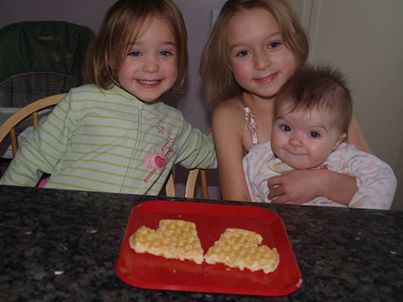
Gianna, Ellie and Mary with a waffleMy daughter, Angela, and her husband, Peter, are home schooling their three daughters, although so far it’s mostly the five year old, Gianna, who is their main focus. Angela has a master’s degree in education;  she knows what she is about.  When Rita and I attempted to home school Angela and her younger sister, Meg, many years ago, far fewer resources and a much smaller support group of like minded parents were available.

Angela belongs to a co-op group of home schoolers which meets weekly; parents take turns putting together classes on reading, writing and ‘rithmetic, as well as science, history and other topics scaled for the younger kids.  Gianna and Ellie (Elena) also are participating in Italian lessons, taught by our mutual friend, Francesca, who is another home schooling mother of three.  Angela studied four years of Italian and visited Italy extensively while studying abroad, so can reinforce the lessons at home.

Francesca taught Italian at the university level and holds advanced degrees in art history from Columbia and Yale.  She is fluent in Italian, the daughter of first generation Italian immigrants and grew up in Queens.  In manner and spirit, Francesca is quintessentially Italian.  We have greatly benefitted from some of her recipes; her cooking is locally legendary.  Once when Rita was unwell, Fran sent over a meal.  With most, a meal sent over to help a sick friend would be a casserole; with Fran, her husband Matthew delivered a five course meal which filled up the back of his station wagon.  She included extra prepped vegetables and a recipe to turn the leftover chicken into a delicious soup.

Gianna came home from her early lessons with perfectly pronounced Italian renditions of her favorite colors.  For me, a Rosetta Stone Italian failure, it was most impressive.  No surprise, a recent lesson turned to food.  The kids glued samples of various pasta varieties to a poster board and learned not just their Italian names, but their descriptive origin and translation.  Vivid pasta names reveal an amusing look into Italy and her people, an earthy candor – a natural humor.

  • Penne — quill or pen.
  • Spaghetti – twine or string.
  • Linguine – little tongues.
  • Vermicelli – worms.
  • Farfalle – butterflies.
  • Occhi di lupo – ribbed wolf eyes.
  • Fusilli – little screws.
  • Orecchiette – little ears.
  • Capellini – thin hair.

Americans may be prickly about tucking into a heaping plate of ears, little tongues, thin hair, worms, butterflies, screws or string, but to the Italian comfortable with coarse reality, such a feast poses no difficulties.  Americans will stick with the mellifluous and mysterious, thanks.  Spoken Italian makes the commonplace sing.

“Italians know about human nature – they understand human nature perhaps better than anyone else does.  They know that people are weak and greedy and lazy and dishonest and they just try to make the best of it; to work around it.” Donna Leon (author of the acclaimed Commissario Guido Brunetti crime novels)

For those who grew up with little exposure to Italians, what comes easily to mind is at best Rocky Balboa, Mussolini’s punctual trains or unstable governments that dissolve every few months and at worst Goodfellows and Don Vito Corleone.  I grew up among a large Italian community replete with barbers, grocers, dentists, doctors and contractors (and married a half Italian beauty).  What comes to mind is effortless laughter and love, quick wit, flashing eyes, effusive, loud communications, food, food, food and warmth – always warmth.   The many Italians I came to know did not suffer fools patiently and gifted their loyalty carefully, but once gifted would sacrifice life, limb, treasure and sweat – unabashed and all-in.

Italian lessons are lasting: Rome, Latin based languages, Leonardo, Dante, Michelangelo, Florence, Venice, the vineyards of Tuscany, Pompeii – surely more than a lifetime of lessons. A personal beloved for me is Italian opera: Puccini, Rossini, Donizetti, and the incomparable Giuseppe Verdi.  Just as “capellini” converts “thin hair” into delectable, so does “Si: corre voce che l’etiope ardisca sfidarci ancora, e del Nilo la valle” transform “Yes, there are rumors that Ethiopia dares to continue to defy our power in the valley of the Nile” into delightful (Verdi’s Aida, first act).

You may prefer “E lucevan le stelle ed olezzava la terra, stridea l’uscio dell’orto e un passo sfiorava la rena” to “The stars were shining, And the earth was scented. The gate of the garden creaked and a footstep grazed the sand.”  From Puccini’s “Tosca” as sung by Luciano Pavarotti.

Italian opera is hyperbole, drama, red emotion, and its American counterpart morphed into both the musical and the soap opera, but there is no inclusive analog.  My favorites are the duets, trios and quartets with the interplay of beautiful voices.  Listen to Joan Sutherland and Pavarotti singing the star crossed, impossible beginning of the love of Alfred for Violetta in Verdi’s “La Traviata” (“The Lost”) (Plot summary here) in “Un di felice” and the inevitable tragic end in  “Parigi o cara”.  If you have little familiarity with Verdi, close your eyes, shut down preconceptions and just listen.

La TraviataAlfredo: Un dì, felice, eterea, Mi balenaste innante, E da quel dì tremante Vissi d’ignoto amor. Di quell’amor ch’è palpito Dell’universo, Dell’universo intero, Misterioso, altero, Croce e delizia cor. Misterioso, Misterioso altero, Croce e delizia al cor.

Alfredo: One day, you, happy, ethereal, appeared in front of me, and ever since,trembling, I lived from unknowed love. That love that’s the pulse of the universe, of the whole universe, Mysterious, proud, torture and delight to the heart. Mysterious, mysterious and proud, torture and delight to the heart.

Violetta: Ah, se ciò è ver, fuggitemi, Solo amistade io v’offro: Amar non so, nè soffro Un così eroico amor. Io sono franca, ingenua; Altra cercar dovete; Non arduo troverete Dimenticarmi allor.

Violetta: Love, I fear, can never be, Friendship is all I can offer. Since love is pain and torment, I avoid that strange emotion. Pleasure is all I ask of life, Freedom and joy forever! So you must soon forget me And find another love.  

*********************************************************************************************************************

Alfredo:  Parigi, o cara, noi lasceremo, la vita uniti trascorreremo. De’ corsi affanni compenso avrai, la tua salute rifiorirà. Sospiro e luce tu mi sarai, tutto il futuro ne arriderà.

Alfredo:  We’ll leave Paris, my dearest, Together we’ll go through life. In reward for your past sorrows, You’ll bloom into health again. Breath of life, sunshine you’ll be to me, All the years to come will smile on us.

Violetta:  Parigi, o caro, noi lasceremo, la vita uniti trascorreremo. De’ corsi affanni compenso avrai, la mia salute rifiorirà. Sospiro e luce tu mi sarai, tutto il futuro ne arriderà.

Violetta: We’ll leave Paris, my dearest, Together we’ll go through life. In reward for your past sorrows, I’ll bloom into health again. Breath of life, sunshine you’ll be to me, All the years to come will smile on us.

Can longing, loss and love be better expressed?

The gift of human voice, music and the creative soul are most profoundly conveyed in these works:  gratuitous beauty fashioned out of our genes, our talents, our dedication and commitment for no other reason than we humans are capable of it.    To this simple soul, such expression of human goodness rivals the genius of St. Thomas Aquinas in his Summa Theologica for sublime proof of the existence of a loving Creator.

“Italians come to ruin most generally in three ways, women, gambling and farming.  My family chose the slowest one.”  Pope John XXIII (Angelo Giuseppe Roncalli), soon to be St. John in April)

3 Comments

Filed under Personal and family life

Ponderings and Conundrums – musings on a cold winter day

“To understand the workings of American politics, you have to understand this fundamental law:  Conservatives think liberals are stupid.  Liberals think conservatives are evil.”  Things That Matter, Charles Krauthammer (reprinted from the Washington Post, July 26, 2002

When we discuss economics, politics or social trends at family gatherings, in the coffee break room or with friends during holiday gatherings, the polarity seems more intense every year, not less.  Talk flows back and forth with hammer blows of conflicting facts and less and less listening from either side.  How do we resolve the seemingly irresolvable?  How do we compromise on issues built on inviolate, but contradictory core values?

The progressive decries the widening gap between the rich and the poor, which is undeniable.  But over nine million formerly well paying industrial blue collar jobs have fled to emerging second and third world countries, and with production goes innovation.  Those nine million jobs have been replaced for the most part by service sector jobs or retail, and rare is the instance that those relatively low skill jobs pay anywhere near as much as a trained machine operator or union car assembler.  The gap grows, but it is facile to make the assumption that the exploitive business owner shoulders all the blame.  We who benefit from lower prices at the cash register vote with our wallets and with the unintended consequence of hurting the highly paid, middle class blue collar worker.

Textile mill of the early twentieth century in New EnglandDemonstrations at Walmart to pay its workers more than the current average $17,500 sound rational on MSNBC.  The underlying economics that drive the decisions by management to set wages are more complicated.  Stocking shelves at Walmart with made in China or Mexico sweaters cannot pay as much as practiced loom operators knitting those sweaters once made in the former textile mills of the Blackstone River Valley in Massachusetts and Rhode Island.  Raising the minimum wage reduces hiring and harms the opportunity of those with few skills entering the workforce, where they will learn how to show up on time, to work diligently and improve their proficiency.

If Walmart decided tomorrow to raise the pay and benefits of all their workers $6,000 per year, it would no longer produce a profit for its owners and would not be viable as an ongoing business, having insufficient resources to compete, replace trucks and pay the light bills.  If they raised their prices to accommodate the higher pay, the customers would soon be over at BJ’s or K-Mart buying their Chinese made sweaters and jeans where shelves are stocked and cash registers staffed with lower paid workers.  Or consumers would buy fewer sweaters because they can’t afford the higher prices.

Raising the minimum wage to a “living wage” is terrific as a campaign slogan, but implementation without repercussions is a tricky business.  NAFTA is a two edged sword.

“Cowboys games at AT&T Stadium can consume up to 10 megawatts of energy, more than is used in three hours by the 3.7 million residents of Liberia.” Kevin Kerr, Sports Illustrated 12/30

American “exceptionalism” is a commendable slogan and core belief as well, but can our citizens reasonably expect that having 4.5% of the world’s population and consuming one-third of the world’s paper, a quarter of the world’s oil, 23 percent of the coal, 27 percent of the aluminum, and 19 percent of the copper is sustainable in a global economy with the other 95.5% wanting their fair share of resources?  Do we believe it is prudent governance to hinder development of domestic sources of oil through fracking while continuing dependence for oil on those who hate us?  Does it make sense to hinder a pipeline from our closest neighbor and ally, which own of the third largest reservoir of oil reserves in the world?  Do we really believe this will prevent Canada from selling this oil?  The oil will be sold, and likely to those who burn it far less efficiently and cleanly than our more closely regulated industries and vehicles.  Does this truly advance the cause of fewer hydrocarbons poisoning the atmosphere?

“I have seen great intolerance shown in support of tolerance.” Samuel Taylor Coleridge

Under the flag of “diversity,” the personal freedom in Western culture and in the United States has been under attack for nearly fifty years:  especially the freedom to live out religious beliefs that do no harm.  Jack Phillips, a baker in Colorado, politely declined the business of a same-sex couple who wanted to buy a wedding cake.  The Left espouses diversity of belief and practice except when it comes to anyone who disagrees with the tenets of their own secular faith.  Rather than simply going to another baker (of whom there are many), the couple sued Mr. Phillips and received a court judgment.  He was fined.  If he refuses to pay the fine or bake a cake, he can be sent to jail.   This is not discrimination in the workplace or hiring practices or bullying or any of the other injustices that have been redressed in the courts.  Jack Phillips chose not to participate by baking a cake and was punished by the court.  How soon will churches be forced to perform marriages that violate their core beliefs?  Will those churches have to get out of the civil marriage business, as the Catholic Church was forced out of the adoption business, closing down the largest adoption provider in the country?

The American Civil Liberties Union recently sued a Catholic hospital to force it to perform abortions.  The Left for years had a mantra stating that, “If you don’t like abortion, don’t have one.”  Apparently that doesn’t hold true if a hospital chooses not to perform one.

“I’ve always felt that a person’s intelligence is directly reflected by the number of conflicting points of view he can entertain simultaneously on the same topic.” Abigail Adams

Mrs. Adams was a superb communicator married to a superb communicator.  Their letters to one another are a priceless legacy.  She was also a lot smarter than most, including most especially me.  I have a difficult time, as do many, trying to “entertain simultaneously conflicting points of view.” – More than ever when those points of view are almost fundamentally irreconcilable.  Compromise may not be possible.  e.g.  How do we reconcile an issue when one group sees only “women’s reproductive rights” (who can oppose someone’s constitutional rights?), and the opposition sees murdered babies who merited protection and nurture?   A Solomonic solution is not possible.

How do we reconcile political viewpoints when the Attorney General lets slide Black Panthers caught on video tape intimidating voters at polling places, and then goes hard after the Little Sisters of the Poor for upholding their rights of personal conscience against the Obamacare monolith mandating abortifacient drug coverage?  How do we find compromise when one side is convinced the opposition is naïve and a little stupid, and the other side sees their opponents as evil incarnate?  How do we reconcile opposing views in which one side perceives exponentially expanding government both in size and scope as a grave danger and the other envisions it as the road to Utopia? There remains little common ground upon which to stand.

This post started with a Charles Krauthammer quote, and it will end in one from a 2012 Washington Post column reprinted in “Things That Matter.”  Read the book.

“(President Obama and progressives are) equating society with government, the collectivity with the state.  Of course we are shaped by our milieu.  But the most important influence on the individual is not government.  It is civil society, those elements of the collectivity that lie outside government:   family, neighborhood, church, Rotary club, PTA, the voluntary associations that Tocqueville understood to be the genius of America and source of its energy and freedom.

Moreover, the greatest threat to a robust, autonomous civil society is the ever-growing Leviathan state and those like Obama who see it as the ultimate expression of the collective.”

20 Comments

Filed under Culture views, Politics and government

Off the Rails

“The only way to be sure of catching a train is to miss the one before it.”  G.K. Chesterton

train tracksThroughout my nearly forty years in the lumber business, I have taken on many responsibilities from time to time.  One of the sidebars that intrigued me was my industry’s sometimes shaky marriage with railroads.  Demurrage charges accrue when the local railroad sets a car of freight on our siding to be unloaded, and the receiving yard takes too long to unload the product and release the car back for pickup.  Demurrage fines can be dear, railroads are enthusiastic to assess them, and the owners of lumber companies hold managers accountable for expediting unloading to avoid them.

Western fir plywood is still a frequent rail traveler, although in times past before manufactured engineered wood products came to the fore, Canadian or West Coast Douglas Fir timbers rode the rails and landed in one yard or another every day.  Now like most things, the set and release are done on line, but I remember often calling a bored dispatcher in some remote dingy railroad office to let them know to pick up their empty.  We kept a careful log in a three ring binder tracking car numbers, dates in and out, product and related purchase orders to the mills to document not infrequent disputes over charges — especially during the reign of the late, unlamented federally run Conrail.

“If you board the wrong train, it is no use running along the corridor in the other direction.”  Dietrich Bonhoeffer (Lutheran theologian and member of German Resistance, murdered by the Nazis)

When diesel was cheap in the seventies, many small railroads lost a lot of business to more flexible trucking companies.  In bankruptcy or near bankruptcy, some of the well connected owners of these railroads lobbied the government hard to bail them out, which, of course, it did, nationalizing the operations of poetically nostalgic names like Erie Lackawanna and Lehigh & Hudson River.  $7.65 billion later and losing nearly a million dollars a day, it was privatized by President Reagan and sold to Norfolk Southern and CSX.  Both companies to this day are chugging along with multibillion dollar annual profits.  Shares for both are trading near their all time highs.

The complexities undergirding their success are beyond the scope of a blog post, the obvious point is that private business out performs the bureaucratic, cholesterol clogged arteries of government run enterprises.  Profit, necessary cost efficiencies and the capital magnet of profitable companies drive success.  Self perpetuating bureaucracy, less than accountable cost structures and the ability to either print or borrow unlimited funds drive more Kafkaesque fiefdoms.

As the rollout of Obamacare continues to make bad news, we are reminded of other train wrecks of Federal programs.  We have yet to see the “rest of the story” when the mandate for small businesses is finally allowed to kick in.  The administration illegally breaks off pieces of the unmanageable bill and postpones other parts time and again to time the next disaster until after the election cycle.  But I suppose pain delayed and deferred is better than immediate suffering.

“Neither a wise man nor a brave man lies down on the tracks of history to wait for the train of the future to run him over.”  Dwight D. Eisenhower

What has me worried next is the nationalization of medical records set for October go live, part of the Patient Protection and Affordable Care Act (the irony in the bill’s name is beyond imagination).  The story this week of Target’s insecure records that resulted in somewhere between 70 and 110 million customers gives us pause.  Credit card numbers, PIN authorization codes, names, addresses and even email addresses were hacked.  Presumably Target has the most up to date security for these records available, but…..

Another story this week told of the vulnerability of offsite access to databases through Virtual Private Networks.  In recent weeks we’ve read of NASDAQ and Snapchat being hacked.  None of these companies lack Information Technology sophistication or concern for the privacy of their records.  Target is thought to be an inside job.  As Edward Snowden showed with his million plus record theft of our country’s deepest secrets, all it takes is one person with an agenda and a grudge.

Do we think that every county hospital and doctor’s office with access to a national database will have the security and IT capability of NASDAQ or Target?  The national database of medical records will tell who has AIDS, who has been treated for STDs, who has struggled with depression or bulimia or had an abortion or breast enhancing surgery, which job applicant has an expensive history of drug use or cardiac problems, members social security numbers – all of it will be there.  The intention to make more accessible and easily transferable all of our health records may or may not be benign to our brave new world, but it will undoubtedly leave us vulnerable.

“Concentrated power is not rendered harmless by the good intentions of those who create it.” Milton Friedman (Nobel Memorial Prize winning economist)

This week we are told that the administration finally chose not to renew the contract to the Canadian company, CGI Group, which was hired to oversee key aspects of the egregious healthcare.gov rollout.  Nobody got fired, including the inept Secretary of HHS, Kathleen Sibelius. Hundreds of millions were spent with CGI, who’s Executive Vice President, Tony Townes-Whitley, went to Princeton with Michelle Obama, belonged to the Princeton Black Alumni association with her and donated to the Obama campaign – a fortuitous coincidence no doubt.  Now after one of the most visible IT debacles in history, they don’t get their contract renewed.  No penalties, no claw back, no anything.

The House of Representatives on Friday passed the Health Exchange Security and Transparency Act with all Republicans and 67 Democrats.  The bill would require the health exchanges to notify victims of identity or information theft within the exchanges.  The administration lobbied Democrats hard to vote against it.  The self proclaimed most transparent administration in U.S. history opposes the Security and Transparency bill and threatens to veto it if enough Democrats in the Senate are persuaded by their nervous constituents to join their House colleagues.

As dear Alice wondered after going down the rabbit hole, it gets curiouser and curiouser!

 “This train don’t carry no con men, this train;

This train don’t carry no con men, this train;

This train don’t carry no con men,

No wheeler dealers, here and gone men,

This train don’t carry no con men, this train.”  This Train is Bound For Glory, Woody Guthrie

Leave a comment

Filed under Politics and government

Good Friends Never Let You Down

Not to imply that we occasionally can’t be disappointed in our friendships (or be disappointing to our friends), but that in the best of friendships, we always find a way to work things out.  Through those friendships we are led to new insights and a deeper understanding of our lives and of ourselves.   In one of the Maine Tales posts, I wrote of our return to our faith and the Church thirty eight years ago.  Here is that post: Maine Tales IV – The Road Not Taken and an excerpt from it, when we met our good friend, Father Joe McKenna:

We looked up Catholic Churches in the Yellow Pages (an anachronism now).  Mount Vernon was at the center of a fifty mile circle roughly encompassing Augusta, Waterville and Farmington.  Rita worked part time as an RN in Augusta, but Farmington for some reason attracted us.  I called St. Joseph’s Church in Farmington; a friendly voice picked up with a lively, “St. Joe’s!”  Father Joe McKenna answered his own phone calls and was nearly perfect for hurting children of the sixties — an admixture of intellectual, poet, faith filled priest and wonderfully warm and funny human being with holes in the elbows of his sweaters. We entered the little, wood framed church on a side street, far smaller than the Baptist, Episcopalian and Congregationalist stone and brick edifices on Main Street.  It was Pentecost Sunday, no happenstance, and Father Joe was alive with the Spirit.

Father Joe has been what he calls semi-retired now for quite a few years and lives in Portland.  He remains active with nursing home work and a prison ministry, but we keep a valued, long distance friendship with emails and too infrequent visits.  As I have occasionally done with others, I’ll take advantage of Father Joe’s writing to share with permission a recent correspondence.  If there are seeming non sequiturs, the errors are mine.

Father Joe, now eighty three, clearly has lost nothing off the fastball and enjoys very much new knowledge.  The email exchange was initiated when Father Joe responded to the post a couple of weeks ago.  Even with editing for brevity, it is still quite lengthy, and I hope you find worth your time and attention.

Father Joe: Hi Jack and Rita.  Very, very interesting.  At last I know the reason why mitochondria passes only though the mother.  Simple enough when you know why.  Merry Christmas to you and yours and many OF them!

Jack: Really enjoyed “Time To Start Thinking” and thank you again. His observations and analysis do get me thinking as we all need to be.  His solutions, when he proposes them are a little too Keynesian and pessimistic for me, but well worth consideration.  A book I would recommend to anyone.  Glad we could clear up mitochondria once and for all.
Love from RI, j&r   

 (Note:  Father Joe had sent me a book he had read, Time to Start Thinking: America in the Age of Descent, by Edward Luce, long time economics writer for the Financial Times of London.  I would recommend it to all who have interest.)

Father Joe: What I found about the book is that it is a series of interviews about what each person thinks is going on.  Then you can draw your own conclusions.  It must be fantastic to have descendants!

Jack:  Terrifying actually.  What have we wrought, and what are we handing on to those descendants?

Father Joe: Oh come on.  It’s Christmas… when we concentrate on the virtue of hope! A lovely virtue.  I discovered it in the seminary sitting next to Mike McManus..… Anyway because he was McManus and I was McKenna sometimes we sat together.  He was filled with hope and happiness and gradually he worked on me to get rid of some of my negativity.  He recommended a book “God Speaks” by Charles Peguy.  I will send you a copy from Amazon.  It changed my life.  Have a merry one!

Jack:  You are right, of course.  And not just for the Christmas season… When I get all cataclysmically dreary and cosmically anxious, I must refocus on gratitude for the many, many blessings in my life and stop whining.  And you, dear friend, are one of the blessings.  I’ve read some of Charles Peguy’s poetry, but can’t remember if I’ve seen that one.

Several exchanges ensued about Peguy’s and Luce’s books, then this.

Father Joe:  Do any of your kids have troubles with science and God?

Jack:  (Note:  Name and identifying pronouns left as ***) I think ***** has the most trouble with faith and science…  If something cannot be demonstrated, touched with any of the five senses or proven with the scientific method, it is discounted.  Completely eludes *****.  Certainly intelligent and realizes that acknowledging God and especially Jesus requires a response…, so *** holds *** ground…  That atheism is every bit as much a leap of faith (and with vast gaps that require invincible credulity) as belief and trust in God, *****does not yet see.  But we are working on it.

Anyway, the prayers of our first pastor would be greatly appreciated for*** faith and the faith of all my children.

Father Joe:  It always comes down to three:  Belief in the Eucharist, belief that Jesus is God, belief in a creator.
(1)  The Eucharist is the Body and Blood of Christ.  Rome accepts the Orthodox Eucharist.  This is not one of the problems that keep us apart.  A Catholic may receive Communion in an Orthodox Church if no Catholic church is available… and, as you know well, we were together for 1000 years.  The Orthodox belief in the Eucharist is interesting:  “The Eucharist is the center of worship in the Orthodox Church. We do not explain scientifically how the bread and wine become the Body and Blood of Christ.  Orthodox Christians believe that during the Eucharist believers partake mystically of Christ’s body and blood and through it receive his life and strength.”  This is acceptable if one has a problem using Aristotle to explain the Eucharist.
(2)  Jesus is God.  Perhaps a new book might be helpful here: Jay Perini: “Jesus, the Human Face of God.”
(3) There is a Creator.  If I can find an essay I wrote for the Portland Press Herald, I’ll send it on.
Happy New Year!

Jack: I’d love to read your article, and it’s easy to get too far in the weeds with the Aristotelian substance and incidentals explanation, so that’s helpful…  I’ve tried to explain to ***** that it’s Fides first, then Ratio. I’m with Pascal on this; faith is first of the heart, imagination and will.  Not irrational by any means, but the mind and the intellect support faith, and understanding follows the decision.

We come first to faith through love, like the love of a small parish priest for his flock leads them to Love.  I guess that is what is most disappointing – that the love from the parents was insufficient to overcome skepticism and incredulity (regarding faith).

I’ll let Father Joe McKenna’s piece end the post. He needs no help from me.

Okay so how DID we get here?

I watch a lot of science programs… on PBS and the History Channel. I have a pretty good science grounding… for an amateur. I’ve been keeping up with the latest in Quantum Physics and Astronomy and the Origins of the Universe. I heard Stephen Hawking say on TV lately that you don’t need a creator to explain where the universe came from… particles just appear and disappear at random. I watched Brian Greene’s “The Fabric of the Universe.” He is a spokesperson for that scientific community who are investigating this very interesting topic.

Let me set up the problem that Greene’s community is involved with.

Here I am sitting at my computer typing this essay. Back 12 billion years ago there was nothing but quarks. So how did I get here from those quarks and why am I smart enough to write this essay?

If I do not accept a creator then the only solution is that I got here by chance; yes, the same chance/luck that is involved when you are sitting at a slot machine. (Well, not exactly because they are fixed to favor the house.) But explaining how I got here by chance requires a lot of lucky outcomes. Here are just a few: By lucky chance stars were formed; by lucky chance our sun was formed to be just the right size; cosmic dust was attracted by our sun and formed planets and by lucky chance one of them…the planet earth… was just the right distance from the sun to have the right temperature and just the right weight to keep its atmosphere from spinning off, etc., etc., etc. All these strokes of luck are now called the “Goldilocks effect”: everything had to be “just right” for life to even start.

What are the chances that each of these fortuitous circumstances would happen (and there are many thousands)? And they must occur at a given moment in the progress of the universe, because if they don’t happen at the proper instant as the universe progresses they do not have a second chance. You can’t go back and try again.

Just like you have to pull the lever on the slot machine quite a number of times…and fail… to finally get the lucky prize, so there has to be multiple universes in which the chances for all these events can play out… and fail… to finally get a universe (ours) and a planet (ours) where life can evolve and I can sit here at this computer. The task that Greene et al have set for themselves is to put into mathematical formulae all the variables that go into all these chances happening, ultimately resulting in me sitting here. It takes more than one blackboard on which to write them all out.

They use the mathematics of Statistics. (Yes, what you learned as seniors in high school.) That’s what all those equations are that fill their blackboards. This is what Steve Green means when he keeps saying “mathematics says that you have to have billions of this or billions of that”… and of course he is right… you would have to have billions of universes if everything depended on chance. And because he is a philosophical Determinist (no free will… everything is “determined”) he goes one further: he maintains that in some of these universes there could be another person just like you.

Do you have to accept this elaborate hypothesis? (Don’t forget, it’s only an hypothesis… not even a theory…unproven.) Will you be considered a science denier if you don’t? Will professors look at you with a condescending smile?

They probably will. We’re supposed to be intimidated by all those equations on those blackboards. Because we’re not cosmologists in the halls of science it can be considered “rubey” (do they still use this word?) to disagree with these very learned researchers.

But hey, you know what? They put their pants on one leg at a time just like the rest of us. Yes, they have doctorate degrees. I know lots of people who have doctorates. I knew a Doctor of Literature one time who believed that the world was made 6000 years ago! My physician has a doctorate. And you know what he tells me? That I have to manage my own health. He is there to give me yearly physicals and to refer me to specialists if the need arises but I have to manage my own health.

I keep up with science. I keep up with Biblical Studies that investigates the meanings of the opening chapters of Genesis. I listen to physical and astronomical scientists explaining their hypotheses… I look at their evidence with an open “scientific” mind. But I manage my own world view.

Some of these scientists, you know, are not even following the scientific method. Scientific method says you start “with an open mind” and proceed to gather evidence no matter where it leads you. And if you find there are two possible conclusions, you follow the principle of Ockham’s Razor and accept the one with the least complications. But if you start with the premise that there is no creator and then proceed to weave theories that back that up… complicated theories… multiple universe theories… is that science?

And as for Steve Hawking: yes particles can come in and out of existence seemingly by themselves. But to conclude from this that the universe came into existence by itself is more than a stretch… it’s not good science.

My advice to the Brian Greenes et al is to put away your blackboards for a while and come out into the real world. Take a walk in a park or by the seashore. Many a genius has come up with an important inspiration walking along the seashore. All these universes you are positing… wouldn’t it be a lot more “economical” and logical scientifically to search for a creative force… of some sort… somewhere?


2 Comments

Filed under Maine Tales, Personal and family life

The DNA of Christmas

dnaThe double helix of DNA stores and passes down through generations all the genetic information necessary for carbon based life forms on this green and blue planet.  DNA diagrams look like counterclockwise corkscrewed ladders.  The models help us to understand how this wondrous alchemy works, but they are simplified.  Inside each nucleus, the DNA coils tightly in and upon itself.

These long molecules recreate through ‘messenger’ molecules the amino acids that build all the proteins of which our bodies consist.  Each connecting rung of the ladder bonds in one of two combinations of four smaller molecules called nucleic bases. When DNA molecules ‘unzip’, separating at the nucleic bases, each half regenerates into an exact replica of the original.  This self replication is what makes possible all life to continue, and such an unzipping and reforming occurs within the human body thousands of times a second.

 “The DNA in just one cell can stretch six feet long – yet it fits into a nucleus around a thousandth of an inch wide.  And since we have trillions of cells, all the DNA in one human body can stretch roughly from the sun to Pluto and back.”  The Violinist’s Thumb: Love, War and Genius as Written by our Genetic Code, Sam Kean

Mitochondria are tiny bean shaped organs that supply energy within our cells. [1]  Curiously, they have their own DNA. Science theorizes that they were bacteria or viruses ‘eaten’ by other primitive cells eons ago and evolved in a symbiotic relationship. Mitochondrial DNA is most useful, because sperm from those of us who are male are primarily DNA carriers that swim with tails; they are too tiny to contain mitochondria.  Hence, all mitochondria and its DNA are passed on solely through the mother.  Since this DNA is stable and reliable, it mutates on average only once every 3,500 years or so.  This remarkable characteristic has enabled biochemists to analyze mitochondrial DNA common to human beings alive today and trace it back to a single source — the first “Eve.”  She lived in Africa approximately 170,000 years ago.  The name “Eve” comes from the Hebrew word, HAWAH, a verb which means “to live.”

And so we come to Christmas.

”For You created my inmost being; You knit me together in my mother’s womb. I praise You because I am fearfully and wonderfully made.”  Psalm 139, 13-14

The early Church fathers in the first two centuries after the apostles wrote extensively of Mary, the mother of Jesus, as a New Eve. Ireneus, Justin and Tertullian, followed by Jerome and Ambrose develop the Eve-Mary parallel.  Jesus is described as the New Adam.  “It was through a man and woman that flesh was cast from paradise; it was through a virgin that flesh was linked to God.” (St. Ambrose).  “Death through Eve.  Life through Mary.” (St. Jerome)  They taught that just as the pride, lies and disobedience of Adam and Eve (and all human beings) opened the breach between God and man, the humility, truth and obedience of first Mary, and then ultimately, perfectly her Son, bridged it.

When Jesus saw his mother there, and the disciple whom he loved standing nearby, he said to her, “Woman, here is your son,” and to the disciple, “Here is your mother.” From that time on, this disciple took her into his home. John 26-27.  Mary became mother of John and of the Church, and spiritually, the mother of us all.  The “disciple took her into his home”; when Mary comes into our home, she does what she always does, she brings Jesus to us and us to Jesus.

“Answer quickly, O Virgin.  Reply in haste to the angel…Why do you delay, why are you afraid? … Let humility be bold… In this matter alone, O prudent Virgin, do not fear to be presumptuous… Arise, hasten, open… ‘Behold, the handmaid of the Lord’, she says, ‘be it done to me according to your word.’”.  Saint Bernard

So as we hasten and worry, as we fret and rush about, we, too, are given the opportunity as Mary was to “be not afraid.”  Christmas is not department stores open a hundred straight hours until late Christmas Eve.  Christmas is not maxing out the credit cards in a futile bargain to please others or to please ourselves.  Where do we find our solace?  Where is peace?  How do we reflect on the miracle and the bridge between Creator and creature, born twenty centuries ago in such humble circumstances?  “Let it be done to me according to your word.”

“There are those who pour out gold from a purse and weigh out silver on the scales; then they hire a goldsmith to make it into a god before which they fall down in worship.  They lift it to their shoulders to carry; when they set it in place again, it stays, and does not move from the spot.  Although they cry out to it, it cannot answer; it delivers no one from distress.” Isaiah 46

Our DNA determines much about us and each mix is unique in all of history, but it does not determine ‘us.’  Our DNA is ephemeral; our soul is immortal.  We are determined in our soul by our will and by our decisions.  Not just at Christmas time, but by the slow aggregation of our daily decisions throughout our life.  We can fall into an “idolatry of disbelief.”[2] We become to a great degree that which we choose to become.  And through our Creator’s great mercy, we have a new opportunity today and every day to become new, to begin again.  That is the Good News of Christmas.

“Christ dwelt for nine months in the tabernacle of Mary’s womb.  He dwells until the end of ages in the tabernacle of the Church’s faith.  He will dwell forever in the knowledge and love of each faithful soul.” Blessed Isaac of Stella, abbot.


[1] Chloroplasts are analogous tiny organs in plant cells with their own DNA. In them, the hard work of photosynthesis takes place that captures the sun’s energy and is a necessary first step for all life.

[2] Article in Crisis Magazine by Regis Martin.

Leave a comment

Filed under Background Perspective

Pink Orthodoxy and The Real War on Women

Copernicus painting of a heliocentric universe

Copernicus painting of a heliocentric universe

As with all revisionist history, the truth is more complicated than the myth.  Mikolaj Kopernik was a canon in the Polish cathedral in Frombork, Poland.  Educated in elite universities in Krakow, Bologna and Padua with support from his uncle, the bishop, he was a church administrator, a lawyer, practiced medicine and to pass the time translated ancient poetry from Greek to Latin, formulated currency reform and painted.  He died in obscurity in 1543 and was buried unmarked beneath the cathedral floor with a hundred others who spent their lives working for the Church.

MIkolaj chose to be known by the Latinized version of his name, Copernicus, and his enduring legacy and thirty year passion was astronomy.  Two months prior to his death, he published in Latin, “De Revolutionibus Orbium Coelestium”, or “On the Revolutions of the Heavenly Spheres.” In it he challenged the scientific orthodoxy that had persisted through ancient Greece and Rome of a geocentric universe which taught that the sun, the planets and the stars revolved around the earth.  His heliocentric hypothesis was indeed a revolution based on his mathematics and observations from the planetarium in a corner of the cathedral grounds.  An esoteric academic work, it was little contested by the Church or anyone else.

“There is talk of a new astrologer who wants to prove that the earth moves and goes around instead of the sky, the sun, the moon, just as if somebody were moving in a carriage or ship might hold that he was sitting still and at rest while the earth and the trees walked and moved. But that is how things are nowadays: when a man wishes to be clever he must needs invent something special, and the way he does it must needs be the best! The fool wants to turn the whole art of astronomy upside-down. However, as Holy Scripture tells us, so did Joshua bid the sun to stand still and not the earth.” Martin Luther about Copernican theory

Everything changed when in the conflagration of the Protestant Revolution, Protestant theologians proclaimed a heliocentric universe as contrary to Holy Scripture.  After Galileo took up the Copernican heliocentric model in 1616, the Church was grievously wrong and reacting to the Protestant position, added “On the Revolutions of the Heavenly Spheres” to her list of banned books. The Pope ordered Galileo held in home confinement.  The book remained on the list for over two centuries until 1835.  The Church has since acknowledged the error.  Science and faith are two complementary, not opposing, aspects of human understanding and truth.

Science can purify religion from error and superstition.  Religion can purify science from idolatry and false absolutes.” Pope John Paul II

In our secular humanist culture, orthodoxies are dearly held, and contrarian evidence is enthusiastically ignored.  One such article of faith recklessly endangers women, especially young women.  “Women’s reproductive rights” as a principle of secular orthodoxy transcends politics, transcends religion and transcends science as well.

Two news stories in the last week or so were not covered extensively in that most ardent defender of the faith, those impregnable bastions of orthodoxy, the liberal press and electronic media from the New York Times to MSNBC et al.  The first defense against heterodoxy is to disregard all evidence that contradicts the precepts; the second is to suppress the sources.

The first story informs us that new incidences of cancer worldwide are up substantively from 12.7 million in 2008 to 14.1 million in 2012.  According to the World Health Organization, deaths from cancer rose in the same period from 7.6 million to 8.2 million.  Deaths from breast cancer rose to 522,000 last year.  Diagnosis of breast cancer rose 20% in four years to 1.7 million women in 2012.  Despite enormous effort in expense and brilliance, cancer seems to keep on keeping on, especially as the developing world claims the dubious benefits of modern culture.

The second story is indeed the ‘elephant in the living room’ that is becoming more and more difficult to overlook. Dr. Joel Brind (Professor of Endocrinology at City University in NY) and Dr. Angela Lanfranchi (breast cancer oncologist, medical school professor and surgeon) founded the Breast Cancer Prevention Institute (BCPI) in the late nineties and have for many years been voices crying in the wilderness regarding the correlation between induced abortions, birth control drugs and breast cancer.  On their website (see link) dozens of studies over many years document these relationships.  A small minority of studies doesn’t show this correlation, and those are the studies most frequently cited by Planned Parenthood and other defenders of abortion, including the current administration in Washington.  The negative finding studies were sometimes funded by abortion advocates or employed flawed methodology in compiling their statistics, according to BCPI.

Last week, the voice of BCPI was joined by a most unlikely chorus – a China based meta study and a study based in India that ties without doubt induced abortion and breast cancer. The meta-analysis from China was published in the peer reviewed international journal, “Cancer Causes and Control.”  A meta-analysis studies data from many experiments and draws conclusions from all of them.  China’s recently modified one child policy has resulted so far in 336 million induced abortions, so there is no lack of subjects available.  The results showed a 44% increase in breast cancer risk for women with a single induced abortion, a 76% increased risk for women with two, and an 89% raised risk for women with more than two.  Dr. Brind commented their findings as “of the sort of magnitude that has typified the link between cigarettes and lung cancer.”

A study in the Indian Journal of Community Medicine found a six fold increased risk for breast cancer for women who have had abortions.  The governments of China and India support abortion, so there is no political motivation for these findings.

For birth control pills, the evidence is also clear.  The birth control pill is actually listed along with tobacco, formaldehyde and plutonium as a group 1 carcinogen by both the American Cancer Society and the World Health Organization.  Group 1 carcinogens are proven to cause cancer.

The reason these facts are not discussed with the women showing up for abortions or birth control pills at Planned Parenthood and other providers and/or advocates for these things is secular orthodoxy revolving around “women’s reproductive rights.”  That Planned Parenthood performed over 327 thousand abortions last year at an average billing of between $300 and $950 ($202 million per year at average) perhaps could influence their reticence[1].  That the pink epicenter of breast cancer awareness, the Susan G Komen Institute funds over $500,000 per year to Planned Parenthood for breast cancer screening[2] may have something to do with their reluctance to publicize these facts. Federal funding for Planned Parenthood under the Obama administration has risen to an all time high of tax payer money – $540 million last year or $1.5 million a week.  Great incentive exists to limit scrutiny.  History will eventually sort out this, as it sorted out a geocentric universe.  For 1.7 million women last year, the sorting will be too late.

“The Muslim world is threatened by religious fanaticism.  The Western world is threatened by secular fanaticism.”  Dennis Prager


[1] Planned Parenthood has 33 executives making more than $200,000 per year.  Their president, Cecile Richards, makes $583,323 annually.

[2] Planned Parenthood’s well publicized breast cancer screenings used to justify the Komen grants dropped 14% last year and a total of 29% from 2009 to 2011. Their screenings are all manual, similar to a self examination.  Although they have publically touted mammograms, none of their facilities actually do them or have the equipment.  They do referrals.

2 Comments

Filed under Culture views

Stone-enders

Eleazer Arnold's Splendid Mansion

Eleazer Arnold’s Splendid Mansion

Walking through Lincoln Woods, we emerged onto Great Road in Lincoln, RI.  Looking for a place to warm up, we happened upon Arnold House and took the short tour with a member of the historical society.  It was built in 1693 and originally called by the local residents “Eleazer’s Splendid Mansion” after its first owner and builder, Eleazer Arnold, who farmed the surrounding 140 acres.  His splendid mansion even after additions over the years is insignificant compared to the overwrought and pretentious McMansion of the early twenty first century. Gracefully proportioned lines fit perfectly with a New England landscape.  “Stone-enders” modeled the former homes in western England of the seventeenth century immigrants.  The west end of those houses consists of three feet of four to fourteen inch stones laid tightly and mortared together; the remainder of the structure was wood post and beam framed with wooden pegs and hand forged nails.  Leaded glass windows were small to be more easily defensible from indigenous raiders and to limit winter air leaks around the glass.  Many of the original wide pine boards, the oak carrying beams and three fire scorched stone fireplaces with their stone hearths are still in place.

The massive stone end is coated on the exterior with local white limestone mortar and tapers from bottom to top, providing vents for multiple walk in fireplaces – one on each floor.  The west end orientation in England presented a staunch bulwark to retain heat and defeat the prevailing winds.  In Lincoln, the stone faces to the west as well, paying no heed to the fiercest storms in New England blowing in from the northeast.  Even though the Arnolds had lived in early Rhode Island for over twenty years, apparently common sense and local conditions had little chance against traditional practices.  The Rhode Island stone-ender is a metaphor for the human condition of “this is the way we do it because this is the way it is done.”

“The pessimist complains about the wind; the optimist expects it to change; the realist adjusts the sails.”  William Arthur Ward

Returning back through the New England woods, I was struck by the persistence of this metaphor in many aspects of our culture and especially in government.  The “audacity of hope” is a conspicuous illustration.  In 2008 Barack Obama railed against the dysfunction in Washington that he was going to remedy. Two groups were singled out: “the typical politician playing the same old tired cynical games,” craving reelection fund money and the oft maligned lobbyists who used “money and influence (to) drown out people’s voices.”  Reiterating this catchphrase incessantly, he boasted that his campaign had not taken a dime from lobbyists or Political Action Committees. He would shun special interest donations to his campaign and find his money from “the working men and women who dug into what little savings they had to give five and ten dollars to this cause.  Supporters had an opportunity to rally around, “Not this year.  Not this time!”[1]  Together with Obama, they could build “a nation healed.  A world repaired. And an America that believes again.” Thrilling and “fundamentally changing America” with “hope and change.”

“Hope is a soufflé that doesn’t rise twice.”  Bill Galston, Deputy Assistant on Domestic Policy to President Clinton and Senior Fellow of the Brookings Institute

This glittering vision was built on carefully parsed sentences that skirted the truth.  He broke George W. Bush’s fund raising records by a large margin.  Bush’s money came from big fossil fuel energy, the defense industry and doctors.  Obama did collect from his little guys and his website; however the foundation of his finances came from Wall Street, Silicon Valley and lawyers.  His largest contributors were corporations, large universities, government agencies, their employees and the immediate family of owners or employees; among them were University of California, Goldman Sachs, JP Morgan Chase, Microsoft, Google, IBM, General Electric, Morgan Stanley and the U.S. Government (especially the Department of Justice).  Millions also were raised by “bundlers” in frequent fundraisers attended by President, and from Planned Parenthood and the unions, especially the Service Employees International Union.   Not their lobbyists, but direct from the source.  One of the most influential lobbyists on K Street in Washington is Tony Podesta.  He said, “Obama doesn’t really mean it, and we’re not taking any of it personally.  We’ll be back to business as usual after the election.”  This proved prophetic understatement.

Another prominent lobbyist put it this way: Obama talks about special interests and their hired guns, but then he only bans the hired guns.  “It was like boycotting a criminal lawyer, then going partying with the defendant.”  The access to the White House by these bundlers and companies is well documented – not quite sleeping in the Lincoln bedroom, but immediate admittance nonetheless.

The dirty little truth about most legislation on the federal and state level is that it is usually written by staffers and lobbyists in small ad hoc committees.  Much of the convoluted 2,400 page Obamacare Affordable Care bill was drafted on behalf of the administration by the staff of retiring Democrat Senator Max Baucus, who over the years received $3.8 million in health care industry campaign contributions.  In order to secure sufficient Democrat support in both houses, it was necessary to forge two major agreements with the interests that provide the money for the new reality of “perpetual campaigns.”  The first deal was cut with the health care industry shutting down any one payer government competition and conscripting for the insurance companies millions of new subscribers.  The second one guaranteed “big pharma” would not face government negotiations for lower Medicare drug costs and banned importation of competitive Canadian products.  Without these arrangements, costing taxpayers billions, the ACA Obamacare bill never would have been enacted.  A senior advisor to the president was heard to say, “Obama has just caved without firing a shot.”

Timothy Geithner, Treasure Secretary at the time, wrote the white paper upon which much of the second major piece of Obama’s first term was based, the Dodd-Frank banking regulation bill,  which enshrined in law the “too big to fail” protections for big banks and financial institutions.  During the writing of this bill, Mr. Geithner met or spoke with Lloyd Blankfein, CEO of Goldman Sachs, the second largest campaign contributor, thirty eight times, eight times as often as he met with either Harry Reid or Nancy Pelosi.  And so it goes.

 A cynic might say that the Barack Obama of Valerie Jarrett, Rahm Emmanuel, Rod Blagojevich and the old Daley Chicago machine is a clever charlatan, well trained in Illinois money and power politics.  Or is it that his aloof (some would contend disinterested) and inexperienced management style left him defenseless to the big money ways of Washington?  Like a man in a dream standing on the beach watching his youthful ideals drown, and wondering why he had forgotten how to swim.

“He is trying to recapture his innocence, yet all he succeeds in doing is to inoculate the world with his disillusionment.”  Henry Miller


[1] Many of these quotes are taken from “Time to Start Thinking – America in the Age of Descent” 2012 Grove Press by Edward Luce 2012.  Mr. Luce is a long time journalist with the Financial Times of London.

5 Comments

Filed under Politics and government

Walden Pond Walk

Walden Pond Autumn

Walden Pond Autumn

“I went to the woods because I wished to live deliberately, to front only the essential facts of life, and see if I could not learn what it had to teach, and not, when I came to die, discover that I had not lived”  Henry David Thoreau, Walden

A few weeks ago, we stopped at the site where Henry David Thoreau built his cabin and walked nearly two miles around the pond. In early November, autumn has settled deeply in, and winter approaches.  The woods in which he chose to pare down to essentials remains.  The chestnuts and the elms are gone, but red oak, white oak, white pine, Canadian hemlock and white spruce remain sprinkled with alder, paper birch and poplar – resplendent with the New England fall palette.

Oak leaves cling late into the year, some persist nearly until spring like pleasant regrets and hope for an annual reawakening.  The peace of the place and the replica cabin where he lived so simply leads to long thoughts.  My friend, Anthony Vinson from Atlanta, who has been referenced here before, sent this out in his pre holiday newsletter:  the concept of happiness through the accumulation of stuff has failed.  Of course, he is right.

“(We) ought to use the world, not become its slave.  And what does this mean?  It means having, as though not having.”  St. Augustine

On Thanksgiving Day, we gather with family and friends, mindful of the many blessings of our lives, most especially the beloved we gather with and those beloved who gather in other places.  If we preserve a Thanksgiving tradition asking around the table for that which we are most grateful in the past year, rarely will it be a new car or flat screen television.  Health renewed or new found faith, the birth of a grandchild, the steadfast love of our children and spouse, perhaps a fresh job or reuniting with a long separated loved one – those are what we cherish.

Gratitude as a way of life brings us happiness.  Joy follows peaceful reflection on captured opportunities to love in our lives.  We are not grateful because we are happy; we are happy because we are grateful.  Even in our most trying circumstances, we are most able to cope with patience and love because of gratitude for our many blessings – past, present and future.

Father James, our pastor at St. Patrick Church, reminded us this morning that thanksgiving is not just an annual dinner, but we should be thanksgiving people every day — several times a day.  Each day offers many moments and occasions to be grateful.  When we pause, reflect, are thankful and then go forward with loving thoughts, words and actions, we become most happy.  All of us have many chances to grow,  to love, to get it right, however our spins around the sun on this tired old planet are finite.  Eventually we run out of mulligans.  We ought not to waste them in trivial pursuits and barren quests to fill the hole in our hearts with non essential and ephemeral goods.

“When a potter is making a vessel and it becomes misshapen or breaks in his hands, he shapes it again; but once placed in the oven, it is beyond repair.”  Unknown second century homilist. 

4 Comments

Filed under Personal and family life

“Don’t Fence Me In”

“I can’t look at hobbles and I can’t stand fences” from “Don’t Fence Me In”, Cole Porter

-fencingConstructing wood fence in the early sixties was my first grown up job.   Having moved on from paper boy, caddy and haying on a diary farm for $1 per hour cash when I was fifteen, my father introduced me to three brothers and their father, Vito.  Each brother practiced a specialty with their own companies, but they conferred daily, so that an employee once hired shifted from installing fence to installing swimming pools and driveways or framing houses, all of which I did when I turned 16.  I settled into the fence business primarily and worked through high school and most of college.  When I turned eighteen, I was awarded my own small crew, a large stake body truck and got paid by the foot.  In a productive week, I could earn two hundred and fifty dollars, a modest fortune in 1965.

We were expected every day to put in twenty sections of six foot cedar picket fence with a gate or thirty sections of post and rail a day.  Each post for a six foot fence was buried roughly thirty inches deep.  If it was sandy and light, a hole could be dug with our hand posthole diggers in under ten minutes.  If we ran into what we called “hard pan” – packed clay that felt like rock – and ran into large stones in our hole, one post could take a half an hour of sweat.  For this tough digging, a posthole digger alone was inadequate, and we would thump away with a heavy iron bar to loosen each grueling scoop.  The bar was hexagonal in section, weighed fifteen pounds, about fifty inches and sharpened to a point on a stone wheel grinder.  No power augurs for us.

Each day we would be assigned to a customer’s home, loading up in the morning the right amount of fence panels, line posts, end posts, corner posts and gates to erect in wood the sketch and specifications agreed to in the contract the owners signed with our salesperson, Eddie.    We built calluses and muscle; and many days were an adventure.  The north shore of Boston, where land was dear and the ground hard, was most challenging.  Once a neighbor came out and spotted the thick string we stretched along the lot line and against which we planned to dig holes and install a fence.  He ran into his house, came out with a hatchet and cut our line in five or six pieces.  I told our customer we’d come back when he sorted out his border dispute.  No extra charge for the lost line.

Occasionally a big job would take more than one day, and we would return to a site. One such project was over four hundred feet of six foot fence around a oversized lot in Revere in which a new in ground swimming pool had been bedded.  Most people with a new pool surrounded it with an unassuming enclosure to meet the building code and prevent uninvited kids from drowning.  This family wrapped their entire yard.  One motive for this barricade became apparent the first afternoon, when the seventeen year old daughter came out to tan in a bikini that failed to cover much of anything.  My distracted crew soldiered on.  They hoped the next day would be sunny.

A bikini is like a barbed wire fence.  It protects the property without obscuring the view.” Joey Adams

Her parents remained on the property all day, which seemed odd to us.  In 1965 most men who had money enough for pool and fence were at work themselves.  The father was a handsome Italian in his early forties, unpretentious, reserved, but friendly, who brought us cold drinks and snacks.  The second day he charcoal grilled us hamburgers for lunch.  I respected customers who took care of the crew – not only for their kindness – but for their intelligence to extract quality workmanship from the young men who wanted to please them.  When we finished, he tipped us generously in cash.

I told Eddie about the family (including the daughter), and he responded with a cautionary tale.  The father made a lucrative business out of killing people.  This affable soft spoken father would get on a plane from time to time, fly to Las Vegas or Detroit or Kansas City, spend a day or two and come home with a lot of cash.  Some other father in Las Vegas, Detroit or Kansas City wouldn’t come home.  Although locally affiliated, he never worked close to home.  I accused Eddie of making up one of his frequent stories, and he remained silent and unsmiling.  Eddie knew things. A few months later during an outbreak of the murderous gang wars between the Italian mob and Whitey Bulger’s Winter Hill gang, I read in the Boston Globe of a body dumped in my old fence customer’s driveway – not his.

“Don’t ever take a fence down unless you know the reason it was put up.”  Robert Frost

I was reminded of the story this week when reading about the Federal circuit court decision upholding the new Texas law that required doctors doing abortions to maintain admitting privileges in a hospital within thirty miles of their clinics. (Bear with me for the connection.)  Supporters of unfettered abortion claim this law is restrictive to a woman’s “right” to take her child’s life, even though the law specifically states it is to protect women’s health when there are complications, such as excessive bleeding, sepsis or a perforated uterus.  The defender’s rationale is that abortion doctors often come from other states or at least from a far flung part of Texas, so they don’t admit enough patients to qualify for hospital privileges.

Elaborating, they contend that it is necessary for these doctors to live other than where they ply their trade because abortion protesters make it uncomfortable or even dangerous for them.  We’ve know many of these “abortion protestors” who “intimidate” these doctors.  Almost all of them are armed with rosary beads or an occasional sign.

Could it be that they live in other states or locations hundreds of miles away because they prefer to fly in from their home environs, do their work for a day or two and fly home, while at least half their patients won’t ever go home?  The neighbors and their daughters may never know how their parents pay for the pool.

“Euphemism is a human device to conceal the horrors of reality.”  Paul Johnson

1 Comment

Filed under Culture views, Personal and family life