Category Archives: Background Perspective

Musicophilia

“Mozart’s music is so pure and beautiful that I see it as a reflection of the inner beauty of the universe.” Albert Einstein

violin partita No 2 D Minor JS BachLast week Dr. Oliver Sacks died well; he wrote, thought and gifted mankind until the end. He was highly praised as a neurologist, author and for the partially autobiographical 1990 film, “Awakenings,” which earned Golden Globe and Academy Award Best Actor nominations for Robert De Niro and Robin Williams. Williams played the Oliver Sacks character. A fine writer, he penned a book, “Musicophilia” in response to Stephen Pinker’s statement that “music is ‘auditory cheesecake, an evolutionary accident piggybacking on language.’” [i]

Dr. Sacks “pointed to [music’s] ability to reach dementia patients as evidence that music appreciation is hard-wired into the brain.” He said in a lecture at Columbia in 2006 that “I haven’t heard of a human being who isn’t musical, or who doesn’t respond to music one way or another . . . I think we are an essentially, profoundly musical species. And I don’t know whether — for all I know, language piggybacked on music.” [ii]

Music is to me the deepest of human efforts to communicate, to impart information – intellectual and emotional – an amalgam of mathematics, symbols, human feelings and poetic beauty. Some is simple; some is more complicated. Musicologist Helga Thoene studied patterns and double coding in music. She applied a number/alphabetic substitution code to the notes of Bach’s exquisite unaccompanied Violin Partita in D-Minor[iii], a piece written after the death of his wife. Thoene discovered encoded within it the medieval Latin proverb, Ex Deo nascimur, in Christo morimur, per Spiritum Sanctum reviviscimus (In God we are born, in Christ we die, through the Holy Spirit we are made alive).

With 27 possibilities (26 letters and one number for a space), the odds of this sixty eight character (with spaces) phrase occurring perfectly and randomly are one in 27 x 27 x 27 and so on 68 times (2768), a very large number – quite respectable odds against pure chance. What is a reasonable person’s reasonable inference about the Ex Deo statement? Applying his considerable genius to create a beautiful piece of music, Bach applied intelligence to impart additional information and intended it to be there. That, of course, is the point.

“The most beautiful experience we can experience is the mysterious. It is the source of all true art and science…” Albert Einstein

Other instances of improbable odds occur in nature. If in the formation of the universe the ratio of the gravitational force-constant to the electro-magnetic force-constant increased by as much as one in 1040 (one with 41 zeros after it), only small stars would be formed. Decrease it by the same amount, only large ones.[iv] Both are needed. Large ones produce all the elements in their thermonuclear center and disperse them with supernovas for their use in new stars and planets; small stars survive long enough to sustain a planet with life. An image to help understand the odds? They are akin to a sharpshooter with a rifle hitting a quarter, but a quarter 20 billion light years away at the outer edge of the observable universe.

Closer to home there is the DNA structure and sequencing for a human being, or even a single protein. To bog down the blog with the details of the math, biology and chemistry would flood too many ideas with inadequate space to explore them. A far better job of it than I could ever attempt is to be found in “God’s Undertaker” referenced in the footnotes. I’ve mentioned this book before, and for any fair minded and motivated curiosity, it is well worth a few evenings of reading. Clearly written and not beyond anyone with a minimal familiarity with scientific and mathematical topics – nothing beyond high school is necessary to understand the concepts.

The formation of a single protein or even more so the human genome DNA generated randomly over eons of time and prebiotic chemistry is doable – as long as we accept one in 10123 odds, or approximately one out of the estimated number of protons in the known universe. Science has succeeded in creating with various manipulations of natural events, such as simulated lightning strikes into the hypothesized primordial soup, some, but not all of the necessary amino acids for all the proteins needed by life. Not a single protein by spontaneous confluence of any kind has been produced in this manner. Artificial proteins, yes, with elaborate computer modeled lab procedures, but with any process mimicking randomness – not even remotely close. Neither has double helix pairing such as the AGCT structure of twenty billion of such pairings in precise sequence in human DNA been shown to be possibly random. The introduction of intricate instructions and information is necessary.

The point is one discussed before in this blog. There is zero proof of any kind that these more complex prebiotic chemical processes took place randomly, nor, despite numerous efforts, have they been close to duplicated in a laboratory.

I was  justly criticized for naming the choice for a theistic vs atheistic or even agnostic perspective on these things as a faith decision. I think that is because it can be confusing to those who don’t see a choice for “no God” or an unprovable God as a faith decision. Rather let’s agree to call it a belief system that undergirds one’s world view. Materialist/naturalist vs. intelligent design. Reflect, then, on the ponderous and convoluted reasoning set forth by the materialist to explain away the odds. Is not the reasonable inference by a reasonable person that the evidence points to an infusion of the necessary information from an intelligent source? That the against-all-odds, irreducible complexity of life is more simply explained by a designer – an Occam ’s razor for our existence?

Are those who trust a designer as more likely than a random accretion as the cause for the presence of elements and the fine-tuned chemistry, physics and biology of life less enlightened than the nature only true believer? If it is credible that the Ex Deo proverb is coded within Bach’s partita by accident or for that matter that a partita or a Bach or the longing and beauty of the human mind creating music was somehow a chance happening like ink drops on a piece of paper, then I suggest you are not following the evidence to lead to your conclusion. That isn’t science; it is belief.

Science that takes as an axiom that all conclusions must find a naturalist/materialist result is not science that follows the evidence, but presupposes and limits its findings to the detriment of the search for truth.

   “I want to know God’s thoughts. The rest are details.” Albert Einstein

[i] Quotes from Peter Leithart’s blog piece in the journal, “First Things.” http://www.firstthings.com/blogs/leithart/2015/09/musicophilia

[ii] Ibid

[iii] As played by Arthur Grumaiux: https://www.youtube.com/watch?v=lpe7thXd69E

[iv] Please see “God’s Undertaker. Has Science Buried God?” by John C Lennox for in depth analysis of these examples.

8 Comments

Filed under Background Perspective

Shrouded 2

“Well, if I had my way, Lord, in this wicked world, Lord. If I had my way, Lord, I would tear this building down.” “Tear This Building Down,” Blind Willie Johnson

starry nightIn an email response from Anthony and a blog comment from my son, Gabriel, we exposed what I find to be a quintessential dichotomy with profound implications, a crucial discussion. The accepted secular wisdom based in pervasive skeptical humanism is that there is an irreconcilable divide between science and religion. This antagonism is promulgated and encouraged by the science only coterie and is depicted as the enlightened modern mind vs the deluded ancient superstitions of the ill-informed.

I’ve read Carl Sagan, Richard Dawkins, Christopher Hitchens and others, but personally found their “explanations” dissatisfying and smug. Sagan proclaims at the beginning of the popular “Cosmos” television series (and follow up book) of the eighties[i]The cosmos is all there is, or was, or ever shall be.” Neil de Grasse Tyson recently updated the series for PBS to great acclaim. He, too, subscribes to a philosophical structure called Naturalism, which holds that everything that exists is within one all-encompassing system of nature, whose cause will ultimately be explained only by science. As Gabriel wrote in his comment posted about the Shroud of Turin, the absence of an explanation using our current scientific abilities does not mean there is no explanation. Like you said, it’s a mystery… for now.”

The shroud is a mystery, but not exactly in the sense that Gabe understands it. Science has explained the ‘how” to a great degree: as was described in the previous post, it was not painted, but imposed upon a microscopically thin outer layer of the fabric in a phenomenon akin to a photographic exposure with an enormous burst of ultraviolet spectrum energy greater than all known sources of such energy in a burst of infinitesimally short duration in a perfect replication front and back of a body crucified and uniformly superimposed on the cloth. This was replicated, but only imperfectly on a very small sample of cloth because of the limitations of available energy and the ability to project it absolutely perfectly uniformly over a large area.

The problem with the defined “how” from a pure scientific method perspective is duplicating the experiment. Hypothesize, test, publish the results and confirm when the experiment is duplicated by others, right?[ii] Very difficult to duplicate since we have no way of generating such energy from the inside of a body scourged with a Roman flagrum, crucified and lanced: difficult to find a grant to fund such research and difficult to find a volunteer subject, I would expect. Perhaps as Gabe suggests, someday science will be able do so. Let me state for the record, I don’t volunteer as the guinea pig.

The dichotomy is not science vs religion, but naturalism vs theism.[iii] I suggested in my email to Anthony that naturalism and science are not the same, are not coterminous. Many advocates and practitioners of the scientific method have been and are theists as well as scientists.

To believe that eventually science will explain all that is, is a through the looking glass view reflecting back the much derided “god of the gaps” accusation leveled at the theists, wherein God exists in our minds only because we haven’t been able to explain something yet by science. But in the naturalist’s view, it is dogma that we will eventually with the right methodology and equipment explain it all. Just please acknowledge that “The cosmos is all that is, ever was, or ever shall be,” is every bit as much a statement of faith as “In the beginning God created the heavens and the earth.” Naturalism, indeed accepting the scientific method as the sole arbiter of discovering truth, is a metaphysical concept.

“If you ask how such things occur, seek the answer in God’s grace, not in doctrine; in the longing of the will, not in the understanding; in the sighs of prayer, not in research; seek the bridegroom not the teacher; God and not man….” From “Journey of the Mind to God” by St. Bonaventure

Downstream of the institutionalizing of skeptical humanism in culture, for good or ill, has been profound change. For instance, with naturalism comes the death of God and with Him, the demise of natural law integral to not only physical ecology, but moral ecology. Truth has become subjective and self-interpreted, and as Justice Antonin Scalia stated in another outnumbered dissent last month, “Words no longer have meaning.” This does not seem to me an improvement. When there is no natural law accepted as a standard of justice or truth, we are cut adrift. There is no purpose. “What is the meaning of life?” or “What am I supposed to do with this life?” or “Why are we here?” become questions without relevance. Whatever truth serves to get us nervously whistling past the graveyard suffices, but objectively has no benchmarks.

When the majority of a court, no matter how august, (many times a slim majority of only five people) can redefine not only the U.S. Constitution, but reality itself, we get results that redefine our humanity. The court is merely reflecting the culture in which it is immersed. Dred Scott v Sandford didn’t make black human beings saleable commodities. Roe v Wade didn’t make pre born babies less than human. Obergefell v Hodges doesn’t make sweaty sheets or even abiding affection into a marriage. We create our own redefinitions of what’s real and what’s ridiculous. To wit: mutilating surgery doesn’t make a Bruce into a Caitlin or a hero, just a sad, disturbed, maimed human being who went from an outsy to an innsy with some ill placed cuts and hormone injections. Culture wars escalate, but natural law doesn’t change. Veritas vincit.

As I was weeding the garden yesterday, marveling at lush provision, I was struck by its simple splendor. Like looking up into the starlit wonder of a moonless, cloudless night sky, or wandering at leisure Sachuest Point Wildlife Refuge, I am always delighted by gratuitous beauty. The old thought experiment comes to mind: waking up on the beach of an uninhabited island and in exploring I come across a tight roofed, freshly painted cottage near the water’s edge with a comfortable bed, a well-stocked pantry, and a relaxing chair on a pretty porch; I ponder its origins. I could, like the naturalist, make the assumption that the cottage was serendipitously left by eons of the fortuitous actions of wind, sand and water over time. Lots and lots of time. Maybe a meteorite, an earthquake or climate change. Or I could come to another, not unreasonable conclusion, that we live on this fragile, beautiful great blue ball as gift, similarly well provisioned. And believe it is fitting to contemplate origins and purpose, meaning and where we are headed. Is it not in such contemplation that we will find the peace our nature seeks?

“I could not exist unless I were in thee from whom are all things, by whom all things are, and in whom are all things…Thou hast made us for Thyself, and our hearts are restless until they find rest in Thee.” Confessions of St. Augustine.


[i] Quote and some of the ideas on naturalism are shamelessly purloined from “God’s Undertaker: Has Science Buried God?” by Dr. John Lennox, Professor of Mathematics and Philosophy at Oxford University

[ii] Not all of science is easily repeatable or able to be duplicated. Cosmologists who spend their lives studying the origins of the universe and what happened in the first nanoseconds of the Big Bang would be dismayed to learn their work is not really science after all.

[iii] Giants of the scientific revolution were theists: Newton, Boyle, Kepler, Galileo, Descartes, and the list goes on. It is when ideology, beliefs outside of science or worse, politics, insinuates itself into the science that is at issue. Darwin would be a prime example. He determined that skeptical humanism would be enhanced if his theory of natural selection could explain all the great gaps in evolution (especially species jumps), so he spent much of his life proselytizing to great effect in the popular consciousness. While natural selection is a proven hypothesis for the most part, undirected evolution from proto proteins to human life is far from cast in stone. The APG climate change science rift is a current example of political and ideology’s unseemly influence over pure science.

6 Comments

Filed under Background Perspective

Shrouded

“Life teaches you how to live it if you live long enough.” Tony Bennett

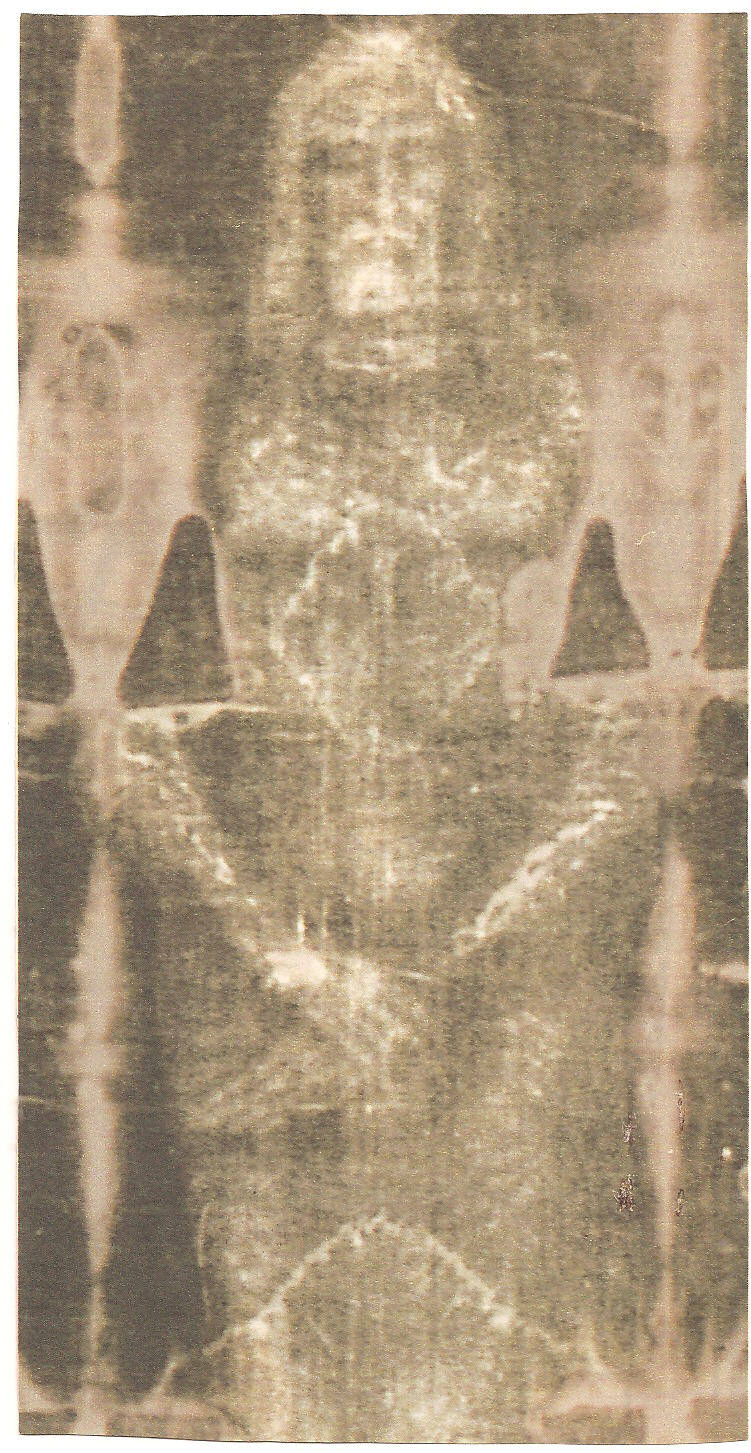
Orig__ShroudIn the late eighties much was made in the secular press with barely suppressed glee of the carbon dating tests conducted on the “Shroud of Turin” that “proved” definitively that it was at best medieval pious art and at worst just another fraudulent prop thrown up by a dying religion–certainly not the authentic burial cloth of Jesus. I remember thinking that late nineteenth century revelations of the shadowy photographic negative image deepened the enigma of how the shroud was fabricated, but, while fascinating, was not essential to my faith one way or the other. I was fully prepared to accept it as the work of a skillful medieval artist.

The “Shroud of Turin” is currently on public display for the next few months. Many still believe it is the burial cloth which wrapped the body of Jesus. Since the startling discovery in 1898 that the image of a scourged, crucified man wrapped front and back is seen much more clearly in a photographic negative, scientific inquiries have been made to ascertain or debunk its origin. The results are mixed, but the presence of human hemoglobin and blood serum is undisputed: type AB negative and possessing both X and Y chromosomes, hence male. How the image was created remains a mystery.

The carbon 14 dating was done on tiny samples clipped from the edges of the cloth in 1988. The samples were necessarily tiny because carbon dating techniques destroy the tested material. The results came back that the cloth was dated between 1260 and 1390. The findings have been disputed, positing that the samples may have been contaminated from repairs woven in by nuns after the shroud was damaged and rescued from a medieval fire. Computer models of the results were unusually scattered unlike other more consistent data from typical carbon date tests.

In 1978 the Vatican invited a U.S. lead multinational scientific team of thirty three with seven tons of equipment to examine the shroud, giving them unprecedented access. They found no evidence of artificial pigments that would be associated with a forgery. The color of the image is somehow photo etched on the outer, microscopically thin (0.000028 of an inch or 1/30th of one fiber of a 200 fiber linen thread) layer by an inexplicable process. In the final report, the STURP (Shroud of Turin Research Project) team concluded “no combination of ‘physical, chemical, biological or medical circumstances’ could adequately account for the image. The Shroud of Turin, the STURP team concluded, ‘remains now, as it has in the past, a mystery.’”[i]

In 2002, three different series of extensive testing were conducted on the Shroud – two chemical analyses of the materials of the linen and the stains and one microscopic mechanical examination of the original weave, comparing it to a database of all known weave and hem sewing patterns of linen. All three confirmed dating compatible with the historical time of the life and death of Jesus.[ii] See the footnote reference below for detailed explanations. The original carbon dating was found to be inaccurate; the area from which the samples were taken were compromised (the medieval patches and backing cloth added after the fire damage). The patterns of blood stains and the image on the shroud were consistent with crucifixion by the Roman government and burial practices of devout Jews.

Next, Physicist Paolo Di Lazzaro and colleagues from Italy’s National Agency for New Technologies, Energy and Sustainable Economic Development (ENEA) spent five years trying to duplicate the shroud’s image using state of the art lasers to focus short bursts of ultraviolet light. In 2011, they published their partial success on a few square centimeters of raw linen. They were unable to match all the physical and chemical characteristics of the shroud or to produce anything close to the full size human image on 53 square feet. The team found that to emulate an image of that size, albeit imperfectly, would require laser “pulses having durations shorter than one forty billionth of a second, and intensities on the order of several billion watts, which exceeds the maximum power released by all the ultraviolet light sources available today.” Presumably the ultraviolet light sources available 2,000 years ago or to a medieval forger were fewer. Dr. Di Lazzaro said, “One could look at hypotheses outside the realm of science, a sort of miracle, but a miracle cannot be investigated by the scientific method.” Just so.

How the image was created remains a mystery. There may be for some a lot at stake. As one wag posted in a long chain on Facebook regarding the current exposition, “My faith does not depend upon its authenticity, but your atheism utterly depends upon its inauthenticity.” Or as William James famously wrote, “In order to disprove the assertion that all crows are black, one white crow is sufficient.”

“Ask yourselves whether you belong to his flock, whether you know him, whether the light of his truth shines in your minds. I assure you that it is not by faith that you will come to know him, but by love; not by mere conviction, but by action.” St. Gregory, the Great.

[i] See April 17, 2015 article in National Geographic. http://news.nationalgeographic.com/2015/04/150417-shroud-turin-relics-jesus-catholic-church-religion-science/


[ii] Summary of the chemical analysis and linen studies: http://www.newgeology.us/presentation24.html


3 Comments

Filed under Background Perspective

Jail Break

“You going to get used to wearing them chains after a while. Don’t you ever stop listening to them clinking.” From “Cool Hand Luke”

Norfolk Prison“Holy Mother of God!” cried my great aunt Isabel Manley (Aunt ‘Tot’). She stood at the sink looking out the kitchen window into the woods and the railroad tracks behind their house. Her brother Charlie had escaped from the Norfolk Medium Security Prison in the adjoining town about five miles away. He emerged from the trees behind the house and Aunt Tot spotted him. Charlie was the baby of the family. He worked for the town as a laborer, which may indicate limited ability, but from a family with some connections in the town.

Two plain clothes detectives were waiting for him. My mother, when she was about twelve, and my grandmother, Molly Manley Laracy, had gone to the West Street house to await developments after the news circulated in Walpole about Charlie’s breakout. The cops waited patiently while my great grandmother, Margaret McHugh Manley, served Charlie what turned out to be (I believe) his last home cooked meal. He was twenty nine. What happened after that remains fuzzy.

“You know, that’s the first thing that got me about this place, that there wasn’t anybody laughing. I haven’t heard a real laugh since I came through that door, do you know that? Man, when you lose your laugh, you lose your footing.” Ken Kesey, “One Flew Over the Cuckoo’s Nest”

 In the depths of the Depression, Charlie Manley robbed a gas station with a toy gun. His motive is unknown.  Piecing together the story from my ninety four year old mother and my one hundred and three year old Aunt Mary left some gaps. Other than the prison break story that my mother related to me recently, neither has any strong recollection of Charlie: he was kind to them as young girls, quiet, and a little shy, worked hard.

His older sister, Julia, married Timothy Cullinane, who rose through the ranks to become the respected and more than a little feared big Irish chief of police in Walpole. Timmy was jovial to his grand nephews and nieces, red faced, well over six feet with broad shoulders and a barrel chest. Their home was the family Christmas afternoon gathering place for a buffet feast, storytelling and laughter while we cousins were growing up. I learned as I got older that Uncle Timmy was not to be trifled with as a cop, however, and more than a few skulls suffered some dents from his night stick as a patrolman, then sergeant. His only child, Marie, taught at Boston College for many years.

No Irish Need ApplyCharlie’s father, Dan Manley, worked for the railroad as many Irish did, as a switch operator, steadier employment than many immigrants enjoyed. Aunt Tot stayed in the West Street house and took care of her parents, the proverbial Irish spinster working as a carder, combing cotton at Kendall Mills, Walpole’s largest employer. She and her brother, my Uncle John, lived in the house all of their lives, drifting into a mostly uneventful retirement. John had one healthy lung left after injuries sustained in a German mustard gas attack in the trenches of 1918 France. What I remember most about John was wry kidding of his grand nephew, his smoky laugh and his yellow, nicotine stained fingers. What I remember most about Aunt Tot was her cackling laugh that terrified me as a young boy. The smell of the old house lingers, cigarette smoke, a faint scent of aging and fading decrepitude – flower patterned, rough textured, lumpy living room furniture and a wall of full bookshelves, not show books, but gently worn. John’s pile of books rested on a side table by his lounger near the back window. Tot and John died within months of each other in 1966. Kid brother Charlie died in 1959 at the age of fifty six in the Bridgewater State Prison Hospital for the Criminally Insane, having never climbed out of “the system.”

“I listened to them fade away till all I could hear was my memory of the sound.” Ken Kesey, “One Flew Over the Cuckoo’s Nest”

How Charlie made his way from Norfolk Medium Security Prison work parties in the local fields to deep incarceration in Bridgewater and why he fell from view from the family and everyone else is a mystery I hope to understand some day. Research on a forgotten prisoner who died over fifty years ago is a slog. No one at Norfolk Prison or Bridgewater State Hospital is amenable to giving out information over the phone. Perhaps someday I’ll find time to drive there and ask for the records. Whether they are forthcoming is a tale for another day. I hope it is not a “Cuckoo’s Nest” dreadful story of the incorrigible escapee the system cannot slot or handle, who succumbs to a thirties era enforced lobotomy and early death. The Irish family closed ranks tightly, and my mother and aunt have no idea what became of him.

A Hassidic rabbi once wrote this prayer: Let me not die while I am still alive. Did Charlie spend his years yearning to go back to what he had? When did he realize it wouldn’t be there anymore? He made mistakes beyond mending and became a ghost. There was no happy ending for Charlie.

“If he breaks a thing down, there is no rebuilding; if he imprisons a man, there is no release.” Job 12:14

1 Comment

Filed under Background Perspective, Personal and family life

Resurrection

Finally crocus blooms“Lo, the winter is past, the rain is ended and gone away; flowers appear on the earth, the time of the singing of birds has come.” Song of Solomon, King James Version

I saw my father this week; it’s been a while. He died in 1982 on his sixty sixth birthday, so his appearances are infrequent and remembered only when I awaken shortly after them. He looked fit, dressed in his typical Saturday casual, not jeans: faded slightly rumpled khakis and a well-worn plaid shirt. No gunmetal sky pallor like the last time I spoke with him in the hospital; his color was healthy, more like he was quarterbacking the street tag football team: tanned, a little ruddy and flushed. We had a short, but satisfying visit. I explained to him how to use a leg press machine at the gym safely, so he would not injure himself. My Dad smiled kindly in a reticent Irish way and whispered that he already knew how.

 “Take care of all your memories, said Mick

For you cannot relive them

And remember when you’re out there tryin’ to heal the sick

That you must always first forgive them.” From “Open the Door, Homer” Bob Dylan

Holy Week.  Easter Sunday. I write of my faith infrequently. Politics and religion at a restaurant – almost never welcome and uncomfortable for those at the next table. Intensely personal, as all faith is, it informs, though, how I see the world, how I think. As it must, or I would be a great fool to hold it dear.

Sitting on a limestone ledge near the edge of the Grand Canyon last month, I was thinking about time and vastness in two contexts from my eclectic recent reading of Aquinas and early twentieth century physics. In Summa Theologica, Thomas Aquinas tells us that time for God is closer to Einsteinian relativity than to Newtonian absolute time: time is a product of our measuring it. [i]  For St. Thomas, the past is no longer actual nor the future yet actual. “Eternity only touches time in the present.” Regrets and guilt are not productive. Anxiety about what may never come is not useful. We have only today; we have only now.

Gianna Barek thinking big thoughts“God is very big, Papa. Bigger than you. Bigger than the whole world and the stars.” Gianna Barek

In Blaise Pascal’s notable gamble, God either is or He isn’t. No absolute proof for or against is possible. “Why not believe?” asks Pascal, because the consequences of betting wrong are eternal loneliness and alienation.  The consequence of being right on atheism is mere extinction, and one’s choices have no effect in this regard. Although Monsieur Pascal was much brighter than I, I believe him to be wrong with his minimalist bet on two counts: his gamble promises too little for and asks too little of the believer.

A new heart I will give you, and a new spirit I will put within you; and I will remove from your body the heart of stone and give you a heart of flesh.” Ezekiel 36:26

The question is this: If the blind cannot see it, does the sun cease to warm us? If blindness is a deliberately chosen mind and spirit closed to faith, does that have any bearing on the reality of the existence of God, of redemption in the cross and resurrection? If we choose not to be open to the possibility, does the truth, if it is so, cease to be true?

“The life of contemplation in action and purity of heart is a life of great simplicity and inner liberty. One is not seeking anything special or demanding any particular satisfaction. One is content with what is. One does what is to be done, and the more concrete it is, the better. One is not worried about the results of what is done. One is content to have good motives and not too anxious about making mistakes. In this way one can swim with the living stream of life and remain at every moment in contact with God, in the hiddenness and ordinariness of the present moment with its obvious task.” Thomas Merton, The Inner Experience

[i] Of course, St. Thomas preceded Newton and Einstein by centuries. His purpose was theological. See Peter Kreeft’s excellent notes in his “Summa of the Summa.”

3 Comments

Filed under Background Perspective, Personal and family life

Spring Snow

“April is the cruelest month, breeding

Lilacs out of the dead land, mixing

Memory and desire, stirring

Dull roots with spring rain.

Winter kept us warm, covering

Earth in forgetful snow, feeding

A little life with dried tubers.”  ‘The Waste Land’, T.S. Eliot

The apple tree in our backyard remains dormant, and no buds swell. Grass, appearing and starting to green this week after months of winter covering, has resettled under new fallen snow this first morning of spring. A gentle snow fell with a higher sun backlighting a gray sky different from a winter sky, not the windblown dark storms of January. A pair of small woodpeckers came back to our suet log in the Rose of Sharon north of the kitchen sink window. We put out seed again for the chickadees, two mourning doves, red winged blackbirds and other over wintering birds that frequent the cedars and sugar maple. The swings out in back, re-hung on a warm day last week, are white coated and still. Spring snow portends of our mortality.

“Amen, amen, I say to you, unless a grain of wheat falls to the ground and dies, it remains just a grain of wheat; but if it dies, it produces much fruit.”  John 12:24

While running Saturday errands, at one of our stops, a thirty something woman approached us with two children, one in a front baby carrier and an obviously blind nine year old girl, Adrianne. Her Mom was petitioning with a colorful paper decorated can to help defray expenses while the family recovered from the loss of her husband’s employment. They had moved from Vermont for cancer treatment for Adrianne last summer. The radiation for her brain tumor arrested the growth of the tumor, but damaged Adrianne’s optic nerve. The father had taken the other four children to the nearby Dunkin Donuts to warm up.  The family was surviving with the support of the local St.  Lucy’s Parish pastor, Father John O’Brien, and the generosity of a local motel, which was putting them up with a deep discount during the winter off season.  They are on a list and hope to have a local rental apartment soon.

Rita spoke to her, helped a little, and we drove to the next stop on the Saturday list. First feeling overwhelmed with this family’s loss, we discussed it in the car and went back. I spoke to her some more; she was remarkably cheerful and friendly given her plight. Her husband had given up a good job with housing in Vermont as a caretaker, so they could tend to Adrianne. As yet he has been unable to find employment, although he is not without skills with experience in carpentry and masonry. They had run off together when she was sixteen, the same age her oldest son is now. Her home life as a child had been difficult, her parents divorced, estranged and unable to help. She told me how blessed she and her husband were to remain in love, together with their beautiful kids. Intelligent and with a lively face, she relayed this remarkable journey in five minutes in front of BJ’s Wholesale Market to total strangers. I sensed no self-pity, no resignation, and no resentment, only hope with immense love for her family and for her faith.

We helped a little more, and I gave her my business card to give to her husband. I hope he calls.  I hope I will be able to help to find a job for him.

What folly and unhappiness in our petty complaints, grudges and in our lack of gratitude for the everyday blessings of our lives. What joy and peace in perseverance, patience, forgiveness and a thankful heart.

“My life is but an instant, an hour which passes by. My life is a moment which I have no power to stay.  You know, oh my God, that to love you here on earth – I have only today.” St. Therese of Lisieux


4 Comments

Filed under Background Perspective, Personal and family life

November 22, 1963

”It may be he shall take my hand And lead me into his dark land And close my eyes and quench my breath-“ “I Have a Rendezvous with Death” one of JFK’s favorite poems – Alan Seeger

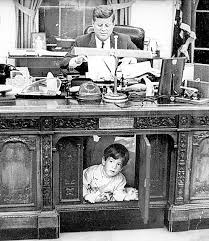
John-John under his father's deskAs it was for 9/11/01, all of us beyond early childhood in 1963 remember where we were and what we were doing when we heard that President John Fitzgerald Kennedy was shot dead in Dallas. For those in and around Boston, Massachusetts, the tragic announcement hit home hard and fast. Irish Catholics in neighborhoods like Jamaica Plain and West Roxbury kept Kennedy shrines with pictures and candles. I was a seventeen year old freshman eating lunch and playing Hearts with some new friends in the cafeteria on campus at Boston College, when a Jesuit dean came into the room and made the shocked announcement. Kennedy was not yet officially declared dead but was gravely wounded in Parkland Memorial Hospital. We bowed our heads while he prayed. Small groups with all the professor – student boundaries broken down gathered around radios and those few televisions that could be found.

Cardinal Cushing, a close friend of the Kennedy family, closed all the Catholic schools and universities in his diocese within the hour. We drove aimlessly listening to the car radio; the city was unearthly quiet, no one worked; mixed clusters of Bostonians crowded around appliance stores with TVs, in bars, and bunched near parked cars with windows down and radios on. Throughout the weekend our family retreated to home and sat stunned in front of the television watching hours of news about the murder of Dallas police officer, J.D. Tippit, the manhunt for Lee Harvey Oswald, his capture in the movie theater, the diorama of Jackie in her bloody dress standing next to Vice President Lyndon Johnson being sworn in as President on Air Force One with her husband’s coffin back in what had been their bedroom that morning.

We watched numbly as the line passed President Kennedy lying in state at the Capital through the night, the horse without a rider and the boots turned backwards, the many foreign rulers and dignitaries at the funeral, a grim President Johnson, the grief stricken, stoic Kennedy icons Bobby, Teddy, Jackie and the kids Caroline and John-John. John-John saluting his father’s flag draped casket. Old pictures repeated many times over the weekend of John-John peeking out from under his father’s desk in the Oval Office while his dad did the work of the most powerful man in the world. Pictures of Caroline riding her pony, Macaroni; Jackie and Jack happy, tanned in sunglasses and casual clothes on the back of a sailboat. Playing tag football with his brothers on the lawn in Hyannis. Camelot bled. My mother wept.

john-john saluting his father's flag draped casketWe lived for days with an exhausted and bereaved Walter Cronkite on CBS News in black and white. When we thought we could absorb no more, we were rendered gap-jawed yet again. As we strained for a look at the assassin being moved at the jail, we saw him gut shot by Jack Ruby on live television, the twenty four year old Oswald’s face distorted in shock and pain. We heard the beginnings of a cornucopia of conspiracy theories, no one wanting to believe that such a man could be taken down by a random act of seemingly deranged violence. Yet the lone wolf assassin with a mail order Italian rifle, shooting from the Texas School Book Depository narrative stuck – with the Warren Commission signing off.

No grassy knoll, no coconspirators, no Mafia, no Cubans, no Russians, no CIA or plotting LBJ, no John Birch Society, no Oliver Stone, no Jim Garrison. The horrific Zapruder home movie with the first shot through his throat and into Texas Governor John Connally, the seconds that seem like hours between shots when we still want to yell hopelessly, “Get down!” The second shot – blood, brains, final. Jackie in shock crawling in her pink dress and pillbox hat over the trunk of the fast moving limo trying to recover part of her husband’s skull blown away as the car accelerated to a way too late escape. That’s what we were left with.

With records sealed seemingly forever, it seemed my questions would not be answered in this lifetime, until on our trip last month to visit Bob and Cathy Cormack, Bob showed me a book I have not been able to put down. How I missed it seven years ago can only be ascribed to preoccupation.

“As I will demonstrate, everything suggests the Soviet Union recruitment of Oswald when he was assigned as a young Marine in Japan. In the available documents I also uncovered clear evidence that his mission upon his return to the United States was to assassinate President Kennedy, who had forced Khrushchev to erect the Berlin Wall in 1961 and hastily withdraw his nuclear missiles from Cuba in 1962. Never before had a Soviet leader been so egregiously humiliated.” From the preface of ”Programmed to Kill, Lee Harvey Oswald, the Soviet KGB, and the Kennedy Assassination – The Training of a Dedicated Agent,” Ion Mihai Pacepa, 2007

Ion Pacepa defected in 1978 from Romanian intelligence, a subsidiary of Soviet intelligence. He was the national security advisor to Romania’s president and acting chief of his foreign intelligence service; he supervised the Romanian equivalent of the American National Security Agency (NSA). Pacepa is the highest ranking Soviet bloc intelligence officer ever to defect to the U.S. In well annotated detail, he describes Lee Harvey Oswald as fitting perfectly the pattern of Soviet recruitment of disaffected American military personnel during the long, Cold War. Oswald’s arranged marriage to Marina, his reinsertion into the U.S., his relationships with known Soviet covert and overt agents all fit the mold of a ”serzhant,” as these agents were called.

Oswald first came to the attention of the PGU (Pervoye Glavnoye Upravleniye), the Soviet espionage service and First Chief Directorate of the KGB, when he was a radar operator in a clandestine base in Japan. When he defected to the USSR, he was treated as royalty, especially after data he supplied on the altitude patterns of the top secret American U2 spy plane led to the downing of one in May of 1960 and the capture of its pilot, Gary Powers. In 1961, he was persuaded by the PGU to train as a clandestine sleeper agent with his mission to assassinate the “Pig” and “son of the millionaire” as Soviet Premier Nikita Khrushchev often referred to the young president who had bested him.

“Programmed to Kill” is an well written study that reads like a spy novel about the inner workings of the KGB and the Soviet Union at its zenith. Khrushchev rescinded the assassination order after his brutality in previous assassinations and attempted assassinations was revealed. Murder was one of his main tools of state, but with the publicity, the Politburo was losing faith in him. The assassination of an American President at his hand could bring Khrushchev himself to a bullet into the back of his head in the basement of the Lubyanka. The PGU lost control of Oswald and feared in an effort to return to Russia a bigger hero, he would complete his original mission in Dallas on his own. All the related Soviet bloc intelligence services began immediately a massive, well run disinformation campaign to deflect attention away from the USSR, casting blame on the CIA, President Johnson and right wing Texas political elements. Dallas nightclub owner and police “hanger on” Jack Ruby, an illegal agent of Cuban intelligence services, was convinced to shoot Oswald to silence him. Ruby was in turn murdered using a well-developed KGB radioactive poison technique inducing a virulent, fast killing cancer.

Credible and chilling, the story holds together, and the book is well worth your time if you have interest in the Kennedys, the assassination, KGB spy craft and the history of a pivotal event in our history. The death of President Kennedy, and the subsequent murders of Robert Kennedy and Martin Luther King, helped to precipitate the cynicism leading to the tsunami of cultural transformation in my generation that resonates to this day.

“The Kennedy assassination was one of the extremely rare cold war episodes in which both sides were vitally interested in hiding the truth.” ”Programmed to Kill, Lee Harvey Oswald, the Soviet KGB, and the Kennedy Assassination – The Training of a Dedicated Agent,” Ion Mihai Pacepa, 2007

3 Comments

Filed under Background Perspective, Personal and family life

Abert Squirrels, Ponderosa Pine and the Mysteries of the Planet

“A thing is right when it tends to preserve the integrity, stability and beauty of the biotic community.  It is wrong when it tends otherwise.” “Essays on Conservation from Round River” Aldo Leopold.

IMG_0333During our recent stay in Flagstaff, Arizona, we were entertained through the window at breakfast by Abert squirrels feeding on the cones of the Ponderosa pines scattered throughout the grounds of the hotel.  Curious creatures, they are quite different from our New England gray squirrel and are primarily found on the Colorado Plateau in the Southwest with tasseled ears and eating pine cones like corn on the cob to get to the seeds. Their obvious attraction for the pines (I’m used to squirrels and oaks, not pine trees) prompted a little research, first to identify them, then to learn a bit about them. From spring to fall, Aberts feed on the tender phloem (inner bark) of the pine twigs; they chew around the bark, exposing the treat.  When they are finished, the twigs fall to the ground, providing fodder for mule deer, normally too high for deer to reach without a squirrel assist.  In the winter, Ponderosa cones are the main source of Abert food, since they don’t store acorns or hibernate, eat they must.

A single squirrel tends to return to one tree year after year and can cause defoliation. Abert squirrels eat almost exclusively Ponderosa pine shoots and cones, but they provide a great benefit to them through a cooperating third party, ectomycorrhizal (EM) fungi.  EM fungi strands act as extensions of Ponderosa pine roots; they are a vital component of those forests, helping trees draw water, nitrogen, phosphorous and other nutrients into the roots.  In turn the fungus obtains needed carbohydrates from the tree.  A secondary source of food for Abert squirrels is the fruiting body of EM fungi. Passing through the squirrel, the spores survive, spreading the fungi crucial to other Ponderosa’s existence. So the next time someone tells you that someone else is as useless as squirrel poop, you now have a rebuttal. This three way symbiosis is another of nature’s wonders.  Many examples of inextricably entwined animal to plant or plant to plant cooperatives are indispensable to the varied ecosystems that make up our planet’s living things. Abert squirrels aren’t just cute; they are metaphors for the complexity and dynamic interdependence so essential to the survival of all life here.

“No matter how intently one studies the hundred little dramas of the woods and meadows, one can never learn all the salient facts about any one of them.” “Essays on Conservation from Round River” Aldo Leopold.

Beside our main objective, the Grand Canyon, we took some side trips from Flagstaff. One was to Walnut Creek Canyon with its pueblos occupied, then abandoned a thousand years ago by the Sinagua, a pre-Columbian people who flourished from approximately 700 AD to 1500 AD. A Western branch of the Anasazi people, they contributed to the genetic and cultural make up of modern day Hopi.  Their name for themselves is still lost, but anthropologists named them “Sinagua,” Spanish for “without water.”

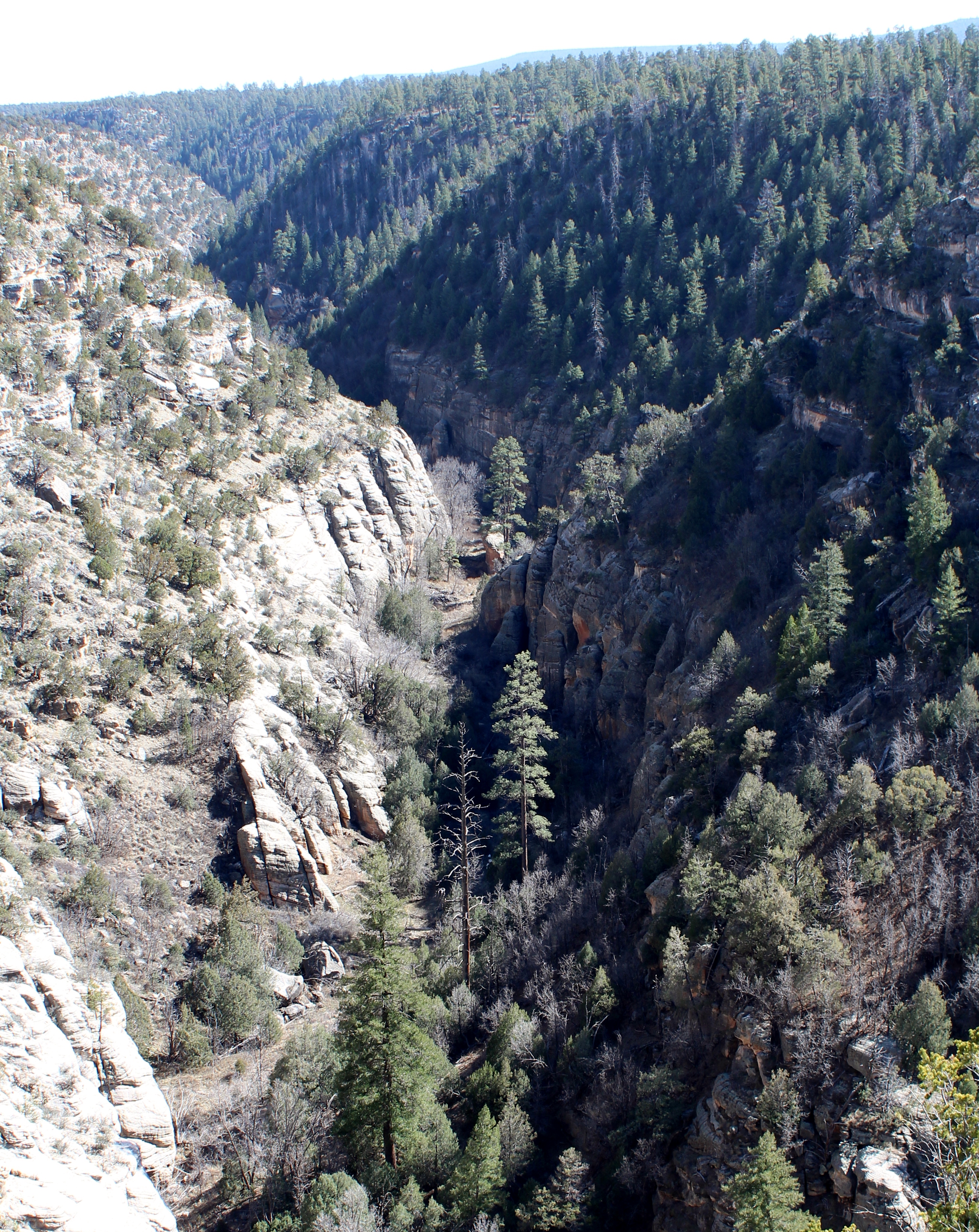
IMG_0260Walnut Creek Canyon is a National Monument located less than fifteen minutes from downtown Flagstaff.  Approximately 600’ deep, its rim is at around 6,700’ elevation. Ponderosa pines along with our Abert squirrels are abundant along the rim.  A Douglas fir ecosystem is on the northern shaded slopes of the canyon; directly opposite on the sunny southern slopes is a completely different ecosystem typical of the high desert with prickly pear cactus, other cacti and yucca plants.  In its shady depths, near the creek are Arizona black walnut trees, for which the canyon is named.  Over twenty species of edible plants are there besides the yucca, walnut and prickly pear cactus, including wild grape and elderberry. The contrast of the shady and sunny sides of the canyon is startling.

Up on the rim, the Sinagua hunted deer, big horn sheep and smaller animals.  They learned to construct dry farming flood pits in which they grew maize corn, beans and squash, the three sisters of Native American agriculture. The biodiversity of the canyon provided them food, medicine and abundant building materials, with our old friend Ponderosa pine supplying perfect ladder and beam stock.  The Sinagua got by on about a gallon of water per person per day. We modern day Americans use about 150 gallons a day for all our purposes.

We have become remote from our planet, its complexity, its beauty, its wonder, its remarkable life, and with that remoteness given away something precious to our understanding of who we are.  Aldo Leopold wrote, “Civilization has so cluttered this elemental man-earth relationship with gadgets and middlemen that awareness of it is growing dim.”

“Our ability to perceive quality in nature begins, as in art, with the pretty.  It expands through successive stages of the beautiful to values as yet uncaptured by language.”  “Essays on Conservation from Round River” Aldo Leopold.

My friend Matthew gave me a transcription of Pope Francis’ general audience on World Environment Day in June, 2013. (Link to whole document)”Cultivating and caring for creation is an instruction of God which He gave not only at the beginning of history, but has also given to each one of us.”  He said that “cultivating and caring” for the earth entailed not only the relationship between man and creation, but to human relations as well – a human ecology.  Francis warns that the environment and other persons suffer when we heedlessly acquire in a “culture of waste,” sacrificed to the idols of consumption. His advice is concrete, achievable by all of us at an intimate level.  What do we eat?  What do we consume?  What do we waste?  What are our idols?

Pope Francis advises us to affect what we can in our daily lives and decisions.  Not a counsel of pompous self righteousness which can infect the “environmental” community; not a proud self aggrandizement, counting ourselves as enlightened and condemning others: businesses, governments, the rich, but possessing a calm confidence in doing the right thing each day:  achievable beginning immediately, human and personal. This does not mean we don’t strive to understand, to address and to improve local and even global issues, but that we start with today, with ourselves and with our families.

I’m not suggesting we revert to subsistence hunter gatherers, only that each of us more frequently simply goes for walks, if not in wild places, at least in the forest, along streams and the ocean, grows some things in our gardens so that we don’t come to believe that the only source of our food is at Whole Foods, and in those quiet pursuits, think about our origins, our journey and our purpose.           

“The wilderness will lead you to the place where I will speak.” Hosea (Come Back to Me), Gregory Norbet

3 Comments

Filed under Background Perspective, Culture views

Climate Change

IMG_0212“What you do not know is the only thing you know.”  T.S. Eliot

           No apt words from this inadequate chronicler can define the Grand Canyon experience, and even photographers (like Rita) with a good eye are able only to approximate its dignity and intimation of eternity. Ten miles wide and a mile deep, coming to a human perspective is nigh on impossible, most certainly for a modest blogger.

The canyon as currently viewable was created by four distinct and necessary geological phases unequally spanning about one and one half billion years. The oldest layers are the deepest and the most recently exposed.  “Recent” is a relative term for us mortals as geological time is similarly difficult to grasp.

The Grand Canyon’s one mile depth is ever changing and growing deeper at the geological fast track rate of about the thickness of a sheet of paper every year. The basement stone is one and one half miles deep, and a fraction is exposed.  This schist or bedrock level sits above the earth’s mantle and was the first stage of the deposition phase of the canyon’s formation, which commenced 1.6 billion years ago or approximately half our weary old planet’s age.  During this period, the land mass was covered by ocean with multiple volcanoes providing the entertainment.  The slow aggregation of the one and a half mile depth of super-heated volcanic activity and magma spanned millennia.

Next up the canyon wall is shale that built up at the bottom of massive swamps after the ocean drained owing to cyclical temperature changes – shale that is clearly delineated greenish gray and relatively soft. Above this is four hundred feet of red tinted limestone that accrued over many thousands of years of calcium buildup from countless generations of bountiful bone and shell decaying after new temperature change brought back the ocean. Red is not limestone’s natural color, but it has been tinted from the iron rich runoff of the few hundred feet of Cocohino sandstone above it. Sandstone clearly shows the ripples of its wind driven drifting during the centuries of desert that formed when the oceans again left the area during yet another naturally occurring era when giant sand dunes were the landscape about 265 million years ago.

Above this is the cap layer of gray white limestone when once again climate altered and back flowed the ocean for millions of years.  Another mile of various layers accumulated during the long deposition phase and various climate changes.  These layers have over millions of years eroded or been scraped away by thousands of feet of glacial ice to expose the current rim of the canyon that lies about 6,900 feet above sea level.

Three more phases, all exactly necessary, followed, or there would be no canyon. The massive Pacific tectonic plate collided with the Continental plate, which possessed the hard and immovable bottom schist layer.  The Pacific plate, unable to crush its way across the Continental dove under it, compelling it up thousands of feet.  What had been at sea level, now rose several miles.  The third phase saw more changes of climate, including Ice Ages. These new mountains spawned the Colorado River, flowing ever downward seeking the sea.  Finally, wind and water erosion from the many tributaries, over eons, widened  the river basin in the soft rock from the hundred feet or so of the river five miles out on each side. Fifteen hundred million years of widely diverse, cyclical climate change carved out a miracle.

“The prospect of domination of the nation’s scholars by Federal employment, project allocations and the power of money is ever present – and is gravely to be regarded.  Yet, in holding scientific research and discovery in respect, as we should, we must also be alert to the equal and opposite danger that public policy itself become the captive of a scientific-technological elite.” President Dwight D. Eisenhower, Farewell Address 1961 (same address that cautioned the nation about the military/industrial complex).  (Link to full address)

No rational person can be a climate change denier any more than a rational person could deny a heliocentric planetary system of which we are the third planet out.  But let us consider that most people and many scientists  believe ourselves to be living in the age of ultimate enlightenment, and that current theory is the final one. Archimedes, Newton, Galileo, Boyle and Einstein believed they had nailed down an understanding of nature, structures and how things worked, and all had made some asymptotic progress.  But none of them had the final answer on Jeopardy.

The issues at hand: what is the current trend of inevitable climate change, what portion of that change is man caused, and what can or should we do to prepare for or mitigate it?  A secondary question, and a critical one for those trying to formulate policy regarding climate change, is what bias exists among those ‘ologists’ studying the phenomena?  When scientists tell us that the science is settled, they have ceased to be scientists and have become advocates.  Their efforts are then spent proving what they have established to be true. Peer review becomes verification, dogma and evangelism.

Have they first defined, and then conformed to an ideological and political narrative? Have the data and statistics been bundled, and do their interpretation and resulting policy recommendations form a consistent drum beat?  Unfortunately, there are dual beats, which are unalterably opposed and express a clear schism along political lines.  Not a good setting to try and do the right thing or the effective thing, if indeed, there is such a policy to be found.

To oversimplify, the right tends to deny there is global warming, and if there is,  it is within the limits of normal climate cycles. Even if it isn’t, what can we do about it, since the worst perpetrators of the CO2 and particulate emission are rapidly growing formerly third world economies that deeply resent former massive despoilers of the environment, who are now preaching with the fervor of recent converts.  “We’ll inhibit our growth by layering on the costs of responsible energy policy when we’ve caught up to you who operated under the old rules while you grew your economy and lifestyle.” Or something like that.

For the left, which includes almost all of academia, current government policy makers and major media, global warming is established science, a panicked crisis, and the only solution is to lower carbon based energy source use precipitously through whatever draconian enforcement and rule making necessary. Economic consequences be damned.  The data that is not reformulated to fit a model curve show that in the last decade the warming has leveled off, which conflicts with the models created by the very scientists who bang the drum.  These models have failed utterly in predictive capability when put to the test.  To jigger the measurements to conform to the models is a continuing, largely unreported scandal and justified by the perpetrators in tweaking the data to conform because, after all, the model must be right, and is for the greater good anyway.

Can we listen to Ike on this?  Has money fatally infected science with an unholy predisposition?  To wit: government bureaucracy, especially left leaning bureaucracy, has as its most sacred postulate a necessity to regulate and to metastasize.  This amorphous, consuming blob through confiscatory tax policy takes our money and among many other self-serving profligacies dispenses grants to scientists.  Scientists have devolved from truth seekers into grant seekers and peer recognition junkies.  Grant seekers get money by conforming to the narrative beloved by the regulators and funders.  Peer reviewed scientific papers bear fruit when their conclusions conform to the same narrative, a narrative perpetuated by other grant seekers and the grant dispensers.  Can this self-perpetuating conformity be healthy for truly unbiased truth seeking?  Of course it can’t.

“Live the questions now. Perhaps you will then gradually, without noticing it, live along some distant day into the answer.” Ranier Maria Rilke

Interesting counterpoint.  See Youtube video with an award winning meteorologist, John Coleman, “How the Global Warming Scare Began“:   Link here.

10 Comments

Filed under Background Perspective

Shibboleths

Vulnerability and persistence

Vulnerability and persistence

The origin of the word “”shibboleth” is from the Hebrew meaning the part of the plant containing grain, like the ear of corn.  In a Bible story the Gileadites used the word to identify the Ephraimites, who couldn’t manage the “sh” sound.  Midwesterners today detect us New Englanders by our inability to get our “r”s in the right place, sometimes substituting “h”s, making it difficult to discuss parking the car or wearing shorts without inviting ridicule.  Or upon hearing “irregardless”, we identify those who paid insufficient attention to Miss Flynn in eighth grade grammar classes.

We tag whole groups of people (and situate ourselves in fixed categories) by our choices of words. If a new acquaintance frequents the phrases “global warming” and “we need carbon credit swaps,” we intuit a quick picture and change the subject.  No rational discussion about the record setting ice depth in Antarctica will follow. A polar divide separates us.  If one person in temporary grouping at a party starts in on “gun control” and “banning automatic weapons,” while another stakes out “Second Amendment rights,” it may be time to refresh our glass at the bar. When a condescending scientism true believer comes down on some dinner companions as blind Creationist fools if they question in any way unfettered Darwinism or simply ask ‘how did all this come about ex nihilo with no First Cause?,’ the conversation is not going to get enlightening or productive anytime soon.

“Science must not impose any philosophy, any more than the telephone must tell us what to say.”  G.K. Chesterton

Nowhere is the conservative/progressive divide less amenable to be bridged than between the semantics of “reproductive rights” or “death with dignity” and “the right to life of human persons from conception to natural death.”  Last week four old friends gathered for lunch; we had worked together for over twenty years in what for me was now five companies ago.  If the volatile housing market and the credit crisis of the early nineties had not intervened, I would be more than content to be working side by side with all of them still.  Two are running companies in my industry, and the third (and proximate cause of the gathering) is retired and recently recovered from a serious illness.  While enjoying a post lunch coffee, the conversation turned (as it occasionally had in the past) to this unbridgeable pro-abortion rights – prolife gap.  Yet with intelligent companions of good will, a civil, yet spirited conversation ensued among men who really like and respect each other.

Since this is my blog (let them make their own), please bear with the debate from my side of the chasm.  I espoused only secular and scientific argument.  If sacred scripture was allowed in and accepted at face value, there is no debate; those documents are clear and consistent in this regard.  Rather than get sidetracked into Christian apologetics, although ultimately they are more ultimate, we stuck to common, mostly agreed upon ground.

We agreed that at conception this new entity contained within herself all the genetic information necessary to distinguish her from all other human beings, a unique creature, human in nature, who was differentiated from all others and needed only time, nutrition and oxygen to mature.  This is merely science, and no biologist, geneticist or embryologist could disagree.

Then we diverged.

Is one reasonable measuring rod of the humaneness and moral character of a culture its ability to protect the vulnerable, the innocent who cannot protect themselves?  And if so, how are we doing, when we kill over a million of them a year just in our country?  Is that a metric that speaks well of us?  Can we do any better than that?

What about the humanity and rights of the woman, and her ability to choose whether she will bear a child?  I respond that I resent the pro-choice label bestowed only to those who favor abortion.  I am very pro-choice myself, however our choices are narrowed once an innocent and helpless third party is subject to those choices, and the tiny one has no choice.  I think the choice for the mother comes much earlier.  Leaving rape aside as a miniscule percentage of causes of abortion, even the case for saving the lives of women from back alley, illicit abortions pre Roe v. Wade, is weak.  Due to their much higher frequency more women die each year from legal abortion complications than ever died of illegal ones.

Well of course it’s killing, says my most honest friend, but they are not citizens, and therefore not entitled to the protections of life, liberty and the pursuit of happiness. The woman is a citizen and therefore has more rights. Then why have attorneys been appointed by the court to protect the inheritance rights of fetuses, if they are not to enjoy at least some of the rights of other citizens?

“The baby, assailed by eyes, ears, nose, skin, and entrails at once, feels it all as one great blooming, buzzing confusion..”  “The Principles of Psychology,” William James, 1890

Clearly the only pertinent and insistent question is this: is the pre born child (or fetus, so we don’t write the conclusion into the premise), a human being? What is the unborn? The answer to this leads inexorably to the immorality or morality of killing it.  What then are those distinguishing characteristics which differentiate the fetus from the citizen, the fully functioning human person with the attendant dignity and worth of a human person, which must be protected by a moral society?  Can we agree on four?[i]

  1. Size. Does Vince Wilfort or Lebron James have more rights and deserve more protection than an adolescent or a 4’11” woman? Or an adolescent more consideration for their lives than an infant?
  2. Level of Development. Does an educated professional have more rights and deserve more protection than an elementary school student or a potty training toddler? Would the torture and murder of a two year old be tolerated by a humane society? If not, why is a less developed pre born fair game?
  3. Environment. (in the womb or out of it). Is the astronaut or submariner, who requires for their every moment the constant protection of a temporarily borrowed and necessary environment outside of themselves, a lower form of human, subject to the choice of her superior whether she lives or dies?
  4. Dependency. Is the person who requires weekly dialysis or the person who requires a respirator or the person under anesthesia and on a heart lung machine during surgery less human than the doctors and nurses providing the care?

The answers to these questions establish the nature and humanity of the unborn.  And the one question that transcends all others in this discussion remains:  What is the unborn?  How we answer that defines our humanity and the humanity of our culture.

The fourth friend, an educated, thoughtful man I have known for over forty years finally joined the conversation.  I was not sure of his position during the debate, but at the end, he answered all the questions, it seems to me.  “I can’t say with certainty when human life begins.  Given the stakes, doesn’t that make it all the more urgent, that we err on the side of caution?”   Just so, my friend, just so.

 “I will give thanks to You for I am fearfully and wonderfully made.. You formed my inward parts. You wove me in my mother’s womb” Psalm 139”

“Before I formed you in the womb, I knew you.  Before you were born, I set you apart.”  Jeremiah 1:5


[i] Thanks to Scott Klusendorf and his excellent pamphlet on this topic, which I whole heartedly recommend,  “Pro-Life 101” Stand to Reason Press, 2002

6 Comments

Filed under Background Perspective, Culture views