Category Archives: Background Perspective

A Wilderness of Error

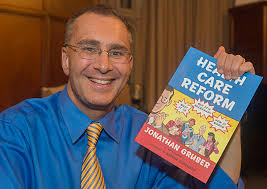
Jonathan Gruber explains what's best for us

“The right thing can seem so wrong and the wrong thing seem so right that we easily become lost, to use Poe’s exquisite phrase, in a wilderness of error.” A Dancer in the Dust, Thomas H. Cook

Unless you have been visiting abroad, say in the Galapagos, you read about or watched Jonathan Gruber, an author of Obamacare. If you have been in the Galapagos, here is a two minute synopsis: Grubergate in Two Minutes from “American Commitment.” Former Speaker of the House, Nancy Pelosi, crowed once that the bill would have to be passed before we knew what was in it. This was not due solely to the closed door machinations and deals, cobbling together a bill meant to be ironed out in joint committee, but frozen, partially done, by the election of Scott Brown. Nor was it due entirely to being over 2,500 pages long and spawning tens of thousands of pages of regulations. The great majority of Americans and American legislators didn’t know what was in it because a.) Obamacare ACA was calculated to obfuscate, and b.) We were “too stupid” to understand it anyway, which was, after all, just as well. As Dr. Gruber clarified to his elite colleagues in academia, “Lack of transparency is a huge political advantage.”

“Speak boastfully no longer, nor let arrogance issue from your mouths.” 1 Samuel 2:3

Obamacare with all its errors in design, the subterfuge in its passage into law and its flawed implementation is a model of progressive mischief, but the ACA is also a metaphor for far more dangerous myopia. Lest we be mistaken, the hubris of the progressive “expert” knows few boundaries. The progressive is willing and able to take us where we ought to go, whether, or perhaps especially, when we do not know enough to want to go there. From their perspective, a stupid and ignorant electorate is best able to be led by those fully prepared to lead them. “Progressive” has become a self-contained oxymoron.

“The trouble is that we always define ‘forward’ as moving in our direction…but not everyone can, and not everyone should.” A Dancer in the Dust, Thomas H. Cook

Norman Angell wrote “The Great Illusion” in 1909 and was awarded the Nobel Peace Prize for his work in 1933. His premise was that large scale war in modern times was futile because of the complex economic interdependence of all the major nations; the cost even for the winners would be too great. His work particularly influenced English leadership, convincing them that even the “Hun” would not be so foolish. They remained in hope almost to the day German troops invaded Belgium and headed towards Paris. Treaty bound to Belgium, the United Kingdom watched as they were inexorably drawn into the beginning of World War I, the bloodiest war in human history until that time. The infirmity of purpose that encouraged the Kaiser was repeated with Neville Chamberlain’s vacillations twenty five years later prior to World War II. Adolph Hitler read the signs of his enemy’s hopeful delusion and warmed up with Austria and Poland before striding down the ChampsÉlysées. The butchery exceeded its predecessor. And so it goes.

For leaders to misunderstand their enemies by trusting optimistic and irresolute illusion kills faith in that leadership as well as the best of the youth under its stewardship.

“In the month of August 1914, there was something looming, inescapable, universal that involved us all. Something in that awful gulf between perfect plans and fallible men that makes one tremble.” Barbara Tuchman, “The Guns of August”

This week we were entertained with the administration’s attempt to placate the offended leaders of almost all major nations. The president once again led from behind by failing to send an appropriate level of representation to the solidarity march of those leaders in Paris after the Charlie Hebdo radical Jihadist attack. To make up for the gaffe, Secretary of State John Kerry gave a stiff hug to Francoise Hollande, the French Premier, and Kerry doubled down by bringing along a grinning James Taylor to sing his sappy “You’ve Got a Friend”. Bad sixties coffee shop folk singing to sooth all insults. If we hadn’t been inured to such awkwardness with six years of this tomfoolery, it would be embarrassing. Now it seems like just another day at the White House. One wag suggested in lieu of Taylor, it should have been Judy Collins with “Send in The Clowns.”

The relevance is not only the tone deafness, but the worldview, the progressive desire to see things as they would hope them to be, irrespective of how they are. Whether Hillary is entreating us to empathize with the Jihadists, Howard Dean denying that the Paris murders were carried out by Muslims or Barack Obama persisting in calling the Fort Hood killings “workplace violence” and Jihadist butchery as “radical extremism” not necessarily unlike  Timothy McVeigh or the demented Jim Jones.

Jihadist violence is inherent, and if we refuse to acknowledge that there is a war, we are probably losing. Releasing Gitmo Islamists who immediately resume killing us or negotiating with Iran over their nuclear ambitions are all of a piece. To the committed Jihadist, there is one dichotomy: dar al-Islam (The House of Islam) and dar al-harb (The House of War), the realm of peace and Islam, and the realm of war: that is everybody else. Leaving the rest of us alone, peaceful coexistence and religious tolerance is as impossible and foreign to them as government by, of and for the people, as constitutional law is to sharia, as democracy is to the Caliphate. Conversion or the sword are the options.

 “And fight with them until there is no more fitna (disorder, unbelief) and religion should be only for Allah!”  Quran (8:39)

“And kill them wherever you find them, and turn them out from where they have turned you out. And Al-Fitnah [disbelief] is worse than killing…  Quran (2:191-193)

4 Comments

Filed under Background Perspective, Politics and government

Beyond Singularity

“Jake Spoon is a mighty leaky vessel to put all your hopes in.” – Gus McCrae, “Lonesome Dove”, Larry McMurtry

In the most recent quovadisblog.net post, we explored however briefly the future according to futurist Ray Kurzweil: the era when man and machine will be inextricably fused into one creature, eternal, omniscient and beyond time and space. A blog post can cover barely a brush by analysis of the roots of this prophesy of the goal of human existence. “Singularity,” a beatific vision of the faith of scientism, is a mighty leaky vessel to put all your hopes in.

How we got here is complicated, but some understanding of the journey which discarded nearly two millennia of human wisdom is worth a word or two.

“This (the abandonment of much of Socratic/Aristotelian thought), though silent and almost unnoticed, was the greatest revolution in human history, far outweighing in importance any of the political revolutions whose thunder has reverberated through the world.” W.T. Stace “Man against Darkness,” The Atlantic (Sept, 1948) as quoted in Leo Sweeney, S.J., “Authentic Metaphysics in an Age of Unreality,” as quoted in “The Last Superstition, A Refutation of the New Atheism,” Edward Feser, 2008

AristotleFor roughly eighteen centuries, the lodestone of Western thought was Aristotle. Before Christianity, before Mohammed, before the Roman Empire, Greek philosophy was true north for all else that was to follow. Until the “Enlightenment,” which wasn’t all light, metaphysics and the search for human wisdom and truth in Western culture relied on principles of natural law and some would say common sense well thought out. What we now deem “science,” and for many the only valid arbiter of truth, was an important, but contracted, aspect of man’s search for truth. All science is based on metaphysical assumptions and precepts. The metaphysical enclosed the hard sciences as a portion, but not the whole.

Aristotle posited that all things have four causes. The first is its material cause: the stuff out of which anything is made (be it wood, iron, chlorophyll, cells, etc.). The formal cause adds the form, structure or pattern which the material assumes and is of a kind that distinguishes it from other things made of the same stuff – be they humans and poodles or countertops and the Pieta. The formal cause exists outside of the thing, separate from it and is congruent with the same form that exists in our minds so that we recognize it. The third attribute is the efficient cause or that which brings a thing into being from exploding stars creating elements to a whittler’s knife carving images – it is what causes a thing to move from potentiality to actuality. Things must have the innate potential to become; and something must act upon them to realize that potential. Finally there is the final cause – that for which something exists, its purpose, its why.

Felix qui potuit rerum cognoscere causas. “Lucky is he who has been able to understand the causes of things,” Virgil, Georgics, Book 2

For Thomas Aquinas, the human person’s formal cause is the soul, which exists beyond space and time; for Aristotle, mankind’s final cause as a “rational animal” is to know the truth, a truth both objective and within our mortal limits, attainable. Beginning slowly with Hume, Locke, Hobbes and the like, modern philosophy disavowed both formal and final causes. We find ourselves on the other side of Neitzsche, Sartre, and now Dawkins and Hitchens and are entangled in webs of relativism, skepticism and purposelessness. [i] Scientism offers us a “leaky vessel” way out, a “hope” rooted in hubris. A mutually exclusive dichotomy now assumed between science and religion was not always so, is erroneous and is not necessary.

Just as the eye was made to see colors, and the ear to hear sounds, so the human mind was made to understand. From “Astronomi Opera Omnia” Johannes Kepler

Science is not scientism; science is an objective search for a limited truth attainable by experimentation and careful observation. Science is agnostic to ultimate purpose or final causes. There is no inherent conflict with faith, but science cannot sound the depths of before time and space. First, science and modern philosophy do not recognize the existence of final causes; secondly they do not possess the means to evaluate them. It is not “faith or reason” that brings us to the fullness of understanding, but “faith and reason” – Fides et Ratio. Scientism is not science; scientism is a faith – a faith not in God, but in “not God.” As in all faiths, there are underlying tenets of that faith that can neither be proven absolutely or refuted absolutely. One can only judge the fruits of it.

Yet the positive results achieved (from pure reason and its handmaid, science) must not obscure the fact that reason, in its one-sided concern to investigate human subjectivity, seems to have forgotten that men and women are always called to direct their steps towards a truth which transcends them. Sundered from that truth, individuals are at the mercy of caprice, and their state as person ends up being judged by pragmatic criteria based essentially upon experimental data, in the mistaken belief that technology must dominate all. It has happened therefore that reason, rather than voicing the human orientation towards truth, has wilted under the weight of so much knowledge and little by little has lost the capacity to lift its gaze to the heights, not daring to rise to the truth of being. Abandoning the investigation of being, modern philosophical research has concentrated instead upon human knowing. Rather than make use of the human capacity to know the truth, modern philosophy has preferred to accentuate the ways in which this capacity is limited and conditioned. Fides et Ratio, 1998 encyclical, Saint John Paul.

Here is an example that may help clarify how it works. Many years ago the Jesuits at Boston College tried to teach me logic, epistemology and other arcane subjects that at the time seemed completely irrelevant to the real world. Pearls cast to swine (or sophomores), I suppose. Of course what they were trying to do was teach me to think; they tried with limited success to inculcate into me a disciplined mind. Perhaps these many decades later to their credit, a few lessons stuck. Among the many examples of logical fallacy we learned was circular reasoning, wherein the preordained conclusion of an argument is baked into the premises to deliver stillborn real debate and analysis.

One such banal argument from the atheist goes like this: Since you benighted theists insist that your God is all good and all powerful and all loving, why is there still evil in the world? Hah! Take that! There is no God! Christian theology replies with an eternal Love, a Person, whose “ways are not our ways”, and of the free will inherent to the human person, free even to choose evil, but free will necessary to the nature of the dignity and worth of a free person. It also teaches of the mystery of suffering and redemptive suffering revealed by God as also necessary to the human person in some way not fully fathomable within our mortal coil, but exemplified and made of inestimable value by Jesus. These and other aspects of this most difficult subject require not only a lifetime of study and understanding, but more importantly prayer, reflection and relationship with God through Jesus. [ii]

But if the discussion is shut down with a trite aphorism with the unstated premise that there is not really any God that can shed light on darkness, but if there was, He could not be all powerful and all good and all knowing and permit evil, therefore He doesn’t exist, the argument reveals itself to be, “there is no God, therefore, there is no God.”

When the true believers of scientism draw their conclusions, they mask as scientific, rational and objective that which was preordained in its premises.

Perhaps there is no God; perhaps God is a Divine Watchmaker who set in motion the laws of the universe and left the premises; perhaps the “Irreducible complexity” debate of the Intelligent Design advocates is really another “god of the gaps” syllogism in a new guise. But perhaps, just perhaps, that as the Jesuits taught me our souls are eternal, as is God, and that we exist on this beleaguered planet, which rides within our solar system, our galaxy and our universe with all of them constantly and intimately enfolded within the Mind of God, utterly dependent for each moment on that Loving Mind.

“I assure you, my brothers, that even to this day it is clear to some that the words which Jesus speaks are spirit and life, and for this reason they follow Him. To others these words seem hard, and so they look elsewhere for some pathetic consolation.” St. Bernard, abbot

[i] For a good analysis of the etiology of the current brand of popular atheism and its convoluted path from the Enlightenment to modernity, try “The Last Superstition, A Refutation of the New Atheism,” Edward Feser, 2008 St. Augustine’s Press.

[ii] See C.S. Lewis “The Problem of Pain”

4 Comments

Filed under Background Perspective, Culture views

Singularity

“Ray Kurzweil is the best person I know at predicting the future of artificial intelligence. His intriguing new book envisions a future in which information technologies have advanced so far and fast that they enable humanity to transcend its biological limitations – transforming our lives in ways we can’t imagine yet.” Bill Gates

Every week it seems business and culture news emerges about the “internet of things.” Our daily lives produce data, and these metadata are tracked, compiled and used to predict, make more comfortable, market to us and filter what we see, hear and experience on the web. Not just tailoring our internet searches to what the search engine “thinks” we want to know, but analyzing key words in our emails and where we linger on the web to “ascertain” through artificial intelligence (AI) algorithms what interests us. Then putting us in touch with our patterns, selling us stuff and fashioning the right box into which we fit – a Procrustean bed. Software is being generated to enhance the sluggish “key words” analysis and advance to concepts and thoughts, something in which computers have not yet surpassed us in ability. They have long since passed us in sheer computing power, speed and memory. Next generation AI software brings intuition and those types of “thinking without thinking” formerly uniquely human judgments written about in Malcolm Gladwell’s “Blink.” Computers are learning to learn and replicate on their own. We are evermore typecast and channeled, aided and abetted into what is profitable financially or politically for someone.

Our smart phones, tablets, computers are joined by our medical records, cars, alarm systems, baby monitors, refrigerators, dish washers, furniture and soon our carpets, toothbrushes, and for all we know toilet seats will feed the maw of data about us. The cloud will know all.

Our rugs will inform us (and the cloud) how often we walk across them, whether we have fallen down and can’t get up, if an unknown walker treads softly upon them or perhaps if we get romantic in front of our fireplace and how long we persist at it. We will go from our smart home to our driverless car, and it will take us door to door.

If we thought the NSA was intrusive, we are desperately naïve. And this is just getting started.

“I would say humans are not purely biological. We’ve already expanded humanity with our technology, and the technology is part of humanity; we are the technology.” Ray Kurzweil

Dr. Kurzweil reflects the hopes of many of those whose belief system is exclusively “scientism,” which holds that science, the scientific method and mathematical reasoning is the only true arbiter of truth and in which we will find humankind’s salvation. The irony of this worldview is while such true scientism believers deride metaphysics, the concepts upon which all of science rests are metaphysical in nature. [i] Scientism is an alternate religion.

He envisions nanobots in our brain, hooked up directly into the cloud. No more fingers on keyboards and mouse to search the internet for knowledge. Our thoughts and memories will access the cloud immediately; we will be one with the cloud, and the cloud will be one with us. He coined the term “Singularity” for this, and his eponymous book ten years ago predicted this state of oneness with computers is not three, two or even one hundred years ahead in science fiction. 2045 is his date for “achieving” singularity. [ii]

Our children and grandchildren will see this, according to the futurist, perhaps even ourselves if we stay healthy and achieve the second aspect of his prediction. All human body parts will be repairable or replaceable with genetic manipulation and perfectly cloned parts from our own DNA, so our brains will become part of the cloud, and our bodies will take on immortality. Millions of car recalls, the roll out of the Affordable Care Act, just my recent experience in figuring out how our new dishwasher worked come to mind. Singularity? What could go wrong?

“And what would they be scared of? There’s nothing to fear in a perfect world, is there?” Catherine Fisher (Welsh author and poet)

Much dystopian science fiction has described computers and robots gradually assuming more and more of our daily lives, then assuming everything. From 2001’s nemesis computer HAL killing the astronauts to Isaac Asimov’s super central computer controlling all in “I Robot” it gets worse. The three rules proscribing that a robot may not harm and must protect any human being broke down. In the Terminator movies, Skybot makes the decision that human kind is a virus on the planet and unleashes genocidal warfare upon us.

I have no mouth and I must screamPerhaps the most awful end for us “hairless apes” is found in Harlan Ellison’s short story from the sixties, “I Have No Mouth and I Must Scream.” The world’s computers hook up into one all encompassing web, wipe out all humans, but keep four around to torture. “AM” reads their thoughts and intention, controls not only their environment, but their biology – AM can keep them alive for its amusement with freshly minted organs virtually forever. After the protagonist, Ted, carefully avoids actively thinking of his “solution,” in a lightning strike frees his companions by killing them. AM transforms him into a limbless blob with no mouth and no ability for even suicide. The final line of the story is its title.

“Why do you ask how you were created and do not seek to know why you were made?” St. Peter Chrysologus

The modest objective of the self congratulatory and elated “Singularity” variety of science and technology is to supplant completely what was formerly reserved to religion and understood through the study of metaphysics. The technocrats will define and implement our happiness, immortality, omnipotence and fulfillment through becoming one with our machines.

How we got here is a topic which will require more than a few blog posts to begin to explore, and perhaps we shall root around a bit. The history extends back not just into the technology of the late nineteenth century through today, but to late medieval philosophers like William of Ockham, then on through Descartes, Hobbes, Locke and all the rest. To understand even peripherally what ideas have these consequences is not a trivial pursuit.

John Hammond, “All major theme parks have delays. When they opened Disneyland in 1956, nothing worked.”

Ian Malcolm, Yeah, but, John, if The Pirates of the Caribbean breaks down, the pirates don’t eat the tourists.”  Jurrasic Park

[i] The concepts undergirding science are the stuff of philosophy.  A physical world exists outside our mind; that there are patterns which can be recognized by our senses reliably as sources of information; that we can form concepts and reason from premises to conclusion.  That causation and result are valid methods of understanding.  All of these and more are metaphysical concepts and provable through metaphysics and logic, not the scientific method.

[ii] Curiously, “singularity” is the scientific term for a single point in space-time of no dimensions, but infinite mass, which current hypothesis holds was blown up by a “quantum fluctuation” to trigger the Big Bang resulting in a inflating universe bubble in an infinite cosmos of other universe bubbles that has no beginning and no end.


6 Comments

Filed under Background Perspective, Culture views

The DNA of Christmas

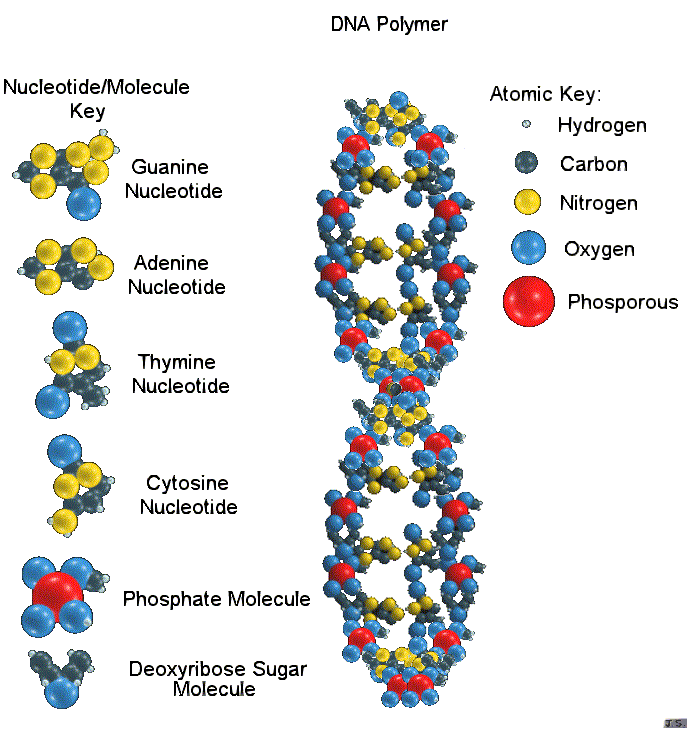
dnaThe double helix of DNA stores and passes down through generations all the genetic information necessary for carbon based life forms on this green and blue planet.  DNA diagrams look like counterclockwise corkscrewed ladders.  The models help us to understand how this wondrous alchemy works, but they are simplified.  Inside each nucleus, the DNA coils tightly in and upon itself.

These long molecules recreate through ‘messenger’ molecules the amino acids that build all the proteins of which our bodies consist.  Each connecting rung of the ladder bonds in one of two combinations of four smaller molecules called nucleic bases. When DNA molecules ‘unzip’, separating at the nucleic bases, each half regenerates into an exact replica of the original.  This self replication is what makes possible all life to continue, and such an unzipping and reforming occurs within the human body thousands of times a second.

 “The DNA in just one cell can stretch six feet long – yet it fits into a nucleus around a thousandth of an inch wide.  And since we have trillions of cells, all the DNA in one human body can stretch roughly from the sun to Pluto and back.”  The Violinist’s Thumb: Love, War and Genius as Written by our Genetic Code, Sam Kean

Mitochondria are tiny bean shaped organs that supply energy within our cells. [1]  Curiously, they have their own DNA. Science theorizes that they were bacteria or viruses ‘eaten’ by other primitive cells eons ago and evolved in a symbiotic relationship. Mitochondrial DNA is most useful, because sperm from those of us who are male are primarily DNA carriers that swim with tails; they are too tiny to contain mitochondria.  Hence, all mitochondria and its DNA are passed on solely through the mother.  Since this DNA is stable and reliable, it mutates on average only once every 3,500 years or so.  This remarkable characteristic has enabled biochemists to analyze mitochondrial DNA common to human beings alive today and trace it back to a single source — the first “Eve.”  She lived in Africa approximately 170,000 years ago.  The name “Eve” comes from the Hebrew word, HAWAH, a verb which means “to live.”

And so we come to Christmas.

”For You created my inmost being; You knit me together in my mother’s womb. I praise You because I am fearfully and wonderfully made.”  Psalm 139, 13-14

The early Church fathers in the first two centuries after the apostles wrote extensively of Mary, the mother of Jesus, as a New Eve. Ireneus, Justin and Tertullian, followed by Jerome and Ambrose develop the Eve-Mary parallel.  Jesus is described as the New Adam.  “It was through a man and woman that flesh was cast from paradise; it was through a virgin that flesh was linked to God.” (St. Ambrose).  “Death through Eve.  Life through Mary.” (St. Jerome)  They taught that just as the pride, lies and disobedience of Adam and Eve (and all human beings) opened the breach between God and man, the humility, truth and obedience of first Mary, and then ultimately, perfectly her Son, bridged it.

When Jesus saw his mother there, and the disciple whom he loved standing nearby, he said to her, “Woman, here is your son,” and to the disciple, “Here is your mother.” From that time on, this disciple took her into his home. John 26-27.  Mary became mother of John and of the Church, and spiritually, the mother of us all.  The “disciple took her into his home”; when Mary comes into our home, she does what she always does, she brings Jesus to us and us to Jesus.

“Answer quickly, O Virgin.  Reply in haste to the angel…Why do you delay, why are you afraid? … Let humility be bold… In this matter alone, O prudent Virgin, do not fear to be presumptuous… Arise, hasten, open… ‘Behold, the handmaid of the Lord’, she says, ‘be it done to me according to your word.’”.  Saint Bernard

So as we hasten and worry, as we fret and rush about, we, too, are given the opportunity as Mary was to “be not afraid.”  Christmas is not department stores open a hundred straight hours until late Christmas Eve.  Christmas is not maxing out the credit cards in a futile bargain to please others or to please ourselves.  Where do we find our solace?  Where is peace?  How do we reflect on the miracle and the bridge between Creator and creature, born twenty centuries ago in such humble circumstances?  “Let it be done to me according to your word.”

“There are those who pour out gold from a purse and weigh out silver on the scales; then they hire a goldsmith to make it into a god before which they fall down in worship.  They lift it to their shoulders to carry; when they set it in place again, it stays, and does not move from the spot.  Although they cry out to it, it cannot answer; it delivers no one from distress.” Isaiah 46

Our DNA determines much about us and each mix is unique in all of history, but it does not determine ‘us.’  Our DNA is ephemeral; our soul is immortal.  We are determined in our soul by our will and by our decisions.  Not just at Christmas time, but by the slow aggregation of our daily decisions throughout our life.  We can fall into an “idolatry of disbelief.”[2] We become to a great degree that which we choose to become.  And through our Creator’s great mercy, we have a new opportunity today and every day to become new, to begin again.  That is the Good News of Christmas.

“Christ dwelt for nine months in the tabernacle of Mary’s womb.  He dwells until the end of ages in the tabernacle of the Church’s faith.  He will dwell forever in the knowledge and love of each faithful soul.” Blessed Isaac of Stella, abbot.


[1] Chloroplasts are analogous tiny organs in plant cells with their own DNA. In them, the hard work of photosynthesis takes place that captures the sun’s energy and is a necessary first step for all life.

[2] Article in Crisis Magazine by Regis Martin.

Leave a comment

Filed under Background Perspective

Maggie (Part 2)

What is crooked cannot be made straight, and what is missing cannot be supplied.  Ecclesiastes 1:15

The prior post on Margaret Sanger explored briefly some of the events and people that helped form her world view and fuel her frenetic efforts to fill the hole in her soul.  Three themes emerged as she came to maturity, and they informed and drove her behavior, writings and passions: unquenchable desires for sexual experience of all kinds and obsession to sever natural human fertility from sexual activity were two. The third was eugenics – promoting the concept that elite illuminati should determine who lives and who doesn’t, who breeds and who doesn’t.

Under threat of arrest in New York for flaunting the law while catechizing a gospel of crude birth control, she fled for a while to Great Britain.  This sojourn congealed her radicalism.  Freed from “the smothering restrictions of marital fidelity,” her unleashed promiscuity took to her bed some of the luminaries of the socialist intelligentsia there, including (among quite a few others) George Bernard Shaw, Havelock Ellis and H.G. Wells.  She advocated ever more stridently that we must strive to disassociate human sexuality from the natural benefits of human bonding, intimacy and parenthood.

Her connections with Ellis and Shaw deepened her commitment to the eugenics movement, and their money funded her American Birth Control League and its propaganda instrument, the Birth Control Review.  One of the articles in the 1920 editions was a favorable review of Lothrop Stoddard’s Fascist book, The Rising Tide of Color Against White World Supremacy.  Three years later a Review editorial advocated restricting immigration based on race.  In 1932 Margaret penned for the Review her “Plan for Peace,” which endorsed coerced sterilizations, mandatory segregation and “rehabilitative” concentration camps for all “dysgenic stocks,” including the handicapped, ethnic minorities and the mentally “defective.”  She routinely inveighed against the “inferior races” that were “human weeds,” a “menace to civilization”; she insisted the “sinister forces of the hordes of irresponsibility and imbecility” be controlled.

birth control revew banner (2)In 1933 the Review published “Eugenic Sterilization: An Urgent Need” by Margaret’s close friend, Ernst Rudin.  Rudin was at the time Adolf Hitler’s director of genetic sterilization, having been one of the founders of the Nazi Society for Racial Hygiene.  Later in 1933, she ran a piece by Leon Whitney, “Selective Sterilization,” which lauded the Nazi pre-holocaust race purification programs.  Margaret’s birth control advocacy was inextricable from her desire to maintain the purity of the human race with her and those most like her as the select survivors.  Like her fellow true believers in the Ku Klux Klan, the Nazis and the Eugenics Society, for Margaret, pulling the weeds in the human garden took the highest priority.

In 1939, Margaret devised the “Negro Project” at the request of “southern state public health officials” in which she stated that the “mass of Negroes ….particularly in the South, still breed carelessly and disastrously, with the result that the increase among Negroes, even more than among whites, is from that portion of the population least intelligent and fit.”  Her plan foreshadowed the goings-on of her current organization.  She suggested that they start with three or four “colored ministers preferably with social service backgrounds, and engaging personalities” to propagandize for birth control.  Her longer quote is enlightening.  “The most successful educational approach to the Negro is through a religious appeal.  We do not want word to go out that we want to exterminate the Negro population and the minister is the man who can straighten out that idea if it ever occurs to any of their more rebellious members.”   Margaret was a militant atheist, but not above manipulating the unsuspecting through their faith.

Nazi atrocities put a knot in Margaret’s plans as the world first recoiled in horror and then destroyed the Third Reich.  The inconvenience of bad public relations for its support of the Nazi agenda made the American Birth Control League and Birth Control Journal untenable as an ongoing enterprise.

What has been will be again, what has been done will be done again; there is nothing new under the sun.  Ecclesiastes 1:9

Margaret, undeterred, started up its successor, Planned Parenthood and the Planned Parenthood Review.  Planned Parenthood has expended great efforts to sanitize the beliefs of their founder, indeed portraying her as a modern day saint who pioneered freedom for women and a savior of their health.  True to course, however, their activities uphold her dreams.  The early offices of the international Planned Parenthood organization were in the offices of the Eugenics Society. Seventy percent of their “woman’s health clinics” are located in poor and minority neighborhoods.  While black Americans comprise 12.6% of the total population, 35.4% of abortions are inflicted on black babies.   For every 1,000 live births, there are 138 abortions in the white population; for black children the rate is 501 dead for every 1,000 born.   Planned Parenthood is self adulatory about their efforts on behalf of feminine health, but they do no mammograms – for those they refer their clients to others.  They say they do them, but they don’t.  What they don’t refer are the big profit items – over 300,000 abortions a year, which bring the “health organization” almost a third of its nearly billion dollar annual income.  The larger PP clinics have assigned abortion “quotas.”[1]

Abortion and racism are evil twins, born of the same lie.  Where racism now hides its face in public, abortion is accomplishing the goals of which racism only once dreamed.  Together, abortionists are destroying humanity at large and the black community in particular.  Alveda King

The Reverend Alveda King (daughter of civil rights leader, the Reverend A.D. King and niece of Martin Luther King) is an outspoken critic of Planned Parenthood.  Based in Atlanta, she speaks of a black genocide at many events throughout the country preaching in the familiar powerful cadences reminiscent of her family.  “Abortion and racism are both symptoms of a fundamental human error.  The error is thinking that when someone stands in the way of our wants, we can justify getting that person out of our lives.  Abortion and racism stem from the same poisonous root, selfishness.”  She was seventeen when her beloved uncle was murdered by James Earl Ray, but she remembers him and their conversations well.  She told us at lunch one day in Providence when she came to speak that while her uncle was killed five years before Roe v Wade struck down all the state laws in the country restricting abortion, he would have been sickened at the targeting of black babies by a white elite.  “A majority, perhaps as many as 75%, of abortion clinics are in areas with high minority populations.  Abortion apologists will say this is because they want to serve the poor.  You don’t serve the poor, however, by taking their money to terminate their children.”

Can foul seed ever blossom into anything but poison fruit?  Margaret Sanger lived until 1966, just short of the “summer of love” in San Francisco in 1967 where her other dreams came to sad, drugged out reality.  The Birth Control League fades into the dim past.  Maggie was praised by presidents and emperors, movie stars and scientists.  Still is.  Her early life and the foundations of her beliefs and work are forgotten or papered over.  Her dream and her organization persist with massive government, taxpayer paid support.  Planned Parenthood’s lobbying and contributions to liberal candidates are among the most aggressive in the country.  Kurt Vonnegut in Slaughter House-Five was perfect:  “And so it goes.”

For in much wisdom there is much sorrow, and he who stores up knowledge stores up grief. Ecclesiastes 1:18


[1]unplanned”, Abby Johnson, former director of a PP clinic.

6 Comments

Filed under Background Perspective, Culture views

Maggie (Part 1)

“I wheedle, I chip away, I argue, I reason, I cajole, I hope. But I do not expect.”  A Delicate Truth, John le Carre

Young Maggie

Young Maggie

In 1879 she was born into hardscrabble Irish immigrant poverty in upstate New York, the sixth of eleven children, as Margaret Higgins.  Her father was an emotionally scarred veteran of the Sherman’s Union Army that left scorched earth and blood from Tennessee to Atlanta.  He treated his wife and daughters as virtual slaves.  Her mother, Anne Purcell, was frail and suffered from tuberculosis, but dedicated to her alcoholic tombstone carver husband.  The family suffered grievous poverty with its inherent gnawing hunger and relentless cold.  Later in her life, she described her youth as “joyless and filled with drudgery and fear.”  Margaret had a terribly difficult start and overcame much to found an organization that today exceeds one billion dollars in annual revenue and exerts great influence over the very center of power in America through a well funded lobbying and public relations machine.

Even though baptized secretly by her mother, her harsh and erratic father’s unrelieved cynicism about all things religious led her into a bitter hatred of the Catholic Church after her mother’s death when Margaret was seventeen.  Her early attempts at making her own way were fitful failures. Finally escaping her father’s control, she went to Claverack College, a small, inexpensive co-educational boarding high school.  There she first experienced unrestricted freedom, and as many have before and since, fell into radical politics, feminism and promiscuity.  After running out of money and with failing grades, she left school, returning home just long enough to plan her final escape.  She began a brief sojourn as a teacher of new immigrants, which she quickly gave up – not really liking her students much.  She next worked as a nurse trainee in a small hospital.  Although later cited in her “Autobiography” as extensive health care professional experience, this proved another of her fantasies: she mostly ran errands, changed bedding and emptied bed pans.  Her early wild freedom, however, forever influenced her future.

Things finally started looking up for Margaret when she married Will, who while not rich, was a young, upcoming architect and financially secure.  At first she enjoyed the fruits of marrying into money by lavish spending and a fine apartment on the Upper East Side of Manhattan.  Will’s career flourished working on projects like Grand Central Station and the Woolworth Building.  Three children later, he still struggled to keep her restless sprit satiated.  To placate her, Will bought a substantial Long Island estate, but after a decade of this, Margaret longed once more for the energy and freedom of the city.  They sold the estate and moved back to Manhattan.

Affluent Will rekindled his college fascination with radical politics and began attending Socialist, Communist and Anarchist meetings in Greenwich Village – not a great deal more mature in this regard from his days of adolescent fascination with utopian idealism.  Margaret thought the fellow travelers boorish, but would tag along to meetings occasionally and continued her fidgety search for fulfillment in shopping, dining, theatre and New York society.  All this changed when she met and became close friends with the renowned and charismatic John Reed, later the famed propagandist for the Bolshevik factions in Soviet Russia and buried as a hero in the walls of the Kremlin.  She became completely immersed with all the enthusiasm of a recent convert, spending her time with Reed, Eugene Debs, Will Durant, Clarence Darrow and Upton Sinclair.  As never before, she became a voracious reader, gulping down radical books and tracts.

 Margaret fled from her former bourgeoisie entertainments as from a leaky ship and espoused with passion a Bohemian lifestyle.  She threw herself into left wing politics, speaking and campaigning for the Socialist Party and Eugene Debs.  When she became enthralled with the radical utopian feminist, Emma Goldman, Will started back peddling.  At first he had encouraged her interest in something other than entertainments, self indulgence and parties, but Goldman was a step too far.  Margaret had virtually abandoned her family, spending less and less time with Will and leaving the children with friends, relatives and strangers.  As one contemporary wrote to a friend, “She became a raging river overflowing the banks of conventionality and propriety.”

Over the next years, her early wildness reemerged under the tutelage of Emma Goldman.  She devoted the rest of her life to three causes, which were related.  She wrote and advocated with skill and passion, becoming a heroine in all three movements to this day.  The first eventually brought a close to her troubled marriage.  The preaching and the practice of “free love” (there’s an oxymoron for you) was finally too much for Will. He had moved the family to Paris to try and distance them from Margaret’s obsessions and friends, but she abandoned him there to move back to New York.  Her compulsion for sexual expression of all varieties and her public advocacy for it as a solution to all manner of human unhappiness became the focus of her lifelong search for meaning.  Margaret began her experimentation with and championing of birth control.  Her early recommendations were, to put it mildly, eccentric.  Among them were Lysol douches.

“The most merciful thing that a large family does to one of its infant members is to kill it.” (Margaret Sanger – Women and the New Race, Eugenics Pub. Co.,1920)

A guest speaker for the boys in the sheets

A guest speaker for the girls in the sheets

She went on to found what was to become the largest provider of abortions in the world – over 300,000 a year in the United States.  The third great passion after promiscuity and population control was the related movement of eugenics – the culling out or limiting the reproduction of inferior races and individuals.  Her foundational work in the worldwide eugenics movement was highly regarded, especially her writings on the “genetic inferiority” of the black race, the enfeebled and the mentally challenged.  She had a solution for them, which was especially well received among the women of the Ku Klux Klan.

Margaret Sanger advocated “to give certain dysgenic groups in our population their choice of segregation [concentration camps] or sterilization.” (“A Plan For Peace,” Birth Control Review, a journal Sanger edited)

There is far too much for one entry – more to follow next post.  Please come back.

Footnote:  A group of high school basketball players in Texas had a different solution for the mentally handicapped than Maggie did.  It’s worth a few minutes of your time.  Love and dignity.

2 Comments

Filed under Background Perspective, Culture views

Still Point

Except for the point, the still point, there would be no dance, and there is only the dance.  T.S. Eliot – Four Quartets

Drove my Chevy to the levyBeing the oldest of five (eventually to be six) children in 1956, the age of ten brought with it occasional responsibilities that would be surprising to most ten year olds in 2013.  We shared one bathroom, and the four boys shared one bedroom in a three bedroom cape with two small one window dormers in the front.  When I was thirteen or so, my youngest brother, Marty, filled out the nest, and my dad added on a family room.  We never questioned and rarely felt put upon by the living arrangements; our family was secure and happy in our daily routines.  My parents had one car; my father worked two jobs and my mother worked full time as a mom, which was quite enough for anyone.

Intermittently my mom asked her oldest to help out paying bills downtown, which was a mile or so from our house.  Accomplishing this on my bike was an easy adventure and invited me in to the mysterious grown up world.  My mother didn’t have a car when my father was at work, and in 1956 in addition to me, she had two kids in diapers plus a set of five year old fraternal twins, one of whom had a severe hearing disability.  She handled this all with aplomb and good humor most of the time, but when the bills were due, she needed some assistance.

The budget was managed by accruing cash weekly in separate envelopes for various expense categories.  I would be given the utilities envelopes and the mortgage envelope, and then mount up on my bike.  There were no bike racks or bike locks, none was needed, just a kickstand or a convenient wall to leave the bike against.  First, I would go to the bank, then the electric company and the telephone office.  No gas company bill in 1956 and I think she paid cash to the oil man, when he delivered.  Grocery shopping was a full family affair when we were little.  The checkout clerk would help load the groceries into our car.  I lost five dollars in change once, which was a minor disaster in a time when it represented nearly fifty percent of the weekly grocery budget.  She was disappointed, but kept her concern brief and tight lipped – almost. I was admonished after that to return straight home with no stops at friends’ houses or especially the library, which could delay my return for hours.

card catalogA bike ride to the library was also about a mile, and with the possible exception of a sandlot baseball game behind the elementary school, my favorite activity.  I was a constant reader and shy at ten.  There are pictures of me my mother still has, sitting on the floor reading a book absolutely absorbed and still, amid the chaos of my five siblings.   I haven’t changed all that much – except for the shy part, although I remain private.  My reading consumption was and remains omnivorous, but at ten inclined towards biographies of Indian fighters and tales of King Arthur and the Knights of the Round Table.  As I got a little older, I was spellbound by biographies of Thomas Edison and Babe Ruth with The Count of Monte Christo not far behind.

The Walpole Library was small, but well stocked. Upstairs was for the adults, but the basement was reserved for children and adolescent fare.  The librarian was a genial and skilled substitute far superior to Google for a ten year old; the card catalog held the keys to the kingdom.  If the librarian was preoccupied, we could sneak out to the front steps and edge our way around the whole structure on an eight inch granite ledge that circumscribed the building as a design feature just below the windows.  The children’s section had round low reading tables with small chairs.

In one corner, two stereoscopes resided along with boxes of the two photo four by ten inch cards that fitted into them.  Most of the pictures were black and white, although some, including Civil War historical shots were sepia. As a ten year old, I especially liked the battle aftermath photos.  When viewed through the lenses, they appeared in 3D.  Developed in the mid nineteenth century and vastly improved by Oliver Wendell Holmes in 1861, the stereoscope opened previously undreamt wonders to a ten year old.  From Egyptian pyramids to the streets of Paris to the Grand Tetons, our new world was limited only by our imaginations.

StereopticonStereoscopes are now valuable antiques and anachronistic reminders of simpler times (that is simpler unless one lifts the edges of the curtains).  They were supplanted sadly by more enticing moving pictures and eventually television.  Our television was a big box in the living room with a small black and white screen and three somewhat fuzzy channels.  Ozzie and Harriet, I Love Lucy, The Ed Sullivan Show, The Jack Benny Show, The Honeymooners and many, many Westerns like Gunsmoke and Have Gun, Will Travel drained away our family hours as we got older. I could still slip away to my sanctuary in the eaves of the attic, which had a single pull chain light bulb and a hook and eye latch, to seek the quiet harbor of my books.

I’ve heard it said that we all have our nineteen year old selves permanently emblazoned on our personalities.  Can it be any less so for ten?  My tenth birthday was in February of 1956, eleven years to the day after the Marines raised the American flag on Iwo Jima, securing a key stronghold on the long drive to Tokyo.  To idealize any period of time is to trivialize it, however to hold it at the center of our innocence is quite another.

The fifties were in some ways innocent and optimistic, yet they also harbored Jim Crow laws and the hypocrisy of country club adultery and too much liquor.  But most families were hard working and held traditional morality dear; the parents were the “Greatest Generation” determined to leave behind the Depression years of the thirties of their youth and the killing years of the forties of the war, and to pass on to their children a safer, more stable and more comfortable future.  For this they worked steadily and generally cheerfully for the rest of their lives.  Comfortable was achieved; stable and safe eventually were beyond theirs to bequeath, but in the fifties, at least the illusion of simpler times was lovingly preserved.

“We don’t know what we are doing, because we don’t know what we are undoing.” G.K. Chesterton

4 Comments

Filed under Background Perspective, Personal and family life