Tag Archives: Aquidneck Island

Snowy

“When the white owl flies, winter has found its voice.”  Inuit saying
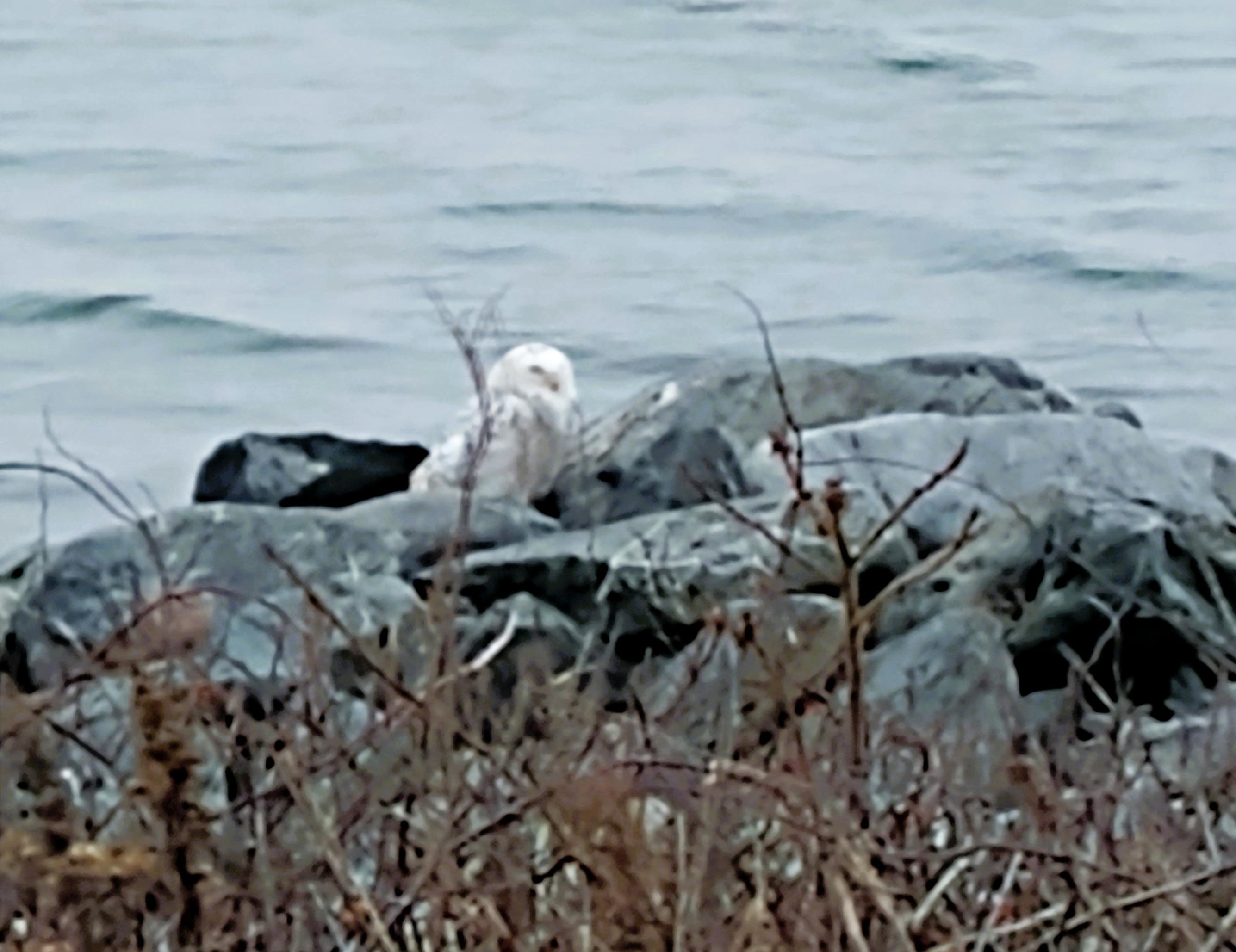
Sachuest Point Wildlife Refuge had another short visit from a snowy owl, the second such visit this winter. She had a two day layover in December at the refuge, was just passing through we think and has not been spotted since she was hanging around Island Rocks. She left before the paparazzi showed up. Snowy’s have a following, and when they grace us with an appearance the parking lot fills up.

If they are on the roof of the visitor center as one was four years ago, the small lawn area in front of the main entrance is overrun with photography equipment worth more than my car. On tripods – lots of tripods sprouting like a field full of oil rigs with large telescoping lenses.  A photographer and ornithologist told me one lens could cost fifteen thousand dollars.

We volunteer Friday afternoons in the Visitor Center. From December to February, at least a few visitors come to the hospitality desk each week to ask us where any snowy owls have been spotted with the excitement of a neighbor enthusing about the Pats back in the Super Bowl. Snowy owls are celebrities. Reports of a sighting on E Bird or Merlin are shared with online contagion as excitedly as if Taylor Swift was spotted at a Newport restaurant with her NFL star fiancé.

During the winter of 2022-23 a pair of snowy owls moved in for the season. The refuge had to close off the Price Neck Overlook Trail where they were nesting because too many hopeful observers were wandering off the trails to locate their nest, and they were stressing out the birds. Hard to get a parking spot, even with the overflow lot opened, so a snowy layover is a mixed blessing.

When they are hunting for lunch, it is major entertainment. A pair of barn owls were nesting on the refuge at the same time the snowys took up residence. Barn owls are not scarce globally but are considered rare and endangered in Rhode Island. Not as many barns for them as there once were.  They became rarer still on Aquidneck Island after the snowy owls killed them both at the refuge. Another volunteer saw a barn owl grab a vole just before the snowy owl snatched up both the barn owl and its prey. Lunch and dessert. I would have loved to have seen that encounter.

“The snowy owl belongs to the great white silence of the Arctic, and when it comes south it brings that silence with it.”  Bernd Heinrich, Winter World
Visits by snowy owls used to be more common before the water warmed up in Narraganset Bay.[i] Our visitors were not fully mature, so they had mixed gray, black, and white feathers and not the purer white that earned them their name. Farther up north in the tundra if food becomes scarce, the snowy parents make a pragmatic decision when their hatched owlets grow larger and fledge. Time to get booted out of the nest and make their way south to find food. Ducks and barn owls beware. Darwin had some things right. Failure to launch is not an option.

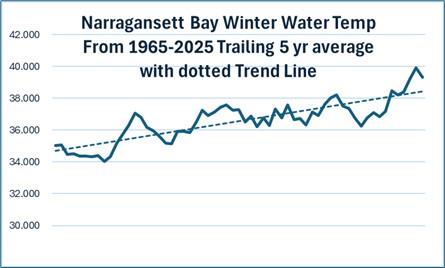
Because the bay waters are warmer and the winters are demonstrably less severe than in the days of my coming of age, the owls don’t have to come as far south to eat regularly. Thus, their visits are now less frequent.

It has not always been that way, not even counting the long era that lasted about eight millennia from twenty three to fourteen thousand years ago, when most of Rhode Island was under a mile deep glacier. That’s a long cold snap. Salty ocean water freezes when its temperature drops to 28 degrees, while freshwater freezes at 32. With billions of gallons of water Narragansett Bay takes a prolonged period of very cold weather to freeze over, especially as it is flushed twice every day with the tidal flows from the ocean.

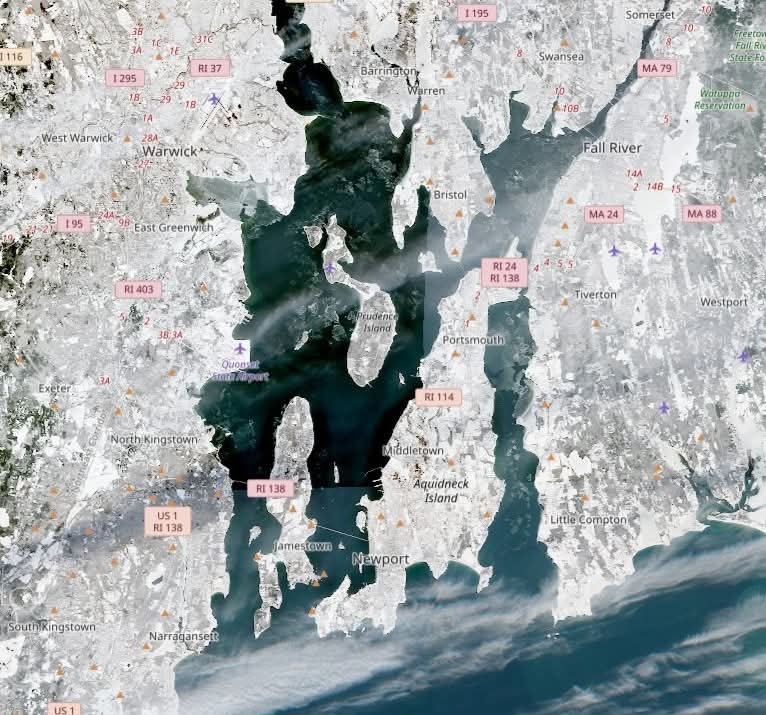
We have enjoyed warming water for generations now, and especially so in the last fifty years. The winter surfers and the New Year’s Day polar plunge folks appreciate it. But this year is the exception to the trend and so far has been the coldest winter in thirty years. The ice we’re seeing now in some spots in the bay as shown in the satellite image is a rarity. Rhode Island needs to stay cold for a long while for Narragansett Bay to show ice.  If warmth is lacking for long enough the bay can freeze solidly as it has frozen in the past, although we are unlikely to experience that again in our lifetime.
Beginning around the edges as an advancing gray slurry with the waves still undulating softly under it, the surface becomes ever more languid as if the sea is nodding off. Light and oxygen diminish under it as it solidifies, and the small inlets succumb to the proliferating crystals of ice. Torpor descends slowly below the ice as light and warmth fade. The fish and crustaceans slow their hunting and eat less; the metabolism of cold blooded species slows as the temperature drops in the water.

At Weaver Cove on our western Narragansett Bay shore a few hundred yards offshore this week we watched a raft of brants (a type of smaller goose). There were at least two hundred of them swimming together in a small area with no chop or waves – clear open water as still as a woodland pond. As if by prearranged signal, they rose as one and flew very fast towards Prudence Island. They are a resolute sign of defiance to the winter and refuse to go gentle into that good night.

According to then Deputy Governor William Greene, the winter of 1740-41 was “the coldest known in New England since the memory of man.” Except for a few days of warmer, rainy weather in mid-December while the General Assembly met in Newport, the deep cold was unabated. Perhaps then, like now, when the state legislature is in session, there is plenty of hot air. “Soon after this,” said Greene, “the weather was again so exceedingly cold that the Narragansett Bay was soon frozen over, and people passed and repassed from Providence to Newport on the ice, and from Newport to Bristol.”[ii]

“As cold as the winter of 1740-41 had been, the winter of 1779-80 was worse. From mid-December through mid-March, frigid Arctic air – accompanied by three major nor’easters – kept the temperature below zero for 11 consecutive days. Not only did the bay freeze, but according to some sources, much of Block Island Sound and the ocean beyond almost to the Gulf Stream was solid.”[iii] That was the winter that followed the killing weather of 1777-78, when George Washington and the remnants of the Continental Army were struggling to survive at Valley Forge.

In those times, sleds brought firewood to Aquidneck Island from the mainland because the British Army occupying Newport had cut down nearly every tree on the island for their campfires and the fireplaces in the homes their officers had occupied. Many residents whose families had been here over a century left. Newport never fully recovered as a major east coast port after the troops pulled out, leaving salted wells and scuttled ships to block the harbor. Sleds traversed the bay and people walked from Providence to Newport.

Cold is not a distinctive attribute as much as a lack of one. Like darkness is not a discrete quality, but a lack of light, so cold is a scarcity of the comfort of warmth. Nature has other analogies in our human self-inflicted winters. Vice is a poverty of virtue, corruption is a failure of renewal, death is an abandonment of life, indifference is a refusal of love, contempt a dearth of humility. Evil is a privation of good, not a Manichean battle of the Force v the Dark Side. Unlike the cold heart of winter which we suffer but can do little to change, virtue, renewal, joy and gratitude for our lives, love for one another, choosing the good, and humility are choices that are ours to make and live. In those choices, the ‘winter of our discontent’ is held at bay.

While we complain a bit about the cold, former Mainers like us quickly adapt, burn a little more wood in the stove, put together a hearty beef stew or a mood brightening lasagna, gather for church suppers in our parish and patiently wait for the spring and cherry blossoms that will soon emerge.

Barry Lopez wrote in Arctic Dream, “The white owl moves across the tundra like a drifting thought, as silent as snowfall.”  New Englanders take what pleasure we can from the silence of the winter, persevere, bring in our wood from the shed, warm up some hot chocolate, take solace in reading by the stove, and wait. We wait. We’re good at it.

“Those who dwell among the beauties and mysteries of the earth are never alone or weary of life.” Rachel Carson, “Help Your Child to Wonder,” 1956 article in Women’s Home Companion


[i] The satellite image was posted by local TV station WJAR showing ice forming in Narragansett Bay in January of 2026. The upper bay section near Warwick shows a large frozen area. Floating ice fields can be seen floating just west of Prudence Island and a few other places. A prolonged cold snap has promulgated the ice, which we haven’t seen here for a while. Point of reference is the small foot like projection on the northeast end of Aquidneck Island. That is Sachuest Point where we have spent hundreds of happy hours.

The snowy owl photo was taken on the rocks at Sachuest Point in 2022 by me.

The chart showing the warming of Narragansett Bay was generated by a spreadsheet of five year increments from 1950 on from the University of Rhode Island Physical Data Master files showing the recorded temps and trend line.

[ii] From a 2014 article in the Jamestown Press, “When Narragansett Bay Freezes Over.”

[iii] Ibid

Leave a comment

Filed under Faith and Reason, Sachuest Point and other wonders

Summer’s End

“April, dressed in all his trim, hath put a spirit of youth in everything.” Sonnet 98, William Shakespeare

Weaver Cove Sunset 3Back in April, the sun rose earlier each day on the eastern horizon and set later and farther to the north on the western horizon until the summer solstice sprinted by on June 21st. The daylight prior to the solstice persists a few minutes longer each day in felicitous, tiny, precious increments. Early mornings are more welcoming, and evening sunsets linger. Here on our little island, the sun rises over the Sakonnet River or the Atlantic out on Sachuest Beach and sets over Narragansett Bay.

We sometimes take sandwiches to watch it sink red and pink and orange behind Conanicut Island to the south in the winter or Prudence Island in the summer at the Weaver Cove boat landing off Burma Road that runs along the west side of our island. Herring gulls, ospreys, and various diving and dabbling waterfowl often join us: cormorants, Northern diving ducks, harlequins, scoters, and loons.

The delicate greens of spring give way to lush summer foliage, then gaudy autumn golds and reds, and end once again in the sparse, naked beauty of winter branches black against cold skies and snowy fields. The seasons flow effortlessly one to the other. The spring miracle is as inevitable as winter, hardwired into genes of living things and into the orbit and tilt of our beautiful blue ball.

The startling pink of abundantly flowering cherries follow the magnolias and dogwoods. Bradford pears planted in half the commercial landscapes on the island burst forth in white once again. In May the petals begin to fade and fall, then cascade, covering ground and windshield. Pink petal decorated cars are often seen on East Main Road and Wapping Road and Indian Road. By August we are greeted each day with the last of the hydrangeas, Black Eye Susans, the pinks of Rose of Sharon, some unlikely, startling, hardy hibiscus, and the splendor of Trees of Heaven.

“He says the early petal-fall in past

 When pear and cherry bloom went down in showers

On sunny days a moment overcast;

And comes that other fall we name the fall.”  The Oven Bird, Robert Frost

Now, when I open the shades to the morning, I begin to track early rising Orion with Betelgeuse and Rigel in the pre-dawn Southern sky; his signature belt and sword are tilted from the angles that will soon help dominate winter skies. The seasons are moving on for 2022, and it’s time to get the winter’s firewood into the shed.

We are a couple of months past the summer solstice for 2022 and each day gets just an inconspicuous bit shorter. Not much, at first, but later towards December, the foreshortening accelerates once again to begin the long climb back towards another flowering. The passing seasons prompt thoughts of the gift of light. I am reminded that the darkness is not a thing unto itself, but a privation. St. Francis taught that no depth of darkness can defeat the light of one candle.

“The darker the night, the brighter the stars, The deeper the grief, the closer is God!” Fyodor Dostoevsky

Evil has no substance of its own but is a privation, a negation, a denial of Good. What is a candle that cannot be extinguished by the depth of evil? I am reminded of one: the non-violent, gentle light of forgiveness. Selfishness, violence, hatred, divisiveness, rancor, vitriol, fierce anger, the depths of human cruelty, even murder ultimately surrender to forgiveness. “Forgive us our trespasses as we forgive those who trespass against us.” Every time we pray that so often recited prayer by habit, we commit ourselves to a promise and an agreement that is not always easy to keep. A promise we should not ignore or neglect.

“Father, forgive them, they do not know what they are doing,” spoken from the bloody pulpit of the Cross. Roman subjects quaked at the threat of it. The Cross symbolized the worst that human beings can do to one another. And yet the response of a mighty God to those who killed Him so terribly was not triumphant vengeance by fierce angelic riders seeking retribution, but the final soft word that defeats the darkness. He descended to the bottom of human suffering and returned the pain, not with justice, but with Love.

“Jesus spoke to them again, saying, ‘I am the light of the world. Whoever follows me will not walk in darkness but will have the light of life.’” John 8:12

Little is more powerful than genuine forgiveness. Forgiveness is not a sentiment, but a decision, a grace filled act of the will. Nothing answers hatred as effectively or more powerfully. The Cross is the symbol and the actuality of cruelty, fear, vindictiveness, and violence unlike almost any other. And it was overcome only and for all of us by Resurrection, forgiveness, and the Light.

 “Darkness cannot drive out darkness; only light can do that. Hate cannot drive out hate; only love can do that.”  Martin Luther King, Jr.

“Anyone who claims to be in the light

but hates his brother

is still in the dark.

But anyone who loves his brother is living in the light

and need not be afraid of stumbling;

unlike the man who hates his brother and is in the darkness,

not knowing where he is going,

because it is too dark to see.” 1 John 2:9-11

1 Comment

Filed under Faith and Reason, Sachuest Point and other wonders

Quaker Hill

“There is a hill about 7 miles from Newport, and on the Eastern side of this Island, called Quaker Hill, from whence there is a very fine view of all the N. part of the Island, and of the adjacent islands, and the Continent for many miles. The many fine and well cultivated islands, and the beautiful bays and inlets, with the distant view of towns, farms and cultivated lands intermixed with Woods, together with the many vies of the adjacent waters, contribute to make this (even at this bleak season of the year) the finest, most diversified, and extensive prospect I have seen in America…. In the beginning of Summer this must be a delightful vista, and I should think hardly to be equalled in America, or any other Country. Major Frederick Mackenzie, British Army occupying Aquidneck Island, 1778[i]

When we do not have the time for one of our favorite longer excursions on the beaches or wildlife refuges, we will walk to the bottom of Pine Tree Street and turn north on Middle Road past our bovine friends in the heifer pen at Escobar Farm. We turn back home after a mile or so at the Friends Evangelical Meeting House and old cemetery. The Friends Meeting House was founded in 1658, and the current building constructed in 1700.  There is a small group of Quaker Friends who thankfully have been doing some meeting and renovating to this marvelous building.

We live on the back side of Quaker Hill and walk by most of it on the way to the Friends Meeting House. Unwavering men battled and died on Quaker Hill in the August 29th dénouement of the 1778 Battle of Rhode Island when an expeditionary force was sent from Fort Barton in Tiverton to free Newport from British occupation. Led by General John Sullivan, the Americans were forced finally to an orderly retreat. After a full-blown hurricane had devastated the allied French fleet that was to have aided the Americans, the better positioned and dug in British forces held the advantage.

Sullivan laid a trap for the British 22nd Regiment luring them with collapsing skirmish lines on the north end of Aquidneck Island, and after repeated assaults on Butt’s and Quaker Hills, the combined British and Hessian troops eventually deserted the field with heavy losses abandoning their dead and wounded. Major Samuel Ward commanded a division of black troops promised their freedom; they repulsed at least three desperate concentrated attacks by the much-feared Hessians, fighting bayonet to bayonet. Lafayette rode seventy miles in seven hours to Boston to convince the French Admiral d’Estaing to return to the battle, but to no avail. Without the French fleet to prevent British ships from cutting them off, General Sullivan had no option but to retreat to safe mainland positions lest they all be trapped. The only major battle of the Revolution in the state, it was one of the largest of the war. The Battle of Rhode Island saw 211 Americans killed or missing; 1,023 British and Hessian troops died or were captured.

Thus, Newport remained in British hands for another two years and through the terrible winter of 1778-1779 when Narraganset Bay froze over.  Those that could fled to the mainland to avoid freezing and starvation. Many did not. The thousands of occupying British troops looted and destroyed homes, stealing firewood, livestock, vegetable stores, clothing, and furniture. They displaced occupants who had been generations in their homes and moved in. Burning about 300 cords of wood a day, not a tree remained standing within five miles of the harbor. No fence post or wooden grave marker escaped the campfires. Scarcely a tree survived on the entire island. Of the thousand or so buildings in the once prosperous trading city, about half were destroyed. Many invaluable books from the Redwood Library were brought to England. Occasionally, they forayed to the mainland and burned and ransacked the towns of Bristol and Warren. At the end of the war, when the Brits moved out two years later, they burned more buildings and filled the wells with dirt and garbage; they scuttled many of their own ships in the harbor to render it impassable and deny use of them to the remaining citizens. The Newporters who lost most of what they had built for 150 years, never lost their resolve to be free.

It took a hundred years for the once major city to begin to recover, and Newport never regained its former prominence in commerce or general prosperity, even with the famous mansions of out of towners on the southern end of the island.

“It only takes two facing mirrors to construct a labyrinth.” Jorge Luis Borges, Seven Nights, 1977

 The Newporters were Congregationalists, Presbyterians, Methodists, Baptists, Quakers, Jews and even a few Papists. The first synagogue in America is still there. Newport’s founders fled the Puritan excesses of Massachusetts, and Newport was one of the first true hubs of religious freedom and tolerance.  What they shared along with the writers of the Declaration of Independence and the Constitution was a common understanding: that human beings found true happiness in and aspired to virtue and in a relationship with the transcendent Creator. However they varied in their specific interpretations from Deists like Thomas Jefferson to devout Christians like John Adams, all agreed that the democratic experiment was possible only with a people willing to sacrifice their own pleasure and prosperity for the good of all and to forgo immediate comfort for the future well-being, freedom and security of their children.

“No government can continue good but under the control of the people; and . . . . their minds are to be informed by education what is right and what wrong; to be encouraged in habits of virtue and to be deterred from those of vice . . . . These are the inculcations necessary to render the people a sure basis for the structure and order of government.” Thomas Jefferson

“To suppose that any form of government will secure liberty or happiness without any virtue in the people, is a chimerical idea.” James Madison

“Human rights can only be assured among a virtuous people. The general government . . . can never be in danger of degenerating into a monarchy, an oligarchy, an aristocracy, or any despotic or oppressive form so long as there is any virtue in the body of the people.” George Washington

“Only a virtuous people are capable of freedom. As nations become more corrupt and vicious, they have more need of masters.” Benjamin Franklin

“Our Constitution was made only for a moral and religious people. It is wholly inadequate to the government of any other.” John Adams [i]

Yes, Jefferson and Washington were slave owners. John Adams was a poor father to his sons. Franklin was a libertine. All of them had quirks, foibles and flaws. Are we better prepared to address the new challenges that face us by ‘cancelling’ them or studying them in their complexity, both the good and the bad? How do we benefit from deconstructing and revising our history from the true with all its blemishes to the tokenism that mirrors current politics?  What have we lost by dumping the objective reality of ‘the good, the true and the beautiful’ as ideals and ditching the pursuit of virtues like prudence, fortitude, temperance, and blind justice without grievance politics?  How does splashing paint, burning books and tearing down monuments to saints elevate necessary conversation? And how do those things differ from the Taliban destroying ancient Buddhist monuments or brown shirts burning books in pre-war Germany when ideology overpowers reasoned thought?

As we walk along Quaker Hill, we reflect on our current state and wonder how our current citizens, bickering over trivial inconveniences like hunkering down a bit to protect one another’s health or grocery stores running out of toilet paper, would bear up to the deprivations of 1778. Mired in splintered ever shrinking groups, each with their own complaints real and imagined and self-serving remedies, is there still a cohesive vision for us as a society? [ii]Can a post-modern culture of entitlement, pleasure seeking, radical subjective individualism, shattered common truths, and abandoned moral guideposts hold together a still experimental project and vision called America? Does such a vision even still exist? Questions we and our children must ponder and resolve.  Or not.

“Even if I knew that tomorrow the world would go to pieces, I would still plant my apple tree.” Martin Luther

 [i] Quote taken from Newport: A Lively Experiment 1639-1969, Rockwell Stensrud, © 2015 by Lively Experiment LLC and Rockwell Stensrud, D Giles Limited, London, in association with the Redwood Library and Athenaeum, Newport, RI

[ii] And many others, including those of luminaries of democracy in other countries:

“I sought for the greatness and genius of America in her commodious harbors and her ample rivers – and it was not there . . . in her fertile fields and boundless forests and it was not there . . . in her rich mines and her vast world commerce – and it was not there . . . in her democratic Congress and her matchless Constitution – and it was not there. Not until I went into the churches of America and heard her pulpits aflame with righteousness did I understand the secret of her genius and power. America is great because she is good, and if America ever ceases to be good, she will cease to be great.”― Alexis de Tocqueville, Democracy in America

“Men are qualified for civil liberty in exact proportion to their disposition to put moral chains upon their appetites; in proportion as their love of justice is above their rapacity; in proportion as their soundness and sobriety of understanding is above their vanity and presumption; in proportion as they are more disposed to listen to the counsel of the wise and good, in preference to the flattery of knaves. Society cannot exist unless a controlling power upon will and appetite be placed somewhere, and the less of it there is within, the more there must be without. It is ordained in the eternal constitution of things, that men of intemperate minds cannot be free. Their passions forge their fetters.” Edmund Burke

[iii] https://www.nytimes.com/2016/05/20/opinion/the-fragmented-society.html

2 Comments

Filed under Sachuest Point and other wonders

Morning Dews and Damps

“Life is like riding a bicycle. To keep your balance, you must keep moving.” Albert Einstein

From our bungalow on Birch Street in Portsmouth, I exit to the bottom of the hill on Orchard View and turn left on Middle Road by Escobar Farm. Middle Road to the end, right on Union to just before West Main Road, left on Jepson Street to the end at Oliphant Lane and back is exactly ten miles. I hold dear my bike ride at five or six am past nurseries and fields of corn, potatoes, squash, pumpkins and strawberries. From the top of Middle Road, one of the highest points on Aquidneck Island, on a clear morning the West Bay is clearly visible and to the east in glimpses, the Sakonnet River, which runs fourteen miles between Mount Hope Bay and Rhode Island Sound.

If I’m running late, the strawberry pickers are starting to gather. On the weekends, the farm owners drag a small wood framed snack stand out to field with a tractor to sell snacks and drinks to the U-Pick-Them crowd. At this point of the summer, the magnolias, dogwoods, apples, cherries, horse chestnuts, azaleas and rhododendrons have past their flowering splendor, but the hydrangeas, Black-eyed Susans, daisies, hostas, Queen Anne’s lace and an occasional tree of heaven are holding their own. Everywhere, in every direction, is quiet and the smells of summer. Most of the farms are arable, but there are a few chickens, ducks and dairy cows. One field near the reservoir on Union, just past the golf course, hosts four beef critters, lazily grazing their way to qualifying for their purpose as steaks and hamburger in the fall or early winter.

Colonial houses dating back to the revolution along with a collection of center chimney capes and newer colonials and ranches are distributed unevenly along the way. There are several small developments of newer homes with farmer’s porches and attached garages with large lots for the most part, many of which back up to planted fields, reservoir or golf course.

Traffic is light, and almost without exception the few cars and pickup trucks slow and swing wide around the frequent bicycle riders. Unlike last year, which for some reason was a bad year for cotton tails, I greet adolescent rabbits a dozen times on my ten -mile ride. Don’t know their names; they remain reticent and watchful. The red-tail hawks look well fed.

“She who succeeds in gaining the mastery of the bicycle will gain the mastery of life.” Susan B. Anthony

At the base of a short hill on Union Street just past the U PICK blueberry farm, a few wicker baskets of haphazard common garden vegetables are often displayed for sale on the honor system with a metal cash box. They sit on a flat spot atop the stone wall in front of a rambling two story white house with several additions and out buildings, some well-considered, others more like orphaned after thoughts; the house is just this side of neglected with a slate roof and washed-out, chalky paint. The yard is losing a long transition from tended gardens to an encroaching wooded glade of mostly maples. Curious, I investigated its history and found it was registered as a National Historic site as “Oak Glen.” Julia Ward Howe died of pneumonia here at 91 in 1910 where she had spent many summers.

As a young girl in New York City, she met Charles Dickens through her father, a prominent Wall Street stock broker and her mother, the poet Julia Rush Cutler. Of a literary bent, privately educated, she published learned essays, biographies, plays and poetry. Her husband in a less than happy marriage was Dr. Samuel Howe, the founder of the Perkins School for the Blind; they raised their children in South Boston. She spent many summers here in Portsmouth and much time in the “Yellow House” in Gardiner, Maine, apparently to get away from her husband. Well known as first an abolitionist, she outraged many with her unflattering descriptions of blacks in her book, “A Trip to Cuba.” While disliking slavery, she did not believe in the equality of races. Apparently “all men are created equal,” although an admirable ideal, did not mean all that it implies. Her most passionate cause was women’s suffrage and equality; I suspect that the landed gentry were a bit more equal than an Irish washerwoman taking in Mrs. Howe’s laundry.

At various times, she was president of both the Massachusetts Woman Suffrage Association and the New England Suffrage Association, which she co-founded. She also founded and served as president for twenty-one years of the Association of American Women, advocating for women’s education.  At some point, she eschewed her father’s strict Calvinist faith in favor of the less demanding, and more fashionable among the literati, Universalist creed.

Mrs. Howe was best remembered for her song writing, and was inducted posthumously into the Song Writers Hall of Fame in 1970. After meeting Abraham Lincoln in 1861, a friend suggested she pen new lyrics to the same tune as the abolitionist anthem, “John Brown’s Body” with the line about “moldering in the grave.” Her “Battle Hymn of the Republic” still rouses many a worship service and patriotic gathering. Four thousand people sang it at her memorial service, as it had been sung at all her speaking engagements for many years.  In 1870, she unsuccessfully lobbied for the country to celebrate a “Mother’s Day” on June second. Two of her daughters collaborated on telling her story, which won a Pulitzer Prize for biography in 1916. Like so many who left a legacy, she was imperfect, an admixture of the admirable and the flawed.

Oak Glen still on its original 4.7 acres sits unnoticed by most next to a similarly neglected small historic cemetery on Union Street in Portsmouth like the faded matron of a once elegant family. Oak Glen has become for me a symbol of ephemeral celebrity, but her signature work, the words of which came to her in a dream, remains. We sang it at church on the Fourth of July as it has been sung for over a century.

“Every time I see an adult on a bicycle, I no longer despair for the future of human life.”  H.G. Wells

2 Comments

Filed under Background Perspective, Personal and family life

Acclimated

“It takes a very long time to become young.” Pablo Picasso

IMG_0570Late in June of 2014 we moved from the Providence home in which we had lived for almost thirty years to Middletown. Riding our bikes yesterday we saw cottontail rabbits again—four of them in a field adjacent to Oliphant Lane along our regular route. On rides earlier in the month I wondered if they would be so numerous as last June and why we had yet to see any this year: a matter of timing as it turns out. At least a year is needed to begin to know a new house, a new locale, a new life: four seasons, weather, and changes slow and sudden, the idiosyncrasies of house upkeep.

We missed the spring last year here: the wild palette of color that catches our eyes and our breath. Soil is rich on Aquidneck Island; many small farms, a couple of large nurseries (one across the street) and at least two commercial vineyards attest to its fecundity. So do our gardens and the diverse flora, both wild and somewhat tamed. After a challenging cold, snowy winter, the spring came “on little cat feet,” tenuously with false starts, and later in all its finery. Early the forsythia, then lilacs, cherry blossoms pink, horse chestnuts white, our pear and apple trees, purple azaleas, rhododendron, and more recently both pink and white dogwood with the Rose of Sharon yet to come. We hung bird feeders and planted flower beds, raised vegetable beds, three blueberry bushes and a moderate sized twenty by twenty garden. Last year we planted little, as we were late to the task.

The bird feeders drew a large crowd: goldfinch, red winged blackbirds, mourning doves, pairs of cardinals, winter wrens, and downy woodpeckers, some unwelcome grackles and gray squirrels. Gianna, now seven, fashioned a bird house from a half gallon cardboard milk container after getting a lesson at the local Norman Bird Sanctuary; one of the wrens moved in.  The smaller female squirrel fed on the ground underneath the seed feeder from some that we scattered and some that we and our guests dropped. She remained unmolested by me although a red tailed hawk noticed, but as yet has not made a dive for her. The male squirrel, undeterred even after we hung an unjustifiably guaranteed squirrel proof plastic hood, required some discouragement with a few stings from an underpowered (one or two pumps) BB gun. The rabbits so far have left our garden alone, but the blueberries needed some netting while they ripen. We share with the birds a good mix of seed and suet from the Agway store, but draw the line on the blueberries.

We have lived rural, and we have lived urban. Middletown is a mixture, but tends toward rural, which taken as a whole is better. The shrubs and trees in Middletown are for the most part less hacked than those in the city. City folk’s drive to tame untamable things mars the landscape with shaped, shorn, unnatural shrubbery and trees cultivated like the gelled, fashionable hair of a vain, just past his prime news anchor on a small market local broadcast. Here, there is less of it.

“Gardeners may create order briefly out of chaos, but nature always gets the last word, and what it says is usually untidy by human standards.” Diane Ackerman

IMG_0567The second tree climbing job I had was for Allen Tree Experts in 1968 between living in Northampton in Western Massachusetts and moving to Colorado. Ellis Allen was a third generation tree warden for the Town of Medfield, Mass. President of the Mass Arborists Association, Ellis was the most knowledgeable of any the many people I worked for in the trade. In his private practice, we worked for the wealthy who could afford him in nearby towns like Dover and Sherborn on estates and gentlemen farms. Boston high-rise buildings were visible from the top of tall oaks and elms. Customers included ex-governor Frank Sargent and former U.S. Senator and Governor Leverett Saltonstall. Ellis was exacting in his instructions and standards; he would suffer no shears—electric or manual. Shrubs were to be pruned precisely with hand snips: no grotesquely mangled Andromeda or Japanese maple, cropped azaleas; no shattered yews. Cuts were made one at a time by skilled hands, angled back into the center of the plant so they didn’t show with casual observation. The objective was a gently disciplined planting that retained the natural shape of its residents. Ellis would fire someone who could not learn the technique and artistry, or he would consign them permanently to chain saws and stump grinding.

We worked for several weeks in Dover on the eighty acre estate, now long since subdivided, of Mrs. Adams, a direct descendent of John and John Quincy.  She was elderly, kind and, while self-possessed with the poise of aristocracy, unpretentious. Her chauffer driven 1938 Plymouth caught her spirit. On the farm estate was a smaller house for the butler and another for the groundskeeper, who directed all the comings and goings of arborists. Mrs. Adams would overlook all; she and Ellis were kindred when it came to all things green. She was the president of the garden club and had been since The War. A large greenhouse adjacent to one of the barns protected award winning orchids and roses. Each day at break time, the cook would bring out fresh coffee and still warm rolls for the staff and the visiting tree climbers.

Once Ellis sent me to find a hundred and fifty year old pin oak that towered thirty feet above the canopy of the surrounding trees fifty yards from the house. Mrs. Adams observed it every morning from her breakfast balcony; several minutes of dead reckoning were needed to find it in the woods. I trimmed just the protruding top most of the morning, leaving the cut branches on the ground where they fell. Another afternoon, I fine pruned a forty foot linden–not like a city chopped lollipop linden, but retaining its innate figure. I used hand snips without a bucket truck. Climbing skills out at the end of the branches were important working for Ellis.

“In June as many as a dozen species may burst their buds on a single day. No man can heed all of these anniversaries; no man can ignore all of them.” Aldo Leopold

3 Comments

Filed under Personal and family life, Tree Stories