
“There they go! See them over the trees?
The emigrants from Ecuador —-
On to the mountains, over the seas
On wings that I shall hear no more!
They are all I had and all I was,
And there they go on their even way!
There is the last, and my own, because
He wanted most of all to stay!
Father Arthur MacGillivray, “Migration,” From “Sufficient Wisdom” 1943, Bruce Humphies, Inc. Boston
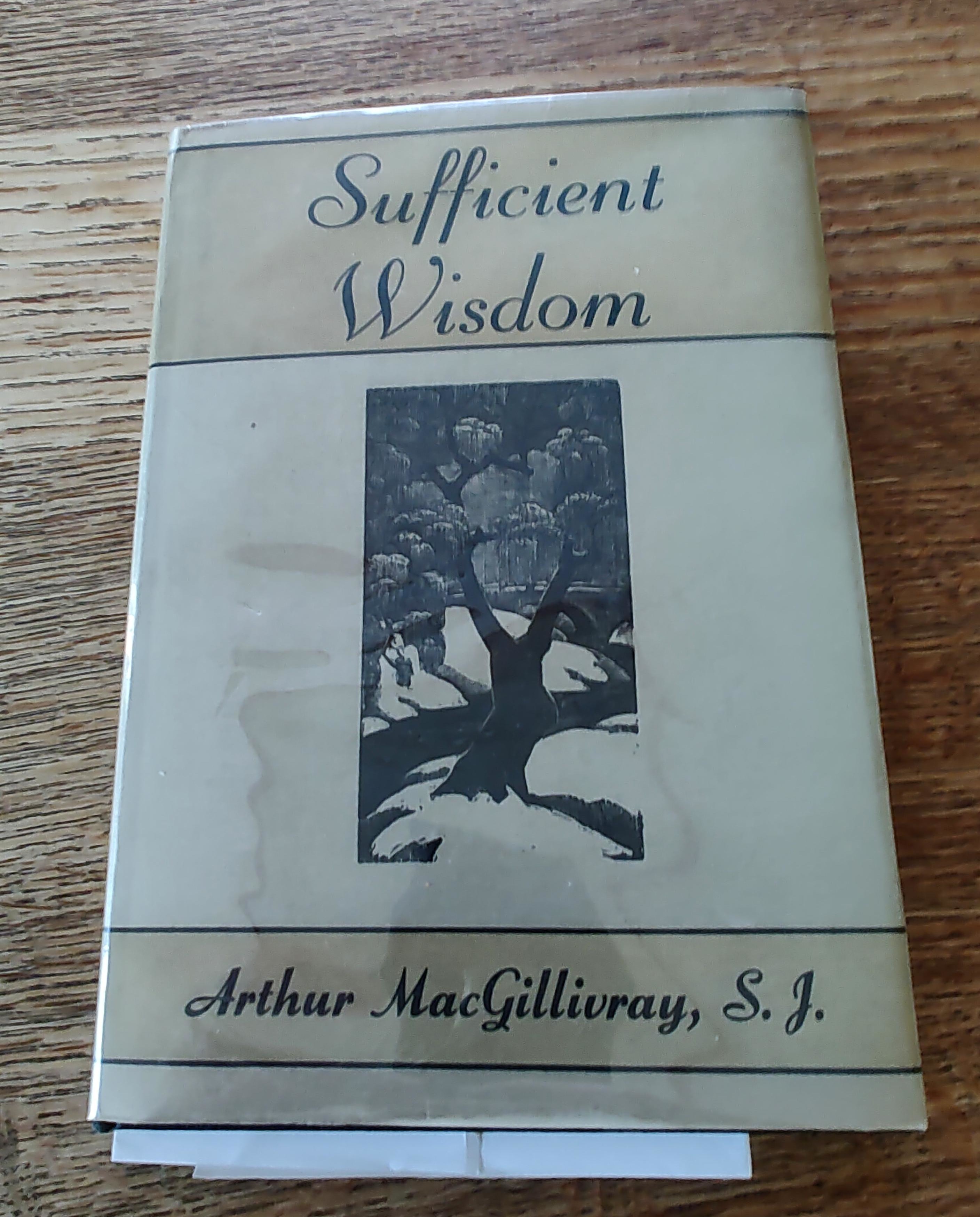 I had an unexpected inquiry last week from an archivist at Eastern Michigan University which had come into possession of a collection of Father MacGillivray’s research files on writer and poet Muriel Rukeyser. I had written a post about Father MacGillivray a few years ago and my time as his student; she was looking for any source of possible information about him and his biography because as a Jesuit priest, his disciplined reticence about himself left very little biographical information. Once anything is posted somewhere on the internet, it has its own existence and a kind of immortality. She managed to find it, so even my brief post had been vacuumed into her search. If you have some curiosity about this gifted teacher of literature and poetry, you can start here: Sufficient Wisdom. He is worth some thought[i], especially compared to what passes for education now in too many schools.
The exchange prompted me to dig out my old copy of his book, and I discovered anew the poem, “Migration,” quoted above in the collection. I do not know the circumstances or people that he met that inspired the poem, but Jesuits still serve as missionaries all over the world. What struck me is the kindness and empathy, which seem sadly to be lacking in much of our public furor over immigrants both documented and undocumented.
His poem is spoken in the voice of a villager in Ecuador who stayed behind when the last friend, family member, or neighbor left. “They are all I had and all I was.” It doesn’t tell us if the voice was too old or unwell or afraid to leave, only that she was alone. The understated emotions remind us of what is missing in our understanding of their plight. People don’t leave their ancestral villages and all they and generations before them have ever known casually.
Rod Serling occasionally used to introduce the original 1960’s “Twilight Zone” episodes, with “Imagine if you will…” So…. ‘Imagine if you will’ what risks and circumstances it would take for a small rural town family to uproot completely from their village, and the village of generations of their family before them, their family and friends and entire social network, then walk a couple of thousand miles to a land where they know no one, don’t speak the language, and have no promise of a livelihood or know what awaits them. Imagine what dire conditions would cause you and your family to leave everything you’ve ever known all behind. They don’t leave because they want to; they leave because they must. Perhaps we could conjure up some empathy for their plight.
It’s a restless hungry feeling
That don’t mean no one no good
When ev’rything I’m a-sayin’
You can say it just as good.
You’re right from your side
I’m right from mine
We’re both just one too many mornings
An’ a thousand miles behind. Bob Dylan, “One Too Many Mornings”, 1964
Since I wrote about this in August here, Coming Home, I’ll try not to cover too much of the same ground except a reminder of a caveat from an old boss and my experience working for national corporations. Some young ambitious corporate bureaucrat would hear some horror story anecdotes from a location or two that may or may not have been exaggerated for effect. The stories might very well have been true; the error was in extrapolating, interpreting, and fabricating a reactive wider response into a blanket policy they would talk senior management into. Inevitably it would do as much damage as good and would cause much cynicism in lumberyard employees about ‘front office’ cluelessness.
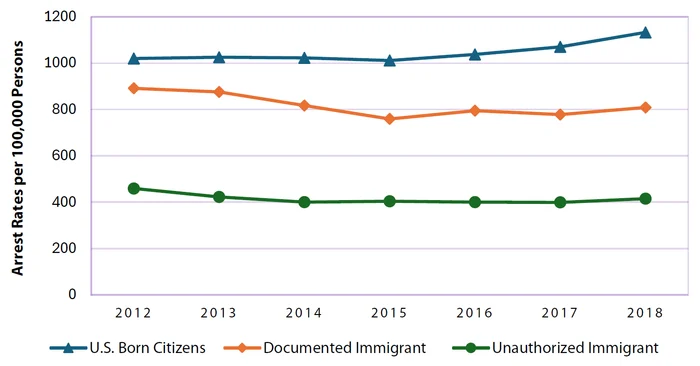 Of course, some of the anecdotes of horrific crimes committed by ‘illegal’ aliens are true, and none of us would protest when the perpetrators suffer the full consequences of their actions: arrest, conviction, incarceration for a long time, and then banishment. But what are the data for the great majority of undocumented workers? Most states don’t track or report arrest records by citizens v migrants v undocumented migrants, but Texas does, and that’s the source of the best long term study. Undocumented workers commit crimes at less than half the rate of citizens, and it’s even more of a discrepancy for violent crimes and murder. See the note below[ii] and the link to the actual Department of Justice study using the Texas data.
The same applies to the anecdotes about ‘illegal’ immigrants who live luxuriously on the public dole, leeching off the tax dollars of the rest of us hard workers. Again, perhaps there are always going to be some, and the abuse needs to be ferreted out and remedied. But the vast majority eke out a living doing jobs most citizens won’t do. They are a net positive to the economy, and even though there are individual towns that lose a bit, especially with schools, in aggregate, immigrants are a huge help, including the undocumented ones. They pay taxes, send whatever they can back to their families to help them, harvest the food we eat, clean the hotel rooms we enjoy, build the homes that we live in. Again, below if you want some discussion points for your Facebook friends are the data and articles[iii] that we should understand so that we will not be manipulated by social media posts and hype by politicians with an agenda.
Management by anecdote is flawed. Don’t ignore the 99 percent of immigrants lawful behavior or for that matter we shouldn’t forget the great majority of our border patrol officers who work their entire career in dedicated service to the country and who do their jobs diligently and lawfully and never draw their weapon. Political posturing and rhetoric that drives fear, distrust, division, and hatred to create policy or motivate protest is woeful and hopefully a temporary condition we are living through as we have before from “no Irish need apply” on down. As a nation, we need to do better than that. We have better angels, let’s listen to them.
Not to say anecdotes do not add perspective and get us thinking in another direction, so here’s one of mine from fifteen years ago about an immigrant (documented or not I have no idea) who did some excellent patio work at our old house in Providence. Selvin’s humanity, kindness, self-deprecating humor, and generosity towards the family and friends he left behind in Guatemala are extraordinary, and I was honored to get to know him. The post tells the story, so I’ll leave you to it if you have interest. Selvin.
Making America Great Again means returning to the embracing kindness and welcome of our better nature, not the xenophobia, mistrust, envy, and animus that informs much of the debate on these issues, especially in social media and on the internet. Return to the poem Emma Lazarus wrote which is memorialized on the Statue of Liberty in New York Harbor overlooking the adjoining Ellis Island with its hospital and welcoming center. That was the defining character of our great nation, and it needs to be again.
“Give me your tired, your poor,
Your huddled masses yearning to breathe free,
The wretched refuse of your teeming shore.
Send these, the homeless, tempest-tost to me,
I lift my lamp beside the golden door!” Emma Lazarus, “The New Colossus”
May our properly formed consciences guide us individually and as a society. May we be accountable for our love or lack of it.
Is this not, rather, the fast that I choose:
releasing those bound unjustly,
untying the thongs of the yoke;
Setting free the oppressed,
breaking off every yoke?
Is it not sharing your bread with the hungry,
bringing the afflicted and the homeless into your house;
Clothing the naked when you see them,
and not turning your back on your own flesh?
Then your light shall break forth like the dawn,
and your wound shall quickly be healed.
Isaiah 58: 6-8a
[i] Father MacGillivray hosted Robert Frost and e.e. Cummings visits at Boston College. He was the longtime moderator of The Stylus, the BC literary magazine and contributed his own poems and reviews, as well as being published in a variety of other journals. His book of poems, “Sufficient Wisdom’ was published in 1943 and was well reviewed. I am the fortunate owner of an original first edition that was once owned by Admiral Richard Byrd and inscribed by hand to him by Father MacGillivray. Prior to BC, he was the head of the English Department in the founding faculty for Fairfield University, the Jesuit college in Connecticut. Father MacGillivray was a “pioneer” at Fairfield University. When the university opened its doors to undergraduate students in 1947, he was a member of the first faculty, serving as the Chairman of the English Department. As the inaugural department head, he was responsible for designing the classical Jesuit English curriculum that defined the university’s early academic identity. He was a well known poet, a friend of Robert Frost and correspondent with T.S. Eliot, Katherine Anne Porter, Robert Penn Warren, and other prominent poets. A ‘legendary’ professor at BC with a sharp Jesuit wit and sense of humor, he was unforgettable to his many students over his thirty year career there. I was fortunate to be one of them.
[ii] U.S. Department of Justice–supported report, “Unauthorized Immigration, Crime, and Recidivism: Evidence From Texas (2012–2018)”, provides arrest rate data across several felony categories:
Violent crime arrests (2012–2018)
U.S.-born citizens: 213 per 100,000
Undocumented immigrants: 96.2 per 100,000
Drug crime arrests:
U.S.-born: 337.2 per 100,000
Undocumented: 135 per 100,000
Property crime arrests:
U.S.-born: 165.2 per 100,000
Undocumented: 38.5 per 100,000
Homicide arrests:
U.S.-born: 4.8 per 100,000
Undocumented: 1.9 per 100,000
[iii] Two articles. The Importance of Immigrant Labor to the US Economy and this one with more information and a good summary about Tax Payments by Undocumented Immigrants. Please read them, so we are informed, not just manipulated.

 Quo Vadis Blog