
“Call it a clan, call it a network, call it a tribe, call it a family. Whatever you call it, whoever you are, you need one.” Jane Howard, Families
We are rapidly approaching holiday family gathering times. They are, as we all have experienced, a blessing, but a blessing with its complications.
Growing up in a small town, the older kids went to Midnight Mass and sang those nostalgic and beautiful familiar carols. We all knew the first verse and most knew the second; after that it was hit or miss. My father used to solo at Midnight Mass in his perfect tenor after a quick shot of Jack Daniels or Southern Comfort at our house to ‘loosen the pipes.’ “Oh, Holy Night” or “Panis Angelicus” at Communion.
Any resistance to going to bed after Mass was dealt with by telling us Santa just doesn’t come to houses where anyone is awake. In the morning there was a barely past sun rise gift opening frenzy with bleary eyed parents who had wrapped gifts until an hour before the kids got up. Next came a quick and unfancy breakfast, some magic time to play with new toys and tally them on the floor of our shared bedrooms. Define the borders of each kid’s stash. I slept in a room with three brothers. One single bed and a bunkbed. It never felt crowded.
The Christmas rituals continued with a turkey dinner for which my father had sacrificed the rest of what little Christmas Eve sleep was available. After he dropped into a quick nap nodding off in his chair, he and my mother would round us up each carrying a new favorite toy. We would pile into the station wagon unstrapped and boisterous, then head over a few miles to Uncle Timmy and Aunt Julia’s Federalist style two story house in an older neighborhood for a casual supper and the annual gathering with our menagerie of uncles, aunts, and cousins. To be more accurate, Timmy and Julia were our great uncle and aunt, Julia was one of two surviving sisters of my mother’s mother, the late Mary Ann (Molly) Laracy, ne Manley. The furniture was solid wood with elaborately carved legs, heavily upholstered in a dark floral pattern, well maintained with arm covers on the chairs, and not much of it was comfortable.
Timmy was genial, slightly flushed, quietly observant, and quintessentially Irish with a knowing eye and a ready quip. He was tall with huge hands and prominent knuckles. He sat at the head of the dining room table while the kids ran carefully amuck. We loved him and his humor. He was also the town chief of police, and as we learned years later he was universally feared by potential malefactors as in ‘don’t ever mess with Timmy Cullinane.’ For his grand nephews and nieces though, he was benign Uncle Timmy, and we felt safe and welcomed in his home. Julia was gracious, kind, with a calming smile, and supplied her loving hospitality without pretense or expectation. Their only child, Marie, taught at the Boston College School of Nursing for many years. Marie baby sat for us once or twice in a pinch when she was still in school, and I confess I had a crush on her soft voice and warm, smoky laughter. Like most of my cousins, she called me Jackie, a name I’ve rarely heard since.
While the adults savored the buffet, drained the spiked punch, and relaxed in mirth and conversation in the formal dining and living rooms, the cousins lived their own version of Christmas in the rest of the house, avoiding being underfoot and annoying the grown-ups. Four of us were born in 1946 of the four Laracy sisters and their husbands recently back from the war. Later came more cousins, including my five siblings. The older cousins would retreat to the back stairway off the kitchen and play school, a game devised and supervised by my cousin Mary. Always supervised and taught by Mary because, well, because she was Mary. She eventually did enjoy a successful career as a teacher in public schools. I do not believe she could use the stairs for her students there, but I wouldn’t put it past her.
The game went like this. The pupils all started bunched up on the bottom step. Mary asked us in turn a question, usually history or science, and the answers she was looking for were determinative. Any arguments disputing wrong answers were not just discouraged; they were futile. Each correct answer allowed the pupil to scoot up one step. There was crowding and jostling and an occasional elbow. Each wrong answer dropped us down a step, but you could not descend lower than the floor, so there was only so far to fall. Mary would often seem slightly more pleased with a smug smile when demoting us than she was gratified to give us a promotion to a higher level, but that just might be my faulty memory. I can’t ever remember a winner. The game went on until we gave up with numb legs and found the next entertainment or a loud complaint escalated until an aunt came over and broke up the class.
“The village policeman always seemed to be about. He knew the foibles of the whole countryside and trod softly, seldom needing to do more than quietly suggest.” James Herriot, “All Creatures Great and Small”
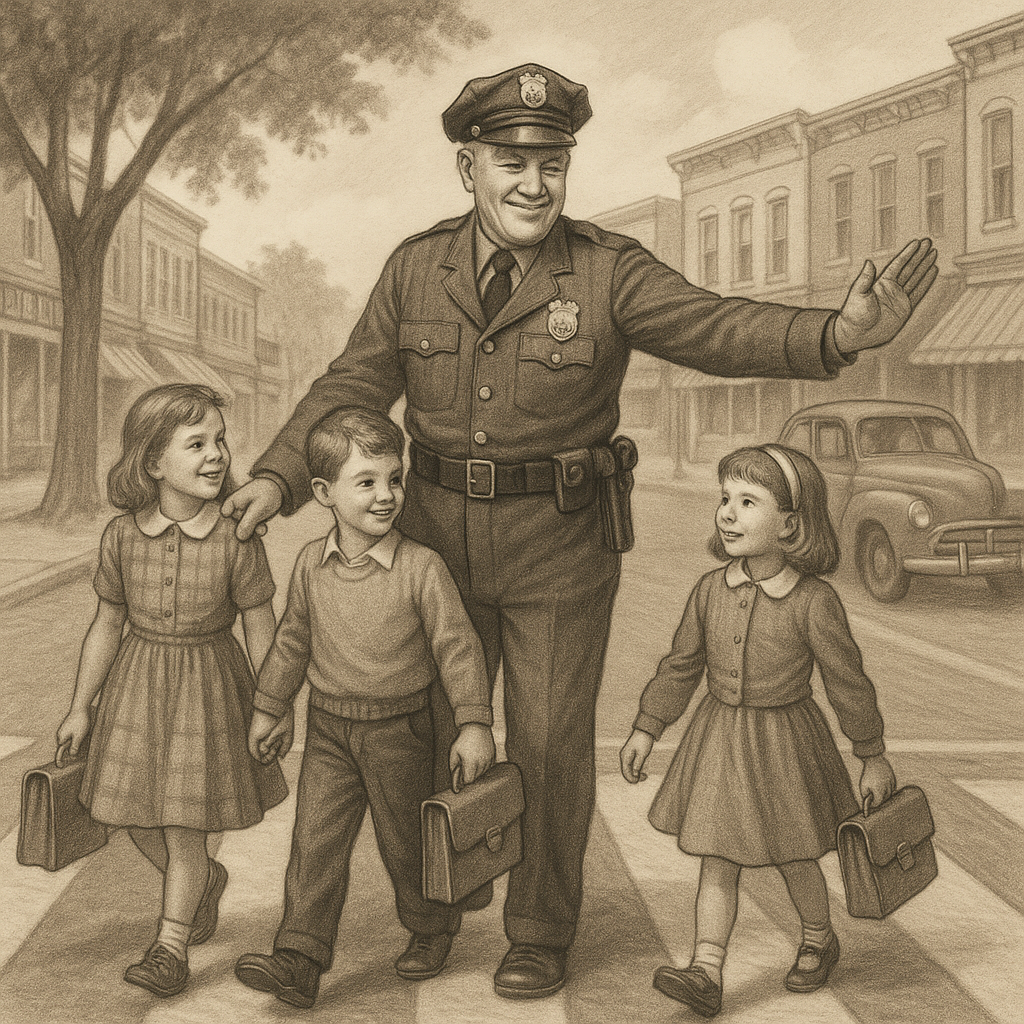 One of Uncle Timmy’s most reliable cops was Wally. Always squared away, big hands, Billy club hung at his belt. Salt and pepper hair, tall, and perhaps ten pounds over his ideal weight by today’s standards, but he carried it well. He frequently played volleyball with the adult men evening league in the high school gym. Knew everyone in our community, or at least all the families. We lived in a growing municipality run by elected selectmen, and we were in transition from a small mill town that still had some factory housing to a larger bedroom commuter hub halfway on the rail line from Providence to Boston.
And everyone knew Wally. Trusted him. The kind of policeman you called when you needed help. The kind of policeman who showed up when you needed help. Rumor had it that, like Uncle Timmy, as friendly as his preferred manner was, Wally was not to be trifled with. An aggressive belligerent drunk would likely need first aid before they locked him up for the night. A particularly troublesome one who hit a woman might require stiches in the emergency room. No one was shot or damaged permanently, but consequences were administered swiftly, and such rough justice was painful and unlikely to be forgotten.
Wally did not wear a balaclava to mask his identity from his fellow townspeople. He was not afraid to be identified or worried about reprisals or ashamed of what he did. I’m not sure if law enforcement that needs to mask up to go to work says more about the cops or about the rest of us. However, masked agents of the law do not strike me as a societal improvement from guys like Wally.
Wally’s main claim to local legend was as a crossing guard for the school before and after classes. He especially enjoyed the elementary school crossing three blocks from the town hall and the old police station. In days of yore, law enforcement sergeants and below did not consider it beneath them to spend a half hour of their shift helping kids safely navigate crossing one of the more heavily traveled streets: Main Street, Common Street, Stone Street, School Street. Even the names evoke clear and pleasant memories for me. A policeman’s job was to keep the town safe for the residents, and kids crossing busy streets were in their care.
Our Wally was special though. His big grin would flash as he recognized his regulars, calling them out by name. His signature move, if they wanted, was to grab their wrists both gently and securely and spin rapidly around. Sadly today, that would probably cost him his job. But for the kids in the nineteen fifties, although it was thrilling and felt a little risky, his strength was unmistakable, and no one was ever afraid. We were flying.
We’d run to him and cry out, “Swing me, Wally!” And he would make us soar.
“Most street cops are honest men doing a hard job. The good ones know their streets like family.” Raymond Chandler, The Long Goodbye

 Quo Vadis Blog