Tag Archives: snowy owl

Snowy

“When the white owl flies, winter has found its voice.”  Inuit saying
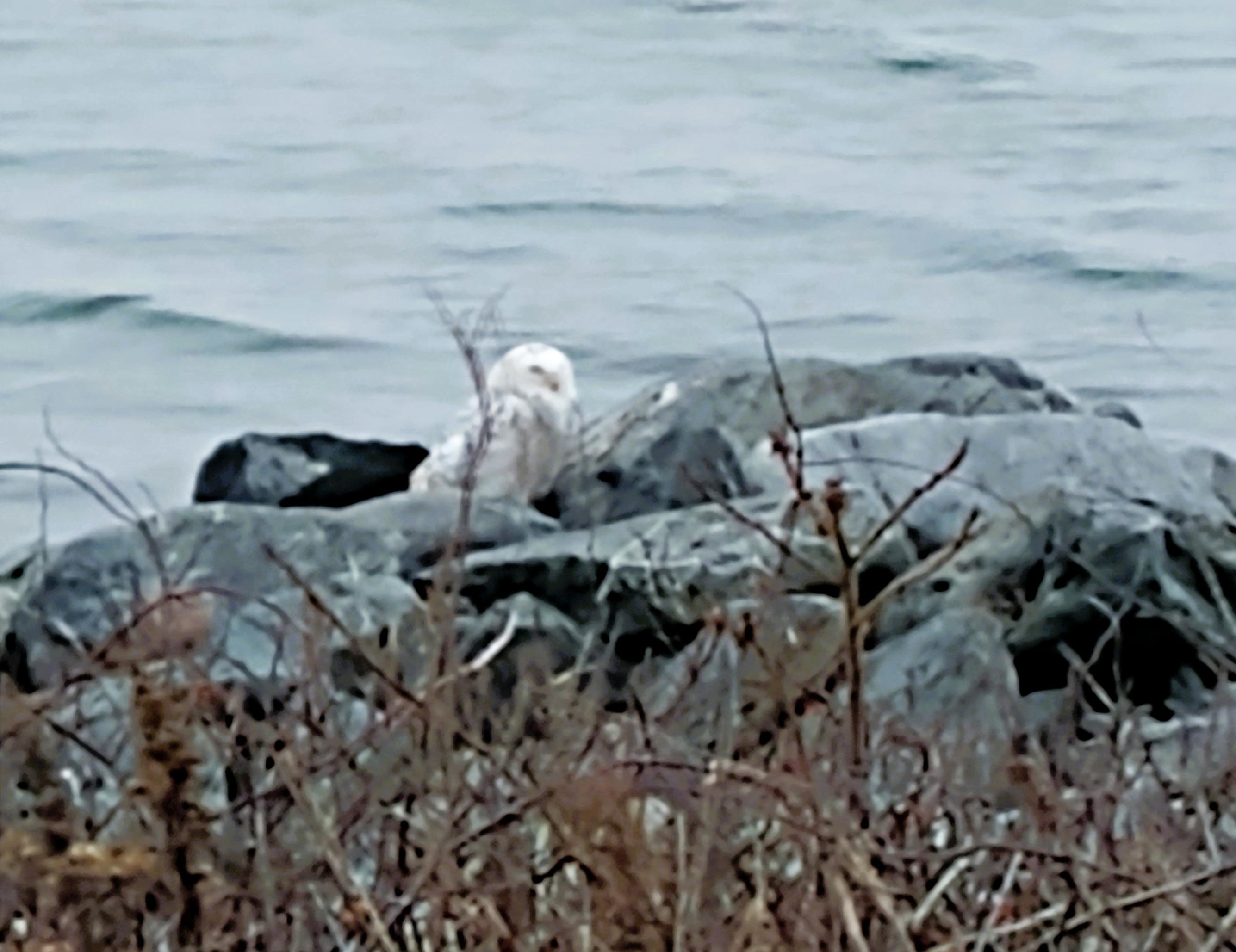
Sachuest Point Wildlife Refuge had another short visit from a snowy owl, the second such visit this winter. She had a two day layover in December at the refuge, was just passing through we think and has not been spotted since she was hanging around Island Rocks. She left before the paparazzi showed up. Snowy’s have a following, and when they grace us with an appearance the parking lot fills up.

If they are on the roof of the visitor center as one was four years ago, the small lawn area in front of the main entrance is overrun with photography equipment worth more than my car. On tripods – lots of tripods sprouting like a field full of oil rigs with large telescoping lenses.  A photographer and ornithologist told me one lens could cost fifteen thousand dollars.

We volunteer Friday afternoons in the Visitor Center. From December to February, at least a few visitors come to the hospitality desk each week to ask us where any snowy owls have been spotted with the excitement of a neighbor enthusing about the Pats back in the Super Bowl. Snowy owls are celebrities. Reports of a sighting on E Bird or Merlin are shared with online contagion as excitedly as if Taylor Swift was spotted at a Newport restaurant with her NFL star fiancé.

During the winter of 2022-23 a pair of snowy owls moved in for the season. The refuge had to close off the Price Neck Overlook Trail where they were nesting because too many hopeful observers were wandering off the trails to locate their nest, and they were stressing out the birds. Hard to get a parking spot, even with the overflow lot opened, so a snowy layover is a mixed blessing.

When they are hunting for lunch, it is major entertainment. A pair of barn owls were nesting on the refuge at the same time the snowys took up residence. Barn owls are not scarce globally but are considered rare and endangered in Rhode Island. Not as many barns for them as there once were.  They became rarer still on Aquidneck Island after the snowy owls killed them both at the refuge. Another volunteer saw a barn owl grab a vole just before the snowy owl snatched up both the barn owl and its prey. Lunch and dessert. I would have loved to have seen that encounter.

“The snowy owl belongs to the great white silence of the Arctic, and when it comes south it brings that silence with it.”  Bernd Heinrich, Winter World
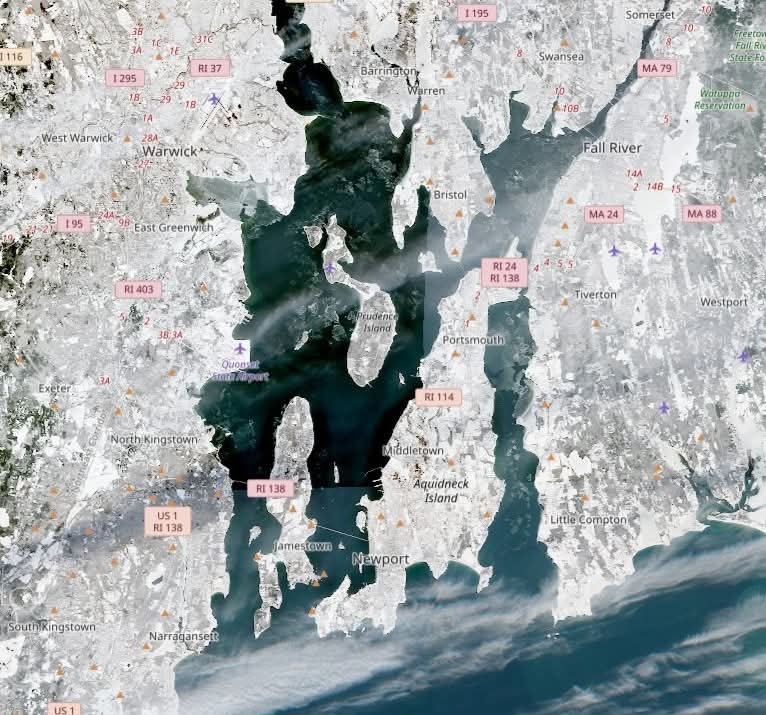
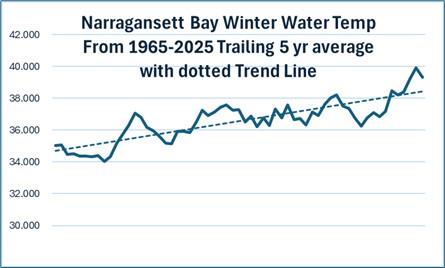
Visits by snowy owls used to be more common before the water warmed up in Narraganset Bay.[i] Our visitors were not fully mature, so they had mixed gray, black, and white feathers and not the purer white that earned them their name. Farther up north in the tundra if food becomes scarce, the snowy parents make a pragmatic decision when their hatched owlets grow larger and fledge. Time to get booted out of the nest and make their way south to find food. Ducks and barn owls beware. Darwin had some things right. Failure to launch is not an option.

Because the bay waters are warmer and the winters are demonstrably less severe than in the days of my coming of age, the owls don’t have to come as far south to eat regularly. Thus, their visits are now less frequent.

It has not always been that way, not even counting the long era that lasted about eight millennia from twenty three to fourteen thousand years ago, when most of Rhode Island was under a mile deep glacier. That’s a long cold snap. Salty ocean water freezes when its temperature drops to 28 degrees, while freshwater freezes at 32. With billions of gallons of water Narragansett Bay takes a prolonged period of very cold weather to freeze over, especially as it is flushed twice every day with the tidal flows from the ocean.

We have enjoyed warming water for generations now, and especially so in the last fifty years. The winter surfers and the New Year’s Day polar plunge folks appreciate it. But this year is the exception to the trend and so far has been the coldest winter in thirty years. The ice we’re seeing now in some spots in the bay as shown in the satellite image is a rarity. Rhode Island needs to stay cold for a long while for Narragansett Bay to show ice.  If warmth is lacking for long enough the bay can freeze solidly as it has frozen in the past, although we are unlikely to experience that again in our lifetime.
Beginning around the edges as an advancing gray slurry with the waves still undulating softly under it, the surface becomes ever more languid as if the sea is nodding off. Light and oxygen diminish under it as it solidifies, and the small inlets succumb to the proliferating crystals of ice. Torpor descends slowly below the ice as light and warmth fade. The fish and crustaceans slow their hunting and eat less; the metabolism of cold blooded species slows as the temperature drops in the water.

At Weaver Cove on our western Narragansett Bay shore a few hundred yards offshore this week we watched a raft of brants (a type of smaller goose). There were at least two hundred of them swimming together in a small area with no chop or waves – clear open water as still as a woodland pond. As if by prearranged signal, they rose as one and flew very fast towards Prudence Island. They are a resolute sign of defiance to the winter and refuse to go gentle into that good night.

According to then Deputy Governor William Greene, the winter of 1740-41 was “the coldest known in New England since the memory of man.” Except for a few days of warmer, rainy weather in mid-December while the General Assembly met in Newport, the deep cold was unabated. Perhaps then, like now, when the state legislature is in session, there is plenty of hot air. “Soon after this,” said Greene, “the weather was again so exceedingly cold that the Narragansett Bay was soon frozen over, and people passed and repassed from Providence to Newport on the ice, and from Newport to Bristol.”[ii]

“As cold as the winter of 1740-41 had been, the winter of 1779-80 was worse. From mid-December through mid-March, frigid Arctic air – accompanied by three major nor’easters – kept the temperature below zero for 11 consecutive days. Not only did the bay freeze, but according to some sources, much of Block Island Sound and the ocean beyond almost to the Gulf Stream was solid.”[iii] That was the winter that followed the killing weather of 1777-78, when George Washington and the remnants of the Continental Army were struggling to survive at Valley Forge.

In those times, sleds brought firewood to Aquidneck Island from the mainland because the British Army occupying Newport had cut down nearly every tree on the island for their campfires and the fireplaces in the homes their officers had occupied. Many residents whose families had been here over a century left. Newport never fully recovered as a major east coast port after the troops pulled out, leaving salted wells and scuttled ships to block the harbor. Sleds traversed the bay and people walked from Providence to Newport.

Cold is not a distinctive attribute as much as a lack of one. Like darkness is not a discrete quality, but a lack of light, so cold is a scarcity of the comfort of warmth. Nature has other analogies in our human self-inflicted winters. Vice is a poverty of virtue, corruption is a failure of renewal, death is an abandonment of life, indifference is a refusal of love, contempt a dearth of humility. Evil is a privation of good, not a Manichean battle of the Force v the Dark Side. Unlike the cold heart of winter which we suffer but can do little to change, virtue, renewal, joy and gratitude for our lives, love for one another, choosing the good, and humility are choices that are ours to make and live. In those choices, the ‘winter of our discontent’ is held at bay.

While we complain a bit about the cold, former Mainers like us quickly adapt, burn a little more wood in the stove, put together a hearty beef stew or a mood brightening lasagna, gather for church suppers in our parish and patiently wait for the spring and cherry blossoms that will soon emerge.

Barry Lopez wrote in Arctic Dream, “The white owl moves across the tundra like a drifting thought, as silent as snowfall.”  New Englanders take what pleasure we can from the silence of the winter, persevere, bring in our wood from the shed, warm up some hot chocolate, take solace in reading by the stove, and wait. We wait. We’re good at it.

“Those who dwell among the beauties and mysteries of the earth are never alone or weary of life.” Rachel Carson, “Help Your Child to Wonder,” 1956 article in Women’s Home Companion


[i] The satellite image was posted by local TV station WJAR showing ice forming in Narragansett Bay in January of 2026. The upper bay section near Warwick shows a large frozen area. Floating ice fields can be seen floating just west of Prudence Island and a few other places. A prolonged cold snap has promulgated the ice, which we haven’t seen here for a while. Point of reference is the small foot like projection on the northeast end of Aquidneck Island. That is Sachuest Point where we have spent hundreds of happy hours.

The snowy owl photo was taken on the rocks at Sachuest Point in 2022 by me.

The chart showing the warming of Narragansett Bay was generated by a spreadsheet of five year increments from 1950 on from the University of Rhode Island Physical Data Master files showing the recorded temps and trend line.

[ii] From a 2014 article in the Jamestown Press, “When Narragansett Bay Freezes Over.”

[iii] Ibid
Leave a comment

Filed under Faith and Reason, Sachuest Point and other wonders

Uncontrolled

“Sometimes you win, sometimes you lose, sometimes it rains.” Nuke LaLooch (played by Tim Robbins) in Ron Shelton’s screenplay for “Bull Durham”

Snowy Owl at Hamden Slough National Wildlife Refuge Lee Kensinger

Snowy owl at Hamden Slough   National Wildlife Refuge in Minnesota by Lee Kensinger.

 Kim Crocker, a volunteer at the Sachuest National Wildlife Refuge   near us, reported a tale that reminded me of the rule of fang and   claw, talon, and blood. After an absence last year of any   overwintering snowy owl at the refuge, this year we have two   visitors, neither of them yet fully mature, but hardy enough to make   the trek from the tundra. Snowy owls can live nine years in the wild and up to twenty-eight in captivity. Fully grown, they have a wingspan of close to five feet: beautiful, formidable hunters, and relentless predators.[i]

Mr. Crocker told me the ranger observed a Cooper’s hawk make a quick kill, probably a vole or field mouse. Raptors drive their long rear talons into their prey with great force from a dive, wrap their front talons securely around their food and begin to eat, often before their victim is dead. This hawk should have been more situationally aware when he grabbed his lunch. Almost as soon as he attacked, he was in turn struck by a snowy, and the predator became the prey with the added benefit of a vole for dessert. Full grown snowy owls have been observed at the refuge taking a full-grown Bufflehead, Eider or Surf Scoter[ii] right out of the surf and carrying them back to a shoreline rock for a leisurely meal.

Sometimes unforeseen trouble can drop on us with the swiftness of a raptor from the sky.  One of the most disconcerting aspects of the last two years of COVID world was the vivid notice that we are not in control. And never have been. This is a valuable lesson.

Oh, we pretend like three-year-olds that if the Bogeyman comes out of the closet or from under the bed we can pull the covers over our head, cuddle our teddy bear, and be protected – that we can be in control, but at three o’clock in the morning on a sleepless night, we know that “the best laid plans o mice and men gang aft agley.”  [iii] Now as adults our Bogeyman occasionally comes out from under the bed, and there is not a damn thing we can do about it when he shows up. We must learn to cope with him and muddle along.

Thus, we are not to be grieved that we don’t control even the most important potentialities of our lives: our health, our safety, or how long we will live on this planet.

“Give up the thought that you have control. You don’t. The best you can do is adapt, anticipate, be flexible, sense the environment and respond.”  Frances Arnold, Nobel Laureate in Chemistry, Cal Tech

Our futile attempts at overcontrolling our lives, especially through government and politics, bring us division, frustration, distrust, anger, aggression, and ultimately despair. Our technological successes have deluded us into believing that all things eventually will be brought under our control.  “The sociocultural formation of modernity turns out to be, in a way, doubly calibrated for the strategy of making the world controllable. We are structurally compelled (from without) and culturally driven (from within) to turn the world into a point of aggression. It appears to us as something to be known, exploited, attained, appropriated, mastered, and controlled. And often this is not just about bringing things – segments of the world – within reach, but about making them faster, easier, cheaper, more efficient, less resistant, more reliably controllable.”[iv]

Illusory control, then, in the end, is an obsession with self-gratification, for individuals and identity groups. For politicians and social media mavens. For the legions of media chattering heads who so want to reshape the culture in their image. All of this is in a context of a couple of generations of the un-enculturated who have been formed not by tradition or objective standards, but by a faith in self-fulfillment that is largely self-defined by individuals and identity groups. The self-definition is rooted not in classic precepts of freedom, but in the post-modern concept of license. We build precariously on a sandy and shifting foundation of false and malicious hope: we can be anything we want to be and behave any way we choose, most especially regarding sexuality, if we don’t infringe too badly on the other person’s fancy.

“Who controls the past controls the future. Who controls the present controls the past.” – George Orwell, ‘1984’

How do we find ourselves so confounded and unmoored? We want to control, but we cannot possibly.

Sachuest Snowy Owl checking out the menu

Sachuest Snowy checking out the menu

We want to redefine our nature, but we cannot possibly. Far too large a topic for this modest post, but we can look at a corner of it. Cultures to persist and offer stable platforms for human flourishing must formally welcome adolescents into adulthood, must train, must recognize what is essential to its existence and never lose sight of forming the next generation in the principles upon which the culture rests.  This instilling of the culture must include objective truths within which the next generation can conform with certainty and find their own context. This has been the case for humans so long as there have been humans.

Our culture neglected this basic principle, and to paraphrase Chesterton, when we cease to believe in something true, it is not that we believe in nothing, but that we will believe in anything. Such is our current state. One of the worst consequences of this is the neglected initiation of young men, prolonged adolescence into their thirties and beyond, and the enduring irresponsibility of too many young men, men without fathers, and men without passages of initiation.[v] These transitions are necessary not just to our culture, but to any culture, and we lost the thread in the latter part of the last century.

“Anchises’ son had halted, pondering on so much, and stood in pity for the souls’ hard lot.” Virgil, Book Six, the Aeneid

Richard Rohr researched this unhappy phenomenon in depth, investigated its roots and consequences in his book “Adam’s Return: The Five Promises of Male Initiation.”   [vi] He discovered that male initiation is significant even in other species like elephants. [vii] The lack of fathers and the lack of proper initiation into manhood has devastated our society in easily foreseen ways. Rohr theorizes that rites of initiation existed in all societies and are necessary still, albeit in different forms. To help boys transition into men and inculcate in them the responsibilities of maturity in the tribe, the rites typically had five common factors, sometimes involving scarification or survival alone in the wilderness. It was always necessary that they learn these lessons, and although it is still necessary to learn for us, modernity teaches in many ways just the opposite from these:[viii]

  • Life is hard.
  • You are not important.
  • Your life is not about you.
  • You are not in control.
  • You are going to die.

We grow wise when we understand that our lives are not ours alone, nor are we in control. We grow wise as Augustine did when we realize that to love and be loved is the fundamental longing of the human heart. We grow wise when we comprehend that the evil that seems all around us is not an adolescent comic book “Dark Side” force or a creature or a thing at all, but a lack, a privation, a missed chance.  Just as dark is not a form of its own, but a lack of the good of light, and coldness is not a thing unto itself, but a privation of warmth, so too hatred, bitterness, loneliness, violence, fear, and existential disappointment are all an absence of Love. And it is for many a self-inflicted deprivation.

“The truth may be stretched thin, but it never breaks, and it always surfaces above lies, as oil floats on water.” Miguel de Cervantes Saavedra, Don Quixote

So, we must go out with joy to look for light where it can be found and delight in it. I was greatly heartened a couple of weeks ago when we walked another of our favorite local trails in Norman Bird Sanctuary. Along the way, we met a young earnest couple who were volunteering the afternoon of their day off cleaning out one small plot of Japanese knotweed, an aggressive invasive species that will crowd out native plants that provide food and shelter for the many birds and other wildlife that live there. They spent hours cutting and bagging the stems and dry foliage of the noxious pest. They took their time with laughter and good fellowship as they went, cutting and handling carefully so as not to disturb and scatter the seeds that will spread the weed. They cheerfully told us they will return another day to dig out the roots. No broad- spectrum damaging herbicides, just laborious, painstaking work.

The plot was about fifteen feet square. Out of 253 acres of the sanctuary. Why spend so much time, attention, and energy on such a tiny fraction of the land? A modest, difficult bit of work against such a bitter foe of the indigenous flora and fauna that we all enjoy and cherish is worth doing. Even if it does not solve the whole problem or change the micro ecosystem permanently, it changes us. If one understands that we’re not able to control every difficult challenge that comes along, that our life is about something greater than ourselves, and that we must do what we can, where and when we can, to improve, however humbly, our situation, this is a truth worth knowing.

 The way a crow

Shook down on me

The dust of snow

From a hemlock tree

Has given my heart

A change of mood

And saved some part

Of a day I had rued.    “Dust of Snow” Robert Frost  

[i] Photo from U.S. Fish and Wildlife site. Snowy owl at Hamden Slough National Wildlife Refuge in Minnesota by Lee Kensinger.

[ii] https://www.newportthisweek.com/articles/sea-ducks-return-to-sachuest-point/

[iii] Gratuitous sidebar: Perhaps the most pernicious and dangerous assumption of the whole progressive project is the illusion that we are in control, and that human progress is linear and headed to an inevitable Omega point of perfection. If only we allow the elite technocrats that we anoint to take control, all will be well irrespective of all evidence so far to the contrary.

[iv] The Uncontrollability of the World, Harmut Rosa, Medford, MA: Polity, 2020

[v] “What is the single condition of a boy’s life that correlates most strongly with whether he will turn criminal? Not income, not by a long shot. It is whether he grew up in the same home with his father. Our prisons are full to bursting with fatherless boys who never became the men and fathers that God meant them to be. The collapse of the black family has been most catastrophic, and what is the result? What anyone not befuddled with feminist ideology would have predicted, from simple observation of nature and from the universal testimony of human cultures. One out of every three black men between the ages of twenty and thirty will spend time in prison. If we blame that on racism, then we had better explain why, in the days when blacks could not ride on certain seats in the bus and could not even play major league baseball, nowhere near as many of their men were in prison. Family, first and last—the family is where you learn of God and man, good and evil, courtesy, diligence, honor, chastity, self-restraint, and true courage. Give me poverty and the family as strong as iron and in one generation in America my family will be poor no longer. That is not speculation or boasting. It is the experience of millions of immigrants who came to the United States with nothing in their pockets, but with a great fund of moral capital; with faith in God, and firm loyalty to the family.”Anthony Esolen, “Out of the Ashes: Rebuilding American Culture”

[vi] Adam’s Return, Richard Rohr, Crossroads, 2004

[vii] Elephants need fathers too. Rohr told of a true story about rogue young male elephants in Pilanesberg National Park, South Africa. They were about fifty orphans immigrated into the park to reestablish the herd and without fathers to train them. An 8’ tall creature with tusks can inflict serious damage. Which they did. Killed over fifty rhinos. The debate among the rangers was whether to euthanize the young thugs, castrate them, which would calm them down, or bring in some help. The adolescent elephants (between twelve and twenty) were in a perpetual state of “musth,” a constant flooding of reproductive hormones. This is normally tamped down by mature bull elephants in the herd that whack them around a bit and tell them to calm down. Knowing they cannot yet compete with a full-grown papa elephant, they do calm down and stop dribbling, spraying everything in sight, and acting out aggressively, which is rough on the rhinos. The rangers shipped in six mature bull elephants and within a day, the adolescents dropped out of musth, and not a single additional rhino was killed.

https://www.bbcearth.com/news/teenage-elephants-need-a-father-figure   https://www.newscientist.com/article/mg15120390-300-orphan-elephants-go-on-the-rampage/

[viii] Summary outline of Rohr’s book.

8 Comments

Filed under Culture views, Sachuest Point and other wonders