Author Archives: jparquette

jparquette's avatar

About jparquette

Fortunate and blessed in companionship with my wife of fifty seven years, in health and in modest, but more than adequate circumstances. Life is good.

Late September on Old Orchard Beach

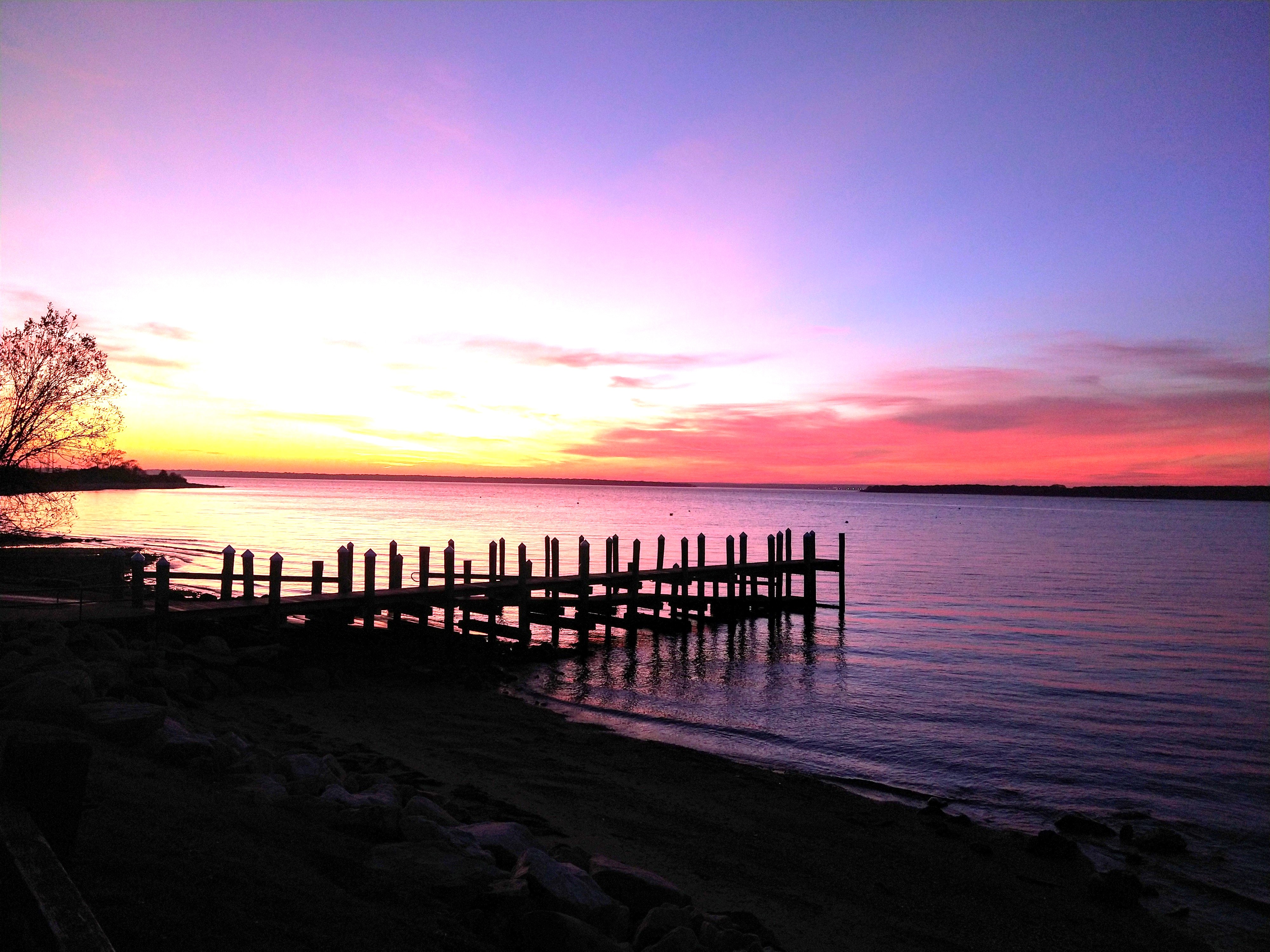
cropped-sunrise-at-old-orchard-beachCold. Penetrating deep cold, but exhilarating. On shore wind as the air rises over the still warmer land, and the ocean air rushes in to fill the vacuum. Cleansing. Lung filling. Soul filling. A sharp breeze comes over the water picking up moisture and is scrubbed as it comes. The air streams around and over Bluff and Stratton Islands in the harbor, loading up from beyond the horizon where the earth curves out of sight, past the Azores, past the edge of the world. Cold, clean, pure, merciless, but without bias or favor.

The sun begins the day’s work out of sight in the east over the rocks and low scrub and a few trees on the wooded point at the end of the beach curve just north of the open sea. Pink-orange and red gray, the clouds reflect the refracted light before the sun makes its morning arrival. Then it does, and we must stop staring at the blinding intensity.

Gulls – American and European herring gulls, ring-billed gulls and a few larger black back gulls join them. Gulls swoop and glide a foot above the beach looking for a landing spot even before full sunrise. Heartbreakingly graceful. One standout wheels back at a nearly impossible angle, pivoting almost on its wingtip, barely clearing the sand, rights itself in a perfect pirouette, glides effortlessly another twenty feet, finds its spot selected with no observable distinction from any other spot, and with a slight change of pitch of wings drops gently on the beach, settles with a brief flourish and straightening of feathers put away like a cloak, more compact than their full spread would suggest, a brief quivering like an elegant woman settling into her chair in a premium restaurant at a choice table. She doesn’t immediately pick up a crab or a clam. Just turns into the wind, stands and waits patiently a couple of feet from the tidal flow. Waits for something not apparent to anyone else. Stretches its neck, looks skyward, parts its bill, and cries out in the unmistakable gull call.

Four surfers and a paddleboarder work on their competences in predawn twilight three hundred yards north down the beach. The surfers take their turns following the wave break that they each ride not quite parallel to the shore. All are skilled. No one puts on a wetsuit when it’s forty five degrees and spends their precious time before work begins for the day by plunging into the surf with their long board tethered to their ankle if they are not serious. They call everyone dude and employ an esoteric vocabulary like a casually organized fraternity, united by a love for their frigid, perfect, wet, plunging and surging sanctuary. When you speak with them occasionally, they are unfailingly polite and friendly. Will talk with strangers about the quality of the waves like they have known each other all their lives. Maybe they have.

Another half dozen or so of us on the nearly empty two mile beach got up to catch the beginning of the day; two are in bathrobes and wrapped in blankets. Some stand or lean on a fence. Several in heavy sweaters, stocking hats, and high ankle hikers are dutifully walking their dogs. Another is meandering slowly, barefoot, but sweater clad, on the edge of the water where the waves finally peter out looking for shells or sand worn beach glass. A guy with a hoodie is running with his very large dog. Maybe a Newfie – hard to tell at distance and murky light. He’s quickly covering the ground south towards the long wooden pier with multiple single-story, now closed, gray shingled souvenir shops. The pier protrudes five hundred feet out into the open ocean. The runner is probably headed home to grab some more coffee and drive to the office. The rest of us are alone. An older woman, slightly portly with glasses and a kind face sits in a high backed beach chair with an expensive looking camera trying to catch the light. She’s barefoot too.  Maybe she’ll paint her photo later. Watercolors.

The laughing, drinking, partying summer throngs have abandoned the jostling crowded sidewalks and have gone home to New Jersey or Quebec or Hartford. Many come every summer for a week or two like a ritual. Expensive vacations, but not out of reach. Not the Hamptons, but not an inflatable pool in the backyard either. Most of the restaurants, pizza places, and French fry stands are already boarded up for the coming winter. But not all of them. The Beach Bagel breakfast counter stays open year round for the regulars and a few hearty bargain seeking tourists. Bacon, egg and cheddar on onion bagels and more; the conversations of townsfolks about the baseball playoffs, the depravations of the now ruined Patriots, the latest expensive embarrassments of town council mistakes, the planned wedding of a daughter in the spring, arthritis, the foolish boss where they work. The waitresses tease and are teased back in familiar ribald jesting.  Familiar faces, too. Relaxed and at ease with each other and the routine, although they may not know all the names; customers are comfortable with silence too, staring into their coffee.

The beach begins a slow recovery and gives itself back to the full time residents who love all its seasons and don’t mind its moods. A recent storm eroded some of the border beach grasses, pushed up flotsam far up on the sand towards the wind fence, a couple of large broken branches that look like white pine wash in and out on the waves, a bent unbuoyed lobster trap rests fifteen feet beyond the farthest breaking waves.

The waves have been breaking endlessly on this beach for a million years or at least for ten thousand since the last Ice Age covered everything here under two hundred feet of glacier. The waves come in gray green, surrender to gravity, pick up the wind, foam white at the crest, cascade, slowly subside and recede. A nanosecond after they fall, I see them; a second later I hear them with a tiny delay. Sound follows light. For a million years the rhythmic breaking proceeds. Not silent, but not jarring. Restful. Sleep on the beach if it was warmer. The voice of the world.

The gulls gather in small groups facing the north Atlantic. No unguarded sandwiches or chip bags on blankets to pillage. Gone for the winter. Picked clean. The gulls too are comfortable in silence. Waiting.

So God created the great creatures of the sea and every living thing with which the water teems and that moves about in it, according to their kinds, and every winged bird according to its kind. And God saw that it was good. Genesis 1:21

Leave a comment

Filed under Maine Tales, Sachuest Point and other wonders

Maine Anecdotes

“The only thing I knew how to do

Was to keep on keepin’ on like a bird that flew.” Bob Dylan “Tangled Up In Blue”

Center Hill panoramaOur two weeks in Maine were nostalgic and new. Old friends, encounters with abundant wildlife, vistas that cause me to catch my breath at any moment around any corner.

Early one morning we were sitting with three of our granddaughters on the little beach on Webb Lake in front of their camp, when all three yelled out something like “Whoa.” A bald eagle was pumping hard and powerfully to regain altitude with water dripping from its wingtips, rising from the lake with a fish in its talons. One of the many of various species of ducks we like watching there was beating wings furiously in the other direction from the same point of origin, clearly panicked. I wasn’t sure of the species since it was moving away with undue haste. The duck flew startlingly fast and low, barely clearing the water’s surface.

The girls told us the eagle had stolen the fish from the duck. Probably it was a merganser if that was what happened, since they will eat larger than the other common ducks on the lake like mallards and wood ducks.  The eagle may have plunged while hunting right next to the shocked duck. Mary told us from “Wild Kratts”[i] that bald eagles prefer fish above all other prey. The duck was fortunate that the eagle’s culinary preferences did not include waterfowl that morning, and a full grown duck would be a talon full for an eagle. Eagles don’t often miss what they spot to eat. Their diving into the water is fast and deadly. It was an indelible moment, unrecorded as my phone was back in the camp. That’s all right, maybe as it should be. The image remains.

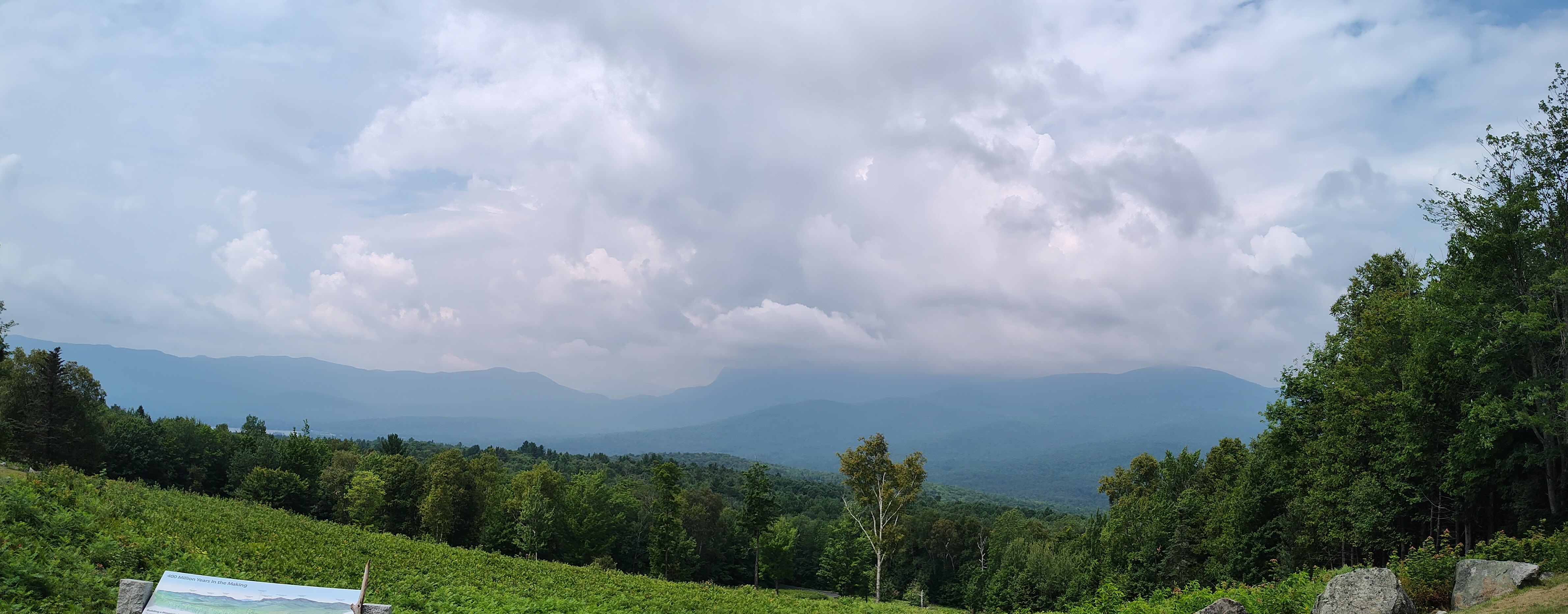
A couple of evenings later we were driving back from our almost nightly visit to Center Hill lookout over the lake (panorama above); as we were passing through the center of town (one store), a pair of white tail deer jumped in front of us. We always travel slowly while going through town and were easily able to avoid a collision. The buck with the rack was chasing the doe; neither were as large as they can be. But perfect, tawny, sinewy, beautiful. We looked over to the small field adjacent to the house on our right. The flirting couple were dancing, bumping, playing, cavorting, four legged straight up hops in sheer fun, oblivious to our observing them.  It was a joyful moment but remains unrecorded as my phone was in my pocket. That’s all right, maybe as it should be. The image remains.

“I ain’t got no window, ain’t got no door

But I can feel sun shinin’ where it’s never shined before, never shined before

Feel sun shinin’ where it’s never, never shined before

But I’m still climbing up the mountain side

You can’t count me out

Long as I got my heart and soul

I got everything, I got everything I need

Everything I need.”  Keb’ Mo’, “Everything I Need”

The temptation is to idealize Maine and idealizing is not without some justification, but that would be trivializing and unfair. Unfair to the wonder of the place and the variety of its people, unfair to anyone reading this. Like most stories, it’s more complicated than that.

Cannabis stores seem to be everywhere now. I counted at least two dozen of them. In the city. In small towns. Along country roads. Most of them look shiny, have professional logos and signage, and have more than a few cars in the parking lot. When we lived here so many years ago, weed was illegal, and weed was everywhere too, but it was in service of a rebellious panache, a naïve ‘rebellion.’ Many I knew grew their own in their garden or up in a hidden clearing behind the house. Almost everyone I knew rolled a joint or picked one out of a bowl at a party from time to time: back to the land hippies, local town young people, artisans, poets, and professionals. So did I, for a while, but I gave it up in my late twenties; an occasional recreational hobby began in Boulder a couple of thousand miles west of Maine and ended in Mount Vernon. No single, articulated reason to stop; it just didn’t seem worth the lethargy in the morning. A casual quit.

 Now that cannabis is commercialized on nearly every corner, smoking weed has lost its outlaw attraction and sunk into just another way to get high on Saturday night. Or Tuesday. Along streets in clapped out mill towns that no longer have a mill, next to the prosperous cannabis storefronts, idle men and women slump on the wooden stairways of three story faded tenements with despairing faces staring vacantly back – prematurely aged with few signs of hope.

“I guess there’s nothing left for me to do but go get stoned

Let the past paint pictures through my head

Might drink a fifth of Thunderbird and try to write a sad song

Tell me baby why you been gone so long.”

“Why You Been Gone So Long,” Mickey Newbury, Eleven Hundred Springs

On a whim coming back to the lake from church, we decided to explore some roads we hadn’t driven in decades, taking a longer way home through the hills. We took the Temple Road, and dead reckoning navigation told me that we could find a shorter way home from Temple once we got there.

But I’ve grown citified and dead reckoning made me nervous where once it would not have been so. Google Maps solved that, and sure enough it highlighted the most direct route back to Webb Lake. We struck out resolutely on the Intervale Road, turned north on Day Mountain Road, which ran into Jackson Mountain Road. Somewhere along the Day Mountain Road, we ran out of pavement, but that didn’t discourage us. Roads in Maine in rural areas frequently turn to well-maintained gravel roads where cars routinely travel at forty five miles per hour.

Unfortunately, that wasn’t Jackson Mountain Road. Hard packed smooth gravel road became loose gravel road, washed out in ten foot fissures, but able to be negotiated on one side or the other at ten miles per hour – too narrow for two cars to safely pass. Then more washed out, but barely navigable with great care. Five miles per hour.  The slope got close to forty five degrees-not straight up, but it felt like it. The camps were fewer and sketchier or abandoned. Finally, the camps ran out and a handwritten “dead end” sign was tacked to a tree.

My trust in Google Maps was shaken, but not stirred. It was always reliable, right? I was still on the blue lighted way. Local signage must be wrong or outdated. What do people who live here know that surpasses the AI wizard behind the black curtain? I kept going. Rita was increasingly skeptical. Finally at the top of a very steep almost impassible run of a quarter mile, a culvert was completely gone, replaced by a four foot drop across the road. Fortunately backing down the hill fifty feet or so, there was a turnaround. Slowly back to Intervale Road and turned left towards the town of Strong. A bit to eat at the good general store there across from the large factory making fuel for pellet stoves. Finally, paved state highway two lane roads all the way to the north end of Webb Lake.

Rita, as I have often given her cause to be, was patient, albeit with a sly smile or two on the way back.

“Then we’re rollin’ on

Rollin’ on

Feeling, better

Than we did last night

Rollin’ on rollin’ on

It’s hard sometimes, but

Pretty much it’s alright.”  “Rollin’ On,” Emmylou Harris and Mark Knopfler


The day before we packed up for home, we drove over more excellent back roads to our old hometown in Mount Vernon, about a fifty minute pretty ride through hills, farms, and lake country.  I was reminded of why I love this place so much.  On the shore of Lake Minnehonk downtown in the building where we once went to pick up our mail, there now is the Post Office Café and Bakery. We met friends from nearly fifty years ago, Alan and Donna, for breakfast. An outstanding place, we sat at a clear finished maple table by the back windows and looked where I walked out one frozen night to do battle in what became known as the Swordfight on the Lake.[ii]

We are decades older now than when Donna used to come over to our place to watch our kids for a few hours two afternoons a week. Rita was working as a labor and delivery nurse forty minutes away in Augusta part time from three to eleven. I was on the road for a commercial lumber company and got home about six most nights. Donna’s kids, Autumn and Oak, would play with our first two, Amy and Gabriel, while Donna lovingly minded everyone at our house until I pulled in. Autumn was the plague of Gabe’s elaborate Lego creations. She delighted in destroying them. Good memories now.

At the Post Office Café, two hours passed in a moment, the conversation picked up as if it was forty years ago. Alan is a successful serial entrepreneur who grew up in Mount Vernon. Back in the seventies, he had a chainsaw and a log cutting business with skidders and trucks. Buying the rights to clear somebody’s woodlot and selling the product to local sawmills and paper mills. Poplar to the paper mills, hemlock, spruce, and pine to be sawn into boards. Hard work. Brutal work only for the strong. Later he slightly altered course and became a skilled contractor. Alan still builds custom homes for folks in the area. He starts with a wooded, difficult lot, and ends with a beautiful structure to provide shelter for his clients.

We laughed, got quiet, remembered, talked again. Caught up. Told stories. One favorite was about the time Alan came into Rita’s flu clinic when she was serving as the town health officer. A rough flu year, and the vaccine was causing some severe and notorious reactions that year. All the old folks in the folding chairs were nervous. Alan, who looked like he could bench press a Buick, lined up, got jabbed, took two steps, spun around, and dramatically crashed through some chairs to the floor in front of the horrified onlookers. Rita ran over to him. Only she recognized that prostrate Alan was quivering, and his shoulders were shaking. As he laughed. She compounded the confusion in the room by kicking him and calling him a decidedly uncivil name.

We talked of kids and grandkids, joys and disappointments. About local people we once knew well, many no longer above the ground. Nostalgic and new. Enjoyed the food and the company immensely. Reconnected seamlessly.

“It is one of the blessings of old friends that you can afford to be stupid with them.” Ralph Waldo Emerson

[1] “Anecdote” is derived from the Greek “anekdota” meaning “things unpublished.

[i] For those without kids around, “Wild Kratts” is a popular partially animated children’s program that teaches them love for and knowledge of many wildlife species.

[ii] https://quovadisblog.net/2022/09/18/swordfight-on-the-lake-redux/

2 Comments

Filed under Maine Tales

Summer Kitchens

“In Maine we have a saying that there is no point in speaking unless you can improve the silence.” Ed Muskie

Not sure this improves the silence, but…

Maine road hazard

When we drive up the dirt road from the camp on Webb Lake to turn east on Wilton Road to Farmington for church or groceries, there are Maine houses along the way that we remember with affection and respect. Old houses, generations old. Practical houses for pragmatic people who avoid many things that don’t make sense and do many things that do. Center chimney capes are common, and there are larger colonials with integrated additions for various purposes and perhaps extra kids.

Maine fosters eccentricity and a vast collection of creative architectural solutions; many varied attempts with mixed success to survive long snowy winters are everywhere in evidence. Homes along the rural roads are scattered with large dooryards, and the inexorable forest threatens to encroach on the fields that are left. Old, barely habitable double-wide faded mobile homes sit on overgrown once cleared lots with a motley collection of partially cannibalized pickups and campers up on blocks – ten foot tall poplars and alders growing through perforated flatbeds. A deserted small John Deere tractor with a flat tire disconsolately rusts out. Rural poverty with stove pipes sticking out through the walls of shacks sided with boards and wind torn Tyvek house wrap. A few are abandoned with collapsed roofs; others look like they should be but aren’t.

A quarter of the mile down the road an impeccable modular cape or ranch sits proudly on a small hill, carefully, lovingly landscaped with a paved, sealed driveway, a small flagpole and new flag in front, and a lawn that looks like it was trimmed with barber scissors. A modest vegetable garden grows fifty feet from the house, often surrounded by a wood pole and galvanized wire perimeter to discourage the deer and rabbits. Hopeful tomato plants, green beans, corn, potatoes, peppers, and some greens – spinach, beets, or Swiss chard, zucchini and summer squash, maybe a pumpkin or watermelon vine spreading along the rich soil, growing so fast the bottom of the fruit is drag worn and discolored.

Certain features identify my favorite species of farmhouse, and there are sadly fewer of them than fifty years ago when we lived here. Some of them are deteriorating and returning slowly to the earth. Some are re-tasked into apartments. Some are meticulously maintained, but there are a couple of overhead garage doors installed where large paned wood windows or homemade matched pine board doors once adorned the facade.

Frequently they have metal roofs that are loud in a downpour. Like sleeping in a tin tent, but comforting, steady protection from nature in a four season environment. Metal roofs with a steep pitch to shed snow easily. We had such a house with a metal roof when we lived in Farmington forty years ago. No gutters to be torn off with ice dams and snow slides, just a two foot cantilever to push the gushing rainwater and melted snow away from the house. Diverters or a small additional extension over the front door with the granite threshold protect visitors and residents opening the door. Sensible roofs that can last for at least a generation for a harsh climate with deep snow in the winter.

A barn that was once for farm animals, and still is for a few, remains attached to some of these homes. Hay in the loft. Stalls and laying nests for the hens, vegetable and egg stands out by the road. Grain in the large wood feed box. Chickens, goats, a milk cow, perhaps some calves for future milk or steaks, and a deadly, half feral, symbiotic barn cat or two to control the mice and rats. Barns are sometimes connected to the family home through that most sensible extra room – a summer kitchen. Much more than a breezeway connecting to a two car garage, a summer kitchen is like many things in Maine – it has more than one useful purpose.

Harsh winters are interrupted by glorious springs that also harken the arrival of mud and black fly season. Time to plant and begin the arduous process of splitting next winter’s firewood. In winter and spring, it’s prudent to have a connection to the barn that doesn’t include wading through drifts or shoveling a path.

When the heat of a six week summer hits, there are abundant lakes, rivers, streams, and for those fortunate coastal dwellers, saltwater beaches. But it’s a time for summer kitchens too.

A summer kitchen serves several critical purposes besides connecting to the barn for winter access to animals needing attention. A summer kitchen lessens July and August heat building up in the house for cooking in the main kitchen, heat rising to the bedrooms to make sleeping a sweaty project even when the screens aren’t torn. A sound wood stove in the summer kitchen is good for the long boils for lobster or sugar corn on the cob and baking bread or canning later in the summer and fall. Summer kitchens by design are practical, built for storage and work with only stone counter workspace and maybe a stool or two without adornment or pictures on the wall. Oftentimes they lack plastered and insulated walls like the barn they connect. Simple and perfect for their purpose.

The kitchen hospitality so common and welcome for Maine visitors planned or unplanned is reserved for the in-house winter kitchen where the family table and chairs are set up. With sugar bowl, creamer, mugs and whatever muffins or scones or cookies are in the pantry at the ready.

Summer kitchens are beneficial, intelligent, thoughtful, sensible things, a symbol for me of a beneficent, thoughtful, and intelligent people with generations of experience and hospitality in a challenging climate.

“Maine is a joy in the summer. But the soul of Maine is more apparent in the winter.” Paul Theroux

Here we are once again after forty or fifty years of enjoying Lake Webb in an old camp – a rare place in west central Maine lakes country. Surrounded by hills and mountains: Mount Blue, Tumbledown, Bald Mountain, Big Jackson, Little Jackson, Blueberry Mountain. Sunsets beyond my ability to describe them. Clean, clear water constantly refreshed with nine streams feeding Webb and one large outlet into the Weld River that flows unimpeded alongside State Highway 142 to the Androscoggin River and on to the Atlantic. Once it was a major logging route with the native tall white pines, spruce, and hemlocks abundant in the eighteenth and nineteenth centuries. Wood to build the houses. Wood to build the ships at Bath. Planks, boards, masts.

Webb trees

More power boats now than our first years here, but mostly on the weekend. Since the beginning occasional water skiers and tubers have circled the five mile long, twenty seven hundred acres lake. But jet skis are a relatively recent, unwelcome, and loud intrusion that terrifies the loons and herds them into the outflow end of the lake. I wonder sadly when the last loon will seek a refuge in another lake farther from the yahoos. That will be a heartbreaking loss. One would think thrill chasers could find a quieter, less obnoxious way of feeling power between their legs. There are plenty of other places to play man-boy. Not this little bit of remaining retreat and haven. That’s why God made Harley’s for crying out loud.

During the week though, there are still mostly single sail wind powered silent boats, canoes, kayaks, and an occasional small flat bottomed fishing boat trawling at a very low speed. The sound of children playing and laughing on a still morning can carry more than the half a mile that separates us from the state beach on the opposite side the lake. Those are welcome sounds. We can see the splashes when they jump off the “Big Rock” about three quarters of the way across. We make at least one pilgrimage ourselves in the canoe. The outcropping juts about four feet above the surface with a straight drop into deep water. The Mount Blue State Park side of the rock is fifteen feet of gradual gentle slope of granite at about a four pitch, perfect for dragging a canoe to rest while we dive, jump, and swim.

“Did you ever see a place that looks like it was built just to enjoy? Well, this whole state of Maine looks that way to me.” Will Rogers

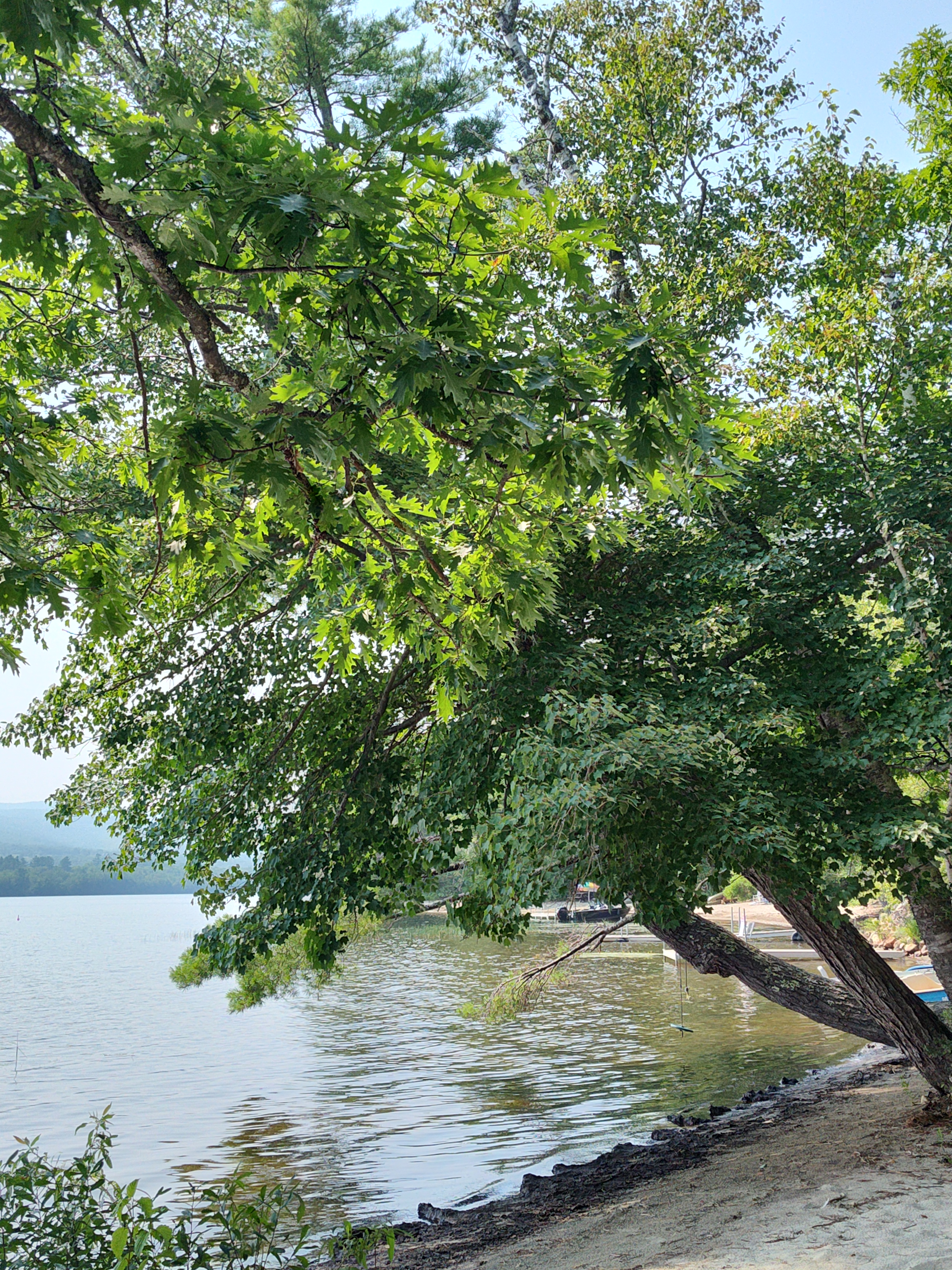
Sunday Mass for us is at St. Joseph Church in Farmington about forty minutes east first up, then down an elevation past Bald Mountain, a winding road with switchbacks and vistas that pops my ears. St. Joe’s is the parish that welcomed us back to the Church half a century ago: the happy event that saved our marriage. There we formed lifelong friendships. The current pastor, Father Paul, recognizes us now with a smile and greeting. As he does greet our daughter and her family with five children who stay at the camp where we stayed with her as an infant so many years ago. The screened in porch sits fifteen feet from the water’s edge. (see picture above for a view from the porch)

The former pastor at St. Joe’s from fifty years ago, Father Joe McKenna, is retired and ninety three, living in Portland. A most welcome visit and meal with him on the way north is something we always look forward to and are grateful for. He still retains his lively, unconventional intelligence, acute insights, fighting spirit, and wry sense of Irish humor. A natural storyteller, he is always delightful company.

The couple that owns the only remaining store in Weld converted it from the last elementary school here; they always greet us as well as old friends. We can get most everything really needed by way of groceries there. Downeast coffee, lunch and breakfast too at the counter in the adjacent old classroom. Good breakfasts with fresh eggs, bacon, toast and home fries. Burgers, fries, hot dogs, sandwiches, pizza, it’s open most summer days from six in the morning until early evening. A small playground next to the parking lot still entertains the kids, albeit with gravel on the ground, not ground up rubber stuff. A single clay tennis court remains well maintained at the bottom of the hill next to the Weld Community Center. Sweep the court, brush clean the lines when done, and wear shoes that won’t tear up the court are the only rules.

The entertainments of screens or city are scraggly substitutes for these simple pleasures. They may bring titillation, but the consolations of woods, fields, mountains, lakes, and time to read are healing. Screens and entertainments bring commotion and distraction from our troubles, but not restoration. Only places like this restore.

“Maine is a beautiful place that I paradoxically want to hoard to myself and share with everyone I meet.” John Hodgman

We know that there will be a last visit someday to our treasured Maine woods. The camp will change hands from the family we have known and liked here for four decades, or we will become too infirm to make the trip. We may not know it when our final visit ends, but I have no regrets, only gratitude for our many irreplaceable memories that will console us for the rest of our lives.

“I would really rather feel bad in Maine than feel good anywhere else.” E.B. White

  • Images: Top: Common Maine road hazard
    • Middle: View at the camp porch of Webb Lake
    • Bottom: View from nearby Center Hill near the spring where we get our water

View from Center Hill

2 Comments

Filed under Maine Tales, Personal and family life

Sagging Bridges

“We all want progress. But progress means getting nearer to the place where you want to be. And if you have taken a wrong turning then to go forward does not get you any nearer. If you are on the wrong road progress means doing an about-turn and walking back to the right road and in that case the man who turns back soonest is the most progressive man.” C.S. Lewis, “The Case for Christianity”


When we first moved to Aquidneck Island[i] in Narragansett Bay, a local carpenter working with me on home renovations told me he had not been off the island for ten years-he had everything he needed here, why waste his time going over bridges? Having lived in four states and traveled in at least forty others, I thought that was ridiculous. After seven years in this beautiful place, I gradually have become more empathic with his perspective. Indeed, why waste my finite time? However, we occasionally really do need to get to other places.

Absent a seaworthy boat or some flying lessons that leaves three avenues: the Mount Hope Bridge into Bristol, the Sakonnet River Bridge into Tiverton, and the Newport Pell Bridge into Jamestown. Our tiny state of Rhode Island is only thirty-seven miles wide and forty-eight miles long, but it has four hundred miles of seashore with its many inlets, islands, and bays small and large.  Surrounded by the Tohu wa-bohu,[ii] bridges are not a trivial concern.

Late last year, Providence and all of Rhode Island suffered some of the worst traffic snarls in my memory when the cantilevered Washington Bridge on I 195 was first shut down and then severely restricted after a young engineer making a routine inspection discovered that one of its supports was rusting out, separating, and shifting each time a load hit it. Our forty-five-minute trip to Heritage Ballet with granddaughters became a dispiriting hour to an hour and a half without notice, and life changed around here. Only the diligence, then alarm, of a single engineer averted structural failure with dozens of cars dumped into the Providence River on the main access to the city from the southeast, and a terrible body count. Years of desultory inspections and shoddy practices led to the failure of a few large bolts and imminent collapse. Or was the original design with its vulnerability to a few bolts rusting out the underlying cause of the misery and potential tragedy?

Panorama of Francis Scott Key Bridge Collapse

Francis Scott Key Bridge Collapse  James Rajda  IStock

[iii]A few months later in March, a giant cargo ship lost power and the ability to turn in Baltimore Harbor and drifted at around 8 mph into one of the supports of the Francis Scott Key Bridge. Underlying that immediate cause was a faulty design concept that neglected to protect against an inadvertent collision.

I asked my friend ChatGPT about the power of a ninety-five-ton vessel loaded with an additional 4,700 twenty-foot ten-ton containers. It quickly came back with the calculations confirming the Dali struck one of the bridge’s supports with a kinetic energy impact of about 16.3 billion foot pounds. How would that compare to a fully loaded 18-wheeler at 80,000 pounds, I asked. Comparable, indeed, Chat told me, if the truck was travelling at 436 miles per hour.  That would do it, I said. Chat agreed with its customary understated lack of humor. A major link to the city was destroyed, and the whole necessary commerce of the harbor was lost for months. Six men were killed who were maintaining the bridge. Some of the bodies were ever recovered. Only good fortune timed the collision to occur during the predawn and not when hundreds of commuters were crossing it.

Was the electrical fault cursing the Dali with a total loss of control the sole proximate cause of the crisis, or was the design and structure of the bridge built in 1977 the true source of the collapse? Federal standards were put in place in 1991 requiring fenders or “dolphins” be built to divert and protect bridge supports from errant giant cargo ships. Existing bridges were ‘grandfathered’ in. Only 34% of bridges in use over American navigable rivers and harbors under which commercial seagoing vessels travel every day protect the structural supports that hold them up.

The Newport Pell Bridge, which is the heavily travelled only bridge on the south end of our island with access to Route 95 south to New York and beyond, is one of them, and of a similar design to the now destroyed Francis Scott Key Bridge. Every day we see the large container ships, tankers, and cruise ships in Newport navigating under the bridge.

There are far more critical bridges than those spanning rivers. Some connect us along more profound ways. Or don’t. We can look at how they are supported and how the supports are holding up.

“If you see somebody, would you send ’em over my way?

I could use some help here with a can of pork and beans.”  John Prine, “Knockin’ on Your Screen Door.


Slowly, inexorably, the unkempt premises of our youth develop into how we think, and the murky waters of the fishbowl in which we swim limits what we see. What we know. What we think we know. Our assumptions about what is real. C.S. Lewis once wrote, “The future is something which everyone reaches at the rate of sixty minutes an hour, whatever he does, whoever he is.”  Thus, it is for us all, and it is beneficial for all to squint through the walls of the bowl from time to time.

 Recent polls confirm that 25% of voters hate and distrust both major candidates in this year’s elections, the highest “double hater” rate in forty years. How ever did we come to this? What divides us is embedded more deeply than two unlikeable politicians. And far less amenable to a quick fix or the next election or better candidates.

 MAGA vs wokeism in our hardened silos. Both sides regularly post memes of their opposition depicted as ignorant, compliant sheep. Can we all be ruminating, cud chewing, herbivores in adjoining pastures suffering through a drought?  Maybe.

Both the MAGA true believers and the woke minions arose from the assumptions and ideas of Enlightenment philosophers and classical liberalism. The same soil raised both grain and weeds, with the weeds stipulated by the other side. When the liberal ideology of democracy, individualism, and liberty seemingly triumphed over the other more baleful ‘isms’ of the twentieth century, our assumptions and premises hardened. We determined that liberalism[iv] and liberal democracy were not only the most just expression of government and philosophy yet devised by human beings, but the only just one, the ultimate end of progress, what we all should and must aspire to. Coloring outside those lines is unrealistic and traitorous. The water in our fishbowl. To think otherwise is to question our most fundamental assumptions.

Consider that both MAGA advocates and the wokeism cancel culture may seem like the basic divide in our culture but have both arisen from the same premises. The definition of the terms of those premises have rusted out from when they were conceived. Liberty and individualism as the basis of human happiness have evolved, moved on, remade themselves predetermined by their headwaters.

Happiness is no longer understood in the context of the preliberal Aristotelian concept of discovering and learning an objective and common goodness and virtue, then living our lives congruent with that. The closer we get to the ideal, the happier we are due to our unchangeable nature. No, happiness has become the unfettered freedom to do what we want to do, our emotional and ephemeral and shifting desires.

Liberty has ceased to be the freedom to do what we ought. “Ought” is no longer a broadly accepted concept – what C.S. Lewis named the “Tao,” the vestigial collective conscience of commonly held beliefs about the good, the true, and the beautiful: what it means to be good wired into our nature. No, liberty has devolved into the absolute freedom to do what we want, when we want  – with the one provision that we don’t harm anyone else. What quickly is exposed as a fantasy of impossible harmlessness is fated to be a perpetual struggle of conflicting wills, leaving us atomized and alone, bewildered and hostile. Without a common ground of what we should be, how do we negotiate a just solution? Or any solutions?

The leftward interpretation of that new definition of freedom tends to be limited to all things pleasurable, especially relating to sexual expression and to avoidance of pain. For those on the right, while paying minimal homage to something called “family values,” the new understanding of freedom tends toward all things economic and unrestricted capitalism resulting in ever more disparity between those that got it, and those that don’t. Freedom means financial freedom. But left and right are merely different interpretations of where classical liberalism led us.

The philosophical supports of liberal democracy and classical liberalism have rusted out from the vulner-abilities of their model. The fenders and dolphins that would protect them have been neglected. Or forgotten entirely.

“When he woke she was leaning against his shoulder. He thought she was asleep but she was looking out the plane window. We can do whatever we want, she said.    

 No, he said. We can’t.”           Cormac McCarthy, “The Passenger”

The authors of our Declaration of Independence and Constitution understood that the sustainability of our whole project of a democratic republic would succeed or fail on the common beliefs and shared values of its citizens, and if those shared values evanesced, it would collapse.[v] Yet, those common beliefs and shared values are not passed along by government; they are learned in organized or informal associations, churches, and most importantly in families. Passed down in a thousand conversations and experiences one person at a time. All of these fenders and protections of associations, faith, and family have degraded in an accelerated fashion over our lifetimes due to the same foundational principles of individualism, materialism, and the primacy of will.

The evidence of that change is all around us and was exposed clearly in a 2023 Wall Street Journal poll that compared the highest values of our citizenry in 1998 and where they shifted in twenty five years. To recap the key findings:

Patriotism: The importance of patriotism has decreased significantly, with only 38% of respondents in 2023 considering it very important, down from 70% in 1998.

Religion: The value placed on religion has also diminished, with 39% of respondents in 2023 viewing it as very important, compared to 62% in 1998.

Community Involvement: The significance of community involvement fell dramatically, with only 27% considering it very important in 2023, compared to 47% in 1998.

Having Children: The importance of having children dropped from 59% in 1998 to 30% in 2023. That is reflected in a birth rate well below replacement, a potential demographic winter, a still prevalent popular misbelief of overpopulation, and the difficulty of funding the social safety net of things like social security and Medicare because of an aging population and not enough workers contributing to keep them solvent.

The family is in such a crisis that over 50% of kids are raised by single parents or unmarried parents with the least affluent and educated among us suffering the most loss. Having children should be seen as an indicator of hope and confidence in the future. No kids indicates a debilitating skepticism about where we are headed.

Money: Conversely, the importance of money increased from 31% in 1998 to 43% in 2023. When hope is lost, financial security is perceived as more important.

The sacrifice and common vision of the founders of our country have given away to subjective and fungible aspirations that find little reason to cohere, and many reasons to pursue their own indulgence.

“Read not to contradict and confute, nor to believe and take for granted….but to weigh and consider.”

 Francis Bacon[vi]

Six years ago, Dr. Patrick Deneen, political philosopher and political science professor at Notre Dame, published a book of powerful and disturbing insight, “Why Liberalism Failed.”  It has been positively and thoughtfully reviewed by such diverse thinkers as Barack Obama and  Rod Dreher as ideas well worth considering. He pleased and distressed readers from both sides of the aisle, sometimes both in the same reader. A great debate ensued across many platforms.  Summarizing it in a blog post is nigh on impossible, but for this some relevant points give us plenty to think about.

To summarize the many ideas worth your attention, a reductionist, and inadequate summary of complex ideas follows below. Much better if it tempts you into buying the book or taking a trip to the library. The footnotes in this post that contain quotes that are worth your scrutiny. Better yet, read the book and some of the abundant commentary with a quick search.

Patrick Deneen critically examined the liberal political philosophy that has dominated Western societies for centuries. Deneen argues that liberalism, both in its classical and progressive forms, is inherently flawed and has led to many of the social, political, and economic crises we face today.

Liberalism contains internal contradictions that make it unsustainable in the long run. While it promotes individual freedom, that same perceived freedom simultaneously undermines the communal bonds and social structures necessary for maintaining that freedom.  The emphasis on individual autonomy and rights has eroded traditional communities and institutions. This has led to social fragmentation, weakening the societal fabric that supports a functioning democracy.

Liberalism’s promotion of market-based economies has resulted in significant economic disparities. The focus on individual success has led to a concentration of wealth and power, exacerbating social inequalities. The liberal pursuit of endless economic growth and consumption also has contributed to environmental degradation. The prioritization of human dominion over nature has led to ecological crises that threaten the planet.

Liberalism’s emphasis on personal choice and freedom has led to political polarization and a breakdown in civil discourse. The lack of a shared moral framework has complicated attempts to address collective challenges effectively, leading to many impasses, obstructing civil discourse, and mutual understanding across ideological lines.  We have busily been building our own tower of Babel for decades.

Does anyone doubt that is the situation we find ourselves in?

The liberal embrace of technological advancement, without sufficient ethical thinking, has resulted in technology dominating human life. We face concerns about privacy, autonomy, and the role of technology in shaping human values.

And most troubling of all, the focus on individualism has led to a loss of shared purpose and meaning. As traditional sources of identity and community have weakened, people have struggled to find a sense of belonging. Deneen calls for a rethinking of political philosophy that goes beyond liberalism. He advocates for a return to more localized, community-oriented ways of life that prioritize human relationships, ethical considerations, and environmental stewardship.

Deneen’s book argues that the very principles that undergird liberalism have sown the seeds of its failure, leading to widespread social, economic, and environmental issues. He urges a reconsideration of our political and social structures to foster a more sustainable and cohesive society. A longer quote from the book is included in the footnotes and expands the basic concepts of the book.[vii] I recommend them to you.

“Perhaps above all, liberalism has drawn down on a preliberal inheritance and resources that at once sustained liberalism but which it cannot replenish. The loosening of social bonds in nearly every aspect of life—familial, neighborly, communal, religious, even national—reflects the advancing logic of liberalism and is the source of its deepest instability. …. Liberalism has failed—not because it fell short, but because it was true to itself.” Patrick Deneen, “Why Liberalism Failed”

We drive over our sagging bridges without hesitation or any concern that they may collapse into the water. Roman culture lasted for well over a thousand years, and her citizenry had little cause to think it wouldn’t last for another thousand. Her citizens had no fears that it would crumble under its own internal contradictions, flaws, hedonism, complacency, and hubris. But collapse it did. There are lessons there.

The ideas to think about here are that perhaps the central supports of liberalism have rusted out since the founding of the American republic. Reflecting on that potential for collapse under its own weight, what adjustments or profound changes need to be thought about as we move into the twenty first century after its first twenty five years. Changes in society; changes in our local support social groups; changes in ourselves.

Changes that may fall upon us whether we are prepared to understand or deal with them. Like the gravity against which bridges struggle to withstand, they have their own inevitability.[viii]

“The truth is like a lion; you don’t have to defend it. Let it loose; it will defend itself.”  St. Augustine

[i] Aquidneck Island consists of the original settlements of Portsmouth, where we live. It was founded in 1638, and Newport was founded in 1639 to our south. After many territorial disputes between the busy port city of Newport and more rural Portsmouth, a permanent resolution was agreed upon by founding the appropriately named Middletown in 1743. The island is only five miles wide and fifteen long, but sometimes it’s just hard to get along. Separate governments still exist for all three – two towns and a small city of long distinction.

[ii] The Tohu wa-bohu is the ancient Hebrew term for the sea and symbol of the formless and terrifying emptiness and confusion, the chaos without God before He formed the earth. When Jesus calmed the sea for the terrified disciples in the New Testament, it told of both a literal event and a symbol for God’s power and providence.

[iii] Image copyright from IStock and photographer James Rajda with permission

[iv] In this context, liberalism refers to classical liberalism as expressed by John Locke, not liberalism as restricted to the progressivism it connotes for the most part in contemporary understanding.

[v] Founding Fathers and the Concept of Virtue:

John Adams famously wrote, “Our Constitution was made only for a moral and religious People. It is wholly inadequate to the government of any other”. He believed that the success of the American republic depended on the virtue of its citizens.

Thomas Jefferson also emphasized the importance of education and the cultivation of virtue. He believed that an informed and virtuous citizenry was essential for the functioning of a democratic society. He was a Deist, not a Christian like Adams, but he believed that natural rights were given by God, however he defined that, and not subject to denial by men or law: We hold these truths to be self-evident, that all men are created equal, that they are endowed by their Creator with certain unalienable Rights, that among these are Life, Liberty and the pursuit of Happiness.

James Madison acknowledged the need for checks and balances within government to mitigate the effects of human frailty but also stressed the importance of civic virtue.

Thus, citizens being formed in the virtues like prudence, self-sacrifice even to giving their lives and fortunes, temperance, right judgment, and a commonly held understanding of objective good were essential to the sustainability of a democratic society.

[vi] Saw this quote posted by a dear friend, Father Joe McKenna. Francis Bacon is considered the inventor of the scientific method.

[vii]  Some quotes from the book, “Why Liberalism Failed:”

“A main result of the widespread view that liberalism’s triumph is complete and uncontested—indeed, that rival claims are no longer regarded as worthy of consideration—is a conclusion within the liberal order that various ills that infect the body politic as well as the civil and private spheres are either remnants of insufficiently realized liberalism or happenstance problems that are subject to policy or technological fix within the liberal horizon. Liberalism’s own success makes it difficult to sustain reflection on the likelihood that the greatest current threat to liberalism lies not outside and beyond liberalism but within it. The potency of this threat arises from the fundamental nature of liberalism, from what are thought to be its very strengths—especially its faith in its ability of self-correction and its belief in progress and continual improvement—which make it largely impervious to discerning its deepest weaknesses and even self-inflicted decline. No matter our contemporary malady, there is no challenge that can’t be fixed by a more perfect application of liberal solutions.

      These maladies include the corrosive social and civic effects of self-interest—a disease that arises from the cure of overcoming the ancient reliance upon virtue. Not only is this malady increasingly manifest in all social interactions and institutions, but it infiltrates liberal politics. Undermining any appeal to common good, it induces a zero-sum mentality that becomes nationalized polarization for a citizenry that is increasingly driven by private and largely material concerns. Similarly, the “cure” by which individuals could be liberated from authoritative cultures generates social anomie that requires expansion of legal redress, police proscriptions, and expanded surveillance. For instance, because social norms and decencies have deteriorated and an emphasis on character was rejected as paternalistic and oppressive, a growing number of the nation’s school districts now deploy surveillance cameras in schools, anonymous oversight triggering post-facto punishment. The cure of human mastery of nature is producing consequences that suggest such mastery is at best temporary and finally illusory: ecological costs of burning of fossil fuels, limits of unlimited application of antibiotics, political fallout from displacement of workforce by technology, and so forth. Among the greatest challenges facing humanity is the ability to survive progress.

      Perhaps above all, liberalism has drawn down on a preliberal inheritance and resources that at once sustained liberalism but which it cannot replenish. The loosening of social bonds in nearly every aspect of life—familial, neighborly, communal, religious, even national—reflects the advancing logic of liberalism and is the source of its deepest instability. The increased focus upon, and intensifying political battles over the role of centralized national and even international governments is at once the consequence of liberalism’s move toward homogenization and one of the indications of its fragility.”

[viii] I enthusiastically recommend a more recent Substack post by N.C. Lyons on a different aspect of the same issues.

“Autonomy and the Automaton”   Here’s a quote to get your attention:

“The paradox is this: we subsist under an increasingly totalizing and oppressive managerial regime, in which a vast impersonal hive-mind of officious bureaucrats and ideological programmers aims to surveil, constrain, and manage every aspect of our lives, from our behavior to our associations and even our language and beliefs. This rule-by-scowling-HR manager could hardly feel more collectivist – we’re trapped in a “longhouse” ruled over by controlling, emasculating, spirit-sapping, safety-obsessed nannies. Naturally, our instinct is to sound a barbaric yawp of revolt in favor of unrestrained individual freedom. And yet, as I’ve endeavored to explain several times before, it is also a kind of blind lust for unrestrained individualism that got us stuck here in the first place.

The paradox is that the more individuals are liberated from the restraints imposed on them by others (e.g. relational bonds, communal duties, morals and norms) and by themselves (moral conscience and self-discipline), the more directionless and atomized they become; and the more atomized they become, the more vulnerable and reliant they are on the safety offered by some greater collective. Alone in his “independence,” the individual finds himself dependent on a larger power to protect his safety and the equality of his proliferating “rights” (desires) from the impositions of others, and today it is the state that answers this demand. Yet the more the state protects his right to consume and “be himself” without restraint, the less independently capable and differentiated he becomes, even as his private affairs increasingly become the business of the expanding state.”

3 Comments

Filed under Culture views

Phubbing Along

“I read for a living, and I fully confess that when I’m reading, I have to put my iPhone on the other side of the room. Otherwise, its presence always suggesting that something very interesting must be going on in my pocket. How does the phone truly operate in our minds?” Jonathan Haidt, from an interview with David Remnick in an article in New Yorker, Jonathan Haidt Wants You to Take Away Your Kid’s Phones”

“Hi, my name is Jack, and I am a phubber.”

Teens in circle holding smart mobile phones - Multicultural young people using cellphones outside - Teenagers addicted to new technology concept

IStock Getty Images

What’s a phubber? Someone addicted to “phubbing, first coined as a word in 2012 by the McCann Group, an advertising  firm in Australia as part of a “Stop Phubbing Campaign.”  Unfortunately for most of us, it was ignored. “Phubbing” is a combination of “phone” and “snubbing.” The miserable practice of ignoring the one you’re with for the omnipresence of those you are not with but remotely connect with our smartphones. “You are not enough to keep my attention; I’ve got to check this text, respond to this compelling ping. This addictive Facebook or Instagram or TikTok post is beckoning to direct me to something to indoctrinate or sell me or just suck my time. No excuse.  Just checking out.”

 “And if you can’t be with the one you love, honey,

Love the one you’re with…” Stephen Stills, “Love the One You’re With,”

                                                                       Crosby, Stills, and Nash

Of course, I don’t want to be in a Phubber’s Anonymous group, or suffer an intervention, or invite a sponsor to  hold me accountable. I’m perfectly content to feed my addiction. Except I’m not. It makes me lonely, vaguely dissatisfied, restless, alienated when I find myself scrolling Instagram pictures or YouTube short sports videos or a Facebook feed. Or accumulated texts and emails from a dozen subscription sources. At least it’s not TikTok accumulating my interests and data to the CCP. Forfeit is a quick hour of my increasingly finite time as it slips by like a bucket full of water with a hole in it. Irretrievably gone. Put the thing away, will ya?  All the algorithms conspire to be ingeniously addictive. You know it’s not good for you, right? We can feel it in our bones like tumors or osteoporosis. But when the urge starts up, and the thing beckons, we go there.

Need to do something. I’m admitting I’m addicted. I’ve done an inventory and come up short. I’m not sure what the program believes the formless ‘higher power’ to be, but I know what God means to me, and I can pray about this and ask for help. I have started down the path to better mental health, but I expect the claws to keep trying to pull me back.

“From 2003 to 2022, American adults reduced their average hours of face-to-face socializing by about 30 percent. For unmarried Americans, the decline was even bigger—more than 35 percent. For teenagers, it was more than 45 percent.”  Derek Thompson, “Why Americans Stopped Hanging Out – And Why It Matters.” From ‘The Ringer’ podcast.

Anxiety, suicidal ideation, depression, loneliness, and alienation have been on the rise for years and are  frequently written about, especially with the young – documented unprecedented levels requiring treatment. In this new era of instant connectedness, we are becoming more unconnected than ever before. But we persist in our ill-conceived faith that technology will solve our problems and cure our ills.

Recently a new bot was introduced from the AI platform Digi – an AI companion in an X post in December. Twenty-three million views. Click the link of the Pixar female image below and see what you think of the sample in the X, formerly-known-as-Twitter, post.  The solution to human loneliness in a lonely time?  A Disney quality animation bot. Just in time. The Pixar female image is reassuring as she promises that I am the most interesting person she’s ever met. So happy someone finally thinks so.

Our faith in our devices and connecting to the greater world informs us that everyone must benefit from the computer in our pocket and a satellite hookup to all the knowledge in the world. The prevailing narrative is we are liberating humankind with this technology. A story last week might give us pause as to how prepared most human beings are for the benefits.

The story was circulating in various news agencies about colonizing with the universal blessings of the computer in our pockets.  Elon Musk is one such evangelist for salvation through technology. Last September a major donor hooked up a remote Amazon tribe to Musk’s Starlink network of 6,000 satellites. The donor has hopes to enable 150 remote tribes to do the same. They will all have phones in their pockets too. If they have pockets.

The 2,000 member Marubo tribe, who live along the Ituí River, are already hooked up and tuned in. Access to the world. And the world’s ways. The chief says his youth, especially the boys, are not only hooked up, but hooked. On phone time. On porn. On violent video games. Learning from the Western ways, the boys have become much more sexually aggressive and experimenting with the kinky stuff they had never conceived of before.

Some quotes from the interviews in the  NY Times article that spawned the internet conversation: “When it arrived, everyone was happy,” Tsainama Marubo, 73, told The New York Times. “But now, things have gotten worse. Young people have gotten lazy because of the internet, they’re learning the ways of the white people.”

“Everyone is so connected that sometimes they don’t even talk to their own family.”

“It changed the routine so much that it was detrimental.”

“In the village, if you don’t hunt, fish and plant, you don’t eat. Some young people maintain our traditions,” TamaSay Marubo, 42, added. “Others just want to spend the whole afternoon on their phones.”

 It appears that I am not alone as a phubber, and the addiction is ready to rewire any of us without regard to where we live, who our tribe is, or what else we should be doing. The unreality of screen connectedness beckons insistently to us all.

“If one thinks that existence itself has no ultimate ground of intrinsic meaning or value, if reality is not perceived as good in itself outside of one’s own manipulation of it, nothing can be truly celebrated, even if one energetically pursues temporary diversions and pleasures.”  Dr. Daria Spezzano, “Thomas Aquinas, The Nones, and the Dones,” The New Ressourcement, Vol 1, No 1, Spring 2024. After the thoughts of Josef Peiper “In Tune With the World,” 1999, South Bend, IN

1 Comment

Filed under Culture views, Personal and family life

Selvage

“The final act of an unraveling society isn’t immoral behavior; it’s canonizing immoral behavior as a ‘new normal’ and celebrating it as a ‘moral victory.’” Jeff Iorg

Selvage is a beautiful word and a meaningful concept that denotes the edge of a web or cloth as finish to prevent it from unraveling. It is derived from Old English, “selfegge” and literally is ‘its own edge,’ derived from self plus edge. Woven from the thing itself. The edge of a lovely woven thing like a scarf or a bolt of good cloth or even a culture. Ours could use some selvage.

Weaver Cove Sunset 3A couple of weeks ago, the general became specific, as cultural changes will do. Rita and I travel seven minutes west to Burma Road and the Weaver Cove Boat Landing on Narragansett Bay often at sunset. A large dock extends out towards Prudence Island, and in the summer it’s busy with boats coming and going – dropping and picking up passengers from the many small craft that launch and return there. Several boats are moored offshore and kept there for the boating season from May to October.

For the rest of the year, the only folks are sunset lovers like us. On a good night, there can be a dozen of us, but many times we have it almost to ourselves. We can walk down a long rocky beach or eat a sandwich supper in the car or venture out on the dock if the winter wind off the bay isn’t trying to cut us in half.

Recently we walked back from the beach. A solitary figure was sitting with his legs dangling off the end of the dock. An old yellow motorcycle was leaning on its stand near the end of it. After a while he laid back looked at the clouds and listened to the fish jump with the evening’s quiet waves slapping gently against the piers. Rita, as she often does, felt a stirring of the spirit. She is much more attuned to such things than I am, a better listener to heavenly interruptions. When he finally gave up his revery, she headed down towards his bike. I followed her. She has sensitive antennae for folks who are hurting.

He politely returned her greeting and commented on the beautiful end of the day. He told us his name, but for this we will call him Jason. She told him how much we enjoyed this lovely spot on this lovely island and said he must too. Jason sighed.

Well, yes, he said, but tonight he came to remember his best friend who died exactly a year before from acute alcoholism before he was thirty.  This was his favorite spot. Had a boat. Ah. Then the gate opened to his heart, and it all poured out. Jason was twenty-nine. Three of his close friends were dead from alcohol and drugs. Another sigh. Then he said he was terribly lonesome. His “significant other” (I hate that phrase) had thrown him out of the apartment two nights before. Let’s call her Alison, although he told us her name.

They have four children together and were saving for a house. He missed her and the children with a deep longing. He sighed again. His dead friend’s brother, for reasons he didn’t understand, had waged a social media campaign of hatred against him with terrible calumnies and accusations that Alison believed. She had the car. He had the bike. She had the lease to the apartment. He had the bike. His paycheck was directly deposited into an account she had barred him from, but he was not overly dismayed because the kids needed to eat. He had a few bucks in cash. We offered him a place to stay for a few nights and some food. He said he was good to go and staying temporarily on another friend’s couch. Jason had pulled into the landing dirt parking lot by the dock to think about things on his way home from work.

He wanted things to go back to what they were a few weeks before. Just wanted to go to work, do his job and come home to his kids. Play with them. Hold them. Read to them. Goof with them. Stopped talking. Stared off over the bay.

Rita told him he was loved by God and that if he trusted in Jesus, he would find his way through this back to the truth of his life and his family. I joined in with a few things about how this would pass. His life was not defined by the last few weeks. That the Creator of all this beauty of the bay knew him and his pain.  Rita and I had been married fifty-seven years with good times and bad; we would pray that things would work out for them. He listened with great attentiveness. Got quiet. He told us he had to go get something to eat and get some sleep. If he could sleep. He reminded us of us at his age when we were going through our worst troubles in Maine.[i] Bewildered at the sudden turn of his life. Confused. Broken hearted. Anxious. Miserable. Lost.  

We all lingered for a minute or so. I asked him about his bike. He said it ran great so long as he could get it going. We started to go back to our car.

He headed to his motorcycle, hesitated, then he turned back towards us. Looked like there was something left to be said-something unfinished. Hesitated. Now shy, he asked if we would hug him. Of course. Rita hugged him with her motherly warm embrace. I hugged him. He clung to me like I was his father.

He thanked us, and after a brief struggle with his kick starter and choke Jason tinkered his motorcycle back to life and headed off south on the Burma Road after he emerged from the parking lot. Rita and I stood together holding hands and watched him go until the sound faded. We pray for Jason, Alison, and their children each day since. We look for him when we go to Weaver Cove, but so far, we haven’t seen him. May never see him again. Hope we do, but sometimes that’s how these things go. We pray together for Jason and Alison and their children everyday now.

“If I needed you, would you come to me,

Would you come to me for to ease my pain?

 If you needed me, I would come to you.

I would swim the seas, for to ease your pain.”  “If I Needed You,” [ii]   Townes Van Zandt

The many articles and podcasts on the unprecedented epidemic of loneliness, depression, anxiety, and brokenness in our culture, especially among the young, are commonplace. Screen time, social media replacing personal relationships with a majority of kids living in single family or recombined families, the failure to commit phenomenon, low marriage rate, critically low birth rate, and COVID isolation are all frequently mentioned as possible causes. I have written in this blog about the many with an unfulfilled capacity for God. All topics unto themselves for books, never mind blog posts.[iii]  The solution is one person at a time, and it is spiritual.  I’ll retell an old joke that may fit the topic:

A believer who perhaps misunderstood how these things most often work was convinced that God would intervene miraculously and save him from the rising river in a hundred-year flood. A rescue vehicle pulled into his driveway and offered the man a ride to safety. “No! God will save me.”  The river rose, and he fled to the second story. A rescue dory rowed against the fierce current to his window, and the firefighter told him to jump in. “No! God will save me.” He fled to his roof. A last-ditch paramedic helicopter hovered over him, and the rescue crew lowered a basket to him. “No. God will save me.” Finally, the river swept the house away and broke it up. He drowned within minutes. Arriving in front of God, he started complaining angrily, loudly, and bitterly. “You failed to rescue me, God; how could you desert me to perish in that flood?”  “My son, you missed the outpouring of my grace; I sent you a truck, a boat, and a helicopter.”

The Lord is near to the brokenhearted and saves the crushed in spirit.”  Psalm 34:18

We heard a moving talk recently from Amy Ford, the founder of Embrace Grace, a nationwide nonprofit that helps equip churches to help single moms and families. She talked about her times of hearing such “heavenly interruptions.” Some would call them invitations of the Spirit. Listening. Being attuned to that gentle whisper, gentle whispers which inspire us to do “small acts of kindness with great love,” as St. Mother Teresa would say.

I tremble at how many whispers I must have missed[iv] and am grateful for those I have managed to respond to. They come every day, perhaps many times a day. A kind word. Just an acknowledgement that another person exists and has struggles. Opportunities to love. Opportunities to be loved.

Just as selvage is the weaving together of the many threads of a cloth to make it strong, so our culture is made strong one thread at a time, one life at a time, one person at a time. By all of us. By me. By you.

“The ultimate test of your greatness is how you treat every human being.” Pope St. John Paul


[i] A summary of our struggles at twenty-nine and the fork in the road. https://quovadisblog.net/2012/05/28/maine-tales-iv-the-road-not-taken/

[ii] “If I Needed You” Don Williams and Emmy Lou Harris cover

[iii] Here is one article in Atlantic: “Loneliness, Solitude and the Pandemic”.  There are many others. An excellent podcast on the lonely culture with Dr. Matthew P and Bishop Robert Barron.

[iv] I am rereading some of Flannery O’Connor’s wonderful, dark, and richly symbolic stories which remind me of the subtle invitations to grace that are often missed by her characters. We all miss occasional invitations to grace. Heavenly interruptions.

4 Comments

Filed under Faith and Reason, Personal and family life

Witnesses

Every year 105,000 Christians are killed because of their faith. This shocking figure was disclosed by Italian sociologist Massimo Introvigne, representative of the OSCE (Organization for Security and Cooperation in Europe) on Combating Intolerance and Discrimination against Christians, at the “International Conference on Inter-religious dialogue between Christians, Jews and Muslims,” (Conference as reported on this site in 2011, Catholic Culture.org)

[i]When we think of martyrs[ii] for their Christian faith, what often first comes to mind are ancient artifacts and stories, some legend, most rooted in fact. The Roman catacombs. Exposed to live beasts in the Colosseum for the entertainment of the gladiator bread and circus spectators, like all addicts needing more and more of their malformed pleasures of gore and the suffering of others to achieve new highs. We think of the original apostles; all but Judas Iscariot who committed suicide and John who died of extreme old age in exile on Patmos. The rest were murdered for their faith, refusing to deny Jesus, a refusal unto their own death.

Beheaded, crucified, burned alive, skinned alive, ran through with a sword, sawn in half. Being an original apostle of Jesus was no sinecure. They died because they had seen something that utterly transformed them and gave them absolute confidence that something was greater than death. Not for riches, not for power or conquest, certainly not for pleasure or praise, but to spread the Good News that echoes down the centuries: Jesus Christ of Nazareth died and then arose from the dead; they gave up everything we tell ourselves is necessary for happiness and died in beatitudo[iii].

What we don’t often think about is that more Christian martyrs were murdered in the last century than in all the previous centuries since Jesus walked in Jerusalem, about forty-five million of them. This does not include those murdered by tyranny who happened to be Christian, only those who specifically died for their faith. From Auschwitz to the Gulag, the Cultural Revolution of Mao and the Marxist revolution in Mexico to the ongoing butchery of radical Islam such as Boko Haram[iv] in Nigeria. From Father Maximillian Kolbe and Edith Stein (Sister Teresa Benedicta of the Cross)[v] to Blessed Miguel Agustín Pro in the Catholic persecution of La Cristiada during the Marxist Mexican revolution and the courageous Cristero resistance to the atheist repressors, what Graham Greene called the “the fiercest persecution of religion anywhere since the reign of Elizabeth.”[vi]

“¡Viva, Cristo Rey!”

“But they cried out with a loud voice and stopped their ears and rushed together upon him. Then they cast him out of the city and stoned him; and the witnesses laid down their garments at the feet of a young man named Saul. And as they were stoning Stephen, he prayed, “Lord Jesus, receive my spirit.” And he knelt down and cried with a loud voice, “Lord, do not hold this sin against them.” And when he had said this, he fell asleep.” Acts 7:57-60, RSV (In a previous verse describing Stephen, his face was described as that of an angel.)

Stella, Jacques, 1596-1657; The Martyrdom of St Stephen

Stella, Jacques; The Martyrdom of St Stephen

In our secular culture of a sort of loosely defined neo Pelagianism, all dogs go to heaven. If most think about God at all, our god is a remote clockmaker who maybe set things in motion millions of years ago but has little or nothing to do with our day-to-day life or how we live it. The qualifier is just being a generally nice person, which is an embarrassingly low bar. Maybe you need to love pets and be pleasant at the coffee shop. The prevalent worldview about these things in young people has been called “Moral Therapeutic Deism,” the central point of which is that the goal of human existence is to feel good about oneself and be happy. Surely a flimsy and ill-defined structure and not one for which self-sacrifice, especially sacrifice of one’s life for a relationship with God makes any sense at all.

Faith like that is not a set of moral principles. Nor a philosophy. Nor just ritual, habit, and lifestyle. No, faith like that is a deep relationship of trust with a Person. An irreplaceable friendship worth dying for. As St. Thomas Aquinas famously stated, “To one who has faith, no explanation is necessary. To one without faith, no explanation is possible.”

Not ancient history, but contemporary and ongoing, the witnesses of great devotion and love are an ongoing miracle. What prompted this post were two stories a visiting Columban missionary priest told us at daily Mass the week before last on the memorial of St. Stephen, who was murdered with large stones. All Stephen had to do was deny the truth of what he knew about Jesus, and all would be forgiven. He chose to suffer an excruciating death before making such a denial. Why would he ever do that?

Our celebrant telling the stories served many years in missions including seven in Juarez, Mexico on the border with El Paso, Texas. While there, he taught and pastored three young men in his confirmation class. One was discerning a vocation to the priesthood. Our meanest poverty here does not approach what afflicts the poor in Juarez. These young men scratched out an income as best they could. One source of cash was helping those trying to make it across to El Paso. Before we start in on “illegal immigrants” and all the rest, these are desperate people trying to escape cruel government, no opportunities, and worried each night how they will feed their kids tomorrow. As we sip our morning coffee and make whatever breakfast pleases us, we may want to ponder for just a moment what it would be like to live in such circumstances and what we would or would not do to provide some measure of security for our loved ones.

Many of these unfortunates are then further exploited by the ‘coyotes’ who traffic human beings. If they are young and female (or sometimes male), after they pay their rapacious fees, they can be trapped into the sex trade, addicted, and ruined. The three young men charged much less and got them safely over the border. However, the coyotes worked for the cartels (one of two in Juarez at the time). With cash flow that rivaled large corporations, the people trade netted as much as the drugs that were their original main product. Brutal and better armed than the police, even the gendarmes are afraid of them. These three young men had no chance at all. One evening, they were kidnapped, dragged into the desert, and stoned to death, their heads were smashed with large rocks. Again, and again, and again. Beyond recognition even with dental records. The cartel thugs then threw dead dogs on top of their corpses as their warning to any who dared to defy them, no matter how insignificant their small piece of the action was.

Called out by the bereaved families the next morning, our visiting priest went out and helped recover the corpses. He remembers carefully scraping the rocks for brain, flesh, and blood, retaining as much of the DNA as possible because it belonged to human beings created in Imago Dei and must be given reverence and be buried with them. Each year on the memorial of the stoned to death St. Stephan, he remembers his three young men. Perhaps they don’t belong in the long list of classic Christian martyrs who died for their faith, but neither were they coyote predators; they had empathy and care for their clients, caring human beings of faith and hope.

The second story the missionary priest told us that morning fits the Christian martyr description more closely. A hundred miles south of Juarez in a diocese served mostly by Jesuit missionaries, Pedro Palma, a sixty-year-old tour guide, similarly crossed paths with the Sinaloa cartel for reasons that may never be known. He was shot several times on the street in front of the church in the village of Cerocahui. He managed to stagger inside crying out for sanctuary, a centuries old tradition of protection. Sanctuary and haven ignored by the gunmen; they rushed in after him and finding him halfway up the center aisle, shot him several more times. With the last of his strength, he dragged himself to the altar and died.

Two elderly Jesuit priests who had retired to live at the church rushed to his aide. Father Joaquin Mora, 78, and Father Javier Campos, 80, were murdered alongside him. Helpers? Yes. Doing what priests do? Yes. But ultimately, they were what the gunman perceived them to be, and rightly so. Witnesses.

***************************************************************************************

Would I have such faith and confidence in my faith in Christ? I pray that I would if called to. Jesus, I trust in You.

One last witness in this post: Charles de Foucauld. As a young man he gained some fame as an explorer and author. Later he experienced as many still do, a new understanding, a conversion, a metanoia change of mind. “He lost his faith as an adolescent. His taste for easy living was well known to all and yet he showed that he could be strong willed and constant in difficult situations. He undertook a risky exploration of Morocco (1883-1884). Seeing the way Muslims expressed their faith questioned him and he began repeating, “My God, if you exist, let me come to know you.” [vii] And so God answered that prayer, and Charles discovered a new life worth living.

Later, Foucauld became a Trappist, then a priest, and worked the rest of his life among the Muslims telling them about the Gospel, the Good News. Charles was murdered by an Islamist gang of assassins in 1916 who clearly didn’t want what he was offering. He wrote many things, including this prayer that explains what becomes the deepest core conviction of all witnesses. One worth dying for.

“Father,

I abandon myself into your hands; do with me what you will. Whatever you may do, I thank you.

I am ready for all, I accept all. Let only your will be done in me, and in all your creatures.

I wish no more than this, O Lord.

Into your hands I commend my soul; I offer it to you with all the love of my heart,

for I love you, Lord, and so need to give myself, to surrender myself into your hands, without reserve, and with

boundless confidence, for you are my Father.” Charles de Foucauld

[i] Main image from UK Art and the Fitzwilliam Museum. The Martyrdom of St. Stephen, Jacques Stella. https://artuk.org/discover/artworks/the-martyrdom-of-st-stephen-5568

[ii] “Martyr” is from the ancient Greek matur, and then liturgical Latin, meaning “witness.” The final and ultimate statement of faith as a witness.

[iii] Great peace and joy.

[iv] “Boko Haram, which aims to expel Western influence and create a Salafi-Islamist state in its area of operations, has killed an estimated 50,000 people and displaced more than 2.5 million people since it was established in 2002.”

[v] St. Teresa Benedicta of the Cross, ne Edith Stein, a Catholic convert and renowned philosopher prior to the war was murdered at Auschwitz for her faith. As was St. Maximillian Kolbe, a Franciscan friar and Polish priest imprisoned for speaking out against the Nazis and while there volunteered to die in place of a married man with children who had been selected to be killed. The man he replaced eventually survived the camps.

[vi] https://www.usccb.org/committees/religious-liberty/viva-cristo-rey

[vii] https://www.vatican.va/news_services/liturgy/saints/ns_lit_doc_20051113_de-foucauld_en.html

1 Comment

Filed under Faith and Reason

Viability

“Whatever else anything is, it ought to begin by being personal.”  Kathleen to Joe (Meg Ryan to Tom Hanks) in “You’ve Got Mail.

chicken or eggA friend told us recently about this meme on Facebook with a simple picture of an egg and the caption, “In Alabama, this is a chicken.”[i] A spirited discussion ensued with some friends about the controversial Alabama Supreme Court decision concerning the nature of embryos and the ethics of ‘in vitro’ fertilization (IVF)[ii].

This led to another friend reminding us of a story from 1979 in nearby Newport that was covered extensively in local news. We were living in Maine at the time and were unaware of the tragedy. A woman she knows well was rear ended in her car. She survived, but her baby was killed. The baby was still in utero, and the mom was within a few days of her due date nine months into her pregnancy. The controversy ensued when the devastated woman pursued the case as a wrongful death caused by vehicular homicide. After a wrenching public trial, the driver of the other car that caused the death was found innocent of that charge, not because he didn’t cause the accident, but because the baby in the mom’s womb according to the court did not meet the requirements to be protected as a human being.

At issue in both controversies is “when does a human being qualify as a human being deserving of the protection of law all of us enjoy and count upon?” Science is clear and uncontroversial in every embryology textbook in every medical school: at conception, a new human is created, with a complete genome unique in all of history. When the sperm’s DNA merges with the DNA of the egg, the resulting zygote contains within itself all that is necessary to produce first the zygote, then the blastocyst, then the embryo, then the baby (or fetus, which just means ‘little one’.)[iii] Thus is initiated the biological wonder of an unbroken continuum that does not cease maturing for the rest of her life.[iv]

Viability means “ability to live,” the root of which, derives from the Latin “vita,” which means life. “Vita” is the same root of many other English words like “vital,” vivacious,” “vitamin,” “revive,” and “survive.” The connotation ascribed to viability in a fetus is one that can survive outside the womb. This connotation is arbitrary as a legal status. No newborn infant can long survive without continued nurture and protection, a fact well known in ancient Rome where unwelcome or imperfect infants were exposed on a rock to die. An infant is viable, so is the preborn baby.  So is the zygote, the blastocyst, and the embryo – viable within the protection and nurture of a woman’s womb – but viable, nonetheless. The continuum of every life, if uninterrupted by disease or mishap or violence is built into the first instant of the creation of the new genome and cell.

Viability outside the womb is the line many have decided to draw concerning when a fetus is a human, a line coming increasingly earlier in a pregnancy.  A baby born at 22 weeks gestation or 18 weeks early at 14 ounces has survived birth and prospered[v] into toddlerhood. Why not make heartbeat or the pulsing of heart tissue the standard? Or implantation of the placenta in the wall of the uterus? Or “quickening?”  Or birth? Or, as some have proposed, such as Dr. Peter Singer, three months after birth? All have their merits and devotees. For that matter, why is vivaciousness off the table? We all like cute babies. Maybe only cute babies are human?  

The whole debate is arbitrary, a philosophical and ethical debate, not a scientific question, which is askedMildred Jefferson quote 1 and answered by the science of embryology. Advancing technology has provided another compelling proof, the visual, emotional confirmation of ultrasound images, which have in many ways changed the discussion. No one ever looked at the live images of a developing human being in their womb and thought, “This is a fetus made up of ‘meat Legos’** or an undifferentiated clump of tissue with which (because I have the power), I can do anything I want.” No, no – they put the images up on their refrigerator with magnets in wonder and joy. This is my baby.

The debate grows ever more bitter and emotional, and no court decision or legislation is going to settle the matter definitively. The public debate is mirrored internally in every human heart and mind, and it is there it will be settled for society. But there is an objective truth with which every conscience must contend. And everyone knows it.

“I shall be telling this with a sigh

Somewhere ages and ages hence:

Two roads diverged in a wood, and I—

I took the one less traveled by,

And that has made all the difference.” Robert Frost, “The Road Not Taken”

Human beings don’t have reproductive systems: we each have half a reproductive system. One half of cell-flashhumans are female. One half are male. Science informs us in the instant a human sperm enters a human egg, there is a flash of light, and in 2016, a lab in Northwestern University filmed it, something to do with the zinc released from the egg.[vi] That flash occurs once in every human life and signals the very beginning of a life that a few hours later when the DNA merges contains all the genetic information necessary to create and develop our mature form. Every tiny increment along our way is human life.

An old series of memes tells us that no one has ever been heard to say on their deathbed that they wished they had spent more time at work (or watching television or death scrolling TikTok). I suggest as an analogue a series of questions each one of us will ask. Or should.

  • Do we want to treat life as a commodity to be frozen, collected, and selected for gender or eye color or possible defect? Or is it our obligation to respect the embryo as a unique and natural to be expected consequence of the total self-giving and loving act between a man and a woman committed for life to one another?[vii] Between a lab or a wedding bed?
  • In the case of abortion, do we choose a nursery or a medical waste bucket? A swaddling cloth or stainless steel? Nurture or disposal?
  • Do we want to objectify human life or treasure it as precious?
  • Do we want to base our decisions on fear, pure self intersest, and despair or hope, self sacrifice, and love?
  • Do we want to be givers of life or bringers of death?

In this context, where do we, (you and I), draw the line between when life is cherished, protected, and nurtured and when it can be discarded as imperfect, too expensive, too frightening, too disruptive, too damn inconvenient?  

Where do you draw the line?  Where do you come down – at how many weeks gestation or stage of development along the continuum? Then each of us needs to justify that position and understand why we hold it.

For me, the known science is sufficient. Not what the social and entertainment media and our culture inculcate in us, but what reason and conscience tells us is true.

It seems to me these are important questions. Not to be given a cursory dismissal with a cutesy, superficially clever meme, trivializing what is solemnly important and redefining anthropology – what it means to be a human being. We owe to ourselves an honest appraisal of what we believe, and why.

“I became a physician in order to help save lives. I am at once a physician, a citizen, and a woman, and I am not willing to stand aside and allow the concept of expendable human lives to turn this great land of ours into just another exclusive reservation where only the perfect, the privileged, and the planned have the right to live.”  Dr. Mildred Jefferson, mentor and much missed friend.


** “Meat legos” is a creative term from Mary Harrington’s blog and her post here in the Reactionary Feminist. She coined the descriptive “meat Legos matrix” as a name for that aspect of our destructive  postmodern culture of radical self invention wherein we harbor an unjustified or delusional optimism that through technology we can enjoy complete freedom to be almost anything, including treating our bodies as disembodied objects of our imagination. The term has gained great currency in the two years since she invented it. “Meat Legos” graphically recognizes an unprecendented shift in human anthropology uhheard of for all of history and calls into question all our basic assumptions about what a human being is, what our purpose is, and the nature of the mind/body synthesis. 


[i] The meme is wrong on many levels. One of them is that an egg or a chicken is not a human being, which is profoundly different. A non-fertilized egg is breakfast. A fertilized egg is a future Sunday dinner.

[ii] The case was a wrongful death civil suit filed by a couple who had preserved frozen “spare” embryos at the IVF clinic they had used. The embryos were destroyed by another disturbed patient who broke into the clinic’s freezer and pulled out a handful produced by the couple who sued him. Burning his hand on the cryogenically frozen embryos, he dropped them, and they were killed. The court found that frozen embryos were human and qualified the case as a wrongful death suit and negligent homicide. The case was not about whether IVF was licit, but about the nature of a human embryo.

[iii] “The best single sperm moves inside the egg and a zygote is formed,” says Dr. Richlin. The zygote phase lasts for around four days; it eventually turns into a blastocyst, and then an embryo.” (From: https://www.parents.com/what-is-a-zygote-7112279#)

[iv] Excellent animated video on fetal development from fertilization to birth: https://babyolivia.liveaction.org/ or some more detailed information here:  https://www.britannica.com/video/192622/Human-embryonic-development-birth-fertilization

[v] One of several articles about this baby: https://www.businessinsider.com/baby-born-at-22-weeks-weighed-14-ounces-2022-8#

[vi] https://www.sciencealert.com/scientists-just-captured-the-actual-flash-of-light-that-sparks-when-sperm-meets-an-egg

[vii] What is the nature of the act? What is its telos or purpose? Unitive and procreative or purely recreational?  Should a pro choice understanding come earlier in the proceedings? Is there a responsibility in choosing to participate in the baby making act?

5 Comments

Filed under Culture views

February Doldrums

“The “doldrums” is a popular nautical term that refers to the belt around the Earth near the equator where sailing ships sometimes get stuck on windless waters.” From the National Oceanic and Atmospheric Administration

Summer relinquishedFebruary is that sort of month. We’ve transited from the early bright lights and joy of the beginning of a New England deep winter in December to a grayer, resigned wait. The chores of winter are wearing and tiresome. The dust and mess on the floor from the woodstove are grinding me down; every evening ends with banking up a load of oak and maple for the night burn, and every morning starts around five with a few coals blown back to life with small wood and a hot start to keep the creosote buildup in the chimney to a minimum.

The snowblower is still covered with a tarp at the head of the driveway, gassed, and ready. New England Road salt is incrementally eating our car, slowly reducing it to rubble. Snow drifts quickly change from pristine white the morning after a night’s storm to grubby gray and randomly stained with occasional brown and yellow blots which we learn young not to use for snow cones. The shrubs and trees still await the greening, the winter snow load has broken them down a bit, and small branches stick up from the snow on the ground where the wind and freeze struck them off the Norway Maples, Eastern white pines, and our sole canoe birch tree. They await the spring clean-up and new mulch. The leaves that the fall raking missed linger under the snow, dark, wet, and growing mold.

February is a month of rumination, self-examination, and contemplating long thoughts. I remember Carl in Mount Vernon, Maine, where we lived for ten years before we moved to the tropics of Rhode Island. West central Maine in hill and lake country set our standard for long, cold winters. Carl was a skilled artist and a professional sign painter for local enterprises. He usually overwintered in Arizona after a long semi-annual migration in his old GMC pickup. One November he neglected his migration prep, got busy with work, and stayed. He had a large barn next to his house that doubled as his Maine studio. A wood burning furnace kept the old structure minimally functional all winter. I visited him one day in February when he was hard at work. A new ten-foot sign adorned the tall wall over the barn door. It was a spare winter scene with three-foot-high letters beautifully formed, that simply said, “It’s really bad!” When I stood admiring it, he told me that he painted it one miserable day with drifts piling up against his windows to remind him to never, ever neglect his fall migration prep again.

Some optimistic and courageous green shoots appear through last year’s mulch only to be covered by an icy, brittle white in a surprise Nor’easter. Cold nights in the twenties remind us, “not yet – not yet.”

“Gather gladness from the skies

Take a lesson from the ground

Flowers do ope’ their heavenward eyes

And a Spring-time joy have found

Earth throws Winter’s robes away,

Decks herself for Easter Day.”       Gerald Manley Hopkins, “Easter”

Signs of spring are here though: the more stalwart robins are returning, fat and feathered thickly; some redwing blackbirds have shown up. Buds are swelling a bit on the early bloomers. We heard doves cooing yesterday evening. No goldfinches or yellow warblers have yet joined the sparrows, wrens, and cardinals at the bird feeder, but they’ll soon be here. Canadian geese are flocking up. Hundreds of them here on the island are now overhead one flight at a time, some already headed north to their summer breeding grounds. Not many sights are as beautiful as a large flock of twenty or fifty or a hundred geese honking in graceful, coordinated movement with their powerful wings beating the air tip to tip or in a final swooping glide into a winter corn field.

The most promising February harbinger is the opening of spring training: first pitchers and catchers, and a week later the boys of summer all show up. The Red Sox of the wonder years of Pedro, Manny, and Big Poppi have faded, and fans have retreated to the losing days of my youth. My father lived for sixty-six years and never saw a World Series win. But we are Sox fans in all weather. Some call it a mental illness, but there you are. Every spring hope and the greening rise in us, maybe to be dashed once again in September, but in February, there is only the joy of new beginnings. A couple of pitchers would help.

February doldrumsLate winter skies are startling blue, and the clouds look like they were painted with a pallet knife, almost unnatural. The sun is two months warmer than December, and with the windows up in the car the glare feels hot against our face. Hope is upon us, the promise of March and April unmistakable. Soon and very soon, the cascade of blooming will begin. First the crocuses, then the yellow profusion of daffodils and forsythia, followed by everything, the pink cherry blossoms, the white of the Bradford pears, magnolias, dogwoods, flowering crabs, azaleas, later the lilacs and rhododendron. The island’s splendor is persistent for months almost into autumn with the Montauk daisies.

Long, cold January and dreary February are intrinsic to the spring explosion of color and light. For me, it has always been and will remain a tradeoff well worth the price. Except for one year in Colorado, we have chosen to live our lives here in Massachusetts, Maine, and now in Rhode Island.  We’ve travelled the country and always come home. The wonder of it is in the profound changes of the seasons, majestically sequencing like a liturgical procession year after year.

We talk sporadically about moving somewhere south where the winters are not so demanding, and the cold is not so penetrating when the wind blows hard off the North Atlantic. But the discussions are never long. The loss would be unbearable.

“Let the earth bless the Lord.

Praise and exalt him above all forever.

Mountains and hills, bless the Lord.

Everything growing from the earth, bless the Lord.

You springs, bless the Lord.

Seas and rivers, bless the Lord.

You dolphins and all water creatures, bless the Lord.

All you birds of the air, bless the Lord.

All you beasts, wild and tame, bless the Lord.

You sons of men, bless the Lord.”  Canticle of the Three Children from Daniel 3: 74-81

4 Comments

Filed under Personal and family life

Big Waves Break Twice

“And when the last law was down, and the Devil turned ’round on you, where would you hide, Roper, the laws all being flat?” as spoken by St. Thomas More, “Man for All Seasons,” Robert Bolt

Sachuest Beach Surfers endRita and I will often walk Sachuest Beach. Sometimes we sit at Surfer End and pray or watch the surfers or the waves on a smaller wave day. We have been transfixed watching them build with the wind far out into the bay. As they approach the shore, the larger ones will break twice: once about fifty feet out and a second time when gravity again overcomes momentum and the top curls over very near shore.

Thousands of gallons cascade over suddenly with a noticeable thump that can be heard and felt up on the seawall. Why anyone would ever bring a sound maker to a beach has always been a mystery to me. Just the waves please. Breaking. Breaking. For a million years.

Recently the big ones breaking twice set me thinking about Brown v Board of Education and the more recent Dobbs v Jackson Women’s Health Organization Supreme Court decision. Both were big waves that broke twice.

“To separate children from others of similar age and qualifications solely because of their race generates a feeling of inferiority as to their status in the community that may affect their hearts and minds in a way unlikely ever to be undone.” Chief Justice Earl Warren about Brown v Board of Education

In 1954 Brown v Board of Education overturned Plessy v Ferguson in 1896 that enforced separate but equal segregation, zealously guarded practices mostly in the South. For fifty-eight years, segregation held sway. Separate facilities for black folks: lunch counters, bus seats, restrooms, hotel accommodations, sports teams, and most damningly, schools.

In Plessy, the Court held that “separate but equal” satisfied the Constitution and the Fourteenth Amendment. But “separate but equal” was separate only.  Equal was a far piece off. In Brown, justice finally prevailed.

A quick and just overturning of a gravely mistaken Supreme Court decision half a century ago, and all was set right overnight. Not exactly. The wave breaks twice. Those of us of an age will never forget the interim.

For the next decade or more, the battle raged with the Federal government stepping in many times to enforce integrated facilities when the various states refused to comply. Democrats pushed hard back for many years to sustain the old “Jim Crow” laws that stifled opportunities for minorities. Opportunities to ride at the front of the bus, opportunities to drink from the same water fountain, opportunities to eat at the same counter in the cafeteria or restaurant, opportunities to an equal education in the same school or college as white kids. Blood was shed. Dr. Martin Luther King and others were shot, hung, burned, and martyred to the cause of equality of rights and opportunity. “We Shall Overcome” was sung by Joan Baez on the steps of the Lincoln Memorial and on the march to Selma, Alabama with Dr. King and became an anthem most of us knew well. The “I Have a Dream” speech on the Lincoln Memorial steps in 1963 can still bring chills almost another sixty years later.

The wave breaks twice, and it’s a brutal turmoil under the swelling surface.

“Like the infamous decision in Plessy v. Ferguson, Roe was also egregiously wrong and on a collision course with the Constitution from the day it was decided. We hold that Roe and Casey must be overruled. The Constitution makes no reference to abortion, and no such right is implicitly protected by any constitutional provision…” Majority opinion in Dobbs v Jackson

As it was with Plessy, so it is with Roe. A gravely flawed decision from nearly fifty years before was justly undone. The second break is building. The segregationists brought out the dogs. The abortion lobby and their political allies are hard at it now with different dogs. This time many states are passing laws and trying to protect those who have no voice, while the Feds are working for the abortion lobby. The Feds have largely ignored almost two hundred attacks on churches and crisis pregnancy centers from vandalism to fire-bombing since the preliminary Dobbs decision was illegally leaked to a complicit press.[i] Those praying and holding signs at abortion clinics have not been so lucky. For them, it’s been predawn arrests in front of their families by heavily armed Department of Justice and FBI storm troopers.[ii] The confusion, draconian policies, and rhetoric we read and see every day is the interim as it was in those fifteen years following Brown v Board of Education. For us, it’s just the beginning.

Perhaps at some future point, a case will be adjudicated about the personhood of the pre-born human being. The science of embryology is settled without exception about the human nature of the fetus with her unique and complete genome. The sticking point is ideological and philosophical, not scientific. When does a developing human being gain the protection as persons under the law? When in the continuum of human development should the dividing line between life and extinction be drawn? Or do we simply ‘follow the science’ and protect innocent human life during its most vulnerable period from the start?

“The person—especially a woman—may be disillusioned by the fact that over time a man’s affection turns out to be only, so to speak, a cover for desire or even for an explicit will to use. Both a woman and a man may be disillusioned by the fact that the values attributed to the beloved person turn out to be fiction. Because of the dissonance between the ideal and the reality, affective love is sometimes not only extinguished but even transformed into affective hatred.” – Karol Wojtyla, Love and Responsibility

The false binding of abortion to the freedom of women has made this discussion most knotty. Once the argument is framed as chattel or forced pregnancy, the humanity of the fetus is quickly pushed to the back of the bus.

What if we considered the discussion from the other side of the mirror, a changed vantage point? What if the sexual revolution has brought about a new type of enslavement for women? Perhaps if men were held accountable more explicitly for their participation in the baby making act, this deeper joint responsibility would allow the developing human to become once again hallowed and an invitation to nurturing, not destruction. Three generations of aggressive and irresponsible sperm donors have risen like specters from the sexual revolution. Women, rather than gaining freedom, are held primarily responsible for an unplanned pregnancy[iii]. The hook up culture assumes hooking up as an expectation, but if the baby making act makes a baby, well, the mom better take care of things because she blew the protection, right? And the kid is thrown into the soul blasted bargain.

Section 17 of Pope St Paul VI’s famous (or infamous according to your light) “Humanae Vitae” accurately foretold the predictable outcome of ubiquitous contraception as a proposed solution to this changed expectation, unprecedented in the history of our culture as a norm. “Not much experience is needed to be fully aware of human weakness and to understand that human beings—and especially the young, who are so exposed to temptation—need incentives to keep the moral law, and it is an evil thing to make it easy for them to break that law. Another effect that gives cause for alarm is that a man who grows accustomed to the use of contraceptive methods may forget the reverence due to a woman, and, disregarding her physical and emotional equilibrium, reduce her to being a mere instrument for the satisfaction of his own desires, no longer considering her as his partner whom he should surround with care and affection.”

One-night stands or a few weeks hook up became far too common, and the surrounding “with care and affection” often was a forgotten victim, along with the baby. Has this been a ‘freedom’ or an impoverishment for women? Does any woman, no matter how frightened and abandoned and alone, in her heart of hearts want to destroy the baby in her womb?

The momentum shift jerked the culture off its center of gravity, and the tilted axis left men, women, and developing babies profoundly undone.

“Love consists of a commitment which limits one’s freedom – it is a giving of the self, and to give oneself means just that: to limit one’s freedom on behalf of another. Limitation of one’s freedom might seem to be something negative and unpleasant, but love makes it a positive, joyful and creative thing. Freedom exists for the sake of love.” Karol Wojtyła, Love and Responsibility

[i] https://www.catholicnewsagency.com/news/256390/2023-witnessed-continued-attacks-on-pro-life-pregnancy-centers-churches

[ii] https://www.heritage.org/crime-and-justice/commentary/fbi-justice-department-twist-federal-law-arrest-charge-pro-life

[iii] After forty years of Rita and I involved in helping women in this predicament, the guy walking or threatening to walk if the woman becomes pregnant is commonplace. The expectation of the man to “do the right thing” is a quaint and naive anachronism.

1 Comment

Filed under Culture views, Faith and Reason