Tag Archives: christianity

Journeyman

“A human community, then, if it is to last long, must exert a sort of centripetal force, holding local soil and memory in place. Practically speaking, human society has no work more important than this.” Wendell Berry, “The Work of Local Culture.”

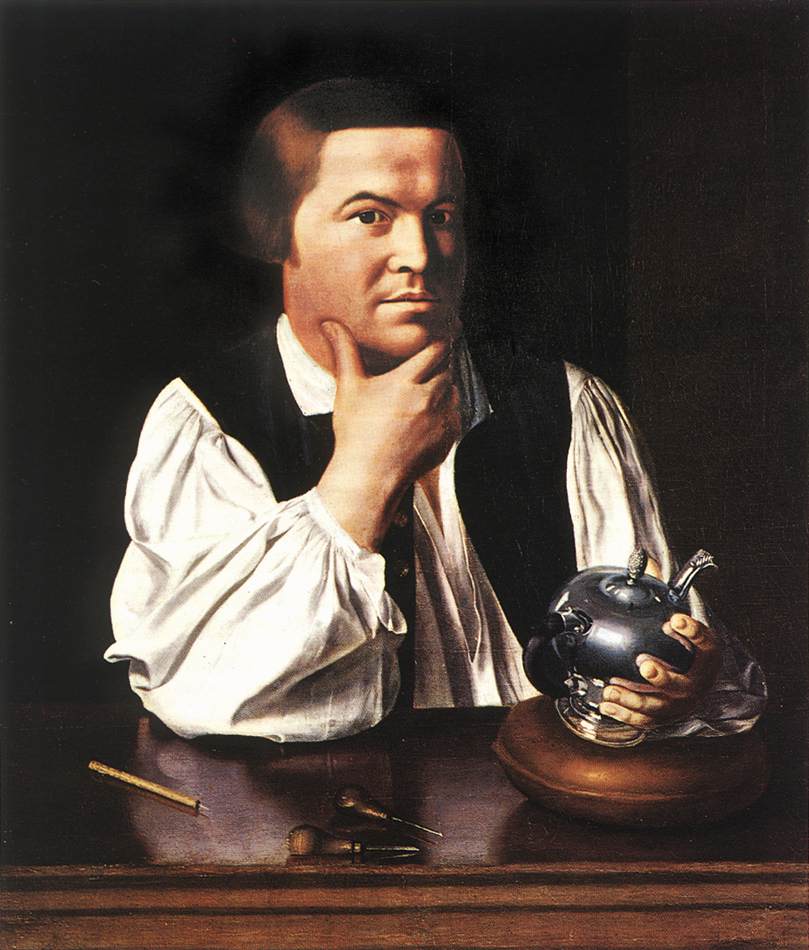
Apollos Rivoire, a French Huguenot refugee, immigrated to Boston when he was thirteen. Apprenticed to a silversmith, he learned his craft well and built a good business. His son followed in his footsteps apprenticed to his father as was the practice for millennia. Joseph was a carpenter as was his son in Nazareth.  There is much to be said for the personal handing down of skills and understanding. The nurturing of young lives, training them day by day into respect for themselves, for each other, for hard work and its fruits. Apollos later anglicized his name to Paul Revere.

Paul Revere, J.S. Copley

His son was born in 1735 and became renowned for his beautiful craftmanship; some of his works are still displayed in art museums including the Boston Museum of Fine Arts and the Metropolitan Museum in New York. [i]After the Revolutionary War that helped make him famous riding through the countryside to Concord and Lexington, to further his status in Boston society he decided to switch teams from a skilled artisan to a wealthy merchant as a nascent industrial age emerged.

Revere the son developed the business into lucrative trade after expanding out into other metals: copper and iron. He began manufacturing iron sash cord weights, church bells and rolled copper roofing, including the roof of the original capitol building in Massachusetts. Revere Copper Works started with a foundry and rolling mill in nearby Canton and still exists as the oldest still operating manufacturing company in America, albeit no longer in New England. Paul Revere was an early advocate of tariffs to protect his business from foreign competition, not to protect jobs, but to enhance profits.

Paul Revere exemplified America’s transformation from an agrarian society of rural farmers and local artisans into a nation massing in cities. American citizens converted by necessity from small-farm stewardship and skilled apprenticeships into specialized wage laborers ever more fragmented and distant from the self-sufficient small community folks who led the sort of lives Thomas Jefferson considered necessary for the American experiment in democracy and a constitutional republic to flourish.

Our agriculture and food supply providers devolved as well with thousands of skilled farmers gradually shrinking to far fewer large international corporate agribusiness managers, machine and chemical dependent, with its primary goal production and bushels per acre the sole measure of success. From mules and sweat and careful planting to harvesting combines and giant tractors. Utilization, not nurture. From the patient, observant skills of the artisan to tending the repetitive pounding of our technological wonders. From painstaking, paying close attention, respectful husbandry to mechanized plowing and harrowing. From rolling contoured pastures to strip mines.

“The first belt knife given by a European to an Indian was a portent as great as the cloud that mushroomed over Hiroshima…Instantly the man of 6,000 BC was bound fast to a way of life that had developed seven and a half millennia beyond his own. He began to live better and he began to die… In the sum it was cataclysmic. A culture was forced to change much faster than change could be adjusted to. All corruptions of culture produce breakdowns of morale, of communal integrity, and of personality….” Bernard DeVoto, The Course of Empire, 1952.

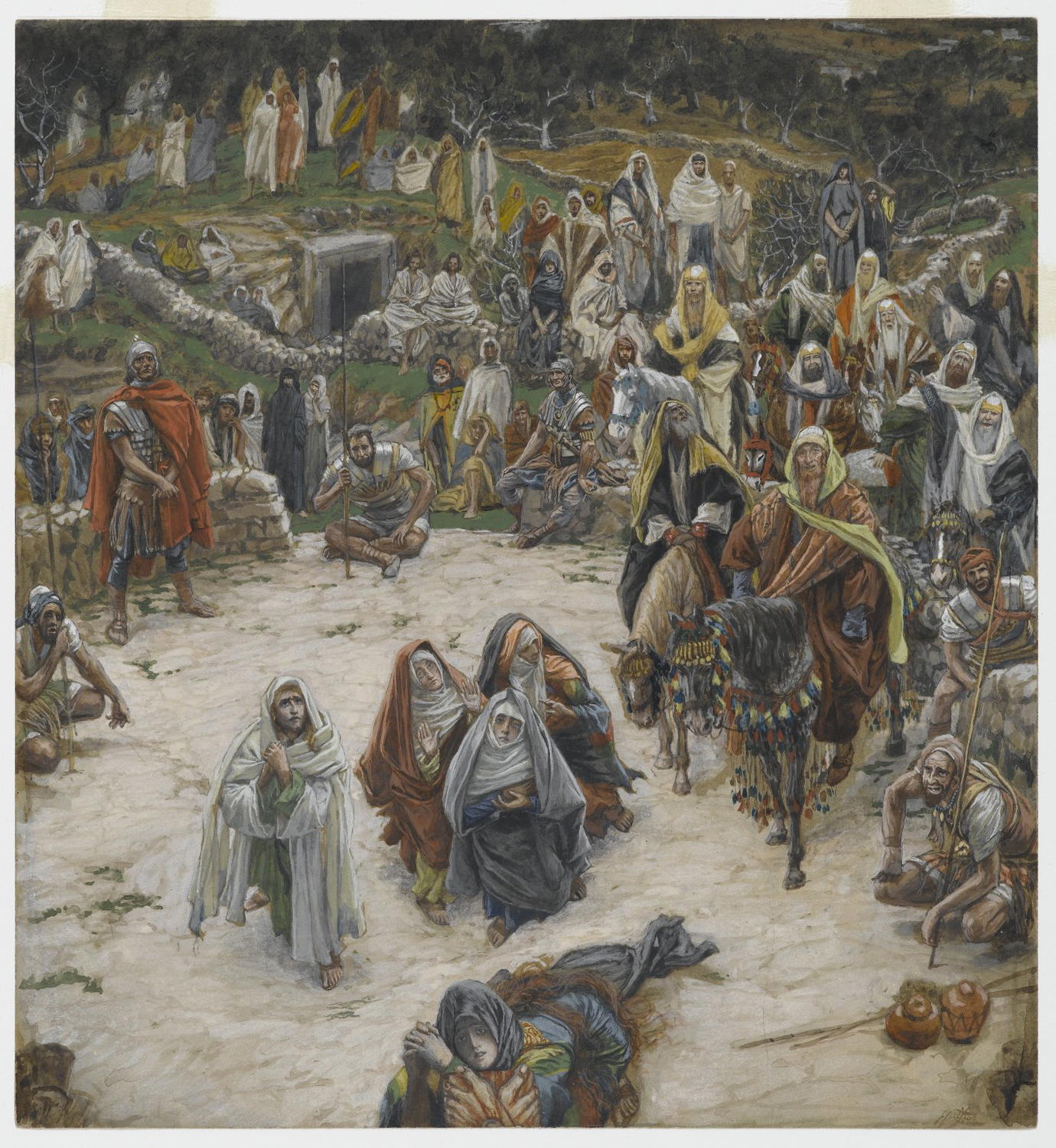
Tower of Babel, Pieter Bruegel the Elder

What can be learned from this brief quote and history lesson about what befell Native Americans? Can that lesson be applied to the great unsettling that seems to have uprooted our culture leaving us all unmoored and trying to figure out how we wound up so divided, adrift, and confused? Our two oldest granddaughters are on the cusp of Generation Z. They are the first generation in human history to grow up with an instantly accessible and seemingly unlimited portal into a strange, dangerous, and contentious world wide web in their pockets. Discerning information from disinformation, a tower of Babel unrivaled[ii]. As Jonathan Haidt put it, “The phone-based life makes it difficult for people to be fully present with others when they are with others, and to sit silently with themselves when they are alone.” [iii]

We have always struggled with what Blaise Pascal called “Divertissement” or distractions. In his posthumously published in 1670 “Pensées,” he lamented that most human tendency to seek distraction in entertainments, amusements of every kind, work, trivial conversations, gambling, addiction, ambition, even war. Anything to avoid confronting ourselves and thinking about our mortality, and the question of God. “(J)’ai dit souvent que tout le malheur des hommes vient d’une seule chose, qui est de ne savoir pas demeurer en repos dans une chambre.”   (“I have often said that the sole cause of man’s unhappiness is that he does not know how to stay quietly in his room.”)

Already well-practiced talent in our predilection to distracting ourselves from the “Big Transcendent Questions,” our creativity and invention have led us to the most pernicious distraction ever devised. Not ex nihilo, but a progression, a development of our irresistible and relentless pursuit of distraction from what we most want to avoid.  Can this profoundly disrupting technology now be accommodated to in a few years?  Or like the Native American suddenly discovering a whole world beyond their centuries old culture, are we “forced to change much faster than change could be adjusted to.”

For everyone older, the transformation has been no less disorienting than for our befuddled Generation Z, and we are just as perplexed about what to do about it. Some of us long in the tooth can even remember a world before the web, even before the blinking cursor, MSDOS, our first desktop personal computers with no hard drives, and the first awakenings of our future: before the deluge of data that assails us every waking moment, and certainly before the shocking portent of artificial intelligence and synthetic consciousness. We old ones are truly anachronism personified.

We have barely cleared the highest rise of the world’s scariest rollercoaster, having endured the slow, clanking, inexorable, hooked-up tow to the top. Now we have crested the peak and are experiencing that vertiginous moment and glimpse of what’s to come. You thought the ride so far has been disconcerting? Raise your hands over your head, maybe start screaming if it helps some, and get ready for the ride of your life.

The Machine manifests today as an intersection of money power, state power and increasingly coercive and manipulative technologies, which constitute an ongoing war against roots and against limits. Its momentum is always forward, and it will not stop until it has conquered and transformed the world. To do that, it must raze or transmute many older and less measurable things: rooted human communities, wild nature, human nature, human freedom, beauty, faith and the many deeper values which we all adhere to in some way or another but find difficult to describe or even to defend.” Paul Kingsnorth, Against the Machine, The Unmaking of Humanity, 2025  

So, we ask, ‘what is to be done?’  How do we survive the plunge?  Perhaps more relevantly, how do we find peace from the din? Silence the unremitting tumult, the cacophony of the screens, the absolute noise of it all? Always connected, often lonely. The Solution will not be found in some innovative Federal program. There is no Solution in a new Progressive Program devised in a focus group or think tank. Never has been.

Not Solution, only solutions. Tens of millions of them. One heart, one mind, one soul at a time. With shared hope, we will gather to support one another in small communities of faith and comradeship, volunteering our time and energy. We can grow a few things in our gardens and relearn that connection with wild things, with the soil, sun, rain, and gentle husbandry; plant indigenous pollinator gardens instead of clearing more ground for chemically sustained fairway lawns squandering thousands of gallons of water. We can patronize local small agriculture through farmer’s markets, buy from artisans in our own towns, and frequent local coffee shops rather than do business with corporate chain stores. Learn their faces and names and stories. Have conversations we don’t have to type or thumb onto our phone screens. We can regularly worship with our brothers and sisters in that church down the street, acknowledging that there is a God and we are not Him.  

But, just maybe, we can shore up a foundation under it all, more essential than even those precious common efforts. Our healing and hope will take place in quiet rooms early in the morning with the window open and a good cup of coffee. Listening. Just listening.  

“The LORD said: ‘Go out and stand on the mountain before the Lord; the Lord will pass by. There was a strong and violent wind…then an earthquake… and then a fire—but the LORD was not in them; after the fire, a gentle breeze.[iv] When he heard this, Elijah hid his face in his cloak and went out and stood at the entrance of the cave. 1 Kings 19:11-13


[i] Image: Paul Revere, J.S. Copley, Museum of Fine Arts, Public Domain, Wikimedia Commons

[ii] Image: Pieter Bruegel the Elder, The Tower of Babel, 1563. Kunsthistorisches Museum, Vienna. Public domain image via Wikimedia Commons / Google Art Project

[iii] The Anxious Generation: How the Great Rewiring of Childhood Caused an Epidemic of Mental Illness, Jonathan Haidt, 2024

[iv] The original Hebrew text, “qol d’mamah daqqah,” translates literally to “the sound of a thin, gentle silence”

2 Comments

Filed under Culture views

Minks, Piping Plovers, and AI

“When we try to pick out anything by itself, we find it hitched to everything else in the Universe.”

John Muir, My First Summer in the Sierra (1911)

I got a call at the wildlife refuge where we volunteer on Fridays from an excited woman who spotted a furry creature when she was walking the trails the evening before.  She wanted to know if anyone had reported a lost pet ferret.  “No,” I replied. “Tell me what you saw.”  I love some of the calls we get and questions from visitors at the desk.

She described a small, long, slender mammal with a luminous coat. I told her it was more than likely a mink, of which Sachuest Refuge has a few. “Wow!, “she said, “I didn’t know we had those around here.” [i]

I told her the story of a friend of ours who had an artificial fishpond her late husband had built for her that she was very fond of sitting near and watching the various finned and gilled creatures swimming about. One morning, she made her way to her fishpond chair to discover carnage. Half eaten and uneaten dead fish were strewn willy nilly on the rock riprap banks as if a plague wiped them out. Every last one of them. Nothing but lily pads left in the pond. A mink living in her stone wall had its way with them. A similar nocturnal mink catastrophe befell the outside fishpond at the local Agway store, but some carp survived. I said to the lady on the phone that not everyone has a positive experience with minks, and since they are smaller than most folks expect, it takes a whole lot of them to make a coat, but I was happy she enjoyed seeing one. They are beautiful.  When I volunteer at the visitor center, I sometimes get in trouble entertaining myself with an interjection of reality. She was a very nice woman full of enthusiasm and bubbling over with happiness.

Although minks are not endangered, I do object to turning them into coats to signal our prosperity, and I like to see them too. See them being minks. Slinking through the meadow grass, catching fish, raiding waterfowl nests for eggs, snatching meals snagging crabs, small voles or mice, making little minks and dodging coyotes, Northern harriers, and red tail hawks.

Our ranger here is young, smart, hard-working, pleasant, and passionate about what she does. She manages the trails, fields, woods, shoreline, wildlife, visitors, the visitor center, projects at other national wildlife refuges, the bureaucracy of her home office, and unruly volunteers like Rita and me. Good thing that she has a lot of energy. This weekend she was training a new batch of volunteer piping plover watchers and monitors. Piping plovers are wonders to watch feed and fly in murmuration. They are endangered and some of them nest along the rocks at the refuge end of Sachuest Beach. The rest of the beach is a walking haven for us for eight months of the year, and a popular swimming, surfing, and sunbathing haven for thousands in the summer. Keeping the tourists and local swimmers away from the piping plover nests is just one of our busy ranger’s many responsibilities. [ii]

“To keep every cog and wheel is the first precaution of intelligent tinkering.”  Aldo Leopold, Round River (published posthumously, 1953)

Only human beings discover the wonder in nature and want to protect other species, deriving no real Darwinian benefit to us. Just beautiful and true in some hard to define sense, so we find it good. Only human beings would dedicate their lives to doing good for a small shoreline bird that is darting back and forth between the waves with their tiny legs a blur to pick out small crustaceans and bugs. Or attend a class to learn how to help. A mink would only notice a piping plover if it wanted to hunt for its nest. A mink would not watch in wonder as a plover danced between the waves. A mink would not ponder the morality of eating an endangered species’ rare eggs. Not for a nanosecond would it hesitate to suck out breakfast.

Transcendentals: beauty, truth, goodness, are cherished by human beings. Some would argue we are a randomly mutated collection of cells which somehow by extraordinary chance evolved into consciousness, then an inner life, then a conscience with an unlikely set of common values. Some would argue that pondering transcendentals and seeking the good, the true, and the beautiful indicates we are creatures with a purpose Not a lucky accident but created in the Creator’s Image with the desire deep in our heart for unity with the transcendental. I would be in the second camp. Protecting piping plovers would be one small piece of evidence.

But that perspective is being challenged at a fundamental level. “What is a human being?” and “What is virtue?” and “What is human meaning and purpose?” are once again being debated in all their implications with the emergence of new technology and the machines we create developing so rapidly that it seems to have assumed a life of its own. And every premise is being deconstructed in its aftermath.

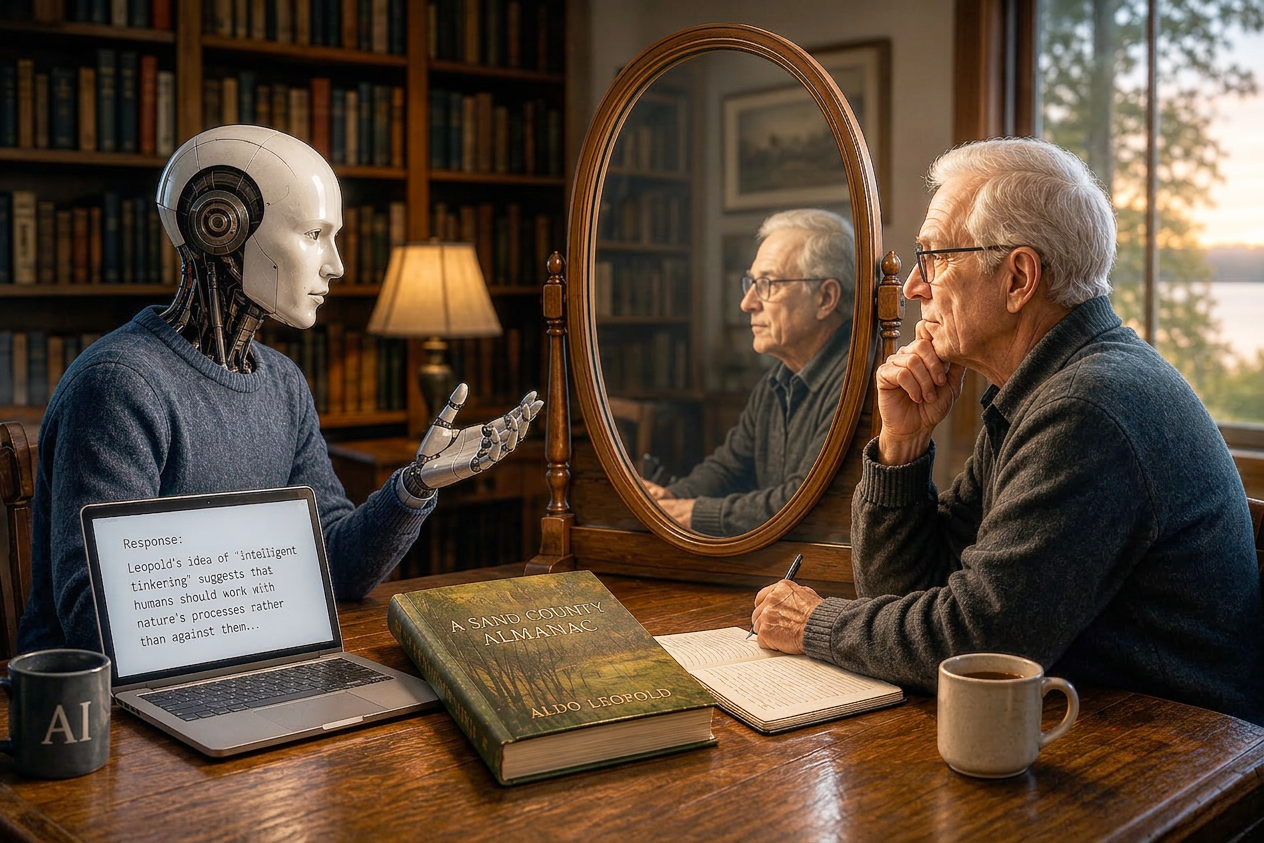
I’ve ‘chatted’ with a variety of Large Language Model Artificial Intelligence: Claude, Alexa, Grok, Gemini, Co-Pilot and mostly ChatGPT To be sure, in the last three years the progress in these machines is extraordinary, in conversational fluency, calculating skills, problem solving, precise responsiveness with nuance to inquiries with fewer errors and hallucinations. However, they remain remarkably capable, even uncanny simulacra.[iii]

Humans have long excelled in fabricating uncanny simulacra with a gift to evoke other human responses, emotions, and new ideas. Michelangelo ‘s David silences the observer with its detail, beauty, power, and presence. But it will never slay Goliath or seduce poor Uriah’s wife. A detailed online map with links could help us better appreciate Sachuest Point Wildlife Refuge, but it will never be the complex reality of marsh, rocks, waves, flowering fields and shrubs, over two hundred species of birds and mammals, wind, weather, and awe. AI can tell us most everything about a mink: habitat, food, where and how it builds a den, how it lives and reproduces, how it lives with detailed descriptions and images. But it will never experience the excitement of a hiker who sees one for the first time. Andi will never be a mink.

“And the people bowed and prayed to the neon god they made.” Paul Simon, Sounds of Silence

Last week, a new voice joined the debate in a profound way. Pope Leo XIV released his first encyclical a year after Chicago born Cardinal Robert Prevost was elected to sit in the chair of Peter as the 267th Pope, leading over a billion Catholics. He has made the news a few times, most recently when a president made the inane comments that a world religious leader had no business speaking out on the morality of war.  But I digress.

He wrote forty three thousand words on the nature of Artificial Intelligence and its implications for the rest of us. How it intensifies the debate about the nature of a human person. Ghost in machine? Accidental consciousness fired up in random atoms? Exceptional combination of the material and spiritual created by God Imago Dei with an obligation to care for the rest of creation? Meat Legos or a person with an eternal destiny and unique calling? He wrote how we are distinguished from our machines with an uncrossable border. Our crisis is not merely ideological; it is intensely anthropological and will have an impact on the rest of my life and yours in unpredictable ways. We ought to be paying close attention.

Magnifica Humanitas will stir introspection and debate in the Church and society to a degree perhaps not seen since his predecessor Leo XIII wrote his landmark encyclical Rerum Novarum. Leo XIII released his a hundred and thirty five years to the day before this one. He wrote about the human costs and implications of the Industrial Revolution. Leo today reiterated and expanded the Catholic social principles from Leo XIII that instantiate the teachings of Christ in new ways to address our postmodern culture. As usual, way too much for a blog post, so I’ll let one sample inspire your own reflections.

“What can be stated, however, is that we must avoid the misconception of equating this type of “intelligence” with that of human beings. These systems merely imitate certain functions of human intelligence. In doing so, they often surpass human intelligence in speed and computational capacity, offering tangible benefits across many fields. Yet this power remains entirely tied to data processing. So-called artificial intelligences do not undergo experiences, do not possess a body, do not feel joy or pain, do not mature through relationships and do not know from within what love, work, friendship or responsibility mean. Nor do they have a moral conscience, since they do not judge good and evil, grasp the ultimate meaning of situations, or bear responsibility for consequences. They may imitate language, behavior and analytical skills, or even simulate empathy and understanding, but they do not understand what they produce, for they lack the affective, relational and spiritual perspective through which human beings grow in wisdom.”

“Maybe someday I’ll wake up

And I’ll do what I should

Write a song to make heaven and earth

Go waltzing in time.” John Prine, Beautiful World

Let us all go to work.  None of us will escape. There is much to be done. No one will be exempt from the effects and implications of this dialogue with our future. I heard a story this week from a talk by Monsignor James Shea, one of our favorite writers about our times and culture. He said Pope Paul VI (now St. Paul VI) was asked by a journalist what was the most momentous day of his life. His questioner fully expected to hear about the day Paul was elected Pope. Or his ordination as a priest. Or his baptism followed by some remarks about salvation. None of the above. It seems saints see things differently.

“Today,” Paul replied. “Today is most momentous day of my life. It’s all I have.”

“Yesterday is gone. Tomorrow has not yet come. We have only today. Let us begin.” St. Mother Teresa


[i] Photo open source from Wikipedia, Mink for Wiki

[ii] Photo: I Naturalist – c Grigory Heaton some rights reserved, cc by NC

[iii] Simulacra is the plural of simulacrum, which I find best describes what AI does and is. A simulacrum is a representation of a something else. An effigy. An image. A reproduction made from something other than the original it represents.

Leave a comment

Filed under Culture views, Faith and Reason, Sachuest Point and other wonders

Afterward

  Ed died a couple of weeks ago. We went to his funeral, incongruously in the stately beauty of St. Mary Church in Newport where the Camelot Kennedys were married. Regular readers have met Ed here in another post. He was the gentle and once suffering soul who lived in an unmaintained mobile home with filthy floors, smoked too much, could barely clear the couch in his hovel to get to the bathroom, and took in homeless people just a click worse off than he was. He slept fitfully on his sagging couch with disheveled gray blankets of an indistinguishable original color, and his guests slept in his bed.

   Later he was moved against his will to a nursing home when pneumonia and advancing neuropathy and Parkinson’s took him down. The ambulance brought him to the hospital, and they wouldn’t let him go home again. We continued to bring him the Eucharist on Sundays after Mass there and celebrate a brief liturgy. It wasn’t a bad place as such places go, and the staff was kind. He was always astonishingly attentive and grateful and reverent with the Blessed Sacrament.

   I took him on an outing one morning in late September after he had recovered somehow from a bout with COVID. He was officially in hospice, but the nurse said I could take him out if I promised to bring him back as soon as he got tired. He could no longer walk, but the nurse helped me move him into the car from the wheelchair. His frail body weighed about as much as my twelve year old granddaughter.

  I had hoped we could go in the chair to a bench overlooking Second Beach outside the Sachuest Point Wildlife Refuge Visitor Center where we volunteer on Fridays. He once loved to walk the trails there when he could. Now even the move in a wheelchair to the bench was beyond him. So, we remained in the car and talked and just sat. Then we drove a couple of miles to Sweetberry Farm, drank coffee, and ate blueberry muffins from their small bakery there. We parked overlooking the orchard and fields and distant hills next to the tall hydrangeas. He most wanted to lower the windows and examine more closely the blooms on the hydrangeas. He was content to sit in silence and contemplate the flowers until he asked quietly if we could go back to his shared room so he could take a nap in his bed.  

“When they heard the sound of the Lord God walking about the garden in the breezy part of the day..” from Genesis 3

  Adam and Eve hid from God because they were afraid and ashamed, though they had never been that before they listened to the snake. They ate the fruit of the tree of good and evil, which was the only fruit of all the delightful trees in the garden from which they had been forbidden. Even though they were completely happy, they wanted more even though they had been warned it would ruin them. They wanted to become like God, to be God, and we still do strive to be so. In doing so, we struggle, fail, alienate ourselves from God and from one another; hurt ourselves and others. We want to be God, but we’re not and cannot be.

  But we are given a lovely image, a glimpse before the Fall when the Lord God walked about the garden in the breezy part of the day. Adam and Eve could join Him, talk with Him about all that is wonderful, laugh with Him, take in the incomprehensible beauty of the garden, of all God had made for us to enjoy, to be utterly joyful within.

  Now, this little bit of anthropomorphizing God is metaphor. We have no idea what before or after are.

  We have been told that whatever comes after our earthly heart stops and our brain stills will be more than we can ‘ask or imagine,’ but we cannot know what the beatific vision will be like. We have been told that there is more than dying and returning to the earth – dust to dust. More than ‘that’s all folks.’ More than a final corruption.

  We have been promised a new body that will last forever, a spiritual body, but not a spirit alone. We won’t be angels. Angels are a different order of creatures. We will be human beings with bodies as we were created from the earth, but in the image of God. Like Jesus, we will be resurrected as He promised for us. We will be ensouled but also embodied. A perfected body in the presence of God. Without disappointment or fear or pain. The breath of God will be within us.

  I dreamed last night. Ed was there. We somehow slid down along the stair walls together in a circular rotunda, very fast, laughing like fools, nearly flying. At the bottom I walked down a well-lit whisper quiet institutional corridor with light tan Formica walls with a pleasing design and matching Formica countertops until I came to a doorway and entered a small room with a desk. Ed was in the room helping an older lady write a letter she needed to petition some authority for help. He was happy to be her companion and aid. He looked up at me and smiled. I woke up.

  My imaginings of heaven are woefully inadequate, but I hope there are little houses in neighborhoods of friends that I love and with whom I am completely affable. Laughter is often heard. We share leisurely conversations about all things that are beautiful with lots of comfortable pauses to enjoy the evening breeze. And there is a yard with a garden to work in until it is green and pleasant and orderly with healthy shade trees, oaks, maples, and birch, perhaps there is a hammock looking up into one of them through the branches into a bright blue sky and billowing clouds, and hydrangeas to prune when I want.

   In the evening when the sea breeze comes up, maybe a walk in the vineyard overlooking the beach with my Lord talking softly or merely silent in sublime company and nothing needs to be said. Blissfully leg weary at the end of the day accomplishing fruitful things in the garden with my well worked hands leaves me pleasantly tired from a day well spent.

  Although Jesus told us that there will be no marriage in Heaven, deep friendships will persist. I like to think I’ll still be able to spoon sleepily with my dearest friend, Rita, with her hair that smells like spring. I like to fall asleep at night. In heaven I hope to fall instantly asleep and dream the unfettered joyful dreams of the redeemed.

“He who dwells in the shelter of the Most High and abides in the shadow of the Almighty says to the Lord: My refuge, my stronghold, my God in Whom I trust” Psalm 91 and the beginning of Sunday Night Prayer in the Liturgy of the Hours.

3 Comments

Filed under Faith and Reason

Amid the Ruins

“We shape our buildings; thereafter they shape us.” (They represent the spirit of their age. When they fall, so too has something essential in the civilization that made them.) quote from a 1943 speech by Winston Churchill

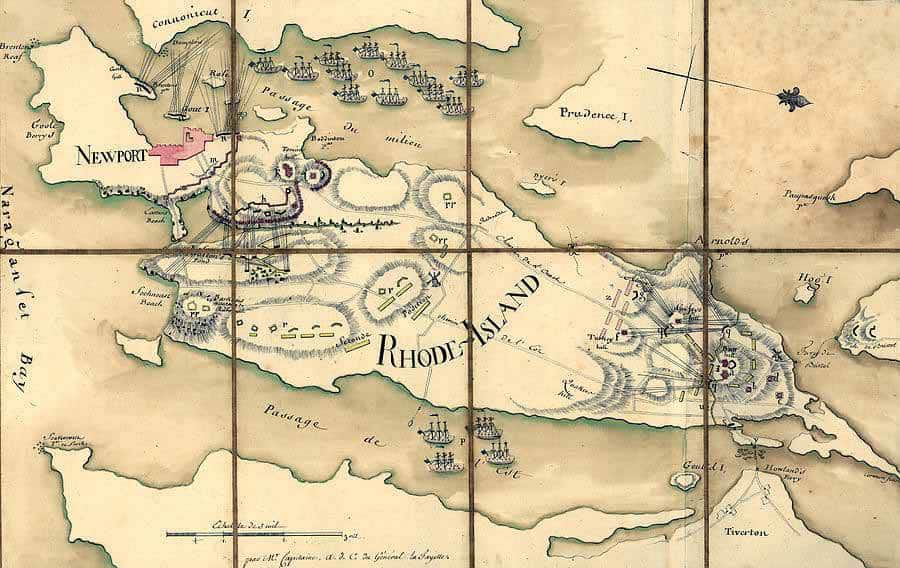
A “Great Storm” that lasted from August 11 to the 13th in 1778[i] disrupted the largest Revolutionary War battle in Rhode Island and changed the course of history, at least for Newport. Named the “Battle of Rhode Island”[ii] or alternatively “Battle of Quaker Hill,”[iii] the storm effectively put an end to the blockade when the supporting French fleet led by Admiral Charles Henri Hector d’Estaing was forced to withdraw to Boston for repairs to its heavily damaged ships, including the dismasting of his flagship.

British and Hessian forces occupying Newport were able to rally, lift the siege of Newport, and force the Colonial Army back to Fort Barton in Tiverton.  The battle was a draw, if not a defeat, and Newport remained in British hands until the end of the war when they finally withdrew after looting and burning the city, poisoning wells, and doing what they could to ruin the harbor by skuttling ships.  A notable feature of the battle was the colonial troops led by Colonel John Sullivan included one of the rare multiracial regiments with ethnic European troops, many Native Americans, and free black soldiers. The inexperienced and largely untrained regiment inflicted significant losses on the seasoned, brutal Hessian troops.

Major General Marquis de Lafayette[iv] was sent by George Washington to Rhode Island to coordinate the French forces with the colonists trying to drive the British from Newport. After the storm, Lafayette rode hard to Boston to try and convince d’Estaing to return to the blockade. Lafayette was unsuccessful in his mission, and the siege was not sustained. Absent the blockade, British forces marched on the Americans, drove them back, but they were able to accomplish an orderly retreat fighting rear guard skirmishes on Quaker Hill and Turkey Hill until escaping back across the Sakonnet River to the safety ofFort Barton in Tiverton.

Abraham Brown served as a private in the Rhode Island brigade and extended his hospitality to the Marquis. While in Tiverton, Marquis de Lafayette quartered at his home in a guest suite on the second floor. Thereafter, the well-known local Main Road farmstead, built around 1735, was referred to as the Lafayette House and registered as an historic landmark.

“Religion in America… must be regarded as the foremost of the political institutions of that country… I do not know whether all the Americans have a sincere faith in their religion—for who can search the human heart?—but I am certain that they hold it to be indispensable to the maintenance of republican institutions.”  Alexis de Tocqueville [v]

In “God of Liberty,” Thomas Kidd’s history of the role of religion in the American Revolution, he documents the remarkable mixture of Christian and Deist faith of the American colonists and Founding Fathers.  From Congregationalists, Methodists, Calvinists, Anglicans, Baptists, remnants of Puritans, Baptists and Evangelicals of the “Great Awakening” to Unitarians, Quakers, and Enlightenment Deists like Franklin and Jefferson. Yet within their theological vagaries and variety there remained a common set of values, an agreed understanding and the basis of the culture that enlivened Revolutionary fervor and informed most all Americans about why citizens benefited from and were due human freedom. Freedom to seek their own path, their own faith, their own prosperity, their own life. Freedoms “endowed by their Creator,” and not the capricious largess of monarchs or men.  

Kidd wrote “They (shared bonds) vitally bound together Americans of widely differing religious opinions…  Common religious public religious values also gave ballast to a new country that badly needed stability.”[vi]  These foundational truths were summarized in five principles:

  1. The disestablishment of state churches.
  2. A Creator God is the guarantor of fundamental human rights.
  3. The threat to polity posed by human sinfulness.
  4. A republic could only be sustained by the virtue of its citizens.
  5. God (or Providence for the Deists) moved in and through nations.

These five principles undergirded the ‘great experiment’ of which we are downstream. How many still inform us? Is the disunity we are experiencing exacerbated or even caused by our abandonment of that community of shared beliefs and cultural imagination? The answer to that, it seems to me, is self-evident.

  “Ruins are the visible symbols and landmarks of our societies and their changes… they expose the omnipresence of death and decay. They are the remains of history.” Andreas Huyssen, Present Pasts[vii]

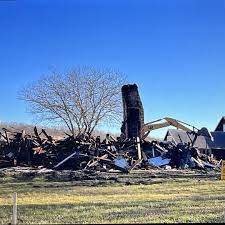
David Rose’s family owned the Lafayette House on Main Road for decades along with the adjacent thirty acres. With an ill-maintained home for a long time, David had a problem. He wanted to sell the prime location acreage for possible development, but the Lafayette landmark, now deteriorating, was a hindrance to the asking price of $6.8 million.

Rose applied to the Tiverton Building Department for a demolition permit. Since the house was listed on the Rhode Island Register of Historic Places, he misrepresented the house on the application by checking “No” on the permit to the question about the house having historic relevance. Thus, he expedited his plans and avoided any potential complications and review by the state or Tiverton Historic Preservation Advisory Board. The acting building inspector, who is no longer the acting building inspector, was either complicit or ignorant, let it slide, and signed off. The Town Manager, who is no longer the Town Manager, and the Building Inspector learned from the Town Council, after the dust settled, it was time to move on or retire.

A week before last Christmas in Blitzkrieg, the house was no more. After the first morning it was mostly a pile of rubble hastened by heavy equipment. By the end of the week, the rubble mostly disappeared, and the foundation hole was leveled over. The shocking effect on many frequent passersby like us was like seeing scorched earth where the garden had been. The Blitzkrieg demolition was not only an architectural loss but a civic betrayal—of truth, of memory, of shared reverence for what came before. Overnight, the beautiful old house on the hill awaiting a conscientious buyer to restore it was no more. Part of our shared history was no more.

“In the West, we have been withdrawing from our tradition-, religion- and even nation-centered cultures… But we are increasingly falling prey to the desperation of meaninglessness, and that is no improvement at all.”  Jordan Peterson

With brief reflection most will agree that the five principles described in the “God of Liberty” book are lost, compromised, broken —- reduced to a ruin, its foundation filled and leveled with debris. At least as far as common understanding and shared worldview. Even the concept of virtue is hotly debated, never mind God endowed rights and responsibilities. We live amid the ruins of what was a shared culture.  The confusion and conflict that result describes our time. Where does that lead us?  What does that leave us?

Disruption and disconcerting events will happen. Suffering will happen. Doubt will happen. Confusion and fear will happen. To everyone, including me. Death will happen, and the existential dread of annihilation haunts us all. Good Fridays will happen to us all.

For me, Easter brings the clarity necessary for me to get up in the morning. As real as Good Friday is in our lives, so is the promise of the Resurrection. God’s answer to our fear, suffering, and bewilderment was not to remove it, to make us automatons without suffering but without our own wills. His answer was in a Person, His own Word, His very self, Who not only joined us, but descended all the way down to godforsakenness.[viii]  He experienced everything that destroys us: the hubris of enemies and authority, scapegoating, betrayal, inconceivable violence, hatred, revenge, abandonment, terrible loneliness, loss of every possession and power, humiliation in every possible way, unimaginable pain and cold death nailed naked on a cross.

The Creator of the universe’s response was not vengeance, not retribution, not raining down fire, not destruction, but forgiveness, patience, love, and new life. Death and hatred defeated by love. That our hope is not in conquest or power, but in surrender to a Will beyond our imagination. For us. For me. For you.

And to those who seek assent even to an imperfect faith and seek to understand and be astonished by the enormity, transcendence, and wonder of this gift, everything changes.[ix]

 “May nothing disturb you, nothing frighten you. All things pass; God does not leave. Patient endurance attains all things. Whoever has God lacks nothing: God alone is enough.” Teresa of Avila

[i] The “Great Storm” so named by those who suffered through it. It was described as a powerful Nor’easter but given its timing in hurricane season and the state of meteorology at the time, I cannot determine exactly its species. Not all storms were named as we currently obsess with, but this one was. Either way, it laid the area low.  

[ii] Here’s a good summary if you have interest in the “Battle of Rhode Island.”

[iii] We live in our modest bungalow on the top of Quaker Hill in Portsmouth where part of the battle took place. Thus, my fascination with the battle. Men died here defending liberty. Perhaps right in our back yard near our bird feeder and daffodils.

[iv] Sidebar: after the war in America Lafayette was an early supporter of the French  Revolution but became a critic when the Republican populists of Robespierre unleashed the chaotic terror of the guillotine and tumbrils. A member of the aristocracy, Lafayette fled for his life and survived. Admiral d’Estaing was not so fortunate, and his head was separated from his body by the guillotine. Robespierre, of course, suffered a similar sudden dismasting when his mob turned on him.

[v] Democracy in America, Volume I, Chapter 17

[vi] God of Liberty, Thomas Kidd, Basic Books, a Member of the Perseus Books Group, 2016

[vii][vii] Present Pasts, Andreas Huyssen, Stanford University Press, 2003

[viii] Bishop Robert Barron, Easter reflection, 2025

[ix] George Weigel, Easter Changes Everything, First Things, 2012

Leave a comment

Filed under Culture views, Faith and Reason

perspectives from a few steps back

“It is better to take refuge in the LORD

than to trust in man.

It is better to take refuge in the LORD

than to trust in princes.”   Psalm 118: 8-9

 Papa standing at the rimIf we had lived in the Roman Empire, which lasted about 500 years as the Western Roman Empire and another thousand or so as the Byzantine Empire based in Constantinople, we would have expected that daily life probably would never change[i].

If I was a carpenter in a village outside of Rome in the year 200 AD, I’d get up before dawn for a simple breakfast of bread, cheese, and water, and gather my wood and iron tools, some I had made, some I inherited from my father and grandfather.  Off to work making doors or furniture or a larger project in a team like an aqueduct. Return home at the end of a taxing day, maintain and clean my tools, readying them for the morning, a supper of fish or grains or occasional meat. Time with my family, a quiet conversation about the kids with my wife, or perhaps head out to the tavern to debate the games or the latest battles up north or the comely suppleness of the new barmaid. A few times a year, if I was so inclined, I might head off to the games. Gladiators, animal hunts, spectacular and gruesome executions, maybe a few of those annoying Christians thrown in among the hungry lions, bears, and tigers.

I would expect my sons to follow in my trade, join the guild, learn the skills. As I had. As my father and grandfather had. There would be a sense of inevitability and the survival of my culture, a natural permanent order of things that always were and always will be. I might complain about the excesses, stupidity, and corruption of the current emperor, grumble quietly to friends or family that I trusted. My best hope might be that an illness or assassination would bring about a change in the emperor. That there would be no emperor would probably never occur to me. I’d have little understanding of the eventual effervescence of every system or culture.

We bicker, fuss, complain about, and regret (or perhaps celebrate) the recent election or the woeful character of the choices presented to us, but do we spend any effort on the why or whether or the finitude of the fragile and vulnerable structure of the society that spawned such an election? Are we bedeviled by the trees and unaware of the danger to the forest? Are the smoldering coals in old fires even now biding time until a little breeze fires them into a conflagration?

But we ought to consider that we may be in a period of profound change that historians will regard as the collapse of a civilization. Not to panic, the transition may be several centuries in the making and another in the denouement, but for we who are living in it, a lasting confusion may accompany us throughout our lifetime.

“Schism in the soul, schism in the body social, will not be resolved by any scheme to return to the good old days (archaism), or by programs guaranteed to render an ideal projected future (futurism), or even by the most realistic, hardheaded work to weld together again the deteriorating elements [of civilization]. Only birth can conquer death―the birth, not of the old thing again, but of something new.”  Joseph Campbell, “The Hero with a Thousand Faces” commenting on Arnold Toynbee’s “A Study of History.

Why does the disruptive populism of a Donald Trump resonate with seventy million voters? One contributing factor is the sense of powerlessness and disconnection of so many. Why are depression, drug use, and loneliness at historically high levels, especially among the young?

We wander around in a time afflicted with “presentism.” From a Rusty Reno article, “Resisting Presentism”, on the fallacy of naively looking towards a perfect future while ignoring the hard earned lessons of the past: “We live in a time of hot takes. Websites rush to post commentary of the latest Trump nomination. Denizens of X and other social-media sites swirl in cyclones of denunciation and attack. Everything is keyed to what’s happening right now. The latest triumph. The latest outrage. The latest meme.” And this societal addiction by its nature leaves us terribly anxious in a constant knawing state of feeling unmoored.

A culture of self-invention, radical subjectivism, and materialist utilitarianism is what we have. A seething cauldron of conflicting values with no umpire who everyone accepts to call balls and strikes or who is safe or out because there are no agreed upon rules. Or commonly understood definitions for that matter.  We are a society of dueling egos and wills in a Nietzschean or Hobbesian nightmare. Some of our disagreements leave little room for compromise because they are so fundamental. A warm baby or a fetus torn asunder before she can draw a breath.  A man somehow changed into a woman or a surgically mutilated, permanently sterile male human body with missing parts and now committed to a lifetime of taking debilitating artificial hormones while still suffering from a tormenting mental illness.

Blame social media, the computer in everyone’s pocket, coercive and intrusive government and institutional reeducation, ideological programs that undermine trust and family structure, the deep and growing hostility and anger in the culture split along ideological lines, the twenty four hour alarmist news cycle, the predominance of nihilism, violence, and exploitive sexuality in popular entertainment, ubiquitous, addictive, and ever more degrading porn, fatherless households, racism, sexism, transphobic animus, Big Corporations, Big Pharma, billionaire tyrants, elite technocrats running our lives, lack of gun laws, too many gun laws, far right extremism, far left extremism, Nazis in the woodshed, communists in the Senate, forever chemicals in the water, overpopulation, death spiral birth rates, or pick your lead story of the day. Reasons for societal unhappiness are not in short supply and reducing our woes to one or the other also breaks along ideological fault lines.

We are the confused mess that is living through the death of one civilization and the unknown beginnings of the next.

“It’s a restless hungry feeling

That don’t mean no one no good

When ev’rything I’m a-sayin’

You can say it just as good

You’re right from your side

I’m right from mine

We’re both just one too many mornings

And a thousand miles behind” Bob Dylan, “One Too Many Mornings.”  1964

 In July, a post here discussed in detail the weakening infrastructure of Sagging Bridges in our home state of Rhode Island. The physical deterioration of what we rely on every day was a metaphor for the deep-rooted breakdown of what we rely on every day for our societal coherence.  Like the road bridges, the bridges of our civilization – their pilings, supports, beams, and the strength of what keeps us from plunging into the river are corroding and creaking a bit each time they are driven over.[ii]

I’ve been fascinated by the various and unlikely voices over the last couple of years who are lamenting the loss of a “Christian civilization,” a culture with objective truths and values, a culture with defined borders, and agreed upon norms of behavior.  Defining for its members what’s good and what’s evil. Defining a solid foundation of an agreed upon understanding of the nature of human fulfillment and happiness. Among these are Richard Dawkins, one the four horsemen of the new atheism, Jordan Peterson, social influencer extraordinaire and still on a spiritual journey, and Bill Maher, celebrated TV host, comedian, atheist, and mocker of all things religious. Others too. They understand the loss and turmoil of living in a post Christian culture but fall short of understanding what is required. They think that we can build a vehicle to the future by our own efforts. Perhaps a few tweaks and little Kantian categorical imperative. Similar to me trying to fix my car with a YouTube video, a screwdriver, and vice grips.

“Said the Lord God, “Build a house,

Smoke and iron, spark and steam,

Speak and vote and buy and sell;

Let a new world throb and stream,

Seers and makers, build it well.”   G.K. Chesterton, The Kingdom of Heaven

 They understand the loss and turmoil of living in a post Christian culture but cannot bring themselves to acknowledge that the center of a Christian culture is not a set of rules, boundaries, and definitions, but a relationship with a Person.[iii] A Christian culture without Christ is incoherent.  We will try in vain to build a tower to heaven as did the people of Babel.  Don’t we ever learn?  A tower buiilt with our own tools  isn’t what is needed, but a road, a path, a Way.

The road to heaven is already leveled and built. We must learn to walk on it.

 “And everyone who listens to these words of mine but does not act on them will be like a fool who built his house on sand. The rain fell, the floods came, and the winds blew and buffeted the house. And it collapsed and was completely ruined.”  Matthew 7: 26-27

[i][i] Other cultures have lasted even longer than the Roman civilization. The folks who lived in them probably never foresaw any different state. Here are a few.

[ii] In that post was some discussion of Patrick Deneen’s insightful 2018 book “Why Liberalism Failed. A worthy read which asks the question has liberalism failed because it succeeded? Its failure was preordained in its premises.  The book was praised by such diverse reviewers as Barack Obama and Rod Dreher.  Rather than reiterate what’s already been written, read last year’s post in the link above or better, read the book. Another powerful book on a related theme was Charles Chaput’s 2016 “Strangers in a Strange Land.”  How does one begin to live an authentic Christian life in a post Christian culture? Way too much for a blog post, I suggest strongly for your reflection and to gain deep insight into our times, read the book. Accessible, wonderfully written and powerfully insightful about what we are living through, yet the book is hopeful about where peace both inner and corporately can be found.

[iii] A brilliant debunking of “Christian civilization” without Christ is in the current First Things issue. “Against Christian Civilization” by Paul Kingsnorth. Taken from his Erasmus Lecture a few months ago. Well worth your time.

1 Comment

Filed under Culture views, Faith and Reason