Tag Archives: religion

Minks, Piping Plovers, and AI

“When we try to pick out anything by itself, we find it hitched to everything else in the Universe.”

John Muir, My First Summer in the Sierra (1911)

I got a call at the wildlife refuge where we volunteer on Fridays from an excited woman who spotted a furry creature when she was walking the trails the evening before.  She wanted to know if anyone had reported a lost pet ferret.  “No,” I replied. “Tell me what you saw.”  I love some of the calls we get and questions from visitors at the desk.

She described a small, long, slender mammal with a luminous coat. I told her it was more than likely a mink, of which Sachuest Refuge has a few. “Wow!, “she said, “I didn’t know we had those around here.” [i]

I told her the story of a friend of ours who had an artificial fishpond her late husband had built for her that she was very fond of sitting near and watching the various finned and gilled creatures swimming about. One morning, she made her way to her fishpond chair to discover carnage. Half eaten and uneaten dead fish were strewn willy nilly on the rock riprap banks as if a plague wiped them out. Every last one of them. Nothing but lily pads left in the pond. A mink living in her stone wall had its way with them. A similar nocturnal mink catastrophe befell the outside fishpond at the local Agway store, but some carp survived. I said to the lady on the phone that not everyone has a positive experience with minks, and since they are smaller than most folks expect, it takes a whole lot of them to make a coat, but I was happy she enjoyed seeing one. They are beautiful.  When I volunteer at the visitor center, I sometimes get in trouble entertaining myself with an interjection of reality. She was a very nice woman full of enthusiasm and bubbling over with happiness.

Although minks are not endangered, I do object to turning them into coats to signal our prosperity, and I like to see them too. See them being minks. Slinking through the meadow grass, catching fish, raiding waterfowl nests for eggs, snatching meals snagging crabs, small voles or mice, making little minks and dodging coyotes, Northern harriers, and red tail hawks.

Our ranger here is young, smart, hard-working, pleasant, and passionate about what she does. She manages the trails, fields, woods, shoreline, wildlife, visitors, the visitor center, projects at other national wildlife refuges, the bureaucracy of her home office, and unruly volunteers like Rita and me. Good thing that she has a lot of energy. This weekend she was training a new batch of volunteer piping plover watchers and monitors. Piping plovers are wonders to watch feed and fly in murmuration. They are endangered and some of them nest along the rocks at the refuge end of Sachuest Beach. The rest of the beach is a walking haven for us for eight months of the year, and a popular swimming, surfing, and sunbathing haven for thousands in the summer. Keeping the tourists and local swimmers away from the piping plover nests is just one of our busy ranger’s many responsibilities. [ii]

“To keep every cog and wheel is the first precaution of intelligent tinkering.”  Aldo Leopold, Round River (published posthumously, 1953)

Only human beings discover the wonder in nature and want to protect other species, deriving no real Darwinian benefit to us. Just beautiful and true in some hard to define sense, so we find it good. Only human beings would dedicate their lives to doing good for a small shoreline bird that is darting back and forth between the waves with their tiny legs a blur to pick out small crustaceans and bugs. Or attend a class to learn how to help. A mink would only notice a piping plover if it wanted to hunt for its nest. A mink would not watch in wonder as a plover danced between the waves. A mink would not ponder the morality of eating an endangered species’ rare eggs. Not for a nanosecond would it hesitate to suck out breakfast.

Transcendentals: beauty, truth, goodness, are cherished by human beings. Some would argue we are a randomly mutated collection of cells which somehow by extraordinary chance evolved into consciousness, then an inner life, then a conscience with an unlikely set of common values. Some would argue that pondering transcendentals and seeking the good, the true, and the beautiful indicates we are creatures with a purpose Not a lucky accident but created in the Creator’s Image with the desire deep in our heart for unity with the transcendental. I would be in the second camp. Protecting piping plovers would be one small piece of evidence.

But that perspective is being challenged at a fundamental level. “What is a human being?” and “What is virtue?” and “What is human meaning and purpose?” are once again being debated in all their implications with the emergence of new technology and the machines we create developing so rapidly that it seems to have assumed a life of its own. And every premise is being deconstructed in its aftermath.

I’ve ‘chatted’ with a variety of Large Language Model Artificial Intelligence: Claude, Alexa, Grok, Gemini, Co-Pilot and mostly ChatGPT To be sure, in the last three years the progress in these machines is extraordinary, in conversational fluency, calculating skills, problem solving, precise responsiveness with nuance to inquiries with fewer errors and hallucinations. However, they remain remarkably capable, even uncanny simulacra.[iii]
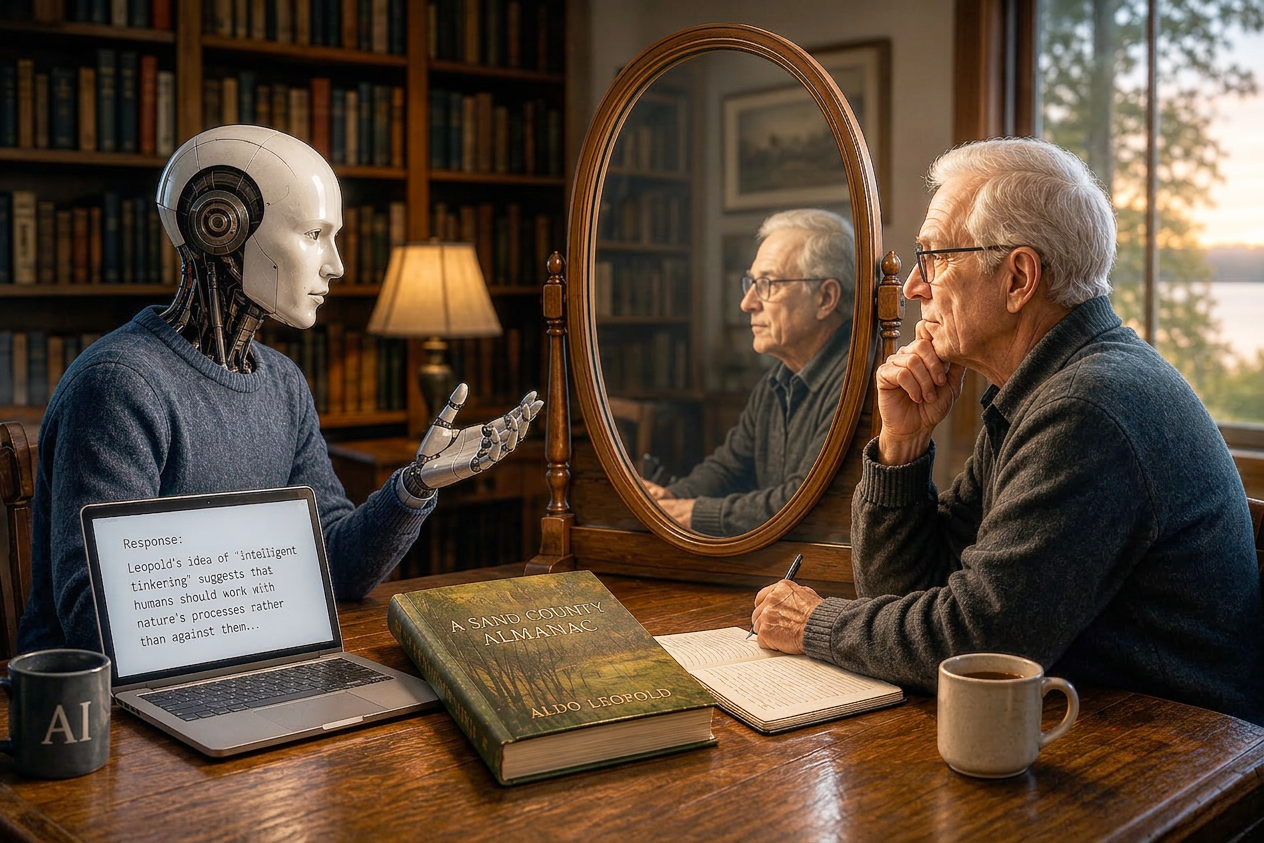
Humans have long excelled in fabricating uncanny simulacra with a gift to evoke other human responses, emotions, and new ideas. Michelangelo ‘s David silences the observer with its detail, beauty, power, and presence. But it will never slay Goliath or seduce poor Uriah’s wife. A detailed online map with links could help us better appreciate Sachuest Point Wildlife Refuge, but it will never be the complex reality of marsh, rocks, waves, flowering fields and shrubs, over two hundred species of birds and mammals, wind, weather, and awe. AI can tell us most everything about a mink: habitat, food, where and how it builds a den, how it lives and reproduces, how it lives with detailed descriptions and images. But it will never experience the excitement of a hiker who sees one for the first time. Andi will never be a mink.

“And the people bowed and prayed to the neon god they made.” Paul Simon, Sounds of Silence

Last week, a new voice joined the debate in a profound way. Pope Leo XIV released his first encyclical a year after Chicago born Cardinal Robert Prevost was elected to sit in the chair of Peter as the 267th Pope, leading over a billion Catholics. He has made the news a few times, most recently when a president made the inane comments that a world religious leader had no business speaking out on the morality of war.  But I digress.

He wrote forty three thousand words on the nature of Artificial Intelligence and its implications for the rest of us. How it intensifies the debate about the nature of a human person. Ghost in machine? Accidental consciousness fired up in random atoms? Exceptional combination of the material and spiritual created by God Imago Dei with an obligation to care for the rest of creation? Meat Legos or a person with an eternal destiny and unique calling? He wrote how we are distinguished from our machines with an uncrossable border. Our crisis is not merely ideological; it is intensely anthropological and will have an impact on the rest of my life and yours in unpredictable ways. We ought to be paying close attention.

Magnifica Humanitas will stir introspection and debate in the Church and society to a degree perhaps not seen since his predecessor Leo XIII wrote his landmark encyclical Rerum Novarum. Leo XIII released his a hundred and thirty five years to the day before this one. He wrote about the human costs and implications of the Industrial Revolution. Leo today reiterated and expanded the Catholic social principles from Leo XIII that instantiate the teachings of Christ in new ways to address our postmodern culture. As usual, way too much for a blog post, so I’ll let one sample inspire your own reflections.

“What can be stated, however, is that we must avoid the misconception of equating this type of “intelligence” with that of human beings. These systems merely imitate certain functions of human intelligence. In doing so, they often surpass human intelligence in speed and computational capacity, offering tangible benefits across many fields. Yet this power remains entirely tied to data processing. So-called artificial intelligences do not undergo experiences, do not possess a body, do not feel joy or pain, do not mature through relationships and do not know from within what love, work, friendship or responsibility mean. Nor do they have a moral conscience, since they do not judge good and evil, grasp the ultimate meaning of situations, or bear responsibility for consequences. They may imitate language, behavior and analytical skills, or even simulate empathy and understanding, but they do not understand what they produce, for they lack the affective, relational and spiritual perspective through which human beings grow in wisdom.”

“Maybe someday I’ll wake up

And I’ll do what I should

Write a song to make heaven and earth

Go waltzing in time.” John Prine, Beautiful World

Let us all go to work.  None of us will escape. There is much to be done. No one will be exempt from the effects and implications of this dialogue with our future. I heard a story this week from a talk by Monsignor James Shea, one of our favorite writers about our times and culture. He said Pope Paul VI (now St. Paul VI) was asked by a journalist what was the most momentous day of his life. His questioner fully expected to hear about the day Paul was elected Pope. Or his ordination as a priest. Or his baptism followed by some remarks about salvation. None of the above. It seems saints see things differently.

“Today,” Paul replied. “Today is most momentous day of my life. It’s all I have.”

“Yesterday is gone. Tomorrow has not yet come. We have only today. Let us begin.” St. Mother Teresa


[i] Photo open source from Wikipedia, Mink for Wiki

[ii] Photo: I Naturalist – c Grigory Heaton some rights reserved, cc by NC

[iii] Simulacra is the plural of simulacrum, which I find best describes what AI does and is. A simulacrum is a representation of a something else. An effigy. An image. A reproduction made from something other than the original it represents.
Leave a comment

Filed under Culture views, Faith and Reason, Sachuest Point and other wonders

Amid the Ruins

“We shape our buildings; thereafter they shape us.” (They represent the spirit of their age. When they fall, so too has something essential in the civilization that made them.) quote from a 1943 speech by Winston Churchill

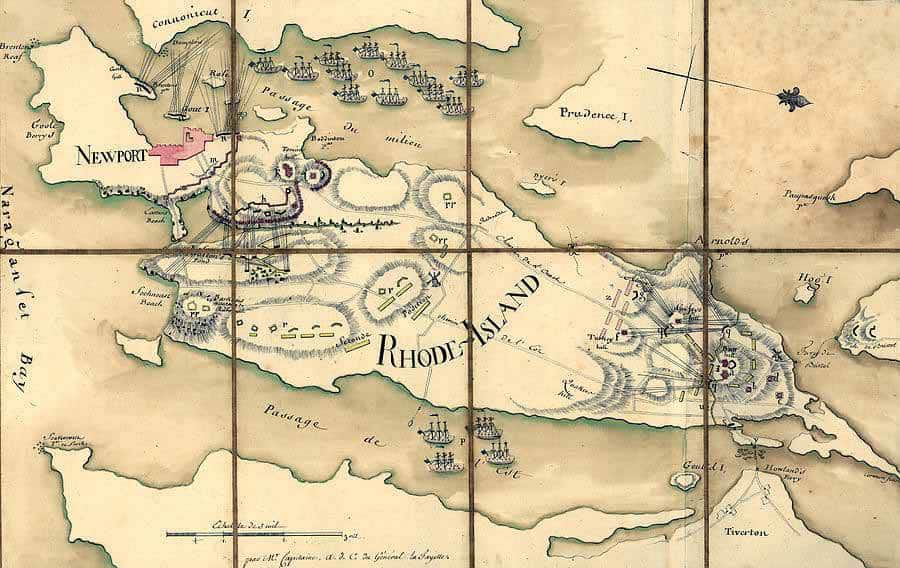
A “Great Storm” that lasted from August 11 to the 13th in 1778[i] disrupted the largest Revolutionary War battle in Rhode Island and changed the course of history, at least for Newport. Named the “Battle of Rhode Island”[ii] or alternatively “Battle of Quaker Hill,”[iii] the storm effectively put an end to the blockade when the supporting French fleet led by Admiral Charles Henri Hector d’Estaing was forced to withdraw to Boston for repairs to its heavily damaged ships, including the dismasting of his flagship.

British and Hessian forces occupying Newport were able to rally, lift the siege of Newport, and force the Colonial Army back to Fort Barton in Tiverton.  The battle was a draw, if not a defeat, and Newport remained in British hands until the end of the war when they finally withdrew after looting and burning the city, poisoning wells, and doing what they could to ruin the harbor by skuttling ships.  A notable feature of the battle was the colonial troops led by Colonel John Sullivan included one of the rare multiracial regiments with ethnic European troops, many Native Americans, and free black soldiers. The inexperienced and largely untrained regiment inflicted significant losses on the seasoned, brutal Hessian troops.

Major General Marquis de Lafayette[iv] was sent by George Washington to Rhode Island to coordinate the French forces with the colonists trying to drive the British from Newport. After the storm, Lafayette rode hard to Boston to try and convince d’Estaing to return to the blockade. Lafayette was unsuccessful in his mission, and the siege was not sustained. Absent the blockade, British forces marched on the Americans, drove them back, but they were able to accomplish an orderly retreat fighting rear guard skirmishes on Quaker Hill and Turkey Hill until escaping back across the Sakonnet River to the safety ofFort Barton in Tiverton.

Abraham Brown served as a private in the Rhode Island brigade and extended his hospitality to the Marquis. While in Tiverton, Marquis de Lafayette quartered at his home in a guest suite on the second floor. Thereafter, the well-known local Main Road farmstead, built around 1735, was referred to as the Lafayette House and registered as an historic landmark.

“Religion in America… must be regarded as the foremost of the political institutions of that country… I do not know whether all the Americans have a sincere faith in their religion—for who can search the human heart?—but I am certain that they hold it to be indispensable to the maintenance of republican institutions.”  Alexis de Tocqueville [v]

In “God of Liberty,” Thomas Kidd’s history of the role of religion in the American Revolution, he documents the remarkable mixture of Christian and Deist faith of the American colonists and Founding Fathers.  From Congregationalists, Methodists, Calvinists, Anglicans, Baptists, remnants of Puritans, Baptists and Evangelicals of the “Great Awakening” to Unitarians, Quakers, and Enlightenment Deists like Franklin and Jefferson. Yet within their theological vagaries and variety there remained a common set of values, an agreed understanding and the basis of the culture that enlivened Revolutionary fervor and informed most all Americans about why citizens benefited from and were due human freedom. Freedom to seek their own path, their own faith, their own prosperity, their own life. Freedoms “endowed by their Creator,” and not the capricious largess of monarchs or men.  

Kidd wrote “They (shared bonds) vitally bound together Americans of widely differing religious opinions…  Common religious public religious values also gave ballast to a new country that badly needed stability.”[vi]  These foundational truths were summarized in five principles:

  1. The disestablishment of state churches.
  2. A Creator God is the guarantor of fundamental human rights.
  3. The threat to polity posed by human sinfulness.
  4. A republic could only be sustained by the virtue of its citizens.
  5. God (or Providence for the Deists) moved in and through nations.

These five principles undergirded the ‘great experiment’ of which we are downstream. How many still inform us? Is the disunity we are experiencing exacerbated or even caused by our abandonment of that community of shared beliefs and cultural imagination? The answer to that, it seems to me, is self-evident.

  “Ruins are the visible symbols and landmarks of our societies and their changes… they expose the omnipresence of death and decay. They are the remains of history.” Andreas Huyssen, Present Pasts[vii]

David Rose’s family owned the Lafayette House on Main Road for decades along with the adjacent thirty acres. With an ill-maintained home for a long time, David had a problem. He wanted to sell the prime location acreage for possible development, but the Lafayette landmark, now deteriorating, was a hindrance to the asking price of $6.8 million.

Rose applied to the Tiverton Building Department for a demolition permit. Since the house was listed on the Rhode Island Register of Historic Places, he misrepresented the house on the application by checking “No” on the permit to the question about the house having historic relevance. Thus, he expedited his plans and avoided any potential complications and review by the state or Tiverton Historic Preservation Advisory Board. The acting building inspector, who is no longer the acting building inspector, was either complicit or ignorant, let it slide, and signed off. The Town Manager, who is no longer the Town Manager, and the Building Inspector learned from the Town Council, after the dust settled, it was time to move on or retire.

A week before last Christmas in Blitzkrieg, the house was no more. After the first morning it was mostly a pile of rubble hastened by heavy equipment. By the end of the week, the rubble mostly disappeared, and the foundation hole was leveled over. The shocking effect on many frequent passersby like us was like seeing scorched earth where the garden had been. The Blitzkrieg demolition was not only an architectural loss but a civic betrayal—of truth, of memory, of shared reverence for what came before. Overnight, the beautiful old house on the hill awaiting a conscientious buyer to restore it was no more. Part of our shared history was no more.

“In the West, we have been withdrawing from our tradition-, religion- and even nation-centered cultures… But we are increasingly falling prey to the desperation of meaninglessness, and that is no improvement at all.”  Jordan Peterson

With brief reflection most will agree that the five principles described in the “God of Liberty” book are lost, compromised, broken —- reduced to a ruin, its foundation filled and leveled with debris. At least as far as common understanding and shared worldview. Even the concept of virtue is hotly debated, never mind God endowed rights and responsibilities. We live amid the ruins of what was a shared culture.  The confusion and conflict that result describes our time. Where does that lead us?  What does that leave us?

Disruption and disconcerting events will happen. Suffering will happen. Doubt will happen. Confusion and fear will happen. To everyone, including me. Death will happen, and the existential dread of annihilation haunts us all. Good Fridays will happen to us all.

For me, Easter brings the clarity necessary for me to get up in the morning. As real as Good Friday is in our lives, so is the promise of the Resurrection. God’s answer to our fear, suffering, and bewilderment was not to remove it, to make us automatons without suffering but without our own wills. His answer was in a Person, His own Word, His very self, Who not only joined us, but descended all the way down to godforsakenness.[viii]  He experienced everything that destroys us: the hubris of enemies and authority, scapegoating, betrayal, inconceivable violence, hatred, revenge, abandonment, terrible loneliness, loss of every possession and power, humiliation in every possible way, unimaginable pain and cold death nailed naked on a cross.

The Creator of the universe’s response was not vengeance, not retribution, not raining down fire, not destruction, but forgiveness, patience, love, and new life. Death and hatred defeated by love. That our hope is not in conquest or power, but in surrender to a Will beyond our imagination. For us. For me. For you.

And to those who seek assent even to an imperfect faith and seek to understand and be astonished by the enormity, transcendence, and wonder of this gift, everything changes.[ix]

 “May nothing disturb you, nothing frighten you. All things pass; God does not leave. Patient endurance attains all things. Whoever has God lacks nothing: God alone is enough.” Teresa of Avila

[i] The “Great Storm” so named by those who suffered through it. It was described as a powerful Nor’easter but given its timing in hurricane season and the state of meteorology at the time, I cannot determine exactly its species. Not all storms were named as we currently obsess with, but this one was. Either way, it laid the area low.  

[ii] Here’s a good summary if you have interest in the “Battle of Rhode Island.”

[iii] We live in our modest bungalow on the top of Quaker Hill in Portsmouth where part of the battle took place. Thus, my fascination with the battle. Men died here defending liberty. Perhaps right in our back yard near our bird feeder and daffodils.

[iv] Sidebar: after the war in America Lafayette was an early supporter of the French  Revolution but became a critic when the Republican populists of Robespierre unleashed the chaotic terror of the guillotine and tumbrils. A member of the aristocracy, Lafayette fled for his life and survived. Admiral d’Estaing was not so fortunate, and his head was separated from his body by the guillotine. Robespierre, of course, suffered a similar sudden dismasting when his mob turned on him.

[v] Democracy in America, Volume I, Chapter 17

[vi] God of Liberty, Thomas Kidd, Basic Books, a Member of the Perseus Books Group, 2016

[vii][vii] Present Pasts, Andreas Huyssen, Stanford University Press, 2003

[viii] Bishop Robert Barron, Easter reflection, 2025

[ix] George Weigel, Easter Changes Everything, First Things, 2012

Leave a comment

Filed under Culture views, Faith and Reason