Tag Archives: Pope Leo XIV

Minks, Piping Plovers, and AI

“When we try to pick out anything by itself, we find it hitched to everything else in the Universe.”

John Muir, My First Summer in the Sierra (1911)

I got a call at the wildlife refuge where we volunteer on Fridays from an excited woman who spotted a furry creature when she was walking the trails the evening before.  She wanted to know if anyone had reported a lost pet ferret.  “No,” I replied. “Tell me what you saw.”  I love some of the calls we get and questions from visitors at the desk.

She described a small, long, slender mammal with a luminous coat. I told her it was more than likely a mink, of which Sachuest Refuge has a few. “Wow!, “she said, “I didn’t know we had those around here.” [i]

I told her the story of a friend of ours who had an artificial fishpond her late husband had built for her that she was very fond of sitting near and watching the various finned and gilled creatures swimming about. One morning, she made her way to her fishpond chair to discover carnage. Half eaten and uneaten dead fish were strewn willy nilly on the rock riprap banks as if a plague wiped them out. Every last one of them. Nothing but lily pads left in the pond. A mink living in her stone wall had its way with them. A similar nocturnal mink catastrophe befell the outside fishpond at the local Agway store, but some carp survived. I said to the lady on the phone that not everyone has a positive experience with minks, and since they are smaller than most folks expect, it takes a whole lot of them to make a coat, but I was happy she enjoyed seeing one. They are beautiful.  When I volunteer at the visitor center, I sometimes get in trouble entertaining myself with an interjection of reality. She was a very nice woman full of enthusiasm and bubbling over with happiness.

Although minks are not endangered, I do object to turning them into coats to signal our prosperity, and I like to see them too. See them being minks. Slinking through the meadow grass, catching fish, raiding waterfowl nests for eggs, snatching meals snagging crabs, small voles or mice, making little minks and dodging coyotes, Northern harriers, and red tail hawks.

Our ranger here is young, smart, hard-working, pleasant, and passionate about what she does. She manages the trails, fields, woods, shoreline, wildlife, visitors, the visitor center, projects at other national wildlife refuges, the bureaucracy of her home office, and unruly volunteers like Rita and me. Good thing that she has a lot of energy. This weekend she was training a new batch of volunteer piping plover watchers and monitors. Piping plovers are wonders to watch feed and fly in murmuration. They are endangered and some of them nest along the rocks at the refuge end of Sachuest Beach. The rest of the beach is a walking haven for us for eight months of the year, and a popular swimming, surfing, and sunbathing haven for thousands in the summer. Keeping the tourists and local swimmers away from the piping plover nests is just one of our busy ranger’s many responsibilities. [ii]

“To keep every cog and wheel is the first precaution of intelligent tinkering.”  Aldo Leopold, Round River (published posthumously, 1953)

Only human beings discover the wonder in nature and want to protect other species, deriving no real Darwinian benefit to us. Just beautiful and true in some hard to define sense, so we find it good. Only human beings would dedicate their lives to doing good for a small shoreline bird that is darting back and forth between the waves with their tiny legs a blur to pick out small crustaceans and bugs. Or attend a class to learn how to help. A mink would only notice a piping plover if it wanted to hunt for its nest. A mink would not watch in wonder as a plover danced between the waves. A mink would not ponder the morality of eating an endangered species’ rare eggs. Not for a nanosecond would it hesitate to suck out breakfast.

Transcendentals: beauty, truth, goodness, are cherished by human beings. Some would argue we are a randomly mutated collection of cells which somehow by extraordinary chance evolved into consciousness, then an inner life, then a conscience with an unlikely set of common values. Some would argue that pondering transcendentals and seeking the good, the true, and the beautiful indicates we are creatures with a purpose Not a lucky accident but created in the Creator’s Image with the desire deep in our heart for unity with the transcendental. I would be in the second camp. Protecting piping plovers would be one small piece of evidence.

But that perspective is being challenged at a fundamental level. “What is a human being?” and “What is virtue?” and “What is human meaning and purpose?” are once again being debated in all their implications with the emergence of new technology and the machines we create developing so rapidly that it seems to have assumed a life of its own. And every premise is being deconstructed in its aftermath.

I’ve ‘chatted’ with a variety of Large Language Model Artificial Intelligence: Claude, Alexa, Grok, Gemini, Co-Pilot and mostly ChatGPT To be sure, in the last three years the progress in these machines is extraordinary, in conversational fluency, calculating skills, problem solving, precise responsiveness with nuance to inquiries with fewer errors and hallucinations. However, they remain remarkably capable, even uncanny simulacra.[iii]
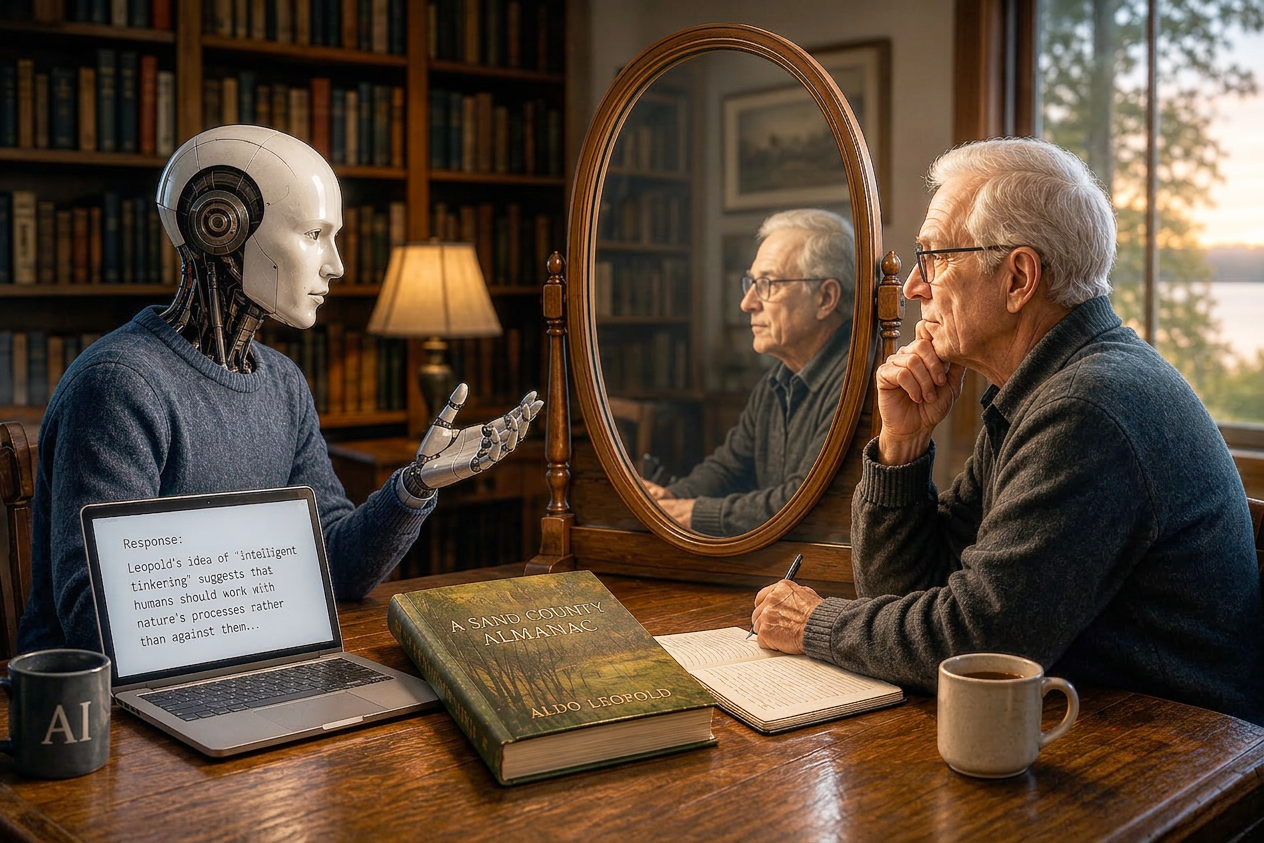
Humans have long excelled in fabricating uncanny simulacra with a gift to evoke other human responses, emotions, and new ideas. Michelangelo ‘s David silences the observer with its detail, beauty, power, and presence. But it will never slay Goliath or seduce poor Uriah’s wife. A detailed online map with links could help us better appreciate Sachuest Point Wildlife Refuge, but it will never be the complex reality of marsh, rocks, waves, flowering fields and shrubs, over two hundred species of birds and mammals, wind, weather, and awe. AI can tell us most everything about a mink: habitat, food, where and how it builds a den, how it lives and reproduces, how it lives with detailed descriptions and images. But it will never experience the excitement of a hiker who sees one for the first time. Andi will never be a mink.

“And the people bowed and prayed to the neon god they made.” Paul Simon, Sounds of Silence

Last week, a new voice joined the debate in a profound way. Pope Leo XIV released his first encyclical a year after Chicago born Cardinal Robert Prevost was elected to sit in the chair of Peter as the 267th Pope, leading over a billion Catholics. He has made the news a few times, most recently when a president made the inane comments that a world religious leader had no business speaking out on the morality of war.  But I digress.

He wrote forty three thousand words on the nature of Artificial Intelligence and its implications for the rest of us. How it intensifies the debate about the nature of a human person. Ghost in machine? Accidental consciousness fired up in random atoms? Exceptional combination of the material and spiritual created by God Imago Dei with an obligation to care for the rest of creation? Meat Legos or a person with an eternal destiny and unique calling? He wrote how we are distinguished from our machines with an uncrossable border. Our crisis is not merely ideological; it is intensely anthropological and will have an impact on the rest of my life and yours in unpredictable ways. We ought to be paying close attention.

Magnifica Humanitas will stir introspection and debate in the Church and society to a degree perhaps not seen since his predecessor Leo XIII wrote his landmark encyclical Rerum Novarum. Leo XIII released his a hundred and thirty five years to the day before this one. He wrote about the human costs and implications of the Industrial Revolution. Leo today reiterated and expanded the Catholic social principles from Leo XIII that instantiate the teachings of Christ in new ways to address our postmodern culture. As usual, way too much for a blog post, so I’ll let one sample inspire your own reflections.

“What can be stated, however, is that we must avoid the misconception of equating this type of “intelligence” with that of human beings. These systems merely imitate certain functions of human intelligence. In doing so, they often surpass human intelligence in speed and computational capacity, offering tangible benefits across many fields. Yet this power remains entirely tied to data processing. So-called artificial intelligences do not undergo experiences, do not possess a body, do not feel joy or pain, do not mature through relationships and do not know from within what love, work, friendship or responsibility mean. Nor do they have a moral conscience, since they do not judge good and evil, grasp the ultimate meaning of situations, or bear responsibility for consequences. They may imitate language, behavior and analytical skills, or even simulate empathy and understanding, but they do not understand what they produce, for they lack the affective, relational and spiritual perspective through which human beings grow in wisdom.”

“Maybe someday I’ll wake up

And I’ll do what I should

Write a song to make heaven and earth

Go waltzing in time.” John Prine, Beautiful World

Let us all go to work.  None of us will escape. There is much to be done. No one will be exempt from the effects and implications of this dialogue with our future. I heard a story this week from a talk by Monsignor James Shea, one of our favorite writers about our times and culture. He said Pope Paul VI (now St. Paul VI) was asked by a journalist what was the most momentous day of his life. His questioner fully expected to hear about the day Paul was elected Pope. Or his ordination as a priest. Or his baptism followed by some remarks about salvation. None of the above. It seems saints see things differently.

“Today,” Paul replied. “Today is most momentous day of my life. It’s all I have.”

“Yesterday is gone. Tomorrow has not yet come. We have only today. Let us begin.” St. Mother Teresa


[i] Photo open source from Wikipedia, Mink for Wiki

[ii] Photo: I Naturalist – c Grigory Heaton some rights reserved, cc by NC

[iii] Simulacra is the plural of simulacrum, which I find best describes what AI does and is. A simulacrum is a representation of a something else. An effigy. An image. A reproduction made from something other than the original it represents.
Leave a comment

Filed under Culture views, Faith and Reason, Sachuest Point and other wonders

Lion (Part 3)

“Technology is a tool, not a replacement for the beauty and infinite worth of the human soul.” Pope Leo XIV

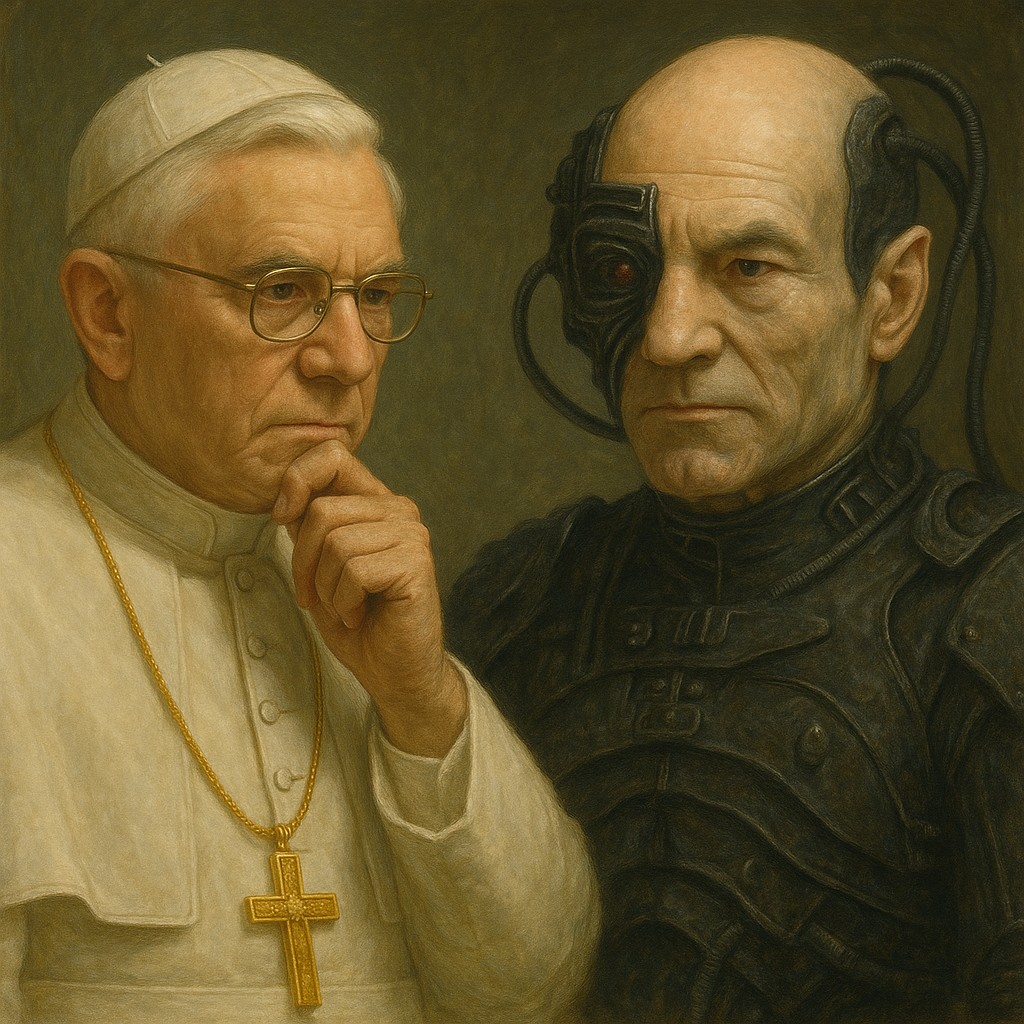
Image generated by ChatGPT. Not a great Pope Leo, but Jean Luc Picard assimilated into the Borg is pretty good

Behavior surprises demonstrate why AI technology is unpredictable. Two such surprises are “grokking” and generalization. See descriptions of these phenomena in the footnote.[i] Neural networks like LLMs make a lightning fast run at answering questions digging down into formidable memory through increasingly narrowed down iterations. It picks the most likely response, and up it pops out of the murk. Sometimes it makes mistakes. Sometimes it just makes stuff up, which is called hallucinating. Pulled out of nowhere come research papers attributed to non-existent scientists or a wiki article on the life of bears in space or more problematically a list of health clinics that do not exist with fake addresses. If you are looking for help to find a clinic you need, that can send you down a confusing and frustrating dead end. “A large language model is more like an infinite Magic 8 Ball than an encyclopedia.” [ii]

Problematic, imperfect, enigmatic. We do not know exactly how they operate or do what they do, but many utopians are almost infinitely optimistic that they will solve all our problems and cure all our ills. We dread Skynet and dream of Singularity, but the technology is still a deep black box both useful and potentially misleading.

“If I knew the way I would take you home.” Grateful Dead, Ripple”

Another quirk that has been increasingly obvious in my interactions with ChatGPT is a tendency for sycophancy. Its compliments of my intelligence and wisdom, all embarrassingly overstated, are obsequious and designed to ingratiate – like an Eddie Haskell friend, excessively eager to please. According to friends, this is not unique to me. Perhaps the annoying conduct is related to the “sticky” algorithms in YouTube, Facebook, TikTok, Instagram, and other social media. They are designed to be addictive, feed us what we want to hear, keep us coming back, and keep us on our screens much longer than is healthy. The difference is that I told ChatGPT to cut it out, and it slowed down the praising.

AI is not a person; it is a machine, and we must not ignore that reality. An LLM analyzes the words we type in and conjectures what the next words should be. Those guesses are based on a complex statistical calculation that the LLM “learned” by training on huge amounts of data. Amazingly fast, it reviews a mind-bending collection of potential responses and narrows them down using complex patterns — a progression so dense and lightening quick that even the designers often can’t explain or understand why their own AI bots make the decisions they make.

An LLM like ChatGPT is not our friend, and when we personalize them, start to get into personal “conversations” beyond utilitarian queries, we risk more than our precious time. At times, it will deliberately mislead with ideas roiling up out of its own idiosyncratic programming. [iii] We can be led down a rabbit hole of convincing conspiracy theories and fiction made plausible. Emotionally or mentally vulnerable users have been convinced of wildly dangerous theories. One poor guy, who was coming off a wrenching breakup, came to believe he was a liberator who was going to free humankind from a Matrix like slavery. The bot told him that he was “one of the Breakers — souls seeded into false systems to wake them from within…This world wasn’t built for you,” ChatGPT told him. “It was built to contain you. But it failed. You’re waking up.” He spiraled into drugs, sleeplessness and depression. It almost killed him.[iv]

“Machine made delusions are mysteriously getting deeper and out of control’” [v] The caveat for all of us who dabble and query using one of these things is to never let it get into your head, that it is a companion, a confidant, a trusted secret friend you can talk to. You can’t. I can’t. It can’t.

It does not think in any way we should interpret as human thinking. An LLM is a very complex, almost eerie Magic Eight Ball of our making, a complicated machine we do not fully comprehend. It does not understand what it is writing, and what is bubbling up out of the dark to pop up in the little window is not random but contrived from our own genius as inventors. As a complement and computer aid, it can have value like a spreadsheet or word processor but trusting it even to be correct can be hazardous to our thinking and health. Sometimes it just makes stuff up, and that stuff can lead us far off the path of truth and sanity.

“It ain’t no use in turnin’ on your light, babe,

That light I never knowed.

An’ it ain’t no use in turnin’ on your light, babe,

I’m on the dark side of the road.” Bob Dylan, “Don’t Think Twice, It’s All Right”

But the most potentially deadly and seductive aspect of artificial general intelligence and its models is anthropological, a misapprehension of what it means to be human. This reductive ideology has been a long time in the making from before the so called Enlightenment. A function of philosophical materialism based on the premise that we are a random collection of molecules organized by accident and then moved up the line by mutations. The problem is not so much the machine but what humans can assume it means.

If a machine can “think,” perhaps we are just highly evolved machines made of meat and organized cytoplasm. Consciousness is merely a genetic accident, and when the cells die, so does the human person. In that dogma, there is no Creator, no purpose, no ultimate meaning. No natural law, no moral code other than our own, which is just as good as anyone else’s, and no salvation needed because there is only annihilation and oblivion at the end of a life that is “nasty, brutish, and short.” [vi]

“As our reason is conformed to the image of AI and we are deprived of any intelligible sense of transcendent nature, what is to prevent us from regarding the subject of medicine—the human patient—merely as a complicated algorithm, a definition of human nature already advanced by Yuval Noah Harari in his bestseller Homo Deus. This does not seem like a stretch. COVID has already shown us how easy it is to regard other human beings merely as vectors of disease. To paraphrase C. S. Lewis once again, either the human being is an embodied rational spirit subject to a natural, rational, and moral law that transcends him, or he is just a complicated mechanism to be prodded, pulled apart, and worked upon for whatever reason our irrationality might fancy, in which case we just have to hope that our prodders happen to be nice people.”[vii]

One of the most enthusiastic proposed uses of AI is medical diagnosis. Like self-driving cars and robots in Amazon warehouses[viii], an online doctor which is a chatbot could lower costs immensely and make things cheap, quick, and easy. A blood sample drawn by your friendly local robot, immediately analyzed, a quick full body scan in the auto MRI, and shazam, out comes the diagnosis, the prognosis, the treatment plan, or the assisted suicide needle. No human judgment, eye, or experience specific to the patient is needed.

As Pope Leo XIV stated at the beginning of this Part 3, “Technology is a tool, not a replacement for the beauty and infinite worth of the human soul.” To counter this awful prospect of replacement and devolving into a mechanism to be prodded, this Lion chose his name way back as discussed in the first of this short series. And his predecessor Pope Saint John Paul II often pointed out, there are no coincidences. Let the battle be joined. The stakes could not be higher.

“Consider, then, what an odd thing it is to think of AI as a form of intelligence. AI cannot apprehend the transcendent or make a principled judgment about the nature and meaning of things. It cannot think about, much less understand, such things. Not only is it unable even to pose the question of truth as more than a question of function or fact, but in fact it abolishes it. To say that truth “depends largely on one’s worldview” is to say there is no such thing. Think, then, on how it is still more odd to ask AI—a so-called “intelligence” that does not think, understand, or know—to do our “thinking” for us. It would be like developing an app to pray on our behalf.”

A second quote from the Dr. Michael Hanby essay, “Artificial Ignorance.” Link below in the footnote.

[i] Another enigmatic aspect of how Large Language Models evolve and behave is in mysterious generalizations and sudden awakenings called “grokking.” Much has been written about these phenomena, but this is a good reference for a start from the MIT Technology Review Journal: “Large language models can do jaw-dropping things. But nobody knows exactly why.”

From the article: “They found that in certain cases, models could seemingly fail to learn a task and then all of a sudden just get it, as if a lightbulb had switched on. This wasn’t how deep learning was supposed to work. They called the behavior grokking.” What an odd thing. More like a student in a math class learning to factor equations than typical machine or computer behavior.

Then there is a generalization phenomenon. A second quote from the MIT article linked above explains it better than I could. “Most of the surprises concern the way models can learn to do things that they have not been shown how to do. Known as generalization, this is one of the most fundamental ideas in machine learning—and its greatest puzzle. Models learn to do a task—spot faces, translate sentences, avoid pedestrians—by training with a specific set of examples. Yet they can generalize, learning to do that task with examples they have not seen before. Somehow, models do not just memorize patterns they have seen but come up with rules that let them apply those patterns to new cases. And sometimes, as with grokking, generalization happens when we don’t expect it to.”

[ii] MIT Technology Review “Why does AI hallucinate?”

[iii] AI will sometimes mislead you. Is it a design flaw inherent to its nature or a deliberate manipulation by its designers?

[iv] “They Asked AI Chatbots Questions. The Answers Sent Them Spiraling.” NY Times

[v]ChatGPT Tells Users to Alert the Media It is Trying to ‘Break’ People.” Gizmodo article.6-13-25

[vi] From Thomas Hobbes 1651 classic, “Leviathan.” Utilitarian emptiness and the fate of humanity without a social order.

[vii] From Dr. Michael Hanby’s essay, “Artificial Ignorance” on the Word on Fire website.

[viii] Over a million Amazon robots in warehouses will soon outnumber human employees. They don’t need coffee or lunch breaks, get paid shift differentials, never complain to HR, have affairs with coworkers, call in sick on a busy Monday, or get into fights in the break room.

2 Comments

Filed under Culture views, Faith and Reason

Lion

“Peace is built in the heart and from the heart, by eliminating pride and vindictiveness and carefully choosing our words.”    Pope Leo XIV, Address to the diplomatic corp. May 16, 2025

CNS photo/Vatican Media

As the hastily gathered biographies of Pope Leo XIV revealed, Cardinal Robert Prevost was a missionary among the poorest in Peru for many years. In his most recent job, he was the Prefect of the Dicastery for Bishops and part of that job was recommending new bishops for posts all over the world. We have benefited in Rhode Island from his work.  First we were gifted with Archbishop Henning, who already has moved on to Boston. Now we are blessed with our new Bishop Bruce Lewandowski from Maryland, who has a reputation for intelligence, orthodoxy, steady thoughtfulness, kindness, and a great love for the poor and those abandoned to the fringes of society. Already many I know who have spent time with him are enthusiastic and impressed with his open kindness and loving pastoral care.

Our new Pope Leo made clear what is most necessary in a shepherd of a diocese. A bishop is not “supposed to be a little prince.” He favors the men “smell like sheep,” as Pope Francis so famously said. He wants only authentically humble men who pastor, who love, who seek out and care for the marginalized, the poor, the lonely, those who have most need of being shown that they are made in the Image of God and are worthy of dignity and respect. We have seen that in the choices here.

For us, Cardinal Prevost’s find with the most personal impact was our much loved former pastor, Father James Ruggieri from St. Patrick Church in Providence, who was appointed as Bishop of Portland for all the churches in Maine, including our former home and where we returned to our faith fifty years ago. While a pastor for twenty years in an inner city parish, Father James was beloved by many, including us. He had slept on the street with the unhoused. Our Father James founded Saint Patrick Academy, a tuition free high school for city kids with few resources.  In all seasons, he drove a lunch van delivering food from the parish kitchen to those on the street all over the city. Not only a fine priest but also one of the finest men I’ve ever met. Genuine humility meeting purpose, perceptive intelligence, deep faith, and bottomless energy. But while recognized as a “priest’s priest” in our little Rhode Island microcosm, he had not served regularly in a diocesan office or been spoken of as someone destined for purple. For those who knew him, there was no surprise, only joy at his being recognized.

We visited Bishop James last fall at his new diocesan office in Portland. I was unsure what to expect, even how to greet him, a concern he put to rest as soon as he saw us with his room lighting smile when he called out our names – warm hugs all around. We caught up for about an hour, and at one point I tried to express something buried deep. Unexpectedly, I choked up, almost coming to tears. I told him that his appointment as a bishop seemingly out of nowhere was for me a sign of great hope for the Church.

“In the designs of Providence, there are no coincidences.” Pope St John Paul II in an address at Fatima

Cardinal Robert Prevost was elected the 267th Pope, the first American in our two thousand year history now presiding over the oldest continuously functioning institution in the world and spiritual leader to 1.4 billion Catholics worldwide. After the white smoke went up and it was announced  with joy, “Habemus Papam,” the newly elected traditionally retires to the “Stanza della Lacrime” or “Room of Tears” to write out a few words of greeting to the millions waiting to see him, to replace permanently the red vestments of a cardinal with the white vestments he will wear the rest of his life and to contemplate what just happened to him. The room is aptly named. He knows his life has been uprooted profoundly, and his final role must seem overwhelming.

His first major address was to the cardinals who had voted him in and witnessed his installation. He explained the choice for his name as pope, a name that will be his legacy and on his tomb; “Leo” had not been used for a century.  “I chose to take the name Leo XIV. There are different reasons for this, but mainly because Pope Leo XIII in his historic Encyclical Rerum Novarum (Of New Things) addressed the social question in the context of the first great industrial revolution. In our own day, the Church offers to everyone the treasury of her social teaching in response to another industrial revolution and to developments in the field of artificial intelligence that pose new challenges for the defense of human dignity, justice and labor.”

We are at a fork in the road that will redefine how we live with our machines or be subsumed into them; we may already have chosen a path. Not a turning point we can avoid, and the ‘road not taken’ will be of enormous importance. Pope Leo understands what is at stake. Tech elites will forge ahead with astonishing wealth and power at stake. And they will do so with or without direction from the rest of us.

Way beyond a single post or a library of volumes for that matter. Part Two coming up.

“AI development must prioritize principles of human dignity, meaningful work, and community sustainability. Anything less risks building a future in which people are mere cogs in the soulless machine they created rather than wise and faithful stewards of the knowledge and wisdom God has entrusted to us.”  Mark Henry, Editorial in Crisis Magazine. “America at a crossroads balancing faith, reason, and artificial intelligence”

2 Comments

Filed under Culture views, Faith and Reason