
“I understood what he meant by a house being finished when you can warm it.”
Walden, “House-Warming,” Henry David Thoreau
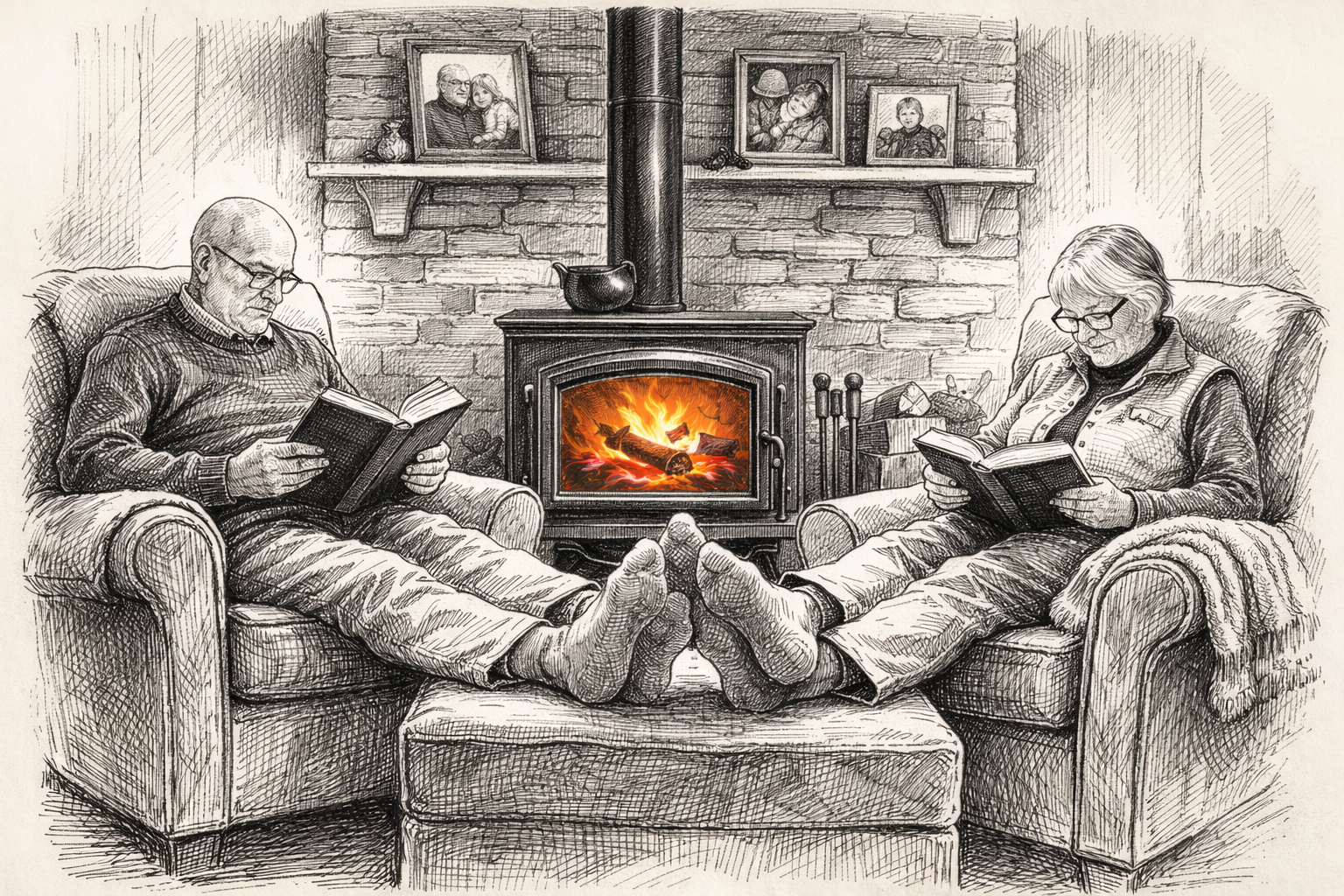
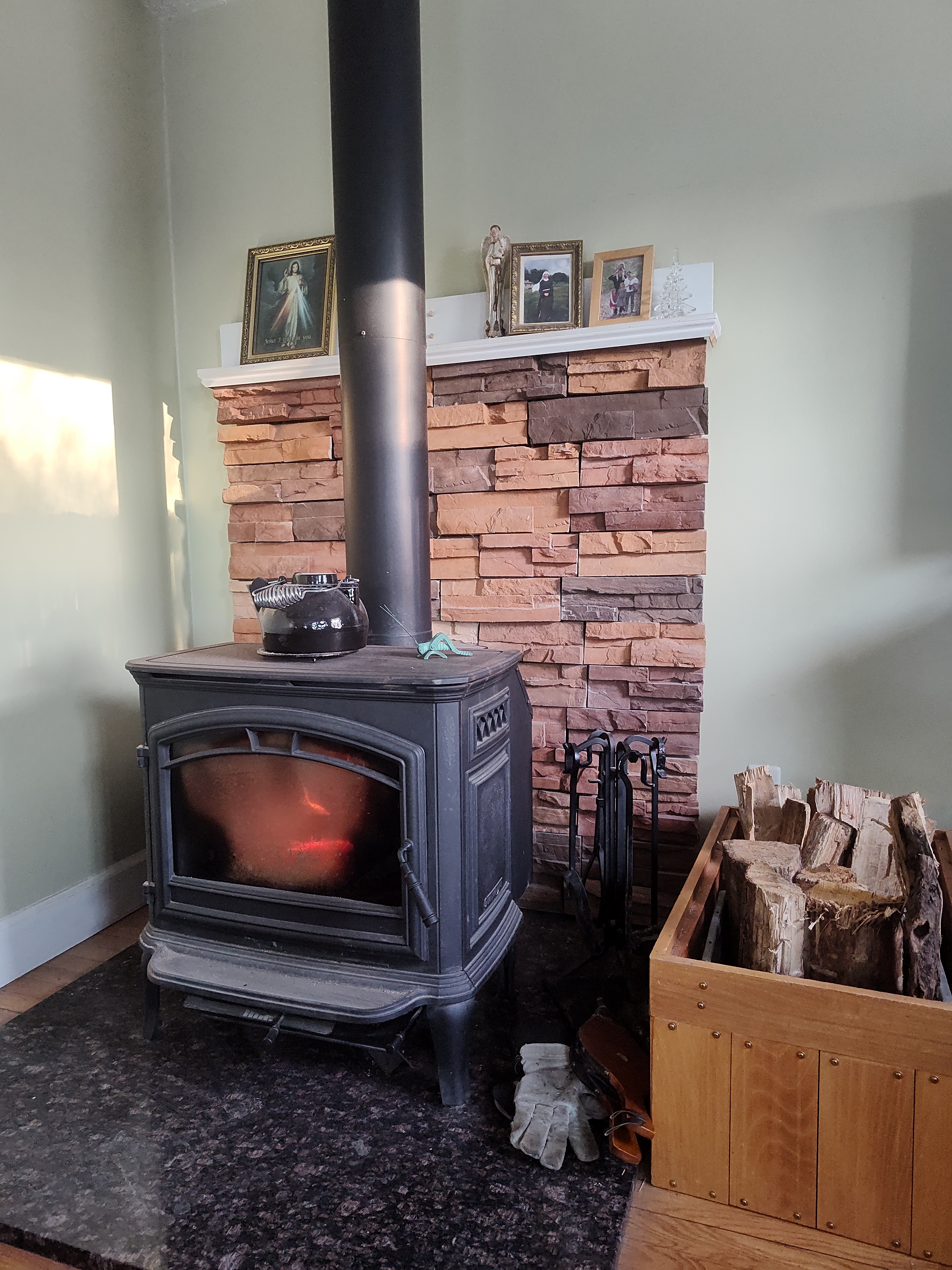 Snowing. Again. Not the demonstration of the power of nature blizzard from a week ago that is almost impossible to walk into, but light snow, steady, gray skies. A good afternoon for a comfortable chair with our feet up by the wood stove, warm with a good book. Rita is next to me doing the very same.
I have spent most of a lifetime with wood – climbing trees, cutting them, then lumberyards, building with it. We’ve also heated our homes with wood for over forty years. Since learning how in Maine. Making mistakes. Refining our technique, building woodsheds – three of them at different homes. Cutting, splitting, now at eighty buying cords of seasoned oak, maple, ash, birch, and apple that some other professional cut, split, seasoned, stacked and delivered. I only have to re-split some of it with my good heavy maul against a solid maple cross section chopping block. I enjoy splitting wood so long as I don’t have to split cords of it. Wood warms me twice as the proverb says.
We use quite a lot of kindling in the fall and spring to relight the wood stove. House gets too hot, so when it does, we let the fire die out. My obsessive compulsive never-fail fire lighting. Crumpled up newspaper, a few ‘logs’ of tightly rolled newspaper, kindling that is gathered cleaning up the driveway after our wood is delivered – splinters and chards of dried hardwood and bark. On top of the kindling and paper, small split wood is stacked crisscross for two or three layers with room in between pieces for air to circulate and smoke to rise. One match ignites the pile at the bottom in four or five places. After it fires up for ten minutes or so with the vent wide open, the fuel mixture blazes into intense heat, and I can build with larger stove wood on the glowing coals. Four or five times a day, we load it and control the heat by the size of the load and the position of the vent.
In the winter it can burn for weeks off that one match, banked up at night with the biggest pieces, and revived in the early morning from the coals about four am. Sometimes it needs the attention of a birch and leather handheld bellows to encourage it when it needs a little help. The fire snaps and issues a quiet rush of fresh flames until it once again catches on its own. The stove creaks and crackles too as the cast iron expands to accommodate the heat. Morning sounds.
Bellows, fire tongs and poker. Small shovel and airtight ash bucket to clean out excess ashes, gloves to handle the wood and avoid splinters in my fingers. A handmade wood box to store the day’s supply after I haul it in from the shed helps keep the mess and dust manageable. What I once cut and split when I was young from sixteen foot logs, I now buy from a reliable local source cut and split, still costing less than oil for our back up furnace. Good tools, lessons learned over many years. Warm in any storm even if we lose our electric power, and we could even cook a bit on the top in a pinch. Sometimes on a cold night I sleep out by the fire to feed it early in the predawn hours to keep the home and family warm.
Musing by the fire. About warmth and weather and wood and other wonders.
“I had for fuel a good supply of wood cut from the forest… which I had stored up.”
Walden, “House-Warming,” Henry David Thoreau
Firewood costs less than framing and finish lumber, but it accrues value in similar ways. Hardwood is denser, has less potential creosote to gum up and cause chimney fires, burns hotter and longer if it is properly seasoned to the right moisture content. A cord measures four feet by four feet by eight feet. One hundred and twenty eight cubic feet of seasoned hard wood that weighs about 3,700 pounds.[i] I move it piece by piece four times: to the wheelbarrow to push to the woodshed, stack it carefully in the woodshed, later take from the woodshed in our durable canvas sling log carrier to stand in our wood box, and the final move as needed is into the stove to keep us warm. Two to two and a half cords handles heating our downsized bungalow nicely for a winter. Our old drafty farmhouse in Maine required eight or nine.
Our son once worked for a division of a large investment company setting up office and remote computer systems to track the accruing value of their assets. South America, New Zealand, southern U.S. What they tracked was the growth of trees in their forests. Investors could buy shares in them. Incrementally, year by year, annual ring by annual ring, a tree’s diameter thickens to support its expanding height and breadth. Growth is extrapolated by professional foresters who estimate precisely the board footage per acre for eventual harvest. The carefully monitored board footage increase is the return on investment valued by the shareholders. Foresters will measure and brokers track the investment like others track income statements, balance sheets, organic growth, share valuation, and ‘green field’ new ventures.
There’s a lot of compiled science, data, and calculations about heating a house with wood or anything else. Our Quadra Fire stove isn’t the most expensive kind with a catalytic burner, but for a combination of affordable and practical, it’s a solid stove with its re-burner tubes, and it burns as cleanly as most. Science tells us the estimated 24 million BTU production of a seasoned oak and maple cord is equivalent in a stove like ours to about 160 gallons of fuel oil in our 85% efficient furnace, which sits quietly most of the time. Wood burns and emits more CO2 than the oil equivalent but with an important distinction. The harvest of wood should be regarded more as agriculture than despoiled park land. Wood is a renewable resource.
Trees survive and grow like all chlorophyll based plants by photosynthesis, a multistep amazing series of chemical reactions within its millions of living cells every moment of sunlight. To simplify a multistage process, that I once studied in detail: photosynthesis harnesses the energy of the sun[ii] absorbed by chlorophyll and uses it to combine atmospheric CO2 with water from the roots to create glucose and oxygen, which is expelled back into the atmosphere. Glucose is used by the plant for energy, a building block for its other necessary proteins, and the oxygen provides the rest of us with clean air. A tree is an efficient carbon processor and atmospheric cleanser.
Every day, cell by cell the trees renew fixing carbon into new potential fuel until the cycle begins again. Tree carbon will recycle whether we use it or not. What grows will decay as inevitably as its life cycle in the forest. Or as in our fire. Harvested or unharvested, it will return to the air and soil. The only variable is time frame.
That is why many consider burning wood for heat as carbon neutral. It releases the carbon bound in the tree more quickly than wood left to rot back into the soil, but the carbon released is the same quantity, rotted or burned, over time. In contrast, burning oil has a similar source of carbon from rotting biomass a million years old, so it releases carbon that would have remained in the ground. Oil, gas, and coal are essentially new sources of atmospheric carbon. Oil doesn’t reabsorb its carbon by regrowth like wood does. Even as we burn, the trees for our future heating seasons are efficiently recleaning the air from this year’s CO2.
Robert Frost once wrote in a poem about a vine covered cord of stacked and split firewood he found abandoned for unknown reasons in the woods. He wondered about the work and care that went into the stack and how it returns the dead wood to the air and soil one way or another.
“What held it though on one side was a tree
Still growing, and on one a stake and prop,
These latter about to fall. I thought that only
Someone who lived in turning to fresh tasks
Could so forget his handiwork on which
He spent himself, the labor of his ax,
And leave it there far from a useful fireplace
To warm the frozen swamp as best it could
With the slow smokeless burning of decay.” Robert Frost, “The Wood-Pile”[iii]
 Science can tell us quite a lot about burning wood and heating homes, but like all science it can rule only on a reductive truth, a constricted concept of reality, not false, but not comprehensive either. Ah, my son, all truth cannot be expressed as science. Not all truth is measured; some of it is simply recognized. Science is one basis of reliable and objective truths; however it is not the only source. Empirical observation, theory, and experiment are marvelous tools, invented by Francis Bacon, but the scientific method is based on principles that are philosophical, even metaphysical, and cannot be verified by science. The erroneous claim that truth can only be established by the scientific method is self-refuting for it cannot be proven by its own rubric.
In addition to the scientific method, an example of truth that cannot be proved by science is intelligibility upon which all science relies. No lesser light than Albert Einstein said, “The most incomprehensible thing about the universe is that it is comprehensible”[iv]. Why is the universe explainable in abstract mathematical terms human beings can describe and formulate? Nothing makes the intelligibility of the universe inevitable or provable by the scientific method. To believe that intelligibility can exist without an Intelligence or Designer behind it is a leap of pollyannish fancy in service of an agenda.
Another set of ideas is the mystery of the ‘anthropic principle.’ Astonishingly narrow ranges of at least seven physical forces are indispensable to allow the formation of carbon, stars, planets, water, and other non-negotiables necessary for our existence. These include gravity, the cosmological constant, both the strong and weak nuclear forces, and the ratio of mass from electrons to protons. Tiny variations in strength in each of them would doom formation of atoms, complex molecules, stars, planets, galaxies and the existence of all known objects in the universe.[v] The odds of these forces existing within these fine-tuned parameters out of all possible potential ranges have been calculated to be less than one in all the subnuclear particles or quarks in the universe. Science can tell us with great exactitude their measurements and why the fine-tuned range is essential to our existence. But it is mute on why they are so perfectly suited to me writing this, and you reading it. Science cannot speak to why existence exists.
A third obvious, but unscientific, proof is what has been called the argument for the existence of God from contingency. Stick to a summary, please Jack, as this is already a long musing. Everything we know is contingent, in other words, we exist, but we are not necessary. We are caused and therefore contingent upon other prior existences. I exist because my parents existed. That oak tree exists because another earlier oak made an acorn from a fertilized flower, dropped it after it ripened according to gravity and the nature of its stems. A squirrel carried it off and buried it a few hundred feet away, and after it rotted, the seed within the acorn germinated in soil, warmth, and moisture conditions necessary for it to prosper. Both oak and squirrel evolved over a few million years from more primitive forms of life back to before recorded history. If everything we know is contingent upon some other cause, what do we call the necessary first thing? The non contingent being without a cause? We cannot be ‘turtles all the way down, in infinite regress and defy all logic, can we?
Science can tell us so much about how, what and when, but cannot speak with any eloquence about why there is something rather than nothing[vi] at all.
These are the truths, and many more that we can ponder and read, and learn about on a cold, snowy afternoon in front of our woodstove.[vii] What is good, and what is evil, and why. Poetry, literature, the good, true and beautiful expressed in art of all kinds. In Act Five, Hamlet spoke to his friend, “There are more things in heaven and earth, Horatio, Than are dreamt of in your philosophy”. Are these ideas not true as well? Self-evident? A kind of ‘true’ more indispensable to the mind, heart, and soul of a human person, that strange hybrid being of body and soul, spirit and earth, mind and mud.
And those complex truths are something the scientific method will be utterly insufficient to explain.
“Shut in from all the world without,
We sat the clean-winged hearth about,
Content to let the north-wind roar
In baffled rage at pane and door,
While the red logs before us beat
The frost-line back with tropic heat.” John Greenleaf Whittier, “Snow-Bound- A Winter Idyl
[i] By contrast a gallon of oil weighs about seven pounds, so the BTU equivalent 160 gallons of fuel oil only weighs about 1,700 pounds and is a very efficient storage source of fuel. Using it requires setting a thermostat and calling up the service company if it doesn’t work. Wood is a lot more work. Hence, oil is still far more commonly used, but oil tanks can run dry at the least opportune moment like a blizzard when deliveries are unavailable. A well-stocked woodshed is a security bank of warmth.
[ii] As a sidebar, science demonstrates that almost all our energy is stored sun or star light one way or another. Fossil fuels and wood are obvious. So is solar. Slightly less obvious is wind power, but wind is produced by the unequal warming of sea and land, a warming produced by the sun. Water power is enabled by the evaporation of water from the sea due primarily to the warmth of the sun, and subsequent rain gathered into streams, rivers, and eventually controlled by dams. Even nuclear power is based on the controlled release of radioactive energy in the form of heat. All radioactive elements were produced in older stars billions of years ago and released in the form of the collapse of neutron stars and the explosions of supernovae, which is gathered again hundreds of thousands of light years away by gravity to help form new suns and more to the point, planets.
[iii] As another aside. If a tree falls in a dry forest, the carbon and methane produced are equivalent to burning. Very little methane is produced and the fire consumes it. If it falls in a swamp and under the mud and water, frozen or otherwise, anerobic decomposition turns much more of it into methane, which is a far more potent greenhouse gas. So, in some common conditions, rotting in the wild pumps more greenhouse effect into our atmosphere. Another plus for woodstoves.
[iv] From Einstein’s 1936 essay “Physics and Reality,”
[v] For a good summary of photosynthesis with detail enough to understand the principles, see this Britanica article.
[vi] By nothing, we infer a nullity, absolutely nothing, not the quantum field of enormous potential energy some propose as an explanation. A quantum field of energy that leaps in and out of existence is not nothing, just another turtle.
[vii] Image of our woodstove at the beginning just a phone photo from me. The sketch of Nonna and Papa reading and thinking by the fire is by ChatGPT based on my description. Not perfect, but I think the point is illustrated, and I don’t have my grand-daughter’s artistic talent or patience.

 Rita and I started volunteering at the Sachuest Point National Wildlife Refuge in February this past year, mostly in the Visitor Center. During a typical shift between fifty and a hundred visitors will come into the center to ask questions, look for directions, cruise our little shop of nature books, clothing, and art, browse the well-designed exhibits while their children try to complete the scavenger hunt identifying the various animals and birds, get a drink of water, or use the restrooms. The rangers estimate they represent about a quarter of the total visitors walking the two and half miles of trails. It’s a busy place, but it rarely feels crowded.
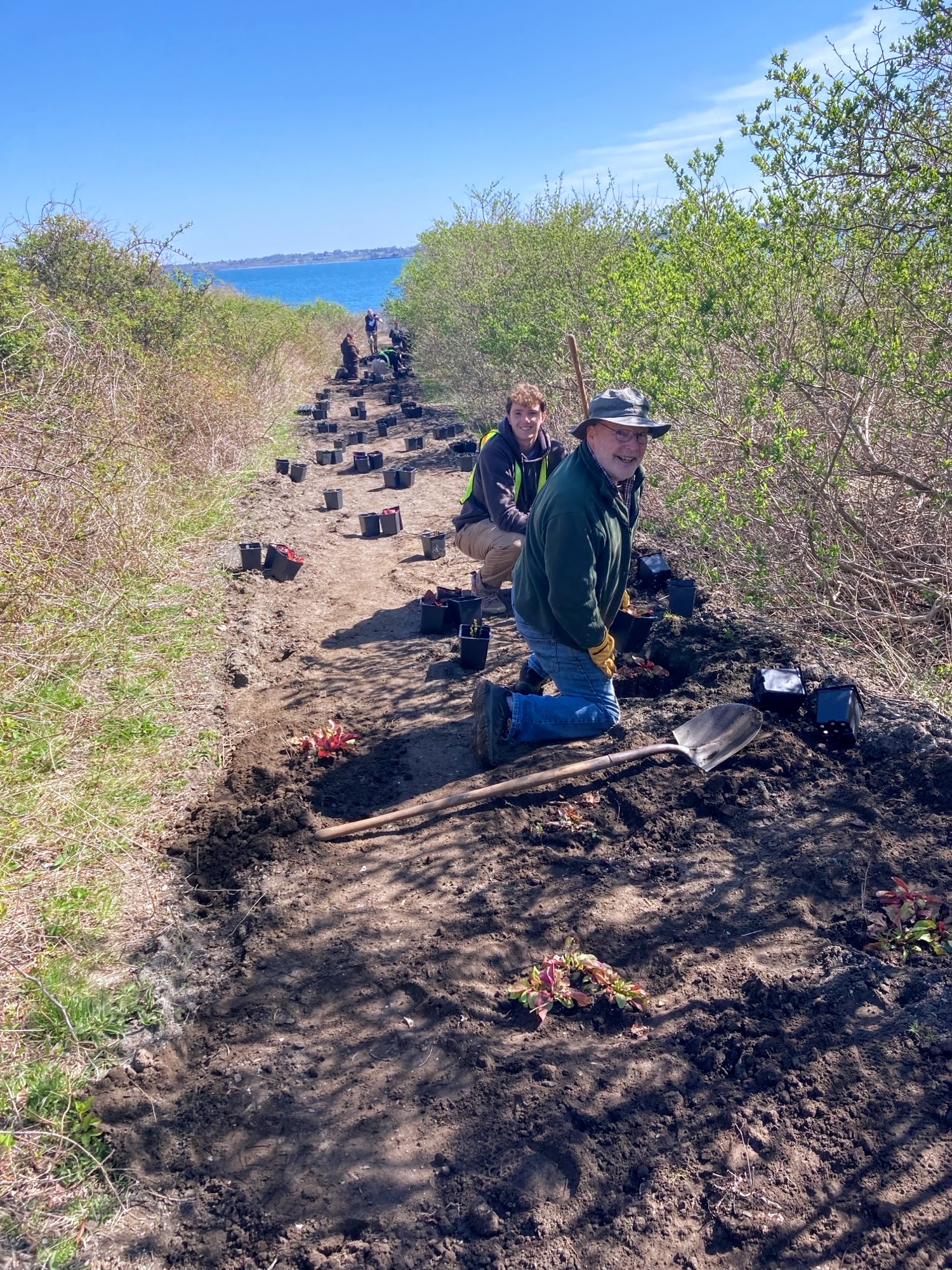 government employees is somehow not up to the standard of private employees. The rangers we’ve had the honor to meet are dedicated, smart, knowledgeable about wildlife – both flora and fauna, friendly, sensitive to visitor needs, diligent about protecting all things wild, and work hard and long. They don’t direct from afar; when plantings are needed to recover and protect erosion areas, they are on their knees with dirt on their hands. Understaffed, they rely heavily on volunteers to help with building and trail maintenance. They have a mission, and willingly fulfill it with dedication and no small measure of joy in their calling.
 Most of the questions we field are prosaic. “Do you have a trail map?” Yes. This is how you orient it to the visitor center. Ocean View is a bit longer, but more open to the sea out by the point. Harbor seals have been seen there. “Can I fish off the rocks for stripers?” Yes. In season and with a license you can get online. “I heard there is a scavenger hunt questionnaire for kids?” There is, and we have stickers for them when they attempt it. “How much do I owe for parking here?” A hundred bucks, cash, is my usual answer, but no one ever believes me or pays. It is open and free to all. “Where are the bathrooms?” For the guys, there is a very big one out back in the woods. Rita gives me ‘the look’ when I say that. Or you can use the ones right behind you that have a flush. “Can you tell me what this bird (or bug or snake or shellfish or snail or flowering shrub or vine) is on my phone camera or as I describe it?” Sometimes we can. Other times we need to consult the many books on our wildlife shelf. It’s enjoyable to search and learn with them. “What is that animal we saw that looks like a weasel?” Probably a mink. “I saw a pair of pheasants (with great enthusiasm)!” Yes. They are very beautiful. “Does anything eat the deer here?” We have a good herd of about forty here. Please don’t feed them. Sometimes coyotes get a small or a weakened one. And sometimes the velociraptors get one. (That may get “the look” again from Rita, but kids like my answer. Wide eyed, they laugh.)
 Like other venues that welcome all comers, Sachuest has regulars who become known and comfortable with the place: men, women, and children who walk the trails weekly or daily. Most are folks like us who have come to love the varying moods and seasons of the trails and walk them year round. We never tire of hundreds of migrating songbirds that come and go, raptors, waterfowl, insects, snails, and flowering plants. We recognize the regular hikers from the trails, and they recognize us. They are invariably friendly and smile easily almost without exception. I have yet to meet a cranky person there – either because the environment eases their angst or because it tends to attract people who don’t carry a lot of it anyway.
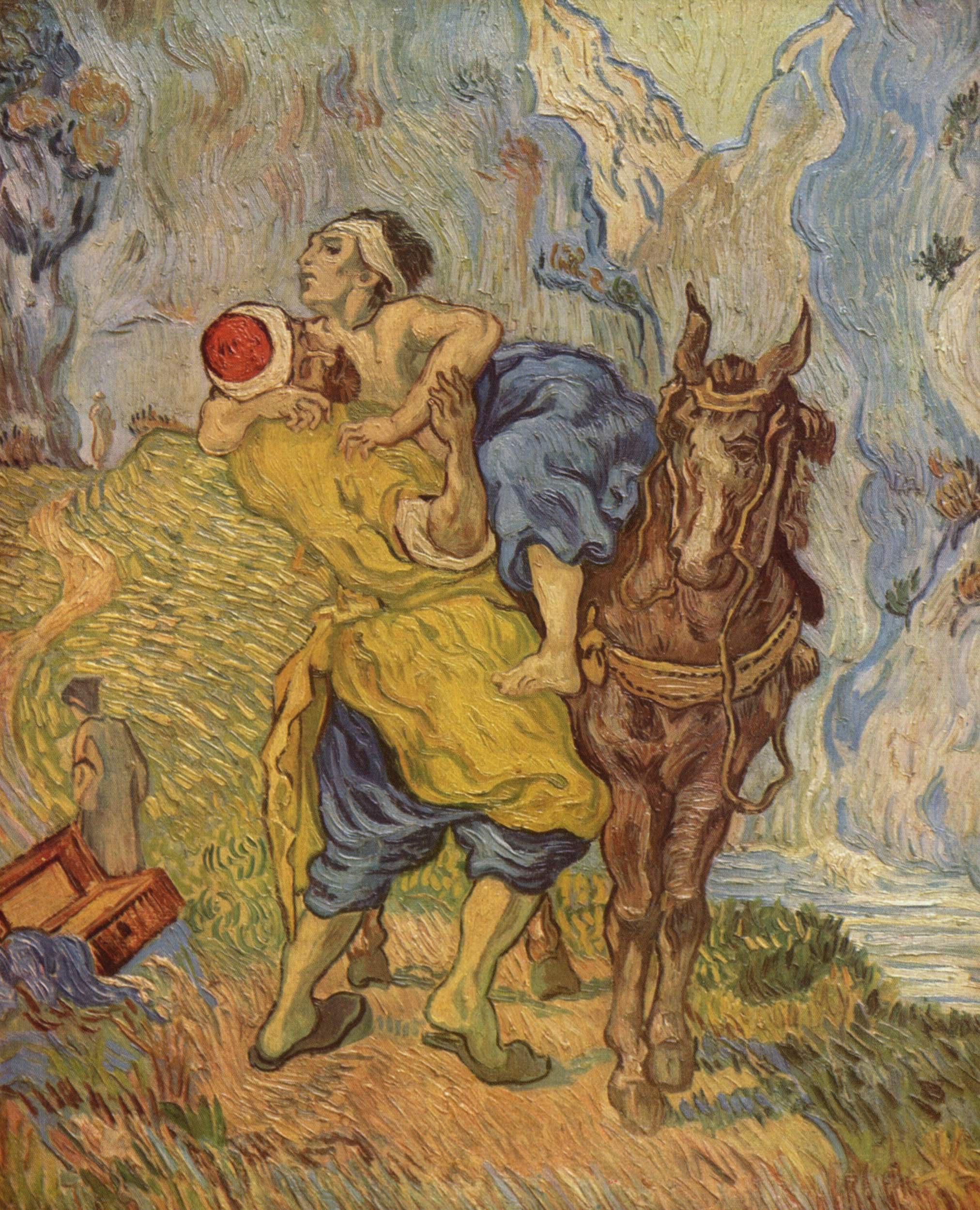 One regular visitor lives in an assisted living and only gets out when her friend (platonic) drives an hour over a couple of bridges to pick her up and bring her to the center after their AA meeting. They come almost every week, sit for a while on the benches outside and chat quietly, enjoying some people watching, and taking in the view of Sachuest Beach with the spires of St. George School on the southern end along with distant views of the Bellevue Avenue mansions across the bay. Oftentimes they come in for a visit and sit in the chairs by the visitor desk to bring us into the conversation. He is a pleasant sort of absent minded fellow who is a retired bus driver, gentle and unassuming without pretensions. She has a couple of black belts in two martial arts, which apparently were helpful in her old job as a bartender and occasional bouncer. Her life remains difficult and now is physically challenging. They seem an unlikely pair but clearly benefit from discovered kinship and support. He lifts her up with quiet small acts of kindness.
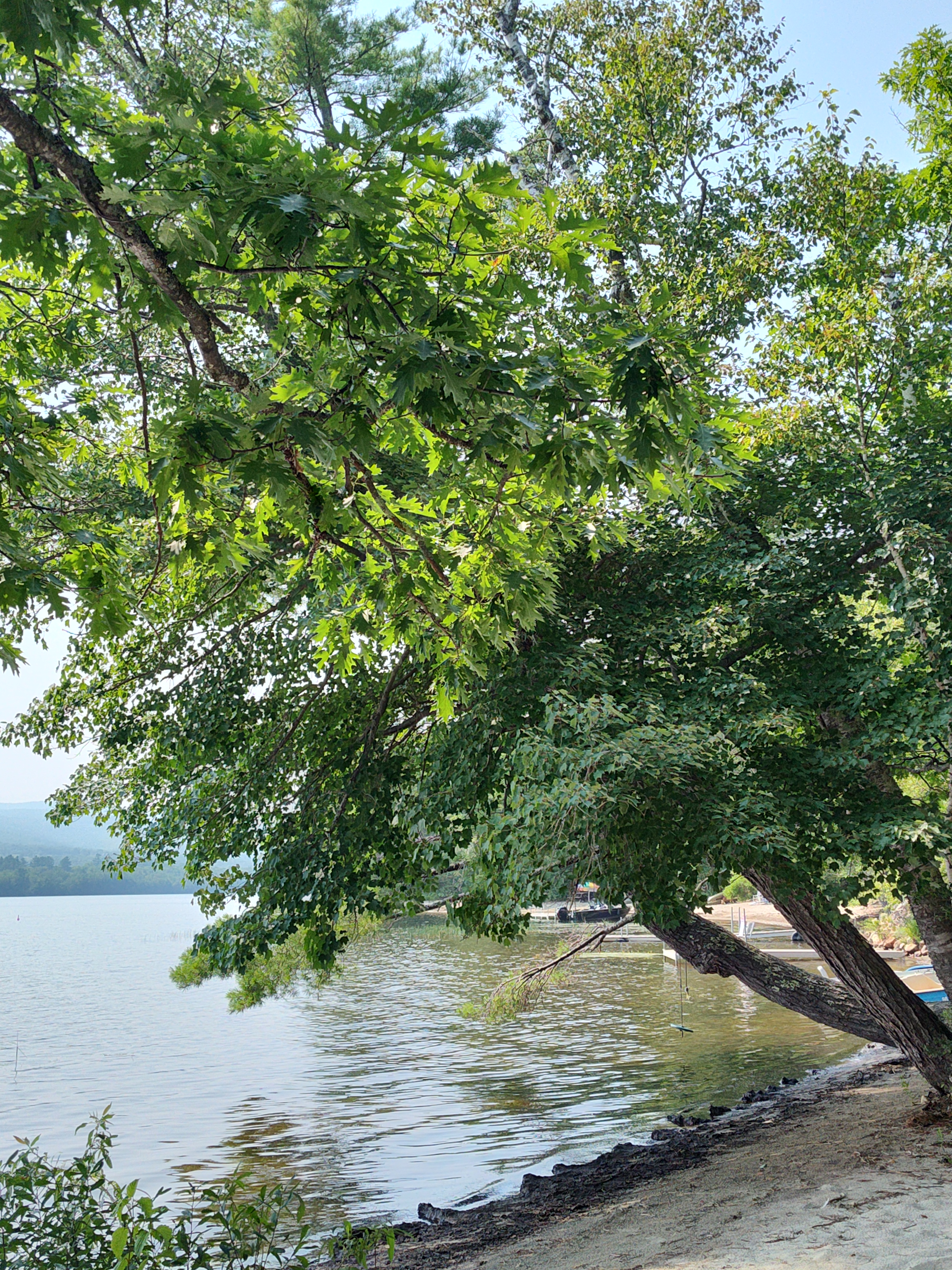
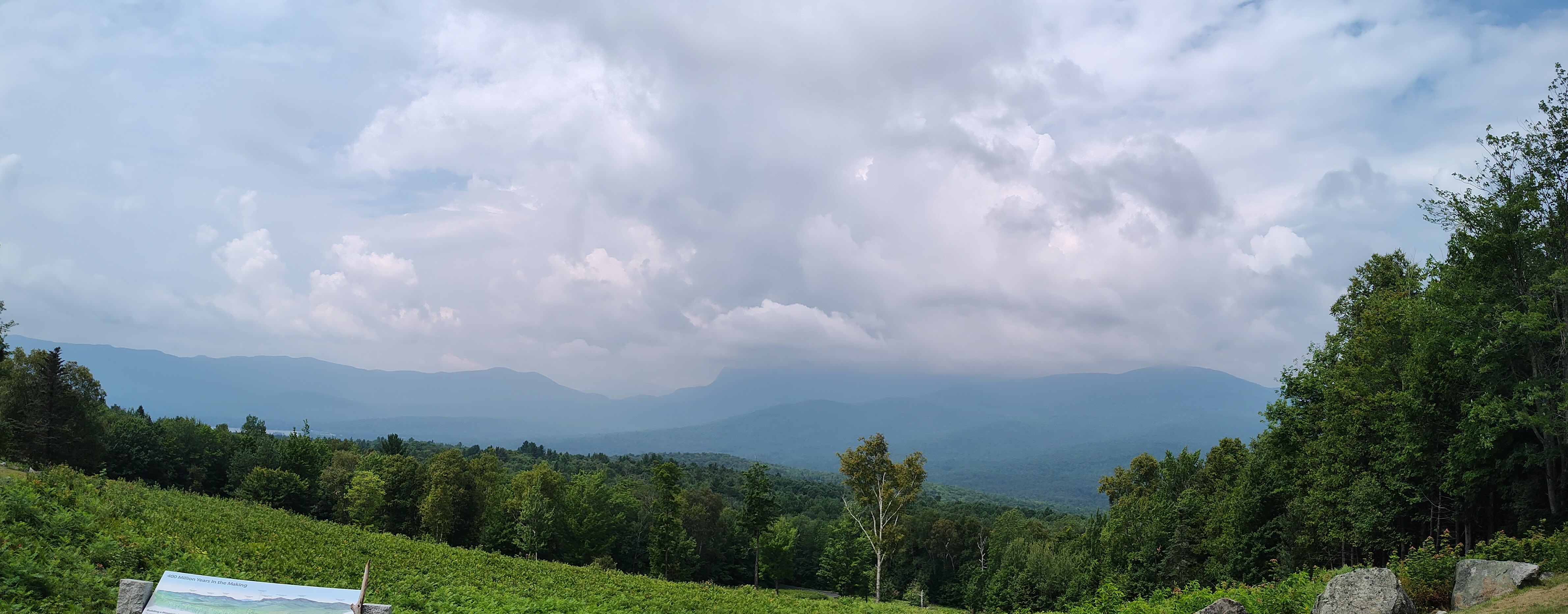

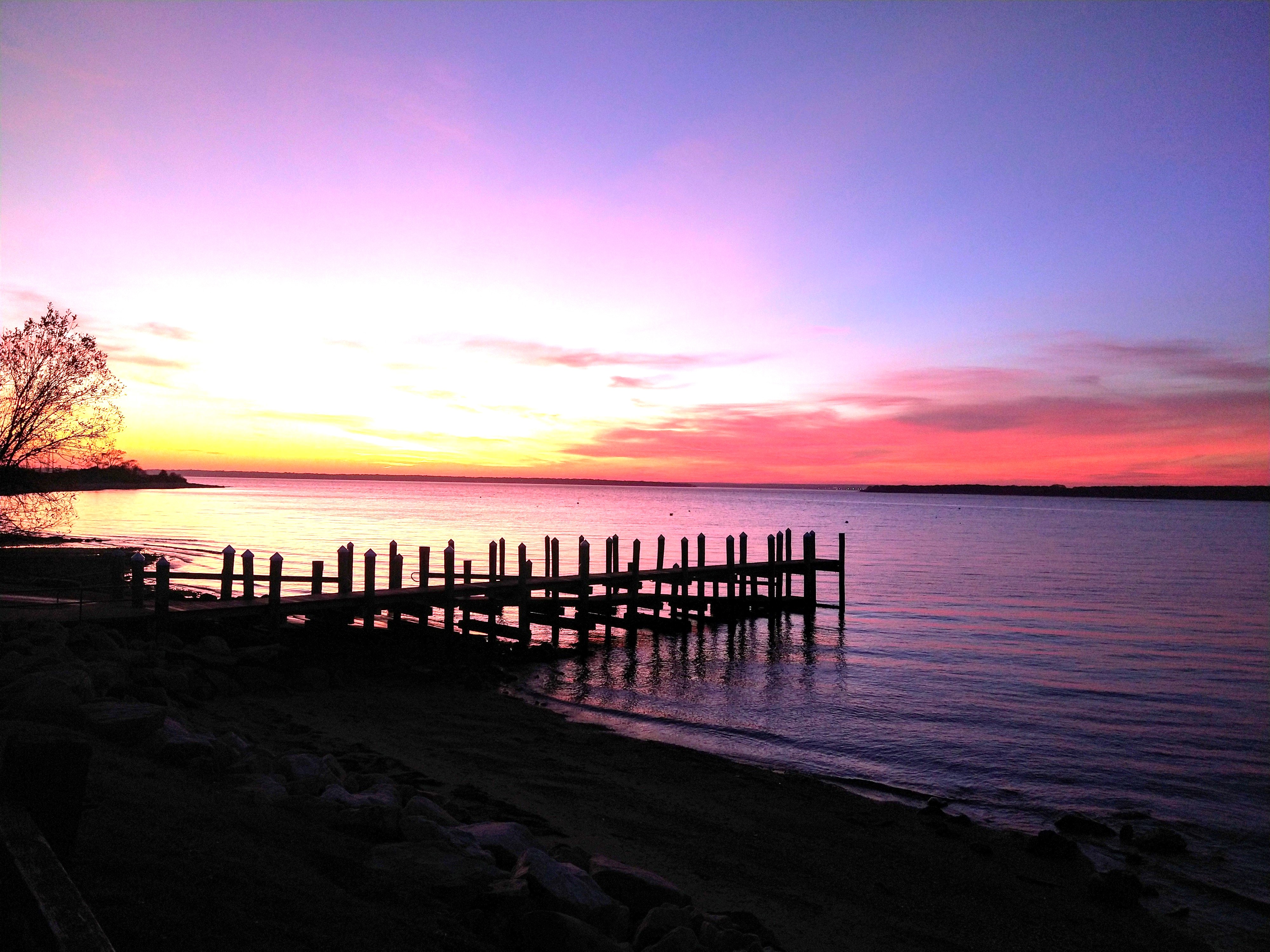 A couple of weeks ago, the general became specific, as cultural changes will do. Rita and I travel seven minutes west to Burma Road and the Weaver Cove Boat Landing on Narragansett Bay often at sunset. A large dock extends out towards Prudence Island, and in the summer it’s busy with boats coming and going – dropping and picking up passengers from the many small craft that launch and return there. Several boats are moored offshore and kept there for the boating season from May to October.
 February is that sort of month. We’ve transited from the early bright lights and joy of the beginning of a New England deep winter in December to a grayer, resigned wait. The chores of winter are wearing and tiresome. The dust and mess on the floor from the woodstove are grinding me down; every evening ends with banking up a load of oak and maple for the night burn, and every morning starts around five with a few coals blown back to life with small wood and a hot start to keep the creosote buildup in the chimney to a minimum.
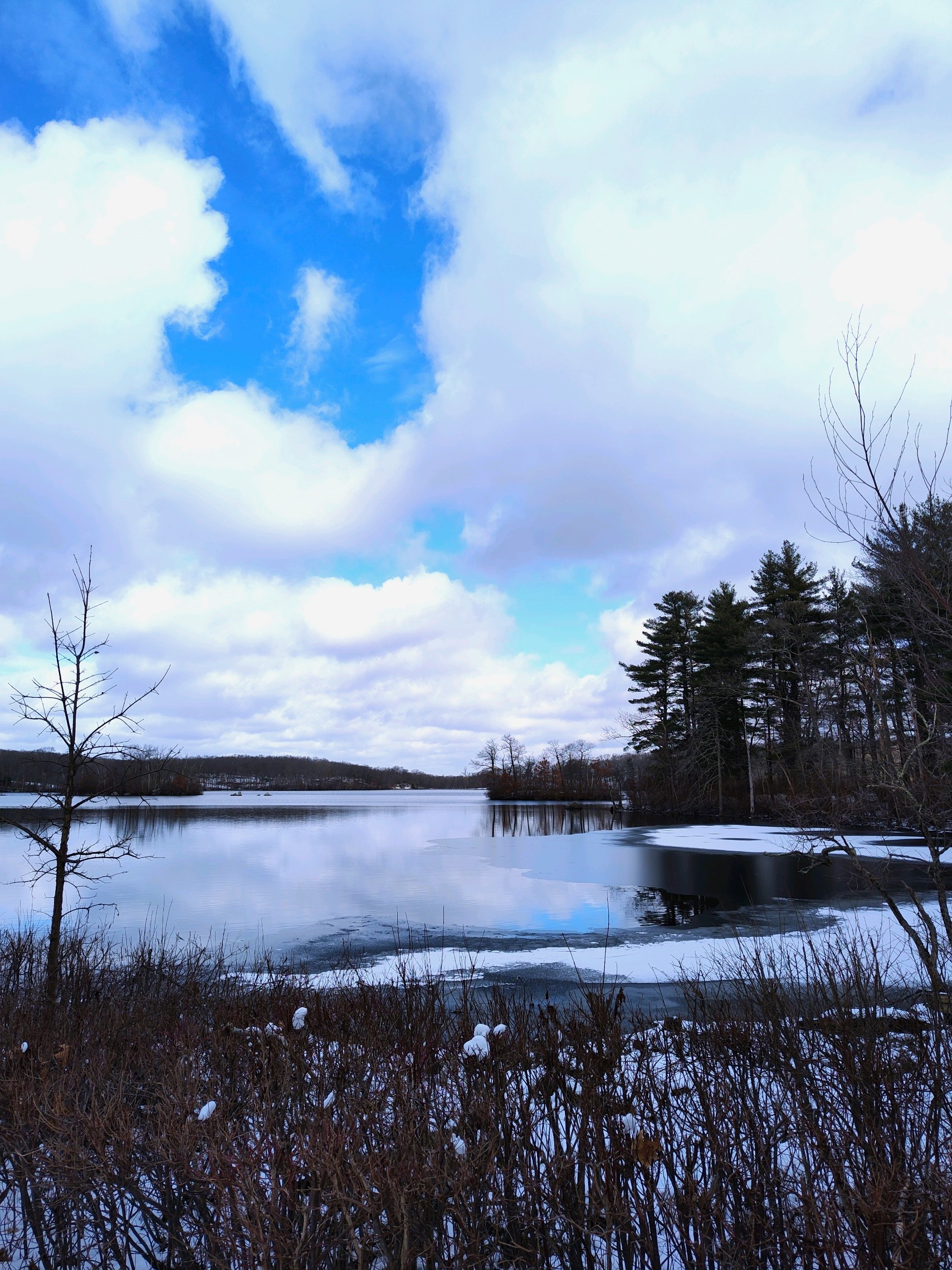 Late winter skies are startling blue, and the clouds look like they were painted with a pallet knife, almost unnatural. The sun is two months warmer than December, and with the windows up in the car the glare feels hot against our face. Hope is upon us, the promise of March and April unmistakable. Soon and very soon, the cascade of blooming will begin. First the crocuses, then the yellow profusion of daffodils and forsythia, followed by everything, the pink cherry blossoms, the white of the Bradford pears, magnolias, dogwoods, flowering crabs, azaleas, later the lilacs and rhododendron. The island’s splendor is persistent for months almost into autumn with the Montauk daisies.
 Quo Vadis Blog