Category Archives: Personal and family life

Aunt Mary’s Amazing Milestone

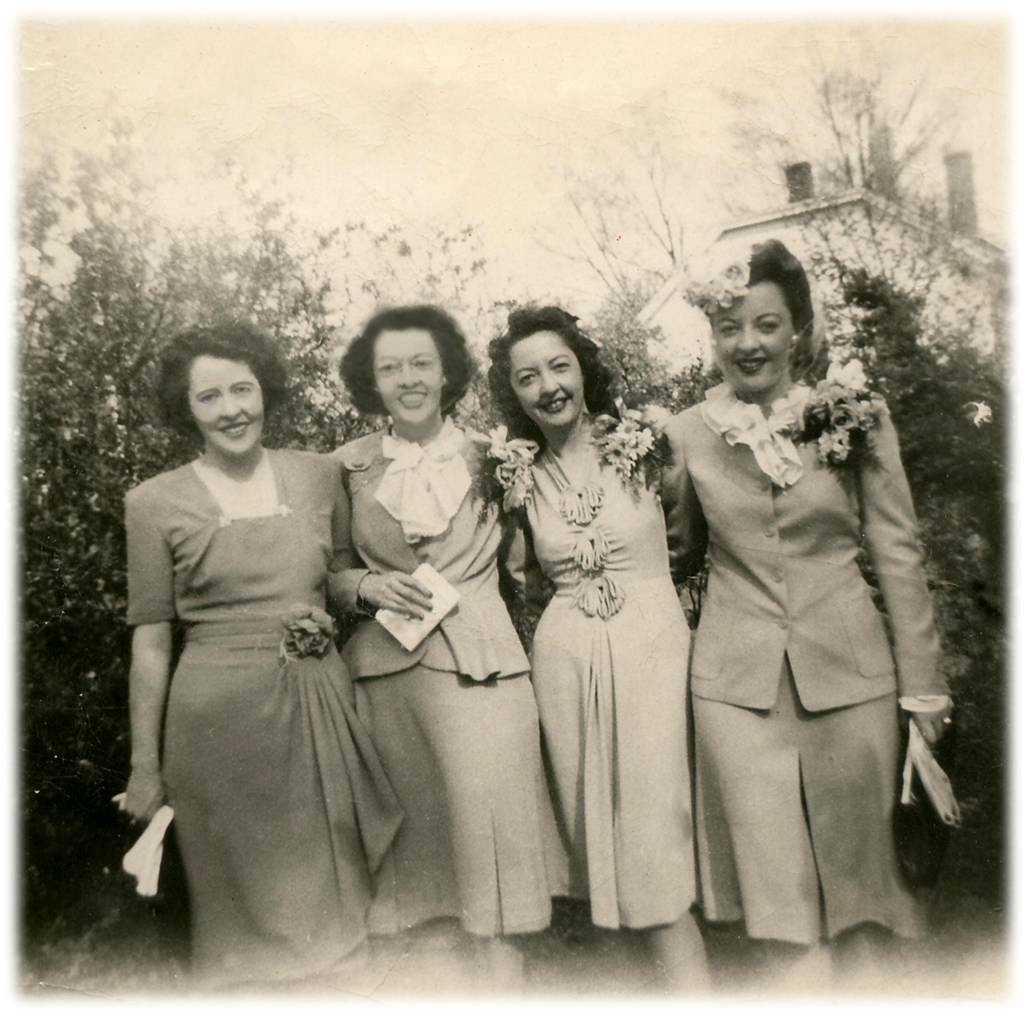
The Laracy Girls - Mill, Babe, Toots and Girly

When Mary was born, telephones, automobiles and electric lights were a rarity, but Civil War veterans lived in every town.  The ice man kept the food cold, the mailman brought almost all communications from far-flung friends and family, and the paper boy delivered the news.  Armies still had horse mounted cavalry; the War to End All Wars was still in the near future and a worse one followed twenty-five years later. Mary celebrates her hundredth birthday this week.

In 1912 western gunman and legendary town marshal of Dodge City, Wyatt Earp, had another seventeen years to go; Joshua Chamberlain, the hero of Little Round Top at Gettysburg, and Harriet Tubman, former slave and station keeper on the Underground Railroad, still lived. The Titanic hit the iceberg and sank in the North Atlantic.  Jackson Pollock, Woody Guthrie, “Lightening” Hopkins, Ben Hogan, John Paul I, Julia Child, “Lady Bird” Johnson and Gene Kelly along with Mary Laracy Smith were born. Mary was the daughter of second generation Irish immigrants, Jim and Molly (Manley) Laracy.  Everyone called her Toots. (“Toots” rhymes with foot, not loot. As in “Hey, Toots, you’re good looking.”)

Three younger sisters, Mildred, Cecelia and Elizabeth followed Mary along with an older brother, Billy, and the twin to Elizabeth (Betty), the baby brother John (Sonny).  Sonny’s WWII Army buddy, Jack, met and married his sister Betty and had six children of whom I am the oldest.  The Laracy girls, Toots, Mill, Babe and Girly broke the mold.  Only Toots and Girly (Mary and Betty) remain with us; they have been sisters for over 91 years, and what a century it was.

Mary was on the leading edge of the “Greatest Generation”, which literally saved the Western world.  The “eternal” German Third Reich, the Russian Revolution, indeed the whole terrible history of the Soviet Union, came and went.  The Spanish Flu took more human beings than the Black Plague.  Mary and her generation triumphed over the bloodiest century in human history and the century that cascaded humankind with more scientific and technological growth than the 20,000 years before it. Her generation faced the carnage, deprivation and exponential change with courage, good-humored resolve and steady intelligence, still managing to have many good times along the way.  They rose up out of the Great Depression determined to leave a better, safer and more prosperous world for their children, and they did.

Billy and Sonny followed their father, Jim, to become expert sheet metal workers.  The girls all worked in the war effort and after the war for the most part stayed home to raise their children; my mother, Betty,  was a telephone operator spending hours in front of one of those celebrated peg boards with a hundred plugs and wires everywhere.  She heard first hand of the Walpole boys who never came home from the Pacific, Northern Africa or Europe.

Cliff Smith married Mary and after the war moved steadily upward to become an executive in the local Kendall Mills textile plant, then he moved on to New York City.  The young Smith family moved to Fairfield County, Connecticut.  Their two children, David and Judy, were among 16 first cousins, with a mini baby boom of us born to the Laracy children within two years of the end of World War II.  All four Laracy women had babies in 1946. The children frequently visited and slept over with their cousins into their teen years.  The personal kindness and hospitality of the aunts and uncles greatly benefitted the nephews and nieces with many warm, fun memories and the security of the love in their homes.  I remember one “cousin” visit to Connecticut, when Cliff killed a poisonous copperhead snake with a rake to much acclaim from us kids.  At the Smith cottage on Lake Ossipee in New Hampshire, David and Judy tried with great fervor and skill, but largely unsuccessfully through no fault of their own, to teach me to water ski.

The sisters raised their children in the “Ozzie and Harriet”, “Father Knows Best” years of the fifties and early sixties, protecting their childhoods through long summer days.  We had bikes and baseball gloves, good schools and solid values — values we challenged and denigrated through the late sixties and seventies, only to rediscover them with our own families and try as best we could to pass them to our children.

Whether history will find the Baby Boomers to be worthy successors to the Greatest Generation is still very much an open question, as is what the next century will bring for our children and grandchildren.  But what is not an open question is the legacy of these amazing Americans, who overcame challenges never confronted by any previous generation and won.

When my Papa Laracy died, he had written my name (“Jackie”) in his little prayer book, “The Man of God, Devotions for Catholic Men”, and so thus it was bequeathed to me.  The inscription of the gift to him was, “To Pa from Toots, 12-25-1941”, only a couple of weeks after the attack at Pearl Harbor.  One of the prayers in it is this, “we beseech thee..amidst all the various changes of this our life and pilgrimage we may ever be protected by Thy help.”

God bless you and keep you at this milestone, Aunt Mary.  Happy Birthday, Toots.  We’ll lift a glass in your honor.

There is a mysterious cycle in human events.  To some generations much is given.  Of other generations much is expected.  This generation of Americans has a rendezvous with destiny.

Franklin D. Roosevelt 

2 Comments

Filed under Personal and family life

Anniversary Waltz

In 1966, when he was nineteen, not much more than a boy really, he fell utterly in love with a girl who was so lovely, he caught his breath sometimes when he saw her. The sound of her voice brought him joy.  Her name was Rita, a name derived from Margarita or Marguerite, from the Greek and Latin, means “pearl”.  They could not be dissuaded by wiser parents and married in the winter of 1967, when they were twenty.  Spenser Tracy played the father character in “Guess Who’s Coming to Dinner”, a great Stanley Kramer film of the same period; he told his daughter, who could not be talked out of marrying a black man (Sidney Poitier), that they would face great difficulty with a marriage of mixed race, but when he realized they were truly and totally in love, he told the family the only thing worse than them marrying would be them not marrying.  Rita and her young husband were in a similar state.

He hadn’t finished college, and Rita had just graduated as a registered nurse; she supported them for the first year and a half.  After a brief January Cape Cod honeymoon on semester break, the couple moved into a third story walk up apartment near the campus of Smith College in Northampton, MA, while he finished his degree at the University of Massachusetts.  He found summer work as a tree climber for an arborist company and paid for tuition and books. She started on a medical/surgical ward at Cooley Dickenson Hospital, where Ted Kennedy had recovered from a broken back suffered in the crash of a small plane. Very little extra money in the tin canister and they were completely happy.

Rita and Amy

More foolishness followed graduation.  After a year living back close to their parents, they ventured west for a year in Colorado: he as a tree climbing foreman, she as a pediatric nurse at Boulder General.  While there, their first child, Amy, was born, and they turned twenty three.  A long period of a dalliance starting with the almost obligatory left wing politics of Boulder followed. After returning to Massachusetts, first Boston, then Cape Cod, they moved for a decade to rural Maine.  In Maine, they survived the first real danger to their marriage in the midst of a long, cold winter, when the snow drifted halfway up the first story windows and cabin fever raged.  After nine years of marriage and months of their winter of discontent, they were literally a day short of separation with two young children, Amy and Gabriel.

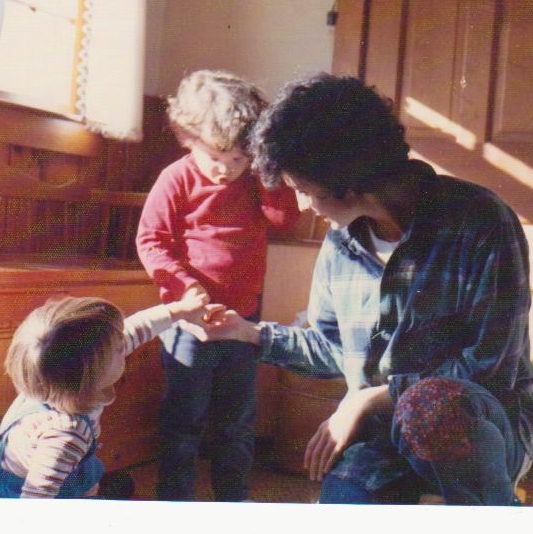
Rita, Amy and Gabe

Reason, a return to the faith of their childhood, the grace of their sacrament and nothing short of a miracle intervened.  They stuck it out.  A difficult year later, their love bloomed again and never left them.  A third child was born while in Maine – Angela. They moved to Rhode Island, and their fourth baby, Meg, came home.

Rita stayed at home to raise their children for many years, except for some part time work as an obstetrical nurse and teaching as a certified childbirth educator.  When Meg started high school, she volunteered with the Diocese of Providence in their pro life office.  Her experiences with maternity nursing, training young mothers to give birth and with her own premature baby (2 lbs) had forged in her a profound fervor for pro life issues.

She was hired as executive director of a crisis pregnancy center, Woman to Woman, and then was recruited as executive director of the state wide Rhode Island Right to Life organization.  RIRTL offers material help to women in crisis pregnancies, educational talks at schools and churches, speeches at political rallies in the state house rotunda and maintains a legislative lobby. Rita did battle with newspapers, local television and legislators.  Her writing became effective, and she spoke to crowds of hundreds.  Upon her retirement, she received written commendations from both houses of the state legislature and the governor.  She had dinner with governors, bishops and congressmen.  None of which meant much to her, the commendations gather dust in a closet.  What mattered to her were the babies and the mothers. She was astonished at this public turn of events, but her husband was not.  Rita is a warrior.

Rita loves to read, especially history; she is a lifelong learner.  Her active mind takes great pleasure in discussion of politics, cultural issues and history.  Her husband and she like very much to walk in the woods or along a beach, holding hands and speaking of many things – sometimes the lives of their children, sometimes their grandchildren, and sometimes the volatile topics of the day.  She favors a few deep friendships to which she is fiercely loyal and is a member of Red Sox Nation.  Rita likes to sing and play her guitar.  She draws well and enjoys sketching.  Her Italian and Portuguese heritage helped her become a good cook.   Her sometimes quick temper, which flows from her passionate nature, flairs far less frequently now, and they rarely have cross words.  Her husband still loves her like life itself; Rita is the greatest blessing of his life, and he is grateful.  The love of this young couple matured and will last them until death do them part.

Forty five years ago today they were married.  Happy anniversary, beautiful.

Proverbs 31

When one finds a worthy wife,           
her value is far beyond pearls.
Her husband, entrusting his heart to her,
has an unfailing prize.
She brings him good, and not evil,
all the days of her life.

14 Comments

Filed under Personal and family life

Retrospectives

Papa Jack hanging Christmas lights in our first house in Maine

Retrospectives for the previous year are ubiquitous in late December:  “The Best Of” and “Worst Of” lists – movies, theater, books, television, every sport known to humankind and Broadway shows; news stories of significance ranked by their impact on our lives and imaginations; fashion and entertainment “ins” and “outs”, championships and crushing defeats.  Late December also evokes a personal retrospective.  December 29th marked what would have been my father’s 95th birthday and the 29th anniversary of his death on the day he turned sixty six, especially poignant for me since I will turn sixty six in February.

Papa Jack was, as are we all, both ordinary and extraordinary.  He didn’t make any Man of the Year lists.  He was a salesperson selling all manner of products and services over the course of his career from land in Arizona to Yellow Page ads and Walpole Woodworker’s fence; death befell him prior to retirement, he liked his work most of the time.  A father of six and grandfather of fourteen, Papa Jack was an imperfect, but unforgettable Dad. He had few role models to learn to be a father, growing up in pre-Depression three deckers in Lynn, MA, a small hardscrabble mill city of working poor and lower middle class folks north of Boston.  His own father, a show troupe manager from Buffalo, NY, was killed in World War I shortly after my father’s birth; his mother, a former Vaudeville singer and Irish immigrant, died when Papa Jack was still a teenager.  Before World War II, he assembled aircraft engines at the “G.E.”, Lynn’s largest employer.   After Pearl Harbor, he joined the Army.

His closest Army buddy was ‘Sonny’ (John) Laracy, the twin brother of my mother, Betty, which is how my parents met.  Sonny and Jack slogged through half of France, Luxemburg and Belgium; he never told us combat stories, except for one.  Most of his WW II stories poked fun at his predilection for humor and running afoul of rules.  Sonny and he were scouts in an advanced Intelligence and Reconnaissance unit for the 52nd Armored Infantry Battalion.  My dad was a sergeant, and they had their own Jeep, although he told us of driving a half track as well.

In the early bad days of the Battle of the Bulge, in the Ardennes Forest of Belgium, troops were pinned down in the snow by deadly artillery, tank and small arms fire.  On December 18, 1944, my Dad and Sonny were separated as the Germans overwhelmed their position; my Dad remembers looking across a field and seeing Sonny racing away, waving back at him, unable to come back with only a suicidal run risking the lives of the other soldiers clinging to the Jeep as an option.  My father, along with many others, was captured and spent the next three months as a prisoner of war.  He spent several weeks living in a boxcar when American Mustangs returning from protecting bombing runs frequently strafed German trains.  The Americans would form the letters P O W in the snow to caution the pilots and stop the shooting.

At the end of his three months as a POW, the Germans drove several canvas roofed trucks transporting the Americans into a remote field.  The prisoners were herded out of the trucks to stand shivering in the snow.  Another truck backed up to the huddled men, surrounded by their guards. The tailgate dropped to reveal a tripod mounted machine gun and two grim German soldiers, one of whom jacked back the action to chamber the first round.  A tense and hopeless silence followed with only the sounds of the cooling engines.  No birds sang.  After what must have been minutes, but seemed an eternity, the soldiers manning the gun laughed mirthlessly, and the truck drove off, leaving the prisoners to make their way back.  When their captors slipped away, American soldiers soon liberated them.

I remember when I was ten or so, attending a Fourth of July cookout at a friend of my family’s.  The friend was Norwegian by birth and had a wood fired sauna in his back yard.  My dad went in with a couple of others.  As a joke, one of the other men jammed a shovel against the door, and started setting off firecrackers against the walls.  My father yelled for him to stop.  He did not.  My father screamed the only time I ever heard that sound; he was a big man, a strong athlete.  He kicked the door off its hinges and emerged furious and shaking.  The joker ran into the house.

My father was the king of street football quarterbacks among my friends and brothers. In his early twenties, he was the home run champion of the Lynn Softball League, playing for the General Electric team.  Before Tee Ball existed he almost despaired of trying to teach his eight year old son how to hit a baseball.  He patiently drilled a hole through a ball, and secured it with a string and a nail to a tree branch where I would happily, though for the most part, ineffectively flail away.  He stood and called out in the stadium at my college graduation, “That’s my boy!”

My dad drank a bit too much, smoked too much, told an easy, usually irreverent and wonderful joke at any opportunity, especially at wakes, and could quiet a room with his memorable Irish tenor.  Not a dry eye after Danny Boy.  My earliest memories of church are in the choir loft while my father would solo Ave Maria or Panis Angelicus.  To help remember his voice, we only have three songs recorded by my brother on a Dictaphone at my cousin’s wedding in 1970. The sound quality is not good, but he can be clearly heard on this link.  Papa Jack sings “On This Day”  Back arrow to return to post.

He was, like most of his generation, flawed, but resolute, and for his kids, a faultless hero.  A year before his death, he came up from Massachusetts, and we roomed together at a three day Catholic men’s retreat in Augusta, Maine near where I lived.  During recreation time, we played in a volleyball tournament and won.  He no longer could soar as he once had, but was a master of the heart breaking deke and soft placement of a point winning shot.  At the end of the three days, our families joined us.  We all took a turn telling briefly of our experience on the retreat. I was able to tell him and the couple of hundred in the audience that I loved him and always had.  I’m forever grateful that I did.

13 Comments

Filed under Personal and family life

Dona Nobis Pacem

The Christmas vs. Holiday tree controversy is threadbare and tedious, even in Rhode Island.   Going into the last week of Advent, it is advisable to avoid other combustible topics unrelated to the season: brevity and simplicity this week.

Christmas celebrates the birth of Christ: the rest is accoutrement. This is a particularly difficult focus to maintain in 2011. George Will once wrote in an honest, low moment, “Christmas will soon be at our throats.”  Regardless of Black Friday, marketing that begins in October, tinsel, flash, dreadful derivative music and parties, our little family prefers to keep the gift giving thoughtful, but minimal, sing perennially moving traditional carols, hold candlelight processions led by the little ones to the crèche my father-in-law built and my mother populated with exquisite hand painted ceramic figures of the Baby Jesus, Joseph, Mary, sheep and shepherds, camels and kings.  Simplicity in this thorny time of year is our hope; attaining simplicity is an annual struggle.

Two Advent readings resonate this year and convey two most valuable Christmas lessons. The saints speak most eloquently.

 The first reminds us to seek out peace, even and especially when chaos and FOMO (Fear Of Missing Out) threaten to overwhelm.  From Thomas à Kempis’s classic, Imitation-of-Christ “A man who lives at peace suspects no one.  But a man who is tense and agitated by evil is troubled with all kinds of suspicions; he is never at peace with himself, nor does he permit others to be at peace…  Above all things, keep peace within yourself, then you will be able to create peace among others.  It is better to be peaceful than learned.”

The second Christmas message is that every human being we encounter has intrinsic worth as their birthright and must be treated with dignity and respect irrespective of the accidents of nativity, appearance, intelligence, equanimity or station.  The eternal human soul is existentially dearer than church or planet or universe or any ephemeral thing.   From a sermon by Blessed Isaac of Stella, a 12th century abbot:  “Christ dwelt for nine months in the tabernacle of Mary’s womb.  He dwells until the end of the ages in the tabernacle of the Church’s faith.  He will dwell forever in the knowledge and love of each faithful soul.”

So to each of you precious souls reading these words and to those you love: Merry Christmas, a peaceful, simple Christmas season and a blessed 2012.

A lovely thing about Christmas is that it’s compulsory, like a thunderstorm, and we all go through it together.      Garrison Keillor

5 Comments

Filed under Personal and family life