Category Archives: Personal and family life

The Perfect Strawberry

The perfect strawberry is a complicated business, and one in which I am not particularly adept. To understand this year’s crop requires a history.

Twenty years ago in Providence, an 80’ Norway spruce in our back yard made the transition from playground and shade provider to weed.  Conifers have been around this tired planet for 200 million years, a vital component of many ecosystems.  Their names are strong, evocative – even poetic:  Sitka Spruce, Pacific Silver Fir, Lodgepole Pine, Incense Cedar, Mountain Hemlock, Baldcypress, Redwood, and Tamarack.   Evergreen is a misnomer.  Each species has its own timetable, but they shed their needles every year like deciduous trees, some with a striking fall yellow.  Their narrow pointed leaves carpet the earth, but they only drop older needles with the current crop (or several year’s worth) remaining to hold ever-green all winter.

In the early nineties, this illustrious past made no difference to me: the needles and shade killed what little lawn I had in my tiny city lot; the sticky, Norway-Spruce-conesgolden drippings from the bark bonded to the finish of our cars; cones devastated our bare feet, and the 18” limbs hung like the Sword of Damocles over my garage, only five feet from its thirty six inch trunk.  We had no hope of a garden, and the pin oak I treasured twenty feet north of the spruce was beginning to deform to find sun of its own. The Norway spruce which had been planted by the previous owner of our home in the 1930’s was sixty years later a tall and heavy weed.

After we moved to Providence, my son designed and built a refuge with his new city friends.  Scavenging from the dumpsters in a six lot subdivision a quarter mile away, they cut and fit remnants of two by fours, two by sixes, half inch plywood and discarded loose nails into a tree house fifteen feet up in the Norway spruce.  My only contributions were a blue tarp to waterproof the roof and, after setting a rope in place, teaching Gabriel how to foot lock up the rope to his sanctuary.  I did go up to reassure his mother that although not OSHA compliant, it was habitable and secure.

The three wings, each long enough to accommodate a sleeping bag conjoined into a four foot square parlor under a three and a half foot ceiling.  Once they hoisted themselves up and pulled the rope up after them, parents slept secure that no marauders could easily access their fortress.  The boys ran an extension cord from Gabe’s window for a light, and when they each stretched out on their bags facing inward, the center afforded ample space for card playing, scarfing down Twinkies, Cokes and Doritos (fare foreign to his mother’s kitchen), tale telling and planning night excursions into the city.  We naively thought they were safe from the city; years later we learned the city wasn’t safe from them.

Unbeknownst to their parents, two in the morning expeditions wandered as far as the bus tunnel steeply descending the half mile from Brown University Hill to South Main Street near the courthouse three miles from our house.  The tunnel was a traffic free route for public transportation connecting the university communities of Rhode Island School of Design and Brown to downtown.  Pitch dark, except when a bus caromed through lights ablaze, the tunnel was an irresistible challenge for pre teen skateboarders.  Even in the nanny state days of ubiquitous helmets, boys will find ways of courting danger to grow into men.  They all survived – no fractures or paralysis.

The boys grew to manhood, and the young man helped his father dismantle the abandoned refuge and cut down its pedestal, now a weed.  With chainsaw, climbing saddle and ropes, we worked for two days first lowering the large limbs over the garage from the bottom up, and then popping the top twenty five feet into the small target circumscribed by the back fence, the pin oak, the garage and our house.  After all the limbs and top were safely cut up on the ground, three more ten foot logs were dropped one at a time from the remaining pole.  Last was the twenty five foot trunk, which we notched and felled onto the mark.

With the spruce gone, several years went by before we dug in a twelve by twenty foot raised planting bed in the sunny spot salvaged from the spruce’s shade.  Hundreds of pounds of organic compost built up top soil, and lime sweetened sixty years of acidic spruce needles.  First there were flowers, a lilac and a butterfly bush.  Later we reverted to our Maine habit of vegetable and herb garden.  In the tiny plot, we plant tomatoes, lettuce, zucchini and an occasional ill advised venture into peppers or pole beans.

strawberryTwo years ago, we put in some strawberry plants, which quickly expired for horticultural reasons unfathomable to amateurs.  Last year I tried again, and they took.  The few miserable fruit that exposed themselves were quickly consumed by birds just as they matured.  Undeterred, this winter I protected them with boards as we stored our firewood in the garden.  Unsure what I would find this spring, I was pleased to find they had prospered under the tarps and four cords of oak and maple.

Spring arrived; I weeded and raked in yet another few hundred pounds of dried manure and planted this year’s crop of vegetables.  The four strawberry plants looked so promising I planned to buy some bird netting to defend the harvest from predators, but waited until the weekend, which as it turned out, was three days too late.

Memo:  buy bird netting early next year.

Last week, while watering the garden at five AM as is my habit, I glimpsed half buried red under one of the strawberry plants.  With faint hope and mounting joy, I gently uncovered just ripened perfection.  I briefly considered saving it for Rita, but she was asleep after all.  I washed off the soil, admired God’s wondrous variety for a few moments and bit into sweet delight after a bitter winter.

“It is better to limp along the way than stride along off the way.  For a man who limps along the way, even if he only makes slow progress, comes to the end of the way, but one who is off the way, the more quickly he runs, the further away he is from his goal.”  Thomas Aquinas

5 Comments

Filed under Personal and family life

Pet Tails

We are pet-less, now, if you don’t count grandchildren, but in the past a small menagerie of somewhat domesticated fauna has graced our path.  Mostly cats and dogs, but occasional hamsters, rabbits, laying hens and completely useless goldfish have come and gone.  By gone, with the goldfish, I am referring to their final resting place, which usually requires just one flush.  Cats and dogs are more complicated.

“Cats don’t like change without their consent.”  Roger Caras

First there were Sam and Harry, who had to be jettisoned to other family members when we moved.  Another half dozen or more cats have drifted in and out of our lives, the last being my favorite, Mama Cat, who died in the bushes out back (as cats are wont to do) after just over twenty years with us.  She used to sleep on top of Meg’s head when she lived here.  Meg attributes that resting spot to affection; I would tease her that Mama Cat liked to be warm, and the crown of her head was an efficient source of heat.  Since our cats were always outside as well as inside cats, every once in a while, Meg, especially, would wake up with flea bites – the price of feline fondness.

Typical for their species, our cats were languid, detached and generally disinterested in pleasing humans —  as happy on a sunny window sill as curled on someone’s lap.   On their whim (not yours) they would purr, rub up against a leg or jump on the table for attention.  Most of the time, however, they were content to pursue their own interests, actually more than content.  Obsessed is more like it.  Several were superlative hunters and would leave gifts of mouse parts or half birds on our front steps.  Big Billy (he of the big body and small brain) was fixated on killing telephone cords.  He also would wage fierce battle for five minutes at a time with his doppelganger up on his hind legs in the floor to ceiling mirror in front of the girl’s ballet exercise bar. He was indifferent to the ridicule of humans.  Billy’s greatest triumph came when the neighbor’s scruffy mongrel chased him under the yews out front; after a terrible yelp, the mutt emerged with a badly bloodied nose and cured of cat chasing.

“If a dog jumps into your lap, it is because he is fond of you; but if a cat does the same thing, it is because your lap is warmer.”  Alfred North Whitehead

Basset houndDogs are a different tale.  Their pleasure was in pleasing and their passion in protective loyalty – except for Frankie, our basset hound, who danced to a different drummer.  A friend found Frankie at around three months old half starved in the foothills outside of Boulder.  Dave and Yvonne had an enormous Weimaraner and a small apartment; a second pooch was not an option, so we were gifted with him.  He was beautiful in a way only funny looking dogs can be.  He had two speeds: absolute rest approaching coma and full throttle.

Back in Massachusetts, I worked awhile as a reporter in the evening covering local boards and politics.  During the day, I would sometimes take Frankie for a run in the nearby forest because beyond all else (except supper meat stolen from our table) he liked to hunt on a scent.  I would wait until he went off after a rabbit or squirrel, then I’d run and hide while he was distracted.  If observed by a rational person, my sanity would have been questioned.  Splashing up streams to lose him, sometimes I would climb a tall, straight tree and jump to another and yet another, so my descent would not land me in the spot from which I ascended.  Eventually Frankie would tire of rabbit and come looking for me. My predilection was to hide in a bush near a clearing where I could observe him.  When he ran out of trail at the base of one tree, he would expand his search in a widening spiral until he again picked up my scent.   As he neared my hiding spot, I would break from the bushes in a dead sprint; Frankie would lift his voice in a full throated howl and run me down.  We’d laugh (or so I imagined he was laughing, too) and wrestle, rolling in the pine needles.

“The great pleasure of a dog is that you may make a fool of yourself with him and not only will he not scold you, but he will make a fool of himself too.”  Samuel Butler

Our second favorite dog was a German Shepherd/Siberian Husky mix, a gift from a couple we knew on Cape Cod, when we lived on Mashnee Island.  Nikki resembled a wolf and was always an outdoor dog, even in the harshest of Maine winters.  She would pace and pant in our house until we put her outside on her long run.  I built for her an insulated lean-to shelter against the lee side of our woodshed, but she preferred to sleep in the snow.  She too had strong hunting instincts and loved to run in the woods. I frequently would go for a two mile run with her loping easily alongside.  In the winter she would tear across the large field adjacent to our house kicking up a ten foot high wake of loose powdered snow.  We were working to expand the woodshed one fall afternoon, when Nikki spotted a large wood rat.  She trapped it under a loose 12” rough board that was lying haphazardly over a small hole.  Bounding back and forth from side to side of the board as the rat attempted one escape after another, she was a picture of silent, deadly focus.  Finally in seeming desperation, the rat fled towards the woods and got five feet before Nikki broke its spine with one clamp of her jaws and a quick backward snap.  Talking her out of her supper was a challenge.

Once after she broke off her run, which was 70’ long and constructed of heavy wire and a chain leash, I called for her at least an hour before she returned with bloody muzzle.  I was afraid she had been hit by a car at first, but found her uninjured.  A few minutes later, my neighbor down on the Vienna Road (pronounced “Vy-anna Rud”), “Juny” Hall (short for Junior) knocked on my door to let me know that he was one sheep short, and I owed him some money.  As gentle as she was with our children, prey was entirely of another order.

“We’ve begun to long for the pitter-patter of little feet – so we bought a dog.  Well, it’s cheaper, and you get more feet.”  Rita Rudner

I sometimes think of the current societal oddness about animals.  P.D. James, the British author of the well known Adam Dalgliesh poet/detective mysteries, wrote in 1992 a dystopia novel about a future culture dying with terminal infertility.  Couples without the ability to have children resorted to dressing up and pushing cats and small dogs around in prams.   As I meet the many young couples in our neighborhood taking their twice daily constitutionals, baggies in hand, I listen to them fawn over their pet’s eccentricities as most once spoke about their children.  When they tell me about spending thousands of dollars on cancer surgeries for twelve year old dogs, my obviously unenlightened sensibilities drive my thoughts unbidden to images of homeless families eating at local church food kitchens for which the money spent on terminally ill pets would be of great benefit.  It seems to this observer that something is out of balance.  I am fond of animals and would never be unkind towards them, but they are not people.

A fellow at work told me the story of his Aunt Barbara in Louisiana and spending summers on her farm.  She had several domestic cats and fed quite a large clowder (or glaring) of feral cats along with her farm animals.  Barbara also had three collies that she would let out at night.  A few times a month one of the feral cats would fail to survive an encounter with a collie.  When asked by her nephew why she allowed, even sanctioned, this harvesting, she explained in a matter of fact way that is reminiscent of the common sense practicality of good Maine rural folks.  It seems she kept the cats around to control the population of rats in her barns; the collies were allowed to roam to control the population of feral cats.  To me this is  symmetry and good logic, displaying a proper relationship of human and animal symbiosis.  Not politically correct in today’s wealthy specialty veterinarian culture with health insurance for pets, but to me, this necessary balance reflects more humanity than kittens and puppies dressed up in doll’s clothes riding in baby carriages.

3 Comments

Filed under Culture views, Personal and family life

Cold Snap

“Human reason has this peculiar fate that … it is burdened by questions which… it is not able to ignore, but which, as transcending all its powers, it is not able to answer.” Immanuel Kant, Critique of Pure Reason

When I went out one morning this week to bring in some wood for the woodstove, the thermometer registered 3 degrees, which is about as cold as it gets in Rhode Island without wind chill. Now in the Sandy River Valley in the West Central Maine where we once lived, 3 degrees before dawn might qualify as a bit of a January thaw.  Routinely in the dead of winter there, we would wake to 20 below.  I remember a week when we didn’t break into positive numbers at the warmest period in the afternoon, and every night was 15 or 20 below.  Hauling in wood from the shed would numb my face in the thirty feet I carried it.  I grew a beard most winters to protect my skin, since I was often outdoors.

Albert Camus once wrote, “in the midst of winter, I finally learned that there was in me an invincible summer.”  Camus’s metaphor seems to bear more than merely surviving a cold winter; perhaps he writes also of the winter none of us will escape in the end.  As I near my 67th birthday, the depths of winter echo with chords of my mortality.   As I near my 67th birthday, I am reminded that one certain inevitability is closer now than ever before, and it is necessary to be reconciled with that truth.  And yet, an “invincible summer” is within us, an unquenchable, “desperate desire” that the final deep cold will not descend undiminished, that we will see those we love again, that the inescapable lowering into frozen ground is not the end.

“The dragon is by the side of the road, watching those who pass.  Beware lest he devour you.  We go (to) the Father of souls, but it is necessary to pass by the dragon.” St. Cyril of Jerusalem

Bill Yates pictureIn December, our dear friend in Maine, Bill Yates, succumbed to bile duct cancer after being diagnosed in August. A strong, unexpected cold wind overwhelmed him.  Always very fit, in July, he was competing in 5K races, still going strong at 71.  He never made 72.  Bill was a former Navy doctor, board certified in obstetrics and gynecology.  In 1975, he opened the first OB/GYN practice in Franklin County, Maine.  Later in his career, he updated his training and refocused on helping infertile couples, but eschewed in vitro procedures, which he deemed risky, expensive and with grave moral issues.  He retired in 2003 after nearly thirty years and over 2,500 babies delivered.

In 1969 while serving as a Navy lieutenant, he married Navy nurse Margaret Bandlow in Virginia two years after graduating from medical school.  Bill and Meg were married forty three years at his passing.  Among their six girls and two boys are a physician (Elena, one of the twins), two Sisters of Life in NY, Leah (Sister Mary Louise Concepta) and Rachel (the other twin, now Sister Mariae Agnus Dei), an engineer and a certified rafting guide on the Colorado River through the Grand Canyon.  Like Bill and Meg, their children travel to places all over the world to explore, hike and run, bicycle hard, and love the hills and rills of Maine.

 Bill grew up in Elyria, Ohio and maintained a Mid Western natural friendliness and dry sense of humor.  His intelligence and insatiable curiosity made him an engaging conversationalist. His kindness made a conversation with him a distinct pleasure: full of new ideas, but devoid of painful pitfalls.  His father owned a general contracting company, so he grew up around construction and summer jobs.  Bill inherited a deep pleasure in building things – a new house, a new office suite for his practice; he would occasionally uproot what was and build something fresh because he wanted to.  Once when his partners wanted to stay in the last office he built, Bill got new partners. “Undeterred” comes to mind whenever I think of him.  Since construction has been the source of my career, we had many talks about contracting and contractors.  My firm hope is that we will have some more when time is no longer finite.

 “Down, down, down into the darkness of the grave

Gently they go, the beautiful, the tender, the kind;

Quietly they go, the intelligent, the witty, the brave.

I know.  But I do not approve.  And I am not resigned.”

Edna St. Vincent Millay

If you are a regular reader, you may remember the story about our choice in 1980 to undo our decision following nearly a decade not to have more children after Amy and Gabriel.  The great blessing of Angela and Meg (and now Pete, Gianna, Ellie, new baby in the womb and Marty) were the direct happy result of that decision.  Bill Yates was Rita’s OB/GYN physician in Maine whose encouragement and connections to his Navy doctor friend in Portland enabled me to have a vasectomy reversed.  Our lives were affected so profoundly that I cannot reflect on them without emotion.  For this and for Bill and Meg Yates, I am forever grateful.

Meg is a lifelong Catholic, and although Bill was raised in a mainline Protestant denomination, he kept the promises he made to her at their wedding and attended Mass with the children and her.  At one point in his forties, he became more curious about her faith.  Rita and I were on vacation for a couple of weeks on Webb Lake, near where they lived.  We happened to be carrying in my Bible our note cards for something called a “Life in the Spirit” seminar, which we had taught as a husband/wife team for quite a few years.  Usually conducted with once a week sessions for seven weeks, we spent several nights covering the material and praying with Bill and Meg.

In the autumn, they came down with the whole crew to visit us and attended a Fall Festival with a Catholic community to which we belonged at the time.  That we absorbed with nary a speed bump the ten Yates in our small house — sleeping bags and air mattresses everywhere — was a testament to the loving, controlled chaos of their family.  While here at a picnic, Bill had an absorbing conversation with our friend, Father John Dreher, himself a convert from Protestantism and a Mid Westerner, who came east to study at Brown decades before.  The next year Bill took formal instruction in the Church and joined Meg as a professed Catholic, a commitment that carried through the rest of his life.

The following summer, when we saw them again, they brought me a magnificent 12 speed bicycle.  At the annual Wilton Blueberry Festival that they helped run, Bill bought a limited run $10 raffle ticket in my name for the bike as a thank you for the previous summer.  The ticket was pulled, and I enjoyed many years of long rides around Webb Lake in Maine and to and from a state park in Rhode Island on many early mornings back in Rhode Island.   Bill’s bike.

I spotted the bike hanging upside down in our garage when I was pulling out my wood splitting maul a month or so ago; the bike has been there for five years without a ride. Pitchers and catchers will arrive in the major league training camps next month.  Ash Wednesday is less than three weeks ahead, which inevitably leads to Easter, and is my personal first sign of the annual greening.  I’m going to take Bill’s gift to a first class bicycle shop for a full tune up and some new tires.  Hope comes once again during a cold snap, as it always does. Spring beckons.

“The leaves are falling, falling as from way off,

as though far gardens withered in the skies;

they are falling with denying gestures.

And in the nights the heavy earth is falling

from all the stars down into loneliness.

We are all falling.  This hand falls.

And look at others: it is in them all.

And yet there is One who holds this falling

endlessly gently in His hands.”

“Autumn”, Ranier Maria Rilke

Quotes in this post were shamelessly purloined (but attributed to their original authors), as was the title of a previous post from Dr. Regis Martin’s superb small book on Christian hope, “Still Point – Loss, Longing and Our Search for God”, which I could not recommend to you more highly, irrespective of your inclinations in this regard.  The desire for hope is imbued in our being.

5 Comments

Filed under Personal and family life

Millie and a Fortieth Anniversary

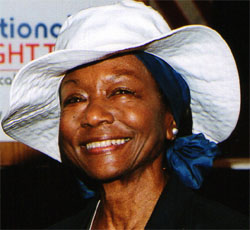
mildred jefferson 1Mildred Fay Jefferson died at age 84 just over two years ago in Cambridge where she lived, not far from Harvard Medical School.  She was the first African American woman to graduate from that prestigious university, having entered it at twenty years of age. She had previously earned a master’s degree from Tufts University following her bachelor’s degree from Texas College at the age of 16.  She went to Tufts while waiting to be old enough to be accepted at Harvard Medical thirty years before “affirmative action” was even a concept.  Mildred was the first woman of any race accepted as a surgical resident at Boston City Hospital, the first woman physician at the former Boston University Medical Center, where she taught, and the first woman member of the Boston Surgical Society. Her intelligence was incandescent, but we will best remember her as a friend.

Dr. Jefferson was the only child of a Methodist minister and a school teacher, born in 1926, and raised in Carthage, a small town in East Texas.  As a young girl, she would ride on house calls in the horse drawn buggy of the town doctor.  Her family and the doctor encouraged her ambition to become a doctor.  Her family called her “Millie”.  No one else did that I ever knew, including us.  In 1973 after the Roe v Wade Supreme Court decision struck down all laws restricting abortion on demand at any stage of pregnancy, Mildred considered her original Hippocratic Oath taken when she graduated from Harvard and refocused her considerable gifts.  (Link to original Hippocratic Oath, no longer taken by new doctors after a 2,000 year history: Original Hippocratic Oath.)  She founded Massachusetts Citizens for Life, and then co founded National Right to Life, becoming first its Vice Chairperson, then Chairperson and then President, overseeing all its activities.  In 1980, she formed the first National Right to Life Political Action Committee.  If you found yourself in a debate or a battle with Mildred Jefferson, you’d better bring a lunch.

 Testifying before Congressional committees led to crisscrossing the country inspiring millions with her extraordinary public speaking ability and multiple appearances on national television, including a session on PBS’s Advocates, remarkable for its long term impact.  She made her case, none of it “religious”, but logically and relentlessly, Mildred outlined the moral, medical and sociological case against women taking the lives of their pre-born infants.   Watching her articulate her deeply held convictions with grace, power and knowledge was the governor of a large state, who had signed into law a bill allowing abortions in that state.  So convinced and convicted was he by her compelling arguments, he wrote her a letter.  In it, he told her that he had never really considered the full implications of abortion, nor its effects on women and the culture. He deeply regretted his unreflective support for a “woman’s right to choose”, and vowed to do everything within his purview to fight for the unborn, a commitment he kept until the end of his life.  As President of the United States, Ronald Reagan could bring considerable influence to bear.

As we mark the fortieth anniversary of Roe v Wade on Tuesday with its sad accumulation of fifty five million aborted babies, and we celebrate the life of Martin Luther King tomorrow, Dr. Jefferson represented the confluence of the civil rights of former slaves and women as well as those of the unborn.  She was knowledgeable about and a warrior in all these struggles, her certitude was that they were of a piece.  She would talk about the racist eugenics advocated by the founder of Planned Parenthood, Margaret Sanger, and how to this day their abortion clinics are located most deliberately in poor and minority neighborhoods.  Mildred deplored the undeniable facts that black citizens comprise about 12% of the U.S. population, yet suffer 35% of the abortions.  She saw this as a kind of genocide, wherein affluent white liberals saw their moral directive was to “help” minorities by lending them a hand to murder their young.

mildredjeffersonWhen my wife, Rita, became the Executive Director of Rhode Island Right to Life early in the new millennium, she understood the medical and moral dimensions of the battle, but was naïve on the political battleground.  Mildred Jefferson took her under her wing.  As a force to be reckoned with in both national pro life activity and Republican Party politics, her mentoring skills were like everything else she did – formidable.  She was in her early seventies then, looked fifty, and had a magnificent gift to make you feel like you were the most important person in the universe – the total focus of her attention in any conversation.  Over lunches and dinners, we soon learned she could discuss knowledgeably any topic that came up, from the Civil Rights movement of the fifties and sixties to whatever became of the owner of the former Steve’s Ice Cream emporiums in Cambridge and Providence, whom she knew well.  Her smile, her laugh, her warmth, her truly startling memory and intelligence were a delight and comfort.  Never was there a hint of affectation in her conversation – only a sincere desire to help, to support, to encourage and to befriend.  The Rhode Island Right to Life annual oratory contest and scholarship award for high school students is named in Mildred’s honor; the national contest, to which the Rhode Island winner is sent, was a special passion of hers.   She supported Rita in many ways throughout her years at RIRTL and sat with us at Rita’s retirement dinner.

When Dr. Jefferson spoke at our annual rally in the Statehouse Rotunda, she was mesmerizing with natural speaking ability and gifted intellect; she would let loose the occasional glimpse into the cadences of her Southern preacher father.  The entire audience of religious and political luminaries along with school buses full of young people and the hundreds of ordinary pro lifers with their families were rapt with attention and respect for her history.  This tiny, unassuming woman who could keep us enthralled around a mealtime conversation, transformed into a speaker of great power.  She could even lead us in a rousing few verses of “Battle Hymn of the Republic”, sung with the accomplishment of her childhood Methodist choir days.

She was beautiful in so many ways; we hope to see her again.  We will miss her at the rally on Tuesday, but even more, we will miss her at dinner.  We miss her smile.

Ecclesiastes 3:11, He has made everything beautiful in its time. He has also set eternity in the human heart.

Link to NRTL tribute to Dr. Jefferson

Link to a commemorative article about her life.

5 Comments

Filed under Culture views, Personal and family life

Still Point

Except for the point, the still point, there would be no dance, and there is only the dance.  T.S. Eliot – Four Quartets

Drove my Chevy to the levyBeing the oldest of five (eventually to be six) children in 1956, the age of ten brought with it occasional responsibilities that would be surprising to most ten year olds in 2013.  We shared one bathroom, and the four boys shared one bedroom in a three bedroom cape with two small one window dormers in the front.  When I was thirteen or so, my youngest brother, Marty, filled out the nest, and my dad added on a family room.  We never questioned and rarely felt put upon by the living arrangements; our family was secure and happy in our daily routines.  My parents had one car; my father worked two jobs and my mother worked full time as a mom, which was quite enough for anyone.

Intermittently my mom asked her oldest to help out paying bills downtown, which was a mile or so from our house.  Accomplishing this on my bike was an easy adventure and invited me in to the mysterious grown up world.  My mother didn’t have a car when my father was at work, and in 1956 in addition to me, she had two kids in diapers plus a set of five year old fraternal twins, one of whom had a severe hearing disability.  She handled this all with aplomb and good humor most of the time, but when the bills were due, she needed some assistance.

The budget was managed by accruing cash weekly in separate envelopes for various expense categories.  I would be given the utilities envelopes and the mortgage envelope, and then mount up on my bike.  There were no bike racks or bike locks, none was needed, just a kickstand or a convenient wall to leave the bike against.  First, I would go to the bank, then the electric company and the telephone office.  No gas company bill in 1956 and I think she paid cash to the oil man, when he delivered.  Grocery shopping was a full family affair when we were little.  The checkout clerk would help load the groceries into our car.  I lost five dollars in change once, which was a minor disaster in a time when it represented nearly fifty percent of the weekly grocery budget.  She was disappointed, but kept her concern brief and tight lipped – almost. I was admonished after that to return straight home with no stops at friends’ houses or especially the library, which could delay my return for hours.

card catalogA bike ride to the library was also about a mile, and with the possible exception of a sandlot baseball game behind the elementary school, my favorite activity.  I was a constant reader and shy at ten.  There are pictures of me my mother still has, sitting on the floor reading a book absolutely absorbed and still, amid the chaos of my five siblings.   I haven’t changed all that much – except for the shy part, although I remain private.  My reading consumption was and remains omnivorous, but at ten inclined towards biographies of Indian fighters and tales of King Arthur and the Knights of the Round Table.  As I got a little older, I was spellbound by biographies of Thomas Edison and Babe Ruth with The Count of Monte Christo not far behind.

The Walpole Library was small, but well stocked. Upstairs was for the adults, but the basement was reserved for children and adolescent fare.  The librarian was a genial and skilled substitute far superior to Google for a ten year old; the card catalog held the keys to the kingdom.  If the librarian was preoccupied, we could sneak out to the front steps and edge our way around the whole structure on an eight inch granite ledge that circumscribed the building as a design feature just below the windows.  The children’s section had round low reading tables with small chairs.

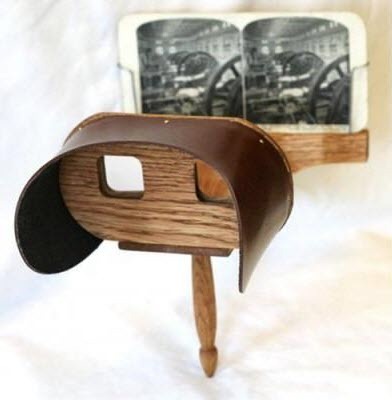
In one corner, two stereoscopes resided along with boxes of the two photo four by ten inch cards that fitted into them.  Most of the pictures were black and white, although some, including Civil War historical shots were sepia. As a ten year old, I especially liked the battle aftermath photos.  When viewed through the lenses, they appeared in 3D.  Developed in the mid nineteenth century and vastly improved by Oliver Wendell Holmes in 1861, the stereoscope opened previously undreamt wonders to a ten year old.  From Egyptian pyramids to the streets of Paris to the Grand Tetons, our new world was limited only by our imaginations.

StereopticonStereoscopes are now valuable antiques and anachronistic reminders of simpler times (that is simpler unless one lifts the edges of the curtains).  They were supplanted sadly by more enticing moving pictures and eventually television.  Our television was a big box in the living room with a small black and white screen and three somewhat fuzzy channels.  Ozzie and Harriet, I Love Lucy, The Ed Sullivan Show, The Jack Benny Show, The Honeymooners and many, many Westerns like Gunsmoke and Have Gun, Will Travel drained away our family hours as we got older. I could still slip away to my sanctuary in the eaves of the attic, which had a single pull chain light bulb and a hook and eye latch, to seek the quiet harbor of my books.

I’ve heard it said that we all have our nineteen year old selves permanently emblazoned on our personalities.  Can it be any less so for ten?  My tenth birthday was in February of 1956, eleven years to the day after the Marines raised the American flag on Iwo Jima, securing a key stronghold on the long drive to Tokyo.  To idealize any period of time is to trivialize it, however to hold it at the center of our innocence is quite another.

The fifties were in some ways innocent and optimistic, yet they also harbored Jim Crow laws and the hypocrisy of country club adultery and too much liquor.  But most families were hard working and held traditional morality dear; the parents were the “Greatest Generation” determined to leave behind the Depression years of the thirties of their youth and the killing years of the forties of the war, and to pass on to their children a safer, more stable and more comfortable future.  For this they worked steadily and generally cheerfully for the rest of their lives.  Comfortable was achieved; stable and safe eventually were beyond theirs to bequeath, but in the fifties, at least the illusion of simpler times was lovingly preserved.

“We don’t know what we are doing, because we don’t know what we are undoing.” G.K. Chesterton

4 Comments

Filed under Background Perspective, Personal and family life

Leverage

A decade or so ago, some friends undertook the arduous journey to adopt their daughter, who spent the first fifteen months of her life in a Moscow orphanage.  The journey was arduous in all ways possible – mileage, time, financially, intellectually demanding to wend their way through the arcane rules and most especially, emotionally.  On their initial visit to the facility, they found most of the younger children were minded in a small enclosed area with a few toys to claim, if they could be held against all competition.  The facility housed over a hundred small clients, a couple of dozen or so under the age of two.  When they first spotted the young beauty that was to transform their lives, the fifteen month old glanced sideways while on the changing table and made eye contact across the room.  That ability to connect with those who were her life line was a skill, either learned or inborn, that conveys to her a gift beyond reckoning and persists into her precocious pre teen personality.  She can take over a room like brightness draws moths into the light.

In Moscow, she competed with a score or more toddlers and infants for the haggard, stretched thin attention of two full time attendants, each of whom worked a twelve hour shift every day.  One person at a time was on duty for changing, food, health care, teaching and loving.  They did their best; they really did.  Learning toys were scarce, food was sparse and survival skills important.  An orphan who prospers learns early to compete, to persist and to make her way.  Her intelligence and persistence were the primary attributes we noticed when we  met her in our friend’s house shortly after they returned home.

For adopting parents, protocol was for at least two visits of a fortnight each, separated by a period of time, usually a month minimum.  The first one was intended for selection of their new family member and early bonding; the second was to complete the paperwork, spend more time with the child, and usually followed a vetting process.  Our friends were able to convince the adoption authorities that a second trip would be prohibitively expensive financially and more importantly expensive for their schedules, since they were both self employed.  They remained in Moscow for twenty eight days at a cost exceeding thirty thousand dollars, but when they got on the first leg of their Aeroflot flight home, there were three of them.

President Vladimir Putin signed a bill Friday banning U.S. citizens from adopting Russian children, raising tensions with Washington as the Obama Administration is trying to win Moscow’s support to end the war in Syria.  Russian officials portrayed the latest legislation as a tit-for-tat retaliation against a new U.S. law that seeks to punish Russians accused of human-rights violations.

Moscow’s legislation—which also bans U.S.-funded civic groups in the country—puts concrete action to rising Russian complaints, voiced most vehemently by Mr. Putin, that the U.S.’s own human-rights failings give it no credibility to lecture others.  But the adoption ban has exposed Mr. Putin to criticism both internationally and within his own government. Critics allege that the law makes political pawns out of Russian orphans, whose living conditions can be dire and prospects for adoption often slim.

Gregory White, Wall Street Journal 12/28/12

Many of the children adopted from Russia by American parents suffer disabilities such as spina bifida, which is treatable if medical resources are more abundant than in a Moscow orphanage.  Without adoption, these children will languish.  Worse yet is the fate of young especially pretty women, who outgrow the orphanage, and become prey on the streets of the city.  The sex slave and drug trade flourish in Russia; young girls are turned on and turned out.  Most grievous are the adoptions shut down in mid stride.  There are children and parents who have spent much time together and bonded; they will now be unable to complete the process, some just a week or so from flying home together.

“I looked the man in the eye. I found him to be very straightforward and trustworthy. We had a very good dialogue. I was able to get a sense of his soul; a man deeply committed to his country and the best interests of his country.”  President G.W. Bush about Vladimir Putin, press conference, 1/6/2001

“I told him (Yeltsin) I was impressed by what I had seen of President Putin but wasn’t sure he was as comfortable with or committed to democracy as Mr. Yeltsin.”  Former President Bill Clinton in a NY Times article, “Boris the Fighter” on the occasion of the funeral of Boris Yeltsin 4/29/2007

Vlad, the Impaler, Putin

Vlad, the Impaler, Putin

These protestations about violated human rights in the United States  coming from Vladimir Putin, a triumphant thug who came up through the ranks of the KGB, now FSB, would be ridiculous, if so many innocent lives were not sacrificed to the brutal, leveraged, “diplomacy” of the hard core left.  Remember in October of 2006, Anna Politkovskaya, a gifted, courageous journalist, was assassinated in the lobby of her apartment building with two bullets in her head.  She had become a potent nuisance to Putin with her brilliant expose of “Failed Democracy” and the outrages against Chechen civilians.  She was murdered on Putin’s birthday, no doubt a gift from his old colleagues in the FSB, who are exceedingly skilled in contract murders.  A month after her death, Alexander Litvenenko, a former FSB officer who had defected to the West, was taken very ill to a British hospital, where he died a gruesome, slow death three weeks later of acute radioactive polonium poisoning.  He had been working with MI5 and MI6 as well as in his new career as a journalist. He published two books:  “Blowing Up Russia, Terror from Within” and “Lubyanka Criminal Group.”   Polonium in the mashed potatoes is a creative and cruel method of political assassination, again one in which the old KGB was particularly gifted.  The “Cold War” may be in the history books, but its practitioners learned their craft well.

President Obama to then President Dmitri Medvedev (now Prime Minister after he and Putin again exchanged chairs): “This is my last election.  After my election, I have more flexibility.”  Video…

Medvedev:  “I understand.  I will transmit this information to Vladimir.” 

Ten years later and fully adapted to her adopted country, this beautiful daughter of our friends is doing splendidly at an exclusive private school.  Her grades are excellent, and she is excelling in her other special interests in photography and basketball. She is on the local “travelling team” as an All Star in her age bracket.  The school for gifted students is on a handsome campus as a “feeder” school for the Ivy League and other top line universities. Her school has won the state wide Academic Decathlon nineteen times out of the twenty nine it’s been held.  One expects her prospects are considerably more promising than those of a street urchin in Moscow.  Her parents are devoted to her success in life and to her nurture.  Love is irreplaceable.

“May it show us the family’s holy and enduring character and exemplifying its basic function in society: a community of love and sharing, beautiful for the problems it poses and the rewards it brings; in sum, the perfect setting for rearing children – and for this there is no substitute.”  Pope Paul VI, speaking of the Holy Family in Nazareth 1/12/1964

3 Comments

Filed under Personal and family life, Politics and government

Irish Cuisine

“I’m Irish, so I’m used to odd stews. I can take it.  Just throw a lot of carrots and onions in there and I’ll call it dinner.”  Liam Neeson

Many would say the topic is oxymoronic, but the roots of all things Irish are hardscrabble.  My father was half Irish, and never knowing his father, who died when he was an infant;  he was raised by his Ma, Margaret Veronica Lannon, a former vaudeville singer who married her stage manager, John Parquette, and helped by her Irish sisters Stacia and Essy — immigrants all in a three decker full of family in Lynn, Massachusetts.  My mother was the youngest of six to Irish parents, her mother, Molly Manley, was full time at home, and her father, Jim Laracy, was a tin knocker.  She was born in the apartment over D.A. Baker’s sheet metal shop where my grandfather lived (and worked) before they bought the house on Maple Street in Walpole.

Our family of six children in Walpole, of which I was the oldest, was deeply imbued with an Irish culture, albeit with a French name.  My mother, Betty (or Girly to her sisters), going strong at 91, still possesses her characteristic sense of humor and intelligence.  The main danger she presents currently is to gondola displays at the local Target when someone foolishly allows her to drive a battery powered ‘accessible’ sit down shopping cart.  All her kids grew up straight and true.  Somehow.  All of us are blessed with the strong work ethic of both our parents.  Ma has long claimed that her six children would never go hungry as long as she had a good can opener.  She was pretty good at potatoes, though, and beef stew, even if Dinty Moore canned stew was not foreign to us in a pinch.

“I have always found the Irish to be a bit odd.  They refuse to be English.” Winston Churchill

My wife, love of my life and frequent muse, Rita, suggested this blog topic, so I’ll begin with a story that includes her.  When we were newlyweds, we didn’t have a lot of money.  Rita was a registered nurse working full time, while I finished out my last three semesters of college.  We lived in a third story walk up ‘shotgun’ apartment on a tight budget, painfully young and rhapsodically happy.  Rita, of Italian and Portuguese descent, is a creative cook acquainted with all manner of spices alien to me at the time.  Salt and pepper were the only spices I knew from my mother’s table, and pepper was suspect.

I tried to inflict my childhood Saturday night tradition of hot dogs and beans on Rita, which held for awhile.  A month or two into our marriage, we sat down on Saturday night – canned Boston baked beans and hot dogs grilled in the frying pan – two each.  Halfway into this ambrosia, Rita, who is genetically incapable of telling a lie or a joke with a straight face, started snickering.  When I asked her what was funny, my question stimulated full blown laughter.

It seems, since our food budget allowed nothing for waste, that when she was gathering the goods for supper, there was a new package of hot dogs and two left over hot dogs that were a bit, shall we say, sticky, but not yet quite green.  My young beloved artfully and meticulously kept the old segregated from the new in the frying pan throughout the cooking.  I, of course, was given the old ones.  But she couldn’t hold the deception together and giggled her way to full disclosure.  Her justification for this crushing of young love was that I, being Irish, couldn’t tell the difference, and she being of more refined culinary sensibilities, could.

“It’s not that the Irish are cynical. It’s rather they have a wonderful lack of respect for everything and everybody.”  Brendan Behan

Our friend and former coworker with Rita at Rhode Island Right to Life, Peg Lavallee, told Rita this recent story of her brother, Charlie Galligan, a retired cop (what else?).  The Lavallees and the Galligans were going to a fund raising event for an Irish cause at McBride’s Pub on Wayland Street in Providence.  McBride’s features normal pub fare along with Galway Shepherd’s Pie, Fish and Chips, Bangers and Mashed, an occasional boiled dinner and “Famine Stew” along with the “Perfect Pint” of Guinness.  The pub is located in the old carriage house of the Monahan Funeral Home and part of the Monahan complex, a century old site of Irish wakes in the city, which is still open for business across the shared parking lot.  It is convenient to go to a wake, tell a few maudlin jokes and hoist a few to honor the recently deceased at the pub.  Every night at ten the bartender calls for a pause as a “Last Call” where all raise their glass in memory of someone who has “gone to the Promised Land.”

As Peg and her husband, Arty, were coming from their cars with Charlie and his wife, a van pulled up with a long wooden box which carried a replica of a full size statue of a small family, part of the Irish Famine Memorial in downtown Providence. It was to be displayed in the restaurant.  Two older gentlemen in their late sixties were unloading the crate.  Charlie offered them a hand, but his help was politely declined.

As the determined Irishmen slid the box out of the back of the van, disaster struck, the statue smashed through the front of the crate and flew out to a loud thud on the parking lot.  Charlie in typical Irish wry humor, without missing a beat, said to them, “Hope you guys aren’t the undertakers.”  Then he started back towards the parking lot pretending to look around, and asked them, “Do you need this head?”

“I’m Irish.  I think about death all the time.”  Jack Nicholson

A grandchild story will round out the topic for this week.  Gianna is my daughter Angela’s four year old.  Her dad is Polish and Irish, and Gia has dragged a few of the dry Irish wit genes through.  She does, however, manage to maintain more sophisticated taste buds.  Recently I was bringing her to Walpole one Saturday to treat my mother to lunch.  On the way, we discussed the menu.  I asked her what she would like for lunch, and she said tostados.  I told her it was unlikely Nana could be talked into a Mexican restaurant (IHOP as it turned out was the selection).  Since squirrels and a large oak tree in my backyard are a frequent topic of conversation, I suggested she might enjoy an acorn sandwich.  She remained somewhat skeptical.

I assured her that with strawberry jam and ketchup, acorn sandwiches were tasty, and that if people were really hungry, they could eat acorns just like squirrels.  She assured me that she wasn’t that hungry.  We changed subjects.

Later we discussed her uncertainty that we might not find Nana’s house given the limited access highway (Route 95) we were on.  I explained the concept of exits and not to be concerned as I knew which one to take.  After we mulled that around for a few more miles, she spotted a sign coming up and proclaimed it said, “EXIT”, which it did.  She asked if that was where we were going, and I told her there was another one farther ahead.

Being a grandfather, I then told her she was the smartest four year old girl in the world.  Gianna graced me with her half smile and replied without a pause, “Smart enough not to eat acorns, Papa.”

“Being Irish, he had an abiding sense of tragedy, which sustained him through temporary periods of joy.” William Butler Yeats

3 Comments

Filed under Personal and family life

Simplicity

Last weekend on Saturday we attended the wedding of Allison and Henry; we’ve known Allison since she became our youngest daughter Meg’s friend in the second grade.  Twenty odd years later, both Meg and Allison are professionals with letters after their names and married.  Both have now been in each other’s wedding parties; Allie was a bridesmaid in Meg’s wedding in August.  Allie’s wedding was in the Cathedral of Saints Peter and Paul near downtown Providence, the main building completed in 1889 on the site of a former, smaller church, built on “Christian Hill” in 1832.  The structure is magnificent and is a sign of the majesty of God, constructed by the faith of its builders and thousands of worshippers who have assembled there for over a century.

For Allie and Henry’s wedding, the ceiling height pipe organ filled the space with classic music, including Johann Pachelbel’s Canon in D as the beautiful bride processed into the church and later Shubert’s Ave Maria.  During the wedding Mass, the priest told a story of the late actress Helen Hayes, a lifelong Catholic and one of only eleven people to ever win an Emmy, an Oscar, a Tony and a Grammy.  She was awarded a Presidential Medal of Freedom, America’s highest civilian honor, by President Reagan.  Her first stage role was in A Midsummer Night’s Dream, when she was five, and her last was as Agatha Christie’s character Miss Marple when she was eighty five.

When Helen was first married to her husband, playwright Charles MacArthur, they had little money.  On their first anniversary he gave her a paper bag full of peanuts and told her he wished it could be a velvet bag full of emeralds.  After nearly thirty years in a loving marriage, Charles was diagnosed with terminal cancer; Helen was fifty six.  On their final anniversary together, he gave her a velvet bag full of emeralds.  Her response was to tell him she wished it was a bag of peanuts, and they could do it all over again.  As he finished the story, Rita and I reached over to grasp hands as both of us were filled with gratitude for our forty five years together.

After the homily, the priest joined the young couple before the altar and guided them through the marriage vows.  He left the microphone off, and in such a large church, only those witnesses right near the bride and groom could hear them.  It wasn’t necessary to hear. As they exchanged rings, everyone present could see and knew their love and sincere intent to “have and to hold” for the rest of their lives.  To me, it was entirely appropriate that their vows and love were for them alone – simple, in complete focus one to one, heart to heart, mind to mind, soul to soul.

“The spirit’s foe in man has not been simplicity, but sophistication.”  George Santayana

Last Sunday, in lieu of our regular parish, we went to Mass at St. Patrick’s on Smith Hill in Providence, an inner city, poor, bilingual church – poor in money and accoutrement, rich in Spirit and Love.  The church building had long ago been declared structurally unsound and demolished, but the parishioners converted their school auditorium into a church and persisted with both school and church.  St. Pats hosts a soup kitchen on Mondays and has for over thirty years.  The school evolved three years ago into St. Patrick’s Academy, a small high school staffed by both professionals and dedicated volunteer mentors. Next year will see its first graduating seniors.  The contrast to the soaring cathedral could not have been more striking.  The music was guitars and a piano, not a large pipe organ; the pews were filled with all manner of folk, color and age – teenagers, children, the elderly, families, the halt and the lame. The sound of children, silent or rare in many churches, was beautiful.

We were a bit disappointed that her pastor, Father James, wasn’t presiding over the Mass, and an older priest was there in his stead.  Father James’ homilies are always to the heart, his humility genuine and immediately apparent to all who are fortunate enough to pass his way.  Since he is fluent in Spanish, he must have been the celebrant last weekend at the Masses in that tongue.  He has done such things as live anonymously on the street as a homeless person to more fully understand the poorest of the poor in our city.  Father James is a gifted listener and counselor.

“I am not a genius, I am just curious. I ask many questions, and when the answer is simple then God is answering.” Albert Einstein

Our disappointment was short lived as we heard the lovely Irish lilt, saw the impish warm smile, intelligence and wisdom of this priest we had never met.  Reminiscent of the many Irish priests of my youth, he was simultaneously loving, witty and direct.  His homily about the gospel reading reminded us that complaining about “not getting anything out of Mass attendance” quite misses the point. “Since when did we become the center of the universe?” he asked.  Worship is not another entertainment we think should have to compete in a world of feel-good distractions, to be judged and participated in based on the liveliness or ‘relevance’ of the music or the emotions and passion of the preaching.  We come for the Eucharist and the Word, to give thanks, to gather together as Christians have gathered for two millennia.  Being a “good person doing our best with good works” is an inadequate response in and of itself to the transcendent Gift which bridged the gap between the eternal and the ephemeral, the mortal and that which never dies – the soul and the Creator.

The music was occasionally ragged, the voices in harmony, but untrained, some of them in their teen years, some of them in their sixties.  Nothing was diminished by the imperfections; the spirit was authentic.  Everyone sang.

“Being with someone, listening without a clock and without anticipation of results, teaches us about love. The success of love is in the loving — it is not in the result of loving. ”
A Simple Path – Mother Teresa

3 Comments

Filed under Personal and family life

A Wedding of Great Promise

Meg was radiant; tough guy Marty’s eyes brimmed with emotion as I walked toward him with her on my arm. The Atlantic created the backdrop behind him while a gentle on shore breeze eased the heat from the mid August late afternoon sun.  The emotions were true, lovely, dear and necessary.  The wedding was charming not because of the setting or the beauty of the bride, the handsomeness of the groom, but because of the promise.  It was a very good beginning, but, still, just a good start.

And I don’t mean a start to the great party afterwards upstairs at the Newport Atlantic Beach Club, although, it, too, more than lived up to expectations.  Everyone danced, the food was superior; conversation flowed easily with much laughing, many toasts and more than a few tears from time to time.

Meg and Marty vowed their lives one to the other from this time forward.  Meg said this, “I love who I am when I’m with you and strive to make you as happy as you make me.  I look forward to seeing you every day and never grow tired of our time spent together.  I find myself comfortable and at peace with growing old together…. I love you with all of my heart and before everyone who is most dear to us today, I promise to commit myself to you completely (even during hockey season).  I know that happiness in a marriage may come and go – but whatever hardships we face throughout the years, I have full confidence that we’ll face them together, make decisions to love even when it’s hard, and we will both be able to look back and find the happiness we feel today.”  I don’t have a copy of Marty’s vows, but they were similarly heartfelt and completely sincere.

Now, don’t get me wrong, the father of the bride is a traditionalist and finds no fault in “to have and to hold, in sickness and in health, for richer or poorer until death do us part” in a church, but promises of the heart are promises of the heart, and God is in the promises – they are compelling and for the rest of their lives.  Meg, Marty and the friends and family who gathered to affirm their promise all know this to be true.

You will reciprocally promise love, loyalty and matrimonial honesty. We only want for you this day that these words constitute the principle of your entire life and that with the help of divine grace you will observe these solemn vows that today, before God, you formulate.  Pope John Paul II

The value of a promise is in its keeping:  in making decisions to love day after day, year after year, even and especially when we don’t feel ‘loving’ and are tired, discouraged, broke or sad.  You have good precedents.  Dore and Gloria (Marty’s folks) have loved and kept their promises for over 35 years; Rita and I have as well for 45.  This is my prayer for Meg and Marty:  keep your promise, trust in one another, cling to your first love when times are hard (and they will be), and you will be all right in the end.

As for man, his days are like grass;

he flowers like the flower of the field;

the wind blows, and he is gone..Psalm103

A few years ago a movie with Morgan Freeman and Jack Nicholson called “The Bucket List” was so popular it added the phrase to common usage.  I think most of us have a “bucket list”.  Mine has nothing to do with climbing mountains, jumping out of airplanes or visiting Florence (although Florence sounds wonderful).  Those have more to do with ego, self image and reputation than legacy.  For me, living a purposeful life and keeping my promises with the beautiful bride of my youth, Rita, is far more important.  She was also a stunning bride, who has grown in character, virtue, wisdom and inner beauty through faithfulness born of suffering the vicissitudes and challenges of life through the years.  I love her more now than then, although at the time, I didn’t think that possible.   Would that my children share this blessing.

Of paramount value in my bucket list is seeing my children off to a good start, especially in their choice of a spouse of good character from a loving, laughing, stable family.  My Meg did that last week.  I know that through age and infirmity, I will be less and less able to help them as time goes by, and eventually be gone from this stage.  My children’s spouse and family will see them through.

High on my list, also, is the hope that my four children will continue to be true and there for each other as well.  This is from Meg’s older (slightly) sister, Angela, her matron of honor last week, “Throughout the years we’ve had different friends and different tastes, but we share the same family, heritage and the same blood.  We’ve been there for each other through first days of school, first kisses, first everything.  I will never ever forget the loving support and encouragement you gave me the day I gave birth to Gianna.  I’m not sure I would have made it through that day without you.   Life may separate us by many miles, but in the words of Jo March in Little Women, (how many times have we seen that movie, maybe 25?!): “I could never love anyone as I love my sisters.””  Link to full text of toast

I say to God, “Do not take me away

before my days are complete,

you whose days last from age to age..”  Psalm 102

And so, dear children, this old dad’s heart is full and at peace this Sunday.  Be of good heart yourselves and thank you all so much.

The psalms seem to me to be like a mirror, in which the person using them can see himself, and the stirrings of his own heart; he can recite them against the background of his own emotions. St. Athanasius

3 Comments

Filed under Personal and family life

Sarah

Sarah was stillborn on Tuesday.  Her heart simply stopped. That certain finality almost causes our own hearts to cease beating like her tiny one: inexplicable, irreversible heartbreak for her parents, Liz and Ray, and her grandparents, my good friend Jim and his beloved wife, Margaret, parents of Liz.  Sarah will never sit in their laps to be sung to sleep or read “Cat in the Hat” or draw with crayons on the kitchen table.  There will be no first steps, no elementary school flute concerts, no graduations, and no walk down the aisle or Sarah’s children.  Her life cut short before she drew breath.  When she emerged twenty three hours after her heartbeat was last detected, her silent, little body was perfect in every way with her father’s eyes; her mother’s nose and mouth and auburn hair.  Her parents and grandparents hugged her, kissed her, held her for a long time and wept over her.

The nurses, midwives and doctors at the Birthing Center of Georgetown University Hospital did whatever could be done, were extraordinarily supportive and grieved with the family for what they could not explain.  Melanie and Sarah, two of the nurses, brought an outfit they picked out for Sarah. She will be laid to rest in a Catholic cemetery in an area reserved for babies.  On May 12th, there will be a memorial Mass at St. Ann Catholic Church in Washington, DC presided over by Monsignor Mosley, Ray and Liz’s pastor.  A second Mass is being planned in Jim and Margaret’s parish in Roswell, Georgia presided over by Father Peter Rau.  These good priests and Father Henry, who married Ray and Liz, help console the family and lovingly minister to their deep faith.

With that faith, there is this:

 Pre born babies have already experienced much. Sarah surely recognized familiar voices and responded to them, especially her mother’s and father’s.  She felt the loving strokes of her mother’s hands through the safe enclosure of her womb.  Sarah reacted and bounced when Liz laughed.  She heard and responded to music. She knew joy. She knew love. She never knew cold or hunger or fear or loneliness, and now never will.  Sarah knew there was wonder and mystery outside her secure, warm world.  She now knows far greater wonder, wisdom and mystery than her family has yet to experience.  Her joy and love are now eternal.

Margaret wrote to her friends and family, “She is now in heaven, a Holy Innocent, powerfully interceding for her family.  We look forward to seeing her again one day, but in the meantime she will remain in our hearts and minds.  It is comforting to know that she is where we all long to be, and that she will never suffer the hardships of this earthly world.”

John Donne wrote, “He that asks me what Heaven is, means not to hear me, but to silence; he knows I cannot tell him: when I meet him there, I shall be able to tell him, and then he will be able to tell me.”  Unity with the Creator is far beyond our limited faculties to comprehend or attempt to explain, yet our faith draws us there to “our own far off country”.

Saint Augustine tells us in “City of God” that “There we shall rest and we shall see; we shall see and we shall love, we shall love and we shall praise.  Behold what shall be in the end and shall not end.” C.S. Lewis in The Weight of Glory likens us, who still engage in this vale of tears, to a schoolboy striving through hard study to learn the sublime, “Those who have attained everlasting life in the vision of God doubtless know it is no mere bribe, but the very consummation of earthly discipleship; but we who have not yet attained it cannot know this… Poetry replaces grammar, gospel replaces law, longing transforms obedience, as gradually as the tide lifts a grounded boat.”

Sarah now knows, truly knows,  what we long for: entirely, effortlessly, within her soul.  The hope of us left behind is that at some joyful, future celebration we will see her perfect and complete.  All guilt, recriminations, self doubt, second guessing will only impede our journey and cause us harm, and in the end slough off.

A close friend once confided to me that his personal belief is that a loving God takes each soul home at the most opportune moment for each person, the moment best suited for our own salvation.  For some that means a long, tough climb.  All of us will come to that moment, of that there is no doubt.  “Our days may come to seventy years, or eighty, if our strength endures; yet the best of them are but trouble and sorrow, for they quickly pass, and we fly away.” Psalm 90.   Even eighty years is a blink of man’s history, and not even that when measured against eternity.  Our time will come.

The name “Sarah” derives from the Hebrew, meaning “Princess”.  This young Sarah is already royalty.  The time of her homecoming was early on, but her outcome is certain.

Sarah, pray for us.

Blessed are those who mourn, for they will be comforted.  Blessed are the pure of heart, for they will see God.  Matthew 5: 4,8

5 Comments

Filed under Personal and family life