Category Archives: Personal and family life

Acclimated

“It takes a very long time to become young.” Pablo Picasso

IMG_0570Late in June of 2014 we moved from the Providence home in which we had lived for almost thirty years to Middletown. Riding our bikes yesterday we saw cottontail rabbits again—four of them in a field adjacent to Oliphant Lane along our regular route. On rides earlier in the month I wondered if they would be so numerous as last June and why we had yet to see any this year: a matter of timing as it turns out. At least a year is needed to begin to know a new house, a new locale, a new life: four seasons, weather, and changes slow and sudden, the idiosyncrasies of house upkeep.

We missed the spring last year here: the wild palette of color that catches our eyes and our breath. Soil is rich on Aquidneck Island; many small farms, a couple of large nurseries (one across the street) and at least two commercial vineyards attest to its fecundity. So do our gardens and the diverse flora, both wild and somewhat tamed. After a challenging cold, snowy winter, the spring came “on little cat feet,” tenuously with false starts, and later in all its finery. Early the forsythia, then lilacs, cherry blossoms pink, horse chestnuts white, our pear and apple trees, purple azaleas, rhododendron, and more recently both pink and white dogwood with the Rose of Sharon yet to come. We hung bird feeders and planted flower beds, raised vegetable beds, three blueberry bushes and a moderate sized twenty by twenty garden. Last year we planted little, as we were late to the task.

The bird feeders drew a large crowd: goldfinch, red winged blackbirds, mourning doves, pairs of cardinals, winter wrens, and downy woodpeckers, some unwelcome grackles and gray squirrels. Gianna, now seven, fashioned a bird house from a half gallon cardboard milk container after getting a lesson at the local Norman Bird Sanctuary; one of the wrens moved in.  The smaller female squirrel fed on the ground underneath the seed feeder from some that we scattered and some that we and our guests dropped. She remained unmolested by me although a red tailed hawk noticed, but as yet has not made a dive for her. The male squirrel, undeterred even after we hung an unjustifiably guaranteed squirrel proof plastic hood, required some discouragement with a few stings from an underpowered (one or two pumps) BB gun. The rabbits so far have left our garden alone, but the blueberries needed some netting while they ripen. We share with the birds a good mix of seed and suet from the Agway store, but draw the line on the blueberries.

We have lived rural, and we have lived urban. Middletown is a mixture, but tends toward rural, which taken as a whole is better. The shrubs and trees in Middletown are for the most part less hacked than those in the city. City folk’s drive to tame untamable things mars the landscape with shaped, shorn, unnatural shrubbery and trees cultivated like the gelled, fashionable hair of a vain, just past his prime news anchor on a small market local broadcast. Here, there is less of it.

“Gardeners may create order briefly out of chaos, but nature always gets the last word, and what it says is usually untidy by human standards.” Diane Ackerman

IMG_0567The second tree climbing job I had was for Allen Tree Experts in 1968 between living in Northampton in Western Massachusetts and moving to Colorado. Ellis Allen was a third generation tree warden for the Town of Medfield, Mass. President of the Mass Arborists Association, Ellis was the most knowledgeable of any the many people I worked for in the trade. In his private practice, we worked for the wealthy who could afford him in nearby towns like Dover and Sherborn on estates and gentlemen farms. Boston high-rise buildings were visible from the top of tall oaks and elms. Customers included ex-governor Frank Sargent and former U.S. Senator and Governor Leverett Saltonstall. Ellis was exacting in his instructions and standards; he would suffer no shears—electric or manual. Shrubs were to be pruned precisely with hand snips: no grotesquely mangled Andromeda or Japanese maple, cropped azaleas; no shattered yews. Cuts were made one at a time by skilled hands, angled back into the center of the plant so they didn’t show with casual observation. The objective was a gently disciplined planting that retained the natural shape of its residents. Ellis would fire someone who could not learn the technique and artistry, or he would consign them permanently to chain saws and stump grinding.

We worked for several weeks in Dover on the eighty acre estate, now long since subdivided, of Mrs. Adams, a direct descendent of John and John Quincy.  She was elderly, kind and, while self-possessed with the poise of aristocracy, unpretentious. Her chauffer driven 1938 Plymouth caught her spirit. On the farm estate was a smaller house for the butler and another for the groundskeeper, who directed all the comings and goings of arborists. Mrs. Adams would overlook all; she and Ellis were kindred when it came to all things green. She was the president of the garden club and had been since The War. A large greenhouse adjacent to one of the barns protected award winning orchids and roses. Each day at break time, the cook would bring out fresh coffee and still warm rolls for the staff and the visiting tree climbers.

Once Ellis sent me to find a hundred and fifty year old pin oak that towered thirty feet above the canopy of the surrounding trees fifty yards from the house. Mrs. Adams observed it every morning from her breakfast balcony; several minutes of dead reckoning were needed to find it in the woods. I trimmed just the protruding top most of the morning, leaving the cut branches on the ground where they fell. Another afternoon, I fine pruned a forty foot linden–not like a city chopped lollipop linden, but retaining its innate figure. I used hand snips without a bucket truck. Climbing skills out at the end of the branches were important working for Ellis.

“In June as many as a dozen species may burst their buds on a single day. No man can heed all of these anniversaries; no man can ignore all of them.” Aldo Leopold

3 Comments

Filed under Personal and family life, Tree Stories

Jail Break

“You going to get used to wearing them chains after a while. Don’t you ever stop listening to them clinking.” From “Cool Hand Luke”

Norfolk Prison“Holy Mother of God!” cried my great aunt Isabel Manley (Aunt ‘Tot’). She stood at the sink looking out the kitchen window into the woods and the railroad tracks behind their house. Her brother Charlie had escaped from the Norfolk Medium Security Prison in the adjoining town about five miles away. He emerged from the trees behind the house and Aunt Tot spotted him. Charlie was the baby of the family. He worked for the town as a laborer, which may indicate limited ability, but from a family with some connections in the town.

Two plain clothes detectives were waiting for him. My mother, when she was about twelve, and my grandmother, Molly Manley Laracy, had gone to the West Street house to await developments after the news circulated in Walpole about Charlie’s breakout. The cops waited patiently while my great grandmother, Margaret McHugh Manley, served Charlie what turned out to be (I believe) his last home cooked meal. He was twenty nine. What happened after that remains fuzzy.

“You know, that’s the first thing that got me about this place, that there wasn’t anybody laughing. I haven’t heard a real laugh since I came through that door, do you know that? Man, when you lose your laugh, you lose your footing.” Ken Kesey, “One Flew Over the Cuckoo’s Nest”

 In the depths of the Depression, Charlie Manley robbed a gas station with a toy gun. His motive is unknown.  Piecing together the story from my ninety four year old mother and my one hundred and three year old Aunt Mary left some gaps. Other than the prison break story that my mother related to me recently, neither has any strong recollection of Charlie: he was kind to them as young girls, quiet, and a little shy, worked hard.

His older sister, Julia, married Timothy Cullinane, who rose through the ranks to become the respected and more than a little feared big Irish chief of police in Walpole. Timmy was jovial to his grand nephews and nieces, red faced, well over six feet with broad shoulders and a barrel chest. Their home was the family Christmas afternoon gathering place for a buffet feast, storytelling and laughter while we cousins were growing up. I learned as I got older that Uncle Timmy was not to be trifled with as a cop, however, and more than a few skulls suffered some dents from his night stick as a patrolman, then sergeant. His only child, Marie, taught at Boston College for many years.

No Irish Need ApplyCharlie’s father, Dan Manley, worked for the railroad as many Irish did, as a switch operator, steadier employment than many immigrants enjoyed. Aunt Tot stayed in the West Street house and took care of her parents, the proverbial Irish spinster working as a carder, combing cotton at Kendall Mills, Walpole’s largest employer. She and her brother, my Uncle John, lived in the house all of their lives, drifting into a mostly uneventful retirement. John had one healthy lung left after injuries sustained in a German mustard gas attack in the trenches of 1918 France. What I remember most about John was wry kidding of his grand nephew, his smoky laugh and his yellow, nicotine stained fingers. What I remember most about Aunt Tot was her cackling laugh that terrified me as a young boy. The smell of the old house lingers, cigarette smoke, a faint scent of aging and fading decrepitude – flower patterned, rough textured, lumpy living room furniture and a wall of full bookshelves, not show books, but gently worn. John’s pile of books rested on a side table by his lounger near the back window. Tot and John died within months of each other in 1966. Kid brother Charlie died in 1959 at the age of fifty six in the Bridgewater State Prison Hospital for the Criminally Insane, having never climbed out of “the system.”

“I listened to them fade away till all I could hear was my memory of the sound.” Ken Kesey, “One Flew Over the Cuckoo’s Nest”

How Charlie made his way from Norfolk Medium Security Prison work parties in the local fields to deep incarceration in Bridgewater and why he fell from view from the family and everyone else is a mystery I hope to understand some day. Research on a forgotten prisoner who died over fifty years ago is a slog. No one at Norfolk Prison or Bridgewater State Hospital is amenable to giving out information over the phone. Perhaps someday I’ll find time to drive there and ask for the records. Whether they are forthcoming is a tale for another day. I hope it is not a “Cuckoo’s Nest” dreadful story of the incorrigible escapee the system cannot slot or handle, who succumbs to a thirties era enforced lobotomy and early death. The Irish family closed ranks tightly, and my mother and aunt have no idea what became of him.

A Hassidic rabbi once wrote this prayer: Let me not die while I am still alive. Did Charlie spend his years yearning to go back to what he had? When did he realize it wouldn’t be there anymore? He made mistakes beyond mending and became a ghost. There was no happy ending for Charlie.

“If he breaks a thing down, there is no rebuilding; if he imprisons a man, there is no release.” Job 12:14

1 Comment

Filed under Background Perspective, Personal and family life

Metanoia

“They are happy, whose strength is in you, in whose hearts are the roads to Zion. As they go through the Bitter Valley, they make it a place of springs.”  Psalm 84

Sister Christina

Sister Christina

“Metanoia” is to “transform one’s heart,” a total change in life, turning from one thing and fully embracing another. Rita and I with our granddaughter, Gianna, were privileged a few weeks ago to attend the public commitment to such a transformation.  Our goddaughter that we’ve known since her birth, now Sister Christina, professed her final vows with the Capuchin Sisters of Nazareth.

Spending most of Saturday with the sisters first at the Mass where Sister Christina took her vows and the reception meal that followed, we were struck with the warmth, joy and intelligence of these lovely women. They laugh easily and often. When I spoke with any of them, I was the only person in the room as they looked directly into my eyes and listened with full attention. I was not exceptional; it is their way.

Sister Christina lives with some other members of her order in rural Pennsylvania. They garden, sew their own simple habits, work with local youth, make candles, but mostly, they pray. For hours every day, they pray. Alone and together within the peaceful daily rhythm of their community, they pray. Capuchin Sisters of Nazareth is a contemplative order. Praise, adoration, singing in harmony, silent contemplation and petitioning for the intentions of the Church and many others, they pray. Unchanging, day after day, with gentleness, much love, peace and persistence, they pray. They assured us there is never a lack of need for their prayerful intentions.

The sisters are of many ages, but most are young. Living out their vows of chastity, obedience and poverty, theirs is a simple life, but not an easy one. I have seen this with other orders: the more arduous the call, the younger the average age. The more secularized orders that have abandoned the habit seem to be aging and atrophying. Orders like the Nashville Dominicans, the Sisters of Life, Mother Teresa’s Missionaries of Charity and these Capuchin Sisters have different charisms and callings, but all are orthodox and centered on service, prayer and seeking holiness. No lack of vocations within these orders; some have a waiting list. Many secular skeptics would tell us the sister’s lives are an anachronism. Meet these women, and you may perceive theirs is the better way, the more essential way than many of our over scheduled lives obsessed with production and efficiency in this age of lonely alienation.

“I pray because the need flows out of me all the time – waking and sleeping. It doesn’t change God – it changes me.”  C.S. Lewis

Encountering women like Sister Christina and her sisters is a species of miracle for which I am grateful.

No definitive proof for or against the existence of God can be ascertained by today’s methodology and philosophy. Such a thing is not provable or disprovable by the 21st century dogmatic arbiter of fact, the scientific method, but deeper sources of proof and truth are available.

Father Pio Mandato[i], the Capuchin priest who knows the sisters, was the celebrant and homilist for the Mass during which Sister Christina professed her vows.  Father Pio told us that there are other proofs positive for God’s existence.  One he finds is to look into the eyes of Sister Christina and see reflected back her deep relationship to God, her faith and certainty.  I agree.

These women live out joyful lives of peace and prayer.  Our existence is enriched simply because they do so, whether we know it or not. Christian joy is not constant happiness without disappointment, but it is finding gratitude in all circumstances.  Perhaps in this tired old world we could aspire to emulate a little of their joy in our lives; take a sad song and make it better.

“Don’t carry the world upon your shoulders. For well you know that it’s a fool who plays it cool by making his world a little colder…Take a sad song and make it better.”  ‘Hey, Jude,’ John Lennon and Paul McCartney

 http://www.capuchinsisters.com/

[i] Father Mandato has his own story, which was related to me by someone at the reception. He lives an hour or two away  but comes from his hermitage from time to time to minister the sacraments to the sisters. Saint Padre Pio of Pietrelcina was the spiritual director in Italy of Father Pio’s mother. When she became pregnant with Father Pio, Padre Pio told her that her child would be a boy and would be a priest. He eventually followed Padre Pio into the Capuchin order. Father Pio’s peace, luminous smile, good humor and inner light were another pleasure of our weekend in Pennsylvania.

Leave a comment

Filed under Personal and family life

Resurrection

Finally crocus blooms“Lo, the winter is past, the rain is ended and gone away; flowers appear on the earth, the time of the singing of birds has come.” Song of Solomon, King James Version

I saw my father this week; it’s been a while. He died in 1982 on his sixty sixth birthday, so his appearances are infrequent and remembered only when I awaken shortly after them. He looked fit, dressed in his typical Saturday casual, not jeans: faded slightly rumpled khakis and a well-worn plaid shirt. No gunmetal sky pallor like the last time I spoke with him in the hospital; his color was healthy, more like he was quarterbacking the street tag football team: tanned, a little ruddy and flushed. We had a short, but satisfying visit. I explained to him how to use a leg press machine at the gym safely, so he would not injure himself. My Dad smiled kindly in a reticent Irish way and whispered that he already knew how.

 “Take care of all your memories, said Mick

For you cannot relive them

And remember when you’re out there tryin’ to heal the sick

That you must always first forgive them.” From “Open the Door, Homer” Bob Dylan

Holy Week.  Easter Sunday. I write of my faith infrequently. Politics and religion at a restaurant – almost never welcome and uncomfortable for those at the next table. Intensely personal, as all faith is, it informs, though, how I see the world, how I think. As it must, or I would be a great fool to hold it dear.

Sitting on a limestone ledge near the edge of the Grand Canyon last month, I was thinking about time and vastness in two contexts from my eclectic recent reading of Aquinas and early twentieth century physics. In Summa Theologica, Thomas Aquinas tells us that time for God is closer to Einsteinian relativity than to Newtonian absolute time: time is a product of our measuring it. [i]  For St. Thomas, the past is no longer actual nor the future yet actual. “Eternity only touches time in the present.” Regrets and guilt are not productive. Anxiety about what may never come is not useful. We have only today; we have only now.

Gianna Barek thinking big thoughts“God is very big, Papa. Bigger than you. Bigger than the whole world and the stars.” Gianna Barek

In Blaise Pascal’s notable gamble, God either is or He isn’t. No absolute proof for or against is possible. “Why not believe?” asks Pascal, because the consequences of betting wrong are eternal loneliness and alienation.  The consequence of being right on atheism is mere extinction, and one’s choices have no effect in this regard. Although Monsieur Pascal was much brighter than I, I believe him to be wrong with his minimalist bet on two counts: his gamble promises too little for and asks too little of the believer.

A new heart I will give you, and a new spirit I will put within you; and I will remove from your body the heart of stone and give you a heart of flesh.” Ezekiel 36:26

The question is this: If the blind cannot see it, does the sun cease to warm us? If blindness is a deliberately chosen mind and spirit closed to faith, does that have any bearing on the reality of the existence of God, of redemption in the cross and resurrection? If we choose not to be open to the possibility, does the truth, if it is so, cease to be true?

“The life of contemplation in action and purity of heart is a life of great simplicity and inner liberty. One is not seeking anything special or demanding any particular satisfaction. One is content with what is. One does what is to be done, and the more concrete it is, the better. One is not worried about the results of what is done. One is content to have good motives and not too anxious about making mistakes. In this way one can swim with the living stream of life and remain at every moment in contact with God, in the hiddenness and ordinariness of the present moment with its obvious task.” Thomas Merton, The Inner Experience

[i] Of course, St. Thomas preceded Newton and Einstein by centuries. His purpose was theological. See Peter Kreeft’s excellent notes in his “Summa of the Summa.”

3 Comments

Filed under Background Perspective, Personal and family life

Spring Snow

“April is the cruelest month, breeding

Lilacs out of the dead land, mixing

Memory and desire, stirring

Dull roots with spring rain.

Winter kept us warm, covering

Earth in forgetful snow, feeding

A little life with dried tubers.”  ‘The Waste Land’, T.S. Eliot

The apple tree in our backyard remains dormant, and no buds swell. Grass, appearing and starting to green this week after months of winter covering, has resettled under new fallen snow this first morning of spring. A gentle snow fell with a higher sun backlighting a gray sky different from a winter sky, not the windblown dark storms of January. A pair of small woodpeckers came back to our suet log in the Rose of Sharon north of the kitchen sink window. We put out seed again for the chickadees, two mourning doves, red winged blackbirds and other over wintering birds that frequent the cedars and sugar maple. The swings out in back, re-hung on a warm day last week, are white coated and still. Spring snow portends of our mortality.

“Amen, amen, I say to you, unless a grain of wheat falls to the ground and dies, it remains just a grain of wheat; but if it dies, it produces much fruit.”  John 12:24

While running Saturday errands, at one of our stops, a thirty something woman approached us with two children, one in a front baby carrier and an obviously blind nine year old girl, Adrianne. Her Mom was petitioning with a colorful paper decorated can to help defray expenses while the family recovered from the loss of her husband’s employment. They had moved from Vermont for cancer treatment for Adrianne last summer. The radiation for her brain tumor arrested the growth of the tumor, but damaged Adrianne’s optic nerve. The father had taken the other four children to the nearby Dunkin Donuts to warm up.  The family was surviving with the support of the local St.  Lucy’s Parish pastor, Father John O’Brien, and the generosity of a local motel, which was putting them up with a deep discount during the winter off season.  They are on a list and hope to have a local rental apartment soon.

Rita spoke to her, helped a little, and we drove to the next stop on the Saturday list. First feeling overwhelmed with this family’s loss, we discussed it in the car and went back. I spoke to her some more; she was remarkably cheerful and friendly given her plight. Her husband had given up a good job with housing in Vermont as a caretaker, so they could tend to Adrianne. As yet he has been unable to find employment, although he is not without skills with experience in carpentry and masonry. They had run off together when she was sixteen, the same age her oldest son is now. Her home life as a child had been difficult, her parents divorced, estranged and unable to help. She told me how blessed she and her husband were to remain in love, together with their beautiful kids. Intelligent and with a lively face, she relayed this remarkable journey in five minutes in front of BJ’s Wholesale Market to total strangers. I sensed no self-pity, no resignation, and no resentment, only hope with immense love for her family and for her faith.

We helped a little more, and I gave her my business card to give to her husband. I hope he calls.  I hope I will be able to help to find a job for him.

What folly and unhappiness in our petty complaints, grudges and in our lack of gratitude for the everyday blessings of our lives. What joy and peace in perseverance, patience, forgiveness and a thankful heart.

“My life is but an instant, an hour which passes by. My life is a moment which I have no power to stay.  You know, oh my God, that to love you here on earth – I have only today.” St. Therese of Lisieux


4 Comments

Filed under Background Perspective, Personal and family life

November 22, 1963

”It may be he shall take my hand And lead me into his dark land And close my eyes and quench my breath-“ “I Have a Rendezvous with Death” one of JFK’s favorite poems – Alan Seeger

John-John under his father's deskAs it was for 9/11/01, all of us beyond early childhood in 1963 remember where we were and what we were doing when we heard that President John Fitzgerald Kennedy was shot dead in Dallas. For those in and around Boston, Massachusetts, the tragic announcement hit home hard and fast. Irish Catholics in neighborhoods like Jamaica Plain and West Roxbury kept Kennedy shrines with pictures and candles. I was a seventeen year old freshman eating lunch and playing Hearts with some new friends in the cafeteria on campus at Boston College, when a Jesuit dean came into the room and made the shocked announcement. Kennedy was not yet officially declared dead but was gravely wounded in Parkland Memorial Hospital. We bowed our heads while he prayed. Small groups with all the professor – student boundaries broken down gathered around radios and those few televisions that could be found.

Cardinal Cushing, a close friend of the Kennedy family, closed all the Catholic schools and universities in his diocese within the hour. We drove aimlessly listening to the car radio; the city was unearthly quiet, no one worked; mixed clusters of Bostonians crowded around appliance stores with TVs, in bars, and bunched near parked cars with windows down and radios on. Throughout the weekend our family retreated to home and sat stunned in front of the television watching hours of news about the murder of Dallas police officer, J.D. Tippit, the manhunt for Lee Harvey Oswald, his capture in the movie theater, the diorama of Jackie in her bloody dress standing next to Vice President Lyndon Johnson being sworn in as President on Air Force One with her husband’s coffin back in what had been their bedroom that morning.

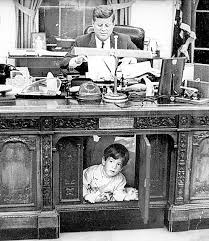
We watched numbly as the line passed President Kennedy lying in state at the Capital through the night, the horse without a rider and the boots turned backwards, the many foreign rulers and dignitaries at the funeral, a grim President Johnson, the grief stricken, stoic Kennedy icons Bobby, Teddy, Jackie and the kids Caroline and John-John. John-John saluting his father’s flag draped casket. Old pictures repeated many times over the weekend of John-John peeking out from under his father’s desk in the Oval Office while his dad did the work of the most powerful man in the world. Pictures of Caroline riding her pony, Macaroni; Jackie and Jack happy, tanned in sunglasses and casual clothes on the back of a sailboat. Playing tag football with his brothers on the lawn in Hyannis. Camelot bled. My mother wept.

john-john saluting his father's flag draped casketWe lived for days with an exhausted and bereaved Walter Cronkite on CBS News in black and white. When we thought we could absorb no more, we were rendered gap-jawed yet again. As we strained for a look at the assassin being moved at the jail, we saw him gut shot by Jack Ruby on live television, the twenty four year old Oswald’s face distorted in shock and pain. We heard the beginnings of a cornucopia of conspiracy theories, no one wanting to believe that such a man could be taken down by a random act of seemingly deranged violence. Yet the lone wolf assassin with a mail order Italian rifle, shooting from the Texas School Book Depository narrative stuck – with the Warren Commission signing off.

No grassy knoll, no coconspirators, no Mafia, no Cubans, no Russians, no CIA or plotting LBJ, no John Birch Society, no Oliver Stone, no Jim Garrison. The horrific Zapruder home movie with the first shot through his throat and into Texas Governor John Connally, the seconds that seem like hours between shots when we still want to yell hopelessly, “Get down!” The second shot – blood, brains, final. Jackie in shock crawling in her pink dress and pillbox hat over the trunk of the fast moving limo trying to recover part of her husband’s skull blown away as the car accelerated to a way too late escape. That’s what we were left with.

With records sealed seemingly forever, it seemed my questions would not be answered in this lifetime, until on our trip last month to visit Bob and Cathy Cormack, Bob showed me a book I have not been able to put down. How I missed it seven years ago can only be ascribed to preoccupation.

“As I will demonstrate, everything suggests the Soviet Union recruitment of Oswald when he was assigned as a young Marine in Japan. In the available documents I also uncovered clear evidence that his mission upon his return to the United States was to assassinate President Kennedy, who had forced Khrushchev to erect the Berlin Wall in 1961 and hastily withdraw his nuclear missiles from Cuba in 1962. Never before had a Soviet leader been so egregiously humiliated.” From the preface of ”Programmed to Kill, Lee Harvey Oswald, the Soviet KGB, and the Kennedy Assassination – The Training of a Dedicated Agent,” Ion Mihai Pacepa, 2007

Ion Pacepa defected in 1978 from Romanian intelligence, a subsidiary of Soviet intelligence. He was the national security advisor to Romania’s president and acting chief of his foreign intelligence service; he supervised the Romanian equivalent of the American National Security Agency (NSA). Pacepa is the highest ranking Soviet bloc intelligence officer ever to defect to the U.S. In well annotated detail, he describes Lee Harvey Oswald as fitting perfectly the pattern of Soviet recruitment of disaffected American military personnel during the long, Cold War. Oswald’s arranged marriage to Marina, his reinsertion into the U.S., his relationships with known Soviet covert and overt agents all fit the mold of a ”serzhant,” as these agents were called.

Oswald first came to the attention of the PGU (Pervoye Glavnoye Upravleniye), the Soviet espionage service and First Chief Directorate of the KGB, when he was a radar operator in a clandestine base in Japan. When he defected to the USSR, he was treated as royalty, especially after data he supplied on the altitude patterns of the top secret American U2 spy plane led to the downing of one in May of 1960 and the capture of its pilot, Gary Powers. In 1961, he was persuaded by the PGU to train as a clandestine sleeper agent with his mission to assassinate the “Pig” and “son of the millionaire” as Soviet Premier Nikita Khrushchev often referred to the young president who had bested him.

“Programmed to Kill” is an well written study that reads like a spy novel about the inner workings of the KGB and the Soviet Union at its zenith. Khrushchev rescinded the assassination order after his brutality in previous assassinations and attempted assassinations was revealed. Murder was one of his main tools of state, but with the publicity, the Politburo was losing faith in him. The assassination of an American President at his hand could bring Khrushchev himself to a bullet into the back of his head in the basement of the Lubyanka. The PGU lost control of Oswald and feared in an effort to return to Russia a bigger hero, he would complete his original mission in Dallas on his own. All the related Soviet bloc intelligence services began immediately a massive, well run disinformation campaign to deflect attention away from the USSR, casting blame on the CIA, President Johnson and right wing Texas political elements. Dallas nightclub owner and police “hanger on” Jack Ruby, an illegal agent of Cuban intelligence services, was convinced to shoot Oswald to silence him. Ruby was in turn murdered using a well-developed KGB radioactive poison technique inducing a virulent, fast killing cancer.

Credible and chilling, the story holds together, and the book is well worth your time if you have interest in the Kennedys, the assassination, KGB spy craft and the history of a pivotal event in our history. The death of President Kennedy, and the subsequent murders of Robert Kennedy and Martin Luther King, helped to precipitate the cynicism leading to the tsunami of cultural transformation in my generation that resonates to this day.

“The Kennedy assassination was one of the extremely rare cold war episodes in which both sides were vitally interested in hiding the truth.” ”Programmed to Kill, Lee Harvey Oswald, the Soviet KGB, and the Kennedy Assassination – The Training of a Dedicated Agent,” Ion Mihai Pacepa, 2007

3 Comments

Filed under Background Perspective, Personal and family life

Gentrification and Generosity

brownstonesWhen I was a young inside sales coordinator at the Gerrity Company millwork location in Boston, one of the outside reps we supported, let’s call him Finn to avoid defamation, possessed all the confidence and mostly inoffensive hubris of someone raised to privilege in an exclusive suburb like Sherborn, Dover, Hingham or Manchester by the Sea. Not that Finn had amassed a fortune, yet, just that he expected to, was born to it, was entitled to it.  He was funny, likable, irreverent, and disparaging about his customers when they weren’t in earshot.

Bespectacled and bright, Finn was seen seldom without a coffee cup the size of a beer stein. Well caffeinated, Finn would burn through the office from time to time and light up the phone lines with incessant emergencies because the details, while not beyond him intellectually, were not worth his time or planning until they became a crisis of six carpenters idling a jobsite without the correct materials to do their jobs.  The crisis was predictably visited upon the staff of the lumberyard or door shop to remedy – the fabricators, load pullers, dispatchers and truck drivers.  Finn would assure his customers that the dim lights of his support would get it right next time because he would set them straight.

He once went on vacation and put his home phone on call forwarding for his customers – to a Dial-a-Prayer recording, where the desperate, out of stock customer would be driven into frenzy with a daily pseudo spiritual bromide. They were not amused, and neither was the unfortunate inside sales coordinator who caught the next call the customer made.  Meanwhile Finn could entertain himself and his cocktail guests on the fantail recounting his cleverness.

Finn did eventually make his fortune, hard wired as he was into the realty and construction community. He bought cheap, renovated cheap and sold dearly the old brownstones and triple deckers in neighborhoods like South Boston, hitting the wave of gentrification before it crested and broke over the heads of late comers.  The mechanics, warehouse workers and city maintenance worker children of multi generation Southie families soon found it impossible to buy near the homes of their parents and grandparents.  They wound up renting in places like Mattapan or Dorchester until they too were discovered by developers, house flippers and those enamored of newly fashionable places to live.

Finn retired in his late forties, as was his self assigned due, and sailed off to Tahiti and other exotic climes for a three or four year tour.

“Living in this gentrification environment is much more difficult for residents. Actually, what they’re doing is killing the indigenous culture.” Finn Kwong, The New Chinatown, 1987

Not all gentrification is exploitation and displacement. When the artistic community moves into garret apartments with good light in old warehouses, establishing a beachhead among crack houses, discount prostitution, steel curtained convenience stores with a weekly robbery, boarded up apartments, gang tag graffiti on every vertical surface, and nightly drive by shootings, it’s not all bad.  Celebrity and youthful trendy enterprises follow; attracting fashionable small restaurants with good wine lists, art galleries and six dollar lattes, then like the first class sleepers at the end of the train comes seven figure roof top garden penthouses with views of distant harbors.  The downside is thereafter the artists can’t afford the neighborhood or the ambiance.

The city planners are elated to rid themselves of a crime infested, blighted section generating ugly headlines, raise the property values and collect more taxes to fund the profligacy of their bleeding budgets, which leads somewhat circuitously to the point.

Conservatism starts from a sentiment that all mature people can readily share: the sentiment that good things are easily destroyed, but not easily created. This is especially true of the good things that come to us as collective assets: peace, freedom, law, civility, public spirit, the security of property and family life, in all of which we depend on the cooperation of others while having no means singlehandedly to obtain it. In respect of such things, the work of destruction is quick, easy and exhilarating; the work of creation is slow, laborious and dull.”  Roger Scruton, How to Be a Conservative, 2014 (quoted in the Wall Street Journal, Notable and Quotable)

Standard progressive rhetoric is that they hold the moral high ground, especially regarding the poor and disadvantaged, however the specifics give the lie to the jargon. The progressive is conditioned to the government solving the problems, curing the cultural ills and buffering direct exposure to the unwashed through public funding.  Not all progressives, to be sure, the best work in the trenches, but in my experience, the comfortable, guilt ridden majority would prefer the state to provide the remedies.  Decrying the lack of resources for the poor, the panacea is to hire the well paid experts, pay for them through the “leaky conduit” of government bureaucracy and hike taxes to cover it all.

The majority of conservatives are neither wealthy nor real estate developers; they are hands on, work hard and create economic growth. They are also generous with those upon whom fortune has not shown as brightly.  In a recent study by “The Chronicle of Philanthropy” [i]some clear trends are shown:  progressive state residents give less to charitable organizations as a percentage of their gross income, conservative states give more.  Similarly there is a strong correlation of generosity in states with a high percentage of religious voters.  The truly wealthy give less than they used to (as a percentage), and the middle class and working class have stepped up their much more painful giving.  The middle class gives until it hurts and drives older cars, cuts coupons and shares of their more meager resources.  The rich buy neighborhoods to flip, hobby ranches, million dollar urban pied-à-terres and Ferraris. The rich get richer, the poor get poorer and those closest to the poor on the income spectrum are more ready to help.

Of the top seventeen states whose residents give the highest percentage of their income to charity, all voted for Mitt Romney in the 2012 election.[ii] Utah, Mississippi and Alabama lead the way; the lowest seven on the list are all Obama blue states: Connecticut, Massachusetts, Rhode Island, New Jersey, Vermont, Maine and New Hampshire.  Utah residents give 6.56% on average of their gross income; Connecticut tops the bottom dwellers at 2.34%, and the others range down to a miserly 1.74%.  The progressive will be happy to fund the social state and wax proudly about the social contract, but pulls up lame by the numbers when it comes to hands on giving.

“In every circumstance and in all things I have learned the secret of being well fed and of going hungry, of living in abundance and of being in need. I can do all things in him who strengthens me. Still, it was kind of you to share in my distress.” St. Paul’s letter to the church at Phillipi

[i] See “How America Gives”  http://philanthropy.com/section/How-America-Gives/621/

[ii] See the table from the article:  http://philanthropy.com/article/How-States-CompareHow/149169/

1 Comment

Filed under Culture views, Personal and family life

Maternity and Modernity

“Maternity dooms woman to sedentary existence, and so it is natural that she remain at the hearth while man hunts, goes fishing, and makes war.” Simone de Beauvoir, The Second Sex

One of the more pernicious effects of the post modern culture in which we find ourselves is the undermining of motherhood, indeed of parenthood. “Undermining” evolved from ancient times as a siege tactic to bring down the staunchest of walled cities. Medieval aggressors dug a tunnel day and night over many weeks under one stone battlement of the stronghold, propping the tunnel as they went with wooden beams and posts to prevent detection. If undiscovered by the defenders, upon completion, the besiegers would lay in more wood and incendiaries to the tunnel, and set it afire. When the wooden supports burned through and the tunnel collapsed, so, too, would the wall on top of it, exposing the previously impregnable city to conquest, plunder, enslavement and ruin.

“Ideas have consequences.” The tunnel digging of the last century and a half evolved from the supremacy of will and self philosophies of Schopenhauer, Neitzsche and Sartre; the reductionism of human beings to the merely chemical and biological by Darwin, Freud and others; the demeaning of human sexuality by Margaret Mead, Margaret Sanger and Albert Kinsey from lifelong commitment and love to casual pleasure seeking; and the utilitarian ethics of Peter Singer, Jack Kevorkian and their ilk, corroding the dignity of the human person into a subjective quality of life standard, which is defenseless against self serving interpretation. [i]

“All the women were captured and chained

And national suicide was proclaimed

And new America fell to the ground

And all the children lay crippled lame.” When the Walls Came Tumbling Down, Def Leppard

After the tunnel was set afire in the “sexual revolution” of the sixties, “the walls came tumbling down.” We walk in our neighborhood: first time parents are now older with their one or two children; many couples have chosen to keep a couple of dogs in lieu of children; annoyed grown men with plastic baggies in their hands walk sweatered mutts, and plush veterinarian clinics outnumber and architecturally outshine both pediatric and child care centers. Children of single parents and of divorce are the norm. American birthrates have dropped below that which is necessary to sustain our population; the Social Security and Medicare programs are in danger of collapse as too few children grow into contributing workers.

“Mother”, especially a full time mother, has diminished in clever cocktail banter into sniping “new speak” for a failed career woman. Simone de Beauvoir, long time lover of Jean Paul Sartre, and darling of the most extreme faction of the feminist “movement” died alone, chain smoking and embittered. She had this to say about mothers and motherhood: such women “are not so much mothers as fertile organisms, like fowls with high egg-production. And they seek eagerly to sacrifice their liberty of action to the functioning of their flesh.” She becomes a “menstrual slave” victimized by her own biology. Ideas do have consequences and take many years to emerge fully. Once hatched, they metastasize into our concepts, morality and worldview, often without our awareness or consent.

“O, brave new world that has such people in’t!” The Tempest, William Shakespeare

The natural consequence of these ideas was brilliantly foretold over eighty years ago in Aldous Huxley’s dystopian novel[ii] set six hundred years in the future. Some of his science fiction devices, such as sound waves recorded as digital light, are already commonplace, and perhaps some are in our future. In this future, the words “mother” and “mammary” are obscenities that make citizens blush, while nothing else does; sex is ubiquitous, pneumatic, loveless and fruitless. Recreational sex and multiple partners are mandatory; marriage or even long term relationships are forbidden as sources of angst and discontent. Fatherhood is unheard of.

Babies are fertilized exclusively in hatcheries; they are “decanted” from bottles, not born, and then moved to conditioning floors where they begin their habituation to “happiness” as alphas, betas, gammas, deltas and epsilons. Alphas are decanted to lead; epsilons poisoned while still in their bottles with alcohol to near morons destined only for menial work, but happy in it. The rest are planned and designed to fit into civilization in their predetermined slot. All are molded into acceptance of their lot and conditioned to despise the messy, overemotional and imperfect family. Under constant “hypnopaedic” sleep learning, they are cloned, cut and pasted into their proper place. Any misgiving or dissatisfaction is remedied with nightly “vacations” for all citizens with “soma”, a euphoric mild hallucinogenic with no hangover that wipes away all anxieties, anger, doubts and questions.

Mustapha Mond (Regional World Controller to students)

“’Try to realize what it was like to have a viviparous mother.’

That smutty word again. But none of them dreamed, this time, of smiling.

‘Try to imagine what ‘living with one’s family’ meant.’

They tried; but obviously without the smallest success.

‘And do you know what a ‘home’ was?’

They shook their heads.” Brave New World, Aldous Huxley

Gianna flies free

Gianna flies free

Angela the same age as Gianna and little sister Meg

Angela the same age as Gianna and little sister Meg

Our five year old granddaughter, Gianna, hit a milestone last weekend with her family in attendance. Her Mom, our daughter Angela, ran behind her with her guiding hand, aiding her balance, teaching her to look ahead, to peddle steadily, to gain confidence, to advance another step like all her prior and future steps. Then Angela let go as all parents must and ran beside her. I was fortunate to see her on one of her earliest runs. Both were grinning widely, Gianna doing a grown up thing, utterly joyful. I apologize for the limitations of my cell phone camera, but the image is there. Gianna told us later that night she felt like she was ten years old. Angela emailed us that “G” was a ‘big girl’ all night, well behaved, helping with dinner and clean up – the felicitous consequence of maturity.  Angela is doing as Rita did for our kids and what mothers have done for millennia – loving and training her children to fly on their own.

Angela is an accomplished young woman with a post graduate degree and certification as a Creighton practitioner, aiding others with natural family planning and infertility. Recently, she testified to a hostile Rhode Island House of Representatives committee and a packed hearing room about fetal development, in which she is well versed. A full time mother of three young girls, she is the furthest one can imagine from a “menstrual slave.” She and her husband, Peter, choose to live on Peter’s income for the most part. They will have fewer things, toys and accoutrement. They will be less obsessive consumers and more focused parents. She is home schooling their children, Gianna, Elena and Mary. They are not an Ozzie and Harriet fifties family, but Pete and Angela choose to be countercultural to a culture distorted by the now established, dysfunctional “counterculture” of the sixties. She is a heroine. She is a mother.

Link to interviews for the ‘toughest job in the world.’

“This afternoon was definitely one of the best moments of my life. Letting go of that bike, I will never forget it, hard to describe.” Angela Barek (my daughter) about her oldest daughter, Gianna, first time flying solo without training wheels or a net.

[i] See the excellent Architects of the Culture of Death, Donald de Marco and Benjamin Wiker, Ignatius Press, 2004

[ii] I recently reread Brave New World, Aldous Huxley, Chatto & WIndus, London, 1932. Still much worth your time.

5 Comments

Filed under Culture views, Personal and family life

Cat Lessons

“Cat lovers turn into cat collectors.”  Greg Kinnear

Visiting my mother Thursday night, my allergic reaction to her three cats remains vigorous, but manageable.  Mom is a lively 93 and entirely unlikely to give up her Cookie, Scout and Checkers companions, so any reaction my eyes and sinuses have to her beloveds is entirely irrelevant – small price tag, really, for still having an engaged, funny, cheerful with infirmity and engaging mother.

Gabe and Faun's predator

Gabe and Faun’s predator

When our children were young we had a rotating menagerie of cats, dogs, a tragedy of hamsters, a turtle and short lived dalliances with goldfish.  I don’t remember any allergies to any of them, but our dogs and cats were mostly outdoor pets who boarded with us most nights except for Nikki the husky mix who preferred sleeping in the snow.

Occasionally one of the more stupid (always male) cats would dash into the street on a mission and be run over by a car.  We always opted for affording them the short, happy life of climbing, sleeping in the sun, courting (although all were “fixed”), defending their territory and hunting indigenous small fauna – four footed or winged.  As anyone familiar with the dead eye gaze of a cat will confirm, its primitive, tiny brain consists of an ineradicable instinct to survey the field and regard anything less than six inches in height as prey.  I remember an uncomfortable feeling when our cat would stare intently at me probably wondering how different their lives would be if I was the size of an adolescent squirrel.

My mother’s cats are entirely housebound and spoiled fat: friendly for the most part, but with normal feline reserve, comfortable with complete freedom to occupy any space their whimsies fancy.  Allergens abound; they frequently dine on the breakfast bar peninsula, which is an accommodation up with which my nurse wife would never put.  Rita has an aversion for some reason to eating where little feet fresh from the litter box have recently trod.

“You can visualize a hundred cats. Beyond that, you can’t. Two hundred, five hundred, it all looks the same.”  Jack Wright, Ontario housepainter and joint record holder.

We are grateful that our mother’s crazy cat lady proclivity is relatively constrained.  The Guinness Book record was set by Jack and Donna Wright.[i]  The collection started with Midnight, Donna’s black long hair, which had a wild night, then a litter that the Wrights were unwilling to break up.  Next came a few strays; their house gained local celebrity as Cat Crossing.  The count ballooned as anyone with an extra cat or a found cat started dropping them off.  After an appearance on the Phil Donahue show about their record 145 cats in one house, contributions went national and got a bit out of hand.  As Cat Crossing’s reputation grew, cats were couriered or shipped in from afar. 689 housecats was their top count.  The Wrights didn’t have it in them to deny any feline some sustenance.  Costs eventually ran to $111,000 a year, which included individually wrapped Christmas toys.  Each and every one had a name.

lots-of-catsCat hoarding has a curious relationship with Toxoplasma gondii, a one-celled protozoan parasite which normally reproduces asexually.  Toxo can enhance its gene pool by reproducing sexually, but that can only occur within a cat’s intestines.  If the parasite invades another host through ingestion or just skin contact with cat feces, then humans, monkeys, Beluga whales, bats, elephants, chickens and many other species become unwilling habitat. Once in, it swims through the blood stream directly to the brain.   One third of the world’s human population has Toxo organism in their system.  After the parasite takes up residence, it forms tiny cysts, especially in the amygdala, the center of both pleasure and anxiety in the mammalian brain.  The violated amygdala produces excess dopamine, a potent and manipulative neurotransmitter. These cysts can slow reaction time, induce aggressive or jealous behavior in people and change the human sense of smell, rendering some humans immune to the pungent odor of cat urine.  All the better for cat collectors.

Even more peculiar is the tested effect of Toxo on rodents.  Lab rats hosting Toxo become obsessed with cat urine; they love cat urine; they crave cat urine; they seek out cat urine.  When exposed to it, their pleasure center resonates with the males reacting physiologically as they do around females in heat. Their little rat testicles swell.  Some aspects of cat hoarding are best left unexplored.

“Time spent with cats is never wasted.”   Sigmund Freud

A cat once figured in an important lesson for me many years ago, fixated as I was on escalating complicated solutions and missing the simple one.  We lived in our old farm house in Farmington, Maine; a section of the dirt floor basement was a crawl space.  I kept finding the basement window sash on the ground and the cat in the basement.  A cat prowling in a dirt floor basement quickly leads to a reeking dirt floor basement, so I had asked everyone to make sure she didn’t go down there.  Too often, I opened the cellar door, and a cat would emerge.  I thought we had a very smart cat which could open the window to get into forbidden territory.   Having no time one such morning, I just jammed a shovel up against the sash into the dirt floor and left for the day’s business.  A week later, I discovered the shovel laid over, the sash open and the cat in the cellar. Damn cat, I thought:   smart and strong.  So I took my twenty two ounce framing hammer with two twelve penny nails and secured the sash, leaving the heads proud until I could come up with a permanent fix.  For a few days all was well, then the cat came up the stairs and the nails were pulled out.  The light finally shone on me, and I asked our son Gabe, who was about eight, what he knew.  He told me the crawl space was his favorite undiscoverable hiding spot when the neighborhood kids got together for a rousing game of Hide and Seek.  He said it had been hard to pull out the nails.  I laughed out loud at my stupidity when I told Rita the story.  I learned William of Ockham had taught us something worth knowing with his razor.[ii]

”When my cats aren’t happy, I’m not happy.  Not because I care about their moods but because I know they’re just sitting there thinking up ways to get even.”  Percy Bysshe Shelley


[i] The Violinist’s Thumb, Sam Kean,  Chapter 7, “The Machiavelli Microbe”

[ii] William of Ockham (1287-1347) wrote of “lex parsimoniae” a principle of succinctness to be used in problem solving wherein the hypothesis with the fewest assumptions and therefore the simplest solution is the correct one.

2 Comments

Filed under Personal and family life

Italian Lessons

Gianna, Ellie and Mary with a waffleMy daughter, Angela, and her husband, Peter, are home schooling their three daughters, although so far it’s mostly the five year old, Gianna, who is their main focus. Angela has a master’s degree in education;  she knows what she is about.  When Rita and I attempted to home school Angela and her younger sister, Meg, many years ago, far fewer resources and a much smaller support group of like minded parents were available.

Angela belongs to a co-op group of home schoolers which meets weekly; parents take turns putting together classes on reading, writing and ‘rithmetic, as well as science, history and other topics scaled for the younger kids.  Gianna and Ellie (Elena) also are participating in Italian lessons, taught by our mutual friend, Francesca, who is another home schooling mother of three.  Angela studied four years of Italian and visited Italy extensively while studying abroad, so can reinforce the lessons at home.

Francesca taught Italian at the university level and holds advanced degrees in art history from Columbia and Yale.  She is fluent in Italian, the daughter of first generation Italian immigrants and grew up in Queens.  In manner and spirit, Francesca is quintessentially Italian.  We have greatly benefitted from some of her recipes; her cooking is locally legendary.  Once when Rita was unwell, Fran sent over a meal.  With most, a meal sent over to help a sick friend would be a casserole; with Fran, her husband Matthew delivered a five course meal which filled up the back of his station wagon.  She included extra prepped vegetables and a recipe to turn the leftover chicken into a delicious soup.

Gianna came home from her early lessons with perfectly pronounced Italian renditions of her favorite colors.  For me, a Rosetta Stone Italian failure, it was most impressive.  No surprise, a recent lesson turned to food.  The kids glued samples of various pasta varieties to a poster board and learned not just their Italian names, but their descriptive origin and translation.  Vivid pasta names reveal an amusing look into Italy and her people, an earthy candor – a natural humor.

  • Penne — quill or pen.
  • Spaghetti – twine or string.
  • Linguine – little tongues.
  • Vermicelli – worms.
  • Farfalle – butterflies.
  • Occhi di lupo – ribbed wolf eyes.
  • Fusilli – little screws.
  • Orecchiette – little ears.
  • Capellini – thin hair.

Americans may be prickly about tucking into a heaping plate of ears, little tongues, thin hair, worms, butterflies, screws or string, but to the Italian comfortable with coarse reality, such a feast poses no difficulties.  Americans will stick with the mellifluous and mysterious, thanks.  Spoken Italian makes the commonplace sing.

“Italians know about human nature – they understand human nature perhaps better than anyone else does.  They know that people are weak and greedy and lazy and dishonest and they just try to make the best of it; to work around it.” Donna Leon (author of the acclaimed Commissario Guido Brunetti crime novels)

For those who grew up with little exposure to Italians, what comes easily to mind is at best Rocky Balboa, Mussolini’s punctual trains or unstable governments that dissolve every few months and at worst Goodfellows and Don Vito Corleone.  I grew up among a large Italian community replete with barbers, grocers, dentists, doctors and contractors (and married a half Italian beauty).  What comes to mind is effortless laughter and love, quick wit, flashing eyes, effusive, loud communications, food, food, food and warmth – always warmth.   The many Italians I came to know did not suffer fools patiently and gifted their loyalty carefully, but once gifted would sacrifice life, limb, treasure and sweat – unabashed and all-in.

Italian lessons are lasting: Rome, Latin based languages, Leonardo, Dante, Michelangelo, Florence, Venice, the vineyards of Tuscany, Pompeii – surely more than a lifetime of lessons. A personal beloved for me is Italian opera: Puccini, Rossini, Donizetti, and the incomparable Giuseppe Verdi.  Just as “capellini” converts “thin hair” into delectable, so does “Si: corre voce che l’etiope ardisca sfidarci ancora, e del Nilo la valle” transform “Yes, there are rumors that Ethiopia dares to continue to defy our power in the valley of the Nile” into delightful (Verdi’s Aida, first act).

You may prefer “E lucevan le stelle ed olezzava la terra, stridea l’uscio dell’orto e un passo sfiorava la rena” to “The stars were shining, And the earth was scented. The gate of the garden creaked and a footstep grazed the sand.”  From Puccini’s “Tosca” as sung by Luciano Pavarotti.

Italian opera is hyperbole, drama, red emotion, and its American counterpart morphed into both the musical and the soap opera, but there is no inclusive analog.  My favorites are the duets, trios and quartets with the interplay of beautiful voices.  Listen to Joan Sutherland and Pavarotti singing the star crossed, impossible beginning of the love of Alfred for Violetta in Verdi’s “La Traviata” (“The Lost”) (Plot summary here) in “Un di felice” and the inevitable tragic end in  “Parigi o cara”.  If you have little familiarity with Verdi, close your eyes, shut down preconceptions and just listen.

La TraviataAlfredo: Un dì, felice, eterea, Mi balenaste innante, E da quel dì tremante Vissi d’ignoto amor. Di quell’amor ch’è palpito Dell’universo, Dell’universo intero, Misterioso, altero, Croce e delizia cor. Misterioso, Misterioso altero, Croce e delizia al cor.

Alfredo: One day, you, happy, ethereal, appeared in front of me, and ever since,trembling, I lived from unknowed love. That love that’s the pulse of the universe, of the whole universe, Mysterious, proud, torture and delight to the heart. Mysterious, mysterious and proud, torture and delight to the heart.

Violetta: Ah, se ciò è ver, fuggitemi, Solo amistade io v’offro: Amar non so, nè soffro Un così eroico amor. Io sono franca, ingenua; Altra cercar dovete; Non arduo troverete Dimenticarmi allor.

Violetta: Love, I fear, can never be, Friendship is all I can offer. Since love is pain and torment, I avoid that strange emotion. Pleasure is all I ask of life, Freedom and joy forever! So you must soon forget me And find another love.  

*********************************************************************************************************************

Alfredo:  Parigi, o cara, noi lasceremo, la vita uniti trascorreremo. De’ corsi affanni compenso avrai, la tua salute rifiorirà. Sospiro e luce tu mi sarai, tutto il futuro ne arriderà.

Alfredo:  We’ll leave Paris, my dearest, Together we’ll go through life. In reward for your past sorrows, You’ll bloom into health again. Breath of life, sunshine you’ll be to me, All the years to come will smile on us.

Violetta:  Parigi, o caro, noi lasceremo, la vita uniti trascorreremo. De’ corsi affanni compenso avrai, la mia salute rifiorirà. Sospiro e luce tu mi sarai, tutto il futuro ne arriderà.

Violetta: We’ll leave Paris, my dearest, Together we’ll go through life. In reward for your past sorrows, I’ll bloom into health again. Breath of life, sunshine you’ll be to me, All the years to come will smile on us.

Can longing, loss and love be better expressed?

The gift of human voice, music and the creative soul are most profoundly conveyed in these works:  gratuitous beauty fashioned out of our genes, our talents, our dedication and commitment for no other reason than we humans are capable of it.    To this simple soul, such expression of human goodness rivals the genius of St. Thomas Aquinas in his Summa Theologica for sublime proof of the existence of a loving Creator.

“Italians come to ruin most generally in three ways, women, gambling and farming.  My family chose the slowest one.”  Pope John XXIII (Angelo Giuseppe Roncalli), soon to be St. John in April)

3 Comments

Filed under Personal and family life