Tag Archives: canoe

Visitation

“But even old men have young memories.”  Allen Levi, “Theo of Golden”

Ralph Town, Public Domain, Wikimedia Commons

Decades ago, the first time I watched a moose swimming on Webb Lake in Weld, Maine, I had no idea how to help the poor thing out in the middle of a near mile wide stretch of water. If it started to founder and go down, I’d never get it into my small canoe, and a moose may not understand I’m just trying to help. My panic built. My embarrassing ignorance was apparent about the power of a moose in the water. I tagged along parallel for the rest of the way, and the bull unintentionally demonstrated how foolish I was.

The trip started on the east side of the lake where the huge animal was leisurely browsing knee deep in the water lilies, pondweed, duckweed, and horsetails off the shore. When it reached the far shore, it stood up without a pause and began to leisurely browse in similar water weeds to those he left behind as far as I could tell, not even breathing hard. I failed to see the improvement in the deliciousness of pondweed that induced a moose to swim nearly a mile, but I was not privy to the moose’s unhurried unconcern with the effort required to get to a new patch of soggy fodder.

A second lesson in Webb Lake wildlife lore occurred a few years later when I paddled a couple of miles down lake toward the southern end of the lake and the outlet into Webb River. The river was the route more than a century ago for the winter harvest of thousands of pine, hemlock, fir, and spruce logs as they were sent down the spring high water seventeen miles to the Androscoggin River and the timber mills. The longest ones with straight grain were valued as masts; they went all the way down the river to the sea and the colonial shipyards in Bath. Now the Webb River is rarely navigable most of the year as it meanders down through Carthage and forms the border between Mexico and Dixfield before it empties into the big river.

I always am the earliest riser in the camp and cherish those times when I can slip away in the canoe on the mirror surface of the early morning lake undisturbed by the winds that usually flow down from Tumbledown at the north end of the lake as the day progresses. The red predawn sky accompanies the silence broken only by the quiet splash of my paddle and the occasional plaintive loon cry, creating treasured memories. I’d get back in time to the camp to greet the sleepy ones and make breakfast.

The lake narrows considerably at the south end, and one time I came too close to a hidden loon nest I didn’t know was there along the darkened early morning east shore in a wooded area with no cabins. The male blasted out of the reeds and rose up out of the water in an impressive noisy display of aggression and wingspan spread intimidatingly wide to protect his mate and the small clutch of one or two eggs or the tiny brood of little loons (as distinct from the brood of our little loons back at camp). I detoured as fast as I could paddle to the opposite shore.  I regretted spooking the birds because too many encounters with too many people could cause them to abandon the old nesting grounds they return to every year and seek a remote lake not so infested with people like me. Webb Lake without loons would break my heart.

Today’s third lesson was what prompted me to remember these Webb Lake canoe stories.  I was on the lake in a large flatbottomed canoe by myself in the early afternoon and loaded no ballast rock in the front to keep the bow from lifting. I struggled to paddle without any counterweight in the front, and the wide beam made it awkward to move up in the tandem configuration.  Large lakes surrounded by mountains have their own weather, and unexpected wind can flow down suddenly over the hills down into the lake like a waterfall with considerable power. The wind came up along with whitecaps. With my unwieldy bow acting like a sail, I fought uselessly to resist it and paddle back to the camp. What I could manage was to guide the canoe to a nearby shore, drag the canoe up into the woods, and walk back on the camp road. Later when the wind subsided, it was easy enough to walk back and paddle home. In the early morning, the lake is often as calm and steady as the gaze of a wise old woman on a porch waiting for the sunrise. Fighting the wind is foolish, much better to go with it to safety.

“Telling a story is like reaching into a granary full of wheat and drawing out a handful. There is always more to tell than can be told.” Wendell Berry, “Jayber Crow”

Raphael, Deliverance of St. Peter, Vatican Museum, Public Domain

What provoked all these canoe memories to bubble up was reading about the deliverance of St. Peter from jail in Acts 12. But I expect you’ll need a connection.

Peter witnessed the bloody death of his lifelong friend James, the brother of John, at the order of King Herod. Herod then had Peter arrested to ready him for the same fate the next day. Trusting nothing to happenstance, Herod had him chained up behind bars with four guards on a rotating shift, two of them chained to Peter, one on each side. The text said the fledgling Church was praying earnestly to God for him. Peter did what anyone would do in such terrifying circumstances: he fell asleep.

The same Peter who denied Jesus in the courtyard out of fear and panic on the night of the Lord’s execution on the cross, the same impetuous, emotional Peter leaping from the boat to try and walk on water, the same Peter drawing his sword to cut off the ear of the servant in the Garden of Gethsemane, the same Peter terrified by the storm while Jesus slept in the boat. That guy once so easily riled up. Chained up awaiting a certain painful death, he nodded off now secure in the trust he had in God. Clearly something had happened to Peter.

But in my reflection on the reading, what struck me first was the angel, the messenger, the envoy on a mission from God to rescue Peter. There was no turmoil, hardly any effort, and like the wind on the lake in a flat bottomed canoe, no possibility of resistance. The jail doors fell open silently, the guards fell asleep, the chains fell off Peter like autumn leaves drift to the ground when it’s time for them to let go. The angel gently woke a drowsy Peter and led him out to the street and away. No drama and not a chance of another outcome. If God, ipsum esse, the ground of all existence from moment to moment, wills that an envoy leads Peter to safety, well, Bob’s your uncle, he’s as good as free.  

Angels are sent on missions which they always complete with the power of God. Our task is to listen and do what they tell us if ever we are asked. Resistance is as futile as fighting the wind on the lake in a flat bottomed canoe. We can grumble and struggle, but all that will accomplish is to make us anxious. Guide it where it’s taking you, be thankful, pull into the woods, walk home.

“When you are old and can look back and see yourself when you were young. It is almost like looking down from Heaven.” Wendell Berry, “Hannah Coulter”
Leave a comment

Filed under Faith and Reason, Maine Tales, Personal and family life

Allagash

“Wilderness is the preservation of the World.” Henry David Thoreau, Walking

The Allagash Wilderness Waterway begins in sight of Mount Katahdin, the highest peak in Maine. Running ninety two miles from lakes west of Katahdin, it ends where the Allagash River, meandering north, runs into the St John River on the Canadian border.

allagash 2In the mid-eighties my fourteen year old son Gabriel and I joined with eight other men for nine days to canoe the Allagash Waterway. We planned logistics, food, equipment – a duty roster calendar and menu for each day: cooking, clean up, water and wood gathering. Two other father and son teams with young men near Gabe’s age, along with a pair of late teens and Father Wilifred Gregoire from Westerly, Rhode Island, partnered with a parishioner who was his friend. Father Greg was an experienced outdoorsman, an Allagash veteran with more than a half dozen previous excursions. Milton Wilbur from Woonsocket, another Allagash veteran, accompanied by his son, Josh, led the trip.

A wilderness canoe trek takes on its own sedate, steady rhythm: rise at dawn; stretch out the previous day’s muscle stiffness; early fire over the previous night’s coals, cowboy coffee and breakfast, clean up, break and pack the camp; put in and begin to paddle – mostly J strokes, slow and unrelenting with little respite; the sound of the water and occasional sighting of deer or hawk or a trout breaking the surface; find a suitable spot for lunch; maybe a swim if the sun is warm; put in for the afternoon miles; locate our planned evening campsite, stake down and raise the tents, roll out the sleeping bags; draw water at a spring, forage for blowdown wood and light the evening campfire; cook and eat dinner, clean; quiet talk around the fire; some nights camp songs with men used to singing together; perhaps some reading or a fold out chess set; more quiet talk with my son in the sleeping bags for the night; deep sleep two to a tent. The rhythm corresponds to the backdrop perfectly. Utter peace. Hard pulling and the soreness disappeared after a day or two. Gabe and the other young guys held their own in the canoes without complaint. Bathing was with Dr. Bronner’s phosphate free, biodegradable peppermint soap in the lakes and river. Shaving was left behind.

On Sunday morning, we changed the rhythm without breaking it. Father Greg celebrated an evening Mass before dinner with us as we neared sunset under the canopy of a stand of Eastern White Pine on the shore of the far end of Chamberlain Lake, sharing prayer and our faith. Singing our worship songs of thanksgiving in the silence of the vast Maine woods.

“How gladly would I treat you like my children and give you a pleasant land, the most beautiful heritage of any nation.” Jeremiah 3:19

The early days of the trip were the most physical, sometimes fighting wind driven swells, which broke on the shore of Chamberlain. The outfitters met us at our jumping off spot after we followed a fifteen mile dirt road to Telos Lake and there delivered our five canoes – well worn, but sound, aluminum, Grumman made, flat bottomed for the river, but tricky to manage on the lakes in a wind. They drove our van back and waited for our call in nine days from the payphone in Allagash, while we paddled north. Telos the first day, tired from an all night drive from Rhode Island; the long miles of Chamberlain, portages to Big Eagle Lake, the long haul up Eagle into Churchill Lake; portage at the top of Churchill Dam to a stretch of river that flowed into Umsaskis Lake, which empties into Long Lake; past Long Lake Dam and Cunniff Island, and finally picking up the aid of the Allagash River current for the rest of the way except for an hour or so traversing Round Pond. On the big lake, we looked up once to see Milton and Josh deploying a clamp-on sail and disappearing ahead. Experience counts.

Allagash Wilderness Tramway EnginesOne long day on the river, a bald eagle followed us for hours, probably looking for scraps. He would settle in a tall hemlock or pine, wait for us to pass, rise effortlessly and glide past us to his next vantage point along the river. On another day, we took a brief hike into the woods between Chamberlain and Eagle Lake to show the boys two railway engines, stranded in the forest sixty years earlier when the logging tramway rail system was abandoned. They climbed happily through, over and around the old boilers and controls. A third diversion when we hit a long stretch of rapids, nothing too challenging, but we had to pay attention. The rangers, who kept an inconspicuous eye out for the safety of the various groups, picked up the gear we left near a woods road log bridge. We had an adventure down the rapids with only bathing suits, life jackets and sneakers at risk. They dropped off our tents, sleeping bags, clothes and provisions, safe and dry, at the end of the rapids, when the descent flattened out and the river widened once again to a more temperate pace. The teen team, Keith and Dave, stood up, then when that failed to capsize them, stood up backwards and finally went down one section of rapids with one on the shoulders of the other. They went in and swept along by the current finished the rapid run laughing riotously. No nanny state for these young lunatics.

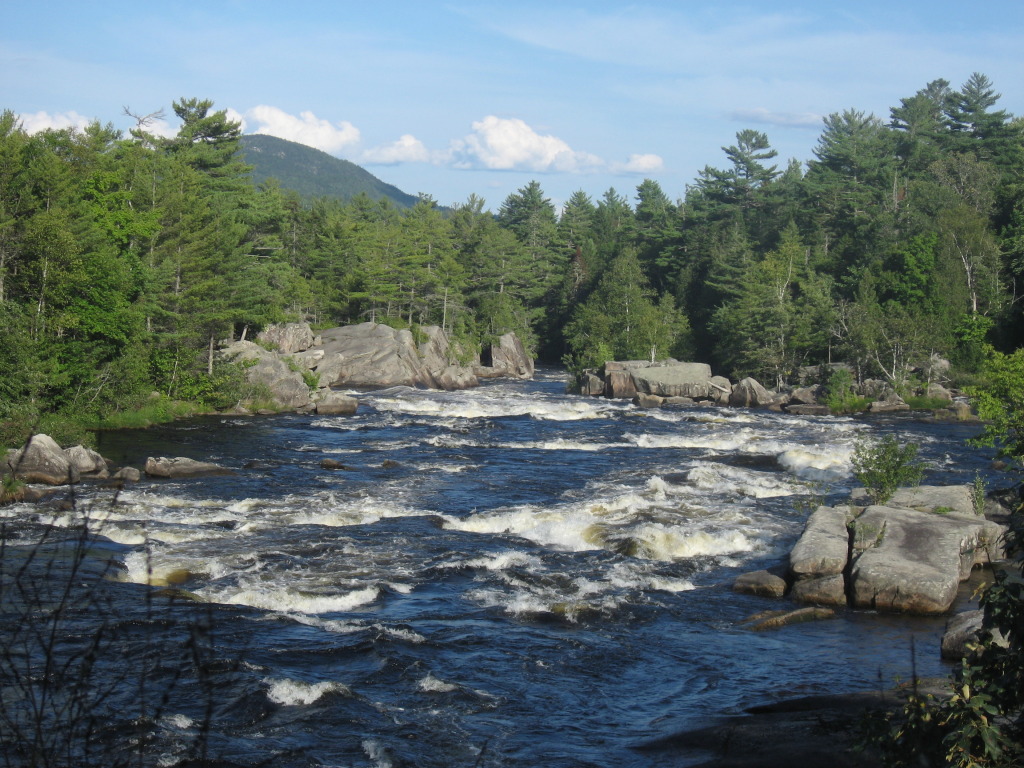
On our last day before we made final landfall in Allagash and swapped our canoes for our van, we pulled the canoes up on a sand spit for lunch and played for several hours at Allagash Falls, where all of us were boys again, splashing in the cold deluge, slithering over the ancient, smoothed rocks like a waterslide freely provided.

The pre-Socratic Greek philosopher, Heraclitus, wrote that one cannot touch the same drop of water twice in a torrent and that “no man ever steps in the same river twice, for it’s not the same river and he’s not the same man.” My memory rusts like the train engines, becomes a bit idealized perhaps, but the Allagash changes us in some undefined way for the good. There is in Nature, for sure, tooth and claw, blood and fury, but there is also in untamed places a feminine aspect: fertile, bountiful, generous with great peace found no other place – a time for thoughts and no thoughts, a time merely to be.

“The life of contemplation in action and purity of heart is a life of great simplicity. One is content to remain at every moment in contact with God, in the hiddenness and ordinariness of the present moment with its obvious task. At such times, walking down a street, sweeping a floor, hoeing beans, reading a book, taking a stroll in the woods – all can be enriched with contemplation and the obscure sense of God’s presence.” Thomas Merton, The Inner Experience, Notes on Contemplation

6 Comments

Filed under Maine Tales, Personal and family life