Category Archives: Sachuest Point and other wonders

Scoters, Eiders, and other Wonders

An experiment with an audio narrative of the post. Not my voice. Yet.

“There are some who can live without wild things, and some who cannot. For us of the minority, the opportunity to see geese is more important than television,” Aldo Leopold, A Sand County Almanac


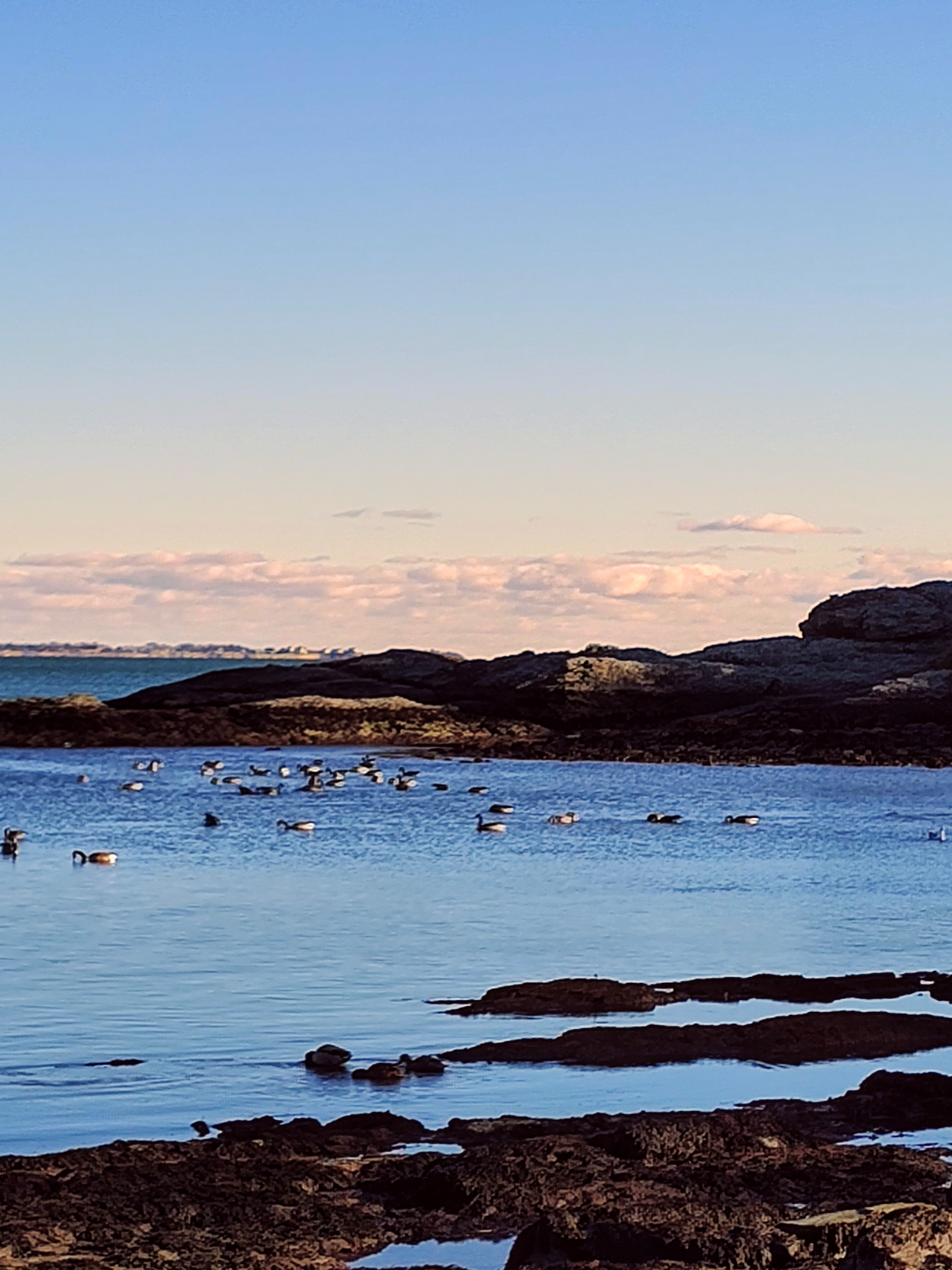
My waterfowl identification is woefully deficient. At a distance without mechanical aids, I have difficulty discerning white winged scoters from surf scoters from black scoters or at a distance even from scaups or goldeneyes or buffleheads. I guess I need to upgrade my glasses prescription. From a greater distance, the distinction blurs even with the larger common eiders. The winter ocean around this place is full of them, large flocks of various scoters, eiders, buffleheads, and some birder attracting harlequins. And Canadian geese. Many geese.

 Large flocks of waterfowl hang out along the Sakonnet River at McCorrie Point, Sandy Point, and Sachuest National Wildlife Refuge, feeding, chatting, floating gently regardless of the vigor or languor of the waves. Up and down, content and rhythmically riding the waves for five thousand years somehow just beyond the break of the surf – a curious reassurance that we can be confident our frantic preoccupations with the current titillation, election, controversy, sensation, or outrage is a momentary distraction.

 Suddenly, they will take wing for their own instinctual inexplicable reasons, first two or four or five, then scores on some signal not understood by me, beating furiously to the next feeding range, sometimes across the river to the North Tiverton side and the Seapowet marshes. The energy of their purposeful rapid flight with blurred-fast wings seems exhausting to watch, but they are undeterred.

 When they drift closer to the shoreline, it’s endlessly entertaining to see them hunt. Diving with quick graceful, rounded back plops, they vanish for what seems like a long time, only to pop up inevitably ten or fifteen feet away. Often their dives and re-emergences are synchronized. Plop. Plop. Plop. Six or eight or more at a time in family groups, disappearing and reappearing almost simultaneously or in sequence. Pop! Pop! Pop! Up they come like small balls released by the kid holding them under. Could watch them for an hour, guessing where they are going to surface.

Drama is inherent in their existence. Raptors, foxes, and other predators are on the prowl. And others. The wildlife ranger who supervises us volunteers leads a weekly bird walk on the trails of Sachuest Wildlife Refuge along the rocky shoreline. She told us a story from last week’s walk. Duck hunting season just ended on January 26th. Hunting is not permitted on the refuge, but hunters can fill their freezers from boats just offshore so long as they aim away from the land towards the open sea. She has no objection to hunters. That’s part of what wildlife managers manage. But it must be safe and lawful.

 Hunting is part of how the balance is managed. Many savor a good Sunday dinner of roasted duck after an overnight soak in rosemary or thyme brine and accompanied by garlic buttered mashed potatoes, sauteed carrots, tomato and cucumber salad, and a nice red cabbage slaw.

On Saturday, she was conducting one of her walks for a couple of dozen curious nature lovers. She took them out near the forty feet of Sachuest Point – the surf pounded cluster of large rocks where the harbor seals sometimes come to sun themselves in the summer.

 Two exquisite eiders exploded from the surface of the water, beating their wings frantically, attaining astonishing speed in a few yards. “There goes a pair of eiders,” she exclaimed and pointed. Two shotgun blasts boomed from one of the inflatable low boats. Splash. Splash. With laconic understatement to the shocked onlookers, she calmly concluded the eider lesson. “There were a pair of eiders.”

“One swallow does not make a summer, but one skein of geese, cleaving the murk of a March thaw, is the spring.” Aldo Leopold

On Aquidneck Island, we don’t have to wait for March to observe the wonder of a flight of Canadian Geese. We do have some visiting migrating flocks passing through to be sure, but hundreds of them overwinter, powerfully cleaving the air with the V formation so easily identified while their unmistakable calls draw our attention overhead – twenty, fifty at a time, filling the sky like B-29s advancing towards the ball bearing factories in Dresden. Only the geese are benign as well as orderly and determined.

 We see them grazing in stubbled winter corn fields, in the marshes, scores of them cluster, feed, and socialize. We see them in any open water on both ocean and unfrozen freshwater ponds. They inhabit plowed fields, golf courses, and dormant winter farmland of which we have an abundance. Lingering and foraging for hours with a few sentinels, they guard their young, reconnoiter, and apparently confer with one another; their low distinctive murmuring conversation is incessant. Abruptly, as if by consensus, a group of them take flight.

 I always pause and look up when they are on the move in their signature V formation, squawking, changing their order of flight to share the load breaking the wind, heading to someplace of their noisy choosing to seek new food or shelter from the incessant wind or refuge for the night.

Compelling. A spectacle of grace, coherence, and power. A confirmation that somewhere, against all odds, all is right in the universe.

“Our ability to perceive quality in nature begins, as in art, with the pretty. It expands through successive stages of the beautiful to values as yet uncaptured by language.” Aldo Leopold, A Sand County Almanac and Sketches Here and There

1 Comment

Filed under Sachuest Point and other wonders

Hospitality

“The paradox of hospitality is that it wants to create emptiness, not a fearful emptiness, but a friendly emptiness where strangers can enter and discover themselves as created free…” Henri J.M. Nouwen

Sachuest Ocean View Trail startRita and I started volunteering at the Sachuest Point National Wildlife Refuge in February this past year, mostly in the Visitor Center. During a typical shift between fifty and a hundred visitors will come into the center to ask questions, look for directions, cruise our little shop of nature books, clothing, and art, browse the well-designed exhibits while their children try to complete the scavenger hunt identifying the various animals and birds, get a drink of water, or use the restrooms. The rangers estimate they represent about a quarter of the total visitors walking the two and half miles of trails. It’s a busy place, but it rarely feels crowded.
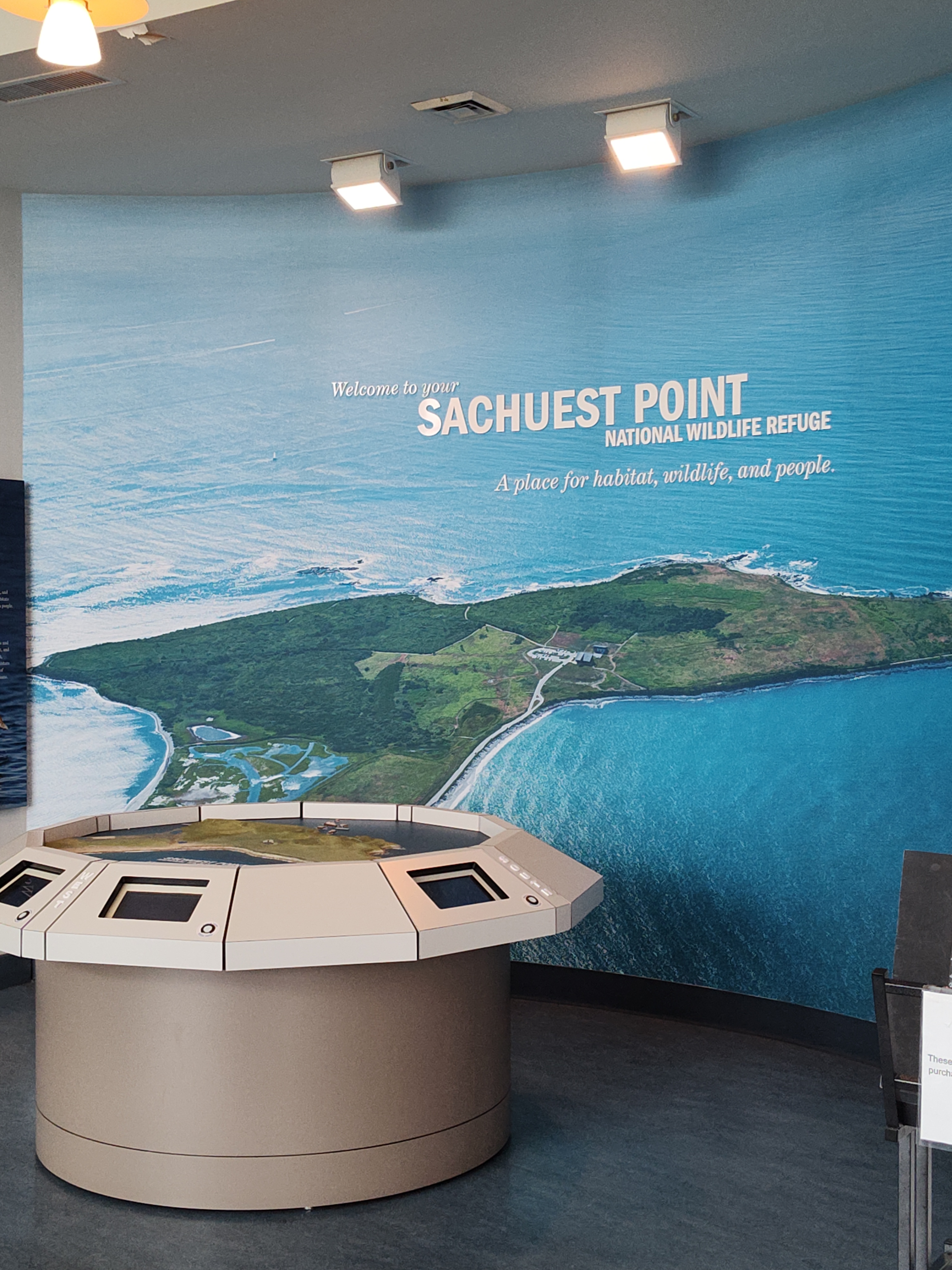
We’ll feed the critters in the tank, make sure there’s plenty of toilet paper in the bathrooms, close out any sales from shoppers who buy from the gift shop, guide the visitors with trail maps and the large mural of the refuge for visitors, answer questions about what they’ve seen, or just point out the entrance to the bathrooms for those who come in looking a bit frantic.

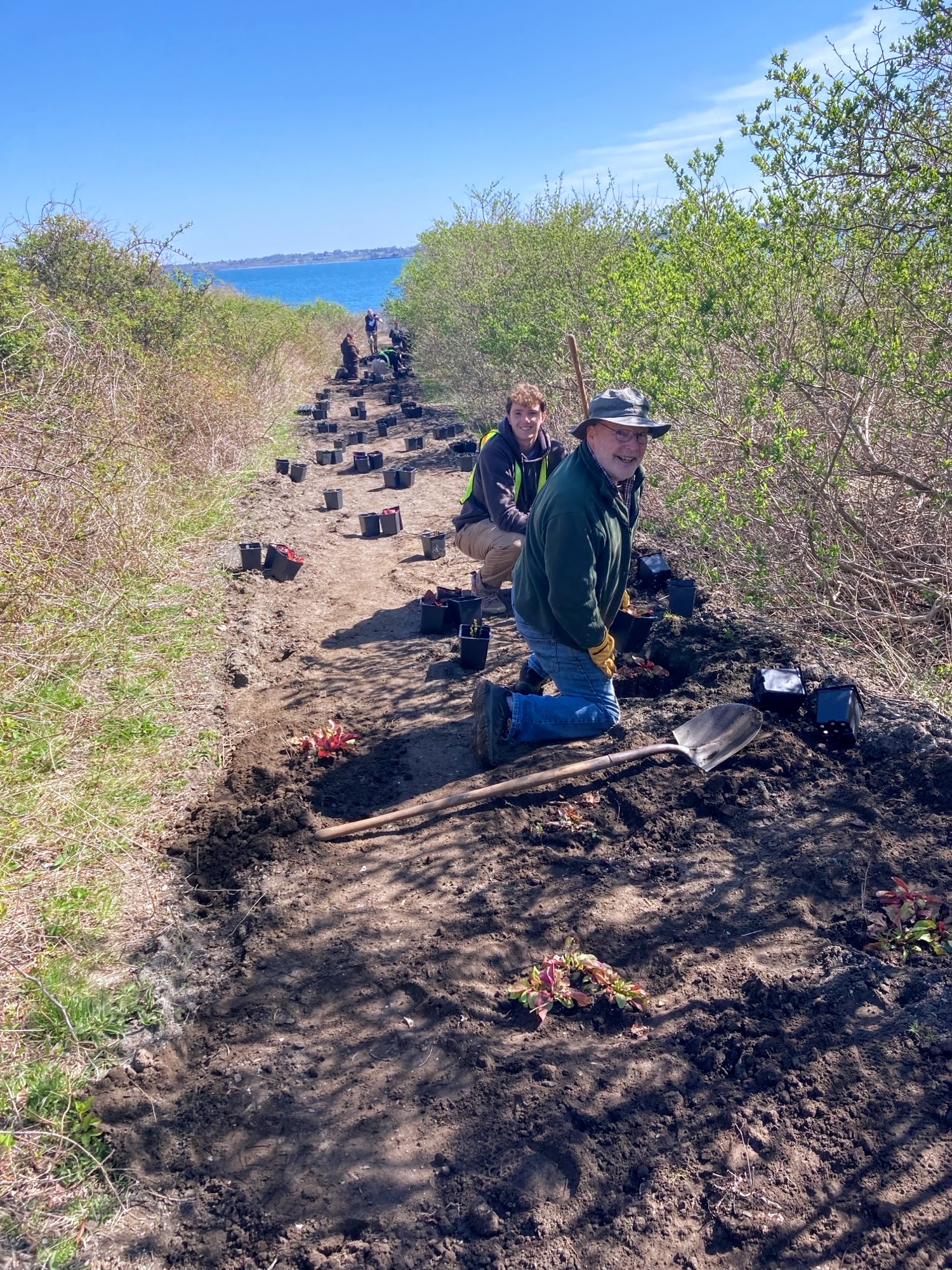
One of the pleasant surprises for us has been to dispel the common misperception that the work ethic ofSachuest planting with the team government employees is somehow not up to the standard of private employees. The rangers we’ve had the honor to meet are dedicated, smart, knowledgeable about wildlife – both flora and fauna, friendly, sensitive to visitor needs, diligent about protecting all things wild, and work hard and long. They don’t direct from afar; when plantings are needed to recover and protect erosion areas, they are on their knees with dirt on their hands. Understaffed, they rely heavily on volunteers to help with building and trail maintenance. They have a mission, and willingly fulfill it with dedication and no small measure of joy in their calling.

A second and more transformative surprise comes in meeting the many strangers who come from all over the country and the world to enjoy the trails and beauty of Sachuest Point and marvel at the array of nature through hiking or studying the exhibits. Hospitality in this sublime place has benefits for the visitors and those who welcome them. Hosting a visitor center turns out to be a minor apostolate and an opportunity to make decisions to love other human beings we meet along the way.

Sachuest fishing off the rocks (2)Most of the questions we field are prosaic. “Do you have a trail map?”  Yes. This is how you orient it to the visitor center. Ocean View is a bit longer, but more open to the sea out by the point. Harbor seals have been seen there.  “Can I fish off the rocks for stripers?” Yes. In season and with a license you can get online. “I heard there is a scavenger hunt questionnaire for kids?” There is, and we have stickers for them when they attempt it.  “How much do I owe for parking here?” A hundred bucks, cash, is my usual answer, but no one ever believes me or pays. It is open and free to all. “Where are the bathrooms?”  For the guys, there is a very big one out back in the woods. Rita gives me ‘the look’ when I say that. Or you can use the ones right behind you that have a flush. “Can you tell me what this bird (or bug or snake or shellfish or snail or flowering shrub or vine) is on my phone camera or as I describe it?”  Sometimes we can. Other times we need to consult the many books on our wildlife shelf. It’s enjoyable to search and learn with them. “What is that animal we saw that looks like a weasel?” Probably a mink. “I saw a pair of pheasants (with great enthusiasm)!”  Yes. They are very beautiful. “Does anything eat the deer here?”  We have a good herd of about forty here. Please don’t feed them.  Sometimes coyotes get a small or a weakened one. And sometimes the velociraptors get one. (That may get “the look” again from Rita, but kids like my answer. Wide eyed, they laugh.)
“’Twas in another lifetime, one of toil and blood

When blackness was a virtue the road was full of mud

I came in from the wilderness, a creature void of form

Come in, she said, I’ll give ya shelter from the storm.” 

Bob Dylan, “Shelter From the Storm”

The word “hospitality” derives from the Latin “hospes.”[i] Other related words derive from this root like hospital, host, hostel, hotel, and hostage or hostile because the Latin could mean guest and stranger or even enemy.  Hospitality implies a mutual social obligation to provide welcome and shelter to neighbors and strangers who might prove occasionally to be a problem. That is always a risk with hospitality, I suppose, but has never proven to be a problem for us.

Sachuest Point Visitor Center drone shotLike other venues that welcome all comers, Sachuest has regulars who become known and comfortable with the place: men, women, and children who walk the trails weekly or daily. Most are folks like us who have come to love the varying moods and seasons of the trails and walk them year round. We never tire of hundreds of migrating songbirds that come and go, raptors, waterfowl, insects, snails, and flowering plants. We recognize the regular hikers from the trails, and they recognize us. They are invariably friendly and smile easily almost without exception. I have yet to meet a cranky person there – either because the environment eases their angst or because it tends to attract people who don’t carry a lot of it anyway.
But some of the regulars are familiar with loneliness, heartache, and hard lives. They come often; we know some of their names.  Occasionally they might drag a chair over to the welcome desk and bring us up to date on the assisted living or nursing home where they live. We have greeted visitors with a terminal diagnosis; they are brought by a friend or family member to remember the many good times here.  Not exactly a bucket list visit, more of a bittersweet farewell. Sachuest visitor center offers them a respite from the grinding routine even if they can no longer walk the trails.

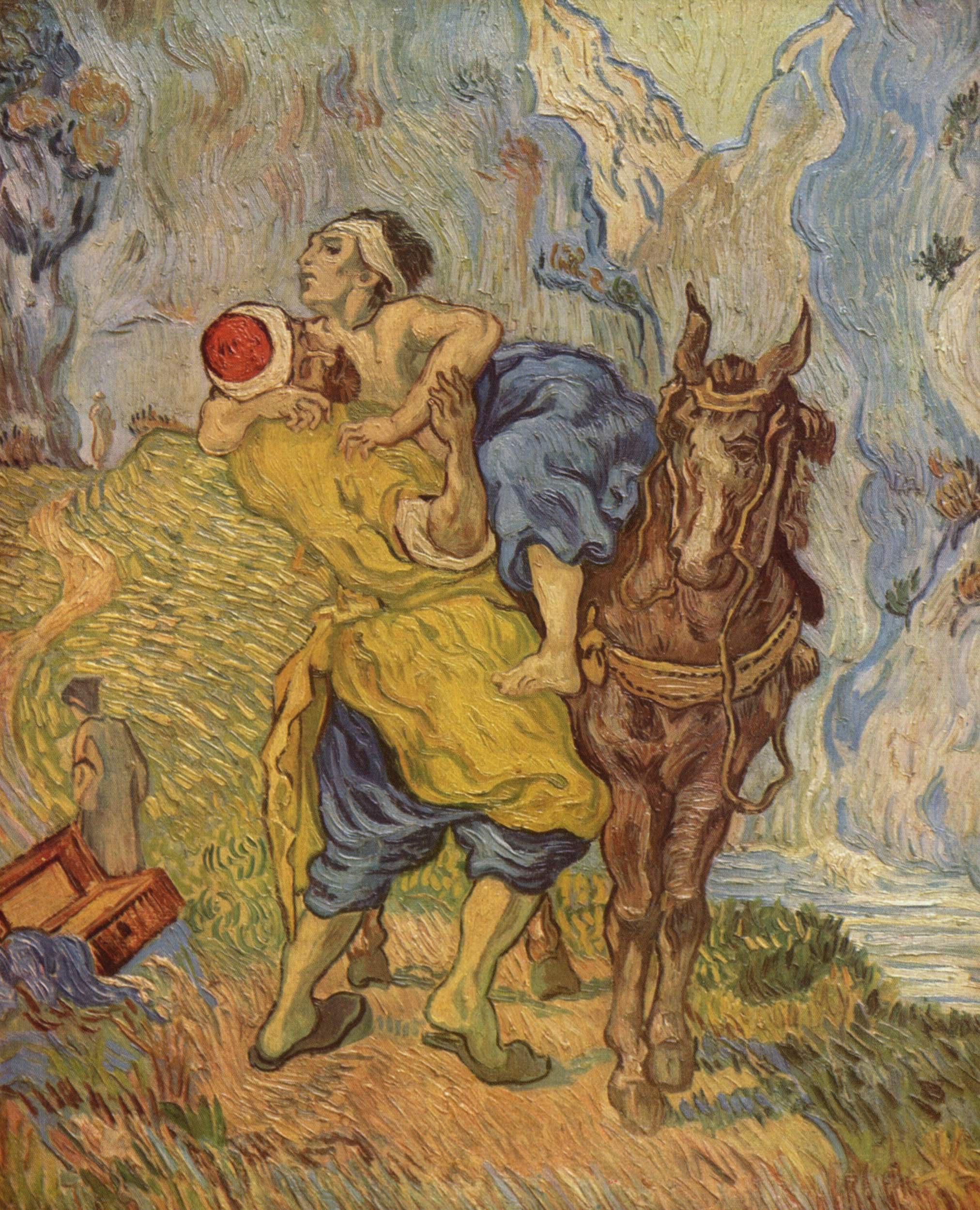
Vincent van Gogh, Public domain, via Wikimedia Commons, Good SamaritanOne regular visitor lives in an assisted living and only gets out when her friend (platonic) drives an hour over a couple of bridges to pick her up and bring her to the center after their AA meeting. They come almost every week, sit for a while on the benches outside and chat quietly, enjoying some people watching, and taking in the view of Sachuest Beach with the spires of St. George School on the southern end along with distant views of the Bellevue Avenue mansions across the bay. Oftentimes they come in for a visit and sit in the chairs by the visitor desk to bring us into the conversation. He is a pleasant sort of absent minded fellow who is a retired bus driver, gentle and unassuming without pretensions. She has a couple of black belts in two martial arts, which apparently were helpful in her old job as a bartender and occasional bouncer. Her life remains difficult and now is physically challenging. They seem an unlikely pair but clearly benefit from discovered kinship and support. He lifts her up with quiet small acts of kindness.

 And so can we try as well — listen, smile, console and commiserate, if that is what seems needed, laugh together if we can, empathize, share stories. Take them by the hand sometimes.  How fragmentary and imperfect and partial our response is, but God uses even our inadequacy to comfort and build up in insignificant actions and words of little consequence. Connect. Acknowledge our common struggle. Lighten the load for a short time. Offer solace and momentary affable companionship. Sachuest Point Wildlife Refuge is a good place, and we will try to make it even more of one if we are able.[ii]

“To love someone means to see him as God intended him.”  Fyodor Dostoevsky

[i] https://www.etymonline.com/word/hospitality

[ii] Pictures from my phone and The Good Samaritan, Vincent van Gogh. Public domain, Wikimedia. One is a phone picture of me taken by a ranger on the day fifteen or so rangers and volunteers planted 1,200 indigenous shrubs and grasses to return an old trail to the wild after it had to be moved due to erosion. It was a grand day among grand company.

2 Comments

Filed under Personal and family life, Sachuest Point and other wonders

Late September on Old Orchard Beach

cropped-sunrise-at-old-orchard-beachCold. Penetrating deep cold, but exhilarating. On shore wind as the air rises over the still warmer land, and the ocean air rushes in to fill the vacuum. Cleansing. Lung filling. Soul filling. A sharp breeze comes over the water picking up moisture and is scrubbed as it comes. The air streams around and over Bluff and Stratton Islands in the harbor, loading up from beyond the horizon where the earth curves out of sight, past the Azores, past the edge of the world. Cold, clean, pure, merciless, but without bias or favor.

The sun begins the day’s work out of sight in the east over the rocks and low scrub and a few trees on the wooded point at the end of the beach curve just north of the open sea. Pink-orange and red gray, the clouds reflect the refracted light before the sun makes its morning arrival. Then it does, and we must stop staring at the blinding intensity.

Gulls – American and European herring gulls, ring-billed gulls and a few larger black back gulls join them. Gulls swoop and glide a foot above the beach looking for a landing spot even before full sunrise. Heartbreakingly graceful. One standout wheels back at a nearly impossible angle, pivoting almost on its wingtip, barely clearing the sand, rights itself in a perfect pirouette, glides effortlessly another twenty feet, finds its spot selected with no observable distinction from any other spot, and with a slight change of pitch of wings drops gently on the beach, settles with a brief flourish and straightening of feathers put away like a cloak, more compact than their full spread would suggest, a brief quivering like an elegant woman settling into her chair in a premium restaurant at a choice table. She doesn’t immediately pick up a crab or a clam. Just turns into the wind, stands and waits patiently a couple of feet from the tidal flow. Waits for something not apparent to anyone else. Stretches its neck, looks skyward, parts its bill, and cries out in the unmistakable gull call.

Four surfers and a paddleboarder work on their competences in predawn twilight three hundred yards north down the beach. The surfers take their turns following the wave break that they each ride not quite parallel to the shore. All are skilled. No one puts on a wetsuit when it’s forty five degrees and spends their precious time before work begins for the day by plunging into the surf with their long board tethered to their ankle if they are not serious. They call everyone dude and employ an esoteric vocabulary like a casually organized fraternity, united by a love for their frigid, perfect, wet, plunging and surging sanctuary. When you speak with them occasionally, they are unfailingly polite and friendly. Will talk with strangers about the quality of the waves like they have known each other all their lives. Maybe they have.

Another half dozen or so of us on the nearly empty two mile beach got up to catch the beginning of the day; two are in bathrobes and wrapped in blankets. Some stand or lean on a fence. Several in heavy sweaters, stocking hats, and high ankle hikers are dutifully walking their dogs. Another is meandering slowly, barefoot, but sweater clad, on the edge of the water where the waves finally peter out looking for shells or sand worn beach glass. A guy with a hoodie is running with his very large dog. Maybe a Newfie – hard to tell at distance and murky light. He’s quickly covering the ground south towards the long wooden pier with multiple single-story, now closed, gray shingled souvenir shops. The pier protrudes five hundred feet out into the open ocean. The runner is probably headed home to grab some more coffee and drive to the office. The rest of us are alone. An older woman, slightly portly with glasses and a kind face sits in a high backed beach chair with an expensive looking camera trying to catch the light. She’s barefoot too.  Maybe she’ll paint her photo later. Watercolors.

The laughing, drinking, partying summer throngs have abandoned the jostling crowded sidewalks and have gone home to New Jersey or Quebec or Hartford. Many come every summer for a week or two like a ritual. Expensive vacations, but not out of reach. Not the Hamptons, but not an inflatable pool in the backyard either. Most of the restaurants, pizza places, and French fry stands are already boarded up for the coming winter. But not all of them. The Beach Bagel breakfast counter stays open year round for the regulars and a few hearty bargain seeking tourists. Bacon, egg and cheddar on onion bagels and more; the conversations of townsfolks about the baseball playoffs, the depravations of the now ruined Patriots, the latest expensive embarrassments of town council mistakes, the planned wedding of a daughter in the spring, arthritis, the foolish boss where they work. The waitresses tease and are teased back in familiar ribald jesting.  Familiar faces, too. Relaxed and at ease with each other and the routine, although they may not know all the names; customers are comfortable with silence too, staring into their coffee.

The beach begins a slow recovery and gives itself back to the full time residents who love all its seasons and don’t mind its moods. A recent storm eroded some of the border beach grasses, pushed up flotsam far up on the sand towards the wind fence, a couple of large broken branches that look like white pine wash in and out on the waves, a bent unbuoyed lobster trap rests fifteen feet beyond the farthest breaking waves.

The waves have been breaking endlessly on this beach for a million years or at least for ten thousand since the last Ice Age covered everything here under two hundred feet of glacier. The waves come in gray green, surrender to gravity, pick up the wind, foam white at the crest, cascade, slowly subside and recede. A nanosecond after they fall, I see them; a second later I hear them with a tiny delay. Sound follows light. For a million years the rhythmic breaking proceeds. Not silent, but not jarring. Restful. Sleep on the beach if it was warmer. The voice of the world.

The gulls gather in small groups facing the north Atlantic. No unguarded sandwiches or chip bags on blankets to pillage. Gone for the winter. Picked clean. The gulls too are comfortable in silence. Waiting.

So God created the great creatures of the sea and every living thing with which the water teems and that moves about in it, according to their kinds, and every winged bird according to its kind. And God saw that it was good. Genesis 1:21

Leave a comment

Filed under Maine Tales, Sachuest Point and other wonders

Summer’s End

“April, dressed in all his trim, hath put a spirit of youth in everything.” Sonnet 98, William Shakespeare

Weaver Cove Sunset 3Back in April, the sun rose earlier each day on the eastern horizon and set later and farther to the north on the western horizon until the summer solstice sprinted by on June 21st. The daylight prior to the solstice persists a few minutes longer each day in felicitous, tiny, precious increments. Early mornings are more welcoming, and evening sunsets linger. Here on our little island, the sun rises over the Sakonnet River or the Atlantic out on Sachuest Beach and sets over Narragansett Bay.
We sometimes take sandwiches to watch it sink red and pink and orange behind Conanicut Island to the south in the winter or Prudence Island in the summer at the Weaver Cove boat landing off Burma Road that runs along the west side of our island. Herring gulls, ospreys, and various diving and dabbling waterfowl often join us: cormorants, Northern diving ducks, harlequins, scoters, and loons.

The delicate greens of spring give way to lush summer foliage, then gaudy autumn golds and reds, and end once again in the sparse, naked beauty of winter branches black against cold skies and snowy fields. The seasons flow effortlessly one to the other. The spring miracle is as inevitable as winter, hardwired into genes of living things and into the orbit and tilt of our beautiful blue ball.

The startling pink of abundantly flowering cherries follow the magnolias and dogwoods. Bradford pears planted in half the commercial landscapes on the island burst forth in white once again. In May the petals begin to fade and fall, then cascade, covering ground and windshield. Pink petal decorated cars are often seen on East Main Road and Wapping Road and Indian Road. By August we are greeted each day with the last of the hydrangeas, Black Eye Susans, the pinks of Rose of Sharon, some unlikely, startling, hardy hibiscus, and the splendor of Trees of Heaven.

“He says the early petal-fall in past

 When pear and cherry bloom went down in showers

On sunny days a moment overcast;

And comes that other fall we name the fall.”  The Oven Bird, Robert Frost

Now, when I open the shades to the morning, I begin to track early rising Orion with Betelgeuse and Rigel in the pre-dawn Southern sky; his signature belt and sword are tilted from the angles that will soon help dominate winter skies. The seasons are moving on for 2022, and it’s time to get the winter’s firewood into the shed.

We are a couple of months past the summer solstice for 2022 and each day gets just an inconspicuous bit shorter. Not much, at first, but later towards December, the foreshortening accelerates once again to begin the long climb back towards another flowering. The passing seasons prompt thoughts of the gift of light. I am reminded that the darkness is not a thing unto itself, but a privation. St. Francis taught that no depth of darkness can defeat the light of one candle.

“The darker the night, the brighter the stars, The deeper the grief, the closer is God!” Fyodor Dostoevsky

Evil has no substance of its own but is a privation, a negation, a denial of Good. What is a candle that cannot be extinguished by the depth of evil? I am reminded of one: the non-violent, gentle light of forgiveness. Selfishness, violence, hatred, divisiveness, rancor, vitriol, fierce anger, the depths of human cruelty, even murder ultimately surrender to forgiveness. “Forgive us our trespasses as we forgive those who trespass against us.” Every time we pray that so often recited prayer by habit, we commit ourselves to a promise and an agreement that is not always easy to keep. A promise we should not ignore or neglect.

“Father, forgive them, they do not know what they are doing,” spoken from the bloody pulpit of the Cross. Roman subjects quaked at the threat of it. The Cross symbolized the worst that human beings can do to one another. And yet the response of a mighty God to those who killed Him so terribly was not triumphant vengeance by fierce angelic riders seeking retribution, but the final soft word that defeats the darkness. He descended to the bottom of human suffering and returned the pain, not with justice, but with Love.

“Jesus spoke to them again, saying, ‘I am the light of the world. Whoever follows me will not walk in darkness but will have the light of life.’” John 8:12

Little is more powerful than genuine forgiveness. Forgiveness is not a sentiment, but a decision, a grace filled act of the will. Nothing answers hatred as effectively or more powerfully. The Cross is the symbol and the actuality of cruelty, fear, vindictiveness, and violence unlike almost any other. And it was overcome only and for all of us by Resurrection, forgiveness, and the Light.

 “Darkness cannot drive out darkness; only light can do that. Hate cannot drive out hate; only love can do that.”  Martin Luther King, Jr.

“Anyone who claims to be in the light

but hates his brother

is still in the dark.

But anyone who loves his brother is living in the light

and need not be afraid of stumbling;

unlike the man who hates his brother and is in the darkness,

not knowing where he is going,

because it is too dark to see.” 1 John 2:9-11

1 Comment

Filed under Faith and Reason, Sachuest Point and other wonders

Uncontrolled

“Sometimes you win, sometimes you lose, sometimes it rains.” Nuke LaLooch (played by Tim Robbins) in Ron Shelton’s screenplay for “Bull Durham”

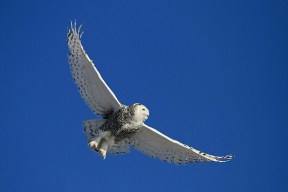
Snowy Owl at Hamden Slough National Wildlife Refuge Lee Kensinger

Snowy owl at Hamden Slough   National Wildlife Refuge in Minnesota by Lee Kensinger.

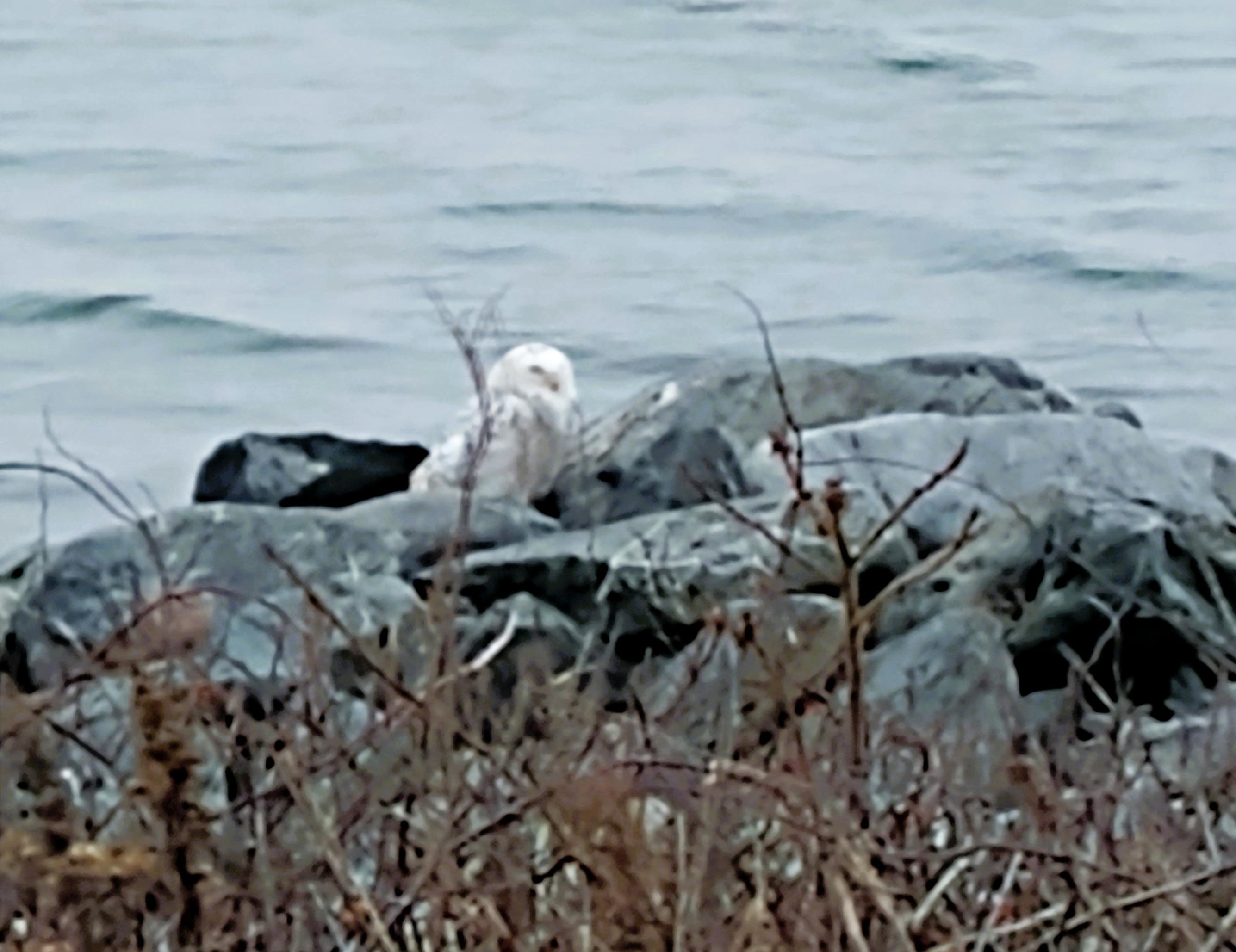
 Kim Crocker, a volunteer at the Sachuest National Wildlife Refuge   near us, reported a tale that reminded me of the rule of fang and   claw, talon, and blood. After an absence last year of any   overwintering snowy owl at the refuge, this year we have two   visitors, neither of them yet fully mature, but hardy enough to make   the trek from the tundra. Snowy owls can live nine years in the wild and up to twenty-eight in captivity. Fully grown, they have a wingspan of close to five feet: beautiful, formidable hunters, and relentless predators.[i]

Mr. Crocker told me the ranger observed a Cooper’s hawk make a quick kill, probably a vole or field mouse. Raptors drive their long rear talons into their prey with great force from a dive, wrap their front talons securely around their food and begin to eat, often before their victim is dead. This hawk should have been more situationally aware when he grabbed his lunch. Almost as soon as he attacked, he was in turn struck by a snowy, and the predator became the prey with the added benefit of a vole for dessert. Full grown snowy owls have been observed at the refuge taking a full-grown Bufflehead, Eider or Surf Scoter[ii] right out of the surf and carrying them back to a shoreline rock for a leisurely meal.

Sometimes unforeseen trouble can drop on us with the swiftness of a raptor from the sky.  One of the most disconcerting aspects of the last two years of COVID world was the vivid notice that we are not in control. And never have been. This is a valuable lesson.

Oh, we pretend like three-year-olds that if the Bogeyman comes out of the closet or from under the bed we can pull the covers over our head, cuddle our teddy bear, and be protected – that we can be in control, but at three o’clock in the morning on a sleepless night, we know that “the best laid plans o mice and men gang aft agley.”  [iii] Now as adults our Bogeyman occasionally comes out from under the bed, and there is not a damn thing we can do about it when he shows up. We must learn to cope with him and muddle along.

Thus, we are not to be grieved that we don’t control even the most important potentialities of our lives: our health, our safety, or how long we will live on this planet.

“Give up the thought that you have control. You don’t. The best you can do is adapt, anticipate, be flexible, sense the environment and respond.”  Frances Arnold, Nobel Laureate in Chemistry, Cal Tech

Our futile attempts at overcontrolling our lives, especially through government and politics, bring us division, frustration, distrust, anger, aggression, and ultimately despair. Our technological successes have deluded us into believing that all things eventually will be brought under our control.  “The sociocultural formation of modernity turns out to be, in a way, doubly calibrated for the strategy of making the world controllable. We are structurally compelled (from without) and culturally driven (from within) to turn the world into a point of aggression. It appears to us as something to be known, exploited, attained, appropriated, mastered, and controlled. And often this is not just about bringing things – segments of the world – within reach, but about making them faster, easier, cheaper, more efficient, less resistant, more reliably controllable.”[iv]

Illusory control, then, in the end, is an obsession with self-gratification, for individuals and identity groups. For politicians and social media mavens. For the legions of media chattering heads who so want to reshape the culture in their image. All of this is in a context of a couple of generations of the un-enculturated who have been formed not by tradition or objective standards, but by a faith in self-fulfillment that is largely self-defined by individuals and identity groups. The self-definition is rooted not in classic precepts of freedom, but in the post-modern concept of license. We build precariously on a sandy and shifting foundation of false and malicious hope: we can be anything we want to be and behave any way we choose, most especially regarding sexuality, if we don’t infringe too badly on the other person’s fancy.

“Who controls the past controls the future. Who controls the present controls the past.” – George Orwell, ‘1984’

How do we find ourselves so confounded and unmoored? We want to control, but we cannot possibly.

Sachuest Snowy Owl checking out the menu

Sachuest Snowy checking out the menu

We want to redefine our nature, but we cannot possibly. Far too large a topic for this modest post, but we can look at a corner of it. Cultures to persist and offer stable platforms for human flourishing must formally welcome adolescents into adulthood, must train, must recognize what is essential to its existence and never lose sight of forming the next generation in the principles upon which the culture rests.  This instilling of the culture must include objective truths within which the next generation can conform with certainty and find their own context. This has been the case for humans so long as there have been humans.

Our culture neglected this basic principle, and to paraphrase Chesterton, when we cease to believe in something true, it is not that we believe in nothing, but that we will believe in anything. Such is our current state. One of the worst consequences of this is the neglected initiation of young men, prolonged adolescence into their thirties and beyond, and the enduring irresponsibility of too many young men, men without fathers, and men without passages of initiation.[v] These transitions are necessary not just to our culture, but to any culture, and we lost the thread in the latter part of the last century.

“Anchises’ son had halted, pondering on so much, and stood in pity for the souls’ hard lot.” Virgil, Book Six, the Aeneid

Richard Rohr researched this unhappy phenomenon in depth, investigated its roots and consequences in his book “Adam’s Return: The Five Promises of Male Initiation.”   [vi] He discovered that male initiation is significant even in other species like elephants. [vii] The lack of fathers and the lack of proper initiation into manhood has devastated our society in easily foreseen ways. Rohr theorizes that rites of initiation existed in all societies and are necessary still, albeit in different forms. To help boys transition into men and inculcate in them the responsibilities of maturity in the tribe, the rites typically had five common factors, sometimes involving scarification or survival alone in the wilderness. It was always necessary that they learn these lessons, and although it is still necessary to learn for us, modernity teaches in many ways just the opposite from these:[viii]

  • Life is hard.
  • You are not important.
  • Your life is not about you.
  • You are not in control.
  • You are going to die.

We grow wise when we understand that our lives are not ours alone, nor are we in control. We grow wise as Augustine did when we realize that to love and be loved is the fundamental longing of the human heart. We grow wise when we comprehend that the evil that seems all around us is not an adolescent comic book “Dark Side” force or a creature or a thing at all, but a lack, a privation, a missed chance.  Just as dark is not a form of its own, but a lack of the good of light, and coldness is not a thing unto itself, but a privation of warmth, so too hatred, bitterness, loneliness, violence, fear, and existential disappointment are all an absence of Love. And it is for many a self-inflicted deprivation.

“The truth may be stretched thin, but it never breaks, and it always surfaces above lies, as oil floats on water.” Miguel de Cervantes Saavedra, Don Quixote

So, we must go out with joy to look for light where it can be found and delight in it. I was greatly heartened a couple of weeks ago when we walked another of our favorite local trails in Norman Bird Sanctuary. Along the way, we met a young earnest couple who were volunteering the afternoon of their day off cleaning out one small plot of Japanese knotweed, an aggressive invasive species that will crowd out native plants that provide food and shelter for the many birds and other wildlife that live there. They spent hours cutting and bagging the stems and dry foliage of the noxious pest. They took their time with laughter and good fellowship as they went, cutting and handling carefully so as not to disturb and scatter the seeds that will spread the weed. They cheerfully told us they will return another day to dig out the roots. No broad- spectrum damaging herbicides, just laborious, painstaking work.

The plot was about fifteen feet square. Out of 253 acres of the sanctuary. Why spend so much time, attention, and energy on such a tiny fraction of the land? A modest, difficult bit of work against such a bitter foe of the indigenous flora and fauna that we all enjoy and cherish is worth doing. Even if it does not solve the whole problem or change the micro ecosystem permanently, it changes us. If one understands that we’re not able to control every difficult challenge that comes along, that our life is about something greater than ourselves, and that we must do what we can, where and when we can, to improve, however humbly, our situation, this is a truth worth knowing.

 The way a crow

Shook down on me

The dust of snow

From a hemlock tree

Has given my heart

A change of mood

And saved some part

Of a day I had rued.    “Dust of Snow” Robert Frost  

[i] Photo from U.S. Fish and Wildlife site. Snowy owl at Hamden Slough National Wildlife Refuge in Minnesota by Lee Kensinger.

[ii] https://www.newportthisweek.com/articles/sea-ducks-return-to-sachuest-point/

[iii] Gratuitous sidebar: Perhaps the most pernicious and dangerous assumption of the whole progressive project is the illusion that we are in control, and that human progress is linear and headed to an inevitable Omega point of perfection. If only we allow the elite technocrats that we anoint to take control, all will be well irrespective of all evidence so far to the contrary.

[iv] The Uncontrollability of the World, Harmut Rosa, Medford, MA: Polity, 2020

[v] “What is the single condition of a boy’s life that correlates most strongly with whether he will turn criminal? Not income, not by a long shot. It is whether he grew up in the same home with his father. Our prisons are full to bursting with fatherless boys who never became the men and fathers that God meant them to be. The collapse of the black family has been most catastrophic, and what is the result? What anyone not befuddled with feminist ideology would have predicted, from simple observation of nature and from the universal testimony of human cultures. One out of every three black men between the ages of twenty and thirty will spend time in prison. If we blame that on racism, then we had better explain why, in the days when blacks could not ride on certain seats in the bus and could not even play major league baseball, nowhere near as many of their men were in prison. Family, first and last—the family is where you learn of God and man, good and evil, courtesy, diligence, honor, chastity, self-restraint, and true courage. Give me poverty and the family as strong as iron and in one generation in America my family will be poor no longer. That is not speculation or boasting. It is the experience of millions of immigrants who came to the United States with nothing in their pockets, but with a great fund of moral capital; with faith in God, and firm loyalty to the family.”Anthony Esolen, “Out of the Ashes: Rebuilding American Culture”

[vi] Adam’s Return, Richard Rohr, Crossroads, 2004

[vii] Elephants need fathers too. Rohr told of a true story about rogue young male elephants in Pilanesberg National Park, South Africa. They were about fifty orphans immigrated into the park to reestablish the herd and without fathers to train them. An 8’ tall creature with tusks can inflict serious damage. Which they did. Killed over fifty rhinos. The debate among the rangers was whether to euthanize the young thugs, castrate them, which would calm them down, or bring in some help. The adolescent elephants (between twelve and twenty) were in a perpetual state of “musth,” a constant flooding of reproductive hormones. This is normally tamped down by mature bull elephants in the herd that whack them around a bit and tell them to calm down. Knowing they cannot yet compete with a full-grown papa elephant, they do calm down and stop dribbling, spraying everything in sight, and acting out aggressively, which is rough on the rhinos. The rangers shipped in six mature bull elephants and within a day, the adolescents dropped out of musth, and not a single additional rhino was killed.

https://www.bbcearth.com/news/teenage-elephants-need-a-father-figure   https://www.newscientist.com/article/mg15120390-300-orphan-elephants-go-on-the-rampage/

[viii] Summary outline of Rohr’s book.

8 Comments

Filed under Culture views, Sachuest Point and other wonders

Quaker Hill

“There is a hill about 7 miles from Newport, and on the Eastern side of this Island, called Quaker Hill, from whence there is a very fine view of all the N. part of the Island, and of the adjacent islands, and the Continent for many miles. The many fine and well cultivated islands, and the beautiful bays and inlets, with the distant view of towns, farms and cultivated lands intermixed with Woods, together with the many vies of the adjacent waters, contribute to make this (even at this bleak season of the year) the finest, most diversified, and extensive prospect I have seen in America…. In the beginning of Summer this must be a delightful vista, and I should think hardly to be equalled in America, or any other Country. Major Frederick Mackenzie, British Army occupying Aquidneck Island, 1778[i]

When we do not have the time for one of our favorite longer excursions on the beaches or wildlife refuges, we will walk to the bottom of Pine Tree Street and turn north on Middle Road past our bovine friends in the heifer pen at Escobar Farm. We turn back home after a mile or so at the Friends Evangelical Meeting House and old cemetery. The Friends Meeting House was founded in 1658, and the current building constructed in 1700.  There is a small group of Quaker Friends who thankfully have been doing some meeting and renovating to this marvelous building.

We live on the back side of Quaker Hill and walk by most of it on the way to the Friends Meeting House. Unwavering men battled and died on Quaker Hill in the August 29th dénouement of the 1778 Battle of Rhode Island when an expeditionary force was sent from Fort Barton in Tiverton to free Newport from British occupation. Led by General John Sullivan, the Americans were forced finally to an orderly retreat. After a full-blown hurricane had devastated the allied French fleet that was to have aided the Americans, the better positioned and dug in British forces held the advantage.

Sullivan laid a trap for the British 22nd Regiment luring them with collapsing skirmish lines on the north end of Aquidneck Island, and after repeated assaults on Butt’s and Quaker Hills, the combined British and Hessian troops eventually deserted the field with heavy losses abandoning their dead and wounded. Major Samuel Ward commanded a division of black troops promised their freedom; they repulsed at least three desperate concentrated attacks by the much-feared Hessians, fighting bayonet to bayonet. Lafayette rode seventy miles in seven hours to Boston to convince the French Admiral d’Estaing to return to the battle, but to no avail. Without the French fleet to prevent British ships from cutting them off, General Sullivan had no option but to retreat to safe mainland positions lest they all be trapped. The only major battle of the Revolution in the state, it was one of the largest of the war. The Battle of Rhode Island saw 211 Americans killed or missing; 1,023 British and Hessian troops died or were captured.

Thus, Newport remained in British hands for another two years and through the terrible winter of 1778-1779 when Narraganset Bay froze over.  Those that could fled to the mainland to avoid freezing and starvation. Many did not. The thousands of occupying British troops looted and destroyed homes, stealing firewood, livestock, vegetable stores, clothing, and furniture. They displaced occupants who had been generations in their homes and moved in. Burning about 300 cords of wood a day, not a tree remained standing within five miles of the harbor. No fence post or wooden grave marker escaped the campfires. Scarcely a tree survived on the entire island. Of the thousand or so buildings in the once prosperous trading city, about half were destroyed. Many invaluable books from the Redwood Library were brought to England. Occasionally, they forayed to the mainland and burned and ransacked the towns of Bristol and Warren. At the end of the war, when the Brits moved out two years later, they burned more buildings and filled the wells with dirt and garbage; they scuttled many of their own ships in the harbor to render it impassable and deny use of them to the remaining citizens. The Newporters who lost most of what they had built for 150 years, never lost their resolve to be free.

It took a hundred years for the once major city to begin to recover, and Newport never regained its former prominence in commerce or general prosperity, even with the famous mansions of out of towners on the southern end of the island.

“It only takes two facing mirrors to construct a labyrinth.” Jorge Luis Borges, Seven Nights, 1977

 The Newporters were Congregationalists, Presbyterians, Methodists, Baptists, Quakers, Jews and even a few Papists. The first synagogue in America is still there. Newport’s founders fled the Puritan excesses of Massachusetts, and Newport was one of the first true hubs of religious freedom and tolerance.  What they shared along with the writers of the Declaration of Independence and the Constitution was a common understanding: that human beings found true happiness in and aspired to virtue and in a relationship with the transcendent Creator. However they varied in their specific interpretations from Deists like Thomas Jefferson to devout Christians like John Adams, all agreed that the democratic experiment was possible only with a people willing to sacrifice their own pleasure and prosperity for the good of all and to forgo immediate comfort for the future well-being, freedom and security of their children.

“No government can continue good but under the control of the people; and . . . . their minds are to be informed by education what is right and what wrong; to be encouraged in habits of virtue and to be deterred from those of vice . . . . These are the inculcations necessary to render the people a sure basis for the structure and order of government.” Thomas Jefferson

“To suppose that any form of government will secure liberty or happiness without any virtue in the people, is a chimerical idea.” James Madison

“Human rights can only be assured among a virtuous people. The general government . . . can never be in danger of degenerating into a monarchy, an oligarchy, an aristocracy, or any despotic or oppressive form so long as there is any virtue in the body of the people.” George Washington

“Only a virtuous people are capable of freedom. As nations become more corrupt and vicious, they have more need of masters.” Benjamin Franklin

“Our Constitution was made only for a moral and religious people. It is wholly inadequate to the government of any other.” John Adams [i]

Yes, Jefferson and Washington were slave owners. John Adams was a poor father to his sons. Franklin was a libertine. All of them had quirks, foibles and flaws. Are we better prepared to address the new challenges that face us by ‘cancelling’ them or studying them in their complexity, both the good and the bad? How do we benefit from deconstructing and revising our history from the true with all its blemishes to the tokenism that mirrors current politics?  What have we lost by dumping the objective reality of ‘the good, the true and the beautiful’ as ideals and ditching the pursuit of virtues like prudence, fortitude, temperance, and blind justice without grievance politics?  How does splashing paint, burning books and tearing down monuments to saints elevate necessary conversation? And how do those things differ from the Taliban destroying ancient Buddhist monuments or brown shirts burning books in pre-war Germany when ideology overpowers reasoned thought?

As we walk along Quaker Hill, we reflect on our current state and wonder how our current citizens, bickering over trivial inconveniences like hunkering down a bit to protect one another’s health or grocery stores running out of toilet paper, would bear up to the deprivations of 1778. Mired in splintered ever shrinking groups, each with their own complaints real and imagined and self-serving remedies, is there still a cohesive vision for us as a society? [ii]Can a post-modern culture of entitlement, pleasure seeking, radical subjective individualism, shattered common truths, and abandoned moral guideposts hold together a still experimental project and vision called America? Does such a vision even still exist? Questions we and our children must ponder and resolve.  Or not.

“Even if I knew that tomorrow the world would go to pieces, I would still plant my apple tree.” Martin Luther

 [i] Quote taken from Newport: A Lively Experiment 1639-1969, Rockwell Stensrud, © 2015 by Lively Experiment LLC and Rockwell Stensrud, D Giles Limited, London, in association with the Redwood Library and Athenaeum, Newport, RI

[ii] And many others, including those of luminaries of democracy in other countries:

“I sought for the greatness and genius of America in her commodious harbors and her ample rivers – and it was not there . . . in her fertile fields and boundless forests and it was not there . . . in her rich mines and her vast world commerce – and it was not there . . . in her democratic Congress and her matchless Constitution – and it was not there. Not until I went into the churches of America and heard her pulpits aflame with righteousness did I understand the secret of her genius and power. America is great because she is good, and if America ever ceases to be good, she will cease to be great.”― Alexis de Tocqueville, Democracy in America

“Men are qualified for civil liberty in exact proportion to their disposition to put moral chains upon their appetites; in proportion as their love of justice is above their rapacity; in proportion as their soundness and sobriety of understanding is above their vanity and presumption; in proportion as they are more disposed to listen to the counsel of the wise and good, in preference to the flattery of knaves. Society cannot exist unless a controlling power upon will and appetite be placed somewhere, and the less of it there is within, the more there must be without. It is ordained in the eternal constitution of things, that men of intemperate minds cannot be free. Their passions forge their fetters.” Edmund Burke

[iii] https://www.nytimes.com/2016/05/20/opinion/the-fragmented-society.html

2 Comments

Filed under Sachuest Point and other wonders

Divers and Dabblers

Statistically, the probability of any one of us being here is so small that you’d think the mere fact of existing would keep us all in a contented dazzlement of surprise.”  Lewis Thomas

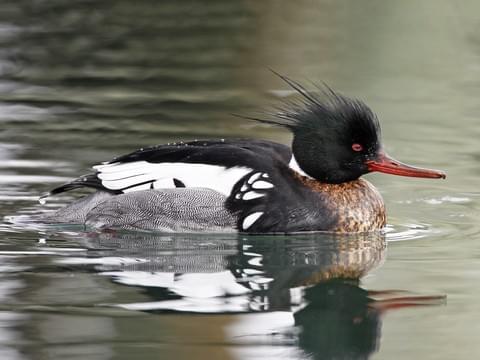
Red-breasted Merganser, All About Birds, Macaulay Library, Cornell University. Ian Davies

Two types of ducks occur: divers and dabblers. The dabblers, compensating for their undignified manner of feeding, oftentimes have plumage more colorfully adorned, at least the males. With their tails up in the air exposed to the world and their heads and upper body submerged, their short legs scramble ceaselessly to maintain their awkward situation while they pick away in the summer and breeding time at insects, larvae, small crabs, worms and the like, often turning up rocks at the bottom of their shallow feeding grounds to dig out their supper. In the winter, dabblers seek the seeds of aquatic plants, feeding in a peculiar surface nibbling[i]. Mallards, and various teals, widgeons and shovelers are among these beautiful, but humble, ducks. Strong flyers and vocal, and because they usually inhabit shallow calm waters, they may be more familiar to us.[ii] Friendly, social ducks, but don’t feed them with your stale bread which stuffs them, leads to dependence on an inconsistent source and provides few of the nutrients they really need.

Divers are a different matter, and fishermen are all too familiar with their skills and appetite.[iii] I have met avid fishermen in Maine who delighted in hunting mergansers in (and sometimes out of) season to reduce their numbers, shooting them in the air or on the water. Too many mergansers, which each eat 15 to 20 fish a day,[iv] are devastating to freshwater game fish populations in some Maine lakes; they more than decimate young bass and lake trout.  Loons, another aquatic diving bird with a similar avian profile, are also voracious feeders, but are protected: shoot them and go to jail. To gain some perspective, wildlife studies estimate that a pair of nesting loons with two chicks in the fifteen weeks of breeding season will consume a half a ton of fish. Loons are prehistoric animals that thankfully still inhabit our world; they lend credence to the theory that birds are descended from dinosaurs. Like diving ducks, they are sometimes found in salt water as well. Diver names are poetic: Red-breasted merganser, canvasback, bufflehead, surf scoter and common eider[v]. Some small ones like the bufflehead nest in the abandoned nests of woodpeckers and can move into your birdhouses. Each species diverged slightly over centuries as circumstances and their genes led them to become unique wonders.

At the risk of anthropomorphic duckery like Donald or Daffy, we can reflect on some human analogy. Are we dabblers or divers? Hunters or gatherers? Perhaps we are both, and our predilections vary according to our personality, our moods and our interests. Diving in some matters and dabbling in others. That is worth some consideration, a self-examination of where we would be better off dabbling and where we need to dive deeper. Are there suspicious creepy crawlers under the rocks in shallow waters that we should avoid turning up whilst we dabble?

 “The capacity to blunder slightly is the real marvel of DNA. Without this special attribute, we would still be anaerobic bacteria and there would be no music.” Lewis Thomas, “The Lives of a Cell”

White tail deer at Sachuest Point

In the rough waves that encircle Sachuest Point Wildlife Refuge, we frequently spot surf riding diving ducks: surf scoters, eiders (also called St. Cuthbert’s duck), red-breasted mergansers, black ducks, harlequins in one of their rare East Coast wintering sites and the occasional loon. A herd of fifty or so white tail deer also permanently inhabit the hilly fields of the point, not quite tame, but not as shy as their unprotected relatives a bit inland. The slow and weak are eaten by coyotes but have no fear of human hunters. I’ve come within fifteen feet of them as they browse in late afternoon. The waterfowl too are immune to human shooters on the wildlife refuge, but the smaller ones live in peril of the large raptors that soar, sail on the winds and hunt. Overwintering snowy owls have been spotted plucking a full-grown unwary scoter out of the water and carrying it back to a field nest or a rock for a leisurely meal. No snowy owl made an appearance this year. The white haunting creature attracts a cadre of two dozen camera laden followers, some coming from hundreds of miles away to take that elusive perfect shot they can sell to the magazines. Too warm this winter, and the snowy owl mercifully stayed north, so we regular hikers of the trails can find a parking spot.

This year the main attraction was the almost as spectacular Northern harrier with her 40” wingspan. She hunts low, frequently gliding ten or so feet above the field looking for small rabbits, voles and mice. Short eared owls show up as well and attract some photographic attention, but the beautiful, smaller and common red-tail hawk remains much higher, mostly unmolested by photo snapping enthusiasts.

Our walk around the point is always restorative and always new after hundreds of repetitions, new with the many moods and seasons of ocean and fields. The three miles of trails are occasionally crowded (we pass ten or fifteen people along the way); many times, though, we’ll see only a few or in cold winds sometimes none. We dabble with everyone, almost universally pleasant and friendly. I am reminded of E.B. White’s memorable eighteen inches of both connection and separation in his classic “Here is New York” [vi]essay. Occasionally unbidden will come an instant of connection as we pass along the trail. We dive unexpectedly into their lives with authentic snippets of the overheard unguarded conversation of strangers, and our imaginations fill in the blanks. Our lives intersect for a passing moment.

  • I saw the harlequin and got my shots. Been looking for weeks for a clear photo for my mother.
  • They still have to dislocate my hip of course, and that will be difficult.
  • I think they are sending me to New York for a project. I’ll be gone a while.
  • I’m not expecting him to change, really, that’s probably impossible. But I do need an acknowledgement.

We dabble and we dive through our time here, and like the ducks we do the best we can to avoid the predators, raise our young and teach them our ways. We teach them to pay attention to the lives that we encounter along our way: to dabble pleasantly, to proffer friendship to all, and occasionally to dive deeply, risking our eighteen inches of separation when we hear the soft cry of loneliness or hurt or confusion. Knowing that often we will be inadequate with our own resources to heal or make whole, we try anyway as best we can.

“It is in our genes to understand the universe if we can, to keep trying if we cannot, and to be enchanted by the act of learning all the way.”  Lewis Thomas.


[i] From the Beauty of Birds website.

[ii] Dabbler ducks feeding

[iii] Diving ducks feeding

[iv] Red-breasted merganser (also called sawbills) from All About Birds, Ian Davies, Macaulay Library, Cornell University

[v] Common eider, from All About Birds

[vi] Here is New York” E.B. White

1 Comment

Filed under Sachuest Point and other wonders