
“We shape our buildings; thereafter they shape us.” (They represent the spirit of their age. When they fall, so too has something essential in the civilization that made them.) quote from a 1943 speech by Winston Churchill
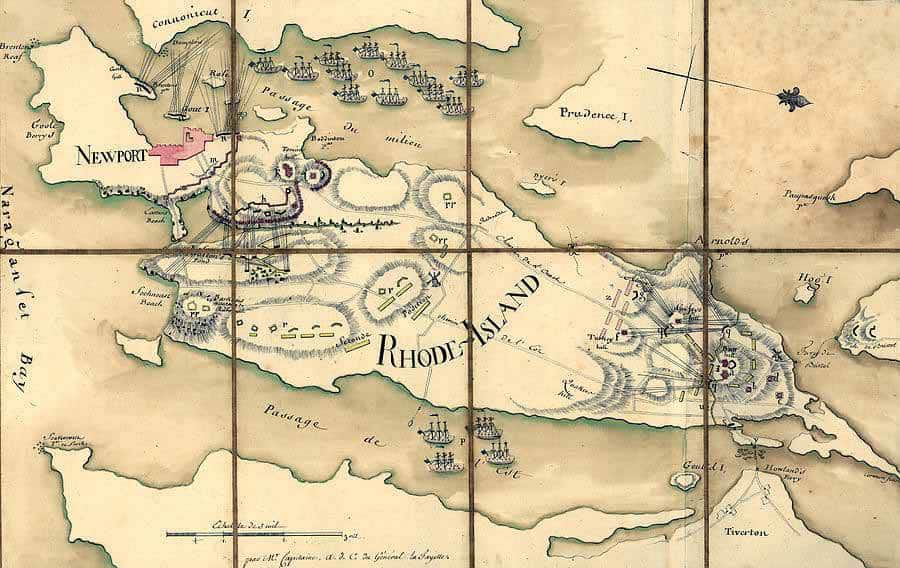 A “Great Storm” that lasted from August 11 to the 13th in 1778[i] disrupted the largest Revolutionary War battle in Rhode Island and changed the course of history, at least for Newport. Named the “Battle of Rhode Island”[ii] or alternatively “Battle of Quaker Hill,”[iii] the storm effectively put an end to the blockade when the supporting French fleet led by Admiral Charles Henri Hector d’Estaing was forced to withdraw to Boston for repairs to its heavily damaged ships, including the dismasting of his flagship.
British and Hessian forces occupying Newport were able to rally, lift the siege of Newport, and force the Colonial Army back to Fort Barton in Tiverton. The battle was a draw, if not a defeat, and Newport remained in British hands until the end of the war when they finally withdrew after looting and burning the city, poisoning wells, and doing what they could to ruin the harbor by skuttling ships. A notable feature of the battle was the colonial troops led by Colonel John Sullivan included one of the rare multiracial regiments with ethnic European troops, many Native Americans, and free black soldiers. The inexperienced and largely untrained regiment inflicted significant losses on the seasoned, brutal Hessian troops.
Major General Marquis de Lafayette[iv] was sent by George Washington to Rhode Island to coordinate the French forces with the colonists trying to drive the British from Newport. After the storm, Lafayette rode hard to Boston to try and convince d’Estaing to return to the blockade. Lafayette was unsuccessful in his mission, and the siege was not sustained. Absent the blockade, British forces marched on the Americans, drove them back, but they were able to accomplish an orderly retreat fighting rear guard skirmishes on Quaker Hill and Turkey Hill until escaping back across the Sakonnet River to the safety of Fort Barton in Tiverton.
Abraham Brown served as a private in the Rhode Island brigade and extended his hospitality to the Marquis. While in Tiverton, Marquis de Lafayette quartered at his home in a guest suite on the second floor. Thereafter, the well-known local Main Road farmstead, built around 1735, was referred to as the Lafayette House and registered as an historic landmark.
“Religion in America… must be regarded as the foremost of the political institutions of that country… I do not know whether all the Americans have a sincere faith in their religion—for who can search the human heart?—but I am certain that they hold it to be indispensable to the maintenance of republican institutions.” Alexis de Tocqueville [v]
In “God of Liberty,” Thomas Kidd’s history of the role of religion in the American Revolution, he documents the remarkable mixture of Christian and Deist faith of the American colonists and Founding Fathers. From Congregationalists, Methodists, Calvinists, Anglicans, Baptists, remnants of Puritans, Baptists and Evangelicals of the “Great Awakening” to Unitarians, Quakers, and Enlightenment Deists like Franklin and Jefferson. Yet within their theological vagaries and variety there remained a common set of values, an agreed understanding and the basis of the culture that enlivened Revolutionary fervor and informed most all Americans about why citizens benefited from and were due human freedom. Freedom to seek their own path, their own faith, their own prosperity, their own life. Freedoms “endowed by their Creator,” and not the capricious largess of monarchs or men.
Kidd wrote “They (shared bonds) vitally bound together Americans of widely differing religious opinions… Common religious public religious values also gave ballast to a new country that badly needed stability.”[vi] These foundational truths were summarized in five principles:
- The disestablishment of state churches.
- A Creator God is the guarantor of fundamental human rights.
- The threat to polity posed by human sinfulness.
- A republic could only be sustained by the virtue of its citizens.
- God (or Providence for the Deists) moved in and through nations.
These five principles undergirded the ‘great experiment’ of which we are downstream. How many still inform us? Is the disunity we are experiencing exacerbated or even caused by our abandonment of that community of shared beliefs and cultural imagination? The answer to that, it seems to me, is self-evident.
“Ruins are the visible symbols and landmarks of our societies and their changes… they expose the omnipresence of death and decay. They are the remains of history.” Andreas Huyssen, Present Pasts[vii]
 David Rose’s family owned the Lafayette House on Main Road for decades along with the adjacent thirty acres. With an ill-maintained home for a long time, David had a problem. He wanted to sell the prime location acreage for possible development, but the Lafayette landmark, now deteriorating, was a hindrance to the asking price of $6.8 million.
Rose applied to the Tiverton Building Department for a demolition permit. Since the house was listed on the Rhode Island Register of Historic Places, he misrepresented the house on the application by checking “No” on the permit to the question about the house having historic relevance. Thus, he expedited his plans and avoided any potential complications and review by the state or Tiverton Historic Preservation Advisory Board. The acting building inspector, who is no longer the acting building inspector, was either complicit or ignorant, let it slide, and signed off. The Town Manager, who is no longer the Town Manager, and the Building Inspector learned from the Town Council, after the dust settled, it was time to move on or retire.
A week before last Christmas in Blitzkrieg, the house was no more. After the first morning it was mostly a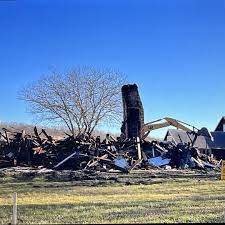 pile of rubble hastened by heavy equipment. By the end of the week, the rubble mostly disappeared, and the foundation hole was leveled over. The shocking effect on many frequent passersby like us was like seeing scorched earth where the garden had been. The Blitzkrieg demolition was not only an architectural loss but a civic betrayal—of truth, of memory, of shared reverence for what came before. Overnight, the beautiful old house on the hill awaiting a conscientious buyer to restore it was no more. Part of our shared history was no more.
“In the West, we have been withdrawing from our tradition-, religion- and even nation-centered cultures… But we are increasingly falling prey to the desperation of meaninglessness, and that is no improvement at all.” Jordan Peterson
With brief reflection most will agree that the five principles described in the “God of Liberty” book are lost, compromised, broken —- reduced to a ruin, its foundation filled and leveled with debris. At least as far as common understanding and shared worldview. Even the concept of virtue is hotly debated, never mind God endowed rights and responsibilities. We live amid the ruins of what was a shared culture. The confusion and conflict that result describes our time. Where does that lead us? What does that leave us?
Disruption and disconcerting events will happen. Suffering will happen. Doubt will happen. Confusion and fear will happen. To everyone, including me. Death will happen, and the existential dread of annihilation haunts us all. Good Fridays will happen to us all.
For me, Easter brings the clarity necessary for me to get up in the morning. As real as Good Friday is in our lives, so is the promise of the Resurrection. God’s answer to our fear, suffering, and bewilderment was not to remove it, to make us automatons without suffering but without our own wills. His answer was in a Person, His own Word, His very self, Who not only joined us, but descended all the way down to godforsakenness.[viii] He experienced everything that destroys us: the hubris of enemies and authority, scapegoating, betrayal, inconceivable violence, hatred, revenge, abandonment, terrible loneliness, loss of every possession and power, humiliation in every possible way, unimaginable pain and cold death nailed naked on a cross.
The Creator of the universe’s response was not vengeance, not retribution, not raining down fire, not destruction, but forgiveness, patience, love, and new life. Death and hatred defeated by love. That our hope is not in conquest or power, but in surrender to a Will beyond our imagination. For us. For me. For you.
And to those who seek assent even to an imperfect faith and seek to understand and be astonished by the enormity, transcendence, and wonder of this gift, everything changes.[ix]
“May nothing disturb you, nothing frighten you. All things pass; God does not leave. Patient endurance attains all things. Whoever has God lacks nothing: God alone is enough.” Teresa of Avila
[i] The “Great Storm” so named by those who suffered through it. It was described as a powerful Nor’easter but given its timing in hurricane season and the state of meteorology at the time, I cannot determine exactly its species. Not all storms were named as we currently obsess with, but this one was. Either way, it laid the area low.
[ii] Here’s a good summary if you have interest in the “Battle of Rhode Island.”
[iii] We live in our modest bungalow on the top of Quaker Hill in Portsmouth where part of the battle took place. Thus, my fascination with the battle. Men died here defending liberty. Perhaps right in our back yard near our bird feeder and daffodils.
[iv] Sidebar: after the war in America Lafayette was an early supporter of the French Revolution but became a critic when the Republican populists of Robespierre unleashed the chaotic terror of the guillotine and tumbrils. A member of the aristocracy, Lafayette fled for his life and survived. Admiral d’Estaing was not so fortunate, and his head was separated from his body by the guillotine. Robespierre, of course, suffered a similar sudden dismasting when his mob turned on him.
[v] Democracy in America, Volume I, Chapter 17
[vi] God of Liberty, Thomas Kidd, Basic Books, a Member of the Perseus Books Group, 2016
[vii][vii] Present Pasts, Andreas Huyssen, Stanford University Press, 2003
[viii] Bishop Robert Barron, Easter reflection, 2025
[ix] George Weigel, Easter Changes Everything, First Things, 2012
 Quo Vadis Blog