
An experiment with an audio narrative of the post. Not my voice. Yet.
“There are some who can live without wild things, and some who cannot. For us of the minority, the opportunity to see geese is more important than television,” Aldo Leopold, A Sand County Almanac
 My waterfowl identification is woefully deficient. At a distance without mechanical aids, I have difficulty discerning white winged scoters from surf scoters from black scoters or at a distance even from scaups or goldeneyes or buffleheads. I guess I need to upgrade my glasses prescription. From a greater distance, the distinction blurs even with the larger common eiders. The winter ocean around this place is full of them, large flocks of various scoters, eiders, buffleheads, and some birder attracting harlequins. And Canadian geese. Many geese.
Large flocks of waterfowl hang out along the Sakonnet River at McCorrie Point, Sandy Point, and Sachuest National Wildlife Refuge, feeding, chatting, floating gently regardless of the vigor or languor of the waves. Up and down, content and rhythmically riding the waves for five thousand years somehow just beyond the break of the surf – a curious reassurance that we can be confident our frantic preoccupations with the current titillation, election, controversy, sensation, or outrage is a momentary distraction.
Suddenly, they will take wing for their own instinctual inexplicable reasons, first two or four or five, then scores on some signal not understood by me, beating furiously to the next feeding range, sometimes across the river to the North Tiverton side and the Seapowet marshes. The energy of their purposeful rapid flight with blurred-fast wings seems exhausting to watch, but they are undeterred.
When they drift closer to the shoreline, it’s endlessly entertaining to see them hunt. Diving with quick graceful, rounded back plops, they vanish for what seems like a long time, only to pop up inevitably ten or fifteen feet away. Often their dives and re-emergences are synchronized. Plop. Plop. Plop. Six or eight or more at a time in family groups, disappearing and reappearing almost simultaneously or in sequence. Pop! Pop! Pop! Up they come like small balls released by the kid holding them under. Could watch them for an hour, guessing where they are going to surface.
Drama is inherent in their existence. Raptors, foxes, and other predators are on the prowl. And others. The wildlife ranger who supervises us volunteers leads a weekly bird walk on the trails of Sachuest Wildlife Refuge along the rocky shoreline. She told us a story from last week’s walk. Duck hunting season just ended on January 26th. Hunting is not permitted on the refuge, but hunters can fill their freezers from boats just offshore so long as they aim away from the land towards the open sea. She has no objection to hunters. That’s part of what wildlife managers manage. But it must be safe and lawful.
Hunting is part of how the balance is managed. Many savor a good Sunday dinner of roasted duck after an overnight soak in rosemary or thyme brine and accompanied by garlic buttered mashed potatoes, sauteed carrots, tomato and cucumber salad, and a nice red cabbage slaw.
On Saturday, she was conducting one of her walks for a couple of dozen curious nature lovers. She took them out near the forty feet of Sachuest Point – the surf pounded cluster of large rocks where the harbor seals sometimes come to sun themselves in the summer.
Two exquisite eiders exploded from the surface of the water, beating their wings frantically, attaining astonishing speed in a few yards. “There goes a pair of eiders,” she exclaimed and pointed. Two shotgun blasts boomed from one of the inflatable low boats. Splash. Splash. With laconic understatement to the shocked onlookers, she calmly concluded the eider lesson. “There were a pair of eiders.”
“One swallow does not make a summer, but one skein of geese, cleaving the murk of a March thaw, is the spring.” Aldo Leopold
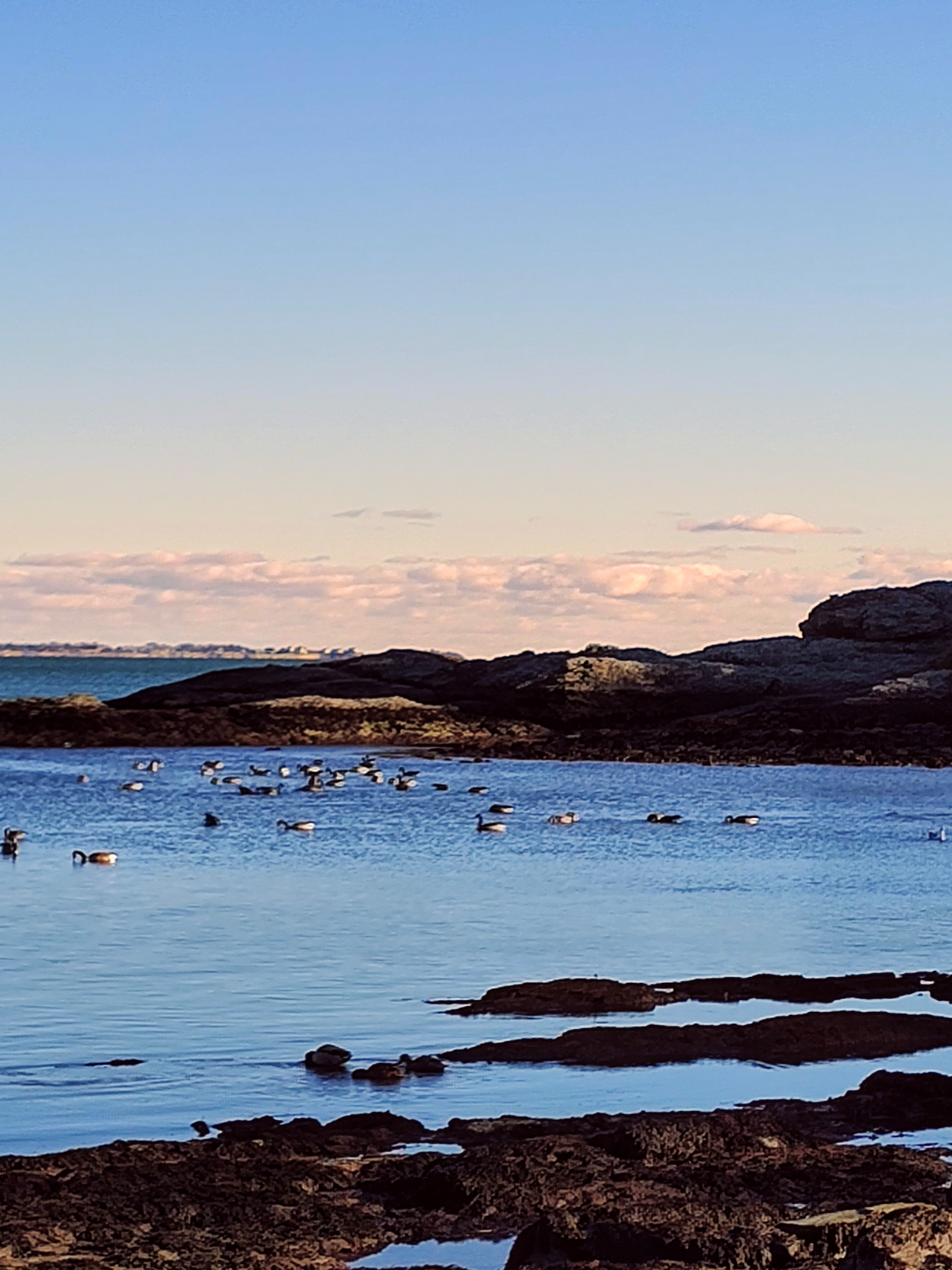 On Aquidneck Island, we don’t have to wait for March to observe the wonder of a flight of Canadian Geese. We do have some visiting migrating flocks passing through to be sure, but hundreds of them overwinter, powerfully cleaving the air with the V formation so easily identified while their unmistakable calls draw our attention overhead – twenty, fifty at a time, filling the sky like B-29s advancing towards the ball bearing factories in Dresden. Only the geese are benign as well as orderly and determined.
We see them grazing in stubbled winter corn fields, in the marshes, scores of them cluster, feed, and socialize. We see them in any open water on both ocean and unfrozen freshwater ponds. They inhabit plowed fields, golf courses, and dormant winter farmland of which we have an abundance. Lingering and foraging for hours with a few sentinels, they guard their young, reconnoiter, and apparently confer with one another; their low distinctive murmuring conversation is incessant. Abruptly, as if by consensus, a group of them take flight.
I always pause and look up when they are on the move in their signature V formation, squawking, changing their order of flight to share the load breaking the wind, heading to someplace of their noisy choosing to seek new food or shelter from the incessant wind or refuge for the night.
Compelling. A spectacle of grace, coherence, and power. A confirmation that somewhere, against all odds, all is right in the universe.
“Our ability to perceive quality in nature begins, as in art, with the pretty. It expands through successive stages of the beautiful to values as yet uncaptured by language.” Aldo Leopold, A Sand County Almanac and Sketches Here and There
 Quo Vadis Blog