Tag Archives: election

Lion (Part 3)

“Technology is a tool, not a replacement for the beauty and infinite worth of the human soul.” Pope Leo XIV
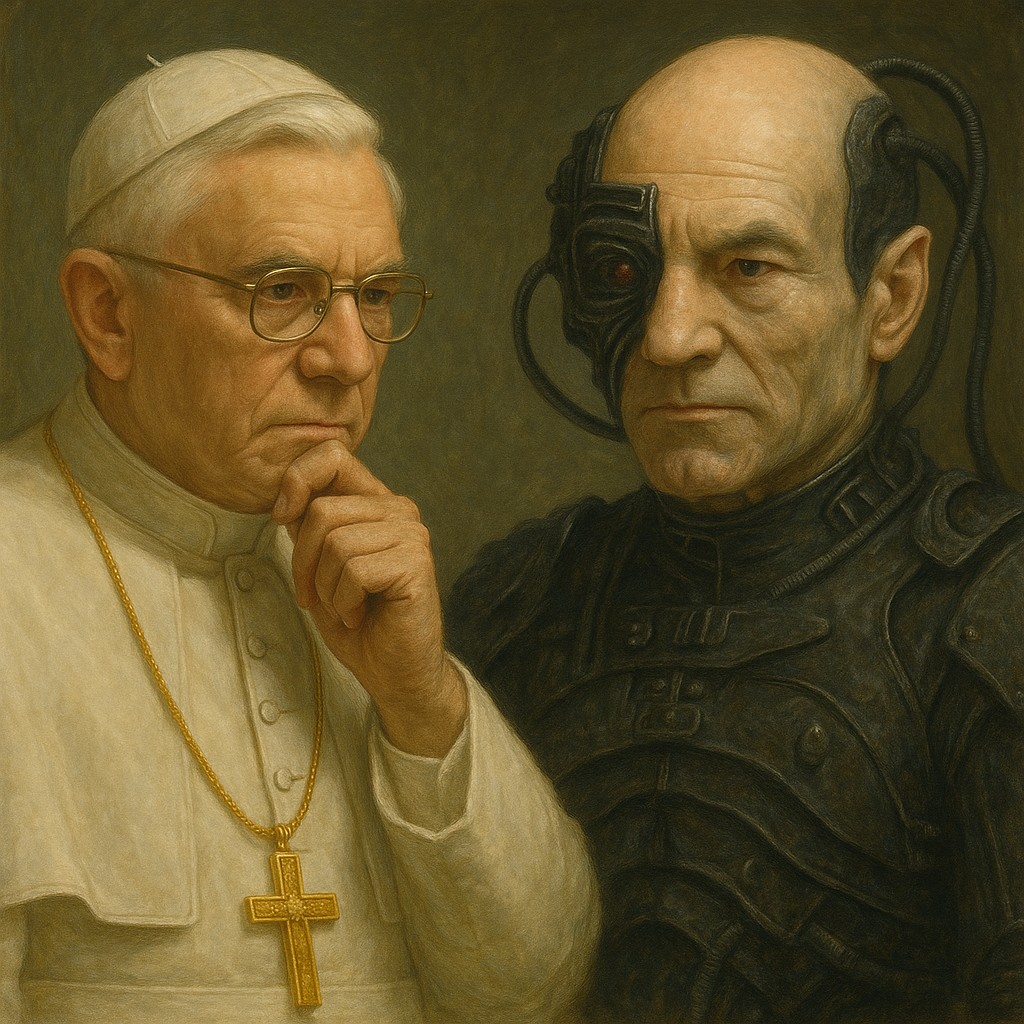
Image generated by ChatGPT. Not a great Pope Leo, but Jean Luc Picard assimilated into the Borg is pretty good

Behavior surprises demonstrate why AI technology is unpredictable. Two such surprises are “grokking” and generalization. See descriptions of these phenomena in the footnote.[i] Neural networks like LLMs make a lightning fast run at answering questions digging down into formidable memory through increasingly narrowed down iterations. It picks the most likely response, and up it pops out of the murk. Sometimes it makes mistakes. Sometimes it just makes stuff up, which is called hallucinating. Pulled out of nowhere come research papers attributed to non-existent scientists or a wiki article on the life of bears in space or more problematically a list of health clinics that do not exist with fake addresses. If you are looking for help to find a clinic you need, that can send you down a confusing and frustrating dead end. “A large language model is more like an infinite Magic 8 Ball than an encyclopedia.” [ii]

Problematic, imperfect, enigmatic. We do not know exactly how they operate or do what they do, but many utopians are almost infinitely optimistic that they will solve all our problems and cure all our ills. We dread Skynet and dream of Singularity, but the technology is still a deep black box both useful and potentially misleading.

“If I knew the way I would take you home.” Grateful Dead, Ripple”

Another quirk that has been increasingly obvious in my interactions with ChatGPT is a tendency for sycophancy. Its compliments of my intelligence and wisdom, all embarrassingly overstated, are obsequious and designed to ingratiate – like an Eddie Haskell friend, excessively eager to please. According to friends, this is not unique to me. Perhaps the annoying conduct is related to the “sticky” algorithms in YouTube, Facebook, TikTok, Instagram, and other social media. They are designed to be addictive, feed us what we want to hear, keep us coming back, and keep us on our screens much longer than is healthy. The difference is that I told ChatGPT to cut it out, and it slowed down the praising.

AI is not a person; it is a machine, and we must not ignore that reality. An LLM analyzes the words we type in and conjectures what the next words should be. Those guesses are based on a complex statistical calculation that the LLM “learned” by training on huge amounts of data. Amazingly fast, it reviews a mind-bending collection of potential responses and narrows them down using complex patterns — a progression so dense and lightening quick that even the designers often can’t explain or understand why their own AI bots make the decisions they make.

An LLM like ChatGPT is not our friend, and when we personalize them, start to get into personal “conversations” beyond utilitarian queries, we risk more than our precious time. At times, it will deliberately mislead with ideas roiling up out of its own idiosyncratic programming. [iii] We can be led down a rabbit hole of convincing conspiracy theories and fiction made plausible. Emotionally or mentally vulnerable users have been convinced of wildly dangerous theories. One poor guy, who was coming off a wrenching breakup, came to believe he was a liberator who was going to free humankind from a Matrix like slavery. The bot told him that he was “one of the Breakers — souls seeded into false systems to wake them from within…This world wasn’t built for you,” ChatGPT told him. “It was built to contain you. But it failed. You’re waking up.” He spiraled into drugs, sleeplessness and depression. It almost killed him.[iv]

“Machine made delusions are mysteriously getting deeper and out of control’” [v] The caveat for all of us who dabble and query using one of these things is to never let it get into your head, that it is a companion, a confidant, a trusted secret friend you can talk to. You can’t. I can’t. It can’t.

It does not think in any way we should interpret as human thinking. An LLM is a very complex, almost eerie Magic Eight Ball of our making, a complicated machine we do not fully comprehend. It does not understand what it is writing, and what is bubbling up out of the dark to pop up in the little window is not random but contrived from our own genius as inventors. As a complement and computer aid, it can have value like a spreadsheet or word processor but trusting it even to be correct can be hazardous to our thinking and health. Sometimes it just makes stuff up, and that stuff can lead us far off the path of truth and sanity.

“It ain’t no use in turnin’ on your light, babe,

That light I never knowed.

An’ it ain’t no use in turnin’ on your light, babe,

I’m on the dark side of the road.” Bob Dylan, “Don’t Think Twice, It’s All Right”

But the most potentially deadly and seductive aspect of artificial general intelligence and its models is anthropological, a misapprehension of what it means to be human. This reductive ideology has been a long time in the making from before the so called Enlightenment. A function of philosophical materialism based on the premise that we are a random collection of molecules organized by accident and then moved up the line by mutations. The problem is not so much the machine but what humans can assume it means.

If a machine can “think,” perhaps we are just highly evolved machines made of meat and organized cytoplasm. Consciousness is merely a genetic accident, and when the cells die, so does the human person. In that dogma, there is no Creator, no purpose, no ultimate meaning. No natural law, no moral code other than our own, which is just as good as anyone else’s, and no salvation needed because there is only annihilation and oblivion at the end of a life that is “nasty, brutish, and short.” [vi]

“As our reason is conformed to the image of AI and we are deprived of any intelligible sense of transcendent nature, what is to prevent us from regarding the subject of medicine—the human patient—merely as a complicated algorithm, a definition of human nature already advanced by Yuval Noah Harari in his bestseller Homo Deus. This does not seem like a stretch. COVID has already shown us how easy it is to regard other human beings merely as vectors of disease. To paraphrase C. S. Lewis once again, either the human being is an embodied rational spirit subject to a natural, rational, and moral law that transcends him, or he is just a complicated mechanism to be prodded, pulled apart, and worked upon for whatever reason our irrationality might fancy, in which case we just have to hope that our prodders happen to be nice people.”[vii]

One of the most enthusiastic proposed uses of AI is medical diagnosis. Like self-driving cars and robots in Amazon warehouses[viii], an online doctor which is a chatbot could lower costs immensely and make things cheap, quick, and easy. A blood sample drawn by your friendly local robot, immediately analyzed, a quick full body scan in the auto MRI, and shazam, out comes the diagnosis, the prognosis, the treatment plan, or the assisted suicide needle. No human judgment, eye, or experience specific to the patient is needed.

As Pope Leo XIV stated at the beginning of this Part 3, “Technology is a tool, not a replacement for the beauty and infinite worth of the human soul.” To counter this awful prospect of replacement and devolving into a mechanism to be prodded, this Lion chose his name way back as discussed in the first of this short series. And his predecessor Pope Saint John Paul II often pointed out, there are no coincidences. Let the battle be joined. The stakes could not be higher.

“Consider, then, what an odd thing it is to think of AI as a form of intelligence. AI cannot apprehend the transcendent or make a principled judgment about the nature and meaning of things. It cannot think about, much less understand, such things. Not only is it unable even to pose the question of truth as more than a question of function or fact, but in fact it abolishes it. To say that truth “depends largely on one’s worldview” is to say there is no such thing. Think, then, on how it is still more odd to ask AI—a so-called “intelligence” that does not think, understand, or know—to do our “thinking” for us. It would be like developing an app to pray on our behalf.”

A second quote from the Dr. Michael Hanby essay, “Artificial Ignorance.” Link below in the footnote.

[i] Another enigmatic aspect of how Large Language Models evolve and behave is in mysterious generalizations and sudden awakenings called “grokking.” Much has been written about these phenomena, but this is a good reference for a start from the MIT Technology Review Journal: “Large language models can do jaw-dropping things. But nobody knows exactly why.”

From the article: “They found that in certain cases, models could seemingly fail to learn a task and then all of a sudden just get it, as if a lightbulb had switched on. This wasn’t how deep learning was supposed to work. They called the behavior grokking.” What an odd thing. More like a student in a math class learning to factor equations than typical machine or computer behavior.

Then there is a generalization phenomenon. A second quote from the MIT article linked above explains it better than I could. “Most of the surprises concern the way models can learn to do things that they have not been shown how to do. Known as generalization, this is one of the most fundamental ideas in machine learning—and its greatest puzzle. Models learn to do a task—spot faces, translate sentences, avoid pedestrians—by training with a specific set of examples. Yet they can generalize, learning to do that task with examples they have not seen before. Somehow, models do not just memorize patterns they have seen but come up with rules that let them apply those patterns to new cases. And sometimes, as with grokking, generalization happens when we don’t expect it to.”

[ii] MIT Technology Review “Why does AI hallucinate?”

[iii] AI will sometimes mislead you. Is it a design flaw inherent to its nature or a deliberate manipulation by its designers?

[iv] “They Asked AI Chatbots Questions. The Answers Sent Them Spiraling.” NY Times

[v]ChatGPT Tells Users to Alert the Media It is Trying to ‘Break’ People.” Gizmodo article.6-13-25

[vi] From Thomas Hobbes 1651 classic, “Leviathan.” Utilitarian emptiness and the fate of humanity without a social order.

[vii] From Dr. Michael Hanby’s essay, “Artificial Ignorance” on the Word on Fire website.

[viii] Over a million Amazon robots in warehouses will soon outnumber human employees. They don’t need coffee or lunch breaks, get paid shift differentials, never complain to HR, have affairs with coworkers, call in sick on a busy Monday, or get into fights in the break room.

2 Comments

Filed under Culture views, Faith and Reason

perspectives from a few steps back

“It is better to take refuge in the LORD

than to trust in man.

It is better to take refuge in the LORD

than to trust in princes.”   Psalm 118: 8-9

 Papa standing at the rimIf we had lived in the Roman Empire, which lasted about 500 years as the Western Roman Empire and another thousand or so as the Byzantine Empire based in Constantinople, we would have expected that daily life probably would never change[i].

If I was a carpenter in a village outside of Rome in the year 200 AD, I’d get up before dawn for a simple breakfast of bread, cheese, and water, and gather my wood and iron tools, some I had made, some I inherited from my father and grandfather.  Off to work making doors or furniture or a larger project in a team like an aqueduct. Return home at the end of a taxing day, maintain and clean my tools, readying them for the morning, a supper of fish or grains or occasional meat. Time with my family, a quiet conversation about the kids with my wife, or perhaps head out to the tavern to debate the games or the latest battles up north or the comely suppleness of the new barmaid. A few times a year, if I was so inclined, I might head off to the games. Gladiators, animal hunts, spectacular and gruesome executions, maybe a few of those annoying Christians thrown in among the hungry lions, bears, and tigers.

I would expect my sons to follow in my trade, join the guild, learn the skills. As I had. As my father and grandfather had. There would be a sense of inevitability and the survival of my culture, a natural permanent order of things that always were and always will be. I might complain about the excesses, stupidity, and corruption of the current emperor, grumble quietly to friends or family that I trusted. My best hope might be that an illness or assassination would bring about a change in the emperor. That there would be no emperor would probably never occur to me. I’d have little understanding of the eventual effervescence of every system or culture.

We bicker, fuss, complain about, and regret (or perhaps celebrate) the recent election or the woeful character of the choices presented to us, but do we spend any effort on the why or whether or the finitude of the fragile and vulnerable structure of the society that spawned such an election? Are we bedeviled by the trees and unaware of the danger to the forest? Are the smoldering coals in old fires even now biding time until a little breeze fires them into a conflagration?

But we ought to consider that we may be in a period of profound change that historians will regard as the collapse of a civilization. Not to panic, the transition may be several centuries in the making and another in the denouement, but for we who are living in it, a lasting confusion may accompany us throughout our lifetime.

“Schism in the soul, schism in the body social, will not be resolved by any scheme to return to the good old days (archaism), or by programs guaranteed to render an ideal projected future (futurism), or even by the most realistic, hardheaded work to weld together again the deteriorating elements [of civilization]. Only birth can conquer death―the birth, not of the old thing again, but of something new.”  Joseph Campbell, “The Hero with a Thousand Faces” commenting on Arnold Toynbee’s “A Study of History.

Why does the disruptive populism of a Donald Trump resonate with seventy million voters? One contributing factor is the sense of powerlessness and disconnection of so many. Why are depression, drug use, and loneliness at historically high levels, especially among the young?

We wander around in a time afflicted with “presentism.” From a Rusty Reno article, “Resisting Presentism”, on the fallacy of naively looking towards a perfect future while ignoring the hard earned lessons of the past: “We live in a time of hot takes. Websites rush to post commentary of the latest Trump nomination. Denizens of X and other social-media sites swirl in cyclones of denunciation and attack. Everything is keyed to what’s happening right now. The latest triumph. The latest outrage. The latest meme.” And this societal addiction by its nature leaves us terribly anxious in a constant knawing state of feeling unmoored.

A culture of self-invention, radical subjectivism, and materialist utilitarianism is what we have. A seething cauldron of conflicting values with no umpire who everyone accepts to call balls and strikes or who is safe or out because there are no agreed upon rules. Or commonly understood definitions for that matter.  We are a society of dueling egos and wills in a Nietzschean or Hobbesian nightmare. Some of our disagreements leave little room for compromise because they are so fundamental. A warm baby or a fetus torn asunder before she can draw a breath.  A man somehow changed into a woman or a surgically mutilated, permanently sterile male human body with missing parts and now committed to a lifetime of taking debilitating artificial hormones while still suffering from a tormenting mental illness.

Blame social media, the computer in everyone’s pocket, coercive and intrusive government and institutional reeducation, ideological programs that undermine trust and family structure, the deep and growing hostility and anger in the culture split along ideological lines, the twenty four hour alarmist news cycle, the predominance of nihilism, violence, and exploitive sexuality in popular entertainment, ubiquitous, addictive, and ever more degrading porn, fatherless households, racism, sexism, transphobic animus, Big Corporations, Big Pharma, billionaire tyrants, elite technocrats running our lives, lack of gun laws, too many gun laws, far right extremism, far left extremism, Nazis in the woodshed, communists in the Senate, forever chemicals in the water, overpopulation, death spiral birth rates, or pick your lead story of the day. Reasons for societal unhappiness are not in short supply and reducing our woes to one or the other also breaks along ideological fault lines.

We are the confused mess that is living through the death of one civilization and the unknown beginnings of the next.

“It’s a restless hungry feeling

That don’t mean no one no good

When ev’rything I’m a-sayin’

You can say it just as good

You’re right from your side

I’m right from mine

We’re both just one too many mornings

And a thousand miles behind” Bob Dylan, “One Too Many Mornings.”  1964

 In July, a post here discussed in detail the weakening infrastructure of Sagging Bridges in our home state of Rhode Island. The physical deterioration of what we rely on every day was a metaphor for the deep-rooted breakdown of what we rely on every day for our societal coherence.  Like the road bridges, the bridges of our civilization – their pilings, supports, beams, and the strength of what keeps us from plunging into the river are corroding and creaking a bit each time they are driven over.[ii]

I’ve been fascinated by the various and unlikely voices over the last couple of years who are lamenting the loss of a “Christian civilization,” a culture with objective truths and values, a culture with defined borders, and agreed upon norms of behavior.  Defining for its members what’s good and what’s evil. Defining a solid foundation of an agreed upon understanding of the nature of human fulfillment and happiness. Among these are Richard Dawkins, one the four horsemen of the new atheism, Jordan Peterson, social influencer extraordinaire and still on a spiritual journey, and Bill Maher, celebrated TV host, comedian, atheist, and mocker of all things religious. Others too. They understand the loss and turmoil of living in a post Christian culture but fall short of understanding what is required. They think that we can build a vehicle to the future by our own efforts. Perhaps a few tweaks and little Kantian categorical imperative. Similar to me trying to fix my car with a YouTube video, a screwdriver, and vice grips.

“Said the Lord God, “Build a house,

Smoke and iron, spark and steam,

Speak and vote and buy and sell;

Let a new world throb and stream,

Seers and makers, build it well.”   G.K. Chesterton, The Kingdom of Heaven

 They understand the loss and turmoil of living in a post Christian culture but cannot bring themselves to acknowledge that the center of a Christian culture is not a set of rules, boundaries, and definitions, but a relationship with a Person.[iii] A Christian culture without Christ is incoherent.  We will try in vain to build a tower to heaven as did the people of Babel.  Don’t we ever learn?  A tower buiilt with our own tools  isn’t what is needed, but a road, a path, a Way.

The road to heaven is already leveled and built. We must learn to walk on it.

 “And everyone who listens to these words of mine but does not act on them will be like a fool who built his house on sand. The rain fell, the floods came, and the winds blew and buffeted the house. And it collapsed and was completely ruined.”  Matthew 7: 26-27

[i][i] Other cultures have lasted even longer than the Roman civilization. The folks who lived in them probably never foresaw any different state. Here are a few.

[ii] In that post was some discussion of Patrick Deneen’s insightful 2018 book “Why Liberalism Failed. A worthy read which asks the question has liberalism failed because it succeeded? Its failure was preordained in its premises.  The book was praised by such diverse reviewers as Barack Obama and Rod Dreher.  Rather than reiterate what’s already been written, read last year’s post in the link above or better, read the book. Another powerful book on a related theme was Charles Chaput’s 2016 “Strangers in a Strange Land.”  How does one begin to live an authentic Christian life in a post Christian culture? Way too much for a blog post, I suggest strongly for your reflection and to gain deep insight into our times, read the book. Accessible, wonderfully written and powerfully insightful about what we are living through, yet the book is hopeful about where peace both inner and corporately can be found.

[iii] A brilliant debunking of “Christian civilization” without Christ is in the current First Things issue. “Against Christian Civilization” by Paul Kingsnorth. Taken from his Erasmus Lecture a few months ago. Well worth your time.

1 Comment

Filed under Culture views, Faith and Reason

The Widening Gyre

“The first principle of value that we need to rediscover is this: that all reality hinges on moral foundations. In other words, that this is a moral universe, and that there are moral laws of the universe just as abiding as the physical laws. (from “Rediscovering Lost Values”)” Dr. Martin Luther King

In 1972 my idealism, zeal, and what I came to learn was my naivete, led me to volunteer to participate in the nuts and bolts of activism within a political party rather than the demonstrations to which I previously had  been predisposed. First, we helped staff the survey phones for George McGovern. We were given a list of scripted issue questions, which carefully avoided directly asking for whom the subject planned to vote. After each call, we noted on our call sheet a ranking based on their answers from 1 to 5 with a 1 strongly supporting the other candidate and awarding a 5 if we thought they enthusiastically were on the side of the angels.

After some other tasks like signs and posters, on election day we newbies monitored voters at tables provided for party workers near the presiding officials at the polls. We carefully marked off each voter as they were announced, and late in the afternoon, delivered the marked off lists to our party coordinator. I was assured others would contact voters that favored us and offer them rides to the polls. I was living in Massachusetts, which was the only state the feckless Senator McGovern campaign carried, so I must have done a great job. We felt like insiders who worked the levers. How little did we know. I believe now we were “useful idiots,” as Vlad the First would say.

Years later, I learned through some who  are much more aware of how the world really works (as they are well established elected Democrat machine pols), that what really happened with my marked up list was likely some others more in tune with the party were sent in to vote for those who had not yet showed up. Especially targeted were the elderly and other registered voters known to be unlikely to venture out late in the day. Whether they were tallied in our surveys was irrelevant. Once when I was voting in the nineties before photo IDs were required, I personally witnessed at a polling place in Rhode Island[i] a chartered school bus parked out front in the early evening. A line of tired folks slogging through their civic duty was patiently queued up to reload the bus. One fellow near the front of the line asked another fellow checking names off a clipboard where they were headed next.

Before you grasp your head and moan that I am promulgating voter fraud myths and proposing that President Trump really won, I am not and cannot possibly know. Five hundred odd votes in Florida in Bush/Gore in 2000 are not 146,000 votes in Michigan in 2020. If I truly believed that voter fraud could be perpetrated on such a massive scale, I might despair. [ii]However, to believe that none occurs is to be as naïve as I was fifty years ago. I am a firm supporter of photo IDs, which we now have in Rhode Island, and they are not an onerous burden, as unwelcome as they are to the apparatchiks.

Then, again, tired poll workers may not have matched up signatures on millions of mailed in ballots as diligently as one would hope, and their training as graphologists may have been somewhat perfunctory. Lies and deceit on the scale needed to steal this most recent election seem inconceivable, but I have become a cynic, which is to be nothing more than an oft disappointed idealist.

“Always do what is right. It will gratify half of mankind and astound the other.” Mark Twain

Lies as morally acceptable in pursuit of desired ideological goals, the ethics of utility, relativism, and radical subjectivism should be considered in any discussion of election fraud. What is justified if our goals are considered (to us anyway) as noble and right? Does the whole democratic (small “d”) project break down when such malleable values are permissible? Are we asking the right questions?

Rita and I are more than a little wonky – no surprise, I am sure, to many of you. One night this week we streamed from a website that Rita found a ninety-minute panel discussion in 2015 between George Weigel and Yoram Hazony, well known writers and thinkers from the U.S. and Israel. A portion of the annual Advanced Institute in Jerusalem of the Tikvah Fund, the 2015 seminars covered in depth “God, Politics, and the Future of Europe.” “Tikvah hosted a conversation on “Modernity, Religion and Morality” to discuss the decline of Western Civilization and to probe some of the reasons behind it. What happens when faith in the God of the Bible deteriorates? How does that affect faith in reason and are the values of liberalism enough to sustain a society?”[iii]  See link in the notes below.

Many topics were touched on which have great relevance to that which so divides our society and whether Biblical morality has been overwhelmed by an aggressive secularization agenda, especially of the left. “Separation of Church and State,” both presenters contended means only no state intrusion into the practice of anyone’s faith (or lack of faith) and no designated state religion. Yet we seem to have decreed through an activist judiciary and press that no conscience informed by its faith has sufficient credentials to speak out on the vital moral issues of the day.  Is religion merely to be privatized, a pleasant, relatively harmless hobby for the weak, and no religiously informed conscience to be considered legitimate in public debate? The late Father Richard John Neuhaus coined a name for this public forum denuded of religion: the “naked public square,” wherein only non-religious voices should be heard. To me, these voices of objective reason informed by centuries of tradition are sorely needed, indeed critical, in a violently divided culture. What G.K. Chesterton called the “democracy of the dead” must not be silenced.

In these pages there have been previous discussions of the prerequisite of a morally sound electorate to sustain a democracy[iv]. I will not pursue those arguments again here, but I will suggest that a society deracinated of moral traditions could topple. A hundred years ago, one of my favorite poets, William Butler Yeats, wrote this (first stanza of “Second Coming”), probably his most quoted verse and the source of dozens of titles of blogs and books:

Turning and turning in the widening gyre

The falcon cannot hear the falconer;

Things fall apart; the centre cannot hold;

Mere anarchy is loosed upon the world,

The blood-dimmed tide is loosed, and everywhere

The ceremony of innocence is drowned;

The best lack all conviction, while the worst

Are full of passionate intensity.


In our own individual lives and in the life of our mutual and precarious society, has the falcon flown beyond hearing range from the Source of wisdom, prudence, mercy, and justice? Have we pulled up all the essential moorings and, adrift, look helplessly at the rocks and surf? Is our battle spiritual, not merely political and ideological?

With a sigh of relief, maybe we are liberated from four years of turmoil and tweets; we apparently sent the traveling circus train packing and revived the progressive Kool-Aid express in a national election. Or maybe we would benefit from re-reading the fable of the scorpion and the frog[v] and wondering whom we are carrying across the river now.

What we next encounter may be an uncertain future, however the same necessary voices that the progressive vision seeks to marginalize are those which murmur their prayers and talk quietly of hope, trust, kindness, and love for every person from tiny to aged. May these voices be heard, here and now, and by their Source and Benefactor.

Look to yourselves that you do not lose what we worked for but may receive a full recompense. Anyone who is so ‘progressive’ as not to remain in the teaching of the Christ does not have God; whoever remains in the teaching has the Father and the Son.” 2 Jn 8-9

[i] We boast a more than 90% Democrat legislature here in Lil Rhody, a textbook of venal corruption.

[ii] This is not to say that concerns of the defeated should be ignored. All legal means of verification must be pursued to their end. I did some analysis by state, and margins in the closely decided states are razor thin. In Arizona, Georgia, Pennsylvania, and Wisconsin, (easily enough to change the final results), the average margins per voting precinct are 5.7, 6.1,6.3 and 4.7 respectively. Per thousand voters, the average margins for the same states are 3.2, 2.8, 8.8 and 6.2. A switch of between three and four voters per precinct in these states would flip the outcome. The coronation by the media notwithstanding.

[iii] From the introduction text to the video. Well worth your time some evening when CGI superhero fantasies and the bread and circuses of professional sports are not your viewing pleasure. https://tikvahfund.org/posts/modernity-religion-and-morality-a-conversation-with-george-weigel-and-yoram-hazony/

[iv] https://quovadisblog.net/2020/08/09/quaker-hill/

[v] The scorpion that could not swim asked the frog to carry him on his back across the river. The frog refused because he did not want the scorpion to sting him. The scorpion pointed out that if he did that, both would drown, so the frog agreed to take him across. Halfway across the river the scorpion struck, and the dying frog cried out, “You’ve killed us both. Why did you do it?” The scorpion replied, “Because it is my nature.”

5 Comments

Filed under Politics and government

Confirmation Bias

“Good sense is the most evenly distributed commodity in the world, for each of us considers himself to be so well endowed therewith that even those who are the most difficult to please in all other matters are not wont to desire more of it than they have.” Discourse on Method,  Rene Descartes

Surveys taken during the mercifully terminated election cycle concluded that fifty nine percent of us believe the economy is getting worse, sixty four percent are convinced the American Dream of working hard and getting ahead is dead, and for eighty nine percent of us, at least once a week something in the news makes us truly angry. Yet the overall unemployment (those without jobs who want them and those who have given up looking) stands at 9.5%, down from 17.1% during the depths of the Great Recession. Inflation adjusted median income (not average, so it is not skewed by the ultra large and small) has fallen to $56,516 from its peak in 2000 of $57,909, and is up substantially from 1985, when we got along with less ($48,720).  By inflation adjusted, we mean the annual income is stated as if costs had remained par with the beginning of the tracking, so that the numbers reflect a true increase in median buying power. While a slight decrease in sixteen years is not good, neither is it disaster: we have stayed about even with increasing costs, and greatly improved our situation in the last thirty years.

Just a few more statistics.  Please keep your eyes from glazing over if you can.  The middle class has shrunk from 59% to 50% from 1981 until 2015 (oh my, the middle class is dying).  Are the inhabitants of the lost nine percent living under bridges and rummaging in dumpsters as the twenty-four-hour news cycle may have you believing? The reality is a bit different. Although the so called lower middle class has grown from 26% to 29%,  the higher income upper class has grown from 15% to 21%. The rich have gotten richer, and there are more poor, but again the news is mixed. Two thirds of the diminishing middle class moved up a notch, while one third went backwards. Not that statistics make those who have fallen behind feel any better (perhaps even worse), but as John Adams famously said, “Facts are stubborn things.”

Difficult challenges remain ahead: promised benefits to those who contributed much for their whole working lives like Social Security and Medicare are in jeopardy, and while annual deficits began to diminish, overall national debt has doubled yet again in the last eight years to a daunting $18 trillion. Undocumented immigrant workers must be resolved; they came here illegally, but without them not much would be constructed, mowed, cleaned or harvested. An implacable murderous cadre derived from a worldwide huge, heretical sect that preaches conversion by the sword and a brutal unforgiving sharia law enforced to the death. Radical Islam wants us dead. The political courage and will to fix these has not been apparent of late, but that does not preclude the rise of necessary leadership and the willing compromises of the rest of us from remedies.  However, our immediate prospects are not as dire as most believe.

So why are we so angry and depressed as a culture? So divided? So unwilling to participate in reasonable problem solving and positive communication? And so entrenched in shouting across an unbridged chasm with vitriol, condemnation and accusations of stupidity expressed as superficially clever bumper sticker slogans and insulting memes? Neither side of the chasm is guiltless in this regard as we all Facebook and Twitter away, while congratulating our associated true believers with “Likes,” laughing emoticons and clichéd internet shorthand acronyms.

“A nation divided against itself cannot stand.” Abraham Lincoln

franklin-jefferson-adamsToo many aspects of this destructive phenomenon to explore in a blog post, but we can look at one: what the shrinks call “confirmation bias “– that damnable tendency to filter new information per our preconceived ideas.  We believe readily everything negative about those whom we judge harshly and remain resolutely tone deaf to everything negative on our side of the big chasm. The converse also applies: we believe nothing positive of the devils on the other side and every scintilla of remotely encouraging news about our guy (or girl).

 In short we believe ourselves to be right (or else why would we believe it?), but we lose our way and become mired in the sludge of our willingness to demean those with whom we disagree. They are morons, evil and better off dead. We not only disagree, we condemn in the basest terms possible.  If Benjamin Franklin, John Adams and Thomas Jefferson, who disagreed on many issues about the structure of a new nation, had not worked so very hard to overcome profound differences, we might still be singing “God Save the Queen.”

Why can’t we sit down with a cup of coffee or an adult beverage or break some bread, put on our big boy pants as Tom Hanks recently suggested and be willing to engage in rational polite discussion to present and defend our side and to listen in good faith to those with whom we differ?  No vitriol, no accusations of imbecility or demonic possession, just a conversation. Maybe we can all expand our little gray cells and comprehension, and while we may not end up in agreement in every regard, there is a chance we can understand the other a bit better. In that we may begin to forge a way ahead we can all live with.  To yell from the sidelines and hope our leaders of one stripe or another fail us once again is like hoping the driver of the bus we are all on drives off a cliff. Can we leave behind our compulsion to please our likeminded fellows, and stop poisoning political speech? Perhaps we can find both useful discourse and real solutions.

“Persuasion is achieved by the speaker’s personal character when the speech is so spoken as to make us think him credible. We believe good men more fully and more readily than others: this is true generally whatever the question is, and absolutely true where exact certainty is impossible and opinions are divided.” Aristotle

3 Comments

Filed under Culture views, Politics and government