Tag Archives: jesus

Afterward

  Ed died a couple of weeks ago. We went to his funeral, incongruously in the stately beauty of St. Mary Church in Newport where the Camelot Kennedys were married. Regular readers have met Ed here in another post. He was the gentle and once suffering soul who lived in an unmaintained mobile home with filthy floors, smoked too much, could barely clear the couch in his hovel to get to the bathroom, and took in homeless people just a click worse off than he was. He slept fitfully on his sagging couch with disheveled gray blankets of an indistinguishable original color, and his guests slept in his bed.

   Later he was moved against his will to a nursing home when pneumonia and advancing neuropathy and Parkinson’s took him down. The ambulance brought him to the hospital, and they wouldn’t let him go home again. We continued to bring him the Eucharist on Sundays after Mass there and celebrate a brief liturgy. It wasn’t a bad place as such places go, and the staff was kind. He was always astonishingly attentive and grateful and reverent with the Blessed Sacrament.

   I took him on an outing one morning in late September after he had recovered somehow from a bout with COVID. He was officially in hospice, but the nurse said I could take him out if I promised to bring him back as soon as he got tired. He could no longer walk, but the nurse helped me move him into the car from the wheelchair. His frail body weighed about as much as my twelve year old granddaughter.

  I had hoped we could go in the chair to a bench overlooking Second Beach outside the Sachuest Point Wildlife Refuge Visitor Center where we volunteer on Fridays. He once loved to walk the trails there when he could. Now even the move in a wheelchair to the bench was beyond him. So, we remained in the car and talked and just sat. Then we drove a couple of miles to Sweetberry Farm, drank coffee, and ate blueberry muffins from their small bakery there. We parked overlooking the orchard and fields and distant hills next to the tall hydrangeas. He most wanted to lower the windows and examine more closely the blooms on the hydrangeas. He was content to sit in silence and contemplate the flowers until he asked quietly if we could go back to his shared room so he could take a nap in his bed.  

“When they heard the sound of the Lord God walking about the garden in the breezy part of the day..” from Genesis 3

  Adam and Eve hid from God because they were afraid and ashamed, though they had never been that before they listened to the snake. They ate the fruit of the tree of good and evil, which was the only fruit of all the delightful trees in the garden from which they had been forbidden. Even though they were completely happy, they wanted more even though they had been warned it would ruin them. They wanted to become like God, to be God, and we still do strive to be so. In doing so, we struggle, fail, alienate ourselves from God and from one another; hurt ourselves and others. We want to be God, but we’re not and cannot be.

  But we are given a lovely image, a glimpse before the Fall when the Lord God walked about the garden in the breezy part of the day. Adam and Eve could join Him, talk with Him about all that is wonderful, laugh with Him, take in the incomprehensible beauty of the garden, of all God had made for us to enjoy, to be utterly joyful within.

  Now, this little bit of anthropomorphizing God is metaphor. We have no idea what before or after are.

  We have been told that whatever comes after our earthly heart stops and our brain stills will be more than we can ‘ask or imagine,’ but we cannot know what the beatific vision will be like. We have been told that there is more than dying and returning to the earth – dust to dust. More than ‘that’s all folks.’ More than a final corruption.

  We have been promised a new body that will last forever, a spiritual body, but not a spirit alone. We won’t be angels. Angels are a different order of creatures. We will be human beings with bodies as we were created from the earth, but in the image of God. Like Jesus, we will be resurrected as He promised for us. We will be ensouled but also embodied. A perfected body in the presence of God. Without disappointment or fear or pain. The breath of God will be within us.

  I dreamed last night. Ed was there. We somehow slid down along the stair walls together in a circular rotunda, very fast, laughing like fools, nearly flying. At the bottom I walked down a well-lit whisper quiet institutional corridor with light tan Formica walls with a pleasing design and matching Formica countertops until I came to a doorway and entered a small room with a desk. Ed was in the room helping an older lady write a letter she needed to petition some authority for help. He was happy to be her companion and aid. He looked up at me and smiled. I woke up.

  My imaginings of heaven are woefully inadequate, but I hope there are little houses in neighborhoods of friends that I love and with whom I am completely affable. Laughter is often heard. We share leisurely conversations about all things that are beautiful with lots of comfortable pauses to enjoy the evening breeze. And there is a yard with a garden to work in until it is green and pleasant and orderly with healthy shade trees, oaks, maples, and birch, perhaps there is a hammock looking up into one of them through the branches into a bright blue sky and billowing clouds, and hydrangeas to prune when I want.

   In the evening when the sea breeze comes up, maybe a walk in the vineyard overlooking the beach with my Lord talking softly or merely silent in sublime company and nothing needs to be said. Blissfully leg weary at the end of the day accomplishing fruitful things in the garden with my well worked hands leaves me pleasantly tired from a day well spent.

  Although Jesus told us that there will be no marriage in Heaven, deep friendships will persist. I like to think I’ll still be able to spoon sleepily with my dearest friend, Rita, with her hair that smells like spring. I like to fall asleep at night. In heaven I hope to fall instantly asleep and dream the unfettered joyful dreams of the redeemed.

“He who dwells in the shelter of the Most High and abides in the shadow of the Almighty says to the Lord: My refuge, my stronghold, my God in Whom I trust” Psalm 91 and the beginning of Sunday Night Prayer in the Liturgy of the Hours.
3 Comments

Filed under Faith and Reason

perspectives from a few steps back

“It is better to take refuge in the LORD

than to trust in man.

It is better to take refuge in the LORD

than to trust in princes.”   Psalm 118: 8-9

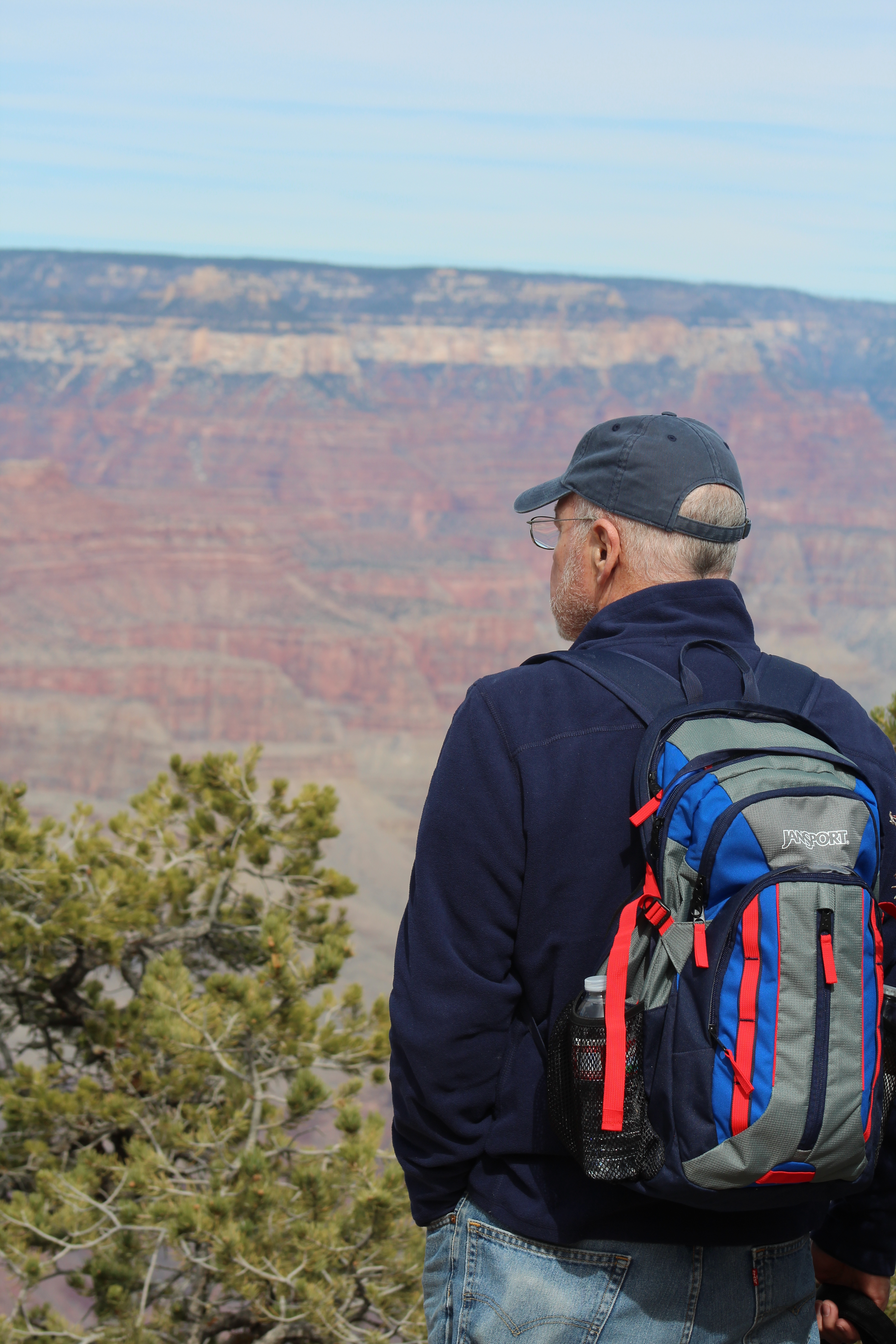
 Papa standing at the rimIf we had lived in the Roman Empire, which lasted about 500 years as the Western Roman Empire and another thousand or so as the Byzantine Empire based in Constantinople, we would have expected that daily life probably would never change[i].

If I was a carpenter in a village outside of Rome in the year 200 AD, I’d get up before dawn for a simple breakfast of bread, cheese, and water, and gather my wood and iron tools, some I had made, some I inherited from my father and grandfather.  Off to work making doors or furniture or a larger project in a team like an aqueduct. Return home at the end of a taxing day, maintain and clean my tools, readying them for the morning, a supper of fish or grains or occasional meat. Time with my family, a quiet conversation about the kids with my wife, or perhaps head out to the tavern to debate the games or the latest battles up north or the comely suppleness of the new barmaid. A few times a year, if I was so inclined, I might head off to the games. Gladiators, animal hunts, spectacular and gruesome executions, maybe a few of those annoying Christians thrown in among the hungry lions, bears, and tigers.

I would expect my sons to follow in my trade, join the guild, learn the skills. As I had. As my father and grandfather had. There would be a sense of inevitability and the survival of my culture, a natural permanent order of things that always were and always will be. I might complain about the excesses, stupidity, and corruption of the current emperor, grumble quietly to friends or family that I trusted. My best hope might be that an illness or assassination would bring about a change in the emperor. That there would be no emperor would probably never occur to me. I’d have little understanding of the eventual effervescence of every system or culture.

We bicker, fuss, complain about, and regret (or perhaps celebrate) the recent election or the woeful character of the choices presented to us, but do we spend any effort on the why or whether or the finitude of the fragile and vulnerable structure of the society that spawned such an election? Are we bedeviled by the trees and unaware of the danger to the forest? Are the smoldering coals in old fires even now biding time until a little breeze fires them into a conflagration?

But we ought to consider that we may be in a period of profound change that historians will regard as the collapse of a civilization. Not to panic, the transition may be several centuries in the making and another in the denouement, but for we who are living in it, a lasting confusion may accompany us throughout our lifetime.

“Schism in the soul, schism in the body social, will not be resolved by any scheme to return to the good old days (archaism), or by programs guaranteed to render an ideal projected future (futurism), or even by the most realistic, hardheaded work to weld together again the deteriorating elements [of civilization]. Only birth can conquer death―the birth, not of the old thing again, but of something new.”  Joseph Campbell, “The Hero with a Thousand Faces” commenting on Arnold Toynbee’s “A Study of History.

Why does the disruptive populism of a Donald Trump resonate with seventy million voters? One contributing factor is the sense of powerlessness and disconnection of so many. Why are depression, drug use, and loneliness at historically high levels, especially among the young?

We wander around in a time afflicted with “presentism.” From a Rusty Reno article, “Resisting Presentism”, on the fallacy of naively looking towards a perfect future while ignoring the hard earned lessons of the past: “We live in a time of hot takes. Websites rush to post commentary of the latest Trump nomination. Denizens of X and other social-media sites swirl in cyclones of denunciation and attack. Everything is keyed to what’s happening right now. The latest triumph. The latest outrage. The latest meme.” And this societal addiction by its nature leaves us terribly anxious in a constant knawing state of feeling unmoored.

A culture of self-invention, radical subjectivism, and materialist utilitarianism is what we have. A seething cauldron of conflicting values with no umpire who everyone accepts to call balls and strikes or who is safe or out because there are no agreed upon rules. Or commonly understood definitions for that matter.  We are a society of dueling egos and wills in a Nietzschean or Hobbesian nightmare. Some of our disagreements leave little room for compromise because they are so fundamental. A warm baby or a fetus torn asunder before she can draw a breath.  A man somehow changed into a woman or a surgically mutilated, permanently sterile male human body with missing parts and now committed to a lifetime of taking debilitating artificial hormones while still suffering from a tormenting mental illness.

Blame social media, the computer in everyone’s pocket, coercive and intrusive government and institutional reeducation, ideological programs that undermine trust and family structure, the deep and growing hostility and anger in the culture split along ideological lines, the twenty four hour alarmist news cycle, the predominance of nihilism, violence, and exploitive sexuality in popular entertainment, ubiquitous, addictive, and ever more degrading porn, fatherless households, racism, sexism, transphobic animus, Big Corporations, Big Pharma, billionaire tyrants, elite technocrats running our lives, lack of gun laws, too many gun laws, far right extremism, far left extremism, Nazis in the woodshed, communists in the Senate, forever chemicals in the water, overpopulation, death spiral birth rates, or pick your lead story of the day. Reasons for societal unhappiness are not in short supply and reducing our woes to one or the other also breaks along ideological fault lines.

We are the confused mess that is living through the death of one civilization and the unknown beginnings of the next.

“It’s a restless hungry feeling

That don’t mean no one no good

When ev’rything I’m a-sayin’

You can say it just as good

You’re right from your side

I’m right from mine

We’re both just one too many mornings

And a thousand miles behind” Bob Dylan, “One Too Many Mornings.”  1964

 In July, a post here discussed in detail the weakening infrastructure of Sagging Bridges in our home state of Rhode Island. The physical deterioration of what we rely on every day was a metaphor for the deep-rooted breakdown of what we rely on every day for our societal coherence.  Like the road bridges, the bridges of our civilization – their pilings, supports, beams, and the strength of what keeps us from plunging into the river are corroding and creaking a bit each time they are driven over.[ii]

I’ve been fascinated by the various and unlikely voices over the last couple of years who are lamenting the loss of a “Christian civilization,” a culture with objective truths and values, a culture with defined borders, and agreed upon norms of behavior.  Defining for its members what’s good and what’s evil. Defining a solid foundation of an agreed upon understanding of the nature of human fulfillment and happiness. Among these are Richard Dawkins, one the four horsemen of the new atheism, Jordan Peterson, social influencer extraordinaire and still on a spiritual journey, and Bill Maher, celebrated TV host, comedian, atheist, and mocker of all things religious. Others too. They understand the loss and turmoil of living in a post Christian culture but fall short of understanding what is required. They think that we can build a vehicle to the future by our own efforts. Perhaps a few tweaks and little Kantian categorical imperative. Similar to me trying to fix my car with a YouTube video, a screwdriver, and vice grips.

“Said the Lord God, “Build a house,

Smoke and iron, spark and steam,

Speak and vote and buy and sell;

Let a new world throb and stream,

Seers and makers, build it well.”   G.K. Chesterton, The Kingdom of Heaven

 They understand the loss and turmoil of living in a post Christian culture but cannot bring themselves to acknowledge that the center of a Christian culture is not a set of rules, boundaries, and definitions, but a relationship with a Person.[iii] A Christian culture without Christ is incoherent.  We will try in vain to build a tower to heaven as did the people of Babel.  Don’t we ever learn?  A tower buiilt with our own tools  isn’t what is needed, but a road, a path, a Way.

The road to heaven is already leveled and built. We must learn to walk on it.

 “And everyone who listens to these words of mine but does not act on them will be like a fool who built his house on sand. The rain fell, the floods came, and the winds blew and buffeted the house. And it collapsed and was completely ruined.”  Matthew 7: 26-27

[i][i] Other cultures have lasted even longer than the Roman civilization. The folks who lived in them probably never foresaw any different state. Here are a few.

[ii] In that post was some discussion of Patrick Deneen’s insightful 2018 book “Why Liberalism Failed. A worthy read which asks the question has liberalism failed because it succeeded? Its failure was preordained in its premises.  The book was praised by such diverse reviewers as Barack Obama and Rod Dreher.  Rather than reiterate what’s already been written, read last year’s post in the link above or better, read the book. Another powerful book on a related theme was Charles Chaput’s 2016 “Strangers in a Strange Land.”  How does one begin to live an authentic Christian life in a post Christian culture? Way too much for a blog post, I suggest strongly for your reflection and to gain deep insight into our times, read the book. Accessible, wonderfully written and powerfully insightful about what we are living through, yet the book is hopeful about where peace both inner and corporately can be found.

[iii] A brilliant debunking of “Christian civilization” without Christ is in the current First Things issue. “Against Christian Civilization” by Paul Kingsnorth. Taken from his Erasmus Lecture a few months ago. Well worth your time.

1 Comment

Filed under Culture views, Faith and Reason