Author Archives: jparquette

jparquette's avatar

About jparquette

Fortunate and blessed in companionship with my wife of fifty seven years, in health and in modest, but more than adequate circumstances. Life is good.

The Fourth Greatest President in American History – Part 3

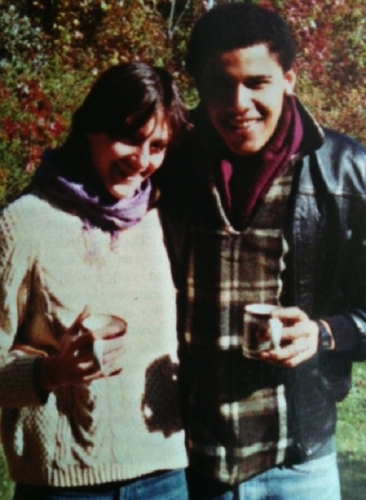
Barry and Genevieve, high school sweethearts

Barack Obama’s well written autobiographical, “Dreams From My Father” portrayed his youth as a series of permanently mind altering revelations at Occidental College, Columbia and Harvard that formed his belief system and character.  His high school career was commonplace.  He drank beer, smoked dope, dated and hung out with friends, mostly white.  In Hawaii with so many of mixed race, there was no stigma and he experienced rare, if any, discrimination.

At Occidental College and Columbia Barry Obama transformed to “Barack”, became radicalized, and it was a journey he avidly sought out – he found his mission; he found his role.  Adolescent insecurities were morphed or sublimated, as with us all.  The narcissism and hubris so evident today took root and blossomed.  In “Dreams” he described incidents and conversations that led to these epiphanies; the troubling element is that some of the characters in the book were composites or didn’t exist at all according to the newly released biography, “Barack Obama: The Story”.  David Maraniss, the author, is a Washington Post reporter and an Obama supporter, so one expects a positive perspective, which it presents for the most part.

In “Dreams”, Mr. Obama writes of how he reinvented himself.  In reality, he was “inventing himself inventing himself.”  Andrew Ferguson’s review of Maraniss’ “The Story” (“meticulously researched, well footnoted, carefully written”) wrote this, “What’s dispiriting is that throughout Dreams, the moments that Obama has invented are precisely the occasions of his epiphanies – precisely those periodic “aha!” moments that carry the book and bring its author closer to self-discovery.  Without them not much is left: a lot of lovely writing, some unoriginal social observations, a handful of precocious literary turns….  As Obama’s best biographer, David Remnick, observed, this wasn’t the stuff of Manchild in the Promised Land; you couldn’t use it to make … the Autobiography of Malcolm X.  So Obama used the drama inside himself, and said he’d found there an experience both singular and universal, and he brought along nonexistent friends like Regina and Ray to goose the story along. He did in effect what so many of us have done with him.  He created a fable about an Obama far bigger and more consequential than the unremarkable man at its center.”

From “Barack Obama: The Story”: The character creations and rearrangements of the book (“Dreams from My Father”) are not merely a matter of style, devises of compression, but are also substantive.  The themes of the book control character and chronology.  Time and again the narrative accentuates characters drawn from black acquaintances who played lesser roles in his real life but could be used to advance a line of thought, while leaving out or distorting the actions of friends who happened to be white.

 Oh yes, I’m the great pretender
Adrift in a world of my own..’
  “The Great Pretender” (The Platters)

It appears President Obama may persist in his self absorbed attempts to reinvent himself as he would prefer to be. Or his publicity flacks, campaign staff and even his national security advisors are doing it for him.  Peggy Noonan’s editorial in last weekend’s Wall Street Journal asks the question, “Who Benefits From the ‘Avalanche of Leaks’?”   In the article, she writes about David Sanger’s new book, “Confront and Conceal: Obama’s Secret Wars and Surprising Use of American Power”, as well as the sensational New York Times articles that expose sensitive and ongoing American covert intelligence operations, putting our own operatives and those of our allies at great risk.   Who benefited from these revelations was a president perceived as “weak, a one man apology tour whose foreign policy is unclear, unsure, and lacking in strategic depth”.   President Obama would rather reinvent a warrior and a “do over” from a walking, inept, act of contrition.  No lesser light from the Left than Senator Dianne Feinstein, who sits on the Senate Intelligence Committee, called these an “avalanche of leaks” and said that her “heart stopped” reading the stories:

  • A Pakistani physician, Dr. Shakil Afridi, who assisted the CIA by taking DNA samples trying to locate Osama Bin Laden’s lair was exposed by the stories, arrested within days by Pakistan agents, tortured and convicted of spying for America.  He was sentenced to 33 years in prison.
  • A sophisticated infusion of trackable video cameras was inserted into Pakistan to enable satellites to identify and find terrorist leaders hiding there.
  •  The double agent in Yemen planted deep in Al Qaeda who provided key information about the new, more deadly, airline destroying underwear explosives.
  •  The joint Israeli American covert Stuxnet virus, a cyber attack, which disrupted the operation of Iranian centrifuges – a cyber attack that could easily be construed as an act of war and used to justify all manner of retribution.
  • And others, most of which could only have come from the recesses of the White House situation room.  Indeed, unnamed White House officials were quoted liberally in the stories.

Before he left the administration, former CIA Director and Defense Secretary Robert Gates, originally a holdover from the Bush White House, visited Obama national security advisor Tom Donilon’s office.  “I have a new strategic communications approach to recommend,” he said.  “What?” asked Mr. Donilon.  “Shut the f*%$ up!” replied Mr. Gates.

Two choices: either the President inexplicably declassified these ongoing operations, which put covert intelligence operatives in mortal danger, betrayed our allies and authorized their leaking to the press OR someone very close to him should be prosecuted for treason.

President Obama has shown himself to be defined by a self reinvented narrative to suit his ambitions.  He has proven to be a gifted campaigner and an inexperienced, ideologically hidebound, manipulative chief executive.  It is not a far stretch of the imagination to envision him as again up to what he’s best at.

There is something childish in it: Knowing secrets is cool, and telling them is cooler.”  Peggy Noonan
1 Comment

Filed under Politics and government

Divided Nation

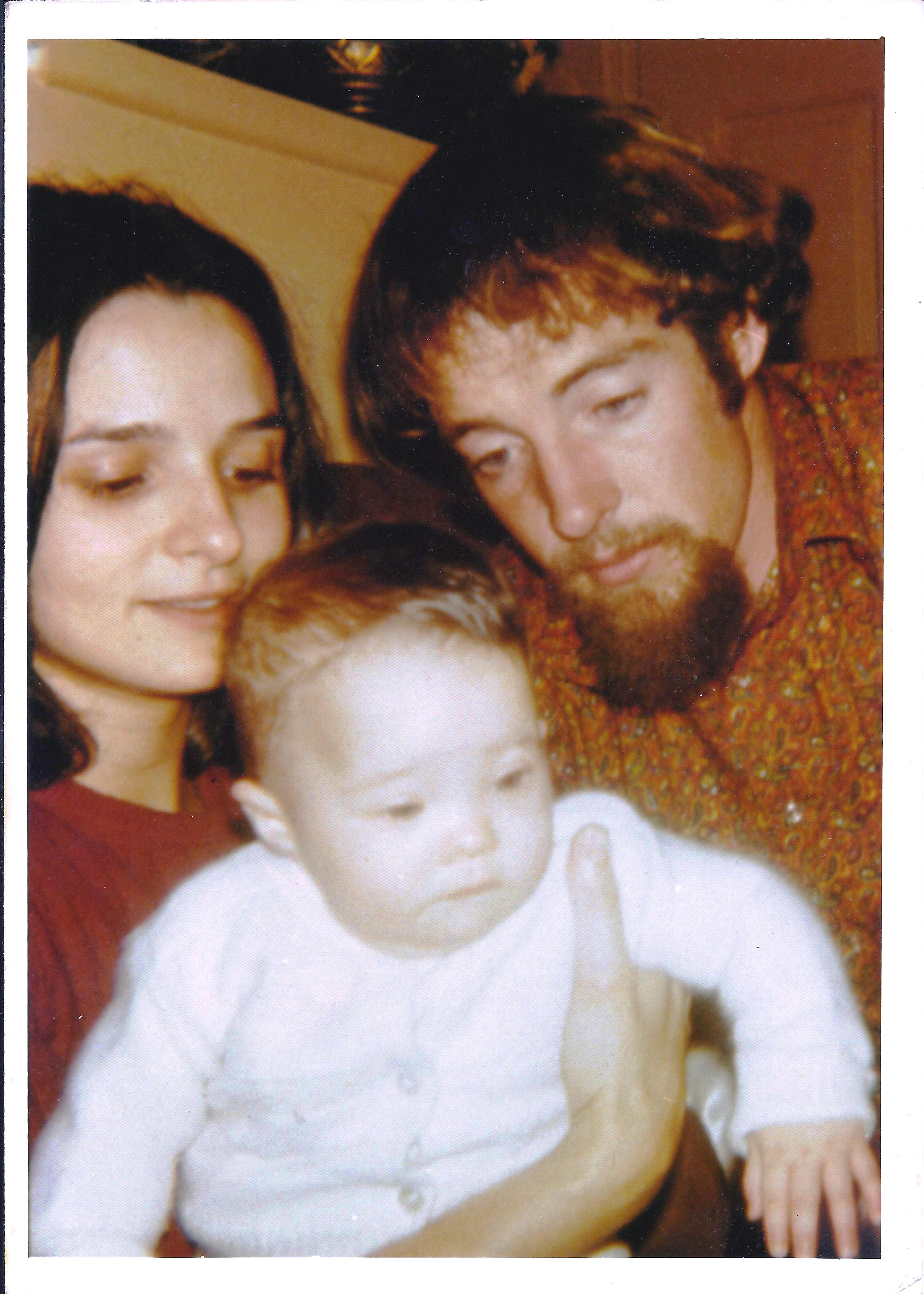
1970 with Amy

Winston Churchill most famously decreed, “If you’re not a liberal at twenty, you have no heart; if you’re not a conservative at forty, you have no brain.”  The journey we’ve made in the last forty years follows that well worn path.  Much is written about current gridlock and which political leader is most divisive, but even a cursory look at the United States demonstrates deep divisions for our whole history.  The early Republican party led by Abraham Lincoln carefully negotiated extremely tricky political waters to the Emancipation Proclamation, followed later, after his death, to amendments to our Constitution to first free, then enfranchise (at least the men) 3 ½ million Americans of African descent.

During the time both before and during a Civil War, emotions ran rampant; a pro slavery South Carolina Democrat Congressman, Preston Brooks, severely beat and nearly killed Massachusetts Republican Senator Charles Sumner with a metal headed cane on the floor of the Senate after Sumner delivered an impassioned Abolitionist speech likening slave owners to pimps.  Sumner took three years to recover sufficiently to return to the Senate.  Brooks was fined $300 and was overwhelmingly reelected to Congress by his constituents. We haven’t yet seen physical violence in Congress yet, although a few like former Senator John Edwards almost certainly would benefit from a sound thrashing.

The leaders on the liberal side of the current schism were produced through the Vietnam War and post Vietnam War periods, during which few compromises were countenanced.  In 1969, Bobby Kennedy and Martin Luther King were murdered martyrs to the anti war and civil rights movements. The eventually disgraced Richard Nixon was the President of the United States, and from the perspective of early twenties dilettante radicals like Rita and me, prospects seemed bleak.  We read rags like “Ramparts” Magazine, books by Eldridge Cleaver and tracts about the Chicago Seven. There was Cambridge, Berkeley and Haight-Ashbury, Ann Arbor and Boulder.  Because we wanted to see the Rockies, we put our few pieces of furniture in storage over Rita’s father’s garage and headed to Boulder, Colorado. “Power to the people.”

In retrospect, we were remarkably uninformed, entitled by the sacrifice of our parents, naïvely idealistic and determined to make a difference – whatever that meant.  A couple of years before, after graduating from college, my military career turned out to be a one day adventure for a physical that I failed when the Army doctors discovered I take an anti-convulsion medication due to a severe head injury from a high school car accident.  I have never had a day time incident, so it didn’t seem crucial, but it was one and out for me.  Things went Left after that.  An arm chair psychoanalyst may discern that my early job choices for dangerous work were possibly compensatory for a young man.  I was a skilled tree worker; Rita was a Boston hospitals trained RN.  Neither one of us had a moment’s doubt that we would find work out West, which turned out to be a problem solved the third day after we arrived.

Our revolutionary efforts were pedestrian and embarrassingly feckless.  One demonstration at the University of Denver; a Joan Baez concert at Red Rocks the same month she performed at a farm in Woodstock, NY (she spoke amusingly of the then Governor of California, Ronald Ray-Gun); a few joints around campfires under the black night of a billion stars on back packing trips into the mountains; a visit or two to the American Friends Service Committee (an offshoot of the non violent Quaker center for conscientious objection), and small gatherings in friend’s apartments to cavil about “the cause” and tell stories about Cam Bishop, whom I once met, a living off the land FBI’s Ten Most Wanted fugitive, who blew up the power station that fed Fort Carson.

With David and Kris Levin, our upstairs neighbors, we decided to take a week’s vacation and drive to San Francisco over Loveland Pass.  David was my chess partner at the University of Colorado Chess Club, until they threw us out when they asked us both to join their chess team, and we confessed to not being students.  He worked for the American Friend’s along with a Catholic priest, whose name escapes me.  David had been a wilderness guide in Talkeetna, Alaska, and they had lived for a while in Mexico City.  Their wanderings were not uncommon.

Driving through eastern Utah, we stopped in Vernal around midnight for fuel at an all night, coin operated gas station – two long haired couples in a worn out station wagon with a mattress in the back, so we could drive straight through to Frisco.  While there, a Camaro SS with a hood scoop pulled in with five twenty something well trimmed guys looking for something to do on a Saturday night.  We qualified as the entertainment, especially after a few beers.  As we pulled out of the station, they followed us.

What followed included huddling in the back seat with a tire iron in my hand while we held the mattress up to the window to protect ourselves from flying glass as they threw full beer bottles at the car and almost running them over when they raced ahead to block the road.  On either side of the road, there was a hundred miles of desolate nothing.

Finally they joined up with another car of their friends, and we knew it was a matter of time before they trapped our old beater.  It took three hours to drive the thirty miles to the next town; David pulled into the yard of a house with the lights still on.  David and I stayed at the car as our tormentors pulled up near us.  Kris and Rita pounded on the door of the home; the owner answered the door for our terrified wives with a lever action 30-30 Winchester at port arms.

The young couple in the house was up with an ill child, so Rita’s pediatric nurse experience was welcomed.  Once he sorted us out, the father recognized the cars parked out front with one belonging to the county sheriff’s son, who had been implicated the summer before in the disappearance of a hitchhiking couple.  We called the state police, who were at first reluctant to come, but after my non violent friend, David, threatened to shoot a few of them, they sent the cavalry.  When the police car approached with lights blaring from a long distance, both cars left back towards Vernal.  After we assured the trooper that it wasn’t just (in his words) “drunk Indians”, he agreed to look for them.  We rode in his car back to Vernal and identified the Camaro in the parking lot of an all night diner.  The trooper dropped us at the courthouse, then went and arrested five of them.

Couples and five harassers then sat in a waiting room at the courthouse for another hour and a half waiting for a judge to show up.  The ensuing conversation confirmed the implacable nature of our differences.   The smooth one was conciliatory after Rita’s pregnancy became obvious.  Another was headed to Vietnam in the Army the following Monday, which had prompted their partying.  They despised us; the hatred was palpable at first, but by the end of the hour and a half, most began to see one another as human beings.  Discussion softened, except for the departing soldier, who kept trying to start a fight, but who could blame him?

We found out a bit about life for young men in rural Utah with fast cars being the extent of available distraction; we all learned to reify the other side’s point of view through discussion held in neutral territory.   No permanent bridges, and conciliation was nearly impossible given the polarity, however all of us became more than caricatures to the other.

When the judge finally came, we filled out complaint forms.  The judge assured us we would be called back to testify when the trial came up in a month or so.  Even though it meant several hundred miles of driving through the mountains, we agreed to come back.  Exhausted, we never made it past Salt Lake City, where we rested and turned around, carefully avoiding Vernal on the way back.

Of course, from the courts of Vernal, we never heard a word.

Still dancing after all these years

For myself, I am an optimist – it doesn’t seem of much use to be anything else.  Winston Churchill.

5 Comments

Filed under Culture views

Maine Tales IV – The Road Not Taken

For all its idyllic vistas and community spirit, rural Maine can be harsh, isolating and lonely, most especially in the winter.  Maine winters hold a stark beauty that shines an unforgiving light on the soul.  We soon found ourselves unable to escape our own frailty and foibles. At the end of our third winter, a singularly snowy and cold one, Rita and I were succumbing to a confluence of secularism, bad advice and the detritus of the Cultural Revolution by which we all are still afflicted. Our young, bright love was threadbare; ten years into our marriage, we were ready to move on.  Virtually all of our friends were counseling a fresh start.  “Time to hang it up,” we were told.  “Why hold on to a dead thing?”  “There are plenty of other opportunities,” and indeed there were for us both.

Rita and the kids

I  fought a separation for the whole long winter, but by spring had hardened myself to leave behind nine lovely years and one difficult, complicated one.  Not much anger, not even a lot of bitterness: after a few brief, generally desultory skirmishes about who got the Bob Dylan albums and other prosaic living arrangement matters, we settled on a Saturday in early May for move out day.  Two separate incidents led us to the other fork in the road.

The first was a coffee Rita shared with our friend, Pam, during the week prior to moving day.  Pam, a gifted artist and painter, lived a rough life; her ne’er do well husband had deserted her a dozen years before with six children.  An earth mother type, Pam soldiered on, tolerating occasional visits from her husband – no divorce and rare support.  She was much liked and admired in town, especially by Rita.  Pam took a chance and defied the common “wisdom” amongst our circle of friends; Pam told Rita that we were a good match wading through some confusion and pain, but that separating was a mistake – a big mistake.

When I came home from work on Friday, Rita asked if we could give it one more effort.  My resolve was hard earned, and my initial internal reaction was “hell, no!”  With my game face on, I looked at our two young children, the vulnerable hope on Rita’s beautiful face and could not, would not smash our one last attempt.  Although I held meager expectations, I thought perhaps, just perhaps, we could raise our children together and restore a semblance of the friendship that had always come so easily and that would allow us to do the right thing.  This was my best hope, but far short of what we would become. I agreed to try again – all in.  I quit my job with all its traveling and worked part time pruning and taking down trees to spend more time on our marriage.  We lived frugally and got by.  But there was no miracle cure.

The next few weeks in retrospect we likened to living in a bombed out, post apocalyptic city among sterile ruins.  There was no healing, no fighting, no feeling, no animus, no forgiveness, not much of anything.  I remember vividly one striking mid spring day of bright sun and burgeoning green, we drove up to the Orono campus of the University of Maine about an hour and a half north.  I had been invited to join the board of a state wide non-profit and thought it would be good to be together for the day.  On the silent ride home, the juxtaposition of vernal splendor, new life and our hollowed out spirits almost brought me to tears.

 The second incident that permanently altered our lives for the good occurred a week or so later.  Rita found an old set of rosary beads given to her by her late aunt, Rose, and awkwardly prayed with no confidence Anyone was listening, a desperation move if ever there was one.  On Saturday, she asked me if we could go to Mass.  Cradle Catholics, we hadn’t set foot in a church for a decade; I wouldn’t have been more surprised if she suggested we move to Zambia.

Rita has always acted as the emotional and spiritual catalyst in our marriage; I tend to be the implementer, who thinks through the how and the why.  It is our defining character and the personality of our relationship.  I didn’t fight the suggestion, but told her that if God existed, if we found any truth in our attendance at Mass, our lives would change profoundly: our activities, our friendships, how we spent our time.  She cautioned me not to get all “cosmic” on her, that she merely sought the solace of a childhood faith for a Sunday morning.  “We’ll see,” I said.

We looked up Catholic Churches in the Yellow Pages (an anachronism now).  Mount Vernon was at the center of a fifty mile circle roughly encompassing Augusta, Waterville and Farmington.  Rita worked part time as an RN in Augusta, but Farmington for some reason attracted us.  I called St. Joseph’s Church in Farmington; a friendly voice picked up with a lively, “St. Joe’s!”  Father Joe McKenna answered his own phone calls and was nearly perfect for hurting children of the sixties — an admixture of intellectual, poet, faith filled priest and wonderfully warm and funny human being with holes in the elbows of his sweaters. We entered the little, wood framed church on a side street, far smaller than the Baptist, Episcopalian and Congregationalist stone and brick edifices on Main Street.  It was Pentecost Sunday, no happenstance, and Father Joe was alive with the Spirit.

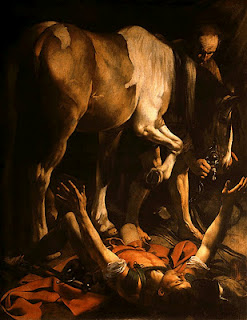
St. Paul on the road to Damascus – Caravaggio

We began an utterly surprising and unexpected faith journey that fills our lives and has never disappointed.  The human mind is immured by limitations of intellect, knowledge and imagination; the soul is unencumbered.  We asked and continue to deepen our understanding of three questions, perhaps the three questions, trinitarian in nature, an inexhaustible wellspring.  To me, no person addresses our existential human loneliness without asking them.

Saint Bede on his deathbed in 735 is known to have said, “If it so please my Maker, it is time for me to return to Him Who created me and formed me out of nothing when I did not exist.”  From whence do we come? Why?

Reinhold Niebuhr, American theologian and commentator, said, “Christian faith stands or falls on the proposition that a character named Jesus, in a particular place at a particular time in history, is more than a man in history, but is a revelation of the mystery of self and of the ultimate mystery of existence.” Is there a bridge to the eternal, a gateway?  If so, Who?

Saint Cyril of Jerusalem wrote, “Water comes down from heaven as rain, and although it is always the same in itself, it produces many different effects… It does not come down now as one thing, now as another, but while remaining essentially the same, it adapts itself to the needs of every creature… In the same way the Holy Spirit, whose nature is always the same, simple and indivisible, apportions grace to each..  Like a dry tree which puts forth shoots when watered, the soul bears the fruit of holiness when repentance has made it worthy of receiving the Holy Spirit.” If the gap is so bridged, where do we go from here?  How?

Nearly two millennia ago on Pentecost, the Church was born with a visitation of the Holy Spirit; thirty five years ago on Pentecost this weekend, our marriage, our faith, our lives and our souls were reborn.  Happy Anniversary, sweetheart.

“Only the Christian thinker is compelled to examine all his premises, and try to start from the fundamental terms and propositions.”  T.S. Eliot

13 Comments

Filed under Faith and Reason, Maine Tales

The Mick

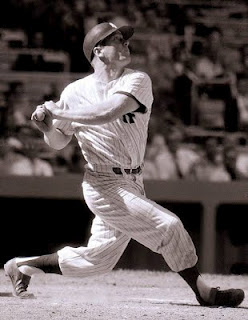
Effortless grace

“I could never be a manager.  All I have is natural ability.”  Mickey Mantle in Great Sports Reporting.

In 1968 Tim was ten when his Dad, Bob, was given tickets to a Red Sox/Yankees game at Fenway.  Like many in Rhode Island Tim grew up a Yankees fan and Mickey Mantle was his hero.  “The Mick” was taking a farewell tour in his retirement year, and it was to be his last series in Fenway Park.  Bob managed a district for Suburban Propane, but with a wife and four boys, they had little money to spare for entertainment.  A family Sunday afternoon at Scarborough Beach was as close as Tim had been to a vacation.  Yankees games were a world of imaginings he heard on the radio; Tim had never been to a major league baseball game.

An equipment supplier offered to take Bob and their top salesperson to the game along with a night of extravagant dining in Boston.  Bob asked first the salesperson and then the benefactor if he could take his sons to the game instead.  Everyone agreed.  When Bob came home, he told Tim and his brother Chuck the news, and it was all Tim thought about until game night.

Every kid remembers his first trip to the ballpark, whether it’s Fenway or Yankee Stadium or Wrigley Field, but Fenway, the grand old “bandbox” is surely special.

Fenway at twilight

“Fenway Park, in Boston, is a lyric little bandbox of a ballpark.  Everything is painted green and seems in curiously sharp focus, like the inside of an old-fashioned peeping-type Easter egg.”  John Updike in the New Yorker on the occasion of Ted William’s retirement.  1960

Coming past the fortress front of Fenway, the boys and their father entered into the catacombs underneath the stands.  Dirty, noisy, crowded, a bewildering array of young and old, more male than female, pushing, bumping, looking at tickets and anxiously following signs to the right section.  Finally they found their ramp, ascended with the crowd, at first seeing only the twilight, the blinding high arrays of lights just coming to life, and then emerging into the aisle to encounter a breath stopping, beatific vision of green, The Wall, natural grass, base paths with freshly limed lines, dugouts full of champions and players stretching and throwing the ball around.  The boys, as all boys, were wide eyed, open mouthed, trying in vain to see it all at once.  Fenway is intimate; they felt on the field, yet it seemed immense; they were flabbergasted just how far their heroes had to bat and throw.  How high the ball went and how amazingly quickly the ball traveled from one end of the field to the other.  Untainted wonder.

Their dad led them down, down until they were four or five rows behind the visitor’s dugout. One further thrill when Dad bought hot dogs wrapped in napkins passed hand to hand down the row while the money went the other way; maybe a bag of peanuts later, thrown twenty feet by another vendor?  “Don’t drop them, Dad, they’ll boo ya!” They were close enough to hear the players shout back and forth and laugh.  Oh my, there was Mickey.

When Mantle first came up in 1951, he made $7,500 and played in the outfield with a guy named DiMaggio.  The Yankees took the World Series in four over the Giants in a subway series. Phil Rizzuto was the shortstop; Bobby Cox played third.  Mickey was an almost mythical farm boy from Oklahoma; he moved with astonishing grace and speed, a god even among all the other amazing athletes.  There was nothing he couldn’t do with bat, ball, glove or legs.  Mickey Mantle was arguably the greatest switch hitter in baseball history and a lock for a first ballot trip to the Hall of Fame with 536 home runs by the time his career wound down. In 1968 he made the kingly salary of $100,000 in the last year of his contract, and played part time first base on worn out wheels.

“I can’t play anymore.  I can’t hit the ball when I need to.  I can’t steal second when I need to.  I can’t go from first to third when I need to.  I have to quit.”  Mickey Mantle in 1968

Neither the Yanks nor the Sox were going anywhere that summer; they finished 4th and 5th in the American League the season Denny McLain pitched 31 wins  with a 1.99 ERA, and the Tigers won the World Series.  It was a tired game in a tired year, but Mickey was there, and both the Sox and Yankee fans loved him.  It was enough. Mick sat on the bench early in the game, but came in later under fan pressure.  He got a standing ovation the first time he got up.  He struck out awkwardly – a gimpy, sore guy, just a vestige of when he owned the game.  Mickey came to the plate one more time late in the game.  The crowd stood again and lifted the roof.  Tim doesn’t remember the score or the outcome, but he remembers this.

“…if I had played my career hitting singles like Pete, I’d wear a dress.”  Mickey on Pete Rose, in The Mick

The Mick fouled the first pitch back.  The second bounced in for a ball.  At the third pitch, he swung with a brief, magnificent flash of his youthful strength, balance and speed; the ball exploded towards left field.  It hit the tin of The Wall with a bang heard throughout the park, an unforgettable sound unique to Fenway Park.  Mick grimaced as he headed towards first, barely able to imitate anything near running.  A young, future Hall of Famer, Carl Yastrzemski, roamed left field like a lion and already had learned like an art form how to play balls hit off The Wall.  He positioned himself perfectly and plucked the ball in the air off the wall.  He spun to throw it in and Mickey was barely halfway to second.  Yaz pumped with the ball towards the infield.  He pumped again, and yet a third time as Mickey pulled into second base; only then did Yaz throw a rope to a grinning Rico Petrocelli covering the bag.  The fans rose as one to applaud this tribute to greatness back before baseball became “Moneyball” spreadsheets of stats and millionaire salaries.  When baseball was still America’s game.

“I would change policy, bring back natural grass and nickel beer.  Baseball is the belly-button of our society.  Straighten out baseball, and you straighten out the rest of the world.”  Bill Lee in an interview with a sports writer about the state of the game he loved.

4 Comments

Filed under Culture views

Maine Tales III – Swordfight on the Lake

The red pumper bounced onto the driveway of the large ante bellum colonial with siren blaring.  The house had once served as an inn, and currently was occupied by a half dozen mostly benign refugees from other late sixties communes.  The flames fully engaged the structure and were seen through the windows.  Everyone got out. The source of the fire was a fifty gallon drum woodstove laid on its side with a fire door kit cut in one end and a stove pipe emerging from the top, not an unusual heating system for rural Maine that can be assembled from a kit for under $100.  If it was a typical set up, sand would cover the bottom to keep the coals from burning through.  Overheated, it could glow cherry red.  Something had gone amiss.

A small fleet of private pickup trucks driven by the rest of the fire department followed the pumper.  The chief’s truck had a prominent flashing light bar on the roof.  A 3” hose with a nozzle was quickly deployed, but the tank rapidly depleted and the stream of water dwindled to a dribble.  An intake hose was unfurled and several fire fighters started rolling it out towards a source of supplementary water, coupling on more hoses as they went.  Back at the truck end, the chief, Dana, bent to hook up to the intake valve and discovered the others were approaching the lake 500 yards away with the wrong end of the hose.  By the time things were reversed, the fire broke through the roof, which fell into the basement a half hour later.  These men were dedicated and courageous; they had saved lives, but all were volunteers, and practiced as they could.  Practice was customarily followed by much truck polishing, hose rolling and beer drinking at the station. Occasionally, they got to burn down a condemned barn to work on their skills. Common wisdom was to get out of the house, and then call your insurance agent and the fire department from a neighbor’s house – in that order. Town residents were fond of saying that the Mount Vernon Fire Department had never lost a foundation.

Official authority and municipal services in a small rural town are a unique experience.  In Mount Vernon circa 1976, there was no police department.  A local constable appointed by the court would serve subpoenas and divorce papers.  The nearest law enforcement was a Maine State Police trooper, who lived 15 miles away in the next town, Readfield.  Once when Rita was involved in a car accident, he came to our house the next evening dressed in jeans to help us fill out the paperwork.  Things were casual.  Only the game warden had true authority.  He was known to shoot a dog if they packed up with others and ran deer.  No appeal, no live trap, no deliberation whether it was a mutt or a Golden Retriever with papers: justice was swift, administered uniformly and accurate.

The only time I remember talk about engaging the police was on the Fourth of July during the bicentennial celebration in 1976.  Other than a few bottle rockets and cherry bombs from New Hampshire, there were no fireworks.  Jeff Kent, a young twenty something native Mount Vernonite, took to drinking beer with a truck full of buddies and dragging an old car hood behind his pickup up and down the roads.  The hood presented an impressive display of sparks and plenty of noise, augmented by custom horns that sounded like a submarine klaxon dive alarm, mounted on the cab roof.  After three hours or so into the wee hours, some of the more sedate residents had had enough.  No one actually called the cops though; one of the dairy farmers who had to get up in the morning told Jeff he would shoot the engine block of the pickup.  We weren’t sure if he had the firepower or the marksmanship, but neither was Jeff, so he pulled the truck into the fire station and drank some more beer.

 A “domestic disturbance” was treated like this: no police involvement because they were too far away to help.  Bia, a recent resident, had moved into an apartment next to a small store front downtown, where she opened up a sheet metal artisan shop, welding and cutting small decorative pieces sold at craft fairs.  Her boyfriend was an odd, slender, bearded, pony tailed archetype prone to buckskin jackets, cowboy hats, silver buckles and a 14” Bowie knife carried in a sheath on his belt.  Bia’s daughter was my daughter’s age, and they became friends during the few months since Bia arrived in town.  In January, our phone rang about eleven one weeknight, long after our bedtime.  She called because we were one of the few she had gotten to know.  The boyfriend, whose name fades, let’s call him Jim, was drinking, smoking dope and hitting her.  Could I come down to help?  Sure, I agreed, groggily.

 As a twenty nine year old, very fit, tree climber, I had an exaggerated confidence in my own invulnerability; I grabbed a 3 foot hickory handle half whittled down to fix my splitting axe and jumped on my trusty steed, well actually, an F150.  What could be better for a chainsaw guy than getting to play knight errant?  On the way to her place, I practiced some tough threat lines involving emergency rooms, reconstructive dentistry and eating through a straw, all of which turned out quickly to be completely inadequate to the situation.  The denouement was less than noteworthy.  Jim had fled out the back door on the snow over the ice of Lake Minnehonk.  I followed his tracks into the dark, axe handle in hand, and found him seventy yards out on the ice in a tee shirt disconsolately sitting and shivering in the snow, his knife still in its sheath.  I asked him if he had a place to go.  He said he did, in Waterville.  I told him that’s where he would be staying.  He started to cry.  Bia packed a duffle bag into his dented Saab with Boulder County Colorado plates, and that was the last anyone ever saw of him.  I went home to bed; Rita was glad to see me.

Thirty years later, we were visiting an old friend, Pam Jones, who still lived near Lou’s store, which was now not Lou’s store.  Bia had long since moved out, but we learned for the first time that a local legend had grown around the “Swordfight On The Lake” with much dramatic license taken. Pam laughed huskily in her smoker’s voice telling us about it.  Entertainment and storytelling are at a premium in a small town.

I hate small towns because once you’ve seen the cannon in the park there’s nothing else to do.
Lenny Bruce. (Mr. Bruce obviously never actually lived in a small town. There’s a lot to do.)

11 Comments

Filed under Maine Tales

Sarah

Sarah was stillborn on Tuesday.  Her heart simply stopped. That certain finality almost causes our own hearts to cease beating like her tiny one: inexplicable, irreversible heartbreak for her parents, Liz and Ray, and her grandparents, my good friend Jim and his beloved wife, Margaret, parents of Liz.  Sarah will never sit in their laps to be sung to sleep or read “Cat in the Hat” or draw with crayons on the kitchen table.  There will be no first steps, no elementary school flute concerts, no graduations, and no walk down the aisle or Sarah’s children.  Her life cut short before she drew breath.  When she emerged twenty three hours after her heartbeat was last detected, her silent, little body was perfect in every way with her father’s eyes; her mother’s nose and mouth and auburn hair.  Her parents and grandparents hugged her, kissed her, held her for a long time and wept over her.

The nurses, midwives and doctors at the Birthing Center of Georgetown University Hospital did whatever could be done, were extraordinarily supportive and grieved with the family for what they could not explain.  Melanie and Sarah, two of the nurses, brought an outfit they picked out for Sarah. She will be laid to rest in a Catholic cemetery in an area reserved for babies.  On May 12th, there will be a memorial Mass at St. Ann Catholic Church in Washington, DC presided over by Monsignor Mosley, Ray and Liz’s pastor.  A second Mass is being planned in Jim and Margaret’s parish in Roswell, Georgia presided over by Father Peter Rau.  These good priests and Father Henry, who married Ray and Liz, help console the family and lovingly minister to their deep faith.

With that faith, there is this:

 Pre born babies have already experienced much. Sarah surely recognized familiar voices and responded to them, especially her mother’s and father’s.  She felt the loving strokes of her mother’s hands through the safe enclosure of her womb.  Sarah reacted and bounced when Liz laughed.  She heard and responded to music. She knew joy. She knew love. She never knew cold or hunger or fear or loneliness, and now never will.  Sarah knew there was wonder and mystery outside her secure, warm world.  She now knows far greater wonder, wisdom and mystery than her family has yet to experience.  Her joy and love are now eternal.

Margaret wrote to her friends and family, “She is now in heaven, a Holy Innocent, powerfully interceding for her family.  We look forward to seeing her again one day, but in the meantime she will remain in our hearts and minds.  It is comforting to know that she is where we all long to be, and that she will never suffer the hardships of this earthly world.”

John Donne wrote, “He that asks me what Heaven is, means not to hear me, but to silence; he knows I cannot tell him: when I meet him there, I shall be able to tell him, and then he will be able to tell me.”  Unity with the Creator is far beyond our limited faculties to comprehend or attempt to explain, yet our faith draws us there to “our own far off country”.

Saint Augustine tells us in “City of God” that “There we shall rest and we shall see; we shall see and we shall love, we shall love and we shall praise.  Behold what shall be in the end and shall not end.” C.S. Lewis in The Weight of Glory likens us, who still engage in this vale of tears, to a schoolboy striving through hard study to learn the sublime, “Those who have attained everlasting life in the vision of God doubtless know it is no mere bribe, but the very consummation of earthly discipleship; but we who have not yet attained it cannot know this… Poetry replaces grammar, gospel replaces law, longing transforms obedience, as gradually as the tide lifts a grounded boat.”

Sarah now knows, truly knows,  what we long for: entirely, effortlessly, within her soul.  The hope of us left behind is that at some joyful, future celebration we will see her perfect and complete.  All guilt, recriminations, self doubt, second guessing will only impede our journey and cause us harm, and in the end slough off.

A close friend once confided to me that his personal belief is that a loving God takes each soul home at the most opportune moment for each person, the moment best suited for our own salvation.  For some that means a long, tough climb.  All of us will come to that moment, of that there is no doubt.  “Our days may come to seventy years, or eighty, if our strength endures; yet the best of them are but trouble and sorrow, for they quickly pass, and we fly away.” Psalm 90.   Even eighty years is a blink of man’s history, and not even that when measured against eternity.  Our time will come.

The name “Sarah” derives from the Hebrew, meaning “Princess”.  This young Sarah is already royalty.  The time of her homecoming was early on, but her outcome is certain.

Sarah, pray for us.

Blessed are those who mourn, for they will be comforted.  Blessed are the pure of heart, for they will see God.  Matthew 5: 4,8

5 Comments

Filed under Personal and family life

Tale of Two Doctors

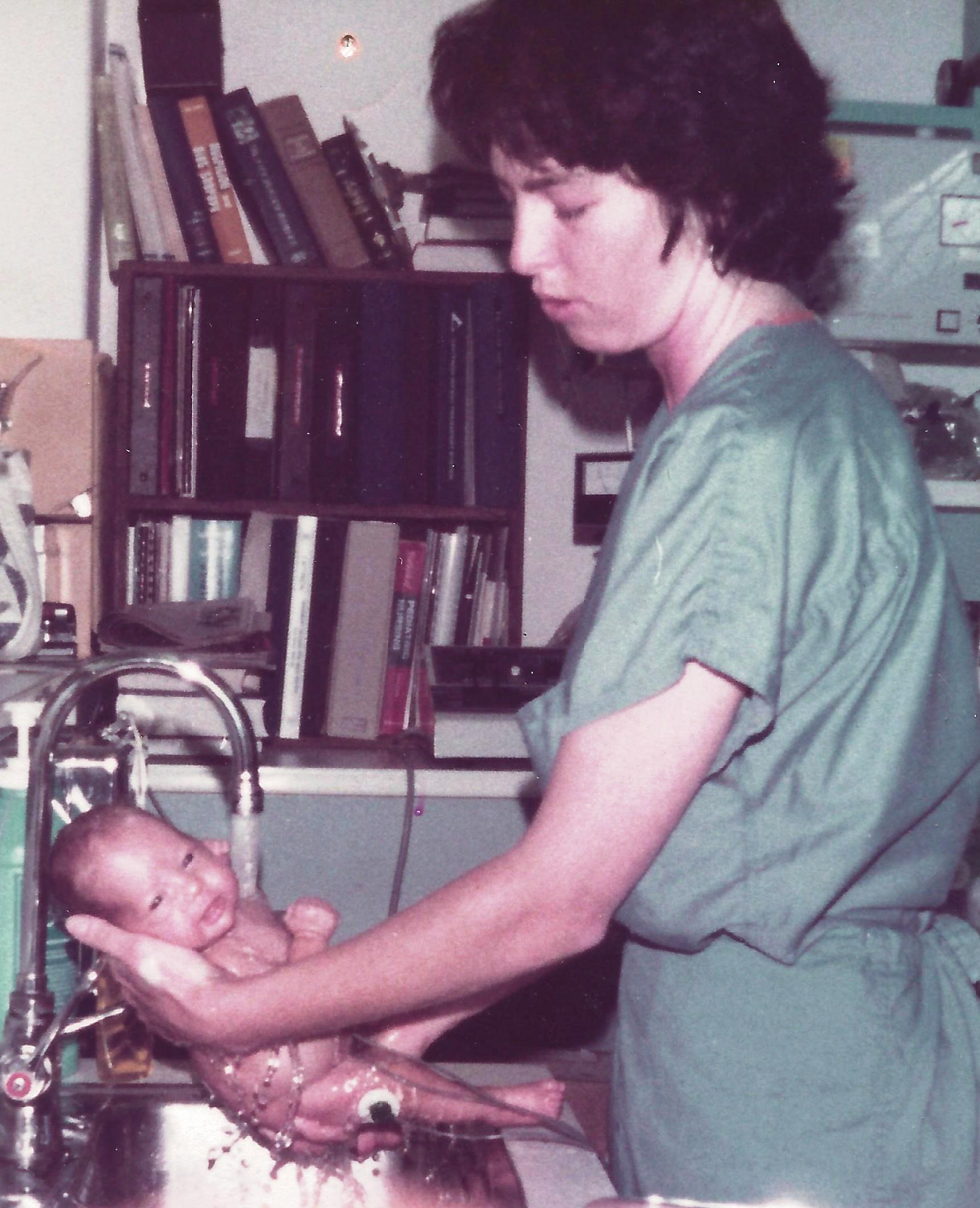
When we were in our early thirties and living in Maine, Rita gave birth to Angela in Portland.  She was 2 pounds, 6 ounces at birth and 28 weeks in the womb.  She spent the next seven weeks in the neonatal intensive care units of Maine Medical Centers in Portland and Lewiston.  Angela now has two beautiful daughters of her own (Gianna and Elena), a great husband as well as a master’s degree in education.   Since Rita’s own OB_GYN doctor lived ninety miles north and near where we lived, the second year resident who delivered her was Dr. Bruce Churchill.  He carefully explained to us what to expect and that because of her early arrival, she most likely wouldn’t cry; that was the only thing he was wrong about.  Angela was a fighter from the jump.

Dr. Bruce Churchill

Dr. Churchill’s grace under pressure, skill and personal warmth will never be forgotten by us.  He was named “Physician of the Year” by the Portland newspaper in 2000.  At one point during those trying first few weeks, he offered us the second bedroom in his apartment because of the travel required by Rita’s successful effort to establish her nursing.  She initially used a breast pump and delivered frozen milk in half ounce containers, which the nurses would feed to Angela a little at a time.  When researching this post, we learned that Dr. Churchill was diagnosed with ALS (Lou Gehrig disease) in 2006, but continues to practice at the Coastal Woman’s Healthcare Center in Scarborough. He and his wife, Cindy, lead the annual ALS march in Portland to raise research funds to fight his terminal disease.  He was the varsity girl’s volleyball assistant coach at Greeley High School.  The annual girls volleyball state championship tournament has been renamed “The Bruce Churchill Classic”.  He specializes in adolescent care and menopause.  His increasing disability forced him to stop delivering babies in 2008.  Not many deserve the honorific, “Doctor” more than Bruce.

The other end of the spectrum fell in Kansas.

Kelly was fourteen and pregnant since she was thirteen.  When her baby was twenty weeks developed, and after four days in a Wichita, Kansas motel during which time her cervix was incrementally dilated, her womb and amniotic fluid were injected with a saline or urea solution.  The baby swallows the stuff; she suffers burned skin and is poisoned.  A saline poisoned baby can take up to an hour to die.  A baby at twenty weeks recognizes her mother’s voice, moves her mouth, grasps, blinks, has hair and fingernails; her gender is distinguishable with ultrasound, and she feels pain.  Kelly was taken into a room with four or five other mothers and awaited the doctor’s order to bring her to a smaller room that served as the final solution.  The nurses instructed her to sit on what resembled a toilet and push.  Her dead baby fell into the toilet.  The remains of the babies were burned in an incinerator, which emitted smoke not unlike the smoke produced at veterinarian clinics or Auschwitz. Link to interview with Kelly.

Dr. George Tiller

Dr. George Tiller owned one of the three abortion facilities nationwide that performed late term abortions into the final month of pregnancy, killing many babies as developed or more developed than our Angela. Until the procedure named as “partial birth abortion” was banned in 2003, Tiller did them. This “intact dilation and extraction” method involved turning the baby and delivering all but the baby’s head, then jamming a pair of surgical scissors into the baby’s head and opening them, finally inserting a vacuum catheter in the wound. The baby’s brain is sucked out, collapsing the skull.  After this barbarity was proscribed, Tiller was left with two still legal procedures for late term abortions: the saline burn and poison method and the other D&E (Dilation and Extraction).  The cervix is dilated and forceps are used to literally tear the baby limb from limb, twisting legs off like one would test a cooked chicken, crushing the skull, snapping the spine and pulling the baby out piece by piece.  In most states, if someone is convicted of doing this to a live guinea pig, they will go to jail for up to five years.

Tiller’s clinic performed between 50,000 and 60,000 abortions during his career, which exceeds the total number of Americans killed in Vietnam, Iraq and Afghanistan.  His father was also a physician and did illegal abortions before Roe v Wade, a mentor while young George was growing up starting a multigenerational thriving business.   Tiller made millions and donated to many politicians through his ProKanDo PAC.  ProKanDo was the largest PAC

Tiller and Sebelius

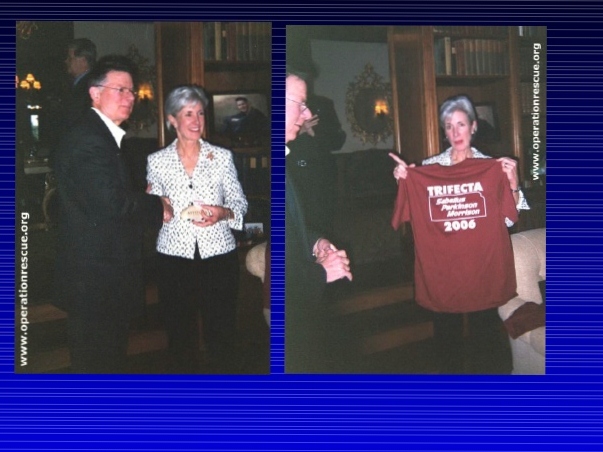
in Kansas.  One of the major beneficiaries was former Kansas Governor Kathleen Sebelius, now the Obama Secretary of Health and Human Services.  She collected tens of thousands from Tiller over the years and profitably helped keep the law off his back.

Kathleen Sebelius and ??

Tiller managed to circumvent Kansas law for thirty years.  He aborted the babies of many minors and did not report the sexual abuse or statutory rape as the law requires.  Kansas law also states that two physicians must authorize late term abortions and both certify that the abortion would prevent a “permanent and irreversible injury to a major bodily function” to the mother, an occurrence that was used by Tiller in 414 cases in 2005 alone.  When these were investigated by Dr. Paul McHugh, a psychiatrist contracted by the Kansas Attorney General, he found only one or two that may have actually qualified.  Among the justifications were such things as delaying the mother’s education and missing a rock concert.  Link to Obama record on life issues

Ann Kristen Neuhaus

The abortionist who helped to certify the abortions, Dr. Ann Kristen Neuhaus, had her license to practice medicine revoked in 2012 after a six year effort, when she was found to have participated in numerous illegal late term abortions while working with Tiller.  She routinely used a computer multiple choice quiz for her psychological “evaluations”, and in some cases never met the patient. Tiller had announced his intention to voluntarily surrender his license and retire in 2009, when he was shot dead through the eye while in church.  Which church is hard to imagine.  His killer was sentenced to life imprisonment.

Tiller and Churchill.  A tale of two doctors.  Your call.

Angela and the girls

3 Comments

Filed under Culture views

Maine Tales 2

Tumbledown and Webb Lake

Lew’s Country Store ran tabs for local residents in a spiral notebook, which we would pay every couple of weeks or when we got around to it.  If the tally got too high, Lew Flewelling would quietly signal us over when we came into the store.  No beer and wine could be put on the cuff: state law required cash only, and Lew assiduously complied.   Lew was trusting, but not uniquely so.

Once, when Rita did her biweekly shopping in Augusta, the total came to over fifty dollars, which now 35 years later would be inflated to nearly $200.  She went into her purse juggling two kids and found no checkbook.  Debit and credit cards were not an option, and she didn’t have nearly enough cash.  The IGA was a large chain, and she didn’t know anyone nor did anyone know her, Augusta being nearly thirty miles from home.  The register clerk took her name and town, and then casually sent her home with the groceries, “Don’t worry about it.  Pay us next time through.”  He didn’t even check her driver’s license.

The street level of Lew’s store had canned goods, boxed cereal, sugar and bags of flour, spices, fresh local vegetables, dairy and eggs, household goods like clothespins and paper towels, paperbacks, magazines, newspapers, postcards, wheels of cheddar, a coffee counter (one flavor – dark and fresh, cream and sugar only), snacks, gloves and some work wear clothing – mostly warm; downstairs held a large selection of hand tools, axes and hickory or ash axe handles, splitting mauls, shovels, rakes, sheet metal wood stove parts, snowshoes, hardware, nails, nuts, bolts and miscellany  – a classic, “if we don’t have it, you don’t need it” establishment.  Lew’s was a clearing house for information, and a venue for impromptu conversation.

We learned, among many other things, how to prepare our old barn of a house for winter: at least six cords of wood, 8 mil black poly secured with nailed lath strips about 10 inches up from the foundation and draped down to the ground with bales of hay pushed up against the plastic to insulate and protect from the wind.  Dry, cut-last-year maple, oak, ash and some apple wood would be delivered to our house for $25 a cord by Ray Hall, a local dairy farmer who also sold us raw milk.  A generous cord measure would come either in log length or 4’ pulp length.  Several weekends were consumed cutting it to fit the stoves and splitting it. A decent supply of kindling in bags from the dowel factory, mostly kiln dried birch dowel ends, sufficient oil for the lamps, and clean chimneys set us up to persevere.  We squirreled up canned pears and tomatoes from our trees and gardens; from our garden we froze peas, corn, and squash.  We kept a potato bin and some frozen black bear steaks.  Well, maybe not the bear.

Winter nights occasionally brought Northern lights, undulations of color that had a soft sound difficult to describe.  Without the interference of city lights, on a cloudless night, no moon was needed to walk; the stars were sufficient with the January constellations like Orion, Taurus and Gemini bright against the backdrop of countless stars that are muted near towns.  The illumination that hit our eyes began its journey from some of those points of light 100,000 years before man walked, putting our infinitesimally small scope, reach and understanding into stark perspective.

Loon with chick

Summers in the lakes and rivers and garden were close to paradise with warm, sunny days and cool evenings, but that was after we got through the snow up to the windows and frightening cold of winter, then mud season with frost heaves that could send the unprepared airborne in their pickup trucks, and then followed black fly and no-see-um season until the misty dawn over the lake echoed again with the 10,000 year old haunting calls of the Common Loon. (click link to hear)

Society and social life exposed a sometimes desperately needed relief from cabin fever, and a darker side of country living.  Pleasant communal Grange Hall pot luck suppers, occasional amateur locally written and directed theatre (e.g. the Mount Vernon “Abu Dubai” musical review, with elaborately painted camels, tents and palm tree sets – so woefully abysmal, it was very entertaining) and regular house parties.  Witty repartee was held in high regard. Parties ranged from fairly sophisticated wine and cheese affairs with side entertainment of a shared nude wood fired sauna to Tunney Leighton’s annual barn party in late February with many smoking homegrown weed and tapping into the previous fall’s apple cider kegs.  The barn party started Friday night, and continued with momentary respite through Sunday afternoon as people came and went and came again.

The seventies were experiencing the full onslaught of the ‘sexual revolution’, and rural culture, especially relocated back-to-the-land culture, was not exempted.  In fact, to some degree the nature worshipping, almost pantheistic, setting was ground zero.  Many marriages hit the shoals.  One indelible memory of Tunney’s barn party was a mixed couple (by mixed, you may infer a male and a female both married to other people) openly making unrestrained love in a snow bank with the temperature a balmy fifteen above.  Apple cider is subtle, sudden and devastating.

Two of the mavens of “upper” society in town were a couple who frequently entertained.  He was a psychiatrist, and she a part-time professor of English literature at the local campus of the University of Maine. Much time must have been spent tweaking the list of invited callers.  Their gatherings were of the wine and dope variety with particular and skilled attention paid to poking the visitors into untoward personal revelations and conflicts, then lighting up the pipe and watching the fun.  Like a good game of “Get the Guests” from “Who’s Afraid of Virginia Woolf”.

Our own marriage barely survived the third winter.  Only a kindly neighbor and a return to the faith of our youth saved us.  Country life is or can be idyllic, but it does not provide a panacea to cultural ills, urban stress or inner demons.  The beauty and peaceful surroundings benefit only so far, then we must learn, mature, love, mutually sacrifice and deepen our faith.  Lacking spiritual healing, stunning mountain and lake vistas or moonless, starlit nights become commonplace, and merely pleasant, momentary distractions.

‘In Maine, there is a deeply ingrained sense that you can always get a little more use out of something.”  Tim Sample

4 Comments

Filed under Maine Tales

Maine Tales 1

We lived in rural central Maine for just shy of a decade from the early seventies to the early eighties.  Idealistic, back to the land, modified hippies with jobs. Mount Vernon was in the lakes country about a half an hour north and west of Augusta, the state capital.  The town’s population was an eclectic mix:  fourth or fifth generation Maine Yankees; professionals with lots of letters after their names who taught in local universities, practiced law or medicine or worked for the state government; and a colorful subculture of neophyte farmers, sculptures, writers, painters and other artists who lived in hope, including the “poet laureate” of Maine, John Stevens, an eccentric given to public poetry recitations whether scheduled or uninvited at any gathering.  Many of us were amateur musicians, had large gardens, raised livestock, canned our food, heated with wood and lived in old houses or converted barns. Many, also, were looking for an escape, new connections, new meaning, which we, after a long, hard journey found, just not where we had expected it.

Lake Minnehonk

Twelve lakes graced this pretty land of rolling hills, farms and forest.  The summer months, both of them, blew the town’s population up from 600 to over 2,000.  Our first house was an ill advised, but romantic, small converted post and beam barn off the Vienna Road (pronounced Vy-anna) with two wood burning stoves: a sky blue porcelain Glenwood cook stove and an antique, side loading, cast iron parlor stove with a lovely 5” porcelain medallion with an enigmatic woman’s face.  We had three large rooms, one of which we used for our two young children’s bedroom, a living room and a dining room in addition to a small back room, used as an office.  A tiny galley kitchen on the south end of the house led directly into an even tinier bathroom with a shower and toilet.

Adult sleeping accommodations were a choice of two open  lofts that we accessed with a rough pole ladder.  Each loft had a floor of painted pine planks supported by cedar poles with the bark still on them across the full width of the room. In the winter we used the one over half of the living room, the rest being open cathedral ceilings.  Summers, we moved the mattress into the dining room loft, which had a window and good ventilation.  Set back from the road a hundred feet, the driveway ended in a ‘door yard’ at the foot of a small hill, which we would climb over and down to enter the front door.  The north end of the living room faced out to a stone wall and a field with the beginnings of the western mountains beyond. In a bad winter, snow would drift halfway up the north and east windows.

On the back end of our five acre wooded lot, about thirty feet in elevation higher than the house, we had a spring house.  The pipe ran 400’ down the slope dug deep about three feet to the ledge.  Even when the electricity and the pump went out, there was sufficient gravity pressure to supply a good flow.  We moved in towards the end of the winter, and the house hadn’t been occupied for a month. Unused, the pipe froze solid going up to the springhouse, and we hand carried water two buckets at a time for the first two months in residence until the frost went out.  After a couple of tumbles on the hill, the spilled water turned the path to a steep icy slide. Baths were in a galvanized tin tub set for warmth next to the cook stove, which heated up large pans of water.  With two small children, I designated my wife, Saint Rita.

The native Mainers were friendly, but reticent with a wait and see attitude towards newcomers until they saw you could learn to bear the winter, which hit twenty below, and stick it out.  I was a lumber salesman traveling the state, so the jury was definitely out.  Our first spring, looking for extra income, I advertised by word of mouth that I was a licensed arborist.  Phil and Mimi Judd lived in a gracious large colonial with an open front yard directly across the main street from Lew’s Country Store, which was on the shore of Lake Minnehonk next to the post office.  In the Mount Vernon universe, Lew’s was the center.  Nestled close to the front right of the Judd house was a ninety foot American Elm stricken with Dutch Elm Disease and doomed.

On a warm early June Saturday, I tackled the elm, hiring the help of local character, “Tunney” Leighton, who had a backhoe.  He ran the ground ropes while we lowered on a one inch rope from the house side of the tree several large leaders that extended out over the center chimney and the roof.  I was tied in near the top with another line.  After we had sufficient weight off the back side, and would clear the chimney, to be safe we ran the 1” “bull” line from three quarters up the tree through a block pulley secured in a white spruce set in the front corner of the yard. Tunney put a steady pull on it with the backhoe.  The base of the tree was about 42 inches in diameter; I cut a notch in the front of the tree, checked the fall area and started the back cut to drop the elm into the front yard.  By this time, half the town was in attendance.  I knew if I buried the tree into the attic, I had done my last tree work in Mount Vernon.   The tree broke correctly and accelerated to a booming crash with pieces of dead elm scattering into the street.

A couple of weeks later, Everett Williams drove into my door yard in his pick up truck.  Everett was the “rudd cummissiona” (road commissioner) and chairman of the town selectmen. He and his wife, Hope, were fourth generation Mount Vernon residents.   I was on my white cedar shingle roof with my trusty chainsaw installing a new Sear’s triple insulated metal chimney for the cook stove.  Any Mainer will tell you to cut the stove pipe out a side wall and corbel the metal chimney up an outside wall, not through the roof, but I was following the certified Sears directions.  Everett watched me silently, probably to his amusement.

I shut off the saw when I saw him and greeted him.  He yelled up, “Does your roof leak?”   I replied back a little indignantly, “No, it doesn’t leak!”  Everett finished his end of the conversation with, “If I had a roof that didn’t leak, I wouldn’t cut a hole in it.”  It was classic Maine Yankee, and I found out as I got to know him, meant kindly.  Of course, he was right, and we always had ice dams and dribbles in around the chimney as long as we lived there.  His visit meant that after the elm tree, the long time residents decided there was more to us than flat lander, temporary dreamy interlopers, and the path to full acceptance was open.

4 Comments

Filed under Maine Tales

Hunger Games

A trademark of the National Socialist German Workers Party was meticulous central planning.  Adolph Hitler had a plan for everything.  And everyone.  Hitler remembered well Napoleon’s admonition that an army marches on its stomach and was determined that this time around Germany would not lose the food war.  Both supply and demand had to be addressed.

To secure a steady food source for the German people, Hitler’s design for his Lebensraum (‘living space’) was a fertile land of about 20 million acres east of Germany. That this acreage was then occupied and governed by Slavs, Poles and Russians was an inconvenient speed bump. In his “Hunger Plan”, his preparation for the demand side was just as direct: to cut down the “useless eaters” by cutting off their food or killing them more expeditiously.  Chief among the eaters were Jews, Slavs, Poles, Russians, the disabled, the mentally challenged and the “degenerates” such as homosexuals. His implementation was carried out efficiently with accurate records kept along the way.  Many were murdered outright; many more died of deprivation and starvation.

Before we indulge in self congratulatory smugness about our moral superiority to the Nazi monsters, examine a few instances where this type of utilitarian ethic presents itself in our own time and culture.  In the most recent edition of the Journal for Medical Ethics there was an article entitled, “After Birth Abortion:  Why should the baby live?” by Alberto Giubilini and Francesca Minerva.   The authors contend that all the reasons for abortion should be equally valid for new born infants.  If the infant is disabled or imperfect in any way, it is a given that they can be eliminated since newborns are just another species of “potential” human being.  They blandly state that other justifications would include health and inconvenience for the mother, such as a new job offer, financial stress or they just don’t like the kid, so it would be difficult for the family. Up until some time line in the sand to be determined, the contention is that a “potential” human being (or “useless eater”) can be put down like an old blind dog.  We already have a euphemism, not infanticide, but “after birth abortion”.

This is not a new argument.  Peter Singer, President Clinton’s bioethics advisor, was the founder of the animal rights movement.  Within that PETA group, it is dogma that an animal’s life is morally equivalent to a human life.  Dr. Singer, still a bioethics professor at Princeton, published an article forty years ago entitled, “Killing Babies Isn’t Always Wrong”.  The bizarre twist to this is that with the current interpretation of the law, killing a baby (read ‘aborting a fetus’) is permissible up until the moment of birth.  Why is Dr. Singer’s, Dr. Giubilini’s and Dr. Minerva’s position any different ethically than current law?  The answer, of course, is that it isn’t, but merely a natural extension of accepted principle.

A subtle, but nonetheless troubling, example of a utilitarian perspective occurred just a few weeks ago from the Obama administration.  HHS Secretary Kathleen Sebelius deliberately ran rough shod over first amendment religious freedom with the administration’s edict to force private Catholic institutions to contract with health insurance companies to provide abortifacient drugs and contraceptive drugs, clearly violating the Church’s moral law.  President Obama offered a transparent and cynical “compromise”, when they protested.  Don’t worry, he patronized, we’ll just make the insurance companies pay for it.  The American bishops responded with the obvious – that insurance companies won’t put these drugs on their bill, but would certainly build the costs into their rates.

Here’s the rub. The president’s rejoinder to the bishops? The insurance companies wouldn’t have to charge because dispensing contraceptives and abortifacient drugs saved them money; it’s cheaper than having babies.  Chemical contraceptives act as abortifacients on occasion and for some like the “morning after” pill, it is their intention.   Think about the ethic that undergirds the president’s rationale for a moment.  What should make this morally acceptable to the bishops and people of faith, according to the president, is that the insurance companies can afford to give these drugs away because it saves them money.  As long as it costs less to abort a baby than to carry her to term, the moral calculus works for the insurance company, so it should be acceptable to the Church.

Utilitarian ethical theory, developed over two hundred years ago by John Stuart Mill and others, differs profoundly from deontological (or rule based) ethics.  Traditional Socratic ethics teaches that true happiness comes from doing what is right; for the utilitarian, happiness is the first goal, and the “right” is fungible.  The utilitarian holds that the overriding standard is the greatest good for the greatest number. What works, not what is right.   Killing, stealing, lying, cheating, breaking promises and manipulation are not intrinsically evil.  Nothing is intrinsically evil; what is good is what serves the greater good and happiness of the many. Understood, but unspoken is the axiom that the intellectual and power elite get to determine who is to be made happy.  And who is to be made dead.

from Psalm 31

Affliction has broken down my strength

and my bones waste away.

I am like a dead man, forgotten,

like a thing thrown away.

My life is in your hands, deliver me

from the hands of those who hate me.

2 Comments

Filed under Culture views