Author Archives: jparquette

jparquette's avatar

About jparquette

Fortunate and blessed in companionship with my wife of fifty seven years, in health and in modest, but more than adequate circumstances. Life is good.

Tale of Two Doctors

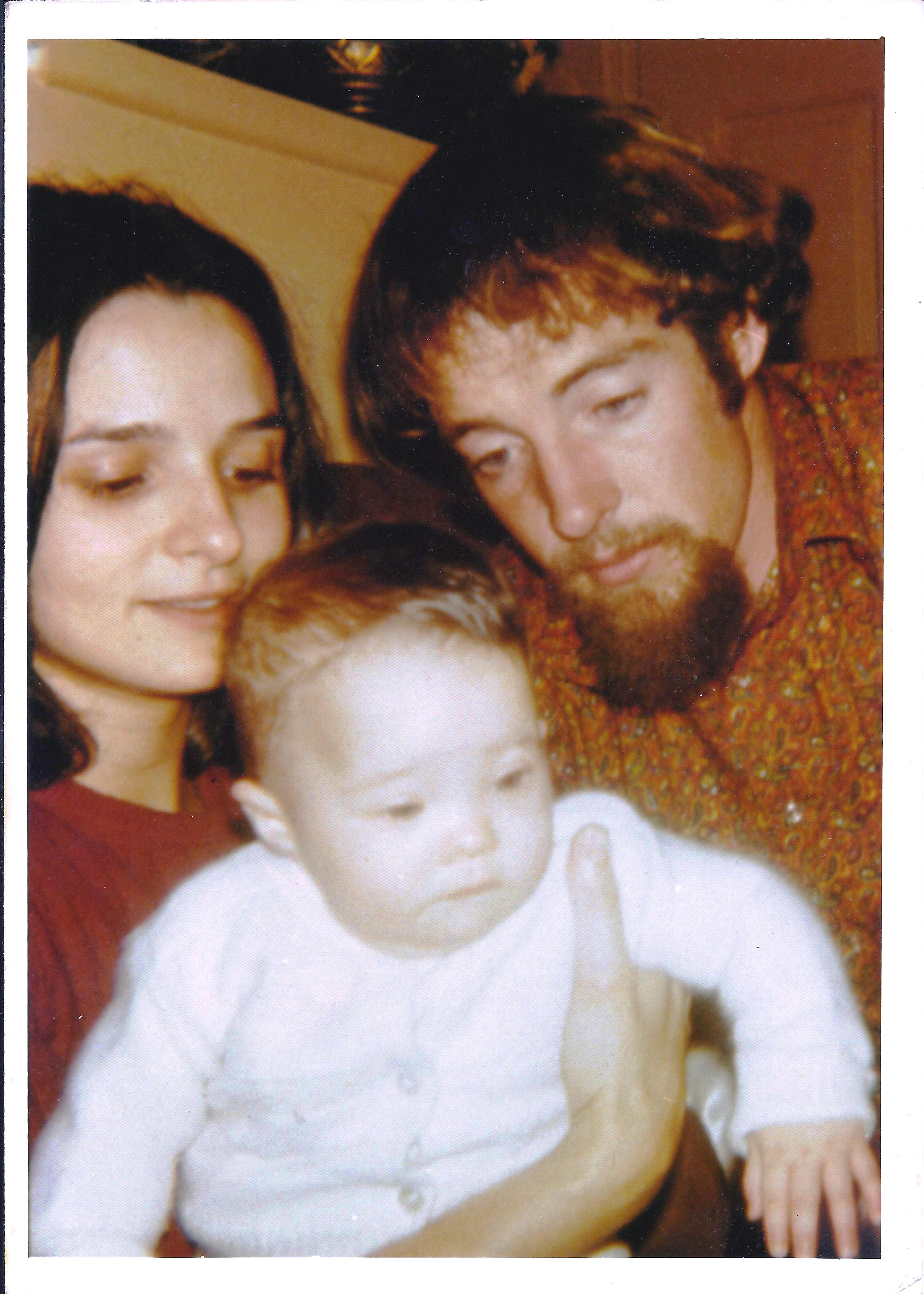
When we were in our early thirties and living in Maine, Rita gave birth to Angela in Portland.  She was 2 pounds, 6 ounces at birth and 28 weeks in the womb.  She spent the next seven weeks in the neonatal intensive care units of Maine Medical Centers in Portland and Lewiston.  Angela now has two beautiful daughters of her own (Gianna and Elena), a great husband as well as a master’s degree in education.   Since Rita’s own OB_GYN doctor lived ninety miles north and near where we lived, the second year resident who delivered her was Dr. Bruce Churchill.  He carefully explained to us what to expect and that because of her early arrival, she most likely wouldn’t cry; that was the only thing he was wrong about.  Angela was a fighter from the jump.

Dr. Bruce Churchill

Dr. Churchill’s grace under pressure, skill and personal warmth will never be forgotten by us.  He was named “Physician of the Year” by the Portland newspaper in 2000.  At one point during those trying first few weeks, he offered us the second bedroom in his apartment because of the travel required by Rita’s successful effort to establish her nursing.  She initially used a breast pump and delivered frozen milk in half ounce containers, which the nurses would feed to Angela a little at a time.  When researching this post, we learned that Dr. Churchill was diagnosed with ALS (Lou Gehrig disease) in 2006, but continues to practice at the Coastal Woman’s Healthcare Center in Scarborough. He and his wife, Cindy, lead the annual ALS march in Portland to raise research funds to fight his terminal disease.  He was the varsity girl’s volleyball assistant coach at Greeley High School.  The annual girls volleyball state championship tournament has been renamed “The Bruce Churchill Classic”.  He specializes in adolescent care and menopause.  His increasing disability forced him to stop delivering babies in 2008.  Not many deserve the honorific, “Doctor” more than Bruce.

The other end of the spectrum fell in Kansas.

Kelly was fourteen and pregnant since she was thirteen.  When her baby was twenty weeks developed, and after four days in a Wichita, Kansas motel during which time her cervix was incrementally dilated, her womb and amniotic fluid were injected with a saline or urea solution.  The baby swallows the stuff; she suffers burned skin and is poisoned.  A saline poisoned baby can take up to an hour to die.  A baby at twenty weeks recognizes her mother’s voice, moves her mouth, grasps, blinks, has hair and fingernails; her gender is distinguishable with ultrasound, and she feels pain.  Kelly was taken into a room with four or five other mothers and awaited the doctor’s order to bring her to a smaller room that served as the final solution.  The nurses instructed her to sit on what resembled a toilet and push.  Her dead baby fell into the toilet.  The remains of the babies were burned in an incinerator, which emitted smoke not unlike the smoke produced at veterinarian clinics or Auschwitz. Link to interview with Kelly.

Dr. George Tiller

Dr. George Tiller owned one of the three abortion facilities nationwide that performed late term abortions into the final month of pregnancy, killing many babies as developed or more developed than our Angela. Until the procedure named as “partial birth abortion” was banned in 2003, Tiller did them. This “intact dilation and extraction” method involved turning the baby and delivering all but the baby’s head, then jamming a pair of surgical scissors into the baby’s head and opening them, finally inserting a vacuum catheter in the wound. The baby’s brain is sucked out, collapsing the skull.  After this barbarity was proscribed, Tiller was left with two still legal procedures for late term abortions: the saline burn and poison method and the other D&E (Dilation and Extraction).  The cervix is dilated and forceps are used to literally tear the baby limb from limb, twisting legs off like one would test a cooked chicken, crushing the skull, snapping the spine and pulling the baby out piece by piece.  In most states, if someone is convicted of doing this to a live guinea pig, they will go to jail for up to five years.

Tiller’s clinic performed between 50,000 and 60,000 abortions during his career, which exceeds the total number of Americans killed in Vietnam, Iraq and Afghanistan.  His father was also a physician and did illegal abortions before Roe v Wade, a mentor while young George was growing up starting a multigenerational thriving business.   Tiller made millions and donated to many politicians through his ProKanDo PAC.  ProKanDo was the largest PAC

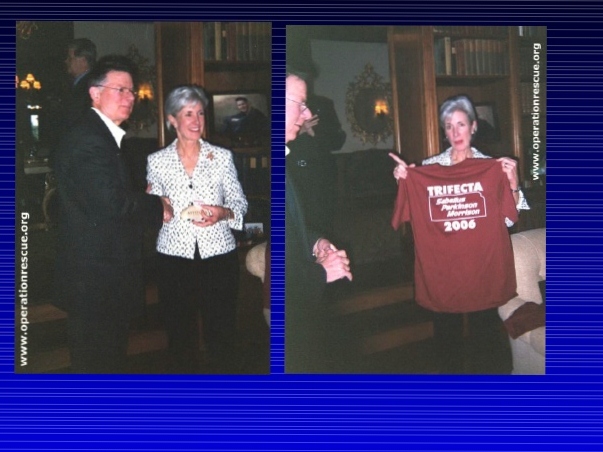
Tiller and Sebelius

in Kansas.  One of the major beneficiaries was former Kansas Governor Kathleen Sebelius, now the Obama Secretary of Health and Human Services.  She collected tens of thousands from Tiller over the years and profitably helped keep the law off his back.

Kathleen Sebelius and ??

Tiller managed to circumvent Kansas law for thirty years.  He aborted the babies of many minors and did not report the sexual abuse or statutory rape as the law requires.  Kansas law also states that two physicians must authorize late term abortions and both certify that the abortion would prevent a “permanent and irreversible injury to a major bodily function” to the mother, an occurrence that was used by Tiller in 414 cases in 2005 alone.  When these were investigated by Dr. Paul McHugh, a psychiatrist contracted by the Kansas Attorney General, he found only one or two that may have actually qualified.  Among the justifications were such things as delaying the mother’s education and missing a rock concert.  Link to Obama record on life issues

Ann Kristen Neuhaus

The abortionist who helped to certify the abortions, Dr. Ann Kristen Neuhaus, had her license to practice medicine revoked in 2012 after a six year effort, when she was found to have participated in numerous illegal late term abortions while working with Tiller.  She routinely used a computer multiple choice quiz for her psychological “evaluations”, and in some cases never met the patient. Tiller had announced his intention to voluntarily surrender his license and retire in 2009, when he was shot dead through the eye while in church.  Which church is hard to imagine.  His killer was sentenced to life imprisonment.

Tiller and Churchill.  A tale of two doctors.  Your call.

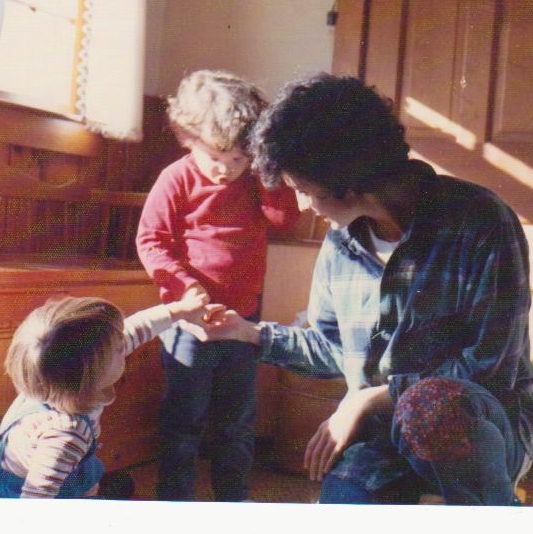
Angela and the girls

3 Comments

Filed under Culture views

Maine Tales 2

Tumbledown and Webb Lake

Lew’s Country Store ran tabs for local residents in a spiral notebook, which we would pay every couple of weeks or when we got around to it.  If the tally got too high, Lew Flewelling would quietly signal us over when we came into the store.  No beer and wine could be put on the cuff: state law required cash only, and Lew assiduously complied.   Lew was trusting, but not uniquely so.

Once, when Rita did her biweekly shopping in Augusta, the total came to over fifty dollars, which now 35 years later would be inflated to nearly $200.  She went into her purse juggling two kids and found no checkbook.  Debit and credit cards were not an option, and she didn’t have nearly enough cash.  The IGA was a large chain, and she didn’t know anyone nor did anyone know her, Augusta being nearly thirty miles from home.  The register clerk took her name and town, and then casually sent her home with the groceries, “Don’t worry about it.  Pay us next time through.”  He didn’t even check her driver’s license.

The street level of Lew’s store had canned goods, boxed cereal, sugar and bags of flour, spices, fresh local vegetables, dairy and eggs, household goods like clothespins and paper towels, paperbacks, magazines, newspapers, postcards, wheels of cheddar, a coffee counter (one flavor – dark and fresh, cream and sugar only), snacks, gloves and some work wear clothing – mostly warm; downstairs held a large selection of hand tools, axes and hickory or ash axe handles, splitting mauls, shovels, rakes, sheet metal wood stove parts, snowshoes, hardware, nails, nuts, bolts and miscellany  – a classic, “if we don’t have it, you don’t need it” establishment.  Lew’s was a clearing house for information, and a venue for impromptu conversation.

We learned, among many other things, how to prepare our old barn of a house for winter: at least six cords of wood, 8 mil black poly secured with nailed lath strips about 10 inches up from the foundation and draped down to the ground with bales of hay pushed up against the plastic to insulate and protect from the wind.  Dry, cut-last-year maple, oak, ash and some apple wood would be delivered to our house for $25 a cord by Ray Hall, a local dairy farmer who also sold us raw milk.  A generous cord measure would come either in log length or 4’ pulp length.  Several weekends were consumed cutting it to fit the stoves and splitting it. A decent supply of kindling in bags from the dowel factory, mostly kiln dried birch dowel ends, sufficient oil for the lamps, and clean chimneys set us up to persevere.  We squirreled up canned pears and tomatoes from our trees and gardens; from our garden we froze peas, corn, and squash.  We kept a potato bin and some frozen black bear steaks.  Well, maybe not the bear.

Winter nights occasionally brought Northern lights, undulations of color that had a soft sound difficult to describe.  Without the interference of city lights, on a cloudless night, no moon was needed to walk; the stars were sufficient with the January constellations like Orion, Taurus and Gemini bright against the backdrop of countless stars that are muted near towns.  The illumination that hit our eyes began its journey from some of those points of light 100,000 years before man walked, putting our infinitesimally small scope, reach and understanding into stark perspective.

Loon with chick

Summers in the lakes and rivers and garden were close to paradise with warm, sunny days and cool evenings, but that was after we got through the snow up to the windows and frightening cold of winter, then mud season with frost heaves that could send the unprepared airborne in their pickup trucks, and then followed black fly and no-see-um season until the misty dawn over the lake echoed again with the 10,000 year old haunting calls of the Common Loon. (click link to hear)

Society and social life exposed a sometimes desperately needed relief from cabin fever, and a darker side of country living.  Pleasant communal Grange Hall pot luck suppers, occasional amateur locally written and directed theatre (e.g. the Mount Vernon “Abu Dubai” musical review, with elaborately painted camels, tents and palm tree sets – so woefully abysmal, it was very entertaining) and regular house parties.  Witty repartee was held in high regard. Parties ranged from fairly sophisticated wine and cheese affairs with side entertainment of a shared nude wood fired sauna to Tunney Leighton’s annual barn party in late February with many smoking homegrown weed and tapping into the previous fall’s apple cider kegs.  The barn party started Friday night, and continued with momentary respite through Sunday afternoon as people came and went and came again.

The seventies were experiencing the full onslaught of the ‘sexual revolution’, and rural culture, especially relocated back-to-the-land culture, was not exempted.  In fact, to some degree the nature worshipping, almost pantheistic, setting was ground zero.  Many marriages hit the shoals.  One indelible memory of Tunney’s barn party was a mixed couple (by mixed, you may infer a male and a female both married to other people) openly making unrestrained love in a snow bank with the temperature a balmy fifteen above.  Apple cider is subtle, sudden and devastating.

Two of the mavens of “upper” society in town were a couple who frequently entertained.  He was a psychiatrist, and she a part-time professor of English literature at the local campus of the University of Maine. Much time must have been spent tweaking the list of invited callers.  Their gatherings were of the wine and dope variety with particular and skilled attention paid to poking the visitors into untoward personal revelations and conflicts, then lighting up the pipe and watching the fun.  Like a good game of “Get the Guests” from “Who’s Afraid of Virginia Woolf”.

Our own marriage barely survived the third winter.  Only a kindly neighbor and a return to the faith of our youth saved us.  Country life is or can be idyllic, but it does not provide a panacea to cultural ills, urban stress or inner demons.  The beauty and peaceful surroundings benefit only so far, then we must learn, mature, love, mutually sacrifice and deepen our faith.  Lacking spiritual healing, stunning mountain and lake vistas or moonless, starlit nights become commonplace, and merely pleasant, momentary distractions.

‘In Maine, there is a deeply ingrained sense that you can always get a little more use out of something.”  Tim Sample

4 Comments

Filed under Maine Tales

Maine Tales 1

We lived in rural central Maine for just shy of a decade from the early seventies to the early eighties.  Idealistic, back to the land, modified hippies with jobs. Mount Vernon was in the lakes country about a half an hour north and west of Augusta, the state capital.  The town’s population was an eclectic mix:  fourth or fifth generation Maine Yankees; professionals with lots of letters after their names who taught in local universities, practiced law or medicine or worked for the state government; and a colorful subculture of neophyte farmers, sculptures, writers, painters and other artists who lived in hope, including the “poet laureate” of Maine, John Stevens, an eccentric given to public poetry recitations whether scheduled or uninvited at any gathering.  Many of us were amateur musicians, had large gardens, raised livestock, canned our food, heated with wood and lived in old houses or converted barns. Many, also, were looking for an escape, new connections, new meaning, which we, after a long, hard journey found, just not where we had expected it.

Lake Minnehonk

Twelve lakes graced this pretty land of rolling hills, farms and forest.  The summer months, both of them, blew the town’s population up from 600 to over 2,000.  Our first house was an ill advised, but romantic, small converted post and beam barn off the Vienna Road (pronounced Vy-anna) with two wood burning stoves: a sky blue porcelain Glenwood cook stove and an antique, side loading, cast iron parlor stove with a lovely 5” porcelain medallion with an enigmatic woman’s face.  We had three large rooms, one of which we used for our two young children’s bedroom, a living room and a dining room in addition to a small back room, used as an office.  A tiny galley kitchen on the south end of the house led directly into an even tinier bathroom with a shower and toilet.

Adult sleeping accommodations were a choice of two open  lofts that we accessed with a rough pole ladder.  Each loft had a floor of painted pine planks supported by cedar poles with the bark still on them across the full width of the room. In the winter we used the one over half of the living room, the rest being open cathedral ceilings.  Summers, we moved the mattress into the dining room loft, which had a window and good ventilation.  Set back from the road a hundred feet, the driveway ended in a ‘door yard’ at the foot of a small hill, which we would climb over and down to enter the front door.  The north end of the living room faced out to a stone wall and a field with the beginnings of the western mountains beyond. In a bad winter, snow would drift halfway up the north and east windows.

On the back end of our five acre wooded lot, about thirty feet in elevation higher than the house, we had a spring house.  The pipe ran 400’ down the slope dug deep about three feet to the ledge.  Even when the electricity and the pump went out, there was sufficient gravity pressure to supply a good flow.  We moved in towards the end of the winter, and the house hadn’t been occupied for a month. Unused, the pipe froze solid going up to the springhouse, and we hand carried water two buckets at a time for the first two months in residence until the frost went out.  After a couple of tumbles on the hill, the spilled water turned the path to a steep icy slide. Baths were in a galvanized tin tub set for warmth next to the cook stove, which heated up large pans of water.  With two small children, I designated my wife, Saint Rita.

The native Mainers were friendly, but reticent with a wait and see attitude towards newcomers until they saw you could learn to bear the winter, which hit twenty below, and stick it out.  I was a lumber salesman traveling the state, so the jury was definitely out.  Our first spring, looking for extra income, I advertised by word of mouth that I was a licensed arborist.  Phil and Mimi Judd lived in a gracious large colonial with an open front yard directly across the main street from Lew’s Country Store, which was on the shore of Lake Minnehonk next to the post office.  In the Mount Vernon universe, Lew’s was the center.  Nestled close to the front right of the Judd house was a ninety foot American Elm stricken with Dutch Elm Disease and doomed.

On a warm early June Saturday, I tackled the elm, hiring the help of local character, “Tunney” Leighton, who had a backhoe.  He ran the ground ropes while we lowered on a one inch rope from the house side of the tree several large leaders that extended out over the center chimney and the roof.  I was tied in near the top with another line.  After we had sufficient weight off the back side, and would clear the chimney, to be safe we ran the 1” “bull” line from three quarters up the tree through a block pulley secured in a white spruce set in the front corner of the yard. Tunney put a steady pull on it with the backhoe.  The base of the tree was about 42 inches in diameter; I cut a notch in the front of the tree, checked the fall area and started the back cut to drop the elm into the front yard.  By this time, half the town was in attendance.  I knew if I buried the tree into the attic, I had done my last tree work in Mount Vernon.   The tree broke correctly and accelerated to a booming crash with pieces of dead elm scattering into the street.

A couple of weeks later, Everett Williams drove into my door yard in his pick up truck.  Everett was the “rudd cummissiona” (road commissioner) and chairman of the town selectmen. He and his wife, Hope, were fourth generation Mount Vernon residents.   I was on my white cedar shingle roof with my trusty chainsaw installing a new Sear’s triple insulated metal chimney for the cook stove.  Any Mainer will tell you to cut the stove pipe out a side wall and corbel the metal chimney up an outside wall, not through the roof, but I was following the certified Sears directions.  Everett watched me silently, probably to his amusement.

I shut off the saw when I saw him and greeted him.  He yelled up, “Does your roof leak?”   I replied back a little indignantly, “No, it doesn’t leak!”  Everett finished his end of the conversation with, “If I had a roof that didn’t leak, I wouldn’t cut a hole in it.”  It was classic Maine Yankee, and I found out as I got to know him, meant kindly.  Of course, he was right, and we always had ice dams and dribbles in around the chimney as long as we lived there.  His visit meant that after the elm tree, the long time residents decided there was more to us than flat lander, temporary dreamy interlopers, and the path to full acceptance was open.

4 Comments

Filed under Maine Tales

Hunger Games

A trademark of the National Socialist German Workers Party was meticulous central planning.  Adolph Hitler had a plan for everything.  And everyone.  Hitler remembered well Napoleon’s admonition that an army marches on its stomach and was determined that this time around Germany would not lose the food war.  Both supply and demand had to be addressed.

To secure a steady food source for the German people, Hitler’s design for his Lebensraum (‘living space’) was a fertile land of about 20 million acres east of Germany. That this acreage was then occupied and governed by Slavs, Poles and Russians was an inconvenient speed bump. In his “Hunger Plan”, his preparation for the demand side was just as direct: to cut down the “useless eaters” by cutting off their food or killing them more expeditiously.  Chief among the eaters were Jews, Slavs, Poles, Russians, the disabled, the mentally challenged and the “degenerates” such as homosexuals. His implementation was carried out efficiently with accurate records kept along the way.  Many were murdered outright; many more died of deprivation and starvation.

Before we indulge in self congratulatory smugness about our moral superiority to the Nazi monsters, examine a few instances where this type of utilitarian ethic presents itself in our own time and culture.  In the most recent edition of the Journal for Medical Ethics there was an article entitled, “After Birth Abortion:  Why should the baby live?” by Alberto Giubilini and Francesca Minerva.   The authors contend that all the reasons for abortion should be equally valid for new born infants.  If the infant is disabled or imperfect in any way, it is a given that they can be eliminated since newborns are just another species of “potential” human being.  They blandly state that other justifications would include health and inconvenience for the mother, such as a new job offer, financial stress or they just don’t like the kid, so it would be difficult for the family. Up until some time line in the sand to be determined, the contention is that a “potential” human being (or “useless eater”) can be put down like an old blind dog.  We already have a euphemism, not infanticide, but “after birth abortion”.

This is not a new argument.  Peter Singer, President Clinton’s bioethics advisor, was the founder of the animal rights movement.  Within that PETA group, it is dogma that an animal’s life is morally equivalent to a human life.  Dr. Singer, still a bioethics professor at Princeton, published an article forty years ago entitled, “Killing Babies Isn’t Always Wrong”.  The bizarre twist to this is that with the current interpretation of the law, killing a baby (read ‘aborting a fetus’) is permissible up until the moment of birth.  Why is Dr. Singer’s, Dr. Giubilini’s and Dr. Minerva’s position any different ethically than current law?  The answer, of course, is that it isn’t, but merely a natural extension of accepted principle.

A subtle, but nonetheless troubling, example of a utilitarian perspective occurred just a few weeks ago from the Obama administration.  HHS Secretary Kathleen Sebelius deliberately ran rough shod over first amendment religious freedom with the administration’s edict to force private Catholic institutions to contract with health insurance companies to provide abortifacient drugs and contraceptive drugs, clearly violating the Church’s moral law.  President Obama offered a transparent and cynical “compromise”, when they protested.  Don’t worry, he patronized, we’ll just make the insurance companies pay for it.  The American bishops responded with the obvious – that insurance companies won’t put these drugs on their bill, but would certainly build the costs into their rates.

Here’s the rub. The president’s rejoinder to the bishops? The insurance companies wouldn’t have to charge because dispensing contraceptives and abortifacient drugs saved them money; it’s cheaper than having babies.  Chemical contraceptives act as abortifacients on occasion and for some like the “morning after” pill, it is their intention.   Think about the ethic that undergirds the president’s rationale for a moment.  What should make this morally acceptable to the bishops and people of faith, according to the president, is that the insurance companies can afford to give these drugs away because it saves them money.  As long as it costs less to abort a baby than to carry her to term, the moral calculus works for the insurance company, so it should be acceptable to the Church.

Utilitarian ethical theory, developed over two hundred years ago by John Stuart Mill and others, differs profoundly from deontological (or rule based) ethics.  Traditional Socratic ethics teaches that true happiness comes from doing what is right; for the utilitarian, happiness is the first goal, and the “right” is fungible.  The utilitarian holds that the overriding standard is the greatest good for the greatest number. What works, not what is right.   Killing, stealing, lying, cheating, breaking promises and manipulation are not intrinsically evil.  Nothing is intrinsically evil; what is good is what serves the greater good and happiness of the many. Understood, but unspoken is the axiom that the intellectual and power elite get to determine who is to be made happy.  And who is to be made dead.

from Psalm 31

Affliction has broken down my strength

and my bones waste away.

I am like a dead man, forgotten,

like a thing thrown away.

My life is in your hands, deliver me

from the hands of those who hate me.

2 Comments

Filed under Culture views

The Problem with Socialism

An article by Kevin Williamson earlier this month in National Review points out the fallacy of thinking Barack Obama a socialist because of his enthrallment with “spreading the wealth”.  Advocacy for large government deficit spending and tax policies tilted towards income redistribution are definitive of all modern liberalism and “progressive” politics, but they don’t make anyone a socialist.  The nucleus of socialism is central planning.  The Obama characteristic that firmly plants him in the socialist camp is his fixation with centrally planned solutions for the nation’s ills, irrespective of their consistent record of disappointment.

Few differences exist between the old five year plans of the Soviet Union for potato or wheat harvests and the “planned” objectives of 50% renewable energy or tax credits to increase purchases of electric cars or health care mandates. What will achieve real progress are competitive and practicable means of renewable energy sources, producing electric cars that anyone actually wants to drive at reasonable prices and facing squarely the many conundrums of modern health care.  Not arbitrary policies implemented by a cumbersome bureaucracy.

The European Union economies of Greece, Spain, Italy and even France are foundering not just because they spend more than they generate in wealth for entitlements, early retirements and “social justice” programs (although that is what is happening), but the root cause of failure is central planning itself.  Collapse occurs not because there aren’t plenty of brilliant true believers doing the planning, but because the premise of central planning is deeply flawed and unworkable.

This weekend’s Wall Street Journal carries an instructive editorial by Alberto Mingardi, the director general of the Intsituto Bruno Leoni, a Milan free market think tank. Link to editorial here.  In it, Mr. Mingardi cites Frederich A. Hayek’s Nobel Prize winning economic writings debunking the central planning myth.  Dr. Hayek is the author of the celebrated “Road to Serfdom”.  Central planning may have been feasible when humankind lived in small, insular groups which shared common values and metrics for measuring relative worth and achievement.  In modern, multifaceted states, there are too much data, too many variables, too many unknowns and too many destabilizing influences. Computer models are not capable of predicting the behavior of or the outcomes for small groups and individuals within this complexity.  Grandiose plans and goals predicated on these models are built on shifting sands.

The inherent waste and inefficiencies in outsized bureaucracy multiplies cost and diminishes the competence of any enterprise.  Corruption, internal wrangling and cronyism exacerbate the ineffectivness of solutions that do not solve and analgesics that do not relieve.  Our path out of the swamp cannot be found in unsound theories.  Socialism reads a lot better than it lives.

Socialism in general has a record of failure so blatant that only an intellectual could ignore or evade it.

Thomas Sowell

2 Comments

Filed under Politics and government

Losing the thread

The ancient Greek legends surrounding Prince Theseus have lessons for today.  Periodically, the king of Athens had agreed to send seven boys and seven girls to Crete to be fed to the Minotaur to appease King Minos.  The Athenian king’s son Theseus volunteered to be one of them, but said he would slay the creature to end the sacrifices.  The Princess Ariadne, daughter of King Minos of Crete, fell in love with Theseus and betrayed to him the secret of killing the Minotaur, a fearsome monster, which was half man with the head of a bull.  She smuggled Theseus a sword and a ball of twisted threads.  The Minotaur lived deep in an impossible labyrinth; the challenge for Theseus was to find his way out should he prevail over the monster.  He needed both a sword and then the twine to leave a trail back.

We have labyrinths today and seem to be losing the thread to find our way back.  A few anecdotes portray some of the twists in the maze.  Some of these seem trivial, but illustrate that we are becoming lost in some fundamental way and are confused about our priorities.    These are mostly unrelated, but seem somehow of a piece.

  •  In Belmont, Massachusetts recently, the animal control officer found a badly injured coyote.  Coyotes have become increasing vexing to suburban Boston communities, and Belmont is among the most affluent.  Twice in the last year, they have attacked children in Massachusetts, and routinely pet cats and small dogs disappear to coyote packs.  The town official didn’t dispatch the coyote to end its suffering.  No, she brought it to an animal rescue hospital in Grafton, MA, which at a cost to the taxpayers in excess of $2,000 nursed it back to health over three months.  The coyote was a fertile, young female, which they did not spay.  Then, of course, they brought it out to release in a remote part of Western Massachusetts, right?  No, it was released with great celebration to the “wilds” of Belmont to reunite with its pack mates.  Does this seem misguided to anyone else?
  • The Federal government has initiated a suit to set prices on e books because they are too high.  The Federal government apparently has solved all the problems of deficit spending, foreign wars, health care, poverty, education, religious freedom, Social Security and contraception, and has the time to turn their eye and insinuate their considerable power into the market place to “correct” the alleged malfeasance of publishers and book sellers.  What happened to a consumer shopping for a book, whether print or electronic, and if they could afford the price, buying it?
  • The Federal government subsidizes with tax credits the manufacture, construction and operating costs of windmill power.  Recently, the Bonneville Power Authority in the Pacific Northwest, another Federal agency, asked the local wind power producers to shut down their windmills seasonally.  Since the existing hydroelectric plants on the rivers produce all the power needed when the rivers are flowing strongly, the windmills were redundant, and their power had no place to flow.  The rivers flowing and the wind blowing tend to peak at the same time of the year. The dams, which are far less expensive per kilowatt hour to run, don’t kill birds and are equally renewable.  Dam generators need to run when the rivers are high because, if they don’t, the salmon run to spawn will be endangered.  The windmills have to stop and lie fallow, not unlike farm subsidies.  The BPA will pay the windmill owners up to $50 million per year to do nothing, and the wind will only howl.
  • The Justice Department has embarked on yet another crusade, most recently in Texas and South Carolina, to stop states from requiring identification of voters.  According to the department filing, voter photo IDs, even if provided free by the state to all who don’t have driver’s licenses, will have a disparate impact on the poor and minorities.  Voter fraud is a problem in many of the large cities where the dead cast their ballots early and often.  Since inner city votes favor almost entirely Democrat candidates, one might suspect an ulterior motive from Eric Holder, the current Attorney General.  Not so, says he.  His enthusiasm even with Fast and Furious, Supreme Court challenges to the health care mandate and myriad other pressing issues extends well above and beyond duty.  He has the time to decide how each state should determine who votes and how voter’s citizenship, right to vote and even their existence above the ground are verified.  Such dedication should not go unrecognized.
  • Finally, we drop all the way through the looking glass into Wonderland.  And the looking glass is a wavy fun mirror that distorts all reality.  The National Association for the Advancement of Colored People (NAACP) petitioned the United Nations Human Rights Council in Geneva to stop the same voter photo ID laws in the U.S., even though Indiana’s ID laws were upheld by our Supreme Court in 2008.  It seems that the U.N. should have more authority over U.S. laws than our courts.  Among the member nations on the U.N. Human Rights Council are such human rights luminaries as Cuba, Russia, China and Saudi Arabia, where women can’t vote at all.

We wander through the labyrinth running the thread through sweaty palms, just hoping to find our way back to the light.  Just a few of these cited twists and turns expose how tricky the journey is.

Marge, it takes two to lie. One to lie, and one to listen.  Homer Simpson

4 Comments

Filed under Culture views

No more pencils, no more books, no more teachers…..

Meg and her fiance Marty Gilbert

Mayor Bloomberg, complying with a court order under a Freedom of Information suit, recently released the test scores and rankings of 18,000 New York City teachers, publicly listing their names.  Rankings were based on their students’ performances in the standardized tests under the No Child Left Behind program begun during the Bush administration and continuing today.  The list purports to identify effective and ineffective teachers.  My daughter, Meg, now in her fourth year teaching in Harlem, posted a note on her Facebook page regarding this.  She was not damaged in this listing, but fine, dedicated colleagues she well knows to be hard working teachers were.   Here is an excerpt from her note addressed to Mayor Bloomberg:

“You do not consider the fact that many of these ‘ineffective’ teachers are attempting to teach children who enter their class severely deficient, are emotionally unstable, are living in shelters, are victims of domestic violence, have drug or alcohol addicted parents, are in the middle of child services cases or are even learning disabled, but are not yet labeled as such since the process to do so can take up to two years.

There are so many aspects that we, as teachers, deal with on a day to day basis.  I’d like to see you come into some of the underperforming neighborhoods of Harlem, Brooklyn, the Bronx and teach for one day.  You wouldn’t last an hour.

Why don’t you find out which children are failing these ridiculous tests that measures so little of their actual intelligence and ask their PARENTS why they continue to fail?  Every teacher knows that in order for a child to succeed, there needs to be a pyramid of effort.  The pyramid consists of the student, the teacher AND the parent.”

Since she took her job in NYC, Meg has related the horror stories to us of what her students face at home, if indeed, their domestic arrangements can be called a home.  And what she deals with daily with classroom disruptions, appalling student behavior and bureaucratic foolishness.  In her elementary school, NYPD police sit full time in the hallways – not security guards, but fully trained professional NYC cops.  Three major studies looked at why students fail or succeed in the United States and illuminate these issues.  These were cited in Dr. Charles Murray’s noteworthy book, “Real Education”.

The Coleman Report, resulting from a mandate of the 1964 Civil Right Act, was commissioned to determine the effects of inequality of educational opportunity.  Dr. James Coleman led the most exhaustive study before or since, involving 645,000 students nationwide.  Data were compiled about school history, parents’ socioeconomic statuses, neighborhoods, curricula, school facilities and teacher qualifications.  He fully expected the study to document that the quality of the schools would correlate strongly with the academic performance of the students.  What he found to his surprise was that teacher credentials, the newness and facilities of the schools, public money spent per student and the curricula were not critical to improving the learning of the students.  What consistently correlated with student performance was family background.  Not to say that great teachers and schools don’t make a profound difference in the lives of some individual children, because they do, but across wide populations, these do not consistently correlate with over all academic achievement.  Innate academic ability, family situations and family support do.

The Title 1 program of the Elementary and Secondary Education Act of 1965 spent and continues to spend billions of dollars each year to upgrade schools attended by children of low income families.  Numerous studies were done to track Title 1 results.  Irrespective of the fond expectations of those gathering these data, no significant effect in any analysis from the 1970s forward has demonstrated improvement in the academic achievement of students in the schools aided by this program.  The most recent comprehensive study in 2001 by the Department of Education  (Dr. Murray’s book was published in 2008) showed that from 1986 to 1999 (the period of the study), the gap between high poverty and low poverty schools actually widened.

Finally, there is the No Child Left Behind programs, passed with strong bipartisan support in January of 2002 and championed by strange bedfellows George W. Bush and Ted Kennedy.  Everyone involved had the best of intentions.  Despite deep changes in the country’s NCLB educational system and a firestorm around “teaching to the test”, the results have been inconclusive at best.  After nearly ten years of effort, math scores for fourth graders at the 25th percentile (lowest 25% of tested academic ability) have risen three points; eight graders fell two points and seniors fell one point. The effective change in reading scores at all levels for the 25th, 10th, 50th and even the 75th percentile was zero.

There is far, far too much to cover in a blog.  I strongly recommend reading Dr. Murray’s book. I can’t even begin to discuss the deleterious effects of teachers unions and bloated school department administrations. Dr. Murray’s book emphasizes four main positions:

  • Abilities vary.
  • Half of the children are below average.
  • Too many people are going to college (especially four year liberal arts colleges).
  • America’s future depends on how we educate the academically gifted.

Educational romanticism, which is sacrosanct today, keeps as dogma that all but intellectually disabled children are capable of greatly improving academic performance, if held to high standards by good schools and tough tests.  While this view is lovely to contemplate, common sense and almost all developed data show it to be untrue.   A false premise condemns good teachers fighting the battle every day and cruelly sets unattainable expectations for many, while neglecting in some cases those who would most benefit.  Job specific technical training beyond high school needs to be strengthened and encouraged.  The exceptional teachers persevering in their frustrating jobs should be recognized for the heroes and heroines they are.

“It really bugs me that someone will tell me, after twenty years of being educated, how I’m supposed to think.”  Clarence Thomas

1 Comment

Filed under Culture views

Aunt Mary’s Amazing Milestone

The Laracy Girls - Mill, Babe, Toots and Girly

When Mary was born, telephones, automobiles and electric lights were a rarity, but Civil War veterans lived in every town.  The ice man kept the food cold, the mailman brought almost all communications from far-flung friends and family, and the paper boy delivered the news.  Armies still had horse mounted cavalry; the War to End All Wars was still in the near future and a worse one followed twenty-five years later. Mary celebrates her hundredth birthday this week.

In 1912 western gunman and legendary town marshal of Dodge City, Wyatt Earp, had another seventeen years to go; Joshua Chamberlain, the hero of Little Round Top at Gettysburg, and Harriet Tubman, former slave and station keeper on the Underground Railroad, still lived. The Titanic hit the iceberg and sank in the North Atlantic.  Jackson Pollock, Woody Guthrie, “Lightening” Hopkins, Ben Hogan, John Paul I, Julia Child, “Lady Bird” Johnson and Gene Kelly along with Mary Laracy Smith were born. Mary was the daughter of second generation Irish immigrants, Jim and Molly (Manley) Laracy.  Everyone called her Toots. (“Toots” rhymes with foot, not loot. As in “Hey, Toots, you’re good looking.”)

Three younger sisters, Mildred, Cecelia and Elizabeth followed Mary along with an older brother, Billy, and the twin to Elizabeth (Betty), the baby brother John (Sonny).  Sonny’s WWII Army buddy, Jack, met and married his sister Betty and had six children of whom I am the oldest.  The Laracy girls, Toots, Mill, Babe and Girly broke the mold.  Only Toots and Girly (Mary and Betty) remain with us; they have been sisters for over 91 years, and what a century it was.

Mary was on the leading edge of the “Greatest Generation”, which literally saved the Western world.  The “eternal” German Third Reich, the Russian Revolution, indeed the whole terrible history of the Soviet Union, came and went.  The Spanish Flu took more human beings than the Black Plague.  Mary and her generation triumphed over the bloodiest century in human history and the century that cascaded humankind with more scientific and technological growth than the 20,000 years before it. Her generation faced the carnage, deprivation and exponential change with courage, good-humored resolve and steady intelligence, still managing to have many good times along the way.  They rose up out of the Great Depression determined to leave a better, safer and more prosperous world for their children, and they did.

Billy and Sonny followed their father, Jim, to become expert sheet metal workers.  The girls all worked in the war effort and after the war for the most part stayed home to raise their children; my mother, Betty,  was a telephone operator spending hours in front of one of those celebrated peg boards with a hundred plugs and wires everywhere.  She heard first hand of the Walpole boys who never came home from the Pacific, Northern Africa or Europe.

Cliff Smith married Mary and after the war moved steadily upward to become an executive in the local Kendall Mills textile plant, then he moved on to New York City.  The young Smith family moved to Fairfield County, Connecticut.  Their two children, David and Judy, were among 16 first cousins, with a mini baby boom of us born to the Laracy children within two years of the end of World War II.  All four Laracy women had babies in 1946. The children frequently visited and slept over with their cousins into their teen years.  The personal kindness and hospitality of the aunts and uncles greatly benefitted the nephews and nieces with many warm, fun memories and the security of the love in their homes.  I remember one “cousin” visit to Connecticut, when Cliff killed a poisonous copperhead snake with a rake to much acclaim from us kids.  At the Smith cottage on Lake Ossipee in New Hampshire, David and Judy tried with great fervor and skill, but largely unsuccessfully through no fault of their own, to teach me to water ski.

The sisters raised their children in the “Ozzie and Harriet”, “Father Knows Best” years of the fifties and early sixties, protecting their childhoods through long summer days.  We had bikes and baseball gloves, good schools and solid values — values we challenged and denigrated through the late sixties and seventies, only to rediscover them with our own families and try as best we could to pass them to our children.

Whether history will find the Baby Boomers to be worthy successors to the Greatest Generation is still very much an open question, as is what the next century will bring for our children and grandchildren.  But what is not an open question is the legacy of these amazing Americans, who overcame challenges never confronted by any previous generation and won.

When my Papa Laracy died, he had written my name (“Jackie”) in his little prayer book, “The Man of God, Devotions for Catholic Men”, and so thus it was bequeathed to me.  The inscription of the gift to him was, “To Pa from Toots, 12-25-1941”, only a couple of weeks after the attack at Pearl Harbor.  One of the prayers in it is this, “we beseech thee..amidst all the various changes of this our life and pilgrimage we may ever be protected by Thy help.”

God bless you and keep you at this milestone, Aunt Mary.  Happy Birthday, Toots.  We’ll lift a glass in your honor.

There is a mysterious cycle in human events.  To some generations much is given.  Of other generations much is expected.  This generation of Americans has a rendezvous with destiny.

Franklin D. Roosevelt 

2 Comments

Filed under Personal and family life

Cognitive Dissonance

Alone in the crowd

A recent article in the Wall Street Journal featured Alain de Botton’s new book “Religion for Atheists: A Non Believers Guide to the Uses of Religion”, which is to be published in March.  His writing is crisp; his observations about the alienation in our culture are astute.  Unfortunately, he attributes the missing sense of community, still found in religious groups, to the lack of the familiarity of rites and formulae, and, of course, utterly misses the point.

“Insofar as modern society ever promises us access to a community, it is one centered on the worship of professional success.  We sense that we are brushing up against its gates when the first question we are asked at a party is, ‘What do you do?’, our answer to which will determine whether we are warmly welcomed or conclusively abandoned.

Religions seem to know a great deal about our loneliness.  Even if we believe very little about what they tell us… we can nonetheless admire their understanding of what separates us from strangers… and prevent(s) us from building connections with others.”

Botton especially values the “genius” of the Catholic Mass.  The congregation, according to him, draws together dissimilar people from all layers of society.  Within the rituals, music and rote of the Mass, they are comfortable with one another; they know when to sit and when to stand and when to kneel.  The words of the prayers are known to all.  In fact even if one finds oneself among complete strangers speaking a foreign tongue, a Catholic can still participate in the Mass with ease – can still easily fit in and feel at home. The setting of the church, the composition of the attendees, who are not usually of the same race, profession, educational or income levels, yet share a “commitment to certain values”, all contribute to the connections of community.  These “values” include acceptance irrespective of class or success.

“As a result, we may start to feel that we could work a little less feverishly, because we see that the respect and security we hope to gain through our careers is already available to us in a warm and impressive community that imposes no worldly requirements on us for its welcome.”

How the Church succeeds in his purview presents a formulaic means of implementing “community” among the lonely, disaffected individuals that everywhere inhabit our population. He does regret the loss of the Agape Meal (Love Feast) of early Christian communities that transformed into the Eucharist of current practice, but still holds that there is some value in what remains.  It is good to know that an atheist has some better ideas to improve the liturgy.

He suggests a secular alternative to worship could be concocted and offered to all.  A “Temple to Perspective” would set the stage, complete with a “to scale” timeline monument to lift our eyes to the stars and put into perspective our tiny presence in geological and astronomical terms.

Temple to Relationships

His solution would include meals in an uplifting set-aside space, but meals with rules and rituals, such that the participants feel welcome, get to know each other in non judgmental ways and follow set patterns of conversation that do not judge others – sort of speed dating with memorized lines and without sex or wine.  Sterile, bleak and contrived come to mind.  From G.K. Chesterton: “When men cease to believe in God, they do not believe in nothing; they believe in anything.”

Personally, I’d prefer the bustling atmosphere of sidewalk tables outside a Federal Hill restaurant (Mediterraneo?) on a summer evening, perhaps bumping into Buddy Cianci, our personable and felonious ex-Mayor making his rounds.

St. Augustine wrote, “Therefore do not understand in order to believe, but believe in order to understand.”  Mr. Botton’s perceptions about the existential loneliness, not just of modern man, but of man without God are entirely accurate.  The point that he misses is the whole one.  Such presumably willful and obstinate spiritual blindness in such an intelligent brain is a great sadness.  He wants the faith but resists with impressive agility the Author of it.  What faith filled Catholics and others hold in common are not merely “shared values” or acceptance of others, although those attributes are valuable, but a deep, personal faith and relationship with their God.  Not superstitious whistling past the graveyard dreams as assumed by those who do not believe, but the intimate relationship of creature and Creator that cannot be imagined or understood by those who have not experienced it and are close minded even to the search.

From St. Augustine’s Confessions

Fecisti nos ad te et inquietum est cor nostrum donec requiescat in te.

You have made us for yourself, O Lord, and our hearts are restless until they rest in you.

Leave a comment

Filed under Culture views

The Fourth Greatest President in American History (Part 2)

President Obama’s claim that the achievements of his first term ranked his presidency as the fourth greatest in American history initiated these posts.  This edition will focus on the administration’s tendency toward fiat, executive orders and ignoring the more inconvenient aspects of the constitution.

President Obama has written and spoken about flaws in the constitution.  He also has publically promised that his main goal is to “fundamentally transform” America.  Even more recently, he pledged to accelerate his agenda by executive orders and rules whether or not Congress was prepared to follow.  If the legislative branch chooses to deliberate, vote, advise and consent on his plans, as is their constitutional responsibility, he will do what he wants to do and let God sort it out.   Here are a few instances where he already has demonstrated his predilection.  There are many more across all executive departments.

  • After the infamous Section 1233 mandating “end of life” counseling was voted out of the final Obamacare bill, it was reinstated by stealth regulation in November 2010 tucked amongst hundreds of new Medicare rules.  Friday night ‘document drops’ of hundreds of regulations and disclosures camouflaged on the slowest day of the news cycle has been an administration mainstay.
  • The Interior Department in Secretarial Order 3310 gave itself the authority to designate public lands as “Wild Lands” taking them off limits to such things as domestic oil exploration. Previously, such designations had been the exclusive prerogative of Congress.
  •  Before the outcry shut it down, after the “cap and trade” bill was defeated in Congress, the Environmental Protection Agency drew up regulations enacting the same anti-carbon measures rejected by the legislature.
  • While many presidents have employed recess appointments, President Obama has made it an art form. When the Senate could not see its way to approving Craig Becker, an AFL-CIO and SEIU lawyer, to the National Labor Relations Board, he was made a recess appointee. After all, the unions had contributed over $400 million almost entirely to Democrat candidates in the previous election, and where was the quid for the quo?  Although after the appointment ran out, Becker was rejected by the Senate and left the board, during his tenure the NLRB prevented Boeing from building a new factory in South Carolina, a right to work state.  The president made other recess appointments when the Senate was actually in session, which was remarkably unconstitutional.  He ignored the protests, challenging the Senate to a constitutional crisis, which Harry Reid declined to pursue.
  • Recently, we’ve seen an Amish farmer put out of business selling raw milk to neighbors, which his family had done for generations.  We once bought such milk from a local farmer in Maine, and it was healthy and the best milk we ever had.
  • Last week we read about a four year old in North Carolina, whose mother made her a turkey and cheese sandwich with a banana and apple juice lunch.  Citing a regulation put in place under the umbrella of Obamacare, the school confiscated the child’s lunch as not meeting their guidelines and gave the girl the prescribed chicken nuggets, then charged the mother for it.  This was put in place as part of an executive order from the president to retrain American citizens by ‘behavior modification.’  Nanny state, indeed.

A recent furor boiled up over Secretary of Health and Human Services Kathleen Sebelius enforcing regulations mandating that Obamacare health insurance coverage for all employees of private companies include abortifacient drugs.  There was no provision for conscience exemptions.  When the Catholic Conference of Bishops objected to this unprecedented crushing of First Amendment protections for churches, the president offered a ‘compromise’ wherein he simply ruled by fiat that, should church organizations demur, their insurance companies must offer at their own expense free coverage for these services.  This transparent ruse has become typical of the administration.  If an awkward constitutional issue blocks their way, declare it a non issue and override the niceties.

The United States Preventative Services Task Force, under Obamacare, makes all decisions on coverage such as the contraception decision.  Empowered to evaluate all preventative health services and decide which will be covered by insurance, the task force rates services “A” through “D” or “I” for “Insufficient Evidence”.  Under Obamacare, services rated “A” or “B” such as colon cancer screening for adults between 50 and 75 must be covered in full without co-pays.  Services rated “C” or “D” such as screening for ovarian or testicular cancer could end up not covered at all.  We first became aware of the task force’s new powers buried within the 2,500 pages of the bill, when it recommended that women ages 40-49 shouldn’t get routine mammograms, men shouldn’t get routine screening for prostate cancer, nor should women be screened for the viruses that cause cervical cancer.    It is one of the few Federal agencies with no review or appeal process defined; they have no requirement for public deliberations and are the only Federal health agency mandated to take cost into account when evaluating medical decisions.  What further restriction, mandate and cost cutting awaits an aging nation remains to be seen. It’s a Brave New World.

Embedded in the thousands of pages of the Obamacare, stimulus and financial reform bills is the power to issue regulations and executive orders to interpret and implement them.  This administration has embraced this control with great enthusiasm in order to “fundamentally transform” America and modify the behavior of Americans.  Without even the modest restraint of a reelection, what will a second term bring?  If this fails to give you pause, you aren’t paying attention.

Psalm 118:  It is better to take refuge in the Lord than to trust in princes.

3 Comments

Filed under Politics and government