Category Archives: Personal and family life

Millie and a Fortieth Anniversary

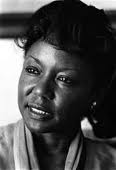
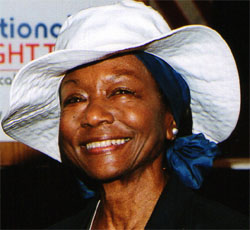
mildred jefferson 1Mildred Fay Jefferson died at age 84 just over two years ago in Cambridge where she lived, not far from Harvard Medical School.  She was the first African American woman to graduate from that prestigious university, having entered it at twenty years of age. She had previously earned a master’s degree from Tufts University following her bachelor’s degree from Texas College at the age of 16.  She went to Tufts while waiting to be old enough to be accepted at Harvard Medical thirty years before “affirmative action” was even a concept.  Mildred was the first woman of any race accepted as a surgical resident at Boston City Hospital, the first woman physician at the former Boston University Medical Center, where she taught, and the first woman member of the Boston Surgical Society. Her intelligence was incandescent, but we will best remember her as a friend.

Dr. Jefferson was the only child of a Methodist minister and a school teacher, born in 1926, and raised in Carthage, a small town in East Texas.  As a young girl, she would ride on house calls in the horse drawn buggy of the town doctor.  Her family and the doctor encouraged her ambition to become a doctor.  Her family called her “Millie”.  No one else did that I ever knew, including us.  In 1973 after the Roe v Wade Supreme Court decision struck down all laws restricting abortion on demand at any stage of pregnancy, Mildred considered her original Hippocratic Oath taken when she graduated from Harvard and refocused her considerable gifts.  (Link to original Hippocratic Oath, no longer taken by new doctors after a 2,000 year history: Original Hippocratic Oath.)  She founded Massachusetts Citizens for Life, and then co founded National Right to Life, becoming first its Vice Chairperson, then Chairperson and then President, overseeing all its activities.  In 1980, she formed the first National Right to Life Political Action Committee.  If you found yourself in a debate or a battle with Mildred Jefferson, you’d better bring a lunch.

 Testifying before Congressional committees led to crisscrossing the country inspiring millions with her extraordinary public speaking ability and multiple appearances on national television, including a session on PBS’s Advocates, remarkable for its long term impact.  She made her case, none of it “religious”, but logically and relentlessly, Mildred outlined the moral, medical and sociological case against women taking the lives of their pre-born infants.   Watching her articulate her deeply held convictions with grace, power and knowledge was the governor of a large state, who had signed into law a bill allowing abortions in that state.  So convinced and convicted was he by her compelling arguments, he wrote her a letter.  In it, he told her that he had never really considered the full implications of abortion, nor its effects on women and the culture. He deeply regretted his unreflective support for a “woman’s right to choose”, and vowed to do everything within his purview to fight for the unborn, a commitment he kept until the end of his life.  As President of the United States, Ronald Reagan could bring considerable influence to bear.

As we mark the fortieth anniversary of Roe v Wade on Tuesday with its sad accumulation of fifty five million aborted babies, and we celebrate the life of Martin Luther King tomorrow, Dr. Jefferson represented the confluence of the civil rights of former slaves and women as well as those of the unborn.  She was knowledgeable about and a warrior in all these struggles, her certitude was that they were of a piece.  She would talk about the racist eugenics advocated by the founder of Planned Parenthood, Margaret Sanger, and how to this day their abortion clinics are located most deliberately in poor and minority neighborhoods.  Mildred deplored the undeniable facts that black citizens comprise about 12% of the U.S. population, yet suffer 35% of the abortions.  She saw this as a kind of genocide, wherein affluent white liberals saw their moral directive was to “help” minorities by lending them a hand to murder their young.

mildredjeffersonWhen my wife, Rita, became the Executive Director of Rhode Island Right to Life early in the new millennium, she understood the medical and moral dimensions of the battle, but was naïve on the political battleground.  Mildred Jefferson took her under her wing.  As a force to be reckoned with in both national pro life activity and Republican Party politics, her mentoring skills were like everything else she did – formidable.  She was in her early seventies then, looked fifty, and had a magnificent gift to make you feel like you were the most important person in the universe – the total focus of her attention in any conversation.  Over lunches and dinners, we soon learned she could discuss knowledgeably any topic that came up, from the Civil Rights movement of the fifties and sixties to whatever became of the owner of the former Steve’s Ice Cream emporiums in Cambridge and Providence, whom she knew well.  Her smile, her laugh, her warmth, her truly startling memory and intelligence were a delight and comfort.  Never was there a hint of affectation in her conversation – only a sincere desire to help, to support, to encourage and to befriend.  The Rhode Island Right to Life annual oratory contest and scholarship award for high school students is named in Mildred’s honor; the national contest, to which the Rhode Island winner is sent, was a special passion of hers.   She supported Rita in many ways throughout her years at RIRTL and sat with us at Rita’s retirement dinner.

When Dr. Jefferson spoke at our annual rally in the Statehouse Rotunda, she was mesmerizing with natural speaking ability and gifted intellect; she would let loose the occasional glimpse into the cadences of her Southern preacher father.  The entire audience of religious and political luminaries along with school buses full of young people and the hundreds of ordinary pro lifers with their families were rapt with attention and respect for her history.  This tiny, unassuming woman who could keep us enthralled around a mealtime conversation, transformed into a speaker of great power.  She could even lead us in a rousing few verses of “Battle Hymn of the Republic”, sung with the accomplishment of her childhood Methodist choir days.

She was beautiful in so many ways; we hope to see her again.  We will miss her at the rally on Tuesday, but even more, we will miss her at dinner.  We miss her smile.

Ecclesiastes 3:11, He has made everything beautiful in its time. He has also set eternity in the human heart.

Link to NRTL tribute to Dr. Jefferson

Link to a commemorative article about her life.

5 Comments

Filed under Culture views, Personal and family life

Still Point

Except for the point, the still point, there would be no dance, and there is only the dance.  T.S. Eliot – Four Quartets

Drove my Chevy to the levyBeing the oldest of five (eventually to be six) children in 1956, the age of ten brought with it occasional responsibilities that would be surprising to most ten year olds in 2013.  We shared one bathroom, and the four boys shared one bedroom in a three bedroom cape with two small one window dormers in the front.  When I was thirteen or so, my youngest brother, Marty, filled out the nest, and my dad added on a family room.  We never questioned and rarely felt put upon by the living arrangements; our family was secure and happy in our daily routines.  My parents had one car; my father worked two jobs and my mother worked full time as a mom, which was quite enough for anyone.

Intermittently my mom asked her oldest to help out paying bills downtown, which was a mile or so from our house.  Accomplishing this on my bike was an easy adventure and invited me in to the mysterious grown up world.  My mother didn’t have a car when my father was at work, and in 1956 in addition to me, she had two kids in diapers plus a set of five year old fraternal twins, one of whom had a severe hearing disability.  She handled this all with aplomb and good humor most of the time, but when the bills were due, she needed some assistance.

The budget was managed by accruing cash weekly in separate envelopes for various expense categories.  I would be given the utilities envelopes and the mortgage envelope, and then mount up on my bike.  There were no bike racks or bike locks, none was needed, just a kickstand or a convenient wall to leave the bike against.  First, I would go to the bank, then the electric company and the telephone office.  No gas company bill in 1956 and I think she paid cash to the oil man, when he delivered.  Grocery shopping was a full family affair when we were little.  The checkout clerk would help load the groceries into our car.  I lost five dollars in change once, which was a minor disaster in a time when it represented nearly fifty percent of the weekly grocery budget.  She was disappointed, but kept her concern brief and tight lipped – almost. I was admonished after that to return straight home with no stops at friends’ houses or especially the library, which could delay my return for hours.

card catalogA bike ride to the library was also about a mile, and with the possible exception of a sandlot baseball game behind the elementary school, my favorite activity.  I was a constant reader and shy at ten.  There are pictures of me my mother still has, sitting on the floor reading a book absolutely absorbed and still, amid the chaos of my five siblings.   I haven’t changed all that much – except for the shy part, although I remain private.  My reading consumption was and remains omnivorous, but at ten inclined towards biographies of Indian fighters and tales of King Arthur and the Knights of the Round Table.  As I got a little older, I was spellbound by biographies of Thomas Edison and Babe Ruth with The Count of Monte Christo not far behind.

The Walpole Library was small, but well stocked. Upstairs was for the adults, but the basement was reserved for children and adolescent fare.  The librarian was a genial and skilled substitute far superior to Google for a ten year old; the card catalog held the keys to the kingdom.  If the librarian was preoccupied, we could sneak out to the front steps and edge our way around the whole structure on an eight inch granite ledge that circumscribed the building as a design feature just below the windows.  The children’s section had round low reading tables with small chairs.

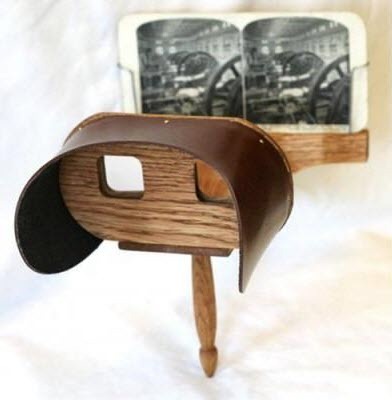
In one corner, two stereoscopes resided along with boxes of the two photo four by ten inch cards that fitted into them.  Most of the pictures were black and white, although some, including Civil War historical shots were sepia. As a ten year old, I especially liked the battle aftermath photos.  When viewed through the lenses, they appeared in 3D.  Developed in the mid nineteenth century and vastly improved by Oliver Wendell Holmes in 1861, the stereoscope opened previously undreamt wonders to a ten year old.  From Egyptian pyramids to the streets of Paris to the Grand Tetons, our new world was limited only by our imaginations.

StereopticonStereoscopes are now valuable antiques and anachronistic reminders of simpler times (that is simpler unless one lifts the edges of the curtains).  They were supplanted sadly by more enticing moving pictures and eventually television.  Our television was a big box in the living room with a small black and white screen and three somewhat fuzzy channels.  Ozzie and Harriet, I Love Lucy, The Ed Sullivan Show, The Jack Benny Show, The Honeymooners and many, many Westerns like Gunsmoke and Have Gun, Will Travel drained away our family hours as we got older. I could still slip away to my sanctuary in the eaves of the attic, which had a single pull chain light bulb and a hook and eye latch, to seek the quiet harbor of my books.

I’ve heard it said that we all have our nineteen year old selves permanently emblazoned on our personalities.  Can it be any less so for ten?  My tenth birthday was in February of 1956, eleven years to the day after the Marines raised the American flag on Iwo Jima, securing a key stronghold on the long drive to Tokyo.  To idealize any period of time is to trivialize it, however to hold it at the center of our innocence is quite another.

The fifties were in some ways innocent and optimistic, yet they also harbored Jim Crow laws and the hypocrisy of country club adultery and too much liquor.  But most families were hard working and held traditional morality dear; the parents were the “Greatest Generation” determined to leave behind the Depression years of the thirties of their youth and the killing years of the forties of the war, and to pass on to their children a safer, more stable and more comfortable future.  For this they worked steadily and generally cheerfully for the rest of their lives.  Comfortable was achieved; stable and safe eventually were beyond theirs to bequeath, but in the fifties, at least the illusion of simpler times was lovingly preserved.

“We don’t know what we are doing, because we don’t know what we are undoing.” G.K. Chesterton

4 Comments

Filed under Background Perspective, Personal and family life

Leverage

A decade or so ago, some friends undertook the arduous journey to adopt their daughter, who spent the first fifteen months of her life in a Moscow orphanage.  The journey was arduous in all ways possible – mileage, time, financially, intellectually demanding to wend their way through the arcane rules and most especially, emotionally.  On their initial visit to the facility, they found most of the younger children were minded in a small enclosed area with a few toys to claim, if they could be held against all competition.  The facility housed over a hundred small clients, a couple of dozen or so under the age of two.  When they first spotted the young beauty that was to transform their lives, the fifteen month old glanced sideways while on the changing table and made eye contact across the room.  That ability to connect with those who were her life line was a skill, either learned or inborn, that conveys to her a gift beyond reckoning and persists into her precocious pre teen personality.  She can take over a room like brightness draws moths into the light.

In Moscow, she competed with a score or more toddlers and infants for the haggard, stretched thin attention of two full time attendants, each of whom worked a twelve hour shift every day.  One person at a time was on duty for changing, food, health care, teaching and loving.  They did their best; they really did.  Learning toys were scarce, food was sparse and survival skills important.  An orphan who prospers learns early to compete, to persist and to make her way.  Her intelligence and persistence were the primary attributes we noticed when we  met her in our friend’s house shortly after they returned home.

For adopting parents, protocol was for at least two visits of a fortnight each, separated by a period of time, usually a month minimum.  The first one was intended for selection of their new family member and early bonding; the second was to complete the paperwork, spend more time with the child, and usually followed a vetting process.  Our friends were able to convince the adoption authorities that a second trip would be prohibitively expensive financially and more importantly expensive for their schedules, since they were both self employed.  They remained in Moscow for twenty eight days at a cost exceeding thirty thousand dollars, but when they got on the first leg of their Aeroflot flight home, there were three of them.

President Vladimir Putin signed a bill Friday banning U.S. citizens from adopting Russian children, raising tensions with Washington as the Obama Administration is trying to win Moscow’s support to end the war in Syria.  Russian officials portrayed the latest legislation as a tit-for-tat retaliation against a new U.S. law that seeks to punish Russians accused of human-rights violations.

Moscow’s legislation—which also bans U.S.-funded civic groups in the country—puts concrete action to rising Russian complaints, voiced most vehemently by Mr. Putin, that the U.S.’s own human-rights failings give it no credibility to lecture others.  But the adoption ban has exposed Mr. Putin to criticism both internationally and within his own government. Critics allege that the law makes political pawns out of Russian orphans, whose living conditions can be dire and prospects for adoption often slim.

Gregory White, Wall Street Journal 12/28/12

Many of the children adopted from Russia by American parents suffer disabilities such as spina bifida, which is treatable if medical resources are more abundant than in a Moscow orphanage.  Without adoption, these children will languish.  Worse yet is the fate of young especially pretty women, who outgrow the orphanage, and become prey on the streets of the city.  The sex slave and drug trade flourish in Russia; young girls are turned on and turned out.  Most grievous are the adoptions shut down in mid stride.  There are children and parents who have spent much time together and bonded; they will now be unable to complete the process, some just a week or so from flying home together.

“I looked the man in the eye. I found him to be very straightforward and trustworthy. We had a very good dialogue. I was able to get a sense of his soul; a man deeply committed to his country and the best interests of his country.”  President G.W. Bush about Vladimir Putin, press conference, 1/6/2001

“I told him (Yeltsin) I was impressed by what I had seen of President Putin but wasn’t sure he was as comfortable with or committed to democracy as Mr. Yeltsin.”  Former President Bill Clinton in a NY Times article, “Boris the Fighter” on the occasion of the funeral of Boris Yeltsin 4/29/2007

Vlad, the Impaler, Putin

Vlad, the Impaler, Putin

These protestations about violated human rights in the United States  coming from Vladimir Putin, a triumphant thug who came up through the ranks of the KGB, now FSB, would be ridiculous, if so many innocent lives were not sacrificed to the brutal, leveraged, “diplomacy” of the hard core left.  Remember in October of 2006, Anna Politkovskaya, a gifted, courageous journalist, was assassinated in the lobby of her apartment building with two bullets in her head.  She had become a potent nuisance to Putin with her brilliant expose of “Failed Democracy” and the outrages against Chechen civilians.  She was murdered on Putin’s birthday, no doubt a gift from his old colleagues in the FSB, who are exceedingly skilled in contract murders.  A month after her death, Alexander Litvenenko, a former FSB officer who had defected to the West, was taken very ill to a British hospital, where he died a gruesome, slow death three weeks later of acute radioactive polonium poisoning.  He had been working with MI5 and MI6 as well as in his new career as a journalist. He published two books:  “Blowing Up Russia, Terror from Within” and “Lubyanka Criminal Group.”   Polonium in the mashed potatoes is a creative and cruel method of political assassination, again one in which the old KGB was particularly gifted.  The “Cold War” may be in the history books, but its practitioners learned their craft well.

President Obama to then President Dmitri Medvedev (now Prime Minister after he and Putin again exchanged chairs): “This is my last election.  After my election, I have more flexibility.”  Video…

Medvedev:  “I understand.  I will transmit this information to Vladimir.” 

Ten years later and fully adapted to her adopted country, this beautiful daughter of our friends is doing splendidly at an exclusive private school.  Her grades are excellent, and she is excelling in her other special interests in photography and basketball. She is on the local “travelling team” as an All Star in her age bracket.  The school for gifted students is on a handsome campus as a “feeder” school for the Ivy League and other top line universities. Her school has won the state wide Academic Decathlon nineteen times out of the twenty nine it’s been held.  One expects her prospects are considerably more promising than those of a street urchin in Moscow.  Her parents are devoted to her success in life and to her nurture.  Love is irreplaceable.

“May it show us the family’s holy and enduring character and exemplifying its basic function in society: a community of love and sharing, beautiful for the problems it poses and the rewards it brings; in sum, the perfect setting for rearing children – and for this there is no substitute.”  Pope Paul VI, speaking of the Holy Family in Nazareth 1/12/1964

3 Comments

Filed under Personal and family life, Politics and government

Irish Cuisine

“I’m Irish, so I’m used to odd stews. I can take it.  Just throw a lot of carrots and onions in there and I’ll call it dinner.”  Liam Neeson

Many would say the topic is oxymoronic, but the roots of all things Irish are hardscrabble.  My father was half Irish, and never knowing his father, who died when he was an infant;  he was raised by his Ma, Margaret Veronica Lannon, a former vaudeville singer who married her stage manager, John Parquette, and helped by her Irish sisters Stacia and Essy — immigrants all in a three decker full of family in Lynn, Massachusetts.  My mother was the youngest of six to Irish parents, her mother, Molly Manley, was full time at home, and her father, Jim Laracy, was a tin knocker.  She was born in the apartment over D.A. Baker’s sheet metal shop where my grandfather lived (and worked) before they bought the house on Maple Street in Walpole.

Our family of six children in Walpole, of which I was the oldest, was deeply imbued with an Irish culture, albeit with a French name.  My mother, Betty (or Girly to her sisters), going strong at 91, still possesses her characteristic sense of humor and intelligence.  The main danger she presents currently is to gondola displays at the local Target when someone foolishly allows her to drive a battery powered ‘accessible’ sit down shopping cart.  All her kids grew up straight and true.  Somehow.  All of us are blessed with the strong work ethic of both our parents.  Ma has long claimed that her six children would never go hungry as long as she had a good can opener.  She was pretty good at potatoes, though, and beef stew, even if Dinty Moore canned stew was not foreign to us in a pinch.

“I have always found the Irish to be a bit odd.  They refuse to be English.” Winston Churchill

My wife, love of my life and frequent muse, Rita, suggested this blog topic, so I’ll begin with a story that includes her.  When we were newlyweds, we didn’t have a lot of money.  Rita was a registered nurse working full time, while I finished out my last three semesters of college.  We lived in a third story walk up ‘shotgun’ apartment on a tight budget, painfully young and rhapsodically happy.  Rita, of Italian and Portuguese descent, is a creative cook acquainted with all manner of spices alien to me at the time.  Salt and pepper were the only spices I knew from my mother’s table, and pepper was suspect.

I tried to inflict my childhood Saturday night tradition of hot dogs and beans on Rita, which held for awhile.  A month or two into our marriage, we sat down on Saturday night – canned Boston baked beans and hot dogs grilled in the frying pan – two each.  Halfway into this ambrosia, Rita, who is genetically incapable of telling a lie or a joke with a straight face, started snickering.  When I asked her what was funny, my question stimulated full blown laughter.

It seems, since our food budget allowed nothing for waste, that when she was gathering the goods for supper, there was a new package of hot dogs and two left over hot dogs that were a bit, shall we say, sticky, but not yet quite green.  My young beloved artfully and meticulously kept the old segregated from the new in the frying pan throughout the cooking.  I, of course, was given the old ones.  But she couldn’t hold the deception together and giggled her way to full disclosure.  Her justification for this crushing of young love was that I, being Irish, couldn’t tell the difference, and she being of more refined culinary sensibilities, could.

“It’s not that the Irish are cynical. It’s rather they have a wonderful lack of respect for everything and everybody.”  Brendan Behan

Our friend and former coworker with Rita at Rhode Island Right to Life, Peg Lavallee, told Rita this recent story of her brother, Charlie Galligan, a retired cop (what else?).  The Lavallees and the Galligans were going to a fund raising event for an Irish cause at McBride’s Pub on Wayland Street in Providence.  McBride’s features normal pub fare along with Galway Shepherd’s Pie, Fish and Chips, Bangers and Mashed, an occasional boiled dinner and “Famine Stew” along with the “Perfect Pint” of Guinness.  The pub is located in the old carriage house of the Monahan Funeral Home and part of the Monahan complex, a century old site of Irish wakes in the city, which is still open for business across the shared parking lot.  It is convenient to go to a wake, tell a few maudlin jokes and hoist a few to honor the recently deceased at the pub.  Every night at ten the bartender calls for a pause as a “Last Call” where all raise their glass in memory of someone who has “gone to the Promised Land.”

As Peg and her husband, Arty, were coming from their cars with Charlie and his wife, a van pulled up with a long wooden box which carried a replica of a full size statue of a small family, part of the Irish Famine Memorial in downtown Providence. It was to be displayed in the restaurant.  Two older gentlemen in their late sixties were unloading the crate.  Charlie offered them a hand, but his help was politely declined.

As the determined Irishmen slid the box out of the back of the van, disaster struck, the statue smashed through the front of the crate and flew out to a loud thud on the parking lot.  Charlie in typical Irish wry humor, without missing a beat, said to them, “Hope you guys aren’t the undertakers.”  Then he started back towards the parking lot pretending to look around, and asked them, “Do you need this head?”

“I’m Irish.  I think about death all the time.”  Jack Nicholson

A grandchild story will round out the topic for this week.  Gianna is my daughter Angela’s four year old.  Her dad is Polish and Irish, and Gia has dragged a few of the dry Irish wit genes through.  She does, however, manage to maintain more sophisticated taste buds.  Recently I was bringing her to Walpole one Saturday to treat my mother to lunch.  On the way, we discussed the menu.  I asked her what she would like for lunch, and she said tostados.  I told her it was unlikely Nana could be talked into a Mexican restaurant (IHOP as it turned out was the selection).  Since squirrels and a large oak tree in my backyard are a frequent topic of conversation, I suggested she might enjoy an acorn sandwich.  She remained somewhat skeptical.

I assured her that with strawberry jam and ketchup, acorn sandwiches were tasty, and that if people were really hungry, they could eat acorns just like squirrels.  She assured me that she wasn’t that hungry.  We changed subjects.

Later we discussed her uncertainty that we might not find Nana’s house given the limited access highway (Route 95) we were on.  I explained the concept of exits and not to be concerned as I knew which one to take.  After we mulled that around for a few more miles, she spotted a sign coming up and proclaimed it said, “EXIT”, which it did.  She asked if that was where we were going, and I told her there was another one farther ahead.

Being a grandfather, I then told her she was the smartest four year old girl in the world.  Gianna graced me with her half smile and replied without a pause, “Smart enough not to eat acorns, Papa.”

“Being Irish, he had an abiding sense of tragedy, which sustained him through temporary periods of joy.” William Butler Yeats

3 Comments

Filed under Personal and family life

Simplicity

Last weekend on Saturday we attended the wedding of Allison and Henry; we’ve known Allison since she became our youngest daughter Meg’s friend in the second grade.  Twenty odd years later, both Meg and Allison are professionals with letters after their names and married.  Both have now been in each other’s wedding parties; Allie was a bridesmaid in Meg’s wedding in August.  Allie’s wedding was in the Cathedral of Saints Peter and Paul near downtown Providence, the main building completed in 1889 on the site of a former, smaller church, built on “Christian Hill” in 1832.  The structure is magnificent and is a sign of the majesty of God, constructed by the faith of its builders and thousands of worshippers who have assembled there for over a century.

For Allie and Henry’s wedding, the ceiling height pipe organ filled the space with classic music, including Johann Pachelbel’s Canon in D as the beautiful bride processed into the church and later Shubert’s Ave Maria.  During the wedding Mass, the priest told a story of the late actress Helen Hayes, a lifelong Catholic and one of only eleven people to ever win an Emmy, an Oscar, a Tony and a Grammy.  She was awarded a Presidential Medal of Freedom, America’s highest civilian honor, by President Reagan.  Her first stage role was in A Midsummer Night’s Dream, when she was five, and her last was as Agatha Christie’s character Miss Marple when she was eighty five.

When Helen was first married to her husband, playwright Charles MacArthur, they had little money.  On their first anniversary he gave her a paper bag full of peanuts and told her he wished it could be a velvet bag full of emeralds.  After nearly thirty years in a loving marriage, Charles was diagnosed with terminal cancer; Helen was fifty six.  On their final anniversary together, he gave her a velvet bag full of emeralds.  Her response was to tell him she wished it was a bag of peanuts, and they could do it all over again.  As he finished the story, Rita and I reached over to grasp hands as both of us were filled with gratitude for our forty five years together.

After the homily, the priest joined the young couple before the altar and guided them through the marriage vows.  He left the microphone off, and in such a large church, only those witnesses right near the bride and groom could hear them.  It wasn’t necessary to hear. As they exchanged rings, everyone present could see and knew their love and sincere intent to “have and to hold” for the rest of their lives.  To me, it was entirely appropriate that their vows and love were for them alone – simple, in complete focus one to one, heart to heart, mind to mind, soul to soul.

“The spirit’s foe in man has not been simplicity, but sophistication.”  George Santayana

Last Sunday, in lieu of our regular parish, we went to Mass at St. Patrick’s on Smith Hill in Providence, an inner city, poor, bilingual church – poor in money and accoutrement, rich in Spirit and Love.  The church building had long ago been declared structurally unsound and demolished, but the parishioners converted their school auditorium into a church and persisted with both school and church.  St. Pats hosts a soup kitchen on Mondays and has for over thirty years.  The school evolved three years ago into St. Patrick’s Academy, a small high school staffed by both professionals and dedicated volunteer mentors. Next year will see its first graduating seniors.  The contrast to the soaring cathedral could not have been more striking.  The music was guitars and a piano, not a large pipe organ; the pews were filled with all manner of folk, color and age – teenagers, children, the elderly, families, the halt and the lame. The sound of children, silent or rare in many churches, was beautiful.

We were a bit disappointed that her pastor, Father James, wasn’t presiding over the Mass, and an older priest was there in his stead.  Father James’ homilies are always to the heart, his humility genuine and immediately apparent to all who are fortunate enough to pass his way.  Since he is fluent in Spanish, he must have been the celebrant last weekend at the Masses in that tongue.  He has done such things as live anonymously on the street as a homeless person to more fully understand the poorest of the poor in our city.  Father James is a gifted listener and counselor.

“I am not a genius, I am just curious. I ask many questions, and when the answer is simple then God is answering.” Albert Einstein

Our disappointment was short lived as we heard the lovely Irish lilt, saw the impish warm smile, intelligence and wisdom of this priest we had never met.  Reminiscent of the many Irish priests of my youth, he was simultaneously loving, witty and direct.  His homily about the gospel reading reminded us that complaining about “not getting anything out of Mass attendance” quite misses the point. “Since when did we become the center of the universe?” he asked.  Worship is not another entertainment we think should have to compete in a world of feel-good distractions, to be judged and participated in based on the liveliness or ‘relevance’ of the music or the emotions and passion of the preaching.  We come for the Eucharist and the Word, to give thanks, to gather together as Christians have gathered for two millennia.  Being a “good person doing our best with good works” is an inadequate response in and of itself to the transcendent Gift which bridged the gap between the eternal and the ephemeral, the mortal and that which never dies – the soul and the Creator.

The music was occasionally ragged, the voices in harmony, but untrained, some of them in their teen years, some of them in their sixties.  Nothing was diminished by the imperfections; the spirit was authentic.  Everyone sang.

“Being with someone, listening without a clock and without anticipation of results, teaches us about love. The success of love is in the loving — it is not in the result of loving. ”
A Simple Path – Mother Teresa

3 Comments

Filed under Personal and family life

A Wedding of Great Promise

Meg was radiant; tough guy Marty’s eyes brimmed with emotion as I walked toward him with her on my arm. The Atlantic created the backdrop behind him while a gentle on shore breeze eased the heat from the mid August late afternoon sun.  The emotions were true, lovely, dear and necessary.  The wedding was charming not because of the setting or the beauty of the bride, the handsomeness of the groom, but because of the promise.  It was a very good beginning, but, still, just a good start.

And I don’t mean a start to the great party afterwards upstairs at the Newport Atlantic Beach Club, although, it, too, more than lived up to expectations.  Everyone danced, the food was superior; conversation flowed easily with much laughing, many toasts and more than a few tears from time to time.

Meg and Marty vowed their lives one to the other from this time forward.  Meg said this, “I love who I am when I’m with you and strive to make you as happy as you make me.  I look forward to seeing you every day and never grow tired of our time spent together.  I find myself comfortable and at peace with growing old together…. I love you with all of my heart and before everyone who is most dear to us today, I promise to commit myself to you completely (even during hockey season).  I know that happiness in a marriage may come and go – but whatever hardships we face throughout the years, I have full confidence that we’ll face them together, make decisions to love even when it’s hard, and we will both be able to look back and find the happiness we feel today.”  I don’t have a copy of Marty’s vows, but they were similarly heartfelt and completely sincere.

Now, don’t get me wrong, the father of the bride is a traditionalist and finds no fault in “to have and to hold, in sickness and in health, for richer or poorer until death do us part” in a church, but promises of the heart are promises of the heart, and God is in the promises – they are compelling and for the rest of their lives.  Meg, Marty and the friends and family who gathered to affirm their promise all know this to be true.

You will reciprocally promise love, loyalty and matrimonial honesty. We only want for you this day that these words constitute the principle of your entire life and that with the help of divine grace you will observe these solemn vows that today, before God, you formulate.  Pope John Paul II

The value of a promise is in its keeping:  in making decisions to love day after day, year after year, even and especially when we don’t feel ‘loving’ and are tired, discouraged, broke or sad.  You have good precedents.  Dore and Gloria (Marty’s folks) have loved and kept their promises for over 35 years; Rita and I have as well for 45.  This is my prayer for Meg and Marty:  keep your promise, trust in one another, cling to your first love when times are hard (and they will be), and you will be all right in the end.

As for man, his days are like grass;

he flowers like the flower of the field;

the wind blows, and he is gone..Psalm103

A few years ago a movie with Morgan Freeman and Jack Nicholson called “The Bucket List” was so popular it added the phrase to common usage.  I think most of us have a “bucket list”.  Mine has nothing to do with climbing mountains, jumping out of airplanes or visiting Florence (although Florence sounds wonderful).  Those have more to do with ego, self image and reputation than legacy.  For me, living a purposeful life and keeping my promises with the beautiful bride of my youth, Rita, is far more important.  She was also a stunning bride, who has grown in character, virtue, wisdom and inner beauty through faithfulness born of suffering the vicissitudes and challenges of life through the years.  I love her more now than then, although at the time, I didn’t think that possible.   Would that my children share this blessing.

Of paramount value in my bucket list is seeing my children off to a good start, especially in their choice of a spouse of good character from a loving, laughing, stable family.  My Meg did that last week.  I know that through age and infirmity, I will be less and less able to help them as time goes by, and eventually be gone from this stage.  My children’s spouse and family will see them through.

High on my list, also, is the hope that my four children will continue to be true and there for each other as well.  This is from Meg’s older (slightly) sister, Angela, her matron of honor last week, “Throughout the years we’ve had different friends and different tastes, but we share the same family, heritage and the same blood.  We’ve been there for each other through first days of school, first kisses, first everything.  I will never ever forget the loving support and encouragement you gave me the day I gave birth to Gianna.  I’m not sure I would have made it through that day without you.   Life may separate us by many miles, but in the words of Jo March in Little Women, (how many times have we seen that movie, maybe 25?!): “I could never love anyone as I love my sisters.””  Link to full text of toast

I say to God, “Do not take me away

before my days are complete,

you whose days last from age to age..”  Psalm 102

And so, dear children, this old dad’s heart is full and at peace this Sunday.  Be of good heart yourselves and thank you all so much.

The psalms seem to me to be like a mirror, in which the person using them can see himself, and the stirrings of his own heart; he can recite them against the background of his own emotions. St. Athanasius

3 Comments

Filed under Personal and family life

Sarah

Sarah was stillborn on Tuesday.  Her heart simply stopped. That certain finality almost causes our own hearts to cease beating like her tiny one: inexplicable, irreversible heartbreak for her parents, Liz and Ray, and her grandparents, my good friend Jim and his beloved wife, Margaret, parents of Liz.  Sarah will never sit in their laps to be sung to sleep or read “Cat in the Hat” or draw with crayons on the kitchen table.  There will be no first steps, no elementary school flute concerts, no graduations, and no walk down the aisle or Sarah’s children.  Her life cut short before she drew breath.  When she emerged twenty three hours after her heartbeat was last detected, her silent, little body was perfect in every way with her father’s eyes; her mother’s nose and mouth and auburn hair.  Her parents and grandparents hugged her, kissed her, held her for a long time and wept over her.

The nurses, midwives and doctors at the Birthing Center of Georgetown University Hospital did whatever could be done, were extraordinarily supportive and grieved with the family for what they could not explain.  Melanie and Sarah, two of the nurses, brought an outfit they picked out for Sarah. She will be laid to rest in a Catholic cemetery in an area reserved for babies.  On May 12th, there will be a memorial Mass at St. Ann Catholic Church in Washington, DC presided over by Monsignor Mosley, Ray and Liz’s pastor.  A second Mass is being planned in Jim and Margaret’s parish in Roswell, Georgia presided over by Father Peter Rau.  These good priests and Father Henry, who married Ray and Liz, help console the family and lovingly minister to their deep faith.

With that faith, there is this:

 Pre born babies have already experienced much. Sarah surely recognized familiar voices and responded to them, especially her mother’s and father’s.  She felt the loving strokes of her mother’s hands through the safe enclosure of her womb.  Sarah reacted and bounced when Liz laughed.  She heard and responded to music. She knew joy. She knew love. She never knew cold or hunger or fear or loneliness, and now never will.  Sarah knew there was wonder and mystery outside her secure, warm world.  She now knows far greater wonder, wisdom and mystery than her family has yet to experience.  Her joy and love are now eternal.

Margaret wrote to her friends and family, “She is now in heaven, a Holy Innocent, powerfully interceding for her family.  We look forward to seeing her again one day, but in the meantime she will remain in our hearts and minds.  It is comforting to know that she is where we all long to be, and that she will never suffer the hardships of this earthly world.”

John Donne wrote, “He that asks me what Heaven is, means not to hear me, but to silence; he knows I cannot tell him: when I meet him there, I shall be able to tell him, and then he will be able to tell me.”  Unity with the Creator is far beyond our limited faculties to comprehend or attempt to explain, yet our faith draws us there to “our own far off country”.

Saint Augustine tells us in “City of God” that “There we shall rest and we shall see; we shall see and we shall love, we shall love and we shall praise.  Behold what shall be in the end and shall not end.” C.S. Lewis in The Weight of Glory likens us, who still engage in this vale of tears, to a schoolboy striving through hard study to learn the sublime, “Those who have attained everlasting life in the vision of God doubtless know it is no mere bribe, but the very consummation of earthly discipleship; but we who have not yet attained it cannot know this… Poetry replaces grammar, gospel replaces law, longing transforms obedience, as gradually as the tide lifts a grounded boat.”

Sarah now knows, truly knows,  what we long for: entirely, effortlessly, within her soul.  The hope of us left behind is that at some joyful, future celebration we will see her perfect and complete.  All guilt, recriminations, self doubt, second guessing will only impede our journey and cause us harm, and in the end slough off.

A close friend once confided to me that his personal belief is that a loving God takes each soul home at the most opportune moment for each person, the moment best suited for our own salvation.  For some that means a long, tough climb.  All of us will come to that moment, of that there is no doubt.  “Our days may come to seventy years, or eighty, if our strength endures; yet the best of them are but trouble and sorrow, for they quickly pass, and we fly away.” Psalm 90.   Even eighty years is a blink of man’s history, and not even that when measured against eternity.  Our time will come.

The name “Sarah” derives from the Hebrew, meaning “Princess”.  This young Sarah is already royalty.  The time of her homecoming was early on, but her outcome is certain.

Sarah, pray for us.

Blessed are those who mourn, for they will be comforted.  Blessed are the pure of heart, for they will see God.  Matthew 5: 4,8

5 Comments

Filed under Personal and family life

Aunt Mary’s Amazing Milestone

The Laracy Girls - Mill, Babe, Toots and Girly

When Mary was born, telephones, automobiles and electric lights were a rarity, but Civil War veterans lived in every town.  The ice man kept the food cold, the mailman brought almost all communications from far-flung friends and family, and the paper boy delivered the news.  Armies still had horse mounted cavalry; the War to End All Wars was still in the near future and a worse one followed twenty-five years later. Mary celebrates her hundredth birthday this week.

In 1912 western gunman and legendary town marshal of Dodge City, Wyatt Earp, had another seventeen years to go; Joshua Chamberlain, the hero of Little Round Top at Gettysburg, and Harriet Tubman, former slave and station keeper on the Underground Railroad, still lived. The Titanic hit the iceberg and sank in the North Atlantic.  Jackson Pollock, Woody Guthrie, “Lightening” Hopkins, Ben Hogan, John Paul I, Julia Child, “Lady Bird” Johnson and Gene Kelly along with Mary Laracy Smith were born. Mary was the daughter of second generation Irish immigrants, Jim and Molly (Manley) Laracy.  Everyone called her Toots. (“Toots” rhymes with foot, not loot. As in “Hey, Toots, you’re good looking.”)

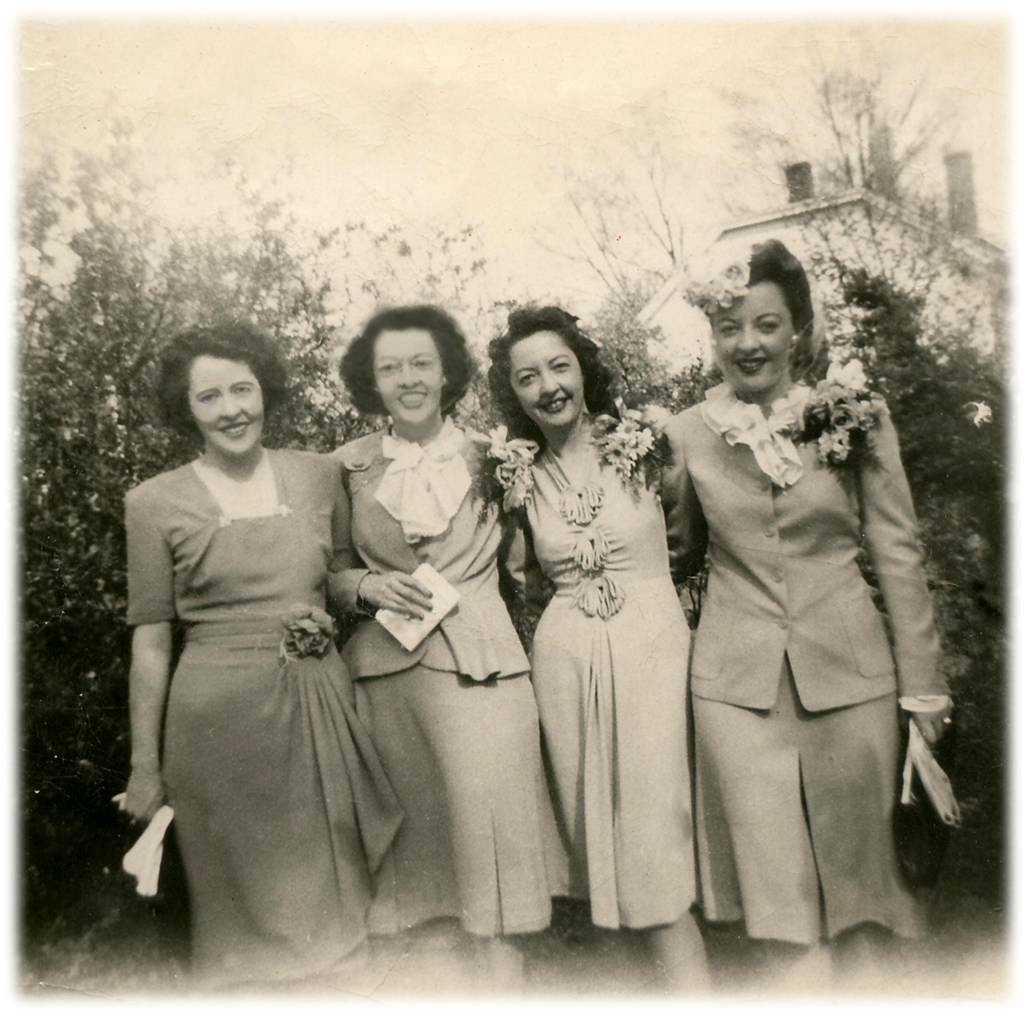
Three younger sisters, Mildred, Cecelia and Elizabeth followed Mary along with an older brother, Billy, and the twin to Elizabeth (Betty), the baby brother John (Sonny).  Sonny’s WWII Army buddy, Jack, met and married his sister Betty and had six children of whom I am the oldest.  The Laracy girls, Toots, Mill, Babe and Girly broke the mold.  Only Toots and Girly (Mary and Betty) remain with us; they have been sisters for over 91 years, and what a century it was.

Mary was on the leading edge of the “Greatest Generation”, which literally saved the Western world.  The “eternal” German Third Reich, the Russian Revolution, indeed the whole terrible history of the Soviet Union, came and went.  The Spanish Flu took more human beings than the Black Plague.  Mary and her generation triumphed over the bloodiest century in human history and the century that cascaded humankind with more scientific and technological growth than the 20,000 years before it. Her generation faced the carnage, deprivation and exponential change with courage, good-humored resolve and steady intelligence, still managing to have many good times along the way.  They rose up out of the Great Depression determined to leave a better, safer and more prosperous world for their children, and they did.

Billy and Sonny followed their father, Jim, to become expert sheet metal workers.  The girls all worked in the war effort and after the war for the most part stayed home to raise their children; my mother, Betty,  was a telephone operator spending hours in front of one of those celebrated peg boards with a hundred plugs and wires everywhere.  She heard first hand of the Walpole boys who never came home from the Pacific, Northern Africa or Europe.

Cliff Smith married Mary and after the war moved steadily upward to become an executive in the local Kendall Mills textile plant, then he moved on to New York City.  The young Smith family moved to Fairfield County, Connecticut.  Their two children, David and Judy, were among 16 first cousins, with a mini baby boom of us born to the Laracy children within two years of the end of World War II.  All four Laracy women had babies in 1946. The children frequently visited and slept over with their cousins into their teen years.  The personal kindness and hospitality of the aunts and uncles greatly benefitted the nephews and nieces with many warm, fun memories and the security of the love in their homes.  I remember one “cousin” visit to Connecticut, when Cliff killed a poisonous copperhead snake with a rake to much acclaim from us kids.  At the Smith cottage on Lake Ossipee in New Hampshire, David and Judy tried with great fervor and skill, but largely unsuccessfully through no fault of their own, to teach me to water ski.

The sisters raised their children in the “Ozzie and Harriet”, “Father Knows Best” years of the fifties and early sixties, protecting their childhoods through long summer days.  We had bikes and baseball gloves, good schools and solid values — values we challenged and denigrated through the late sixties and seventies, only to rediscover them with our own families and try as best we could to pass them to our children.

Whether history will find the Baby Boomers to be worthy successors to the Greatest Generation is still very much an open question, as is what the next century will bring for our children and grandchildren.  But what is not an open question is the legacy of these amazing Americans, who overcame challenges never confronted by any previous generation and won.

When my Papa Laracy died, he had written my name (“Jackie”) in his little prayer book, “The Man of God, Devotions for Catholic Men”, and so thus it was bequeathed to me.  The inscription of the gift to him was, “To Pa from Toots, 12-25-1941”, only a couple of weeks after the attack at Pearl Harbor.  One of the prayers in it is this, “we beseech thee..amidst all the various changes of this our life and pilgrimage we may ever be protected by Thy help.”

God bless you and keep you at this milestone, Aunt Mary.  Happy Birthday, Toots.  We’ll lift a glass in your honor.

There is a mysterious cycle in human events.  To some generations much is given.  Of other generations much is expected.  This generation of Americans has a rendezvous with destiny.

Franklin D. Roosevelt 

2 Comments

Filed under Personal and family life

Anniversary Waltz

In 1966, when he was nineteen, not much more than a boy really, he fell utterly in love with a girl who was so lovely, he caught his breath sometimes when he saw her. The sound of her voice brought him joy.  Her name was Rita, a name derived from Margarita or Marguerite, from the Greek and Latin, means “pearl”.  They could not be dissuaded by wiser parents and married in the winter of 1967, when they were twenty.  Spenser Tracy played the father character in “Guess Who’s Coming to Dinner”, a great Stanley Kramer film of the same period; he told his daughter, who could not be talked out of marrying a black man (Sidney Poitier), that they would face great difficulty with a marriage of mixed race, but when he realized they were truly and totally in love, he told the family the only thing worse than them marrying would be them not marrying.  Rita and her young husband were in a similar state.

He hadn’t finished college, and Rita had just graduated as a registered nurse; she supported them for the first year and a half.  After a brief January Cape Cod honeymoon on semester break, the couple moved into a third story walk up apartment near the campus of Smith College in Northampton, MA, while he finished his degree at the University of Massachusetts.  He found summer work as a tree climber for an arborist company and paid for tuition and books. She started on a medical/surgical ward at Cooley Dickenson Hospital, where Ted Kennedy had recovered from a broken back suffered in the crash of a small plane. Very little extra money in the tin canister and they were completely happy.

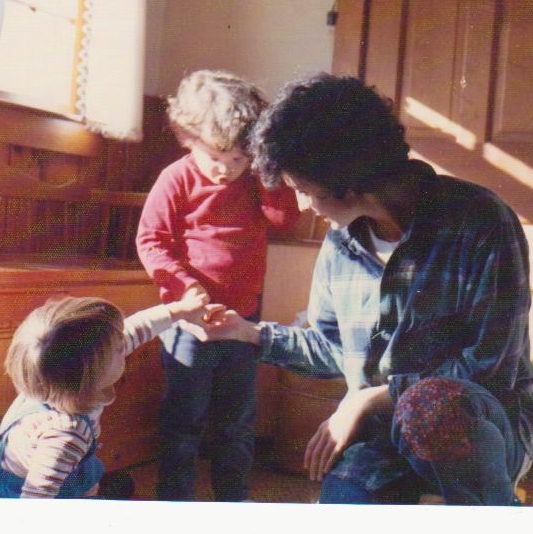
Rita and Amy

More foolishness followed graduation.  After a year living back close to their parents, they ventured west for a year in Colorado: he as a tree climbing foreman, she as a pediatric nurse at Boulder General.  While there, their first child, Amy, was born, and they turned twenty three.  A long period of a dalliance starting with the almost obligatory left wing politics of Boulder followed. After returning to Massachusetts, first Boston, then Cape Cod, they moved for a decade to rural Maine.  In Maine, they survived the first real danger to their marriage in the midst of a long, cold winter, when the snow drifted halfway up the first story windows and cabin fever raged.  After nine years of marriage and months of their winter of discontent, they were literally a day short of separation with two young children, Amy and Gabriel.

Rita, Amy and Gabe

Reason, a return to the faith of their childhood, the grace of their sacrament and nothing short of a miracle intervened.  They stuck it out.  A difficult year later, their love bloomed again and never left them.  A third child was born while in Maine – Angela. They moved to Rhode Island, and their fourth baby, Meg, came home.

Rita stayed at home to raise their children for many years, except for some part time work as an obstetrical nurse and teaching as a certified childbirth educator.  When Meg started high school, she volunteered with the Diocese of Providence in their pro life office.  Her experiences with maternity nursing, training young mothers to give birth and with her own premature baby (2 lbs) had forged in her a profound fervor for pro life issues.

She was hired as executive director of a crisis pregnancy center, Woman to Woman, and then was recruited as executive director of the state wide Rhode Island Right to Life organization.  RIRTL offers material help to women in crisis pregnancies, educational talks at schools and churches, speeches at political rallies in the state house rotunda and maintains a legislative lobby. Rita did battle with newspapers, local television and legislators.  Her writing became effective, and she spoke to crowds of hundreds.  Upon her retirement, she received written commendations from both houses of the state legislature and the governor.  She had dinner with governors, bishops and congressmen.  None of which meant much to her, the commendations gather dust in a closet.  What mattered to her were the babies and the mothers. She was astonished at this public turn of events, but her husband was not.  Rita is a warrior.

Rita loves to read, especially history; she is a lifelong learner.  Her active mind takes great pleasure in discussion of politics, cultural issues and history.  Her husband and she like very much to walk in the woods or along a beach, holding hands and speaking of many things – sometimes the lives of their children, sometimes their grandchildren, and sometimes the volatile topics of the day.  She favors a few deep friendships to which she is fiercely loyal and is a member of Red Sox Nation.  Rita likes to sing and play her guitar.  She draws well and enjoys sketching.  Her Italian and Portuguese heritage helped her become a good cook.   Her sometimes quick temper, which flows from her passionate nature, flairs far less frequently now, and they rarely have cross words.  Her husband still loves her like life itself; Rita is the greatest blessing of his life, and he is grateful.  The love of this young couple matured and will last them until death do them part.

Forty five years ago today they were married.  Happy anniversary, beautiful.

Proverbs 31

When one finds a worthy wife,           
her value is far beyond pearls.
Her husband, entrusting his heart to her,
has an unfailing prize.
She brings him good, and not evil,
all the days of her life.

14 Comments

Filed under Personal and family life

Retrospectives

Papa Jack hanging Christmas lights in our first house in Maine

Retrospectives for the previous year are ubiquitous in late December:  “The Best Of” and “Worst Of” lists – movies, theater, books, television, every sport known to humankind and Broadway shows; news stories of significance ranked by their impact on our lives and imaginations; fashion and entertainment “ins” and “outs”, championships and crushing defeats.  Late December also evokes a personal retrospective.  December 29th marked what would have been my father’s 95th birthday and the 29th anniversary of his death on the day he turned sixty six, especially poignant for me since I will turn sixty six in February.

Papa Jack was, as are we all, both ordinary and extraordinary.  He didn’t make any Man of the Year lists.  He was a salesperson selling all manner of products and services over the course of his career from land in Arizona to Yellow Page ads and Walpole Woodworker’s fence; death befell him prior to retirement, he liked his work most of the time.  A father of six and grandfather of fourteen, Papa Jack was an imperfect, but unforgettable Dad. He had few role models to learn to be a father, growing up in pre-Depression three deckers in Lynn, MA, a small hardscrabble mill city of working poor and lower middle class folks north of Boston.  His own father, a show troupe manager from Buffalo, NY, was killed in World War I shortly after my father’s birth; his mother, a former Vaudeville singer and Irish immigrant, died when Papa Jack was still a teenager.  Before World War II, he assembled aircraft engines at the “G.E.”, Lynn’s largest employer.   After Pearl Harbor, he joined the Army.

His closest Army buddy was ‘Sonny’ (John) Laracy, the twin brother of my mother, Betty, which is how my parents met.  Sonny and Jack slogged through half of France, Luxemburg and Belgium; he never told us combat stories, except for one.  Most of his WW II stories poked fun at his predilection for humor and running afoul of rules.  Sonny and he were scouts in an advanced Intelligence and Reconnaissance unit for the 52nd Armored Infantry Battalion.  My dad was a sergeant, and they had their own Jeep, although he told us of driving a half track as well.

In the early bad days of the Battle of the Bulge, in the Ardennes Forest of Belgium, troops were pinned down in the snow by deadly artillery, tank and small arms fire.  On December 18, 1944, my Dad and Sonny were separated as the Germans overwhelmed their position; my Dad remembers looking across a field and seeing Sonny racing away, waving back at him, unable to come back with only a suicidal run risking the lives of the other soldiers clinging to the Jeep as an option.  My father, along with many others, was captured and spent the next three months as a prisoner of war.  He spent several weeks living in a boxcar when American Mustangs returning from protecting bombing runs frequently strafed German trains.  The Americans would form the letters P O W in the snow to caution the pilots and stop the shooting.

At the end of his three months as a POW, the Germans drove several canvas roofed trucks transporting the Americans into a remote field.  The prisoners were herded out of the trucks to stand shivering in the snow.  Another truck backed up to the huddled men, surrounded by their guards. The tailgate dropped to reveal a tripod mounted machine gun and two grim German soldiers, one of whom jacked back the action to chamber the first round.  A tense and hopeless silence followed with only the sounds of the cooling engines.  No birds sang.  After what must have been minutes, but seemed an eternity, the soldiers manning the gun laughed mirthlessly, and the truck drove off, leaving the prisoners to make their way back.  When their captors slipped away, American soldiers soon liberated them.

I remember when I was ten or so, attending a Fourth of July cookout at a friend of my family’s.  The friend was Norwegian by birth and had a wood fired sauna in his back yard.  My dad went in with a couple of others.  As a joke, one of the other men jammed a shovel against the door, and started setting off firecrackers against the walls.  My father yelled for him to stop.  He did not.  My father screamed the only time I ever heard that sound; he was a big man, a strong athlete.  He kicked the door off its hinges and emerged furious and shaking.  The joker ran into the house.

My father was the king of street football quarterbacks among my friends and brothers. In his early twenties, he was the home run champion of the Lynn Softball League, playing for the General Electric team.  Before Tee Ball existed he almost despaired of trying to teach his eight year old son how to hit a baseball.  He patiently drilled a hole through a ball, and secured it with a string and a nail to a tree branch where I would happily, though for the most part, ineffectively flail away.  He stood and called out in the stadium at my college graduation, “That’s my boy!”

My dad drank a bit too much, smoked too much, told an easy, usually irreverent and wonderful joke at any opportunity, especially at wakes, and could quiet a room with his memorable Irish tenor.  Not a dry eye after Danny Boy.  My earliest memories of church are in the choir loft while my father would solo Ave Maria or Panis Angelicus.  To help remember his voice, we only have three songs recorded by my brother on a Dictaphone at my cousin’s wedding in 1970. The sound quality is not good, but he can be clearly heard on this link.  Papa Jack sings “On This Day”  Back arrow to return to post.

He was, like most of his generation, flawed, but resolute, and for his kids, a faultless hero.  A year before his death, he came up from Massachusetts, and we roomed together at a three day Catholic men’s retreat in Augusta, Maine near where I lived.  During recreation time, we played in a volleyball tournament and won.  He no longer could soar as he once had, but was a master of the heart breaking deke and soft placement of a point winning shot.  At the end of the three days, our families joined us.  We all took a turn telling briefly of our experience on the retreat. I was able to tell him and the couple of hundred in the audience that I loved him and always had.  I’m forever grateful that I did.

13 Comments

Filed under Personal and family life