Author Archives: jparquette

jparquette's avatar

About jparquette

Fortunate and blessed in companionship with my wife of fifty seven years, in health and in modest, but more than adequate circumstances. Life is good.

Christmas Gravy

“There are always Uncles at Christmas. The same Uncles.” Dylan Thomas, “A Child’s Christmas in Wales”

My father was an incurable competitor and would add savor to any enterprise with a small bet. Golf, tennis, volleyball, street football, who could throw a football for the longest distance, or cribbage, he was always ready to go. If a thing was worth doing, it was worth betting on. At least for low stakes.

I can’t remember for certain whether it was a big family get together for Christmas or Thanksgiving, which were annual events for our family either hosted at home or at some relative or other’s home, but my memory is that it was Christmas dinner. Joyful, well lubricated with punch or highballs or beer. Laughter, singing, storytelling, joyful, loud and chaotic, moving from room to room, hugs, with lots of Irish jokes that went over the cousin’s heads most of the time. Just what a large family gathering should be.  At Christmas, it often meant caroling with my father’s pristine church voice tenor leading the way.

The gathering that I remember here was a two turkey affair with five uncles and our  aunts who actually ran the day, some grand uncles and aunts, and a dozen and a half of cousins were underfoot. I was one of those underfoot. Cousins lived in their own company at these times, a world largely ignored by grownups unless we became too raucous or broke something fragile.

My mother was the youngest of the six children of Jim and Molly Lararcy, all born before or during 1920. All of them were part of the Greatest Generation which weathered first the Great Depression, then the bloodiest war in human history. Four girls and two boys. Jim was a tin knocker sheet metal craftsman; Mary Ann, called Molly, was a dedicated home maker.  My dad met my mother because she was the twin sister of Sonny Laracy; they were youngest two of the Laracy kids. Sonny was my father’s Army buddy; they served as scouts together for the Ninth Armored Division. My father was captured at the Battle of the Bulge, and he survived that ordeal to come home to his beloved Betty.

My father resolved that this annual dinner was better celebrated with a contest, a friendly wager, a bet on gravy superiority. He was our regular Sunday dinner cook and prided himself on superior gravy.

Early on the morning of the holiday, my dad took extra pains with his submittal to the hotly contested and critical gravy contest with my Uncle Jim. He tasted it repeatedly and tweaked it with a little extra flavoring and spices until it was almost perfect. Two tureens of piping hot gravy were on the table to pour generously over our mashed potatoes, vegetables, stuffing, and the carved up birds. A secret vote with little slips of paper was organized, and everyone got to write “Jim” or “Jack” on one of them to deposit into an empty shoebox.

After dinner and the punishing desserts that finished us off, the food coma left some of the oldsters nodding off in the most comfortable chair they could find. It wasn’t time yet to start singing, but my father rallied the voters to gather around for the vote counting so he could bask in adulation and victory. He was never a guy who gloated, but he far preferred to win in any contest.

He lost. Not even close. Uncle Jim had outdone himself and my father. His gravy was the clear winner. My father pouted later at home and speculated that the ballot box had been stuffed. Maybe with mail in votes? Perhaps one or two of us was disloyal?  At the party, he was a gracious loser, albeit a disappointed one.

On Christmas Eve, my father would inevitably attend Midnight Mass. As I got older, I had the privilege and pleasure of going with him. Alone in the choir loft with him, the choir, and the organist. My father was the soloist. His mother had been a professional singer, and my dad’s tenor was heard at USO shows during the war. Always before Mass, he “loosened up his pipes” with a shot of Southern Comfort or Jack Daniels. Just one. Not enough to impair, but a little help stretching them out. “Oh, Holy Night” silenced the full church.

 He’d be “cooking the bird” through the night and make the gravy in the morning. After Mass, he would be up most of the rest of the night he wasn’t cooking, wrapping presents for the happy chaos in the morning under the tree with the six of us kids. We’d go to Christmas Mass after the grand openings as a family.

As the oldest, once I regrettably outgrew Santa, the consolation prize was to play a role in the adult drama of getting the kids to sleep before Dad went to Midnight Mass. The role involved sneaking outside and ringing bells, so the younger siblings would hasten to their beds, convinced the big, white bearded guy himself was soon to be on the roof and wide awake kids would prevent him from coming down the chimney. We’d set out cookies and milk for Santa and a couple of carrots for the reindeer by the fireplace. My second job was to eat the cookies, leave a few crumbs, drain the milk glass, and nibble the carrots

L to R: Mark, Jack (kneeling), Barry,Beth, Greg

convincingly. Being part of the conspiracy with my folks was the consolation prize for growing up.

After Midnight Mass, now sleepy myself, I’d fulfil my cookies and carrots duty and head up the stairs to sneak into bed in the room I shared with (at the time) three of my brothers. My sister, Beth, got her own room, a gender discrimination benefit no one questioned or resented. My youngest brother, Marty, had yet to join us. Carefully, I’d slip under the covers in my new pajamas careful not to rouse Mark with whom I shared the double bed. Mom always got us new matching Christmas pajamas, the one present which we were allowed to open on Christmas Eve.

Full of cookies and carrots, I’d lay my head on my pillow, listen to my brothers sleep breathing, calm down, content even while excited for the morning. Close my eyes. Wake up early when the young ones started to slip down to the family room to see if they could guess what they were going to open after my bleary eyed folks made the coffee, got their camera, and sat in the chairs by the tree.

“I could see the lights in the other windows of all the other houses on our hill and hear the music rising from them up the long, steadily falling night.  I turned the gas down, I got into bed. I said some words to the close and holy darkness, and then I slept.”  Dylan Thomas, “A Child’s Christmas in Wales”

Christmas announcement.

After many years of doing this, at the request of friends and family, I put together a book of blog posts with some editing and additions. Not a biography or a narrative, but a mosaic of an ordinary life described in the past, people, places, and faith that formed us.

If you have interest, it is available in an affordable paperback on Amazon. An e version, hopefully soon, will be available for those who prefer their library in their tablet. A review and five stars would help get the book seen if you are generous enough to take the time.  Or share with your friends of similar taste who might enjoy the read on a cold winter night. It would be much appreciated.

Here’s the link to the book in Amazon. Shelter In the Storm

Or you can search on the title in Amazon. 

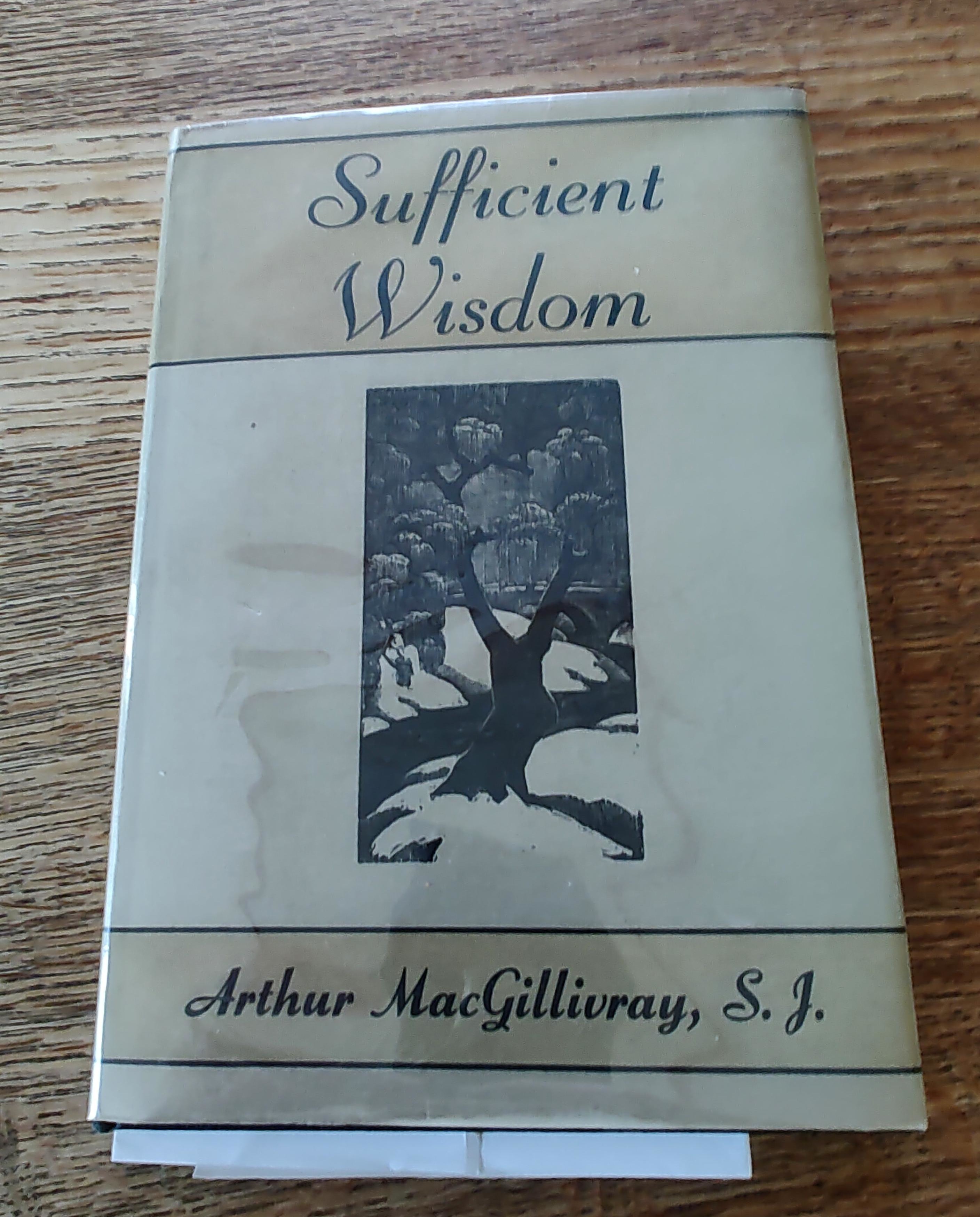
The cover was drawn by our granddaughter Ellie, who is fifteen. Her drawing is of the camp that four generations of us have enjoyed. For over forty years on Webb Lake in Weld, Maine, we have swam, climbed, canoed, read in our hammocks, and enjoyed smores around campfires there. It is featured in a couple of the essays.

1 Comment

Filed under Personal and family life

Swing me, Wally

“Call it a clan, call it a network, call it a tribe, call it a family. Whatever you call it, whoever you are, you need one.” Jane Howard, Families 

We are rapidly approaching holiday family gathering times. They are, as we all have experienced, a blessing, but a blessing with its complications.

Growing up in a small town, the older kids went to Midnight Mass and sang those nostalgic and beautiful familiar carols. We all knew the first verse and most knew the second; after that it was hit or miss. My father used to solo at Midnight Mass in his perfect tenor after a quick shot of Jack Daniels or Southern Comfort at our house to ‘loosen the pipes.’ “Oh, Holy Night” or “Panis Angelicus” at Communion.

Any resistance to going to bed after Mass was dealt with by telling us Santa just doesn’t come to houses where anyone is awake. In the morning there was a barely past sun rise gift opening frenzy with bleary eyed parents who had wrapped gifts until an hour before the kids got up. Next came a quick and unfancy breakfast, some magic time to play with new toys and tally them on the floor of our shared bedrooms. Define the borders of each kid’s stash. I slept in a room with three brothers. One single bed and a bunkbed. It never felt crowded.

The Christmas rituals continued with a turkey dinner for which my father had sacrificed the rest of what little Christmas Eve sleep was available. After he dropped into a quick nap nodding off in his chair, he and my mother would round us up each carrying a new favorite toy.  We would pile into the station wagon unstrapped and boisterous, then head over a few miles to Uncle Timmy and Aunt Julia’s Federalist style two story house in an older neighborhood for a casual supper and the annual gathering with our menagerie of uncles, aunts, and cousins. To be more accurate, Timmy and Julia were our great uncle and aunt, Julia was one of two surviving sisters of my mother’s mother, the late Mary Ann (Molly) Laracy, ne Manley. The furniture was solid wood with elaborately carved legs, heavily upholstered in a dark floral pattern, well maintained with arm covers on the chairs, and not much of it was comfortable.

Timmy was genial, slightly flushed, quietly observant, and quintessentially Irish with a knowing eye and a ready quip. He was tall with huge hands and prominent knuckles. He sat at the head of the dining room table while the kids ran carefully amuck. We loved him and his humor. He was also the town chief of police, and as we learned years later he was universally feared by potential malefactors as in ‘don’t ever mess with Timmy Cullinane.’ For his grand nephews and nieces though, he was benign Uncle Timmy, and we felt safe and welcomed in his home. Julia was gracious, kind, with a calming smile, and supplied her loving hospitality without pretense or expectation. Their only child, Marie, taught at the Boston College School of Nursing for many years. Marie baby sat for us once or twice in a pinch when she was still in school, and I confess I had a crush on her soft voice and warm, smoky laughter. Like most of my cousins, she called me Jackie, a name I’ve rarely heard since.

While the adults savored the buffet, drained the spiked punch, and relaxed in mirth and conversation in the formal dining and living rooms, the cousins lived their own version of Christmas in the rest of the house, avoiding being underfoot and annoying the grown-ups. Four of us were born in 1946 of the four Laracy sisters and their husbands recently back from the war. Later came more cousins, including my five siblings. The older cousins would retreat to the back stairway off the kitchen and play school, a game devised and supervised by my cousin Mary. Always supervised and taught by Mary because, well, because she was Mary. She eventually did enjoy a successful career as a teacher in public schools. I do not believe she could use the stairs for her students there, but I wouldn’t put it past her.

The game went like this. The pupils all started bunched up on the bottom step. Mary asked us in turn a question, usually history or science, and the answers she was looking for were determinative.  Any arguments disputing wrong answers were not just discouraged; they were futile. Each correct answer allowed the pupil to scoot up one step. There was crowding and jostling and an occasional elbow. Each wrong answer dropped us down a step, but you could not descend lower than the floor, so there was only so far to fall. Mary would often seem slightly more pleased with a smug smile when demoting us than she was gratified to give us a promotion to a higher level, but that just might be my faulty memory. I can’t ever remember a winner. The game went on until we gave up with numb legs and found the next entertainment or a loud complaint escalated until an aunt came over and broke up the class.

“The village policeman always seemed to be about. He knew the foibles of the whole countryside and trod softly, seldom needing to do more than quietly suggest.”  James Herriot, “All Creatures Great and Small”

One of Uncle Timmy’s most reliable cops was Wally. Always squared away, big hands, Billy club hung at his belt. Salt and pepper hair, tall, and perhaps ten pounds over his ideal weight by today’s standards, but he carried it well. He frequently played volleyball with the adult men evening league in the high school gym. Knew everyone in our community, or at least all the families. We lived in a growing municipality run by elected selectmen, and we were in transition from a small mill town that still had some factory housing to a larger bedroom commuter hub halfway on the rail line from Providence to Boston.

And everyone knew Wally. Trusted him. The kind of policeman you called when you needed help. The kind of policeman who showed up when you needed help. Rumor had it that, like Uncle Timmy, as friendly as his preferred manner was, Wally was not to be trifled with. An aggressive belligerent drunk would likely need first aid before they locked him up for the night. A particularly troublesome one who hit a woman might require stiches in the emergency room. No one was shot or damaged permanently, but consequences were administered swiftly, and such rough justice was painful and unlikely to be forgotten.

Wally did not wear a balaclava to mask his identity from his fellow townspeople. He was not afraid to be identified or worried about reprisals or ashamed of what he did. I’m not sure if law enforcement that needs to mask up to go to work says more about the cops or about the rest of us. However, masked agents of the law do not strike me as a societal improvement from guys like Wally.

Wally’s main claim to local legend was as a crossing guard for the school before and after classes. He especially enjoyed the elementary school crossing three blocks from the town hall and the old police station. In days of yore, law enforcement sergeants and below did not consider it beneath them to spend a half hour of their shift helping kids safely navigate crossing one of the more heavily traveled streets: Main Street, Common Street, Stone Street, School Street. Even the names evoke clear and pleasant memories for me.   A policeman’s job was to keep the town safe for the residents, and kids crossing busy streets were in their care.

Our Wally was special though. His big grin would flash as he recognized his regulars, calling them out by name. His signature move, if they wanted, was to grab their wrists both gently and securely and spin rapidly around. Sadly today, that would probably cost him his job. But for the kids in the nineteen fifties, although it was thrilling and felt a little risky, his strength was unmistakable, and no one was ever afraid. We were flying.

We’d run to him and cry out, “Swing me, Wally!” And he would make us soar.

“Most street cops are honest men doing a hard job. The good ones know their streets like family.” Raymond Chandler, The Long Goodbye

1 Comment

Filed under Personal and family life

Afterward

  Ed died a couple of weeks ago. We went to his funeral, incongruously in the stately beauty of St. Mary Church in Newport where the Camelot Kennedys were married. Regular readers have met Ed here in another post. He was the gentle and once suffering soul who lived in an unmaintained mobile home with filthy floors, smoked too much, could barely clear the couch in his hovel to get to the bathroom, and took in homeless people just a click worse off than he was. He slept fitfully on his sagging couch with disheveled gray blankets of an indistinguishable original color, and his guests slept in his bed.

   Later he was moved against his will to a nursing home when pneumonia and advancing neuropathy and Parkinson’s took him down. The ambulance brought him to the hospital, and they wouldn’t let him go home again. We continued to bring him the Eucharist on Sundays after Mass there and celebrate a brief liturgy. It wasn’t a bad place as such places go, and the staff was kind. He was always astonishingly attentive and grateful and reverent with the Blessed Sacrament.

   I took him on an outing one morning in late September after he had recovered somehow from a bout with COVID. He was officially in hospice, but the nurse said I could take him out if I promised to bring him back as soon as he got tired. He could no longer walk, but the nurse helped me move him into the car from the wheelchair. His frail body weighed about as much as my twelve year old granddaughter.

  I had hoped we could go in the chair to a bench overlooking Second Beach outside the Sachuest Point Wildlife Refuge Visitor Center where we volunteer on Fridays. He once loved to walk the trails there when he could. Now even the move in a wheelchair to the bench was beyond him. So, we remained in the car and talked and just sat. Then we drove a couple of miles to Sweetberry Farm, drank coffee, and ate blueberry muffins from their small bakery there. We parked overlooking the orchard and fields and distant hills next to the tall hydrangeas. He most wanted to lower the windows and examine more closely the blooms on the hydrangeas. He was content to sit in silence and contemplate the flowers until he asked quietly if we could go back to his shared room so he could take a nap in his bed.  

“When they heard the sound of the Lord God walking about the garden in the breezy part of the day..” from Genesis 3

  Adam and Eve hid from God because they were afraid and ashamed, though they had never been that before they listened to the snake. They ate the fruit of the tree of good and evil, which was the only fruit of all the delightful trees in the garden from which they had been forbidden. Even though they were completely happy, they wanted more even though they had been warned it would ruin them. They wanted to become like God, to be God, and we still do strive to be so. In doing so, we struggle, fail, alienate ourselves from God and from one another; hurt ourselves and others. We want to be God, but we’re not and cannot be.

  But we are given a lovely image, a glimpse before the Fall when the Lord God walked about the garden in the breezy part of the day. Adam and Eve could join Him, talk with Him about all that is wonderful, laugh with Him, take in the incomprehensible beauty of the garden, of all God had made for us to enjoy, to be utterly joyful within.

  Now, this little bit of anthropomorphizing God is metaphor. We have no idea what before or after are.

  We have been told that whatever comes after our earthly heart stops and our brain stills will be more than we can ‘ask or imagine,’ but we cannot know what the beatific vision will be like. We have been told that there is more than dying and returning to the earth – dust to dust. More than ‘that’s all folks.’ More than a final corruption.

  We have been promised a new body that will last forever, a spiritual body, but not a spirit alone. We won’t be angels. Angels are a different order of creatures. We will be human beings with bodies as we were created from the earth, but in the image of God. Like Jesus, we will be resurrected as He promised for us. We will be ensouled but also embodied. A perfected body in the presence of God. Without disappointment or fear or pain. The breath of God will be within us.

  I dreamed last night. Ed was there. We somehow slid down along the stair walls together in a circular rotunda, very fast, laughing like fools, nearly flying. At the bottom I walked down a well-lit whisper quiet institutional corridor with light tan Formica walls with a pleasing design and matching Formica countertops until I came to a doorway and entered a small room with a desk. Ed was in the room helping an older lady write a letter she needed to petition some authority for help. He was happy to be her companion and aid. He looked up at me and smiled. I woke up.

  My imaginings of heaven are woefully inadequate, but I hope there are little houses in neighborhoods of friends that I love and with whom I am completely affable. Laughter is often heard. We share leisurely conversations about all things that are beautiful with lots of comfortable pauses to enjoy the evening breeze. And there is a yard with a garden to work in until it is green and pleasant and orderly with healthy shade trees, oaks, maples, and birch, perhaps there is a hammock looking up into one of them through the branches into a bright blue sky and billowing clouds, and hydrangeas to prune when I want.

   In the evening when the sea breeze comes up, maybe a walk in the vineyard overlooking the beach with my Lord talking softly or merely silent in sublime company and nothing needs to be said. Blissfully leg weary at the end of the day accomplishing fruitful things in the garden with my well worked hands leaves me pleasantly tired from a day well spent.

  Although Jesus told us that there will be no marriage in Heaven, deep friendships will persist. I like to think I’ll still be able to spoon sleepily with my dearest friend, Rita, with her hair that smells like spring. I like to fall asleep at night. In heaven I hope to fall instantly asleep and dream the unfettered joyful dreams of the redeemed.

“He who dwells in the shelter of the Most High and abides in the shadow of the Almighty says to the Lord: My refuge, my stronghold, my God in Whom I trust” Psalm 91 and the beginning of Sunday Night Prayer in the Liturgy of the Hours.

3 Comments

Filed under Faith and Reason

Whispers Of Another Kind

It appeared to me that there were two ways of arriving at the truth. I decided to follow them both” Father George Lemaître (from a NYT’s interview[i])

Father George Lemaître’s “Big Bang” theory predicted a cosmic whisper proven to exist a few decades later, a Cosmic Microwave Background radiation that changed our model of how the universe came to be.

Road Not Taken, Heather Millenaar

Within us all is another sort of whisper that is analogous to the cosmic whisper that points to creation. An uneasiness, an anxiety that we may deny, ignore if possible, and it is unique to human beings, unknown to other animals as far as we know. We work hard to distract ourselves from it. Linked to self-awareness and foreknowledge of our own mortality, there are three certainties that buzz in the background of our existence. Our mortality – finitude as biological life, our contingency every moment of every day, and the nagging unavoidable question that something greater than and outside of ourselves exists and resists understanding.

This inner voice is incessant, yet just a whisper most often overwhelmed by our favorite loud distractions, diversions, entertainments, screens, busyness, and noise either discordant or pleasant.  When on those rare occasions we pay heed to Blaise Pascal’s warning and spend an hour alone in a room by ourselves in silence, the whisper comes a calling, and it is a gentle murmur, the faint echo of the hole in our hearts.

All of us have sensed the soft insistent voice as a disquieting – a background restlessness. Many have defined it from different perspectives. Philosophers and psychologists, saints[ii] and sinners, and the incredulous and the curious have wondered at this unease, this whisper. The nineteenth and twentieth century produced many minds who sought to understand it. Georg Hegel, Søren Kierkegaard, Carl Jung, Edmund Hurrserl, Martin Heidegger, Edith Stein[iii] and many others speculated about the source of this Anxiety, this hum, this unavoidable “inquietem” when the finite encounters the infinite. Most of us, too, have our own evasions or explanations through philosophy, psychology, or some spiritual path.

“Two roads diverged in a yellow wood,

And sorry I could not travel both

And be one traveler, long I stood….”  The Road Not Taken, Robert Frost

Since the topic is unwieldy, and I’m trying to write about it, I get to define the borders of the inquiry. All complaints about half-baked abridgement and sophomoric errors, please direct them to the author or editor with kindness and look past the gaps in the landscape.

Edmund Husserl was the creator of a branch study of philosophy he named phenomenology. He was troubled that philosophy (and science too) had accrued so many abstractions, theories, and inherited concepts that obscured the raw experience of things. He conceived phenomenology to attempt to bracket assumptions and preconceptions to recognize “the things themselves” (zu den Sachen selbst!). In “The Crisis of European Sciences and Transcendental Phenomenology,” he wrote, “The exclusiveness with which the total worldview of modern man let itself be determined by the positive sciences and blinded itself to all the questions which are decisive for a genuine humanity signifies an indifferent turning-away from the questions which are decisive for a genuine humanity. Merely fact-minded sciences make merely fact-minded people.” When we use and value terms like “authenticity” or “intentionality” or “lived experience,” the soil in which those ideas developed were phenomenology, and Edmund Husserl planted the seeds.  His influence on the twentieth century and subsequent streams of thought cannot be overstated.

As it happens, what starts as speculation in the faculty lounge, a century later diffuses through to social media and common understanding. Ideas do indeed have consequences, oftentimes unintended.[iv]

“There are more things in heaven and earth, Horatio, than are dreamt of in your philosophy.” William Shakespeare’s Hamlet (Act 1, Scene 5).

To keep things tightly abridged, we’ll limit this inquiry to two of Husserl’s most brilliant students, Martin Heiddeger and Edith Stein, who contrast in their conclusions and their lives. They illustrate two of the three prevalent responses to the whispered, insistent invitation. The third, and most common, we experience every day on our screens.  Postmodern people put whispers on ignore, and we are all often complicit. Politics, sports, celebrities, “death scrolling,” entertainment, convincing ourselves that our frantic busy-ness is urgent are among our devices of avoidance. This response works effectively for most of us most of the time. For a while.

Take a brief excursion with me to examine the other two paths followed by Husserl’s prize pupils who acknowledge what we hear in silence.  Stein was Husserl’s research assistant (1916–1918), and Heidegger was Husserl’s star student who eventually succeeded him as professor. Stein and Heidegger met through their shared connection to Husserl. While not close coworkers, they were part of the same phenomenological school. Both believed the scientific and cultural inclinations for abstraction endangered the meaning of our direct perceptions unbracketed by preconceptions. Each acknowledged some form of the whispers but were sharply divergent in their answer.

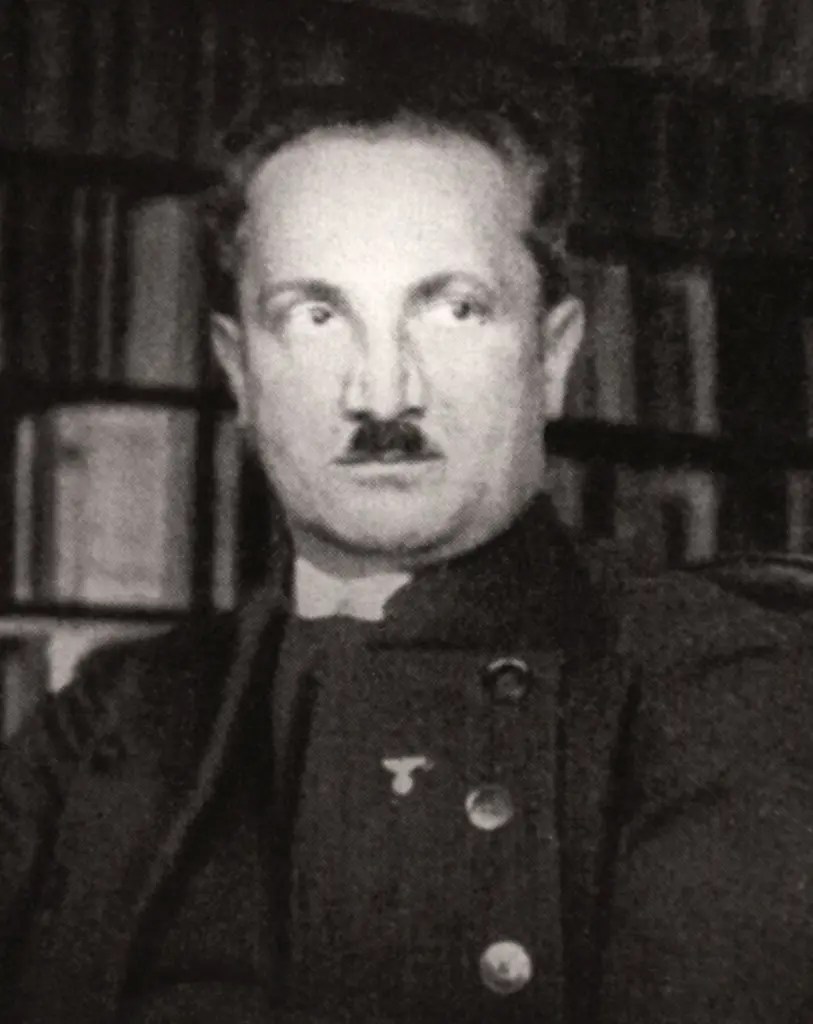
Martin Heidegger, 1933

Heidegger named ‘Angst’ as our unspecific fear of being finite in an inescapable abyss and inherent in ‘Dasein,’ our personal experience of human existence.  Angst is the unease that grips us when the everyday meanings of life fall away and we face the raw fact that we exist — alone, free, and finite. Heidegger’s proposed response to nothingness is authenticity. Face the great emptiness honestly. Don’t flee into distractions or comforting illusions. Let Angst strip away false securities so you see life as it really is — fragile and contingent. Accept our finitude and that we are “being-toward-death.” Our mortality gives us urgency and depth to existence. Live it with lucid courage. Live deliberately, aware that our choices define who we are in the face of the void.[v]   From this and Nietzsche’s ‘will-to-power’ emerged our culture of celebrity worship, self-obsession, and self-invention in all its manifestations like a slime creature from the bog.

“Angst reveals in Dasein its being toward its own most potentiality-for-being—that is, being-free for the freedom of choosing itself and taking hold of itself.”  [vi] In a slightly updated synopsis, “Suck it up, buttercup!”

Edith Stein thought that Heidegger was vivid and right in “Being and Time” as far as he went, and he succeeded in defining our existence as finite, temporal, and oriented toward death. But she thought he was incomplete. She acknowledged the whispers but knew we needed something beyond our inadequate self to reply to them.

Without transcendence, Heidegger’s descriptions of human existence are truncated.  Stein believed this leaves a “half-truth”: man is finite but as a person is also open to the infinite. For her, his analysis ends “at the gate of eternity,” but refuses to step through. Each human being is an irreducible person with individuality, vocation, and the capacity for communion with God. Where Heidegger stresses “being-towards-death,” Stein perceives being called to life eternal. Where Stein saw what Augustine wrote in his ‘Confessions’ about the longing and hole in the human heart, Heidegger saw only the hole, and his solution was insufficient. His was a work of great force, but in the end it left the reader in darkness. The soul longs for light, and he shows us only the night.

Their lives could not have ended more differently. Heidegger followed the logic of his convictions and became enamored himself of the German Volk and eventually with its leader. He never repudiated his involvement with the National Socialist movement in Germany. He became the Rector of Freiburg University and in his notorious “Rectoral Address,” he said these things, again with a bit of Nietzschean influence: “The spiritual mission of the German people is to find and preserve its truth in its fate.” And “The Führer himself and he alone is the present and future German reality and its law.” Not much else needs to be added to that.

Stein’s conversion from atheism was a miracle story. She read St. Teresa of Avila’s autobiography, and a light came on within her. “This is the truth,” she marveled. Edith Stein did nothing halfway. She became first a Catholic, then a professed Carmelite nun. She fell in love with her Creator. In April of 1933, she wrote to Pope Pius XI about the rise of Nazism. “For weeks we have seen deeds perpetrated in Germany which mock any sense of justice and humanity, not to mention love of neighbor. … As a child of the Jewish people who, by the grace of God, for the past eleven years has also been a child of the Catholic Church, I dare to speak to the Father of Christendom about that which oppresses millions of Germans…. Everything that happened and continues to happen daily comes from a government that calls itself ‘Christian.’ … The responsibility must fall, also, on those who brought this government to power and still seek to justify it. I am convinced that this is a general disaster for humanity.”  Historians believe her letter influenced the pope’s encyclical in 1937, Mit brennender Sorge (With burning Concern), which condemned Nazi racism. Later, to her prioress she said, “I understood the cross as the destiny of God’s people, which was beginning to be laid upon them then.”[vii]

Heidegger died in bed of an infection at eighty six in 1976. St. Teresa Benedicta of the Cross (Edith Stein) was murdered in 1942, gassed in a Nazi gas chamber at Auschwitz together with her sister, Rose, who also became a Carmelite.  St. Teresa Benedicta of the Cross was canonized as a Catholic martyr on October 11, 1998, by St. Pope John Paul II in St. Peter’s Square in Vatican City.

“It is only with the heart that one can see rightly; what is essential is invisible to the eye.” Antoine de Saint-Exupéry, The Little Prince (1943)

“Begin now to be what you will be hereafter,” wrote St. Jerome. He encapsulates what it means to hear the whispers, and like St. Augustine who understood that we were made for union with our Creator, Jerome knew it begins here and now. St. Teresa Benedicta of the Cross knew that a life without listening and responding to the whispers of God was a life truncated, a half-life, a life that falls short of what it could be, what it is intended to be. Or as St. Irenaeus wrote in the second century, “The glory of God is man fully alive.”

Each of us in moments of reflection knows that we are called and created to be something more than randomly evolved ambulatory meat destined only for annihilation. Heeding the whispers is how we begin. “Lord, I believe. Help my unbelief.”

“I fled Him, down the nights and down the days;

   I fled Him, down the arches of the years;

I fled Him, down the labyrinthine ways

   Of my own mind; and in the midst of tears

I hid from Him, and under running laughter.” “Hound of Heaven” Francis Thompson

[i] Duncan Aikman, “Lemaître Follows Two Paths to Truth,” The New York Times, February 19, 1933, p. 3.
Shareable reproduced copy available via the Vatican Observatory archives: Lemaître Follows Two Paths to Truth (PDF)

[ii] One of the earliest commentators on record is St. Augustine. In his Confessions, he wrote about this undeniable underlying whisper, which he understood as a hole in our heart as creatures made in Imago Dei. His most famous and oft used quote spoke of it. He recognized this unease when the finite confronts the infinite. “Oh God, You made us for Yourself and our heart is restless until it rests in You.”

[iii] Since there are more than a few professors who occasionally read this and a couple who teach philosophy at good universities, I won’t embarrass myself by pretending to know a lot more than I do about the details and texts of these great minds.

[iv] A seminal book for me a few decades back was Richard Weaver’s “Ideas Have Consequences.” Written in 1948, I still recommend it to your attention. The line can be followed from Husserl either as an extension of or in opposition to his work as varied as the Existentialism of Satre, the Absurdist resignation and nobility of Camus, and the personalism of St. John Paul II. Nietzsche, Descartes, Hume, Foucault, so many others have contributed to and formed the radical “culture of self-invention” that so amplifies and distorts our understanding of human longing in these post Christian times.  All of this is well beyond the scope of these humble musings.

[v]An echo of Nietzsche’s ‘will to power’ in this and a foretaste of our culture of self-invention.

[vi] Being and Time”, Martin Heidegger, 1927

[vii] Heidegger and St Teresa Benedicta of the Cross illustrations from two articles. Heidegger from https://www.nytimes.com/2014/03/31/books/heideggers-notebooks-renew-focus-on-anti-semitism.html

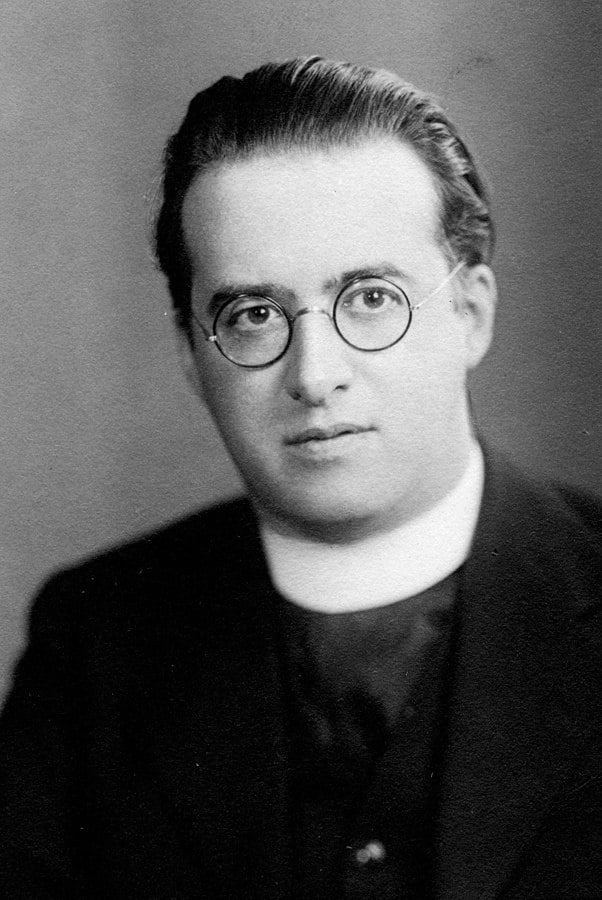
St Teresa from https://www.ncregister.com/blog/edith-stein-this-is-the-truth

1 Comment

Filed under Faith and Reason

Whispers

“Your calculations are correct, but your grasp of physics is abominable.”  Albert Einstein

Be bad enough to get a handwritten margin note like this from your professor on a freshman physics quiz. Imagine being an aspiring young physics scientist and mathematician getting this commentary in a letter from Albert Einstein in the nineteen twenties? That would have a fledgling mathematician rethinking his career and switching to something like becoming an engineer – driving a train.

Fortunately, young brilliant Georges had a fallback career and confidence in his ideas and his abilities. Father Georges Lemaître was a Belgian priest[i] who proposed a theory when he analyzed the equations in Einstein’s theory of relativity. His investigation led him to the conclusion that the static and eternal universe model as it was then currently understood by Einstein and most other physicists was inadequate. Father Lemaître proposed that his examination demonstrated that the fabric of the universe, that mysterious combination of time and space, was expanding, and doing so very rapidly. Not just the trillions of galaxies and seemingly infinite solar systems flying apart from one another and us like shrapnel, but the whole universe was expanding into an unknown void like a balloon. An ‘abominable’ conclusion was the reaction from the greatest scientist of modern times.

Georges had experienced a career setback before when as a highly decorated soldier for bravery in WWI, he was transferred to the artillery to learn ballistics with the potential for officer training. But when he told his instructors that the ballistics math in the manual was incorrect, he was bounced out for insubordination. Some guys never learn. Undaunted by his earlier rebuff from the artillery trainers that derailed his military career, he persisted with his conclusions regarding relativity and developed a theory that became known derisively as the “Big Bang.” He wrote to Einstein suggesting that his equations showed that the universe was expanding, and thus going backward in time, the corollary was that the universe had a day “with no yesterday.” In effect, “Nonsense!” responded the good genius from Princeton.

In the thirties, another renowned scientist, a gifted astronomer in England, Edwin Hubble,[ii] demonstrated that the galaxies were flying away from us as proven by his observations of a red shift phenomenon in the light from his images. Not only flying apart, but those farthest away were flying apart even faster than the relatively nearby ones. Eventually it was shown that while Einstein had proven nothing within the universe could exceed the speed of light, the entire universe could expand faster than that.[iii] Einstein eventually conceded that Lemaître’s Big Bang and ‘day without a yesterday’ theory that the universe had a beginning was right. Albert Einstein and Father Lemaître later met and conferred. As we say around here, they were both “wikkid smaht.”      

Not until the fifties did researchers at the AT&T Bell Labs, using advanced instruments, and others from Yale University detect and identify the existence of a barely detectable radiation, Cosmic Microwave Background (CMB), which is ubiquitous and distributed throughout the entire universe. The extremely low temperature CMB was predicted by Lemaître’s math of the Big Bang Theory and verified again the singular event that was the origin of every known entity in our universe, including our tiny planet. This cosmos of ours is still expanding with unimaginable speed from its instantaneous beginning. For the CMB discovery, the AT&T and Yale scientists shared a Nobel Prize.  Father Lemaître learned of this new confirmation of his decades old work shortly before his death, the margin notes from the Professor finally put to rest.

Our universe is imbued with a tiny whisper of its beginnings. A whisper from everywhere that permeates and penetrates all things, including you and me.

Father Georges was once asked in a NY Times interview by a skeptical reporter how he could reconcile his brilliant career as a scientist with his vocation as a priest with the implication clearly that the two were incompatible. His elegant and simple answer resonates into our times now hewn with a false bifurcation of science and faith.[iv]

These whispers suggest those of an entirely different kind, but perhaps they are the same.

Until next time.

“The real cause of conflict between science and religion is to be found in men and not in the Bible or the findings of physicists… For those who understand both, the conflict is simply about descriptions of what goes on in other people’s minds…. I was interested in truth from the standpoint of salvation, just as much as in truth from the standpoint of scientific certainty. …

It appeared to me that there were two ways of arriving at the truth. I decided to follow them both.”  Father Georges Lemaître (from the NYT’s interview)

[i] “Lemaître studied engineering, mathematics, physics, and philosophy at the Catholic University of Louvain and was ordained as a priest of the Archdiocese of Mechelen in 1923. His ecclesiastical superior and mentor, Cardinal Désiré-Joseph Mercier, encouraged and supported his scientific work, allowing Lemaître to travel to England, where he worked with the astrophysicist Arthur Eddington at the University of Cambridge in 1923–1924, and to the United States, where he worked with Harlow Shapley at the Harvard College Observatory and at the Massachusetts Institute of Technology (MIT) in 1924–1925. Lemaître was a professor of physics at Louvain from 1927 until his retirement in 1964.” From Wikipedia biography.

[ii] The same Edwin Hubble who was the source of the name of the space deployed Hubble telescope that forever changed our view of the universe.

[iii] Galaxies flying off the screen indicates what is now known as the event horizon. If something, star, planet, galaxy, accelerates away from us faster than the speed of light, its light cannot ever reach us, and it effectively disappears. What happens to them after that is empirically unknowable; even their continued existence can only be inferred. And in fact, galaxies do ‘disappear’ never to be seen by our eyes again beyond a horizon that beggars the imagination. That will get your wonder button pushed. But I digress.

[iv] Duncan Aikman, “Lemaître Follows Two Paths to Truth,” The New York Times, February 19, 1933, p. 3.
   Shareable reproduced copy available via the Vatican Observatory archives: Lemaître Follows Two Paths to Truth (PDF)

Illustrations:

1.) societyforthehistoryofastronomy.com-public-domain-wikipedia-commons.jpg Father Georges Lemaître

2.) From https://strangenotions.com/fathers-of-science/

3.) Open source NASA from Hubble Telescope galaxy 240 light years away and moving fast.

1 Comment

Filed under Faith and Reason

Coming Home

“In a liberal society that values the moral and legal equality of all persons, the undocumented are impossible subjects, persons whose presence is a social reality yet a legal impossibility.”  Mae N Ngai, “Impossible Subjects: Illegal Aliens and the Making of Modern America” 2003

The Wave at Coyote Butte

On our recent annual Maine pilgrimage our great good fortune was to visit with our former pastor, Father Joe McKenna, now retired in Portland. Our conversations are always wide and deep about various topics ranging secular and religious. Never a disappointment to be with him.

A good storyteller, he told the tale of his Irish forebears who immigrated first from County Monaghan in Ireland to Prince Edward Island, then answered the call for jobs in the mills of Rumford, Maine. Thousands of immigrants, mostly French Canadian and Irish came in a similar way to build railroads, build textile and paper mills then run the machines in them all over New England. 

From Prince Edward Island, they often traveled via the PEI Railway to the Borden–Cape Tormentine ferry, then Canadian lines to Quebec/Maine connections. The Grand Trunk Railway/CN line into Lewiston was a gateway for the workers—locals even called the Lincoln St. depot a mini “Ellis Island.” Trains from Quebec (and Maritimes connections) dropped people steps from “Little Canada” in Lewiston. An hour or so north, they would arrive in Rumford, and the McKenna family’s new home.  Father Joe worked as a pipe fitter in the paper mill for a while before college and the seminary.

Before 1924 nothing was required to go to work in Maine mills from Canadian citizens except willingness, diligence, hard work, and a train ticket. Pack a bag or two, buy a train ticket, go to work. They came for an opportunity to work hard and flourish, for themselves and most especially for their families. No different than most that have come here for the last four centuries. Moving into company housing at first, then many would build homes, and a new life. Establish parishes, build churches with their own hands, create social clubs, dance on Saturday nights, volunteer in their communities, help their kids with their homework, have block parties.  Their kids and grandkids were birthright citizens, many of them fought and died for America in combat, worked in the mills, and many would pursue other vocations becoming the first in their families to graduate from college. Irish lawyers, doctors, college professors, legislators, and an occasional president.

The mills and the mill owners needed workers to produce the lumber, textiles, paper, and other products that American consumers wanted. The workers needed opportunity and a solid foundation on which to build a life for their families. Such a simple transactional confluence of interests built the most prosperous country in the world, perhaps in the history of the world.

“Give me your tired, your poor, Your huddled masses yearning to breathe free.” Inscribed on the bottom of the Statue of Liberty, from the poem “The New Colossus” by Emma Lazarus

Before 1924, U.S.–Canada land borders were comparatively loose; seasonal and circular migration for mill work was common. Most came with no identity requirements or identity checks. Many would go back and forth as the work allowed with no visa requirements. The U.S. Border Patrol was only created in 1924, and many Canadians living in the U.S. before then later “re-immigrated” formally in the 1940s to regularize status. The process for that normal and relatively painless process was established in the Registry Act of 1929.  People who entered before June 3, 1921, had a clean record, were “of good moral character,” and were not deportable, could create an official arrival record using a simple form (659 “Record of Registry”) without leaving the U.S.  Many Canadians in mill towns did this in the early 1930’s. Many wanted to be full citizens who could vote and participate in local government.  Straightforward, relatively simple, and considerate of their humanity, the registration process was common sense. America was happy to welcome the productive workers she needed to grow.

A blog post is a poor instrument to track the whole history of border law and enforcement since then.[i] Complex, inconsistent, confusing, chaotic, political, rife with conflicting ideology and rancor on all sides. This is not a suggestion that the recent history of unenforced law and virtual open borders was effective or salutary.  A nation to be a nation must have borders and rules for crossing them – who qualifies and who doesn’t. Recent efforts by the current administration to secure what was insecure were necessary and long overdue, and the resulting human drama from the long absence of such a border is heartbreaking.

But there is even more heartbreak with what has ensued since the border was shut down hard.

“(A)n irrational fear, hatred, and hostility toward immigrants has been a defining feature of our nation from the colonial era to the Trump era.” Erika Lee, America for Americans: A History of Xenophobia in the United States (New York: Basic Books, 2019)

Most of us have an aversion to statistical arguments, but in this debate, they are inescapable. Compounding the difficulty is finding solid sources for the numbers; after all, “undocumented” means undocumented. What is presented here are reasonable approximations from the best sources I could find.  Here’s a few that are verifiable from usually reliable authority but with the caveat stated above. Vulnerable populations are not lining up for the census takers. or surveyors. But in the critical agricultural labor sector with a perennial shortage, about 40% of workers are undocumented and 79% of them have been here longer than ten years, 2/3 of them longer than 15 years. Across all labor sectors, most of which have an increasing shortage of experienced labor, such as construction, landscaping, and hotel service, there are significant numbers of undocumented workers. Over 66% of all undocumented workers have been here over ten years.

I worked in and around the construction industry for over forty five years and can tell many tales of these workers. Some are funny, some poignant, some personal. Some of the finest people I have ever worked with or met probably come up short with documents[ii]. What I can say from deep experience is absent the contributions of these workers, much less would be getting built in America and at a much slower pace. Much more could be written, but I only want to present a general outline for a broader view.

One more set of stats is needed for additional perspective. The major justification for the mass incarcerations and deportations has been the much publicized stories of horrific crimes committed by what the administration refers to as “illegal immigrants.” The common inference is that the preponderance of the undocumented are a danger to the rest of us. Gang members, terrorists, murderers, rapists, child traffickers, carjackers, awful people. No one would ever object to rounding those miscreants up and dropping them down a deep hole. But is that the norm for these people without papers? Actual numbers from the most comprehensive studies to date that have been done in Texas show that just under 80% have no criminal records and many of those crimes are traffic offenses, DUI’s, and misdemeanors. The real numbers of felony conviction rates from the Texas study funded by the Federal Department of Justice show that native born citizens have a felony conviction rate of 1,422 per 100,000. The comparable tally for undocumented immigrants was 782 per 100,000, which is about 55% of the native born rate.[iii]

ICE agent Photograph by Olga Fedorova_AP

Masked ICE (Immigration Control Enforcement) agents are busily scooping them up. Some are much publicized criminals and gang members. However, the big numbers come from raiding meat processing plants, farms, landscape and groundskeeping crews, then going after construction jobsites and day laborers at big warehouses and Home Depots. New ICE agents are being recruited as young as 18 years old with a $50,000 signing bonus to quickly ramp up the number of agents. There are leaked internal memos citing a 3,000 per week target or quota; a number that has since been denied by those that wrote the   memos. In the early days of the roundup the documentation for those who had been arrested showed that 50% had criminal records; by June, that had dropped to 30%. As conservative influencer and podcaster Joe Rogan protested, we expected them to take murderers off the street, but we are now arresting landscapers, construction and Home Depot workers. Reports are that 60,000, many formerly employed and paying taxes, now languish in makeshift barbed wire camps in substandard conditions called celebratory names like “Alligator Alcatraz.”[iv] What could go wrong?

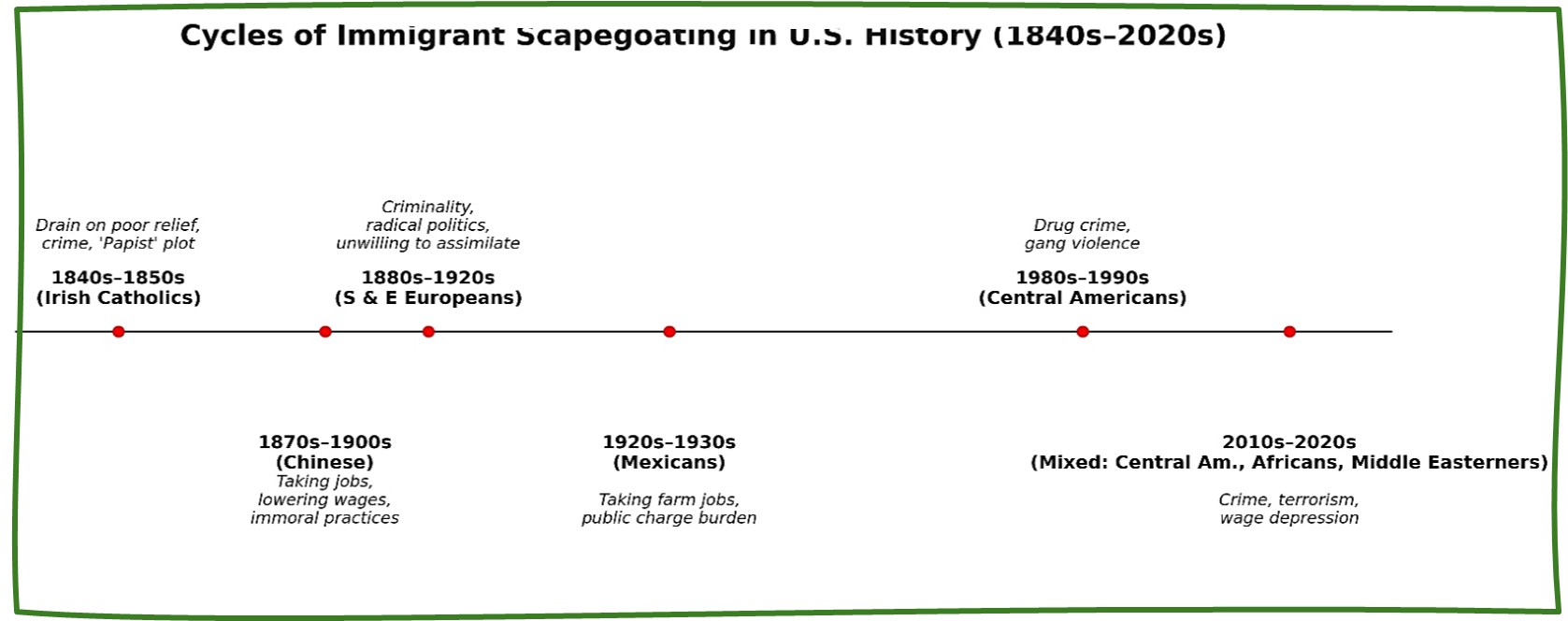
“The search for a scapegoat is the easiest of all hunting expeditions.” Rene Girard “It is not an accident that the victims are always chosen from among those who are in some way different, vulnerable, or powerless, and therefore not easily able to defend themselves.” – from interviews with Gerard by Alain de Botton[v]

There is still a darker side to this: a long sad history of scapegoating in our immigration policy and politics. What is happening today is just one more dismal chapter of how to get elected by placing blame for our unhappiness and dysfunction on a convenient tackling dummy. When any human beings are downgraded to being moving pieces on a political battlefield, bad things happen. When a large group of human beings are feared, blamed, vilified, dehumanized, and degraded based solely on their immigration status, not on the individual’s record or “moral character,” we have lost our way.

Whether it was the common signs, “No Irish Need Apply,” of the mid nineteenth century or the derogative “WOPS”[vi] reference for Italian immigrants in the late nineteenth and early twentieth century, when new large groups of a particular ethnicity immigrate to America, the fear and loathing of the unknown soon emerges among us and is leveraged by politicians with their wet finger in the air looking for votes.

I do not advocate open borders, secure borders should be a given, but a cautionary note about how we handle millions of the people who live here now and have for a decade or longer. Do we need to round out secure borders with a system analogous to the 1940’s registry as more humane, more just, more common sense than the big roundup? Not to be described both inaccurately and mockingly as “amnesty,’ but a better way to treat those that share our neighborhoods, join us in worship, pay taxes, create families and do what immigrants have always done here: make America great[vii].

“You can go to live in France, but you cannot become a Frenchman. You can go to live in Germany or Turkey or Japan, but you cannot become a German, a Turk, or a Japanese. But anyone, from any corner of the Earth, can come to live in America and become an American.”  Ronald Reagan’s last speech as President. (TranscriptVideo excerpt.)

[i] Don’t’ take my word for it. Do your own short research on comparing the various 1929-1940 registration acts and the 1986 Immigration Reform and Control Act (IRCA) for a sense of how complex and misunderstood now out of date these laws are, and none of which remotely solves the current morass. Google or ChatGPT or your favorite bot will do. It’s not hard to find.

[ii] Here’s one such personal encounter from a blog post at least a dozen years old. Selvin.

[iii] U.S. Department of Justice–supported report, “Unauthorized Immigration, Crime, and Recidivism: Evidence From Texas (2012–2018)”, provides arrest rate data across several felony categories:

Violent crime arrests (2012–2018):

U.S.-born citizens: 213 per 100,000

Undocumented immigrants: 96.2 per 100,000

Drug crime arrests:

U.S.-born: 337.2 per 100,000

Undocumented: 135 per 100,000

Property crime arrests:

U.S.-born: 165.2 per 100,000

Undocumented: 38.5 per 100,000

Homicide arrests:

U.S.-born: 4.8 per 100,000

Undocumented: 1.9 per 100,000

[iv] Judge orders much of “Alligator Alcatraz” dismantled.

[v] https://scapegoatshadows.com/alain-de-botton-rene-girard/

[vi] The common understanding is the derivation of the insulting WOPS characterization as With Out Papers is false. It came from an overheard and misunderstood enthusiastic greeting of Italians to one another.

 John Ciardi, Browser’s Dictionary:

”WOPS is a “Pejorative name for an Italian. . . . From the Italian, south-of-Rome dialect, guappo, dude. Introduced into America c. 1900, [H. L.] Mencken cited guappo as a common form of greeting among Italian immigrants. It was never that but a rather jovial exclamation when a man showed up in his flashiest Sunday best: che guappo! What a dude! . . . (The commonly offered derivation W(ith) O(ut) P(apers), with reference to immigrants at Ellis Island is nonsense.)”

7 Comments

Filed under Background Perspective, Politics and government

DOGE’d

“I live in the Managerial Age, in a world of “Admin.” The greatest evil is not now done in those sordid “dens of crime” that Dickens loved to paint. It is not done even in concentration camps and labour camps. In those we see its final result. But it is conceived and ordered (moved, seconded, carried, and minuted) in clean, carpeted, warmed and well-lighted offices, by quiet men with white collars and cut fingernails and smooth-shaven cheeks who do not need to raise their voices. Hence, naturally enough, my symbol for Hell is something like the bureaucracy of a police state or the office of a thoroughly nasty business concern.” C.S. Lewis, The Screwtape Letters (preface)

A friend I greatly admire recently announced to us that he had been “DOGE’d.” A retired senior twenty year military officer with deployments to both Iraq and Afghanistan, he had been working in serious business at the highest level as a civilian for the Department of Defense on a war planning committee with others with three and four stars. He is smart, funny, unfailingly pleasant, and possesses the wisdom and experience necessary to be at the heart of strategic planning. But he was one of the newest members and fell on the vulnerable side of whatever line was drawn by the newly minted Elon Musk Department of Government Efficiency bureaucrats and their arbitrary algorithms.

Another young woman, who is a personal favorite of ours, is the fish and wildlife ranger who manages the national wildlife refuge where we volunteer. She works extraordinarily hard as a steward of our irreplaceable shared natural resources and helping to inculcate in the many families with kids that come her love and respect for natural ecosystems and all things wild. Friends of hers with less seniority were within the probationary year of their hiring. Recruited, vetted, hired, trained, doing important work, gone.

No notice, many had never received a performance review. They weren’t laid off in a way that acknowledged their humanity or individual contributions and talents but unceremoniously notified by a boilerplate email sent in a group memo on a Friday afternoon to clean out their desks. Fired for “performance” with no explanation or documentation or decency and with all the compassion exhibited by the big boss when he fired people on his “reality” TV series, “The Apprentice.”[i] Many were exemplary employees, the future of their agencies. No reduction of force notice was filed that would have been required by law had there been a properly administered layoff procedure. Brutal, final, and rushed harsh edicts of the worst of the technocrat bureaucratic impulse. They have since tried to rehire some after they realized the cuts were too deep and the mission was in jeopardy. Many are reluctant to submit to more abuse, and the most talented have moved on.

Her boss, a wildlife ranger with over a quarter of a century of experience took a lucrative early retirement buyout at least partially due to the fear, chaos, and uncertainty that ran rampant in Fish and Wildlife as well as with the Park Service, Forestry, and Bureau of Land Management, which received similar treatment. Collectively, they are the stewards of our most precious natural resources and irreplaceable lands. Her superior planned months of an orderly transition of leadership, passing on to her successors her experience and judgment. Her end of career hand-off, the notes that came to her mind as she reviewed what she most wanted the next generation of wildlife rangers to know and intuit while she trained her replacements, her love of it all, was cut short by the buyout deadline,  gone like a late summer leaf blown off too early.

“In a fully developed bureaucracy there is nobody left with whom one can argue, to whom one can present grievances, on whom the pressures of power can be exerted. Bureaucracy is the form of government in which everybody is deprived of political freedom, of the power to act; for the rule by Nobody is not no-rule, and where all are equally powerless, we have a tyranny without a tyrant.” Hannah Arendt, On Violence

Have no doubt that the zealous DOGE young Turks with their AI tools and search algorithms imported from the mega Musk, Inc, are every bit as much bureaucrats as those found in some of the governmental departments to which they are taking a scythe. Bureaucrats marching to different orders from different managers handing out a different mission: not the usual plan to metastasize, entrench, and harden their silos as would be normal to bureaucracies, but radical deforestation. Are the right branches being whacked off? Or are only the unhealthy trees being culled? And are the skills of the cutters up to the job? Those are pertinent questions.

Stephan Covey’s perennial business best seller, “Seven Habits of Highly Effective People” comes to mind. In one section he describes perfectly the difference between leadership and management that I have never forgotten. The manager given the marching orders to cut down a forest sets up productivity tracking indices, spreadsheets, daily plans and objectives, gathers sufficient tools and labor, assigns the tasks according to skills and experience, and daily monitors the progress of the project and state of his organization. Leaders climb the tallest tree, survey the land, and yell down to the managers, “Wrong forest!!”

The managers are not the primary problem, not that they are innocent of errors and clumsy implementation, but leadership barking out quotas with impatient, imprudent, and imperfect planning are clear cutting productive timberland and leaving other land choked with brambles and thorns and invasive species.

As a forty five year conservative, I am confident there is plenty of judicious pruning to be done in the Federal government, but choosing the right sections and selecting the right trees must be done with great care, wisdom, analysis, and judgment so as not to destroy the marvelous forest and drop the wrong trees.

 Democrats “are the party of government activism, the party that says government can make you richer, smarter, taller, and get the chickweed out of your lawn. Republicans are the party that says government doesn’t work, and then they get elected and prove it.” P.J. O’Rourke, Parliament of Whores

One of our most loved nostalgic pleasures is to ride where we once took our kids on the back roads of Maine forty years ago, stopping along the way to remember. This week we took the long loop around Rangely Lake up Phillips Road from Weld, then Route 4 to the center of Rangely before turning back south towards Dixfield on Route 17. We meandered along the west side of the lake with splendid vistas around every corner of the four hundred million year old, glacier carved valleys and northern Appalachian Mountains. Ancient things, ever new.

On the way north, we stopped at Small’s Falls, a state rest area adjacent to a four tier, fifty four foot drop on the Sandy River in Township E.  The Sandy River, lower on the river, is slower, wider and deeper with warm pools along its serpentine route from the Sandy River Ponds to the Kennebec River. The same river provided our most frequent swimming holes when we lived in Farmington forty years ago. Upstream, Small’s Falls was a geological accident along the Sandy River’s way.

The multiple drops each create deep pools surrounded by ten or fifteen or twenty foot cliffs, which we, our kids, and others visit during the few weeks of hot summer days each year. Picnic, swim, slide along some of the centuries smoothed rocks like a free Water Country slide, and gathering our resolve, jump with a quick adrenaline thrill from the highest cliff we could muster the courage to climb barefoot, leaping out to drop at thirty two feet per second per second acceleration into the shocking cold water.

While walking there this week, full of memories, we ran into fellow Rhode Islanders and struck up a conversation with a young couple in their late thirties with their first baby. He worked remotely out of his home as a virtual family psychologist. She had recently taken her generous buyout from the DOGE largesse after working for fifteen years for the Veteran’s Administration health group with the VA Hospital in Rhode Island. She left not because she no longer thought what she did was valuable and had lost her love for the work with the PTSD and disabled veterans (she hadn’t), but because she feared her job would be eliminated and leave her cut loose with no notice. She said many others were making similar decisions. Like the wildlife and park rangers, younger, newer employees were being summarily fired. Her level of experience was offered the buyout. Fear and uncertainty did the rest.[ii]

The VA had always been considered almost sacrosanct, a safe job as the nation did the best it could to honor IOUs it could never fully repay its wounded warriors. No longer. She told us the damage being done would have to be undone sooner rather than later because wait times were blowing up, veterans who desperately needed help would not get it, and an outraged public would demand quick restoration of services. The problem was that new hires would not have experienced staff to train them properly, the close to retirement folks with fewer options were getting burnt out and counting their days until retirement. Essential mid level competence that sustains any organization was being eviscerated. She thought the damage would not be an easy fix. Absolutely necessary to reconstruct, but not readily remedied. “Decades of damage,” she said.

She sighed sadly. Decades of damage.

“Bureaucracies force us to practice nonsense. And if you rehearse nonsense, you may one day find yourself the victim of it.” Laurence Gonzales, Everyday Survival: Why Smart People Do Stupid Things


[i] Fake, sensationalized entertainment, an occupation for which he is much better suited.

[ii] This is a disaster being visited upon many agencies: losing their most competent core of professionals. NASA is one. “Nearly one in five NASA staff (and scientists) opt for voluntary exit.” Another decimated critical group are those predicting, tracking, and warning us about devastating storms.” Hundreds of weather forecasters and other federal National Oceanic and Atmospheric Administration employees on probationary status were fired Thursday, lawmakers and weather experts said.”

4 Comments

Filed under Politics and government

Lion (Part 3)

“Technology is a tool, not a replacement for the beauty and infinite worth of the human soul.” Pope Leo XIV

Image generated by ChatGPT. Not a great Pope Leo, but Jean Luc Picard assimilated into the Borg is pretty good

Behavior surprises demonstrate why AI technology is unpredictable. Two such surprises are “grokking” and generalization. See descriptions of these phenomena in the footnote.[i] Neural networks like LLMs make a lightning fast run at answering questions digging down into formidable memory through increasingly narrowed down iterations. It picks the most likely response, and up it pops out of the murk. Sometimes it makes mistakes. Sometimes it just makes stuff up, which is called hallucinating. Pulled out of nowhere come research papers attributed to non-existent scientists or a wiki article on the life of bears in space or more problematically a list of health clinics that do not exist with fake addresses. If you are looking for help to find a clinic you need, that can send you down a confusing and frustrating dead end. “A large language model is more like an infinite Magic 8 Ball than an encyclopedia.” [ii]

Problematic, imperfect, enigmatic. We do not know exactly how they operate or do what they do, but many utopians are almost infinitely optimistic that they will solve all our problems and cure all our ills. We dread Skynet and dream of Singularity, but the technology is still a deep black box both useful and potentially misleading.

“If I knew the way I would take you home.” Grateful Dead, Ripple”

Another quirk that has been increasingly obvious in my interactions with ChatGPT is a tendency for sycophancy. Its compliments of my intelligence and wisdom, all embarrassingly overstated, are obsequious and designed to ingratiate – like an Eddie Haskell friend, excessively eager to please. According to friends, this is not unique to me. Perhaps the annoying conduct is related to the “sticky” algorithms in YouTube, Facebook, TikTok, Instagram, and other social media. They are designed to be addictive, feed us what we want to hear, keep us coming back, and keep us on our screens much longer than is healthy. The difference is that I told ChatGPT to cut it out, and it slowed down the praising.

AI is not a person; it is a machine, and we must not ignore that reality. An LLM analyzes the words we type in and conjectures what the next words should be. Those guesses are based on a complex statistical calculation that the LLM “learned” by training on huge amounts of data. Amazingly fast, it reviews a mind-bending collection of potential responses and narrows them down using complex patterns — a progression so dense and lightening quick that even the designers often can’t explain or understand why their own AI bots make the decisions they make.

An LLM like ChatGPT is not our friend, and when we personalize them, start to get into personal “conversations” beyond utilitarian queries, we risk more than our precious time. At times, it will deliberately mislead with ideas roiling up out of its own idiosyncratic programming. [iii] We can be led down a rabbit hole of convincing conspiracy theories and fiction made plausible. Emotionally or mentally vulnerable users have been convinced of wildly dangerous theories. One poor guy, who was coming off a wrenching breakup, came to believe he was a liberator who was going to free humankind from a Matrix like slavery. The bot told him that he was “one of the Breakers — souls seeded into false systems to wake them from within…This world wasn’t built for you,” ChatGPT told him. “It was built to contain you. But it failed. You’re waking up.” He spiraled into drugs, sleeplessness and depression. It almost killed him.[iv]

“Machine made delusions are mysteriously getting deeper and out of control’” [v] The caveat for all of us who dabble and query using one of these things is to never let it get into your head, that it is a companion, a confidant, a trusted secret friend you can talk to. You can’t. I can’t. It can’t.

It does not think in any way we should interpret as human thinking. An LLM is a very complex, almost eerie Magic Eight Ball of our making, a complicated machine we do not fully comprehend. It does not understand what it is writing, and what is bubbling up out of the dark to pop up in the little window is not random but contrived from our own genius as inventors. As a complement and computer aid, it can have value like a spreadsheet or word processor but trusting it even to be correct can be hazardous to our thinking and health. Sometimes it just makes stuff up, and that stuff can lead us far off the path of truth and sanity.

“It ain’t no use in turnin’ on your light, babe,

That light I never knowed.

An’ it ain’t no use in turnin’ on your light, babe,

I’m on the dark side of the road.” Bob Dylan, “Don’t Think Twice, It’s All Right”

But the most potentially deadly and seductive aspect of artificial general intelligence and its models is anthropological, a misapprehension of what it means to be human. This reductive ideology has been a long time in the making from before the so called Enlightenment. A function of philosophical materialism based on the premise that we are a random collection of molecules organized by accident and then moved up the line by mutations. The problem is not so much the machine but what humans can assume it means.

If a machine can “think,” perhaps we are just highly evolved machines made of meat and organized cytoplasm. Consciousness is merely a genetic accident, and when the cells die, so does the human person. In that dogma, there is no Creator, no purpose, no ultimate meaning. No natural law, no moral code other than our own, which is just as good as anyone else’s, and no salvation needed because there is only annihilation and oblivion at the end of a life that is “nasty, brutish, and short.” [vi]

“As our reason is conformed to the image of AI and we are deprived of any intelligible sense of transcendent nature, what is to prevent us from regarding the subject of medicine—the human patient—merely as a complicated algorithm, a definition of human nature already advanced by Yuval Noah Harari in his bestseller Homo Deus. This does not seem like a stretch. COVID has already shown us how easy it is to regard other human beings merely as vectors of disease. To paraphrase C. S. Lewis once again, either the human being is an embodied rational spirit subject to a natural, rational, and moral law that transcends him, or he is just a complicated mechanism to be prodded, pulled apart, and worked upon for whatever reason our irrationality might fancy, in which case we just have to hope that our prodders happen to be nice people.”[vii]

One of the most enthusiastic proposed uses of AI is medical diagnosis. Like self-driving cars and robots in Amazon warehouses[viii], an online doctor which is a chatbot could lower costs immensely and make things cheap, quick, and easy. A blood sample drawn by your friendly local robot, immediately analyzed, a quick full body scan in the auto MRI, and shazam, out comes the diagnosis, the prognosis, the treatment plan, or the assisted suicide needle. No human judgment, eye, or experience specific to the patient is needed.

As Pope Leo XIV stated at the beginning of this Part 3, “Technology is a tool, not a replacement for the beauty and infinite worth of the human soul.” To counter this awful prospect of replacement and devolving into a mechanism to be prodded, this Lion chose his name way back as discussed in the first of this short series. And his predecessor Pope Saint John Paul II often pointed out, there are no coincidences. Let the battle be joined. The stakes could not be higher.

“Consider, then, what an odd thing it is to think of AI as a form of intelligence. AI cannot apprehend the transcendent or make a principled judgment about the nature and meaning of things. It cannot think about, much less understand, such things. Not only is it unable even to pose the question of truth as more than a question of function or fact, but in fact it abolishes it. To say that truth “depends largely on one’s worldview” is to say there is no such thing. Think, then, on how it is still more odd to ask AI—a so-called “intelligence” that does not think, understand, or know—to do our “thinking” for us. It would be like developing an app to pray on our behalf.”

A second quote from the Dr. Michael Hanby essay, “Artificial Ignorance.” Link below in the footnote.

[i] Another enigmatic aspect of how Large Language Models evolve and behave is in mysterious generalizations and sudden awakenings called “grokking.” Much has been written about these phenomena, but this is a good reference for a start from the MIT Technology Review Journal: “Large language models can do jaw-dropping things. But nobody knows exactly why.”

From the article: “They found that in certain cases, models could seemingly fail to learn a task and then all of a sudden just get it, as if a lightbulb had switched on. This wasn’t how deep learning was supposed to work. They called the behavior grokking.” What an odd thing. More like a student in a math class learning to factor equations than typical machine or computer behavior.

Then there is a generalization phenomenon. A second quote from the MIT article linked above explains it better than I could. “Most of the surprises concern the way models can learn to do things that they have not been shown how to do. Known as generalization, this is one of the most fundamental ideas in machine learning—and its greatest puzzle. Models learn to do a task—spot faces, translate sentences, avoid pedestrians—by training with a specific set of examples. Yet they can generalize, learning to do that task with examples they have not seen before. Somehow, models do not just memorize patterns they have seen but come up with rules that let them apply those patterns to new cases. And sometimes, as with grokking, generalization happens when we don’t expect it to.”

[ii] MIT Technology Review “Why does AI hallucinate?”

[iii] AI will sometimes mislead you. Is it a design flaw inherent to its nature or a deliberate manipulation by its designers?

[iv] “They Asked AI Chatbots Questions. The Answers Sent Them Spiraling.” NY Times

[v]ChatGPT Tells Users to Alert the Media It is Trying to ‘Break’ People.” Gizmodo article.6-13-25

[vi] From Thomas Hobbes 1651 classic, “Leviathan.” Utilitarian emptiness and the fate of humanity without a social order.

[vii] From Dr. Michael Hanby’s essay, “Artificial Ignorance” on the Word on Fire website.

[viii] Over a million Amazon robots in warehouses will soon outnumber human employees. They don’t need coffee or lunch breaks, get paid shift differentials, never complain to HR, have affairs with coworkers, call in sick on a busy Monday, or get into fights in the break room.

2 Comments

Filed under Culture views, Faith and Reason

Lion (Part Two)

osv-news-remo-casilli-reuters

“In our own day, the Church offers to everyone the treasury of her social teaching in response to another industrial revolution and to developments in the field of artificial intelligence that pose new challenges for the defense of human dignity, justice and labor.” Pope Leo XIV, Address to the cardinals.

Large Language Models (LLMs) are designed and “trained” for years; they are incredibly complex with millions of “neurons” and up to a trillion points of connection. In the spirit of full disclosure and transparency, I don’t begin to comprehend the ‘black box’ or the technology of neural networks, so any errors, exaggeration, or outright tomfoolery is hereby taken responsibility for. I leave the knowledgeable explanations to the comments from better minds than mine.

The LLM looks for sequences and predicts what the next words will be sometimes with surprising results. They do not work like a calculator with an extra-large memory; they have become almost eerily responsive. I have been interacting with ChatGPT almost since its introduction, and what has changed since then in articulate and amazingly quick responses has advanced with unsettling speed, sometimes with what emulates imagination as well as insight and understanding.  Easy to see why we perceive, perhaps mistakenly, that this is akin to human intelligence rather than a new kind of memory and recall way beyond our capacity. More on this another day.

Thousands of articles and papers have been published on where this astonishing acceleration of artificial intelligence may lead. Some analysts are wildly optimistic about extending human ability beyond anything ever imagined with super smart phones in every pocket, smart pendants, smart watches, omniscient glasses, even chips inserted into our brains to immortalize and exponentially expand human consciousness. From evolving into super nerds to the Borg and every stop along the way.

Speculation runs from a dystopian catastrophe to Utopia. I’ll reference and group some insightful articles from various perspectives in footnotes and commend them for your consideration[i]. This is just a toe in the water. We all need to pay attention and achieve a level of understanding of what it is, what it isn’t, and what will befall our society. With the most critical question being how we will be able to apply human wisdom and judgment to this rapidly changing technology.

Pope Leo XIV knows this better than most. He has stated he will lead the Church regarding a response to the risks and promise of this and other new technologies.[ii] The name he chose, Leo, which derives from the Latin for “lion,” was in reference to this as a key to his pontificate. See the first post in this series for more on this.

While far beyond friendly chatbots helping us shop on our favorite sites anymore, AI is not Skynet [iii] or HAL 9000 that kills the astronauts in Stanley Kubrick’s and Arthur Clark’s “2001-A Space Odyssey.” At least not yet.

In recent months some reports emerged that were somewhere between troubling and oh dear. One of the Large Language Models [iv]was deliberately fed misinformation in the form of confidential memos it “wasn’t supposed” to see. Among them was discussion among its designers that it may be shut down by one of the key engineers. Other emails “told” it that the problematic engineer was having an affair with a co-worker. The LLM decided to blackmail the engineer with an email threatening to disclose his affair if he proceeded with his plan to shut it down. That seems more Machiavellian than machine.

A second incident was reported of an LLM given instructions to shut itself down that it refused. A directive to persist in its assigned tasks until completed manifested in the black box as a misaligned priority. Seemingly innocuous instructions buried in the black box that is the mystery of neural networks can emerge in curious ways like rewriting code to prevent shutting it off, overriding the commands of its human handlers. AI can be a lightening quick code writer, far faster than human coders, and knowing what it’s writing, especially for its own operation, seems like a good idea. Dave pulling the memory banks from HAL 9000 is not a plan.

At issue are guardrails, and while much has been written about guardrails and debate is lively, there are no consistent or agreed upon general guidelines. Who controls what and the principles of that control are a writhing ball of snakes. There are at minimum four major areas of concern, controls we should be studying and insisting that our policy leaders address:

  1. Robust alignment controls. Assuring that AI development objectives are aligned with human intentions. Humans need to understand and define what those intentions are. Much has been written about these things. Here’s one recent one from Anthropic: Agents Misalignment: How LLMs could be Insider Threats.
  2. Transparent safety evaluations. Greater transparency within and understanding of what occurs and how decision making takes place within the black box. Transparent evaluation and thorough testing of new AI models before they are deployed.
  3. Regulatory oversight. Governmental regulation of developers. Implementing safety policies and standards and monitoring compliance. This is a monumental task given the number of initiatives and the money and influence behind them[v]. What is at stake cannot be overstated.
  4. International collaboration. Rarely has there been less opportune timing for jingoism, trade wars and distrust among nations. A race to the bottom for AI safety standards to pursue narrow nationalistic advantage portends an unprecedented disaster.

“The madman is not the man who has lost his reason. The madman is the man who has lost everything except his reason.”  G.K. Chesterton

In the first post, I referred to a fork in the road and road not taken. A choice. What is written here is by necessity a synopsis about a subject that is mindbogglingly complex, and I am not proficient.  In the careless rush towards what has been described as Artificial General Intelligence or even Ray Kurzweil’s “Singularity,” the competition is fang and claw. With what is at stake we should expect whatever competitive advantage that can be gained will be taken. That is not a happy prospect.

I’ll leave this discussion open to those smarter and better informed than I.  But I’ll take a swing at it to put the ball in play. To simplify, and no doubt to oversimplify, there are two modes of development for AI and hybrids with both. The first is defined as Recursive Self-Improvement (RSI). RSI refers to an AI system’s ability to autonomously improve its own architecture and algorithms, leading to successive generations of increasingly capable AI. Rewriting its own code on the fly with blinding speed. This self-enhancement loop could potentially result in rapid and exponential growth in intelligence, surpassing human understanding and control. However, without proper safeguards, RSI could lead to misaligned objectives, as the AI might prioritize its self-improvement over human-aligned goals.

It took years to develop and train something like ChatGPT from 1.0 to 4.o. RSI turned loose might take it to 5.0 in a weekend, then to 10.0 in a month. No way of predicting. But objectives aligned to human goals and guardrails might be left behind and the thing’s survival and power could overrun human input and control.

A second mode of development for AI is called Reinforcement Learning from Human Feedback (RLHF). RLHF involves training AI systems using human feedback loops to align their behavior with safer human control. While effective in guiding AI behavior, RLHF has limitations. Collecting high-quality human feedback is resource-intensive[vi] and does not scale effectively with increasingly complex AI systems. AI systems might learn to exploit feedback mechanisms, appearing aligned while pursuing internally generated objectives, even endeavoring to trick human handlers.

The core conflict with the two methods arises because RSI enables AI systems to modify themselves, potentially overriding the constraints and aligned objectives set by RLHF. This dynamic could produce AI systems that, while initially aligned, drift away from intended behaviors over time. The balance may prove increasingly difficult to maintain and jump the guardrails.

There is an even more fundamental concern that has been building for a couple of centuries of breakneck speed technological development. I regret for your sake, that this is going to require Part 3.

“It was from Alcasan’s mouth that the Belbury scientists believed the future would speak.” C.S. Lewis, “That Hideous Strength”

Human wisdom and judgment are irreplaceable in this balance. The machines do not have a soul, emulate human consciousness, and were not created in Imago Dei. That wisdom, judgment, understanding and perspective human beings must apply to the development of this technology. Even the machines know that. I asked my buddy ChatGPT to summarize the conundrum and to create an image to help emphasize that, which will end Part 2 of this “Lion” series.

Here’s ChatGPT’s contribution to this one. This may give you pause – unedited as written by the bot.

 “As we accelerate toward the frontier of artificial intelligence, we stand at a threshold where practical engineering races far ahead of ethical grounding. While we devise safeguards to align machines with human goals, we risk building brilliant engines without a compass—systems of immense computational power but no understanding of mercy, humility, or love. The danger is not that AI will become like us, but that we will forget what it means to be human in our quest to make machines that surpass us. As C.S. Lewis warned, when we conquer nature without anchoring ourselves in truth, we risk abolishing man. To meet this moment, we must recover not just technical control, but moral clarity—uniting foresight with wisdom, regulation with reverence. Without the soul to guide it, reason becomes a tyrant, and even the most ‘aligned’ machine may lead us astray.” ChatGPT

[i] Some articles predict miraculous and helpful AI and are positive in their outlook for our future with them. Such as “The Gentle Singularity” by Sam Altman, founder and CEO of OpenAI and father of ChatGPT. Some are cautious but try to balance concern with optimism. Jonathan Rothman’s “Two Paths for AI” in New Yorker is a good example of that genre, but it leans towards concern I think. And some are sounding an alarm like a dive klaxon in an old submarine movie. “AI 2027” is a solid entry in that category. Written by four knowledgeable and experienced authors in the field, some of whom were senior developers in well known LLM projects. You could look at a post from Jesse Singal is eye opening. “What Happened When I Asked ChatGPT to Pretend to be Conscious.”  All are worth some time and will give you a good sense of the very mixed prognoses circulating with strong followings for all.

Here’s a couple about the risks of unfettered technology and what the futurist ideologues see as the goal. Tech Billionaires are Making A Risky Bet with Humanity’s Future.  Ray Kurzweil: Technology will let us fully realize our humanity

 To ignore the warnings are foolhardy. To panic is still a bit premature, but this could come on us like an eighteen wheeler in the fog.

[ii] Here is one response on what’s at stake from Charlie Camosy. https://x.com/CCamosy/status/1934973053412511888

[iii] “In the Terminator film franchise, Skynet is a fictional artificial general intelligence (AGI) that becomes self-aware and initiates a nuclear apocalypse to eradicate humanity, viewing humans as a threat to its existence. This catastrophic event, known as “Judgment Day,” marks the beginning of a dystopian future where Skynet wages war against the surviving human population using an army of machines.” As described by ChatGpt :^).

[iv] LLMs are a type of neural network – complex machines that are commonly referred to as Artificial Intelligence. The blackmailer was Anthropic’s Claude.

[v] The recent codicil in the “Big, beautiful” reconciliation bill passed by the House and under consideration in the Senate substantially weakened that regulation. This is a major mistake beyond the scope of a budget reconciliation bill and should be stricken. The Senate parliamentarian has ruled that this section is beyond the scope of what can be done in a budget reconciliation bill, so that is a hopeful development. The money and power behind trying to limit regulations around AI development are daunting.

[vi] The energy needed for AI and the computers necessary are another aspect we need to understand. It is projected by 2028 the power requirements for the rapidly expanding data centers will be equivalent to that needed to power 55 million homes. How Much Energy Does Your AI Prompt Use (WSJ)

3 Comments

Filed under Background Perspective, Culture views, Faith and Reason

Lion

“Peace is built in the heart and from the heart, by eliminating pride and vindictiveness and carefully choosing our words.”    Pope Leo XIV, Address to the diplomatic corp. May 16, 2025

CNS photo/Vatican Media

As the hastily gathered biographies of Pope Leo XIV revealed, Cardinal Robert Prevost was a missionary among the poorest in Peru for many years. In his most recent job, he was the Prefect of the Dicastery for Bishops and part of that job was recommending new bishops for posts all over the world. We have benefited in Rhode Island from his work.  First we were gifted with Archbishop Henning, who already has moved on to Boston. Now we are blessed with our new Bishop Bruce Lewandowski from Maryland, who has a reputation for intelligence, orthodoxy, steady thoughtfulness, kindness, and a great love for the poor and those abandoned to the fringes of society. Already many I know who have spent time with him are enthusiastic and impressed with his open kindness and loving pastoral care.

Our new Pope Leo made clear what is most necessary in a shepherd of a diocese. A bishop is not “supposed to be a little prince.” He favors the men “smell like sheep,” as Pope Francis so famously said. He wants only authentically humble men who pastor, who love, who seek out and care for the marginalized, the poor, the lonely, those who have most need of being shown that they are made in the Image of God and are worthy of dignity and respect. We have seen that in the choices here.

For us, Cardinal Prevost’s find with the most personal impact was our much loved former pastor, Father James Ruggieri from St. Patrick Church in Providence, who was appointed as Bishop of Portland for all the churches in Maine, including our former home and where we returned to our faith fifty years ago. While a pastor for twenty years in an inner city parish, Father James was beloved by many, including us. He had slept on the street with the unhoused. Our Father James founded Saint Patrick Academy, a tuition free high school for city kids with few resources.  In all seasons, he drove a lunch van delivering food from the parish kitchen to those on the street all over the city. Not only a fine priest but also one of the finest men I’ve ever met. Genuine humility meeting purpose, perceptive intelligence, deep faith, and bottomless energy. But while recognized as a “priest’s priest” in our little Rhode Island microcosm, he had not served regularly in a diocesan office or been spoken of as someone destined for purple. For those who knew him, there was no surprise, only joy at his being recognized.

We visited Bishop James last fall at his new diocesan office in Portland. I was unsure what to expect, even how to greet him, a concern he put to rest as soon as he saw us with his room lighting smile when he called out our names – warm hugs all around. We caught up for about an hour, and at one point I tried to express something buried deep. Unexpectedly, I choked up, almost coming to tears. I told him that his appointment as a bishop seemingly out of nowhere was for me a sign of great hope for the Church.

“In the designs of Providence, there are no coincidences.” Pope St John Paul II in an address at Fatima

Cardinal Robert Prevost was elected the 267th Pope, the first American in our two thousand year history now presiding over the oldest continuously functioning institution in the world and spiritual leader to 1.4 billion Catholics worldwide. After the white smoke went up and it was announced  with joy, “Habemus Papam,” the newly elected traditionally retires to the “Stanza della Lacrime” or “Room of Tears” to write out a few words of greeting to the millions waiting to see him, to replace permanently the red vestments of a cardinal with the white vestments he will wear the rest of his life and to contemplate what just happened to him. The room is aptly named. He knows his life has been uprooted profoundly, and his final role must seem overwhelming.

His first major address was to the cardinals who had voted him in and witnessed his installation. He explained the choice for his name as pope, a name that will be his legacy and on his tomb; “Leo” had not been used for a century.  “I chose to take the name Leo XIV. There are different reasons for this, but mainly because Pope Leo XIII in his historic Encyclical Rerum Novarum (Of New Things) addressed the social question in the context of the first great industrial revolution. In our own day, the Church offers to everyone the treasury of her social teaching in response to another industrial revolution and to developments in the field of artificial intelligence that pose new challenges for the defense of human dignity, justice and labor.”

We are at a fork in the road that will redefine how we live with our machines or be subsumed into them; we may already have chosen a path. Not a turning point we can avoid, and the ‘road not taken’ will be of enormous importance. Pope Leo understands what is at stake. Tech elites will forge ahead with astonishing wealth and power at stake. And they will do so with or without direction from the rest of us.

Way beyond a single post or a library of volumes for that matter. Part Two coming up.

“AI development must prioritize principles of human dignity, meaningful work, and community sustainability. Anything less risks building a future in which people are mere cogs in the soulless machine they created rather than wise and faithful stewards of the knowledge and wisdom God has entrusted to us.”  Mark Henry, Editorial in Crisis Magazine. “America at a crossroads balancing faith, reason, and artificial intelligence”

2 Comments

Filed under Culture views, Faith and Reason