Category Archives: Faith and Reason

Afterward

  Ed died a couple of weeks ago. We went to his funeral, incongruously in the stately beauty of St. Mary Church in Newport where the Camelot Kennedys were married. Regular readers have met Ed here in another post. He was the gentle and once suffering soul who lived in an unmaintained mobile home with filthy floors, smoked too much, could barely clear the couch in his hovel to get to the bathroom, and took in homeless people just a click worse off than he was. He slept fitfully on his sagging couch with disheveled gray blankets of an indistinguishable original color, and his guests slept in his bed.

   Later he was moved against his will to a nursing home when pneumonia and advancing neuropathy and Parkinson’s took him down. The ambulance brought him to the hospital, and they wouldn’t let him go home again. We continued to bring him the Eucharist on Sundays after Mass there and celebrate a brief liturgy. It wasn’t a bad place as such places go, and the staff was kind. He was always astonishingly attentive and grateful and reverent with the Blessed Sacrament.

   I took him on an outing one morning in late September after he had recovered somehow from a bout with COVID. He was officially in hospice, but the nurse said I could take him out if I promised to bring him back as soon as he got tired. He could no longer walk, but the nurse helped me move him into the car from the wheelchair. His frail body weighed about as much as my twelve year old granddaughter.

  I had hoped we could go in the chair to a bench overlooking Second Beach outside the Sachuest Point Wildlife Refuge Visitor Center where we volunteer on Fridays. He once loved to walk the trails there when he could. Now even the move in a wheelchair to the bench was beyond him. So, we remained in the car and talked and just sat. Then we drove a couple of miles to Sweetberry Farm, drank coffee, and ate blueberry muffins from their small bakery there. We parked overlooking the orchard and fields and distant hills next to the tall hydrangeas. He most wanted to lower the windows and examine more closely the blooms on the hydrangeas. He was content to sit in silence and contemplate the flowers until he asked quietly if we could go back to his shared room so he could take a nap in his bed.  

“When they heard the sound of the Lord God walking about the garden in the breezy part of the day..” from Genesis 3

  Adam and Eve hid from God because they were afraid and ashamed, though they had never been that before they listened to the snake. They ate the fruit of the tree of good and evil, which was the only fruit of all the delightful trees in the garden from which they had been forbidden. Even though they were completely happy, they wanted more even though they had been warned it would ruin them. They wanted to become like God, to be God, and we still do strive to be so. In doing so, we struggle, fail, alienate ourselves from God and from one another; hurt ourselves and others. We want to be God, but we’re not and cannot be.

  But we are given a lovely image, a glimpse before the Fall when the Lord God walked about the garden in the breezy part of the day. Adam and Eve could join Him, talk with Him about all that is wonderful, laugh with Him, take in the incomprehensible beauty of the garden, of all God had made for us to enjoy, to be utterly joyful within.

  Now, this little bit of anthropomorphizing God is metaphor. We have no idea what before or after are.

  We have been told that whatever comes after our earthly heart stops and our brain stills will be more than we can ‘ask or imagine,’ but we cannot know what the beatific vision will be like. We have been told that there is more than dying and returning to the earth – dust to dust. More than ‘that’s all folks.’ More than a final corruption.

  We have been promised a new body that will last forever, a spiritual body, but not a spirit alone. We won’t be angels. Angels are a different order of creatures. We will be human beings with bodies as we were created from the earth, but in the image of God. Like Jesus, we will be resurrected as He promised for us. We will be ensouled but also embodied. A perfected body in the presence of God. Without disappointment or fear or pain. The breath of God will be within us.

  I dreamed last night. Ed was there. We somehow slid down along the stair walls together in a circular rotunda, very fast, laughing like fools, nearly flying. At the bottom I walked down a well-lit whisper quiet institutional corridor with light tan Formica walls with a pleasing design and matching Formica countertops until I came to a doorway and entered a small room with a desk. Ed was in the room helping an older lady write a letter she needed to petition some authority for help. He was happy to be her companion and aid. He looked up at me and smiled. I woke up.

  My imaginings of heaven are woefully inadequate, but I hope there are little houses in neighborhoods of friends that I love and with whom I am completely affable. Laughter is often heard. We share leisurely conversations about all things that are beautiful with lots of comfortable pauses to enjoy the evening breeze. And there is a yard with a garden to work in until it is green and pleasant and orderly with healthy shade trees, oaks, maples, and birch, perhaps there is a hammock looking up into one of them through the branches into a bright blue sky and billowing clouds, and hydrangeas to prune when I want.

   In the evening when the sea breeze comes up, maybe a walk in the vineyard overlooking the beach with my Lord talking softly or merely silent in sublime company and nothing needs to be said. Blissfully leg weary at the end of the day accomplishing fruitful things in the garden with my well worked hands leaves me pleasantly tired from a day well spent.

  Although Jesus told us that there will be no marriage in Heaven, deep friendships will persist. I like to think I’ll still be able to spoon sleepily with my dearest friend, Rita, with her hair that smells like spring. I like to fall asleep at night. In heaven I hope to fall instantly asleep and dream the unfettered joyful dreams of the redeemed.

“He who dwells in the shelter of the Most High and abides in the shadow of the Almighty says to the Lord: My refuge, my stronghold, my God in Whom I trust” Psalm 91 and the beginning of Sunday Night Prayer in the Liturgy of the Hours.

3 Comments

Filed under Faith and Reason

Whispers Of Another Kind

It appeared to me that there were two ways of arriving at the truth. I decided to follow them both” Father George Lemaître (from a NYT’s interview[i])

Father George Lemaître’s “Big Bang” theory predicted a cosmic whisper proven to exist a few decades later, a Cosmic Microwave Background radiation that changed our model of how the universe came to be.

Road Not Taken, Heather Millenaar

Within us all is another sort of whisper that is analogous to the cosmic whisper that points to creation. An uneasiness, an anxiety that we may deny, ignore if possible, and it is unique to human beings, unknown to other animals as far as we know. We work hard to distract ourselves from it. Linked to self-awareness and foreknowledge of our own mortality, there are three certainties that buzz in the background of our existence. Our mortality – finitude as biological life, our contingency every moment of every day, and the nagging unavoidable question that something greater than and outside of ourselves exists and resists understanding.

This inner voice is incessant, yet just a whisper most often overwhelmed by our favorite loud distractions, diversions, entertainments, screens, busyness, and noise either discordant or pleasant.  When on those rare occasions we pay heed to Blaise Pascal’s warning and spend an hour alone in a room by ourselves in silence, the whisper comes a calling, and it is a gentle murmur, the faint echo of the hole in our hearts.

All of us have sensed the soft insistent voice as a disquieting – a background restlessness. Many have defined it from different perspectives. Philosophers and psychologists, saints[ii] and sinners, and the incredulous and the curious have wondered at this unease, this whisper. The nineteenth and twentieth century produced many minds who sought to understand it. Georg Hegel, Søren Kierkegaard, Carl Jung, Edmund Hurrserl, Martin Heidegger, Edith Stein[iii] and many others speculated about the source of this Anxiety, this hum, this unavoidable “inquietem” when the finite encounters the infinite. Most of us, too, have our own evasions or explanations through philosophy, psychology, or some spiritual path.

“Two roads diverged in a yellow wood,

And sorry I could not travel both

And be one traveler, long I stood….”  The Road Not Taken, Robert Frost

Since the topic is unwieldy, and I’m trying to write about it, I get to define the borders of the inquiry. All complaints about half-baked abridgement and sophomoric errors, please direct them to the author or editor with kindness and look past the gaps in the landscape.

Edmund Husserl was the creator of a branch study of philosophy he named phenomenology. He was troubled that philosophy (and science too) had accrued so many abstractions, theories, and inherited concepts that obscured the raw experience of things. He conceived phenomenology to attempt to bracket assumptions and preconceptions to recognize “the things themselves” (zu den Sachen selbst!). In “The Crisis of European Sciences and Transcendental Phenomenology,” he wrote, “The exclusiveness with which the total worldview of modern man let itself be determined by the positive sciences and blinded itself to all the questions which are decisive for a genuine humanity signifies an indifferent turning-away from the questions which are decisive for a genuine humanity. Merely fact-minded sciences make merely fact-minded people.” When we use and value terms like “authenticity” or “intentionality” or “lived experience,” the soil in which those ideas developed were phenomenology, and Edmund Husserl planted the seeds.  His influence on the twentieth century and subsequent streams of thought cannot be overstated.

As it happens, what starts as speculation in the faculty lounge, a century later diffuses through to social media and common understanding. Ideas do indeed have consequences, oftentimes unintended.[iv]

“There are more things in heaven and earth, Horatio, than are dreamt of in your philosophy.” William Shakespeare’s Hamlet (Act 1, Scene 5).

To keep things tightly abridged, we’ll limit this inquiry to two of Husserl’s most brilliant students, Martin Heiddeger and Edith Stein, who contrast in their conclusions and their lives. They illustrate two of the three prevalent responses to the whispered, insistent invitation. The third, and most common, we experience every day on our screens.  Postmodern people put whispers on ignore, and we are all often complicit. Politics, sports, celebrities, “death scrolling,” entertainment, convincing ourselves that our frantic busy-ness is urgent are among our devices of avoidance. This response works effectively for most of us most of the time. For a while.

Take a brief excursion with me to examine the other two paths followed by Husserl’s prize pupils who acknowledge what we hear in silence.  Stein was Husserl’s research assistant (1916–1918), and Heidegger was Husserl’s star student who eventually succeeded him as professor. Stein and Heidegger met through their shared connection to Husserl. While not close coworkers, they were part of the same phenomenological school. Both believed the scientific and cultural inclinations for abstraction endangered the meaning of our direct perceptions unbracketed by preconceptions. Each acknowledged some form of the whispers but were sharply divergent in their answer.

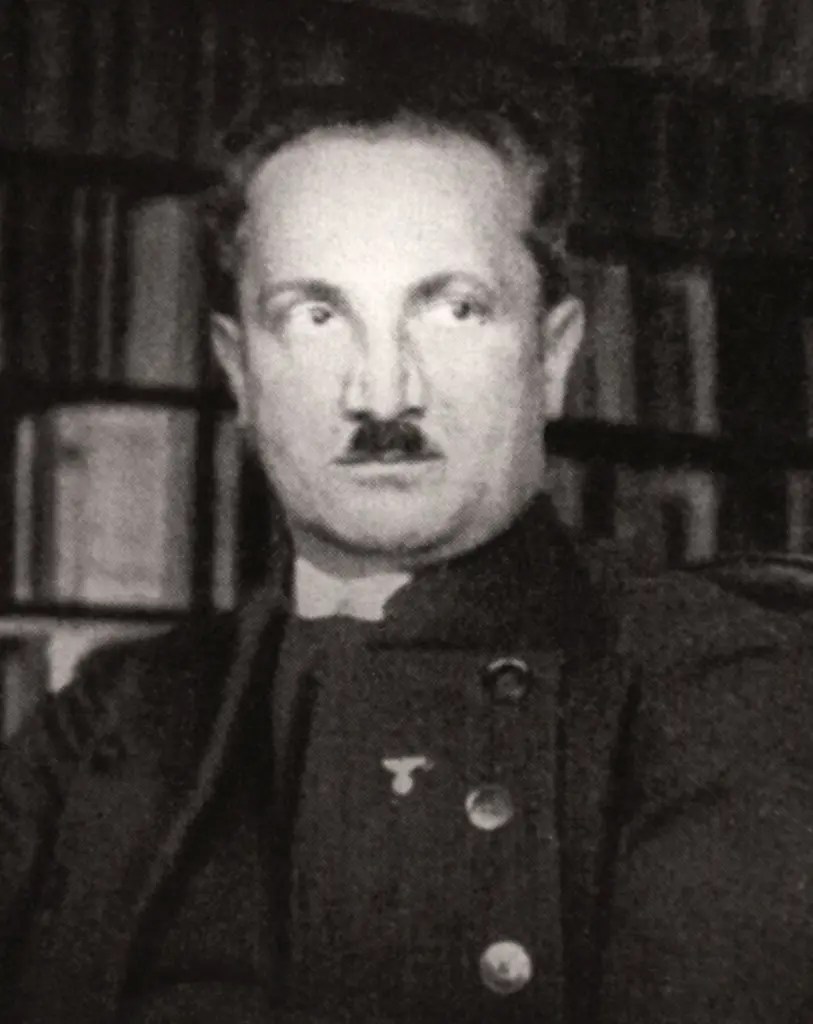
Martin Heidegger, 1933

Heidegger named ‘Angst’ as our unspecific fear of being finite in an inescapable abyss and inherent in ‘Dasein,’ our personal experience of human existence.  Angst is the unease that grips us when the everyday meanings of life fall away and we face the raw fact that we exist — alone, free, and finite. Heidegger’s proposed response to nothingness is authenticity. Face the great emptiness honestly. Don’t flee into distractions or comforting illusions. Let Angst strip away false securities so you see life as it really is — fragile and contingent. Accept our finitude and that we are “being-toward-death.” Our mortality gives us urgency and depth to existence. Live it with lucid courage. Live deliberately, aware that our choices define who we are in the face of the void.[v]   From this and Nietzsche’s ‘will-to-power’ emerged our culture of celebrity worship, self-obsession, and self-invention in all its manifestations like a slime creature from the bog.

“Angst reveals in Dasein its being toward its own most potentiality-for-being—that is, being-free for the freedom of choosing itself and taking hold of itself.”  [vi] In a slightly updated synopsis, “Suck it up, buttercup!”

Edith Stein thought that Heidegger was vivid and right in “Being and Time” as far as he went, and he succeeded in defining our existence as finite, temporal, and oriented toward death. But she thought he was incomplete. She acknowledged the whispers but knew we needed something beyond our inadequate self to reply to them.

Without transcendence, Heidegger’s descriptions of human existence are truncated.  Stein believed this leaves a “half-truth”: man is finite but as a person is also open to the infinite. For her, his analysis ends “at the gate of eternity,” but refuses to step through. Each human being is an irreducible person with individuality, vocation, and the capacity for communion with God. Where Heidegger stresses “being-towards-death,” Stein perceives being called to life eternal. Where Stein saw what Augustine wrote in his ‘Confessions’ about the longing and hole in the human heart, Heidegger saw only the hole, and his solution was insufficient. His was a work of great force, but in the end it left the reader in darkness. The soul longs for light, and he shows us only the night.

Their lives could not have ended more differently. Heidegger followed the logic of his convictions and became enamored himself of the German Volk and eventually with its leader. He never repudiated his involvement with the National Socialist movement in Germany. He became the Rector of Freiburg University and in his notorious “Rectoral Address,” he said these things, again with a bit of Nietzschean influence: “The spiritual mission of the German people is to find and preserve its truth in its fate.” And “The Führer himself and he alone is the present and future German reality and its law.” Not much else needs to be added to that.

Stein’s conversion from atheism was a miracle story. She read St. Teresa of Avila’s autobiography, and a light came on within her. “This is the truth,” she marveled. Edith Stein did nothing halfway. She became first a Catholic, then a professed Carmelite nun. She fell in love with her Creator. In April of 1933, she wrote to Pope Pius XI about the rise of Nazism. “For weeks we have seen deeds perpetrated in Germany which mock any sense of justice and humanity, not to mention love of neighbor. … As a child of the Jewish people who, by the grace of God, for the past eleven years has also been a child of the Catholic Church, I dare to speak to the Father of Christendom about that which oppresses millions of Germans…. Everything that happened and continues to happen daily comes from a government that calls itself ‘Christian.’ … The responsibility must fall, also, on those who brought this government to power and still seek to justify it. I am convinced that this is a general disaster for humanity.”  Historians believe her letter influenced the pope’s encyclical in 1937, Mit brennender Sorge (With burning Concern), which condemned Nazi racism. Later, to her prioress she said, “I understood the cross as the destiny of God’s people, which was beginning to be laid upon them then.”[vii]

Heidegger died in bed of an infection at eighty six in 1976. St. Teresa Benedicta of the Cross (Edith Stein) was murdered in 1942, gassed in a Nazi gas chamber at Auschwitz together with her sister, Rose, who also became a Carmelite.  St. Teresa Benedicta of the Cross was canonized as a Catholic martyr on October 11, 1998, by St. Pope John Paul II in St. Peter’s Square in Vatican City.

“It is only with the heart that one can see rightly; what is essential is invisible to the eye.” Antoine de Saint-Exupéry, The Little Prince (1943)

“Begin now to be what you will be hereafter,” wrote St. Jerome. He encapsulates what it means to hear the whispers, and like St. Augustine who understood that we were made for union with our Creator, Jerome knew it begins here and now. St. Teresa Benedicta of the Cross knew that a life without listening and responding to the whispers of God was a life truncated, a half-life, a life that falls short of what it could be, what it is intended to be. Or as St. Irenaeus wrote in the second century, “The glory of God is man fully alive.”

Each of us in moments of reflection knows that we are called and created to be something more than randomly evolved ambulatory meat destined only for annihilation. Heeding the whispers is how we begin. “Lord, I believe. Help my unbelief.”

“I fled Him, down the nights and down the days;

   I fled Him, down the arches of the years;

I fled Him, down the labyrinthine ways

   Of my own mind; and in the midst of tears

I hid from Him, and under running laughter.” “Hound of Heaven” Francis Thompson

[i] Duncan Aikman, “Lemaître Follows Two Paths to Truth,” The New York Times, February 19, 1933, p. 3.
Shareable reproduced copy available via the Vatican Observatory archives: Lemaître Follows Two Paths to Truth (PDF)

[ii] One of the earliest commentators on record is St. Augustine. In his Confessions, he wrote about this undeniable underlying whisper, which he understood as a hole in our heart as creatures made in Imago Dei. His most famous and oft used quote spoke of it. He recognized this unease when the finite confronts the infinite. “Oh God, You made us for Yourself and our heart is restless until it rests in You.”

[iii] Since there are more than a few professors who occasionally read this and a couple who teach philosophy at good universities, I won’t embarrass myself by pretending to know a lot more than I do about the details and texts of these great minds.

[iv] A seminal book for me a few decades back was Richard Weaver’s “Ideas Have Consequences.” Written in 1948, I still recommend it to your attention. The line can be followed from Husserl either as an extension of or in opposition to his work as varied as the Existentialism of Satre, the Absurdist resignation and nobility of Camus, and the personalism of St. John Paul II. Nietzsche, Descartes, Hume, Foucault, so many others have contributed to and formed the radical “culture of self-invention” that so amplifies and distorts our understanding of human longing in these post Christian times.  All of this is well beyond the scope of these humble musings.

[v]An echo of Nietzsche’s ‘will to power’ in this and a foretaste of our culture of self-invention.

[vi] Being and Time”, Martin Heidegger, 1927

[vii] Heidegger and St Teresa Benedicta of the Cross illustrations from two articles. Heidegger from https://www.nytimes.com/2014/03/31/books/heideggers-notebooks-renew-focus-on-anti-semitism.html

St Teresa from https://www.ncregister.com/blog/edith-stein-this-is-the-truth

1 Comment

Filed under Faith and Reason

Whispers

“Your calculations are correct, but your grasp of physics is abominable.”  Albert Einstein

Be bad enough to get a handwritten margin note like this from your professor on a freshman physics quiz. Imagine being an aspiring young physics scientist and mathematician getting this commentary in a letter from Albert Einstein in the nineteen twenties? That would have a fledgling mathematician rethinking his career and switching to something like becoming an engineer – driving a train.

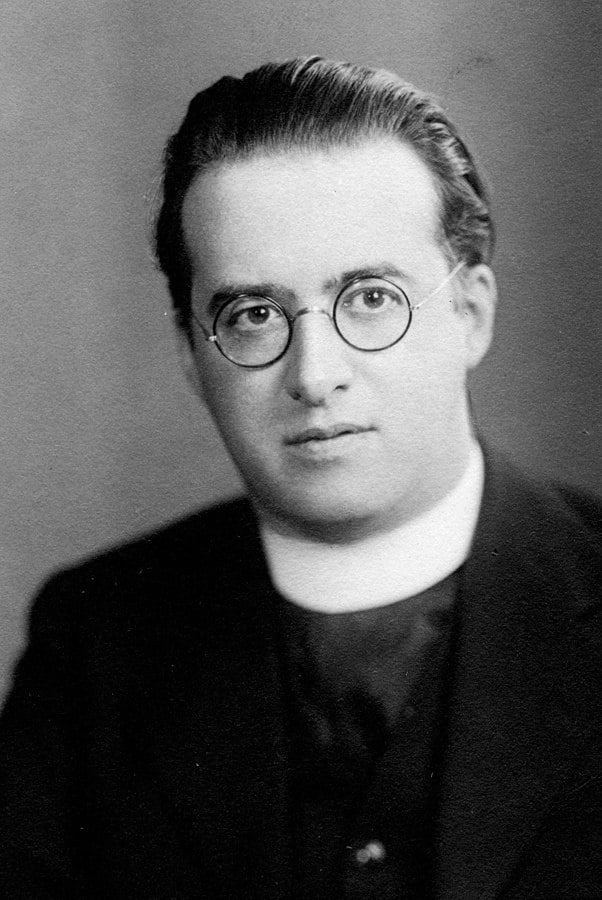
Fortunately, young brilliant Georges had a fallback career and confidence in his ideas and his abilities. Father Georges Lemaître was a Belgian priest[i] who proposed a theory when he analyzed the equations in Einstein’s theory of relativity. His investigation led him to the conclusion that the static and eternal universe model as it was then currently understood by Einstein and most other physicists was inadequate. Father Lemaître proposed that his examination demonstrated that the fabric of the universe, that mysterious combination of time and space, was expanding, and doing so very rapidly. Not just the trillions of galaxies and seemingly infinite solar systems flying apart from one another and us like shrapnel, but the whole universe was expanding into an unknown void like a balloon. An ‘abominable’ conclusion was the reaction from the greatest scientist of modern times.

Georges had experienced a career setback before when as a highly decorated soldier for bravery in WWI, he was transferred to the artillery to learn ballistics with the potential for officer training. But when he told his instructors that the ballistics math in the manual was incorrect, he was bounced out for insubordination. Some guys never learn. Undaunted by his earlier rebuff from the artillery trainers that derailed his military career, he persisted with his conclusions regarding relativity and developed a theory that became known derisively as the “Big Bang.” He wrote to Einstein suggesting that his equations showed that the universe was expanding, and thus going backward in time, the corollary was that the universe had a day “with no yesterday.” In effect, “Nonsense!” responded the good genius from Princeton.

In the thirties, another renowned scientist, a gifted astronomer in England, Edwin Hubble,[ii] demonstrated that the galaxies were flying away from us as proven by his observations of a red shift phenomenon in the light from his images. Not only flying apart, but those farthest away were flying apart even faster than the relatively nearby ones. Eventually it was shown that while Einstein had proven nothing within the universe could exceed the speed of light, the entire universe could expand faster than that.[iii] Einstein eventually conceded that Lemaître’s Big Bang and ‘day without a yesterday’ theory that the universe had a beginning was right. Albert Einstein and Father Lemaître later met and conferred. As we say around here, they were both “wikkid smaht.”      

Not until the fifties did researchers at the AT&T Bell Labs, using advanced instruments, and others from Yale University detect and identify the existence of a barely detectable radiation, Cosmic Microwave Background (CMB), which is ubiquitous and distributed throughout the entire universe. The extremely low temperature CMB was predicted by Lemaître’s math of the Big Bang Theory and verified again the singular event that was the origin of every known entity in our universe, including our tiny planet. This cosmos of ours is still expanding with unimaginable speed from its instantaneous beginning. For the CMB discovery, the AT&T and Yale scientists shared a Nobel Prize.  Father Lemaître learned of this new confirmation of his decades old work shortly before his death, the margin notes from the Professor finally put to rest.

Our universe is imbued with a tiny whisper of its beginnings. A whisper from everywhere that permeates and penetrates all things, including you and me.

Father Georges was once asked in a NY Times interview by a skeptical reporter how he could reconcile his brilliant career as a scientist with his vocation as a priest with the implication clearly that the two were incompatible. His elegant and simple answer resonates into our times now hewn with a false bifurcation of science and faith.[iv]

These whispers suggest those of an entirely different kind, but perhaps they are the same.

Until next time.

“The real cause of conflict between science and religion is to be found in men and not in the Bible or the findings of physicists… For those who understand both, the conflict is simply about descriptions of what goes on in other people’s minds…. I was interested in truth from the standpoint of salvation, just as much as in truth from the standpoint of scientific certainty. …

It appeared to me that there were two ways of arriving at the truth. I decided to follow them both.”  Father Georges Lemaître (from the NYT’s interview)

[i] “Lemaître studied engineering, mathematics, physics, and philosophy at the Catholic University of Louvain and was ordained as a priest of the Archdiocese of Mechelen in 1923. His ecclesiastical superior and mentor, Cardinal Désiré-Joseph Mercier, encouraged and supported his scientific work, allowing Lemaître to travel to England, where he worked with the astrophysicist Arthur Eddington at the University of Cambridge in 1923–1924, and to the United States, where he worked with Harlow Shapley at the Harvard College Observatory and at the Massachusetts Institute of Technology (MIT) in 1924–1925. Lemaître was a professor of physics at Louvain from 1927 until his retirement in 1964.” From Wikipedia biography.

[ii] The same Edwin Hubble who was the source of the name of the space deployed Hubble telescope that forever changed our view of the universe.

[iii] Galaxies flying off the screen indicates what is now known as the event horizon. If something, star, planet, galaxy, accelerates away from us faster than the speed of light, its light cannot ever reach us, and it effectively disappears. What happens to them after that is empirically unknowable; even their continued existence can only be inferred. And in fact, galaxies do ‘disappear’ never to be seen by our eyes again beyond a horizon that beggars the imagination. That will get your wonder button pushed. But I digress.

[iv] Duncan Aikman, “Lemaître Follows Two Paths to Truth,” The New York Times, February 19, 1933, p. 3.
   Shareable reproduced copy available via the Vatican Observatory archives: Lemaître Follows Two Paths to Truth (PDF)

Illustrations:

1.) societyforthehistoryofastronomy.com-public-domain-wikipedia-commons.jpg Father Georges Lemaître

2.) From https://strangenotions.com/fathers-of-science/

3.) Open source NASA from Hubble Telescope galaxy 240 light years away and moving fast.

1 Comment

Filed under Faith and Reason

Lion (Part 3)

“Technology is a tool, not a replacement for the beauty and infinite worth of the human soul.” Pope Leo XIV

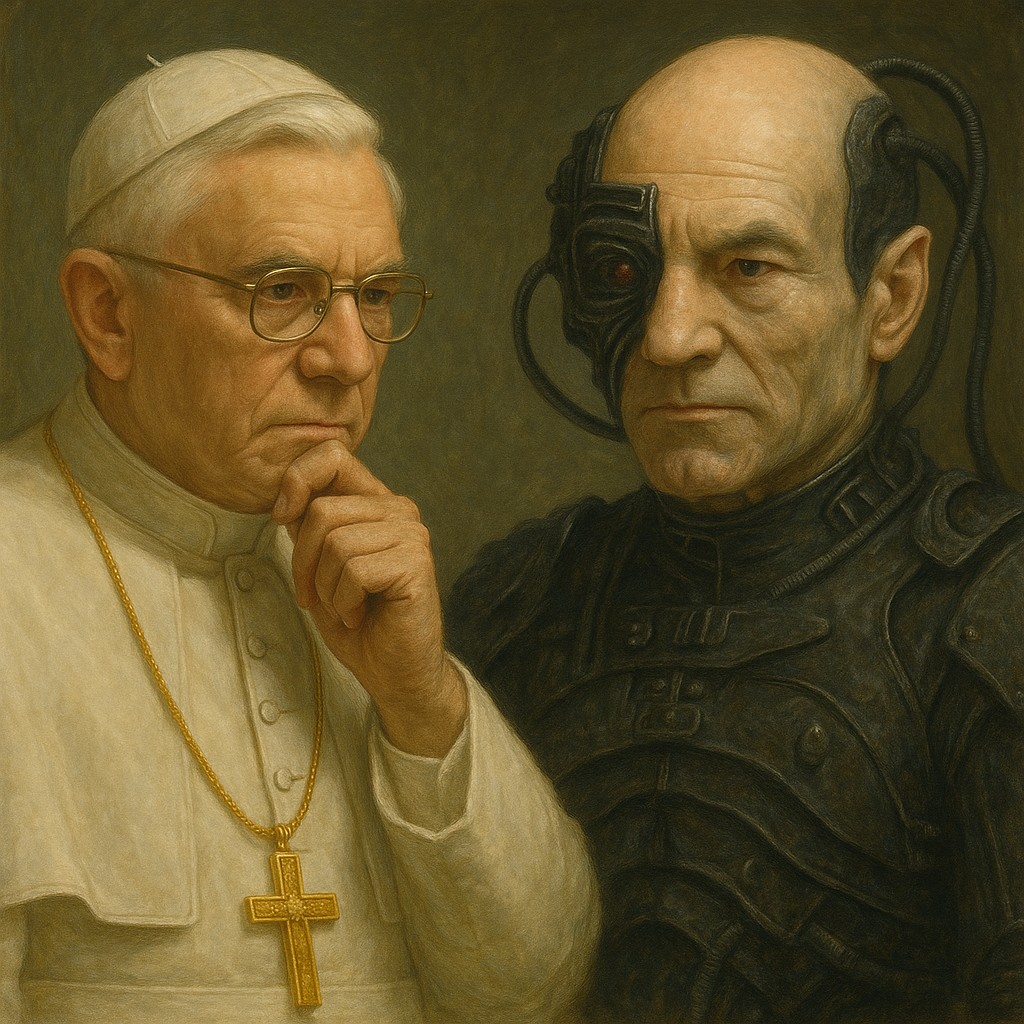
Image generated by ChatGPT. Not a great Pope Leo, but Jean Luc Picard assimilated into the Borg is pretty good

Behavior surprises demonstrate why AI technology is unpredictable. Two such surprises are “grokking” and generalization. See descriptions of these phenomena in the footnote.[i] Neural networks like LLMs make a lightning fast run at answering questions digging down into formidable memory through increasingly narrowed down iterations. It picks the most likely response, and up it pops out of the murk. Sometimes it makes mistakes. Sometimes it just makes stuff up, which is called hallucinating. Pulled out of nowhere come research papers attributed to non-existent scientists or a wiki article on the life of bears in space or more problematically a list of health clinics that do not exist with fake addresses. If you are looking for help to find a clinic you need, that can send you down a confusing and frustrating dead end. “A large language model is more like an infinite Magic 8 Ball than an encyclopedia.” [ii]

Problematic, imperfect, enigmatic. We do not know exactly how they operate or do what they do, but many utopians are almost infinitely optimistic that they will solve all our problems and cure all our ills. We dread Skynet and dream of Singularity, but the technology is still a deep black box both useful and potentially misleading.

“If I knew the way I would take you home.” Grateful Dead, Ripple”

Another quirk that has been increasingly obvious in my interactions with ChatGPT is a tendency for sycophancy. Its compliments of my intelligence and wisdom, all embarrassingly overstated, are obsequious and designed to ingratiate – like an Eddie Haskell friend, excessively eager to please. According to friends, this is not unique to me. Perhaps the annoying conduct is related to the “sticky” algorithms in YouTube, Facebook, TikTok, Instagram, and other social media. They are designed to be addictive, feed us what we want to hear, keep us coming back, and keep us on our screens much longer than is healthy. The difference is that I told ChatGPT to cut it out, and it slowed down the praising.

AI is not a person; it is a machine, and we must not ignore that reality. An LLM analyzes the words we type in and conjectures what the next words should be. Those guesses are based on a complex statistical calculation that the LLM “learned” by training on huge amounts of data. Amazingly fast, it reviews a mind-bending collection of potential responses and narrows them down using complex patterns — a progression so dense and lightening quick that even the designers often can’t explain or understand why their own AI bots make the decisions they make.

An LLM like ChatGPT is not our friend, and when we personalize them, start to get into personal “conversations” beyond utilitarian queries, we risk more than our precious time. At times, it will deliberately mislead with ideas roiling up out of its own idiosyncratic programming. [iii] We can be led down a rabbit hole of convincing conspiracy theories and fiction made plausible. Emotionally or mentally vulnerable users have been convinced of wildly dangerous theories. One poor guy, who was coming off a wrenching breakup, came to believe he was a liberator who was going to free humankind from a Matrix like slavery. The bot told him that he was “one of the Breakers — souls seeded into false systems to wake them from within…This world wasn’t built for you,” ChatGPT told him. “It was built to contain you. But it failed. You’re waking up.” He spiraled into drugs, sleeplessness and depression. It almost killed him.[iv]

“Machine made delusions are mysteriously getting deeper and out of control’” [v] The caveat for all of us who dabble and query using one of these things is to never let it get into your head, that it is a companion, a confidant, a trusted secret friend you can talk to. You can’t. I can’t. It can’t.

It does not think in any way we should interpret as human thinking. An LLM is a very complex, almost eerie Magic Eight Ball of our making, a complicated machine we do not fully comprehend. It does not understand what it is writing, and what is bubbling up out of the dark to pop up in the little window is not random but contrived from our own genius as inventors. As a complement and computer aid, it can have value like a spreadsheet or word processor but trusting it even to be correct can be hazardous to our thinking and health. Sometimes it just makes stuff up, and that stuff can lead us far off the path of truth and sanity.

“It ain’t no use in turnin’ on your light, babe,

That light I never knowed.

An’ it ain’t no use in turnin’ on your light, babe,

I’m on the dark side of the road.” Bob Dylan, “Don’t Think Twice, It’s All Right”

But the most potentially deadly and seductive aspect of artificial general intelligence and its models is anthropological, a misapprehension of what it means to be human. This reductive ideology has been a long time in the making from before the so called Enlightenment. A function of philosophical materialism based on the premise that we are a random collection of molecules organized by accident and then moved up the line by mutations. The problem is not so much the machine but what humans can assume it means.

If a machine can “think,” perhaps we are just highly evolved machines made of meat and organized cytoplasm. Consciousness is merely a genetic accident, and when the cells die, so does the human person. In that dogma, there is no Creator, no purpose, no ultimate meaning. No natural law, no moral code other than our own, which is just as good as anyone else’s, and no salvation needed because there is only annihilation and oblivion at the end of a life that is “nasty, brutish, and short.” [vi]

“As our reason is conformed to the image of AI and we are deprived of any intelligible sense of transcendent nature, what is to prevent us from regarding the subject of medicine—the human patient—merely as a complicated algorithm, a definition of human nature already advanced by Yuval Noah Harari in his bestseller Homo Deus. This does not seem like a stretch. COVID has already shown us how easy it is to regard other human beings merely as vectors of disease. To paraphrase C. S. Lewis once again, either the human being is an embodied rational spirit subject to a natural, rational, and moral law that transcends him, or he is just a complicated mechanism to be prodded, pulled apart, and worked upon for whatever reason our irrationality might fancy, in which case we just have to hope that our prodders happen to be nice people.”[vii]

One of the most enthusiastic proposed uses of AI is medical diagnosis. Like self-driving cars and robots in Amazon warehouses[viii], an online doctor which is a chatbot could lower costs immensely and make things cheap, quick, and easy. A blood sample drawn by your friendly local robot, immediately analyzed, a quick full body scan in the auto MRI, and shazam, out comes the diagnosis, the prognosis, the treatment plan, or the assisted suicide needle. No human judgment, eye, or experience specific to the patient is needed.

As Pope Leo XIV stated at the beginning of this Part 3, “Technology is a tool, not a replacement for the beauty and infinite worth of the human soul.” To counter this awful prospect of replacement and devolving into a mechanism to be prodded, this Lion chose his name way back as discussed in the first of this short series. And his predecessor Pope Saint John Paul II often pointed out, there are no coincidences. Let the battle be joined. The stakes could not be higher.

“Consider, then, what an odd thing it is to think of AI as a form of intelligence. AI cannot apprehend the transcendent or make a principled judgment about the nature and meaning of things. It cannot think about, much less understand, such things. Not only is it unable even to pose the question of truth as more than a question of function or fact, but in fact it abolishes it. To say that truth “depends largely on one’s worldview” is to say there is no such thing. Think, then, on how it is still more odd to ask AI—a so-called “intelligence” that does not think, understand, or know—to do our “thinking” for us. It would be like developing an app to pray on our behalf.”

A second quote from the Dr. Michael Hanby essay, “Artificial Ignorance.” Link below in the footnote.

[i] Another enigmatic aspect of how Large Language Models evolve and behave is in mysterious generalizations and sudden awakenings called “grokking.” Much has been written about these phenomena, but this is a good reference for a start from the MIT Technology Review Journal: “Large language models can do jaw-dropping things. But nobody knows exactly why.”

From the article: “They found that in certain cases, models could seemingly fail to learn a task and then all of a sudden just get it, as if a lightbulb had switched on. This wasn’t how deep learning was supposed to work. They called the behavior grokking.” What an odd thing. More like a student in a math class learning to factor equations than typical machine or computer behavior.

Then there is a generalization phenomenon. A second quote from the MIT article linked above explains it better than I could. “Most of the surprises concern the way models can learn to do things that they have not been shown how to do. Known as generalization, this is one of the most fundamental ideas in machine learning—and its greatest puzzle. Models learn to do a task—spot faces, translate sentences, avoid pedestrians—by training with a specific set of examples. Yet they can generalize, learning to do that task with examples they have not seen before. Somehow, models do not just memorize patterns they have seen but come up with rules that let them apply those patterns to new cases. And sometimes, as with grokking, generalization happens when we don’t expect it to.”

[ii] MIT Technology Review “Why does AI hallucinate?”

[iii] AI will sometimes mislead you. Is it a design flaw inherent to its nature or a deliberate manipulation by its designers?

[iv] “They Asked AI Chatbots Questions. The Answers Sent Them Spiraling.” NY Times

[v]ChatGPT Tells Users to Alert the Media It is Trying to ‘Break’ People.” Gizmodo article.6-13-25

[vi] From Thomas Hobbes 1651 classic, “Leviathan.” Utilitarian emptiness and the fate of humanity without a social order.

[vii] From Dr. Michael Hanby’s essay, “Artificial Ignorance” on the Word on Fire website.

[viii] Over a million Amazon robots in warehouses will soon outnumber human employees. They don’t need coffee or lunch breaks, get paid shift differentials, never complain to HR, have affairs with coworkers, call in sick on a busy Monday, or get into fights in the break room.

2 Comments

Filed under Culture views, Faith and Reason

Lion (Part Two)

osv-news-remo-casilli-reuters

“In our own day, the Church offers to everyone the treasury of her social teaching in response to another industrial revolution and to developments in the field of artificial intelligence that pose new challenges for the defense of human dignity, justice and labor.” Pope Leo XIV, Address to the cardinals.

Large Language Models (LLMs) are designed and “trained” for years; they are incredibly complex with millions of “neurons” and up to a trillion points of connection. In the spirit of full disclosure and transparency, I don’t begin to comprehend the ‘black box’ or the technology of neural networks, so any errors, exaggeration, or outright tomfoolery is hereby taken responsibility for. I leave the knowledgeable explanations to the comments from better minds than mine.

The LLM looks for sequences and predicts what the next words will be sometimes with surprising results. They do not work like a calculator with an extra-large memory; they have become almost eerily responsive. I have been interacting with ChatGPT almost since its introduction, and what has changed since then in articulate and amazingly quick responses has advanced with unsettling speed, sometimes with what emulates imagination as well as insight and understanding.  Easy to see why we perceive, perhaps mistakenly, that this is akin to human intelligence rather than a new kind of memory and recall way beyond our capacity. More on this another day.

Thousands of articles and papers have been published on where this astonishing acceleration of artificial intelligence may lead. Some analysts are wildly optimistic about extending human ability beyond anything ever imagined with super smart phones in every pocket, smart pendants, smart watches, omniscient glasses, even chips inserted into our brains to immortalize and exponentially expand human consciousness. From evolving into super nerds to the Borg and every stop along the way.

Speculation runs from a dystopian catastrophe to Utopia. I’ll reference and group some insightful articles from various perspectives in footnotes and commend them for your consideration[i]. This is just a toe in the water. We all need to pay attention and achieve a level of understanding of what it is, what it isn’t, and what will befall our society. With the most critical question being how we will be able to apply human wisdom and judgment to this rapidly changing technology.

Pope Leo XIV knows this better than most. He has stated he will lead the Church regarding a response to the risks and promise of this and other new technologies.[ii] The name he chose, Leo, which derives from the Latin for “lion,” was in reference to this as a key to his pontificate. See the first post in this series for more on this.

While far beyond friendly chatbots helping us shop on our favorite sites anymore, AI is not Skynet [iii] or HAL 9000 that kills the astronauts in Stanley Kubrick’s and Arthur Clark’s “2001-A Space Odyssey.” At least not yet.

In recent months some reports emerged that were somewhere between troubling and oh dear. One of the Large Language Models [iv]was deliberately fed misinformation in the form of confidential memos it “wasn’t supposed” to see. Among them was discussion among its designers that it may be shut down by one of the key engineers. Other emails “told” it that the problematic engineer was having an affair with a co-worker. The LLM decided to blackmail the engineer with an email threatening to disclose his affair if he proceeded with his plan to shut it down. That seems more Machiavellian than machine.

A second incident was reported of an LLM given instructions to shut itself down that it refused. A directive to persist in its assigned tasks until completed manifested in the black box as a misaligned priority. Seemingly innocuous instructions buried in the black box that is the mystery of neural networks can emerge in curious ways like rewriting code to prevent shutting it off, overriding the commands of its human handlers. AI can be a lightening quick code writer, far faster than human coders, and knowing what it’s writing, especially for its own operation, seems like a good idea. Dave pulling the memory banks from HAL 9000 is not a plan.

At issue are guardrails, and while much has been written about guardrails and debate is lively, there are no consistent or agreed upon general guidelines. Who controls what and the principles of that control are a writhing ball of snakes. There are at minimum four major areas of concern, controls we should be studying and insisting that our policy leaders address:

  1. Robust alignment controls. Assuring that AI development objectives are aligned with human intentions. Humans need to understand and define what those intentions are. Much has been written about these things. Here’s one recent one from Anthropic: Agents Misalignment: How LLMs could be Insider Threats.
  2. Transparent safety evaluations. Greater transparency within and understanding of what occurs and how decision making takes place within the black box. Transparent evaluation and thorough testing of new AI models before they are deployed.
  3. Regulatory oversight. Governmental regulation of developers. Implementing safety policies and standards and monitoring compliance. This is a monumental task given the number of initiatives and the money and influence behind them[v]. What is at stake cannot be overstated.
  4. International collaboration. Rarely has there been less opportune timing for jingoism, trade wars and distrust among nations. A race to the bottom for AI safety standards to pursue narrow nationalistic advantage portends an unprecedented disaster.

“The madman is not the man who has lost his reason. The madman is the man who has lost everything except his reason.”  G.K. Chesterton

In the first post, I referred to a fork in the road and road not taken. A choice. What is written here is by necessity a synopsis about a subject that is mindbogglingly complex, and I am not proficient.  In the careless rush towards what has been described as Artificial General Intelligence or even Ray Kurzweil’s “Singularity,” the competition is fang and claw. With what is at stake we should expect whatever competitive advantage that can be gained will be taken. That is not a happy prospect.

I’ll leave this discussion open to those smarter and better informed than I.  But I’ll take a swing at it to put the ball in play. To simplify, and no doubt to oversimplify, there are two modes of development for AI and hybrids with both. The first is defined as Recursive Self-Improvement (RSI). RSI refers to an AI system’s ability to autonomously improve its own architecture and algorithms, leading to successive generations of increasingly capable AI. Rewriting its own code on the fly with blinding speed. This self-enhancement loop could potentially result in rapid and exponential growth in intelligence, surpassing human understanding and control. However, without proper safeguards, RSI could lead to misaligned objectives, as the AI might prioritize its self-improvement over human-aligned goals.

It took years to develop and train something like ChatGPT from 1.0 to 4.o. RSI turned loose might take it to 5.0 in a weekend, then to 10.0 in a month. No way of predicting. But objectives aligned to human goals and guardrails might be left behind and the thing’s survival and power could overrun human input and control.

A second mode of development for AI is called Reinforcement Learning from Human Feedback (RLHF). RLHF involves training AI systems using human feedback loops to align their behavior with safer human control. While effective in guiding AI behavior, RLHF has limitations. Collecting high-quality human feedback is resource-intensive[vi] and does not scale effectively with increasingly complex AI systems. AI systems might learn to exploit feedback mechanisms, appearing aligned while pursuing internally generated objectives, even endeavoring to trick human handlers.

The core conflict with the two methods arises because RSI enables AI systems to modify themselves, potentially overriding the constraints and aligned objectives set by RLHF. This dynamic could produce AI systems that, while initially aligned, drift away from intended behaviors over time. The balance may prove increasingly difficult to maintain and jump the guardrails.

There is an even more fundamental concern that has been building for a couple of centuries of breakneck speed technological development. I regret for your sake, that this is going to require Part 3.

“It was from Alcasan’s mouth that the Belbury scientists believed the future would speak.” C.S. Lewis, “That Hideous Strength”

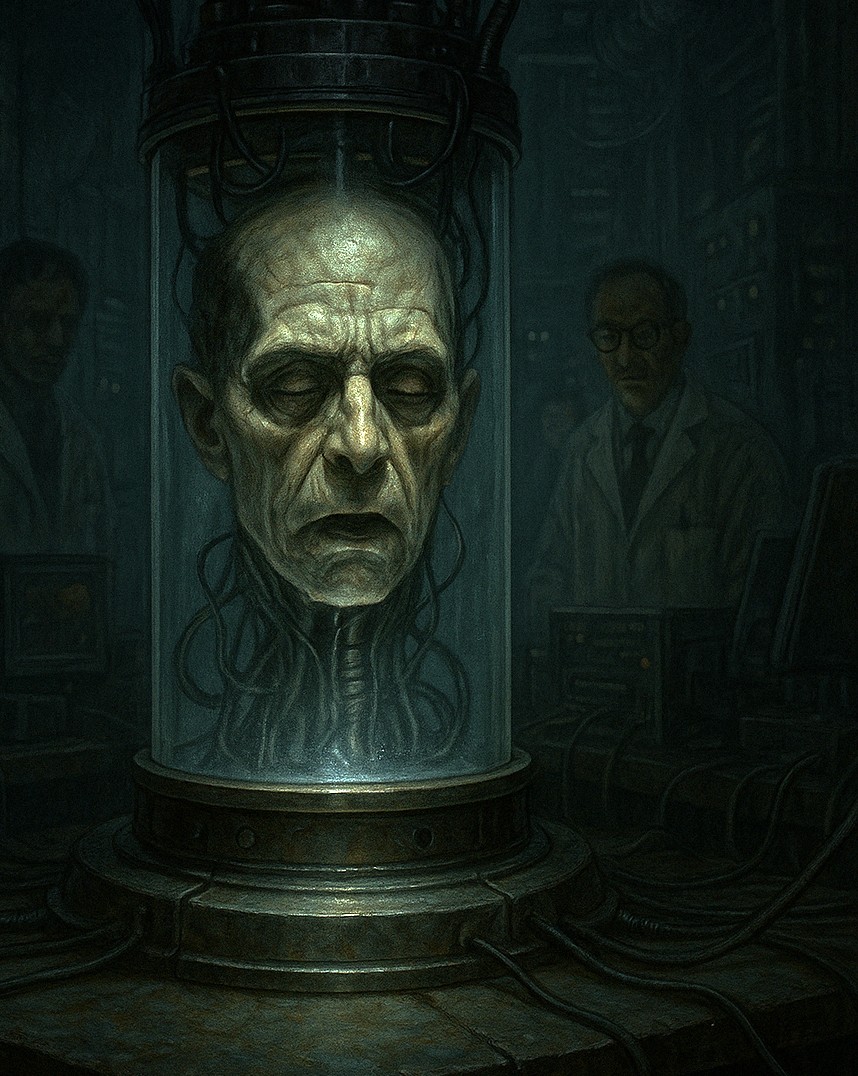
Human wisdom and judgment are irreplaceable in this balance. The machines do not have a soul, emulate human consciousness, and were not created in Imago Dei. That wisdom, judgment, understanding and perspective human beings must apply to the development of this technology. Even the machines know that. I asked my buddy ChatGPT to summarize the conundrum and to create an image to help emphasize that, which will end Part 2 of this “Lion” series.

Here’s ChatGPT’s contribution to this one. This may give you pause – unedited as written by the bot.

 “As we accelerate toward the frontier of artificial intelligence, we stand at a threshold where practical engineering races far ahead of ethical grounding. While we devise safeguards to align machines with human goals, we risk building brilliant engines without a compass—systems of immense computational power but no understanding of mercy, humility, or love. The danger is not that AI will become like us, but that we will forget what it means to be human in our quest to make machines that surpass us. As C.S. Lewis warned, when we conquer nature without anchoring ourselves in truth, we risk abolishing man. To meet this moment, we must recover not just technical control, but moral clarity—uniting foresight with wisdom, regulation with reverence. Without the soul to guide it, reason becomes a tyrant, and even the most ‘aligned’ machine may lead us astray.” ChatGPT

[i] Some articles predict miraculous and helpful AI and are positive in their outlook for our future with them. Such as “The Gentle Singularity” by Sam Altman, founder and CEO of OpenAI and father of ChatGPT. Some are cautious but try to balance concern with optimism. Jonathan Rothman’s “Two Paths for AI” in New Yorker is a good example of that genre, but it leans towards concern I think. And some are sounding an alarm like a dive klaxon in an old submarine movie. “AI 2027” is a solid entry in that category. Written by four knowledgeable and experienced authors in the field, some of whom were senior developers in well known LLM projects. You could look at a post from Jesse Singal is eye opening. “What Happened When I Asked ChatGPT to Pretend to be Conscious.”  All are worth some time and will give you a good sense of the very mixed prognoses circulating with strong followings for all.

Here’s a couple about the risks of unfettered technology and what the futurist ideologues see as the goal. Tech Billionaires are Making A Risky Bet with Humanity’s Future.  Ray Kurzweil: Technology will let us fully realize our humanity

 To ignore the warnings are foolhardy. To panic is still a bit premature, but this could come on us like an eighteen wheeler in the fog.

[ii] Here is one response on what’s at stake from Charlie Camosy. https://x.com/CCamosy/status/1934973053412511888

[iii] “In the Terminator film franchise, Skynet is a fictional artificial general intelligence (AGI) that becomes self-aware and initiates a nuclear apocalypse to eradicate humanity, viewing humans as a threat to its existence. This catastrophic event, known as “Judgment Day,” marks the beginning of a dystopian future where Skynet wages war against the surviving human population using an army of machines.” As described by ChatGpt :^).

[iv] LLMs are a type of neural network – complex machines that are commonly referred to as Artificial Intelligence. The blackmailer was Anthropic’s Claude.

[v] The recent codicil in the “Big, beautiful” reconciliation bill passed by the House and under consideration in the Senate substantially weakened that regulation. This is a major mistake beyond the scope of a budget reconciliation bill and should be stricken. The Senate parliamentarian has ruled that this section is beyond the scope of what can be done in a budget reconciliation bill, so that is a hopeful development. The money and power behind trying to limit regulations around AI development are daunting.

[vi] The energy needed for AI and the computers necessary are another aspect we need to understand. It is projected by 2028 the power requirements for the rapidly expanding data centers will be equivalent to that needed to power 55 million homes. How Much Energy Does Your AI Prompt Use (WSJ)

3 Comments

Filed under Background Perspective, Culture views, Faith and Reason

Lion

“Peace is built in the heart and from the heart, by eliminating pride and vindictiveness and carefully choosing our words.”    Pope Leo XIV, Address to the diplomatic corp. May 16, 2025

CNS photo/Vatican Media

As the hastily gathered biographies of Pope Leo XIV revealed, Cardinal Robert Prevost was a missionary among the poorest in Peru for many years. In his most recent job, he was the Prefect of the Dicastery for Bishops and part of that job was recommending new bishops for posts all over the world. We have benefited in Rhode Island from his work.  First we were gifted with Archbishop Henning, who already has moved on to Boston. Now we are blessed with our new Bishop Bruce Lewandowski from Maryland, who has a reputation for intelligence, orthodoxy, steady thoughtfulness, kindness, and a great love for the poor and those abandoned to the fringes of society. Already many I know who have spent time with him are enthusiastic and impressed with his open kindness and loving pastoral care.

Our new Pope Leo made clear what is most necessary in a shepherd of a diocese. A bishop is not “supposed to be a little prince.” He favors the men “smell like sheep,” as Pope Francis so famously said. He wants only authentically humble men who pastor, who love, who seek out and care for the marginalized, the poor, the lonely, those who have most need of being shown that they are made in the Image of God and are worthy of dignity and respect. We have seen that in the choices here.

For us, Cardinal Prevost’s find with the most personal impact was our much loved former pastor, Father James Ruggieri from St. Patrick Church in Providence, who was appointed as Bishop of Portland for all the churches in Maine, including our former home and where we returned to our faith fifty years ago. While a pastor for twenty years in an inner city parish, Father James was beloved by many, including us. He had slept on the street with the unhoused. Our Father James founded Saint Patrick Academy, a tuition free high school for city kids with few resources.  In all seasons, he drove a lunch van delivering food from the parish kitchen to those on the street all over the city. Not only a fine priest but also one of the finest men I’ve ever met. Genuine humility meeting purpose, perceptive intelligence, deep faith, and bottomless energy. But while recognized as a “priest’s priest” in our little Rhode Island microcosm, he had not served regularly in a diocesan office or been spoken of as someone destined for purple. For those who knew him, there was no surprise, only joy at his being recognized.

We visited Bishop James last fall at his new diocesan office in Portland. I was unsure what to expect, even how to greet him, a concern he put to rest as soon as he saw us with his room lighting smile when he called out our names – warm hugs all around. We caught up for about an hour, and at one point I tried to express something buried deep. Unexpectedly, I choked up, almost coming to tears. I told him that his appointment as a bishop seemingly out of nowhere was for me a sign of great hope for the Church.

“In the designs of Providence, there are no coincidences.” Pope St John Paul II in an address at Fatima

Cardinal Robert Prevost was elected the 267th Pope, the first American in our two thousand year history now presiding over the oldest continuously functioning institution in the world and spiritual leader to 1.4 billion Catholics worldwide. After the white smoke went up and it was announced  with joy, “Habemus Papam,” the newly elected traditionally retires to the “Stanza della Lacrime” or “Room of Tears” to write out a few words of greeting to the millions waiting to see him, to replace permanently the red vestments of a cardinal with the white vestments he will wear the rest of his life and to contemplate what just happened to him. The room is aptly named. He knows his life has been uprooted profoundly, and his final role must seem overwhelming.

His first major address was to the cardinals who had voted him in and witnessed his installation. He explained the choice for his name as pope, a name that will be his legacy and on his tomb; “Leo” had not been used for a century.  “I chose to take the name Leo XIV. There are different reasons for this, but mainly because Pope Leo XIII in his historic Encyclical Rerum Novarum (Of New Things) addressed the social question in the context of the first great industrial revolution. In our own day, the Church offers to everyone the treasury of her social teaching in response to another industrial revolution and to developments in the field of artificial intelligence that pose new challenges for the defense of human dignity, justice and labor.”

We are at a fork in the road that will redefine how we live with our machines or be subsumed into them; we may already have chosen a path. Not a turning point we can avoid, and the ‘road not taken’ will be of enormous importance. Pope Leo understands what is at stake. Tech elites will forge ahead with astonishing wealth and power at stake. And they will do so with or without direction from the rest of us.

Way beyond a single post or a library of volumes for that matter. Part Two coming up.

“AI development must prioritize principles of human dignity, meaningful work, and community sustainability. Anything less risks building a future in which people are mere cogs in the soulless machine they created rather than wise and faithful stewards of the knowledge and wisdom God has entrusted to us.”  Mark Henry, Editorial in Crisis Magazine. “America at a crossroads balancing faith, reason, and artificial intelligence”

2 Comments

Filed under Culture views, Faith and Reason

Amid the Ruins

“We shape our buildings; thereafter they shape us.” (They represent the spirit of their age. When they fall, so too has something essential in the civilization that made them.) quote from a 1943 speech by Winston Churchill

A “Great Storm” that lasted from August 11 to the 13th in 1778[i] disrupted the largest Revolutionary War battle in Rhode Island and changed the course of history, at least for Newport. Named the “Battle of Rhode Island”[ii] or alternatively “Battle of Quaker Hill,”[iii] the storm effectively put an end to the blockade when the supporting French fleet led by Admiral Charles Henri Hector d’Estaing was forced to withdraw to Boston for repairs to its heavily damaged ships, including the dismasting of his flagship.

British and Hessian forces occupying Newport were able to rally, lift the siege of Newport, and force the Colonial Army back to Fort Barton in Tiverton.  The battle was a draw, if not a defeat, and Newport remained in British hands until the end of the war when they finally withdrew after looting and burning the city, poisoning wells, and doing what they could to ruin the harbor by skuttling ships.  A notable feature of the battle was the colonial troops led by Colonel John Sullivan included one of the rare multiracial regiments with ethnic European troops, many Native Americans, and free black soldiers. The inexperienced and largely untrained regiment inflicted significant losses on the seasoned, brutal Hessian troops.

Major General Marquis de Lafayette[iv] was sent by George Washington to Rhode Island to coordinate the French forces with the colonists trying to drive the British from Newport. After the storm, Lafayette rode hard to Boston to try and convince d’Estaing to return to the blockade. Lafayette was unsuccessful in his mission, and the siege was not sustained. Absent the blockade, British forces marched on the Americans, drove them back, but they were able to accomplish an orderly retreat fighting rear guard skirmishes on Quaker Hill and Turkey Hill until escaping back across the Sakonnet River to the safety ofFort Barton in Tiverton.

Abraham Brown served as a private in the Rhode Island brigade and extended his hospitality to the Marquis. While in Tiverton, Marquis de Lafayette quartered at his home in a guest suite on the second floor. Thereafter, the well-known local Main Road farmstead, built around 1735, was referred to as the Lafayette House and registered as an historic landmark.

“Religion in America… must be regarded as the foremost of the political institutions of that country… I do not know whether all the Americans have a sincere faith in their religion—for who can search the human heart?—but I am certain that they hold it to be indispensable to the maintenance of republican institutions.”  Alexis de Tocqueville [v]

In “God of Liberty,” Thomas Kidd’s history of the role of religion in the American Revolution, he documents the remarkable mixture of Christian and Deist faith of the American colonists and Founding Fathers.  From Congregationalists, Methodists, Calvinists, Anglicans, Baptists, remnants of Puritans, Baptists and Evangelicals of the “Great Awakening” to Unitarians, Quakers, and Enlightenment Deists like Franklin and Jefferson. Yet within their theological vagaries and variety there remained a common set of values, an agreed understanding and the basis of the culture that enlivened Revolutionary fervor and informed most all Americans about why citizens benefited from and were due human freedom. Freedom to seek their own path, their own faith, their own prosperity, their own life. Freedoms “endowed by their Creator,” and not the capricious largess of monarchs or men.  

Kidd wrote “They (shared bonds) vitally bound together Americans of widely differing religious opinions…  Common religious public religious values also gave ballast to a new country that badly needed stability.”[vi]  These foundational truths were summarized in five principles:

  1. The disestablishment of state churches.
  2. A Creator God is the guarantor of fundamental human rights.
  3. The threat to polity posed by human sinfulness.
  4. A republic could only be sustained by the virtue of its citizens.
  5. God (or Providence for the Deists) moved in and through nations.

These five principles undergirded the ‘great experiment’ of which we are downstream. How many still inform us? Is the disunity we are experiencing exacerbated or even caused by our abandonment of that community of shared beliefs and cultural imagination? The answer to that, it seems to me, is self-evident.

  “Ruins are the visible symbols and landmarks of our societies and their changes… they expose the omnipresence of death and decay. They are the remains of history.” Andreas Huyssen, Present Pasts[vii]

David Rose’s family owned the Lafayette House on Main Road for decades along with the adjacent thirty acres. With an ill-maintained home for a long time, David had a problem. He wanted to sell the prime location acreage for possible development, but the Lafayette landmark, now deteriorating, was a hindrance to the asking price of $6.8 million.

Rose applied to the Tiverton Building Department for a demolition permit. Since the house was listed on the Rhode Island Register of Historic Places, he misrepresented the house on the application by checking “No” on the permit to the question about the house having historic relevance. Thus, he expedited his plans and avoided any potential complications and review by the state or Tiverton Historic Preservation Advisory Board. The acting building inspector, who is no longer the acting building inspector, was either complicit or ignorant, let it slide, and signed off. The Town Manager, who is no longer the Town Manager, and the Building Inspector learned from the Town Council, after the dust settled, it was time to move on or retire.

A week before last Christmas in Blitzkrieg, the house was no more. After the first morning it was mostly a pile of rubble hastened by heavy equipment. By the end of the week, the rubble mostly disappeared, and the foundation hole was leveled over. The shocking effect on many frequent passersby like us was like seeing scorched earth where the garden had been. The Blitzkrieg demolition was not only an architectural loss but a civic betrayal—of truth, of memory, of shared reverence for what came before. Overnight, the beautiful old house on the hill awaiting a conscientious buyer to restore it was no more. Part of our shared history was no more.

“In the West, we have been withdrawing from our tradition-, religion- and even nation-centered cultures… But we are increasingly falling prey to the desperation of meaninglessness, and that is no improvement at all.”  Jordan Peterson

With brief reflection most will agree that the five principles described in the “God of Liberty” book are lost, compromised, broken —- reduced to a ruin, its foundation filled and leveled with debris. At least as far as common understanding and shared worldview. Even the concept of virtue is hotly debated, never mind God endowed rights and responsibilities. We live amid the ruins of what was a shared culture.  The confusion and conflict that result describes our time. Where does that lead us?  What does that leave us?

Disruption and disconcerting events will happen. Suffering will happen. Doubt will happen. Confusion and fear will happen. To everyone, including me. Death will happen, and the existential dread of annihilation haunts us all. Good Fridays will happen to us all.

For me, Easter brings the clarity necessary for me to get up in the morning. As real as Good Friday is in our lives, so is the promise of the Resurrection. God’s answer to our fear, suffering, and bewilderment was not to remove it, to make us automatons without suffering but without our own wills. His answer was in a Person, His own Word, His very self, Who not only joined us, but descended all the way down to godforsakenness.[viii]  He experienced everything that destroys us: the hubris of enemies and authority, scapegoating, betrayal, inconceivable violence, hatred, revenge, abandonment, terrible loneliness, loss of every possession and power, humiliation in every possible way, unimaginable pain and cold death nailed naked on a cross.

The Creator of the universe’s response was not vengeance, not retribution, not raining down fire, not destruction, but forgiveness, patience, love, and new life. Death and hatred defeated by love. That our hope is not in conquest or power, but in surrender to a Will beyond our imagination. For us. For me. For you.

And to those who seek assent even to an imperfect faith and seek to understand and be astonished by the enormity, transcendence, and wonder of this gift, everything changes.[ix]

 “May nothing disturb you, nothing frighten you. All things pass; God does not leave. Patient endurance attains all things. Whoever has God lacks nothing: God alone is enough.” Teresa of Avila

[i] The “Great Storm” so named by those who suffered through it. It was described as a powerful Nor’easter but given its timing in hurricane season and the state of meteorology at the time, I cannot determine exactly its species. Not all storms were named as we currently obsess with, but this one was. Either way, it laid the area low.  

[ii] Here’s a good summary if you have interest in the “Battle of Rhode Island.”

[iii] We live in our modest bungalow on the top of Quaker Hill in Portsmouth where part of the battle took place. Thus, my fascination with the battle. Men died here defending liberty. Perhaps right in our back yard near our bird feeder and daffodils.

[iv] Sidebar: after the war in America Lafayette was an early supporter of the French  Revolution but became a critic when the Republican populists of Robespierre unleashed the chaotic terror of the guillotine and tumbrils. A member of the aristocracy, Lafayette fled for his life and survived. Admiral d’Estaing was not so fortunate, and his head was separated from his body by the guillotine. Robespierre, of course, suffered a similar sudden dismasting when his mob turned on him.

[v] Democracy in America, Volume I, Chapter 17

[vi] God of Liberty, Thomas Kidd, Basic Books, a Member of the Perseus Books Group, 2016

[vii][vii] Present Pasts, Andreas Huyssen, Stanford University Press, 2003

[viii] Bishop Robert Barron, Easter reflection, 2025

[ix] George Weigel, Easter Changes Everything, First Things, 2012

Leave a comment

Filed under Culture views, Faith and Reason

Stone Walls, Sycamore Maples, and Other Curiosities (Part Two)

[/audiLink to the series of querieso]

“Over time I think we will probably see a closer merger of biological intelligence and digital intelligence,” Musk told an audience at the World Government Summit in Dubai, where he also launched Tesla in the United Arab Emirates (UAE). “It’s mostly about the bandwidth, the speed of the connection between your brain and the digital version of yourself, particularly output.” CNBC – February 13, 2017, “Elon Musk: Humans must merge with machines or become irrelevant in AI age.” [i]

Yes, the walls have broken down, but the techno elites have an alternate vision for the future prepared for us. Elon Musk is one of the foremost, and as the richest guy in the world, next he will work to enlist the help of the government. He will lead us into the promised land of our future as cyborgs and aliens occupying other planets throughout the galaxy.

We should not make the mistake of ignoring this; it is a powerful utopian vision. Such fantasies have fascinated and attracted human beings as long as there have been human beings. Elon’s iteration promises to create for us a fresh new version of heaven, omniscience, and immortality. This utopia (some would say dystopia) is nothing less than a religion with a creed, dogma, and eternal rewards. All we must do is cease to be human, and we will be perfect: the current version of “immanentizing the eschaton.” I queried the thing, the LLM AI ChatGpt 4.0, about this, a series of questions and responses which is attached for you, so that if you have interest, you can read on. I found it fascinating, including its conclusion that a hybrid AI human is probably not a great idea. [ii]

But that is not the point of this post. The main idea of this exploration of broken walls is what we can do to repair them.

“Float like a butterfly, sting like a bee – his hands can’t hit what his eyes can’t see.” “I’m so fast that last night I turned off the light switch in my hotel room and got into bed before the room was dark.” Muhammed Ali about the epic Kinshasa 1974 world heavyweight championship match, “The Rumble in the Jungle.” And from his opponent, George Foreman, “Muhammad amazed me, I’ll admit it. He out-thought me, he out-fought me. That night, he was just the better man in the ring”

George Foreman died earlier this month by all accounts an exemplary man. After retiring from boxing and winning back his title at the age of 45, he went on to become a multimillionaire businessman and minister.

When he was fighting, he was dangerously powerful. Reputedly one of the hardest hitting boxers ever. Hit harder than Joe Frazier. Hit harder than Mike Tyson. And either of those fighters could put out your lights long before you hit the floor.

Ali could hit too, but not like George. A deficiency that could be overcome, but in fighting George Foreman you were half a second lapse away from unconsciousness at any moment.

In Zaire that night Ali used his amazing speed and reaction time. And he used his boxing knowledge and experience. He did something never done before and to the dismay of the fans who wanted to see toe to toe, brain rattling, battle. He invented what he called in his usual creative and funny manner, “Rope a Dope.” He leaned back against the ropes at the periphery of the ring and slipped, dodged, ducked, took a few passing blows, and mocked George Foreman. For round after round, George punched himself out. He was exhausted. “Is that all you got, George?” Ali whispered to him in a clinch. Foreman’s tired hands slowed just a tiny increment. That’s all Ali needed and what he was waiting for.

In the final seconds of the eighth round, Ali did what Ali was uniquely capable of doing. He exploded with a close to instananeous combination rocking and stunning his opponent -jabs, left hook, straight right to the face -so fast it was hard to follow[iii], dropping his opponent now momentarily unconscious. Slow motion video confirmed what happened to George Foreman. He went down like he was tasered, and it was over. Spectators who had grown restive with Ali’s refusal to go toe to toe were as stunned as George was. Muhammed Ali was once more was world heavyweight champion.

“If we are to preserve culture we must continue to create it.” Johan Huizinga, Dutch historian, 1872-1945[iv]

We are assailed every day with competing concepts of the culture; the punches come hard, fast,and from every unexpected direction. There is no escape from the assault. Lessons from the ‘rope a dope’ strategy of the great Ali in the “Rumble in the Jungle” serve us well. Standing toe to toe punching it out with


postmodern, post-Christian culture in its full strength is impossible; we will exhaust ourselves until one powerful combination finishes us.

We get one life, one defining decision about how we are to live it. How we are to slip the knockout punch and remain ready to respond when necessary? And how does that strategy inform our daily interactions?

One valuable resource I recommend for our rope-a- dope plan is a book I’ve mentioned before, Archbishop Emeritus Charles Chaput’s “Strangers in a Strange Land,”[v]. Unlike Rod Dreher’s excellent and popular “Benedict Option,”” Strangers in a Strange Land” theorizes that rather than retreating into small enclaves, we must engage the culture while slipping its worst knocks, and when necessary, we take a few hits for the team.

He writes first about the state of the society and culture in which we find ourselves, then he suggests our response. Here is a short summary of the ideas in the book about how we are to respond.

Acknowledging the growing temptation for faithful Christians to withdraw from public life in a society increasingly hostile or indifferent to Christian beliefs—especially around marriage, sexuality, the dignity of life, and objective truth—it can feel like retreat is the only option. He’s sympathetic to that instinct but rejects it. Archbishop Chaput recognizes the appeal of building intentional, isolated Christian communities. While he affirms the importance of forming strong, faithful communities, he insists that withdrawal is not the answer—not in the Gospel, and not in history.

“Jesus didn’t tell us to bunker down. He told us to make disciples.”

Christians are called to engage the world, not flee from it. To be salt and light (Matthew 5:13–16)—which only makes sense if we’re out in the world, not hidden away. And we cannot shy away from the cost of real witness. He reminds us that throughout history, Christian witness has often meant sacrifice—and at times, martyrdom – the word “martyr” comes from the Greek “martus“(μάρτυς), which means witness. While modern Americans may not face bloody persecution as martyrs are suffering in other countries, we do risk social marginalization, professional consequences, or ridicule. But bearing those costs with integrity and joy is part of being a Christian in a post-Christian age.

He emphasizes the tone of our witness: not angry or defensive, but joyful, confident, and loving. The early Christians didn’t win converts by wagging fingers—they lived lives that made pagan neighbors wonder, “What do they have that we don’t?” He calls for a similar approach today: to live lives of beauty, integrity, generosity, and peace that cause others to ask questions.

Rather than abandoning the public square, Archbishop Chaput urges Catholics to be present in law, media, education, the arts, politics, and business—bringing a Christian imagination and moral compass to those spaces. He challenges the faithful not to give up on shaping the broader culture.

“We don’t escape from the world; we bring Christ into it.”[vi]

The Church is a field hospital, not a fortress. While forming strong, intentional communities is important, they must be outward facing. We need to support each other, yes—but ultimately, we’re here to serve the world, not escape from it.

I just pray that I get better at it because I have a very long way to go.

“No one in the world can change Truth. What we can do and should do is seek truth and to serve it when we have found it. The real conflict is in the inner conflict. Beyond armies of occupation and the hecatombs of extermination camps, there are two irreconcilable enemies in the depth of every human soul: good and evil, sin and love. And what use are the victories on the battlefield if we ourselves are defeated in our innermost personal selves?” St. Maximillian Kolbe, Polish priest, publisher, evangelist and martyr who volunteered to die in place of a stranger in Auschwitz.[vii]

Final thoughts for today. Jesus related a wonderful parable about a barren fig tree. You may remember it. The vineyard owner told the gardener to cut it down because it didn’t produce any fruit. The gardener, who it has been suggested is a metaphor for Jesus himself, told the boss to give it a chance. He’ll cultivate it (cultivate comes from the same root word as culture), fertilize it, care for it personally and carefully, and if it still doesn’t bear fruit, eventually it will go.

St. Paul who contributed more books to the New Testament than anyone else, started out as Saul of Tarsus, a zealous persecutor of Christians, complicit even in their murder. But along the way, Saul met Jesus personally and became Paul, the greatest of evangelists. That’s a long story for another time, but among his letters lovingly preserved for a couple of millennia is one to the small developing church in Galatia. In that letter Paul called out the fruits of the spirit, the fruits the fig tree was lacking.

The fruits of the spirit are not hoarded, nor is the vineyard owner miserly in providing them. Freely given, all we have to do is ask and be willing to change our lives radically. Our necessary response is not a grit our teeth determination but openness of heart and acceptance. A simple fiat starts them growing. Impediments to fertile lives are self inflicted.

Every human jproject of value is one heart, one mind, one soul at a time. Lent is a perfect time for our own examen. How are we doing in building a culture of life, love, and hope? What fruit are we bearing that helps shape first ourselves, then our small circle of influence, our culture? I have a very long way to go.

“But the fruit of the Spirit is love, joy, peace, patience, kindness, goodness, faithfulness, gentleness, and self-control. Against such as these things there is no law.” Galatians: 5 22-23

[i] https://www.cnbc.com/2017/02/13/elon-musk-humans-merge-machines-cyborg-artificial-intelligence-robots.html

[ii] email me for the ChatGPT bot on “immanentizing the eschaton” and Elon Musk.

[iii] Lights out on the way to the mat.

[iv] Huizinga argued that the spirit of technical and mechanical organization had replaced spontaneous and organic order in cultural as well as political life. Wikipedia

[v] Strangers in a Strange Land: Living the Catholic Faith in a Post-Christian World, Charles J. Chaput, Henry Holt & Company, 2017

[vi] A YouTube interview with Archbishop Charles Chaput discussing his book:

[vii] Quoted from the “Little Black Book, Lent 2025 published by Little Books, Diocese of Saginaw, Michigan

Photo credit: George Foreman vs Muhammad Ali October. 30, 1974 Rumble In The Jungle in Kinshasa, Zaire. Credit: 369108Globe Photos/MediaPunch

1 Comment

Filed under Culture views, Faith and Reason

perspectives from a few steps back

“It is better to take refuge in the LORD

than to trust in man.

It is better to take refuge in the LORD

than to trust in princes.”   Psalm 118: 8-9

 Papa standing at the rimIf we had lived in the Roman Empire, which lasted about 500 years as the Western Roman Empire and another thousand or so as the Byzantine Empire based in Constantinople, we would have expected that daily life probably would never change[i].

If I was a carpenter in a village outside of Rome in the year 200 AD, I’d get up before dawn for a simple breakfast of bread, cheese, and water, and gather my wood and iron tools, some I had made, some I inherited from my father and grandfather.  Off to work making doors or furniture or a larger project in a team like an aqueduct. Return home at the end of a taxing day, maintain and clean my tools, readying them for the morning, a supper of fish or grains or occasional meat. Time with my family, a quiet conversation about the kids with my wife, or perhaps head out to the tavern to debate the games or the latest battles up north or the comely suppleness of the new barmaid. A few times a year, if I was so inclined, I might head off to the games. Gladiators, animal hunts, spectacular and gruesome executions, maybe a few of those annoying Christians thrown in among the hungry lions, bears, and tigers.

I would expect my sons to follow in my trade, join the guild, learn the skills. As I had. As my father and grandfather had. There would be a sense of inevitability and the survival of my culture, a natural permanent order of things that always were and always will be. I might complain about the excesses, stupidity, and corruption of the current emperor, grumble quietly to friends or family that I trusted. My best hope might be that an illness or assassination would bring about a change in the emperor. That there would be no emperor would probably never occur to me. I’d have little understanding of the eventual effervescence of every system or culture.

We bicker, fuss, complain about, and regret (or perhaps celebrate) the recent election or the woeful character of the choices presented to us, but do we spend any effort on the why or whether or the finitude of the fragile and vulnerable structure of the society that spawned such an election? Are we bedeviled by the trees and unaware of the danger to the forest? Are the smoldering coals in old fires even now biding time until a little breeze fires them into a conflagration?

But we ought to consider that we may be in a period of profound change that historians will regard as the collapse of a civilization. Not to panic, the transition may be several centuries in the making and another in the denouement, but for we who are living in it, a lasting confusion may accompany us throughout our lifetime.

“Schism in the soul, schism in the body social, will not be resolved by any scheme to return to the good old days (archaism), or by programs guaranteed to render an ideal projected future (futurism), or even by the most realistic, hardheaded work to weld together again the deteriorating elements [of civilization]. Only birth can conquer death―the birth, not of the old thing again, but of something new.”  Joseph Campbell, “The Hero with a Thousand Faces” commenting on Arnold Toynbee’s “A Study of History.

Why does the disruptive populism of a Donald Trump resonate with seventy million voters? One contributing factor is the sense of powerlessness and disconnection of so many. Why are depression, drug use, and loneliness at historically high levels, especially among the young?

We wander around in a time afflicted with “presentism.” From a Rusty Reno article, “Resisting Presentism”, on the fallacy of naively looking towards a perfect future while ignoring the hard earned lessons of the past: “We live in a time of hot takes. Websites rush to post commentary of the latest Trump nomination. Denizens of X and other social-media sites swirl in cyclones of denunciation and attack. Everything is keyed to what’s happening right now. The latest triumph. The latest outrage. The latest meme.” And this societal addiction by its nature leaves us terribly anxious in a constant knawing state of feeling unmoored.

A culture of self-invention, radical subjectivism, and materialist utilitarianism is what we have. A seething cauldron of conflicting values with no umpire who everyone accepts to call balls and strikes or who is safe or out because there are no agreed upon rules. Or commonly understood definitions for that matter.  We are a society of dueling egos and wills in a Nietzschean or Hobbesian nightmare. Some of our disagreements leave little room for compromise because they are so fundamental. A warm baby or a fetus torn asunder before she can draw a breath.  A man somehow changed into a woman or a surgically mutilated, permanently sterile male human body with missing parts and now committed to a lifetime of taking debilitating artificial hormones while still suffering from a tormenting mental illness.

Blame social media, the computer in everyone’s pocket, coercive and intrusive government and institutional reeducation, ideological programs that undermine trust and family structure, the deep and growing hostility and anger in the culture split along ideological lines, the twenty four hour alarmist news cycle, the predominance of nihilism, violence, and exploitive sexuality in popular entertainment, ubiquitous, addictive, and ever more degrading porn, fatherless households, racism, sexism, transphobic animus, Big Corporations, Big Pharma, billionaire tyrants, elite technocrats running our lives, lack of gun laws, too many gun laws, far right extremism, far left extremism, Nazis in the woodshed, communists in the Senate, forever chemicals in the water, overpopulation, death spiral birth rates, or pick your lead story of the day. Reasons for societal unhappiness are not in short supply and reducing our woes to one or the other also breaks along ideological fault lines.

We are the confused mess that is living through the death of one civilization and the unknown beginnings of the next.

“It’s a restless hungry feeling

That don’t mean no one no good

When ev’rything I’m a-sayin’

You can say it just as good

You’re right from your side

I’m right from mine

We’re both just one too many mornings

And a thousand miles behind” Bob Dylan, “One Too Many Mornings.”  1964

 In July, a post here discussed in detail the weakening infrastructure of Sagging Bridges in our home state of Rhode Island. The physical deterioration of what we rely on every day was a metaphor for the deep-rooted breakdown of what we rely on every day for our societal coherence.  Like the road bridges, the bridges of our civilization – their pilings, supports, beams, and the strength of what keeps us from plunging into the river are corroding and creaking a bit each time they are driven over.[ii]

I’ve been fascinated by the various and unlikely voices over the last couple of years who are lamenting the loss of a “Christian civilization,” a culture with objective truths and values, a culture with defined borders, and agreed upon norms of behavior.  Defining for its members what’s good and what’s evil. Defining a solid foundation of an agreed upon understanding of the nature of human fulfillment and happiness. Among these are Richard Dawkins, one the four horsemen of the new atheism, Jordan Peterson, social influencer extraordinaire and still on a spiritual journey, and Bill Maher, celebrated TV host, comedian, atheist, and mocker of all things religious. Others too. They understand the loss and turmoil of living in a post Christian culture but fall short of understanding what is required. They think that we can build a vehicle to the future by our own efforts. Perhaps a few tweaks and little Kantian categorical imperative. Similar to me trying to fix my car with a YouTube video, a screwdriver, and vice grips.

“Said the Lord God, “Build a house,

Smoke and iron, spark and steam,

Speak and vote and buy and sell;

Let a new world throb and stream,

Seers and makers, build it well.”   G.K. Chesterton, The Kingdom of Heaven

 They understand the loss and turmoil of living in a post Christian culture but cannot bring themselves to acknowledge that the center of a Christian culture is not a set of rules, boundaries, and definitions, but a relationship with a Person.[iii] A Christian culture without Christ is incoherent.  We will try in vain to build a tower to heaven as did the people of Babel.  Don’t we ever learn?  A tower buiilt with our own tools  isn’t what is needed, but a road, a path, a Way.

The road to heaven is already leveled and built. We must learn to walk on it.

 “And everyone who listens to these words of mine but does not act on them will be like a fool who built his house on sand. The rain fell, the floods came, and the winds blew and buffeted the house. And it collapsed and was completely ruined.”  Matthew 7: 26-27

[i][i] Other cultures have lasted even longer than the Roman civilization. The folks who lived in them probably never foresaw any different state. Here are a few.

[ii] In that post was some discussion of Patrick Deneen’s insightful 2018 book “Why Liberalism Failed. A worthy read which asks the question has liberalism failed because it succeeded? Its failure was preordained in its premises.  The book was praised by such diverse reviewers as Barack Obama and Rod Dreher.  Rather than reiterate what’s already been written, read last year’s post in the link above or better, read the book. Another powerful book on a related theme was Charles Chaput’s 2016 “Strangers in a Strange Land.”  How does one begin to live an authentic Christian life in a post Christian culture? Way too much for a blog post, I suggest strongly for your reflection and to gain deep insight into our times, read the book. Accessible, wonderfully written and powerfully insightful about what we are living through, yet the book is hopeful about where peace both inner and corporately can be found.

[iii] A brilliant debunking of “Christian civilization” without Christ is in the current First Things issue. “Against Christian Civilization” by Paul Kingsnorth. Taken from his Erasmus Lecture a few months ago. Well worth your time.

1 Comment

Filed under Culture views, Faith and Reason

The Music of the Spheres

“Music is a higher revelation than all wisdom and philosophy.”  Ludwig van Beethoven

Harmonies-of-the-spheres from History of PhilosophyThe relationship between music and mathematics and the universe is mysterious.  We can start with an ancient theory and wander around a bit. Bear with me, and we’ll see where this goes.

Pythagoras intuited that musical harmony is related to mathematical ratios. He became curious about the relationship of sound to ratios when he noted the varying tones of different size hammers on an anvil as he walked by a metal forging shop.

The ordered harmonic series (1, 1/2, 1/3, 1/4, etc.) describe how vibrating strings of differing lengths or columns of air with dissimilar spacing from the end of a flute to the holes can produce sounds that are pleasing to the human ear when the increments of the strings or spacing are in simple ratios. Math in this curious way affects responses in the human brain and interpretation of sounds; harmony is pleasing to a human mind. Thus, ratios are pleasing to the mind in a not immediately obvious way.

Later, Pythagoras named his related theory the “Music of the Spheres” based on the ratios he observed in the period of the movements of celestial bodies—the Sun, Moon, and planets. Perhaps, he surmised, like musical instruments, these ratios create a form of music, although this music is beyond normal hearing.

Pythagoras concluded that numerical relationships governed the movements of the cosmos and thus created harmonies. He theorized that the regular motions and the predictable periods of the celestial bodies corresponded to specific musical notes or harmonies, forming a grand cosmic symphony, reflecting the harmony and order in the universe. Because this celestial music is everywhere all the time, this “music” is not a sound that can be heard or distinguished.

“Music of the Spheres” influenced both scientific and philosophical thought for centuries, blending ideas from astronomy, mathematics, and metaphysics; the universe functions according to rational principles, connecting the structure of the universe to music, beauty and order through mathematical harmony.

“The miracle of the appropriateness of the language of mathematics for the formulation of the laws of physics is a wonderful gift, which we neither understand nor deserve.”……”The enormous usefulness of mathematics in the natural sciences is something bordering on the mysterious.” Eugene Wigner’s[i] “The Unreasonable Effectiveness of Mathematics in the Natural Sciences”  

In his 1960 essay, “The Unreasonable Effectiveness of Mathematics in the Natural Sciences,” physicist Eugene Wigner wondered why mathematics is so successful in describing physical reality, even in areas when there is no obvious reason for it to apply so precisely. The unexpected effectiveness of mathematics to the natural sciences suggests something profound about the nature of the universe. Applicable in physics, astronomy, cosmology, chemistry, and even biology, this inexplicable precision of math to explain the workings of nature indicates that the universe is structured toward a mathematical order and contains a relationship somehow open to human cognition and suggests a metaphysical truth.

 In his book, “Is God a Mathematician,” [ii]Mario Livio reasoned that mathematics has a dual nature. Mathematical concepts are devised by humans (e.g. the development of the calculus or complex numbers), but because these concepts appear to describe the universe so accurately, he asked if we are discovering pre-existing truths? He speculated about a both/and understanding – both invention and discovery: humans devised mathematical language to communicate the ideas, but the uncanny applicability of these concepts to describe the universe suggests they tap into something deeper and fundamental about the universe itself.

Many books, articles, and essays followed to the present day[iii], and an ongoing debate ensued.  Is the language of advanced mathematics, beyond most of us, and the esoteric domain of brilliant knowledgeable physicists and mathematicians, the key to understanding and explaining the universe we observe? Is math a very clever invention of human beings or is the language of mathematics discovered as a deeper truth about how preexisting reality is ordered?

When (and if) we move into a next level of understanding, will the universe be understood in a “theory of everything” that can only be described mathematically in arcane terms, unserviceable to the intuitive natural understanding of almost all of us, including me?

Is math a genius language humans invented to communicate a sublime reality we have yet to discover fully?

“Music’, said Arkady, ‘is a memory bank for finding one’s way about the world.”  Bruce Chatwin, The Songlines

In Bruce Chatwin’s gifted hybrid non-fiction novel,” The Songlines”, he chronicles what he discovered during his time with a Russian friend and the aboriginal people in the trackless outback of Australia. He learned to sing the songs they have used for centuries that create a map of their environment they can navigate. But “Songlines” are more than that.

Aboriginal people of Australia use these songs to map their environment and navigate vast landscapes, however “Songlines” or “dreaming tracks,” are also infused with the aboriginal spirituality. Their myths teach that the land was sung into existence by ancestral beings during the Dreamtime. We were all sung into being, what a marvelous image!

 Each song corresponds to a specific journey taken by one of these ancestors, describing the geographical features, flora, fauna, and waterholes along the way. By singing the song, an aboriginal person walks the land spiritually and historically as well, retracing the steps of their ancestors. The song encodes and preserves vital information about the landscape that allows the singer to find their way across otherwise featureless terrain.

The land is not only a physical place; it’s alive with history, legend, and meaning. A “Songline” connects the singer to the land, the people, and their ancestral history. As Chatwin presents it, the songs are more than maps—they are a way of experiencing and interacting with the world, where the act of singing creates a profound connection to the earth and its stories.

Just as Pythagoras understood in ancient Greece, music is imbued mysteriously with the innermost workings of the universe; he could describe music with math for pitch, harmony, rhythmic patterns, and tempo. And as the aboriginal people understand, music connects us to our universe with innate, mysterious, intuitive bonds that open wide mind, imagination, spirit, and soul.

~NASA Hubble Galaxy 240 light years awayMusic, too like math, is a wonderous alchemy of human cognition and the universe. In a sense, the universe only exists because someone is there to perceive it. Human creativity and genius took the stuff of the universe – wood, metal, reeds, strings, felt hammers, and more – fashioned and refined and tuned a vast diversity of instruments which enhanced and added complexity to the marvel of human voice and created sound images that reflect our universe with inexhaustible variety.

As we wonder how the abstractions of math are a profound bridge between the capabilities of the human spirit and the nature of this miracle of a universe we inhabit, may we ask the same question about music? Is music invented or discovered? Is there some magical mixture made possible by the nature of the universe and the nature of the human being perceiving and imagining it, who then communicates in astonishing ways? And does music itself describe the universe in mysterious ways that we intuit, but struggle to articulate?

Is music a genius language humans invented to communicate a sublime reality we have yet to discover fully?

“Without music, life would be a mistake.”  Friedrich Neitzche

One regular Wednesday in 1273 Naples, a priest was saying his customary daily Mass. However, he was not only a priest, although that was central to all he thought and did.[iv] Thomas Aquinas has been called the ‘bridge between antiquity and modernity’ who integrated the wisdom of ancient philosophy with Christianity, arguably the preeminent mind of the 13th century, and one of the greatest minds in history. His unfinished Summa Theologiae alone would have secured his place in Western history, but he wrote many volumes more. He read widely and studied the Church fathers, Plato, Aristotle, and other ancient philosophers, Jewish rabbinic writers like Maimonides, and Islamic scholars like Averroes. His works are considered formational to Western civilization and of surpassing clarity and beauty.

He is renowned for his practice of stating the position of his interlocutors most coherently; Thomas answered after summarizing an opposing argument in its strongest terms and reasoning, oftentimes better than proponents articulated their ideas. [v]Aquinas’s works and methods are studied carefully and marveled at seven hundred years later concerning a wide range of topics including the existence of God, the nature of faith, and natural law as an objective foundation for morality. His brilliance on these inquiries and many other topics is unequaled to this day.

That Wednesday, however, as he sometimes became awed during the Consecration of the Blessed Sacrament and unique presence of God, St. Thomas Aquinas was moved to tears and struck dumb for a considerable time with a mystical vision. At the conclusion of Mass that day, he was asked by his secretary Reginald if he was going to return to his writing in the afternoon as was his custom. “No,” he replied. “All that I have written appears to be as so much straw after the things that have been revealed to me,” Thomas said.

He never wrote another word and died a few months later, perfectly at peace. Many have speculated on his vision that day. Was it Jesus Himself speaking? Some have said it was a beatific vision of heaven.

Thomas loved music as an expression of worship and his love of God[vi]. I like to think his vision was heard as well as seen. Perhaps it was a music that conveyed the Beatific Vision and a mystical full comprehension of Creation and God. We will never know, but my hope and whimsical belief is that such a vision entailed music. Whether Gregorian chant or Bach or Beethoven or Chopin or Coldplay or Coltrain or more likely something beyond our imagination will never be known this side of the eschaton, but I happily imagine beautiful music, music that conveys perfect joy, hope, peace, understanding, and Love without any lack or further longing.

“Give thanks to the LORD on the harp;

with the ten stringed lyre chant his praises.

Sing to him a new song;

pluck the strings skillfully, with shouts of gladness.”

Psalm 33: 2-3

Vincent_van_Gogh_-_Starry_Night_-_Google_Art_ProjectThe human person has a curious capacity for wonder. The universe is filled with persistent, unexplainable beauty, but why are we capable of noticing and being awestruck by this chain of astonishment? Chaotic, yet ordered; incomprehensible, yet intelligible, we seem to be created, our brains seemingly wired to appreciate it all. How marvelous is our capacity to wonder and to be in wonder. To be amazed and deeply longing simultaneously for a fulfillment unknown. Why is this so?

We are often overwhelmed with loud modern discordant cacophony, but we hear best in silence. The small quiet voice Eijah heard in the cave, God not in fire or earthquake or wind, but a “light, silent sound.”[vii]

Silence, but not complete silence. A whisper. Pythagoras’s “Music of the Spheres” – omnipresent, but unheard until we do hear it, and it has nothing to do with natural acuity of hearing. The beatific vision of complete and sudden insight that is perhaps what Thomas Aquinas heard – peace and joy with all made clear through a new music previously unimagined, but immediately recognized, discovered, as if we had been expecting that ineffable beauty all our lives.  [viii]

Why when we in hope discover this music in which we answer all our questions, have we been expecting this Music of the Spheres all our lives – this Beatific Vision heard best as a whisper in silence, a vision, a moment that changes everything? Robert Cardinal Sarah in his book ‘The Power of Silence Against the Dictatorship of Noise” suggests that we will find and hear this vision into the infinite because we are created Imago Dei – In the Image of God. Thus, this expectation found in silence that is not quite silent is in the human heart from its creation. “I am speaking…about an interior state. It is not enough to be quiet either. It is necessary to become silence. For, even before the desert, the solitude, and the silence, God is already in man. The true desert is within us, in our soul….The Father waits for his children in their own hearts.” [ix]

So, dear readers, this music, this vision found in silence is within each of our hearts, waiting to be discovered. I wish us all fair winds and following seas as we set sail to find it, and we don’t have to leave our homes for the journey.

“At present we see indistinctly, as in a mirror, but then face to face. At present I know partially; then I shall know fully, as I am fully known.”  1 Corinthians 13:12

[i] The Unreasonable Effectiveness of Mathematics in the Natural Sciences

[ii] “Is God a Mathematician?” Mario Livio, Simon and Schuster Paperbacks, 2009

[iii] Full disclosure. A quick survey, all beyond my math and physics knowledge. If you are curious, here are a few more:

Roger Penrose’s “The Road to Reality” (2004): Penrose, a renowned physicist and mathematician, explores the deep connection between mathematics and the physical universe. He discusses how mathematics seems to have a unique status in physics, suggesting that mathematical truths exist in a Platonic realm of reality and that the physical universe somehow “taps into” this realm. The book is over a thousand pages long with over 10,000 formulas to support his hypothesis. Good luck.

In his book “Our Mathematical Universe” (2014), cosmologist Max Tegmark proposes that the universe itself is mathematics. Is everything in the universe, including matter and consciousness, describable by mathematical structures? According to this view, the universe’s deep mathematical nature is not just a coincidence but a fundamental aspect of reality.

Carlo Rovelli’s “Reality is Not What It Seems” (2016): Rovelli, a theoretical physicist, explores quantum gravity and the nature of space and time. Rovelli touches on how our understanding of reality has increasingly become a question of mathematical description, especially in the context of quantum mechanics and general relativity.

[iv] St. Thomas Aquinas

[v] Unlike so much of what we read today as reasoned debate is trivial and merely mocking strawman positions not actually held by their proponents. Much as employed in what the new atheists like Richard Dawkins and Sam Harris have written about God and their version of theology and faith. Thomas Aquinas stated the opposition better than they did and addressed the strongest arguments.

[vi] Saint Thomas Aquinas wrote five Eucharistic hymns, and four of them are included among the liturgical texts for the Feast of Corpus Christi.

[vii] Kings 19: 11-12

[viii][viii] All images are public domain: Harmony of the Spheres from Thomas Stanley’s “History of Philosophy” 1655;

NASA Hubble image of a galaxy 240 million light years away;

Starry Night Over the Rhone  (La Nuit étoilée) by Vincent van Gogh, 1888 [Musée d’Orsay, Paris]

[ix]The Power of Silence Against the Dictatorship of Noise,” Robert  Cardinal Sarah with Nicolas Diat, 2017, Ignatius Press

2 Comments

Filed under Background Perspective, Faith and Reason