Category Archives: Personal and family life

Noise

 “There is a silent self within us whose presence is disturbing precisely because it is so silent: it can’t be spoken. To articulate it, to verbalize it, is to tamper with it, and in some ways to destroy it. Our culture is geared in many ways to help us evade any need to face this inner, silent self.” Thomas Merton, Love and Living.

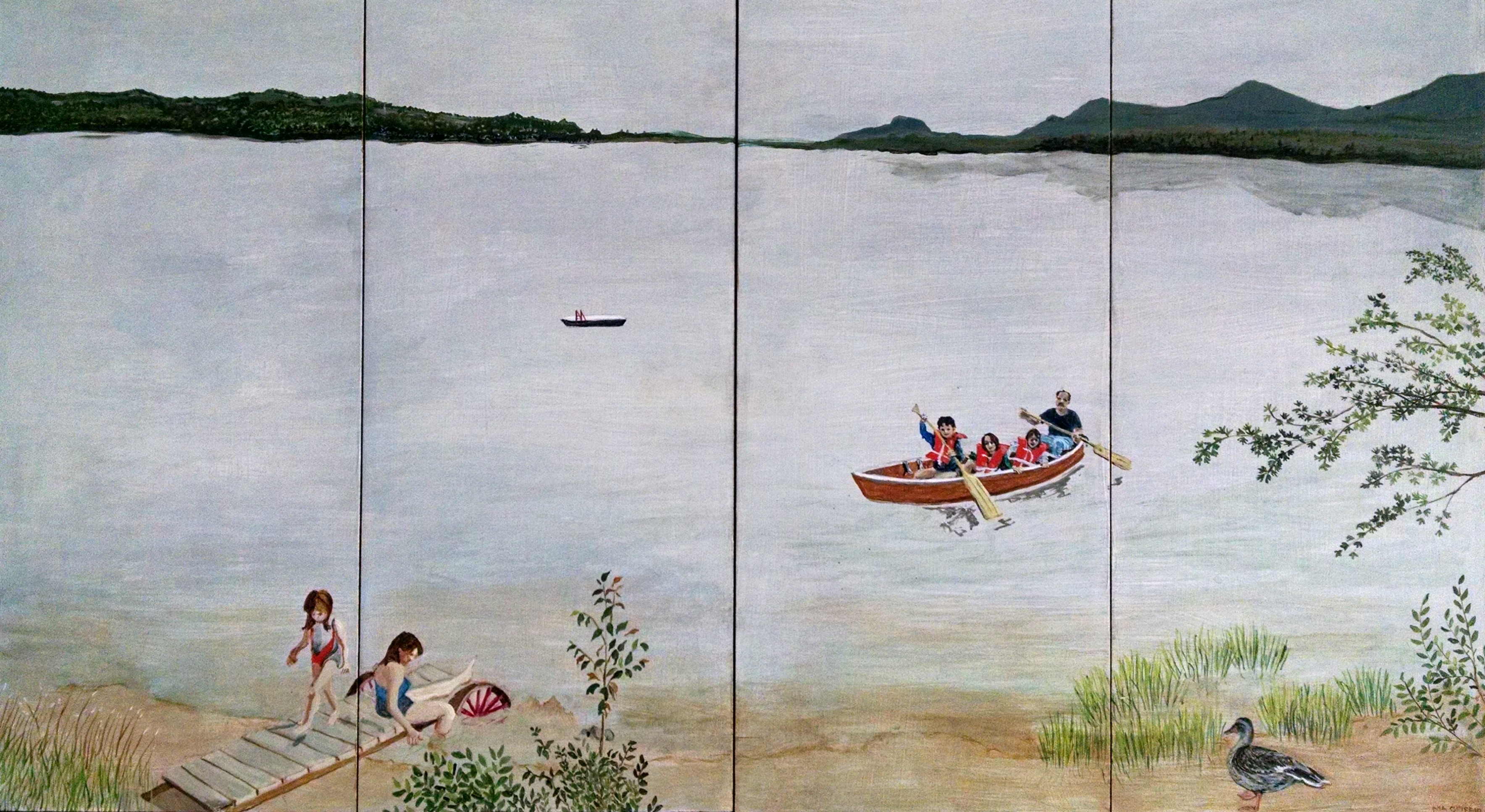
Webb Lake wall panelsSteve Griffin, owner of Island Carpentry, has done much precise, beautiful work in our house in Middletown. We have come to know and value Steve’s friendship. Last year when he directed the installation and did the carpentry to install our gas fireplaces, he built a box over the mantle of one of them to mount our television. Bartering for our replaced electric kitchen stove, Steve’s wife, Mary Ann, created with Steve a four panel door to hide the box. Using old photographs Rita gave her, she painted a composite scene of our many summers spent in a rented old camp on Webb Lake in Weld, ME. This week she finished.

One of the many gifts Webb Lake gave us was solace and silence, especially early in the morning when the lake was mirror calm. I’m an early morning riser and have been for at least fifty years. Silence for private time, prayer and reading that leads to reflection and meditation is a before dawn activity for me, as it was on Webb Lake in the canoe. Here it is birdsong and sometimes the distant, muted foghorn in Newport Harbor which carries in the pre-dawn stillness. Is there anything more grand than that first cup of coffee in the sunroom looking out over the garden, the eighteenth century stone wall and Rhode Island Nursery across the lane? As Thomas Merton wrote, “our culture is geared…to help us evade any need to face (our) inner, silent self.” Yet this “inner, silent self” is where we most need to wander at leisure if we ever expect to find our peace, our self-knowledge, our connection.

“We live in a state of constant semi-attention to the sound of voices, music, traffic, or the generalized noise of what goes on around us all the time. We are more or less there.” Thomas Merton, Love and Living.

To Merton’s constant semi-attention in the last few decades, we’ve layered on omnipresent emails, texts, Facebook, Snapchat, Tweets, YouTube, television with a thousand channels, Pandora, videos and video games on demand, the insistent phones on our belt and on and on.  And on.  We don’t have to do much to completely avoid our silent, inner selves and the meaning of our increasingly preoccupied lives. In truth, we seek commotion: for after all, within those distractions persists our ability to avoid what we truly need to engage. For the ‘unexamined’ life is frenetically busy, exhausting even, but on the surface painless, while vaguely troubling underneath is a deep discontent like a tumor without symptoms yet. Without recognizing our core, what is left wanting, and what change is prerequisite to peace, we are left without a center at rest. Human beings are born with restless hearts, with a hole in the center. Do we seek what will truly heal it or do we squander our time by obfuscating with the deluge of stimuli?

” A great strong wind was rending the mountains and breaking in pieces the rocks before the Lord; but the Lord was not in the wind. And after the wind, an earthquake, but the Lord was not in the earthquake. And after the earthquake, a fire, but the Lord was not in the fire; and after the fire the sound of a gentle blowing. When Elijah heard this, he wrapped his face in his mantle and went out and stood in the entrance of the cave. And behold a voice came to him and said to him, “What are you doing here, Elijah?”  1 Kings 19: 11-13

“What are you doing here?” is the only relevant question we all must answer.

Garden 2016As I was going through the painstaking process of pulling the disassembled tomato support cages from the ceiling joists of the shed, straightening out the bent members, cobbling them back together for one more year and erecting them around this season’s hope for red tomatoes, Rita remarked to me that I was a patient gardener. I have never thought of myself as particularly patient; Type A, driving for perfection, impatient with myself especially. But times and souls change, especially when we spend the time to fill the hole in the middle.

I realized planting the last of the pole beans, the yellow bush beans and peas today with Gianna and Ellie, our two oldest granddaughters, that the hours pass quickly. We laugh, teach, learn and plant. They tell us where to put the pumpkins and sunflowers, their favorites. We can also be quiet together. Gianna is eight and now is the official reader of seed packets, discerning depth and spacing. Why are cucumber and the various kinds of squash planted in rings called hills? Why are some seeds planted an inch deep, and some only a quarter inch? Why is the squirrel eating the new corn and cucumber sprouts? If we see the baby rabbits out there in the garden, will I turn into Mr. McGregor?

I further realize that the overriding sensation of the garden in the sun with sore muscles, dirty feet, red knees and calloused hands is contentment, deep, abiding contentment. And that is enough.

“We are not fully present and not fully absent; not fully withdrawn, yet not completely available. We just float along in the general noise which drowns out the deep, secret and insistent demands of the inner self.” Thomas Merton, Love and Living.

8 Comments

Filed under Culture views, Personal and family life

Of Winter and Circus Wagons

“Winter is a season of recovery and preparation.” Paul Theroux

Our first winter in Maine came on us suddenly and without adequate groundwork. We had purchased our somewhat renovated post and beam barn on five mostly wooded acres in Mount Vernon. Sagely we thought, our family planned to move from Cape Cod in the spring, so we rented the house out to a couple of single young men we met briefly. In January, they stopped paying rent and moved out without notice. Didn’t return phone calls either. Since we couldn’t afford the new Maine house and our rental house on Mashnee Island, in late February we moved.

The property boasted pristine spring water which gravity fed the house over a drop of about fifty feet of elevation through a five-hundred-foot underground pipe from our spring enclosure in the woods. Even flatlanders like us took only our first day to discover that an unused pipe barely clearing ledge eighteen inches below the soil in late January freezes solid. We were lucky; it didn’t split open. But neither did it deliver water until May.

Digging out the septic tank with shovel and pick to expose the cover, we bought an indoor Sears chemical toilet that I emptied daily. A forty gallon galvanized wash tub, a wood stove to heat up the kettles and multiple trips to the spring with a couple of two gallon buckets took care of the bathing. Drinking, cooking and incidental washing cost a few more trips a day. After a few spills of water on the hill, it became a slippery and occasionally painful adventure to fetch water. I had no idea how much wood we needed, so we quickly ran out, and Maine is not an easy place for strangers to find firewood for our principal source of heat in February. Every week, I would take our Ford F-150 to a birch toothpick and dowel sawmill factory and fill it with burlap bags of dowel ends and bark trimmings.

When a twenty-four-hour stomach bug ripped through the family, the Sears chemical toilet proved to be a sad, inadequate resource. But, Rita didn’t leave me, and we muddled through the rest of the first winter. At least the twenty below nights were behind us with the ascent of the February sun. We were in our first house, sleeping in an overhead loft on a mattress jammed up tight against the roof at the edges, and while the Maine winter soon made mock of any romantic notions, the loft was warm, and we made it until the blackflies and mud season signaled spring.

“By suffering comes understanding.” (toi pathei mathos), Ancient Greek saying.

The townspeople, who were welcoming, but reserved, tried to help us prepare for our second (and first full) winter as best they could; locals retain a wait and see attitude towards newcomers until they prove they can stay the course. Snow started in earnest before Thanksgiving, but happily relented around Easter. Sort of. I observed, asked questions, built a small pole barn wood shed with spruce cut out back and filled it with five cords of dry hardwood I split by hand. Working together, Rita and I wrapped the entire perimeter of the house to about a foot above the stone foundation with black plastic secured with wood lathe and roofing nails, then laid bales of hay against it to keep out the floor drafts. I made a matched spruce board storm door, weather-stripped to seal out more leaks. Large double-hung salvaged windows looked north, providing a house selling view of the adjacent field and mountains beyond, but they squandered heat and rattled in the wind. Tacked up clear plastic inside storm windows helped. Rita’s dad came for a visit and helpfully suggested we give the house back to the bank. So we awaited the onslaught, seemingly much better prepared than our first winter.

Circus wagonNothing could prepare us, however, for weeks that never went above zero and snow that drifted up against the house covering the lower half of the windows on the north and east end. On the south side of the house, we were in perpetual shade, which cooled us in the summer, but the snow shed from the roof built up against the back of the house, covering all but the top eight inches of the windows in the kid’s bedroom. In front the snow packed down under snowshoes and boots, and when our children looked out to see Dad hauling wood from the woodshed, only my legs trudging past the windows were visible. The entire interior of the house was painted a solid white semi-gloss, no doubt purchased on sale in five gallon buckets from the Sherman Williams store in Augusta.

On days with a higher sun and no wind Rita would sometimes bundle up the kids and take them on a lunch picnic in the back of the truck. I worked late too many nights trying to establish my company’s business in new territory. After one particularly isolating week in Mount Vernon of white out and cold, I came home after an overnight in Aroostook County to find the living room and dining room (both had sleeping lofts) transformed. The décor was early circus wagon. Gold yellow walls and red painted posts up to the bottom horizontal beam and the cathedral ceilings. Preparation ill-advised or perceptive cannot cover all contingencies; sometimes you’ve just got to go with your gut.

“He who is best prepared can best serve his moment of inspiration.” Samuel Taylor Coleridge


9 Comments

Filed under Maine Tales, Personal and family life

Allagash

“Wilderness is the preservation of the World.” Henry David Thoreau, Walking

The Allagash Wilderness Waterway begins in sight of Mount Katahdin, the highest peak in Maine. Running ninety two miles from lakes west of Katahdin, it ends where the Allagash River, meandering north, runs into the St John River on the Canadian border.

allagash 2In the mid-eighties my fourteen year old son Gabriel and I joined with eight other men for nine days to canoe the Allagash Waterway. We planned logistics, food, equipment – a duty roster calendar and menu for each day: cooking, clean up, water and wood gathering. Two other father and son teams with young men near Gabe’s age, along with a pair of late teens and Father Wilifred Gregoire from Westerly, Rhode Island, partnered with a parishioner who was his friend. Father Greg was an experienced outdoorsman, an Allagash veteran with more than a half dozen previous excursions. Milton Wilbur from Woonsocket, another Allagash veteran, accompanied by his son, Josh, led the trip.

A wilderness canoe trek takes on its own sedate, steady rhythm: rise at dawn; stretch out the previous day’s muscle stiffness; early fire over the previous night’s coals, cowboy coffee and breakfast, clean up, break and pack the camp; put in and begin to paddle – mostly J strokes, slow and unrelenting with little respite; the sound of the water and occasional sighting of deer or hawk or a trout breaking the surface; find a suitable spot for lunch; maybe a swim if the sun is warm; put in for the afternoon miles; locate our planned evening campsite, stake down and raise the tents, roll out the sleeping bags; draw water at a spring, forage for blowdown wood and light the evening campfire; cook and eat dinner, clean; quiet talk around the fire; some nights camp songs with men used to singing together; perhaps some reading or a fold out chess set; more quiet talk with my son in the sleeping bags for the night; deep sleep two to a tent. The rhythm corresponds to the backdrop perfectly. Utter peace. Hard pulling and the soreness disappeared after a day or two. Gabe and the other young guys held their own in the canoes without complaint. Bathing was with Dr. Bronner’s phosphate free, biodegradable peppermint soap in the lakes and river. Shaving was left behind.

On Sunday morning, we changed the rhythm without breaking it. Father Greg celebrated an evening Mass before dinner with us as we neared sunset under the canopy of a stand of Eastern White Pine on the shore of the far end of Chamberlain Lake, sharing prayer and our faith. Singing our worship songs of thanksgiving in the silence of the vast Maine woods.

“How gladly would I treat you like my children and give you a pleasant land, the most beautiful heritage of any nation.” Jeremiah 3:19

The early days of the trip were the most physical, sometimes fighting wind driven swells, which broke on the shore of Chamberlain. The outfitters met us at our jumping off spot after we followed a fifteen mile dirt road to Telos Lake and there delivered our five canoes – well worn, but sound, aluminum, Grumman made, flat bottomed for the river, but tricky to manage on the lakes in a wind. They drove our van back and waited for our call in nine days from the payphone in Allagash, while we paddled north. Telos the first day, tired from an all night drive from Rhode Island; the long miles of Chamberlain, portages to Big Eagle Lake, the long haul up Eagle into Churchill Lake; portage at the top of Churchill Dam to a stretch of river that flowed into Umsaskis Lake, which empties into Long Lake; past Long Lake Dam and Cunniff Island, and finally picking up the aid of the Allagash River current for the rest of the way except for an hour or so traversing Round Pond. On the big lake, we looked up once to see Milton and Josh deploying a clamp-on sail and disappearing ahead. Experience counts.

Allagash Wilderness Tramway EnginesOne long day on the river, a bald eagle followed us for hours, probably looking for scraps. He would settle in a tall hemlock or pine, wait for us to pass, rise effortlessly and glide past us to his next vantage point along the river. On another day, we took a brief hike into the woods between Chamberlain and Eagle Lake to show the boys two railway engines, stranded in the forest sixty years earlier when the logging tramway rail system was abandoned. They climbed happily through, over and around the old boilers and controls. A third diversion when we hit a long stretch of rapids, nothing too challenging, but we had to pay attention. The rangers, who kept an inconspicuous eye out for the safety of the various groups, picked up the gear we left near a woods road log bridge. We had an adventure down the rapids with only bathing suits, life jackets and sneakers at risk. They dropped off our tents, sleeping bags, clothes and provisions, safe and dry, at the end of the rapids, when the descent flattened out and the river widened once again to a more temperate pace. The teen team, Keith and Dave, stood up, then when that failed to capsize them, stood up backwards and finally went down one section of rapids with one on the shoulders of the other. They went in and swept along by the current finished the rapid run laughing riotously. No nanny state for these young lunatics.

On our last day before we made final landfall in Allagash and swapped our canoes for our van, we pulled the canoes up on a sand spit for lunch and played for several hours at Allagash Falls, where all of us were boys again, splashing in the cold deluge, slithering over the ancient, smoothed rocks like a waterslide freely provided.

The pre-Socratic Greek philosopher, Heraclitus, wrote that one cannot touch the same drop of water twice in a torrent and that “no man ever steps in the same river twice, for it’s not the same river and he’s not the same man.” My memory rusts like the train engines, becomes a bit idealized perhaps, but the Allagash changes us in some undefined way for the good. There is in Nature, for sure, tooth and claw, blood and fury, but there is also in untamed places a feminine aspect: fertile, bountiful, generous with great peace found no other place – a time for thoughts and no thoughts, a time merely to be.

“The life of contemplation in action and purity of heart is a life of great simplicity. One is content to remain at every moment in contact with God, in the hiddenness and ordinariness of the present moment with its obvious task. At such times, walking down a street, sweeping a floor, hoeing beans, reading a book, taking a stroll in the woods – all can be enriched with contemplation and the obscure sense of God’s presence.” Thomas Merton, The Inner Experience, Notes on Contemplation

6 Comments

Filed under Maine Tales, Personal and family life

Acclimated

“It takes a very long time to become young.” Pablo Picasso

IMG_0570Late in June of 2014 we moved from the Providence home in which we had lived for almost thirty years to Middletown. Riding our bikes yesterday we saw cottontail rabbits again—four of them in a field adjacent to Oliphant Lane along our regular route. On rides earlier in the month I wondered if they would be so numerous as last June and why we had yet to see any this year: a matter of timing as it turns out. At least a year is needed to begin to know a new house, a new locale, a new life: four seasons, weather, and changes slow and sudden, the idiosyncrasies of house upkeep.

We missed the spring last year here: the wild palette of color that catches our eyes and our breath. Soil is rich on Aquidneck Island; many small farms, a couple of large nurseries (one across the street) and at least two commercial vineyards attest to its fecundity. So do our gardens and the diverse flora, both wild and somewhat tamed. After a challenging cold, snowy winter, the spring came “on little cat feet,” tenuously with false starts, and later in all its finery. Early the forsythia, then lilacs, cherry blossoms pink, horse chestnuts white, our pear and apple trees, purple azaleas, rhododendron, and more recently both pink and white dogwood with the Rose of Sharon yet to come. We hung bird feeders and planted flower beds, raised vegetable beds, three blueberry bushes and a moderate sized twenty by twenty garden. Last year we planted little, as we were late to the task.

The bird feeders drew a large crowd: goldfinch, red winged blackbirds, mourning doves, pairs of cardinals, winter wrens, and downy woodpeckers, some unwelcome grackles and gray squirrels. Gianna, now seven, fashioned a bird house from a half gallon cardboard milk container after getting a lesson at the local Norman Bird Sanctuary; one of the wrens moved in.  The smaller female squirrel fed on the ground underneath the seed feeder from some that we scattered and some that we and our guests dropped. She remained unmolested by me although a red tailed hawk noticed, but as yet has not made a dive for her. The male squirrel, undeterred even after we hung an unjustifiably guaranteed squirrel proof plastic hood, required some discouragement with a few stings from an underpowered (one or two pumps) BB gun. The rabbits so far have left our garden alone, but the blueberries needed some netting while they ripen. We share with the birds a good mix of seed and suet from the Agway store, but draw the line on the blueberries.

We have lived rural, and we have lived urban. Middletown is a mixture, but tends toward rural, which taken as a whole is better. The shrubs and trees in Middletown are for the most part less hacked than those in the city. City folk’s drive to tame untamable things mars the landscape with shaped, shorn, unnatural shrubbery and trees cultivated like the gelled, fashionable hair of a vain, just past his prime news anchor on a small market local broadcast. Here, there is less of it.

“Gardeners may create order briefly out of chaos, but nature always gets the last word, and what it says is usually untidy by human standards.” Diane Ackerman

IMG_0567The second tree climbing job I had was for Allen Tree Experts in 1968 between living in Northampton in Western Massachusetts and moving to Colorado. Ellis Allen was a third generation tree warden for the Town of Medfield, Mass. President of the Mass Arborists Association, Ellis was the most knowledgeable of any the many people I worked for in the trade. In his private practice, we worked for the wealthy who could afford him in nearby towns like Dover and Sherborn on estates and gentlemen farms. Boston high-rise buildings were visible from the top of tall oaks and elms. Customers included ex-governor Frank Sargent and former U.S. Senator and Governor Leverett Saltonstall. Ellis was exacting in his instructions and standards; he would suffer no shears—electric or manual. Shrubs were to be pruned precisely with hand snips: no grotesquely mangled Andromeda or Japanese maple, cropped azaleas; no shattered yews. Cuts were made one at a time by skilled hands, angled back into the center of the plant so they didn’t show with casual observation. The objective was a gently disciplined planting that retained the natural shape of its residents. Ellis would fire someone who could not learn the technique and artistry, or he would consign them permanently to chain saws and stump grinding.

We worked for several weeks in Dover on the eighty acre estate, now long since subdivided, of Mrs. Adams, a direct descendent of John and John Quincy.  She was elderly, kind and, while self-possessed with the poise of aristocracy, unpretentious. Her chauffer driven 1938 Plymouth caught her spirit. On the farm estate was a smaller house for the butler and another for the groundskeeper, who directed all the comings and goings of arborists. Mrs. Adams would overlook all; she and Ellis were kindred when it came to all things green. She was the president of the garden club and had been since The War. A large greenhouse adjacent to one of the barns protected award winning orchids and roses. Each day at break time, the cook would bring out fresh coffee and still warm rolls for the staff and the visiting tree climbers.

Once Ellis sent me to find a hundred and fifty year old pin oak that towered thirty feet above the canopy of the surrounding trees fifty yards from the house. Mrs. Adams observed it every morning from her breakfast balcony; several minutes of dead reckoning were needed to find it in the woods. I trimmed just the protruding top most of the morning, leaving the cut branches on the ground where they fell. Another afternoon, I fine pruned a forty foot linden–not like a city chopped lollipop linden, but retaining its innate figure. I used hand snips without a bucket truck. Climbing skills out at the end of the branches were important working for Ellis.

“In June as many as a dozen species may burst their buds on a single day. No man can heed all of these anniversaries; no man can ignore all of them.” Aldo Leopold

3 Comments

Filed under Personal and family life, Tree Stories

Jail Break

“You going to get used to wearing them chains after a while. Don’t you ever stop listening to them clinking.” From “Cool Hand Luke”

Norfolk Prison“Holy Mother of God!” cried my great aunt Isabel Manley (Aunt ‘Tot’). She stood at the sink looking out the kitchen window into the woods and the railroad tracks behind their house. Her brother Charlie had escaped from the Norfolk Medium Security Prison in the adjoining town about five miles away. He emerged from the trees behind the house and Aunt Tot spotted him. Charlie was the baby of the family. He worked for the town as a laborer, which may indicate limited ability, but from a family with some connections in the town.

Two plain clothes detectives were waiting for him. My mother, when she was about twelve, and my grandmother, Molly Manley Laracy, had gone to the West Street house to await developments after the news circulated in Walpole about Charlie’s breakout. The cops waited patiently while my great grandmother, Margaret McHugh Manley, served Charlie what turned out to be (I believe) his last home cooked meal. He was twenty nine. What happened after that remains fuzzy.

“You know, that’s the first thing that got me about this place, that there wasn’t anybody laughing. I haven’t heard a real laugh since I came through that door, do you know that? Man, when you lose your laugh, you lose your footing.” Ken Kesey, “One Flew Over the Cuckoo’s Nest”

 In the depths of the Depression, Charlie Manley robbed a gas station with a toy gun. His motive is unknown.  Piecing together the story from my ninety four year old mother and my one hundred and three year old Aunt Mary left some gaps. Other than the prison break story that my mother related to me recently, neither has any strong recollection of Charlie: he was kind to them as young girls, quiet, and a little shy, worked hard.

His older sister, Julia, married Timothy Cullinane, who rose through the ranks to become the respected and more than a little feared big Irish chief of police in Walpole. Timmy was jovial to his grand nephews and nieces, red faced, well over six feet with broad shoulders and a barrel chest. Their home was the family Christmas afternoon gathering place for a buffet feast, storytelling and laughter while we cousins were growing up. I learned as I got older that Uncle Timmy was not to be trifled with as a cop, however, and more than a few skulls suffered some dents from his night stick as a patrolman, then sergeant. His only child, Marie, taught at Boston College for many years.

No Irish Need ApplyCharlie’s father, Dan Manley, worked for the railroad as many Irish did, as a switch operator, steadier employment than many immigrants enjoyed. Aunt Tot stayed in the West Street house and took care of her parents, the proverbial Irish spinster working as a carder, combing cotton at Kendall Mills, Walpole’s largest employer. She and her brother, my Uncle John, lived in the house all of their lives, drifting into a mostly uneventful retirement. John had one healthy lung left after injuries sustained in a German mustard gas attack in the trenches of 1918 France. What I remember most about John was wry kidding of his grand nephew, his smoky laugh and his yellow, nicotine stained fingers. What I remember most about Aunt Tot was her cackling laugh that terrified me as a young boy. The smell of the old house lingers, cigarette smoke, a faint scent of aging and fading decrepitude – flower patterned, rough textured, lumpy living room furniture and a wall of full bookshelves, not show books, but gently worn. John’s pile of books rested on a side table by his lounger near the back window. Tot and John died within months of each other in 1966. Kid brother Charlie died in 1959 at the age of fifty six in the Bridgewater State Prison Hospital for the Criminally Insane, having never climbed out of “the system.”

“I listened to them fade away till all I could hear was my memory of the sound.” Ken Kesey, “One Flew Over the Cuckoo’s Nest”

How Charlie made his way from Norfolk Medium Security Prison work parties in the local fields to deep incarceration in Bridgewater and why he fell from view from the family and everyone else is a mystery I hope to understand some day. Research on a forgotten prisoner who died over fifty years ago is a slog. No one at Norfolk Prison or Bridgewater State Hospital is amenable to giving out information over the phone. Perhaps someday I’ll find time to drive there and ask for the records. Whether they are forthcoming is a tale for another day. I hope it is not a “Cuckoo’s Nest” dreadful story of the incorrigible escapee the system cannot slot or handle, who succumbs to a thirties era enforced lobotomy and early death. The Irish family closed ranks tightly, and my mother and aunt have no idea what became of him.

A Hassidic rabbi once wrote this prayer: Let me not die while I am still alive. Did Charlie spend his years yearning to go back to what he had? When did he realize it wouldn’t be there anymore? He made mistakes beyond mending and became a ghost. There was no happy ending for Charlie.

“If he breaks a thing down, there is no rebuilding; if he imprisons a man, there is no release.” Job 12:14

1 Comment

Filed under Background Perspective, Personal and family life

Metanoia

“They are happy, whose strength is in you, in whose hearts are the roads to Zion. As they go through the Bitter Valley, they make it a place of springs.”  Psalm 84

Sister Christina

Sister Christina

“Metanoia” is to “transform one’s heart,” a total change in life, turning from one thing and fully embracing another. Rita and I with our granddaughter, Gianna, were privileged a few weeks ago to attend the public commitment to such a transformation.  Our goddaughter that we’ve known since her birth, now Sister Christina, professed her final vows with the Capuchin Sisters of Nazareth.

Spending most of Saturday with the sisters first at the Mass where Sister Christina took her vows and the reception meal that followed, we were struck with the warmth, joy and intelligence of these lovely women. They laugh easily and often. When I spoke with any of them, I was the only person in the room as they looked directly into my eyes and listened with full attention. I was not exceptional; it is their way.

Sister Christina lives with some other members of her order in rural Pennsylvania. They garden, sew their own simple habits, work with local youth, make candles, but mostly, they pray. For hours every day, they pray. Alone and together within the peaceful daily rhythm of their community, they pray. Capuchin Sisters of Nazareth is a contemplative order. Praise, adoration, singing in harmony, silent contemplation and petitioning for the intentions of the Church and many others, they pray. Unchanging, day after day, with gentleness, much love, peace and persistence, they pray. They assured us there is never a lack of need for their prayerful intentions.

The sisters are of many ages, but most are young. Living out their vows of chastity, obedience and poverty, theirs is a simple life, but not an easy one. I have seen this with other orders: the more arduous the call, the younger the average age. The more secularized orders that have abandoned the habit seem to be aging and atrophying. Orders like the Nashville Dominicans, the Sisters of Life, Mother Teresa’s Missionaries of Charity and these Capuchin Sisters have different charisms and callings, but all are orthodox and centered on service, prayer and seeking holiness. No lack of vocations within these orders; some have a waiting list. Many secular skeptics would tell us the sister’s lives are an anachronism. Meet these women, and you may perceive theirs is the better way, the more essential way than many of our over scheduled lives obsessed with production and efficiency in this age of lonely alienation.

“I pray because the need flows out of me all the time – waking and sleeping. It doesn’t change God – it changes me.”  C.S. Lewis

Encountering women like Sister Christina and her sisters is a species of miracle for which I am grateful.

No definitive proof for or against the existence of God can be ascertained by today’s methodology and philosophy. Such a thing is not provable or disprovable by the 21st century dogmatic arbiter of fact, the scientific method, but deeper sources of proof and truth are available.

Father Pio Mandato[i], the Capuchin priest who knows the sisters, was the celebrant and homilist for the Mass during which Sister Christina professed her vows.  Father Pio told us that there are other proofs positive for God’s existence.  One he finds is to look into the eyes of Sister Christina and see reflected back her deep relationship to God, her faith and certainty.  I agree.

These women live out joyful lives of peace and prayer.  Our existence is enriched simply because they do so, whether we know it or not. Christian joy is not constant happiness without disappointment, but it is finding gratitude in all circumstances.  Perhaps in this tired old world we could aspire to emulate a little of their joy in our lives; take a sad song and make it better.

“Don’t carry the world upon your shoulders. For well you know that it’s a fool who plays it cool by making his world a little colder…Take a sad song and make it better.”  ‘Hey, Jude,’ John Lennon and Paul McCartney

 http://www.capuchinsisters.com/

[i] Father Mandato has his own story, which was related to me by someone at the reception. He lives an hour or two away  but comes from his hermitage from time to time to minister the sacraments to the sisters. Saint Padre Pio of Pietrelcina was the spiritual director in Italy of Father Pio’s mother. When she became pregnant with Father Pio, Padre Pio told her that her child would be a boy and would be a priest. He eventually followed Padre Pio into the Capuchin order. Father Pio’s peace, luminous smile, good humor and inner light were another pleasure of our weekend in Pennsylvania.

Leave a comment

Filed under Personal and family life

Resurrection

Finally crocus blooms“Lo, the winter is past, the rain is ended and gone away; flowers appear on the earth, the time of the singing of birds has come.” Song of Solomon, King James Version

I saw my father this week; it’s been a while. He died in 1982 on his sixty sixth birthday, so his appearances are infrequent and remembered only when I awaken shortly after them. He looked fit, dressed in his typical Saturday casual, not jeans: faded slightly rumpled khakis and a well-worn plaid shirt. No gunmetal sky pallor like the last time I spoke with him in the hospital; his color was healthy, more like he was quarterbacking the street tag football team: tanned, a little ruddy and flushed. We had a short, but satisfying visit. I explained to him how to use a leg press machine at the gym safely, so he would not injure himself. My Dad smiled kindly in a reticent Irish way and whispered that he already knew how.

 “Take care of all your memories, said Mick

For you cannot relive them

And remember when you’re out there tryin’ to heal the sick

That you must always first forgive them.” From “Open the Door, Homer” Bob Dylan

Holy Week.  Easter Sunday. I write of my faith infrequently. Politics and religion at a restaurant – almost never welcome and uncomfortable for those at the next table. Intensely personal, as all faith is, it informs, though, how I see the world, how I think. As it must, or I would be a great fool to hold it dear.

Sitting on a limestone ledge near the edge of the Grand Canyon last month, I was thinking about time and vastness in two contexts from my eclectic recent reading of Aquinas and early twentieth century physics. In Summa Theologica, Thomas Aquinas tells us that time for God is closer to Einsteinian relativity than to Newtonian absolute time: time is a product of our measuring it. [i]  For St. Thomas, the past is no longer actual nor the future yet actual. “Eternity only touches time in the present.” Regrets and guilt are not productive. Anxiety about what may never come is not useful. We have only today; we have only now.

Gianna Barek thinking big thoughts“God is very big, Papa. Bigger than you. Bigger than the whole world and the stars.” Gianna Barek

In Blaise Pascal’s notable gamble, God either is or He isn’t. No absolute proof for or against is possible. “Why not believe?” asks Pascal, because the consequences of betting wrong are eternal loneliness and alienation.  The consequence of being right on atheism is mere extinction, and one’s choices have no effect in this regard. Although Monsieur Pascal was much brighter than I, I believe him to be wrong with his minimalist bet on two counts: his gamble promises too little for and asks too little of the believer.

A new heart I will give you, and a new spirit I will put within you; and I will remove from your body the heart of stone and give you a heart of flesh.” Ezekiel 36:26

The question is this: If the blind cannot see it, does the sun cease to warm us? If blindness is a deliberately chosen mind and spirit closed to faith, does that have any bearing on the reality of the existence of God, of redemption in the cross and resurrection? If we choose not to be open to the possibility, does the truth, if it is so, cease to be true?

“The life of contemplation in action and purity of heart is a life of great simplicity and inner liberty. One is not seeking anything special or demanding any particular satisfaction. One is content with what is. One does what is to be done, and the more concrete it is, the better. One is not worried about the results of what is done. One is content to have good motives and not too anxious about making mistakes. In this way one can swim with the living stream of life and remain at every moment in contact with God, in the hiddenness and ordinariness of the present moment with its obvious task.” Thomas Merton, The Inner Experience

[i] Of course, St. Thomas preceded Newton and Einstein by centuries. His purpose was theological. See Peter Kreeft’s excellent notes in his “Summa of the Summa.”

3 Comments

Filed under Background Perspective, Personal and family life

Spring Snow

“April is the cruelest month, breeding

Lilacs out of the dead land, mixing

Memory and desire, stirring

Dull roots with spring rain.

Winter kept us warm, covering

Earth in forgetful snow, feeding

A little life with dried tubers.”  ‘The Waste Land’, T.S. Eliot

The apple tree in our backyard remains dormant, and no buds swell. Grass, appearing and starting to green this week after months of winter covering, has resettled under new fallen snow this first morning of spring. A gentle snow fell with a higher sun backlighting a gray sky different from a winter sky, not the windblown dark storms of January. A pair of small woodpeckers came back to our suet log in the Rose of Sharon north of the kitchen sink window. We put out seed again for the chickadees, two mourning doves, red winged blackbirds and other over wintering birds that frequent the cedars and sugar maple. The swings out in back, re-hung on a warm day last week, are white coated and still. Spring snow portends of our mortality.

“Amen, amen, I say to you, unless a grain of wheat falls to the ground and dies, it remains just a grain of wheat; but if it dies, it produces much fruit.”  John 12:24

While running Saturday errands, at one of our stops, a thirty something woman approached us with two children, one in a front baby carrier and an obviously blind nine year old girl, Adrianne. Her Mom was petitioning with a colorful paper decorated can to help defray expenses while the family recovered from the loss of her husband’s employment. They had moved from Vermont for cancer treatment for Adrianne last summer. The radiation for her brain tumor arrested the growth of the tumor, but damaged Adrianne’s optic nerve. The father had taken the other four children to the nearby Dunkin Donuts to warm up.  The family was surviving with the support of the local St.  Lucy’s Parish pastor, Father John O’Brien, and the generosity of a local motel, which was putting them up with a deep discount during the winter off season.  They are on a list and hope to have a local rental apartment soon.

Rita spoke to her, helped a little, and we drove to the next stop on the Saturday list. First feeling overwhelmed with this family’s loss, we discussed it in the car and went back. I spoke to her some more; she was remarkably cheerful and friendly given her plight. Her husband had given up a good job with housing in Vermont as a caretaker, so they could tend to Adrianne. As yet he has been unable to find employment, although he is not without skills with experience in carpentry and masonry. They had run off together when she was sixteen, the same age her oldest son is now. Her home life as a child had been difficult, her parents divorced, estranged and unable to help. She told me how blessed she and her husband were to remain in love, together with their beautiful kids. Intelligent and with a lively face, she relayed this remarkable journey in five minutes in front of BJ’s Wholesale Market to total strangers. I sensed no self-pity, no resignation, and no resentment, only hope with immense love for her family and for her faith.

We helped a little more, and I gave her my business card to give to her husband. I hope he calls.  I hope I will be able to help to find a job for him.

What folly and unhappiness in our petty complaints, grudges and in our lack of gratitude for the everyday blessings of our lives. What joy and peace in perseverance, patience, forgiveness and a thankful heart.

“My life is but an instant, an hour which passes by. My life is a moment which I have no power to stay.  You know, oh my God, that to love you here on earth – I have only today.” St. Therese of Lisieux


4 Comments

Filed under Background Perspective, Personal and family life

November 22, 1963

”It may be he shall take my hand And lead me into his dark land And close my eyes and quench my breath-“ “I Have a Rendezvous with Death” one of JFK’s favorite poems – Alan Seeger

John-John under his father's deskAs it was for 9/11/01, all of us beyond early childhood in 1963 remember where we were and what we were doing when we heard that President John Fitzgerald Kennedy was shot dead in Dallas. For those in and around Boston, Massachusetts, the tragic announcement hit home hard and fast. Irish Catholics in neighborhoods like Jamaica Plain and West Roxbury kept Kennedy shrines with pictures and candles. I was a seventeen year old freshman eating lunch and playing Hearts with some new friends in the cafeteria on campus at Boston College, when a Jesuit dean came into the room and made the shocked announcement. Kennedy was not yet officially declared dead but was gravely wounded in Parkland Memorial Hospital. We bowed our heads while he prayed. Small groups with all the professor – student boundaries broken down gathered around radios and those few televisions that could be found.

Cardinal Cushing, a close friend of the Kennedy family, closed all the Catholic schools and universities in his diocese within the hour. We drove aimlessly listening to the car radio; the city was unearthly quiet, no one worked; mixed clusters of Bostonians crowded around appliance stores with TVs, in bars, and bunched near parked cars with windows down and radios on. Throughout the weekend our family retreated to home and sat stunned in front of the television watching hours of news about the murder of Dallas police officer, J.D. Tippit, the manhunt for Lee Harvey Oswald, his capture in the movie theater, the diorama of Jackie in her bloody dress standing next to Vice President Lyndon Johnson being sworn in as President on Air Force One with her husband’s coffin back in what had been their bedroom that morning.

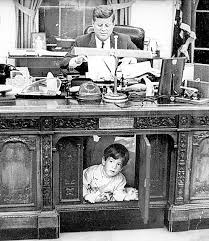
We watched numbly as the line passed President Kennedy lying in state at the Capital through the night, the horse without a rider and the boots turned backwards, the many foreign rulers and dignitaries at the funeral, a grim President Johnson, the grief stricken, stoic Kennedy icons Bobby, Teddy, Jackie and the kids Caroline and John-John. John-John saluting his father’s flag draped casket. Old pictures repeated many times over the weekend of John-John peeking out from under his father’s desk in the Oval Office while his dad did the work of the most powerful man in the world. Pictures of Caroline riding her pony, Macaroni; Jackie and Jack happy, tanned in sunglasses and casual clothes on the back of a sailboat. Playing tag football with his brothers on the lawn in Hyannis. Camelot bled. My mother wept.

john-john saluting his father's flag draped casketWe lived for days with an exhausted and bereaved Walter Cronkite on CBS News in black and white. When we thought we could absorb no more, we were rendered gap-jawed yet again. As we strained for a look at the assassin being moved at the jail, we saw him gut shot by Jack Ruby on live television, the twenty four year old Oswald’s face distorted in shock and pain. We heard the beginnings of a cornucopia of conspiracy theories, no one wanting to believe that such a man could be taken down by a random act of seemingly deranged violence. Yet the lone wolf assassin with a mail order Italian rifle, shooting from the Texas School Book Depository narrative stuck – with the Warren Commission signing off.

No grassy knoll, no coconspirators, no Mafia, no Cubans, no Russians, no CIA or plotting LBJ, no John Birch Society, no Oliver Stone, no Jim Garrison. The horrific Zapruder home movie with the first shot through his throat and into Texas Governor John Connally, the seconds that seem like hours between shots when we still want to yell hopelessly, “Get down!” The second shot – blood, brains, final. Jackie in shock crawling in her pink dress and pillbox hat over the trunk of the fast moving limo trying to recover part of her husband’s skull blown away as the car accelerated to a way too late escape. That’s what we were left with.

With records sealed seemingly forever, it seemed my questions would not be answered in this lifetime, until on our trip last month to visit Bob and Cathy Cormack, Bob showed me a book I have not been able to put down. How I missed it seven years ago can only be ascribed to preoccupation.

“As I will demonstrate, everything suggests the Soviet Union recruitment of Oswald when he was assigned as a young Marine in Japan. In the available documents I also uncovered clear evidence that his mission upon his return to the United States was to assassinate President Kennedy, who had forced Khrushchev to erect the Berlin Wall in 1961 and hastily withdraw his nuclear missiles from Cuba in 1962. Never before had a Soviet leader been so egregiously humiliated.” From the preface of ”Programmed to Kill, Lee Harvey Oswald, the Soviet KGB, and the Kennedy Assassination – The Training of a Dedicated Agent,” Ion Mihai Pacepa, 2007

Ion Pacepa defected in 1978 from Romanian intelligence, a subsidiary of Soviet intelligence. He was the national security advisor to Romania’s president and acting chief of his foreign intelligence service; he supervised the Romanian equivalent of the American National Security Agency (NSA). Pacepa is the highest ranking Soviet bloc intelligence officer ever to defect to the U.S. In well annotated detail, he describes Lee Harvey Oswald as fitting perfectly the pattern of Soviet recruitment of disaffected American military personnel during the long, Cold War. Oswald’s arranged marriage to Marina, his reinsertion into the U.S., his relationships with known Soviet covert and overt agents all fit the mold of a ”serzhant,” as these agents were called.

Oswald first came to the attention of the PGU (Pervoye Glavnoye Upravleniye), the Soviet espionage service and First Chief Directorate of the KGB, when he was a radar operator in a clandestine base in Japan. When he defected to the USSR, he was treated as royalty, especially after data he supplied on the altitude patterns of the top secret American U2 spy plane led to the downing of one in May of 1960 and the capture of its pilot, Gary Powers. In 1961, he was persuaded by the PGU to train as a clandestine sleeper agent with his mission to assassinate the “Pig” and “son of the millionaire” as Soviet Premier Nikita Khrushchev often referred to the young president who had bested him.

“Programmed to Kill” is an well written study that reads like a spy novel about the inner workings of the KGB and the Soviet Union at its zenith. Khrushchev rescinded the assassination order after his brutality in previous assassinations and attempted assassinations was revealed. Murder was one of his main tools of state, but with the publicity, the Politburo was losing faith in him. The assassination of an American President at his hand could bring Khrushchev himself to a bullet into the back of his head in the basement of the Lubyanka. The PGU lost control of Oswald and feared in an effort to return to Russia a bigger hero, he would complete his original mission in Dallas on his own. All the related Soviet bloc intelligence services began immediately a massive, well run disinformation campaign to deflect attention away from the USSR, casting blame on the CIA, President Johnson and right wing Texas political elements. Dallas nightclub owner and police “hanger on” Jack Ruby, an illegal agent of Cuban intelligence services, was convinced to shoot Oswald to silence him. Ruby was in turn murdered using a well-developed KGB radioactive poison technique inducing a virulent, fast killing cancer.

Credible and chilling, the story holds together, and the book is well worth your time if you have interest in the Kennedys, the assassination, KGB spy craft and the history of a pivotal event in our history. The death of President Kennedy, and the subsequent murders of Robert Kennedy and Martin Luther King, helped to precipitate the cynicism leading to the tsunami of cultural transformation in my generation that resonates to this day.

“The Kennedy assassination was one of the extremely rare cold war episodes in which both sides were vitally interested in hiding the truth.” ”Programmed to Kill, Lee Harvey Oswald, the Soviet KGB, and the Kennedy Assassination – The Training of a Dedicated Agent,” Ion Mihai Pacepa, 2007

3 Comments

Filed under Background Perspective, Personal and family life

Gentrification and Generosity

brownstonesWhen I was a young inside sales coordinator at the Gerrity Company millwork location in Boston, one of the outside reps we supported, let’s call him Finn to avoid defamation, possessed all the confidence and mostly inoffensive hubris of someone raised to privilege in an exclusive suburb like Sherborn, Dover, Hingham or Manchester by the Sea. Not that Finn had amassed a fortune, yet, just that he expected to, was born to it, was entitled to it.  He was funny, likable, irreverent, and disparaging about his customers when they weren’t in earshot.

Bespectacled and bright, Finn was seen seldom without a coffee cup the size of a beer stein. Well caffeinated, Finn would burn through the office from time to time and light up the phone lines with incessant emergencies because the details, while not beyond him intellectually, were not worth his time or planning until they became a crisis of six carpenters idling a jobsite without the correct materials to do their jobs.  The crisis was predictably visited upon the staff of the lumberyard or door shop to remedy – the fabricators, load pullers, dispatchers and truck drivers.  Finn would assure his customers that the dim lights of his support would get it right next time because he would set them straight.

He once went on vacation and put his home phone on call forwarding for his customers – to a Dial-a-Prayer recording, where the desperate, out of stock customer would be driven into frenzy with a daily pseudo spiritual bromide. They were not amused, and neither was the unfortunate inside sales coordinator who caught the next call the customer made.  Meanwhile Finn could entertain himself and his cocktail guests on the fantail recounting his cleverness.

Finn did eventually make his fortune, hard wired as he was into the realty and construction community. He bought cheap, renovated cheap and sold dearly the old brownstones and triple deckers in neighborhoods like South Boston, hitting the wave of gentrification before it crested and broke over the heads of late comers.  The mechanics, warehouse workers and city maintenance worker children of multi generation Southie families soon found it impossible to buy near the homes of their parents and grandparents.  They wound up renting in places like Mattapan or Dorchester until they too were discovered by developers, house flippers and those enamored of newly fashionable places to live.

Finn retired in his late forties, as was his self assigned due, and sailed off to Tahiti and other exotic climes for a three or four year tour.

“Living in this gentrification environment is much more difficult for residents. Actually, what they’re doing is killing the indigenous culture.” Finn Kwong, The New Chinatown, 1987

Not all gentrification is exploitation and displacement. When the artistic community moves into garret apartments with good light in old warehouses, establishing a beachhead among crack houses, discount prostitution, steel curtained convenience stores with a weekly robbery, boarded up apartments, gang tag graffiti on every vertical surface, and nightly drive by shootings, it’s not all bad.  Celebrity and youthful trendy enterprises follow; attracting fashionable small restaurants with good wine lists, art galleries and six dollar lattes, then like the first class sleepers at the end of the train comes seven figure roof top garden penthouses with views of distant harbors.  The downside is thereafter the artists can’t afford the neighborhood or the ambiance.

The city planners are elated to rid themselves of a crime infested, blighted section generating ugly headlines, raise the property values and collect more taxes to fund the profligacy of their bleeding budgets, which leads somewhat circuitously to the point.

Conservatism starts from a sentiment that all mature people can readily share: the sentiment that good things are easily destroyed, but not easily created. This is especially true of the good things that come to us as collective assets: peace, freedom, law, civility, public spirit, the security of property and family life, in all of which we depend on the cooperation of others while having no means singlehandedly to obtain it. In respect of such things, the work of destruction is quick, easy and exhilarating; the work of creation is slow, laborious and dull.”  Roger Scruton, How to Be a Conservative, 2014 (quoted in the Wall Street Journal, Notable and Quotable)

Standard progressive rhetoric is that they hold the moral high ground, especially regarding the poor and disadvantaged, however the specifics give the lie to the jargon. The progressive is conditioned to the government solving the problems, curing the cultural ills and buffering direct exposure to the unwashed through public funding.  Not all progressives, to be sure, the best work in the trenches, but in my experience, the comfortable, guilt ridden majority would prefer the state to provide the remedies.  Decrying the lack of resources for the poor, the panacea is to hire the well paid experts, pay for them through the “leaky conduit” of government bureaucracy and hike taxes to cover it all.

The majority of conservatives are neither wealthy nor real estate developers; they are hands on, work hard and create economic growth. They are also generous with those upon whom fortune has not shown as brightly.  In a recent study by “The Chronicle of Philanthropy” [i]some clear trends are shown:  progressive state residents give less to charitable organizations as a percentage of their gross income, conservative states give more.  Similarly there is a strong correlation of generosity in states with a high percentage of religious voters.  The truly wealthy give less than they used to (as a percentage), and the middle class and working class have stepped up their much more painful giving.  The middle class gives until it hurts and drives older cars, cuts coupons and shares of their more meager resources.  The rich buy neighborhoods to flip, hobby ranches, million dollar urban pied-à-terres and Ferraris. The rich get richer, the poor get poorer and those closest to the poor on the income spectrum are more ready to help.

Of the top seventeen states whose residents give the highest percentage of their income to charity, all voted for Mitt Romney in the 2012 election.[ii] Utah, Mississippi and Alabama lead the way; the lowest seven on the list are all Obama blue states: Connecticut, Massachusetts, Rhode Island, New Jersey, Vermont, Maine and New Hampshire.  Utah residents give 6.56% on average of their gross income; Connecticut tops the bottom dwellers at 2.34%, and the others range down to a miserly 1.74%.  The progressive will be happy to fund the social state and wax proudly about the social contract, but pulls up lame by the numbers when it comes to hands on giving.

“In every circumstance and in all things I have learned the secret of being well fed and of going hungry, of living in abundance and of being in need. I can do all things in him who strengthens me. Still, it was kind of you to share in my distress.” St. Paul’s letter to the church at Phillipi

[i] See “How America Gives”  http://philanthropy.com/section/How-America-Gives/621/

[ii] See the table from the article:  http://philanthropy.com/article/How-States-CompareHow/149169/

1 Comment

Filed under Culture views, Personal and family life