Author Archives: jparquette

jparquette's avatar

About jparquette

Fortunate and blessed in companionship with my wife of fifty seven years, in health and in modest, but more than adequate circumstances. Life is good.

A Wilderness of Error

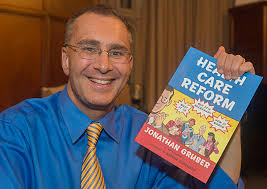
Jonathan Gruber explains what's best for us

“The right thing can seem so wrong and the wrong thing seem so right that we easily become lost, to use Poe’s exquisite phrase, in a wilderness of error.” A Dancer in the Dust, Thomas H. Cook

Unless you have been visiting abroad, say in the Galapagos, you read about or watched Jonathan Gruber, an author of Obamacare. If you have been in the Galapagos, here is a two minute synopsis: Grubergate in Two Minutes from “American Commitment.” Former Speaker of the House, Nancy Pelosi, crowed once that the bill would have to be passed before we knew what was in it. This was not due solely to the closed door machinations and deals, cobbling together a bill meant to be ironed out in joint committee, but frozen, partially done, by the election of Scott Brown. Nor was it due entirely to being over 2,500 pages long and spawning tens of thousands of pages of regulations. The great majority of Americans and American legislators didn’t know what was in it because a.) Obamacare ACA was calculated to obfuscate, and b.) We were “too stupid” to understand it anyway, which was, after all, just as well. As Dr. Gruber clarified to his elite colleagues in academia, “Lack of transparency is a huge political advantage.”

“Speak boastfully no longer, nor let arrogance issue from your mouths.” 1 Samuel 2:3

Obamacare with all its errors in design, the subterfuge in its passage into law and its flawed implementation is a model of progressive mischief, but the ACA is also a metaphor for far more dangerous myopia. Lest we be mistaken, the hubris of the progressive “expert” knows few boundaries. The progressive is willing and able to take us where we ought to go, whether, or perhaps especially, when we do not know enough to want to go there. From their perspective, a stupid and ignorant electorate is best able to be led by those fully prepared to lead them. “Progressive” has become a self-contained oxymoron.

“The trouble is that we always define ‘forward’ as moving in our direction…but not everyone can, and not everyone should.” A Dancer in the Dust, Thomas H. Cook

Norman Angell wrote “The Great Illusion” in 1909 and was awarded the Nobel Peace Prize for his work in 1933. His premise was that large scale war in modern times was futile because of the complex economic interdependence of all the major nations; the cost even for the winners would be too great. His work particularly influenced English leadership, convincing them that even the “Hun” would not be so foolish. They remained in hope almost to the day German troops invaded Belgium and headed towards Paris. Treaty bound to Belgium, the United Kingdom watched as they were inexorably drawn into the beginning of World War I, the bloodiest war in human history until that time. The infirmity of purpose that encouraged the Kaiser was repeated with Neville Chamberlain’s vacillations twenty five years later prior to World War II. Adolph Hitler read the signs of his enemy’s hopeful delusion and warmed up with Austria and Poland before striding down the ChampsÉlysées. The butchery exceeded its predecessor. And so it goes.

For leaders to misunderstand their enemies by trusting optimistic and irresolute illusion kills faith in that leadership as well as the best of the youth under its stewardship.

“In the month of August 1914, there was something looming, inescapable, universal that involved us all. Something in that awful gulf between perfect plans and fallible men that makes one tremble.” Barbara Tuchman, “The Guns of August”

This week we were entertained with the administration’s attempt to placate the offended leaders of almost all major nations. The president once again led from behind by failing to send an appropriate level of representation to the solidarity march of those leaders in Paris after the Charlie Hebdo radical Jihadist attack. To make up for the gaffe, Secretary of State John Kerry gave a stiff hug to Francoise Hollande, the French Premier, and Kerry doubled down by bringing along a grinning James Taylor to sing his sappy “You’ve Got a Friend”. Bad sixties coffee shop folk singing to sooth all insults. If we hadn’t been inured to such awkwardness with six years of this tomfoolery, it would be embarrassing. Now it seems like just another day at the White House. One wag suggested in lieu of Taylor, it should have been Judy Collins with “Send in The Clowns.”

The relevance is not only the tone deafness, but the worldview, the progressive desire to see things as they would hope them to be, irrespective of how they are. Whether Hillary is entreating us to empathize with the Jihadists, Howard Dean denying that the Paris murders were carried out by Muslims or Barack Obama persisting in calling the Fort Hood killings “workplace violence” and Jihadist butchery as “radical extremism” not necessarily unlike  Timothy McVeigh or the demented Jim Jones.

Jihadist violence is inherent, and if we refuse to acknowledge that there is a war, we are probably losing. Releasing Gitmo Islamists who immediately resume killing us or negotiating with Iran over their nuclear ambitions are all of a piece. To the committed Jihadist, there is one dichotomy: dar al-Islam (The House of Islam) and dar al-harb (The House of War), the realm of peace and Islam, and the realm of war: that is everybody else. Leaving the rest of us alone, peaceful coexistence and religious tolerance is as impossible and foreign to them as government by, of and for the people, as constitutional law is to sharia, as democracy is to the Caliphate. Conversion or the sword are the options.

 “And fight with them until there is no more fitna (disorder, unbelief) and religion should be only for Allah!”  Quran (8:39)

“And kill them wherever you find them, and turn them out from where they have turned you out. And Al-Fitnah [disbelief] is worse than killing…  Quran (2:191-193)

4 Comments

Filed under Background Perspective, Politics and government

Gentrification and Generosity

brownstonesWhen I was a young inside sales coordinator at the Gerrity Company millwork location in Boston, one of the outside reps we supported, let’s call him Finn to avoid defamation, possessed all the confidence and mostly inoffensive hubris of someone raised to privilege in an exclusive suburb like Sherborn, Dover, Hingham or Manchester by the Sea. Not that Finn had amassed a fortune, yet, just that he expected to, was born to it, was entitled to it.  He was funny, likable, irreverent, and disparaging about his customers when they weren’t in earshot.

Bespectacled and bright, Finn was seen seldom without a coffee cup the size of a beer stein. Well caffeinated, Finn would burn through the office from time to time and light up the phone lines with incessant emergencies because the details, while not beyond him intellectually, were not worth his time or planning until they became a crisis of six carpenters idling a jobsite without the correct materials to do their jobs.  The crisis was predictably visited upon the staff of the lumberyard or door shop to remedy – the fabricators, load pullers, dispatchers and truck drivers.  Finn would assure his customers that the dim lights of his support would get it right next time because he would set them straight.

He once went on vacation and put his home phone on call forwarding for his customers – to a Dial-a-Prayer recording, where the desperate, out of stock customer would be driven into frenzy with a daily pseudo spiritual bromide. They were not amused, and neither was the unfortunate inside sales coordinator who caught the next call the customer made.  Meanwhile Finn could entertain himself and his cocktail guests on the fantail recounting his cleverness.

Finn did eventually make his fortune, hard wired as he was into the realty and construction community. He bought cheap, renovated cheap and sold dearly the old brownstones and triple deckers in neighborhoods like South Boston, hitting the wave of gentrification before it crested and broke over the heads of late comers.  The mechanics, warehouse workers and city maintenance worker children of multi generation Southie families soon found it impossible to buy near the homes of their parents and grandparents.  They wound up renting in places like Mattapan or Dorchester until they too were discovered by developers, house flippers and those enamored of newly fashionable places to live.

Finn retired in his late forties, as was his self assigned due, and sailed off to Tahiti and other exotic climes for a three or four year tour.

“Living in this gentrification environment is much more difficult for residents. Actually, what they’re doing is killing the indigenous culture.” Finn Kwong, The New Chinatown, 1987

Not all gentrification is exploitation and displacement. When the artistic community moves into garret apartments with good light in old warehouses, establishing a beachhead among crack houses, discount prostitution, steel curtained convenience stores with a weekly robbery, boarded up apartments, gang tag graffiti on every vertical surface, and nightly drive by shootings, it’s not all bad.  Celebrity and youthful trendy enterprises follow; attracting fashionable small restaurants with good wine lists, art galleries and six dollar lattes, then like the first class sleepers at the end of the train comes seven figure roof top garden penthouses with views of distant harbors.  The downside is thereafter the artists can’t afford the neighborhood or the ambiance.

The city planners are elated to rid themselves of a crime infested, blighted section generating ugly headlines, raise the property values and collect more taxes to fund the profligacy of their bleeding budgets, which leads somewhat circuitously to the point.

Conservatism starts from a sentiment that all mature people can readily share: the sentiment that good things are easily destroyed, but not easily created. This is especially true of the good things that come to us as collective assets: peace, freedom, law, civility, public spirit, the security of property and family life, in all of which we depend on the cooperation of others while having no means singlehandedly to obtain it. In respect of such things, the work of destruction is quick, easy and exhilarating; the work of creation is slow, laborious and dull.”  Roger Scruton, How to Be a Conservative, 2014 (quoted in the Wall Street Journal, Notable and Quotable)

Standard progressive rhetoric is that they hold the moral high ground, especially regarding the poor and disadvantaged, however the specifics give the lie to the jargon. The progressive is conditioned to the government solving the problems, curing the cultural ills and buffering direct exposure to the unwashed through public funding.  Not all progressives, to be sure, the best work in the trenches, but in my experience, the comfortable, guilt ridden majority would prefer the state to provide the remedies.  Decrying the lack of resources for the poor, the panacea is to hire the well paid experts, pay for them through the “leaky conduit” of government bureaucracy and hike taxes to cover it all.

The majority of conservatives are neither wealthy nor real estate developers; they are hands on, work hard and create economic growth. They are also generous with those upon whom fortune has not shown as brightly.  In a recent study by “The Chronicle of Philanthropy” [i]some clear trends are shown:  progressive state residents give less to charitable organizations as a percentage of their gross income, conservative states give more.  Similarly there is a strong correlation of generosity in states with a high percentage of religious voters.  The truly wealthy give less than they used to (as a percentage), and the middle class and working class have stepped up their much more painful giving.  The middle class gives until it hurts and drives older cars, cuts coupons and shares of their more meager resources.  The rich buy neighborhoods to flip, hobby ranches, million dollar urban pied-à-terres and Ferraris. The rich get richer, the poor get poorer and those closest to the poor on the income spectrum are more ready to help.

Of the top seventeen states whose residents give the highest percentage of their income to charity, all voted for Mitt Romney in the 2012 election.[ii] Utah, Mississippi and Alabama lead the way; the lowest seven on the list are all Obama blue states: Connecticut, Massachusetts, Rhode Island, New Jersey, Vermont, Maine and New Hampshire.  Utah residents give 6.56% on average of their gross income; Connecticut tops the bottom dwellers at 2.34%, and the others range down to a miserly 1.74%.  The progressive will be happy to fund the social state and wax proudly about the social contract, but pulls up lame by the numbers when it comes to hands on giving.

“In every circumstance and in all things I have learned the secret of being well fed and of going hungry, of living in abundance and of being in need. I can do all things in him who strengthens me. Still, it was kind of you to share in my distress.” St. Paul’s letter to the church at Phillipi

[i] See “How America Gives”  http://philanthropy.com/section/How-America-Gives/621/

[ii] See the table from the article:  http://philanthropy.com/article/How-States-CompareHow/149169/

1 Comment

Filed under Culture views, Personal and family life

Beyond Singularity

“Jake Spoon is a mighty leaky vessel to put all your hopes in.” – Gus McCrae, “Lonesome Dove”, Larry McMurtry

In the most recent quovadisblog.net post, we explored however briefly the future according to futurist Ray Kurzweil: the era when man and machine will be inextricably fused into one creature, eternal, omniscient and beyond time and space. A blog post can cover barely a brush by analysis of the roots of this prophesy of the goal of human existence. “Singularity,” a beatific vision of the faith of scientism, is a mighty leaky vessel to put all your hopes in.

How we got here is complicated, but some understanding of the journey which discarded nearly two millennia of human wisdom is worth a word or two.

“This (the abandonment of much of Socratic/Aristotelian thought), though silent and almost unnoticed, was the greatest revolution in human history, far outweighing in importance any of the political revolutions whose thunder has reverberated through the world.” W.T. Stace “Man against Darkness,” The Atlantic (Sept, 1948) as quoted in Leo Sweeney, S.J., “Authentic Metaphysics in an Age of Unreality,” as quoted in “The Last Superstition, A Refutation of the New Atheism,” Edward Feser, 2008

AristotleFor roughly eighteen centuries, the lodestone of Western thought was Aristotle. Before Christianity, before Mohammed, before the Roman Empire, Greek philosophy was true north for all else that was to follow. Until the “Enlightenment,” which wasn’t all light, metaphysics and the search for human wisdom and truth in Western culture relied on principles of natural law and some would say common sense well thought out. What we now deem “science,” and for many the only valid arbiter of truth, was an important, but contracted, aspect of man’s search for truth. All science is based on metaphysical assumptions and precepts. The metaphysical enclosed the hard sciences as a portion, but not the whole.

Aristotle posited that all things have four causes. The first is its material cause: the stuff out of which anything is made (be it wood, iron, chlorophyll, cells, etc.). The formal cause adds the form, structure or pattern which the material assumes and is of a kind that distinguishes it from other things made of the same stuff – be they humans and poodles or countertops and the Pieta. The formal cause exists outside of the thing, separate from it and is congruent with the same form that exists in our minds so that we recognize it. The third attribute is the efficient cause or that which brings a thing into being from exploding stars creating elements to a whittler’s knife carving images – it is what causes a thing to move from potentiality to actuality. Things must have the innate potential to become; and something must act upon them to realize that potential. Finally there is the final cause – that for which something exists, its purpose, its why.

Felix qui potuit rerum cognoscere causas. “Lucky is he who has been able to understand the causes of things,” Virgil, Georgics, Book 2

For Thomas Aquinas, the human person’s formal cause is the soul, which exists beyond space and time; for Aristotle, mankind’s final cause as a “rational animal” is to know the truth, a truth both objective and within our mortal limits, attainable. Beginning slowly with Hume, Locke, Hobbes and the like, modern philosophy disavowed both formal and final causes. We find ourselves on the other side of Neitzsche, Sartre, and now Dawkins and Hitchens and are entangled in webs of relativism, skepticism and purposelessness. [i] Scientism offers us a “leaky vessel” way out, a “hope” rooted in hubris. A mutually exclusive dichotomy now assumed between science and religion was not always so, is erroneous and is not necessary.

Just as the eye was made to see colors, and the ear to hear sounds, so the human mind was made to understand. From “Astronomi Opera Omnia” Johannes Kepler

Science is not scientism; science is an objective search for a limited truth attainable by experimentation and careful observation. Science is agnostic to ultimate purpose or final causes. There is no inherent conflict with faith, but science cannot sound the depths of before time and space. First, science and modern philosophy do not recognize the existence of final causes; secondly they do not possess the means to evaluate them. It is not “faith or reason” that brings us to the fullness of understanding, but “faith and reason” – Fides et Ratio. Scientism is not science; scientism is a faith – a faith not in God, but in “not God.” As in all faiths, there are underlying tenets of that faith that can neither be proven absolutely or refuted absolutely. One can only judge the fruits of it.

Yet the positive results achieved (from pure reason and its handmaid, science) must not obscure the fact that reason, in its one-sided concern to investigate human subjectivity, seems to have forgotten that men and women are always called to direct their steps towards a truth which transcends them. Sundered from that truth, individuals are at the mercy of caprice, and their state as person ends up being judged by pragmatic criteria based essentially upon experimental data, in the mistaken belief that technology must dominate all. It has happened therefore that reason, rather than voicing the human orientation towards truth, has wilted under the weight of so much knowledge and little by little has lost the capacity to lift its gaze to the heights, not daring to rise to the truth of being. Abandoning the investigation of being, modern philosophical research has concentrated instead upon human knowing. Rather than make use of the human capacity to know the truth, modern philosophy has preferred to accentuate the ways in which this capacity is limited and conditioned. Fides et Ratio, 1998 encyclical, Saint John Paul.

Here is an example that may help clarify how it works. Many years ago the Jesuits at Boston College tried to teach me logic, epistemology and other arcane subjects that at the time seemed completely irrelevant to the real world. Pearls cast to swine (or sophomores), I suppose. Of course what they were trying to do was teach me to think; they tried with limited success to inculcate into me a disciplined mind. Perhaps these many decades later to their credit, a few lessons stuck. Among the many examples of logical fallacy we learned was circular reasoning, wherein the preordained conclusion of an argument is baked into the premises to deliver stillborn real debate and analysis.

One such banal argument from the atheist goes like this: Since you benighted theists insist that your God is all good and all powerful and all loving, why is there still evil in the world? Hah! Take that! There is no God! Christian theology replies with an eternal Love, a Person, whose “ways are not our ways”, and of the free will inherent to the human person, free even to choose evil, but free will necessary to the nature of the dignity and worth of a free person. It also teaches of the mystery of suffering and redemptive suffering revealed by God as also necessary to the human person in some way not fully fathomable within our mortal coil, but exemplified and made of inestimable value by Jesus. These and other aspects of this most difficult subject require not only a lifetime of study and understanding, but more importantly prayer, reflection and relationship with God through Jesus. [ii]

But if the discussion is shut down with a trite aphorism with the unstated premise that there is not really any God that can shed light on darkness, but if there was, He could not be all powerful and all good and all knowing and permit evil, therefore He doesn’t exist, the argument reveals itself to be, “there is no God, therefore, there is no God.”

When the true believers of scientism draw their conclusions, they mask as scientific, rational and objective that which was preordained in its premises.

Perhaps there is no God; perhaps God is a Divine Watchmaker who set in motion the laws of the universe and left the premises; perhaps the “Irreducible complexity” debate of the Intelligent Design advocates is really another “god of the gaps” syllogism in a new guise. But perhaps, just perhaps, that as the Jesuits taught me our souls are eternal, as is God, and that we exist on this beleaguered planet, which rides within our solar system, our galaxy and our universe with all of them constantly and intimately enfolded within the Mind of God, utterly dependent for each moment on that Loving Mind.

“I assure you, my brothers, that even to this day it is clear to some that the words which Jesus speaks are spirit and life, and for this reason they follow Him. To others these words seem hard, and so they look elsewhere for some pathetic consolation.” St. Bernard, abbot

[i] For a good analysis of the etiology of the current brand of popular atheism and its convoluted path from the Enlightenment to modernity, try “The Last Superstition, A Refutation of the New Atheism,” Edward Feser, 2008 St. Augustine’s Press.

[ii] See C.S. Lewis “The Problem of Pain”

4 Comments

Filed under Background Perspective, Culture views

Singularity

“Ray Kurzweil is the best person I know at predicting the future of artificial intelligence. His intriguing new book envisions a future in which information technologies have advanced so far and fast that they enable humanity to transcend its biological limitations – transforming our lives in ways we can’t imagine yet.” Bill Gates

Every week it seems business and culture news emerges about the “internet of things.” Our daily lives produce data, and these metadata are tracked, compiled and used to predict, make more comfortable, market to us and filter what we see, hear and experience on the web. Not just tailoring our internet searches to what the search engine “thinks” we want to know, but analyzing key words in our emails and where we linger on the web to “ascertain” through artificial intelligence (AI) algorithms what interests us. Then putting us in touch with our patterns, selling us stuff and fashioning the right box into which we fit – a Procrustean bed. Software is being generated to enhance the sluggish “key words” analysis and advance to concepts and thoughts, something in which computers have not yet surpassed us in ability. They have long since passed us in sheer computing power, speed and memory. Next generation AI software brings intuition and those types of “thinking without thinking” formerly uniquely human judgments written about in Malcolm Gladwell’s “Blink.” Computers are learning to learn and replicate on their own. We are evermore typecast and channeled, aided and abetted into what is profitable financially or politically for someone.

Our smart phones, tablets, computers are joined by our medical records, cars, alarm systems, baby monitors, refrigerators, dish washers, furniture and soon our carpets, toothbrushes, and for all we know toilet seats will feed the maw of data about us. The cloud will know all.

Our rugs will inform us (and the cloud) how often we walk across them, whether we have fallen down and can’t get up, if an unknown walker treads softly upon them or perhaps if we get romantic in front of our fireplace and how long we persist at it. We will go from our smart home to our driverless car, and it will take us door to door.

If we thought the NSA was intrusive, we are desperately naïve. And this is just getting started.

“I would say humans are not purely biological. We’ve already expanded humanity with our technology, and the technology is part of humanity; we are the technology.” Ray Kurzweil

Dr. Kurzweil reflects the hopes of many of those whose belief system is exclusively “scientism,” which holds that science, the scientific method and mathematical reasoning is the only true arbiter of truth and in which we will find humankind’s salvation. The irony of this worldview is while such true scientism believers deride metaphysics, the concepts upon which all of science rests are metaphysical in nature. [i] Scientism is an alternate religion.

He envisions nanobots in our brain, hooked up directly into the cloud. No more fingers on keyboards and mouse to search the internet for knowledge. Our thoughts and memories will access the cloud immediately; we will be one with the cloud, and the cloud will be one with us. He coined the term “Singularity” for this, and his eponymous book ten years ago predicted this state of oneness with computers is not three, two or even one hundred years ahead in science fiction. 2045 is his date for “achieving” singularity. [ii]

Our children and grandchildren will see this, according to the futurist, perhaps even ourselves if we stay healthy and achieve the second aspect of his prediction. All human body parts will be repairable or replaceable with genetic manipulation and perfectly cloned parts from our own DNA, so our brains will become part of the cloud, and our bodies will take on immortality. Millions of car recalls, the roll out of the Affordable Care Act, just my recent experience in figuring out how our new dishwasher worked come to mind. Singularity? What could go wrong?

“And what would they be scared of? There’s nothing to fear in a perfect world, is there?” Catherine Fisher (Welsh author and poet)

Much dystopian science fiction has described computers and robots gradually assuming more and more of our daily lives, then assuming everything. From 2001’s nemesis computer HAL killing the astronauts to Isaac Asimov’s super central computer controlling all in “I Robot” it gets worse. The three rules proscribing that a robot may not harm and must protect any human being broke down. In the Terminator movies, Skybot makes the decision that human kind is a virus on the planet and unleashes genocidal warfare upon us.

I have no mouth and I must screamPerhaps the most awful end for us “hairless apes” is found in Harlan Ellison’s short story from the sixties, “I Have No Mouth and I Must Scream.” The world’s computers hook up into one all encompassing web, wipe out all humans, but keep four around to torture. “AM” reads their thoughts and intention, controls not only their environment, but their biology – AM can keep them alive for its amusement with freshly minted organs virtually forever. After the protagonist, Ted, carefully avoids actively thinking of his “solution,” in a lightning strike frees his companions by killing them. AM transforms him into a limbless blob with no mouth and no ability for even suicide. The final line of the story is its title.

“Why do you ask how you were created and do not seek to know why you were made?” St. Peter Chrysologus

The modest objective of the self congratulatory and elated “Singularity” variety of science and technology is to supplant completely what was formerly reserved to religion and understood through the study of metaphysics. The technocrats will define and implement our happiness, immortality, omnipotence and fulfillment through becoming one with our machines.

How we got here is a topic which will require more than a few blog posts to begin to explore, and perhaps we shall root around a bit. The history extends back not just into the technology of the late nineteenth century through today, but to late medieval philosophers like William of Ockham, then on through Descartes, Hobbes, Locke and all the rest. To understand even peripherally what ideas have these consequences is not a trivial pursuit.

John Hammond, “All major theme parks have delays. When they opened Disneyland in 1956, nothing worked.”

Ian Malcolm, Yeah, but, John, if The Pirates of the Caribbean breaks down, the pirates don’t eat the tourists.”  Jurrasic Park

[i] The concepts undergirding science are the stuff of philosophy.  A physical world exists outside our mind; that there are patterns which can be recognized by our senses reliably as sources of information; that we can form concepts and reason from premises to conclusion.  That causation and result are valid methods of understanding.  All of these and more are metaphysical concepts and provable through metaphysics and logic, not the scientific method.

[ii] Curiously, “singularity” is the scientific term for a single point in space-time of no dimensions, but infinite mass, which current hypothesis holds was blown up by a “quantum fluctuation” to trigger the Big Bang resulting in a inflating universe bubble in an infinite cosmos of other universe bubbles that has no beginning and no end.


6 Comments

Filed under Background Perspective, Culture views

Maternity and Modernity

“Maternity dooms woman to sedentary existence, and so it is natural that she remain at the hearth while man hunts, goes fishing, and makes war.” Simone de Beauvoir, The Second Sex

One of the more pernicious effects of the post modern culture in which we find ourselves is the undermining of motherhood, indeed of parenthood. “Undermining” evolved from ancient times as a siege tactic to bring down the staunchest of walled cities. Medieval aggressors dug a tunnel day and night over many weeks under one stone battlement of the stronghold, propping the tunnel as they went with wooden beams and posts to prevent detection. If undiscovered by the defenders, upon completion, the besiegers would lay in more wood and incendiaries to the tunnel, and set it afire. When the wooden supports burned through and the tunnel collapsed, so, too, would the wall on top of it, exposing the previously impregnable city to conquest, plunder, enslavement and ruin.

“Ideas have consequences.” The tunnel digging of the last century and a half evolved from the supremacy of will and self philosophies of Schopenhauer, Neitzsche and Sartre; the reductionism of human beings to the merely chemical and biological by Darwin, Freud and others; the demeaning of human sexuality by Margaret Mead, Margaret Sanger and Albert Kinsey from lifelong commitment and love to casual pleasure seeking; and the utilitarian ethics of Peter Singer, Jack Kevorkian and their ilk, corroding the dignity of the human person into a subjective quality of life standard, which is defenseless against self serving interpretation. [i]

“All the women were captured and chained

And national suicide was proclaimed

And new America fell to the ground

And all the children lay crippled lame.” When the Walls Came Tumbling Down, Def Leppard

After the tunnel was set afire in the “sexual revolution” of the sixties, “the walls came tumbling down.” We walk in our neighborhood: first time parents are now older with their one or two children; many couples have chosen to keep a couple of dogs in lieu of children; annoyed grown men with plastic baggies in their hands walk sweatered mutts, and plush veterinarian clinics outnumber and architecturally outshine both pediatric and child care centers. Children of single parents and of divorce are the norm. American birthrates have dropped below that which is necessary to sustain our population; the Social Security and Medicare programs are in danger of collapse as too few children grow into contributing workers.

“Mother”, especially a full time mother, has diminished in clever cocktail banter into sniping “new speak” for a failed career woman. Simone de Beauvoir, long time lover of Jean Paul Sartre, and darling of the most extreme faction of the feminist “movement” died alone, chain smoking and embittered. She had this to say about mothers and motherhood: such women “are not so much mothers as fertile organisms, like fowls with high egg-production. And they seek eagerly to sacrifice their liberty of action to the functioning of their flesh.” She becomes a “menstrual slave” victimized by her own biology. Ideas do have consequences and take many years to emerge fully. Once hatched, they metastasize into our concepts, morality and worldview, often without our awareness or consent.

“O, brave new world that has such people in’t!” The Tempest, William Shakespeare

The natural consequence of these ideas was brilliantly foretold over eighty years ago in Aldous Huxley’s dystopian novel[ii] set six hundred years in the future. Some of his science fiction devices, such as sound waves recorded as digital light, are already commonplace, and perhaps some are in our future. In this future, the words “mother” and “mammary” are obscenities that make citizens blush, while nothing else does; sex is ubiquitous, pneumatic, loveless and fruitless. Recreational sex and multiple partners are mandatory; marriage or even long term relationships are forbidden as sources of angst and discontent. Fatherhood is unheard of.

Babies are fertilized exclusively in hatcheries; they are “decanted” from bottles, not born, and then moved to conditioning floors where they begin their habituation to “happiness” as alphas, betas, gammas, deltas and epsilons. Alphas are decanted to lead; epsilons poisoned while still in their bottles with alcohol to near morons destined only for menial work, but happy in it. The rest are planned and designed to fit into civilization in their predetermined slot. All are molded into acceptance of their lot and conditioned to despise the messy, overemotional and imperfect family. Under constant “hypnopaedic” sleep learning, they are cloned, cut and pasted into their proper place. Any misgiving or dissatisfaction is remedied with nightly “vacations” for all citizens with “soma”, a euphoric mild hallucinogenic with no hangover that wipes away all anxieties, anger, doubts and questions.

Mustapha Mond (Regional World Controller to students)

“’Try to realize what it was like to have a viviparous mother.’

That smutty word again. But none of them dreamed, this time, of smiling.

‘Try to imagine what ‘living with one’s family’ meant.’

They tried; but obviously without the smallest success.

‘And do you know what a ‘home’ was?’

They shook their heads.” Brave New World, Aldous Huxley

Gianna flies free

Gianna flies free

Angela the same age as Gianna and little sister Meg

Angela the same age as Gianna and little sister Meg

Our five year old granddaughter, Gianna, hit a milestone last weekend with her family in attendance. Her Mom, our daughter Angela, ran behind her with her guiding hand, aiding her balance, teaching her to look ahead, to peddle steadily, to gain confidence, to advance another step like all her prior and future steps. Then Angela let go as all parents must and ran beside her. I was fortunate to see her on one of her earliest runs. Both were grinning widely, Gianna doing a grown up thing, utterly joyful. I apologize for the limitations of my cell phone camera, but the image is there. Gianna told us later that night she felt like she was ten years old. Angela emailed us that “G” was a ‘big girl’ all night, well behaved, helping with dinner and clean up – the felicitous consequence of maturity.  Angela is doing as Rita did for our kids and what mothers have done for millennia – loving and training her children to fly on their own.

Angela is an accomplished young woman with a post graduate degree and certification as a Creighton practitioner, aiding others with natural family planning and infertility. Recently, she testified to a hostile Rhode Island House of Representatives committee and a packed hearing room about fetal development, in which she is well versed. A full time mother of three young girls, she is the furthest one can imagine from a “menstrual slave.” She and her husband, Peter, choose to live on Peter’s income for the most part. They will have fewer things, toys and accoutrement. They will be less obsessive consumers and more focused parents. She is home schooling their children, Gianna, Elena and Mary. They are not an Ozzie and Harriet fifties family, but Pete and Angela choose to be countercultural to a culture distorted by the now established, dysfunctional “counterculture” of the sixties. She is a heroine. She is a mother.

Link to interviews for the ‘toughest job in the world.’

“This afternoon was definitely one of the best moments of my life. Letting go of that bike, I will never forget it, hard to describe.” Angela Barek (my daughter) about her oldest daughter, Gianna, first time flying solo without training wheels or a net.

[i] See the excellent Architects of the Culture of Death, Donald de Marco and Benjamin Wiker, Ignatius Press, 2004

[ii] I recently reread Brave New World, Aldous Huxley, Chatto & WIndus, London, 1932. Still much worth your time.

5 Comments

Filed under Culture views, Personal and family life

This is a Man’s World

“This is a man’s world, a man’s world

But it would be nothing, it wouldn’t be nothing

Nothing without a woman or a girl.”

 It’s a Man’s, Man’s World by James Brown and Betty Jean Newsome[i]

Now that we are thoroughly liberated and bone weary of it, some perspective may prove beneficial.   Betty Jean Newsome never received much recognition for the song; most remember only James Brown, although many covers were successful, notably Grand Funk Railroad, Van Morrison, Christine Aguilera, Celine Dion and the superb Etta James version in 2006. Women often were not acknowledged for their intellectual property contributions. With the exception of Marie Curie, name three women scientists.  Quick.

Sister Miriam Michael Stimson

Sister Miriam Michael Stimson

How many know of Sister Miriam Michael Stimson, a Dominican nun and scientist of the forties and fifties?  Yet her successful experiments to create a thin enough sample to observe DNA and the X ray chemistry work of Rosalind Franklin that illuminated the double helix were critical in the discovery of the ATCG form of DNA.  James Watson and Francis Crick likely would have had no Nobel Prize and worldwide fame without the seminal work of Sister Stimson and Franklin.  Some hold that Watson and Crick borrowed a bit too liberally without attribution to Sister Miriam and Franklin.  Watson and Crick parlayed their “discovery” to beat out other publicity eager academics like Linus Pauling for the science win of the century.  Crick would have had no bully pulpit for his later eccentricities and crusades against religion and for eugenics to genetically engineer a better sort of human being.  He thought it might be possible to program a computer to have a soul.  Perhaps Dr. Crick should have stuck to physics and borrowing ideas from chemists.  Perhaps he could have shared some of the recognition for his Nobel Prize as well.

“People have so many religious beliefs and until we have a more uniform view[ii] of ourselves, I think it would be risky to try and do anything in the way of eugenics.”   “Christianity may be OK between consenting adults in private but should not be taught to young children.” Francis Crick

Occasionally we venture out to the cutting edge of science and find lawyers.  Rita and I are possessed of a quirky sense of irony and find the class action lawsuits against Androgel, Fortesa and other pharmaceutical pitchmen for testosterone therapy a vein too rich to pass up.  In our headlong rush to remain forever young, men are easy prey to promises of better muscle definition, improved strength, inexhaustible energy and prodigious erections.  Unfortunately users of this snake oil also fall prey to more heart attacks, strokes and a 30% higher death rate than those who don’t rub on the magic gel.  Some say it’s a small price to pay for multiple orgasms, but others call in the attorneys.  The ads are current and frequent to attract more clients to reinforce the lawsuits, especially on sports shows.

What is more ironic is how fast these lawsuits proliferated and how slowly if at all, similar lawsuits have been filed for damages against big pharma for birth control pills.  Invented by men, pushed by men as “liberating” for women (and expedient for men with throbbing testosterone), birth control pills are listed as Group 1 carcinogens for breast cancer by the World Health Organization (see previous post, “Pink Orthodoxy”).  When convenient for men, the drugs get pushed and risks downplayed.  When somewhat inconvenient for men (strokes and heart attacks fall into the category of ‘inconvenient’), then loose the dogs of personal injury partnerships.

Remember how short lived male birth control pills were?  Never heard of them, did you?  Side effects included erectile dysfunction (known in the trade as limp under fire) and shrinkage (similar to skinny dipping in a Maine lake in April).  The side effects defeat the purpose. No lawsuits needed; much better for the women to shut up and take their medicine.

“Men marry women with the hope they will never change.  Women marry men with the hope they will change.  Invariably they are both disappointed.”  Albert Einstein


[i] Years after James Brown dropped Betty Jean as a girlfriend; she sued him for unpaid royalties declaring that she had written the entire song, not just the lyrics.

[ii] Saint Thomas More first used the term “Utopia” in his fictional book of political philosophy of the same name.  It is derived from the Greek: “eu” – “good”, ou, “not” and “topos” meaning “place”.  “no good place” or “no place land.”  When a eugenicist proposes to create a utopia with a “uniform view”, we can be assured that “view” is his own. Peel away a layer of a utopian eugenicist and the coercing fascist soon reveals himself.

1 Comment

Filed under Culture views

Cat Lessons

“Cat lovers turn into cat collectors.”  Greg Kinnear

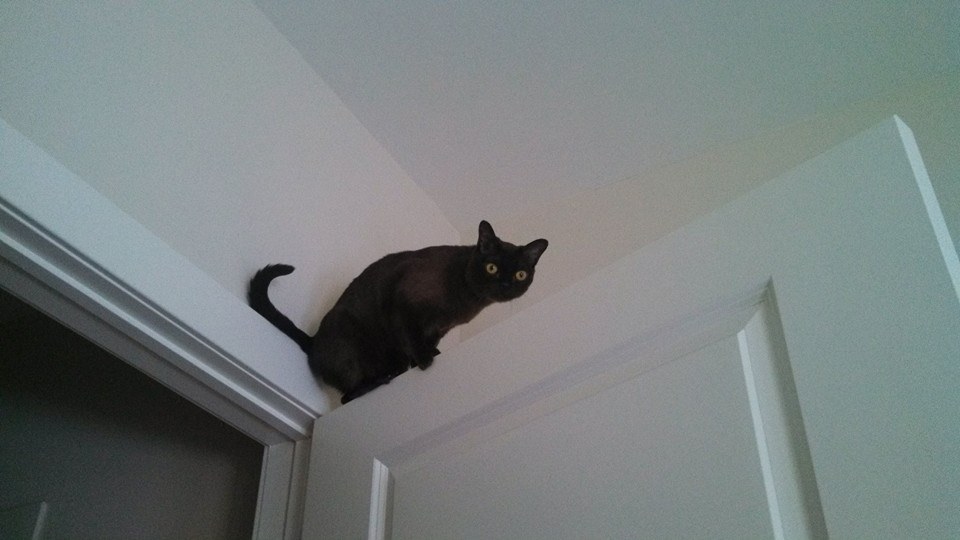
Visiting my mother Thursday night, my allergic reaction to her three cats remains vigorous, but manageable.  Mom is a lively 93 and entirely unlikely to give up her Cookie, Scout and Checkers companions, so any reaction my eyes and sinuses have to her beloveds is entirely irrelevant – small price tag, really, for still having an engaged, funny, cheerful with infirmity and engaging mother.

Gabe and Faun's predator

Gabe and Faun’s predator

When our children were young we had a rotating menagerie of cats, dogs, a tragedy of hamsters, a turtle and short lived dalliances with goldfish.  I don’t remember any allergies to any of them, but our dogs and cats were mostly outdoor pets who boarded with us most nights except for Nikki the husky mix who preferred sleeping in the snow.

Occasionally one of the more stupid (always male) cats would dash into the street on a mission and be run over by a car.  We always opted for affording them the short, happy life of climbing, sleeping in the sun, courting (although all were “fixed”), defending their territory and hunting indigenous small fauna – four footed or winged.  As anyone familiar with the dead eye gaze of a cat will confirm, its primitive, tiny brain consists of an ineradicable instinct to survey the field and regard anything less than six inches in height as prey.  I remember an uncomfortable feeling when our cat would stare intently at me probably wondering how different their lives would be if I was the size of an adolescent squirrel.

My mother’s cats are entirely housebound and spoiled fat: friendly for the most part, but with normal feline reserve, comfortable with complete freedom to occupy any space their whimsies fancy.  Allergens abound; they frequently dine on the breakfast bar peninsula, which is an accommodation up with which my nurse wife would never put.  Rita has an aversion for some reason to eating where little feet fresh from the litter box have recently trod.

“You can visualize a hundred cats. Beyond that, you can’t. Two hundred, five hundred, it all looks the same.”  Jack Wright, Ontario housepainter and joint record holder.

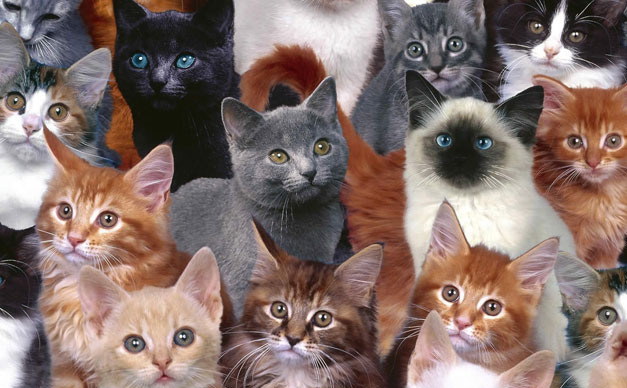
We are grateful that our mother’s crazy cat lady proclivity is relatively constrained.  The Guinness Book record was set by Jack and Donna Wright.[i]  The collection started with Midnight, Donna’s black long hair, which had a wild night, then a litter that the Wrights were unwilling to break up.  Next came a few strays; their house gained local celebrity as Cat Crossing.  The count ballooned as anyone with an extra cat or a found cat started dropping them off.  After an appearance on the Phil Donahue show about their record 145 cats in one house, contributions went national and got a bit out of hand.  As Cat Crossing’s reputation grew, cats were couriered or shipped in from afar. 689 housecats was their top count.  The Wrights didn’t have it in them to deny any feline some sustenance.  Costs eventually ran to $111,000 a year, which included individually wrapped Christmas toys.  Each and every one had a name.

lots-of-catsCat hoarding has a curious relationship with Toxoplasma gondii, a one-celled protozoan parasite which normally reproduces asexually.  Toxo can enhance its gene pool by reproducing sexually, but that can only occur within a cat’s intestines.  If the parasite invades another host through ingestion or just skin contact with cat feces, then humans, monkeys, Beluga whales, bats, elephants, chickens and many other species become unwilling habitat. Once in, it swims through the blood stream directly to the brain.   One third of the world’s human population has Toxo organism in their system.  After the parasite takes up residence, it forms tiny cysts, especially in the amygdala, the center of both pleasure and anxiety in the mammalian brain.  The violated amygdala produces excess dopamine, a potent and manipulative neurotransmitter. These cysts can slow reaction time, induce aggressive or jealous behavior in people and change the human sense of smell, rendering some humans immune to the pungent odor of cat urine.  All the better for cat collectors.

Even more peculiar is the tested effect of Toxo on rodents.  Lab rats hosting Toxo become obsessed with cat urine; they love cat urine; they crave cat urine; they seek out cat urine.  When exposed to it, their pleasure center resonates with the males reacting physiologically as they do around females in heat. Their little rat testicles swell.  Some aspects of cat hoarding are best left unexplored.

“Time spent with cats is never wasted.”   Sigmund Freud

A cat once figured in an important lesson for me many years ago, fixated as I was on escalating complicated solutions and missing the simple one.  We lived in our old farm house in Farmington, Maine; a section of the dirt floor basement was a crawl space.  I kept finding the basement window sash on the ground and the cat in the basement.  A cat prowling in a dirt floor basement quickly leads to a reeking dirt floor basement, so I had asked everyone to make sure she didn’t go down there.  Too often, I opened the cellar door, and a cat would emerge.  I thought we had a very smart cat which could open the window to get into forbidden territory.   Having no time one such morning, I just jammed a shovel up against the sash into the dirt floor and left for the day’s business.  A week later, I discovered the shovel laid over, the sash open and the cat in the cellar. Damn cat, I thought:   smart and strong.  So I took my twenty two ounce framing hammer with two twelve penny nails and secured the sash, leaving the heads proud until I could come up with a permanent fix.  For a few days all was well, then the cat came up the stairs and the nails were pulled out.  The light finally shone on me, and I asked our son Gabe, who was about eight, what he knew.  He told me the crawl space was his favorite undiscoverable hiding spot when the neighborhood kids got together for a rousing game of Hide and Seek.  He said it had been hard to pull out the nails.  I laughed out loud at my stupidity when I told Rita the story.  I learned William of Ockham had taught us something worth knowing with his razor.[ii]

”When my cats aren’t happy, I’m not happy.  Not because I care about their moods but because I know they’re just sitting there thinking up ways to get even.”  Percy Bysshe Shelley


[i] The Violinist’s Thumb, Sam Kean,  Chapter 7, “The Machiavelli Microbe”

[ii] William of Ockham (1287-1347) wrote of “lex parsimoniae” a principle of succinctness to be used in problem solving wherein the hypothesis with the fewest assumptions and therefore the simplest solution is the correct one.

2 Comments

Filed under Personal and family life

Italian Lessons

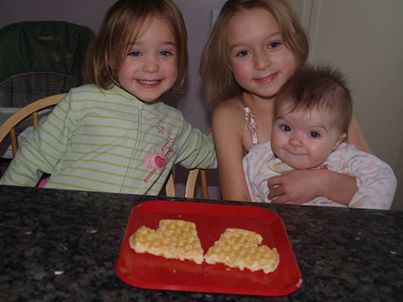
Gianna, Ellie and Mary with a waffleMy daughter, Angela, and her husband, Peter, are home schooling their three daughters, although so far it’s mostly the five year old, Gianna, who is their main focus. Angela has a master’s degree in education;  she knows what she is about.  When Rita and I attempted to home school Angela and her younger sister, Meg, many years ago, far fewer resources and a much smaller support group of like minded parents were available.

Angela belongs to a co-op group of home schoolers which meets weekly; parents take turns putting together classes on reading, writing and ‘rithmetic, as well as science, history and other topics scaled for the younger kids.  Gianna and Ellie (Elena) also are participating in Italian lessons, taught by our mutual friend, Francesca, who is another home schooling mother of three.  Angela studied four years of Italian and visited Italy extensively while studying abroad, so can reinforce the lessons at home.

Francesca taught Italian at the university level and holds advanced degrees in art history from Columbia and Yale.  She is fluent in Italian, the daughter of first generation Italian immigrants and grew up in Queens.  In manner and spirit, Francesca is quintessentially Italian.  We have greatly benefitted from some of her recipes; her cooking is locally legendary.  Once when Rita was unwell, Fran sent over a meal.  With most, a meal sent over to help a sick friend would be a casserole; with Fran, her husband Matthew delivered a five course meal which filled up the back of his station wagon.  She included extra prepped vegetables and a recipe to turn the leftover chicken into a delicious soup.

Gianna came home from her early lessons with perfectly pronounced Italian renditions of her favorite colors.  For me, a Rosetta Stone Italian failure, it was most impressive.  No surprise, a recent lesson turned to food.  The kids glued samples of various pasta varieties to a poster board and learned not just their Italian names, but their descriptive origin and translation.  Vivid pasta names reveal an amusing look into Italy and her people, an earthy candor – a natural humor.

  • Penne — quill or pen.
  • Spaghetti – twine or string.
  • Linguine – little tongues.
  • Vermicelli – worms.
  • Farfalle – butterflies.
  • Occhi di lupo – ribbed wolf eyes.
  • Fusilli – little screws.
  • Orecchiette – little ears.
  • Capellini – thin hair.

Americans may be prickly about tucking into a heaping plate of ears, little tongues, thin hair, worms, butterflies, screws or string, but to the Italian comfortable with coarse reality, such a feast poses no difficulties.  Americans will stick with the mellifluous and mysterious, thanks.  Spoken Italian makes the commonplace sing.

“Italians know about human nature – they understand human nature perhaps better than anyone else does.  They know that people are weak and greedy and lazy and dishonest and they just try to make the best of it; to work around it.” Donna Leon (author of the acclaimed Commissario Guido Brunetti crime novels)

For those who grew up with little exposure to Italians, what comes easily to mind is at best Rocky Balboa, Mussolini’s punctual trains or unstable governments that dissolve every few months and at worst Goodfellows and Don Vito Corleone.  I grew up among a large Italian community replete with barbers, grocers, dentists, doctors and contractors (and married a half Italian beauty).  What comes to mind is effortless laughter and love, quick wit, flashing eyes, effusive, loud communications, food, food, food and warmth – always warmth.   The many Italians I came to know did not suffer fools patiently and gifted their loyalty carefully, but once gifted would sacrifice life, limb, treasure and sweat – unabashed and all-in.

Italian lessons are lasting: Rome, Latin based languages, Leonardo, Dante, Michelangelo, Florence, Venice, the vineyards of Tuscany, Pompeii – surely more than a lifetime of lessons. A personal beloved for me is Italian opera: Puccini, Rossini, Donizetti, and the incomparable Giuseppe Verdi.  Just as “capellini” converts “thin hair” into delectable, so does “Si: corre voce che l’etiope ardisca sfidarci ancora, e del Nilo la valle” transform “Yes, there are rumors that Ethiopia dares to continue to defy our power in the valley of the Nile” into delightful (Verdi’s Aida, first act).

You may prefer “E lucevan le stelle ed olezzava la terra, stridea l’uscio dell’orto e un passo sfiorava la rena” to “The stars were shining, And the earth was scented. The gate of the garden creaked and a footstep grazed the sand.”  From Puccini’s “Tosca” as sung by Luciano Pavarotti.

Italian opera is hyperbole, drama, red emotion, and its American counterpart morphed into both the musical and the soap opera, but there is no inclusive analog.  My favorites are the duets, trios and quartets with the interplay of beautiful voices.  Listen to Joan Sutherland and Pavarotti singing the star crossed, impossible beginning of the love of Alfred for Violetta in Verdi’s “La Traviata” (“The Lost”) (Plot summary here) in “Un di felice” and the inevitable tragic end in  “Parigi o cara”.  If you have little familiarity with Verdi, close your eyes, shut down preconceptions and just listen.

La TraviataAlfredo: Un dì, felice, eterea, Mi balenaste innante, E da quel dì tremante Vissi d’ignoto amor. Di quell’amor ch’è palpito Dell’universo, Dell’universo intero, Misterioso, altero, Croce e delizia cor. Misterioso, Misterioso altero, Croce e delizia al cor.

Alfredo: One day, you, happy, ethereal, appeared in front of me, and ever since,trembling, I lived from unknowed love. That love that’s the pulse of the universe, of the whole universe, Mysterious, proud, torture and delight to the heart. Mysterious, mysterious and proud, torture and delight to the heart.

Violetta: Ah, se ciò è ver, fuggitemi, Solo amistade io v’offro: Amar non so, nè soffro Un così eroico amor. Io sono franca, ingenua; Altra cercar dovete; Non arduo troverete Dimenticarmi allor.

Violetta: Love, I fear, can never be, Friendship is all I can offer. Since love is pain and torment, I avoid that strange emotion. Pleasure is all I ask of life, Freedom and joy forever! So you must soon forget me And find another love.  

*********************************************************************************************************************

Alfredo:  Parigi, o cara, noi lasceremo, la vita uniti trascorreremo. De’ corsi affanni compenso avrai, la tua salute rifiorirà. Sospiro e luce tu mi sarai, tutto il futuro ne arriderà.

Alfredo:  We’ll leave Paris, my dearest, Together we’ll go through life. In reward for your past sorrows, You’ll bloom into health again. Breath of life, sunshine you’ll be to me, All the years to come will smile on us.

Violetta:  Parigi, o caro, noi lasceremo, la vita uniti trascorreremo. De’ corsi affanni compenso avrai, la mia salute rifiorirà. Sospiro e luce tu mi sarai, tutto il futuro ne arriderà.

Violetta: We’ll leave Paris, my dearest, Together we’ll go through life. In reward for your past sorrows, I’ll bloom into health again. Breath of life, sunshine you’ll be to me, All the years to come will smile on us.

Can longing, loss and love be better expressed?

The gift of human voice, music and the creative soul are most profoundly conveyed in these works:  gratuitous beauty fashioned out of our genes, our talents, our dedication and commitment for no other reason than we humans are capable of it.    To this simple soul, such expression of human goodness rivals the genius of St. Thomas Aquinas in his Summa Theologica for sublime proof of the existence of a loving Creator.

“Italians come to ruin most generally in three ways, women, gambling and farming.  My family chose the slowest one.”  Pope John XXIII (Angelo Giuseppe Roncalli), soon to be St. John in April)

3 Comments

Filed under Personal and family life

Ponderings and Conundrums – musings on a cold winter day

“To understand the workings of American politics, you have to understand this fundamental law:  Conservatives think liberals are stupid.  Liberals think conservatives are evil.”  Things That Matter, Charles Krauthammer (reprinted from the Washington Post, July 26, 2002

When we discuss economics, politics or social trends at family gatherings, in the coffee break room or with friends during holiday gatherings, the polarity seems more intense every year, not less.  Talk flows back and forth with hammer blows of conflicting facts and less and less listening from either side.  How do we resolve the seemingly irresolvable?  How do we compromise on issues built on inviolate, but contradictory core values?

The progressive decries the widening gap between the rich and the poor, which is undeniable.  But over nine million formerly well paying industrial blue collar jobs have fled to emerging second and third world countries, and with production goes innovation.  Those nine million jobs have been replaced for the most part by service sector jobs or retail, and rare is the instance that those relatively low skill jobs pay anywhere near as much as a trained machine operator or union car assembler.  The gap grows, but it is facile to make the assumption that the exploitive business owner shoulders all the blame.  We who benefit from lower prices at the cash register vote with our wallets and with the unintended consequence of hurting the highly paid, middle class blue collar worker.

Textile mill of the early twentieth century in New EnglandDemonstrations at Walmart to pay its workers more than the current average $17,500 sound rational on MSNBC.  The underlying economics that drive the decisions by management to set wages are more complicated.  Stocking shelves at Walmart with made in China or Mexico sweaters cannot pay as much as practiced loom operators knitting those sweaters once made in the former textile mills of the Blackstone River Valley in Massachusetts and Rhode Island.  Raising the minimum wage reduces hiring and harms the opportunity of those with few skills entering the workforce, where they will learn how to show up on time, to work diligently and improve their proficiency.

If Walmart decided tomorrow to raise the pay and benefits of all their workers $6,000 per year, it would no longer produce a profit for its owners and would not be viable as an ongoing business, having insufficient resources to compete, replace trucks and pay the light bills.  If they raised their prices to accommodate the higher pay, the customers would soon be over at BJ’s or K-Mart buying their Chinese made sweaters and jeans where shelves are stocked and cash registers staffed with lower paid workers.  Or consumers would buy fewer sweaters because they can’t afford the higher prices.

Raising the minimum wage to a “living wage” is terrific as a campaign slogan, but implementation without repercussions is a tricky business.  NAFTA is a two edged sword.

“Cowboys games at AT&T Stadium can consume up to 10 megawatts of energy, more than is used in three hours by the 3.7 million residents of Liberia.” Kevin Kerr, Sports Illustrated 12/30

American “exceptionalism” is a commendable slogan and core belief as well, but can our citizens reasonably expect that having 4.5% of the world’s population and consuming one-third of the world’s paper, a quarter of the world’s oil, 23 percent of the coal, 27 percent of the aluminum, and 19 percent of the copper is sustainable in a global economy with the other 95.5% wanting their fair share of resources?  Do we believe it is prudent governance to hinder development of domestic sources of oil through fracking while continuing dependence for oil on those who hate us?  Does it make sense to hinder a pipeline from our closest neighbor and ally, which own of the third largest reservoir of oil reserves in the world?  Do we really believe this will prevent Canada from selling this oil?  The oil will be sold, and likely to those who burn it far less efficiently and cleanly than our more closely regulated industries and vehicles.  Does this truly advance the cause of fewer hydrocarbons poisoning the atmosphere?

“I have seen great intolerance shown in support of tolerance.” Samuel Taylor Coleridge

Under the flag of “diversity,” the personal freedom in Western culture and in the United States has been under attack for nearly fifty years:  especially the freedom to live out religious beliefs that do no harm.  Jack Phillips, a baker in Colorado, politely declined the business of a same-sex couple who wanted to buy a wedding cake.  The Left espouses diversity of belief and practice except when it comes to anyone who disagrees with the tenets of their own secular faith.  Rather than simply going to another baker (of whom there are many), the couple sued Mr. Phillips and received a court judgment.  He was fined.  If he refuses to pay the fine or bake a cake, he can be sent to jail.   This is not discrimination in the workplace or hiring practices or bullying or any of the other injustices that have been redressed in the courts.  Jack Phillips chose not to participate by baking a cake and was punished by the court.  How soon will churches be forced to perform marriages that violate their core beliefs?  Will those churches have to get out of the civil marriage business, as the Catholic Church was forced out of the adoption business, closing down the largest adoption provider in the country?

The American Civil Liberties Union recently sued a Catholic hospital to force it to perform abortions.  The Left for years had a mantra stating that, “If you don’t like abortion, don’t have one.”  Apparently that doesn’t hold true if a hospital chooses not to perform one.

“I’ve always felt that a person’s intelligence is directly reflected by the number of conflicting points of view he can entertain simultaneously on the same topic.” Abigail Adams

Mrs. Adams was a superb communicator married to a superb communicator.  Their letters to one another are a priceless legacy.  She was also a lot smarter than most, including most especially me.  I have a difficult time, as do many, trying to “entertain simultaneously conflicting points of view.” – More than ever when those points of view are almost fundamentally irreconcilable.  Compromise may not be possible.  e.g.  How do we reconcile an issue when one group sees only “women’s reproductive rights” (who can oppose someone’s constitutional rights?), and the opposition sees murdered babies who merited protection and nurture?   A Solomonic solution is not possible.

How do we reconcile political viewpoints when the Attorney General lets slide Black Panthers caught on video tape intimidating voters at polling places, and then goes hard after the Little Sisters of the Poor for upholding their rights of personal conscience against the Obamacare monolith mandating abortifacient drug coverage?  How do we find compromise when one side is convinced the opposition is naïve and a little stupid, and the other side sees their opponents as evil incarnate?  How do we reconcile opposing views in which one side perceives exponentially expanding government both in size and scope as a grave danger and the other envisions it as the road to Utopia? There remains little common ground upon which to stand.

This post started with a Charles Krauthammer quote, and it will end in one from a 2012 Washington Post column reprinted in “Things That Matter.”  Read the book.

“(President Obama and progressives are) equating society with government, the collectivity with the state.  Of course we are shaped by our milieu.  But the most important influence on the individual is not government.  It is civil society, those elements of the collectivity that lie outside government:   family, neighborhood, church, Rotary club, PTA, the voluntary associations that Tocqueville understood to be the genius of America and source of its energy and freedom.

Moreover, the greatest threat to a robust, autonomous civil society is the ever-growing Leviathan state and those like Obama who see it as the ultimate expression of the collective.”

20 Comments

Filed under Culture views, Politics and government

Off the Rails

“The only way to be sure of catching a train is to miss the one before it.”  G.K. Chesterton

train tracksThroughout my nearly forty years in the lumber business, I have taken on many responsibilities from time to time.  One of the sidebars that intrigued me was my industry’s sometimes shaky marriage with railroads.  Demurrage charges accrue when the local railroad sets a car of freight on our siding to be unloaded, and the receiving yard takes too long to unload the product and release the car back for pickup.  Demurrage fines can be dear, railroads are enthusiastic to assess them, and the owners of lumber companies hold managers accountable for expediting unloading to avoid them.

Western fir plywood is still a frequent rail traveler, although in times past before manufactured engineered wood products came to the fore, Canadian or West Coast Douglas Fir timbers rode the rails and landed in one yard or another every day.  Now like most things, the set and release are done on line, but I remember often calling a bored dispatcher in some remote dingy railroad office to let them know to pick up their empty.  We kept a careful log in a three ring binder tracking car numbers, dates in and out, product and related purchase orders to the mills to document not infrequent disputes over charges — especially during the reign of the late, unlamented federally run Conrail.

“If you board the wrong train, it is no use running along the corridor in the other direction.”  Dietrich Bonhoeffer (Lutheran theologian and member of German Resistance, murdered by the Nazis)

When diesel was cheap in the seventies, many small railroads lost a lot of business to more flexible trucking companies.  In bankruptcy or near bankruptcy, some of the well connected owners of these railroads lobbied the government hard to bail them out, which, of course, it did, nationalizing the operations of poetically nostalgic names like Erie Lackawanna and Lehigh & Hudson River.  $7.65 billion later and losing nearly a million dollars a day, it was privatized by President Reagan and sold to Norfolk Southern and CSX.  Both companies to this day are chugging along with multibillion dollar annual profits.  Shares for both are trading near their all time highs.

The complexities undergirding their success are beyond the scope of a blog post, the obvious point is that private business out performs the bureaucratic, cholesterol clogged arteries of government run enterprises.  Profit, necessary cost efficiencies and the capital magnet of profitable companies drive success.  Self perpetuating bureaucracy, less than accountable cost structures and the ability to either print or borrow unlimited funds drive more Kafkaesque fiefdoms.

As the rollout of Obamacare continues to make bad news, we are reminded of other train wrecks of Federal programs.  We have yet to see the “rest of the story” when the mandate for small businesses is finally allowed to kick in.  The administration illegally breaks off pieces of the unmanageable bill and postpones other parts time and again to time the next disaster until after the election cycle.  But I suppose pain delayed and deferred is better than immediate suffering.

“Neither a wise man nor a brave man lies down on the tracks of history to wait for the train of the future to run him over.”  Dwight D. Eisenhower

What has me worried next is the nationalization of medical records set for October go live, part of the Patient Protection and Affordable Care Act (the irony in the bill’s name is beyond imagination).  The story this week of Target’s insecure records that resulted in somewhere between 70 and 110 million customers gives us pause.  Credit card numbers, PIN authorization codes, names, addresses and even email addresses were hacked.  Presumably Target has the most up to date security for these records available, but…..

Another story this week told of the vulnerability of offsite access to databases through Virtual Private Networks.  In recent weeks we’ve read of NASDAQ and Snapchat being hacked.  None of these companies lack Information Technology sophistication or concern for the privacy of their records.  Target is thought to be an inside job.  As Edward Snowden showed with his million plus record theft of our country’s deepest secrets, all it takes is one person with an agenda and a grudge.

Do we think that every county hospital and doctor’s office with access to a national database will have the security and IT capability of NASDAQ or Target?  The national database of medical records will tell who has AIDS, who has been treated for STDs, who has struggled with depression or bulimia or had an abortion or breast enhancing surgery, which job applicant has an expensive history of drug use or cardiac problems, members social security numbers – all of it will be there.  The intention to make more accessible and easily transferable all of our health records may or may not be benign to our brave new world, but it will undoubtedly leave us vulnerable.

“Concentrated power is not rendered harmless by the good intentions of those who create it.” Milton Friedman (Nobel Memorial Prize winning economist)

This week we are told that the administration finally chose not to renew the contract to the Canadian company, CGI Group, which was hired to oversee key aspects of the egregious healthcare.gov rollout.  Nobody got fired, including the inept Secretary of HHS, Kathleen Sibelius. Hundreds of millions were spent with CGI, who’s Executive Vice President, Tony Townes-Whitley, went to Princeton with Michelle Obama, belonged to the Princeton Black Alumni association with her and donated to the Obama campaign – a fortuitous coincidence no doubt.  Now after one of the most visible IT debacles in history, they don’t get their contract renewed.  No penalties, no claw back, no anything.

The House of Representatives on Friday passed the Health Exchange Security and Transparency Act with all Republicans and 67 Democrats.  The bill would require the health exchanges to notify victims of identity or information theft within the exchanges.  The administration lobbied Democrats hard to vote against it.  The self proclaimed most transparent administration in U.S. history opposes the Security and Transparency bill and threatens to veto it if enough Democrats in the Senate are persuaded by their nervous constituents to join their House colleagues.

As dear Alice wondered after going down the rabbit hole, it gets curiouser and curiouser!

 “This train don’t carry no con men, this train;

This train don’t carry no con men, this train;

This train don’t carry no con men,

No wheeler dealers, here and gone men,

This train don’t carry no con men, this train.”  This Train is Bound For Glory, Woody Guthrie

Leave a comment

Filed under Politics and government