Author Archives: jparquette

jparquette's avatar

About jparquette

Fortunate and blessed in companionship with my wife of fifty seven years, in health and in modest, but more than adequate circumstances. Life is good.

Maggie (Part 2)

What is crooked cannot be made straight, and what is missing cannot be supplied.  Ecclesiastes 1:15

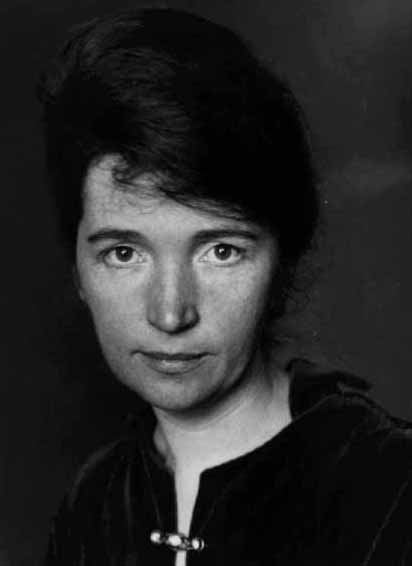
The prior post on Margaret Sanger explored briefly some of the events and people that helped form her world view and fuel her frenetic efforts to fill the hole in her soul.  Three themes emerged as she came to maturity, and they informed and drove her behavior, writings and passions: unquenchable desires for sexual experience of all kinds and obsession to sever natural human fertility from sexual activity were two. The third was eugenics – promoting the concept that elite illuminati should determine who lives and who doesn’t, who breeds and who doesn’t.

Under threat of arrest in New York for flaunting the law while catechizing a gospel of crude birth control, she fled for a while to Great Britain.  This sojourn congealed her radicalism.  Freed from “the smothering restrictions of marital fidelity,” her unleashed promiscuity took to her bed some of the luminaries of the socialist intelligentsia there, including (among quite a few others) George Bernard Shaw, Havelock Ellis and H.G. Wells.  She advocated ever more stridently that we must strive to disassociate human sexuality from the natural benefits of human bonding, intimacy and parenthood.

Her connections with Ellis and Shaw deepened her commitment to the eugenics movement, and their money funded her American Birth Control League and its propaganda instrument, the Birth Control Review.  One of the articles in the 1920 editions was a favorable review of Lothrop Stoddard’s Fascist book, The Rising Tide of Color Against White World Supremacy.  Three years later a Review editorial advocated restricting immigration based on race.  In 1932 Margaret penned for the Review her “Plan for Peace,” which endorsed coerced sterilizations, mandatory segregation and “rehabilitative” concentration camps for all “dysgenic stocks,” including the handicapped, ethnic minorities and the mentally “defective.”  She routinely inveighed against the “inferior races” that were “human weeds,” a “menace to civilization”; she insisted the “sinister forces of the hordes of irresponsibility and imbecility” be controlled.

birth control revew banner (2)In 1933 the Review published “Eugenic Sterilization: An Urgent Need” by Margaret’s close friend, Ernst Rudin.  Rudin was at the time Adolf Hitler’s director of genetic sterilization, having been one of the founders of the Nazi Society for Racial Hygiene.  Later in 1933, she ran a piece by Leon Whitney, “Selective Sterilization,” which lauded the Nazi pre-holocaust race purification programs.  Margaret’s birth control advocacy was inextricable from her desire to maintain the purity of the human race with her and those most like her as the select survivors.  Like her fellow true believers in the Ku Klux Klan, the Nazis and the Eugenics Society, for Margaret, pulling the weeds in the human garden took the highest priority.

In 1939, Margaret devised the “Negro Project” at the request of “southern state public health officials” in which she stated that the “mass of Negroes ….particularly in the South, still breed carelessly and disastrously, with the result that the increase among Negroes, even more than among whites, is from that portion of the population least intelligent and fit.”  Her plan foreshadowed the goings-on of her current organization.  She suggested that they start with three or four “colored ministers preferably with social service backgrounds, and engaging personalities” to propagandize for birth control.  Her longer quote is enlightening.  “The most successful educational approach to the Negro is through a religious appeal.  We do not want word to go out that we want to exterminate the Negro population and the minister is the man who can straighten out that idea if it ever occurs to any of their more rebellious members.”   Margaret was a militant atheist, but not above manipulating the unsuspecting through their faith.

Nazi atrocities put a knot in Margaret’s plans as the world first recoiled in horror and then destroyed the Third Reich.  The inconvenience of bad public relations for its support of the Nazi agenda made the American Birth Control League and Birth Control Journal untenable as an ongoing enterprise.

What has been will be again, what has been done will be done again; there is nothing new under the sun.  Ecclesiastes 1:9

Margaret, undeterred, started up its successor, Planned Parenthood and the Planned Parenthood Review.  Planned Parenthood has expended great efforts to sanitize the beliefs of their founder, indeed portraying her as a modern day saint who pioneered freedom for women and a savior of their health.  True to course, however, their activities uphold her dreams.  The early offices of the international Planned Parenthood organization were in the offices of the Eugenics Society. Seventy percent of their “woman’s health clinics” are located in poor and minority neighborhoods.  While black Americans comprise 12.6% of the total population, 35.4% of abortions are inflicted on black babies.   For every 1,000 live births, there are 138 abortions in the white population; for black children the rate is 501 dead for every 1,000 born.   Planned Parenthood is self adulatory about their efforts on behalf of feminine health, but they do no mammograms – for those they refer their clients to others.  They say they do them, but they don’t.  What they don’t refer are the big profit items – over 300,000 abortions a year, which bring the “health organization” almost a third of its nearly billion dollar annual income.  The larger PP clinics have assigned abortion “quotas.”[1]

Abortion and racism are evil twins, born of the same lie.  Where racism now hides its face in public, abortion is accomplishing the goals of which racism only once dreamed.  Together, abortionists are destroying humanity at large and the black community in particular.  Alveda King

The Reverend Alveda King (daughter of civil rights leader, the Reverend A.D. King and niece of Martin Luther King) is an outspoken critic of Planned Parenthood.  Based in Atlanta, she speaks of a black genocide at many events throughout the country preaching in the familiar powerful cadences reminiscent of her family.  “Abortion and racism are both symptoms of a fundamental human error.  The error is thinking that when someone stands in the way of our wants, we can justify getting that person out of our lives.  Abortion and racism stem from the same poisonous root, selfishness.”  She was seventeen when her beloved uncle was murdered by James Earl Ray, but she remembers him and their conversations well.  She told us at lunch one day in Providence when she came to speak that while her uncle was killed five years before Roe v Wade struck down all the state laws in the country restricting abortion, he would have been sickened at the targeting of black babies by a white elite.  “A majority, perhaps as many as 75%, of abortion clinics are in areas with high minority populations.  Abortion apologists will say this is because they want to serve the poor.  You don’t serve the poor, however, by taking their money to terminate their children.”

Can foul seed ever blossom into anything but poison fruit?  Margaret Sanger lived until 1966, just short of the “summer of love” in San Francisco in 1967 where her other dreams came to sad, drugged out reality.  The Birth Control League fades into the dim past.  Maggie was praised by presidents and emperors, movie stars and scientists.  Still is.  Her early life and the foundations of her beliefs and work are forgotten or papered over.  Her dream and her organization persist with massive government, taxpayer paid support.  Planned Parenthood’s lobbying and contributions to liberal candidates are among the most aggressive in the country.  Kurt Vonnegut in Slaughter House-Five was perfect:  “And so it goes.”

For in much wisdom there is much sorrow, and he who stores up knowledge stores up grief. Ecclesiastes 1:18


[1]unplanned”, Abby Johnson, former director of a PP clinic.

6 Comments

Filed under Background Perspective, Culture views

Maggie (Part 1)

“I wheedle, I chip away, I argue, I reason, I cajole, I hope. But I do not expect.”  A Delicate Truth, John le Carre

Young Maggie

Young Maggie

In 1879 she was born into hardscrabble Irish immigrant poverty in upstate New York, the sixth of eleven children, as Margaret Higgins.  Her father was an emotionally scarred veteran of the Sherman’s Union Army that left scorched earth and blood from Tennessee to Atlanta.  He treated his wife and daughters as virtual slaves.  Her mother, Anne Purcell, was frail and suffered from tuberculosis, but dedicated to her alcoholic tombstone carver husband.  The family suffered grievous poverty with its inherent gnawing hunger and relentless cold.  Later in her life, she described her youth as “joyless and filled with drudgery and fear.”  Margaret had a terribly difficult start and overcame much to found an organization that today exceeds one billion dollars in annual revenue and exerts great influence over the very center of power in America through a well funded lobbying and public relations machine.

Even though baptized secretly by her mother, her harsh and erratic father’s unrelieved cynicism about all things religious led her into a bitter hatred of the Catholic Church after her mother’s death when Margaret was seventeen.  Her early attempts at making her own way were fitful failures. Finally escaping her father’s control, she went to Claverack College, a small, inexpensive co-educational boarding high school.  There she first experienced unrestricted freedom, and as many have before and since, fell into radical politics, feminism and promiscuity.  After running out of money and with failing grades, she left school, returning home just long enough to plan her final escape.  She began a brief sojourn as a teacher of new immigrants, which she quickly gave up – not really liking her students much.  She next worked as a nurse trainee in a small hospital.  Although later cited in her “Autobiography” as extensive health care professional experience, this proved another of her fantasies: she mostly ran errands, changed bedding and emptied bed pans.  Her early wild freedom, however, forever influenced her future.

Things finally started looking up for Margaret when she married Will, who while not rich, was a young, upcoming architect and financially secure.  At first she enjoyed the fruits of marrying into money by lavish spending and a fine apartment on the Upper East Side of Manhattan.  Will’s career flourished working on projects like Grand Central Station and the Woolworth Building.  Three children later, he still struggled to keep her restless sprit satiated.  To placate her, Will bought a substantial Long Island estate, but after a decade of this, Margaret longed once more for the energy and freedom of the city.  They sold the estate and moved back to Manhattan.

Affluent Will rekindled his college fascination with radical politics and began attending Socialist, Communist and Anarchist meetings in Greenwich Village – not a great deal more mature in this regard from his days of adolescent fascination with utopian idealism.  Margaret thought the fellow travelers boorish, but would tag along to meetings occasionally and continued her fidgety search for fulfillment in shopping, dining, theatre and New York society.  All this changed when she met and became close friends with the renowned and charismatic John Reed, later the famed propagandist for the Bolshevik factions in Soviet Russia and buried as a hero in the walls of the Kremlin.  She became completely immersed with all the enthusiasm of a recent convert, spending her time with Reed, Eugene Debs, Will Durant, Clarence Darrow and Upton Sinclair.  As never before, she became a voracious reader, gulping down radical books and tracts.

 Margaret fled from her former bourgeoisie entertainments as from a leaky ship and espoused with passion a Bohemian lifestyle.  She threw herself into left wing politics, speaking and campaigning for the Socialist Party and Eugene Debs.  When she became enthralled with the radical utopian feminist, Emma Goldman, Will started back peddling.  At first he had encouraged her interest in something other than entertainments, self indulgence and parties, but Goldman was a step too far.  Margaret had virtually abandoned her family, spending less and less time with Will and leaving the children with friends, relatives and strangers.  As one contemporary wrote to a friend, “She became a raging river overflowing the banks of conventionality and propriety.”

Over the next years, her early wildness reemerged under the tutelage of Emma Goldman.  She devoted the rest of her life to three causes, which were related.  She wrote and advocated with skill and passion, becoming a heroine in all three movements to this day.  The first eventually brought a close to her troubled marriage.  The preaching and the practice of “free love” (there’s an oxymoron for you) was finally too much for Will. He had moved the family to Paris to try and distance them from Margaret’s obsessions and friends, but she abandoned him there to move back to New York.  Her compulsion for sexual expression of all varieties and her public advocacy for it as a solution to all manner of human unhappiness became the focus of her lifelong search for meaning.  Margaret began her experimentation with and championing of birth control.  Her early recommendations were, to put it mildly, eccentric.  Among them were Lysol douches.

“The most merciful thing that a large family does to one of its infant members is to kill it.” (Margaret Sanger – Women and the New Race, Eugenics Pub. Co.,1920)

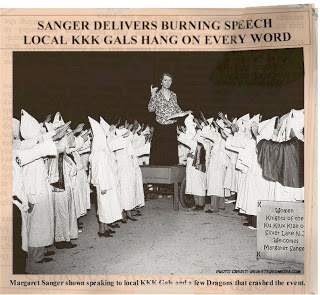
A guest speaker for the boys in the sheets

A guest speaker for the girls in the sheets

She went on to found what was to become the largest provider of abortions in the world – over 300,000 a year in the United States.  The third great passion after promiscuity and population control was the related movement of eugenics – the culling out or limiting the reproduction of inferior races and individuals.  Her foundational work in the worldwide eugenics movement was highly regarded, especially her writings on the “genetic inferiority” of the black race, the enfeebled and the mentally challenged.  She had a solution for them, which was especially well received among the women of the Ku Klux Klan.

Margaret Sanger advocated “to give certain dysgenic groups in our population their choice of segregation [concentration camps] or sterilization.” (“A Plan For Peace,” Birth Control Review, a journal Sanger edited)

There is far too much for one entry – more to follow next post.  Please come back.

Footnote:  A group of high school basketball players in Texas had a different solution for the mentally handicapped than Maggie did.  It’s worth a few minutes of your time.  Love and dignity.

2 Comments

Filed under Background Perspective, Culture views

Zeitgeist

No posts in far too long.  For the last couple of weeks, the metaphysical relationship between the Kermit Gosnell trial in Philadelphia and the terrorist attacks in Boston struck me.  As I was struggling to excavate the time to explore this for the blog, I opened this week’s edition of our statewide Catholic newspaper, the “Rhode Island Catholic”. On the Commentary page was a piece by my friend Barth Bracy that made the connection far better than I could have.  Barth is a deacon who worked and studied many years in Manilla.  He currently holds my wife Rita’s old job – Executive Director of Rhode Island Right to Life.  At the risk of embarrassing Barth, when someone refers to “the smartest guy in the room”, it’s usually Barth.

If you have not had the time to pay attention to the Gosnell atrocities, the mainstream media ignored (some say suppressed) it until the clamor forced them to cover the story; here is a link to a CNN feature posted on the 3801Lancaster site.  Not for the weak stomached.  We can speculate on the degree to which one has to sear their conscience to fill pressure cookers with black powder and ball bearings and explode them among hundreds of innocents.  The conscience of a doctor who is on trial for murdering four infants by severing their spinal cords with scissors is beyond the imagination of anyone but a sociopath.   I’ll leave the rest to Barth – this week’s guest writer.

“No more hurting people”

Barth BracyWho can escape the atrocities reported with increasing frequency from every part of the globe, and now even upon our very doorstep with the recent horrors in Newtown and in Boston?

From the time of Cain to this very day, each human being and human society is presented a challenge. Their response (our response) leaves a defining mark upon them (upon us).

 Does human life have intrinsic value and inherent dignity such that innocent human life should be protected and must never be deliberately taken?

The extent to which peoples and nations have answered “yes” to this question has been the extent to which those same peoples and nations have been marked by peace and justice, offering their citizens the opportunity for dignified and fulfilling lives.

Conversely, peoples and nations that have answered “no” to this question, choosing to disregard the unalienable right to life of each human being, have been marked by a descent into depravity, barbarity, and crimes against innocent human life; the kinds of unspeakable acts witnessed so frequently today, whether in Sandy Hook, or at the Boston Marathon, or in Kermit Gosnell’s abortion mill in Philadelphia, or in the government-sanctioned starvations of Terri Schiavo and, here in Rhode Island, Marcia Gray.

It is not possible to separate the prevailing chaos and senseless acts of mass violence from the disordered and murderous acts protected by the “right to privacy” concocted by a court system blind to the most fundamental principles of justice.

When Jesus spoke of the reality of hell in the Gospels of Matthew, Mark, and Luke, He spoke of Gehenna. What was Gehenna that makes it the most concrete image of hell?  Gehenna was a valley a little to the south and west of Jerusalem where the Canaanites, who were expelled by Israel from the Promised Land, as well as the apostate Jews who adopted the evil ways of the Canaanites, would go to sacrifice their very own children at the altars of false gods.

When Jesus spoke of of hell, He spoke of a place where parents sacrifice their own children… He spoke of what our world has become through the scourge of legal abortion.

The inescapable fact of the matter is that when the world embraces a perverse notion of freedom, an autonomy unfettered by the duty to respect the fundamental right to life with which each human being has been endowed by their Creator, that murderous world marks itself, fashioning itself into a living hell.

Yet even in the midst of the hell we have fashioned, God ever beckons: “I have set before you both life and death, the blessing and the curse: choose life, therefore, that you and your descendants may live.” (Deut. 30:19) Isn’t this the meaning of little Martin Richard’s sign: “No more hurting people.”

Leave a comment

Filed under Culture views

Lent

“It was the epoch of belief, it was the epoch of incredulity, it was the season of Light, it was the season of Darkness, it was the spring of hope, it was the winter of despair.”  A Tale of Two Cities, Charles Dickens

I have had a long fascination with the origin of words.  Lent derives from the old German or Teutonic root word meaning “spring” or a “lengthening of days.”  As such, Ash Wednesday promises the coming of the annual warming and greening with longer days and shorter nights.  I love Ash Wednesday and look forward to it each year.  For the non Catholic, this may strike some as odd, but I love Lent, and not just for its indication of sunnier afternoons, but for its call to deeper human wholeness.

“Oh God, you are my God, for you I long; for you my soul is thirsting….like a dry, weary land without water.”  Palm 63

As well as the clear reminder of our mortality with “from dust you came and to dust you shall return” as the priest imparts the ashes in a sign of Christ’s cross on our foreheads, during Lent we are encouraged to deeper prayer, penitential fasting and openhanded charity.  Part and parcel to our Lenten prayer also is a rigorously honest personal moral inventory.  The word “ἁμαρτία” (“hamartia”) from the original Greek New Testament is typically translated into English as “sin.”  Hamartia literally means “misses the mark.”  Lenten meditation asks of us an examination of conscience, not to establish guilt, but to sharpen our aim.

We all miss the mark, but the serenity and clarity attained from finding some time each day for silent reflection and honest self assessment has no analog in the exactingly physical existence in which we spend most of our waking hours.

“We must maintain great stillness of mind even in the midst of our struggles… A tranquil sea allows the fisherman to gaze right to its depths.  No fish can hide there and escape his sight.  The stormy sea, however, becomes murky when it is agitated by the winds.  The very depths that it revealed in its placidness, the sea now hides.  The skills of the fisherman are useless.” Diadochus, Bishop of Photice

Another type of Lent encompasses the whole Church, and instead of forty days, it may not be fully understood for forty more years — or even forty decades.  The retirement of Benedict XVI makes us mindful of the crucial drama being played out in our lifetimes page by page for Catholicism, perhaps for all Christendom – a drama the denouement of which we likely will not live to see. The Second Vatican Council was called by Pope John XXIII in 1962 and closed under Paul VI in 1965.  Four men who attended the opening session and participated in writing the resulting documents were chosen as the next four popes to lead the Church in the intervening sixty years: Giovanni Montini (Paul VI), Albino Luciani (John Paul I), Karol Wojtlya (John Paul II) and Joseph Ratzinger (Benedict XVI, the 265th Pope including the first, Peter the Apostle). The selection of the next Pope will indicate how resolute the Church remains in her commitment to fidelity to first principles and beliefs.

While attempting to “open the windows” to modernity and the cultural tsunami of the last century, the crisis of scandal within the Church grew to a great degree through confusion regarding the interpretation of Vatican II documents: the so named “spirit of Vatican II”.  What was misunderstood about the council writings became even more murky when dissidents and outside influences critical of (and often antagonistic towards) the Church stirred up the waters disputing issues involving celibacy , married priests, priest’s gender, homosexual marriage,  teaching authority of bishops, “liberation” theology, armed rebel priests and almost any other conjuring that could be contrived.  Volumes have been written on each of these issues, and both my skills and the scope of a blog will not attempt to write of them.  Suffice it to say that it is still an open question as to how or if we will reconcile “Catholic lite” with its stepchild “Cafeteria Catholicism” and fidelity to orthodoxy.

The point here is that one of the consequences of this confusion evolved a pervasive homosexual culture in some seminaries in the late sixties and seventies leading to a betrayal of trust with the “pedophilia” crisis within the priesthood in the seventies and eighties that was exposed in the early years of the last decade.  Actual pedophilia (a pathological sexual attraction to children under 13) was rare within the priesthood and within the culture. Ninety percent or more of the molestation offenses involved teenage boys, not seven year olds, an under reported truth regarding these events, not that this mitigates the sin of the perpetrators and the incompetence or malfeasance of the bishops who failed to curb it.  One of the saddest aspects of this scandal is the salacious jokes and depiction of all priests — including some of the finest men I have ever known, as similarly disposed – a tragic lie of epic proportions.

The collapse of these men was not caused by their vows of celibacy – that rationale is a fabrication of dissidents and media with an agenda.  The breakdown resulted from a violation of their vows. Betrayal of vows is not a new phenomenon; all four Gospels record the first defection of a priest and bishop, Judas Iscariot.  Nothing is accidentally incorporated into the scriptures, so it is relevant to all times.  Indeed the whole history of Christianity is a cycle of fidelity, betrayal, reform and fidelity to start anew.  We are not to lose heart, but we are to look at these events in the harsh light of day.

“They strayed, as faithless as their fathers, like a bow on which the archer cannot count.” Psalm 78

The confusion rippling through the last sixty years has attended the years following all the councils called to navigate changes in the Church or in the world.  There have been only twenty one such councils in the twenty one century long history of the Church.  Some like the Fifth Lateran Council of 1512-1517 were too timid and shallow, having no lasting effect and leading directly to the great schisms and upheaval of the Protestant Rebellions with bloodshed, hatred and bitterness – none of which in my experience have anything to do with God.  Occasionally, a council like Trent (1545-1563) takes place with long reaching positive consequences for centuries.   The mark of all long lasting reform is fidelity to “first things”, to ageless truths and fearlessness in implementation of their findings. 

Since the Church consists of imperfect human beings, many periods of infidelity and disgrace have occurred throughout the long centuries of Church history, which have always been followed by renewal and recommitment with reformers as diverse as Francis of Assisi and Catherine of Sienna.  A further sign of all renewal is that light is shed on darkness, the excising of the evil.  In the past, those engaged in scandal and sinful behavior were exposed, taken out of ministry and punished during any rekindling of the faith, whether the offense was sexual, abuse of power or financial.  That this cleansing is happening is a sign of expectant healing, not one of despair.

Recalling these seminaries to fidelity (or closing them) and culling the predators and those who were so woefully derelict in their solemn trust to protect the innocent began in earnest during the later years of John Paul II and continued through Benedict XVI.  More is to be done.  For those of us who remain, our hope and prayer is we live in the beginning of a true renewal. Today we are seeing a resurgence of strong, faithful, intelligent and committed young priests coming into some of our parishes.  Spirited (and Spirit filled) revival and strong growth is taking place in Africa and the Pacific Islands.  Those remaining in our churches, at least those that are alive and pulsing with life, are younger, full of love for each other and for the Church – a Gideon’s Army of rebirth.  These are signs of great hope for Catholics everywhere.

“There are those who despair of finding any meaning in life:  they commend the boldness of those who deny all significance to human existence in itself, and seek to impose a total meaning on it only from within themselves.

But in the face of the way in which the world is developing today there is an ever increasing number of people who are asking the most fundamental questions. Or are seeing them with a keener awareness:  What is man?  What is the meaning of pain, of evil, of death, which still persist in spite of such great progress?  What is the use of those successes, achieved at such a cost?  What can man contribute to society?  What will come after this life on earth?”  

From the pastoral constitution on the Church in the modern world of the Second Vatican Council

Leave a comment

Filed under Culture views

Pet Tails

We are pet-less, now, if you don’t count grandchildren, but in the past a small menagerie of somewhat domesticated fauna has graced our path.  Mostly cats and dogs, but occasional hamsters, rabbits, laying hens and completely useless goldfish have come and gone.  By gone, with the goldfish, I am referring to their final resting place, which usually requires just one flush.  Cats and dogs are more complicated.

“Cats don’t like change without their consent.”  Roger Caras

First there were Sam and Harry, who had to be jettisoned to other family members when we moved.  Another half dozen or more cats have drifted in and out of our lives, the last being my favorite, Mama Cat, who died in the bushes out back (as cats are wont to do) after just over twenty years with us.  She used to sleep on top of Meg’s head when she lived here.  Meg attributes that resting spot to affection; I would tease her that Mama Cat liked to be warm, and the crown of her head was an efficient source of heat.  Since our cats were always outside as well as inside cats, every once in a while, Meg, especially, would wake up with flea bites – the price of feline fondness.

Typical for their species, our cats were languid, detached and generally disinterested in pleasing humans —  as happy on a sunny window sill as curled on someone’s lap.   On their whim (not yours) they would purr, rub up against a leg or jump on the table for attention.  Most of the time, however, they were content to pursue their own interests, actually more than content.  Obsessed is more like it.  Several were superlative hunters and would leave gifts of mouse parts or half birds on our front steps.  Big Billy (he of the big body and small brain) was fixated on killing telephone cords.  He also would wage fierce battle for five minutes at a time with his doppelganger up on his hind legs in the floor to ceiling mirror in front of the girl’s ballet exercise bar. He was indifferent to the ridicule of humans.  Billy’s greatest triumph came when the neighbor’s scruffy mongrel chased him under the yews out front; after a terrible yelp, the mutt emerged with a badly bloodied nose and cured of cat chasing.

“If a dog jumps into your lap, it is because he is fond of you; but if a cat does the same thing, it is because your lap is warmer.”  Alfred North Whitehead

Basset houndDogs are a different tale.  Their pleasure was in pleasing and their passion in protective loyalty – except for Frankie, our basset hound, who danced to a different drummer.  A friend found Frankie at around three months old half starved in the foothills outside of Boulder.  Dave and Yvonne had an enormous Weimaraner and a small apartment; a second pooch was not an option, so we were gifted with him.  He was beautiful in a way only funny looking dogs can be.  He had two speeds: absolute rest approaching coma and full throttle.

Back in Massachusetts, I worked awhile as a reporter in the evening covering local boards and politics.  During the day, I would sometimes take Frankie for a run in the nearby forest because beyond all else (except supper meat stolen from our table) he liked to hunt on a scent.  I would wait until he went off after a rabbit or squirrel, then I’d run and hide while he was distracted.  If observed by a rational person, my sanity would have been questioned.  Splashing up streams to lose him, sometimes I would climb a tall, straight tree and jump to another and yet another, so my descent would not land me in the spot from which I ascended.  Eventually Frankie would tire of rabbit and come looking for me. My predilection was to hide in a bush near a clearing where I could observe him.  When he ran out of trail at the base of one tree, he would expand his search in a widening spiral until he again picked up my scent.   As he neared my hiding spot, I would break from the bushes in a dead sprint; Frankie would lift his voice in a full throated howl and run me down.  We’d laugh (or so I imagined he was laughing, too) and wrestle, rolling in the pine needles.

“The great pleasure of a dog is that you may make a fool of yourself with him and not only will he not scold you, but he will make a fool of himself too.”  Samuel Butler

Our second favorite dog was a German Shepherd/Siberian Husky mix, a gift from a couple we knew on Cape Cod, when we lived on Mashnee Island.  Nikki resembled a wolf and was always an outdoor dog, even in the harshest of Maine winters.  She would pace and pant in our house until we put her outside on her long run.  I built for her an insulated lean-to shelter against the lee side of our woodshed, but she preferred to sleep in the snow.  She too had strong hunting instincts and loved to run in the woods. I frequently would go for a two mile run with her loping easily alongside.  In the winter she would tear across the large field adjacent to our house kicking up a ten foot high wake of loose powdered snow.  We were working to expand the woodshed one fall afternoon, when Nikki spotted a large wood rat.  She trapped it under a loose 12” rough board that was lying haphazardly over a small hole.  Bounding back and forth from side to side of the board as the rat attempted one escape after another, she was a picture of silent, deadly focus.  Finally in seeming desperation, the rat fled towards the woods and got five feet before Nikki broke its spine with one clamp of her jaws and a quick backward snap.  Talking her out of her supper was a challenge.

Once after she broke off her run, which was 70’ long and constructed of heavy wire and a chain leash, I called for her at least an hour before she returned with bloody muzzle.  I was afraid she had been hit by a car at first, but found her uninjured.  A few minutes later, my neighbor down on the Vienna Road (pronounced “Vy-anna Rud”), “Juny” Hall (short for Junior) knocked on my door to let me know that he was one sheep short, and I owed him some money.  As gentle as she was with our children, prey was entirely of another order.

“We’ve begun to long for the pitter-patter of little feet – so we bought a dog.  Well, it’s cheaper, and you get more feet.”  Rita Rudner

I sometimes think of the current societal oddness about animals.  P.D. James, the British author of the well known Adam Dalgliesh poet/detective mysteries, wrote in 1992 a dystopia novel about a future culture dying with terminal infertility.  Couples without the ability to have children resorted to dressing up and pushing cats and small dogs around in prams.   As I meet the many young couples in our neighborhood taking their twice daily constitutionals, baggies in hand, I listen to them fawn over their pet’s eccentricities as most once spoke about their children.  When they tell me about spending thousands of dollars on cancer surgeries for twelve year old dogs, my obviously unenlightened sensibilities drive my thoughts unbidden to images of homeless families eating at local church food kitchens for which the money spent on terminally ill pets would be of great benefit.  It seems to this observer that something is out of balance.  I am fond of animals and would never be unkind towards them, but they are not people.

A fellow at work told me the story of his Aunt Barbara in Louisiana and spending summers on her farm.  She had several domestic cats and fed quite a large clowder (or glaring) of feral cats along with her farm animals.  Barbara also had three collies that she would let out at night.  A few times a month one of the feral cats would fail to survive an encounter with a collie.  When asked by her nephew why she allowed, even sanctioned, this harvesting, she explained in a matter of fact way that is reminiscent of the common sense practicality of good Maine rural folks.  It seems she kept the cats around to control the population of rats in her barns; the collies were allowed to roam to control the population of feral cats.  To me this is  symmetry and good logic, displaying a proper relationship of human and animal symbiosis.  Not politically correct in today’s wealthy specialty veterinarian culture with health insurance for pets, but to me, this necessary balance reflects more humanity than kittens and puppies dressed up in doll’s clothes riding in baby carriages.

3 Comments

Filed under Culture views, Personal and family life

Firebreak

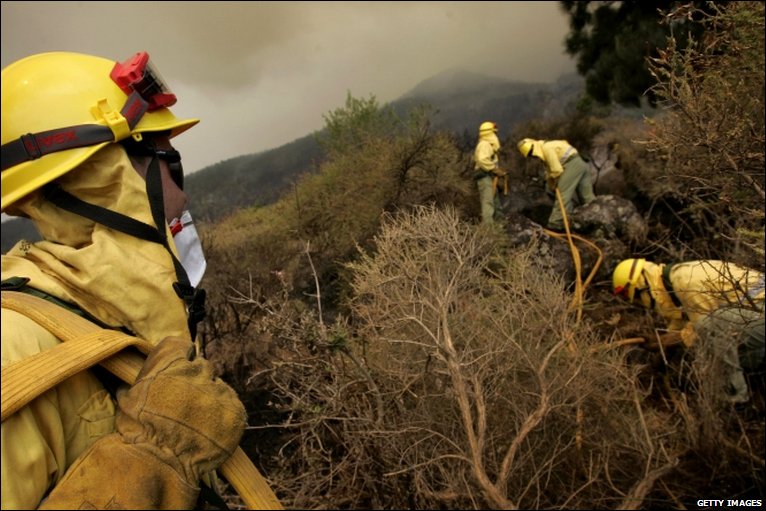
cutting a firebreakCreating a firebreak is sweaty, sometimes risky work and especially dangerous in an emergency.  Crews crank up bulldozers, brush axes and chainsaws, even light backfires – anything to stop a wildfire from spreading further destruction onto fresh ground.  If the fire rushes too quickly upon the firefighters and fleeing panic stricken animals rush by, they have little choice but to run for their own lives or hunker down under emergency wild land fire shelters and hope they can keep breathing long enough for the fire to pass over them.  Other crews will be working again ahead of the fire to make a new firebreak to try and restrain the blaze.  A successful firebreak contains the devastation and preserves what remains.

If our house be on fire, without inquiring whether it was fired from within or without, we must try to extinguish it.  Thomas Jefferson

An article in this weekend’s Wall Street Journal entitled “America’s Baby Bust” by Jonathan Last tells of a different kind of consuming fire – one far more destructive.  United States citizens, like 97% of the rest of the world’s population now, live in a country with birth rates below a replacement threshold necessary to sustain itself – 2.1 births per woman.  We have not been consistently at a sustaining rate since the early 70’s; currently we are at 1.93 and dropping because the immigrant population, which was holding its own for a long time, has now followed those of us born here.  Among college educated women, the rate is 1.60 births per child bearing woman, about what it is in Japan overall.  China is in worse shape at a 1.54 rate after decades of a one child and forced abortion policy, exacerbated because of cultural bias with a young demographic heavily weighted male.  Japan has been at it longer and is in full blown panic.  Russia, Italy, France and Canada are all paying mothers large tax credits or even cash bounties for new babies.  By 2100, Japan will be half its current population.  Its once dazzling growth rate in GDP has ground to a halt.

Many of the economic and sociopolitical crises we face arise from a stagnant population.  A rapidly aging demographic makes any social security program for the elderly unsustainable with only two workers for every person drawing benefits.  The major impetus for escalating health care costs is directly attributable to the inescapable reality that we are living longer with more expensive health remedies available, and there are too few still working (and contributing) to pay for it all.  Another slow train coming is too few young fit people to staff a strong military and too few taxpayers to fund it.

The myth of overpopulation touted incessantly in the 70’s is long behind us.

If I … comprehend all mysteries and all knowledge…, but do not have love, I am nothing.   1 Cor 13:2

prolife rally 2013Last week in Washington, there were two demonstrations: one to express support for new gun control legislation was attended by three to four thousand people and received ubiquitous coverage by every major network and print news media.  The second was to commemorate the fortieth anniversary of the Roe v Wade Supreme Court decision in 1973 that overturned every state law in the country that limited abortion for any reason at any stage of pregnancy.  Attended by somewhere between 500,000 and 650,000 people, the March for Life got little if any mention on most news outlets (except for Fox News and EWTN) with every effort made to obfuscate the size of the crowd.

The most eye-catching aspect of the turnout was the average age of the participants.  Hundreds of thousands of young people from high school to post graduates braved the bitter cold, carried signs and chanted, “We are the pro life generation.”  They are the survivors of the last forty years in which between 25 and 33% of those conceived in the womb were killed – fifty five million of them.  Earnest, healthy, full of life, intelligence and humor, the young people came.  The progeny of a generation of materialists, hedonist pleasure seekers, narcissists and those committed to self fulfillment, not self sacrifice, they came.  To make extraordinarily clear that the torch has been passed to those even better suited for the fight, they came.  And given the sparse numbers born to those committed to a pro-choice agenda, these born to be pro life will eventually triumph – even if just by an inexorable demographic.

These are the children cutting the firebreak, and they will persist.  They will not go gently into the night.  They will “rage, rage against the dying of the light.”

I have set before you life and death, blessings and curses. Now choose life, so that you and your children may live.  Deuteronomy 30:19 (NIV)

One more article captured my attention this week.  In it pro choice (or formerly pro choice) reporters described what they observed in abortion clinics.  For the sake of brevity and limiting the brutality, I will cite only one out of seven.  Pro choice author, Magda Denes, in her book, “Necessity and Sorrow: Life and Death Inside an Abortion Hospital”, wrote this about coming into an operating room following the abortion of a second trimester baby:

I remove with one hand the lid of a bucket … I look inside the bucket in front of me. There is a small naked person there floating in a bloody liquid- plainly the tragic victim of a drowning accident. But then perhaps this was no accident, because the body is purple with bruises and the face has the agonized tautness of one forced to die too soon. Death overtakes me in a rush of madness … I have seen this before. The face of a Russian soldier, lying on a frozen snow covered hill, stiff with death and cold. … A death factory is the same anywhere, and the agony of early death is the same anywhere.

We have made technological advances undreamt of by our parents and grandparents.  Among these is the scientific and medical ability to control pregnancies in a way not possible just forty years ago.  We can take a pill to end a pregnancy and flush a new life away.  We bicker about whether taxpayers who find the practice morally repugnant and in violation of their religious freedom should have to pay for it.  We seem to have lost the thread on the larger question.  The issue is not “how” or even “why”, the issue is “ought”.

These are some of the gripping questions it will take at least another generation to determine, and they will look into themselves, not into the media, to resolve them.  And this generation is hopeful and ready.

So to my pro life and pro choice friends, I pose these queries.  Have we come so far?  We differentiate ourselves from all other known species not just with rationality and imagination, but with accrued knowledge, wisdom, a search for love, truth and beauty, with spirit and soul, and with consciences formed by all of these facets.  Do we endure in dragging along with our hoodies up, our ear buds in and our eyes cast down a yard or so ahead of our sad shuffling?  Is this really the best we can make of it?  Is this really the best we can do?

The world arrays a twofold battle line. It offers temptation to lead us astray; it strikes terror into us to break our spirit.  Hence if our personal pleasures do not hold us captive, and if we are not frightened by brutality, then the world is overcome.  St. Augustine

1 Comment

Filed under Culture views

Cold Snap

“Human reason has this peculiar fate that … it is burdened by questions which… it is not able to ignore, but which, as transcending all its powers, it is not able to answer.” Immanuel Kant, Critique of Pure Reason

When I went out one morning this week to bring in some wood for the woodstove, the thermometer registered 3 degrees, which is about as cold as it gets in Rhode Island without wind chill. Now in the Sandy River Valley in the West Central Maine where we once lived, 3 degrees before dawn might qualify as a bit of a January thaw.  Routinely in the dead of winter there, we would wake to 20 below.  I remember a week when we didn’t break into positive numbers at the warmest period in the afternoon, and every night was 15 or 20 below.  Hauling in wood from the shed would numb my face in the thirty feet I carried it.  I grew a beard most winters to protect my skin, since I was often outdoors.

Albert Camus once wrote, “in the midst of winter, I finally learned that there was in me an invincible summer.”  Camus’s metaphor seems to bear more than merely surviving a cold winter; perhaps he writes also of the winter none of us will escape in the end.  As I near my 67th birthday, the depths of winter echo with chords of my mortality.   As I near my 67th birthday, I am reminded that one certain inevitability is closer now than ever before, and it is necessary to be reconciled with that truth.  And yet, an “invincible summer” is within us, an unquenchable, “desperate desire” that the final deep cold will not descend undiminished, that we will see those we love again, that the inescapable lowering into frozen ground is not the end.

“The dragon is by the side of the road, watching those who pass.  Beware lest he devour you.  We go (to) the Father of souls, but it is necessary to pass by the dragon.” St. Cyril of Jerusalem

Bill Yates pictureIn December, our dear friend in Maine, Bill Yates, succumbed to bile duct cancer after being diagnosed in August. A strong, unexpected cold wind overwhelmed him.  Always very fit, in July, he was competing in 5K races, still going strong at 71.  He never made 72.  Bill was a former Navy doctor, board certified in obstetrics and gynecology.  In 1975, he opened the first OB/GYN practice in Franklin County, Maine.  Later in his career, he updated his training and refocused on helping infertile couples, but eschewed in vitro procedures, which he deemed risky, expensive and with grave moral issues.  He retired in 2003 after nearly thirty years and over 2,500 babies delivered.

In 1969 while serving as a Navy lieutenant, he married Navy nurse Margaret Bandlow in Virginia two years after graduating from medical school.  Bill and Meg were married forty three years at his passing.  Among their six girls and two boys are a physician (Elena, one of the twins), two Sisters of Life in NY, Leah (Sister Mary Louise Concepta) and Rachel (the other twin, now Sister Mariae Agnus Dei), an engineer and a certified rafting guide on the Colorado River through the Grand Canyon.  Like Bill and Meg, their children travel to places all over the world to explore, hike and run, bicycle hard, and love the hills and rills of Maine.

 Bill grew up in Elyria, Ohio and maintained a Mid Western natural friendliness and dry sense of humor.  His intelligence and insatiable curiosity made him an engaging conversationalist. His kindness made a conversation with him a distinct pleasure: full of new ideas, but devoid of painful pitfalls.  His father owned a general contracting company, so he grew up around construction and summer jobs.  Bill inherited a deep pleasure in building things – a new house, a new office suite for his practice; he would occasionally uproot what was and build something fresh because he wanted to.  Once when his partners wanted to stay in the last office he built, Bill got new partners. “Undeterred” comes to mind whenever I think of him.  Since construction has been the source of my career, we had many talks about contracting and contractors.  My firm hope is that we will have some more when time is no longer finite.

 “Down, down, down into the darkness of the grave

Gently they go, the beautiful, the tender, the kind;

Quietly they go, the intelligent, the witty, the brave.

I know.  But I do not approve.  And I am not resigned.”

Edna St. Vincent Millay

If you are a regular reader, you may remember the story about our choice in 1980 to undo our decision following nearly a decade not to have more children after Amy and Gabriel.  The great blessing of Angela and Meg (and now Pete, Gianna, Ellie, new baby in the womb and Marty) were the direct happy result of that decision.  Bill Yates was Rita’s OB/GYN physician in Maine whose encouragement and connections to his Navy doctor friend in Portland enabled me to have a vasectomy reversed.  Our lives were affected so profoundly that I cannot reflect on them without emotion.  For this and for Bill and Meg Yates, I am forever grateful.

Meg is a lifelong Catholic, and although Bill was raised in a mainline Protestant denomination, he kept the promises he made to her at their wedding and attended Mass with the children and her.  At one point in his forties, he became more curious about her faith.  Rita and I were on vacation for a couple of weeks on Webb Lake, near where they lived.  We happened to be carrying in my Bible our note cards for something called a “Life in the Spirit” seminar, which we had taught as a husband/wife team for quite a few years.  Usually conducted with once a week sessions for seven weeks, we spent several nights covering the material and praying with Bill and Meg.

In the autumn, they came down with the whole crew to visit us and attended a Fall Festival with a Catholic community to which we belonged at the time.  That we absorbed with nary a speed bump the ten Yates in our small house — sleeping bags and air mattresses everywhere — was a testament to the loving, controlled chaos of their family.  While here at a picnic, Bill had an absorbing conversation with our friend, Father John Dreher, himself a convert from Protestantism and a Mid Westerner, who came east to study at Brown decades before.  The next year Bill took formal instruction in the Church and joined Meg as a professed Catholic, a commitment that carried through the rest of his life.

The following summer, when we saw them again, they brought me a magnificent 12 speed bicycle.  At the annual Wilton Blueberry Festival that they helped run, Bill bought a limited run $10 raffle ticket in my name for the bike as a thank you for the previous summer.  The ticket was pulled, and I enjoyed many years of long rides around Webb Lake in Maine and to and from a state park in Rhode Island on many early mornings back in Rhode Island.   Bill’s bike.

I spotted the bike hanging upside down in our garage when I was pulling out my wood splitting maul a month or so ago; the bike has been there for five years without a ride. Pitchers and catchers will arrive in the major league training camps next month.  Ash Wednesday is less than three weeks ahead, which inevitably leads to Easter, and is my personal first sign of the annual greening.  I’m going to take Bill’s gift to a first class bicycle shop for a full tune up and some new tires.  Hope comes once again during a cold snap, as it always does. Spring beckons.

“The leaves are falling, falling as from way off,

as though far gardens withered in the skies;

they are falling with denying gestures.

And in the nights the heavy earth is falling

from all the stars down into loneliness.

We are all falling.  This hand falls.

And look at others: it is in them all.

And yet there is One who holds this falling

endlessly gently in His hands.”

“Autumn”, Ranier Maria Rilke

Quotes in this post were shamelessly purloined (but attributed to their original authors), as was the title of a previous post from Dr. Regis Martin’s superb small book on Christian hope, “Still Point – Loss, Longing and Our Search for God”, which I could not recommend to you more highly, irrespective of your inclinations in this regard.  The desire for hope is imbued in our being.

5 Comments

Filed under Personal and family life

Millie and a Fortieth Anniversary

mildred jefferson 1Mildred Fay Jefferson died at age 84 just over two years ago in Cambridge where she lived, not far from Harvard Medical School.  She was the first African American woman to graduate from that prestigious university, having entered it at twenty years of age. She had previously earned a master’s degree from Tufts University following her bachelor’s degree from Texas College at the age of 16.  She went to Tufts while waiting to be old enough to be accepted at Harvard Medical thirty years before “affirmative action” was even a concept.  Mildred was the first woman of any race accepted as a surgical resident at Boston City Hospital, the first woman physician at the former Boston University Medical Center, where she taught, and the first woman member of the Boston Surgical Society. Her intelligence was incandescent, but we will best remember her as a friend.

Dr. Jefferson was the only child of a Methodist minister and a school teacher, born in 1926, and raised in Carthage, a small town in East Texas.  As a young girl, she would ride on house calls in the horse drawn buggy of the town doctor.  Her family and the doctor encouraged her ambition to become a doctor.  Her family called her “Millie”.  No one else did that I ever knew, including us.  In 1973 after the Roe v Wade Supreme Court decision struck down all laws restricting abortion on demand at any stage of pregnancy, Mildred considered her original Hippocratic Oath taken when she graduated from Harvard and refocused her considerable gifts.  (Link to original Hippocratic Oath, no longer taken by new doctors after a 2,000 year history: Original Hippocratic Oath.)  She founded Massachusetts Citizens for Life, and then co founded National Right to Life, becoming first its Vice Chairperson, then Chairperson and then President, overseeing all its activities.  In 1980, she formed the first National Right to Life Political Action Committee.  If you found yourself in a debate or a battle with Mildred Jefferson, you’d better bring a lunch.

 Testifying before Congressional committees led to crisscrossing the country inspiring millions with her extraordinary public speaking ability and multiple appearances on national television, including a session on PBS’s Advocates, remarkable for its long term impact.  She made her case, none of it “religious”, but logically and relentlessly, Mildred outlined the moral, medical and sociological case against women taking the lives of their pre-born infants.   Watching her articulate her deeply held convictions with grace, power and knowledge was the governor of a large state, who had signed into law a bill allowing abortions in that state.  So convinced and convicted was he by her compelling arguments, he wrote her a letter.  In it, he told her that he had never really considered the full implications of abortion, nor its effects on women and the culture. He deeply regretted his unreflective support for a “woman’s right to choose”, and vowed to do everything within his purview to fight for the unborn, a commitment he kept until the end of his life.  As President of the United States, Ronald Reagan could bring considerable influence to bear.

As we mark the fortieth anniversary of Roe v Wade on Tuesday with its sad accumulation of fifty five million aborted babies, and we celebrate the life of Martin Luther King tomorrow, Dr. Jefferson represented the confluence of the civil rights of former slaves and women as well as those of the unborn.  She was knowledgeable about and a warrior in all these struggles, her certitude was that they were of a piece.  She would talk about the racist eugenics advocated by the founder of Planned Parenthood, Margaret Sanger, and how to this day their abortion clinics are located most deliberately in poor and minority neighborhoods.  Mildred deplored the undeniable facts that black citizens comprise about 12% of the U.S. population, yet suffer 35% of the abortions.  She saw this as a kind of genocide, wherein affluent white liberals saw their moral directive was to “help” minorities by lending them a hand to murder their young.

mildredjeffersonWhen my wife, Rita, became the Executive Director of Rhode Island Right to Life early in the new millennium, she understood the medical and moral dimensions of the battle, but was naïve on the political battleground.  Mildred Jefferson took her under her wing.  As a force to be reckoned with in both national pro life activity and Republican Party politics, her mentoring skills were like everything else she did – formidable.  She was in her early seventies then, looked fifty, and had a magnificent gift to make you feel like you were the most important person in the universe – the total focus of her attention in any conversation.  Over lunches and dinners, we soon learned she could discuss knowledgeably any topic that came up, from the Civil Rights movement of the fifties and sixties to whatever became of the owner of the former Steve’s Ice Cream emporiums in Cambridge and Providence, whom she knew well.  Her smile, her laugh, her warmth, her truly startling memory and intelligence were a delight and comfort.  Never was there a hint of affectation in her conversation – only a sincere desire to help, to support, to encourage and to befriend.  The Rhode Island Right to Life annual oratory contest and scholarship award for high school students is named in Mildred’s honor; the national contest, to which the Rhode Island winner is sent, was a special passion of hers.   She supported Rita in many ways throughout her years at RIRTL and sat with us at Rita’s retirement dinner.

When Dr. Jefferson spoke at our annual rally in the Statehouse Rotunda, she was mesmerizing with natural speaking ability and gifted intellect; she would let loose the occasional glimpse into the cadences of her Southern preacher father.  The entire audience of religious and political luminaries along with school buses full of young people and the hundreds of ordinary pro lifers with their families were rapt with attention and respect for her history.  This tiny, unassuming woman who could keep us enthralled around a mealtime conversation, transformed into a speaker of great power.  She could even lead us in a rousing few verses of “Battle Hymn of the Republic”, sung with the accomplishment of her childhood Methodist choir days.

She was beautiful in so many ways; we hope to see her again.  We will miss her at the rally on Tuesday, but even more, we will miss her at dinner.  We miss her smile.

Ecclesiastes 3:11, He has made everything beautiful in its time. He has also set eternity in the human heart.

Link to NRTL tribute to Dr. Jefferson

Link to a commemorative article about her life.

5 Comments

Filed under Culture views, Personal and family life

Still Point

Except for the point, the still point, there would be no dance, and there is only the dance.  T.S. Eliot – Four Quartets

Drove my Chevy to the levyBeing the oldest of five (eventually to be six) children in 1956, the age of ten brought with it occasional responsibilities that would be surprising to most ten year olds in 2013.  We shared one bathroom, and the four boys shared one bedroom in a three bedroom cape with two small one window dormers in the front.  When I was thirteen or so, my youngest brother, Marty, filled out the nest, and my dad added on a family room.  We never questioned and rarely felt put upon by the living arrangements; our family was secure and happy in our daily routines.  My parents had one car; my father worked two jobs and my mother worked full time as a mom, which was quite enough for anyone.

Intermittently my mom asked her oldest to help out paying bills downtown, which was a mile or so from our house.  Accomplishing this on my bike was an easy adventure and invited me in to the mysterious grown up world.  My mother didn’t have a car when my father was at work, and in 1956 in addition to me, she had two kids in diapers plus a set of five year old fraternal twins, one of whom had a severe hearing disability.  She handled this all with aplomb and good humor most of the time, but when the bills were due, she needed some assistance.

The budget was managed by accruing cash weekly in separate envelopes for various expense categories.  I would be given the utilities envelopes and the mortgage envelope, and then mount up on my bike.  There were no bike racks or bike locks, none was needed, just a kickstand or a convenient wall to leave the bike against.  First, I would go to the bank, then the electric company and the telephone office.  No gas company bill in 1956 and I think she paid cash to the oil man, when he delivered.  Grocery shopping was a full family affair when we were little.  The checkout clerk would help load the groceries into our car.  I lost five dollars in change once, which was a minor disaster in a time when it represented nearly fifty percent of the weekly grocery budget.  She was disappointed, but kept her concern brief and tight lipped – almost. I was admonished after that to return straight home with no stops at friends’ houses or especially the library, which could delay my return for hours.

card catalogA bike ride to the library was also about a mile, and with the possible exception of a sandlot baseball game behind the elementary school, my favorite activity.  I was a constant reader and shy at ten.  There are pictures of me my mother still has, sitting on the floor reading a book absolutely absorbed and still, amid the chaos of my five siblings.   I haven’t changed all that much – except for the shy part, although I remain private.  My reading consumption was and remains omnivorous, but at ten inclined towards biographies of Indian fighters and tales of King Arthur and the Knights of the Round Table.  As I got a little older, I was spellbound by biographies of Thomas Edison and Babe Ruth with The Count of Monte Christo not far behind.

The Walpole Library was small, but well stocked. Upstairs was for the adults, but the basement was reserved for children and adolescent fare.  The librarian was a genial and skilled substitute far superior to Google for a ten year old; the card catalog held the keys to the kingdom.  If the librarian was preoccupied, we could sneak out to the front steps and edge our way around the whole structure on an eight inch granite ledge that circumscribed the building as a design feature just below the windows.  The children’s section had round low reading tables with small chairs.

In one corner, two stereoscopes resided along with boxes of the two photo four by ten inch cards that fitted into them.  Most of the pictures were black and white, although some, including Civil War historical shots were sepia. As a ten year old, I especially liked the battle aftermath photos.  When viewed through the lenses, they appeared in 3D.  Developed in the mid nineteenth century and vastly improved by Oliver Wendell Holmes in 1861, the stereoscope opened previously undreamt wonders to a ten year old.  From Egyptian pyramids to the streets of Paris to the Grand Tetons, our new world was limited only by our imaginations.

StereopticonStereoscopes are now valuable antiques and anachronistic reminders of simpler times (that is simpler unless one lifts the edges of the curtains).  They were supplanted sadly by more enticing moving pictures and eventually television.  Our television was a big box in the living room with a small black and white screen and three somewhat fuzzy channels.  Ozzie and Harriet, I Love Lucy, The Ed Sullivan Show, The Jack Benny Show, The Honeymooners and many, many Westerns like Gunsmoke and Have Gun, Will Travel drained away our family hours as we got older. I could still slip away to my sanctuary in the eaves of the attic, which had a single pull chain light bulb and a hook and eye latch, to seek the quiet harbor of my books.

I’ve heard it said that we all have our nineteen year old selves permanently emblazoned on our personalities.  Can it be any less so for ten?  My tenth birthday was in February of 1956, eleven years to the day after the Marines raised the American flag on Iwo Jima, securing a key stronghold on the long drive to Tokyo.  To idealize any period of time is to trivialize it, however to hold it at the center of our innocence is quite another.

The fifties were in some ways innocent and optimistic, yet they also harbored Jim Crow laws and the hypocrisy of country club adultery and too much liquor.  But most families were hard working and held traditional morality dear; the parents were the “Greatest Generation” determined to leave behind the Depression years of the thirties of their youth and the killing years of the forties of the war, and to pass on to their children a safer, more stable and more comfortable future.  For this they worked steadily and generally cheerfully for the rest of their lives.  Comfortable was achieved; stable and safe eventually were beyond theirs to bequeath, but in the fifties, at least the illusion of simpler times was lovingly preserved.

“We don’t know what we are doing, because we don’t know what we are undoing.” G.K. Chesterton

4 Comments

Filed under Background Perspective, Personal and family life

Leverage

A decade or so ago, some friends undertook the arduous journey to adopt their daughter, who spent the first fifteen months of her life in a Moscow orphanage.  The journey was arduous in all ways possible – mileage, time, financially, intellectually demanding to wend their way through the arcane rules and most especially, emotionally.  On their initial visit to the facility, they found most of the younger children were minded in a small enclosed area with a few toys to claim, if they could be held against all competition.  The facility housed over a hundred small clients, a couple of dozen or so under the age of two.  When they first spotted the young beauty that was to transform their lives, the fifteen month old glanced sideways while on the changing table and made eye contact across the room.  That ability to connect with those who were her life line was a skill, either learned or inborn, that conveys to her a gift beyond reckoning and persists into her precocious pre teen personality.  She can take over a room like brightness draws moths into the light.

In Moscow, she competed with a score or more toddlers and infants for the haggard, stretched thin attention of two full time attendants, each of whom worked a twelve hour shift every day.  One person at a time was on duty for changing, food, health care, teaching and loving.  They did their best; they really did.  Learning toys were scarce, food was sparse and survival skills important.  An orphan who prospers learns early to compete, to persist and to make her way.  Her intelligence and persistence were the primary attributes we noticed when we  met her in our friend’s house shortly after they returned home.

For adopting parents, protocol was for at least two visits of a fortnight each, separated by a period of time, usually a month minimum.  The first one was intended for selection of their new family member and early bonding; the second was to complete the paperwork, spend more time with the child, and usually followed a vetting process.  Our friends were able to convince the adoption authorities that a second trip would be prohibitively expensive financially and more importantly expensive for their schedules, since they were both self employed.  They remained in Moscow for twenty eight days at a cost exceeding thirty thousand dollars, but when they got on the first leg of their Aeroflot flight home, there were three of them.

President Vladimir Putin signed a bill Friday banning U.S. citizens from adopting Russian children, raising tensions with Washington as the Obama Administration is trying to win Moscow’s support to end the war in Syria.  Russian officials portrayed the latest legislation as a tit-for-tat retaliation against a new U.S. law that seeks to punish Russians accused of human-rights violations.

Moscow’s legislation—which also bans U.S.-funded civic groups in the country—puts concrete action to rising Russian complaints, voiced most vehemently by Mr. Putin, that the U.S.’s own human-rights failings give it no credibility to lecture others.  But the adoption ban has exposed Mr. Putin to criticism both internationally and within his own government. Critics allege that the law makes political pawns out of Russian orphans, whose living conditions can be dire and prospects for adoption often slim.

Gregory White, Wall Street Journal 12/28/12

Many of the children adopted from Russia by American parents suffer disabilities such as spina bifida, which is treatable if medical resources are more abundant than in a Moscow orphanage.  Without adoption, these children will languish.  Worse yet is the fate of young especially pretty women, who outgrow the orphanage, and become prey on the streets of the city.  The sex slave and drug trade flourish in Russia; young girls are turned on and turned out.  Most grievous are the adoptions shut down in mid stride.  There are children and parents who have spent much time together and bonded; they will now be unable to complete the process, some just a week or so from flying home together.

“I looked the man in the eye. I found him to be very straightforward and trustworthy. We had a very good dialogue. I was able to get a sense of his soul; a man deeply committed to his country and the best interests of his country.”  President G.W. Bush about Vladimir Putin, press conference, 1/6/2001

“I told him (Yeltsin) I was impressed by what I had seen of President Putin but wasn’t sure he was as comfortable with or committed to democracy as Mr. Yeltsin.”  Former President Bill Clinton in a NY Times article, “Boris the Fighter” on the occasion of the funeral of Boris Yeltsin 4/29/2007

Vlad, the Impaler, Putin

Vlad, the Impaler, Putin

These protestations about violated human rights in the United States  coming from Vladimir Putin, a triumphant thug who came up through the ranks of the KGB, now FSB, would be ridiculous, if so many innocent lives were not sacrificed to the brutal, leveraged, “diplomacy” of the hard core left.  Remember in October of 2006, Anna Politkovskaya, a gifted, courageous journalist, was assassinated in the lobby of her apartment building with two bullets in her head.  She had become a potent nuisance to Putin with her brilliant expose of “Failed Democracy” and the outrages against Chechen civilians.  She was murdered on Putin’s birthday, no doubt a gift from his old colleagues in the FSB, who are exceedingly skilled in contract murders.  A month after her death, Alexander Litvenenko, a former FSB officer who had defected to the West, was taken very ill to a British hospital, where he died a gruesome, slow death three weeks later of acute radioactive polonium poisoning.  He had been working with MI5 and MI6 as well as in his new career as a journalist. He published two books:  “Blowing Up Russia, Terror from Within” and “Lubyanka Criminal Group.”   Polonium in the mashed potatoes is a creative and cruel method of political assassination, again one in which the old KGB was particularly gifted.  The “Cold War” may be in the history books, but its practitioners learned their craft well.

President Obama to then President Dmitri Medvedev (now Prime Minister after he and Putin again exchanged chairs): “This is my last election.  After my election, I have more flexibility.”  Video…

Medvedev:  “I understand.  I will transmit this information to Vladimir.” 

Ten years later and fully adapted to her adopted country, this beautiful daughter of our friends is doing splendidly at an exclusive private school.  Her grades are excellent, and she is excelling in her other special interests in photography and basketball. She is on the local “travelling team” as an All Star in her age bracket.  The school for gifted students is on a handsome campus as a “feeder” school for the Ivy League and other top line universities. Her school has won the state wide Academic Decathlon nineteen times out of the twenty nine it’s been held.  One expects her prospects are considerably more promising than those of a street urchin in Moscow.  Her parents are devoted to her success in life and to her nurture.  Love is irreplaceable.

“May it show us the family’s holy and enduring character and exemplifying its basic function in society: a community of love and sharing, beautiful for the problems it poses and the rewards it brings; in sum, the perfect setting for rearing children – and for this there is no substitute.”  Pope Paul VI, speaking of the Holy Family in Nazareth 1/12/1964

3 Comments

Filed under Personal and family life, Politics and government