Author Archives: jparquette

jparquette's avatar

About jparquette

Fortunate and blessed in companionship with my wife of fifty seven years, in health and in modest, but more than adequate circumstances. Life is good.

Stone Walls, Sycamore Maples, and Other Curiosities


“Something there is that doesn’t love a wall,

That sends the frozen-ground-swell under it,

And spills the upper boulders in the sun…” Robert Frost, Mending Wall

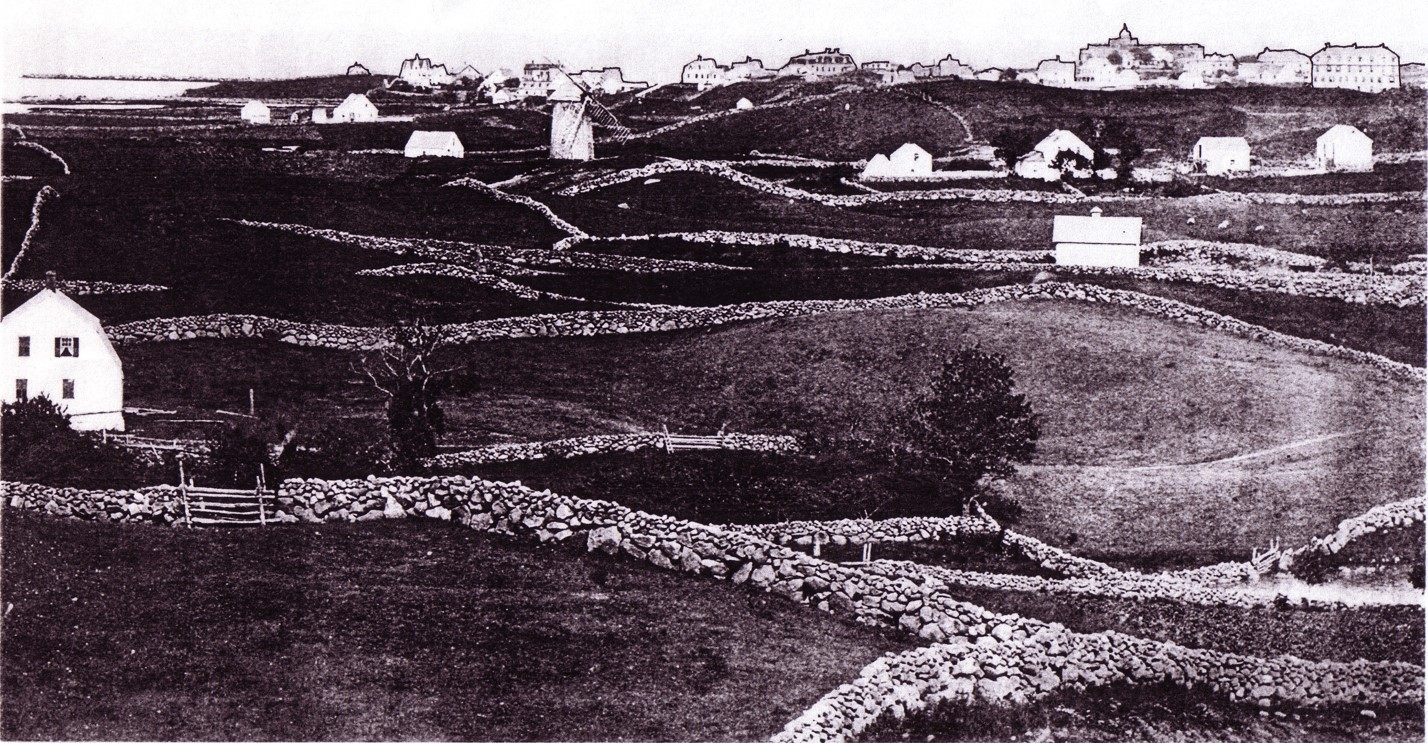
Stone walls in Block Island, Rhode Island, c. 1880. Block Island Historical Society, printed by Robert Downie

Frost, deep frozen ground, not poets, is not the only nemesis of the old stone walls crisscrossing this island and all the rest of New England, but it is a formidable one. At the peak of their domination of the landscape in the mid 1800’s, there were an estimated 240,000 miles of them. The total weight of them equaled sixty Pyramids of Giza or about four hundred million tons[i]. One by one, the farmers gathered the stones and built the walls.

The other (Robert) Frost wrote famously in his poem, Mending Wall, “Good fences make good neighbors.” New England soil and geology scattered the material for these borders across this landscape in forests and fields. The frost does not just undermine existing walls, the frozen earth provided for them. Each winter and spring cycle the frost slowly worked up millions of rocks through the soil to the surface. Farmers cultivating the land and before them farmers raising Merino sheep each year faced one of their most arduous tasks: picking up the stones, called “two handers,” throwing them first into a formidable pile, then carting them to build the walls. Walls to keep in livestock and keep out someone else’s livestock; walls to delineate property; walls to get the rocks out of the way of plows and the grazing of cows and sheep.

Farmers and estate owners often planted Sycamore maples and pin oaks and Norway maples and sugar maples and American beech trees along these walls for shade, maple syrup, further definition of who owns what land, and because they are beautiful. They assumed residence beside the wall for decades or a century. The relationship between the wall and the tree is eventually contentious. Trees grow, albeit slowly, but inexorably. Up and out and thick in the trunk. And not just stems and buds, flowers, and leaves. The girth of the trunk expands in the cambium, that thin layer of vascular cells between the inner tree and the outer bark, between the xylem and the phloem. The xylem presses inward eventually hardening into heart and sapwood. The phloem presses outward creating the vessels that become cork like and harden into bark. One cell at a time, the cambium does its work. Mitosis, dividing, each tiny increment insignificant, but relentlessly they push out and up. The annual growth cycle of early wood and late wood creates the rings that chronicle the age of the tree and the history of the weather each year.

The power of this tiny expansion continues unabated. A fraction of an inch at a time, it does not stop. When the tree necessarily grows in diameter, a stone wall in its path suffers a slow demise. Eventually a bulge becomes a fall becomes a collapsed hole. The wall begins its slow dis-integration back into the soil that spawned it. The fields they once defined sometimes revert to wall-demised overgrown forests once again.

“When a friend calls to me from the road

And slows his horse to a meaning walk,

I don’t stand still and look around

On all the hills I haven’t hoed,

And shout from where I am, What is it?

No, not as there is a time to talk.

I thrust my hoe in the mellow ground,

Blade-end up and five feet tall,

And plod: I go up to the stone wall

For a friendly visit.” Robert Frost, A Time to Talk

 In 1961, Dr. Stewart Wolf, the head of medicine at the University of Oklahoma, met a local doctor for Roseta, Pennsylvania, who told him about the remarkable, negligible rate of heart attacks from 1954 to 1961 in Roseta[ii]. Curious, Dr. Wolf confirmed the anecdotal evidence by researching death certificates for the town during that period. Numerous studies followed, including a fifty year exhaustive one comparing Roseta to the similar sized town nearby, Bangor, PA, as natural experiment control. The researchers named these findings the “Roseta Effect.”  Why they were so different in heart attack frequency was the pressing question.

Researchers concluded that the community cohesion of the Italian culture and unity centered on the united worship in the church, common agreed upon values, and closely shared family and community lives there lowered the stress level, loneliness, and attendant health risks. People still died, of course, but later, and not of heart attacks. Normally at risk men from 54 to 64 had almost no heart attacks. They did not eat the Mediterranean diet but regularly chowed down on sausage fried in bacon grease; they smoked unfiltered tobacco, and worked extremely hard in slate mines, contracting the usual toxic dust related diseases. But they did not drop dead from heart attacks.

They were hardworking, poor, lived in tightly packed similar housing, and did not contend with social envy or material or pretentious aspirations. Simple, deep shared faith as a given, mutually supportive lives connected everyday face to face with close friends and relatives. Loneliness was foreign to them. You can read more in the footnote link.

As the years merged into decades, the trust, social cohesion, security, and friendships of 1950’s Roseta slowly effervesced like flat soda. Roseta became homogeneous with the rest of the country. People died, moved way, families broken and dispersed, neighborhoods broken and dispersed, the world seen filtered through the lens of a screen, the mines closed, new folks moved in. The heart attack rate grew until it was indistinguishable from the rest of us. Roseta became modern, and the Roseta Effect dissipated like the morning mist.

Like the inexorable growth of tree trunks first strained, then broke down centuries of stone walls, inexorable modernity broke down the societal boundaries of Roseta. In Part II, while we cannot regress into an idyl of nostalgia, we can do a few good things to find our way home. Until next time.

“The postmodern vision of society, in rejecting objective truth and inherited cultural bonds, has dissolved the very idea of community. In place of solidarity, it offers only a marketplace of transient identities, each competing for recognition while eroding the deeper structures—family, faith, and nation—that once made society coherent.” Roger Scruton, The West and the Rest

[i] Article from AtlasObscura.com

[ii] I learned about this story as part of a great Sunday homily our pastor, Father David Thurber, taught us. Curious, with just a quick Google search, the “Roseta Effect” story had many related scientific studies.

2 Comments

Filed under Background Perspective

Scoters, Eiders, and other Wonders

An experiment with an audio narrative of the post. Not my voice. Yet.

“There are some who can live without wild things, and some who cannot. For us of the minority, the opportunity to see geese is more important than television,” Aldo Leopold, A Sand County Almanac


My waterfowl identification is woefully deficient. At a distance without mechanical aids, I have difficulty discerning white winged scoters from surf scoters from black scoters or at a distance even from scaups or goldeneyes or buffleheads. I guess I need to upgrade my glasses prescription. From a greater distance, the distinction blurs even with the larger common eiders. The winter ocean around this place is full of them, large flocks of various scoters, eiders, buffleheads, and some birder attracting harlequins. And Canadian geese. Many geese.

 Large flocks of waterfowl hang out along the Sakonnet River at McCorrie Point, Sandy Point, and Sachuest National Wildlife Refuge, feeding, chatting, floating gently regardless of the vigor or languor of the waves. Up and down, content and rhythmically riding the waves for five thousand years somehow just beyond the break of the surf – a curious reassurance that we can be confident our frantic preoccupations with the current titillation, election, controversy, sensation, or outrage is a momentary distraction.

 Suddenly, they will take wing for their own instinctual inexplicable reasons, first two or four or five, then scores on some signal not understood by me, beating furiously to the next feeding range, sometimes across the river to the North Tiverton side and the Seapowet marshes. The energy of their purposeful rapid flight with blurred-fast wings seems exhausting to watch, but they are undeterred.

 When they drift closer to the shoreline, it’s endlessly entertaining to see them hunt. Diving with quick graceful, rounded back plops, they vanish for what seems like a long time, only to pop up inevitably ten or fifteen feet away. Often their dives and re-emergences are synchronized. Plop. Plop. Plop. Six or eight or more at a time in family groups, disappearing and reappearing almost simultaneously or in sequence. Pop! Pop! Pop! Up they come like small balls released by the kid holding them under. Could watch them for an hour, guessing where they are going to surface.

Drama is inherent in their existence. Raptors, foxes, and other predators are on the prowl. And others. The wildlife ranger who supervises us volunteers leads a weekly bird walk on the trails of Sachuest Wildlife Refuge along the rocky shoreline. She told us a story from last week’s walk. Duck hunting season just ended on January 26th. Hunting is not permitted on the refuge, but hunters can fill their freezers from boats just offshore so long as they aim away from the land towards the open sea. She has no objection to hunters. That’s part of what wildlife managers manage. But it must be safe and lawful.

 Hunting is part of how the balance is managed. Many savor a good Sunday dinner of roasted duck after an overnight soak in rosemary or thyme brine and accompanied by garlic buttered mashed potatoes, sauteed carrots, tomato and cucumber salad, and a nice red cabbage slaw.

On Saturday, she was conducting one of her walks for a couple of dozen curious nature lovers. She took them out near the forty feet of Sachuest Point – the surf pounded cluster of large rocks where the harbor seals sometimes come to sun themselves in the summer.

 Two exquisite eiders exploded from the surface of the water, beating their wings frantically, attaining astonishing speed in a few yards. “There goes a pair of eiders,” she exclaimed and pointed. Two shotgun blasts boomed from one of the inflatable low boats. Splash. Splash. With laconic understatement to the shocked onlookers, she calmly concluded the eider lesson. “There were a pair of eiders.”

“One swallow does not make a summer, but one skein of geese, cleaving the murk of a March thaw, is the spring.” Aldo Leopold

On Aquidneck Island, we don’t have to wait for March to observe the wonder of a flight of Canadian Geese. We do have some visiting migrating flocks passing through to be sure, but hundreds of them overwinter, powerfully cleaving the air with the V formation so easily identified while their unmistakable calls draw our attention overhead – twenty, fifty at a time, filling the sky like B-29s advancing towards the ball bearing factories in Dresden. Only the geese are benign as well as orderly and determined.

 We see them grazing in stubbled winter corn fields, in the marshes, scores of them cluster, feed, and socialize. We see them in any open water on both ocean and unfrozen freshwater ponds. They inhabit plowed fields, golf courses, and dormant winter farmland of which we have an abundance. Lingering and foraging for hours with a few sentinels, they guard their young, reconnoiter, and apparently confer with one another; their low distinctive murmuring conversation is incessant. Abruptly, as if by consensus, a group of them take flight.

 I always pause and look up when they are on the move in their signature V formation, squawking, changing their order of flight to share the load breaking the wind, heading to someplace of their noisy choosing to seek new food or shelter from the incessant wind or refuge for the night.

Compelling. A spectacle of grace, coherence, and power. A confirmation that somewhere, against all odds, all is right in the universe.

“Our ability to perceive quality in nature begins, as in art, with the pretty. It expands through successive stages of the beautiful to values as yet uncaptured by language.” Aldo Leopold, A Sand County Almanac and Sketches Here and There

1 Comment

Filed under Sachuest Point and other wonders

Unsung Heroes of Civilization

Weaver Cove dock at Sunset smaller

“Labor was the first price, the original purchase-money that was paid for all things. It was not by gold or by silver, but by labor, that all wealth of the world was originally purchased.” Adam Smith

We paused recently at one of our favorite stops – the boat landing at Weaver Cove off Burma Road on the west side of the island overlooking Narragansett Bay. Sunset is our favorite time there, but we often make our way over the rocks at other times and walk down the beach at low tide towards the Navy base and Coast Guard station. During the warm months, there is a lot of activity at the boat launch out on the bay. Fishing boats, sailing craft, barges and tugs headed up to Providence, freighters, luxury yachts. Some single mast sailing boats are moored just offshore from April until October. In the summer, families journey down from Fall River and New Bedford, setting up tents, chairs, and grill for a day of picnicking, swimming, playing with their kids, digging quahogs, and napping. A United Nations of languages and laughing.

By this time of year, the moored boats are back in storage, and only working craft come through the channel. When we stopped last week, there was a large yellow and red concrete truck waiting with its large, angled drum churning to keep its load from hardening. I thought the driver was on a break or waiting for a call from a local foundation being poured telling him that they were ready for him. Fifteen minutes later, a strange looking boat, which looked from a distance like it had an overly tall, awkward cabin at the stern, approached steadily from behind Dyer Island coming from Prudence Island directly west of Dyer.

As it got closer, it was a boat of a type I had never seen at the boat launch before with the odd appearance of a WWII landing craft at the bow. Another big truck perched on it – an exact match of the parked one near us. The driver of the waiting truck was affable with a full head of gray hair and a well-trimmed beard. I asked him if he was headed back to Prudence to continue a large foundation pour. Never taking his eyes off the boat, he told me that was precisely what they were up to. As soon as the truck ferry from Prudence got close to the Weaver Cove launch, our driver lined up to reload the boat. The switch was made quickly as soon as the odd looking boat pulled into the boat launch ramp, its inclined bow opening even as it approached.

The driver positioned himself directly in front of the ramp with enough room for his colleague in the other empty truck to disembark. Within seconds of the other truck clearing the ramp, he adeptly backed into the tight fit on the waiting boat without the appearance of one tiny course correction. The bow smoothly retracted back into position even as its pilot immediately started backing out, and the boat turned back to Prudence to continue the foundation pouring. The squat ferry sat noticeably deeper in the water with the fully loaded replacement. The whole switch and turn around took less than five minutes like a well-practiced dance.

“All labor that uplifts humanity has dignity and importance and should be undertaken with painstaking excellence.” Dr. Martin Luther King, Jr.

As the ferry and concrete truck receded from our view around Dyer Island, Rita and I discussed how many jobs requiring years of experience and skill go unheralded: the pilot of the truck ferry, concrete truck drivers, the crew back at the building site who set the forms, tie rods, and rebar, the foundation pouring crew directing the cement into the forms so that there were no voids or weaknesses as it set, the site work heavy equipment operators backfilling around the new foundation once the forms were stripped.

Prior to the forms showing up others had built the roads to get there, cut the trees, cleared the lot, dug in the septic system, drilled the well, and excavated the foundation hole after others had tested the soil, surveyed the property lines, and pounded in the offset stakes located by a transit to site the house and grade the lot. The coordinated, complex choreography continues until the house is ready for mail in the mailbox and kid’s bikes in the driveway: framing carpenters, window and door installers, siding and roofing specialists, insulation crew, electricians, heating and ventilation specialists, plumbers, sheetrock board hangers, plasterers, interior finish carpenters, kitchen cabinet and countertop fabricators, flooring team, painters, landscapers, and more. Offsite manufacturers fabricate hundreds of components, milled lumber, appliances, and all the building materials necessary to construct the home. Hundreds of skilled laborers contribute to a finished home.

Much of it is hard physical work, some of it dangerous. Years of experience and apprenticeship are necessary to gain proficiency in each trade, including our new acquaintance who made backing a fully loaded concrete truck weighing over thirty tons on to the narrow ramp of a small ferry look routine. It’s not.

Each day they sweat or are cold or wet or sore with fresh small injuries to their hands – limb and brain weary at day’s end from steady effort and paying constant close attention to their movements.

Those who do these things daily are practiced and confident in their hard earned expertise. They are intelligent, committed to doing a good job, and proud of their proficiency. Some are scornful of those who don’t have such skills. Watching them perform is always a vicarious pleasure; I always learn something new. Some little trick, or shortcut, some clever and quicker way to do what they do and produce better work. Some of their skillfulness I learned in my long working career, albeit never as adroitly as someone who repeated their tasks a hundred times a month for decades.

There are thousands of different jobs from the multitude of various skills it takes to grow and harvest our food, and those who keep us safe in our beds, and those who manage our commerce, and the many who quietly bang away writing the code that is now so necessary to our communications and entertainment. We surely are not even aware of many of the more esoteric jobs that exist, yet each one is supported by and utilized within our complex civilization.

“Work is not a curse, it is the prerogative of intelligence, the only means to manhood, and the measure of civilization. Savages do not work. The growth of a sentiment that despises work is an appeal from civilization to barbarism.” Calvin Coolidge

Just a few moments ago in geological time, we were all subsistence scratch the earth farmers or hunter gatherers. We all shared the same skills and worked together, or we died. Formal government, increased specialization, and a division of labor were developed and slowly emerged into the complexity we accept as normal. Human beings built cities and civilizations. Without the myriad skills of laborers, neither would there be politicians, university professors, poets, musicians or artists who can buy their daily needs and live in the shelters created by the workers. No workers, no civilization.

I have been very fortunate in knowing so many of them. Throughout sixty years of earning a living, I worked variously for a few months or for years as a framing carpenter, a fence builder, a tree climber, a roofing laborer humping bundles of shingles up ladders, a landscaper planting and grooming, a land surveyor, a truck driver, a driveway asphalt laborer, a form setter and fabricator of septic tanks and concrete pipe sections, a bucket truck operator, and a newspaper reporter, an assembler of doors and windows in a small carpentry shop, a warehouse shipper and receiver, a purchasing agent and inside sales coordinator, a road salesperson of building materials on hundreds of job sites. These jobs were learned at least well enough to keep food on the table before I spent most of my career managing people and running lumberyards and light manufacturing facilities.

No job was a waste of time; all prepared me for others; all taught me something necessary to all the rest.

Each job and especially learning what was entailed to accomplish their work inculcated in me deep respect for those who do the work, build the houses, and drive the trucks that supply us every day with our needs.

So many jobs we will never learn even exist. They may contribute to our lives without our noticing. We may take them for granted, but I hope I never do.

“Each morning sees some task begin,

Each evening sees it close;

Something attempted, some done,

Has earned a night’s repose.” Henry Wadsworth Longfellow

5 Comments

Filed under Background Perspective

perspectives from a few steps back

“It is better to take refuge in the LORD

than to trust in man.

It is better to take refuge in the LORD

than to trust in princes.”   Psalm 118: 8-9

 Papa standing at the rimIf we had lived in the Roman Empire, which lasted about 500 years as the Western Roman Empire and another thousand or so as the Byzantine Empire based in Constantinople, we would have expected that daily life probably would never change[i].

If I was a carpenter in a village outside of Rome in the year 200 AD, I’d get up before dawn for a simple breakfast of bread, cheese, and water, and gather my wood and iron tools, some I had made, some I inherited from my father and grandfather.  Off to work making doors or furniture or a larger project in a team like an aqueduct. Return home at the end of a taxing day, maintain and clean my tools, readying them for the morning, a supper of fish or grains or occasional meat. Time with my family, a quiet conversation about the kids with my wife, or perhaps head out to the tavern to debate the games or the latest battles up north or the comely suppleness of the new barmaid. A few times a year, if I was so inclined, I might head off to the games. Gladiators, animal hunts, spectacular and gruesome executions, maybe a few of those annoying Christians thrown in among the hungry lions, bears, and tigers.

I would expect my sons to follow in my trade, join the guild, learn the skills. As I had. As my father and grandfather had. There would be a sense of inevitability and the survival of my culture, a natural permanent order of things that always were and always will be. I might complain about the excesses, stupidity, and corruption of the current emperor, grumble quietly to friends or family that I trusted. My best hope might be that an illness or assassination would bring about a change in the emperor. That there would be no emperor would probably never occur to me. I’d have little understanding of the eventual effervescence of every system or culture.

We bicker, fuss, complain about, and regret (or perhaps celebrate) the recent election or the woeful character of the choices presented to us, but do we spend any effort on the why or whether or the finitude of the fragile and vulnerable structure of the society that spawned such an election? Are we bedeviled by the trees and unaware of the danger to the forest? Are the smoldering coals in old fires even now biding time until a little breeze fires them into a conflagration?

But we ought to consider that we may be in a period of profound change that historians will regard as the collapse of a civilization. Not to panic, the transition may be several centuries in the making and another in the denouement, but for we who are living in it, a lasting confusion may accompany us throughout our lifetime.

“Schism in the soul, schism in the body social, will not be resolved by any scheme to return to the good old days (archaism), or by programs guaranteed to render an ideal projected future (futurism), or even by the most realistic, hardheaded work to weld together again the deteriorating elements [of civilization]. Only birth can conquer death―the birth, not of the old thing again, but of something new.”  Joseph Campbell, “The Hero with a Thousand Faces” commenting on Arnold Toynbee’s “A Study of History.

Why does the disruptive populism of a Donald Trump resonate with seventy million voters? One contributing factor is the sense of powerlessness and disconnection of so many. Why are depression, drug use, and loneliness at historically high levels, especially among the young?

We wander around in a time afflicted with “presentism.” From a Rusty Reno article, “Resisting Presentism”, on the fallacy of naively looking towards a perfect future while ignoring the hard earned lessons of the past: “We live in a time of hot takes. Websites rush to post commentary of the latest Trump nomination. Denizens of X and other social-media sites swirl in cyclones of denunciation and attack. Everything is keyed to what’s happening right now. The latest triumph. The latest outrage. The latest meme.” And this societal addiction by its nature leaves us terribly anxious in a constant knawing state of feeling unmoored.

A culture of self-invention, radical subjectivism, and materialist utilitarianism is what we have. A seething cauldron of conflicting values with no umpire who everyone accepts to call balls and strikes or who is safe or out because there are no agreed upon rules. Or commonly understood definitions for that matter.  We are a society of dueling egos and wills in a Nietzschean or Hobbesian nightmare. Some of our disagreements leave little room for compromise because they are so fundamental. A warm baby or a fetus torn asunder before she can draw a breath.  A man somehow changed into a woman or a surgically mutilated, permanently sterile male human body with missing parts and now committed to a lifetime of taking debilitating artificial hormones while still suffering from a tormenting mental illness.

Blame social media, the computer in everyone’s pocket, coercive and intrusive government and institutional reeducation, ideological programs that undermine trust and family structure, the deep and growing hostility and anger in the culture split along ideological lines, the twenty four hour alarmist news cycle, the predominance of nihilism, violence, and exploitive sexuality in popular entertainment, ubiquitous, addictive, and ever more degrading porn, fatherless households, racism, sexism, transphobic animus, Big Corporations, Big Pharma, billionaire tyrants, elite technocrats running our lives, lack of gun laws, too many gun laws, far right extremism, far left extremism, Nazis in the woodshed, communists in the Senate, forever chemicals in the water, overpopulation, death spiral birth rates, or pick your lead story of the day. Reasons for societal unhappiness are not in short supply and reducing our woes to one or the other also breaks along ideological fault lines.

We are the confused mess that is living through the death of one civilization and the unknown beginnings of the next.

“It’s a restless hungry feeling

That don’t mean no one no good

When ev’rything I’m a-sayin’

You can say it just as good

You’re right from your side

I’m right from mine

We’re both just one too many mornings

And a thousand miles behind” Bob Dylan, “One Too Many Mornings.”  1964

 In July, a post here discussed in detail the weakening infrastructure of Sagging Bridges in our home state of Rhode Island. The physical deterioration of what we rely on every day was a metaphor for the deep-rooted breakdown of what we rely on every day for our societal coherence.  Like the road bridges, the bridges of our civilization – their pilings, supports, beams, and the strength of what keeps us from plunging into the river are corroding and creaking a bit each time they are driven over.[ii]

I’ve been fascinated by the various and unlikely voices over the last couple of years who are lamenting the loss of a “Christian civilization,” a culture with objective truths and values, a culture with defined borders, and agreed upon norms of behavior.  Defining for its members what’s good and what’s evil. Defining a solid foundation of an agreed upon understanding of the nature of human fulfillment and happiness. Among these are Richard Dawkins, one the four horsemen of the new atheism, Jordan Peterson, social influencer extraordinaire and still on a spiritual journey, and Bill Maher, celebrated TV host, comedian, atheist, and mocker of all things religious. Others too. They understand the loss and turmoil of living in a post Christian culture but fall short of understanding what is required. They think that we can build a vehicle to the future by our own efforts. Perhaps a few tweaks and little Kantian categorical imperative. Similar to me trying to fix my car with a YouTube video, a screwdriver, and vice grips.

“Said the Lord God, “Build a house,

Smoke and iron, spark and steam,

Speak and vote and buy and sell;

Let a new world throb and stream,

Seers and makers, build it well.”   G.K. Chesterton, The Kingdom of Heaven

 They understand the loss and turmoil of living in a post Christian culture but cannot bring themselves to acknowledge that the center of a Christian culture is not a set of rules, boundaries, and definitions, but a relationship with a Person.[iii] A Christian culture without Christ is incoherent.  We will try in vain to build a tower to heaven as did the people of Babel.  Don’t we ever learn?  A tower buiilt with our own tools  isn’t what is needed, but a road, a path, a Way.

The road to heaven is already leveled and built. We must learn to walk on it.

 “And everyone who listens to these words of mine but does not act on them will be like a fool who built his house on sand. The rain fell, the floods came, and the winds blew and buffeted the house. And it collapsed and was completely ruined.”  Matthew 7: 26-27

[i][i] Other cultures have lasted even longer than the Roman civilization. The folks who lived in them probably never foresaw any different state. Here are a few.

[ii] In that post was some discussion of Patrick Deneen’s insightful 2018 book “Why Liberalism Failed. A worthy read which asks the question has liberalism failed because it succeeded? Its failure was preordained in its premises.  The book was praised by such diverse reviewers as Barack Obama and Rod Dreher.  Rather than reiterate what’s already been written, read last year’s post in the link above or better, read the book. Another powerful book on a related theme was Charles Chaput’s 2016 “Strangers in a Strange Land.”  How does one begin to live an authentic Christian life in a post Christian culture? Way too much for a blog post, I suggest strongly for your reflection and to gain deep insight into our times, read the book. Accessible, wonderfully written and powerfully insightful about what we are living through, yet the book is hopeful about where peace both inner and corporately can be found.

[iii] A brilliant debunking of “Christian civilization” without Christ is in the current First Things issue. “Against Christian Civilization” by Paul Kingsnorth. Taken from his Erasmus Lecture a few months ago. Well worth your time.

1 Comment

Filed under Culture views, Faith and Reason

perspective

Someone left the cake out in the rain

I don’t think that I can take it

‘Cause it took so long to bake it

And I’ll never have that recipe again

Oh, no…. Jimmy Webb, “MacArthur Park”

[i]We have survived the election of 2024 (so far). Some are fleeing the country and heading to more stable Perspectivesociety – like France or Somalia. Some are pledging to shun and have no contact with family, friends and neighbors who voted for the winner (which does not bode well for some marriages, block parties, and Thanksgiving dinners). Some are joining the “4B” movement[ii] of women who are shaving their heads and pledging no men, no dating, no sex, no marriage, and no children.

This seems counterproductive to long-term societal health in a nation nearly 25% below the replacement rate necessary to sustain the population and programs like Social Security and Medicare. Not to mention sustaining a trend to run out of consumers in a country that is centered on consumerism. Creating together in solidarity a joyful future full of hope. Makes sense to me.

And so it goes.

“In framing a government which is to be administered by men over men, the great difficulty lies in this: you must first enable the government to control the governed and the next place, oblige it to control itself.” James Madison, Federalist Papers

The campaigns of both parties, never a bloodless affair, were dispiritedly acrimonious. Opponents were not merely variously fascist, racist, murderous, communist, or tyrannical; they were evil instruments of the devil, irredeemable and odious. We all lived through the recent campaigns in which the Harris campaign raised and spent over a billion dollars in direct funds and around six hundred and fifty in outside PAC spending. The Trump campaign raised about three hundred and eighty million in direct campaign funds and another seven hundred and eleven million in outside PAC spending.[iii] That’s an astonishing jackpot and a lot of ads we sat through. And been polled about. And identifying which voters were likely to support the candidates, then trying to turn them out. Vitriol ruled. Accusations flew. Lies abounded. I was very happy to see the backside of that.

We hate politicians. We want principled leaders who are courageous, articulate, calm, and not noisy faultfinders. We want statesmen, but they are scarce. What we have are opportunistic candidates who tell us what we think we want to hear depending upon the audience that day. Not a recent phenomenon, but seemingly endemic in our system of governance; this sorry state is – in the end – the nature of representative democracy.

“With exceptions so rare that they are regarded as miracles and freaks of nature, successful democratic politicians are insecure and intimidated men. They advance politically only as they placate, appease, bribe, seduce, bamboozle, or otherwise manage to manipulate the demanding and threatening elements in their constituencies. The decisive consideration is not whether the proposition is good but whether it is popular—not whether it will work well and prove itself but whether the active talking constituents like it immediately.” Walter Lippmann, “The Decline of Western Democracy”, Atlantic Magazine, February 1955.

election map

An alternative to despair (or elation) after the election might be to take a deep breath, look at the results and learn, maybe change course. With a cursory look, the Red Wave seems to have been decisive, a trifecta, Executive Office, Senate, and House. There is some evidence to support triumphalist gloating. In the electoral college, President Trump captured 312 out of a possible 538 and Kamala Harris a distant 226, a remarkable gain of 80 delegates since his loss in 2020 and a percentage gain of nearly fifteen percent. Tsunami scale.

However, once we look at the detail, it gets a little murky. The margin of total voters was slim, under two percent, and after the multiple third party candidates are factored in, he didn’t have a true majority over fifty percent. The Red Wave means something, but it is more a pronounced ripple. Except for four states, the left – right split is not hard to decipher. Two percent of voters make the difference; of course, there was a whole lot more than that in geography.[iv] Mostly the coastal elites v the ‘basket of deplorables’ in flyover country.

There is something else going on, and an election of a disruptive and off-putting real estate developer and game show host is not going to solve all our problems and cure all our ills.

Two thirds of the voters in the country think we are headed in the wrong direction. Our leaders seem not to recognize the struggles of those who don’t go to wine tastings in enclaves like Georgetown. Despite all reassurances of a recovered economy, most of us are aware that accumulated twenty one percent inflation since 2020 is painful. We get nervous every time we go to the grocery store. Paying the credit card bills and keeping nutritious food on the table for our kids and taking them to the doctor when they need it seems to be ever more at risk.

I won’t reiterate what people better informed and smarter than I have covered with well-reasoned insight.[v] See the footnotes below for links to some good sources with which you may not be familiar.

“What people want to be governed by a ruling class that holds it in contempt? What historical precedent is there for a lasting culture whose story-makers are embarrassed by their own ancestors? How can any culture continue into the future if it is teaching its children a deeply disturbing form of racialised self-loathing?” Paul Kingsnorth, “The Abbey of Misrule” Substack, “The Faustian Fire,” April 28, 2021

The seemingly irreconcilable divisions of polity and principles have not abated. If anything, the passions of the election have widened the chasm. For politicians, the political process, the legacy media that once served as a de facto fourth branch of government to keep legislators honest and voters informed, and in the immense Federal bureaucracy scornfully referred to as the ‘deep state,’ trust is at an all time low point. Approval ratings of the current administration were in the thirties. So, an unlikable and unlikely challenger who himself has approval ratings just better than small plastic bags full of dog excrement left on the side of a hiking trail made an historic comeback. His disapproval ratings approach ‘fear and loathing’ among his many detractors. The election has been resolved; the divide that separates us has deepened.

Seventy five plus million voters chose a problematic candidate, a blustering disruptor with baggage. Why would they do so? The obvious answer is in the previous citation that just under seventy percent of us think the country is headed in the wrong direction. We want a disruptor who promises to shake the foundations and to fix us. We’re unhappy with a paycheck to paycheck wallet and not sure we can pay for groceries if we make our car payments. We’re unhappy with a national debt that exceeds our mortgage per household[vi]. We’re unhappy with our credit card balances growing so rapidly to keep ourselves temporality afloat – currently all together at $1.17 trillion, a daunting high water mark. We’re unhappy with Federal agencies holding enormous power seemingly targeting political enemies. We’re unhappy with incessant, ideological ‘wokeism’ incoherence, which is increasingly detached from what most see as reality. We’re unhappy reading about and experiencing that agenda being forced upon the institutions of our society: our schools, our government, and even private businesses. Out of our control to deter – so much seems out of our control and beyond our power to affect. Desperate measures – we elect as savior a serial liar and (possibly) reformed exploitive womanizer who calls people ugly names. What the hell is wrong with us?

We’re unhappy with the government we’re living under, and the politicians hold their own subjects outside the Beltway in transparent contempt. That we would willingly choose such a flawed and self-absorbed candidate, one so laden with hubris and flamboyant braggadocio, insulated by surrounding himself with sycophants,  cries out that we are in trouble and see no easy path out.

But choose these people we do. We don’t trust them, and they don’t trust us.

We ask our representatives to accomplish the impossible with effortless grace while looking telegenic, then we disdain them and call them evil. Who would apply for such a job?

“The third and most significant source of pressures which discourage political courage in the conscientious Senator or Congressman… is the pressure of his constituency, the interest groups, the organized letter writers, the economic blocs and even the average voter. To cope with such pressures, to defy them or even to satisfy them is a formidable task. All of us occasionally have the urge to follow the example of Congressman John Steven McGroarty of California, who wrote a constituent in 1934: One of the countless drawbacks of being in Congress is that I am compelled to receive impertinent letters from a jackass like you in which you say I promised to have the Sierra Madre mountains reforested and I have been in Congress two months and haven’t done it. Will you please take two running jumps and go to hell.” From “Profiles in Courage” by John F Kennedy, 1955, Harper

No, something else far deeper is going on, trust is broken, the culture is broken, and one election is not going to fix it. Maybe no election can fix it. More to follow next time. The often quoted lines from Yeats’ “The Second Coming”[vii] seem more instantiated every passing year:

“Things fall apart; the centre cannot hold;

Mere anarchy is loosed upon the world,

The blood-dimmed tide is loosed, and everywhere

The ceremony of innocence is drowned;

The best lack all conviction, while the worst

Are full of passionate intensity.”

[i] Open source image. The big rock and the photo are not retouched or Photoshopped. Turn upside down if you want a different perspective.

[ii] 4B Movement of fear, misandry, and suicidal bitterness.

[iii] Tracking political spending and sources of funds: https://www.opensecrets.org/2024-presidential-race

[iv] Election map – Associated Press

[v] From the Tangle news website: https://www.readtangle.com/final-2024-election-post-mortem/ or here from James Heaney at De Civitate: https://decivitate.substack.com/p/some-impromptu-post-election-thoughts

[vi] The average mortgage balance per household is around $146,000. The Federal debt exceeds $35 trillion and growing rapidly. Expressed as a per household debt, each household is on the hook for over $266,000. No business or home could support such a load.

[vii] Poetry Foundation. W.B. Yeats. https://www.poetryfoundation.org/poems/43290/the-second-coming

7 Comments

Filed under Politics and government

Hospitality

“The paradox of hospitality is that it wants to create emptiness, not a fearful emptiness, but a friendly emptiness where strangers can enter and discover themselves as created free…” Henri J.M. Nouwen

Sachuest Ocean View Trail startRita and I started volunteering at the Sachuest Point National Wildlife Refuge in February this past year, mostly in the Visitor Center. During a typical shift between fifty and a hundred visitors will come into the center to ask questions, look for directions, cruise our little shop of nature books, clothing, and art, browse the well-designed exhibits while their children try to complete the scavenger hunt identifying the various animals and birds, get a drink of water, or use the restrooms. The rangers estimate they represent about a quarter of the total visitors walking the two and half miles of trails. It’s a busy place, but it rarely feels crowded.

We’ll feed the critters in the tank, make sure there’s plenty of toilet paper in the bathrooms, close out any sales from shoppers who buy from the gift shop, guide the visitors with trail maps and the large mural of the refuge for visitors, answer questions about what they’ve seen, or just point out the entrance to the bathrooms for those who come in looking a bit frantic.

One of the pleasant surprises for us has been to dispel the common misperception that the work ethic ofSachuest planting with the team government employees is somehow not up to the standard of private employees. The rangers we’ve had the honor to meet are dedicated, smart, knowledgeable about wildlife – both flora and fauna, friendly, sensitive to visitor needs, diligent about protecting all things wild, and work hard and long. They don’t direct from afar; when plantings are needed to recover and protect erosion areas, they are on their knees with dirt on their hands. Understaffed, they rely heavily on volunteers to help with building and trail maintenance. They have a mission, and willingly fulfill it with dedication and no small measure of joy in their calling.

A second and more transformative surprise comes in meeting the many strangers who come from all over the country and the world to enjoy the trails and beauty of Sachuest Point and marvel at the array of nature through hiking or studying the exhibits. Hospitality in this sublime place has benefits for the visitors and those who welcome them. Hosting a visitor center turns out to be a minor apostolate and an opportunity to make decisions to love other human beings we meet along the way.

Sachuest fishing off the rocks (2)Most of the questions we field are prosaic. “Do you have a trail map?”  Yes. This is how you orient it to the visitor center. Ocean View is a bit longer, but more open to the sea out by the point. Harbor seals have been seen there.  “Can I fish off the rocks for stripers?” Yes. In season and with a license you can get online. “I heard there is a scavenger hunt questionnaire for kids?” There is, and we have stickers for them when they attempt it.  “How much do I owe for parking here?” A hundred bucks, cash, is my usual answer, but no one ever believes me or pays. It is open and free to all. “Where are the bathrooms?”  For the guys, there is a very big one out back in the woods. Rita gives me ‘the look’ when I say that. Or you can use the ones right behind you that have a flush. “Can you tell me what this bird (or bug or snake or shellfish or snail or flowering shrub or vine) is on my phone camera or as I describe it?”  Sometimes we can. Other times we need to consult the many books on our wildlife shelf. It’s enjoyable to search and learn with them. “What is that animal we saw that looks like a weasel?” Probably a mink. “I saw a pair of pheasants (with great enthusiasm)!”  Yes. They are very beautiful. “Does anything eat the deer here?”  We have a good herd of about forty here. Please don’t feed them.  Sometimes coyotes get a small or a weakened one. And sometimes the velociraptors get one. (That may get “the look” again from Rita, but kids like my answer. Wide eyed, they laugh.)

“’Twas in another lifetime, one of toil and blood

When blackness was a virtue the road was full of mud

I came in from the wilderness, a creature void of form

Come in, she said, I’ll give ya shelter from the storm.” 

Bob Dylan, “Shelter From the Storm”

The word “hospitality” derives from the Latin “hospes.”[i] Other related words derive from this root like hospital, host, hostel, hotel, and hostage or hostile because the Latin could mean guest and stranger or even enemy.  Hospitality implies a mutual social obligation to provide welcome and shelter to neighbors and strangers who might prove occasionally to be a problem. That is always a risk with hospitality, I suppose, but has never proven to be a problem for us.

Sachuest Point Visitor Center drone shotLike other venues that welcome all comers, Sachuest has regulars who become known and comfortable with the place: men, women, and children who walk the trails weekly or daily. Most are folks like us who have come to love the varying moods and seasons of the trails and walk them year round. We never tire of hundreds of migrating songbirds that come and go, raptors, waterfowl, insects, snails, and flowering plants. We recognize the regular hikers from the trails, and they recognize us. They are invariably friendly and smile easily almost without exception. I have yet to meet a cranky person there – either because the environment eases their angst or because it tends to attract people who don’t carry a lot of it anyway.

But some of the regulars are familiar with loneliness, heartache, and hard lives. They come often; we know some of their names.  Occasionally they might drag a chair over to the welcome desk and bring us up to date on the assisted living or nursing home where they live. We have greeted visitors with a terminal diagnosis; they are brought by a friend or family member to remember the many good times here.  Not exactly a bucket list visit, more of a bittersweet farewell. Sachuest visitor center offers them a respite from the grinding routine even if they can no longer walk the trails.

Vincent van Gogh, Public domain, via Wikimedia Commons, Good SamaritanOne regular visitor lives in an assisted living and only gets out when her friend (platonic) drives an hour over a couple of bridges to pick her up and bring her to the center after their AA meeting. They come almost every week, sit for a while on the benches outside and chat quietly, enjoying some people watching, and taking in the view of Sachuest Beach with the spires of St. George School on the southern end along with distant views of the Bellevue Avenue mansions across the bay. Oftentimes they come in for a visit and sit in the chairs by the visitor desk to bring us into the conversation. He is a pleasant sort of absent minded fellow who is a retired bus driver, gentle and unassuming without pretensions. She has a couple of black belts in two martial arts, which apparently were helpful in her old job as a bartender and occasional bouncer. Her life remains difficult and now is physically challenging. They seem an unlikely pair but clearly benefit from discovered kinship and support. He lifts her up with quiet small acts of kindness.

 And so can we try as well — listen, smile, console and commiserate, if that is what seems needed, laugh together if we can, empathize, share stories. Take them by the hand sometimes.  How fragmentary and imperfect and partial our response is, but God uses even our inadequacy to comfort and build up in insignificant actions and words of little consequence. Connect. Acknowledge our common struggle. Lighten the load for a short time. Offer solace and momentary affable companionship. Sachuest Point Wildlife Refuge is a good place, and we will try to make it even more of one if we are able.[ii]

“To love someone means to see him as God intended him.”  Fyodor Dostoevsky

[i] https://www.etymonline.com/word/hospitality

[ii] Pictures from my phone and The Good Samaritan, Vincent van Gogh. Public domain, Wikimedia. One is a phone picture of me taken by a ranger on the day fifteen or so rangers and volunteers planted 1,200 indigenous shrubs and grasses to return an old trail to the wild after it had to be moved due to erosion. It was a grand day among grand company.

2 Comments

Filed under Personal and family life, Sachuest Point and other wonders

The Music of the Spheres

“Music is a higher revelation than all wisdom and philosophy.”  Ludwig van Beethoven

Harmonies-of-the-spheres from History of PhilosophyThe relationship between music and mathematics and the universe is mysterious.  We can start with an ancient theory and wander around a bit. Bear with me, and we’ll see where this goes.

Pythagoras intuited that musical harmony is related to mathematical ratios. He became curious about the relationship of sound to ratios when he noted the varying tones of different size hammers on an anvil as he walked by a metal forging shop.

The ordered harmonic series (1, 1/2, 1/3, 1/4, etc.) describe how vibrating strings of differing lengths or columns of air with dissimilar spacing from the end of a flute to the holes can produce sounds that are pleasing to the human ear when the increments of the strings or spacing are in simple ratios. Math in this curious way affects responses in the human brain and interpretation of sounds; harmony is pleasing to a human mind. Thus, ratios are pleasing to the mind in a not immediately obvious way.

Later, Pythagoras named his related theory the “Music of the Spheres” based on the ratios he observed in the period of the movements of celestial bodies—the Sun, Moon, and planets. Perhaps, he surmised, like musical instruments, these ratios create a form of music, although this music is beyond normal hearing.

Pythagoras concluded that numerical relationships governed the movements of the cosmos and thus created harmonies. He theorized that the regular motions and the predictable periods of the celestial bodies corresponded to specific musical notes or harmonies, forming a grand cosmic symphony, reflecting the harmony and order in the universe. Because this celestial music is everywhere all the time, this “music” is not a sound that can be heard or distinguished.

“Music of the Spheres” influenced both scientific and philosophical thought for centuries, blending ideas from astronomy, mathematics, and metaphysics; the universe functions according to rational principles, connecting the structure of the universe to music, beauty and order through mathematical harmony.

“The miracle of the appropriateness of the language of mathematics for the formulation of the laws of physics is a wonderful gift, which we neither understand nor deserve.”……”The enormous usefulness of mathematics in the natural sciences is something bordering on the mysterious.” Eugene Wigner’s[i] “The Unreasonable Effectiveness of Mathematics in the Natural Sciences”  

In his 1960 essay, “The Unreasonable Effectiveness of Mathematics in the Natural Sciences,” physicist Eugene Wigner wondered why mathematics is so successful in describing physical reality, even in areas when there is no obvious reason for it to apply so precisely. The unexpected effectiveness of mathematics to the natural sciences suggests something profound about the nature of the universe. Applicable in physics, astronomy, cosmology, chemistry, and even biology, this inexplicable precision of math to explain the workings of nature indicates that the universe is structured toward a mathematical order and contains a relationship somehow open to human cognition and suggests a metaphysical truth.

 In his book, “Is God a Mathematician,” [ii]Mario Livio reasoned that mathematics has a dual nature. Mathematical concepts are devised by humans (e.g. the development of the calculus or complex numbers), but because these concepts appear to describe the universe so accurately, he asked if we are discovering pre-existing truths? He speculated about a both/and understanding – both invention and discovery: humans devised mathematical language to communicate the ideas, but the uncanny applicability of these concepts to describe the universe suggests they tap into something deeper and fundamental about the universe itself.

Many books, articles, and essays followed to the present day[iii], and an ongoing debate ensued.  Is the language of advanced mathematics, beyond most of us, and the esoteric domain of brilliant knowledgeable physicists and mathematicians, the key to understanding and explaining the universe we observe? Is math a very clever invention of human beings or is the language of mathematics discovered as a deeper truth about how preexisting reality is ordered?

When (and if) we move into a next level of understanding, will the universe be understood in a “theory of everything” that can only be described mathematically in arcane terms, unserviceable to the intuitive natural understanding of almost all of us, including me?

Is math a genius language humans invented to communicate a sublime reality we have yet to discover fully?

“Music’, said Arkady, ‘is a memory bank for finding one’s way about the world.”  Bruce Chatwin, The Songlines

In Bruce Chatwin’s gifted hybrid non-fiction novel,” The Songlines”, he chronicles what he discovered during his time with a Russian friend and the aboriginal people in the trackless outback of Australia. He learned to sing the songs they have used for centuries that create a map of their environment they can navigate. But “Songlines” are more than that.

Aboriginal people of Australia use these songs to map their environment and navigate vast landscapes, however “Songlines” or “dreaming tracks,” are also infused with the aboriginal spirituality. Their myths teach that the land was sung into existence by ancestral beings during the Dreamtime. We were all sung into being, what a marvelous image!

 Each song corresponds to a specific journey taken by one of these ancestors, describing the geographical features, flora, fauna, and waterholes along the way. By singing the song, an aboriginal person walks the land spiritually and historically as well, retracing the steps of their ancestors. The song encodes and preserves vital information about the landscape that allows the singer to find their way across otherwise featureless terrain.

The land is not only a physical place; it’s alive with history, legend, and meaning. A “Songline” connects the singer to the land, the people, and their ancestral history. As Chatwin presents it, the songs are more than maps—they are a way of experiencing and interacting with the world, where the act of singing creates a profound connection to the earth and its stories.

Just as Pythagoras understood in ancient Greece, music is imbued mysteriously with the innermost workings of the universe; he could describe music with math for pitch, harmony, rhythmic patterns, and tempo. And as the aboriginal people understand, music connects us to our universe with innate, mysterious, intuitive bonds that open wide mind, imagination, spirit, and soul.

~NASA Hubble Galaxy 240 light years awayMusic, too like math, is a wonderous alchemy of human cognition and the universe. In a sense, the universe only exists because someone is there to perceive it. Human creativity and genius took the stuff of the universe – wood, metal, reeds, strings, felt hammers, and more – fashioned and refined and tuned a vast diversity of instruments which enhanced and added complexity to the marvel of human voice and created sound images that reflect our universe with inexhaustible variety.

As we wonder how the abstractions of math are a profound bridge between the capabilities of the human spirit and the nature of this miracle of a universe we inhabit, may we ask the same question about music? Is music invented or discovered? Is there some magical mixture made possible by the nature of the universe and the nature of the human being perceiving and imagining it, who then communicates in astonishing ways? And does music itself describe the universe in mysterious ways that we intuit, but struggle to articulate?

Is music a genius language humans invented to communicate a sublime reality we have yet to discover fully?

“Without music, life would be a mistake.”  Friedrich Neitzche

One regular Wednesday in 1273 Naples, a priest was saying his customary daily Mass. However, he was not only a priest, although that was central to all he thought and did.[iv] Thomas Aquinas has been called the ‘bridge between antiquity and modernity’ who integrated the wisdom of ancient philosophy with Christianity, arguably the preeminent mind of the 13th century, and one of the greatest minds in history. His unfinished Summa Theologiae alone would have secured his place in Western history, but he wrote many volumes more. He read widely and studied the Church fathers, Plato, Aristotle, and other ancient philosophers, Jewish rabbinic writers like Maimonides, and Islamic scholars like Averroes. His works are considered formational to Western civilization and of surpassing clarity and beauty.

He is renowned for his practice of stating the position of his interlocutors most coherently; Thomas answered after summarizing an opposing argument in its strongest terms and reasoning, oftentimes better than proponents articulated their ideas. [v]Aquinas’s works and methods are studied carefully and marveled at seven hundred years later concerning a wide range of topics including the existence of God, the nature of faith, and natural law as an objective foundation for morality. His brilliance on these inquiries and many other topics is unequaled to this day.

That Wednesday, however, as he sometimes became awed during the Consecration of the Blessed Sacrament and unique presence of God, St. Thomas Aquinas was moved to tears and struck dumb for a considerable time with a mystical vision. At the conclusion of Mass that day, he was asked by his secretary Reginald if he was going to return to his writing in the afternoon as was his custom. “No,” he replied. “All that I have written appears to be as so much straw after the things that have been revealed to me,” Thomas said.

He never wrote another word and died a few months later, perfectly at peace. Many have speculated on his vision that day. Was it Jesus Himself speaking? Some have said it was a beatific vision of heaven.

Thomas loved music as an expression of worship and his love of God[vi]. I like to think his vision was heard as well as seen. Perhaps it was a music that conveyed the Beatific Vision and a mystical full comprehension of Creation and God. We will never know, but my hope and whimsical belief is that such a vision entailed music. Whether Gregorian chant or Bach or Beethoven or Chopin or Coldplay or Coltrain or more likely something beyond our imagination will never be known this side of the eschaton, but I happily imagine beautiful music, music that conveys perfect joy, hope, peace, understanding, and Love without any lack or further longing.

“Give thanks to the LORD on the harp;

with the ten stringed lyre chant his praises.

Sing to him a new song;

pluck the strings skillfully, with shouts of gladness.”

Psalm 33: 2-3

Vincent_van_Gogh_-_Starry_Night_-_Google_Art_ProjectThe human person has a curious capacity for wonder. The universe is filled with persistent, unexplainable beauty, but why are we capable of noticing and being awestruck by this chain of astonishment? Chaotic, yet ordered; incomprehensible, yet intelligible, we seem to be created, our brains seemingly wired to appreciate it all. How marvelous is our capacity to wonder and to be in wonder. To be amazed and deeply longing simultaneously for a fulfillment unknown. Why is this so?

We are often overwhelmed with loud modern discordant cacophony, but we hear best in silence. The small quiet voice Eijah heard in the cave, God not in fire or earthquake or wind, but a “light, silent sound.”[vii]

Silence, but not complete silence. A whisper. Pythagoras’s “Music of the Spheres” – omnipresent, but unheard until we do hear it, and it has nothing to do with natural acuity of hearing. The beatific vision of complete and sudden insight that is perhaps what Thomas Aquinas heard – peace and joy with all made clear through a new music previously unimagined, but immediately recognized, discovered, as if we had been expecting that ineffable beauty all our lives.  [viii]

Why when we in hope discover this music in which we answer all our questions, have we been expecting this Music of the Spheres all our lives – this Beatific Vision heard best as a whisper in silence, a vision, a moment that changes everything? Robert Cardinal Sarah in his book ‘The Power of Silence Against the Dictatorship of Noise” suggests that we will find and hear this vision into the infinite because we are created Imago Dei – In the Image of God. Thus, this expectation found in silence that is not quite silent is in the human heart from its creation. “I am speaking…about an interior state. It is not enough to be quiet either. It is necessary to become silence. For, even before the desert, the solitude, and the silence, God is already in man. The true desert is within us, in our soul….The Father waits for his children in their own hearts.” [ix]

So, dear readers, this music, this vision found in silence is within each of our hearts, waiting to be discovered. I wish us all fair winds and following seas as we set sail to find it, and we don’t have to leave our homes for the journey.

“At present we see indistinctly, as in a mirror, but then face to face. At present I know partially; then I shall know fully, as I am fully known.”  1 Corinthians 13:12

[i] The Unreasonable Effectiveness of Mathematics in the Natural Sciences

[ii] “Is God a Mathematician?” Mario Livio, Simon and Schuster Paperbacks, 2009

[iii] Full disclosure. A quick survey, all beyond my math and physics knowledge. If you are curious, here are a few more:

Roger Penrose’s “The Road to Reality” (2004): Penrose, a renowned physicist and mathematician, explores the deep connection between mathematics and the physical universe. He discusses how mathematics seems to have a unique status in physics, suggesting that mathematical truths exist in a Platonic realm of reality and that the physical universe somehow “taps into” this realm. The book is over a thousand pages long with over 10,000 formulas to support his hypothesis. Good luck.

In his book “Our Mathematical Universe” (2014), cosmologist Max Tegmark proposes that the universe itself is mathematics. Is everything in the universe, including matter and consciousness, describable by mathematical structures? According to this view, the universe’s deep mathematical nature is not just a coincidence but a fundamental aspect of reality.

Carlo Rovelli’s “Reality is Not What It Seems” (2016): Rovelli, a theoretical physicist, explores quantum gravity and the nature of space and time. Rovelli touches on how our understanding of reality has increasingly become a question of mathematical description, especially in the context of quantum mechanics and general relativity.

[iv] St. Thomas Aquinas

[v] Unlike so much of what we read today as reasoned debate is trivial and merely mocking strawman positions not actually held by their proponents. Much as employed in what the new atheists like Richard Dawkins and Sam Harris have written about God and their version of theology and faith. Thomas Aquinas stated the opposition better than they did and addressed the strongest arguments.

[vi] Saint Thomas Aquinas wrote five Eucharistic hymns, and four of them are included among the liturgical texts for the Feast of Corpus Christi.

[vii] Kings 19: 11-12

[viii][viii] All images are public domain: Harmony of the Spheres from Thomas Stanley’s “History of Philosophy” 1655;

NASA Hubble image of a galaxy 240 million light years away;

Starry Night Over the Rhone  (La Nuit étoilée) by Vincent van Gogh, 1888 [Musée d’Orsay, Paris]

[ix]The Power of Silence Against the Dictatorship of Noise,” Robert  Cardinal Sarah with Nicolas Diat, 2017, Ignatius Press

2 Comments

Filed under Background Perspective, Faith and Reason

Late September on Old Orchard Beach

cropped-sunrise-at-old-orchard-beachCold. Penetrating deep cold, but exhilarating. On shore wind as the air rises over the still warmer land, and the ocean air rushes in to fill the vacuum. Cleansing. Lung filling. Soul filling. A sharp breeze comes over the water picking up moisture and is scrubbed as it comes. The air streams around and over Bluff and Stratton Islands in the harbor, loading up from beyond the horizon where the earth curves out of sight, past the Azores, past the edge of the world. Cold, clean, pure, merciless, but without bias or favor.

The sun begins the day’s work out of sight in the east over the rocks and low scrub and a few trees on the wooded point at the end of the beach curve just north of the open sea. Pink-orange and red gray, the clouds reflect the refracted light before the sun makes its morning arrival. Then it does, and we must stop staring at the blinding intensity.

Gulls – American and European herring gulls, ring-billed gulls and a few larger black back gulls join them. Gulls swoop and glide a foot above the beach looking for a landing spot even before full sunrise. Heartbreakingly graceful. One standout wheels back at a nearly impossible angle, pivoting almost on its wingtip, barely clearing the sand, rights itself in a perfect pirouette, glides effortlessly another twenty feet, finds its spot selected with no observable distinction from any other spot, and with a slight change of pitch of wings drops gently on the beach, settles with a brief flourish and straightening of feathers put away like a cloak, more compact than their full spread would suggest, a brief quivering like an elegant woman settling into her chair in a premium restaurant at a choice table. She doesn’t immediately pick up a crab or a clam. Just turns into the wind, stands and waits patiently a couple of feet from the tidal flow. Waits for something not apparent to anyone else. Stretches its neck, looks skyward, parts its bill, and cries out in the unmistakable gull call.

Four surfers and a paddleboarder work on their competences in predawn twilight three hundred yards north down the beach. The surfers take their turns following the wave break that they each ride not quite parallel to the shore. All are skilled. No one puts on a wetsuit when it’s forty five degrees and spends their precious time before work begins for the day by plunging into the surf with their long board tethered to their ankle if they are not serious. They call everyone dude and employ an esoteric vocabulary like a casually organized fraternity, united by a love for their frigid, perfect, wet, plunging and surging sanctuary. When you speak with them occasionally, they are unfailingly polite and friendly. Will talk with strangers about the quality of the waves like they have known each other all their lives. Maybe they have.

Another half dozen or so of us on the nearly empty two mile beach got up to catch the beginning of the day; two are in bathrobes and wrapped in blankets. Some stand or lean on a fence. Several in heavy sweaters, stocking hats, and high ankle hikers are dutifully walking their dogs. Another is meandering slowly, barefoot, but sweater clad, on the edge of the water where the waves finally peter out looking for shells or sand worn beach glass. A guy with a hoodie is running with his very large dog. Maybe a Newfie – hard to tell at distance and murky light. He’s quickly covering the ground south towards the long wooden pier with multiple single-story, now closed, gray shingled souvenir shops. The pier protrudes five hundred feet out into the open ocean. The runner is probably headed home to grab some more coffee and drive to the office. The rest of us are alone. An older woman, slightly portly with glasses and a kind face sits in a high backed beach chair with an expensive looking camera trying to catch the light. She’s barefoot too.  Maybe she’ll paint her photo later. Watercolors.

The laughing, drinking, partying summer throngs have abandoned the jostling crowded sidewalks and have gone home to New Jersey or Quebec or Hartford. Many come every summer for a week or two like a ritual. Expensive vacations, but not out of reach. Not the Hamptons, but not an inflatable pool in the backyard either. Most of the restaurants, pizza places, and French fry stands are already boarded up for the coming winter. But not all of them. The Beach Bagel breakfast counter stays open year round for the regulars and a few hearty bargain seeking tourists. Bacon, egg and cheddar on onion bagels and more; the conversations of townsfolks about the baseball playoffs, the depravations of the now ruined Patriots, the latest expensive embarrassments of town council mistakes, the planned wedding of a daughter in the spring, arthritis, the foolish boss where they work. The waitresses tease and are teased back in familiar ribald jesting.  Familiar faces, too. Relaxed and at ease with each other and the routine, although they may not know all the names; customers are comfortable with silence too, staring into their coffee.

The beach begins a slow recovery and gives itself back to the full time residents who love all its seasons and don’t mind its moods. A recent storm eroded some of the border beach grasses, pushed up flotsam far up on the sand towards the wind fence, a couple of large broken branches that look like white pine wash in and out on the waves, a bent unbuoyed lobster trap rests fifteen feet beyond the farthest breaking waves.

The waves have been breaking endlessly on this beach for a million years or at least for ten thousand since the last Ice Age covered everything here under two hundred feet of glacier. The waves come in gray green, surrender to gravity, pick up the wind, foam white at the crest, cascade, slowly subside and recede. A nanosecond after they fall, I see them; a second later I hear them with a tiny delay. Sound follows light. For a million years the rhythmic breaking proceeds. Not silent, but not jarring. Restful. Sleep on the beach if it was warmer. The voice of the world.

The gulls gather in small groups facing the north Atlantic. No unguarded sandwiches or chip bags on blankets to pillage. Gone for the winter. Picked clean. The gulls too are comfortable in silence. Waiting.

So God created the great creatures of the sea and every living thing with which the water teems and that moves about in it, according to their kinds, and every winged bird according to its kind. And God saw that it was good. Genesis 1:21

Leave a comment

Filed under Maine Tales, Sachuest Point and other wonders

Maine Anecdotes

“The only thing I knew how to do

Was to keep on keepin’ on like a bird that flew.” Bob Dylan “Tangled Up In Blue”

Center Hill panoramaOur two weeks in Maine were nostalgic and new. Old friends, encounters with abundant wildlife, vistas that cause me to catch my breath at any moment around any corner.

Early one morning we were sitting with three of our granddaughters on the little beach on Webb Lake in front of their camp, when all three yelled out something like “Whoa.” A bald eagle was pumping hard and powerfully to regain altitude with water dripping from its wingtips, rising from the lake with a fish in its talons. One of the many of various species of ducks we like watching there was beating wings furiously in the other direction from the same point of origin, clearly panicked. I wasn’t sure of the species since it was moving away with undue haste. The duck flew startlingly fast and low, barely clearing the water’s surface.

The girls told us the eagle had stolen the fish from the duck. Probably it was a merganser if that was what happened, since they will eat larger than the other common ducks on the lake like mallards and wood ducks.  The eagle may have plunged while hunting right next to the shocked duck. Mary told us from “Wild Kratts”[i] that bald eagles prefer fish above all other prey. The duck was fortunate that the eagle’s culinary preferences did not include waterfowl that morning, and a full grown duck would be a talon full for an eagle. Eagles don’t often miss what they spot to eat. Their diving into the water is fast and deadly. It was an indelible moment, unrecorded as my phone was back in the camp. That’s all right, maybe as it should be. The image remains.

A couple of evenings later we were driving back from our almost nightly visit to Center Hill lookout over the lake (panorama above); as we were passing through the center of town (one store), a pair of white tail deer jumped in front of us. We always travel slowly while going through town and were easily able to avoid a collision. The buck with the rack was chasing the doe; neither were as large as they can be. But perfect, tawny, sinewy, beautiful. We looked over to the small field adjacent to the house on our right. The flirting couple were dancing, bumping, playing, cavorting, four legged straight up hops in sheer fun, oblivious to our observing them.  It was a joyful moment but remains unrecorded as my phone was in my pocket. That’s all right, maybe as it should be. The image remains.

“I ain’t got no window, ain’t got no door

But I can feel sun shinin’ where it’s never shined before, never shined before

Feel sun shinin’ where it’s never, never shined before

But I’m still climbing up the mountain side

You can’t count me out

Long as I got my heart and soul

I got everything, I got everything I need

Everything I need.”  Keb’ Mo’, “Everything I Need”

The temptation is to idealize Maine and idealizing is not without some justification, but that would be trivializing and unfair. Unfair to the wonder of the place and the variety of its people, unfair to anyone reading this. Like most stories, it’s more complicated than that.

Cannabis stores seem to be everywhere now. I counted at least two dozen of them. In the city. In small towns. Along country roads. Most of them look shiny, have professional logos and signage, and have more than a few cars in the parking lot. When we lived here so many years ago, weed was illegal, and weed was everywhere too, but it was in service of a rebellious panache, a naïve ‘rebellion.’ Many I knew grew their own in their garden or up in a hidden clearing behind the house. Almost everyone I knew rolled a joint or picked one out of a bowl at a party from time to time: back to the land hippies, local town young people, artisans, poets, and professionals. So did I, for a while, but I gave it up in my late twenties; an occasional recreational hobby began in Boulder a couple of thousand miles west of Maine and ended in Mount Vernon. No single, articulated reason to stop; it just didn’t seem worth the lethargy in the morning. A casual quit.

 Now that cannabis is commercialized on nearly every corner, smoking weed has lost its outlaw attraction and sunk into just another way to get high on Saturday night. Or Tuesday. Along streets in clapped out mill towns that no longer have a mill, next to the prosperous cannabis storefronts, idle men and women slump on the wooden stairways of three story faded tenements with despairing faces staring vacantly back – prematurely aged with few signs of hope.

“I guess there’s nothing left for me to do but go get stoned

Let the past paint pictures through my head

Might drink a fifth of Thunderbird and try to write a sad song

Tell me baby why you been gone so long.”

“Why You Been Gone So Long,” Mickey Newbury, Eleven Hundred Springs

On a whim coming back to the lake from church, we decided to explore some roads we hadn’t driven in decades, taking a longer way home through the hills. We took the Temple Road, and dead reckoning navigation told me that we could find a shorter way home from Temple once we got there.

But I’ve grown citified and dead reckoning made me nervous where once it would not have been so. Google Maps solved that, and sure enough it highlighted the most direct route back to Webb Lake. We struck out resolutely on the Intervale Road, turned north on Day Mountain Road, which ran into Jackson Mountain Road. Somewhere along the Day Mountain Road, we ran out of pavement, but that didn’t discourage us. Roads in Maine in rural areas frequently turn to well-maintained gravel roads where cars routinely travel at forty five miles per hour.

Unfortunately, that wasn’t Jackson Mountain Road. Hard packed smooth gravel road became loose gravel road, washed out in ten foot fissures, but able to be negotiated on one side or the other at ten miles per hour – too narrow for two cars to safely pass. Then more washed out, but barely navigable with great care. Five miles per hour.  The slope got close to forty five degrees-not straight up, but it felt like it. The camps were fewer and sketchier or abandoned. Finally, the camps ran out and a handwritten “dead end” sign was tacked to a tree.

My trust in Google Maps was shaken, but not stirred. It was always reliable, right? I was still on the blue lighted way. Local signage must be wrong or outdated. What do people who live here know that surpasses the AI wizard behind the black curtain? I kept going. Rita was increasingly skeptical. Finally at the top of a very steep almost impassible run of a quarter mile, a culvert was completely gone, replaced by a four foot drop across the road. Fortunately backing down the hill fifty feet or so, there was a turnaround. Slowly back to Intervale Road and turned left towards the town of Strong. A bit to eat at the good general store there across from the large factory making fuel for pellet stoves. Finally, paved state highway two lane roads all the way to the north end of Webb Lake.

Rita, as I have often given her cause to be, was patient, albeit with a sly smile or two on the way back.

“Then we’re rollin’ on

Rollin’ on

Feeling, better

Than we did last night

Rollin’ on rollin’ on

It’s hard sometimes, but

Pretty much it’s alright.”  “Rollin’ On,” Emmylou Harris and Mark Knopfler


The day before we packed up for home, we drove over more excellent back roads to our old hometown in Mount Vernon, about a fifty minute pretty ride through hills, farms, and lake country.  I was reminded of why I love this place so much.  On the shore of Lake Minnehonk downtown in the building where we once went to pick up our mail, there now is the Post Office Café and Bakery. We met friends from nearly fifty years ago, Alan and Donna, for breakfast. An outstanding place, we sat at a clear finished maple table by the back windows and looked where I walked out one frozen night to do battle in what became known as the Swordfight on the Lake.[ii]

We are decades older now than when Donna used to come over to our place to watch our kids for a few hours two afternoons a week. Rita was working as a labor and delivery nurse forty minutes away in Augusta part time from three to eleven. I was on the road for a commercial lumber company and got home about six most nights. Donna’s kids, Autumn and Oak, would play with our first two, Amy and Gabriel, while Donna lovingly minded everyone at our house until I pulled in. Autumn was the plague of Gabe’s elaborate Lego creations. She delighted in destroying them. Good memories now.

At the Post Office Café, two hours passed in a moment, the conversation picked up as if it was forty years ago. Alan is a successful serial entrepreneur who grew up in Mount Vernon. Back in the seventies, he had a chainsaw and a log cutting business with skidders and trucks. Buying the rights to clear somebody’s woodlot and selling the product to local sawmills and paper mills. Poplar to the paper mills, hemlock, spruce, and pine to be sawn into boards. Hard work. Brutal work only for the strong. Later he slightly altered course and became a skilled contractor. Alan still builds custom homes for folks in the area. He starts with a wooded, difficult lot, and ends with a beautiful structure to provide shelter for his clients.

We laughed, got quiet, remembered, talked again. Caught up. Told stories. One favorite was about the time Alan came into Rita’s flu clinic when she was serving as the town health officer. A rough flu year, and the vaccine was causing some severe and notorious reactions that year. All the old folks in the folding chairs were nervous. Alan, who looked like he could bench press a Buick, lined up, got jabbed, took two steps, spun around, and dramatically crashed through some chairs to the floor in front of the horrified onlookers. Rita ran over to him. Only she recognized that prostrate Alan was quivering, and his shoulders were shaking. As he laughed. She compounded the confusion in the room by kicking him and calling him a decidedly uncivil name.

We talked of kids and grandkids, joys and disappointments. About local people we once knew well, many no longer above the ground. Nostalgic and new. Enjoyed the food and the company immensely. Reconnected seamlessly.

“It is one of the blessings of old friends that you can afford to be stupid with them.” Ralph Waldo Emerson

[1] “Anecdote” is derived from the Greek “anekdota” meaning “things unpublished.

[i] For those without kids around, “Wild Kratts” is a popular partially animated children’s program that teaches them love for and knowledge of many wildlife species.

[ii] https://quovadisblog.net/2022/09/18/swordfight-on-the-lake-redux/

2 Comments

Filed under Maine Tales

Summer Kitchens

“In Maine we have a saying that there is no point in speaking unless you can improve the silence.” Ed Muskie

Not sure this improves the silence, but…

Maine road hazard

When we drive up the dirt road from the camp on Webb Lake to turn east on Wilton Road to Farmington for church or groceries, there are Maine houses along the way that we remember with affection and respect. Old houses, generations old. Practical houses for pragmatic people who avoid many things that don’t make sense and do many things that do. Center chimney capes are common, and there are larger colonials with integrated additions for various purposes and perhaps extra kids.

Maine fosters eccentricity and a vast collection of creative architectural solutions; many varied attempts with mixed success to survive long snowy winters are everywhere in evidence. Homes along the rural roads are scattered with large dooryards, and the inexorable forest threatens to encroach on the fields that are left. Old, barely habitable double-wide faded mobile homes sit on overgrown once cleared lots with a motley collection of partially cannibalized pickups and campers up on blocks – ten foot tall poplars and alders growing through perforated flatbeds. A deserted small John Deere tractor with a flat tire disconsolately rusts out. Rural poverty with stove pipes sticking out through the walls of shacks sided with boards and wind torn Tyvek house wrap. A few are abandoned with collapsed roofs; others look like they should be but aren’t.

A quarter of the mile down the road an impeccable modular cape or ranch sits proudly on a small hill, carefully, lovingly landscaped with a paved, sealed driveway, a small flagpole and new flag in front, and a lawn that looks like it was trimmed with barber scissors. A modest vegetable garden grows fifty feet from the house, often surrounded by a wood pole and galvanized wire perimeter to discourage the deer and rabbits. Hopeful tomato plants, green beans, corn, potatoes, peppers, and some greens – spinach, beets, or Swiss chard, zucchini and summer squash, maybe a pumpkin or watermelon vine spreading along the rich soil, growing so fast the bottom of the fruit is drag worn and discolored.

Certain features identify my favorite species of farmhouse, and there are sadly fewer of them than fifty years ago when we lived here. Some of them are deteriorating and returning slowly to the earth. Some are re-tasked into apartments. Some are meticulously maintained, but there are a couple of overhead garage doors installed where large paned wood windows or homemade matched pine board doors once adorned the facade.

Frequently they have metal roofs that are loud in a downpour. Like sleeping in a tin tent, but comforting, steady protection from nature in a four season environment. Metal roofs with a steep pitch to shed snow easily. We had such a house with a metal roof when we lived in Farmington forty years ago. No gutters to be torn off with ice dams and snow slides, just a two foot cantilever to push the gushing rainwater and melted snow away from the house. Diverters or a small additional extension over the front door with the granite threshold protect visitors and residents opening the door. Sensible roofs that can last for at least a generation for a harsh climate with deep snow in the winter.

A barn that was once for farm animals, and still is for a few, remains attached to some of these homes. Hay in the loft. Stalls and laying nests for the hens, vegetable and egg stands out by the road. Grain in the large wood feed box. Chickens, goats, a milk cow, perhaps some calves for future milk or steaks, and a deadly, half feral, symbiotic barn cat or two to control the mice and rats. Barns are sometimes connected to the family home through that most sensible extra room – a summer kitchen. Much more than a breezeway connecting to a two car garage, a summer kitchen is like many things in Maine – it has more than one useful purpose.

Harsh winters are interrupted by glorious springs that also harken the arrival of mud and black fly season. Time to plant and begin the arduous process of splitting next winter’s firewood. In winter and spring, it’s prudent to have a connection to the barn that doesn’t include wading through drifts or shoveling a path.

When the heat of a six week summer hits, there are abundant lakes, rivers, streams, and for those fortunate coastal dwellers, saltwater beaches. But it’s a time for summer kitchens too.

A summer kitchen serves several critical purposes besides connecting to the barn for winter access to animals needing attention. A summer kitchen lessens July and August heat building up in the house for cooking in the main kitchen, heat rising to the bedrooms to make sleeping a sweaty project even when the screens aren’t torn. A sound wood stove in the summer kitchen is good for the long boils for lobster or sugar corn on the cob and baking bread or canning later in the summer and fall. Summer kitchens by design are practical, built for storage and work with only stone counter workspace and maybe a stool or two without adornment or pictures on the wall. Oftentimes they lack plastered and insulated walls like the barn they connect. Simple and perfect for their purpose.

The kitchen hospitality so common and welcome for Maine visitors planned or unplanned is reserved for the in-house winter kitchen where the family table and chairs are set up. With sugar bowl, creamer, mugs and whatever muffins or scones or cookies are in the pantry at the ready.

Summer kitchens are beneficial, intelligent, thoughtful, sensible things, a symbol for me of a beneficent, thoughtful, and intelligent people with generations of experience and hospitality in a challenging climate.

“Maine is a joy in the summer. But the soul of Maine is more apparent in the winter.” Paul Theroux

Here we are once again after forty or fifty years of enjoying Lake Webb in an old camp – a rare place in west central Maine lakes country. Surrounded by hills and mountains: Mount Blue, Tumbledown, Bald Mountain, Big Jackson, Little Jackson, Blueberry Mountain. Sunsets beyond my ability to describe them. Clean, clear water constantly refreshed with nine streams feeding Webb and one large outlet into the Weld River that flows unimpeded alongside State Highway 142 to the Androscoggin River and on to the Atlantic. Once it was a major logging route with the native tall white pines, spruce, and hemlocks abundant in the eighteenth and nineteenth centuries. Wood to build the houses. Wood to build the ships at Bath. Planks, boards, masts.

Webb trees

More power boats now than our first years here, but mostly on the weekend. Since the beginning occasional water skiers and tubers have circled the five mile long, twenty seven hundred acres lake. But jet skis are a relatively recent, unwelcome, and loud intrusion that terrifies the loons and herds them into the outflow end of the lake. I wonder sadly when the last loon will seek a refuge in another lake farther from the yahoos. That will be a heartbreaking loss. One would think thrill chasers could find a quieter, less obnoxious way of feeling power between their legs. There are plenty of other places to play man-boy. Not this little bit of remaining retreat and haven. That’s why God made Harley’s for crying out loud.

During the week though, there are still mostly single sail wind powered silent boats, canoes, kayaks, and an occasional small flat bottomed fishing boat trawling at a very low speed. The sound of children playing and laughing on a still morning can carry more than the half a mile that separates us from the state beach on the opposite side the lake. Those are welcome sounds. We can see the splashes when they jump off the “Big Rock” about three quarters of the way across. We make at least one pilgrimage ourselves in the canoe. The outcropping juts about four feet above the surface with a straight drop into deep water. The Mount Blue State Park side of the rock is fifteen feet of gradual gentle slope of granite at about a four pitch, perfect for dragging a canoe to rest while we dive, jump, and swim.

“Did you ever see a place that looks like it was built just to enjoy? Well, this whole state of Maine looks that way to me.” Will Rogers

Sunday Mass for us is at St. Joseph Church in Farmington about forty minutes east first up, then down an elevation past Bald Mountain, a winding road with switchbacks and vistas that pops my ears. St. Joe’s is the parish that welcomed us back to the Church half a century ago: the happy event that saved our marriage. There we formed lifelong friendships. The current pastor, Father Paul, recognizes us now with a smile and greeting. As he does greet our daughter and her family with five children who stay at the camp where we stayed with her as an infant so many years ago. The screened in porch sits fifteen feet from the water’s edge. (see picture above for a view from the porch)

The former pastor at St. Joe’s from fifty years ago, Father Joe McKenna, is retired and ninety three, living in Portland. A most welcome visit and meal with him on the way north is something we always look forward to and are grateful for. He still retains his lively, unconventional intelligence, acute insights, fighting spirit, and wry sense of Irish humor. A natural storyteller, he is always delightful company.

The couple that owns the only remaining store in Weld converted it from the last elementary school here; they always greet us as well as old friends. We can get most everything really needed by way of groceries there. Downeast coffee, lunch and breakfast too at the counter in the adjacent old classroom. Good breakfasts with fresh eggs, bacon, toast and home fries. Burgers, fries, hot dogs, sandwiches, pizza, it’s open most summer days from six in the morning until early evening. A small playground next to the parking lot still entertains the kids, albeit with gravel on the ground, not ground up rubber stuff. A single clay tennis court remains well maintained at the bottom of the hill next to the Weld Community Center. Sweep the court, brush clean the lines when done, and wear shoes that won’t tear up the court are the only rules.

The entertainments of screens or city are scraggly substitutes for these simple pleasures. They may bring titillation, but the consolations of woods, fields, mountains, lakes, and time to read are healing. Screens and entertainments bring commotion and distraction from our troubles, but not restoration. Only places like this restore.

“Maine is a beautiful place that I paradoxically want to hoard to myself and share with everyone I meet.” John Hodgman

We know that there will be a last visit someday to our treasured Maine woods. The camp will change hands from the family we have known and liked here for four decades, or we will become too infirm to make the trip. We may not know it when our final visit ends, but I have no regrets, only gratitude for our many irreplaceable memories that will console us for the rest of our lives.

“I would really rather feel bad in Maine than feel good anywhere else.” E.B. White

  • Images: Top: Common Maine road hazard
    • Middle: View at the camp porch of Webb Lake
    • Bottom: View from nearby Center Hill near the spring where we get our water

View from Center Hill

3 Comments

Filed under Maine Tales, Personal and family life