Category Archives: Personal and family life

Maternity and Modernity

“Maternity dooms woman to sedentary existence, and so it is natural that she remain at the hearth while man hunts, goes fishing, and makes war.” Simone de Beauvoir, The Second Sex

One of the more pernicious effects of the post modern culture in which we find ourselves is the undermining of motherhood, indeed of parenthood. “Undermining” evolved from ancient times as a siege tactic to bring down the staunchest of walled cities. Medieval aggressors dug a tunnel day and night over many weeks under one stone battlement of the stronghold, propping the tunnel as they went with wooden beams and posts to prevent detection. If undiscovered by the defenders, upon completion, the besiegers would lay in more wood and incendiaries to the tunnel, and set it afire. When the wooden supports burned through and the tunnel collapsed, so, too, would the wall on top of it, exposing the previously impregnable city to conquest, plunder, enslavement and ruin.

“Ideas have consequences.” The tunnel digging of the last century and a half evolved from the supremacy of will and self philosophies of Schopenhauer, Neitzsche and Sartre; the reductionism of human beings to the merely chemical and biological by Darwin, Freud and others; the demeaning of human sexuality by Margaret Mead, Margaret Sanger and Albert Kinsey from lifelong commitment and love to casual pleasure seeking; and the utilitarian ethics of Peter Singer, Jack Kevorkian and their ilk, corroding the dignity of the human person into a subjective quality of life standard, which is defenseless against self serving interpretation. [i]

“All the women were captured and chained

And national suicide was proclaimed

And new America fell to the ground

And all the children lay crippled lame.” When the Walls Came Tumbling Down, Def Leppard

After the tunnel was set afire in the “sexual revolution” of the sixties, “the walls came tumbling down.” We walk in our neighborhood: first time parents are now older with their one or two children; many couples have chosen to keep a couple of dogs in lieu of children; annoyed grown men with plastic baggies in their hands walk sweatered mutts, and plush veterinarian clinics outnumber and architecturally outshine both pediatric and child care centers. Children of single parents and of divorce are the norm. American birthrates have dropped below that which is necessary to sustain our population; the Social Security and Medicare programs are in danger of collapse as too few children grow into contributing workers.

“Mother”, especially a full time mother, has diminished in clever cocktail banter into sniping “new speak” for a failed career woman. Simone de Beauvoir, long time lover of Jean Paul Sartre, and darling of the most extreme faction of the feminist “movement” died alone, chain smoking and embittered. She had this to say about mothers and motherhood: such women “are not so much mothers as fertile organisms, like fowls with high egg-production. And they seek eagerly to sacrifice their liberty of action to the functioning of their flesh.” She becomes a “menstrual slave” victimized by her own biology. Ideas do have consequences and take many years to emerge fully. Once hatched, they metastasize into our concepts, morality and worldview, often without our awareness or consent.

“O, brave new world that has such people in’t!” The Tempest, William Shakespeare

The natural consequence of these ideas was brilliantly foretold over eighty years ago in Aldous Huxley’s dystopian novel[ii] set six hundred years in the future. Some of his science fiction devices, such as sound waves recorded as digital light, are already commonplace, and perhaps some are in our future. In this future, the words “mother” and “mammary” are obscenities that make citizens blush, while nothing else does; sex is ubiquitous, pneumatic, loveless and fruitless. Recreational sex and multiple partners are mandatory; marriage or even long term relationships are forbidden as sources of angst and discontent. Fatherhood is unheard of.

Babies are fertilized exclusively in hatcheries; they are “decanted” from bottles, not born, and then moved to conditioning floors where they begin their habituation to “happiness” as alphas, betas, gammas, deltas and epsilons. Alphas are decanted to lead; epsilons poisoned while still in their bottles with alcohol to near morons destined only for menial work, but happy in it. The rest are planned and designed to fit into civilization in their predetermined slot. All are molded into acceptance of their lot and conditioned to despise the messy, overemotional and imperfect family. Under constant “hypnopaedic” sleep learning, they are cloned, cut and pasted into their proper place. Any misgiving or dissatisfaction is remedied with nightly “vacations” for all citizens with “soma”, a euphoric mild hallucinogenic with no hangover that wipes away all anxieties, anger, doubts and questions.

Mustapha Mond (Regional World Controller to students)

“’Try to realize what it was like to have a viviparous mother.’

That smutty word again. But none of them dreamed, this time, of smiling.

‘Try to imagine what ‘living with one’s family’ meant.’

They tried; but obviously without the smallest success.

‘And do you know what a ‘home’ was?’

They shook their heads.” Brave New World, Aldous Huxley

Gianna flies free

Gianna flies free

Angela the same age as Gianna and little sister Meg

Angela the same age as Gianna and little sister Meg

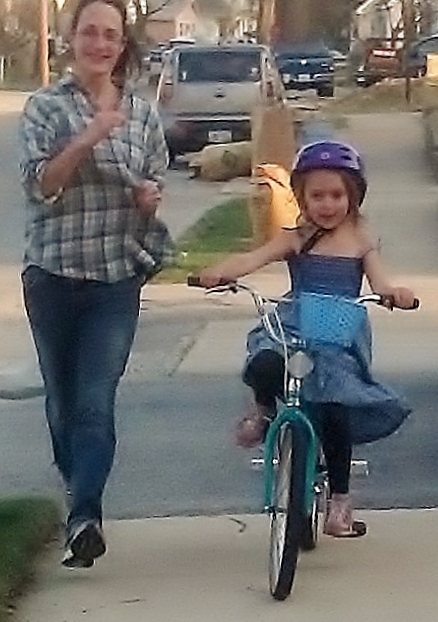
Our five year old granddaughter, Gianna, hit a milestone last weekend with her family in attendance. Her Mom, our daughter Angela, ran behind her with her guiding hand, aiding her balance, teaching her to look ahead, to peddle steadily, to gain confidence, to advance another step like all her prior and future steps. Then Angela let go as all parents must and ran beside her. I was fortunate to see her on one of her earliest runs. Both were grinning widely, Gianna doing a grown up thing, utterly joyful. I apologize for the limitations of my cell phone camera, but the image is there. Gianna told us later that night she felt like she was ten years old. Angela emailed us that “G” was a ‘big girl’ all night, well behaved, helping with dinner and clean up – the felicitous consequence of maturity.  Angela is doing as Rita did for our kids and what mothers have done for millennia – loving and training her children to fly on their own.

Angela is an accomplished young woman with a post graduate degree and certification as a Creighton practitioner, aiding others with natural family planning and infertility. Recently, she testified to a hostile Rhode Island House of Representatives committee and a packed hearing room about fetal development, in which she is well versed. A full time mother of three young girls, she is the furthest one can imagine from a “menstrual slave.” She and her husband, Peter, choose to live on Peter’s income for the most part. They will have fewer things, toys and accoutrement. They will be less obsessive consumers and more focused parents. She is home schooling their children, Gianna, Elena and Mary. They are not an Ozzie and Harriet fifties family, but Pete and Angela choose to be countercultural to a culture distorted by the now established, dysfunctional “counterculture” of the sixties. She is a heroine. She is a mother.

Link to interviews for the ‘toughest job in the world.’

“This afternoon was definitely one of the best moments of my life. Letting go of that bike, I will never forget it, hard to describe.” Angela Barek (my daughter) about her oldest daughter, Gianna, first time flying solo without training wheels or a net.

[i] See the excellent Architects of the Culture of Death, Donald de Marco and Benjamin Wiker, Ignatius Press, 2004

[ii] I recently reread Brave New World, Aldous Huxley, Chatto & WIndus, London, 1932. Still much worth your time.

5 Comments

Filed under Culture views, Personal and family life

Cat Lessons

“Cat lovers turn into cat collectors.”  Greg Kinnear

Visiting my mother Thursday night, my allergic reaction to her three cats remains vigorous, but manageable.  Mom is a lively 93 and entirely unlikely to give up her Cookie, Scout and Checkers companions, so any reaction my eyes and sinuses have to her beloveds is entirely irrelevant – small price tag, really, for still having an engaged, funny, cheerful with infirmity and engaging mother.

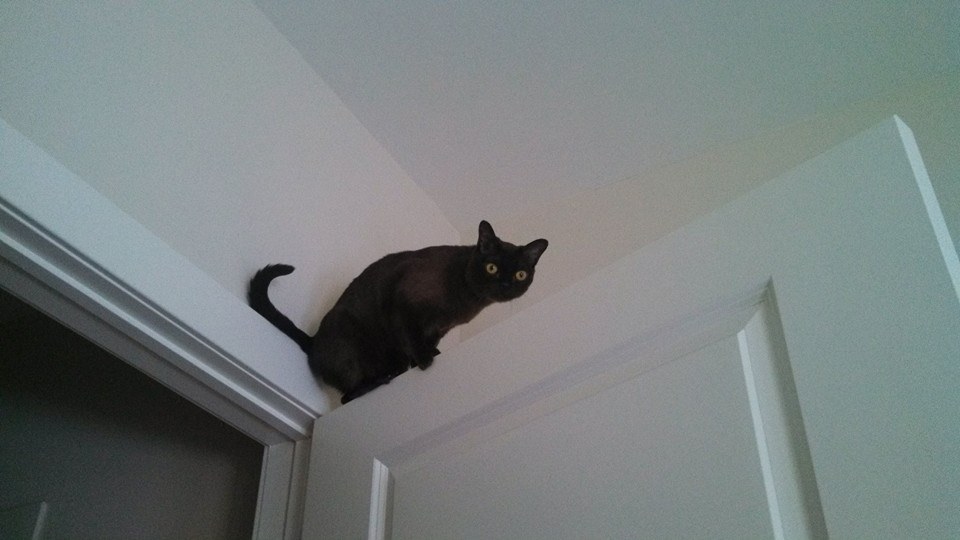
Gabe and Faun's predator

Gabe and Faun’s predator

When our children were young we had a rotating menagerie of cats, dogs, a tragedy of hamsters, a turtle and short lived dalliances with goldfish.  I don’t remember any allergies to any of them, but our dogs and cats were mostly outdoor pets who boarded with us most nights except for Nikki the husky mix who preferred sleeping in the snow.

Occasionally one of the more stupid (always male) cats would dash into the street on a mission and be run over by a car.  We always opted for affording them the short, happy life of climbing, sleeping in the sun, courting (although all were “fixed”), defending their territory and hunting indigenous small fauna – four footed or winged.  As anyone familiar with the dead eye gaze of a cat will confirm, its primitive, tiny brain consists of an ineradicable instinct to survey the field and regard anything less than six inches in height as prey.  I remember an uncomfortable feeling when our cat would stare intently at me probably wondering how different their lives would be if I was the size of an adolescent squirrel.

My mother’s cats are entirely housebound and spoiled fat: friendly for the most part, but with normal feline reserve, comfortable with complete freedom to occupy any space their whimsies fancy.  Allergens abound; they frequently dine on the breakfast bar peninsula, which is an accommodation up with which my nurse wife would never put.  Rita has an aversion for some reason to eating where little feet fresh from the litter box have recently trod.

“You can visualize a hundred cats. Beyond that, you can’t. Two hundred, five hundred, it all looks the same.”  Jack Wright, Ontario housepainter and joint record holder.

We are grateful that our mother’s crazy cat lady proclivity is relatively constrained.  The Guinness Book record was set by Jack and Donna Wright.[i]  The collection started with Midnight, Donna’s black long hair, which had a wild night, then a litter that the Wrights were unwilling to break up.  Next came a few strays; their house gained local celebrity as Cat Crossing.  The count ballooned as anyone with an extra cat or a found cat started dropping them off.  After an appearance on the Phil Donahue show about their record 145 cats in one house, contributions went national and got a bit out of hand.  As Cat Crossing’s reputation grew, cats were couriered or shipped in from afar. 689 housecats was their top count.  The Wrights didn’t have it in them to deny any feline some sustenance.  Costs eventually ran to $111,000 a year, which included individually wrapped Christmas toys.  Each and every one had a name.

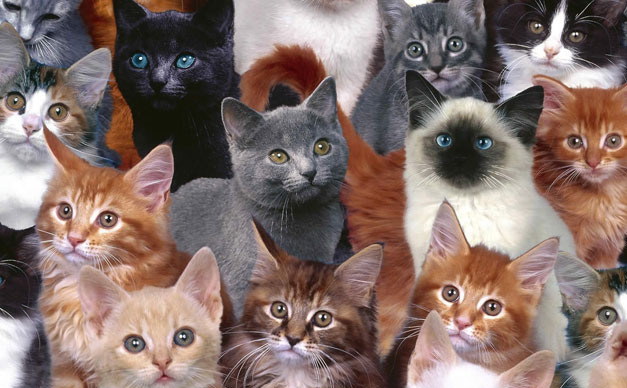
lots-of-catsCat hoarding has a curious relationship with Toxoplasma gondii, a one-celled protozoan parasite which normally reproduces asexually.  Toxo can enhance its gene pool by reproducing sexually, but that can only occur within a cat’s intestines.  If the parasite invades another host through ingestion or just skin contact with cat feces, then humans, monkeys, Beluga whales, bats, elephants, chickens and many other species become unwilling habitat. Once in, it swims through the blood stream directly to the brain.   One third of the world’s human population has Toxo organism in their system.  After the parasite takes up residence, it forms tiny cysts, especially in the amygdala, the center of both pleasure and anxiety in the mammalian brain.  The violated amygdala produces excess dopamine, a potent and manipulative neurotransmitter. These cysts can slow reaction time, induce aggressive or jealous behavior in people and change the human sense of smell, rendering some humans immune to the pungent odor of cat urine.  All the better for cat collectors.

Even more peculiar is the tested effect of Toxo on rodents.  Lab rats hosting Toxo become obsessed with cat urine; they love cat urine; they crave cat urine; they seek out cat urine.  When exposed to it, their pleasure center resonates with the males reacting physiologically as they do around females in heat. Their little rat testicles swell.  Some aspects of cat hoarding are best left unexplored.

“Time spent with cats is never wasted.”   Sigmund Freud

A cat once figured in an important lesson for me many years ago, fixated as I was on escalating complicated solutions and missing the simple one.  We lived in our old farm house in Farmington, Maine; a section of the dirt floor basement was a crawl space.  I kept finding the basement window sash on the ground and the cat in the basement.  A cat prowling in a dirt floor basement quickly leads to a reeking dirt floor basement, so I had asked everyone to make sure she didn’t go down there.  Too often, I opened the cellar door, and a cat would emerge.  I thought we had a very smart cat which could open the window to get into forbidden territory.   Having no time one such morning, I just jammed a shovel up against the sash into the dirt floor and left for the day’s business.  A week later, I discovered the shovel laid over, the sash open and the cat in the cellar. Damn cat, I thought:   smart and strong.  So I took my twenty two ounce framing hammer with two twelve penny nails and secured the sash, leaving the heads proud until I could come up with a permanent fix.  For a few days all was well, then the cat came up the stairs and the nails were pulled out.  The light finally shone on me, and I asked our son Gabe, who was about eight, what he knew.  He told me the crawl space was his favorite undiscoverable hiding spot when the neighborhood kids got together for a rousing game of Hide and Seek.  He said it had been hard to pull out the nails.  I laughed out loud at my stupidity when I told Rita the story.  I learned William of Ockham had taught us something worth knowing with his razor.[ii]

”When my cats aren’t happy, I’m not happy.  Not because I care about their moods but because I know they’re just sitting there thinking up ways to get even.”  Percy Bysshe Shelley


[i] The Violinist’s Thumb, Sam Kean,  Chapter 7, “The Machiavelli Microbe”

[ii] William of Ockham (1287-1347) wrote of “lex parsimoniae” a principle of succinctness to be used in problem solving wherein the hypothesis with the fewest assumptions and therefore the simplest solution is the correct one.

2 Comments

Filed under Personal and family life

Italian Lessons

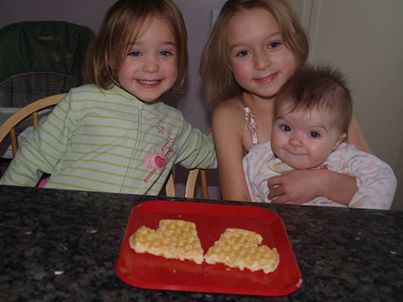
Gianna, Ellie and Mary with a waffleMy daughter, Angela, and her husband, Peter, are home schooling their three daughters, although so far it’s mostly the five year old, Gianna, who is their main focus. Angela has a master’s degree in education;  she knows what she is about.  When Rita and I attempted to home school Angela and her younger sister, Meg, many years ago, far fewer resources and a much smaller support group of like minded parents were available.

Angela belongs to a co-op group of home schoolers which meets weekly; parents take turns putting together classes on reading, writing and ‘rithmetic, as well as science, history and other topics scaled for the younger kids.  Gianna and Ellie (Elena) also are participating in Italian lessons, taught by our mutual friend, Francesca, who is another home schooling mother of three.  Angela studied four years of Italian and visited Italy extensively while studying abroad, so can reinforce the lessons at home.

Francesca taught Italian at the university level and holds advanced degrees in art history from Columbia and Yale.  She is fluent in Italian, the daughter of first generation Italian immigrants and grew up in Queens.  In manner and spirit, Francesca is quintessentially Italian.  We have greatly benefitted from some of her recipes; her cooking is locally legendary.  Once when Rita was unwell, Fran sent over a meal.  With most, a meal sent over to help a sick friend would be a casserole; with Fran, her husband Matthew delivered a five course meal which filled up the back of his station wagon.  She included extra prepped vegetables and a recipe to turn the leftover chicken into a delicious soup.

Gianna came home from her early lessons with perfectly pronounced Italian renditions of her favorite colors.  For me, a Rosetta Stone Italian failure, it was most impressive.  No surprise, a recent lesson turned to food.  The kids glued samples of various pasta varieties to a poster board and learned not just their Italian names, but their descriptive origin and translation.  Vivid pasta names reveal an amusing look into Italy and her people, an earthy candor – a natural humor.

  • Penne — quill or pen.
  • Spaghetti – twine or string.
  • Linguine – little tongues.
  • Vermicelli – worms.
  • Farfalle – butterflies.
  • Occhi di lupo – ribbed wolf eyes.
  • Fusilli – little screws.
  • Orecchiette – little ears.
  • Capellini – thin hair.

Americans may be prickly about tucking into a heaping plate of ears, little tongues, thin hair, worms, butterflies, screws or string, but to the Italian comfortable with coarse reality, such a feast poses no difficulties.  Americans will stick with the mellifluous and mysterious, thanks.  Spoken Italian makes the commonplace sing.

“Italians know about human nature – they understand human nature perhaps better than anyone else does.  They know that people are weak and greedy and lazy and dishonest and they just try to make the best of it; to work around it.” Donna Leon (author of the acclaimed Commissario Guido Brunetti crime novels)

For those who grew up with little exposure to Italians, what comes easily to mind is at best Rocky Balboa, Mussolini’s punctual trains or unstable governments that dissolve every few months and at worst Goodfellows and Don Vito Corleone.  I grew up among a large Italian community replete with barbers, grocers, dentists, doctors and contractors (and married a half Italian beauty).  What comes to mind is effortless laughter and love, quick wit, flashing eyes, effusive, loud communications, food, food, food and warmth – always warmth.   The many Italians I came to know did not suffer fools patiently and gifted their loyalty carefully, but once gifted would sacrifice life, limb, treasure and sweat – unabashed and all-in.

Italian lessons are lasting: Rome, Latin based languages, Leonardo, Dante, Michelangelo, Florence, Venice, the vineyards of Tuscany, Pompeii – surely more than a lifetime of lessons. A personal beloved for me is Italian opera: Puccini, Rossini, Donizetti, and the incomparable Giuseppe Verdi.  Just as “capellini” converts “thin hair” into delectable, so does “Si: corre voce che l’etiope ardisca sfidarci ancora, e del Nilo la valle” transform “Yes, there are rumors that Ethiopia dares to continue to defy our power in the valley of the Nile” into delightful (Verdi’s Aida, first act).

You may prefer “E lucevan le stelle ed olezzava la terra, stridea l’uscio dell’orto e un passo sfiorava la rena” to “The stars were shining, And the earth was scented. The gate of the garden creaked and a footstep grazed the sand.”  From Puccini’s “Tosca” as sung by Luciano Pavarotti.

Italian opera is hyperbole, drama, red emotion, and its American counterpart morphed into both the musical and the soap opera, but there is no inclusive analog.  My favorites are the duets, trios and quartets with the interplay of beautiful voices.  Listen to Joan Sutherland and Pavarotti singing the star crossed, impossible beginning of the love of Alfred for Violetta in Verdi’s “La Traviata” (“The Lost”) (Plot summary here) in “Un di felice” and the inevitable tragic end in  “Parigi o cara”.  If you have little familiarity with Verdi, close your eyes, shut down preconceptions and just listen.

La TraviataAlfredo: Un dì, felice, eterea, Mi balenaste innante, E da quel dì tremante Vissi d’ignoto amor. Di quell’amor ch’è palpito Dell’universo, Dell’universo intero, Misterioso, altero, Croce e delizia cor. Misterioso, Misterioso altero, Croce e delizia al cor.

Alfredo: One day, you, happy, ethereal, appeared in front of me, and ever since,trembling, I lived from unknowed love. That love that’s the pulse of the universe, of the whole universe, Mysterious, proud, torture and delight to the heart. Mysterious, mysterious and proud, torture and delight to the heart.

Violetta: Ah, se ciò è ver, fuggitemi, Solo amistade io v’offro: Amar non so, nè soffro Un così eroico amor. Io sono franca, ingenua; Altra cercar dovete; Non arduo troverete Dimenticarmi allor.

Violetta: Love, I fear, can never be, Friendship is all I can offer. Since love is pain and torment, I avoid that strange emotion. Pleasure is all I ask of life, Freedom and joy forever! So you must soon forget me And find another love.  

*********************************************************************************************************************

Alfredo:  Parigi, o cara, noi lasceremo, la vita uniti trascorreremo. De’ corsi affanni compenso avrai, la tua salute rifiorirà. Sospiro e luce tu mi sarai, tutto il futuro ne arriderà.

Alfredo:  We’ll leave Paris, my dearest, Together we’ll go through life. In reward for your past sorrows, You’ll bloom into health again. Breath of life, sunshine you’ll be to me, All the years to come will smile on us.

Violetta:  Parigi, o caro, noi lasceremo, la vita uniti trascorreremo. De’ corsi affanni compenso avrai, la mia salute rifiorirà. Sospiro e luce tu mi sarai, tutto il futuro ne arriderà.

Violetta: We’ll leave Paris, my dearest, Together we’ll go through life. In reward for your past sorrows, I’ll bloom into health again. Breath of life, sunshine you’ll be to me, All the years to come will smile on us.

Can longing, loss and love be better expressed?

The gift of human voice, music and the creative soul are most profoundly conveyed in these works:  gratuitous beauty fashioned out of our genes, our talents, our dedication and commitment for no other reason than we humans are capable of it.    To this simple soul, such expression of human goodness rivals the genius of St. Thomas Aquinas in his Summa Theologica for sublime proof of the existence of a loving Creator.

“Italians come to ruin most generally in three ways, women, gambling and farming.  My family chose the slowest one.”  Pope John XXIII (Angelo Giuseppe Roncalli), soon to be St. John in April)

3 Comments

Filed under Personal and family life

Good Friends Never Let You Down

Not to imply that we occasionally can’t be disappointed in our friendships (or be disappointing to our friends), but that in the best of friendships, we always find a way to work things out.  Through those friendships we are led to new insights and a deeper understanding of our lives and of ourselves.   In one of the Maine Tales posts, I wrote of our return to our faith and the Church thirty eight years ago.  Here is that post: Maine Tales IV – The Road Not Taken and an excerpt from it, when we met our good friend, Father Joe McKenna:

We looked up Catholic Churches in the Yellow Pages (an anachronism now).  Mount Vernon was at the center of a fifty mile circle roughly encompassing Augusta, Waterville and Farmington.  Rita worked part time as an RN in Augusta, but Farmington for some reason attracted us.  I called St. Joseph’s Church in Farmington; a friendly voice picked up with a lively, “St. Joe’s!”  Father Joe McKenna answered his own phone calls and was nearly perfect for hurting children of the sixties — an admixture of intellectual, poet, faith filled priest and wonderfully warm and funny human being with holes in the elbows of his sweaters. We entered the little, wood framed church on a side street, far smaller than the Baptist, Episcopalian and Congregationalist stone and brick edifices on Main Street.  It was Pentecost Sunday, no happenstance, and Father Joe was alive with the Spirit.

Father Joe has been what he calls semi-retired now for quite a few years and lives in Portland.  He remains active with nursing home work and a prison ministry, but we keep a valued, long distance friendship with emails and too infrequent visits.  As I have occasionally done with others, I’ll take advantage of Father Joe’s writing to share with permission a recent correspondence.  If there are seeming non sequiturs, the errors are mine.

Father Joe, now eighty three, clearly has lost nothing off the fastball and enjoys very much new knowledge.  The email exchange was initiated when Father Joe responded to the post a couple of weeks ago.  Even with editing for brevity, it is still quite lengthy, and I hope you find worth your time and attention.

Father Joe: Hi Jack and Rita.  Very, very interesting.  At last I know the reason why mitochondria passes only though the mother.  Simple enough when you know why.  Merry Christmas to you and yours and many OF them!

Jack: Really enjoyed “Time To Start Thinking” and thank you again. His observations and analysis do get me thinking as we all need to be.  His solutions, when he proposes them are a little too Keynesian and pessimistic for me, but well worth consideration.  A book I would recommend to anyone.  Glad we could clear up mitochondria once and for all.
Love from RI, j&r   

 (Note:  Father Joe had sent me a book he had read, Time to Start Thinking: America in the Age of Descent, by Edward Luce, long time economics writer for the Financial Times of London.  I would recommend it to all who have interest.)

Father Joe: What I found about the book is that it is a series of interviews about what each person thinks is going on.  Then you can draw your own conclusions.  It must be fantastic to have descendants!

Jack:  Terrifying actually.  What have we wrought, and what are we handing on to those descendants?

Father Joe: Oh come on.  It’s Christmas… when we concentrate on the virtue of hope! A lovely virtue.  I discovered it in the seminary sitting next to Mike McManus..… Anyway because he was McManus and I was McKenna sometimes we sat together.  He was filled with hope and happiness and gradually he worked on me to get rid of some of my negativity.  He recommended a book “God Speaks” by Charles Peguy.  I will send you a copy from Amazon.  It changed my life.  Have a merry one!

Jack:  You are right, of course.  And not just for the Christmas season… When I get all cataclysmically dreary and cosmically anxious, I must refocus on gratitude for the many, many blessings in my life and stop whining.  And you, dear friend, are one of the blessings.  I’ve read some of Charles Peguy’s poetry, but can’t remember if I’ve seen that one.

Several exchanges ensued about Peguy’s and Luce’s books, then this.

Father Joe:  Do any of your kids have troubles with science and God?

Jack:  (Note:  Name and identifying pronouns left as ***) I think ***** has the most trouble with faith and science…  If something cannot be demonstrated, touched with any of the five senses or proven with the scientific method, it is discounted.  Completely eludes *****.  Certainly intelligent and realizes that acknowledging God and especially Jesus requires a response…, so *** holds *** ground…  That atheism is every bit as much a leap of faith (and with vast gaps that require invincible credulity) as belief and trust in God, *****does not yet see.  But we are working on it.

Anyway, the prayers of our first pastor would be greatly appreciated for*** faith and the faith of all my children.

Father Joe:  It always comes down to three:  Belief in the Eucharist, belief that Jesus is God, belief in a creator.
(1)  The Eucharist is the Body and Blood of Christ.  Rome accepts the Orthodox Eucharist.  This is not one of the problems that keep us apart.  A Catholic may receive Communion in an Orthodox Church if no Catholic church is available… and, as you know well, we were together for 1000 years.  The Orthodox belief in the Eucharist is interesting:  “The Eucharist is the center of worship in the Orthodox Church. We do not explain scientifically how the bread and wine become the Body and Blood of Christ.  Orthodox Christians believe that during the Eucharist believers partake mystically of Christ’s body and blood and through it receive his life and strength.”  This is acceptable if one has a problem using Aristotle to explain the Eucharist.
(2)  Jesus is God.  Perhaps a new book might be helpful here: Jay Perini: “Jesus, the Human Face of God.”
(3) There is a Creator.  If I can find an essay I wrote for the Portland Press Herald, I’ll send it on.
Happy New Year!

Jack: I’d love to read your article, and it’s easy to get too far in the weeds with the Aristotelian substance and incidentals explanation, so that’s helpful…  I’ve tried to explain to ***** that it’s Fides first, then Ratio. I’m with Pascal on this; faith is first of the heart, imagination and will.  Not irrational by any means, but the mind and the intellect support faith, and understanding follows the decision.

We come first to faith through love, like the love of a small parish priest for his flock leads them to Love.  I guess that is what is most disappointing – that the love from the parents was insufficient to overcome skepticism and incredulity (regarding faith).

I’ll let Father Joe McKenna’s piece end the post. He needs no help from me.

Okay so how DID we get here?

I watch a lot of science programs… on PBS and the History Channel. I have a pretty good science grounding… for an amateur. I’ve been keeping up with the latest in Quantum Physics and Astronomy and the Origins of the Universe. I heard Stephen Hawking say on TV lately that you don’t need a creator to explain where the universe came from… particles just appear and disappear at random. I watched Brian Greene’s “The Fabric of the Universe.” He is a spokesperson for that scientific community who are investigating this very interesting topic.

Let me set up the problem that Greene’s community is involved with.

Here I am sitting at my computer typing this essay. Back 12 billion years ago there was nothing but quarks. So how did I get here from those quarks and why am I smart enough to write this essay?

If I do not accept a creator then the only solution is that I got here by chance; yes, the same chance/luck that is involved when you are sitting at a slot machine. (Well, not exactly because they are fixed to favor the house.) But explaining how I got here by chance requires a lot of lucky outcomes. Here are just a few: By lucky chance stars were formed; by lucky chance our sun was formed to be just the right size; cosmic dust was attracted by our sun and formed planets and by lucky chance one of them…the planet earth… was just the right distance from the sun to have the right temperature and just the right weight to keep its atmosphere from spinning off, etc., etc., etc. All these strokes of luck are now called the “Goldilocks effect”: everything had to be “just right” for life to even start.

What are the chances that each of these fortuitous circumstances would happen (and there are many thousands)? And they must occur at a given moment in the progress of the universe, because if they don’t happen at the proper instant as the universe progresses they do not have a second chance. You can’t go back and try again.

Just like you have to pull the lever on the slot machine quite a number of times…and fail… to finally get the lucky prize, so there has to be multiple universes in which the chances for all these events can play out… and fail… to finally get a universe (ours) and a planet (ours) where life can evolve and I can sit here at this computer. The task that Greene et al have set for themselves is to put into mathematical formulae all the variables that go into all these chances happening, ultimately resulting in me sitting here. It takes more than one blackboard on which to write them all out.

They use the mathematics of Statistics. (Yes, what you learned as seniors in high school.) That’s what all those equations are that fill their blackboards. This is what Steve Green means when he keeps saying “mathematics says that you have to have billions of this or billions of that”… and of course he is right… you would have to have billions of universes if everything depended on chance. And because he is a philosophical Determinist (no free will… everything is “determined”) he goes one further: he maintains that in some of these universes there could be another person just like you.

Do you have to accept this elaborate hypothesis? (Don’t forget, it’s only an hypothesis… not even a theory…unproven.) Will you be considered a science denier if you don’t? Will professors look at you with a condescending smile?

They probably will. We’re supposed to be intimidated by all those equations on those blackboards. Because we’re not cosmologists in the halls of science it can be considered “rubey” (do they still use this word?) to disagree with these very learned researchers.

But hey, you know what? They put their pants on one leg at a time just like the rest of us. Yes, they have doctorate degrees. I know lots of people who have doctorates. I knew a Doctor of Literature one time who believed that the world was made 6000 years ago! My physician has a doctorate. And you know what he tells me? That I have to manage my own health. He is there to give me yearly physicals and to refer me to specialists if the need arises but I have to manage my own health.

I keep up with science. I keep up with Biblical Studies that investigates the meanings of the opening chapters of Genesis. I listen to physical and astronomical scientists explaining their hypotheses… I look at their evidence with an open “scientific” mind. But I manage my own world view.

Some of these scientists, you know, are not even following the scientific method. Scientific method says you start “with an open mind” and proceed to gather evidence no matter where it leads you. And if you find there are two possible conclusions, you follow the principle of Ockham’s Razor and accept the one with the least complications. But if you start with the premise that there is no creator and then proceed to weave theories that back that up… complicated theories… multiple universe theories… is that science?

And as for Steve Hawking: yes particles can come in and out of existence seemingly by themselves. But to conclude from this that the universe came into existence by itself is more than a stretch… it’s not good science.

My advice to the Brian Greenes et al is to put away your blackboards for a while and come out into the real world. Take a walk in a park or by the seashore. Many a genius has come up with an important inspiration walking along the seashore. All these universes you are positing… wouldn’t it be a lot more “economical” and logical scientifically to search for a creative force… of some sort… somewhere?


2 Comments

Filed under Maine Tales, Personal and family life

Walden Pond Walk

Walden Pond Autumn

Walden Pond Autumn

“I went to the woods because I wished to live deliberately, to front only the essential facts of life, and see if I could not learn what it had to teach, and not, when I came to die, discover that I had not lived”  Henry David Thoreau, Walden

A few weeks ago, we stopped at the site where Henry David Thoreau built his cabin and walked nearly two miles around the pond. In early November, autumn has settled deeply in, and winter approaches.  The woods in which he chose to pare down to essentials remains.  The chestnuts and the elms are gone, but red oak, white oak, white pine, Canadian hemlock and white spruce remain sprinkled with alder, paper birch and poplar – resplendent with the New England fall palette.

Oak leaves cling late into the year, some persist nearly until spring like pleasant regrets and hope for an annual reawakening.  The peace of the place and the replica cabin where he lived so simply leads to long thoughts.  My friend, Anthony Vinson from Atlanta, who has been referenced here before, sent this out in his pre holiday newsletter:  the concept of happiness through the accumulation of stuff has failed.  Of course, he is right.

“(We) ought to use the world, not become its slave.  And what does this mean?  It means having, as though not having.”  St. Augustine

On Thanksgiving Day, we gather with family and friends, mindful of the many blessings of our lives, most especially the beloved we gather with and those beloved who gather in other places.  If we preserve a Thanksgiving tradition asking around the table for that which we are most grateful in the past year, rarely will it be a new car or flat screen television.  Health renewed or new found faith, the birth of a grandchild, the steadfast love of our children and spouse, perhaps a fresh job or reuniting with a long separated loved one – those are what we cherish.

Gratitude as a way of life brings us happiness.  Joy follows peaceful reflection on captured opportunities to love in our lives.  We are not grateful because we are happy; we are happy because we are grateful.  Even in our most trying circumstances, we are most able to cope with patience and love because of gratitude for our many blessings – past, present and future.

Father James, our pastor at St. Patrick Church, reminded us this morning that thanksgiving is not just an annual dinner, but we should be thanksgiving people every day — several times a day.  Each day offers many moments and occasions to be grateful.  When we pause, reflect, are thankful and then go forward with loving thoughts, words and actions, we become most happy.  All of us have many chances to grow,  to love, to get it right, however our spins around the sun on this tired old planet are finite.  Eventually we run out of mulligans.  We ought not to waste them in trivial pursuits and barren quests to fill the hole in our hearts with non essential and ephemeral goods.

“When a potter is making a vessel and it becomes misshapen or breaks in his hands, he shapes it again; but once placed in the oven, it is beyond repair.”  Unknown second century homilist. 

4 Comments

Filed under Personal and family life

“Don’t Fence Me In”

“I can’t look at hobbles and I can’t stand fences” from “Don’t Fence Me In”, Cole Porter

-fencingConstructing wood fence in the early sixties was my first grown up job.   Having moved on from paper boy, caddy and haying on a diary farm for $1 per hour cash when I was fifteen, my father introduced me to three brothers and their father, Vito.  Each brother practiced a specialty with their own companies, but they conferred daily, so that an employee once hired shifted from installing fence to installing swimming pools and driveways or framing houses, all of which I did when I turned 16.  I settled into the fence business primarily and worked through high school and most of college.  When I turned eighteen, I was awarded my own small crew, a large stake body truck and got paid by the foot.  In a productive week, I could earn two hundred and fifty dollars, a modest fortune in 1965.

We were expected every day to put in twenty sections of six foot cedar picket fence with a gate or thirty sections of post and rail a day.  Each post for a six foot fence was buried roughly thirty inches deep.  If it was sandy and light, a hole could be dug with our hand posthole diggers in under ten minutes.  If we ran into what we called “hard pan” – packed clay that felt like rock – and ran into large stones in our hole, one post could take a half an hour of sweat.  For this tough digging, a posthole digger alone was inadequate, and we would thump away with a heavy iron bar to loosen each grueling scoop.  The bar was hexagonal in section, weighed fifteen pounds, about fifty inches and sharpened to a point on a stone wheel grinder.  No power augurs for us.

Each day we would be assigned to a customer’s home, loading up in the morning the right amount of fence panels, line posts, end posts, corner posts and gates to erect in wood the sketch and specifications agreed to in the contract the owners signed with our salesperson, Eddie.    We built calluses and muscle; and many days were an adventure.  The north shore of Boston, where land was dear and the ground hard, was most challenging.  Once a neighbor came out and spotted the thick string we stretched along the lot line and against which we planned to dig holes and install a fence.  He ran into his house, came out with a hatchet and cut our line in five or six pieces.  I told our customer we’d come back when he sorted out his border dispute.  No extra charge for the lost line.

Occasionally a big job would take more than one day, and we would return to a site. One such project was over four hundred feet of six foot fence around a oversized lot in Revere in which a new in ground swimming pool had been bedded.  Most people with a new pool surrounded it with an unassuming enclosure to meet the building code and prevent uninvited kids from drowning.  This family wrapped their entire yard.  One motive for this barricade became apparent the first afternoon, when the seventeen year old daughter came out to tan in a bikini that failed to cover much of anything.  My distracted crew soldiered on.  They hoped the next day would be sunny.

A bikini is like a barbed wire fence.  It protects the property without obscuring the view.” Joey Adams

Her parents remained on the property all day, which seemed odd to us.  In 1965 most men who had money enough for pool and fence were at work themselves.  The father was a handsome Italian in his early forties, unpretentious, reserved, but friendly, who brought us cold drinks and snacks.  The second day he charcoal grilled us hamburgers for lunch.  I respected customers who took care of the crew – not only for their kindness – but for their intelligence to extract quality workmanship from the young men who wanted to please them.  When we finished, he tipped us generously in cash.

I told Eddie about the family (including the daughter), and he responded with a cautionary tale.  The father made a lucrative business out of killing people.  This affable soft spoken father would get on a plane from time to time, fly to Las Vegas or Detroit or Kansas City, spend a day or two and come home with a lot of cash.  Some other father in Las Vegas, Detroit or Kansas City wouldn’t come home.  Although locally affiliated, he never worked close to home.  I accused Eddie of making up one of his frequent stories, and he remained silent and unsmiling.  Eddie knew things. A few months later during an outbreak of the murderous gang wars between the Italian mob and Whitey Bulger’s Winter Hill gang, I read in the Boston Globe of a body dumped in my old fence customer’s driveway – not his.

“Don’t ever take a fence down unless you know the reason it was put up.”  Robert Frost

I was reminded of the story this week when reading about the Federal circuit court decision upholding the new Texas law that required doctors doing abortions to maintain admitting privileges in a hospital within thirty miles of their clinics. (Bear with me for the connection.)  Supporters of unfettered abortion claim this law is restrictive to a woman’s “right” to take her child’s life, even though the law specifically states it is to protect women’s health when there are complications, such as excessive bleeding, sepsis or a perforated uterus.  The defender’s rationale is that abortion doctors often come from other states or at least from a far flung part of Texas, so they don’t admit enough patients to qualify for hospital privileges.

Elaborating, they contend that it is necessary for these doctors to live other than where they ply their trade because abortion protesters make it uncomfortable or even dangerous for them.  We’ve know many of these “abortion protestors” who “intimidate” these doctors.  Almost all of them are armed with rosary beads or an occasional sign.

Could it be that they live in other states or locations hundreds of miles away because they prefer to fly in from their home environs, do their work for a day or two and fly home, while at least half their patients won’t ever go home?  The neighbors and their daughters may never know how their parents pay for the pool.

“Euphemism is a human device to conceal the horrors of reality.”  Paul Johnson

1 Comment

Filed under Culture views, Personal and family life

Broken Music

Angela and Meg on Lake Webb, Weld, ME circa 1988

Angela and Meg on Lake Webb, Weld, ME circa 1988

Music is well said to be the speech of angels.  Thomas Carlyle

Twenty five years ago we were walking the neighborhood with our two youngest daughters, Angela and Meg, when three year old Meg took note of sewage back up.  “Dad,” she said, “someone is having a yucky cookout!”  I had been pondering the science that concluded that all smells consist of millions of tiny particles spewed from their point of origin; she was trying to make sense of a new experience as all children will do.  At first I was confused, and then all became clear.  Meg’s experience of outdoor smells was mostly of hamburgers, hot dogs and chicken on the grill.  This was an outdoor smell, but made her queasy, therefore….

“Yucky cookout” wasn’t Meg’s mistake; it was someone else’s misfortune.

Without music, life would be a mistake.  Friederich Nietzsche

Our first grandchild, Gianna, is now five, the daughter of Peter and our next to youngest daughter, Angela.  They live a couple of blocks over, and we see them often.  When a car passes with windows down presumably to assault the rest of us with make-believe gangsta toughness, she takes note of the pulsing onslaught at decibel levels which would require OSHA approved ear protection.  Occasionally, she will mimic Peter’s response, “Thank you for sharing,” but she adds her own refinement to this auditory mugging, “Thank you for sharing the broken music.”  Much young wisdom lies in this analogy.

Gianna and Ellie on Lake Webb 2013

Gianna and Ellie on Lake Webb 2013

Since well before she was born, as her mother had, Gianna listened to magnificent sounds that are sometimes elevating, sometimes spiritually stirring, sometimes peaceful. Mozart, Verdi, Tchaikovsky, Debussy, Chopin, but also an eclectic medley of Norah Jones, Doc Watson, bluegrass from Alison Krauss or old Nitty Gritty Dirt Band albums like “Will the Circle Be Unbroken”, Nat King Cole, Dave Brubeck and many others.  She is in her second year of ballet lessons – her teacher, Jamie, danced as Sugar Plum Fairy for the same “Nutcracker” Christmas productions in which Angela and Meg danced.  Our parish is lively – the whole congregation at Sunday Mass, including the children, sing uplifting songs.  Her whole young life has been immersed in beautiful music.  Gianna’s response to music often is to break into spontaneous dance; her two year old sister, Ellie, imitates her as she sweeps into the living room with kindergarten chassés, petit jetés and demi-pliés. This is so reminiscent to us of her mother and Aunt Meg at that age.

“Broken music” wasn’t Gianna’s mistake; it was someone else’s misfortune.

Music expresses that which cannot be said and on which it is impossible to be silent.    Victor Hugo

Admittedly, hip-hop and rapping are estranged from me, and I remain ignorant of their nuance (if nuance isn’t a bridge too far for them); they evolved from and were a reaction to the dismal disco of the seventies. Disco also spawned the early sampling of rave techno and house music.  These genres are contrived offshoots, but allegedly reflect an alienated culture: outraged anger or frenetic coupling — joyless, addictive, frequently drugged out, adrenaline fueled thrill and pleasure-seeking without succor or respite or ascent of the spirit.  They seem to me to stink of stale sweat, testosterone, hostility and lust void of love. For your edification, here’s a small sampling:

Smoke any as***le that’s sweating me
Or any motherf**ker that threatens me
I’m a sniper with a hell of a scope
Takin out a cop or two they can’t cope with me

F**k the Police – NWA (Dre)

And I’m gunning for your spouse
Tryin to send the b***h back to her maker
And if you’ve got a daughter over 15
I’m gonna rape her!

X is Coming for you – DMX

So I f**ked your b***h you fat motherf**ker!
Hit ‘em up – 2pac and The Outlaws

Music is intended and designed for sentient beings that have hopes and purposes and emotions.  Jacques Barzun

Angela posted a video on her Facebook page this week, which is well worth the four minutes it takes to watch, about the Landfill Harmonic Orchestra.  Brimful of gratitude for the many blessings in my life, I marvel at the elegance brought up like precious stones from the refuse.  The creators of the video tell of an enormous landfill in Cateura, Paraguay, on which thousands of people live and rely upon for sustenance, recycling trash and selling it.  Some of the youth have been organized by volunteer musicians and teachers into an orchestra; they play instruments fashioned from other people’s junk.  Bebi is a nineteen year old who plays a cello, he tells us, made from an oil drum and salvaged wood; the pegs are made out of an old tool used to tenderize beef. He plays a credible version of the J.S. Bach Prelude from Unaccompanied Cello Suite No. 1 in G Major, which you may recognize from the Galapagos Island scene in the Russell Crowe movie, “Master and Commander.” These children play Handel’s Water Music and many other pieces.  From out of the most wretched conditions, they draw beauty.

The machine nature of hip-hop and techno music draws alienation from what was once meaningful:  sampling and repeating and hammering away with no instruments made by hand out of real materials – wood, gut and steel string, reeds, brass and craftsmanship.  The derivative nature of hip hop requires not as much musical ability as some sophisticated electronic gear – a DJ and a recurrently angry and misogynist MC.  Where the Landfill Harmonic Orchestra recaptures harmony and beauty from deprivation; the rappers distort into depravity what was once harmonious.

Rita and I played guitar and banjo when our kids were small and sang a lot with them; Rita also plays an accordion, a legacy from her childhood.  Angela and Meg played piano and flute; Gianna this morning told us she wants to play piano or violin.  She has lovely hands with long, strong fingers that will help her to do that.  She has expressed no interest in learning to “scratch” a turntable or to “play” an electronic beat maker or synthesizer.

For Gianna and for me, sadly, there is “broken music” without redemption or real meaning to draw us closer to one another or to lift our souls.  Perhaps this brokenness exposes a broken culture; if so, it is a culture Gianna chooses not to embrace.

My life would be worthless without music….. People realize that we shouldn’t throw away trash carelessly; well we shouldn’t throw away people either.  From two of the players in the Landfill Harmonic Orchestra

If music be the food of love, play on.  William Shakespeare

5 Comments

Filed under Culture views, Personal and family life

The Perfect Strawberry

The perfect strawberry is a complicated business, and one in which I am not particularly adept. To understand this year’s crop requires a history.

Twenty years ago in Providence, an 80’ Norway spruce in our back yard made the transition from playground and shade provider to weed.  Conifers have been around this tired planet for 200 million years, a vital component of many ecosystems.  Their names are strong, evocative – even poetic:  Sitka Spruce, Pacific Silver Fir, Lodgepole Pine, Incense Cedar, Mountain Hemlock, Baldcypress, Redwood, and Tamarack.   Evergreen is a misnomer.  Each species has its own timetable, but they shed their needles every year like deciduous trees, some with a striking fall yellow.  Their narrow pointed leaves carpet the earth, but they only drop older needles with the current crop (or several year’s worth) remaining to hold ever-green all winter.

In the early nineties, this illustrious past made no difference to me: the needles and shade killed what little lawn I had in my tiny city lot; the sticky, Norway-Spruce-conesgolden drippings from the bark bonded to the finish of our cars; cones devastated our bare feet, and the 18” limbs hung like the Sword of Damocles over my garage, only five feet from its thirty six inch trunk.  We had no hope of a garden, and the pin oak I treasured twenty feet north of the spruce was beginning to deform to find sun of its own. The Norway spruce which had been planted by the previous owner of our home in the 1930’s was sixty years later a tall and heavy weed.

After we moved to Providence, my son designed and built a refuge with his new city friends.  Scavenging from the dumpsters in a six lot subdivision a quarter mile away, they cut and fit remnants of two by fours, two by sixes, half inch plywood and discarded loose nails into a tree house fifteen feet up in the Norway spruce.  My only contributions were a blue tarp to waterproof the roof and, after setting a rope in place, teaching Gabriel how to foot lock up the rope to his sanctuary.  I did go up to reassure his mother that although not OSHA compliant, it was habitable and secure.

The three wings, each long enough to accommodate a sleeping bag conjoined into a four foot square parlor under a three and a half foot ceiling.  Once they hoisted themselves up and pulled the rope up after them, parents slept secure that no marauders could easily access their fortress.  The boys ran an extension cord from Gabe’s window for a light, and when they each stretched out on their bags facing inward, the center afforded ample space for card playing, scarfing down Twinkies, Cokes and Doritos (fare foreign to his mother’s kitchen), tale telling and planning night excursions into the city.  We naively thought they were safe from the city; years later we learned the city wasn’t safe from them.

Unbeknownst to their parents, two in the morning expeditions wandered as far as the bus tunnel steeply descending the half mile from Brown University Hill to South Main Street near the courthouse three miles from our house.  The tunnel was a traffic free route for public transportation connecting the university communities of Rhode Island School of Design and Brown to downtown.  Pitch dark, except when a bus caromed through lights ablaze, the tunnel was an irresistible challenge for pre teen skateboarders.  Even in the nanny state days of ubiquitous helmets, boys will find ways of courting danger to grow into men.  They all survived – no fractures or paralysis.

The boys grew to manhood, and the young man helped his father dismantle the abandoned refuge and cut down its pedestal, now a weed.  With chainsaw, climbing saddle and ropes, we worked for two days first lowering the large limbs over the garage from the bottom up, and then popping the top twenty five feet into the small target circumscribed by the back fence, the pin oak, the garage and our house.  After all the limbs and top were safely cut up on the ground, three more ten foot logs were dropped one at a time from the remaining pole.  Last was the twenty five foot trunk, which we notched and felled onto the mark.

With the spruce gone, several years went by before we dug in a twelve by twenty foot raised planting bed in the sunny spot salvaged from the spruce’s shade.  Hundreds of pounds of organic compost built up top soil, and lime sweetened sixty years of acidic spruce needles.  First there were flowers, a lilac and a butterfly bush.  Later we reverted to our Maine habit of vegetable and herb garden.  In the tiny plot, we plant tomatoes, lettuce, zucchini and an occasional ill advised venture into peppers or pole beans.

strawberryTwo years ago, we put in some strawberry plants, which quickly expired for horticultural reasons unfathomable to amateurs.  Last year I tried again, and they took.  The few miserable fruit that exposed themselves were quickly consumed by birds just as they matured.  Undeterred, this winter I protected them with boards as we stored our firewood in the garden.  Unsure what I would find this spring, I was pleased to find they had prospered under the tarps and four cords of oak and maple.

Spring arrived; I weeded and raked in yet another few hundred pounds of dried manure and planted this year’s crop of vegetables.  The four strawberry plants looked so promising I planned to buy some bird netting to defend the harvest from predators, but waited until the weekend, which as it turned out, was three days too late.

Memo:  buy bird netting early next year.

Last week, while watering the garden at five AM as is my habit, I glimpsed half buried red under one of the strawberry plants.  With faint hope and mounting joy, I gently uncovered just ripened perfection.  I briefly considered saving it for Rita, but she was asleep after all.  I washed off the soil, admired God’s wondrous variety for a few moments and bit into sweet delight after a bitter winter.

“It is better to limp along the way than stride along off the way.  For a man who limps along the way, even if he only makes slow progress, comes to the end of the way, but one who is off the way, the more quickly he runs, the further away he is from his goal.”  Thomas Aquinas

5 Comments

Filed under Personal and family life

Pet Tails

We are pet-less, now, if you don’t count grandchildren, but in the past a small menagerie of somewhat domesticated fauna has graced our path.  Mostly cats and dogs, but occasional hamsters, rabbits, laying hens and completely useless goldfish have come and gone.  By gone, with the goldfish, I am referring to their final resting place, which usually requires just one flush.  Cats and dogs are more complicated.

“Cats don’t like change without their consent.”  Roger Caras

First there were Sam and Harry, who had to be jettisoned to other family members when we moved.  Another half dozen or more cats have drifted in and out of our lives, the last being my favorite, Mama Cat, who died in the bushes out back (as cats are wont to do) after just over twenty years with us.  She used to sleep on top of Meg’s head when she lived here.  Meg attributes that resting spot to affection; I would tease her that Mama Cat liked to be warm, and the crown of her head was an efficient source of heat.  Since our cats were always outside as well as inside cats, every once in a while, Meg, especially, would wake up with flea bites – the price of feline fondness.

Typical for their species, our cats were languid, detached and generally disinterested in pleasing humans —  as happy on a sunny window sill as curled on someone’s lap.   On their whim (not yours) they would purr, rub up against a leg or jump on the table for attention.  Most of the time, however, they were content to pursue their own interests, actually more than content.  Obsessed is more like it.  Several were superlative hunters and would leave gifts of mouse parts or half birds on our front steps.  Big Billy (he of the big body and small brain) was fixated on killing telephone cords.  He also would wage fierce battle for five minutes at a time with his doppelganger up on his hind legs in the floor to ceiling mirror in front of the girl’s ballet exercise bar. He was indifferent to the ridicule of humans.  Billy’s greatest triumph came when the neighbor’s scruffy mongrel chased him under the yews out front; after a terrible yelp, the mutt emerged with a badly bloodied nose and cured of cat chasing.

“If a dog jumps into your lap, it is because he is fond of you; but if a cat does the same thing, it is because your lap is warmer.”  Alfred North Whitehead

Basset houndDogs are a different tale.  Their pleasure was in pleasing and their passion in protective loyalty – except for Frankie, our basset hound, who danced to a different drummer.  A friend found Frankie at around three months old half starved in the foothills outside of Boulder.  Dave and Yvonne had an enormous Weimaraner and a small apartment; a second pooch was not an option, so we were gifted with him.  He was beautiful in a way only funny looking dogs can be.  He had two speeds: absolute rest approaching coma and full throttle.

Back in Massachusetts, I worked awhile as a reporter in the evening covering local boards and politics.  During the day, I would sometimes take Frankie for a run in the nearby forest because beyond all else (except supper meat stolen from our table) he liked to hunt on a scent.  I would wait until he went off after a rabbit or squirrel, then I’d run and hide while he was distracted.  If observed by a rational person, my sanity would have been questioned.  Splashing up streams to lose him, sometimes I would climb a tall, straight tree and jump to another and yet another, so my descent would not land me in the spot from which I ascended.  Eventually Frankie would tire of rabbit and come looking for me. My predilection was to hide in a bush near a clearing where I could observe him.  When he ran out of trail at the base of one tree, he would expand his search in a widening spiral until he again picked up my scent.   As he neared my hiding spot, I would break from the bushes in a dead sprint; Frankie would lift his voice in a full throated howl and run me down.  We’d laugh (or so I imagined he was laughing, too) and wrestle, rolling in the pine needles.

“The great pleasure of a dog is that you may make a fool of yourself with him and not only will he not scold you, but he will make a fool of himself too.”  Samuel Butler

Our second favorite dog was a German Shepherd/Siberian Husky mix, a gift from a couple we knew on Cape Cod, when we lived on Mashnee Island.  Nikki resembled a wolf and was always an outdoor dog, even in the harshest of Maine winters.  She would pace and pant in our house until we put her outside on her long run.  I built for her an insulated lean-to shelter against the lee side of our woodshed, but she preferred to sleep in the snow.  She too had strong hunting instincts and loved to run in the woods. I frequently would go for a two mile run with her loping easily alongside.  In the winter she would tear across the large field adjacent to our house kicking up a ten foot high wake of loose powdered snow.  We were working to expand the woodshed one fall afternoon, when Nikki spotted a large wood rat.  She trapped it under a loose 12” rough board that was lying haphazardly over a small hole.  Bounding back and forth from side to side of the board as the rat attempted one escape after another, she was a picture of silent, deadly focus.  Finally in seeming desperation, the rat fled towards the woods and got five feet before Nikki broke its spine with one clamp of her jaws and a quick backward snap.  Talking her out of her supper was a challenge.

Once after she broke off her run, which was 70’ long and constructed of heavy wire and a chain leash, I called for her at least an hour before she returned with bloody muzzle.  I was afraid she had been hit by a car at first, but found her uninjured.  A few minutes later, my neighbor down on the Vienna Road (pronounced “Vy-anna Rud”), “Juny” Hall (short for Junior) knocked on my door to let me know that he was one sheep short, and I owed him some money.  As gentle as she was with our children, prey was entirely of another order.

“We’ve begun to long for the pitter-patter of little feet – so we bought a dog.  Well, it’s cheaper, and you get more feet.”  Rita Rudner

I sometimes think of the current societal oddness about animals.  P.D. James, the British author of the well known Adam Dalgliesh poet/detective mysteries, wrote in 1992 a dystopia novel about a future culture dying with terminal infertility.  Couples without the ability to have children resorted to dressing up and pushing cats and small dogs around in prams.   As I meet the many young couples in our neighborhood taking their twice daily constitutionals, baggies in hand, I listen to them fawn over their pet’s eccentricities as most once spoke about their children.  When they tell me about spending thousands of dollars on cancer surgeries for twelve year old dogs, my obviously unenlightened sensibilities drive my thoughts unbidden to images of homeless families eating at local church food kitchens for which the money spent on terminally ill pets would be of great benefit.  It seems to this observer that something is out of balance.  I am fond of animals and would never be unkind towards them, but they are not people.

A fellow at work told me the story of his Aunt Barbara in Louisiana and spending summers on her farm.  She had several domestic cats and fed quite a large clowder (or glaring) of feral cats along with her farm animals.  Barbara also had three collies that she would let out at night.  A few times a month one of the feral cats would fail to survive an encounter with a collie.  When asked by her nephew why she allowed, even sanctioned, this harvesting, she explained in a matter of fact way that is reminiscent of the common sense practicality of good Maine rural folks.  It seems she kept the cats around to control the population of rats in her barns; the collies were allowed to roam to control the population of feral cats.  To me this is  symmetry and good logic, displaying a proper relationship of human and animal symbiosis.  Not politically correct in today’s wealthy specialty veterinarian culture with health insurance for pets, but to me, this necessary balance reflects more humanity than kittens and puppies dressed up in doll’s clothes riding in baby carriages.

3 Comments

Filed under Culture views, Personal and family life

Cold Snap

“Human reason has this peculiar fate that … it is burdened by questions which… it is not able to ignore, but which, as transcending all its powers, it is not able to answer.” Immanuel Kant, Critique of Pure Reason

When I went out one morning this week to bring in some wood for the woodstove, the thermometer registered 3 degrees, which is about as cold as it gets in Rhode Island without wind chill. Now in the Sandy River Valley in the West Central Maine where we once lived, 3 degrees before dawn might qualify as a bit of a January thaw.  Routinely in the dead of winter there, we would wake to 20 below.  I remember a week when we didn’t break into positive numbers at the warmest period in the afternoon, and every night was 15 or 20 below.  Hauling in wood from the shed would numb my face in the thirty feet I carried it.  I grew a beard most winters to protect my skin, since I was often outdoors.

Albert Camus once wrote, “in the midst of winter, I finally learned that there was in me an invincible summer.”  Camus’s metaphor seems to bear more than merely surviving a cold winter; perhaps he writes also of the winter none of us will escape in the end.  As I near my 67th birthday, the depths of winter echo with chords of my mortality.   As I near my 67th birthday, I am reminded that one certain inevitability is closer now than ever before, and it is necessary to be reconciled with that truth.  And yet, an “invincible summer” is within us, an unquenchable, “desperate desire” that the final deep cold will not descend undiminished, that we will see those we love again, that the inescapable lowering into frozen ground is not the end.

“The dragon is by the side of the road, watching those who pass.  Beware lest he devour you.  We go (to) the Father of souls, but it is necessary to pass by the dragon.” St. Cyril of Jerusalem

Bill Yates pictureIn December, our dear friend in Maine, Bill Yates, succumbed to bile duct cancer after being diagnosed in August. A strong, unexpected cold wind overwhelmed him.  Always very fit, in July, he was competing in 5K races, still going strong at 71.  He never made 72.  Bill was a former Navy doctor, board certified in obstetrics and gynecology.  In 1975, he opened the first OB/GYN practice in Franklin County, Maine.  Later in his career, he updated his training and refocused on helping infertile couples, but eschewed in vitro procedures, which he deemed risky, expensive and with grave moral issues.  He retired in 2003 after nearly thirty years and over 2,500 babies delivered.

In 1969 while serving as a Navy lieutenant, he married Navy nurse Margaret Bandlow in Virginia two years after graduating from medical school.  Bill and Meg were married forty three years at his passing.  Among their six girls and two boys are a physician (Elena, one of the twins), two Sisters of Life in NY, Leah (Sister Mary Louise Concepta) and Rachel (the other twin, now Sister Mariae Agnus Dei), an engineer and a certified rafting guide on the Colorado River through the Grand Canyon.  Like Bill and Meg, their children travel to places all over the world to explore, hike and run, bicycle hard, and love the hills and rills of Maine.

 Bill grew up in Elyria, Ohio and maintained a Mid Western natural friendliness and dry sense of humor.  His intelligence and insatiable curiosity made him an engaging conversationalist. His kindness made a conversation with him a distinct pleasure: full of new ideas, but devoid of painful pitfalls.  His father owned a general contracting company, so he grew up around construction and summer jobs.  Bill inherited a deep pleasure in building things – a new house, a new office suite for his practice; he would occasionally uproot what was and build something fresh because he wanted to.  Once when his partners wanted to stay in the last office he built, Bill got new partners. “Undeterred” comes to mind whenever I think of him.  Since construction has been the source of my career, we had many talks about contracting and contractors.  My firm hope is that we will have some more when time is no longer finite.

 “Down, down, down into the darkness of the grave

Gently they go, the beautiful, the tender, the kind;

Quietly they go, the intelligent, the witty, the brave.

I know.  But I do not approve.  And I am not resigned.”

Edna St. Vincent Millay

If you are a regular reader, you may remember the story about our choice in 1980 to undo our decision following nearly a decade not to have more children after Amy and Gabriel.  The great blessing of Angela and Meg (and now Pete, Gianna, Ellie, new baby in the womb and Marty) were the direct happy result of that decision.  Bill Yates was Rita’s OB/GYN physician in Maine whose encouragement and connections to his Navy doctor friend in Portland enabled me to have a vasectomy reversed.  Our lives were affected so profoundly that I cannot reflect on them without emotion.  For this and for Bill and Meg Yates, I am forever grateful.

Meg is a lifelong Catholic, and although Bill was raised in a mainline Protestant denomination, he kept the promises he made to her at their wedding and attended Mass with the children and her.  At one point in his forties, he became more curious about her faith.  Rita and I were on vacation for a couple of weeks on Webb Lake, near where they lived.  We happened to be carrying in my Bible our note cards for something called a “Life in the Spirit” seminar, which we had taught as a husband/wife team for quite a few years.  Usually conducted with once a week sessions for seven weeks, we spent several nights covering the material and praying with Bill and Meg.

In the autumn, they came down with the whole crew to visit us and attended a Fall Festival with a Catholic community to which we belonged at the time.  That we absorbed with nary a speed bump the ten Yates in our small house — sleeping bags and air mattresses everywhere — was a testament to the loving, controlled chaos of their family.  While here at a picnic, Bill had an absorbing conversation with our friend, Father John Dreher, himself a convert from Protestantism and a Mid Westerner, who came east to study at Brown decades before.  The next year Bill took formal instruction in the Church and joined Meg as a professed Catholic, a commitment that carried through the rest of his life.

The following summer, when we saw them again, they brought me a magnificent 12 speed bicycle.  At the annual Wilton Blueberry Festival that they helped run, Bill bought a limited run $10 raffle ticket in my name for the bike as a thank you for the previous summer.  The ticket was pulled, and I enjoyed many years of long rides around Webb Lake in Maine and to and from a state park in Rhode Island on many early mornings back in Rhode Island.   Bill’s bike.

I spotted the bike hanging upside down in our garage when I was pulling out my wood splitting maul a month or so ago; the bike has been there for five years without a ride. Pitchers and catchers will arrive in the major league training camps next month.  Ash Wednesday is less than three weeks ahead, which inevitably leads to Easter, and is my personal first sign of the annual greening.  I’m going to take Bill’s gift to a first class bicycle shop for a full tune up and some new tires.  Hope comes once again during a cold snap, as it always does. Spring beckons.

“The leaves are falling, falling as from way off,

as though far gardens withered in the skies;

they are falling with denying gestures.

And in the nights the heavy earth is falling

from all the stars down into loneliness.

We are all falling.  This hand falls.

And look at others: it is in them all.

And yet there is One who holds this falling

endlessly gently in His hands.”

“Autumn”, Ranier Maria Rilke

Quotes in this post were shamelessly purloined (but attributed to their original authors), as was the title of a previous post from Dr. Regis Martin’s superb small book on Christian hope, “Still Point – Loss, Longing and Our Search for God”, which I could not recommend to you more highly, irrespective of your inclinations in this regard.  The desire for hope is imbued in our being.

5 Comments

Filed under Personal and family life