Author Archives: jparquette

jparquette's avatar

About jparquette

Fortunate and blessed in companionship with my wife of fifty seven years, in health and in modest, but more than adequate circumstances. Life is good.

No Woodchucks

“I became a physician in order to help save lives. I am at once a physician, a citizen, and a woman, and I am not willing to stand aside and allow the concept of expendable human lives to turn this great land of ours into just another exclusive reservation where only the perfect, the privileged, and the planned have the right to live.” Dr. Mildred Jefferson[i]

Regular readers may remember Weaver Cove Boat Landing, a nearby frequent sunset stop for Rita and me[ii]. On the road in, last summer we were greeted often on a small hillock next to the railroad crossing by two families of woodchucks. Mothers, fathers, and pups. Watchful and wary, the adults would bark when we got close, and the young ones would dive into the brush and the safety of their dens. We monitored their progress and growth. Woodchuck pups grazing on the fresh spring grass are cute, and a passel of the large ground squirrels is entertaining. Lumbering awkwardly, yet quickly when necessary, they are somehow encouraging, life in one of its myriad varieties.

The ospreys still nest and hunt there. The various species of gulls, terns, and ducks are abundant. Canadian geese summer at the cove. But this year and not for lack of looking for them, we have seen only one lonely woodchuck, and he was a gray whiskered grizzled veteran. Only once, and not again at the edge of the bushes. I wonder where they went. Coyotes? Woodchuck failed relationships? Did the neighborhood get too expensive? Too many trains? One old remaining woodchuck who looked around in the spring, spied no eligible woodchuck beauties, got discouraged, retreated to one of his tunnels and pulled the dirt in behind him?  We will probably never know, but I miss the woodchucks.

A friendly knoll devoid of woodchuck pups is a momentary deprivation; they are hardly an endangered species[iii].

A country well below our population replacement rate and increasingly devoid of young human pups is entirely a different matter.

One tragedy that Mildred Jefferson understood well is the misconception that terminating babies liberates women. The truly liberated are three generations of irresponsible sperm donors who have increasingly laid off the responsibility for their libidos and the resulting pregnancies on women. “Pregnancy was not what I signed up for, honey. Either the kid goes, or I do,” is the tragic refrain of far too many postmodern boys who fail the opportunity to be men. Rita and I have been involved in helping many women facing just this awful choice for nearly fifty years.

“My angel in distress

You look OK to me

I’ll send you my address

When I know what it will be

I could easily stay with you

On your side of heaven’s door

‘Cause I don’t love you any less

But I can’t love you anymore.”   Lyle Lovett, “I Can’t Love You Anymore”

Far too large a topic for a blog post, but we can look at one major contributor to the dearth of babies in our country and in many others.

Pre-born infant “termination” and lies have are frequent allies. The narrative that legal abortion alleviates more heartbreak than it creates is a commonly accepted truism that rings increasingly hollow.

Just one example (and there are many others[iv]): the New York Times (yes, that New York Times) recently ran an expose of carelessness, unsanitary conditions and danger to patients at Planned Parenthood. I invite you to read the full article if you get past the paywall and form your own opinion: Botched Care and Tired Staff: Planned Parenthood in Crisis. Here are some relevant quotes: “In a case settled in California last year, a woman accused the organization of improperly implanting a birth control device in her arm and causing nerve damage.” “A Nebraska clinician in 2022 did not realize that a woman was four months pregnant when she inserted an IUD. Several hours later, the patient was rushed to an emergency room and gave birth to a stillborn fetus.” “For months last year at the North Central States affiliate, which oversees the Nebraska clinic, an understaffed nursing department did not upload sexually transmitted infection test results into charts, and patients wrongly believed that their results were negative when they did not hear back.” “Many clinics are in dire need of upgrades and repairs. In Omaha last year, sewage from a backed-up toilet seeped into the abortion recovery room for two days, according to interviews with staff members..”

The Times article finds underfunding, underpaid staff, high turnover, and poorly trained staff responsible. Perhaps there is an underlying and more pernicious explanation.

Planned Parenthood is a business and not a healthcare clinic[v]. The many ethical and legal violations are well documented. Planned Parenthood consists of forty nine semi-independent affiliates each with their own CEO. The average pay for those executives based on the local affiliate’s income was $352,661 in 2023, the last full year reports were filed. The highest is Sue Dunlap in Los Angeles. Sue pulled down a lucrative $875,942 in total compensation. Not a bad job. Neither is the top job at the mother ship.  National President and CEO Alexis McGill Johnson was paid $904,014.

In some states local law for political reasons exempts Planned Parenthood and other abortion businesses from the mandated health inspections[vi] that keep real health care clinics clean, safe, and professional, or local authorities are less inclined to enforce the regulations that do exist for politically ‘sensitive’ businesses.  Efforts by some states to mandate that physicians perpetrating these procedures must be granted admitting privileges to local hospital have been stopped in the courts so far. Too much of a burden on a woman’s right, etc. A doctor can fly in from another state, whack out a few late term abortions and fly home with impunity, especially if their home state has passed laws shielding them from liability.

The abortion industry regulations and their enforcement are heavily influenced by money, politics and ideology, not just medical prudence and common sense.

“How many deaths were we talking about when abortion was illegal? In NARAL, we always said “5,000 to 10,000 deaths a year.” I confess that I knew the figures were totally false, and I suppose the others did too if they stopped to think of it. But in the “morality” of our revolution, it was a useful figure, widely accepted, so why go out of our way to correct it with honest statistics?”  Dr. Bernard Nathanson, co-founder of NARAL (National Abortion Rights Action League). Dr. Nathanson, who later became an outspoken abortion opponent, presided over 60,000 abortions and performed over 5,000 personally.

The false narrative of thousands of maternal deaths from back alley abortions to support the original Roe v Wade decision has been debunked many times, most notably by Dr. Nathanson who helped make the statistics up to “document” his case when he was one of the most vocal advocates for legal abortion. The actual number of women who died from illegal abortions prior to Roe was estimated to be under a 100 per year for the nation. 87% of ‘back alley’ illegal abortions were committed by doctors in medical facilities or hospitals. The common meme of unsanitary knitting needles, brutal coat hangers, and bloody kitchen tables were emotional appeals to support pro-abortion advocacy.  Did such horror occur? Most likely. But they were the rare exception, not the norm. Not even close. [vii]

Lies and the abortion lobby have long been close companions. The ongoing controversy regarding the high risk of chemical abortions without adequate supervision and follow up has yet to be resolved. It is another instance of politics and ideology affecting science and medicine.

 A recent largest ever study from insurance company data[viii] found that in just under 11% of chemical abortions, women develop serious and even life threatening side effects requiring emergency room care or hospitalization. That’s 22 times more often than the FDA publishes for injuries caused by chemical abortions. Incomplete abortions, ectopic pregnancies, extensive bleeding, infections, sepsis, necessary surgery to complete the abortion, and cardiac or thrombosis problems were among the treated conditions.

Worsening the risks to women are the laxity of regulations in the use of these pills. When initially approved in an expedited, conditional process by the FDA during the Clinton administration, restrictions for safety and medical oversight were included: at least three office visits, prescribed only by a physician, no pregnancy past seven weeks, pills must be dispensed and taken only in the doctor’s office with a preliminary exam, observation and follow up, and adverse effects must be reported. Regulations were loosened progressively during the Obama administration and again under Joe Biden. The limit was pushed to ten weeks gestation and none of the above apply. At ten weeks, the woman could expel a tiny, but recognizable baby into a toilet or on the sheets and be left to deal with that on her own. Mail order drugs ordered over the phone with no physician required and no office visits are approved are the current almost negligible requirements. There is pressure from the pharmaceutical industry and the abortion lobby to make them available over the counter.

When politics and profits determine medical practice, what could go wrong?

*******************

And yet, I remain hopeful. Perhaps reason and prudence will eventually regain their rightful place. And life will again be protected. Life will again be cherished. Life will again be loved as our most precious gift. Abundant life will prevail.

“What’s lost is nothing to what’s found, and all the death that ever was, set next to life, would scarcely fill a cup.”  Frederick Buechner, “Godric”

[i][i] Dr. Jefferson became a personal friend prior to her death fourteen years ago.  A wonder and unique. Here’s an old post with some background: https://quovadisblog.net/2013/01/20/millie-and-a-fortieth-anniversary/

[ii] Here’s three. There may be more:  Unsung Heros of Civilization –  Selvage –  Summer’s End

[iii] We once enjoyed woodchuck stew at the home of some farmer friends. Woodchucks (alternately called groundhogs) are a damaging pest to vegetable gardens. Our friend would shoot them out of his garden, and since they are clean herbivores, they are good healthy eating like rabbits.

[iv] A second egregious example is a pending lawsuit from a woman who underwent an abortion in Illinois. After being put off several times by the doctor when she called to complain of excruciating post op pain and being told to take laxatives and Tylenol, she went to an emergency room. The competent doctors there performed emergency surgery and saved her life. They discovered a perforated uterus and almost 2/3 of a dismembered baby that had infiltrated into her abdominal cavity through the hole in her uterus. Another few days would have left her with sepsis and life threatening infection. Don’t read this on an empty stomach.

[v] An argument should be made that in abortion facilities where more than half the humans entering the doors end up dead is not health care.

[vi] Connecticut is one. So is Oregon. Other states use different rules for the inspections than surgical outpatient clinics follow.

[vii] https://www.hli.org/resources/doesnt-legal-abortion-save-women-filthy-back-alley-abortion-mills/

[viii] https://eppc.org/stop-harming-women/

2 Comments

Filed under Background Perspective

Amid the Ruins

“We shape our buildings; thereafter they shape us.” (They represent the spirit of their age. When they fall, so too has something essential in the civilization that made them.) quote from a 1943 speech by Winston Churchill

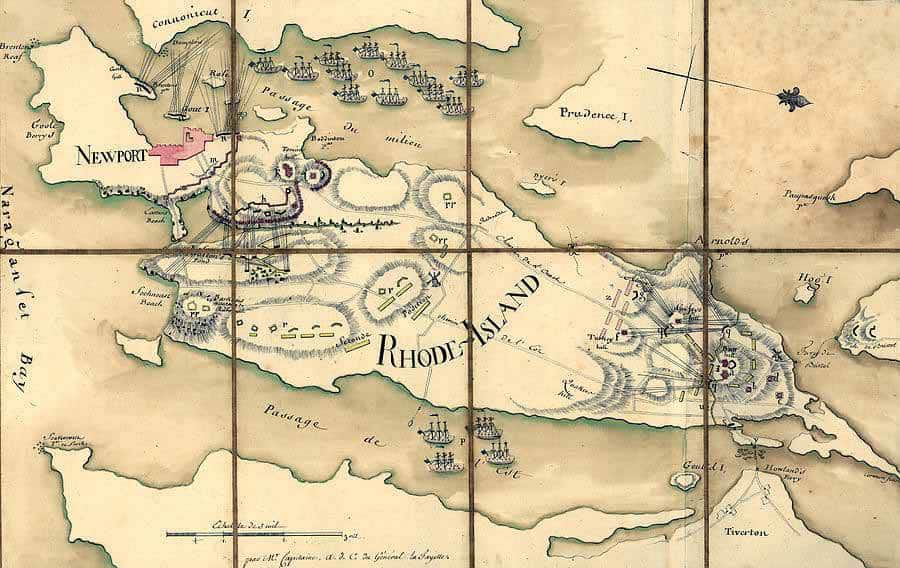
A “Great Storm” that lasted from August 11 to the 13th in 1778[i] disrupted the largest Revolutionary War battle in Rhode Island and changed the course of history, at least for Newport. Named the “Battle of Rhode Island”[ii] or alternatively “Battle of Quaker Hill,”[iii] the storm effectively put an end to the blockade when the supporting French fleet led by Admiral Charles Henri Hector d’Estaing was forced to withdraw to Boston for repairs to its heavily damaged ships, including the dismasting of his flagship.

British and Hessian forces occupying Newport were able to rally, lift the siege of Newport, and force the Colonial Army back to Fort Barton in Tiverton.  The battle was a draw, if not a defeat, and Newport remained in British hands until the end of the war when they finally withdrew after looting and burning the city, poisoning wells, and doing what they could to ruin the harbor by skuttling ships.  A notable feature of the battle was the colonial troops led by Colonel John Sullivan included one of the rare multiracial regiments with ethnic European troops, many Native Americans, and free black soldiers. The inexperienced and largely untrained regiment inflicted significant losses on the seasoned, brutal Hessian troops.

Major General Marquis de Lafayette[iv] was sent by George Washington to Rhode Island to coordinate the French forces with the colonists trying to drive the British from Newport. After the storm, Lafayette rode hard to Boston to try and convince d’Estaing to return to the blockade. Lafayette was unsuccessful in his mission, and the siege was not sustained. Absent the blockade, British forces marched on the Americans, drove them back, but they were able to accomplish an orderly retreat fighting rear guard skirmishes on Quaker Hill and Turkey Hill until escaping back across the Sakonnet River to the safety ofFort Barton in Tiverton.

Abraham Brown served as a private in the Rhode Island brigade and extended his hospitality to the Marquis. While in Tiverton, Marquis de Lafayette quartered at his home in a guest suite on the second floor. Thereafter, the well-known local Main Road farmstead, built around 1735, was referred to as the Lafayette House and registered as an historic landmark.

“Religion in America… must be regarded as the foremost of the political institutions of that country… I do not know whether all the Americans have a sincere faith in their religion—for who can search the human heart?—but I am certain that they hold it to be indispensable to the maintenance of republican institutions.”  Alexis de Tocqueville [v]

In “God of Liberty,” Thomas Kidd’s history of the role of religion in the American Revolution, he documents the remarkable mixture of Christian and Deist faith of the American colonists and Founding Fathers.  From Congregationalists, Methodists, Calvinists, Anglicans, Baptists, remnants of Puritans, Baptists and Evangelicals of the “Great Awakening” to Unitarians, Quakers, and Enlightenment Deists like Franklin and Jefferson. Yet within their theological vagaries and variety there remained a common set of values, an agreed understanding and the basis of the culture that enlivened Revolutionary fervor and informed most all Americans about why citizens benefited from and were due human freedom. Freedom to seek their own path, their own faith, their own prosperity, their own life. Freedoms “endowed by their Creator,” and not the capricious largess of monarchs or men.  

Kidd wrote “They (shared bonds) vitally bound together Americans of widely differing religious opinions…  Common religious public religious values also gave ballast to a new country that badly needed stability.”[vi]  These foundational truths were summarized in five principles:

  1. The disestablishment of state churches.
  2. A Creator God is the guarantor of fundamental human rights.
  3. The threat to polity posed by human sinfulness.
  4. A republic could only be sustained by the virtue of its citizens.
  5. God (or Providence for the Deists) moved in and through nations.

These five principles undergirded the ‘great experiment’ of which we are downstream. How many still inform us? Is the disunity we are experiencing exacerbated or even caused by our abandonment of that community of shared beliefs and cultural imagination? The answer to that, it seems to me, is self-evident.

  “Ruins are the visible symbols and landmarks of our societies and their changes… they expose the omnipresence of death and decay. They are the remains of history.” Andreas Huyssen, Present Pasts[vii]

David Rose’s family owned the Lafayette House on Main Road for decades along with the adjacent thirty acres. With an ill-maintained home for a long time, David had a problem. He wanted to sell the prime location acreage for possible development, but the Lafayette landmark, now deteriorating, was a hindrance to the asking price of $6.8 million.

Rose applied to the Tiverton Building Department for a demolition permit. Since the house was listed on the Rhode Island Register of Historic Places, he misrepresented the house on the application by checking “No” on the permit to the question about the house having historic relevance. Thus, he expedited his plans and avoided any potential complications and review by the state or Tiverton Historic Preservation Advisory Board. The acting building inspector, who is no longer the acting building inspector, was either complicit or ignorant, let it slide, and signed off. The Town Manager, who is no longer the Town Manager, and the Building Inspector learned from the Town Council, after the dust settled, it was time to move on or retire.

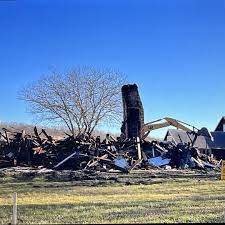
A week before last Christmas in Blitzkrieg, the house was no more. After the first morning it was mostly a pile of rubble hastened by heavy equipment. By the end of the week, the rubble mostly disappeared, and the foundation hole was leveled over. The shocking effect on many frequent passersby like us was like seeing scorched earth where the garden had been. The Blitzkrieg demolition was not only an architectural loss but a civic betrayal—of truth, of memory, of shared reverence for what came before. Overnight, the beautiful old house on the hill awaiting a conscientious buyer to restore it was no more. Part of our shared history was no more.

“In the West, we have been withdrawing from our tradition-, religion- and even nation-centered cultures… But we are increasingly falling prey to the desperation of meaninglessness, and that is no improvement at all.”  Jordan Peterson

With brief reflection most will agree that the five principles described in the “God of Liberty” book are lost, compromised, broken —- reduced to a ruin, its foundation filled and leveled with debris. At least as far as common understanding and shared worldview. Even the concept of virtue is hotly debated, never mind God endowed rights and responsibilities. We live amid the ruins of what was a shared culture.  The confusion and conflict that result describes our time. Where does that lead us?  What does that leave us?

Disruption and disconcerting events will happen. Suffering will happen. Doubt will happen. Confusion and fear will happen. To everyone, including me. Death will happen, and the existential dread of annihilation haunts us all. Good Fridays will happen to us all.

For me, Easter brings the clarity necessary for me to get up in the morning. As real as Good Friday is in our lives, so is the promise of the Resurrection. God’s answer to our fear, suffering, and bewilderment was not to remove it, to make us automatons without suffering but without our own wills. His answer was in a Person, His own Word, His very self, Who not only joined us, but descended all the way down to godforsakenness.[viii]  He experienced everything that destroys us: the hubris of enemies and authority, scapegoating, betrayal, inconceivable violence, hatred, revenge, abandonment, terrible loneliness, loss of every possession and power, humiliation in every possible way, unimaginable pain and cold death nailed naked on a cross.

The Creator of the universe’s response was not vengeance, not retribution, not raining down fire, not destruction, but forgiveness, patience, love, and new life. Death and hatred defeated by love. That our hope is not in conquest or power, but in surrender to a Will beyond our imagination. For us. For me. For you.

And to those who seek assent even to an imperfect faith and seek to understand and be astonished by the enormity, transcendence, and wonder of this gift, everything changes.[ix]

 “May nothing disturb you, nothing frighten you. All things pass; God does not leave. Patient endurance attains all things. Whoever has God lacks nothing: God alone is enough.” Teresa of Avila

[i] The “Great Storm” so named by those who suffered through it. It was described as a powerful Nor’easter but given its timing in hurricane season and the state of meteorology at the time, I cannot determine exactly its species. Not all storms were named as we currently obsess with, but this one was. Either way, it laid the area low.  

[ii] Here’s a good summary if you have interest in the “Battle of Rhode Island.”

[iii] We live in our modest bungalow on the top of Quaker Hill in Portsmouth where part of the battle took place. Thus, my fascination with the battle. Men died here defending liberty. Perhaps right in our back yard near our bird feeder and daffodils.

[iv] Sidebar: after the war in America Lafayette was an early supporter of the French  Revolution but became a critic when the Republican populists of Robespierre unleashed the chaotic terror of the guillotine and tumbrils. A member of the aristocracy, Lafayette fled for his life and survived. Admiral d’Estaing was not so fortunate, and his head was separated from his body by the guillotine. Robespierre, of course, suffered a similar sudden dismasting when his mob turned on him.

[v] Democracy in America, Volume I, Chapter 17

[vi] God of Liberty, Thomas Kidd, Basic Books, a Member of the Perseus Books Group, 2016

[vii][vii] Present Pasts, Andreas Huyssen, Stanford University Press, 2003

[viii] Bishop Robert Barron, Easter reflection, 2025

[ix] George Weigel, Easter Changes Everything, First Things, 2012

Leave a comment

Filed under Culture views, Faith and Reason

Stone Walls, Sycamore Maples, and Other Curiosities (Part Two)

[/audiLink to the series of querieso]

“Over time I think we will probably see a closer merger of biological intelligence and digital intelligence,” Musk told an audience at the World Government Summit in Dubai, where he also launched Tesla in the United Arab Emirates (UAE). “It’s mostly about the bandwidth, the speed of the connection between your brain and the digital version of yourself, particularly output.” CNBC – February 13, 2017, “Elon Musk: Humans must merge with machines or become irrelevant in AI age.” [i]

Yes, the walls have broken down, but the techno elites have an alternate vision for the future prepared for us. Elon Musk is one of the foremost, and as the richest guy in the world, next he will work to enlist the help of the government. He will lead us into the promised land of our future as cyborgs and aliens occupying other planets throughout the galaxy.

We should not make the mistake of ignoring this; it is a powerful utopian vision. Such fantasies have fascinated and attracted human beings as long as there have been human beings. Elon’s iteration promises to create for us a fresh new version of heaven, omniscience, and immortality. This utopia (some would say dystopia) is nothing less than a religion with a creed, dogma, and eternal rewards. All we must do is cease to be human, and we will be perfect: the current version of “immanentizing the eschaton.” I queried the thing, the LLM AI ChatGpt 4.0, about this, a series of questions and responses which is attached for you, so that if you have interest, you can read on. I found it fascinating, including its conclusion that a hybrid AI human is probably not a great idea. [ii]

But that is not the point of this post. The main idea of this exploration of broken walls is what we can do to repair them.

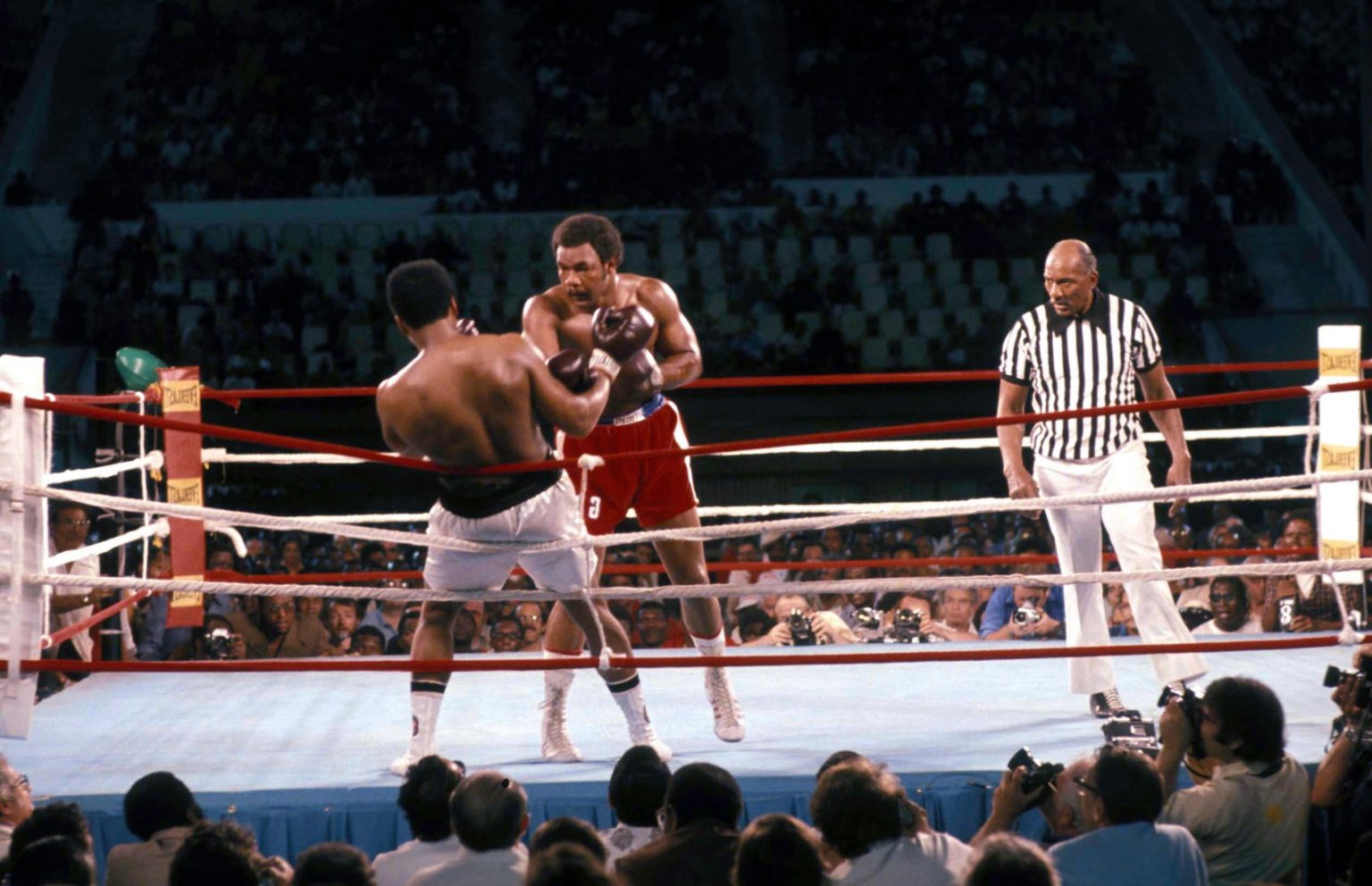
“Float like a butterfly, sting like a bee – his hands can’t hit what his eyes can’t see.” “I’m so fast that last night I turned off the light switch in my hotel room and got into bed before the room was dark.” Muhammed Ali about the epic Kinshasa 1974 world heavyweight championship match, “The Rumble in the Jungle.” And from his opponent, George Foreman, “Muhammad amazed me, I’ll admit it. He out-thought me, he out-fought me. That night, he was just the better man in the ring”

George Foreman died earlier this month by all accounts an exemplary man. After retiring from boxing and winning back his title at the age of 45, he went on to become a multimillionaire businessman and minister.

When he was fighting, he was dangerously powerful. Reputedly one of the hardest hitting boxers ever. Hit harder than Joe Frazier. Hit harder than Mike Tyson. And either of those fighters could put out your lights long before you hit the floor.

Ali could hit too, but not like George. A deficiency that could be overcome, but in fighting George Foreman you were half a second lapse away from unconsciousness at any moment.

In Zaire that night Ali used his amazing speed and reaction time. And he used his boxing knowledge and experience. He did something never done before and to the dismay of the fans who wanted to see toe to toe, brain rattling, battle. He invented what he called in his usual creative and funny manner, “Rope a Dope.” He leaned back against the ropes at the periphery of the ring and slipped, dodged, ducked, took a few passing blows, and mocked George Foreman. For round after round, George punched himself out. He was exhausted. “Is that all you got, George?” Ali whispered to him in a clinch. Foreman’s tired hands slowed just a tiny increment. That’s all Ali needed and what he was waiting for.

In the final seconds of the eighth round, Ali did what Ali was uniquely capable of doing. He exploded with a close to instananeous combination rocking and stunning his opponent -jabs, left hook, straight right to the face -so fast it was hard to follow[iii], dropping his opponent now momentarily unconscious. Slow motion video confirmed what happened to George Foreman. He went down like he was tasered, and it was over. Spectators who had grown restive with Ali’s refusal to go toe to toe were as stunned as George was. Muhammed Ali was once more was world heavyweight champion.

“If we are to preserve culture we must continue to create it.” Johan Huizinga, Dutch historian, 1872-1945[iv]

We are assailed every day with competing concepts of the culture; the punches come hard, fast,and from every unexpected direction. There is no escape from the assault. Lessons from the ‘rope a dope’ strategy of the great Ali in the “Rumble in the Jungle” serve us well. Standing toe to toe punching it out with


postmodern, post-Christian culture in its full strength is impossible; we will exhaust ourselves until one powerful combination finishes us.

We get one life, one defining decision about how we are to live it. How we are to slip the knockout punch and remain ready to respond when necessary? And how does that strategy inform our daily interactions?

One valuable resource I recommend for our rope-a- dope plan is a book I’ve mentioned before, Archbishop Emeritus Charles Chaput’s “Strangers in a Strange Land,”[v]. Unlike Rod Dreher’s excellent and popular “Benedict Option,”” Strangers in a Strange Land” theorizes that rather than retreating into small enclaves, we must engage the culture while slipping its worst knocks, and when necessary, we take a few hits for the team.

He writes first about the state of the society and culture in which we find ourselves, then he suggests our response. Here is a short summary of the ideas in the book about how we are to respond.

Acknowledging the growing temptation for faithful Christians to withdraw from public life in a society increasingly hostile or indifferent to Christian beliefs—especially around marriage, sexuality, the dignity of life, and objective truth—it can feel like retreat is the only option. He’s sympathetic to that instinct but rejects it. Archbishop Chaput recognizes the appeal of building intentional, isolated Christian communities. While he affirms the importance of forming strong, faithful communities, he insists that withdrawal is not the answer—not in the Gospel, and not in history.

“Jesus didn’t tell us to bunker down. He told us to make disciples.”

Christians are called to engage the world, not flee from it. To be salt and light (Matthew 5:13–16)—which only makes sense if we’re out in the world, not hidden away. And we cannot shy away from the cost of real witness. He reminds us that throughout history, Christian witness has often meant sacrifice—and at times, martyrdom – the word “martyr” comes from the Greek “martus“(μάρτυς), which means witness. While modern Americans may not face bloody persecution as martyrs are suffering in other countries, we do risk social marginalization, professional consequences, or ridicule. But bearing those costs with integrity and joy is part of being a Christian in a post-Christian age.

He emphasizes the tone of our witness: not angry or defensive, but joyful, confident, and loving. The early Christians didn’t win converts by wagging fingers—they lived lives that made pagan neighbors wonder, “What do they have that we don’t?” He calls for a similar approach today: to live lives of beauty, integrity, generosity, and peace that cause others to ask questions.

Rather than abandoning the public square, Archbishop Chaput urges Catholics to be present in law, media, education, the arts, politics, and business—bringing a Christian imagination and moral compass to those spaces. He challenges the faithful not to give up on shaping the broader culture.

“We don’t escape from the world; we bring Christ into it.”[vi]

The Church is a field hospital, not a fortress. While forming strong, intentional communities is important, they must be outward facing. We need to support each other, yes—but ultimately, we’re here to serve the world, not escape from it.

I just pray that I get better at it because I have a very long way to go.

“No one in the world can change Truth. What we can do and should do is seek truth and to serve it when we have found it. The real conflict is in the inner conflict. Beyond armies of occupation and the hecatombs of extermination camps, there are two irreconcilable enemies in the depth of every human soul: good and evil, sin and love. And what use are the victories on the battlefield if we ourselves are defeated in our innermost personal selves?” St. Maximillian Kolbe, Polish priest, publisher, evangelist and martyr who volunteered to die in place of a stranger in Auschwitz.[vii]

Final thoughts for today. Jesus related a wonderful parable about a barren fig tree. You may remember it. The vineyard owner told the gardener to cut it down because it didn’t produce any fruit. The gardener, who it has been suggested is a metaphor for Jesus himself, told the boss to give it a chance. He’ll cultivate it (cultivate comes from the same root word as culture), fertilize it, care for it personally and carefully, and if it still doesn’t bear fruit, eventually it will go.

St. Paul who contributed more books to the New Testament than anyone else, started out as Saul of Tarsus, a zealous persecutor of Christians, complicit even in their murder. But along the way, Saul met Jesus personally and became Paul, the greatest of evangelists. That’s a long story for another time, but among his letters lovingly preserved for a couple of millennia is one to the small developing church in Galatia. In that letter Paul called out the fruits of the spirit, the fruits the fig tree was lacking.

The fruits of the spirit are not hoarded, nor is the vineyard owner miserly in providing them. Freely given, all we have to do is ask and be willing to change our lives radically. Our necessary response is not a grit our teeth determination but openness of heart and acceptance. A simple fiat starts them growing. Impediments to fertile lives are self inflicted.

Every human jproject of value is one heart, one mind, one soul at a time. Lent is a perfect time for our own examen. How are we doing in building a culture of life, love, and hope? What fruit are we bearing that helps shape first ourselves, then our small circle of influence, our culture? I have a very long way to go.

“But the fruit of the Spirit is love, joy, peace, patience, kindness, goodness, faithfulness, gentleness, and self-control. Against such as these things there is no law.” Galatians: 5 22-23

[i] https://www.cnbc.com/2017/02/13/elon-musk-humans-merge-machines-cyborg-artificial-intelligence-robots.html

[ii] email me for the ChatGPT bot on “immanentizing the eschaton” and Elon Musk.

[iii] Lights out on the way to the mat.

[iv] Huizinga argued that the spirit of technical and mechanical organization had replaced spontaneous and organic order in cultural as well as political life. Wikipedia

[v] Strangers in a Strange Land: Living the Catholic Faith in a Post-Christian World, Charles J. Chaput, Henry Holt & Company, 2017

[vi] A YouTube interview with Archbishop Charles Chaput discussing his book:

[vii] Quoted from the “Little Black Book, Lent 2025 published by Little Books, Diocese of Saginaw, Michigan

Photo credit: George Foreman vs Muhammad Ali October. 30, 1974 Rumble In The Jungle in Kinshasa, Zaire. Credit: 369108Globe Photos/MediaPunch

1 Comment

Filed under Culture views, Faith and Reason

Stone Walls, Sycamore Maples, and Other Curiosities


“Something there is that doesn’t love a wall,

That sends the frozen-ground-swell under it,

And spills the upper boulders in the sun…” Robert Frost, Mending Wall

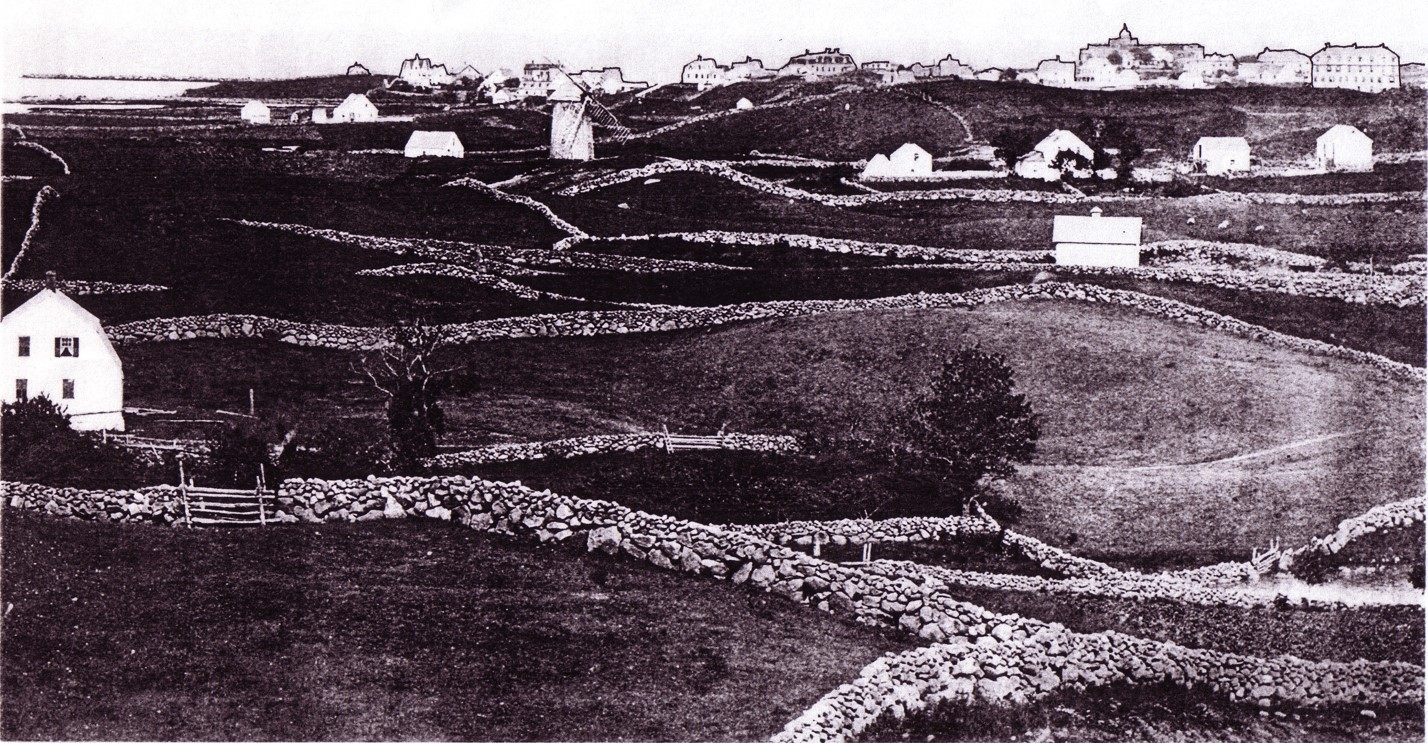
Stone walls in Block Island, Rhode Island, c. 1880. Block Island Historical Society, printed by Robert Downie

Frost, deep frozen ground, not poets, is not the only nemesis of the old stone walls crisscrossing this island and all the rest of New England, but it is a formidable one. At the peak of their domination of the landscape in the mid 1800’s, there were an estimated 240,000 miles of them. The total weight of them equaled sixty Pyramids of Giza or about four hundred million tons[i]. One by one, the farmers gathered the stones and built the walls.

The other (Robert) Frost wrote famously in his poem, Mending Wall, “Good fences make good neighbors.” New England soil and geology scattered the material for these borders across this landscape in forests and fields. The frost does not just undermine existing walls, the frozen earth provided for them. Each winter and spring cycle the frost slowly worked up millions of rocks through the soil to the surface. Farmers cultivating the land and before them farmers raising Merino sheep each year faced one of their most arduous tasks: picking up the stones, called “two handers,” throwing them first into a formidable pile, then carting them to build the walls. Walls to keep in livestock and keep out someone else’s livestock; walls to delineate property; walls to get the rocks out of the way of plows and the grazing of cows and sheep.

Farmers and estate owners often planted Sycamore maples and pin oaks and Norway maples and sugar maples and American beech trees along these walls for shade, maple syrup, further definition of who owns what land, and because they are beautiful. They assumed residence beside the wall for decades or a century. The relationship between the wall and the tree is eventually contentious. Trees grow, albeit slowly, but inexorably. Up and out and thick in the trunk. And not just stems and buds, flowers, and leaves. The girth of the trunk expands in the cambium, that thin layer of vascular cells between the inner tree and the outer bark, between the xylem and the phloem. The xylem presses inward eventually hardening into heart and sapwood. The phloem presses outward creating the vessels that become cork like and harden into bark. One cell at a time, the cambium does its work. Mitosis, dividing, each tiny increment insignificant, but relentlessly they push out and up. The annual growth cycle of early wood and late wood creates the rings that chronicle the age of the tree and the history of the weather each year.

The power of this tiny expansion continues unabated. A fraction of an inch at a time, it does not stop. When the tree necessarily grows in diameter, a stone wall in its path suffers a slow demise. Eventually a bulge becomes a fall becomes a collapsed hole. The wall begins its slow dis-integration back into the soil that spawned it. The fields they once defined sometimes revert to wall-demised overgrown forests once again.

“When a friend calls to me from the road

And slows his horse to a meaning walk,

I don’t stand still and look around

On all the hills I haven’t hoed,

And shout from where I am, What is it?

No, not as there is a time to talk.

I thrust my hoe in the mellow ground,

Blade-end up and five feet tall,

And plod: I go up to the stone wall

For a friendly visit.” Robert Frost, A Time to Talk

 In 1961, Dr. Stewart Wolf, the head of medicine at the University of Oklahoma, met a local doctor for Roseta, Pennsylvania, who told him about the remarkable, negligible rate of heart attacks from 1954 to 1961 in Roseta[ii]. Curious, Dr. Wolf confirmed the anecdotal evidence by researching death certificates for the town during that period. Numerous studies followed, including a fifty year exhaustive one comparing Roseta to the similar sized town nearby, Bangor, PA, as natural experiment control. The researchers named these findings the “Roseta Effect.”  Why they were so different in heart attack frequency was the pressing question.

Researchers concluded that the community cohesion of the Italian culture and unity centered on the united worship in the church, common agreed upon values, and closely shared family and community lives there lowered the stress level, loneliness, and attendant health risks. People still died, of course, but later, and not of heart attacks. Normally at risk men from 54 to 64 had almost no heart attacks. They did not eat the Mediterranean diet but regularly chowed down on sausage fried in bacon grease; they smoked unfiltered tobacco, and worked extremely hard in slate mines, contracting the usual toxic dust related diseases. But they did not drop dead from heart attacks.

They were hardworking, poor, lived in tightly packed similar housing, and did not contend with social envy or material or pretentious aspirations. Simple, deep shared faith as a given, mutually supportive lives connected everyday face to face with close friends and relatives. Loneliness was foreign to them. You can read more in the footnote link.

As the years merged into decades, the trust, social cohesion, security, and friendships of 1950’s Roseta slowly effervesced like flat soda. Roseta became homogeneous with the rest of the country. People died, moved way, families broken and dispersed, neighborhoods broken and dispersed, the world seen filtered through the lens of a screen, the mines closed, new folks moved in. The heart attack rate grew until it was indistinguishable from the rest of us. Roseta became modern, and the Roseta Effect dissipated like the morning mist.

Like the inexorable growth of tree trunks first strained, then broke down centuries of stone walls, inexorable modernity broke down the societal boundaries of Roseta. In Part II, while we cannot regress into an idyl of nostalgia, we can do a few good things to find our way home. Until next time.

“The postmodern vision of society, in rejecting objective truth and inherited cultural bonds, has dissolved the very idea of community. In place of solidarity, it offers only a marketplace of transient identities, each competing for recognition while eroding the deeper structures—family, faith, and nation—that once made society coherent.” Roger Scruton, The West and the Rest

[i] Article from AtlasObscura.com

[ii] I learned about this story as part of a great Sunday homily our pastor, Father David Thurber, taught us. Curious, with just a quick Google search, the “Roseta Effect” story had many related scientific studies.

2 Comments

Filed under Background Perspective

Scoters, Eiders, and other Wonders

An experiment with an audio narrative of the post. Not my voice. Yet.

“There are some who can live without wild things, and some who cannot. For us of the minority, the opportunity to see geese is more important than television,” Aldo Leopold, A Sand County Almanac


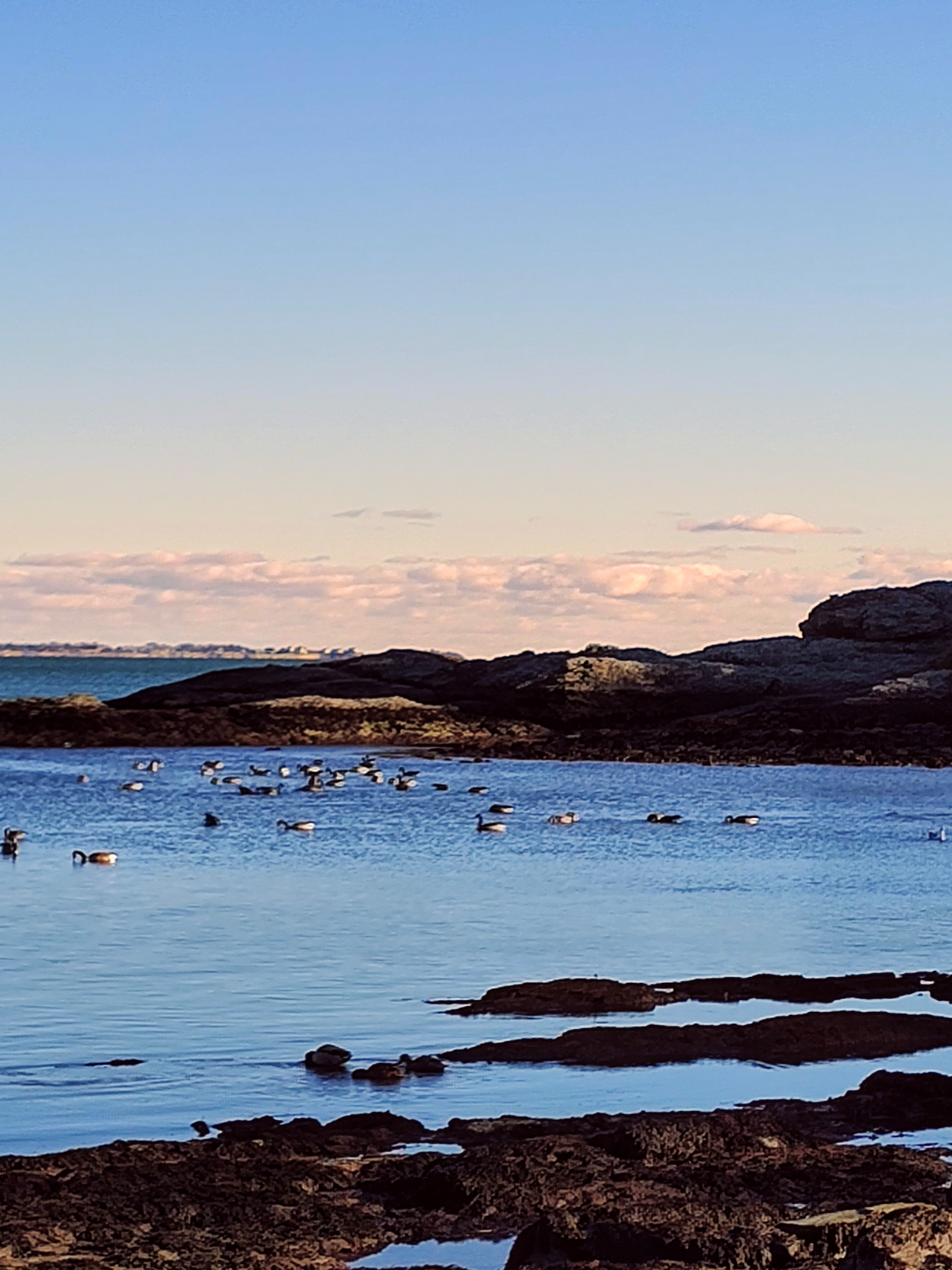
My waterfowl identification is woefully deficient. At a distance without mechanical aids, I have difficulty discerning white winged scoters from surf scoters from black scoters or at a distance even from scaups or goldeneyes or buffleheads. I guess I need to upgrade my glasses prescription. From a greater distance, the distinction blurs even with the larger common eiders. The winter ocean around this place is full of them, large flocks of various scoters, eiders, buffleheads, and some birder attracting harlequins. And Canadian geese. Many geese.

 Large flocks of waterfowl hang out along the Sakonnet River at McCorrie Point, Sandy Point, and Sachuest National Wildlife Refuge, feeding, chatting, floating gently regardless of the vigor or languor of the waves. Up and down, content and rhythmically riding the waves for five thousand years somehow just beyond the break of the surf – a curious reassurance that we can be confident our frantic preoccupations with the current titillation, election, controversy, sensation, or outrage is a momentary distraction.

 Suddenly, they will take wing for their own instinctual inexplicable reasons, first two or four or five, then scores on some signal not understood by me, beating furiously to the next feeding range, sometimes across the river to the North Tiverton side and the Seapowet marshes. The energy of their purposeful rapid flight with blurred-fast wings seems exhausting to watch, but they are undeterred.

 When they drift closer to the shoreline, it’s endlessly entertaining to see them hunt. Diving with quick graceful, rounded back plops, they vanish for what seems like a long time, only to pop up inevitably ten or fifteen feet away. Often their dives and re-emergences are synchronized. Plop. Plop. Plop. Six or eight or more at a time in family groups, disappearing and reappearing almost simultaneously or in sequence. Pop! Pop! Pop! Up they come like small balls released by the kid holding them under. Could watch them for an hour, guessing where they are going to surface.

Drama is inherent in their existence. Raptors, foxes, and other predators are on the prowl. And others. The wildlife ranger who supervises us volunteers leads a weekly bird walk on the trails of Sachuest Wildlife Refuge along the rocky shoreline. She told us a story from last week’s walk. Duck hunting season just ended on January 26th. Hunting is not permitted on the refuge, but hunters can fill their freezers from boats just offshore so long as they aim away from the land towards the open sea. She has no objection to hunters. That’s part of what wildlife managers manage. But it must be safe and lawful.

 Hunting is part of how the balance is managed. Many savor a good Sunday dinner of roasted duck after an overnight soak in rosemary or thyme brine and accompanied by garlic buttered mashed potatoes, sauteed carrots, tomato and cucumber salad, and a nice red cabbage slaw.

On Saturday, she was conducting one of her walks for a couple of dozen curious nature lovers. She took them out near the forty feet of Sachuest Point – the surf pounded cluster of large rocks where the harbor seals sometimes come to sun themselves in the summer.

 Two exquisite eiders exploded from the surface of the water, beating their wings frantically, attaining astonishing speed in a few yards. “There goes a pair of eiders,” she exclaimed and pointed. Two shotgun blasts boomed from one of the inflatable low boats. Splash. Splash. With laconic understatement to the shocked onlookers, she calmly concluded the eider lesson. “There were a pair of eiders.”

“One swallow does not make a summer, but one skein of geese, cleaving the murk of a March thaw, is the spring.” Aldo Leopold

On Aquidneck Island, we don’t have to wait for March to observe the wonder of a flight of Canadian Geese. We do have some visiting migrating flocks passing through to be sure, but hundreds of them overwinter, powerfully cleaving the air with the V formation so easily identified while their unmistakable calls draw our attention overhead – twenty, fifty at a time, filling the sky like B-29s advancing towards the ball bearing factories in Dresden. Only the geese are benign as well as orderly and determined.

 We see them grazing in stubbled winter corn fields, in the marshes, scores of them cluster, feed, and socialize. We see them in any open water on both ocean and unfrozen freshwater ponds. They inhabit plowed fields, golf courses, and dormant winter farmland of which we have an abundance. Lingering and foraging for hours with a few sentinels, they guard their young, reconnoiter, and apparently confer with one another; their low distinctive murmuring conversation is incessant. Abruptly, as if by consensus, a group of them take flight.

 I always pause and look up when they are on the move in their signature V formation, squawking, changing their order of flight to share the load breaking the wind, heading to someplace of their noisy choosing to seek new food or shelter from the incessant wind or refuge for the night.

Compelling. A spectacle of grace, coherence, and power. A confirmation that somewhere, against all odds, all is right in the universe.

“Our ability to perceive quality in nature begins, as in art, with the pretty. It expands through successive stages of the beautiful to values as yet uncaptured by language.” Aldo Leopold, A Sand County Almanac and Sketches Here and There

1 Comment

Filed under Sachuest Point and other wonders

Unsung Heroes of Civilization

Weaver Cove dock at Sunset smaller

“Labor was the first price, the original purchase-money that was paid for all things. It was not by gold or by silver, but by labor, that all wealth of the world was originally purchased.” Adam Smith

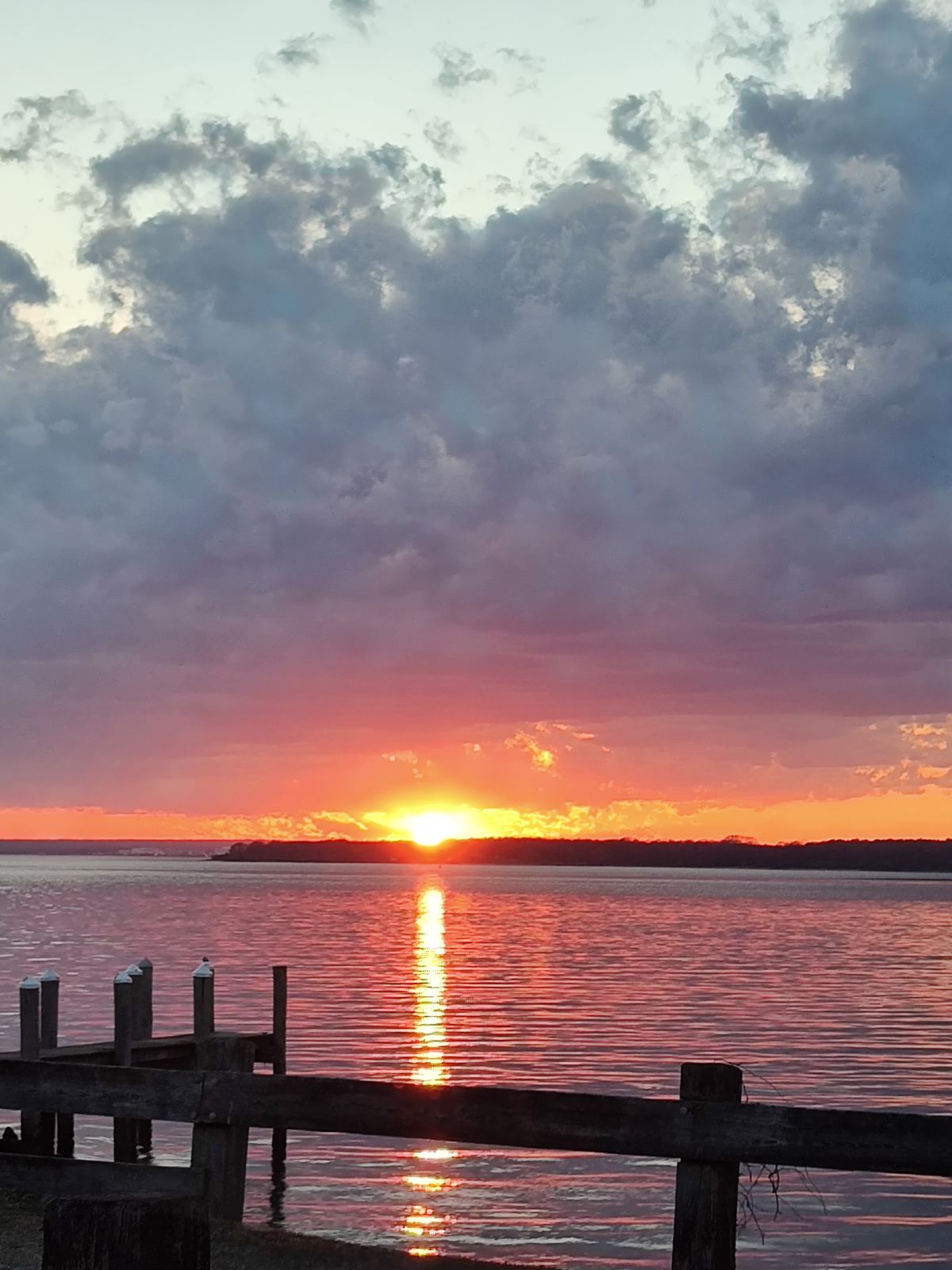
We paused recently at one of our favorite stops – the boat landing at Weaver Cove off Burma Road on the west side of the island overlooking Narragansett Bay. Sunset is our favorite time there, but we often make our way over the rocks at other times and walk down the beach at low tide towards the Navy base and Coast Guard station. During the warm months, there is a lot of activity at the boat launch out on the bay. Fishing boats, sailing craft, barges and tugs headed up to Providence, freighters, luxury yachts. Some single mast sailing boats are moored just offshore from April until October. In the summer, families journey down from Fall River and New Bedford, setting up tents, chairs, and grill for a day of picnicking, swimming, playing with their kids, digging quahogs, and napping. A United Nations of languages and laughing.

By this time of year, the moored boats are back in storage, and only working craft come through the channel. When we stopped last week, there was a large yellow and red concrete truck waiting with its large, angled drum churning to keep its load from hardening. I thought the driver was on a break or waiting for a call from a local foundation being poured telling him that they were ready for him. Fifteen minutes later, a strange looking boat, which looked from a distance like it had an overly tall, awkward cabin at the stern, approached steadily from behind Dyer Island coming from Prudence Island directly west of Dyer.

As it got closer, it was a boat of a type I had never seen at the boat launch before with the odd appearance of a WWII landing craft at the bow. Another big truck perched on it – an exact match of the parked one near us. The driver of the waiting truck was affable with a full head of gray hair and a well-trimmed beard. I asked him if he was headed back to Prudence to continue a large foundation pour. Never taking his eyes off the boat, he told me that was precisely what they were up to. As soon as the truck ferry from Prudence got close to the Weaver Cove launch, our driver lined up to reload the boat. The switch was made quickly as soon as the odd looking boat pulled into the boat launch ramp, its inclined bow opening even as it approached.

The driver positioned himself directly in front of the ramp with enough room for his colleague in the other empty truck to disembark. Within seconds of the other truck clearing the ramp, he adeptly backed into the tight fit on the waiting boat without the appearance of one tiny course correction. The bow smoothly retracted back into position even as its pilot immediately started backing out, and the boat turned back to Prudence to continue the foundation pouring. The squat ferry sat noticeably deeper in the water with the fully loaded replacement. The whole switch and turn around took less than five minutes like a well-practiced dance.

“All labor that uplifts humanity has dignity and importance and should be undertaken with painstaking excellence.” Dr. Martin Luther King, Jr.

As the ferry and concrete truck receded from our view around Dyer Island, Rita and I discussed how many jobs requiring years of experience and skill go unheralded: the pilot of the truck ferry, concrete truck drivers, the crew back at the building site who set the forms, tie rods, and rebar, the foundation pouring crew directing the cement into the forms so that there were no voids or weaknesses as it set, the site work heavy equipment operators backfilling around the new foundation once the forms were stripped.

Prior to the forms showing up others had built the roads to get there, cut the trees, cleared the lot, dug in the septic system, drilled the well, and excavated the foundation hole after others had tested the soil, surveyed the property lines, and pounded in the offset stakes located by a transit to site the house and grade the lot. The coordinated, complex choreography continues until the house is ready for mail in the mailbox and kid’s bikes in the driveway: framing carpenters, window and door installers, siding and roofing specialists, insulation crew, electricians, heating and ventilation specialists, plumbers, sheetrock board hangers, plasterers, interior finish carpenters, kitchen cabinet and countertop fabricators, flooring team, painters, landscapers, and more. Offsite manufacturers fabricate hundreds of components, milled lumber, appliances, and all the building materials necessary to construct the home. Hundreds of skilled laborers contribute to a finished home.

Much of it is hard physical work, some of it dangerous. Years of experience and apprenticeship are necessary to gain proficiency in each trade, including our new acquaintance who made backing a fully loaded concrete truck weighing over thirty tons on to the narrow ramp of a small ferry look routine. It’s not.

Each day they sweat or are cold or wet or sore with fresh small injuries to their hands – limb and brain weary at day’s end from steady effort and paying constant close attention to their movements.

Those who do these things daily are practiced and confident in their hard earned expertise. They are intelligent, committed to doing a good job, and proud of their proficiency. Some are scornful of those who don’t have such skills. Watching them perform is always a vicarious pleasure; I always learn something new. Some little trick, or shortcut, some clever and quicker way to do what they do and produce better work. Some of their skillfulness I learned in my long working career, albeit never as adroitly as someone who repeated their tasks a hundred times a month for decades.

There are thousands of different jobs from the multitude of various skills it takes to grow and harvest our food, and those who keep us safe in our beds, and those who manage our commerce, and the many who quietly bang away writing the code that is now so necessary to our communications and entertainment. We surely are not even aware of many of the more esoteric jobs that exist, yet each one is supported by and utilized within our complex civilization.

“Work is not a curse, it is the prerogative of intelligence, the only means to manhood, and the measure of civilization. Savages do not work. The growth of a sentiment that despises work is an appeal from civilization to barbarism.” Calvin Coolidge

Just a few moments ago in geological time, we were all subsistence scratch the earth farmers or hunter gatherers. We all shared the same skills and worked together, or we died. Formal government, increased specialization, and a division of labor were developed and slowly emerged into the complexity we accept as normal. Human beings built cities and civilizations. Without the myriad skills of laborers, neither would there be politicians, university professors, poets, musicians or artists who can buy their daily needs and live in the shelters created by the workers. No workers, no civilization.

I have been very fortunate in knowing so many of them. Throughout sixty years of earning a living, I worked variously for a few months or for years as a framing carpenter, a fence builder, a tree climber, a roofing laborer humping bundles of shingles up ladders, a landscaper planting and grooming, a land surveyor, a truck driver, a driveway asphalt laborer, a form setter and fabricator of septic tanks and concrete pipe sections, a bucket truck operator, and a newspaper reporter, an assembler of doors and windows in a small carpentry shop, a warehouse shipper and receiver, a purchasing agent and inside sales coordinator, a road salesperson of building materials on hundreds of job sites. These jobs were learned at least well enough to keep food on the table before I spent most of my career managing people and running lumberyards and light manufacturing facilities.

No job was a waste of time; all prepared me for others; all taught me something necessary to all the rest.

Each job and especially learning what was entailed to accomplish their work inculcated in me deep respect for those who do the work, build the houses, and drive the trucks that supply us every day with our needs.

So many jobs we will never learn even exist. They may contribute to our lives without our noticing. We may take them for granted, but I hope I never do.

“Each morning sees some task begin,

Each evening sees it close;

Something attempted, some done,

Has earned a night’s repose.” Henry Wadsworth Longfellow

5 Comments

Filed under Background Perspective

perspectives from a few steps back

“It is better to take refuge in the LORD

than to trust in man.

It is better to take refuge in the LORD

than to trust in princes.”   Psalm 118: 8-9

 Papa standing at the rimIf we had lived in the Roman Empire, which lasted about 500 years as the Western Roman Empire and another thousand or so as the Byzantine Empire based in Constantinople, we would have expected that daily life probably would never change[i].

If I was a carpenter in a village outside of Rome in the year 200 AD, I’d get up before dawn for a simple breakfast of bread, cheese, and water, and gather my wood and iron tools, some I had made, some I inherited from my father and grandfather.  Off to work making doors or furniture or a larger project in a team like an aqueduct. Return home at the end of a taxing day, maintain and clean my tools, readying them for the morning, a supper of fish or grains or occasional meat. Time with my family, a quiet conversation about the kids with my wife, or perhaps head out to the tavern to debate the games or the latest battles up north or the comely suppleness of the new barmaid. A few times a year, if I was so inclined, I might head off to the games. Gladiators, animal hunts, spectacular and gruesome executions, maybe a few of those annoying Christians thrown in among the hungry lions, bears, and tigers.

I would expect my sons to follow in my trade, join the guild, learn the skills. As I had. As my father and grandfather had. There would be a sense of inevitability and the survival of my culture, a natural permanent order of things that always were and always will be. I might complain about the excesses, stupidity, and corruption of the current emperor, grumble quietly to friends or family that I trusted. My best hope might be that an illness or assassination would bring about a change in the emperor. That there would be no emperor would probably never occur to me. I’d have little understanding of the eventual effervescence of every system or culture.

We bicker, fuss, complain about, and regret (or perhaps celebrate) the recent election or the woeful character of the choices presented to us, but do we spend any effort on the why or whether or the finitude of the fragile and vulnerable structure of the society that spawned such an election? Are we bedeviled by the trees and unaware of the danger to the forest? Are the smoldering coals in old fires even now biding time until a little breeze fires them into a conflagration?

But we ought to consider that we may be in a period of profound change that historians will regard as the collapse of a civilization. Not to panic, the transition may be several centuries in the making and another in the denouement, but for we who are living in it, a lasting confusion may accompany us throughout our lifetime.

“Schism in the soul, schism in the body social, will not be resolved by any scheme to return to the good old days (archaism), or by programs guaranteed to render an ideal projected future (futurism), or even by the most realistic, hardheaded work to weld together again the deteriorating elements [of civilization]. Only birth can conquer death―the birth, not of the old thing again, but of something new.”  Joseph Campbell, “The Hero with a Thousand Faces” commenting on Arnold Toynbee’s “A Study of History.

Why does the disruptive populism of a Donald Trump resonate with seventy million voters? One contributing factor is the sense of powerlessness and disconnection of so many. Why are depression, drug use, and loneliness at historically high levels, especially among the young?

We wander around in a time afflicted with “presentism.” From a Rusty Reno article, “Resisting Presentism”, on the fallacy of naively looking towards a perfect future while ignoring the hard earned lessons of the past: “We live in a time of hot takes. Websites rush to post commentary of the latest Trump nomination. Denizens of X and other social-media sites swirl in cyclones of denunciation and attack. Everything is keyed to what’s happening right now. The latest triumph. The latest outrage. The latest meme.” And this societal addiction by its nature leaves us terribly anxious in a constant knawing state of feeling unmoored.

A culture of self-invention, radical subjectivism, and materialist utilitarianism is what we have. A seething cauldron of conflicting values with no umpire who everyone accepts to call balls and strikes or who is safe or out because there are no agreed upon rules. Or commonly understood definitions for that matter.  We are a society of dueling egos and wills in a Nietzschean or Hobbesian nightmare. Some of our disagreements leave little room for compromise because they are so fundamental. A warm baby or a fetus torn asunder before she can draw a breath.  A man somehow changed into a woman or a surgically mutilated, permanently sterile male human body with missing parts and now committed to a lifetime of taking debilitating artificial hormones while still suffering from a tormenting mental illness.

Blame social media, the computer in everyone’s pocket, coercive and intrusive government and institutional reeducation, ideological programs that undermine trust and family structure, the deep and growing hostility and anger in the culture split along ideological lines, the twenty four hour alarmist news cycle, the predominance of nihilism, violence, and exploitive sexuality in popular entertainment, ubiquitous, addictive, and ever more degrading porn, fatherless households, racism, sexism, transphobic animus, Big Corporations, Big Pharma, billionaire tyrants, elite technocrats running our lives, lack of gun laws, too many gun laws, far right extremism, far left extremism, Nazis in the woodshed, communists in the Senate, forever chemicals in the water, overpopulation, death spiral birth rates, or pick your lead story of the day. Reasons for societal unhappiness are not in short supply and reducing our woes to one or the other also breaks along ideological fault lines.

We are the confused mess that is living through the death of one civilization and the unknown beginnings of the next.

“It’s a restless hungry feeling

That don’t mean no one no good

When ev’rything I’m a-sayin’

You can say it just as good

You’re right from your side

I’m right from mine

We’re both just one too many mornings

And a thousand miles behind” Bob Dylan, “One Too Many Mornings.”  1964

 In July, a post here discussed in detail the weakening infrastructure of Sagging Bridges in our home state of Rhode Island. The physical deterioration of what we rely on every day was a metaphor for the deep-rooted breakdown of what we rely on every day for our societal coherence.  Like the road bridges, the bridges of our civilization – their pilings, supports, beams, and the strength of what keeps us from plunging into the river are corroding and creaking a bit each time they are driven over.[ii]

I’ve been fascinated by the various and unlikely voices over the last couple of years who are lamenting the loss of a “Christian civilization,” a culture with objective truths and values, a culture with defined borders, and agreed upon norms of behavior.  Defining for its members what’s good and what’s evil. Defining a solid foundation of an agreed upon understanding of the nature of human fulfillment and happiness. Among these are Richard Dawkins, one the four horsemen of the new atheism, Jordan Peterson, social influencer extraordinaire and still on a spiritual journey, and Bill Maher, celebrated TV host, comedian, atheist, and mocker of all things religious. Others too. They understand the loss and turmoil of living in a post Christian culture but fall short of understanding what is required. They think that we can build a vehicle to the future by our own efforts. Perhaps a few tweaks and little Kantian categorical imperative. Similar to me trying to fix my car with a YouTube video, a screwdriver, and vice grips.

“Said the Lord God, “Build a house,

Smoke and iron, spark and steam,

Speak and vote and buy and sell;

Let a new world throb and stream,

Seers and makers, build it well.”   G.K. Chesterton, The Kingdom of Heaven

 They understand the loss and turmoil of living in a post Christian culture but cannot bring themselves to acknowledge that the center of a Christian culture is not a set of rules, boundaries, and definitions, but a relationship with a Person.[iii] A Christian culture without Christ is incoherent.  We will try in vain to build a tower to heaven as did the people of Babel.  Don’t we ever learn?  A tower buiilt with our own tools  isn’t what is needed, but a road, a path, a Way.

The road to heaven is already leveled and built. We must learn to walk on it.

 “And everyone who listens to these words of mine but does not act on them will be like a fool who built his house on sand. The rain fell, the floods came, and the winds blew and buffeted the house. And it collapsed and was completely ruined.”  Matthew 7: 26-27

[i][i] Other cultures have lasted even longer than the Roman civilization. The folks who lived in them probably never foresaw any different state. Here are a few.

[ii] In that post was some discussion of Patrick Deneen’s insightful 2018 book “Why Liberalism Failed. A worthy read which asks the question has liberalism failed because it succeeded? Its failure was preordained in its premises.  The book was praised by such diverse reviewers as Barack Obama and Rod Dreher.  Rather than reiterate what’s already been written, read last year’s post in the link above or better, read the book. Another powerful book on a related theme was Charles Chaput’s 2016 “Strangers in a Strange Land.”  How does one begin to live an authentic Christian life in a post Christian culture? Way too much for a blog post, I suggest strongly for your reflection and to gain deep insight into our times, read the book. Accessible, wonderfully written and powerfully insightful about what we are living through, yet the book is hopeful about where peace both inner and corporately can be found.

[iii] A brilliant debunking of “Christian civilization” without Christ is in the current First Things issue. “Against Christian Civilization” by Paul Kingsnorth. Taken from his Erasmus Lecture a few months ago. Well worth your time.

1 Comment

Filed under Culture views, Faith and Reason

perspective

Someone left the cake out in the rain

I don’t think that I can take it

‘Cause it took so long to bake it

And I’ll never have that recipe again

Oh, no…. Jimmy Webb, “MacArthur Park”

[i]We have survived the election of 2024 (so far). Some are fleeing the country and heading to more stable Perspectivesociety – like France or Somalia. Some are pledging to shun and have no contact with family, friends and neighbors who voted for the winner (which does not bode well for some marriages, block parties, and Thanksgiving dinners). Some are joining the “4B” movement[ii] of women who are shaving their heads and pledging no men, no dating, no sex, no marriage, and no children.

This seems counterproductive to long-term societal health in a nation nearly 25% below the replacement rate necessary to sustain the population and programs like Social Security and Medicare. Not to mention sustaining a trend to run out of consumers in a country that is centered on consumerism. Creating together in solidarity a joyful future full of hope. Makes sense to me.

And so it goes.

“In framing a government which is to be administered by men over men, the great difficulty lies in this: you must first enable the government to control the governed and the next place, oblige it to control itself.” James Madison, Federalist Papers

The campaigns of both parties, never a bloodless affair, were dispiritedly acrimonious. Opponents were not merely variously fascist, racist, murderous, communist, or tyrannical; they were evil instruments of the devil, irredeemable and odious. We all lived through the recent campaigns in which the Harris campaign raised and spent over a billion dollars in direct funds and around six hundred and fifty in outside PAC spending. The Trump campaign raised about three hundred and eighty million in direct campaign funds and another seven hundred and eleven million in outside PAC spending.[iii] That’s an astonishing jackpot and a lot of ads we sat through. And been polled about. And identifying which voters were likely to support the candidates, then trying to turn them out. Vitriol ruled. Accusations flew. Lies abounded. I was very happy to see the backside of that.

We hate politicians. We want principled leaders who are courageous, articulate, calm, and not noisy faultfinders. We want statesmen, but they are scarce. What we have are opportunistic candidates who tell us what we think we want to hear depending upon the audience that day. Not a recent phenomenon, but seemingly endemic in our system of governance; this sorry state is – in the end – the nature of representative democracy.

“With exceptions so rare that they are regarded as miracles and freaks of nature, successful democratic politicians are insecure and intimidated men. They advance politically only as they placate, appease, bribe, seduce, bamboozle, or otherwise manage to manipulate the demanding and threatening elements in their constituencies. The decisive consideration is not whether the proposition is good but whether it is popular—not whether it will work well and prove itself but whether the active talking constituents like it immediately.” Walter Lippmann, “The Decline of Western Democracy”, Atlantic Magazine, February 1955.

election map

An alternative to despair (or elation) after the election might be to take a deep breath, look at the results and learn, maybe change course. With a cursory look, the Red Wave seems to have been decisive, a trifecta, Executive Office, Senate, and House. There is some evidence to support triumphalist gloating. In the electoral college, President Trump captured 312 out of a possible 538 and Kamala Harris a distant 226, a remarkable gain of 80 delegates since his loss in 2020 and a percentage gain of nearly fifteen percent. Tsunami scale.

However, once we look at the detail, it gets a little murky. The margin of total voters was slim, under two percent, and after the multiple third party candidates are factored in, he didn’t have a true majority over fifty percent. The Red Wave means something, but it is more a pronounced ripple. Except for four states, the left – right split is not hard to decipher. Two percent of voters make the difference; of course, there was a whole lot more than that in geography.[iv] Mostly the coastal elites v the ‘basket of deplorables’ in flyover country.

There is something else going on, and an election of a disruptive and off-putting real estate developer and game show host is not going to solve all our problems and cure all our ills.

Two thirds of the voters in the country think we are headed in the wrong direction. Our leaders seem not to recognize the struggles of those who don’t go to wine tastings in enclaves like Georgetown. Despite all reassurances of a recovered economy, most of us are aware that accumulated twenty one percent inflation since 2020 is painful. We get nervous every time we go to the grocery store. Paying the credit card bills and keeping nutritious food on the table for our kids and taking them to the doctor when they need it seems to be ever more at risk.

I won’t reiterate what people better informed and smarter than I have covered with well-reasoned insight.[v] See the footnotes below for links to some good sources with which you may not be familiar.

“What people want to be governed by a ruling class that holds it in contempt? What historical precedent is there for a lasting culture whose story-makers are embarrassed by their own ancestors? How can any culture continue into the future if it is teaching its children a deeply disturbing form of racialised self-loathing?” Paul Kingsnorth, “The Abbey of Misrule” Substack, “The Faustian Fire,” April 28, 2021

The seemingly irreconcilable divisions of polity and principles have not abated. If anything, the passions of the election have widened the chasm. For politicians, the political process, the legacy media that once served as a de facto fourth branch of government to keep legislators honest and voters informed, and in the immense Federal bureaucracy scornfully referred to as the ‘deep state,’ trust is at an all time low point. Approval ratings of the current administration were in the thirties. So, an unlikable and unlikely challenger who himself has approval ratings just better than small plastic bags full of dog excrement left on the side of a hiking trail made an historic comeback. His disapproval ratings approach ‘fear and loathing’ among his many detractors. The election has been resolved; the divide that separates us has deepened.

Seventy five plus million voters chose a problematic candidate, a blustering disruptor with baggage. Why would they do so? The obvious answer is in the previous citation that just under seventy percent of us think the country is headed in the wrong direction. We want a disruptor who promises to shake the foundations and to fix us. We’re unhappy with a paycheck to paycheck wallet and not sure we can pay for groceries if we make our car payments. We’re unhappy with a national debt that exceeds our mortgage per household[vi]. We’re unhappy with our credit card balances growing so rapidly to keep ourselves temporality afloat – currently all together at $1.17 trillion, a daunting high water mark. We’re unhappy with Federal agencies holding enormous power seemingly targeting political enemies. We’re unhappy with incessant, ideological ‘wokeism’ incoherence, which is increasingly detached from what most see as reality. We’re unhappy reading about and experiencing that agenda being forced upon the institutions of our society: our schools, our government, and even private businesses. Out of our control to deter – so much seems out of our control and beyond our power to affect. Desperate measures – we elect as savior a serial liar and (possibly) reformed exploitive womanizer who calls people ugly names. What the hell is wrong with us?

We’re unhappy with the government we’re living under, and the politicians hold their own subjects outside the Beltway in transparent contempt. That we would willingly choose such a flawed and self-absorbed candidate, one so laden with hubris and flamboyant braggadocio, insulated by surrounding himself with sycophants,  cries out that we are in trouble and see no easy path out.

But choose these people we do. We don’t trust them, and they don’t trust us.

We ask our representatives to accomplish the impossible with effortless grace while looking telegenic, then we disdain them and call them evil. Who would apply for such a job?

“The third and most significant source of pressures which discourage political courage in the conscientious Senator or Congressman… is the pressure of his constituency, the interest groups, the organized letter writers, the economic blocs and even the average voter. To cope with such pressures, to defy them or even to satisfy them is a formidable task. All of us occasionally have the urge to follow the example of Congressman John Steven McGroarty of California, who wrote a constituent in 1934: One of the countless drawbacks of being in Congress is that I am compelled to receive impertinent letters from a jackass like you in which you say I promised to have the Sierra Madre mountains reforested and I have been in Congress two months and haven’t done it. Will you please take two running jumps and go to hell.” From “Profiles in Courage” by John F Kennedy, 1955, Harper

No, something else far deeper is going on, trust is broken, the culture is broken, and one election is not going to fix it. Maybe no election can fix it. More to follow next time. The often quoted lines from Yeats’ “The Second Coming”[vii] seem more instantiated every passing year:

“Things fall apart; the centre cannot hold;

Mere anarchy is loosed upon the world,

The blood-dimmed tide is loosed, and everywhere

The ceremony of innocence is drowned;

The best lack all conviction, while the worst

Are full of passionate intensity.”

[i] Open source image. The big rock and the photo are not retouched or Photoshopped. Turn upside down if you want a different perspective.

[ii] 4B Movement of fear, misandry, and suicidal bitterness.

[iii] Tracking political spending and sources of funds: https://www.opensecrets.org/2024-presidential-race

[iv] Election map – Associated Press

[v] From the Tangle news website: https://www.readtangle.com/final-2024-election-post-mortem/ or here from James Heaney at De Civitate: https://decivitate.substack.com/p/some-impromptu-post-election-thoughts

[vi] The average mortgage balance per household is around $146,000. The Federal debt exceeds $35 trillion and growing rapidly. Expressed as a per household debt, each household is on the hook for over $266,000. No business or home could support such a load.

[vii] Poetry Foundation. W.B. Yeats. https://www.poetryfoundation.org/poems/43290/the-second-coming

7 Comments

Filed under Politics and government

Hospitality

“The paradox of hospitality is that it wants to create emptiness, not a fearful emptiness, but a friendly emptiness where strangers can enter and discover themselves as created free…” Henri J.M. Nouwen

Sachuest Ocean View Trail startRita and I started volunteering at the Sachuest Point National Wildlife Refuge in February this past year, mostly in the Visitor Center. During a typical shift between fifty and a hundred visitors will come into the center to ask questions, look for directions, cruise our little shop of nature books, clothing, and art, browse the well-designed exhibits while their children try to complete the scavenger hunt identifying the various animals and birds, get a drink of water, or use the restrooms. The rangers estimate they represent about a quarter of the total visitors walking the two and half miles of trails. It’s a busy place, but it rarely feels crowded.

We’ll feed the critters in the tank, make sure there’s plenty of toilet paper in the bathrooms, close out any sales from shoppers who buy from the gift shop, guide the visitors with trail maps and the large mural of the refuge for visitors, answer questions about what they’ve seen, or just point out the entrance to the bathrooms for those who come in looking a bit frantic.

One of the pleasant surprises for us has been to dispel the common misperception that the work ethic ofSachuest planting with the team government employees is somehow not up to the standard of private employees. The rangers we’ve had the honor to meet are dedicated, smart, knowledgeable about wildlife – both flora and fauna, friendly, sensitive to visitor needs, diligent about protecting all things wild, and work hard and long. They don’t direct from afar; when plantings are needed to recover and protect erosion areas, they are on their knees with dirt on their hands. Understaffed, they rely heavily on volunteers to help with building and trail maintenance. They have a mission, and willingly fulfill it with dedication and no small measure of joy in their calling.

A second and more transformative surprise comes in meeting the many strangers who come from all over the country and the world to enjoy the trails and beauty of Sachuest Point and marvel at the array of nature through hiking or studying the exhibits. Hospitality in this sublime place has benefits for the visitors and those who welcome them. Hosting a visitor center turns out to be a minor apostolate and an opportunity to make decisions to love other human beings we meet along the way.

Sachuest fishing off the rocks (2)Most of the questions we field are prosaic. “Do you have a trail map?”  Yes. This is how you orient it to the visitor center. Ocean View is a bit longer, but more open to the sea out by the point. Harbor seals have been seen there.  “Can I fish off the rocks for stripers?” Yes. In season and with a license you can get online. “I heard there is a scavenger hunt questionnaire for kids?” There is, and we have stickers for them when they attempt it.  “How much do I owe for parking here?” A hundred bucks, cash, is my usual answer, but no one ever believes me or pays. It is open and free to all. “Where are the bathrooms?”  For the guys, there is a very big one out back in the woods. Rita gives me ‘the look’ when I say that. Or you can use the ones right behind you that have a flush. “Can you tell me what this bird (or bug or snake or shellfish or snail or flowering shrub or vine) is on my phone camera or as I describe it?”  Sometimes we can. Other times we need to consult the many books on our wildlife shelf. It’s enjoyable to search and learn with them. “What is that animal we saw that looks like a weasel?” Probably a mink. “I saw a pair of pheasants (with great enthusiasm)!”  Yes. They are very beautiful. “Does anything eat the deer here?”  We have a good herd of about forty here. Please don’t feed them.  Sometimes coyotes get a small or a weakened one. And sometimes the velociraptors get one. (That may get “the look” again from Rita, but kids like my answer. Wide eyed, they laugh.)

“’Twas in another lifetime, one of toil and blood

When blackness was a virtue the road was full of mud

I came in from the wilderness, a creature void of form

Come in, she said, I’ll give ya shelter from the storm.” 

Bob Dylan, “Shelter From the Storm”

The word “hospitality” derives from the Latin “hospes.”[i] Other related words derive from this root like hospital, host, hostel, hotel, and hostage or hostile because the Latin could mean guest and stranger or even enemy.  Hospitality implies a mutual social obligation to provide welcome and shelter to neighbors and strangers who might prove occasionally to be a problem. That is always a risk with hospitality, I suppose, but has never proven to be a problem for us.

Sachuest Point Visitor Center drone shotLike other venues that welcome all comers, Sachuest has regulars who become known and comfortable with the place: men, women, and children who walk the trails weekly or daily. Most are folks like us who have come to love the varying moods and seasons of the trails and walk them year round. We never tire of hundreds of migrating songbirds that come and go, raptors, waterfowl, insects, snails, and flowering plants. We recognize the regular hikers from the trails, and they recognize us. They are invariably friendly and smile easily almost without exception. I have yet to meet a cranky person there – either because the environment eases their angst or because it tends to attract people who don’t carry a lot of it anyway.

But some of the regulars are familiar with loneliness, heartache, and hard lives. They come often; we know some of their names.  Occasionally they might drag a chair over to the welcome desk and bring us up to date on the assisted living or nursing home where they live. We have greeted visitors with a terminal diagnosis; they are brought by a friend or family member to remember the many good times here.  Not exactly a bucket list visit, more of a bittersweet farewell. Sachuest visitor center offers them a respite from the grinding routine even if they can no longer walk the trails.

Vincent van Gogh, Public domain, via Wikimedia Commons, Good SamaritanOne regular visitor lives in an assisted living and only gets out when her friend (platonic) drives an hour over a couple of bridges to pick her up and bring her to the center after their AA meeting. They come almost every week, sit for a while on the benches outside and chat quietly, enjoying some people watching, and taking in the view of Sachuest Beach with the spires of St. George School on the southern end along with distant views of the Bellevue Avenue mansions across the bay. Oftentimes they come in for a visit and sit in the chairs by the visitor desk to bring us into the conversation. He is a pleasant sort of absent minded fellow who is a retired bus driver, gentle and unassuming without pretensions. She has a couple of black belts in two martial arts, which apparently were helpful in her old job as a bartender and occasional bouncer. Her life remains difficult and now is physically challenging. They seem an unlikely pair but clearly benefit from discovered kinship and support. He lifts her up with quiet small acts of kindness.

 And so can we try as well — listen, smile, console and commiserate, if that is what seems needed, laugh together if we can, empathize, share stories. Take them by the hand sometimes.  How fragmentary and imperfect and partial our response is, but God uses even our inadequacy to comfort and build up in insignificant actions and words of little consequence. Connect. Acknowledge our common struggle. Lighten the load for a short time. Offer solace and momentary affable companionship. Sachuest Point Wildlife Refuge is a good place, and we will try to make it even more of one if we are able.[ii]

“To love someone means to see him as God intended him.”  Fyodor Dostoevsky

[i] https://www.etymonline.com/word/hospitality

[ii] Pictures from my phone and The Good Samaritan, Vincent van Gogh. Public domain, Wikimedia. One is a phone picture of me taken by a ranger on the day fifteen or so rangers and volunteers planted 1,200 indigenous shrubs and grasses to return an old trail to the wild after it had to be moved due to erosion. It was a grand day among grand company.

2 Comments

Filed under Personal and family life, Sachuest Point and other wonders

The Music of the Spheres

“Music is a higher revelation than all wisdom and philosophy.”  Ludwig van Beethoven

Harmonies-of-the-spheres from History of PhilosophyThe relationship between music and mathematics and the universe is mysterious.  We can start with an ancient theory and wander around a bit. Bear with me, and we’ll see where this goes.

Pythagoras intuited that musical harmony is related to mathematical ratios. He became curious about the relationship of sound to ratios when he noted the varying tones of different size hammers on an anvil as he walked by a metal forging shop.

The ordered harmonic series (1, 1/2, 1/3, 1/4, etc.) describe how vibrating strings of differing lengths or columns of air with dissimilar spacing from the end of a flute to the holes can produce sounds that are pleasing to the human ear when the increments of the strings or spacing are in simple ratios. Math in this curious way affects responses in the human brain and interpretation of sounds; harmony is pleasing to a human mind. Thus, ratios are pleasing to the mind in a not immediately obvious way.

Later, Pythagoras named his related theory the “Music of the Spheres” based on the ratios he observed in the period of the movements of celestial bodies—the Sun, Moon, and planets. Perhaps, he surmised, like musical instruments, these ratios create a form of music, although this music is beyond normal hearing.

Pythagoras concluded that numerical relationships governed the movements of the cosmos and thus created harmonies. He theorized that the regular motions and the predictable periods of the celestial bodies corresponded to specific musical notes or harmonies, forming a grand cosmic symphony, reflecting the harmony and order in the universe. Because this celestial music is everywhere all the time, this “music” is not a sound that can be heard or distinguished.

“Music of the Spheres” influenced both scientific and philosophical thought for centuries, blending ideas from astronomy, mathematics, and metaphysics; the universe functions according to rational principles, connecting the structure of the universe to music, beauty and order through mathematical harmony.

“The miracle of the appropriateness of the language of mathematics for the formulation of the laws of physics is a wonderful gift, which we neither understand nor deserve.”……”The enormous usefulness of mathematics in the natural sciences is something bordering on the mysterious.” Eugene Wigner’s[i] “The Unreasonable Effectiveness of Mathematics in the Natural Sciences”  

In his 1960 essay, “The Unreasonable Effectiveness of Mathematics in the Natural Sciences,” physicist Eugene Wigner wondered why mathematics is so successful in describing physical reality, even in areas when there is no obvious reason for it to apply so precisely. The unexpected effectiveness of mathematics to the natural sciences suggests something profound about the nature of the universe. Applicable in physics, astronomy, cosmology, chemistry, and even biology, this inexplicable precision of math to explain the workings of nature indicates that the universe is structured toward a mathematical order and contains a relationship somehow open to human cognition and suggests a metaphysical truth.

 In his book, “Is God a Mathematician,” [ii]Mario Livio reasoned that mathematics has a dual nature. Mathematical concepts are devised by humans (e.g. the development of the calculus or complex numbers), but because these concepts appear to describe the universe so accurately, he asked if we are discovering pre-existing truths? He speculated about a both/and understanding – both invention and discovery: humans devised mathematical language to communicate the ideas, but the uncanny applicability of these concepts to describe the universe suggests they tap into something deeper and fundamental about the universe itself.

Many books, articles, and essays followed to the present day[iii], and an ongoing debate ensued.  Is the language of advanced mathematics, beyond most of us, and the esoteric domain of brilliant knowledgeable physicists and mathematicians, the key to understanding and explaining the universe we observe? Is math a very clever invention of human beings or is the language of mathematics discovered as a deeper truth about how preexisting reality is ordered?

When (and if) we move into a next level of understanding, will the universe be understood in a “theory of everything” that can only be described mathematically in arcane terms, unserviceable to the intuitive natural understanding of almost all of us, including me?

Is math a genius language humans invented to communicate a sublime reality we have yet to discover fully?

“Music’, said Arkady, ‘is a memory bank for finding one’s way about the world.”  Bruce Chatwin, The Songlines

In Bruce Chatwin’s gifted hybrid non-fiction novel,” The Songlines”, he chronicles what he discovered during his time with a Russian friend and the aboriginal people in the trackless outback of Australia. He learned to sing the songs they have used for centuries that create a map of their environment they can navigate. But “Songlines” are more than that.

Aboriginal people of Australia use these songs to map their environment and navigate vast landscapes, however “Songlines” or “dreaming tracks,” are also infused with the aboriginal spirituality. Their myths teach that the land was sung into existence by ancestral beings during the Dreamtime. We were all sung into being, what a marvelous image!

 Each song corresponds to a specific journey taken by one of these ancestors, describing the geographical features, flora, fauna, and waterholes along the way. By singing the song, an aboriginal person walks the land spiritually and historically as well, retracing the steps of their ancestors. The song encodes and preserves vital information about the landscape that allows the singer to find their way across otherwise featureless terrain.

The land is not only a physical place; it’s alive with history, legend, and meaning. A “Songline” connects the singer to the land, the people, and their ancestral history. As Chatwin presents it, the songs are more than maps—they are a way of experiencing and interacting with the world, where the act of singing creates a profound connection to the earth and its stories.

Just as Pythagoras understood in ancient Greece, music is imbued mysteriously with the innermost workings of the universe; he could describe music with math for pitch, harmony, rhythmic patterns, and tempo. And as the aboriginal people understand, music connects us to our universe with innate, mysterious, intuitive bonds that open wide mind, imagination, spirit, and soul.

~NASA Hubble Galaxy 240 light years awayMusic, too like math, is a wonderous alchemy of human cognition and the universe. In a sense, the universe only exists because someone is there to perceive it. Human creativity and genius took the stuff of the universe – wood, metal, reeds, strings, felt hammers, and more – fashioned and refined and tuned a vast diversity of instruments which enhanced and added complexity to the marvel of human voice and created sound images that reflect our universe with inexhaustible variety.

As we wonder how the abstractions of math are a profound bridge between the capabilities of the human spirit and the nature of this miracle of a universe we inhabit, may we ask the same question about music? Is music invented or discovered? Is there some magical mixture made possible by the nature of the universe and the nature of the human being perceiving and imagining it, who then communicates in astonishing ways? And does music itself describe the universe in mysterious ways that we intuit, but struggle to articulate?

Is music a genius language humans invented to communicate a sublime reality we have yet to discover fully?

“Without music, life would be a mistake.”  Friedrich Neitzche

One regular Wednesday in 1273 Naples, a priest was saying his customary daily Mass. However, he was not only a priest, although that was central to all he thought and did.[iv] Thomas Aquinas has been called the ‘bridge between antiquity and modernity’ who integrated the wisdom of ancient philosophy with Christianity, arguably the preeminent mind of the 13th century, and one of the greatest minds in history. His unfinished Summa Theologiae alone would have secured his place in Western history, but he wrote many volumes more. He read widely and studied the Church fathers, Plato, Aristotle, and other ancient philosophers, Jewish rabbinic writers like Maimonides, and Islamic scholars like Averroes. His works are considered formational to Western civilization and of surpassing clarity and beauty.

He is renowned for his practice of stating the position of his interlocutors most coherently; Thomas answered after summarizing an opposing argument in its strongest terms and reasoning, oftentimes better than proponents articulated their ideas. [v]Aquinas’s works and methods are studied carefully and marveled at seven hundred years later concerning a wide range of topics including the existence of God, the nature of faith, and natural law as an objective foundation for morality. His brilliance on these inquiries and many other topics is unequaled to this day.

That Wednesday, however, as he sometimes became awed during the Consecration of the Blessed Sacrament and unique presence of God, St. Thomas Aquinas was moved to tears and struck dumb for a considerable time with a mystical vision. At the conclusion of Mass that day, he was asked by his secretary Reginald if he was going to return to his writing in the afternoon as was his custom. “No,” he replied. “All that I have written appears to be as so much straw after the things that have been revealed to me,” Thomas said.

He never wrote another word and died a few months later, perfectly at peace. Many have speculated on his vision that day. Was it Jesus Himself speaking? Some have said it was a beatific vision of heaven.

Thomas loved music as an expression of worship and his love of God[vi]. I like to think his vision was heard as well as seen. Perhaps it was a music that conveyed the Beatific Vision and a mystical full comprehension of Creation and God. We will never know, but my hope and whimsical belief is that such a vision entailed music. Whether Gregorian chant or Bach or Beethoven or Chopin or Coldplay or Coltrain or more likely something beyond our imagination will never be known this side of the eschaton, but I happily imagine beautiful music, music that conveys perfect joy, hope, peace, understanding, and Love without any lack or further longing.

“Give thanks to the LORD on the harp;

with the ten stringed lyre chant his praises.

Sing to him a new song;

pluck the strings skillfully, with shouts of gladness.”

Psalm 33: 2-3

Vincent_van_Gogh_-_Starry_Night_-_Google_Art_ProjectThe human person has a curious capacity for wonder. The universe is filled with persistent, unexplainable beauty, but why are we capable of noticing and being awestruck by this chain of astonishment? Chaotic, yet ordered; incomprehensible, yet intelligible, we seem to be created, our brains seemingly wired to appreciate it all. How marvelous is our capacity to wonder and to be in wonder. To be amazed and deeply longing simultaneously for a fulfillment unknown. Why is this so?

We are often overwhelmed with loud modern discordant cacophony, but we hear best in silence. The small quiet voice Eijah heard in the cave, God not in fire or earthquake or wind, but a “light, silent sound.”[vii]

Silence, but not complete silence. A whisper. Pythagoras’s “Music of the Spheres” – omnipresent, but unheard until we do hear it, and it has nothing to do with natural acuity of hearing. The beatific vision of complete and sudden insight that is perhaps what Thomas Aquinas heard – peace and joy with all made clear through a new music previously unimagined, but immediately recognized, discovered, as if we had been expecting that ineffable beauty all our lives.  [viii]

Why when we in hope discover this music in which we answer all our questions, have we been expecting this Music of the Spheres all our lives – this Beatific Vision heard best as a whisper in silence, a vision, a moment that changes everything? Robert Cardinal Sarah in his book ‘The Power of Silence Against the Dictatorship of Noise” suggests that we will find and hear this vision into the infinite because we are created Imago Dei – In the Image of God. Thus, this expectation found in silence that is not quite silent is in the human heart from its creation. “I am speaking…about an interior state. It is not enough to be quiet either. It is necessary to become silence. For, even before the desert, the solitude, and the silence, God is already in man. The true desert is within us, in our soul….The Father waits for his children in their own hearts.” [ix]

So, dear readers, this music, this vision found in silence is within each of our hearts, waiting to be discovered. I wish us all fair winds and following seas as we set sail to find it, and we don’t have to leave our homes for the journey.

“At present we see indistinctly, as in a mirror, but then face to face. At present I know partially; then I shall know fully, as I am fully known.”  1 Corinthians 13:12

[i] The Unreasonable Effectiveness of Mathematics in the Natural Sciences

[ii] “Is God a Mathematician?” Mario Livio, Simon and Schuster Paperbacks, 2009

[iii] Full disclosure. A quick survey, all beyond my math and physics knowledge. If you are curious, here are a few more:

Roger Penrose’s “The Road to Reality” (2004): Penrose, a renowned physicist and mathematician, explores the deep connection between mathematics and the physical universe. He discusses how mathematics seems to have a unique status in physics, suggesting that mathematical truths exist in a Platonic realm of reality and that the physical universe somehow “taps into” this realm. The book is over a thousand pages long with over 10,000 formulas to support his hypothesis. Good luck.

In his book “Our Mathematical Universe” (2014), cosmologist Max Tegmark proposes that the universe itself is mathematics. Is everything in the universe, including matter and consciousness, describable by mathematical structures? According to this view, the universe’s deep mathematical nature is not just a coincidence but a fundamental aspect of reality.

Carlo Rovelli’s “Reality is Not What It Seems” (2016): Rovelli, a theoretical physicist, explores quantum gravity and the nature of space and time. Rovelli touches on how our understanding of reality has increasingly become a question of mathematical description, especially in the context of quantum mechanics and general relativity.

[iv] St. Thomas Aquinas

[v] Unlike so much of what we read today as reasoned debate is trivial and merely mocking strawman positions not actually held by their proponents. Much as employed in what the new atheists like Richard Dawkins and Sam Harris have written about God and their version of theology and faith. Thomas Aquinas stated the opposition better than they did and addressed the strongest arguments.

[vi] Saint Thomas Aquinas wrote five Eucharistic hymns, and four of them are included among the liturgical texts for the Feast of Corpus Christi.

[vii] Kings 19: 11-12

[viii][viii] All images are public domain: Harmony of the Spheres from Thomas Stanley’s “History of Philosophy” 1655;

NASA Hubble image of a galaxy 240 million light years away;

Starry Night Over the Rhone  (La Nuit étoilée) by Vincent van Gogh, 1888 [Musée d’Orsay, Paris]

[ix]The Power of Silence Against the Dictatorship of Noise,” Robert  Cardinal Sarah with Nicolas Diat, 2017, Ignatius Press

2 Comments

Filed under Background Perspective, Faith and Reason